1. Introduction
1.1. Critical Thinking and Science Education
In the 21st century, there is an urgent need to transform science education, moving beyond traditional, rote-based teaching methods toward approaches that foster scientific literacy, inquiry, and critical thinking (
Bybee, 2013;
Osborne, 2014).
Critical thinking (CT) development is now considered a crucial aspect, a key cross-curricular skill in citizenship education (
González-Salamanca et al., 2020) that must be addressed in education across all subject areas, specifically in science education (
Blanco-López et al., 2015). Attention to CT is not new in science education but has long been considered an essential goal of science teaching (for example,
Rickert, 1967) since criticism and questioning are essential to the practice of science (
Osborne, 2014).
However, contrary to what one might expect, the critical spirit of science is not a prominent feature of science education.
Henderson et al. (
2015) argued that science education has overemphasized knowledge construction at the expense of criticism. They maintain that the undervaluation of criticism in the curriculum and in teaching results in a failure to develop analytical skills, which are the hallmark of the active scientist; in a misrepresentation of the nature of science; and, more importantly, in a less effective learning experience.
Despite this ‘early attention,’ for many years, science education has overlooked the development of PC skills (
Halpern & Danna, 2023).
Bailin (
2002) suggested that many efforts to promote CT in science education have been hampered by certain misconceptions about the nature of CT, particularly the characterization of CT in terms of processes or skills and the separation of CT and knowledge (p. 361). This author argues that CT always arises in response to a task, question, problematic situation, or challenge. This encompasses inherently context-specific activities such as problem-solving, theorizing, evaluating theories, conducting research, and engaging in creative tasks.
Critically addressing these challenges involves drawing on a complex range of knowledge that depends on the context. Given the contextual nature of CT, its application in science teaching requires a focus on tasks, problems, and questions in the science curriculum that require or stimulate CT (
Tamayo, 2015).
Based on these ideas, it is logical to consider that teaching approaches based on scientific practices are, from the outset, suitable for the development of critical thinking (
García-Carmona, 2023).
Vázquez-Alonso and Manassero-Mas (
2018) considered that the effectiveness of CT models can be exemplified in Inquiry Based Science Education (IBSE).
1.2. Inquiry-Based Science Education
Inquiry-Based Science Education (IBSE) has been consolidated as one of the most effective strategies for fostering the development of critical thinking (
Arifin et al., 2025), as it places students at the centre of the knowledge-construction process and enables them to act as scientists in training.
The IBSE approach encourages the formulation of questions, the development of hypotheses, the search for and analysis of evidence, and the construction of well-founded explanations—all practices that reflect the skills associated with scientific thinking. These abilities—such as respect for evidence, the capacity to argue from data, and the willingness to revise one’s own ideas—also constitute the foundation upon which critical thinking is built (
García-Carmona, 2023). However, while scientific thinking seeks the best rational explanation for a phenomenon, critical thinking goes further by requiring the evaluation of different alternatives and making well-reasoned decisions that integrate ethical, social, and political dimensions alongside the scientific ones (
Ennis, 2018).
Zohar (
2013) emphasized that inquiry-based environments are especially conducive to higher-order thinking development because they require students to engage in processes such as evaluating evidence, comparing alternative explanations, and regulating their own reasoning. These demands position IBSE as a powerful context not only for cultivating scientific thinking but also for promoting metacognitive and epistemic dimensions of critical thinking.
IBSE serves as a bridge between the two forms of thinking, by confronting students with open-ended problems and the need to justify their conclusions through evidence-based arguments, IBSE promotes higher-order reasoning processes and stimulates metacognitive reflection on how knowledge is constructed and validated. Such practices strengthen intellectual autonomy, argumentation, and the disposition to question one’s own and others’ ideas from an informed and rational standpoint (
Jiménez-Aleixandre & Puig, 2012).
1.3. STEM Education and IBSE, Promoting Critical Thinking
Innovative pedagogies, such as STEM and IBSE, actively engage learners in exploration, problem-solving, and establishing interdisciplinary connections, offering prominence in achieving the competency goals of new generations (
Hsu et al., 2017;
UNESCO, 2019).
Both models encourage learners to navigate uncertainty, test hypotheses, and accept iteration as part of the learning process—essential conditions for nurturing critical and higher-order thinking skills (
Zohar & Dori, 2003). Recent innovations in inquiry-based and contextualized teaching strategies have proven to be particularly effective in motivating students, fostering scientific attitudes, strengthening 21st-century skills, and raising STEM career pathway awareness (
Lupión-Cobos et al., 2023a).
The integration of Ars within STEAM supports inclusivity and diverse learning styles, enabling broader access to complex scientific concepts (
Henriksen, 2014). Moreover, these frameworks align with international benchmarks, such as the PISA assessments of the Organization for Economic Cooperation and Development (OECD), which emphasize the importance of interdisciplinary learning and critical thinking for sustainable development and global citizenship (
OECD, 2018).
Ultimately, the convergence of STEM/STEAM and IBSE offers a pathway for cultivating scientific literacy, creativity, collaboration, and resilience in educational practices to cultivate critical and creative thinking (
de Vries, 2021). By embedding inquiry and critical reflection into the curriculum, these approaches prepare students not only to understand scientific phenomena but also to apply knowledge critically and innovatively in real-world contexts, are more likely to perceive relevance and engagement in their learning and shape informed and responsible future citizens (
Furtak et al., 2012).
Recent systematic reviews have shown that both STEM education (
Irvaniyah et al., 2025;
Padmawati et al., 2025) and IBSE (
Arifin et al., 2025) are relevant approaches for the development of critical thinking. The results indicate that STEM-based learning consistently enhances students’ CT skills, particularly through project-based learning, problem-based learning, and inquiry-based instructional approaches (
Padmawati et al., 2025). STEM integration through models such as Problem-Based Learning (PBL) and Inquiry-based learning supports the development of several CT indicators, especially explanation, inference, and decision-making (
Irvaniyah et al., 2025).
CT constitutes a core competence in STEM, encompassing the scrutiny of arguments, the appraisal of evidence, and the formulation of well-justified conclusions, while acknowledging the credibility of claims and the uncertainties involved. Rather than being a general skill, such reasoning is inherently discipline-specific, as it relies on domain knowledge and on an understanding of how scientific evidence is produced and validated. Accordingly, CT promotes a set of integrated capacities that enable learners to evaluate sources and information, engage with multiple perspectives, and provide robust justifications in interdisciplinary contexts, particularly when addressing real-world problems.
Regarding IBSE,
Arifin et al. (
2025) conclude that it is an effective approach for cultivating higher-order thinking skills, although the precise components of inquiry that improve CT skills remain poorly understood. Several studies have shown that the systematic use of IBSE facilitates the transfer of CT to non-scientific contexts by cultivating the ability to analyze information, establish causal relationships, and justify complex decisions (
Furtak et al., 2012;
Lupión-Cobos et al., 2023b;
Vázquez-Alonso & Manassero-Mas, 2018). Although these results seem to suggest that inquiry will in itself lead to an improvement in CT, we should treat this conclusion with caution for several reasons (
Ellerton, 2021): (a) the analysis of complex problems, such as those that can be addressed in inquiry-based teaching, does not in itself guarantee the development of CT, since analysis is only one of the skills involved; (b) following a methodology does not imply understanding it; and (c) the explicit nature of PC skills within a discipline is not always the subject of study in that discipline. Therefore, it seems necessary to explicitly show, while teaching, how inquiry includes aspects of CT and explains why and how it makes epistemic sense (
González Rodríguez & Crujeiras Pérez, 2024).
1.4. Developing Critical Thinking in STEM Teacher Education
Despite the contributions of STEM and IBSE to the development of CT,
Strat et al. (
2024) found little research on the effects of inquiry on the metacognitive and creative skills or CT dispositions of preservice science teachers.
STEM education is characterized using active methods.
Thibaut et al. (
2019) identified collaborative work, interdisciplinarity, inquiry-based learning, problem-solving, and design-based learning as the most frequently employed approaches in STEM classrooms.
In the context of teacher education, the use of STEM education through IBSE requires that pre-service and in-service teachers learn to facilitate active and student-centered learning, design and implement collaborative, project-based activities, and value error and iteration as integral parts of the learning process. Thus, inquiry-based learning fosters resilience, creativity, and critical thinking, competencies that should be at the core of teacher training in STEM contexts.
Teachers play a pivotal role as catalysts in this process (
Margot & Kettler, 2019), yet many report insufficient preparation in specific STEM methodologies, which may include the selection of contexts relevant to students (
Gilbert, 2006;
Bennett et al., 2010;
Lupión-Cobos et al., 2017). Their use is important as a constitutive element that shapes—and is shaped by—scientific, technical, and social content, as well as student engagement (
Finkelstein, 2005). The ability of students to transfer knowledge to novel contexts further underscores the importance of context selection in STEM education (
Marchán-Carvajal & Sanmartí-Puig, 2013;
Gilbert et al., 2011).
Consequently, they often struggle to make meaningful interdisciplinary connections, leading to fragmented instruction and limited understanding of the relevance of STEM to real-world contexts. Creating supportive learning environments and adopting effective teaching strategies are critical for ensuring successful STEM implementation. Although evidence regarding the effectiveness of STEM support programs remains mixed (
Bahr et al., 2024), such initiatives nonetheless hold the potential to spark students’ sustained interest. For example, introducing situationally meaningful STEM learning objects can inspire learners to engage independently with mathematical, natural, and technical science concepts.
Furthermore, it allows educators to address diverse learning styles and foster equity. For teacher education, this implies preparing future teachers with inclusive pedagogical strategies that blend scientific inquiry with creative approaches, enabling multiple representations of scientific phenomena and helping broaden participation and support varied cognitive and cultural learning pathways (
Henriksen, 2014;
Perignat & Katz-Buonincontro, 2019).
The integration of STEM and IBSE in teacher preparation not only provides educators with innovative methodological tools but also strengthens their ability to guide students toward problem-solving, creativity, collaboration, and critical thinking—skills essential for navigating contemporary society’s complexities.
Fostering critical thinking in teacher education requires learning environments that integrate disciplinary knowledge, scientific practices, and higher-order thinking skills. The STEM approach offers a powerful framework for this purpose; however, its implementation faces the persistent challenge of overcoming traditional curricular fragmentation.
1.5. Co-Occurrence Conceptual and Critical Thinking in STEM Teacher Education
From a conceptual co-occurrence perspective (
Zohar, 2004;
Saldaña & Zohar, 2023), integration does not merely imply juxtaposing disciplines but also designing experiences in which content, practices, and skills develop simultaneously around authentic, real-world problems.
In the STEM field, the reasoning processes are not generic; rather, they depend on domain-specific knowledge that enables students to navigate disciplinary representations, inferential structures, and epistemic norms (
Tricot & Sweller, 2014). Consequently, effective CT in STEM presupposes a conceptual understanding of how evidence is generated, validated, and constrained within specific scientific domains. To design effective STEM activities, teachers must consider each discipline’s specific procedures.
Shulman (
1986) already highlighted the importance of integrating subject matter knowledge and pedagogical content knowledge.
Van Driel et al. (
2014) state that teachers will teach a topic more effectively if they are understanding students’ difficulties and using a wide range of teaching strategies within an integrated teaching approach.
Roehrig et al. (
2021) highlighted that the key features of integrated STEM education include engineering design, authentic problem-solving, engagement in scientific and engineering practices, development of 21st-century skills, and metacognitive reflection.
Gale et al.’s (
2020) Innovation Implementation Framework emphasizes the importance of organizational alignment, pedagogical leadership, and teacher agency as critical components for effective STEM curriculum implementation.
These frameworks demand a profound epistemological shift for preservice teachers: STEM teaching as a dynamic process of co-occurrence between conceptual understanding and critical thinking. Inquiry-based and project-oriented STEM experiences enable future teachers to simultaneously engage in reasoning, reflection, and decision-making—key mechanisms for developing critical and metacognitive awareness. Recent research supports this view: studies on engineering and computational thinking education (
Cervin-Ellqvist et al., 2021) show that self-regulation and metacognitive awareness are essential for students to internalize STEM practices as ways of thinking rather than mere technical repertoire. Empirical evidence (
Chine & Larwin, 2022) confirms that integrated STEM approaches positively impact student achievement when grounded in authentic problem-solving and collaborative reflection.
With this background, in this study we have understood CT as an epistemic, and evaluative competence that involves monitoring and regulating one’s reasoning, judging the credibility of claims, and making justified decisions based on evidence. By scientific thinking, we refer specifically to inquiry-related skills, operationalized through a rubric-based assessment of students’ performance in key stages of scientific inquiry (e.g., posing questions, interpreting data, and drawing evidence-based conclusions). Other references to “thinking” (e.g., computational thinking, design thinking, or engineering thinking) are used as part of the broader language of the STEM framework to describe the interdisciplinary context of the intervention; however, these forms of thinking were not operationalized, directly assessed, or measured in the present study.
Appendix A (
Table A1) describes forms of thinking referenced in this study and how they are used.
In conclusion, preparing teachers for STEM education entails promoting reflective integration—a process where knowledge, practice, and prior-background knowledge interact through inquiry and authentic problem contexts. CT thus emerges not as an isolated skill, but as a central outcome of sustained, reflective engagement with disciplinary and interdisciplinary practices within this framework.
This study aims to analyze the challenges and opportunities that methodologies such as scientific inquiry mobilize in the attitudes and future performance of early childhood education pre-service teachers (PECET) during their teaching instruction.
RQ1. What level of critical thinking performance does PECET demonstrate after receiving specific formative instruction?
RQ2. What critical analysis skills do these students demonstrate in relation to the STEM approach and scientific inquiry?
RQ3. What types of relationships, if any, do these students establish between the STEM approach and scientific inquiry in relation to the critical thinking it promotes?
2. Materials and Methods
This study was conducted during the 2024–2025 academic year with 130 third-year students enrolled in the bachelor’s degree in early childhood education at the University of Málaga. Of these participants, 127 were women (97.69%) and three were men (2.31%).
The main objective was to foster the development of critical thinking among future teachers within a training program designed from a STEM perspective and grounded in the use of scientific inquiry practices.
2.1. Training Programme
The participants engaged in a program focused on the design and implementation of teaching units integrating STEM and scientific inquiry approaches. The programme was implemented over a one-month period, comprising three hours per week delivered by two researchers of this study who acted as responsible teachers for the participants, through various instructional formats, including lectures, workshops, and guided practice. The proposals were developed cooperatively in teams of four to five students, and each participant submitted an individual final report reflecting critically on the methodological approach and on the development of their own critical thinking as prospective teachers.
The teaching proposal *My Happy Neighborhood*, framed within the EduCA-STE(A)M project, was addressed to the second cycle of Early Childhood Education and aligned with SDG 11 (Sustainable Cities and Communities). The learning sequence revolved around the question *How can we make our neighborhood a happy place for everyone? * Combining environmental observation, experimentation, argumentation, and creativity, culminating in the collaborative construction of a model representing a sustainable and inclusive neighborhood.
Instruction was structured in three phases, each associated with a specific formative role: science learner, teacher in training, and instructional designer. This progressive model—validated in previous research with students of the same degree (
Lupión-Cobos, 2025;
Girón-Gambero & Lupión-Cobos, 2025)—favored an integrated understanding of both the STEM approach and critical thinking. Its design draws on teacher-education frameworks that promote the transition between experience, reflection, and pedagogical action (
Korthagen et al., 2006;
Schön, 1992;
Zeichner & Liston, 2014), as well as on situated learning, which emphasizes knowledge construction in authentic contexts (
Lave & Wenger, 1991).
In the first phase, students adopted the role of science learners, experiencing the proposal from the child’s perspective and addressing a contextualized problem through scientific inquiry strategies.
In the second phase, they assumed the role of teachers in training, analyzing the experience from a professional standpoint by identifying curricular elements, methodological decisions, and their impact on critical thinking.
Finally, in the designer phase, they developed new teaching units for children aged 3 to 6, structured around investigable questions. The proposals were presented at a university science fair, accompanied by an individual reflective report on the training process.
2.2. Method
This study adopted a qualitative, interpretive approach, complemented by descriptive quantitative analyses, in line with mixed-methods frameworks such as those proposed by
Creswell and Plano Clark (
2017). The qualitative analysis was carried out independently by two researchers (the second and first authors), who later reached consensus on their evaluations.
2.3. Instruments and Analyse Data
Two complementary raw data were employed: (a) teaching units designed by PECET teams; (b) individual final reports. Besides, we used an emergent category system derived from written texts. These sources, along with their corresponding analytical instruments, are briefly described below.
- (a)
Teaching units designed by the PECET teams. These were analyzed using rubric adapted from
Croner (
2003) and recent studies on scientific thinking (
Alarcón-Orozco et al., 2024). The rubric, presented in
Table 1, enables the assessment of preservice teachers’ performance across different stages of scientific inquiry—problem formulation, hypothesis development, variable definition, data collection and analysis, and conclusion drawing—establishing their correspondence with the aspects of scientific thinking promoted by each stage.
- (b)
Individual Final Reports. These documents were produced by the PECET participants at the end of the course and evaluated using a rubric specifically designed for this study. Although the rubric included several assessment criteria, the researchers read the full reports to gain a holistic understanding, focusing their analysis exclusively on the first criterion, as it was the one most directly related to the development of critical thinking, the central focus of the study. This criterion was formulated as follows: Critical analysis of the STEM approach and scientific inquiry. Complete rubric is not presented in this paper; only the performance levels corresponding to the criterion are included. These levels range from a deep, critical, and well-reasoned analysis (excellent level) to a very superficial or absent analysis (insufficient level). In addition, representative excerpts from participants’ reports were selected by the researchers to illustrate the various performance levels identified.
Of the 130 PECET who took part in the study, 113 submitted their individual reports, and 102 of them completed the section related to critical thinking and the relationships between the STEM approach and scientific inquiry.
Table 2 describes the performance levels for the criterion Critical analysis of the STEM approach and scientific inquiry, along with representative examples drawn from the final reports. It should be noted that no insufficient analyses were identified.
- (c)
Emergent Category System (
Charmaz, 2006). To address the third research question, a further content analysis of the individual reports was conducted to identify the relationships established by students among critical thinking, inquiry, and the STEM approach. The content analysis made it possible to identify five inductive categories that reflect different levels of understanding regarding how inquiry fosters critical thinking both in preservice teachers and in young children.
Table 3 presents these categories, their descriptions, and illustrative examples drawn from the participants’ own statements. Each category was assigned a code, which appears next to its name to facilitate analysis.
2.4. Data Analysis Procedure
The data analysis was organized into four complementary phases:
Evaluation of scientific thinking in the teaching units (RQ1): The 25 group teaching units designed by the PECET teams were evaluated using rubric (
Table 1) with seven indicators organized into three key dimensions of scientific thinking: (1) hypothesis creation and testing, (2) causal thinking, and (3) evidence-based explanation construction. Each indicator was scored on a scale of 1 to 3 (needs improvement—good—excellent).
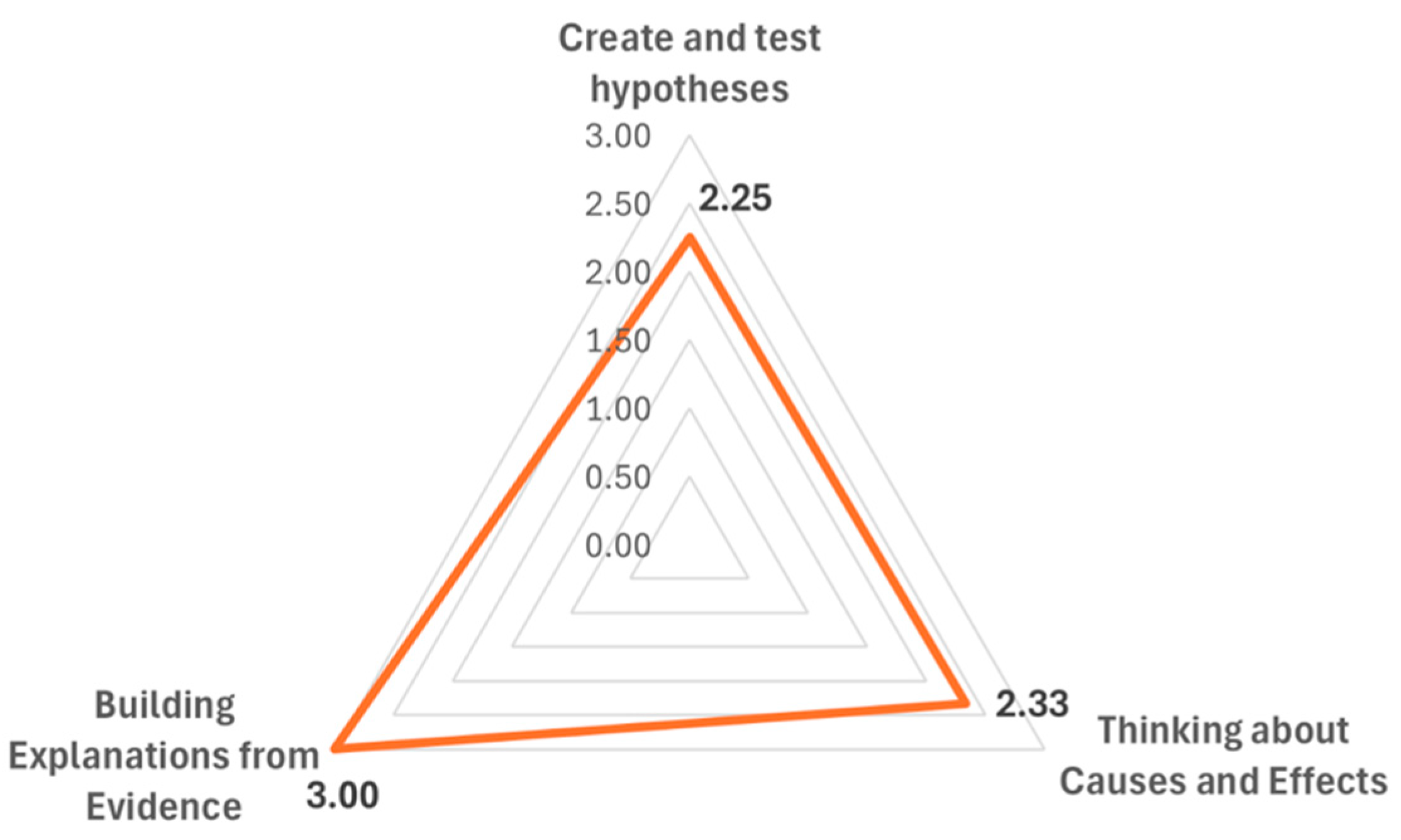
Two researchers independently evaluated each unit; discrepancies greater than one point were resolved by consensus, ensuring reliability. For each unit, the mean per dimension was calculated, and then the overall means for the 25 units. These were represented in a radar chart (values 0–3) (
Figure 1) to visualize the competency profile.
According to the rubric, 2.5–3.0 indicates an excellent level, 2.0–2.49 good/intermediate, and 1.0–1.99 needs improvement. The procedure made it possible to identify strengths and weaknesses in the application of the selected aspects of scientific thinking as the basis for critical thinking in early childhood education.
Analysis of critical thinking in the individual reports (RQ2): The final reports written by the PECET were analyzed according to the first criterion of the ad hoc rubric (
Table 2), focused on the critical analysis of the STEM approach and scientific inquiry. Performance levels were established (excellent, adequate, basic, insufficient), and representative quotations were selected. Each report was independently evaluated by both researchers, and consensus was reached to ensure inter-rater reliability.
Qualitative coding of written discourse (RQ3): To explore the relationships among critical thinking, inquiry, and the STEM approach, an inductive content analysis (
Charmaz, 2006) of the written texts was conducted. From this analysis, five conceptual categories emerged (
Table 3), and levels of conceptual integration were determined based on the number of categories identified per participant: fragmented (1–2), interconnected (3–4), and integrated (5), consistent with models of cognitive complexity (
King & Kitchener, 2004;
Kuhn, 1999;
Anderson & Krathwohl, 2001;
Zohar & Dori, 2003).
Triangulation of results: Finally, the data obtained from the three sources— teaching units, reports, and coding—were integrated through a co-occurrence matrix, which enabled the identification of associations among conceptual dimensions and the observation of articulation patterns in students’ discourse (
Miles et al., 2014).
3. Results
In response to the first research question (RQ1), the results are presented in
Figure 1 through a radar chart that includes the three dimensions outlined in
Table 1: creating and testing hypotheses, constructing explanations based on evidence, and thinking in terms of causes and effects.
The mean scores across the three dimensions are approximately 2 on a scale from 0 to 3, corresponding to an intermediate level of performance. The highest-scoring dimension is constructing explanations from evidence, whereas creating and testing hypotheses and thinking about causes and effects show slightly lower, though relatively similar, values.
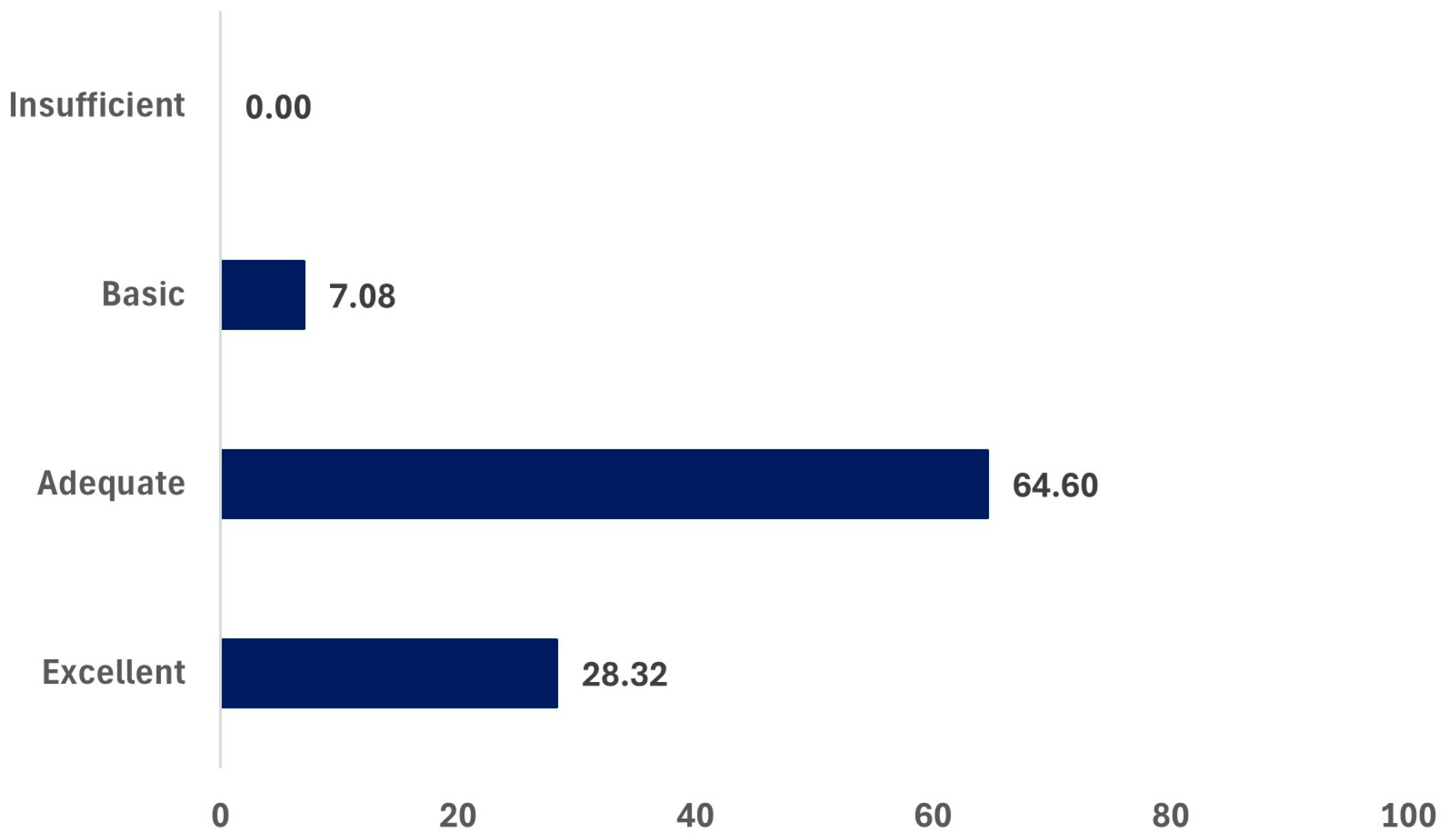
Regarding the PECET students’ ability for critical analysis of the STEM approach and scientific inquiry (RQ2), the results obtained (
Figure 2), based on the ad hoc rubric (
Table 2), show a clear concentration in the higher performance levels. No participants were classified as insufficient (0.0%), and only 7.08% reached the basic level, characterized by descriptive analyses with limited depth.
Most students (64.60%) were categorized as adequate, demonstrating sound analyses and clear connections between theory and practice, although with some degree of superficiality. Finally, 28.32% achieved an excellent level, reflecting a critical and well-reasoned analysis, with consistent integration of theory and practice in their evaluation of the STEM approach and scientific inquiry activities.
The following excerpts illustrate the qualitative progression between performance levels:
Excellent level: “The STEM approach promotes meaningful, cross-curricular, and transformative learning. By focusing on inquiry and critical thinking, it develops active and reflective students who can understand and engage with the world around them.” (A177)
Adequate level: “Furthermore, this teaching unit becomes a very comprehensive proposal, as students learn meaningfully and through experience, fostering both scientific and critical thinking.” (A173).
Basic level: “Critical thinking is cultivated by encouraging children to make decisions, solve challenges, express ideas, experiment, and reason from an early age.” (A188)
Table 4 presents the frequency and percentage of the five categories identified in the analysis of the relationships established by PECET among the STEM approach, scientific inquiry, and critical thinking (RQ3). Since participants could refer to more than one category, the percentages in
Table 4 exceed 100%.
Categories C3 and C1 were the most frequent, suggesting that most participants associate critical thinking with the application of active methodologies and with their own formative process. In contrast, categories C2 and C5 appeared less frequently and in statements showing greater reflective complexity, indicating a more sophisticated level of reasoning that was less common among the overall group of students. This may suggest that only some students reached a clear understanding of the teaching strategies required to foster critical thinking in early childhood classrooms.
Another aspect analyzed was the number of categories appearing in each PECET student’s responses (
Table 5).
Most PECET participants mentioned at least three of the five identified categories, indicating that they perceived connections among the STEM approach, scientific inquiry, and critical thinking. However, the frequency distribution and the nature of the analyzed statements reflect varying levels of conceptual understanding of these relationships.
Regarding the number of categories mentioned per student, the distribution reveals different levels of conceptual integration. A total of 39.22% of the students referred to three categories, and 30.39% to four, suggesting that the majority exhibit an interconnected and multifaceted view of the relationship among STEM, inquiry, and critical thinking. In contrast, 12.75% mentioned only one category, indicating a fragmented understanding, while only 6.86% articulated all five dimensions, reflecting an advanced level of metacognitive understanding.
The co-occurrence matrix among categories (
Table 6) confirms these trends and provides additional insight into the most significant associations.
The strongest co-occurrences were observed between C1 and C3 (53 matches) and between C3 and C4 (46 matches), revealing an integrative view between methodological action and scientific reasoning. A notable connection was also found between C2 (future teacher) and C3 (42 matches), showing how students associate the development of their own critical thinking with the application of STEM methodologies.
In summary, considering the results presented in
Table 4,
Table 5 and
Table 6, the data make it possible to distinguish three levels of relationship:
Level 1. Superficial–Descriptive (12.75%). A single category is mentioned, generally C3, associating critical thinking with student participation without delving into the underlying cognitive processes.
Level 2. Instrumental–Formative (69.61%). This level combines three to four categories, integrating reflection on students’ own learning (C2) with STEM methodologies (C3) and inquiry processes (C4).
Level 3. Integrated–Metacognitive (6.86%). All five categories (C1–C5) are articulated simultaneously, demonstrating a holistic understanding of critical thinking as a cognitive and attitudinal process that encompasses both teaching practice and children’s learning.
To complement the quantitative results and deepen the interpretation of conceptual integration levels, representative qualitative evidence was selected from the individual reports. These excerpts illustrate the three identified levels—superficial–descriptive, instrumental–formative, and integrated–metacognitive—and reveal how PECET expressed the relationships among critical thinking, scientific inquiry, and the STEM approach.
Table 7 provides a representative example of each level, illustrating the progression from general or functional descriptions toward more complex and self-regulated reflections on the processes of science learning and teaching.
4. Discussion
RQ1. What level of critical thinking performance does prospective early childhood education teachers (PECET) demonstrate after receiving specific formative instruction?
The results of RQ1 indicate that PECET achieved an overall intermediate level of performance in the selected aspects of scientific thinking studied. Their strongest development was observed in the dimension of constructing evidence-based explanations, whereas comparatively lower scores were obtained in hypothesis formulation and causal reasoning. The distribution suggests that, following the training intervention, participants found analytical phases more manageable than tasks requiring anticipatory reasoning or experimental control.
This pattern is consistent with previous research. For instance,
Zohar and Dori (
2003) note that higher-order skills such as hypothesis generation and variable manipulation require explicit and sustained instruction, particularly among learners with limited prior scientific training. Similarly,
Alarcón-Orozco et al. (
2024) report that prospective teachers tend to perform more confidently in phases related to data interpretation than in the formulation of investigable questions, highlighting the need to strengthen the initial stages of the inquiry cycle.
In our case, the progressive design of the training programme—structured through sequential roles as learners, preservice teachers, and designers—appears to have facilitated a practical understanding of the inquiry-based approach and of scientific thinking. This structure, aligned with models such as ENCIC-CT (
Alarcón-Orozco et al., 2024), strengthens the transition from experience to reflection, and pedagogical action, which are key elements in their generation of critical thinking in their initial teacher education. These transitions are key to the development of generic teaching skills to domain-specific and practical knowledge (
Tricot & Sweller, 2014;
Van Driel et al., 2014).
It is also important to note that this study is not limited to the procedural dimension. The analysis of individual reports enabled access reflective accounts in which PECET examined their personal evaluations of the STEM approach, inquiry processes, and their own professional development. This combined approach strengthens the validity of the findings by evidencing critical thinking not only as a technical competence but also as a metacognitive and attitudinal process.
Overall, although the data indicate meaningful progress, the levels achieved reveal that difficulties persist in key aspects of scientific thinking, particularly hypothesis formulation and the accurate identification of variables. This suggests the need to continue strengthening these competencies through teacher modelling, case analysis, explicit scaffolding, and opportunities for reasoned decision-making. Reinforcing these dimensions will contribute to more robust teacher education, better equipped to promote in young learners not only scientific skills but also a critical and reflective attitude toward knowledge.
RQ2. What critical analysis skills do these students demonstrate in relation to the STEM approach and scientific inquiry?
The analysis of individual reflective reports reveals that preservice teachers achieved generally high levels in their capacity for critical analysis regarding the STEM approach and scientific inquiry. Most participants (64.6%) reached an adequate level, while 28.3% attained an excellent level and 7.1% remained at a basic level. No insufficient analyses were recorded.
These results indicate that the training programme supported the development of reflective and analytical competencies, enabling PECET to connect their practical experiences with theoretical foundations related to inquiry-based learning and critical thinking. Nevertheless, the predominance of the adequate level suggests that many participants’ reflections remain at a functional rather than a metacognitive level, focusing on the observable benefits of the approach without delving into the epistemological mechanisms that underpin it.
Overall, the findings show that preservice teachers recognize the importance of the STEM approach and inquiry for fostering critical thinking, but only a minority achieve a theoretically grounded understanding of their underlying mechanisms. This aligns with previous research (
Vázquez-Alonso & Manassero-Mas, 2018;
Holmes et al., 2015), which highlights the need for metacognitive scaffolding and spaces for argumentation in consolidating critical reflection.
Therefore, teacher education programmes should incorporate strategies such as reflective dialogue, co-assessment, and the analysis of teaching cases, which would enable PECET to move from an instrumental view of the STEM approach toward an epistemological understanding of it. In this regard, inquiry is conceived not merely as an active methodology, but as a process of knowledge construction and the development of autonomous reasoning—essential foundations of critical thinking in teaching practice.
RQ3. What types of relationships, if any, do these students establish between the STEM approach and scientific inquiry in relation to the critical thinking it promotes?
The co-occurrence analysis among the five inductive categories (C1–C5) shows that most prospective teachers established meaningful relationships between the STEM approach, inquiry, and critical thinking, although with varying levels of conceptual integration. The most frequent categories—C3 (relationship between critical thinking and active methodologies or the STEM approach) and C1 (development of critical thinking in early childhood)—indicate that participants perceive inquiry as a privileged context for fostering reflection and reasoning at early ages. However, these associations are often formulated from a practical or functional perspective, without an in-depth analysis of the cognitive or metacognitive processes involved.
Considering the three levels of co-occurrence relationships established in the
Section 3, the study’s findings indicate that Level 2, Instrumental–Formative, comprises nearly 70% of PECET, who articulate connections among three or four categories. These participants link critical thinking with active methodologies and with their own training process, recognizing inquiry as a driver of curiosity, reasoning, and collaborative problem solving—elements also highlighted by
García-Carmona (
2023) and
Zohar and Dori (
2003). This pattern suggests an emerging understanding of the epistemological coherence between the STEM approach and inquiry, both of which are centered on evidence-based reasoning and iterative learning.
Only a minority (6.9%) reached Level 3, Integrated–Metacognitive, in which all five categories are articulated simultaneously. These PECET demonstrated a holistic view of critical thinking as a cognitive, reflective, and attitudinal process, recognizing inquiry as a self-regulated practice that promotes intellectual autonomy and pedagogical awareness. This understanding is aligned with recent perspectives that conceive STEM and inquiry as complementary frameworks for preparing reflective and transformative teachers (
Roehrig et al., 2021;
Cervin-Ellqvist et al., 2021).
The strongest co-occurrences—between C1 and C3 (53 instances) and between C3 and C4 (46)—show that PECET discourse frequently connects methodological action with cognitive processes, positioning inquiry as a catalyst for critical thinking. However, the lower presence of C2 and C5 indicates that few participants explicitly recognize the relationship between their own critical development and the strategies required to foster it in early childhood. This suggests that although preservice teachers understand the potential of the STEM approach to promote critical thinking, they still need support in translating these ideas into instructional planning and reflective practice.
Taken together, the results suggest gradual progression from descriptive accounts towards more integrated interpretations of how the STEM approach and scientific inquiry contribute to critical thinking. The co-occurrence network confirms that conceptual integration remains partial, yet it also reveals an emerging core of metacognitive understanding among a subset of PECET. These findings reinforce the need to strengthen reflective scaffolding in initial teacher education, enabling future teachers to conceive inquiry not only as an instructional technique but as a process of knowledge construction, reflection, and transformation that underpins both scientific literacy and critical education.
5. Conclusions
The study opens the debate on how to further incorporate CT into STEM education. It highlights CT as a key transversal competence for addressing current challenges and stresses the need to disseminate and implement it across different STEM disciplines, showing that CT can be developed through everyday practice to better understand science and the interpretation of results.
Overall, the results from the three research questions confirm the formative potential of inquiry-based STEM education for the development of critical thinking in preservice early childhood education teachers. In this regard, the training program implemented within the framework of the project (
Girón-Gambero & Lupión-Cobos, 2025;
Alarcón-Orozco et al., 2025) facilitated significant progress in the sample’s overall performance, as well as in their analytical and reflective competencies. However, further progress is still needed in conceptual integration and metacognitive depth, which remain areas for improvement.
Therefore, it is recommended that teacher education programs incorporate explicit instruction on the phases of inquiry, structured spaces for reflection, and opportunities for collaborative argumentation. Such strategies will support progress toward a more transformative training model—one that not only equips teachers with methodological tools but also prepares them to educate citizens capable of thinking critically, creating, collaborating, and engaging responsibly with science and society.
Author Contributions
Conceptualization, T.L.-C., M.M.A.-O. and Á.B.-L.; methodology, T.L.-C., M.M.A.-O. and M.C.-G.; formal analysis, T.L.-C., M.M.A.-O. and Á.B.-L.; investigation, T.L.-C., M.M.A.-O. and Á.B.-L.; resources, T.L.-C. and M.M.A.-O.; writing—original draft preparation, T.L.-C., M.M.A.-O., M.C.-G. and Á.B.-L.; writing—review and editing, T.L.-C., M.M.A.-O., M.C.-G. and Á.B.-L.; visualization, M.M.A.-O.; supervision, T.L.-C.; project administration, T.L.-C.; funding acquisition, T.L.-C. All authors have read and agreed to the published version of the manuscript.
Funding
This research was funded by the Spanish National Plan R+D+i project entitled STEAM y CIUDADANIA. Desarrollo con procesos de indagación y argumentación en la formación del docente de ciencias y su enseñanza. Estudio identitario, entornos y género [STEAM and Citizenship. Development through inquiry and argumentation processes in science teacher education and its teaching practice. Identity study, contexts, and gender] EduCA-STE(A)M, reference PID2023-147028NB-I00 funded by MICIU/AEI/10.13039/501100011033 and FEDER, UE. The APC was waived by Editors.
Institutional Review Board Statement
The study was conducted in accordance with the Declaration of Helsinki and approved by the Ethics Committee of University of Málaga (protocol code 149-2025-H, 30 January 2026).
Informed Consent Statement
Informed consent was obtained from all subjects involved in the study who voluntarily responded to an anonymous questionnaire without physical procedures or sensitive data collection. Written informed consents were obtained from the participants.
Data Availability Statement
The original contributions presented in this study are included in the article. Further inquiries can be directed to the corresponding author.
Conflicts of Interest
The authors declare no conflicts of interest.
Appendix A
Table A1.
Forms of thinking referenced in this study and how they are used.
Table A1.
Forms of thinking referenced in this study and how they are used.
| Term Used | Short Meaning (as Used Here) | How It Is Handled in This Study |
|---|
| Critical thinking (CT) | Second-order cognition (metacognitive/epistemic): evaluating claims, using reasons/evidence, and reflecting on justification. | Addressed through participants’ critical analysis of STEM and inquiry in final reports (rubric levels in Table 2). |
| Scientific thinking | Reasoning embedded in inquiry stages (question/hypothesis, variables, data, analysis, conclusions). | Measured in teaching units with the adapted rubric (Table 1). |
| Higher-order thinking (HOTS) | Broad umbrella for complex cognition beyond recall (analysis/evaluation; inquiry skills often counted as HOTS). | Mentioned as a related construct in the literature; not directly scored as a separate variable. |
| Creative thinking | Generating ideas/solutions and exploring alternatives within open tasks typical of STEM/IBSE contexts. | Framing term only; not assessed with a creativity instrument. |
| Engineering thinking | Thinking associated with design, iteration, and problem-solving typical of integrated STEM. | Contextual reference within STEM integration; not measured as a standalone construct. |
| Computational thinking | Thinking is associated with decomposition, algorithmic/logical structuring, or tool-mediated problem solving in STEM contexts. | Contextual reference only; not operationalized in instruments used. |
References
- Alarcón-Orozco, M. M., Franco-Mariscal, A. J., & Blanco-López, Á. (2024). Analysis of critical thinking through scientific thinking in the design of inquiries by preservice preschool teachers. In Critical thinking in science education and teacher training (pp. 193–209). Springer Nature Switzerland. [Google Scholar]
- Alarcón-Orozco, M. M., Franco-Mariscal, A. J., Oliva-Martínez, J. M., & Blanco-López, Á. (2025). Emotions experienced by preservice early childhood teachers during a training program in inquiry-based science education. Journal of Research in Science Teaching, 62(8), 1879–1901. [Google Scholar] [CrossRef]
- Anderson, L. W., & Krathwohl, D. R. (Eds.). (2001). A taxonomy for learning, teaching, and assessing: A revision of Bloom’s taxonomy of educational objectives. Longman. [Google Scholar]
- Arifin, Z., Sukarmin, Saputro, S., & Kamari, A. (2025). The effect of inquiry-based learning on students’ critical thinking skills in science education: A systematic review and meta-analysis. Eurasia Journal of Mathematics, Science and Technology Education, 21(3), em2592. [Google Scholar] [CrossRef]
- Bahr, P. R., Jackson, G., & Stensaker, B. (2024). STEM teacher support programs: Evaluating impact on instructional practice. Teaching and Teacher Education, 139, 104613. [Google Scholar] [CrossRef]
- Bailin, S. (2002). Critical thinking and science education. Science & Education, 11(4), 361–375. [Google Scholar] [CrossRef]
- Bennett, J., Hogarth, S., Lubben, F., Campbell, B., & Robinson, A. (2010). Talking science: The research evidence on the use of small group discussions in science teaching. International Journal of Science Education, 32(1), 69–95. [Google Scholar] [CrossRef]
- Blanco-López, Á., España-Ramos, E., González-García, F. J., & Franco-Mariscal, A. J. (2015). Key aspects of scientific competence for citizenship: A Delphi study of the expert community in Spain. Journal of Research in Science Teaching, 52(2), 164–198. [Google Scholar] [CrossRef]
- Bybee, R. W. (2013). The case for STEM education: Challenges and opportunities. NSTA Press. [Google Scholar]
- Cervin-Ellqvist, M., Larsson, D., Adawi, T., Stöhr, C., & Negretti, R. (2021). Metacognitive illusion or self-regulated learning? Assessing engineering students’ learning strategies against the backdrop of recent advances in cognitive science. Higher Education, 82(3), 477–498. [Google Scholar] [CrossRef]
- Charmaz, K. (2006). Constructing grounded theory: A practical guide through qualitative analysis. Sage. [Google Scholar]
- Chine, D. R., & Larwin, K. H. (2022). The impact of STEM integration on student achievement using HLM: A case study. Journal of Research in STEM Education, 8(1), 1–23. [Google Scholar] [CrossRef]
- Creswell, J. W., & Plano Clark, V. L. (2017). Designing and conducting mixed methods research (3rd ed.). SAGE. [Google Scholar]
- Croner, M. (2003). Developing critical thinking skills through the use of guided laboratory activities. The Science Education Review, 2(2), 46–49. [Google Scholar]
- de Vries, M. J. (2021). Design-based learning in science and technology as integrated STEM. In I. Henze, & M. J. de Vries (Eds.), Design-based concept learning in science and technology education (Vol. 17, pp. 25–44). Brill|Sense. [Google Scholar]
- Ellerton, P. (2021, June 30–July 3). Critical thinking and the methodology of science. Presentation to the Australasian Science Education Research Association, Brisbane, Australia. [Google Scholar] [CrossRef]
- Ennis, R. H. (2018). Critical thinking across the curriculum: A vision. Topoi, 37(1), 165–184. [Google Scholar] [CrossRef]
- Finkelstein, N. (2005). Learning physics in context: A study of students learning about electricity and magnetism. International Journal of Science Education, 27(10), 1187–1209. [Google Scholar] [CrossRef]
- Furtak, E. M., Seidel, T., Iverson, H., & Briggs, D. C. (2012). Experimental and quasi-experimental studies of inquiry-based science teaching: A meta-analysis. Review of Educational Research, 82(3), 300–329. [Google Scholar] [CrossRef]
- Gale, T., Mills, C., & Cross, R. (2020). Innovation implementation framework for STEM education. Australian Council for Educational Research. [Google Scholar]
- García-Carmona, A. (2023). Scientific thinking and critical thinking in science education: Two distinct symbiotically related intellectual processes. Science & Education, 34(1), 227–245. [Google Scholar] [CrossRef]
- Gilbert, J. K. (2006). On the nature of “context” in chemical education. International Journal of Science Education, 28(9), 957–976. [Google Scholar] [CrossRef]
- Gilbert, J. K., Bulte, A. M. W., & Pilot, A. (2011). Concept development and transfer in context-based science education. International Journal of Science Education, 33(6), 817–837. [Google Scholar] [CrossRef]
- Girón-Gambero, J. R., & Lupión-Cobos, T. (2025). Emotions expressed by grade-8 students in STEM projects. EURASIA Journal of Mathematics, Science and Technology Education, 21(10), em2709. [Google Scholar] [CrossRef]
- González Rodríguez, L., & Crujeiras Pérez, B. (2024). Actividades para desarrollar el conocimiento epistémico y el pensamiento crítico a través de la indagación científica en el laboratorio escolar. Revista Eureka Sobre Enseñanza y Divulgación de las Ciencias, 21(3), 3201. [Google Scholar] [CrossRef]
- González-Salamanca, J. C., Agudelo, O. L., & Salinas, J. (2020). Key competences, education for sustainable development and strategies for the development of 21st century skills. A systematic literature review. Sustainability, 12(24), 10366. [Google Scholar] [CrossRef]
- Halpern, D. F., & Danna, C. (2023). Critical thinking: Foundations and teaching strategies. Routledge. [Google Scholar]
- Henderson, J. B., MacPherson, A., Osborne, J., & Wild, A. (2015). Beyond construction: Five arguments for the role and value of critique in learning science. International Journal of Science Education, 37(10), 1668–1697. [Google Scholar] [CrossRef]
- Henriksen, D. (2014). Full STEAM ahead: Creativity in excellent STEM teaching practices. The STEAM Journal, 1(2), 15. [Google Scholar] [CrossRef]
- Holmes, N. G., Wieman, C. E., & Bonn, D. A. (2015). Teaching critical thinking. Proceedings of the National Academy of Sciences, 112(36), 11199–11204. [Google Scholar] [CrossRef]
- Hsu, Y. S., Purzer, Ş., & Cardella, M. E. (2017). STEM education research: Concepts, frameworks, and findings. Springer. [Google Scholar]
- Irvaniyah, B. N., Parno, & Ali, M. (2025). Bridging minds: Systematic literature review of STEM approaches in cultivating critical thinking in science education. Jurnal Penelitian Pendidikan IPA, 11(10), 43–53. [Google Scholar] [CrossRef]
- Jiménez-Aleixandre, M. P., & Puig, B. (2012). Argumentation, evidence evaluation and critical thinking. In B. Fraser, K. Tobin, & C. McRobbie (Eds.), Second international handbook of science education (Vol. 24). Springer. [Google Scholar]
- King, P. M., & Kitchener, K. S. (2004). Reflective judgment: Theory and research on the development of epistemic assumptions through adulthood. Educational Psychologist, 39(1), 5–18. [Google Scholar] [CrossRef]
- Korthagen, F. A. J., Loughran, J., & Russell, T. (2006). Developing fundamental principles for teacher education programs and practices. Teaching and Teacher Education, 22(8), 1020–1041. [Google Scholar] [CrossRef]
- Kuhn, D. (1999). A developmental model of critical thinking. Educational Researcher, 28(2), 16–25. [Google Scholar] [CrossRef]
- Lave, J., & Wenger, E. (1991). Situated learning: Legitimate peripheral participation. Cambridge University Press. [Google Scholar]
- Lupión-Cobos, T. (2025). STE(A)M and citizenship: Development with processes of inquiry and argumentation in science teacher training and teaching. Identity, environments and gender study (EduCA-STE(A)M). In ETE 2025: Educating the educators. University of Nicosia. [Google Scholar]
- Lupión-Cobos, T., Couso-Lagarón, D., Romero-Ariza, M., & Domènech-Casal, J. (2023a). STEM education in the Spanish context: Key features and issues. In S. M. Al-Balushi, L. Martin-Hansen, & Y. Song (Eds.), Reforming science teacher education programs in the STEM era: International and comparative perspectives (pp. 181–198). Palgrave Studies on Leadership and Learning in Teacher Education. Springer. [Google Scholar]
- Lupión-Cobos, T., Crespo-Gómez, J. I., & García-Ruiz, C. (2023b). Challenges and opportunities to teach inquiry approaches by STE(A)M projects in the primary education classroom. Journal of Baltic Science Education, 22(3), 454–469. [Google Scholar] [CrossRef]
- Lupión-Cobos, T., López-Castilla, R., & Blanco-López, Á. (2017). What do science teachers think about developing scientific competences through context-based teaching? A case study. International Journal of Science Education, 39(7), 937–963. [Google Scholar] [CrossRef]
- Marchán-Carvajal, I., & Sanmartí-Puig, N. (2013). El problema de la transferencia en el aprendizaje científico: Análisis de la implementación en el aula de una unidad didáctica contextualizada. Enseñanza de las Ciencias, 31(3), 63–84. [Google Scholar]
- Margot, K. C., & Kettler, T. (2019). Teachers’ perception of STEM integration and education: A systematic literature review. International Journal of STEM Education, 6(1), 2. [Google Scholar] [CrossRef]
- Miles, M. B., Huberman, A. M., & Saldaña, J. (2014). Qualitative data analysis: A methods sourcebook (3rd ed.). Sage. [Google Scholar]
- OECD. (2018). The future of education and skills: Education 2030. OECD Publishing. [Google Scholar]
- Osborne, J. (2014). Teaching critical thinking? New directions in science education. School Science Review, 95(352), 53–62. [Google Scholar]
- Padmawati, K., Suyanto, S., Pertiwi, K. R., & Wulan, A. N. (2025). The impact of STEM education on critical thinking skills: A systematic literature review. Jurnal Penelitian Pendidikan IPA, 11(12), 43–51. [Google Scholar] [CrossRef]
- Perignat, E., & Katz-Buonincontro, J. (2019). STEAM in practice and research: An integrative literature review. Thinking Skills and Creativity, 31, 31–43. [Google Scholar] [CrossRef]
- Rickert, R. K. (1967). Development critical thinking. Science Education, 51(1), 24–27. [Google Scholar] [CrossRef]
- Roehrig, G. H., Dare, E. A., Ring-Whalen, E. A., & Wieselmann, J. R. (2021). Understanding coherence and integration in integrated STEM education. International Journal of STEM Education, 8(2), 7–20. [Google Scholar] [CrossRef]
- Saldaña, J., & Zohar, A. (2023). Conceptual co-occurrence in integrated STEM education: A theoretical synthesis. Science Education, 107(4), 954–972. [Google Scholar] [CrossRef]
- Schön, D. A. (1992). The reflective practitioner: How professionals think in action. Basic Books. [Google Scholar]
- Shulman, L. S. (1986). Those who understand: Knowledge growth in teaching. Educational Researcher, 15(2), 4–14. [Google Scholar] [CrossRef]
- Strat, T. T. S., Henriksen, E. K., & Jegstad, K. M. (2024). Inquiry-based science education in science teacher education: A systematic review. Studies in Science Education, 60(2), 191–249. [Google Scholar] [CrossRef]
- Tamayo, O. (2015). Pensamiento crítico en la enseñanza de las ciencias: Retos y posibilidades. Universidad de Antioquia. [Google Scholar]
- Thibaut, L., Knipprath, H., Dehaene, W., & Depaepe, F. (2019). Teachers’ attitudes toward teaching integrated STEM: The impact of personal background and school context. International Journal of Science and Mathematics Education, 17(5), 987–1007. [Google Scholar] [CrossRef]
- Tricot, A., & Sweller, J. (2014). Domain-specific knowledge and why teaching generic skills does not work. Educational Psychology Review, 26(2), 265–283. [Google Scholar] [CrossRef]
- UNESCO. (2019). Science, technology, engineering and mathematics (STEM) education for girls and women: Breaking barriers and achieving gender equality. UNESCO Publishing. [Google Scholar]
- Van Driel, J. H., Verloop, N., & de Vos, W. (2014). Professional development and reform in science education: The role of teachers’ practical knowledge. Journal of Research in Science Teaching, 51(10), 1251–1271. [Google Scholar]
- Vázquez-Alonso, A., & Manassero-Mas, M. A. (2018). Critical thinking and scientific thinking: A relationship for science education. Revista Eureka Sobre Enseñanza y Divulgación de las Ciencias, 15(2), 2101–2118. [Google Scholar] [CrossRef]
- Zeichner, K. M., & Liston, D. P. (2014). Reflective teaching: An introduction (2nd ed.). Routledge. [Google Scholar]
- Zohar, A. (2004). Elements of teachers’ pedagogical knowledge regarding instruction of higher-order thinking. Journal of Science Teacher Education, 15(4), 293–312. [Google Scholar] [CrossRef]
- Zohar, A. (2013). Challenges in defining and developing higher order thinking in science education. In R. Evans, J. Luft, C. Czerniak, & C. Pea (Eds.), The role of scientific thinking in science education (pp. 119–136). Springer. [Google Scholar] [CrossRef]
- Zohar, A., & Dori, Y. J. (2003). Higher order thinking skills and low-achieving students: Are they mutually exclusive? Journal of the Learning Sciences, 12(2), 145–181. [Google Scholar] [CrossRef]
| Disclaimer/Publisher’s Note: The statements, opinions and data contained in all publications are solely those of the individual author(s) and contributor(s) and not of MDPI and/or the editor(s). MDPI and/or the editor(s) disclaim responsibility for any injury to people or property resulting from any ideas, methods, instructions or products referred to in the content. |




 ,
,