Integrating Generative AI in Engineering Education: Enhancing Learning and Attendance in a Vehicle Theory Course

 , , and
Abstract
1. Introduction
2. Challenges in Vehicle Theory Education
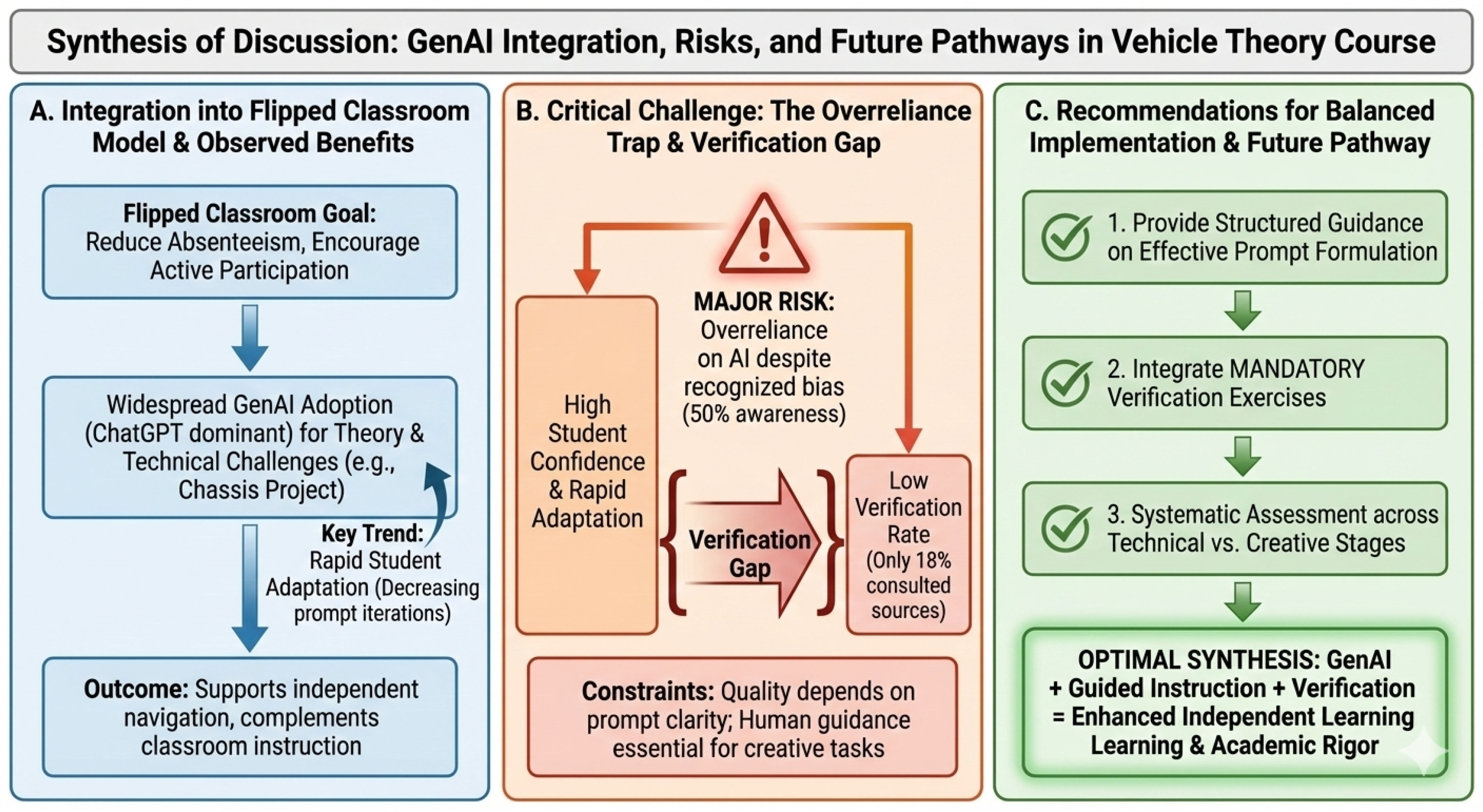
- Increasing student engagement and attendance. Classes are made more interactive and motivating to encourage consistent attendance. At the start of each session, students complete a 10 min flipped classroom activity, summarizing previous lessons and using GenAI to support their understanding and explanations.
- Supporting student projects. Students apply GenAI tools to assist in the design and optimization of a tubular chassis for automobiles. The AI supports them in generating ideas, performing analyses, and exploring alternative solutions throughout the project.
- Promote active attendance in typically theoretical lecture sessions.
- Facilitate understanding of key concepts by highlighting essential ideas and practical examples, supported by GenAI.
- Raise awareness of environmental and sustainability considerations within the design process.
- Develop teamwork skills, enabling students to collaborate effectively.
- Foster critical thinking, particularly regarding results obtained using GenAI tools.
- Train students to produce justified reports documenting their use of GenAI in projects.
- Enhance communication skills, ensuring clarity and technical rigor in both written and oral presentations.
3. Improving Student Attendance and Learning Through Active Participation Based on GenAI
4. Supporting Engineering Projects with GenAI
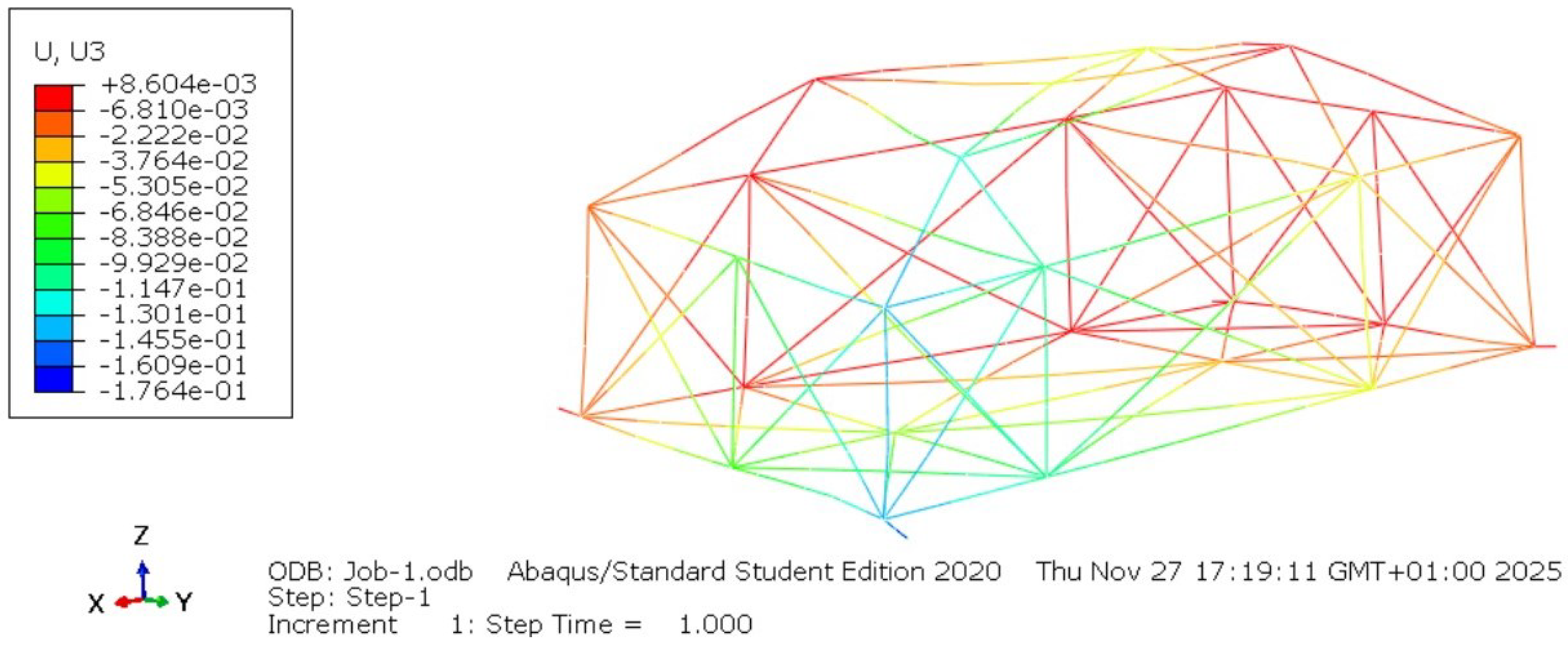
- Session 1. Week 3. During this class, students are introduced to the technical guidelines governing the chassis design, including specifications such as maximum weight, track width, and permissible wheelbase range. In addition, instructions are provided on the integration of GenAI tools to support the decision-making process in chassis selection and preliminary design.The chassis represents the primary structural element of a vehicle, serving as the foundation upon which all other components are mounted. It bears static and dynamic loads while ensuring structural integrity and occupant protection in the event of a collision. Consequently, students are expected to design their chassis by considering critical engineering trade-offs between stiffness, weight, and spatial efficiency. Emphasis is therefore placed on the necessity of adhering to defined project requirements, as these are integral to professional engineering practice.Following this introductory session, students begin independent group work in teams of three. To support this, a dedicated technical session is held during the main course to provide training in the use of finite element analysis software, specifically ANSYS and Abaqus. Each group is then tasked with developing a chassis design, supported by these tools to model the geometry and assess its structural performance prior to physical construction (see Figure 1). To complement their technical analysis, students are encouraged to employ generative AI tools for tasks such as retrieving design information, exploring alternative solutions, and seeking software guidance, with the caveat that all AI-generated outputs must be critically evaluated and validated against authoritative sources.
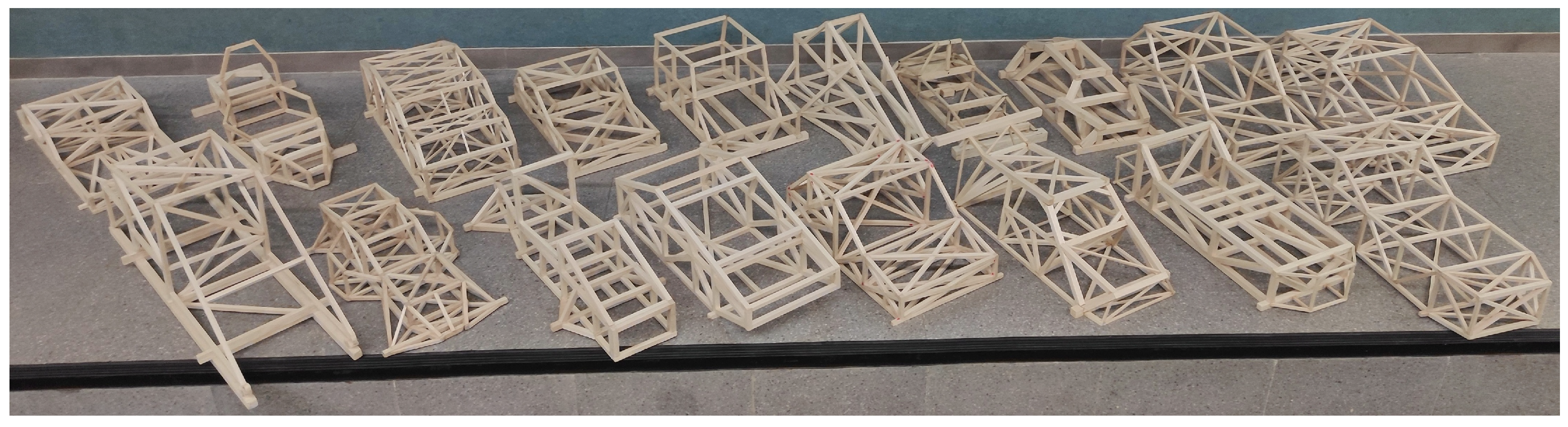
- Session 2. Week 14. In this class, students deliver an oral presentation in which they justify their chassis design (see Figure 2) and describe how GenAI tools supported them throughout the different phases of the project. Following the presentations, each chassis is weighed and subjected to an experimental test in which a vertical load is applied at the ends of the axle shafts in order to evaluate torsional stiffness.Once the tests are completed, each group receives a technical score based on the relative performance of their chassis with respect to two key parameters: the lowest mass achieved within the class and the highest torsional stiffness measured. The final score is calculated according to the following expression:where:
- -
- : Evaluation of design parameters, including the group presentation and the accompanying technical report that explains the rationale behind the final design.
- -
- : Mass of the lightest chassis among all groups.
- -
- : Mass of the chassis being evaluated.
- -
- : Minimum vertical displacement recorded during testing among all groups.
- -
- : Vertical displacement measured for the chassis being evaluated.
- -
- : Minimum product of vertical displacement and mass obtained among all groups, used as a reference value for comparative assessment.
5. Evaluation of Student Perspectives on Learning with GenAI
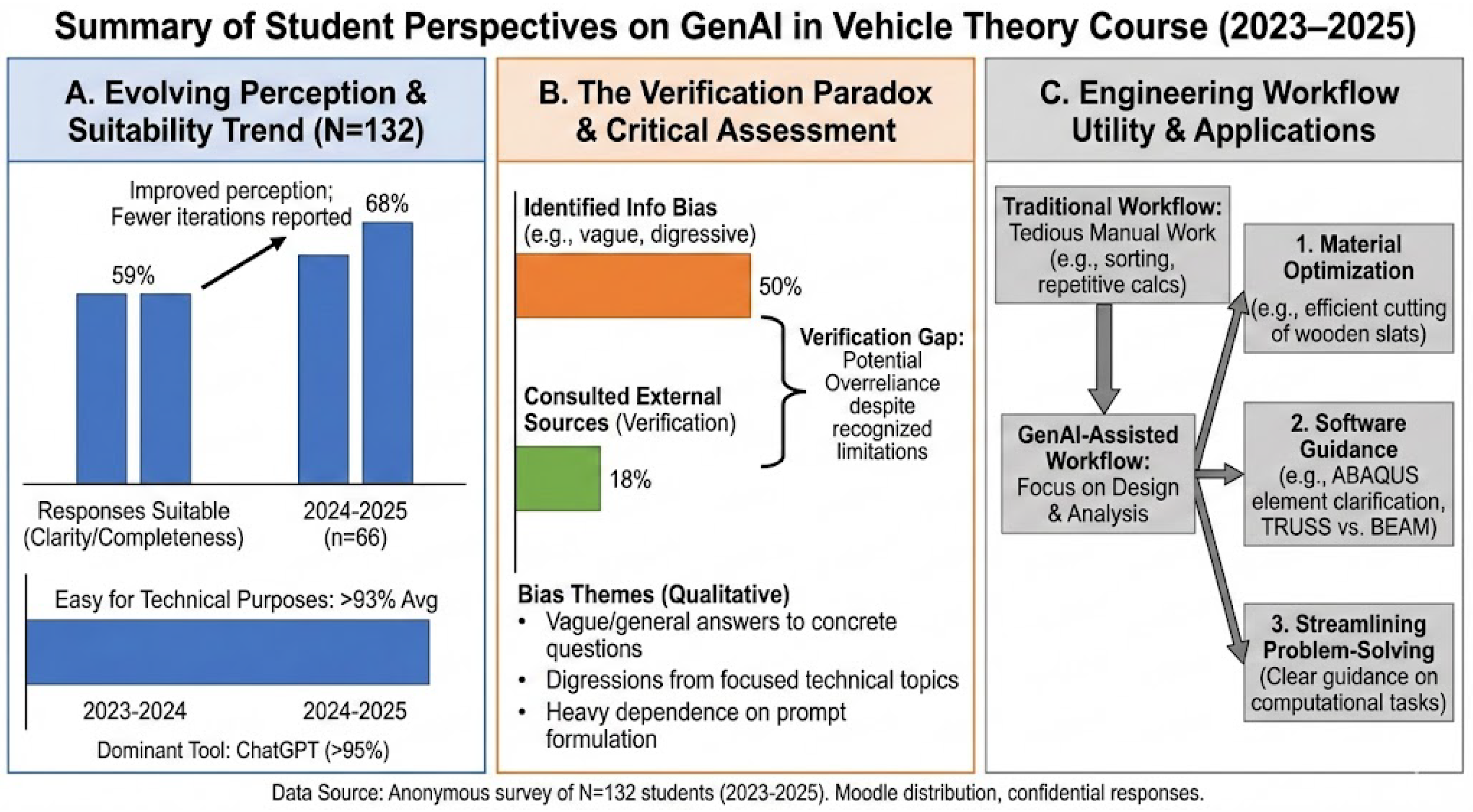
- The responses generated are often vague and overly general; when specific, concrete questions are posed, the AI frequently fails to provide clear or precise answers.
- It can be challenging to obtain answers that are tightly focused on the intended topic. For instance, when inquiring about strength of materials, the AI often digresses, addressing broader mechanical issues or the composition of materials rather than the specific topic.
- The effectiveness of the responses heavily depends on how the questions are formulated. While the AI performs well with theoretical inquiries, it may struggle to generate responses that require creative or nuanced reasoning.
- To optimize the use of wooden slats, we tested whether artificial intelligence could help determine the most efficient way to cut 1 m rods into different lengths. The results showed the optimal combination of rod lengths to minimize waste. AI was particularly useful for automating the tedious task of sorting and optimizing groups within larger sets, which is more efficient for a computer than a human.
- ChatGPT proved to be a valuable resource when using the ABAQUS program. It helped clarify differences between TRUSS and BEAM elements and guided us in extracting high-resolution images from the software, which were included in the report.
- In general, AI tools supported technical problem-solving by providing clear guidance on computational and structural tasks, streamlining work that would otherwise be time-consuming and prone to errors.
6. Discussion
7. Conclusions
Author Contributions
Funding
Institutional Review Board Statement
Informed Consent Statement
Data Availability Statement
Acknowledgments
Conflicts of Interest
Abbreviations
| AI | Artificial intelligence |
| GenAI | Generative artificial intelligence |
Appendix A
- 1.
- Were you aware of any GenAI tools, such as ChatGPT, before studying Vehicle Theory? (Yes/No)
- 2.
- Have you used a GenAI tool, such as ChatGPT, prior to studying Vehicle Theory? (Yes/No)
- 3.
- Have you used GenAI tools for any academic or technical purposes before studying Vehicle Theory? (Yes/No)
- 4.
- Which GenAIs have you used as an assistant during Vehicle Theory? (ChatGPT/Bing/Bard/Others)
- 5.
- Are GenAI tools easy to use when looking for answers to technical questions or doubts at the university level? (Yes/No)
- 6.
- Are GenAI tools useful for finding answers to technical questions or doubts at the university level? (Yes/No)
- 7.
- On a scale from 0 (not useful) to 10 (very useful), please rate the usefulness of GenAI tools. (0–10 Likert scale)
- 8.
- Are GenAI answers to technical questions clear and complete? (Yes/No)
- 9.
- How many iterations were required to obtain an answer that was deemed accurate? (1/2–3/4 or more)
- 10.
- Did you consult non-GenAI sources to verify the accuracy of the GenAI answers? (Yes/No)
- 11.
- If you consulted additional sources to verify the accuracy of the GenAI answers, could this task be conducted with ease? (Yes/No)
- 12.
- Have you observed any information bias in GenAI? For example, does GenAI overexplain certain aspects to compensate for lack of knowledge in other fields? (Yes/No)
- 13.
- Please rate the accuracy of the GenAI answers on a scale of 0 (not accurate) to 10 (very accurate). (0–10 Likert scale)
- 14.
- Would you like to provide some feedback on the accuracy of the answers? (Open-ended question)
- 15.
- Do you think that GenAI tools can replace search sources such as books, research articles or libraries? (Yes/No)
- 16.
- Do you believe that GenAI can replace lectures or books to study the Vehicle Theory course? (Yes/No)
- 17.
- To which questions related to Vehicle Theory can GenAI answer properly? (Theoretical concepts|Application examples|Equations and formulas | Exercises)
- 18.
- Please evaluate the support provided by GenAI in the Vehicle Theory chassis project. Use a scale from 0 (not useful at all) to 10 (extremely useful) to rate the following aspects:
- Basic information (0–10 Likert scale)
- Problem formulation (0–10 Likert scale)
- Chassis selection (0–10 Likert scale)
- Torsional stiffness (0–10 Likert scale)
- Chassis design (0–10 Likert scale)
- Chassis optimization (0–10 Likert scale)
- Finite element modelling (0–10 Likert scale)
- Balsa wood processing (0–10 Likert scale)
- Bibliographic research (0–10 Likert scale)
References
- Bercaru, V., & Popescu, N. (2025). Exploring sign language dataset augmentation with generative artificial intelligence videos: A case study using adobe firefly-generated american sign language data. Information, 16(9), 799. [Google Scholar] [CrossRef] [Scilit]
- Cordero, J., Torres-Zambrano, J., & Cordero-Castillo, A. (2024). Integration of generative artificial intelligence in higher education: Best practices. Education Sciences, 15(1), 32. [Google Scholar] [CrossRef] [Scilit]
- Đerić, E., Frank, D., & Milković, M. (2025a). Trust in generative AI tools: A comparative study of higher education students, teachers, and researchers. Information, 16(7), 622. [Google Scholar] [CrossRef] [Scilit]
- Đerić, E., Frank, D., & Vuković, D. (2025b). Exploring the ethical implications of using generative AI tools in higher education. Informatics, 12, 36. [Google Scholar] [CrossRef] [Scilit]
- Francis, N. J., Jones, S., & Smith, D. P. (2025). Generative AI in higher education: Balancing innovation and integrity. British Journal of Biomedical Science, 81, 14048. [Google Scholar] [CrossRef] [Scilit]
- Franco, J. V. P., Naranjo-Zolotov, M., Vai, C., & Pazmino-Sarango, M. (2025, June 12–18). Exploring psychological and technological drivers of student absenteeism in the era of artificial intelligence. European Conference on Information Systems (ECIS) 2025, Amman, Jordan. [Google Scholar]
- Fulsher, A., Pagkratidou, M., & Kendeou, P. (2025). GenAI and misinformation in education: A systematic scoping review of opportunities and challenges. AI & Society, 1–13. [Google Scholar] [CrossRef] [Scilit]
- Garcia-Pozuelo, D., Olatunbosun, O., Yunta, J., Yang, X., & Diaz, V. (2017). A novel strain-based method to estimate tire conditions using fuzzy logic for intelligent tires. Sensors, 17(2), 350. [Google Scholar] [CrossRef] [Scilit] [PubMed]
- Grassini, S. (2023). Shaping the future of education: Exploring the potential and consequences of AI and ChatGPT in educational settings. Education Sciences, 13(7), 692. [Google Scholar] [CrossRef] [Scilit]
- Huang, Y., Zhang, K., & Li, S. (2025). How postgraduates navigate GenAI’s dual pathways between research creativity and academic plagiarism: Research engagement and self-regulated learning matter. Studies in Higher Education, 1–22. [Google Scholar] [CrossRef] [Scilit]
- Huynh, L., & McNamara, D. S. (2025). GenAI-powered text personalization: Natural language processing validation of adaptation capabilities. Applied Sciences, 15(12), 6791. [Google Scholar] [CrossRef] [Scilit]
- Imran, M., & Almusharraf, N. (2024). Google Gemini as a next generation AI educational tool: A review of emerging educational technology. Smart Learning Environments, 11(1), 22. [Google Scholar] [CrossRef] [Scilit]
- Kamruzzaman, M., Salinas, J. S., Kolla, H., Sale, K. L., Balakrishnan, U., & Poorey, K. (2025). GenAI-based digital twins aided data augmentation increases accuracy in real-time cokurtosis-based anomaly detection of wearable data. Sensors, 25(17), 5586. [Google Scholar] [CrossRef] [Scilit]
- Kovari, A. (2025). Ethical use of ChatGPT in education—Best practices to combat AI-induced plagiarism. Frontiers in Education, 9, 1465703. [Google Scholar] [CrossRef] [Scilit]
- Llerena-Izquierdo, J., Mendez-Reyes, J., Ayala-Carabajo, R., & Andrade-Martinez, C. (2024). Innovations in introductory programming education: The role of ai with google colab and gemini. Education Sciences, 14(12), 1330. [Google Scholar] [CrossRef] [Scilit]
- Lo, C. K. (2023). What is the impact of ChatGPT on education? A rapid review of the literature. Education Sciences, 13(4), 410. [Google Scholar] [CrossRef] [Scilit]
- Martínez-Peláez, R., Mena, L. J., Toral-Cruz, H., Ochoa-Brust, A., Potes, A. G., Flores, V., Ostos, R., Pacheco, J. C. R., Félix, R. A., & Félix, V. G. (2025). Can large language models foster critical thinking, teamwork, and problem-solving skills in higher education?: A literature review. Systems, 13(11), 1013. [Google Scholar] [CrossRef] [Scilit]
- Meléndez-Useros, M., Jiménez-Salas, M., Viadero-Monasterio, F., & Boada, B. L. (2023). Tire slip H∞ control for optimal braking depending on road condition. Sensors, 23(3), 1417. [Google Scholar] [CrossRef] [Scilit]
- Naznin, K., Al Mahmud, A., Nguyen, M. T., & Chua, C. (2025). ChatGPT integration in higher education for personalized learning, academic writing, and coding tasks: A systematic review. Computers, 14(2), 53. [Google Scholar] [CrossRef] [Scilit]
- Rai, S., Abubakar, A. A., Shetty, R., Bijur, G., Shetty, N. K., & Kumar, A. P. (2025). Diagnosis of sarcoidosis through supervised ensemble method and GenAI-based data augmentation: An intelligent diagnostic tool. Applied Sciences, 15(22), 12213. [Google Scholar] [CrossRef] [Scilit]
- Rajamani, R. (2006). Vehicle dynamics and control. Springer. [Google Scholar]
- Ribeirinha, T., Santos, R., & Correia, M. (2025). Exploring the educational acceptance and use of artificial intelligence tools: Perceptions among portuguese university students. Trends in Higher Education, 4(4), 77. [Google Scholar] [CrossRef] [Scilit]
- Swacha, J., & Gracel, M. (2025). Supporting serious game development with generative artificial intelligence: Mapping solutions to lifecycle stages. Applied Sciences, 15(21), 11606. [Google Scholar] [CrossRef] [Scilit]
- Thampanichwat, C., Wongvorachan, T., Sirisakdi, L., Chunhajinda, P., Bunyarittikit, S., & Wongmahasiri, R. (2025). Mindful architecture from text-to-image AI perspectives: A case study of DALL-E, Midjourney, and Stable Diffusion. Buildings, 15(6), 972. [Google Scholar] [CrossRef] [Scilit]
- Tillmanns, T., Salomão Filho, A., Rudra, S., Weber, P., Dawitz, J., Wiersma, E., Dudenaite, D., & Reynolds, S. (2025). Mapping tomorrow’s teaching and learning spaces: A systematic review on GenAI in higher education. Trends in Higher Education, 4(1), 2. [Google Scholar] [CrossRef] [Scilit]
- Viadero-Monasterio, F., Boada, B., Boada, M., & Díaz, V. (2022). H∞ dynamic output feedback control for a networked control active suspension system under actuator faults. Mechanical Systems and Signal Processing, 162, 108050. [Google Scholar] [CrossRef] [Scilit]
- Viadero-Monasterio, F., Nguyen, A.-T., Lauber, J., Boada, M. J. L., & Boada, B. L. (2023). Event-triggered robust path tracking control considering roll stability under network-induced delays for autonomous vehicles. IEEE Transactions on Intelligent Transportation Systems, 24(12), 14743–14756. [Google Scholar] [CrossRef] [Scilit]
- Wang, K., & Guo, Z. (2025). Can learners’ use of GenAI enhance learning engagement?—A meta-analysis. Education Sciences, 15(12), 1578. [Google Scholar] [CrossRef] [Scilit]
- Wei, L., Yu, Y., Qin, Y., & Zhang, S. (2025). From tools to creators: A review on the development and application of artificial intelligence music generation. Information, 16(8), 656. [Google Scholar] [CrossRef] [Scilit]
- Yavich, R., & Davidovitch, N. (2024). Plagiarism among higher education students. Education Sciences, 14(8), 908. [Google Scholar] [CrossRef] [Scilit]


Disclaimer/Publisher’s Note: The statements, opinions and data contained in all publications are solely those of the individual author(s) and contributor(s) and not of MDPI and/or the editor(s). MDPI and/or the editor(s) disclaim responsibility for any injury to people or property resulting from any ideas, methods, instructions or products referred to in the content. |
© 2026 by the authors. Licensee MDPI, Basel, Switzerland. This article is an open access article distributed under the terms and conditions of the Creative Commons Attribution (CC BY) license.
Share and Cite
Viadero-Monasterio, F.; Gutiérrez-Moizant, R.A.; Meléndez-Useros, M.; García-Pozuelo Ramos, D. Integrating Generative AI in Engineering Education: Enhancing Learning and Attendance in a Vehicle Theory Course. Educ. Sci. 2026, 16, 239. https://doi.org/10.3390/educsci16020239
Viadero-Monasterio F, Gutiérrez-Moizant RA, Meléndez-Useros M, García-Pozuelo Ramos D. Integrating Generative AI in Engineering Education: Enhancing Learning and Attendance in a Vehicle Theory Course. Education Sciences. 2026; 16(2):239. https://doi.org/10.3390/educsci16020239
Chicago/Turabian StyleViadero-Monasterio, Fernando, Ramón Alberto Gutiérrez-Moizant, Miguel Meléndez-Useros, and Daniel García-Pozuelo Ramos. 2026. "Integrating Generative AI in Engineering Education: Enhancing Learning and Attendance in a Vehicle Theory Course" Education Sciences 16, no. 2: 239. https://doi.org/10.3390/educsci16020239
APA StyleViadero-Monasterio, F., Gutiérrez-Moizant, R. A., Meléndez-Useros, M., & García-Pozuelo Ramos, D. (2026). Integrating Generative AI in Engineering Education: Enhancing Learning and Attendance in a Vehicle Theory Course. Education Sciences, 16(2), 239. https://doi.org/10.3390/educsci16020239