School-Level and Demographic Differences in the Use of Artificial Intelligence Among Hungarian Elementary and High School Students


Abstract
1. Introduction
2. Literature Review
2.1. Artificial Intelligence (AI)
2.2. Importance of AI in Education
2.3. Previous Research Findings About AI in Education (The International Context)
2.4. Previous Research Findings About AI in Education (The Hungarian Context)
2.5. Theoretical Framework of Technology Acceptance
2.6. Rationale of the Study
- RQ1: What are the demographic differences in AI usage patterns between elementary and high school students in Hungary?
- RQ2: How do students at the two educational levels differ in their attitudes toward the use of AI in learning?
- RQ3: What background factors (gender, parental education, settlement type) are associated with students’ AI use and attitudes at each school level?
3. Materials and Methods
3.1. Sample Presentation
3.2. Design and Instrument
3.2.1. Assessment of AI Use and Experience
3.2.2. Assessment of Attitude Towards AI in Education
3.3. Analysis
4. Results
4.1. School-Level and Demographic Differences in AI Use
4.1.1. Online Platforms Used
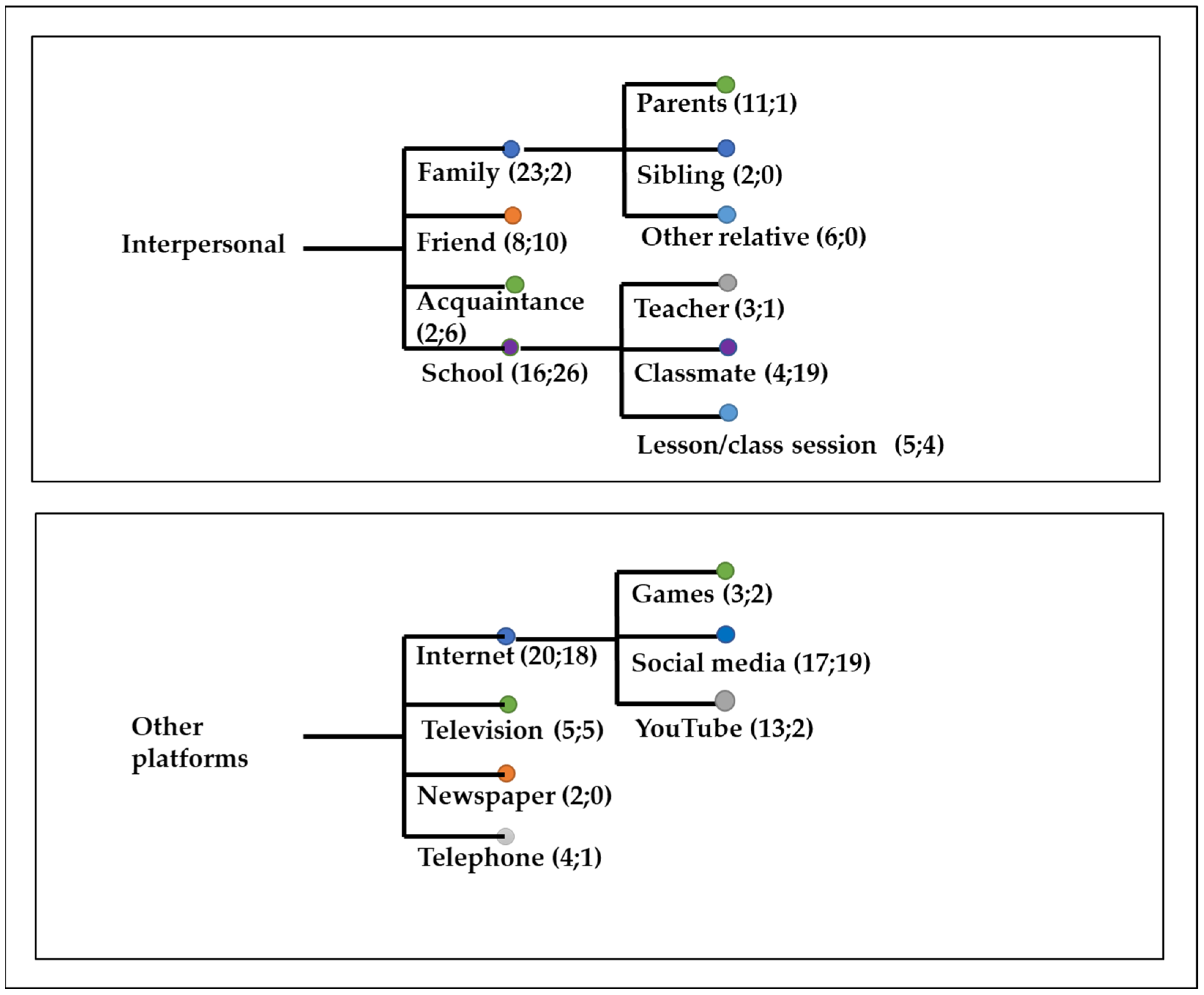
4.1.2. Sources of AI Knowledge
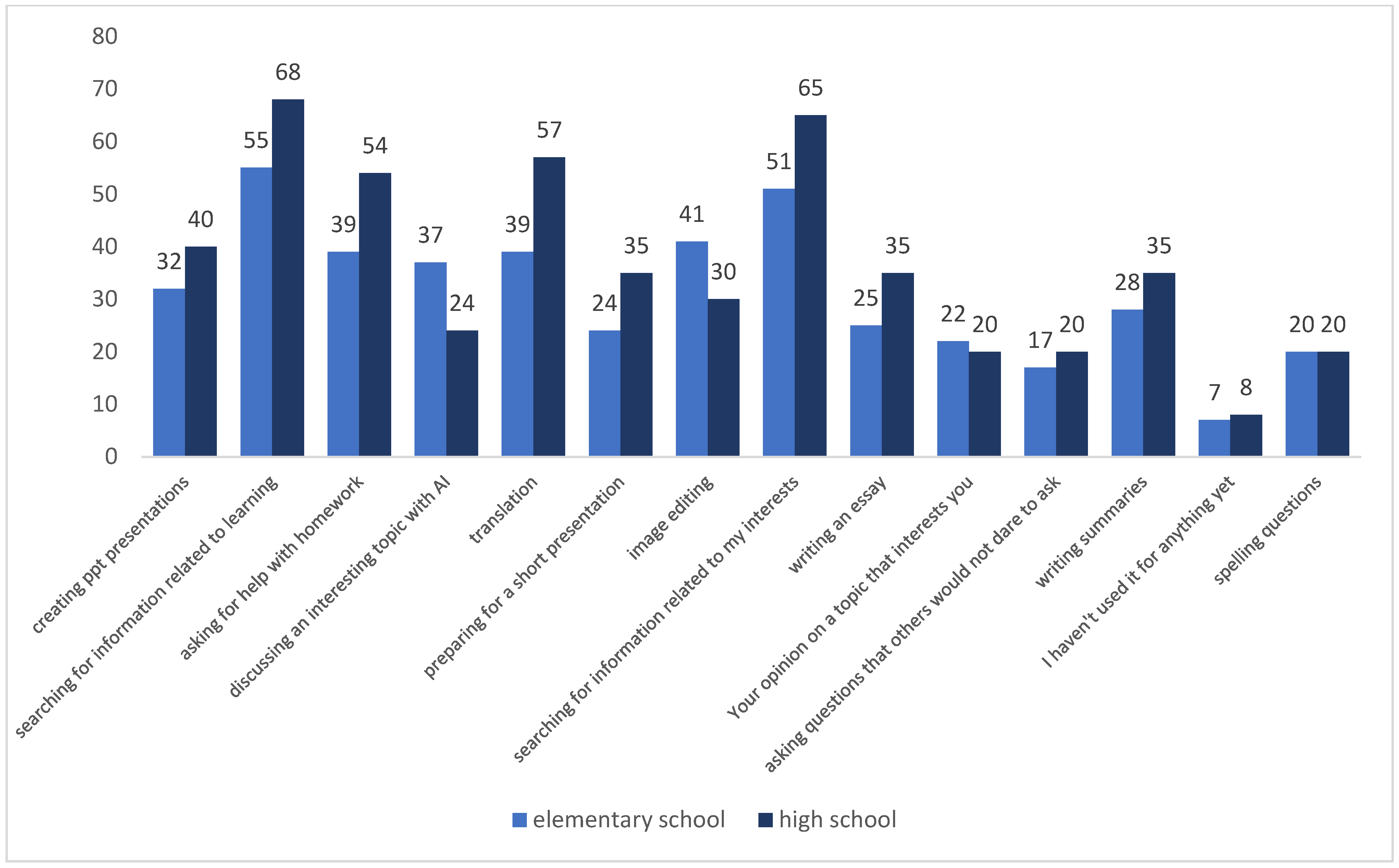
4.1.3. Purposes of AI Use
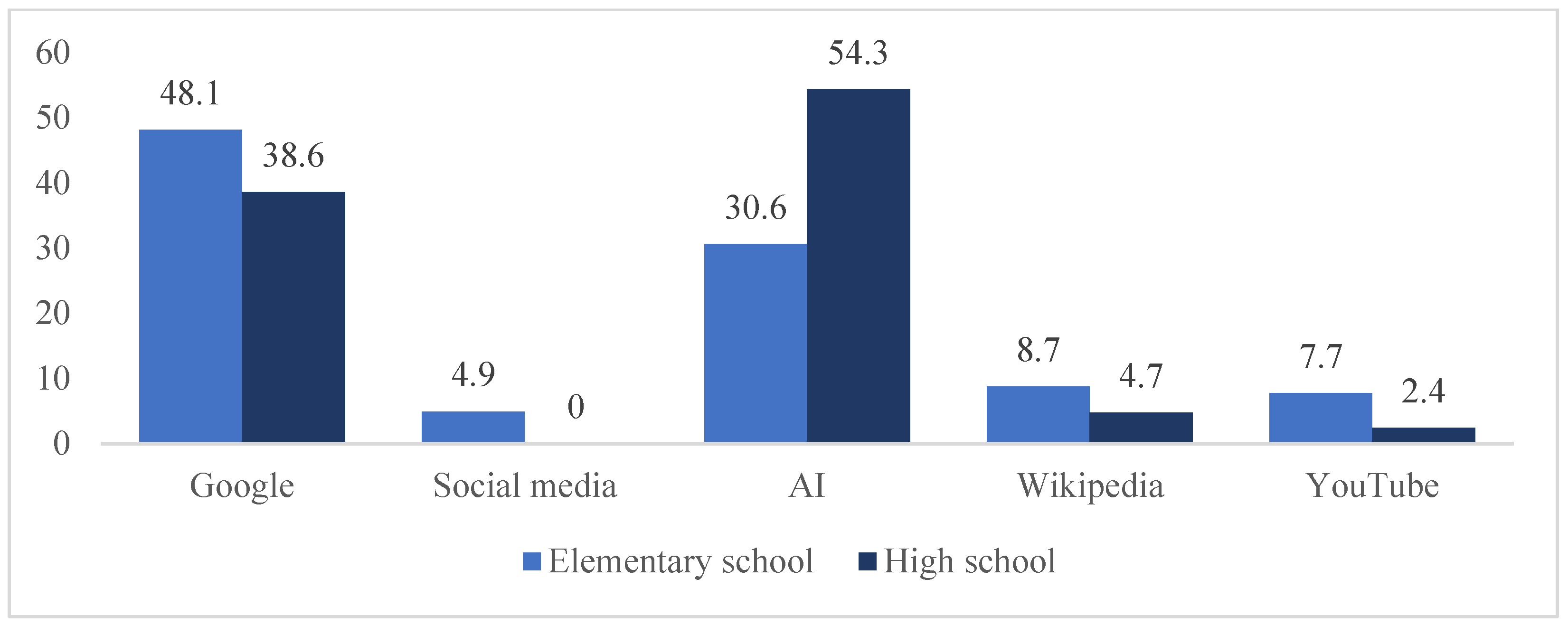
4.1.4. Role of AI in Education
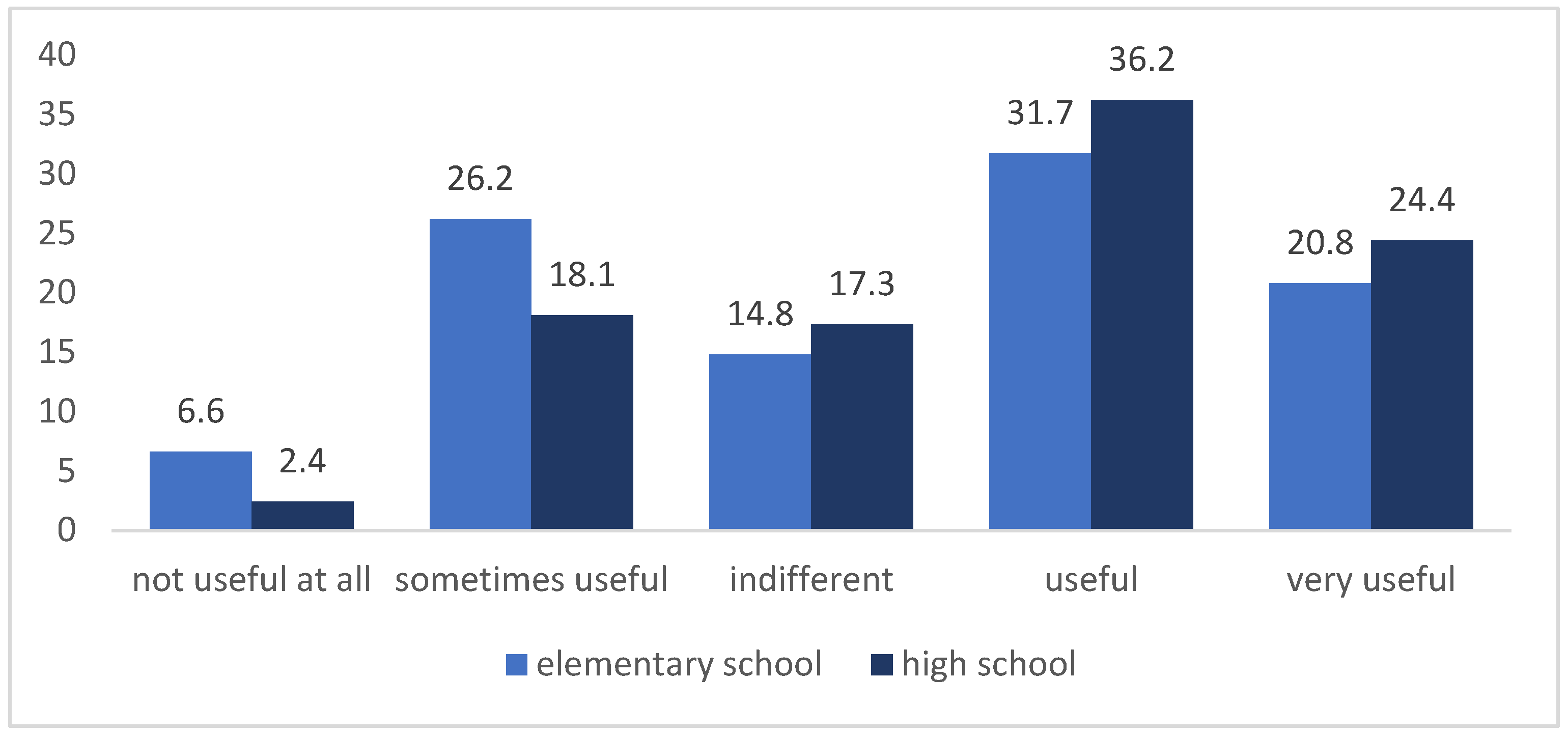
4.2. Attitudes Towards AI Use
4.3. Associating Factors of AI Use and Attitudes
5. Discussion
6. Conclusions
Author Contributions
Funding
Institutional Review Board Statement
Data Availability Statement
Conflicts of Interest
References
- Abbas, M., Jam, F. A., & Khan, T. I. (2024). Is it harmful or helpful? Examining the causes and consequences of generative AI usage among university students. International Journal of Educational Technology in Higher Education, 21(1), 10. [Google Scholar] [CrossRef]
- Abuhassna, H., Yahaya, N., Zakaria, M. A. Z. M., Zaid, N. M., Samah, N. A., Awae, F., Nee, C. K., & Alsharif, A. H. (2023). Trends on using the technology acceptance model (TAM) for online learning: A bibliometric and content analysis. International Journal of Information and Education Technology, 13(1), 131–142. [Google Scholar] [CrossRef]
- Alasgarova, R., & Rzayev, Z. (2024). The role of artificial intelligence in shaping high school students’ motivation. International Journal of Technology in Education and Science, 8(2), 311–324. [Google Scholar] [CrossRef]
- Arkoumanis, G., Sofos, A., Ventista, O. M., Ventistas, G., & Tsani, P. (2025). The impact of artificial intelligence on elementary school students’ learning: A meta-analysis. Computers in the Schools, 1–22. [Google Scholar] [CrossRef]
- Baker, T., Smith, L., & Anissa, N. (2019). Educ-AI-tion rebooted? Exploring the future of artificial intelligence in schools and colleges. Nesta. Available online: https://media.nesta.org.uk/documents/Future_of_AI_and_education_v5_WEB.pdf (accessed on 13 July 2025).
- Bantoto, F. M. O., Rillo, R., Abequibel, B., Mangila, B. B., & Alieto, E. O. (2024). Is AI an effective “learning tool” in academic writing? Investigating the perceptions of third-year university students on the use of artificial intelligence in classroom instruction. In International conference on digital technologies and applications (Vol. 1098, pp. 72–81). Lecture Notes in Networks and Systems (LNNS). Springer. [Google Scholar] [CrossRef]
- Bello, L., & Aubert, L. (2025). Artificial intelligence in the classroom: Democratizing knowledge and transforming education. Seminars in Medical Writing and Education, 4, 7. [Google Scholar] [CrossRef]
- Black, R. W., & Tomlinson, B. (2025). University students describe how they adopt AI for writing and research in a general education course. Scientific Reports, 15(1), 8799. [Google Scholar] [CrossRef] [PubMed]
- Bokor, T. (2023). A mesterséges intelligencia alkalmazása az oktatásban—Kihívások és következmények technológiainvariáns szempontból [The application of artificial intelligence in education—Challenges and consequences from a technology-invariant perspective]. In Z. Kovács (Ed.), A mesterséges intelligencia és egyéb felforgató technológiák hatásainak átfogó vizsgálata [A comprehensive examination of the effects of artificial intelligence and other disruptive technologies] (pp. 114–129). Military National Security Service. [Google Scholar]
- Boulhrir, T., & Hamash, M. (2025). Unpacking artificial intelligence in elementary education: A comprehensive thematic analysis systematic review. Computers and Education: Artificial Intelligence, 9, 100442. [Google Scholar] [CrossRef]
- Chen, L., Chen, P., & Lin, Z. (2020). Artificial intelligence in education: A review. IEEE Access, 8, 75264–75278. [Google Scholar] [CrossRef]
- Chiu, T. K. F. (2024). Future research recommendations for transforming higher education with generative AI. Computers and Education: Artificial Intelligence, 6, 100197. [Google Scholar] [CrossRef]
- Coppin, B. (2004). Artificial intelligence illuminated. Jones and Bartlett Publishers. [Google Scholar]
- Davis, F. D. (1989). Perceived usefulness, perceived ease of use, and user acceptance of information technology. MIS Quarterly, 13(3), 319–340. [Google Scholar] [CrossRef]
- Demeter, Z., & Mező, K. (2023). Tanító szakos hallgatók és a mesterséges intelligencia [Teacher training students and artificial intelligence]. Mesterséges Intelligencia, 5(1), 73–87. [Google Scholar] [CrossRef]
- Fajt, B., & Kállai, B. J. (2024). (Nem) gondolkodom, tehát ChatGPT-zek? Egyetemi hallgatók plágiummal és ChatGPT-val kapcsolatos véleményei [I (don’t) think, therefore I use ChatGPT? University students’ views on plagiarism and the use of ChatGPT]. Iskolakultúra, 34(12), 75–96. [Google Scholar] [CrossRef]
- Gaonkar, B., & Macyszyn, L. (2024). Technological view. In A. E. M. Eltorai, & H. H. Guo (Eds.), Impact of artificial intelligence in radiology (pp. 54–61). CRC Press. [Google Scholar] [CrossRef]
- Gil-Fernández, R., & Calderón-Garrido, D. (2023). Teachers’ perceptions of the challenges of the digital society: From technology acceptance models to the development of teachers’ digital competences. Bordon. Revista de Pedagogia, 75(4), 93–108. [Google Scholar] [CrossRef]
- Giwa, T. A. (2025, March 15). PolluSpot: A novel tool for teaching model training to middle school students. 15th IEEE Integrated STEM Education Conference, ISEC 2025, Princeton, NJ, USA. [Google Scholar] [CrossRef]
- Granström, M., & Oppi, P. (2025). Student engagement with AI tools in learning: Evidence from a large-scale Estonian survey. Frontiers in Education, 10, 1688092. [Google Scholar] [CrossRef]
- Gutiérrez-Santiuste, E., López-Pérez, L., Poza-Vilches, F., Molina-Cabrera, D., Montes-Soldado, R., & Alcalá, L. (2025). Pre-university students’ perception of algorithmic biases of artificial intelligence. Educational Technology and Society, 28(3), 369–382. [Google Scholar] [CrossRef]
- Hammerschmidt, T., Stolz, K., & Posegga, O. (2025). Bridging the gap: Inequalities that divide those who can and cannot create sustainable outcomes with AI. Behaviour & Information Technology. Advance online publication. 1–30. [Google Scholar] [CrossRef]
- Ho, C.-W. (2025). A study on integrating artificial intelligence into teaching activities in rural communities for elementary school students. International Journal of Information and Education Technology, 15(6), 1144–1149. [Google Scholar] [CrossRef]
- Hossain, Z., Biswas, M. S., Khan, N. A., & Khan, G. (2025). Artificial intelligence literacy among South Asian library and information science students: Socio-demographic influences and educational implications. IFLA Journal, 51(3), 629–646. [Google Scholar] [CrossRef]
- Huang, J., Shen, G., & Ren, X. (2021). Connotation analysis and paradigm shift of teaching design under artificial intelligence technology. International Journal of Emerging Technologies in Learning, 16(5), 73–86. [Google Scholar] [CrossRef]
- Jackaria, P. M., Hajan, B. H., Mastul, A.-R. H., & Sali, F. Z. (2024). Generation AI in a reimagined classroom: Challenges, opportunities and implications to education. In Z. Zaremohzzabieh, R. Abdullah, & S. Ahrari (Eds.), Exploring youth studies in the age of AI (pp. 174–185). IGI Global Scientific Publishing. [Google Scholar] [CrossRef]
- Kamalov, F., Santandreu Calonge, D., & Gurrib, I. (2023). New era of artificial intelligence in education: Towards a sustainable multifaceted revolution. Sustainability, 15(16), 12451. [Google Scholar] [CrossRef]
- Karahan Adalı, G., & Bilgili, A. (2025). Generative AI in higher education: Students’ perspectives on adoption, ethical concerns, and academic impact. Acta Infologica, 9(1), 147–166. [Google Scholar] [CrossRef]
- Kim, S.-W., & Lee, Y. (2024). Investigation into the influence of socio-cultural factors on attitudes toward artificial intelligence. Education and Information Technologies, 29(8), 9907–9935. [Google Scholar] [CrossRef]
- Kour, J., Bhatia, R., & Joshi, R. (2025). Artificial intelligence in education: Insights from gender and locality-based perspectives. In F. Mobo (Ed.), Impacts of AI on students and teachers in education 5.0 (pp. 193–210). IGI Global Scientific Publishing. [Google Scholar] [CrossRef]
- Lameras, P., & Arnab, S. (2022). Power to the teachers: An exploratory review on artificial intelligence in education. Information, 13(1), 14. [Google Scholar] [CrossRef]
- Loder, J., & Nicholas, L. (2018). Confronting Dr robot: Creating a people-powered future for AI in health. Nesta Health Lab. Available online: https://media.nesta.org.uk/documents/confronting_dr_robot.pdf (accessed on 13 May 2025).
- Lopez Barrios, M., & Déri, C. E. (2025). The usage of generative artificial intelligence according to sociodemographic characteristics of undergraduate students. Journal of Scholarly Publishing, 56(2), 440–462. [Google Scholar] [CrossRef]
- Lubis, Y., Dalimunte, M., Salmiah, M., Lubis, Z., & Ismahani, S. (2024). Utilizing AI to improve the quality of learning in elementary schools in Indonesia. BIO Web of Conferences, 146, 01089. [Google Scholar] [CrossRef]
- Ma’amor, H., Achim, N., Ahmad, N. L., Roszaman, N. S., Kamarul Anuar, N. N., Khairul Azwa, N. C. A., Abd Rahman, S. N., & Aqilah Hamjah, N. A. (2024). The effect of artificial intelligence (AI) on students’ learning. Information Management and Business Review, 16(3S(I)a), 856–867. [Google Scholar] [CrossRef]
- Malatji, W. R., van Eck, R., & Zuva, T. (2020). Understanding the usage, modifications, limitations, and criticisms of the technology acceptance model (TAM). Advances in Science, Technology and Engineering Systems, 5(6), 113–117. [Google Scholar] [CrossRef]
- Martin, F., Vahedian Movahed, S., Dimino, J., Farrell, A., Irankhah, E., Ghosh, S., Jain, G., Mahipal, V., Rayavaram, P., Temitayo Sanusi, I., Salas, E., Wolkowicz, K., & Narain, S. (2024, March 20–23). Perception, trust, attitudes, and models: Introducing children to AI and machine learning with five software exhibits. SIGCSE 2024: Proceedings of the 55th ACM Technical Symposium on Computer Science Education v. 2 (pp. 1740–1741), Portland, OR, USA. [Google Scholar] [CrossRef]
- Maxwell, D., Oyarzun, B., Kim, S., & Bong, J. Y. (2025). Generative AI in higher education: Demographic differences in student perceived readiness, benefits, and challenges. TechTrends, 69, 1248–1259. [Google Scholar] [CrossRef]
- Mohamed, A. M., Shaaban, T. S., Bakry, S. H., Guillén-Gámez, F. D., & Strzeleczki, A. (2025). Empowering the faculty of education students: Applying AI’s potential for motivating and enhancing learning. Innovative Higher Education, 50, 587–609. [Google Scholar] [CrossRef]
- Musztafa, M. Y., Tlili, A., Lampropoulos, G., Huang, L., Jadrić, P., Zhao, J., Salha, S., Xu, L., Panda, S., López-Pernas, S., & Saqr, M. (2024). A systematic review of literature reviews on artificial intelligence in education (AIED): A roadmap to a future research agenda. Smart Learning Environments, 11(1), 59. [Google Scholar] [CrossRef]
- Nemzeti Média-és Hírközlési Hatóság, NMHH. (2025). Media awareness is becoming more valuable in the age of artificial intelligence. Available online: https://english.nmhh.hu/article/255259/In_the_age_of_artificial_intelligence_media_literacy_is_becoming_increasingly_valuable (accessed on 10 November 2025).
- Phua, J. T. K., Neo, H.-F., & Teo, C.-C. (2025). Evaluating the impact of artificial intelligence tools on enhancing student academic performance: Efficacy amidst security and privacy concerns. Big Data and Cognitive Computing, 9(5), 131. [Google Scholar] [CrossRef]
- Rajki, Z., Dringó-Horváth, I., & Nagy, J. T. (2025). Artificial intelligence in higher education: Students’ artificial intelligence use and its influencing factors. Journal of University Teaching and Learning Practice, 22(2), 1–21. [Google Scholar] [CrossRef]
- Rajki, Z., Nagy, J. T., & Dringó-Horváth, I. (2024). A mesterséges intelligencia a felsőoktatásban: Hallgatói hozzáférés, attitűd és felhasználási gyakorlat [Artificial intelligence in higher education: Student access, attitudes, and usage practices]. Iskolakultúra, 34(7), 3–22. [Google Scholar] [CrossRef]
- Rayavaram, P., Narain, S., & Martin, F. (2024, October 13–16). Let’s go for a drive: Exploring AI’s societal impact in K-8 education with an interactive self-driving car tool. Proceedings—Frontiers in Education Conference, FIE, Washington, DC, USA. [Google Scholar] [CrossRef]
- Ríos Hernández, I. N., Mateus, J.-C., Rivera-Rogel, D., & Ávila Meléndez, L. R. (2024). Perceptions of Latin American students on the use of artificial intelligence in higher education. Austral Comunicación, 13(1), e01302. [Google Scholar] [CrossRef]
- Rubiyanti, N., Abu Sujak, A. F., Madiawati, P. N., Nurutami, F., & Bt Raja Razali, R. R. (2023, August 2–3). Perceived usefulness: A bibliometric visualization. 2023 International Conference on Digital Business and Technology Management, ICONDBTM 2023, Lombok, Indonesia. [Google Scholar] [CrossRef]
- Samardžija, J. (2025, June 2–6). AI-enhanced exam preparation: Addressing economic and sustainability challenges in digital transformation. 2025 MIPRO 48th ICT and Electronics Convention (pp. 1117–1122), Opatija, Croatia. [Google Scholar] [CrossRef]
- Sok, S., Heng, K., & Pum, M. (2025). Investigating high school students’ attitudes toward the use of AI in education: Evidence from Cambodia. SAGE Open, 15(3), 21582440251353575. [Google Scholar] [CrossRef]
- Song, X., Mak, J., & Chen, H. (2025). Teachers and learners’ perceptions about the implementation of AI tools in elementary mathematics classes. SAGE Open, 15(2), 21582440251334545. [Google Scholar] [CrossRef]
- Sultana, A., Abdul Latheef, N., Siby, N., & Ahmad, Z. (2025). Exploring students’ attitudes toward artificial intelligence (AI): Psychometric validation of AI-attitude scale. SAGE Open, 15(4), 21582440251378375. [Google Scholar] [CrossRef]
- Szűts, Z., Nagy, R., & Turós, M. (2024). Fiatalok mesterséges intelligenciával kapcsolatos nézetei, különös tekintettel az oktatásra és a digitálismédia-tartalmakra. A Nemzeti Média- és Hírközlési Hatóság megbízásából készített kutatási jelentés [Young people’s views on artificial intelligence, with particular regard to education and digital media content. Research report commissioned by the National Media and Communications Authority]. Available online: https://onlineplatformok.hu/files/967e7de9-2bcb-495c-bce6-b1a2414e06c1.pdf (accessed on 14 May 2025).
- Taherdoost, H., Mohamed, N., & Madanchian, M. (2024). Navigating technology adoption/acceptance models. Procedia Computer Science, 237, 833–840. [Google Scholar] [CrossRef]
- Tamimi, J., Addichane, E., & Alaoui, S. M. (2024). Evaluating the effects of artificial intelligence homework assistance tools on high school students’ academic performance and personal development [Special issue]. Arab World English Journal, (10), 36–42. [Google Scholar] [CrossRef]
- Tariq, M. U. (2025). AI-driven personalized learning: Revolutionizing student engagement and teacher efficiency in education 5.0. In AI and emerging technologies for emergency response and smart cities (pp. 75–95). IGI Global Scientific Publishing. [Google Scholar] [CrossRef]
- Tetik, G., Türkeli, S., Pinar, S., & Tarim, M. (2024). Health information systems with technology acceptance model approach: A systematic review. International Journal of Medical Informatics, 190, 105556. [Google Scholar] [CrossRef]
- Tolner, N., & Pogátsnik, M. (2024). The large language models in the service of education [Special issue]. Magyar Nyelvor, 148(5), 629–649. [Google Scholar] [CrossRef]
- Tóth, N. E., Oszkó, B., & Yang, Z. G. (2025). Hungarian sentence analysis learning application with transformer models. Acta Cybernetica, 27, 83–91. [Google Scholar] [CrossRef]
- Turós, M., Nagy, R., & Szűts, Z. (2025). What percentage of secondary school students do their homework with the help of artificial intelligence?—A survey of attitudes towards artificial intelligence. Computers and Education: Artificial Intelligence, 8, 100394. [Google Scholar] [CrossRef]
- Umirova, S., Mahmadiev, S., Zuparov, T., Yuldashev, A., Abdullayev, A., & Sobirova, N. (2024, November 23–24). AI-assisted tutoring systems: Improving engagement and learning outcomes in elementary education. International Conference on IoT, Communication and Automation Technology (ICICAT) (pp. 779–784), Gorakhpur, India. [Google Scholar] [CrossRef]
- Upadhyay, P., Bhardwaj, H., & Tomar, P. (2025). Artificial intelligence tools for instructors and learners to optimize the teaching and learning processes. In K. M. Soni, N. Hasteer, A. Bhardwaj, R. Sindhwani, & J. P. Davim (Eds.), AI-based solutions for inclusive quality education (pp. 45–56). CRC Press. [Google Scholar] [CrossRef]
- Venkatesh, V., & Davis, F. D. (2000). A theoretical extension of the technology acceptance model: Four longitudinal field studies. Management Science, 46(2), 186–204. [Google Scholar] [CrossRef]
- Venkatesh, V., Thong, J. Y. L., & Xu, X. (2012). Consumer acceptance and use of information technology: Extending the unified theory of acceptance and use of technology. MIS Quarterly, 36(1), 157–178. [Google Scholar] [CrossRef]
- Vieriu, A. M., & Petrea, G. (2025). The impact of artificial intelligence (AI) on students’ academic development. Education Sciences, 15(3), 343. [Google Scholar] [CrossRef]
- Wang, S., Wang, F., Zhu, Z., Wang, J., Tran, T., & Du, Z. (2024). Artificial intelligence in education: A systematic literature review. Expert Systems with Applications, 252, 124167. [Google Scholar] [CrossRef]
- Wang, T., Lund, B. D., Marengo, A., Pagano, A., Mannuru, N. R., Teel, Z. A., & Pange, J. (2023). Exploring the potential impact of artificial intelligence (AI) on international students in higher education: Generative AI, chatbots, analytics, and international student success. Applied Sciences, 13(11), 6716. [Google Scholar] [CrossRef]
- Wong, W. L. (2025). The feasibility of using artificial intelligence to explore ecological balance in primary education. In S. C. Kong, H. S. Hoppe, T. C. Hsu, & J. Zhao (Eds.), Proceedings of international conference on computational thinking education (pp. 175–177). The Education University of Hong Kong. [Google Scholar]
- Yang, T. C., Hsu, Y. C., & Wu, J. Y. (2025). The effectiveness of ChatGPT in assisting high school students in programming learning: Evidence from a quasi-experimental research. Interactive Learning Environments, 33(6), 3726–3743. [Google Scholar] [CrossRef]
- Yavich, R. (2025). Will the use of AI undermine students’ independent thinking? Education Sciences, 15(6), 669. [Google Scholar] [CrossRef]
- Zhai, C., Wibowo, S., & Li, L. D. (2024). The effects of over-reliance on AI dialogue systems on students’ cognitive abilities: A systematic review. Smart Learning Environments, 11(1), 28. [Google Scholar] [CrossRef]



| School | Parents | Less than 8 Years of Primary School | Elementary School | High School Without a Diploma | High School with a Diploma | College, University |
|---|---|---|---|---|---|---|
| Elementary school | mother | 1.6 | 4.4 | 7.7 | 28.4 | 57.9 |
| father | 0 | 5.5 | 15.7 | 32.3 | 46.5 | |
| High school | mother | 1.6 | 4.9 | 11.5 | 35.5 | 46.4 |
| father | 0 | 6.3 | 30.7 | 31.5 | 31.5 |
Disclaimer/Publisher’s Note: The statements, opinions and data contained in all publications are solely those of the individual author(s) and contributor(s) and not of MDPI and/or the editor(s). MDPI and/or the editor(s) disclaim responsibility for any injury to people or property resulting from any ideas, methods, instructions or products referred to in the content. |
© 2026 by the authors. Licensee MDPI, Basel, Switzerland. This article is an open access article distributed under the terms and conditions of the Creative Commons Attribution (CC BY) license.
Share and Cite
Józsa, G.; Oo, T.Z.; Vallent, B.; Józsa, K. School-Level and Demographic Differences in the Use of Artificial Intelligence Among Hungarian Elementary and High School Students. Educ. Sci. 2026, 16, 240. https://doi.org/10.3390/educsci16020240
Józsa G, Oo TZ, Vallent B, Józsa K. School-Level and Demographic Differences in the Use of Artificial Intelligence Among Hungarian Elementary and High School Students. Education Sciences. 2026; 16(2):240. https://doi.org/10.3390/educsci16020240
Chicago/Turabian StyleJózsa, Gabriella, Tun Zaw Oo, Brigitta Vallent, and Krisztián Józsa. 2026. "School-Level and Demographic Differences in the Use of Artificial Intelligence Among Hungarian Elementary and High School Students" Education Sciences 16, no. 2: 240. https://doi.org/10.3390/educsci16020240
APA StyleJózsa, G., Oo, T. Z., Vallent, B., & Józsa, K. (2026). School-Level and Demographic Differences in the Use of Artificial Intelligence Among Hungarian Elementary and High School Students. Education Sciences, 16(2), 240. https://doi.org/10.3390/educsci16020240