


Abstract
Understanding acceptance is relevant to planning technology-supported music education, but is not evidence of teaching competence or learning effectiveness. This cross-sectional study examines virtual reality (VR) acceptance among 80 conservatoire and university music graduates, including 25 undertaking postgraduate study, recruited through an open online call. Responses concerning VR for practice, rehearsal, and performance were analysed using an extended Technology Acceptance Model and partial least squares structural equation modelling. Insufficient discriminant validity among usefulness, attitude, and relevance prompted an exploratory re-specification with a provisionally labelled perceived-value composite. The model accounted for 58.2% of the in-sample variance in behavioural intention (52.3% under cross-validation). Perceived value was positively associated with intention (β = 0.600), alongside a smaller direct association with perceived ease of use (β = 0.245); both associations were stable in direction across alternative measurement specifications, whereas their relative size was not. Equivalence of the experience-intention association within bounds of [−0.20, +0.20] was not established. The findings motivate task-focused familiarisation and independent evaluations of VR-supported music learning; these are proposed applications, not tested interventions. Participants were self-reported music graduates rather than a verified sample of practising teachers; digital competence, teaching performance, and student learning were not directly assessed.
1. Introduction
The digital transformation of music education raises a pedagogical question: how can new technologies support purposeful learning rather than merely introduce additional equipment? The European Commission’s Digital Education Action Plan links digital education with accessible learning, institutional capacity, and support for educators (European Commission, 2026). For music, this directs attention to how immersive activities might be integrated with listening, rehearsal, feedback, and reflection, and to the beliefs that may encourage or discourage engagement with these opportunities.
Immersive technologies have been investigated as potential resources for learning and performance preparation. In music, Aufegger et al. (2017) examined nine conservatory students’ perceptions and experiences of simulated recital and audition environments incorporating virtual audiences or judges. Their findings concern participants’ experiences and perceived training opportunities; they do not speak to the effectiveness of all forms of VR-based music instruction. Across educational settings, Çoban et al. (2022) synthesised 48 experimental and quasi-experimental studies and reported a small overall effect of immersive VR on learning outcomes (Hedges’ g = 0.38). These findings provide a rationale for investigating immersive technologies while indicating the need to distinguish particular applications, educational contexts, and measured outcomes.
The educational potential of a technology and users’ willingness to engage with it constitute related but distinct research questions. The Technology Acceptance Model (TAM) identifies perceived usefulness and perceived ease of use as central acceptance-related beliefs (Davis, 1989). Its application to education has been examined through meta-analytic structural equation modelling of teachers’ adoption of digital technology (Scherer et al., 2019). This literature provides a basis for studying acceptance-related beliefs, but does not make behavioural intention a measure of learning effectiveness.
Against this background, the present study examines acceptance-related beliefs among conservatoire and university music graduates as a starting point for investigating engagement with VR-supported music learning and professional development. Their formal training makes the population educationally relevant, although it does not imply current teaching employment. The questionnaire concerns practice, rehearsal, and performance, not direct use with students. The educational contribution is therefore to identify issues that should be considered when designing and evaluating subsequent learning activities, while distinguishing willingness to use a technology from the competence to use it pedagogically and from its effects on learning.
1.1. Immersive Technologies and Music Learning
Direct evidence from music education illustrates the importance of a defined learning task. Degli Innocenti et al. (2019) evaluated a mobile-VR application with two primary-school classes, focusing on musical genres, characteristic instruments, and their spatial arrangement. The study reported better genre-characterisation learning than lessons using printed materials and passive listening. This is evidence about a particular protocol, not a general advantage of VR across music curricula. It also extends the educational discussion beyond instrumental performance to active listening and conceptual understanding.
Recent educational reviews place learning design and social interaction at the centre of immersive practice. Paulsen et al. (2024) synthesised 11 empirical studies of collaborative immersive VR and emphasised shared learning goals, participation, and pedagogical support alongside technical usability. Kang et al. (2025), reviewing 40 studies of immersive technology-supported collaboration, organised the relevant affordances around context, human, and technology dimensions. The latter review includes virtual and augmented reality; its conclusions are therefore not findings about VR alone. Neither review directly establishes effectiveness in music education.
Recent music-related interaction research offers additional design examples without resolving this effectiveness question. Wang et al. (2025) developed a spatial-audio VR system for engagement with Peking opera through co-design, prototyping, and a 16-participant user study. The work concerned active exploration of musical heritage and interaction patterns, rather than a controlled test of classroom learning. It supports considering cultural listening activities as a design possibility, while keeping engagement evidence separate from evidence of educational attainment.
Together, these studies motivate a task-specific approach to immersive music education, but respondents in the present survey did not test any of the systems cited above: they evaluated VR as a general concept described to them, without hands-on use. The cited studies also involve different technologies, participants, and outcomes and are not interchangeable with the present survey, which did not identify a shared instructional application. Their role here is to situate the acceptance findings and guide proposals for subsequent educational research.
1.2. Digital Competence, Learning Design, and Acceptance
Digital competence provides a complementary educational perspective, rather than another label for technology acceptance. DigCompEdu describes educator competence across professional engagement, digital resources, teaching and learning, assessment, empowering learners, and facilitating learners’ digital competence (Redecker, 2017). Its focus extends beyond operating devices. Applied to future music-education activities, this perspective suggests assessing resource selection, pedagogical justification, and evaluation of learning separately from favourable perceptions of VR. DigCompEdu was not administered in this study and is not incorporated retrospectively into the statistical model.
The Cognitive Affective Model of Immersive Learning likewise locates learning in the interaction between immersive affordances and instructional methods, considering presence, agency, and processes including cognitive load and self-regulation (Makransky & Petersen, 2021). It offers a rationale for connecting immersive exploration with guidance and reflection rather than assuming that immersion produces learning. Here, CAMIL informs the interpretation of possible educational designs; its mechanisms were not measured or tested.
TAM addresses a different part of the problem: beliefs associated with intention to engage with a technology. The present study therefore contributes to the acceptance side of a broader educational question. Whether graduates subsequently use VR, develop digital-pedagogical competence, or support learners effectively requires separate evidence. These distinctions allow a connection to digital-skills development without claiming that the questionnaire measured such development.
1.3. Technology Acceptance Model: Theoretical Foundations
TAM foregrounds perceived usefulness and perceived ease of use in explaining acceptance of information technology (Davis, 1989). Perceived usefulness concerns expected performance benefits, whereas perceived ease of use concerns the effort associated with using a system. Davis et al. (1989) examined relationships among these beliefs, attitudes, behavioural intentions, and subsequent system use, finding that attitudes only partially mediated the relationships between beliefs and intentions. These studies provide the theoretical basis for the present application, while leaving the empirical distinctiveness of the adapted measures to be evaluated in the study context.
Adams et al. (1992) subsequently examined the psychometric properties of the usefulness and ease-of-use scales across messaging technologies and software applications. Their results supported the scales’ reliability and validity while also illustrating that relationships with usage can depend on the technological context.
1.4. TAM Evolution and Applications
TAM has been criticised for insufficient attention to broader decision processes and social, emotional, and contextual aspects of technology use (Bagozzi, 2007). Benbasat and Barki (2007) questioned whether repeated extensions necessarily produce cumulative theoretical progress. Legris et al. (2003) also argued for situating acceptance within broader models of human and social change. These critiques motivate context-sensitive applications but do not show in advance that the model is unsuitable for music.
TAM2 extended the explanation of perceived usefulness through social-influence and cognitive-instrumental processes, including job relevance (Venkatesh & Davis, 2000). Venkatesh et al. (2003) subsequently integrated elements of eight acceptance models in the Unified Theory of Acceptance and Use of Technology (UTAUT), identifying performance expectancy, effort expectancy, social influence, and facilitating conditions as central determinants of intention and use.
Applications to newer technologies illustrate the importance of specifying the technology and setting under investigation. Rese et al. (2017) examined consumer acceptance of augmented-reality applications, whereas Al-Rahmi et al. (2019) combined TAM and innovation diffusion theory to investigate students’ intentions to use e-learning systems. These studies concern different technologies and populations and are not direct tests of the VR-for-music relationships proposed here.
The working premise of this study is that musicians’ intentions to use virtual environments for rehearsal, practice, or performance may be associated with general usefulness and usability beliefs, previous experience, and relevance to musical activities. The inclusion of these variables is an empirical extension to be assessed, not evidence that TAM necessarily lacks explanatory adequacy in music.
The distinctiveness of acceptance measures should not be assumed solely from their theoretical labels. Scherer et al. (2020), analysing a meta-analytic sample of 37,211 teachers, found evidence for a common factor underlying several technology-acceptance measures. Although their constructs and modelling strategy differ from those employed here, the study shows that substantial overlap is not restricted to artistic populations. Accordingly, overlap in the present application should be situated within the broader construct-validity literature rather than interpreted automatically as a uniquely musical mode of evaluation.
1.5. Research Hypotheses for VR Acceptance in Music
The model examines perceived ease of use (PEU), perceived usefulness (PU), attitude towards use (ATU), behavioural intention to use (BIU), prior VR experience, and job relevance (JR). Here, usefulness concerns expected benefits for musical activities and ease concerns the effort of learning and using a VR environment. Table 1 summarises eleven directional hypotheses. They specify theoretically expected associations; the cross-sectional design cannot establish temporal ordering or causal effects.
Table 1.
Directional hypotheses for VR acceptance among musicians. PEU = perceived ease of use; PU = perceived usefulness; ATU = attitude towards use; BIU = behavioural intention; JR = job relevance; Lack of VR exp. = lack of prior VR experience, measured with a single categorical item (Section 2.5).
1.5.1. Core TAM Relationships
H1 examines whether perceived ease of use has a positive direct association with intention in the specified model, alongside the other acceptance-related variables (Davis et al., 1989). It is treated as a relationship to be evaluated in this setting, not a universally established direct effect.
Hypothesis 1.
Perceived ease of use is positively associated with the intention to use a VR environment.
H2 concerns the proposed relationship between the effort associated with using a system and its attitudinal evaluation within TAM (Davis et al., 1989).
Hypothesis 2.
Perceived ease of use is positively associated with attitudes towards a VR environment.
Perceived usefulness concerns the expected contribution of a technology to relevant activities. Foundational TAM research provides a rationale for its association with behavioural intention (Davis et al., 1989), while educational meta-analytic research examines this relationship within broader models of technology adoption (Scherer et al., 2019). H3 therefore proposes that musicians who perceive VR as more useful will report stronger intentions to use it.
Hypothesis 3.
Perceived usefulness is positively associated with the intention to use a VR environment.
H4 follows the proposed usefulness-attitude relationship examined in TAM (Davis et al., 1989). In the present context, anticipated benefits for musical activities are expected to accompany a more favourable evaluation of VR.
Hypothesis 4.
Perceived usefulness is positively associated with attitudes towards a VR environment.
H5 concerns the relationship between an attitudinal evaluation and intention to use the technology (Davis et al., 1989; Scherer et al., 2019). Its evaluation requires attitude and intention to be measured as empirically distinguishable constructs.
Hypothesis 5.
Attitude towards use is positively associated with the intention to use a VR environment.
H6 reflects TAM’s proposition that perceived ease of use is related to perceived usefulness (Davis, 1989). Applied here, a VR environment perceived as less effortful is expected to receive a more favourable appraisal of its practical benefits.
Hypothesis 6.
Perceived ease of use is positively associated with the perceived usefulness of a VR environment.
1.5.2. External Factors
The model includes two external variables: prior VR experience and job relevance. Their inclusion allows the study to examine context-related associations without assuming that either is a necessary or sufficient condition for VR acceptance.
Prior VR experience. Acceptance models recognise experience as a condition under which relationships between beliefs, intentions, and use may differ (Venkatesh & Bala, 2008; Venkatesh et al., 2003). The present study examines associations with prior VR experience rather than estimating the moderation effects specified in those models.
H7 proposes that lack of prior VR experience is associated with lower intention to use the technology. This is a context-specific directional expectation, not a direct replication of the experience-moderation hypotheses in UTAUT (Venkatesh et al., 2003).
Hypothesis 7.
Lack of prior VR experience is negatively associated with intention to use VR.
H8 proposes an association between lack of previous VR experience and lower perceived ease of use. TAM3 provides a rationale for considering experience when investigating ease-related beliefs, although it does not test this specific relationship for musicians or VR (Venkatesh & Bala, 2008).
Hypothesis 8.
Lack of prior VR experience is negatively associated with perceived ease of use.
H9 proposes an association between lack of previous VR experience and lower perceived usefulness. The proposition concerns an anticipated relationship in this study and should not be treated as an established effect of experience across technologies (Venkatesh & Davis, 2000).
Hypothesis 9.
Lack of prior VR experience is negatively associated with perceived usefulness.
Job relevance. In TAM2, job relevance concerns the perceived applicability of a technology to relevant work activities (Venkatesh & Davis, 2000). In the present questionnaire, the two items addressed the value of VR for musical activity and its relevance to rehearsal and preparation needs. The resulting measure should be interpreted within that scope rather than as a comprehensive assessment of relevance across all musical occupations and teaching activities.
H10 follows the job-relevance-to-usefulness relationship specified in TAM2 (Venkatesh & Davis, 2000). It requires job relevance and usefulness to be measured as separate constructs.
Hypothesis 10.
Job relevance is positively associated with the perceived usefulness of a VR environment.
H11 extends the model by proposing that relevance to familiar musical tasks may accompany greater perceived ease of use. Task-technology fit research supports attending to the relationship between technologies and users’ tasks (Goodhue & Thompson, 1995), but does not by itself imply this particular path. H11 is therefore presented as an additional proposition to be evaluated.
Hypothesis 11.
Job relevance is positively associated with the perceived ease of use of a VR environment.
1.6. Theoretical Contribution
The study contributes a context-specific examination of acceptance-related beliefs among formally trained musicians, which may inform the design and evaluation of future music-learning opportunities. It does not test an educational intervention. It contributes in two ways: by documenting measurement difficulties that caution against treating usefulness, attitude, and relevance as automatically distinct in this application, and by identifying associations that can inform future investigations of engagement with VR-supported activities. The exploratory re-specification informs instrument development and independent replication, rather than establishing a new theory of learning or a definitive acceptance model for practising music teachers.
2. Materials and Methods
2.1. Pilot Study
A pilot with a university choir in Greece assessed the instrument before wider use, using an online questionnaire administered via Google Forms (Google LLC, Mountain View, CA, USA). Twenty-nine musicians participated: 18 men (62.1%) and 11 women (37.9%), with ages spanning 18–24 (48.3%), 25–34 (20.7%), 35–44 (10.3%), and 45 or above (20.7%). The questionnaire assessed five constructs using five-point response scales. Internal-consistency estimates are presented in Table 2.
Table 2.
Pilot reliability (N = 29).
The two-item job-relevance measure showed low internal consistency in the pilot (α = 0.490). It was retained on theoretical grounds, given the role of job relevance as an antecedent of perceived usefulness in TAM2 (Venkatesh & Davis, 2000); no predefined statistical retention criterion was applied. With two items and N = 29, alpha depends on a single inter-item correlation and is estimated imprecisely, so the pilot coefficient indicated uncertainty about the measure’s performance rather than a definitive deficiency. The pilot findings did not establish whether the low coefficient arose from sampling variability, item wording, restricted content coverage, or other measurement characteristics. No items were reworded after the pilot. The suitability of the adapted items was assessed through the pilot internal-consistency estimates and, in the main sample, through the reliability, loading, discriminant-validity, and dimensionality analyses reported in Section 3.2. The consequences of retaining the measure for the structural results were examined in a sensitivity analysis (Section 3.4).
2.2. Participants and Procedure
The main study used convenience sampling. Participants were recruited through an open call posted on the forum of a large Greek-language online platform for musicians. The call was addressed to music teachers holding a conservatoire or university music qualification, stated that participants had to be 18 years of age or older, and briefly described the purpose of the study. It also included a short description of virtual reality as a computer-generated, immersive three-dimensional environment experienced through a head-mounted display, presented in the context of musical rehearsal and performance. No images, videos, or demonstration of a specific VR system were provided. The original post is no longer accessible; its content is therefore described here rather than reproduced verbatim. The questionnaire, also administered online via Google Forms, received 81 responses between 21 May and 11 June 2025. One response was excluded on grounds of age, as described below, leaving an analysed sample of 80.
Eligibility was based on participants’ self-identification with the call, and no independent verification of qualifications or teaching status was undertaken. Participation was anonymous and unpaid, which removed material incentives to misrepresent eligibility (Fernandez Lynch et al., 2019), although research with paid online samples shows that explicitly stated eligibility criteria can prompt misrepresentation (Chandler & Paolacci, 2017). The educational-status item offered three qualification categories and no option for respondents without a formal music qualification; it therefore recorded the type of qualification reported rather than verifying eligibility. All respondents reported having completed conservatoire or university music studies. The questionnaire did not include an item on current teaching employment or teaching experience.
The educational-status variable recorded 49 conservatoire graduates (61.2%), six university music graduates in the graduate category (7.5%), and 25 participants undertaking postgraduate studies in music (31.2%). The questionnaire did not record participants’ previous degrees. Because admission to postgraduate music programmes normally requires a prior degree in music, the 25 postgraduate students were assumed to hold a university music degree; on this assumption, 31 participants (38.8%) held such a degree. This figure is therefore an inference from the educational-status category rather than an independently recorded qualification. Current postgraduate enrolment is distinguished here from the previously completed qualification. These categories describe the reported educational profile and should not be interpreted as a complete inventory of all qualifications held by each participant.
The sample included 49 women (61.2%) and 31 men (38.8%) and represented a range of musical instruments and specialisations. Reported musical qualifications provide the basis for the sample’s educational relevance; they do not show that all participants held current teaching appointments. Recruitment through a single online platform limits generalisation beyond the sampled participants and may have favoured respondents more engaged with digital technologies, which could inflate acceptance-related evaluations relative to the wider population of music graduates.
The call stated that participants had to be 18 years of age or older. One respondent nevertheless selected the under-18 age category. Because the questionnaire was anonymous, no later statement about this respondent’s age could be reliably linked to the response, which was therefore excluded from all analyses. Re-estimating the analyses with this response retained (N = 81) changed the estimates only at the second or third decimal place and did not alter the direction or statistical significance of any reported association; these estimates are reported in Supplementary File S1. Of the 80 participants analysed, 42 were aged 45 or above (52.5%), 21 were aged 35–44 (26.2%), 13 were aged 25–34 (16.2%), and four were aged 18–24 (5.0%).
2.3. Educational and Professional Context
Formal musical qualifications are relevant to different teaching pathways within the Greek educational system. Public-school recruitment distinguishes university-level music qualifications associated with the PE79.01 category from specified non-university music qualifications associated with TE16, subject to the requirements of the relevant recruitment framework (Supreme Council for Civil Personnel Selection [ASEP], 2023, 2024). These pathways should not be interpreted as interchangeable or as providing automatic appointment to a teaching position.
Music teaching also extends beyond instrumental tuition. The subject-assignment framework for Greek Music Schools includes music history, music theory, and ensemble activities alongside individual instrumental instruction (Hellenic Ministry of Education, Research and Religious Affairs, 2018). In conservatoires, approval of teaching personnel is subject-specific and depends on the relevant qualification and teaching grade (Hellenic Ministry of Culture, 2026). This institutional context supports the educational relevance of the sample, although it does not mean that every participant was authorised to teach every musical subject or employed in every type of institution.
2.4. Measures
The questionnaire contained 20 agreement items rated on a five-point scale, ranging from 1 (strongly disagree) to 5 (strongly agree). Nineteen items were assigned to the five TAM-related measures: perceived ease of use (six items), perceived usefulness (six items), attitude towards use (three items), behavioural intention (two items), and job relevance (two items). The relevance items concerned the perceived value of VR for musical activity and its relationship to rehearsal and preparation needs. Items were adapted from established TAM and TAM2 measures (Davis, 1989; Venkatesh & Davis, 2000) by replacing references to a work system and job performance with references to a VR environment and to musical practice, rehearsal, and performance; for example, the usefulness items refer to preparing for rehearsals, performance as a musician, and productivity in practice (Appendix A). The items were administered in Greek. No specific VR application was named in the items, so respondents may have had different uses of VR in mind when answering.
One additional item assessed whether respondents considered their ability to judge VR ease of use to be limited by their lack of experience. This item was analysed separately and was not included as a reverse-scored indicator of perceived ease of use. Descriptive scale scores were calculated as arithmetic means of the assigned items. Appendix A provides the item allocation and English translations of the Greek-language items recorded in the response export.
Additional questions recorded gender, age group, educational status, principal instrument or musical specialisation, location, general VR experience, and previous use of VR for musical rehearsal or performance. These background variables were not treated as direct measures of current teaching employment or pedagogical competence. Identifying a principal instrument does not independently establish authorisation to teach it, and holding a university music degree does not imply an exclusively instrumental educational role. The acceptance items did not directly assess intentions to use VR when teaching students.
2.5. Analytical Strategy
All 80 records contained complete responses to the 20 agreement items. Measurement analyses used the 19 indicators assigned to the five TAM-related constructs, while the additional experience-related appraisal item was analysed descriptively. Internal consistency was assessed using Cronbach’s alpha calculated from the original item scores. Composite reliability and average variance extracted (AVE) were calculated from model-specific outer loadings. Discriminant validity was examined using the heterotrait-monotrait ratio of correlations (HTMT) and the Fornell-Larcker criterion (Fornell & Larcker, 1981; Henseler et al., 2015).
The partial least squares (PLS) models were estimated using a custom Python 3.13.5 implementation with standardised indicators, reflective Mode A measurement, and the path-weighting scheme (Hair et al., 2022). Outer weights were initialised positively, and the convergence tolerance was set to 1 × 10⁻¹⁰, with a maximum of 3000 iterations. The five-construct specification included the six proposed relationships among ease, usefulness, attitude, and intention, together with relevance-usefulness and relevance-ease relationships. Prior experience was examined separately.
The exploratory three-construct specification included perceived ease of use, perceived value, and behavioural intention, with paths from ease to value, ease to intention, and value to intention. Uncertainty was assessed using 5000 case-resampled bootstrap datasets, with the complete model re-estimated in each sample. A fixed random seed of 20261019 was used; all 5000 fits converged. Confidence intervals are percentile bootstrap intervals. Two-sided p values were obtained using a normal approximation based on the original coefficient divided by its bootstrap standard error. The reported f2 values compare the full structural regression with regressions omitting one predictor while holding the full-model construct scores fixed.
To examine whether the structural relationships depended on the decision to combine the evaluative indicators, the three-construct model was re-estimated under alternative specifications of the evaluative construct: usefulness items only; usefulness and attitude items, excluding relevance; attitude items only; relevance items only; a disjoint two-stage higher-order specification in which usefulness, attitude, and relevance scores from the five-construct model formed the evaluative construct (Sarstedt et al., 2019), with lower-order scores held fixed across bootstrap resamples; and unit-weighted item means estimated with ordinary least squares. Each specification used the same bootstrap procedure. Because all specifications were estimated on the same 80 observations, this analysis assesses the robustness of conclusions to measurement choices within the sample and does not provide independent validation. Out-of-sample predictive performance was estimated with 10-fold cross-validation repeated 50 times: the model was re-estimated in each training fold, and the item-mean intention scores of the held-out cases were predicted from their construct scores (Shmueli et al., 2016).
Dimensionality was examined through principal component analysis (PCA)-based parallel analysis of the 19 indicators (Horn, 1965), using 5000 independent within-item permutations and 95th-percentile reference eigenvalues (seed = 20261020). Supplementary five-factor and three-factor confirmatory factor analyses (CFAs) used conventional normal-theory maximum likelihood, freely correlated factors, and uncorrelated indicator residuals. Factor variances were fixed to one, and chi-square was calculated as N multiplied by the ML discrepancy function. These analyses treated item scores as continuous and were not robust ordinal analyses. Their fit indices are supplementary dimensionality diagnostics (Hu & Bentler, 1999).
Prior VR experience was coded as no experience, limited experience, moderate experience, and frequent use (0–3). The response indicating unawareness of what VR is was treated as unclassified exposure and excluded only from the experience-related analyses, yielding n = 79. Pearson correlations used the ordinal codes and item-mean scale scores; Spearman correlations were also examined. Exploratory two one-sided tests (TOST) for equivalence used Fisher’s z transformation and bounds of [−0.20, +0.20], with α = 0.05 for each one-sided test (Lakens, 2017). These bounds define the range regarded as practically small for this analysis and were not treated as evidence of a prospectively registered threshold. A correlation of 0.20 corresponds to 4% shared variance and lies between conventional benchmarks for small (0.10) and medium (0.30) correlations (Cohen, 1988); associations below this magnitude were regarded as too weak to inform decisions about familiarisation activities. Narrower bounds could not have been tested informatively with n = 79.
The re-specified model was developed and evaluated using the same dataset. Its measurement structure and structural estimates are therefore interpreted as exploratory. Explained variance refers to in-sample performance rather than independently validated prediction. PLS-SEM does not remove small-sample uncertainty or establish adequate power for every original hypothesis (Goodhue et al., 2012). Transparent documentation of item selection, adaptation, and scoring remains necessary for evaluating the measurements (Flake & Fried, 2020).
The analysis scripts, item codebook, and aggregate outputs are supplied in Supplementary File S1. The reproducibility check used NumPy 2.3.5, SciPy 1.17.0, pandas 2.2.3, openpyxl 3.1.5, statsmodels 0.14.6, and PyTorch 2.10.0 on Python 3.13.5. The scripts in Supplementary File S1 are an independent re-implementation prepared for the revised submission; run with NumPy 2.5.3, SciPy 1.18.1, pandas 3.0.5, and openpyxl 3.1.5 on Python 3.13.18, they reproduce the estimates reported for the main sample, including the sensitivity and cross-validation analyses, and they also report the estimates obtained when the excluded response is retained (N = 81). The supplementary archive does not include individual response records or the pilot data. Readers can therefore inspect the procedures and the aggregate outputs, but recomputing the estimates independently requires the individual-level responses, which are not publicly available (see the Data Availability Statement).
2.6. Ethics and Informed Consent
Participation in the anonymous online survey was voluntary. Before accessing the questionnaire, respondents received an on-screen information statement explaining the study’s purpose, the voluntary nature of participation, and the anonymity of responses. Electronic informed consent was obtained through a mandatory item following the information statement (“I have read and understood the above information about the study. I voluntarily consent to my participation and accept the use of my anonymous responses exclusively for research purposes.”), with “Yes” and “No” response options; only respondents who selected “Yes” could proceed to the questionnaire. No signatures were collected, since a signature would have compromised anonymity, and the form was configured not to collect e-mail addresses. No names or contact details were recorded in the analysed response export.
3. Results
3.1. Descriptive Statistics
Mean scores for the five original constructs were above the scale midpoint (Table 3). Behavioural intention had the highest mean (M = 3.675, SD = 0.788), followed by attitude towards use (M = 3.621, SD = 0.753). Perceived ease of use and perceived usefulness had similar means, whereas job relevance had the lowest mean (M = 3.281, SD = 0.758). These results describe respondents’ evaluations and intentions; they do not demonstrate actual use or educational effectiveness.
Table 3.
Descriptive statistics (N = 80; 1–5 arithmetic item-mean scores). SD denotes the sample standard deviation.
For the additional experience-related appraisal item, the mean was 3.588 (SD = 1.133); 50 respondents (62.5%) agreed or strongly agreed that their lack of experience limited their ability to judge VR ease of use. This item was not included in the five-construct measurement model.
3.2. Measurement of the Five-Construct Model
Cronbach’s alpha ranged from 0.721 for job relevance to 0.911 for perceived usefulness. Composite reliability ranged from 0.878 to 0.932, and AVE ranged from 0.661 to 0.870 (Table 4). These estimates concern internal consistency and convergent measurement performance, but do not establish that the five constructs were empirically distinct. The job-relevance internal-consistency estimate was higher in the main sample (α = 0.721) than the estimate reported for the pilot (α = 0.490); the data do not show why.
Table 4.
Internal consistency and convergent measurement estimates for the original five-construct specification (N = 80). Alpha uses raw item scores; CR and AVE use model-specific outer loadings.
Discriminant validity was not established for all construct pairs under the adopted HTMT threshold of 0.85. Values for usefulness-relevance (0.959), attitude-relevance (0.963), usefulness-attitude (0.882), and attitude-intention (0.895) exceeded this threshold (Table 5). Perceived ease of use was more clearly differentiated, with HTMT values ranging from 0.532 to 0.629. These results indicate insufficient differentiation of several measures in this sample; they do not demonstrate that their underlying theoretical concepts are identical (Henseler et al., 2015).
Table 5.
HTMT ratios for the five-construct specification. Values above 0.85 indicate insufficient discriminant validity under the adopted criterion.
The Kaiser–Meyer–Olkin index for the 19 indicators was 0.896, and Bartlett’s test of sphericity was significant, χ2(171) = 1196.061, p < 0.001. PCA-based parallel analysis retained two components. The first principal component accounted for 50.988% of the variance. The supplementary five-factor maximum-likelihood CFA yielded χ2(142) = 273.930, CFI = 0.886, TLI = 0.863, and RMSEA = 0.108. The corresponding three-factor CFA did not improve global fit (CFI = 0.871, TLI = 0.852, RMSEA = 0.113). These results indicate limitations in the initial measurement specification but do not point to a uniquely supported alternative. Component retention, covariance-based CFA, and PLS composite modelling address different aspects of measurement and should not be treated as interchangeable evidence.
3.3. Hypothesis Outcomes in Light of the Measurement Findings
The measurement findings restrict interpretation of the original hypotheses. Paths involving insufficiently differentiated constructs are not treated as valid confirmation of those hypotheses. Structural estimates from the re-specified model are reported separately as exploratory relationships and do not test hypotheses involving usefulness, attitude, or relevance as separate constructs. Experience associations are reported for the original item-mean scales where relevant. Table 6 classifies each hypothesis as tested and supported, tested and not supported, or not meaningfully testable as specified because the constructs involved were insufficiently differentiated; the last category is distinct from rejection.
Table 6.
Interpretive status of the original hypotheses following measurement assessment. Each entry first states whether the hypothesis could be tested as specified. Results based on perceived value do not directly test hypotheses about perceived usefulness alone.
3.4. The Re-Specified Parsimonious Model
The exploratory re-specification combined the six usefulness, three attitude, and two relevance indicators into an eleven-item composite provisionally labelled perceived value. Perceived ease of use and behavioural intention remained separate (Table 7). HTMT values were 0.562 for ease-value, 0.629 for ease-intention, and 0.797 for value-intention, below the adopted 0.85 threshold.
Table 7.
Exploratory three-construct measurement model (N = 80). HTMT: ease-value = 0.562; ease-intention = 0.629; value-intention = 0.797.
Improved pairwise discrimination does not independently validate the decision to combine the evaluative indicators. ‘Perceived value’ is a provisional label for this combined item set, not an independently administered, comprehensive perceived-value scale. The revised specification is an exploratory composite representation rather than an independently confirmed latent-factor structure.
Conceptually, the eleven items share an evaluative orientation towards VR in the respondent’s own musical practice: whether it would be beneficial (usefulness), whether its use is desirable (attitude), and whether it is pertinent to rehearsal and preparation needs (relevance). In TAM2, job relevance is an antecedent of usefulness judgements (Venkatesh & Davis, 2000), and attitude represents an overall affective evaluation of using a system (Davis et al., 1989); for respondents with little direct experience of the technology, these judgements may not be formed separately. The composite is therefore intended to represent the anticipated overall value of VR for musical rehearsal and performance, not a new theoretical construct. With the present data, it cannot be distinguished from a general positive evaluation of VR in this context. This interpretation is consistent with the parallel analysis, which retained two components: after varimax rotation, the ease-of-use items formed one component, whereas the usefulness, attitude, and relevance items formed the other, together with the two intention items. The latter result means that the evaluative composite and intention are themselves only partly differentiated, which bears on the interpretation of the value-intention coefficient below.
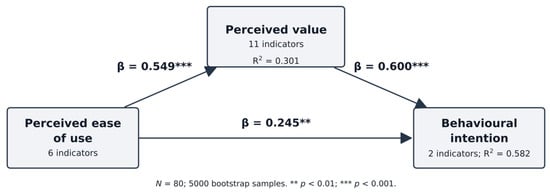
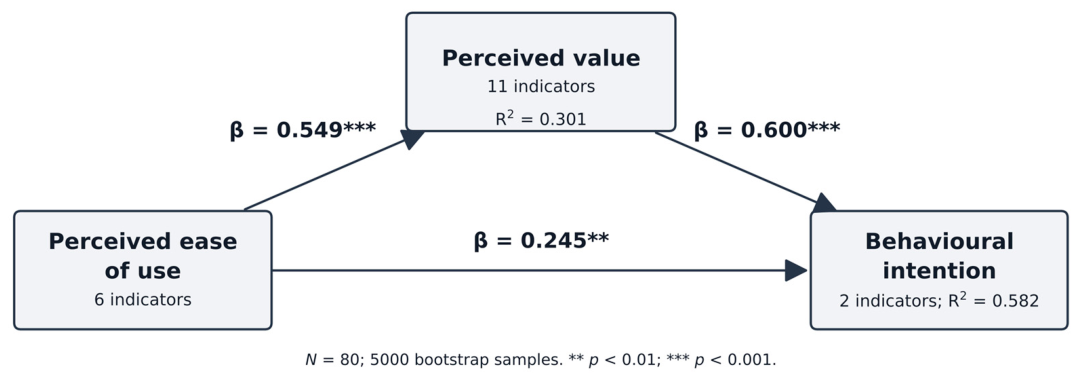
The exploratory structural model accounted for 58.2% of the in-sample variance in behavioural intention and 30.1% in perceived value (Table 8; Figure 1). Perceived value was positively associated with intention (β = 0.600, 95% CI [0.361, 0.761]), alongside a smaller direct association with perceived ease of use (β = 0.245, 95% CI [0.083, 0.448]). Perceived ease of use was also positively associated with perceived value (β = 0.549, 95% CI [0.409, 0.710]). These estimates are conditional on the exploratory measurement specification and do not establish causal effects; their sensitivity to this specification and their out-of-sample performance are examined below.
Table 8.
Standardised structural estimates (N = 80; 5000 bootstrap samples). Intervals are percentile bootstrap intervals; p values use the normal approximation described in the method. R2: value = 0.301; intention = 0.582. The f2 values hold full-model construct scores fixed.
Figure 1.
Exploratory re-specified model of VR acceptance. Two explanatory constructs, perceived ease of use and provisionally labelled perceived value, are related to behavioural intention. Arrows show specified analytical relationships, not established causal direction. Coefficients and R2 values are in-sample estimates from an exploratory re-specification developed on the same data (N = 80); their sensitivity to the measurement specification is reported in Table 9. ** p < 0.01; *** p < 0.001.
The estimated indirect association between ease and intention through value was 0.329, with a 95% percentile bootstrap interval of [0.199, 0.471]. The total association was 0.574, with a corresponding interval of [0.439, 0.719]. These are model-based associations, not evidence of a temporally ordered mediating mechanism. Cross-sectional mediation estimates can differ substantially from the longitudinal processes they are intended to represent (Maxwell & Cole, 2007).
Across the alternative specifications (Table 9), the evaluative construct remained positively associated with intention (β = 0.416 to 0.647), and perceived ease of use retained a smaller positive direct association with intention (β = 0.237 to 0.374); all 95% confidence intervals excluded zero. Excluding the relevance items left the estimates essentially unchanged (β = 0.245 and 0.606), as did the higher-order and unit-weighted specifications, indicating that the decision to retain the relevance measure did not drive the structural results. The magnitude of the evaluative association, however, varied with the item set and tracked its overlap with intention: it was largest when the attitude items were used alone (β = 0.647), the specification with the highest HTMT ratio relative to intention (0.895). In the original five-construct model, attitude was associated with intention (β = 0.613, 95% CI [0.387, 0.815]), whereas usefulness was not (β = 0.047, 95% CI [−0.157, 0.243]); given the overlap between these measures, this pattern reflects their collinearity rather than evidence that usefulness is unrelated to intention. The direction of both associations with intention is therefore robust to the measurement specification, but their relative size is not, and the larger coefficient for perceived value should not be interpreted as evidence that it is the stronger determinant of VR acceptance among musicians.
Table 9.
Sensitivity of the structural estimates to the specification of the evaluative construct (N = 80; 5000 bootstrap samples; percentile 95% CIs). All specifications include perceived ease of use (PEU) and behavioural intention (BIU) with the paths shown in Table 8. HTMT refers to the evaluative construct and intention. PU = perceived usefulness; ATU = attitude towards use; JR = job relevance; OLS = ordinary least squares. a Lower-order scores were held fixed across bootstrap resamples.
Repeated 10-fold cross-validation yielded a mean out-of-sample R2 of 0.523 for the item-mean intention score in the perceived-value model (range across repetitions 0.474 to 0.547), compared with the in-sample value of 0.582, indicating modest shrinkage. The corresponding value was 0.531 when the relevance items were excluded and 0.432 when usefulness items alone formed the evaluative construct. Because the predicted outcome was the item-mean score rather than the PLS construct score, the in-sample and cross-validated values are not strictly comparable, and cross-validation within one sample does not replace replication with independent data.
3.5. Prior VR Experience
Prior VR experience was limited. Forty-eight respondents reported no experience (60.0%), 24 reported limited experience (30.0%), six reported moderate experience (7.5%), and one reported frequent use (1.2%). One respondent indicated not knowing what VR is (1.2%); this response was excluded from experience-related association analyses but retained in the main measurement and structural analyses. Four respondents (5.0%) reported previous use of VR for musical rehearsal or performance. Only seven respondents (8.8%) reported moderate or frequent use, so the experience analyses rest almost entirely on contrasts between no and limited exposure.
Among the 79 respondents with classifiable exposure, the Pearson correlation between experience and perceived ease of use was 0.220 (p = 0.052). Correlations with usefulness (r = −0.103, p = 0.368), behavioural intention (r = −0.027, p = 0.813), and perceived value (r = −0.113, p = 0.323) were not statistically significant. Spearman analyses likewise did not identify statistically significant associations (Table 10).
Table 10.
Associations between ordinal VR experience (0–3) and item-mean scale scores (n = 79). The unclassified exposure response is omitted only from these analyses. Tests are two-sided and unadjusted for multiplicity.
The equivalence test for experience and behavioural intention did not establish equivalence within bounds of [−0.20, +0.20] (TOST p = 0.063; 90% CI [−0.213, 0.160]). The data therefore show neither a statistically detectable association nor an association sufficiently precise to be considered negligible under these bounds. With n = 79, the 90% confidence interval for a correlation near zero spans approximately ±0.19, so equivalence within these bounds could have been established only for an observed correlation very close to zero. Equivalence testing assesses magnitude relative to specified bounds, not the reason for the observed association (Lakens, 2017). Limited representation of frequent users constrains generalisation but does not demonstrate that range restriction caused the results.
4. Discussion
This study examined VR acceptance among conservatoire and university music graduates. Its findings are relevant to the design of technology-supported music education because they identify beliefs to investigate when introducing immersive learning opportunities to a formally trained population. The exploratory model accounted for 58.2% of the in-sample variance in intention (52.3% under cross-validation). Perceived value and perceived ease of use were both positively associated with intention under every measurement specification examined, but their relative size depended on the specification. Measurement overlap and the same-sample re-specification therefore require caution. The educational implications below are proposals derived from these findings and the learning-design literature, not demonstrated effects on teaching or student learning.
4.1. The Convergence of TAM’s Evaluative Constructs
The principal contribution is evidence of a measurement difficulty in this application, not proof that TAM’s evaluative constructs are inherently inseparable among musicians. The data show that usefulness, attitude, and relevance, as operationalised here, were not empirically distinguishable in this sample; they do not establish a distinctive acceptance structure among musicians. Research on teachers has also identified a substantial common component among acceptance measures (Scherer et al., 2020). A holistic appraisal of musical relevance is one possible interpretation of the overlap, but similar item content, limited familiarity, and shared measurement conditions remain competing explanations. Limited familiarity deserves particular attention: most respondents had no VR experience, and the call described VR only briefly, without images or a demonstration. Respondents may therefore have answered with different applications in mind, and evaluative items referring to such a loosely specified technology may converge on a general impression of it. The design does not distinguish these accounts or allow a comparison between musicians and non-musicians. Measurement overlap prevents a defensible separate interpretation of the proposed relevance-to-ease relationship in H11; this limitation should not be presented as its rejection.
The findings also cannot show that formal musical training caused the overlap. The study did not compare participants with and without these qualifications. The supplementary three-factor CFA also did not improve global fit relative to the five-factor specification. The perceived-value composite is therefore an exploratory modelling choice, not confirmation that the evaluative concepts form a single latent factor.
4.2. An Alternative Explanation: Common-Method Variance
Common-method variance remains a possible contributor because the constructs were assessed through the same self-report instrument. The first principal component’s 50.988% variance share does not isolate method-related covariance from substantive covariance. It is the same component result reported in the dimensionality analysis, not an independent measure of method bias. Harman-type single-component diagnostics cannot resolve this distinction (Podsakoff et al., 2003). The fact that perceived ease of use remained distinguishable does not eliminate the possibility that shared measurement conditions affected other relationships. The current results cannot quantify the respective contributions of substantive overlap and method-related covariance.
Whichever of these explanations accounts for the overlap (holistic appraisal, similar item content, limited familiarity, or common-method variance), three conclusions remain defensible. First, usefulness, attitude, and relevance as operationalised here cannot be interpreted as separate constructs in this sample, so the hypotheses involving them remain untested rather than rejected. Second, a positive association between respondents’ overall evaluation of VR and their intention to use it, and a smaller positive association between perceived ease of use and intention, were observed under every specification examined. Third, the relative weight of evaluative beliefs and ease of use cannot be determined from these data. Conversely, no conclusion should be drawn about a distinctive acceptance structure among musicians, because the design included no comparison group and comparable overlap has been reported among teachers (Scherer et al., 2020).
4.3. Implications for Research and Implementation in Music Education
4.3.1. Connecting Perceived Value with Learning Activities
The positive association between perceived value and intention, which was stable across measurement specifications, suggests that relevance to a recognisable musical task deserves attention in future educational designs. This inference is informed by the present findings, but it is a design inference, not evidence that increasing perceived value will cause greater uptake or improve learning. Because the relative size of the value and ease associations depended on the specification, the findings do not indicate that value-oriented design should take priority over usability. Perceived value also combines usefulness, attitude, and relevance items; it cannot be interpreted as a direct measure of pedagogical value.
A practical implication is to investigate VR through clearly specified rehearsal and performance-preparation activities, the uses to which the questionnaire items referred, rather than generic demonstrations of technological novelty. The specific examples that follow draw primarily on previous research rather than on the present data. A performance-preparation activity could combine a simulated audience with an explicit performance rubric and post-session reflection, building on research with simulated recital and audition environments (Aufegger et al., 2017). An active-listening lesson comparing instrument families and ensemble layouts provides a further precedent (Degli Innocenti et al., 2019), although listening activities were not covered by the questionnaire. These activities would connect practice to educational aims without assuming that using a virtual stage is itself instruction.
4.3.2. Familiarisation and Professional Learning
The appraisal item, which is directly informed by the present data, provides a specific basis for investigating familiarisation: 50 respondents (62.5%) agreed that their lack of experience limited their ability to judge VR ease of use, and only four reported previous VR use for musical rehearsal or performance. These responses indicate perceived limits to evaluation, not a demonstrated deficit in digital competence. They motivate evaluating whether structured opportunities to try a clearly described system lead to more informed judgements. The non-significant experience correlations and inconclusive equivalence analysis do not mean that familiarisation would be ineffective.
For practising educators, such familiarisation could be examined in future research as part of a professional-learning sequence combining a demonstration tied to a musical objective, guided interaction, design of a short learning activity, and reflection on its strengths and limitations. This proposal draws on DigCompEdu rather than on the present findings; DigCompEdu could inform assessment of resource selection and pedagogical justification, with actual task performance measured separately from self-reported acceptance (Redecker, 2017). Because teaching status was not recorded in this study, the proposal should be evaluated with a documented sample of practising teachers.
4.3.3. Organisational Conditions and Educational Evaluation
Implementation also requires attention beyond individual attitudes. Drawing on the context-human-technology perspective of Kang et al. (2025), a music-education pilot would need to consider equipment access, staff support, accessible alternatives, audio and interaction quality, participant comfort, and preparation time. These factors were not measured here and should be recorded in prospective evaluations alongside pedagogical outcomes.
4.4. Prior VR Experience: Scope of Inference
The non-significant experience-intention correlation does not establish an absence of association. The equivalence analysis was also inconclusive under the specified bounds. Only seven respondents reported moderate or frequent VR use and four had used VR for musical rehearsal or performance, so the analyses compare mainly respondents with no or limited exposure; with n = 79, the equivalence test could have been conclusive only for an observed correlation very close to zero. Both findings concern the particular coding and sample distribution used here. The concentration of respondents at low exposure levels limits extension to frequent users; it does not independently demonstrate attenuation from range restriction. Experience-related associations should therefore remain distinct from claims about causal effects of familiarisation or the effectiveness of VR training.
4.5. Limitations and Future Research
The convenience sample was recruited through an open call on a Greek-language online platform for musicians and was concentrated in older age groups. Eligibility was self-reported and not independently verified, and online recruitment may have favoured respondents more engaged with digital technologies. Although all participants reported having completed conservatoire or university music studies, the dataset did not separately measure current teaching employment, teaching experience, instructional workload, or individual authorisation to teach particular subjects. The educational profile establishes the population’s relevance to music education, but does not make the sample representative of employed music teachers.
The study did not compare participants with and without formal musical qualifications or examine differences between specific teaching roles. The observed measurement pattern cannot therefore be attributed to formal musical training or to a particular professional identity. Reported locations were not confined to Greece, and the language of recruitment should not be treated as evidence of a shared country of residence or nationality.
The cross-sectional design and self-reported measures do not establish causal direction. Behavioural intention should not be equated with subsequent adoption, and no direct assessment of instructional effectiveness, student learning, or digital competence was included. The initial measurement specification showed insufficient discriminant validity, and the alternative was developed and evaluated using the same dataset. Improved HTMT values do not amount to an independently validated factor structure.
The added digital-competence and immersive-learning frameworks serve as interpretive resources only. No DigCompEdu assessment, test of CAMIL mechanisms, or evaluation of a specified VR lesson was conducted. Although the call was addressed to music teachers, the acceptance items concerned personal practice, rehearsal, and performance and did not distinguish personal use from use when teaching students. Respondents received only a brief verbal description of VR, without images or a demonstration of a specific system, and most had no prior VR experience; their responses therefore reflect expectations about a loosely specified technology rather than judgements informed by use. Consequently, the study cannot speak to educators’ digital proficiency or identify which proposed learning activity would be most effective.
Experience was measured using a single categorical question, with limited representation of frequent users and one unclassified response. The analyses did not establish equivalence within the specified bounds. Shared measurement conditions leave substantive and method-related covariance unresolved. Future research should document teaching roles and qualification profiles more fully, use independently collected data and transparent item-level measurement documentation, and evaluate clearly specified educational uses of VR.
Future educational research should therefore separate at least three questions: whether participants intend to use VR, whether they can design and implement a suitable activity, and whether learners benefit. An independent study could recruit practising music teachers and graduates separately, document their roles and prior experience, and assess beliefs before and after a common VR task. A subsequent classroom evaluation could compare VR-supported and non-immersive versions of the same musical task with comparable content and instructional time. Blinded rubric-based assessment where feasible, delayed retention or transfer tasks, and implementation records would help distinguish engagement, competence, and learning. The measurement structure should be validated independently before comparing groups.
5. Conclusions
This study provides an exploratory examination of VR acceptance, and of the validity of an adapted TAM instrument, within a specific sample of conservatoire and university music graduates. Its principal contribution is not a new acceptance model but the transparent identification of a measurement difficulty: usefulness, attitude, and relevance were not empirically distinguishable in this application, and the original hypotheses involving them could not be tested as specified. Under every measurement specification examined, respondents’ overall evaluation of VR and, to a lesser extent, its perceived ease of use were positively associated with intention to use it; the relative weight of these beliefs could not be determined. These findings identify questions for future research: whether a VR activity serves a recognisable musical purpose, how users can become familiar with it, and how acceptance relates to subsequent participation.
The potential educational contribution lies in informing task-focused familiarisation and the design of learning activities that can then be evaluated independently. Reflective performance preparation and guided listening are examples for future testing, not demonstrated benefits of this survey. Research should distinguish willingness to use VR from digital-pedagogical competence, actual teaching practice, and student outcomes, and should include practising teachers as a separately documented population. Such work would connect acceptance research to the digital transformation of music education without treating technology adoption as an end in itself.
Supplementary Materials
The following supporting information can be downloaded at: https://www.mdpi.com/article/10.3390/educsci16122027/s1, File S1: Analysis scripts, item codebook, and aggregate outputs for the main sample, including the sensitivity and cross-validation analyses. The item wording and allocation are also reported in Appendix A.
Author Contributions
Conceptualization, K.K. and P.D.; methodology, K.K.; software, K.M.; validation, K.K., P.D. and K.M.; formal analysis, K.K., P.D. and K.M.; investigation, P.D.; resources, K.K., P.D. and K.M.; data curation, K.K., P.D. and K.M.; writing—original draft preparation, K.K., P.D. and K.M.; writing—review and editing, K.K., P.D. and K.M.; visualization, P.D. and K.M.; supervision, K.K.; project administration, K.K.; funding acquisition, P.D. and K.M. All authors have read and agreed to the published version of the manuscript.
Funding
This research received no external funding. The APC was partially funded by the Special Account for Research Grants (ELKE) of the University of West Attica. The funding acquisition listed under Author Contributions refers solely to this partial APC funding; the study itself received no funding.
Institutional Review Board Statement
Formal ethical review and approval were not required for this study, and no exemption was sought from or granted by an ethics committee. Under Greek law (Law 4521/2018, Article 23(2)(a)), prior approval by an institutional Research Ethics and Deontology Committee is mandatory for funded research projects involving research on human participants; other research may be submitted for review but is not required to be (Article 23(2)(b)). The study was not funded. It was an anonymous, non-interventional online survey of adult volunteers (aged 18 or over); it collected no names, contact details, or other directly identifying information, addressed no sensitive topics, and posed no more than minimal risk to participants. The partial funding of the article processing charge (see Funding) does not concern the conduct of the research.
Informed Consent Statement
Electronic informed consent was obtained from all participants before they could access the questionnaire, as described in Section 2.6. Written signatures were not collected in order to preserve anonymity.
Data Availability Statement
Analysis scripts, the item codebook, and aggregate outputs are supplied in Supplementary File S1. Individual-level data are not publicly available because the consent obtained did not cover public data deposition, and the combination of demographic and musical-specialisation variables within a small, specialised sample could increase the risk of re-identification.
Acknowledgments
During the preparation of this manuscript, the authors used ChatGPT (GPT-5; OpenAI) for the purposes of translation from Greek into English, language editing (grammar, style, readability), and the structuring of sections. The authors have reviewed and edited the output and take full responsibility for the content of this publication.
Conflicts of Interest
The authors declare no conflicts of interest.
Appendix A. Item Allocation and Reporting Translation
The statements below are English translations of the Greek-language agreement items recorded in the analysed response export. They document the item content and scoring used here; they are not a separately validated English questionnaire. All statements used the same five-point agreement scale (1 = strongly disagree; 5 = strongly agree). Column letters identify the response-export columns.
Table A1.
Allocation of the 20 agreement items in their original export order. EXP-LIM is analysed separately and is not reverse-scored into PEU. The exploratory PV composite comprises PU1-PU6, ATU1-ATU3, and JR1-JR2; BIU remains separate.
References
- Adams, D. A., Nelson, R. R., & Todd, P. A. (1992). Perceived usefulness, ease of use, and usage of information technology: A replication. MIS Quarterly, 16(2), 227–247. [Google Scholar] [CrossRef] [Scilit]
- Al-Rahmi, W. M., Yahaya, N., Aldraiweesh, A. A., Alamri, M. M., Aljarboa, N. A., Alturki, U., & Aljeraiwi, A. A. (2019). Integrating technology acceptance model with innovation diffusion theory: An empirical investigation on students’ intention to use e-learning systems. IEEE Access, 7, 26797–26809. [Google Scholar] [CrossRef] [Scilit]
- Aufegger, L., Perkins, R., Wasley, D., & Williamon, A. (2017). Musicians’ perceptions and experiences of using simulation training to develop performance skills. Psychology of Music, 45(3), 417–431. [Google Scholar] [CrossRef] [Scilit]
- Bagozzi, R. P. (2007). The legacy of the technology acceptance model and a proposal for a paradigm shift. Journal of the Association for Information Systems, 8(4), 244–254. [Google Scholar] [CrossRef] [Scilit]
- Benbasat, I., & Barki, H. (2007). Quo vadis TAM? Journal of the Association for Information Systems, 8(4), 211–218. [Google Scholar] [CrossRef] [Scilit]
- Chandler, J. J., & Paolacci, G. (2017). Lie for a dime: When most prescreening responses are honest but most study participants are impostors. Social Psychological and Personality Science, 8(5), 500–508. [Google Scholar] [CrossRef] [Scilit]
- Cohen, J. (1988). Statistical power analysis for the behavioral sciences (2nd ed.). Lawrence Erlbaum Associates. [Google Scholar]
- Çoban, M., Bolat, Y. İ., & Göksu, İ. (2022). The potential of immersive virtual reality to enhance learning: A meta-analysis. Educational Research Review, 36, 100452. [Google Scholar] [CrossRef] [Scilit]
- Davis, F. D. (1989). Perceived usefulness, perceived ease of use, and user acceptance of information technology. MIS Quarterly, 13(3), 319–340. [Google Scholar] [CrossRef] [Scilit]
- Davis, F. D., Bagozzi, R. P., & Warshaw, P. R. (1989). User acceptance of computer technology: A comparison of two theoretical models. Management Science, 35(8), 982–1003. [Google Scholar] [CrossRef] [Scilit]
- Degli Innocenti, E., Geronazzo, M., Vescovi, D., Nordahl, R., Serafin, S., Ludovico, L. A., & Avanzini, F. (2019). Mobile virtual reality for musical genre learning in primary education. Computers & Education, 139, 102–117. [Google Scholar] [CrossRef] [Scilit]
- European Commission. (2026, June 5). Digital education action plan: Policy background. European Education Area. Available online: https://education.ec.europa.eu/focus-topics/digital-education/actions/plan (accessed on 30 October 2026).
- Fernandez Lynch, H., Joffe, S., Thirumurthy, H., Xie, D., & Largent, E. A. (2019). Association between financial incentives and participant deception about study eligibility. JAMA Network Open, 2(1), e187355. [Google Scholar] [CrossRef] [Scilit]
- Flake, J. K., & Fried, E. I. (2020). Measurement schmeasurement: Questionable measurement practices and how to avoid them. Advances in Methods and Practices in Psychological Science, 3(4), 456–465. [Google Scholar] [CrossRef] [Scilit]
- Fornell, C., & Larcker, D. F. (1981). Evaluating structural equation models with unobservable variables and measurement error. Journal of Marketing Research, 18(1), 39–50. [Google Scholar] [CrossRef] [Scilit]
- Goodhue, D. L., Lewis, W., & Thompson, R. (2012). Does PLS have advantages for small sample size or non-normal data? MIS Quarterly, 36(3), 981–1001. [Google Scholar] [CrossRef] [Scilit]
- Goodhue, D. L., & Thompson, R. L. (1995). Task-technology fit and individual performance. MIS Quarterly, 19(2), 213–236. [Google Scholar] [CrossRef] [Scilit]
- Hair, J. F., Hult, G. T. M., Ringle, C. M., & Sarstedt, M. (2022). A primer on partial least squares structural equation modeling (PLS-SEM) (3rd ed.). SAGE. [Google Scholar]
- Hellenic Ministry of Culture. (2026, September 14). Approval of the recruitment of teaching personnel in music educational institutions. National Registry of Administrative Procedures (MITOS). Available online: https://mitos.gov.gr/index.php/ΔΔ:Έγκριση_πρόσληψης_εκπαιδευτικού_προσωπικού_Μουσικών_Εκπαιδευτικών_Ιδρυμάτων (accessed on 30 October 2026). (In Greek)
- Hellenic Ministry of Education, Research and Religious Affairs. (2018, September 25). Ministerial decision 144236/Δ2/05-09-2018: Assignment of music-education subjects in music schools (Series B, 4202). Government Gazette of the Hellenic Republic. (In Greek)
- Henseler, J., Ringle, C. M., & Sarstedt, M. (2015). A new criterion for assessing discriminant validity in variance-based structural equation modeling. Journal of the Academy of Marketing Science, 43(1), 115–135. [Google Scholar] [CrossRef] [Scilit]
- Horn, J. L. (1965). A rationale and test for the number of factors in factor analysis. Psychometrika, 30(2), 179–185. [Google Scholar] [CrossRef] [Scilit]
- Hu, L.-t., & Bentler, P. M. (1999). Cutoff criteria for fit indexes in covariance structure analysis: Conventional criteria versus new alternatives. Structural Equation Modeling: A Multidisciplinary Journal, 6(1), 1–55. [Google Scholar] [CrossRef] [Scilit]
- Kang, J., Xu, X., & Yan, L. (2025). Leveraging affordances of immersive technology-supported collaborative learning (ITCL): A systematic review. Education and Information Technologies, 30(1), 607–647. [Google Scholar] [CrossRef] [Scilit]
- Lakens, D. (2017). Equivalence tests: A practical primer for t tests, correlations, and meta-analyses. Social Psychological and Personality Science, 8(4), 355–362. [Google Scholar] [CrossRef] [Scilit]
- Legris, P., Ingham, J., & Collerette, P. (2003). Why do people use information technology? A critical review of the technology acceptance model. Information & Management, 40(3), 191–204. [Google Scholar] [CrossRef] [Scilit]
- Makransky, G., & Petersen, G. B. (2021). The Cognitive Affective Model of Immersive Learning (CAMIL): A theoretical research-based model of learning in immersive virtual reality. Educational Psychology Review, 33(3), 937–958. [Google Scholar] [CrossRef] [Scilit]
- Maxwell, S. E., & Cole, D. A. (2007). Bias in cross-sectional analyses of longitudinal mediation. Psychological Methods, 12(1), 23–44. [Google Scholar] [CrossRef] [Scilit]
- Paulsen, L., Dau, S., & Davidsen, J. (2024). Designing for collaborative learning in immersive virtual reality: A systematic literature review. Virtual Reality, 28(1), 63. [Google Scholar] [CrossRef] [Scilit]
- Podsakoff, P. M., MacKenzie, S. B., Lee, J.-Y., & Podsakoff, N. P. (2003). Common method biases in behavioral research: A critical review of the literature and recommended remedies. Journal of Applied Psychology, 88(5), 879–903. [Google Scholar] [CrossRef] [Scilit]
- Redecker, C. (2017). European framework for the digital competence of educators: DigCompEdu (Y. Punie, Ed.). Publications Office of the European Union. [Google Scholar] [CrossRef]
- Rese, A., Baier, D., Geyer-Schulz, A., & Schreiber, S. (2017). How augmented reality apps are accepted by consumers: A comparative analysis using scales and opinions. Technological Forecasting and Social Change, 124, 306–319. [Google Scholar] [CrossRef] [Scilit]
- Sarstedt, M., Hair, J. F., Cheah, J.-H., Becker, J.-M., & Ringle, C. M. (2019). How to specify, estimate, and validate higher-order constructs in PLS-SEM. Australasian Marketing Journal, 27(3), 197–211. [Google Scholar] [CrossRef] [Scilit]
- Scherer, R., Siddiq, F., & Tondeur, J. (2019). The technology acceptance model (TAM): A meta-analytic structural equation modeling approach to explaining teachers’ adoption of digital technology in education. Computers & Education, 128, 13–35. [Google Scholar] [CrossRef] [Scilit]
- Scherer, R., Siddiq, F., & Tondeur, J. (2020). All the same or different? Revisiting measures of teachers’ technology acceptance. Computers & Education, 143, 103656. [Google Scholar] [CrossRef] [Scilit]
- Shmueli, G., Ray, S., Velasquez Estrada, J. M., & Chatla, S. B. (2016). The elephant in the room: Predictive performance of PLS models. Journal of Business Research, 69(10), 4552–4564. [Google Scholar] [CrossRef] [Scilit]
- Supreme Council for Civil Personnel Selection [ASEP]. (2023, February 20). Notice 1GE/2023: Ranking of candidate teachers for primary and secondary general education, university education category (ASEP Series, 5). Government Gazette of the Hellenic Republic. Available online: https://info.asep.gr/node/64005 (accessed on 30 October 2026). (In Greek)
- Supreme Council for Civil Personnel Selection [ASEP]. (2024, July 10). Notice 1GT/2024: Ranking of candidate teachers for primary and secondary general education, technological education category (ASEP Series, 25). Government Gazette of the Hellenic Republic. Available online: https://info.asep.gr/node/73171 (accessed on 30 October 2026). (In Greek)
- Venkatesh, V., & Bala, H. (2008). Technology acceptance model 3 and a research agenda on interventions. Decision Sciences, 39(2), 273–315. [Google Scholar] [CrossRef] [Scilit]
- Venkatesh, V., & Davis, F. D. (2000). A theoretical extension of the technology acceptance model: Four longitudinal field studies. Management Science, 46(2), 186–204. [Google Scholar] [CrossRef] [Scilit]
- Venkatesh, V., Morris, M. G., Davis, G. B., & Davis, F. D. (2003). User acceptance of information technology: Toward a unified view. MIS Quarterly, 27(3), 425–478. [Google Scholar] [CrossRef] [Scilit]
- Wang, Y., Wang, S., Zhang, S., Fu, K., Lui, M., & Lc, R. (2025). From temporal to spatial: Designing spatialized interactions with segmented-audios in immersive environments for active engagement with performing arts intangible cultural heritage. In Proceedings of the 2025 ACM Designing Interactive Systems Conference (DIS ‘25, pp. 3292–3312). Association for Computing Machinery. [Google Scholar] [CrossRef] [Scilit]

Disclaimer/Publisher’s Note: The statements, opinions and data contained in all publications are solely those of the individual author(s) and contributor(s) and not of MDPI and/or the editor(s). MDPI and/or the editor(s) disclaim responsibility for any injury to people or property resulting from any ideas, methods, instructions or products referred to in the content. |
© 2026 by the authors. Licensee MDPI, Basel, Switzerland. This article is an open access article distributed under the terms and conditions of the Creative Commons Attribution (CC BY) license.