


Abstract
Creativity is increasingly understood as something that can be domain-specific, relational and developed across the lifespan, rather than a fixed individual trait. Inclusive education, by contrast, still tends to treat profound differences among learners mainly as difficulties to be accommodated, rather than as occasions for the domain-specific, relational creativity just described. This paper examines a different possibility: that radical heterogeneity—the co-presence, in one setting, of irreducibly different ways of perceiving, communicating and making sense of experience—can become an occasion for creative learning. We report an abductive, theory-building, qualitative single-case study of an inclusive, theatre-based workshop involving university students, community participants with disabilities, educators and communication-support professionals. The coded corpus comprises 135 contributions (119 textual) on a shared reflective board; contribution was voluntary and uneven. Reflexive thematic analysis generated five themes. Four describe conditions that made invention possible. The fifth, inventive facilitation, is the process this paper proposes as central: when a planned activity did not fit a participant, a new form was invented on the spot and adjusted to how that participant responded. Most documented inventions were initiated or supported by an experienced theatre professional, so the case points to heterogeneity mediated by expert facilitation rather than to group composition alone. The Open Badge pathway within which the workshop ran is described as context, not evaluated. This study offers a proposition for comparative testing.
1. Introduction
Creativity is now widely regarded as one of the core capacities education should foster. The standard scholarly definition treats it as the production of work that is both novel and appropriate to its context (Runco & Jaeger, 2012). Influential accounts describe it not as a trait lodged in the solitary individual but as a distributed accomplishment, situated in social and cultural settings (Csikszentmihalyi, 1996; Sawyer, 2012). Recent scholarship adds that creativity is, to an important degree, domain-specific: a learner may be creative in one field and not in another, so nurturing it means attending to the languages and practices of particular disciplines (Baer, 1998; Kaufman & Baer, 2004). Frameworks of lifelong and future competences, finally, position creativity—alongside adaptability and problem-solving—as a capacity to be developed and recognised across the lifespan and across formal, non-formal and informal learning (European Commission, 2019; Field, 2006).
Education finds these commitments—to foster creativity and to recognise it across the lifespan—hardest to honour where it most needs them: in settings of radical heterogeneity, where learners differ not marginally but constitutively in how they perceive, communicate and make sense of experience. Disability is one salient, rights-protected form of such difference (Meyer et al., 2014; United Nations, 2006). Faced with such difference, the prevailing professional vocabulary treats it as a problem to be managed, through adaptation, compensation and accommodation. Yet what most defines educators’ professionalism is something this vocabulary does not capture: the relational, embodied capacity to attune to others and to act competently under uncertainty (Dewey, 1938; Schön, 1983). That capacity is neither transmitted as content nor easily measured as discrete performance. When creative and relational competences are addressed at all, they tend to be addressed episodically rather than woven through the curriculum (European Commission, 2019). And when they are assessed, the dominant logic is standardised measurement, which sits uneasily with a creativity that is situated and relational, and which can discourage the risk-taking that creative learning requires (Beghetto & Kaufman, 2007; Rosa, 2019).
This paper advances a twofold proposition. The first part concerns how such creativity arises. Radical heterogeneity—the co-presence, within a learning context, of irreducibly different ways of perceiving, inhabiting and making sense of experience—can act not as an obstacle to be neutralised but as an occasion for domain-specific creativity. When an established routine fails before a differently situated participant, a new expressive or pedagogical form has to be invented in action, and it is in that invention that creative learning becomes observable. Such forms are more than adaptations: they are novel, and their appropriateness is judged by the participant they were made for, which gives the standard definition of creativity (Runco & Jaeger, 2012) a relational sense. The claim is conditional throughout. Heterogeneity does not generate creativity on its own; what made it generative here were specific enabling conditions—accessible communication support, sustained professional facilitation, relational safety and time for trust to form—and it is heterogeneity under such conditions that we examine. Experimental work supports the expectation that difference can be generative, while naming its cost: mixed-neurotype groups have been found to innovate more than matched ones (Axbey et al., 2023), even though communication and rapport across neurotypes can be poorer (Crompton et al., 2020). This weaker rapport is exactly why the enabling conditions matter.
The second part concerns recognition. Creativity of this kind—relational, situated, embodied and distributed—is difficult to recognise with instruments designed to measure one individual’s performance on a repeatable task. We therefore turn to one approach from educational practice, designed to recognise development as it happens rather than to certify a fixed result: educational Open Badges. Open Badges are digital credentials whose public criteria and evidence are meant to make competences visible and to recognise them as they are acquired along a learning pathway (Section 2.4). In the case studied here, they framed the workshop as a formative, developmental process rather than a terminal stamp.
The aim of this study is to examine, through a single case, how creative learning can arise in a radically heterogeneous educational setting, and how an Open Badge approach framed the recognition of that learning. The case is a theatre-based service-learning workshop run at an Italian university with a deliberately heterogeneous group of students, community participants with disabilities, educators and support professionals. Two kinds of creativity are in play, and we keep them distinct. The first is the theatrical creativity of the forms participants produced on stage. The second is the pedagogical creativity of facilitation: the invention of ways to make participation possible, which is what the students, as educators in training, were themselves learning. One main research question guides the analysis: in what ways does the documented encounter with irreducible difference occasion the invention of new expressive, communicative and pedagogical forms among participants? The workshop was part of a wider educational programme, the Open Badge pathway, whose formative-assessment design aims not to measure creativity but to support participants in developing competences and the self-efficacy to keep using them in real settings beyond the university. A second, descriptive question therefore accompanies the main one: how was this Open Badge approach adapted and enacted for a radically heterogeneous group, and with what fit to the creativity the workshop generated? We return to both questions explicitly in the Section 5. Methodologically, this study is an abductive, theory-building, qualitative single-case study of naturally occurring reflective documentation produced within the initiative and analysed with participants’ informed consent. A single case of this kind supports analytic generalisation—the development and disciplining of a conceptual proposition—rather than causal or statistical inference (Flyvbjerg, 2006; Timmermans & Tavory, 2012; Yin, 2018).
2. Theoretical Background
2.1. Creativity as Situated, Domain-Specific and Lifelong
To call creativity situated is to locate the creative act in context rather than in the solitary mind. Sociocultural accounts describe creativity as emerging from the interaction of people, audiences, artefacts and settings, not from individual cognition alone (Csikszentmihalyi, 1996; Glăveanu, 2013). This view is consistent with the standard definition of creativity, which counts an output as creative only when it is appropriate to its context (Runco & Jaeger, 2012), and with componential models of creativity that foreground intrinsic motivation and domain-relevant skill (Amabile, 1996). Seeing creativity as situated has a practical consequence: it turns attention to the conditions under which a creative response becomes both necessary and possible.
A substantial body of work argues that creativity is also, to a large degree, domain-specific: creative performance and its development differ from field to field, so pedagogy and recognition must engage the particular medium in which creativity is exercised (Baer, 1998; Kaufman & Baer, 2004). The Four-C model is a useful reminder that creativity is not only eminent achievement. Everyday achievement (“little-c”) and personal, learning-oriented (“mini-c”) creativity also deserve cultivation and acknowledgement (Kaufman & Beghetto, 2009). This matters for lifelong and lifewide education, where adults keep developing creative capacities in informal settings (European Commission, 2019; Field, 2006). This leads to the question the next section takes up: under what conditions does a learning situation call for creativity, and from whom?
2.2. Radical Heterogeneity as a Generative Condition
A recurring theme in theories of experiential and professional learning is that new responses are prompted when established routine no longer suffices. For Dewey (1938), inquiry begins in an indeterminate situation that habit cannot resolve. For Schön (1983), professional practice runs on a repertoire of knowing-in-action until the situation “talks back”, and that surprise opens reflection-in-action. For Mezirow (1991), a “disorienting dilemma” can restructure the frames through which experience is interpreted. And experiential learning theory places the cycle of concrete experience, reflection, conceptualisation and experimentation at the centre of professional growth (Kolb, 1984). These are theories of learning rather than of creativity as such; what they offer here is an account of the occasion for a creative response, not a reduction in creativity to problem-solving. The breakdown of routine does not produce a new form by itself—someone still has to invent one—but it is a reliable occasion on which invention is called for.
One such situation is the meeting with a participant whose way of perceiving, moving or communicating differs from the one an exercise assumes—a situation that recurs in inclusive settings. When the person in front of the educator does not share that assumption, the failure of routine is structural rather than accidental: no stored solution fits, because the gap lies between what the practice affords and the situation of this particular participant (Glăveanu, 2013). A response has to be invented—an alternative channel, a redesigned exercise, a new mode of address—and its worth is decided not by its author but by whether the participant it was made for takes it up. Both prongs of the standard definition of creativity (Runco & Jaeger, 2012) are thereby engaged: the form is novel, and its appropriateness is judged by that person. Such a response is often made in action—a gesture, a touch and a change in position—before it is put into words. Embodied accounts of understanding are therefore relevant: we grasp others partly through bodily, pre-reflective resonance (Freedberg & Gallese, 2007). Embodied, perspective-shifting practices have in turn been shown to sharpen educators’ situated perception in the encounter with diversity (Rubat du Mérac & Favella, 2026).
Two clarifications delimit the concept of radical heterogeneity. First, it is used here as a sensitizing concept, not a classificatory one, and it names a property of a situation, not of persons: no participant is heterogeneous; a group is. The concept is adjacent to, though not the same as, superdiversity, learner variability and neurodiversity, which describe populations or forms of variation, and Universal Design for Learning, which prescribes anticipatory design (Meyer et al., 2014). What the qualifier “radical” marks is not a degree of impairment but a threshold in the situation: the point at which a difference can no longer be absorbed by adjusting a shared format, because the participants do not share the perceptual or communicative channel the format assumes. The earlier point—that a routine fails when a participant does not share its assumptions—should be read in this light: it is not the differently situated person who breaks the routine, but the routine, built on narrow perceptual and communicative assumptions, which proves inadequate in the encounter. This is the reframing at the heart of the social, and specifically the social–relational, model of disability, which locates disability in the interaction between embodied difference and disabling environments rather than in the individual (Shakespeare, 2013; Thomas, 2004). Disability is one salient, rights-protected form of the difference at issue, and the form present in this case; linguistic, cultural and generational differences can create comparable thresholds, so the concept is not confined to disability.
Framing difference as a generative condition carries a clear risk: that participants, and disabled participants in particular, be cast as raw material for other people’s learning. We take this risk seriously and address it on three levels—analytically, by treating creativity as belonging to the encounter and not to any one party; ethically, by insisting that recognition reach everyone who takes part (Section 5); and epistemically, by acknowledging that the interpretive authority exercised here has not been shared with participants, a limitation this study only begins to redress (Fricker, 2007; Section 6). A second clarification distinguishes our claim from the familiar thesis that constraints breed creativity (Stokes, 2005). A constraint is mute: it rules out habitual responses and so channels invention. A differently situated other is responsive—answering back, refusing, helping to shape the emerging form. The generativity at issue is therefore dialogic, not merely restrictive, and the invented form is co-authored: a responsive relation that assessment geared only to output leaves mute (Rosa, 2019).
By inclusion we mean more than the presence of disabled learners in a shared space. Following the relational model, we take it to mean arranging the setting—its communication channels, its pace, its forms of participation—so that each person can take part and contribute on their own terms (Booth & Ainscow, 2002; UNESCO, 2020). The participants in this case differed along sensory, motor, cognitive and communicative lines; their access needs are described in aggregate in Section 3.1, with individual detail given only where an invention cannot be understood without it. What matters for the argument is not the participants’ diagnoses but the thresholds their co-presence created for a shared expressive practice.
One further idea can be stated briefly, as an option rather than a commitment: relational ontologies such as Barad’s (2007) intra-action hold that capacities emerge within an encounter rather than pre-existing it, so that the theatrical competence of a blind participant, or the facilitation skill of the student who devises a tactile guide, is partly constituted by who else is present. We mention this reading because it states, in its strongest form, a claim that Dewey and Schön already imply; the analysis that follows does not depend on it, and the corpus was neither built nor coded through an agential-realist lens. Figure 1 sets out the sequence proposed here, together with the enabling conditions under which it unfolds.
Figure 1.
The proposed sequence, with professional facilitation as a mediating term rather than a background condition. The sequence is iterative: a participant’s refusal or partial uptake returns the process to invention. The proposition examined here concerns the sequence under the conditions listed, not heterogeneity as such.
2.3. Social Theatre as a Creative Domain
Social and pedagogical theatre differs from “art” theatre in that its end is participants’ well-being, expression and the quality of relationships in the community: theatre is the means, and the pathway is what matters (Boal, 1979; Nicholson, 2014). For the present argument, theatre is a domain especially well-suited to observing creative forms grounded in co-presence, because co-presence is its medium. Its material is the encounter itself—bodies in contact, address and response, proximity and distance, suspending judgement, improvising within the unforeseen, recognising and regulating emotion, decentring from one’s own perspective. Recent work on theatre with disabled and non-disabled participants reports creative outcomes on both sides of that encounter (Worthington & Sextou, 2025). A group whose members see, hear, move and communicate differently does more than take part in a theatre workshop; it extends the expressive language of the domain, calling for theatrical solutions—tactile, spatial, rhythmic and scenic—that a more homogeneous group would have had less occasion to devise.
2.4. The Educational Setting: Open Badges as Formative Recognition
A creativity that is relational, unrepeatable and distributed poses a distinctive recognition problem. Standardised measurement addresses the individual, the repeatable and the comparable; the creativity described in Section 2.2 happens between people, in unrepeatable situations, and is co-authored. Recognising it without extracting it from the relations that produce it calls for an architecture designed to observe competence in action, to document its process over time, and to certify it dialogically and transparently. Educational Open Badges, we argue, are designed to do this, and the remainder of this section sets out the design rationale; whether the design delivers is a separate, empirical question, addressed only in part here.
Open Badges are digital credentials that certify knowledge, skills and dispositions while embedding metadata that make criteria, evidence and indicators transparent (Abramovich et al., 2013; Davies et al., 2015; Gibson et al., 2015). The literature reports positive effects on motivation and on learners’ perception of their learning, and highlights their value for accrediting informal and prior learning and meta-skills such as collaboration, critical thinking and communication (Abramovich et al., 2013; Ahn et al., 2014; Carey & Stefaniak, 2018). Micro-credentials more broadly are debated as instruments of lifelong, unbundled recognition (Oliver, 2019). At the level of formal qualifications, the European framework treats such micro-credentials as a way to make visible and portable the competences that degree-level descriptors leave implicit, provided they meet agreed standards of quality, transparency and recognition (Council of the European Union, 2022). The pedagogically decisive point is not certification as such: a badge stays merely certificatory unless it is embedded in an assessment that is at once diagnostic, formative and orienting (Rubat du Mérac et al., 2022). Credentials that recognise competence merely for completing a number of hours encourage the accumulation of disconnected experiences, whereas a composite pathway in which each step contributes to the meaning of the whole can sustain self-efficacy and the construction of professional identity (Rosa, 2019; Rubat du Mérac et al., 2022). This reframing aligns the badge with authentic assessment—tasks performed in realistic contexts (Gulikers et al., 2004; Wiggins, 1989)—and with formative, feedback-rich and sustainable assessment that builds learners’ capacity to evaluate their own work over time (Black & Wiliam, 1998; Boud & Soler, 2016; Nicol & Macfarlane-Dick, 2006). Self-assessment, in this view, is itself a creative and metacognitive act (Andrade, 2019), and instruments for the self-evaluation of soft skills can support its formative use (Rubat du Mérac et al., 2026).
2.5. Lifelong Learning and the Relational University
The frameworks drawn on so far—situated and lifelong views of creativity and the relational model of difference—invite a particular view of the university, which we adopt here: not a closed institution that transmits knowledge to enrolled students, but a site of continual learning that forms and recognises competence through participation (Rubat du Mérac & Favella, 2026). Lifelong and lifewide learning (Field, 2006) and communities of practice (Lave & Wenger, 1991) suggest that when a university opens its activities to learners who are not enrolled students—here, community participants with disabilities—it is not simply doing outreach; it is enlarging the community within which competence is formed and recognised, and taking on the task of recognising that competence. Where that community is heterogeneous, the university’s own routines—of teaching, of assessment, of what counts as a learner—are among the things that must be reworked.
3. The Case and Method
3.1. An Inclusive Service-Learning Workshop
The workshop analysed here was one of a set of educational Open Badge activities run at an Italian university. In the edition under study (2023–2024) it was designed as service learning, linking the academic curriculum to community needs (Aramburuzabala et al., 2019; Eyler & Giles, 1999). It was taught and led by a professional theatre director and trainer specialised in social theatre, who is also the artistic director of one of the partner organisations. The university worked with two third-sector organisations active in disability, inclusion and augmentative and alternative communication; these organisations identified, among the people they support, the community participants who joined the workshop.
The group was deliberately and radically heterogeneous, a choice with direct creative implications (Section 2.2 and Section 2.5). Alongside students from education-related degree programmes, the workshop included four community participants supported by the partner organisations. Their situations differed so sharply from one another, and from those of the students, that no ready-made script for facilitation, expressive work or relational engagement could run without invention. Their access needs spanned the sensory, motor, cognitive and communicative domains: some did not share the visual or auditory channel that most exercises assume; for some, movement and posture were mediated by equipment and by other people; some communicated without speech, through assistive technology or through sign; and for some the pace and abstraction of conventional instruction were themselves a barrier. Taking part alongside the participants were the people the group’s composition required—a sign-language interpreter, communication assistants and a professional educator from the partner organisations—together with community partners, for about fifteen people in each session. In practice, almost every session called for strategies of involvement, communication and expressive response fitted to what each person present could actually do.
The programme ran from October to June and was organised in four thematic modules: social skills and communication; creative expression and non-verbal language; self-knowledge; and emotional awareness and regulation. Sessions lasted three hours and took place across roughly twenty meetings; a period of reflection followed each module. The pathway ended in a public performance—a sharing back of the work to an audience, which in Italian is called a “restituzione”—after which the badges were conferred. Because the pathway admits learners who are not enrolled students, including people with disabilities, it functions as a mixed, lifewide community of practice (Lave & Wenger, 1991), in which diversity and disability are not an object of study but the substance of the shared work.
3.2. The Recognition Architecture
Badge attainment is organised around service objectives and learning objectives, the latter aligned with the Dublin Descriptors (Joint Quality Initiative, 2004). It comprises three trials, conceived as developmental stages. In the technical trial, the candidate not only performs an exercise but leads it for others, so the assessment covers a “knowing how to do” together with a “knowing how to enable others to do”. A written design trial follows. In the practical trial, a phase of the project is enacted with real participants (Rubat du Mérac et al., 2022). The instrument of the practical trial is an observation grid on a 1–5 scale range, completed by both observer and candidate, and therefore simultaneously top-down (criteria drawn from the literature on competences relevant to the educational professions) (Mori et al., 2022) and bottom-up (the fruit of dialogue between observer and candidate). Two grids exist, one for school and one for non-school educational contexts (e.g., early-childhood services, family homes, residential care); for experiences such as this one, the latter is pertinent, organised into four dimensions—effective group management; practices for conducting activities; assessment; participative leadership—and twenty-four indicators, one of which is expressly sensitive to recipients’ characteristics and possibilities, “age and/or disability” included (Rubat du Mérac & Corbucci, 2022).
Two points about the status of this architecture should be stated before it is described. It is a formative assessment model, designed from the outset to be adapted to each competence-development pathway rather than applied uniformly; and it is a component of the educational initiative, not an object constructed for this study. The observation grids are deliberately situated: a behaviour counts as adequate or inadequate relative to a context, and the grids had been developed for the contexts in which future teachers and socio-pedagogical educators typically operate (classrooms, nurseries, care homes). Opening the course to participants who do not normally attend university courses—because the standard training format does not answer their needs—changed the context itself: several group members were not future educators, and the grid, in its standard modalities and contents, no longer fitted. The evaluative model—situated observation, the three-step dialogic procedure and public criteria—was preserved; its modalities were redesigned for the heterogeneous group. The badge is public: issued by the university on a certified Open Badge platform at the end of a short course, its metadata state that evaluation “is not limited to the cognitive and planning sphere but also includes creativity and the ability to use theatre as a tool for communication and artistic expression” (Sapienza University of Rome, 2023).
Three features make this architecture consistent with formative and inclusive recognition. First, a three-step dialogic procedure—hetero-assessment, self-assessment and a negotiated comparison of divergences—yields a judgement oriented to the continuity of the competence process and formative for both candidate and observer, activating metacognition and decentring (Andrade, 2019; Nicol & Macfarlane-Dick, 2006). Second, openness to peer assessment: students trained in the use of grids take part in the evaluation, which becomes for them too an occasion for development. Third, the integration of continuous reflective documentation—here a shared digital board—as part of the monitoring.
3.3. Corpus, Analysis and Ethics
This study is designed as an abductive, theory-building, qualitative single-case study (Timmermans & Tavory, 2012), based on naturally occurring reflective documentation. The term secondary analysis would be imprecise: two of the authors were involved in the initiative and the documentation includes their own contributions, so this is a practitioner analysis of material generated by a practice in which they took part. The documentation was not produced for research purposes: it was generated within an educational initiative, as part of the workshop’s own reflective practice; its research use in the present study is covered by participants’ informed consent (see back matter), and it is treated methodologically as a documentary corpus for reflexive thematic analysis (Braun & Clarke, 2006, 2021).
The analysis is conducted from a contextualist position: extracts are read as situated accounts, not as transparent reports of inner states, and themes are developed at both the semantic level—what participants say happened—and the latent level, concerning what their accounts presuppose about competence, difference and recognition. Consistently with reflexive thematic analysis, coding reliability coefficients were not sought (Braun & Clarke, 2021); interpretive quality is pursued through transparency of decisions, retention of disconfirming material and declared positionality.
The corpus comprises 135 contributions (119 containing text) posted between 19 October 2023 and 10 July 2024 from nineteen distinct accounts—participants, facilitators and the academic lead—organised into twenty sections corresponding to the sessions. Contribution was voluntary and unevenly distributed. Writing on the board was not graded or tied to badge attainment, and posts were visible to the group. Eighteen of the nineteen accounts contributed text (the nineteenth posted only image or video material); one of the eighteen is the platform’s anonymous posting option, used for 46 of the 119 textual contributions (39%), which cannot be attributed to individual authors, while the remaining 73 textual posts come from seventeen named accounts, with a median of three posts each (range: 1–22). Sixty-four contributions include photo or video attachments; these were consulted as context for interpreting the textual posts but were not systematically coded, so the analysed corpus is the textual one. Two sections function as thresholds: the public event (31 May) and the restitution (3 June).
The whole post was retained as the contextual unit, while relevant meaning segments within a post could receive more than one code. Coding was conducted with MAXQDA 2024 (VERBI Software, Berlin, Germany): codes were generated inductively in a first open-coding pass by the first author and organised into a thematic structure through iterative discussion among the authors, including the second author, who had collected and curated the documentation, following the six-phase procedure recommended by Braun and Clarke (2006, 2021). The final codebook comprised forty-seven codes distributed across five overarching themes. Analysis interwove a bottom-up reading with a top-down recoding onto dimensions coherent with the literature on social theatre and creativity: relational attunement and group formation; embodiment and presence; self-awareness and expressive agency; process, product and creative safety; and inventive facilitation—the strategies devised in real time to enable participation where no pre-established format fitted.
Open coding preceded the theoretical model: the initial pass was organised around what participants reported doing, feeling and noticing, without a mechanism to confirm. Four of the five themes are recognisably congruent with the literature that motivated the study and were consolidated through the top-down pass. The fifth was not anticipated: inventive facilitation emerged from codes about improvised solutions that fitted none of the existing categories, and its emergence obliged us to rework the conceptual proposition around the inventive necessity it documented. It is this movement between an unexpected empirical pattern and its theoretical reconstruction that makes the analysis abductive (Timmermans & Tavory, 2012), and it also means that the proposed mechanism was formulated after, not before, the coding. The threshold described next was then applied in a second reading of the whole corpus. Where the authors read an extract differently, the discussion was treated as a resource for interpretation, not as a route to a single correct code; disagreements were worked through by returning to the extract in context, and where a more cautious and a more expansive reading both remained available, the more cautious one was carried forward. The systematically coded source was the shared reflective board; no separate interviews were conducted. The enactment of the badge assessment is documented through complementary sources—the adapted protocol, the teaching team’s records of proposals and formative feedback, the operator’s preparation notes, a reflective essay written in 2024 by one of the participating educators, participant observation and the video of the final trial—used descriptively in Section 4.5 and Section 4.6 and not coded thematically. Episodes drawn from these complementary sources were selected on the same threshold applied to the board (below), not for their fit to the process; each is attributed to its source, and where board, records and video bore on one episode they were read together, the more cautious reading retained in case of discrepancy. The quantitative records of the procedure (completed grids, self- and peer-assessment scores, attribution decisions) were not analysed, a limitation noted in Section 6.
Because the argument turns on distinguishing creative invention from the competent application of familiar accommodations, we adopted an explicit threshold, and we distinguish three levels of claim: the descriptive criteria that identify an episode, the interpretation of that episode as creative and the evidence it offers for the proposed mechanism. Descriptively, an extract was recorded as a candidate episode where the material showed: (i) a breakdown or insufficiency of the planned routine or format; (ii) the introduction of a form the format did not prescribe; (iii) the pertinence of that form to the theatrical or pedagogical domain at stake rather than to generic problem-solving; (iv) an uptake, modification or refusal by the participant for whom it was devised; and, where documented, (v) a subsequent re-elaboration or professional appropriation by its author. Where a simpler explanation was available—most often the application of a standard accessibility accommodation—the episode was recorded as adaptation, not as creative invention; several were. Interpreting a candidate episode as creative is a further, defeasible step, and one that shares its criteria with the mechanism it is used to examine. We therefore do not present the coded episodes as an independent test of the mechanism. Table 1 summarises the case and the corpus. What the threshold provides is disciplined identification: it makes the interpretation open to disconfirmation within the corpus by supplying explicit grounds for distinguishing supporting, ambiguous and non-supporting episodes, and by requiring the ambiguous and non-supporting ones to be reported (Section 4 and Section 4.6).
Table 1.
The case and the documentary corpus. Contribution was voluntary and unevenly distributed; no claim about prevalence or representativeness is made.
The authors were not external to the project—the corpus itself includes contributions by the teaching team and by the co-authors—a positionality we sought to offset through reflexive engagement, attention to disconfirming cases and the explicit separation, in reporting, of participants’ testimony from the team’s field notes. Extracts are reported in English translation from the Italian; a participant code (stable per participant) or the label “unattributed” (for posts published anonymously) identifies the source, together with the month of posting and the role where this is evident from the contribution itself; names occurring within extracts are replaced by role descriptors in square brackets. Extracts from the participating educator’s essay are labelled “participant essay, 2024”.
Ethically, because the material consists of participants’ personal texts, its use presupposes informed consent and careful de-identification. We did not treat disability as entailing, in itself, vulnerability or diminished agency; we treated the small size and internal distinctiveness of the group as raising a concrete risk of deductive identification, and adopted correspondingly conservative reporting choices: contributions are quoted briefly, in translation, under codes; identifying details are removed or generalised; and the visual materials, though part of the board, are not reproduced. De-identification concerns analysis and publication: within the project, the board was a shared space in which participants wrote as recognisable members of the group. The corpus also has intrinsic limits: it is spontaneous and uneven (not everyone writes, or writes alike) and privileges the verbalisable, potentially under-representing bodily and relational change. Formal ethics and consent statements are reported in the back matter. Consent was obtained at the start of the pathway, in advance of any research use, by the psychologists of the partner organisations for community participants and by the scientific lead for students, using formats adapted to each person’s communication channel; it covered participation, the documentary use of reflective material and the publication of de-identified extracts. Extracts were translated from Italian by the first author, a native French speaker working in Italian and English, and checked against the originals by the second author; translations preserve non-standard syntax where it is analytically meaningful, and terminology referring to disability follows the wording participants used of themselves. One asymmetry should be named here rather than deferred: participants co-authored the forms analysed in this paper, but not its analysis. As a first, partial step towards redressing it, the five themes were shared with participants in plain-language form once the analysis had stabilised, in July 2026, through the partner organisations and in the communication modalities available to each person, with an open invitation to agree, disagree or add; three written responses were received within the time available before submission. These are treated as participant reflection on the preliminary thematic interpretation, not as validation of the analysis, and are reported as such in Section 4; the consent obtained at the outset covers this reflective use. A systematic, fully accessible member-reflection process, reaching participants who do not communicate in writing, remains outstanding (Section 6).
4. Documented Traces of Situated Invention and Perceived Learning
The five themes are not evidence of the same kind, and we read them accordingly. Four of them—relational attunement; embodiment and presence; self-awareness and expressive agency; and process, product and creative safety—describe the relational, bodily and emotional conditions that made participation and invention possible. These matter, but much of what they capture is good inclusive practice and the ordinary give and take of an ensemble, rather than domain-specific invention. The fifth theme, inventive facilitation, is the one that bears most directly on the proposed process: the clearest instances of a routine failing and a new, domain-pertinent form being devised are concentrated there (Section 4.5). Because invention and competent inclusive practice can look alike, we applied the threshold set out in Section 3.3 to tell them apart, and we report, for each theme, both the episodes that meet it and those better read as adaptation or as ambivalent (Table 2). Read against RQ1, then, the four enabling themes are consistent with the conditions the process requires, while the evidence for the sequence itself—routine insufficiency, invention, participant response and re-elaboration—rests mainly on the fifth; throughout, the reading stays compatible with the simpler accounts noted below and with the rival explanations discussed in Section 6. Each theme is presented with its analytic definition and representative extracts, keeping participants’ testimony distinct from the teaching team’s field notes and deliberately including ambivalent and non-linear moments; extracts follow the notation described in Section 3.3. We make nothing of the fact that contributions cluster in the opening months and around the late-spring performances, since the corpus is too uneven to support such a claim.
Table 2.
Thematic structure, codes and the treatment of ambiguous and non-supporting material.
4.1. Relational Attunement and Group Formation
This theme gathers contributions in which trust, mutual care and a sense of “we” are described as arising within the encounter rather than preceding it. A participant wrote of the first sessions: “There was a real and positive lowering of defences: in a welcoming environment, surrounded by people who were all there for the same reason—to come into contact in some way. And contact there was, fully, on several levels through the activities—it was a unique experience to let yourself be guided by each person, and reciprocally” (P9, November). The reciprocity is not rhetorical. In one exchange, a student thanks a deaf participant for reassuring her: ‘while we were laughing, at one point we looked at each other and you told me, lip-reading, “It’s so hard not to laugh”, and I, apologetically: “Yes, it’s so hard”, and you answered: “It’s not a problem, it’s not a problem”. Thank you because you made me feel better, you made me feel welcomed and accepted’ (unattributed student post, May). An invented micro-channel—lip reading within laughter—here carries care in the direction opposite to the one deficit framings would predict: it is the participant with a disability who steadies the student. Attunement, however, is documented as an achievement that can also fail. A field note from the teaching team registers precisely its absence: ‘reciting each a fragment of poetry, the singularity of each delivery and the fragmentation of the whole jarred; each of us (myself included) seemed to speak alone... We are not “resonating”; I feel the lack of a “we”’ (field note, teaching team, April). That the “we” could be missed, named as missing and subsequently rebuilt is itself evidence that the group’s relational fabric was constructed—and reconstructable—rather than given.
4.2. Embodiment and Presence
This theme identifies the body and the senses as the medium of participation and understanding. An educator-participant framed the point programmatically: theatre allowed her “to enter into relation with the other through a different language, playfully and through all five senses”, adding: “this year’s heterogeneous group is a great resource—just as we maintain in theory—but we need to live these experiences” (unattributed participant post, November). The sessions multiplied sensory channels by design—scent-based games, tactile exploration of the room and movement work with wheeled chairs: “the classroom allowed us to use the wheeled chairs and feel at one with them: we went around the room introducing ourselves with our feet” (P11, November). Embodiment was not comfortable by default. A participant described an exercise deliberately offered in two modalities: “there are two ways: one, touching with your hands, closing your eyes, like blind people; two, the gaze, which is mine... in this game it made me a bit ashamed to look at people, but then I felt the experience helped me a little more” (P12, March). Shame, here, is not an accident to be edited out: it marks the bodily cost—and the traversal—of entering an unfamiliar expressive channel.
4.3. Self-Awareness and Expressive Agency
This theme documents the emergence of a personal expressive voice, including through unconventional channels. Its clearest instance is a participant’s account of rehearsing a poem at home through her eye-tracking device: ‘I was at home, in my room, to access the computer and copy and paste the poem into Word, with the “eye pointer”. And I managed by myself... I repeated it at least ten or eleven times, maybe more; and that makes me feel Enthusiasm’ (P12, January). This extract is instructive because it is borderline, and because it did not happen in the workshop: it took place at home and was initiated by the participant, not prompted or facilitated by a teacher, so it speaks to personal creativity rather than to facilitation. What it documents unambiguously is autonomy, perseverance and competent use of assistive technology. It passes the threshold only on the narrower point that the rehearsal channel itself had to be assembled—the text transferred, retrieved and repeated through the eye-pointer, in the absence of any prescribed way of rehearsing for someone who could not rehearse aloud—and that the resulting practice was new to her. On that reading, it is creativity of the mini-c kind, novel and meaningful at the level of the person; on the alternative reading, it is skilled self-regulation. We report both, and the affect (“Enthusiasm”, capitalised in the original) belongs to either. A student traces the same emergence in a different register: “I was very scared at the idea... things went differently from what I expected... I managed to live the emotions tied to it without feeling judged and, even if not completely, free to represent my experience as I saw fit” (unattributed student post, March). A third voice makes visible how demanding this channel can be. A participant writing in Italian as an additional language—the translation preserves the original’s syntax—reflected at the closing restitution: “after emotion I do not feel and the words are difficult... then on 31 May the real show, but nothing happened, only a normal mistake... and then they gave me a shirt and a diploma... unfortunately my emotion is little and I gave few words” (unattributed participant post, June). Read against the cost that writing has for this participant, the post itself is an expressive achievement; “only a normal mistake” records an internalised norm of creative safety; and the shirt and the diploma—the recognition artefacts—appear in his own inventory of what the experience left him.
4.4. Process, Product and Creative Safety
This theme follows the passage from open-ended play to a shared product, and the function of safety at the moments of highest exposure. The public event concentrates it: “I was a bit anxious, of course! When I handed the yellow sheet to the lady, my hand was trembling... in the end, fun prevailed. It almost felt as if there were no audience, as if we were rehearsing alone at [the usual venue]. I felt safe even while people were watching” (P17, 31 May). The safety is not painless, nor evenly distributed in time. In the preceding weeks, a student recorded the strain of the threshold: “I was already disoriented... I wasn’t very active and I’m very sorry... on the 31st I will have to expose myself, facing an external audience, probably less empathetic [than the director]... I don’t know whether it’s inspiration I’m waiting for, or the pressure of the approaching deadline” (P15, May). The teaching team’s own note after the event is candid in the same register: “we were not that prepared and almost all of us were stressed, but we enjoyed this performance... I see you changed, transformed by the interaction among us” (field note, teaching team, 31 May). Taken together, these posts locate creative risk-taking inside a scaffold of mutual assurance, and they are a reminder that the generativity of difference documented here flourished within deliberate structures of support and safety, not in their absence.
4.5. Inventive Facilitation
The fifth theme—inductively emergent and, for the argument of this paper, the keystone—gathers the creative strategies invented in real time so that every participant could take part and express themselves. The mechanism is visible at both ends. On the students’ side, a single student’s posts trace it across the opening months. In November, the anticipated deficit framing is overturned: “I was afraid of not knowing how to relate functionally with all the newcomers, and that perhaps, slowing the pace, it might become boring; instead I had the fortune of living an afternoon full of warmth” (P5, November). In December, the failure of routine is experienced firsthand: “in [the sign-language interpreter]’s absence I felt limited, in difficulty communicating, not knowing sign language—until she came to our aid... from these experiences one learns a great deal” (P5, December).
On the participants’ side, the invented forms are received, and adjudicated, by those for whom they were made. The choreography devised so that a wheelchair could enter the final piece is narrated by the participant herself: ‘I liked something inside me when [the director] taught us how to move the chair—my chair. The students stood still... each one takes the chair, or my arm, in a different way to turn me around; someone takes my arm, but delicately... then the poem: “You hold me/and I will turn into wonder”... thank you all for carrying me forward in a creative way’ (P12, May). Set out against the threshold, the episode reads as follows. What was planned was a group choreography built on walking, turning and contact. What failed was its presupposition: the movement vocabulary did not accommodate a participant seated in a wheelchair, so the routine could not simply be adjusted. What was introduced was a redesigned sequence in which the chair became an element of the choreography and the group learned specific ways of moving it and of taking her arm—devised by the director with the students, and pertinent to the theatrical domain, not a generic accommodation. What is documented as response is her own account, registering both the differentiation of the group’s touch and its quality. Two cautions are due. Her words attest appreciation and perceived relevance; they do not, on their own, establish the full construct of relational creativity, and “in a creative way” is her expression, not an analytic verdict. And the episode remains open to a simpler reading in which the redesign is competent inclusive practice by an expert director. What tips it above the threshold, in our reading, is that the invented form entered the final piece as a scenic element and outlived the difficulty that occasioned it. Finally, facilitation itself is recognised by students as a creative professional competence to be learned: “[the director] always surprises me in his readiness to respond to everyone’s needs. Being attentive to each person’s characteristics and anticipating how they might feel is not a quality that belongs to me markedly—and I would like to train it!” (P15, April).
The participating educator’s reflective essay records the same mechanism operating in both directions. In the mirror exercise, contact through the hands replaced the gaze for a blind participant, giving him security and curiosity about his partner. In a movement game, a participant who has partial control of the movement of her head and face “herself proposed a new mode of exploration”, using exactly that resource. The invention led the educator to devise a new variant of the exercise: “if the rest of the body were blocked and we could move only the head, how would our interaction change?” (participant essay, 2024). And the pathway’s assessment practices migrated into the educator’s own professional repertoire: the closing feedback round, she writes, was “a moment I honestly had not conceived of in my own lessons as a conductor, and which I will certainly revisit” (participant essay, 2024).
Across the five themes, the final piece condenses the trajectory. The final piece was not performed to a passive audience, but co-created with the public during the closing event (31 May 2024). Spectators were drawn into the trust-and-contact exercises, so that the boundary between performers and audience—like the one between student and community participant—became porous, making the distributed character of the creativity literal rather than merely theorised. These are traces of perceived transformation and documented processes, not measured effects; their evidential status is discussed in Section 5 and Section 6.
One further, distinct data point is reported here for transparency, though it stands outside the corpus just analysed. As described in Section 3.3, the five themes mentioned above were shared with participants in July 2026, in plain-language form, inviting agreement, disagreement or additions; three responded within the time available. These responses are participant reflection on the preliminary interpretation, not a validation of the analysis. All three assented to the themes. The blind participant introduced in Section 4.6 wrote, unprompted: “There’s something important to say: it’s you who always supported us, even though on the first day I thought: this course will be the usual bore with all the scripts we’d have to learn by heart... Instead it’s the most open-to-freedom-of-expression course I have ever experienced in my whole life” (participant feedback, July 2026)—a first-person corroboration, in his own terms, of the routine-to-openness contrast the paper turns on. A second participant confirmed the themes and added a connecting thread the five did not name: “a dynamic that can be a thread joining us all is the interaction among all of us, through several modalities, to reach the shared goal of living an experience together” (participant feedback, July 2026). This foregrounds multimodal interaction toward a common end—close to the process described in Section 2.2, and a useful corrective to any reading of the themes as five separate findings. A third simply endorsed them as “the cardinal points of this whole intense experience of growth, mutual trust and collective sharing” (participant feedback, July 2026). Three responses cannot stand for the group as a whole, and those received came from participants able and willing to reply in writing over a summer period; Section 6 states what a fuller, accessible member-reflection process would still require. But that the themes drew assent, and one substantive addition, from participants writing in their own words is a first indication that the reading offered here is not foreign to those whose experience it interprets.
4.6. Assessing Creativity in Action
The badge assessment was enacted during the pathway, in the form adapted to the heterogeneous group (Section 3.2). In mixed groups of two or three—students together with external participants—candidates designed and led an expressive activity for the rest of the group, with declared formative objectives (developing a sense, building trust and body awareness). Table 3 separates what the model prescribes, what the available sources document and what falls outside the analysis. The dimensions assessed map onto creativity and critical–reflective thinking: adequacy of the activity to its declared objectives; capacity to present it and to include interpersonal and sensory differences; observation of responses and real-time recalibration; identification of difficulties and the flexibility and creativity of the adaptations introduced; quality of the concluding reflection; and analysis of one’s own performance. Each proposal was followed by formative feedback from the social-theatre professional and the pedagogist, offered publicly so that every group could learn from every performance, with participants contributing their own reflections. A participating educator’s reflective essay confirms the in-process character of the procedure from the candidates’ side: while the badge formally comprises three trials—technical, written and practical—“in the pathway as I experienced it, these three phases took place concurrently: the professional leading the group assessed the participants’ capacities in itinere” (participant essay, 2024). The episodes reported below are reconstructed from the teaching team’s records and the first author’s participant observation, triangulated with the video recording of the final trial.
Table 3.
The Open Badge assessment model: design, documented enactment and what falls outside the analysis.
One assessed proposal illustrates the procedure. A student and a participant with a disability co-designed an exercise on the embodiment of emotions: each participant, given an emotion—whispered, or presented in writing—embodied it as an expressive statue (posture; tensions and releases; facial expression), which the others, including through guided touch for a blind participant, tried to recognise. The exercise made visible forms of participation and reflection consistent with the learning aims of the pathway. The blind participant expressed emotions with a freedom unconstrained by visual convention, working from internal perception. This made two things visible at once: how much more varied emotional expression can be than shared codes suggest, and why shared codes are still needed to communicate even the most intimate experience. A participant with autism found recognising expressions difficult and was supported by guided prompts, which in turn sharpened the performers’ own awareness of what their bodies were conveying. And several participants were surprised by interpretations that diverged from their own, which exposed how readily we generalise our own expressive habits.
The formative feedback then assessed the candidates’ conduct of the exercise as such. The theatre professional observed that the candidates’ anxiety about explaining the instructions had displaced the work of setting a safety frame—stating what would be assessed, generating the energy of play, defining pairs, time and space, and inviting questions before starting. The pedagogist suggested composing pairs according to competence levels and cognitive and expressive styles, and rotating roles, so that each candidate would also assess another pair and bring what they observed into their own performance. Creativity and critical–reflective thinking were thus not inferred post hoc from the documentation: they were named as criteria, observed in performance, returned as public formative feedback and re-elaborated by the candidates—during the process, not after it. What the available material documents is that the procedure took place and what it consisted of; how each candidate was rated, and how ratings converged or diverged, is not part of it.
The final practical trial—the public performance co-created with the audience (Section 4.4)—is documented in a seventeen-minute video recording made by the partner organisation, consulted for this study (see the Data Availability Statement). The operator’s written preparation notes for the performance articulate the assessed qualities in operational form—authenticity, precision and economy of action, emotional coherence, openness to uncertainty, narrative continuity, physical interaction with the other performers and attention to detail—several of which name, in the language of the craft, precisely the creative dispositions this paper theorises. The trial was followed by a collective debriefing that directly solicited the competences named in the badge. One moment of that sharing condenses the argument of this paper. During the performance, the blind participant had neither a cane nor physical guide, yet he felt guided by voices—not by messages addressed to him, since the words spoken were the performance text, but by the intonation, quality and direction of the sound, through which he registered the attention of the group. The trust built over the pathway, he said, had reduced his inhibition to the point of daring a final rap solo before an audience he could not see, in the knowledge that the group would support him. In his own account, the barriers he ordinarily associates with his disability became less salient as his sense of self-efficacy grew—a first-person articulation of disability as relational, relative to others and to the environment rather than a stable individual property (United Nations, 2006), and of competence as constituted in the encounter (Section 2.2).
5. Discussion
We address the two research questions in turn. The main question asked in what ways the encounter with irreducible difference occasions the invention of new expressive, communicative and pedagogical forms. In answer, the case offers a close, documented account of how creative learning can arise when an inclusive routine breaks down—not the bare fact that it can, which inclusive-arts research already suggests, but the moment-to-moment process through which participants and facilitators remake an expressive practice once its usual form stops working. Read against this question, the process is legible across the five themes, though unevenly. Routines failed structurally: several contributions describe planned exercises whose affordances did not reach particular participants (Section 4.2 and Section 4.5). New forms were then invented in action—augmentative and alternative communication channels, tactile and spatial orientation supports, individualised scaffolds and redesigned exercises—and participants’ responses supplied situated evidence of fit, modification or non-fit, so that different bodies and modes of perception became part of the scene rather than obstacles to it. Change is visible on both sides of the encounter: the individualised expressive mode developed by the participant who communicates without speech, and the students’ own accounts of moving from uncertainty to competence, and from observation to co-authorship. This is creativity distributed across the encounter, as the framework predicts, and it was made literal by the final piece, which the group created with its audience. Two limits bound the reading. The corpus permits no independent measure of the changes participants report; and the counterfactual—that a more homogeneous group would have had less occasion for such invention—is a hypothesis this single case cannot test, although it is consistent with experimental evidence that mixed-neurotype groups innovate more than matched ones (Axbey et al., 2023). The reading also remains compatible with the simpler accounts of Section 4 and the rival explanations of Section 6.
Because the Open Badge system defines distinct artistic profiles—theatre, music, narration and others—it operationalises the recognition of creativity in its particular media rather than as a generic faculty (Baer, 1998; Kaufman & Baer, 2004; Rubat du Mérac et al., 2022). Notably, the inventions catalogued in Section 4 are theatrical in kind—tactile, spatial, rhythmic and scenic—not instances of generic problem-solving: heterogeneity stretched the language of a particular domain.
In answer to the second, descriptive question, we read the Open Badge setting against this creativity—as context, not as something this study evaluates. The badge pathway was built on a formative-assessment rationale. Creative and relational competence was to be shown in a practical trial with real participants and in peer-assessment moments, observed and returned rather than merely asserted (Section 4.6). And the badge’s public metadata were meant to give visibility and portability to domain-specific creative capacities that would otherwise go unrecognised (Abramovich et al., 2013; Gibson et al., 2015; Oliver, 2019). Three features of that design are worth drawing out, as an illustration of what recognition suited to relational creativity might involve. First, it fits creativity understood as domain-specific: the badge certifies competence in particular artistic media, not a generic faculty. Second, it fits creativity understood as processual and relational: what it aims to recognise is a trajectory of development and a growth in self-efficacy—the confidence to keep using and improving one’s competences afterwards—not a single performance. Third, it carries a normative implication. If the forms invented were co-authored, then a credential reaching only the enrolled students would misrecognise what it certifies; extending recognition to the community participants, including those with disabilities, is therefore a matter of coherence, not an inclusive extra, and is consistent with the Convention on the Rights of Persons with Disabilities, the Index for Inclusion and Universal Design for Learning (Booth & Ainscow, 2002; Meyer et al., 2014; United Nations, 2006). What this study establishes about the model is, however, bounded. It shows that the model was adapted to this heterogeneous group and enacted, and that the enactment made creative and critical–reflective competence partly observable and documentable (Section 4.6). It does not show whether the model recognises that competence well. The assessment record itself—completed grids, self- and peer-assessment scores, attribution decisions and the badges issued and their later use—was not analysed; whether recognition was in fact extended to the community participants, and with what effect, belongs to the reporting of assessment outcomes, not to the reflective corpus studied here (Section 6).
A strong tradition seeks to measure creativity through divergent-thinking tests, ratings and talent identification. The approach proposed here is complementary to that tradition, addressing a different question: where measurement asks “how much,” a dialogic, formative recognition asks “what is becoming visible, and how can it continue.” For relational and embodied creativity exercised in the unrepeatable here and now of a theatre exercise, a negotiated judgement that preserves rather than flattens differences may capture what a single score cannot (Boud & Soler, 2016; Nicol & Macfarlane-Dick, 2006; Rosa, 2019). Recognition and measurement are, on this view, answers to different questions; lifelong creativity education needs both.
A further implication concerns the pedagogical design itself. Assembling so heterogeneous a group was a deliberate choice, made on the wager—examined in Section 2.2—that supported heterogeneity would occasion invention rather than exclusion.
6. Limitations and Future Directions
As a single case, this study cannot separate the contribution of heterogeneity from the conditions that accompanied it: the facilitator’s craft, the length of the pathway, the deliberate structures of safety and trust, the self-selection of participants, the novelty of theatre, the reciprocity of the service-learning frame and the anticipation of a public performance. Several of these conditions are not rival causes to be explained away but part of what we have called supported heterogeneity; the claim throughout has been conditional, never that difference generates creativity by itself. One condition deserves to be stated as a finding rather than a caveat: much of the invention in Section 4.5 was initiated, modelled or rescued by a highly experienced social-theatre professional, and the students describe learning by watching him respond to needs they had not anticipated. The most defensible reading of the case is therefore not that heterogeneity produces pedagogical creativity, but that heterogeneity mediated by expert facilitation does, with professional noticing—the situated skill of registering a mismatch and knowing what it calls for (Goodwin, 1994; Van Es & Sherin, 2002)—as the mediating term (Figure 1). What a single case cannot establish is that heterogeneity, rather than these conditions, was decisive; that would require comparative designs in which group composition varies while facilitation, duration and framing are held constant.
Three limits of evidence follow from the design. First, the corpus is spontaneous and uneven, depends on written expression and may under-represent bodily and relational change; it supports analytic generalisation to theory, not causal or statistical inference. Second, the inventive-facilitation theme, though the most productive, rests on a small number of contributions and is best treated as this study’s principal abductive result—a proposition to be developed and tested, not an established mechanism. Third, although the badge assessment is documented (Section 4.6), its quantitative records were not analysed, so the Open Badge model is appraised through its design and enactment, not through scored outcomes. Future work should complement spontaneous documentation with structured tools—observation rubrics, repeated self-assessments and pre-/post-measures—and should test the proposition in comparative designs across groups of different composition. A second edition of the pathway (2024–2025), outside the present corpus, already offers material for such longitudinal and comparative study.
A final limitation is substantive rather than procedural. This study argues that creativity belongs to the encounter, yet interpretive authority over its meaning has remained with the university-based authors: participants co-authored the forms analysed, but not the analysis. We record this as a limitation of the present study. Redressing it would mean returning the themes to participants in accessible modalities and reporting their agreements, disagreements and revisions—not to verify the analysis but to widen the interpretive perspectives on it (Gjermestad et al., 2023). A first, modest step is reported in Section 4: three participants responded to the themes before submission, assenting to them and, in one case, adding a connecting thread the analysis had not named. This is an encouraging but partial signal; the systematic process remains outstanding for most participants, including those who do not communicate in writing.
7. Conclusions
Education that takes creativity seriously as a lifelong, domain-specific and inclusive capacity must find non-episodic ways to cultivate it and non-reductive ways to recognise it. We examined the proposition that radical heterogeneity, adequately supported, can be an occasion for such cultivation: where learners perceive, inhabit and make sense of experience in irreducibly different ways, established routines fail, and new forms of expression, facilitation and recognition have to be invented in action, collectively, by a group in which students too must become reflective and inventive educators in real time. The documentation analysed here is consistent with that proposition, and with the more precise version the case suggests: that it is heterogeneity mediated by accessible communication, relational safety and expert facilitation that recurrently occasions invention.
The recognition question follows from it rather than standing beside it. If the forms invented are co-authored, a device confined to enrolled students would misrecognise what it certifies. Whether it recognises that competence well—how candidates were rated, how assessors converged, whether the credential travels and supports learners in continuing to use their competences beyond the university—is a question this study leaves open and that the analysis of assessment outcomes could answer.
What the case offers is a proposition worth testing rather than a finding to be applied: that difference, adequately supported, can be an occasion for creative learning, and that recognising it in those who exercise it is both a pedagogical and an ethical commitment. Testing it will require comparative designs in which group composition varies while facilitation, duration and framing are held constant; analysis of assessment records alongside reflective documentation; and, not least, the participation of learners with disabilities in interpreting what their own learning has been.
Author Contributions
Conceptualization, E.R.d.M.; methodology, E.R.d.M. and P.L.D.; formal analysis, E.R.d.M.; investigation, M.T.B. and P.L.D.; resources, E.R.d.M. and P.L.D.; data curation, M.T.B.; writing—original draft preparation, E.R.d.M.; writing—review and editing, E.R.d.M., M.T.B. and P.L.D.; supervision, E.R.d.M.; project administration, E.R.d.M.; funding acquisition, E.R.d.M. All authors have read and agreed to the published version of the manuscript.
Funding
The service-learning framework within which the workshop was carried out forms part of the Erasmus+ KA2 Cooperation Partnership project “Service-Learning: Intersectoral Collaboration Practices for the Development of Students’ Soft Skills and Socially Engaged Universities” (SL-ICP), grant agreement no. 2022-1-FR01-KA220-HED-000089742, co-funded by the European Union and implemented within the CIVIS Alliance. The educational Open Badge initiative on which this paper draws was supported by two competitive Sapienza University of Rome grants awarded to E.R.d.M.: “Open Badge educativi: sviluppo e certificazione di competenze per una professionalità aperta, polivalente e altamente qualificata in ambito educativo e formativo” (grant no. RM12117A8A4EC22E) and “Certificazione di competenze extracurricolari come modello di orientamento: costruzione di un modello di Open Badge pedagogico” (grant no. RP11916B84CE2418). The article processing charge (APC) was funded by E.R.d.M.’s personal research funds.
Institutional Review Board Statement
Ethical review and approval were not sought for this study. The workshop was conceived and conducted not as a research project but as an inclusive educational initiative for the development of soft skills, open to the Sapienza University community and to people with disabilities supported by partner organisations. It was carried out under formal scientific-collaboration agreements between the Department of Psychology of Developmental and Socialization Processes of Sapienza University of Rome and these organisations (Io Se Posso Komunico-I-SPK: Agreement No. 12/2022, Prot. No. 547 of 29 April 2022; ASP Sant’Alessio-Margherita di Savoia: Agreement No. 36/2022, Prot. No. 0001614 of 12 December 2022). The secondary use of the participants’ reflective documentation for the present study—de-identified prior to analysis and publication—was based on the informed consent reported below; under the applicable institutional rules, such an educational activity did not require review by an ethics committee.
Informed Consent Statement
Informed consent for participation and for the research use of the anonymised reflective material was obtained from all participants. For participants with disabilities, it was collected at the start of the pathway by the psychologists of the partner organisations (Io Se Posso Komunico, I-SPK; and ASP Sant’Alessio-Margherita di Savoia) using accessible, supported formats; for the participating students, it was obtained by the scientific lead (E.R.d.M.). All material was de-identified prior to analysis and publication.
Data Availability Statement
The qualitative corpus analysed in this study is not publicly available in order to protect participants’ privacy; brief de-identified excerpts, in English translation, are reported within the article. The EDUACT badge and its public metadata are available on the Bestr platform (https://bestr.it/badge/show/3613, accessed on 6 August 2026). A video recording of the final public performance was consulted for this study; because it is inherently identifying, it is neither linked nor shared, in order to protect participants’ identities.
Acknowledgments
The authors thank the partner organisations Io Se Posso Komunico-I-SPK and ASP Sant’Alessio-Margherita di Savoia for their collaboration. This paper draws on documentation collected and first analysed by M.T.B. within her master’s thesis (Sapienza University of Rome), here reinterpreted within a distinct theoretical and evaluative framework. During the preparation of this manuscript, the authors used Claude (Anthropic, version 6.6395.1, build 8fc566) for the purposes of English-language editing, formatting, and the preparation of Figure 1. The authors have reviewed and edited the output and take full responsibility for the content of this publication.
Conflicts of Interest
P.L.D. is the artistic director of Oltre Le Parole ETS, one of the partner organisations involved in the initiative. The other authors declare no conflicts of interest.
References
- Abramovich, S., Schunn, C., & Higashi, R. M. (2013). Are badges useful in education?: It depends upon the type of badge and expertise of learner. Educational Technology Research and Development, 61(2), 217–232. [Google Scholar] [CrossRef] [Scilit]
- Ahn, J., Pellicone, A., & Butler, B. S. (2014). Open badges for education: What are the implications at the intersection of open systems and badging? Research in Learning Technology, 22, 23563. [Google Scholar] [CrossRef] [Scilit]
- Amabile, T. M. (1996). Creativity in context: Update to the social psychology of creativity. Westview Press. [Google Scholar]
- Andrade, H. L. (2019). A critical review of research on student self-assessment. Frontiers in Education, 4, 87. [Google Scholar] [CrossRef] [Scilit]
- Aramburuzabala, P., McIlrath, L., & Opazo, H. (Eds.). (2019). Embedding service learning in European higher education: Developing a culture of civic engagement. Routledge. [Google Scholar] [CrossRef] [Scilit]
- Axbey, H., Beckmann, N., Fletcher-Watson, S., Tullo, A., & Crompton, C. J. (2023). Innovation through neurodiversity: Diversity is beneficial. Autism, 27(7), 2193–2198. [Google Scholar] [CrossRef] [Scilit]
- Baer, J. (1998). The case for domain specificity of creativity. Creativity Research Journal, 11(2), 173–177. [Google Scholar] [CrossRef] [Scilit]
- Barad, K. (2007). Meeting the universe halfway: Quantum physics and the entanglement of matter and meaning. Duke University Press. [Google Scholar]
- Beghetto, R. A., & Kaufman, J. C. (2007). Toward a broader conception of creativity: A case for mini-c creativity. Psychology of Aesthetics, Creativity, and the Arts, 1(2), 73–79. [Google Scholar] [CrossRef] [Scilit]
- Black, P., & Wiliam, D. (1998). Assessment and classroom learning. Assessment in Education: Principles, Policy & Practice, 5(1), 7–74. [Google Scholar] [CrossRef] [Scilit]
- Boal, A. (1979). Theatre of the oppressed. Pluto Press. [Google Scholar]
- Booth, T., & Ainscow, M. (2002). Index for inclusion: Developing learning and participation in schools. CSIE. [Google Scholar]
- Boud, D., & Soler, R. (2016). Sustainable assessment revisited. Assessment & Evaluation in Higher Education, 41(3), 400–413. [Google Scholar] [CrossRef] [Scilit]
- Braun, V., & Clarke, V. (2006). Using thematic analysis in psychology. Qualitative Research in Psychology, 3(2), 77–101. [Google Scholar] [CrossRef] [Scilit]
- Braun, V., & Clarke, V. (2021). One size fits all? What counts as quality practice in (reflexive) thematic analysis? Qualitative Research in Psychology, 18(3), 328–352. [Google Scholar] [CrossRef] [Scilit]
- Carey, K. L., & Stefaniak, J. E. (2018). An exploration of the utility of digital badging in higher education settings. Educational Technology Research and Development, 66(5), 1211–1229. [Google Scholar] [CrossRef] [Scilit]
- Council of the European Union. (2022). Council recommendation of 16 June 2022 on a European approach to micro-credentials for lifelong learning and employability (2022/C 243/02). Official Journal of the European Union, C 243, 10–25. [Google Scholar]
- Crompton, C. J., Ropar, D., Evans-Williams, C. V. M., Flynn, E. G., & Fletcher-Watson, S. (2020). Autistic peer-to-peer information transfer is highly effective. Autism, 24(7), 1704–1712. [Google Scholar] [CrossRef] [Scilit]
- Csikszentmihalyi, M. (1996). Creativity: Flow and the psychology of discovery and invention. HarperCollins. [Google Scholar]
- Davies, R., Randall, D., & West, R. E. (2015). Using open badges to certify practicing evaluators. American Journal of Evaluation, 36(2), 151–163. [Google Scholar] [CrossRef] [Scilit]
- Dewey, J. (1938). Experience and education. Kappa Delta Pi. [Google Scholar]
- European Commission. (2019). Key competences for lifelong learning. Publications Office of the European Union. [Google Scholar] [CrossRef]
- Eyler, J., & Giles, D. E. (1999). Where’s the learning in service-learning? Jossey-Bass. [Google Scholar]
- Field, J. (2006). Lifelong learning and the new educational order (2nd ed.). Trentham Books. [Google Scholar]
- Flyvbjerg, B. (2006). Five misunderstandings about case-study research. Qualitative Inquiry, 12(2), 219–245. [Google Scholar] [CrossRef] [Scilit]
- Freedberg, D., & Gallese, V. (2007). Motion, emotion and empathy in esthetic experience. Trends in Cognitive Sciences, 11(5), 197–203. [Google Scholar] [CrossRef] [Scilit]
- Fricker, M. (2007). Epistemic injustice: Power and the ethics of knowing. Oxford University Press. [Google Scholar] [CrossRef] [Scilit]
- Gibson, D., Ostashewski, N., Flintoff, K., Grant, S., & Knight, E. (2015). Digital badges in education. Education and Information Technologies, 20(2), 403–410. [Google Scholar] [CrossRef] [Scilit]
- Gjermestad, A., Skarsaune, S. N., & Bartlett, R. L. (2023). Advancing inclusive research with people with profound and multiple learning disabilities through a sensory-dialogical approach. Journal of Intellectual Disabilities, 27(1), 519–533. [Google Scholar] [CrossRef] [Scilit]
- Glăveanu, V. P. (2013). Rewriting the language of creativity: The Five A’s framework. Review of General Psychology, 17(1), 69–81. [Google Scholar] [CrossRef] [Scilit]
- Goodwin, C. (1994). Professional vision. American Anthropologist, 96(3), 606–633. [Google Scholar] [CrossRef] [Scilit]
- Gulikers, J. T. M., Bastiaens, T. J., & Kirschner, P. A. (2004). A five-dimensional framework for authentic assessment. Educational Technology Research and Development, 52(3), 67–86. [Google Scholar] [CrossRef] [Scilit]
- Joint Quality Initiative. (2004). Shared ‘Dublin’ descriptors for the Bachelor’s, Master’s and Doctoral awards. Joint Quality Initiative Informal Group. [Google Scholar]
- Kaufman, J. C., & Baer, J. (2004). Sure, I’m creative—But not in mathematics! Self-reported creativity in diverse domains. Empirical Studies of the Arts, 22(2), 143–155. [Google Scholar] [CrossRef] [Scilit]
- Kaufman, J. C., & Beghetto, R. A. (2009). Beyond big and little: The Four C model of creativity. Review of General Psychology, 13(1), 1–12. [Google Scholar] [CrossRef] [Scilit]
- Kolb, D. A. (1984). Experiential learning: Experience as the source of learning and development. Prentice Hall. [Google Scholar]
- Lave, J., & Wenger, E. (1991). Situated learning: Legitimate peripheral participation. Cambridge University Press. [Google Scholar]
- Meyer, A., Rose, D. H., & Gordon, D. (2014). Universal design for learning: Theory and practice. CAST Professional Publishing. [Google Scholar]
- Mezirow, J. (1991). Transformative dimensions of adult learning. Jossey-Bass. [Google Scholar]
- Mori, S., Rubat du Mérac, E., & Rosa, A. (2022). Modelli per lo sviluppo e la valutazione delle competenze trasversali nella didattica universitaria [Models for the development and assessment of transversal competences in university teaching]. In P. Limone, G. A. Toto, & N. Sansone (Eds.), Didattica universitaria ibrida. Tra emergenza e prospettive future (pp. 158–179). Progedit. [Google Scholar]
- Nicholson, H. (2014). Applied drama: The gift of theatre (2nd ed.). Palgrave Macmillan. [Google Scholar]
- Nicol, D. J., & Macfarlane-Dick, D. (2006). Formative assessment and self-regulated learning: A model and seven principles of good feedback practice. Studies in Higher Education, 31(2), 199–218. [Google Scholar] [CrossRef] [Scilit]
- Oliver, B. (2019). Making micro-credentials work for learners, employers and providers. Deakin University. [Google Scholar]
- Rosa, H. (2019). Resonance: A sociology of our relationship to the world. Polity Press. [Google Scholar]
- Rubat du Mérac, E., Borghese, M. C., & La Delfa, P. (2022). Open Badge educativi: Linguaggi e pratiche dell’arte in ambito educativo e di formazione [Educational Open Badges: Languages and practices of art in education and training]. In P. Lucisano, & A. Marzano (Eds.), Quale scuola per i cittadini del mondo? A cento anni dalla fondazione della Ligue Internationale de l’Éducation Nouvelle, proceedings of the SIRD international conference (pp. 973–984). Pensa MultiMedia. [Google Scholar]
- Rubat du Mérac, E., Botta, E., & Lupo, I. (2026). Extending the validation of the 3SQ to higher education: Factor structure and reliability in a large Italian university sample. Journal of Educational, Cultural and Psychological Studies (ECPS Journal), 33, 169–181. [Google Scholar] [CrossRef] [Scilit]
- Rubat du Mérac, E., & Corbucci, M. (2022). Narrare humanum est: Percorsi Open Badge di narrazione per l’ambito educativo e formativo [Open Badge narration pathways for education and training]. In A. La Marca, & A. Marzano (Eds.), Ricerca didattica e formazione insegnanti per lo sviluppo delle Soft Skills, Proceedings of the SIRD national conference (pp. 378–390). Pensa MultiMedia. [Google Scholar]
- Rubat du Mérac, E., & Favella, A. (2026). “Becoming-With the World”: Embodied perspective-shifting practices and the development of educators’ transformative agency. European Journal of Education, 61(1), e70518. [Google Scholar] [CrossRef] [Scilit]
- Runco, M. A., & Jaeger, G. J. (2012). The standard definition of creativity. Creativity Research Journal, 24(1), 92–96. [Google Scholar] [CrossRef] [Scilit]
- Sapienza University of Rome. (2023). EDUACT [Open Badge]. Bestr. Available online: https://bestr.it/badge/show/3613 (accessed on 6 August 2026).
- Sawyer, R. K. (2012). Explaining creativity: The science of human innovation (2nd ed.). Oxford University Press. [Google Scholar]
- Schön, D. A. (1983). The reflective practitioner: How professionals think in action. Basic Books. [Google Scholar]
- Shakespeare, T. (2013). Disability rights and wrongs revisited (2nd ed.). Routledge. [Google Scholar] [CrossRef] [Scilit]
- Stokes, P. D. (2005). Creativity from constraints: The psychology of breakthrough. Springer. [Google Scholar]
- Thomas, C. (2004). How is disability understood? An examination of sociological approaches. Disability & Society, 19(6), 569–583. [Google Scholar] [CrossRef] [Scilit]
- Timmermans, S., & Tavory, I. (2012). Theory construction in qualitative research: From grounded theory to abductive analysis. Sociological Theory, 30(3), 167–186. Available online: http://www.jstor.org/stable/41725511 (accessed on 6 August 2026).
- UNESCO. (2020). Global education monitoring report 2020: Inclusion and education: All means all. UNESCO. [Google Scholar]
- United Nations. (2006). Convention on the rights of persons with disabilities. United Nations.
- Van Es, E. A., & Sherin, M. G. (2002). Learning to notice: Scaffolding new teachers’ interpretations of classroom interactions. Journal of Technology and Teacher Education, 10(4), 571–596. [Google Scholar]
- Wiggins, G. (1989). A true test: Toward more authentic and equitable assessment. Phi Delta Kappan, 70, 703–713. [Google Scholar]
- Worthington, N. M., & Sextou, P. (2025). Theatre, disability and wellbeing: Addressing best practice and creative outcomes across disabled and non-disabled communities through an interpretative phenomenological analysis. Arts & Health, 17(3), 294–307. [Google Scholar] [CrossRef] [Scilit]
- Yin, R. K. (2018). Case study research and applications: Design and methods (6th ed.). SAGE. [Google Scholar]
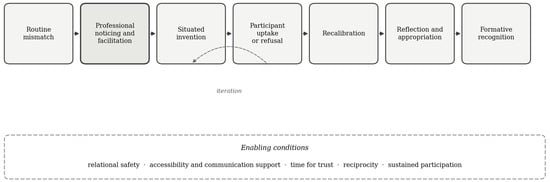
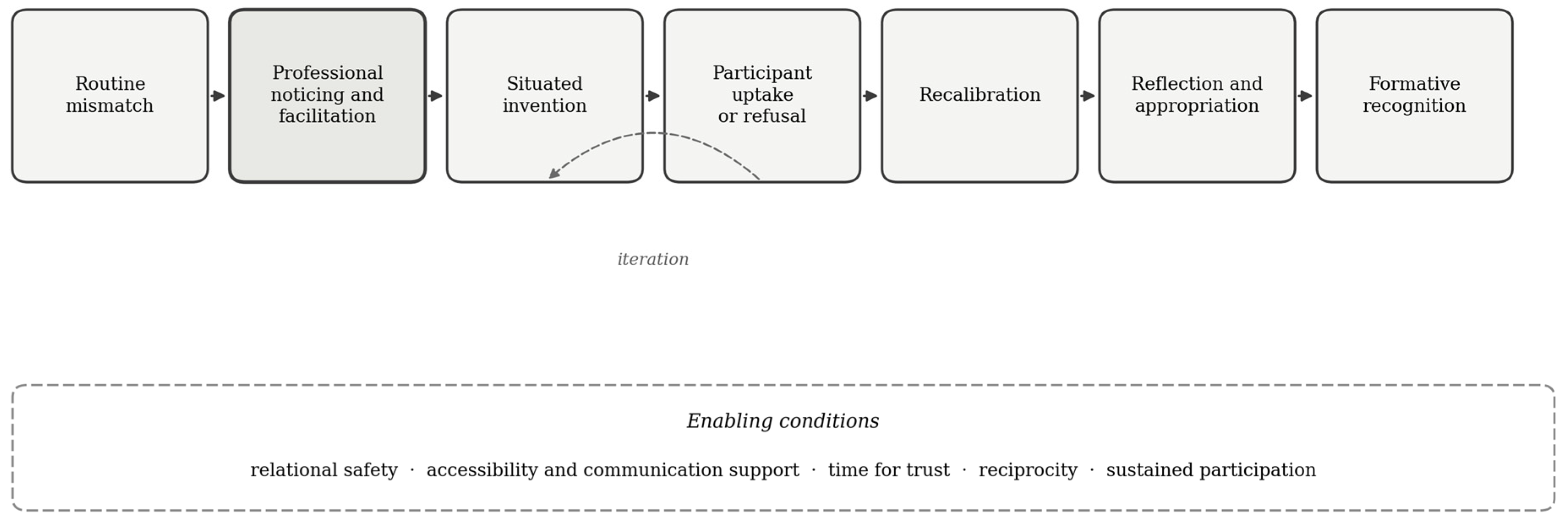

Disclaimer/Publisher’s Note: The statements, opinions and data contained in all publications are solely those of the individual author(s) and contributor(s) and not of MDPI and/or the editor(s). MDPI and/or the editor(s) disclaim responsibility for any injury to people or property resulting from any ideas, methods, instructions or products referred to in the content. |
© 2026 by the authors. Licensee MDPI, Basel, Switzerland. This article is an open access article distributed under the terms and conditions of the Creative Commons Attribution (CC BY) license.