


Abstract
Scientific literacy is widely recognised as a fundamental outcome of science education, yet little is known about how it is conceptualised, developed, and assessed in undergraduate science courses. This systematic quantitative literature review (SQLR) synthesised empirical studies published between 2015 and 2025 to examine: (1) how scientific literacy is conceptualised in undergraduate science courses, (2) the pedagogical, curricular, and assessment strategies used to develop scientific literacy, and (3) key trends and gaps in the literature. Following PRISMA 2020 guidelines, 15 empirical studies were identified from an initial pool of 333 records. First, substantial variation existed in how scientific literacy was conceptualised across the reviewed studies. Only three studies provided explicit conceptual definitions, while four operationalised scientific literacy through assessment instruments or measurable competencies and the remainder relied on implicit conceptualisations. Across these studies, scientific literacy was most associated with evidence evaluation, scientific reasoning, scientific communication, argumentation, interpretation of scientific literature, and credibility appraisal. Common pedagogical approaches included inquiry-based learning, course-based undergraduate research experiences, peer review, journal clubs, structured engagement with scientific literature, and socioscientific issues-based learning. Assessment practices included validated instruments, rubric-based evaluations, surveys, reflective journals, peer feedback, and self-report measures, although alignment between assessment approaches and conceptual definitions of scientific literacy was often limited. Key gaps in the literature included the underrepresentation of equity, intercultural perspectives, digital scientific literacy, and coherent assessment frameworks. The review highlights the need for greater alignment between conceptualisation, pedagogy, and assessment and suggests that scientific literacy in undergraduate science education is more commonly operationalised and enacted than explicitly defined.
1. Introduction
Scientific literacy is widely recognised as a foundational outcome of school science instruction generally, the achievement of which equips students to engage meaningfully with future science-related issues in personal, civic, and professional contexts (Bezci & Bircan, 2026; DeBoer, 2000; Kumar & Choudhary, 2025; OECD, 2020; Roessger & Greenleaf, 2025; Roy et al., 2025; Sjöström, 2025). With new global issues and challenges such as climate change, pandemics, artificial intelligence, and sustainability, students completing their science education must also gain the ability to critically evaluate and apply scientific evidence (Kisa & Kisa, 2024; Smith et al., 2023; Wineburg & McGrew, 2019), communicate scientific ideas effectively (Baldrich et al., 2025; Patil et al., 2021), and make ethically informed decisions in societal contexts (IPCC, 2023; Melisa et al., 2025; Redman & Wiek, 2021; Wiek et al., 2011). Scientific literacy is broadly understood as the capacity to understand and use scientific knowledge, evaluate evidence and scientific claims, communicate scientific ideas, and make informed decisions about science-related issues in personal and societal contexts (Baram-Tsabari & Osborne, 2015; Laugksch, 2000; Miller, 1983; Roberts & Bybee, 2014). Significant variation exists regarding the relative importance of these dimensions and how they should be enacted within science education. This will be discussed in the literature review section.
Higher education institutions play a pivotal role in continuing the development of students’ scientific literacy by not only focusing on expanding their conceptual and procedural knowledge within a particular science discipline but also extending their ability to engage confidently with science-related issues in professional and civic contexts (Baram-Tsabari & Osborne, 2015; OECD, 2019; Roberts & Bybee, 2014; Sjöström, 2025). Existing research in science education suggests that, despite its recognised importance, scientific literacy is not the central focus of planned and enacted teaching in undergraduate science courses, and is often poorly defined, unevenly prioritised, and inconsistently embedded within undergraduate science curricula (Baram-Tsabari & Osborne, 2015; Roberts & Bybee, 2014; Valladares, 2021). This lack of conceptual clarity and curricular coherence makes it difficult to determine how scientific literacy is being operationalised in practice, which pedagogical approaches are being used to support its implementation, and what evidence exists for its development in undergraduate science instruction. These gaps highlight the need for a focused synthesis of empirical research examining how scientific literacy is defined, taught, and assessed in undergraduate science programs.
Undergraduate university education represents a critical transition period during which students’ prior knowledge, epistemic beliefs, and emerging disciplinary identities intersect with new academic expectations (Limeri et al., 2020; Pintrich et al., 1993; Tinto, 2012). These expectations include increased demands for independent learning and self-regulation, which require students to monitor and manage their own learning processes more actively than in secondary schooling (Pintrich et al., 1993). They also require higher-order cognitive skills and engagement with disciplinary modes of reasoning, as undergraduate science learning increasingly prioritises analysis, evaluation, and scientific ways of thinking (Roberts & Bybee, 2014). Undergraduate science students are expected to develop proficiency in scientific communication, including reading, writing and explaining scientific ideas, while navigating fast-paced and conceptually demanding science curricula that differ substantially from secondary school norms (Limeri et al., 2020; Tinto, 2012).
1.1. Current Understandings of Scientific Literacy in Higher Education
Definitions of scientific literacy are underpinned by epistemological and ontological assumptions about the purpose of science education in rapidly evolving societies (Treagust & Won, 2023). These assumptions are increasingly shaped by conditions such as accelerated scientific and technological change, heightened public exposure to scientific claims and the need for citizens to understand and parse such claims, and growing uncertainty about whether science contributes to social benefit or harm (Osborne, 2023). Such conceptual positions directly influence what is prioritised in university science curricula, determining whether emphasis remains on content knowledge and laboratory skills, or extends to broader competencies such as evidence appraisal, argumentation, socio-scientific reasoning, and ethical awareness (Aikenhead, 2007). Recent scholarship highlights the challenge facing higher education in positioning scientific literacy in ways that foreground socio-scientific issues and enable students to apply scientific literacy competencies in responding to complex societal challenges (Zeidler & Sadler, 2023).
Scientific literacy also incorporates understandings about the Nature of Science (NOS), including how scientific knowledge is generated, evaluated, revised, and communicated within scientific communities (Lederman et al., 2014). NOS scholarship emphasises that scientific knowledge is both evidence-based and socially situated, shaped by empirical inquiry, peer review, disciplinary norms, and broader cultural influences. Understanding these epistemological and sociological dimensions is increasingly recognised as an important component of scientific literacy because it supports informed evaluation of scientific claims and engagement with complex socioscientific issues (Abd-El-Khalick & Lederman, 2023; McComas & Clough, 2020).
Three perspectives have influenced contemporary understandings of scientific literacy. Vision I focuses on disciplinary knowledge and scientific inquiry, Vision II emphasises the use of science in personal and societal decision-making, and Vision III extends scientific literacy towards ethical, socio-political, and sustainability-oriented engagement with complex global issues (Roberts & Bybee, 2014; Sjöström, 2025). The present review adopts Vision II as an analytical lens because its emphasis on evidence evaluation, scientific communication, argumentation, and informed decision-making aligns closely with the competencies most frequently associated with scientific literacy in undergraduate science education. While Vision III extends scientific literacy towards ethical, socio-political, sustainability, and transformative dimensions, these perspectives were less consistently represented across the empirical studies included in this review. Vision III is therefore acknowledged as an important extension of contemporary scientific literacy scholarship; however, for our study, Vision II is applied as the conceptual framework for examining the conceptualisations, pedagogical approaches, and assessment practices represented within the reviewed literature.
Miller (1983) proposed scientific literacy as a three-component framework comprising scientific content knowledge, understanding of scientific processes, and engagement with science-related public issues. Laugksch (2000) extended this conceptual definition of scientific literacy by foregrounding informed decision-making and civic participation. The Programme for International Student Assessment (PISA) has played an influential role in shaping contemporary understandings of scientific literacy. The PISA 2018 Science Framework defined scientific literacy as students’ capacity to engage with science-related issues and ideas as reflective citizens using scientific knowledge, explanation of phenomena, and evaluation of evidence (OECD, 2019). More recently, the PISA 2025 Science Framework broadened this perspective by placing greater emphasis on critical evaluation of scientific information, decision-making and action, science identity, and environmental science competencies, reflecting evolving expectations of science education in contemporary societies (OECD, 2025). Drawing on the recurring competencies identified across the reviewed studies and informed by a Vision II perspective, this review conceptualises scientific literacy as students’ capacity to use scientific knowledge and practices to interpret phenomena, evaluate evidence and scientific inquiry, and communicate scientific ideas in real-world contexts, enabling informed participation in societal and civic decision-making (Laugksch, 2000; Osborne, 2023; Roberts & Bybee, 2014; Valladares, 2021).
Despite its centrality within school science education, there is growing concern that scientific literacy is not being systematically or effectively developed within undergraduate science programs (Baram-Tsabari & Osborne, 2015; Roberts & Bybee, 2014; Valladares, 2021). Studies indicate that many undergraduate students struggle to apply scientific knowledge beyond disciplinary contexts, particularly when required to evaluate evidence, interpret conflicting information, or engage with socio scientific reasoning (Lombardi et al., 2016; Norris & Phillips, 2003; Osborne, 2010). For example, research on undergraduate reasoning has shown that students often rely on surface-level cues or prior beliefs rather than disciplinary evidence when evaluating scientific claims, limiting their capacity for critical engagement with complex issues (Lombardi et al., 2016; Wineburg & McGrew, 2019). Studies examining undergraduate students’ engagement with primary scientific literature demonstrate persistent difficulties in interpreting methodology, assessing validity, and synthesising findings, even in later years of study (Hoskins et al., 2011). These challenges suggest that scientific literacy does not develop implicitly through exposure to content-heavy curricula alone but requires explicit and sustained instructional focus.
Addressing this gap represents an important step towards understanding whether there is conceptual coherence between theoretical discussions of scientific literacy and its implementation within higher education. Compounding this issue, there is evidence that undergraduate science curricula remain heavily oriented towards disciplinary content coverage and summative assessment practices, with comparatively limited alignment to broader scientific literacy competencies such as argumentation, evidence evaluation, and communication (Roberts & Bybee, 2014; Valladares, 2021). Assessment tasks frequently prioritise recall and procedural knowledge over higher-order reasoning, making it difficult to capture the multidimensional nature of scientific literacy and to provide robust evidence of student learning (National Research Council, 2012; Sadler & Zeidler, 2009). As a result, the development of scientific literacy is often assumed to be a by-product of instruction, rather than conceptualised as a learning outcome that needs to be explicitly defined, planned for, and assessed within courses, leading to variability in how it is operationalised across programs and institutions. This disconnect between conceptual intention and classroom practice creates challenges for undergraduate science, as it undermines the capacity to ensure that graduates are equipped with the critical, evaluative, and communicative skills required to engage with science in contemporary society.
1.2. School-Based Scientific Literacy Research
In contemporary science education, scientific literacy is often represented through a suite of competencies rather than a single discrete capability. These competencies commonly include understanding scientific concepts, interpreting data, evaluating evidence, understanding scientific inquiry, engaging in argumentation, communicating scientific ideas, and applying scientific knowledge to personal, civic, and societal issues (ACARA, 2022; OECD, 2019; Roberts & Bybee, 2014). Consequently, many empirical studies infer scientific literacy through the assessment of one or more of these competencies rather than through direct measurement of a single agreed construct.
Research on scientific literacy has been dominated by studies conducted in primary and secondary school settings. Large-scale empirical studies, systematic reviews, meta-analyses, and international assessment frameworks such as PISA have examined how scientific literacy develops through inquiry-based learning, socio-scientific issues (SSI), argumentation, and science curriculum reform (Arifin et al., 2025; OECD, 2019). This body of work has consistently associated scientific literacy with competencies such as scientific reasoning, evidence evaluation, argumentation, problem solving, and informed decision-making in science-related contexts (ACARA, 2022; Karaman Türk & Çam, 2025). More recently, researchers have developed and validated PISA-aligned instruments to measure scientific literacy competencies across secondary schooling, providing opportunities for system-level monitoring and international comparison (Baltikian et al., 2024; Zhang et al., 2023). These studies have contributed substantially to understanding how scientific literacy develops in K-12 settings and how it may be assessed.
1.3. Nature of Scientific Literacy in Undergraduate Science Courses
Research indicates that undergraduate students often struggle to apply disciplinary knowledge in ways that align with broader scientific literacy competencies, particularly in relation to evaluating evidence, constructing arguments, and engaging with uncertainty (Lombardi & Sinatra, 2012; Nussbaum, 2011). Difficulties are also evident in students’ engagement with primary scientific literature, a key component of scientific literacy in university contexts. Studies show that undergraduate students often experience challenges in interpreting research methods, understanding the structure of scientific arguments, and evaluating the validity of findings, even when they have strong disciplinary knowledge (Hoskins et al., 2011; Phillips & Norris, 2009).
Traditional lecture-based teaching and assessment practices tend to emphasise recall and procedural problem-solving, with limited opportunities for students to engage in authentic scientific practices such as argumentation, critical evaluation of evidence, and communication of scientific ideas (Freeman et al., 2014; Michael, 2006). Graduate capabilities in higher education extend beyond disciplinary knowledge to include critical thinking, problem-solving, communication, and ethical reasoning, competencies that are closely aligned with scientific literacy (Murphy et al., 2025; Oliver & Jorre de St Jorre, 2018). Higher education policy frameworks in a range of countries increasingly expect graduates to demonstrate disciplinary knowledge alongside the capacity to apply that knowledge in real-world contexts, engage in critical thinking, communicate effectively, and contribute to society. These expectations align closely with contemporary interpretations of scientific literacy as a graduate capability extending beyond disciplinary content knowledge (Oliver & Jorre de St Jorre, 2018; Roberts & Bybee, 2014).
Assessing scientific literacy remains challenging because the construct is commonly described as multidimensional, encompassing scientific knowledge, evidence evaluation, communication, argumentation, and socio-scientific reasoning (National Research Council, 2012; OECD, 2019). Existing scholarship has questioned whether traditional assessment approaches adequately capture these broader competencies (Pellegrino, 2017; Sadler & Zeidler, 2009).
1.4. Research Questions
This Systematic Quantitative Literature Review (SQLR) has three interrelated aims:
RQ1: How is the construct of “scientific literacy” conceptualised in undergraduate science courses? This question considers whether scientific literacy is articulated explicitly or implicitly, which competency domains are foregrounded (e.g., the abilities to interpret phenomena, evaluate evidence and inquiry, and communicate scientific ideas in real-world contexts). Mapping these definitional patterns enables the review to assess the coherence, or lack thereof, between how scientific literacy is understood in undergraduate science education.
RQ2: What are the pedagogical, curricular, and assessment strategies used to develop scientific literacy? This question focuses on undergraduate science students and examines how scientific literacy is intentionally embedded, or in some cases only partially embedded, within teaching approaches, course structures, and evaluation methods.
RQ3: What are the trends and gaps in the literature, with the purpose of informing curriculum design and teaching practice in higher education? This question aims to explore broader patterns across the literature to identify which aspects of scientific literacy are consistently supported by empirical evidence, and where persistent gaps, omissions, or conceptual inconsistencies remain. This synthesis highlights which elements of scientific literacy are well represented in undergraduate science education and which remain underdeveloped.
2. Methodology and Methods
This review was informed by the Systematic Quantitative Literature Review (SQLR) approach described by Pickering and Byrne (2014), which emphasises systematic identification, classification, and quantitative description of literature to reveal trends, patterns, and research gaps within a field. SQLR was considered appropriate because the review sought not only to synthesise findings but also to quantify and compare how scientific literacy was conceptualised, taught, assessed, and represented across the included studies. Consistent with this approach, descriptive quantitative analyses were used to examine study characteristics, conceptualisations of scientific literacy, thematic emphases, pedagogical approaches, assessment practices, and geographical distributions before these findings were interpreted through narrative synthesis.
2.1. Design of the Systematic Review
The PRISMA 2020 (Preferred Reporting Items for Systematic Reviews and Meta-Analyses) guidelines were followed for transparent identification, screening, eligibility, and inclusion of studies (Page et al., 2021). The review was not prospectively registered in PROSPERO, OSF, or another formal review registry. This SQLR explored empirical studies published between 2015 and 2025 to examine how scientific literacy has been conceptualised, operationalised, taught, and assessed in undergraduate science education. This timeframe was selected to capture contemporary developments in scientific literacy research following growing emphasis on science-in-society perspectives, scientific communication, and informed citizenship (Baram-Tsabari & Osborne, 2015; Osborne, 2023; Roberts & Bybee, 2014). The period also coincides with increasing adoption of active-learning pedagogies and authentic research experiences in undergraduate science education, including inquiry-based learning and course-based undergraduate research experiences (Auerbach & Schussler, 2017; Freeman et al., 2014). Focusing on the most recent decade therefore enabled the review to examine how scientific literacy is currently being conceptualised and enacted within contemporary undergraduate science programs.
The review focused on undergraduate science students in higher education. The included studies represented a range of year levels, including first-year, intermediate, advanced, and honours-level cohorts. Adopting this broader population criterion ensured that the review accurately reflected the available empirical literature and maintained consistency between the inclusion criteria, research questions, and findings. A Vision II perspective (Roberts & Bybee, 2014) was adopted as an a priori analytical framework to guide interpretation of the findings of this review, particularly in relation to science-in-society competencies such as evidence evaluation, communication, and informed decision-making. The included studies were not required to explicitly adopt Vision II; rather, the framework was used retrospectively to support cross-study analysis and interpretation.
2.2. Search Strategy
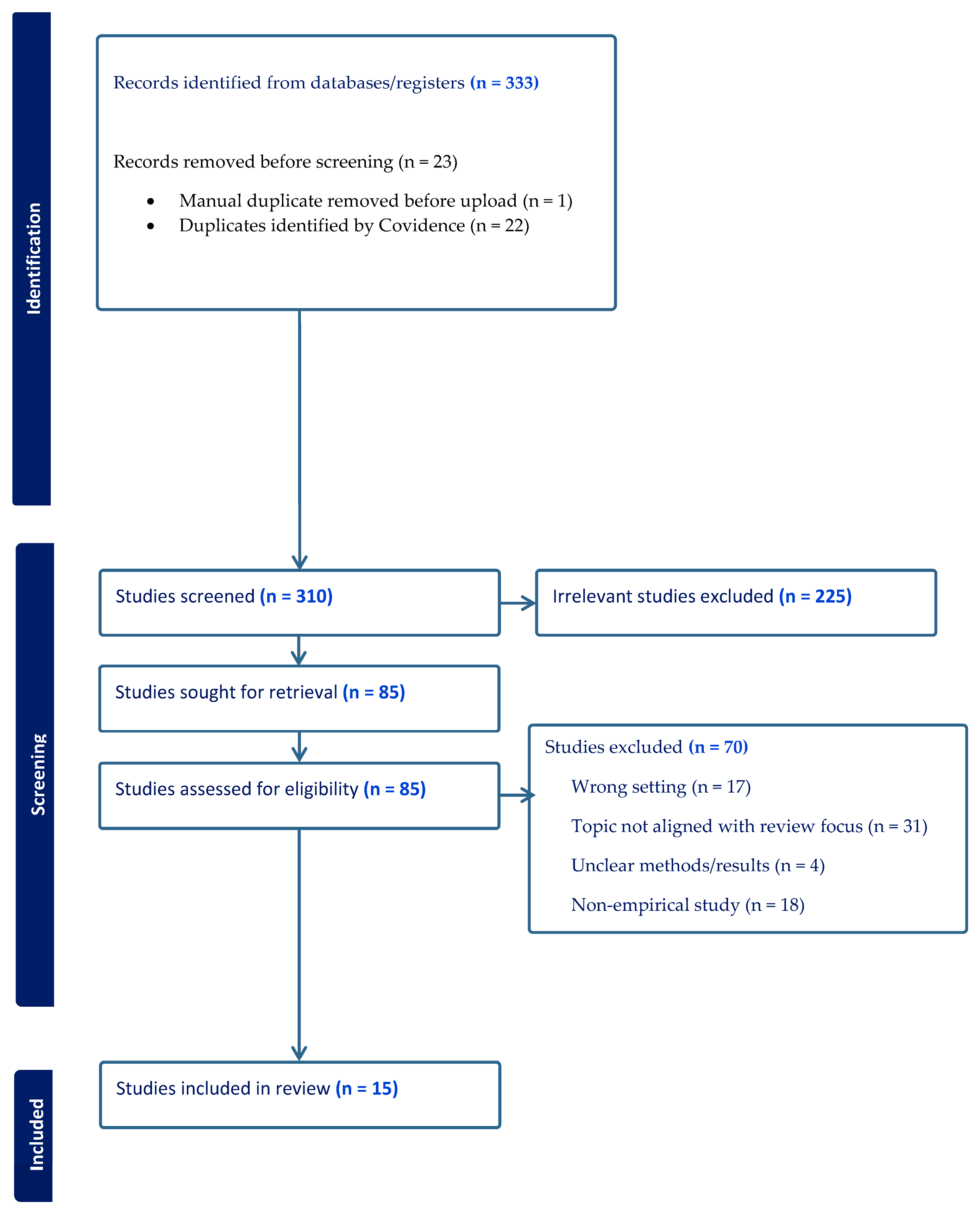
A multi-stage search was conducted on 7 July 2025 across ERIC, ProQuest Education, and Scopus. Searches were designed to balance specificity with breadth by grouping keywords into five conceptual blocks including Concept, Population, Context, Filters, and Exclusion (see Table 1). Searches across Scopus, ERIC, and ProQuest Education identified 333 records (Primary Dataset is included in Supplementary Files S2–S4). One duplicate record from Scopus was removed manually prior to import into Covidence, resulting in 332 records entering the Covidence screening workflow. Covidence subsequently identified 22 duplicate records, leaving 310 records for title and abstract screening. Database-specific search strategies were developed for Scopus, ERIC, and ProQuest Education, with the full search strings reported in Supplementary File S1. A sample Boolean search string used across each of the search engines was: (“scientific literacy” OR “science literacy”) AND (“undergraduate” OR “university science”) AND (“science education”) (Table 1).
Table 1.
Five Conceptual Blocks of the Keywords.
2.3. Inclusion and Exclusion Criteria
The PICOS framework (Amir-Behghadami & Janati, 2020) was applied as follows for the inclusion and exclusion criteria (Table 2). A completed PRISMA 2020 Checklist (Page et al., 2021) has been included as Supplementary File S5.
Table 2.
PICOS Element, Inclusion and Exclusion Criteria.
2.4. Screening and Selection
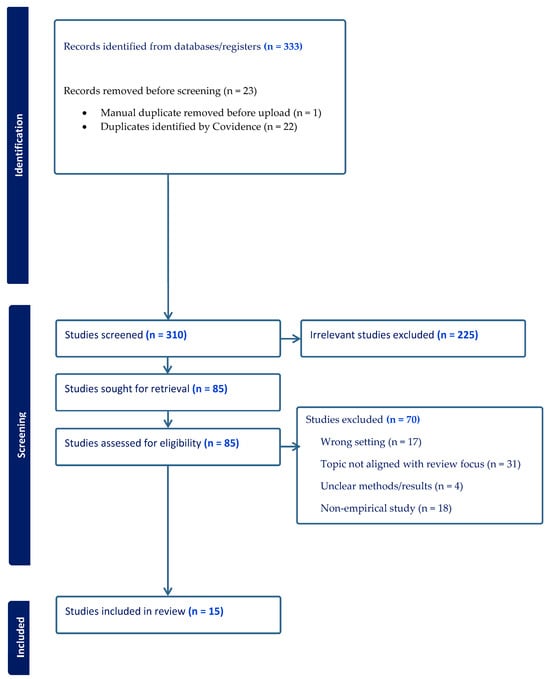
Search results were imported into Covidence for screening and eligibility assessment. As shown in Figure 1, 332 records entered the Covidence review workflow. One duplicate record was identified manually, and a further 21 duplicate records were identified by Covidence. Following duplicate removal and screening procedures, 310 records were screened, 85 full-text articles were assessed for eligibility, and 15 studies met the inclusion criteria and were included in the review. During full-text screening, studies were excluded when the construct under investigation focused primarily on science achievement, disciplinary content knowledge, or science literacy without reference to broader scientific literacy competencies. Search terms included both “scientific literacy” and “science literacy” to maximise retrieval sensitivity; however, inclusion decisions were based on conceptual alignment with contemporary understandings of scientific literacy rather than keyword usage alone.
Figure 1.
PRISMA Flow Chart.
Two expert reviewers (with PhD qualifications) independently screened records against the eligibility criteria within Covidence. No formal conflicts were recorded in Covidence, and any differences in interpretation were resolved through verbal discussion and consensus. Formal inter-rater reliability statistics were not calculated. Raw data was subsequently downloaded from Covidence to Excel for extraction and thematic coding. Data were subsequently reviewed by the research team, with coding decisions and framework refinements discussed to enhance consistency and transparency.
2.5. Data Extraction and Analytical Framework
Data were systematically extracted from Covidence and moved to a Microsoft ExcelTM spreadsheet using a structured coding framework. Extracted variables included study characteristics (year, country, discipline), participant characteristics, definitions and operationalisations of scientific literacy, pedagogical approaches, assessment methods, and reported learning outcomes. Coding was conducted iteratively, combining deductive categories informed by the Vision II framework with inductive refinement based on patterns emerging across studies. Activities related to the final literature search, screening, title and abstract review, full-text assessment, quality control, and descriptive analysis of the selected articles were conducted between February and June 2026. A narrative synthesis approach was adopted to accommodate the multidimensional nature of the research questions and the diversity of study designs included in this review. This approach permitted the integration of findings across heterogeneous methodologies by summarising study results and explaining patterns and relationships within the data (Gough et al., 2017; Popay et al., 2006). The review uses the Vision II conceptualization of Science Literacy as an analytical framework which conceptualises scientific literacy as related to or impacting science-in-society (Vision II; Roberts and Bybee, 2014).
The analytical framework presented in Table 3 was developed a priori from the Vision II scientific literacy literature, the review questions, and broader conceptual scholarship on scientific literacy. The framework comprised eight themes relating to definitions and conceptions, curriculum and pedagogy, assessment, collaboration, educational technology, critical thinking, socioscientific issues, and equity and inclusion. During data extraction, the framework was applied deductively and refined iteratively to accommodate recurring patterns identified across the included studies. Consequently, the analysis adopted a hybrid deductive-inductive approach, combining pre-established categories informed by theory with insights emerging from the empirical literature. Coding decisions and framework refinements were reviewed and discussed among the research team to ensure consistency throughout the analytical process.
Table 3.
Vision II-Informed Analytical Framework Used to Examine Scientific Literacy Studies.
2.6. Classification of Scientific Literacy Representations
Given the well-documented lack of consensus surrounding scientific literacy (Laugksch, 2000; Roberts & Bybee, 2014; Valladares, 2021), an analytical classification framework was developed to support comparison across the included studies. The framework was designed to distinguish between studies that explicitly defined scientific literacy, studies that operationalised scientific literacy through instruments or measurable outcomes, and studies in which scientific literacy was implied through pedagogical goals or learning outcomes. The framework was used to guide analysis of the included studies and is applied in the Results section. This approach aligns with methodological guidance on distinguishing between conceptual and operational definitions (Kerlinger & Lee, 2000) and with systematic review practices that emphasise transparent classification of conceptual heterogeneity (Popay et al., 2006). Three categories were identified as follows and described in Table 4.
Table 4.
Distribution of 15 reviewed studies across eight key themes in scientific literacy research.
- Explicit Definition
Studies in this category provided a clear conceptual definition or theoretical framing of scientific literacy, often drawing on established literature or adapting the construct to a specific domain such as digital or media scientific literacy. These studies explicitly articulated what constituted scientific literacy and used this definition to inform the design of learning activities, curriculum interventions, or assessment approaches.
- 2.
- Explicit Operationalisation
Studies in this category did not provide a comprehensive conceptual definition of scientific literacy but operationalised the construct through clearly identified competencies, learning outcomes, or assessment instruments. Scientific literacy was treated as a measurable construct through tools such as the Test of Scientific Literacy Skills (TOSLS) or other validated measures. For example, Lee et al. (2022) operationalised scientific literacy through students’ use of reading strategies when engaging with primary scientific literature, including summarising, questioning, monitoring understanding, and critically evaluating evidence. In these studies, scientific literacy was primarily represented through observable competencies rather than an explicitly articulated definition.
- 3.
- Implicit–Explicit Boundary
Studies in this category demonstrated characteristics of both explicit operationalisation and implicit conceptualisation. Scientific literacy was not formally defined, but the study included sufficiently detailed descriptions of competencies, outcomes, or educational aims that clearly signalled an underlying conceptualisation of scientific literacy. These studies occupied an intermediate position between explicit measurement and implicit representation of the construct.
- 4.
- Implicit Conceptualisation
Studies in this category neither defined nor explicitly operationalised scientific literacy. Instead, scientific literacy was inferred from broader pedagogical goals, course objectives, or educational practices such as inquiry-based learning, argumentation, disciplinary communication, scientific reasoning, or participation in research activities. In these cases, scientific literacy functioned as an assumed or background outcome of instruction. Examples include studies such as Goodwin et al. (2023) and Otto et al. (2023), where scientific literacy was inferred through engagement with scientific practices including journal clubs, peer review, and disciplinary communication rather than being explicitly defined.
3. Results and Discussion
The final dataset comprised 15 studies published between 2017 and 2025 that examined scientific literacy in undergraduate science education. The studies focused on scientific literacy via scientific reasoning and evidence evaluation (Auerbach & Schussler, 2017; Brendel et al., 2025), reading and interpreting scientific literature (Goodwin et al., 2023; Lee et al., 2022), scientific communication and peer review (Howitt et al., 2024; Otto et al., 2023), credibility appraisal and media literacy (Archila et al., 2021; Zaboski & Therriault, 2020), socio-scientific argumentation (Archila et al., 2023; Archila et al., 2025), and digital scientific literacy (Holincheck et al., 2022). Consequently, the reviewed studies were not simply measuring students’ science knowledge but a broader range of competencies that researchers associated with scientific literacy. The evidence base was geographically concentrated, with most studies conducted in North America (n = 9), followed by South America (n = 3), Asia (n = 2), and one cross-national study involving institutions in the United States and Mexico. This distribution suggests that current understandings of scientific literacy are largely informed by Western higher education contexts, with relatively limited representation from other regions.
The studies spanned a diverse range of undergraduate science disciplines and cohorts, including biology, biochemistry, chemistry, environmental science, engineering, and broader STEM programs. Participants ranged from first-year undergraduates through to senior and honours-level students, with sample sizes varying considerably, from small qualitative cohorts to large multi-institutional studies involving more than 300 participants. Methodologically, the literature was dominated by mixed-methods and quantitative approaches, with comparatively fewer qualitative or experimental studies. Rather than measuring science knowledge alone, the reviewed studies examined a broad range of scientific-literacy-related competencies, including evidence evaluation, reasoning, communication, argumentation, interpretation of scientific literature, and credibility appraisal (Table 4). Future research could employ qualitative and longitudinal designs to examine how undergraduate students understand, experience, and develop scientific literacy over time, thereby providing richer insights into the meanings that students and educators attach to the construct.
A central finding of this study was that scientific literacy remains a widely valued yet inconsistently defined construct. Although all studies positioned scientific literacy, either explicitly or implicitly (Table 4), as an important educational outcome, there was little consensus regarding what scientific literacy entails, how it should be developed, or how it should be assessed. Instead, scientific literacy was commonly associated with competencies such as evidence evaluation, scientific reasoning, data interpretation, argumentation, communication, and engagement with scientific information (Table 4). As a result, scientific literacy was often assumed, enacted, or measured rather than explicitly conceptualised. This finding has important implications for higher education because it suggests that the field has made considerable progress in developing pedagogical approaches intended to support scientific literacy while remaining less certain about the construct itself. The results that follow therefore examine how scientific literacy was conceptualised and enacted, the pedagogical and assessment approaches used to support its development, and the major trends and gaps emerging from empirical literature.
RQ1: How is the construct of “scientific literacy” conceptualised in undergraduate science courses?
Many studies appeared to assume a shared understanding of scientific literacy without explicitly defining the construct. As summarised in Table 4, only three of the 15 reviewed studies provided explicit conceptual definitions of scientific literacy (Chambers et al., 2019; Archila et al., 2021; Holincheck et al., 2022), while four studies explicitly operationalised scientific literacy through instruments or measurable competencies without providing a comprehensive definition (Auerbach & Schussler, 2017; Lee et al., 2022; Wu & Wu, 2024; Brendel et al., 2025). Two studies occupied an implicit-explicit boundary position (Archila et al., 2023; Archila et al., 2025), and the remaining six studies relied on implicit conceptualisations of scientific literacy. Scientific literacy was frequently operationalised through competencies, assessment instruments, or pedagogical approaches, yet the conceptual basis for these choices was often unstated. Consequently, researchers may have been investigating different dimensions of scientific literacy while using the same terminology, making comparison across studies difficult and contributing to ongoing conceptual ambiguity within undergraduate science education. When definitions were provided, they were typically domain-specific rather than holistic, such as utilitarian scientific literacy (Chambers et al., 2019), digital scientific literacy (Holincheck et al., 2022), or scientific media literacy (Archila et al., 2021).
Explicit operationalisation through assessment instruments was more common than explicit theorisation. Several widely cited studies operationalised scientific literacy through validated tools, most notably the Test of Scientific Literacy Skills (TOSLS) (Auerbach & Schussler, 2017; Brendel et al., 2025), or through structured instruments targeting reading strategies, credibility judgements, or reasoning processes (Lee et al., 2022; Zaboski & Therriault, 2020). In these cases, scientific literacy was effectively defined by what the instruments measured, capturing competencies such as data interpretation, evaluation of evidence, and critical appraisal of claims. While this approach supported comparability and quantification, it also narrowed the operational boundaries of scientific literacy to assessable cognitive skills. Implicit conceptualisation dominated pedagogy-focused studies. Many curriculum- and intervention-based studies embedded scientific literacy within specific learning activities without explicitly defining the construct. For example, Goodwin et al. (2023) used a CREATE(S)-based journal club model to develop students’ ability to analyse and discuss primary scientific literature, Otto et al. (2023) employed authentic preprint peer-review activities to promote disciplinary literacy and scientific communication, and Wu and Wu (2024) implemented an interest-oriented CURE designed to strengthen scientific reasoning, problem solving, and scientific process skills. Although these studies targeted competencies commonly associated with scientific literacy, none provided a detailed conceptual definition of scientific literacy itself. In these cases, scientific literacy was assumed to emerge through participation in authentic scientific practices. While such approaches aligned strongly with practice-based and disciplinary views of science learning, the absence of explicit conceptual framing limited clarity about which dimensions of scientific literacy were being intentionally targeted or assessed. This finding is consistent with longstanding observations that scientific literacy remains conceptually contested (Laugksch, 2000; Roberts & Bybee, 2014; Valladares, 2021). However, the present review extends this literature by demonstrating that conceptual ambiguity persists within contemporary empirical undergraduate science education research.
RQ2: What are the pedagogical, curricular, and assessment strategies used to develop scientific literacy?
The most common research focus was scientific literacy linked with curriculum/pedagogy (6 of 15 reviewed studies), including studies that applied the Vision-and-Change curriculum alignment and course-level redesigns (Auerbach & Schussler, 2017; Wu & Wu, 2024). Vision and Change in Undergraduate Biology Education is a major international reform initiative launched by the American Association for the Advancement of Science (AAAS), in partnership with the U.S. National Science Foundation (NSF), beginning in 2007 (AAAS, 2011). The Vision and Change initiative arose from the recognition that undergraduate science curricula in the 21st Century need to move beyond just content coverage and prepare students to be able to successfully engage with scientific issues in society (AAAS, 2011). Communication and literacy practices (4 of 15) comprising the second cluster, covering textual analysis (focuses on close reading and interpretation of text, in terms of its language, structure and meaning), media literacy (students’ ability to critique science as it appears in the media), digital literacy (student engagement with scientific information, tools, and communities), and academic writing (formal, evidence-based communication practices through which learners analyse, construct, and communicate knowledge, supporting disciplined reasoning and participation in scholarly communities) (Archila et al., 2021; Zaboski & Therriault, 2020). Skills development/retention (3 of 15) included studies reporting short-term scientific literacy skill gains and/or follow-up retention checks (Archila et al., 2025; Brendel et al., 2025). Specific pedagogical interventions (2 of 15) included drama-based learning and structured peer-review training (Archila et al., 2023; Otto et al., 2023).
Several recurring learning interventions were identified that were associated with the development of scientific-literacy-related competencies among undergraduate students. At the curriculum level, the work of Auerbach & Schussler (2017) shows that aligning curricula with Vision and Change was associated with scientific literacy outcomes. Other key pedagogical interventions included teaching models where students were provided with collaborative learning environments (e.g., journal clubs) where students were able to engage with the scientific content in a visual manner led by peer-to-peer engagement in the scientific discussions (Goodwin et al., 2023; Goto and Gutierrez-Gomez, 2024; Howitt et al., 2024), and critical scientific literature reading abilities (Archila et al., 2025). Active learning and development of scientific literacy skills were associated with higher reported performance (Brendel et al., 2025). Providing students with learning opportunities to understand the basics of scientific communication through structured peer review of scientific literature and research-based learning opportunities was associated with scientific-literacy-related outcomes (Wu & Wu, 2024; Wang et al., 2022; Otto et al., 2023). Other emerging interventions for scientific literacy skills included expert-like reading strategies (Lee et al., 2022), digital scientific literacy (Holincheck et al., 2022), pseudoscientific texts (Zaboski & Therriault, 2020), drama-based argumentation of real-world issues (Archila et al., 2023) and scientific media literacy (Archila et al., 2021).
Self-efficacy-related outcomes (or closely related perceptions) were reported following a first-year utilitarian scientific literacy course by Chambers et al. (2019) and undergraduate preprint peer-review participation by Otto et al. (2023). Retention outcomes were reported in the flipped-classroom study via TOSLS at a 4-month delay (Brendel et al., 2025). Writing-related observations in a qualitative study indicated challenges with disciplinary conventions and genre expectations in an undergraduate research-writing context (Howitt et al., 2024). Finally, credibility-perception studies addressed media/news and pseudoscience: one TLS examined students’ evaluation of sensationalised or misleading science news (Archila et al., 2021), and an experimental study tested how references and credentials altered perceived scientificness and credibility of pseudoscientific texts (Zaboski & Therriault, 2020). These findings indicate that pedagogical strategies are primarily aligned with active and authentic learning approaches, with assessment practices increasingly attempting to capture higher-order scientific literacy skills, although alignment remains inconsistent across studies.
Despite considerable variation in how scientific literacy was defined, a degree of convergence emerged regarding the competencies that researchers sought to develop and assess. Across the reviewed studies, scientifically literate undergraduates were expected to evaluate evidence, interpret data, reason scientifically, critically engage with scientific literature, communicate scientific ideas, construct evidence-based arguments, assess information credibility, and apply scientific knowledge to real-world and socio-scientific issues (Table 4). These recurring competencies suggest that greater agreement exists regarding the attributes of scientifically literate graduates than regarding the formal definition of scientific literacy itself. The reviewed studies varied considerably in the extent to which they aligned with this working definition.
A notable finding across the reviewed studies was the diversity of assessment approaches used to evaluate scientific literacy. Assessment practices ranged from validated instruments such as the Test of Scientific Literacy Skills (TOSLS), Digital Scientific Literacy Questionnaire (DSLQ), and Personal Science Literacy strategy scales to rubric-based evaluations, self-report surveys, peer-review artefacts, reflective journals, and authentic research outputs. Despite this diversity, relatively few studies demonstrated clear alignment between their conceptualisations of scientific literacy and the assessment methods used to evaluate it. Several studies operationalised scientific literacy through disciplinary competencies or pedagogical outcomes without clearly explaining how those competencies corresponded to their underlying conceptual definitions. This suggests that assessment remains one of the least developed and least coherent dimensions of scientific literacy research within undergraduate science education. From a Vision II perspective, scientific literacy assessment should extend beyond factual recall to evaluate students’ capacity to interpret evidence, communicate scientific ideas, engage with socioscientific issues, and apply scientific reasoning in real-world contexts. While several studies adopted assessments consistent with these broader goals, the overall evidence base revealed considerable variation in assessment design and purpose. The lack of conceptual and assessment alignment suggests that progress in scientific literacy pedagogy has not always been matched by comparable advances in assessment practice (Roberts & Bybee, 2014).
RQ3: What are the thematic trends and gaps in the literature, with the purpose of informing curriculum design and teaching practice in higher education?
Results addressing Research Question 3 were synthesised using the Vision II-aligned thematic framework presented earlier in Table 3, enabling identification of cross-cutting trends and gaps across the dataset. Across the reviewed studies, there is a consistent emphasis on the development of applied scientific literacy competencies, particularly with targets related to evidence evaluation, argumentation, and scientific communication. These competencies were most supported through pedagogical strategies such as inquiry-based learning, course-based undergraduate research experiences, and structured engagement with scientific literature, reflecting a strong alignment with Vision II principles of science-in-society learning.
Several important gaps were identified including lack of conceptual coherence across studies in the definitions of scientific literacy, with many failing to explicitly define scientific literacy or to align conceptual definitions with pedagogical and assessment practices. There is limited attention to emerging contexts of scientific literacy, particularly in relation to digital environments, artificial intelligence, and platform-mediated information, indicating a potential “digital futures” gap in the literature. While some studies engage with socio-scientific issues, these are not systematically integrated across curricula, and there is little exploration of disciplinary variation in how such issues are addressed. Issues of equity, inclusion, and global perspectives remain underrepresented. Few studies explicitly consider how scientific literacy is shaped by sociocultural, linguistic, or socioeconomic factors, particularly for diverse student populations. This is notable given the emphasis within Vision II on inclusive and participatory engagement with science in society. Assessment also emerged as a recurring challenge across literature. As discussed in RQ2, considerable variation existed in the assessment approaches used to evaluate scientific literacy, reflecting broader concerns regarding alignment between conceptualisations of scientific literacy and the tools used to measure it (National Research Council, 2012; Pellegrino, 2017; Sadler & Zeidler, 2009).
Limitations
This review should be interpreted considering some limitations. First, the search was restricted to three databases (Scopus, ERIC, and ProQuest Education), which may have excluded relevant studies indexed elsewhere. Second, only English-language publications were included, potentially limiting representation of scientific literacy research conducted in non-English-speaking contexts. Third, while journal quality indicators were reviewed following study selection, the review did not undertake a formal quality appraisal using instruments such as the Mixed Methods Appraisal Tool (MMAT) or Joanna Briggs Institute (JBI) critical appraisal tools. Consequently, findings should be interpreted as a synthesis of patterns and trends within literature rather than an evaluation of methodological quality.
A further limitation concerns the composition of the evidence base. Only 15 studies met the inclusion criteria, reflecting the relatively limited body of empirical research examining scientific literacy in undergraduate science education. In addition, the literature was geographically concentrated, with most studies originating from North America and relatively limited representation from Europe, Africa, Oceania, and other regions. Consequently, the findings may reflect regional priorities, curriculum traditions, and higher education contexts rather than representing the full diversity of global scientific literacy research.
Finally, database searching occurred on 7 July 2025, while screening, coding, and analysis were completed between February and June 2026. Consequently, any studies published in the intervening six-month period are not represented. These limitations do not diminish the value of the review but should be considered when interpreting the findings and their transferability to other contexts.
4. Conclusions
This review examined how scientific literacy is conceptualised, taught, assessed, and represented within empirical undergraduate science education research. Three key findings emerged. practices. First, the reviewed studies represented scientific literacy in different ways, with explicit conceptual definitions appearing infrequently. Second, recurring attention was given to competencies such as evidence evaluation, reasoning, communication, and engagement with scientific information and practices. Third, assessment approaches varied considerably across studies and showed differing levels of alignment with the conceptualisations of scientific literacy underlying the research.
4.1. Implications for Developing Scientific Literacy in Undergraduate Science Courses
The findings reinforce longstanding concerns that scientific literacy remains conceptually fragmented despite its prominence within science education scholarship and policy (Laugksch, 2000; Roberts & Bybee, 2014; Valladares, 2021). Although scientific literacy is widely promoted as an important graduate outcome, there remains limited agreement regarding how it should be defined, operationalised, developed, or assessed within undergraduate science programs (Baram-Tsabari & Osborne, 2015; Osborne, 2023; Valladares, 2021).
The pedagogical approaches identified in this review, including inquiry-based learning, course-based undergraduate research experiences (CUREs), peer review, scientific communication, and socioscientific issues-based learning, align strongly with Vision II conceptions of scientific literacy that emphasise evidence evaluation, communication, and informed participation in science-related issues (Baram-Tsabari & Osborne, 2015; Roberts & Bybee, 2014). However, the review suggests that greater coherence is needed between conceptual definitions, curriculum design, pedagogical implementation, and assessment practices.
Assessment represented one of the least coherent dimensions of the literature, with substantial variation in assessment approaches and limited alignment between conceptualisations of scientific literacy and assessment practices. This finding is consistent with broader concerns regarding the assessment of multidimensional competencies such as argumentation, evidence evaluation, scientific communication, and socioscientific reasoning (National Research Council, 2012; Pellegrino, 2017; Sadler & Zeidler, 2009).
4.2. Future Research Directions
Several priorities for future research emerged from this review. First, future scholarships should seek to develop and evaluate higher education-specific conceptualisations of scientific literacy that align definitions, learning outcomes, pedagogy, and assessment. Such work may help address the conceptual ambiguity identified repeatedly within the scientific literacy literature (Laugksch, 2000; Roberts & Bybee, 2014; Valladares, 2021).
Second, greater attention should be given to equity, inclusion, intercultural perspectives, digital scientific literacy, and Global South contexts, all of which were underrepresented within the reviewed literature. Expanding scientific literacy research across diverse social, cultural, linguistic, and educational contexts may provide a more comprehensive understanding of how scientific literacy develops in higher education environments (Sjöström, 2025; Valladares, 2021).
Third, future studies should continue exploring how scientific literacy prepares graduates to engage with emerging societal challenges, including sustainability, climate change, artificial intelligence, misinformation, and other complex socioscientific issues. Such challenges increasingly require graduates who can critically evaluate evidence, communicate effectively, and make informed decisions in uncertain and rapidly changing contexts (Osborne, 2023; Sjöström, 2025; Zeidler & Sadler, 2023).
Supplementary Materials
The following supporting information can be downloaded at: https://www.mdpi.com/article/10.3390/educsci16122012/s1, File S1, Search Strings; File S2, ERIC 7.7.25; File S3, Scopus 7.7.25; File S4, Proquest Ed 7.7.25; File S5, PRISMA checklist.
Funding
This research received no external funding.
Institutional Review Board Statement
Not applicable.
Informed Consent Statement
Not applicable.
Data Availability Statement
All data is available in the Supplementary Materials.
Conflicts of Interest
The authors declare no conflict of interest.
Abbreviations
The following abbreviations are used in this manuscript:
| Abbreviation | Definition |
| AAAS | American Association for the Advancement of Science |
| ACARA | Australian Curriculum, Assessment and Reporting Authority |
| ALS | Argumentation Learning Strategy |
| CURE | Course-Based Undergraduate Research Experience |
| COIL | Collaborative Online International Learning |
| DSLQ | Digital Scientific Literacy Questionnaire |
| HLM | Hierarchical Linear Modelling |
| IPCC | Intergovernmental Panel on Climate Change |
| OECD | Organisation for Economic Co-operation and Development |
| PICOS | Population, Intervention, Comparison, Outcomes, and Study Characteristics |
| PISA | Programme for International Student Assessment |
| PRISMA | Preferred Reporting Items for Systematic Reviews and Meta-Analyses |
| PSL | Personal Science Literacy |
| SSI | Socioscientific Issues |
| SQLR | Systematic Quantitative Literature Review |
| STEM | Science, Technology, Engineering and Mathematics |
| TLS | Teaching-Learning Sequence |
| TORI | Task-Oriented Reading Instruction |
| TOSLS | Test of Scientific Literacy Skills |
| Vision I | Science Literacy as Knowledge of Science and Scientific Inquiry |
| Vision II | Science Literacy for Science-in-Society Contexts |
| Vision III | Transformative, Ethical, and Sustainability-Oriented Scientific Literacy |
References
- Abd-El-Khalick, F., & Lederman, N. G. (2023). Research on teaching, learning, and assessment of nature of science. In N. G. Lederman, D. L. Zeidler, & J. S. Lederman (Eds.), Handbook of research on science education (Vol. III, pp. 49–76). Routledge. [Google Scholar] [CrossRef] [Scilit]
- Aikenhead, G. S. (2007). Expanding the research agenda for scientific literacy. Journal of Research in Science Teaching, 44(1), 159–170. [Google Scholar]
- American Association for the Advancement of Science (AAAS). (2011). Vision and change in undergraduate biology education: A call to action. AAAS. [Google Scholar]
- Amir-Behghadami, M., & Janati, A. (2020). Population, Intervention, Comparison, Outcomes and Study (PICOS) design as a framework to formulate eligibility criteria in systematic reviews. Emergency Medicine Journal, 37(6), 387. [Google Scholar] [CrossRef] [Scilit]
- Archila, P. A., Molina, J., Danies, G., Truscott de Mejía, A.-M., & Restrepo, S. (2021). Providing undergraduates with opportunities to explicitly reflect on how news articles promote the public (mis)understanding of science. Science & Education, 30(2), 267–291. [Google Scholar] [CrossRef] [Scilit]
- Archila, P. A., Ortiz, B. T., & Truscott de Mejía, A.-M. (2025). Beyond the passive absorption of information: Engaging students in the critical reading of scientific articles. Science & Education, 34(8), 2189–2223. [Google Scholar] [CrossRef] [Scilit]
- Archila, P. A., Truscott de Mejía, A.-M., & Restrepo, S. (2023). Using drama to enrich students’ argumentation about genetically modified foods. Science & Education, 32(3), 635–668. [Google Scholar] [CrossRef] [Scilit]
- Arifin, Z., Sukarmin, S., Saputro, S., & Kamari, A. (2025). The effect of inquiry-based learning on students’ critical thinking skills in science education: A systematic review and meta-analysis. Eurasia Journal of Mathematics, Science and Technology Education, 21(3), em2592. [Google Scholar] [CrossRef] [Scilit]
- Auerbach, A. J., & Schussler, E. E. (2017). Curriculum alignment with vision and change improves student scientific literacy. CBE Life Sciences Education, 16(2), ar29. [Google Scholar] [CrossRef] [Scilit]
- Australian Curriculum, Assessment and Reporting Authority (ACARA). (2022). Australian curriculum: Science (version 9.0). Available online: https://www.australiancurriculum.edu.au/curriculum-information/understand-this-learning-area/science (accessed on 7 July 2025).
- Baldrich, K. B., Pérez-García, C. P., & Santamarina-Sancho, M. S. (2025). Artificial intelligence in academic literacy: Empirical evidence on reading and writing practices in higher education. Frontiers in Education, 10, 1701238. [Google Scholar] [CrossRef] [Scilit]
- Baltikian, M., Kärkkäinen, S., & Kukkonen, J. (2024). Assessment of scientific literacy levels among secondary school students in Lebanon: Exploring gender-based differences. Eurasia Journal of Mathematics, Science and Technology Education, 20(3), em2407. [Google Scholar] [CrossRef] [Scilit]
- Baram-Tsabari, A., & Osborne, J. (2015). Bridging science education and science communication research. Journal of Research in Science Teaching, 52(2), 135–144. [Google Scholar] [CrossRef] [Scilit]
- Bezci, F., & Bircan, H. (2026). Scientific literacy in higher education: Revisiting institutional proximity through engagement and attitudes. International Journal of Science Education. Advance online publication. [Google Scholar] [CrossRef] [Scilit]
- Brendel, E. B. K., Alzubi, A., Rai, S., Mariathasan, C., Snook, L. A., & Monk, J. M. (2025). Using a flipped classroom teaching and learning approach to promote scientific literacy skill development and retention. FEBS Open Bio, 15(3), 490–505. [Google Scholar] [CrossRef] [Scilit]
- Chambers, C., Schreiber, J. B., Abrami, P. C., & Morrison, S. (2019). A first-year course designed to improve scientific literacy and retention among at-risk STEM students. Journal of College Science Teaching, 48(6), 48–57. [Google Scholar]
- Dauer, J. M., Bravo Gaona, V., & Meulenbroeks, R. (2025). Vision II scientific literacy assessment instruments for secondary education: A scoping review. International Journal of Education in Mathematics, Science and Technology, 13(2), 498–516. [Google Scholar] [CrossRef] [Scilit]
- DeBoer, G. E. (2000). Scientific literacy: Another look at its historical and contemporary meanings and its relationship to science education reform. Journal of Research in Science Teaching, 37(6), 582–601. [Google Scholar] [CrossRef] [Scilit]
- Freeman, S., Eddy, S. L., McDonough, M., Smith, M. K., Okoroafor, N., Jordt, H., & Wenderoth, M. P. (2014). Active learning increases student performance in science, engineering, and mathematics. Proceedings of the National Academy of Sciences, 111(23), 8410–8415. [Google Scholar] [CrossRef] [Scilit]
- Goodwin, E. C., Shapiro, C., Freise, A. C., Toven-Lindsey, B., & Parker, J. M. (2023). Synthesizing research narratives to reveal the big picture: A CREATE(S) intervention modified for journal club improves undergraduate science literacy. Journal of Microbiology & Biology Education, 24(2), e00055-23. [Google Scholar] [CrossRef] [Scilit]
- Goto, K., & Gutierrez-Gomez, Y. (2024). Research globally, learn globally: An innovative course-based research project through Collaborative Online International Learning (COIL) among nutrition students from American and Mexican universities. Pedagogy in Health Promotion, 10(1), 56–62. [Google Scholar] [CrossRef] [Scilit]
- Gough, D., Oliver, S., & Thomas, J. (2017). An introduction to systematic reviews (2nd ed.). Sage. [Google Scholar]
- Holincheck, N., Galanti, T. M., & Trefil, J. (2022). Assessing the development of digital scientific literacy with a computa-tional evidence-based reasoning tool. Journal of Educational Computing Research, 60(7), 1796–1817. [Google Scholar] [CrossRef] [Scilit]
- Hoskins, S. G., Lopatto, D., & Stevens, L. M. (2011). The C.R.E.A.T.E. approach to primary literature shifts undergraduates’ self-assessed ability to read and analyze scientific literature. CBE—Life Sciences Education, 10(4), 368–378. [Google Scholar] [CrossRef] [Scilit]
- Howitt, S. M., Wilson, A. N., & Higgins, D. M. (2024). Unlearning, uncovering and becoming: Experiencing academic writing as part of undergraduate research. Teaching in Higher Education, 29(5), 1322–1337. [Google Scholar] [CrossRef] [Scilit]
- Intergovernmental Panel on Climate Change (IPCC). (2023). Climate change 2023: AR6 synthesis report—Summary for policymakers. IPCC. Available online: https://www.ipcc.ch/report/ar6/syr/summary-for-policymakers/ (accessed on 7 July 2025).
- Karaman Türk, C., & Çam, A. (2025). The effect of argumentation on middle school students’ scientific literacy as well as their views, attitudes and knowledge about socioscientific issues. Science & Education, 34(3), 1363–1388. [Google Scholar] [CrossRef] [Scilit]
- Kerlinger, F. N., & Lee, H. B. (2000). Foundations of behavioral research (4th ed.). Harcourt. [Google Scholar]
- Kisa, S., & Kisa, A. (2024). A comprehensive analysis of COVID-19 misinformation, public health impacts, and communication strategies: Scoping review. Journal of Medical Internet Research, 26, e56931. [Google Scholar] [CrossRef] [Scilit]
- Kumar, V., & Choudhary, S. K. (2025). Reimagining scientific literacy: A textbook framework for future-focused science education. Research in Science Education, 55(4), 1109–1127. [Google Scholar] [CrossRef] [Scilit]
- Laugksch, R. C. (2000). Scientific literacy: A conceptual overview. Science Education, 84(1), 71–94. [Google Scholar] [CrossRef] [Scilit]
- Lederman, N. G., Antink, A., & Bartos, S. (2014). Nature of science, scientific inquiry, and socioscientific issues arising from genetics: A pathway to developing a scientifically literate citizenry. Science & Education, 23, 285–302. [Google Scholar] [CrossRef] [Scilit]
- Lederman, N. G., Zeidler, D. L., & Lederman, J. S. (Eds.). (2023). Handbook of research on science education (Vol. III). Routledge. [Google Scholar] [CrossRef] [Scilit]
- Lee, S., Zhong, M., Foster, C., Segura-Totten, M., & McCartney, M. (2022). From novice to expert: An assessment to measure strategies students implement while learning to read primary scientific Literature. Journal of Microbiology & Biology Education, 23(3), 1–13. [Google Scholar] [CrossRef] [Scilit]
- Limeri, L. B., Asif, M. Z., Bridges, B. H. T., Esparza, D., Tuma, T. T., Sanders, D., Morrison, A. J., Rao, P., Harsh, J. A., Maltese, A. V., & Dolan, E. L. (2020). Where’s my mentor?! Characterizing negative mentoring experiences in undergraduate life science research. CBE-Life Sciences Education, 18(4), ar61. [Google Scholar] [CrossRef] [Scilit]
- Lombardi, D., & Sinatra, G. M. (2012). College students’ perceptions about the plausibility of human-induced climate change. Research in Science Education, 42(2), 201–217. [Google Scholar] [CrossRef] [Scilit]
- Lombardi, D., Sinatra, G. M., & Nussbaum, E. M. (2016). Plausibility judgments in conceptual change and epistemic cognition. Educational Psychologist, 51(1), 35–56. [Google Scholar] [CrossRef] [Scilit]
- McComas, W. F., & Clough, M. P. (2020). Nature of science in science instruction: Meaning, advocacy, rationales, and recommendations. In W. F. McComas (Ed.), Nature of science in science instruction: Rationales and strategies (pp. 3–22). Springer. [Google Scholar] [CrossRef] [Scilit]
- Melisa, R., Ashadi, A., Triastuti, A., Hidayati, S., Salido, A., Ero, P. E. L., Marlini, C., Zefrin, Z., & Fuad, Z. A. (2025). Critical thinking in the age of AI: A systematic review of AI’s effects on higher education. Educational Process: International Journal, 14, e2025031. [Google Scholar] [CrossRef] [Scilit]
- Michael, J. (2006). Where’s the evidence that active learning works? Advances in Physiology Education, 30(4), 159–167. [Google Scholar] [CrossRef] [Scilit]
- Miller, J. D. (1983). Scientific literacy: A conceptual and empirical review. Daedalus, 112(2), 29–48. [Google Scholar]
- Murphy, K., Murphy, S., & Swain, N. (2025). Australian teachers’ adoption of critical and creative thinking as curriculum. The Australian Educational Researcher, 52(1), 275–294. [Google Scholar] [CrossRef] [Scilit]
- National Research Council. (2012). A framework for K–12 science education: Practices, crosscutting concepts, and core ideas. National Academies Press. [Google Scholar] [CrossRef] [Scilit]
- Norris, S. P., & Phillips, L. M. (2003). How literacy in its fundamental sense is central to scientific literacy. Science Education, 87(2), 224–240. [Google Scholar] [CrossRef] [Scilit]
- Nussbaum, E. M. (2011). Argumentation, dialogue theory, and probability modeling: Alternative frameworks for argumentation research in education. Educational Psychologist, 46(2), 84–106. [Google Scholar] [CrossRef] [Scilit]
- Oliver, B., & Jorre de St Jorre, T. (2018). Graduate attributes for 2020 and beyond: Recommendations for Australian higher education providers. Higher Education Research & Development, 37(4), 821–836. [Google Scholar] [CrossRef] [Scilit]
- Organisation for Economic Co-Operation and Development (OECD). (2019). PISA 2018 assessment and analytical framework. OECD Publishing. [Google Scholar]
- Organisation for Economic Co-Operation and Development (OECD). (2020). PISA 2018 results (volume VI): Are students ready to thrive in an interconnected world? OECD Publishing. [Google Scholar] [CrossRef] [Scilit]
- Organisation for Economic Co-Operation and Development (OECD). (2025). PISA 2025 assessment and analytical framework. OECD Publishing. Available online: https://www.oecd.org/en/publications/pisa-2025-assessment-and-analytical-framework_86c36975-en.html (accessed on 7 July 2025).
- Osborne, J. (2010). Arguing to learn in science: The role of collaborative, critical discourse. Science, 328(5977), 463–466. [Google Scholar] [CrossRef] [Scilit]
- Osborne, J. (2023). Science, scientific literacy, and science education. In N. G. Lederman, D. L. Zeidler, & J. S. Lederman (Eds.), Handbook of research on science education (Vol. III, pp. 30–61). Routledge. [Google Scholar] [CrossRef] [Scilit]
- Otto, J. L., McDowell, G. S., Balgopal, M. M., & Lijek, R. S. (2023). Preprint peer review enhances undergraduate biology students’ disciplinary literacy and sense of belonging in STEM. Journal of Microbiology & Biology Education, 24(2), e00053-e23. [Google Scholar] [CrossRef] [Scilit]
- Page, M. J., McKenzie, J. E., Bossuyt, P. M., Boutron, I., Hoffmann, T. C., Mulrow, C. D., Shamseer, L., Tetzlaff, J. M., Akl, E. A., Brennan, S. E., Chou, R., Glanville, J., Grimshaw, J. M., Hróbjartsson, A., Lalu, M. M., Li, T., Loder, E. W., Mayo-Wilson, E., McDonald, S., … Moher, D. (2021). The PRISMA 2020 statement: An updated guideline for reporting systematic reviews. BMJ, 372, n71. [Google Scholar] [CrossRef] [Scilit]
- Patil, U., Kostareva, U., Hadley, M., Manganello, J. A., Okan, O., Dadaczynski, K., Massey, P. M., Agner, J., & Sentell, T. (2021). Health literacy, digital health literacy, and COVID-19 pandemic attitudes and behaviors in U.S. college students: Implications for interventions. International Journal of Environmental Research and Public Health, 18(6), 3301. [Google Scholar] [CrossRef] [Scilit]
- Pellegrino, J. W. (2017). Teaching, learning, and assessing 21st century skills. In National academies of sciences workshop summary. National Academies Press. [Google Scholar]
- Phillips, L. M., & Norris, S. P. (2009). Bridging the gap between the language of science and the language of school science through the use of adapted primary literature. Research in Science Education, 39(3), 313–319. [Google Scholar] [CrossRef] [Scilit]
- Pickering, C., & Byrne, J. (2014). The benefits of publishing systematic quantitative literature reviews for PhD candidates and other early-career researchers. Higher Education Research & Development, 33(3), 534–548. [Google Scholar] [CrossRef] [Scilit]
- Pintrich, P. R., Smith, D. A. F., Garcia, T., & McKeachie, W. J. (1993). Manual for the use of the Motivated Strategies for Learning Questionnaire (MSLQ). National Center for Research to Improve Postsecondary Teaching and Learning, University of Michigan. [Google Scholar]
- Popay, J., Roberts, H., Sowden, A., Petticrew, M., Arai, L., Rodgers, M., Britten, N., Roen, K., & Duffy, S. (2006). Guidance on the conduct of narrative synthesis in systematic reviews: A product from the ESRC Methods Programme. Lancaster University. [Google Scholar]
- Redman, A., & Wiek, A. (2021). Competencies for advancing transformations towards sustainability. Frontiers in Education, 6, 785163. [Google Scholar] [CrossRef] [Scilit]
- Roberts, D. A., & Bybee, R. W. (2014). Scientific literacy, science literacy, and science education. In N. G. Lederman, & S. K. Abell (Eds.), Handbook of research on science education (Vol. II, pp. 545–558). Routledge. [Google Scholar]
- Roessger, K. M., & Greenleaf, A. T. (2025). Learning to support science: Gender differences in how scientific literacy mediates formal education’s effect on U.S. adults’ public support for science. Frontiers in Education, 10, 1556464. [Google Scholar] [CrossRef] [Scilit]
- Roy, G., Sikder, S., & Danaia, L. (2025). Adopting scientific literacy in early years from empirical studies on formal education: A systematic review of the literature. International Journal of STEM Education, 12(1), 26. [Google Scholar] [CrossRef] [Scilit]
- Sadler, T. D., & Zeidler, D. L. (2009). Scientific literacy, PISA, and socioscientific discourse: Assessment for progressive aims of science education. Journal of Research in Science Teaching, 46(8), 909–921. [Google Scholar] [CrossRef] [Scilit]
- Sjöström, J. (2025). Vision III of scientific literacy and science education: An alternative vision for science education emphasising the ethico-socio-political and relational-existential. Studies in Science Education, 61(2), 239–274. [Google Scholar] [CrossRef] [Scilit]
- Sjöström, J., & Eilks, I. (2018). Reconsidering different visions of scientific literacy and science education based on the concept of Bildung. In Y. J. Dori, Z. Mevarech, & D. Baker (Eds.), Cognition, metacognition, and culture in STEM education (pp. 65–88). Springer. [Google Scholar] [CrossRef] [Scilit]
- Smith, R., Chen, K., Winner, D., Friedhoff, S., & Wardle, C. (2023). A systematic review of COVID-19 misinformation interventions: Lessons learned. Health Affairs, 42(12), 1738–1746. [Google Scholar] [CrossRef] [Scilit]
- Tinto, V. (2012). Completing college: Rethinking institutional action. University of Chicago Press. [Google Scholar]
- Treagust, D. F., & Won, M. (2023). Paradigms in science education research. In N. G. Lederman, D. L. Zeidler, & J. S. Lederman (Eds.), Handbook of research on science education (Vol. III, pp. 3–27). Routledge. [Google Scholar] [CrossRef] [Scilit]
- Valladares, L. (2021). Scientific literacy and social transformation. Science & Education, 30(3), 557–587. [Google Scholar] [CrossRef] [Scilit]
- Wang, M., Wu, S.-F., Sang, W.-L., Zhang, Y.-Y., Liu, W., & Yang, Y. (2022). Student-driven course-based undergraduate research experience (CUREs) projects in identifying vaginal microorganism species communities to promote scientific literacy skills. Frontiers in Public Health, 10, 870301. [Google Scholar] [CrossRef] [Scilit]
- Wiek, A., Withycombe, L., & Redman, C. L. (2011). Key competencies in sustainability: A reference framework for academic program development. Sustainability Science, 6, 203–218. [Google Scholar] [CrossRef] [Scilit]
- Wineburg, S., & McGrew, S. (2019). Lateral reading and the nature of expertise: Reading less and learning more when evaluating digital information. Teachers College Record, 121(11), 1–40. [Google Scholar] [CrossRef] [Scilit]
- Wu, G., & Wu, K. (2024). An interest-oriented laboratory microbial engineering course is helpful for the cultivation of scientific literacy. Journal of Biological Education, 58(5), 1035–1047. [Google Scholar] [CrossRef] [Scilit]
- Zaboski, B. A., & Therriault, D. J. (2020). Faking science: Scientificness, credibility, and belief in pseudoscience. Educational Psychology, 40(7), 820–837. [Google Scholar] [CrossRef] [Scilit]
- Zeidler, D. L., & Sadler, T. D. (2023). Exploring and expanding the frontiers of socioscientific issues. In N. G. Lederman, D. L. Zeidler, & J. S. Lederman (Eds.), Handbook of research on science education (Vol. III, pp. 899–929). Routledge. [Google Scholar] [CrossRef] [Scilit]
- Zhang, L., Liu, X., & Feng, H. (2023). Development and validation of an instrument for assessing scientific literacy from junior to senior high school. Disciplinary and Interdisciplinary Science Education Research, 5, 21. [Google Scholar] [CrossRef] [Scilit]

Disclaimer/Publisher’s Note: The statements, opinions and data contained in all publications are solely those of the individual author(s) and contributor(s) and not of MDPI and/or the editor(s). MDPI and/or the editor(s) disclaim responsibility for any injury to people or property resulting from any ideas, methods, instructions or products referred to in the content. |
© 2026 by the authors. Licensee MDPI, Basel, Switzerland. This article is an open access article distributed under the terms and conditions of the Creative Commons Attribution (CC BY) license.