


Abstract
Although science-related motivation and scientific reasoning are both associated with academic achievement, less is known about the role of scientific reasoning in linking motivation and achievement in elementary science education. This study examined the role of scientific reasoning in the relationships between dimensions of science-related motivation and achievement in science and mathematics among fourth-grade students. The sample consisted of 2901 fourth-grade students (M = 10.84, SD = 0.65, 50.9% boys) from 103 primary schools in Hungary. Science-related motivation was measured using the online version of the Science Motivation Questionnaire II, and scientific reasoning using a computer-based adaptation of the Science-K Inventory. Academic achievement was assessed using end-of-year grades in science and mathematics. Structural equation modeling indicated that scientific reasoning was positively associated with science and mathematics achievement and that all five motivational dimensions showed significant indirect effects on achievement through scientific reasoning. Despite differences in their direct effects, these indirect associations varied in direction and magnitude across motivational dimensions. Self-efficacy showed the strongest positive total effect on achievement, whereas career motivation showed a negative total effect. The model explained 16% of the variance in scientific reasoning and 44% of the variance in achievement. These findings underscore the importance of scientific reasoning in understanding associations between dimensions of science-related motivation and science and mathematics achievement in elementary education.
1. Introduction
One of the main goals of science education is to develop scientific reasoning skills (National Research Council, 2012), which enable students to formulate research questions and hypotheses, plan investigations, collect data, evaluate evidence, and draw conclusions (Kuhn, 2010; Zimmerman, 2007). Scientific reasoning is an important competence for learning in science, technology, engineering, and mathematics (STEM) and supports performance across STEM fields (Krell et al., 2022; Nyberg et al., 2022; OECD, 2019). It also supports students’ understanding of scientific processes (Kind & Osborne, 2017; Lawson, 2004; Lazonder & Harmsen, 2016). Students with advanced scientific reasoning skills can critically evaluate information and apply reasoning strategies more effectively (Bao et al., 2009). Scientific reasoning is also important in everyday life, as it is essential for effective information management and decision-making (Dawson et al., 2024).
Although students’ cognitive abilities are strong predictors of academic success, affective factors also play a significant role in science learning (Fortus, 2014). Alongside the development of scientific reasoning, fostering students’ motivation is therefore an important goal of science education. Students’ motivation to learn science often declines as they progress through their studies, with potential implications for their interest in STEM careers (Osborne et al., 2003; Potvin & Hasni, 2014). Several studies have reported associations between motivational factors and achievement in science and mathematics (Lee et al., 2016). Students’ motivational orientation influences how actively they engage in learning activities, which shapes the quality of their learning. Internally motivated learners are more likely to use deeper processing strategies, persevere in their studies, and actively reflect on their own understanding (Ryan & Deci, 2000). Motivation also depends on how valuable students perceive learning tasks to be and how strongly they believe they can succeed (Eccles & Wigfield, 2002).
Although scientific reasoning and motivation are both related to academic achievement, less is known about how scientific reasoning may link motivation to achievement during elementary education. Preliminary research findings suggest that the relationship between motivation and academic achievement may also involve cognitive engagement, self-regulated learning, and other cognitively demanding learning activities (Greene et al., 2004; Honicke & Broadbent, 2016). Scientific reasoning may be particularly relevant in this context because it is an important cognitive competence for STEM learning (Krell et al., 2022; Nyberg et al., 2022). However, its role in the relationship between motivation and achievement remains less understood during elementary education when both reasoning skills and motivation toward science are developing.
The present study used structural equation modeling (SEM) to examine the role of scientific reasoning in linking dimensions of science-related motivation to achievement in science and mathematics among fourth-grade students. Specifically, we examined the direct and indirect associations of the motivational dimensions with achievement through scientific reasoning. This study goes beyond previous studies, which primarily focused on older students and treated motivation to learn science as a single construct.
2. Theoretical Background
2.1. Scientific Reasoning
Scientific reasoning comprises the cognitive processes necessary to address scientific problems, acquire scientific knowledge, conduct research, and reflect on the knowledge gained from that research (Dunbar & Fugelsang, 2005; Dunbar & Klahr, 2012; Kuhn, 2010). Although it originates from everyday reasoning, it is more complex and structured (Zimmerman & Klahr, 2018). Curiosity functions as a significant motivator in information seeking, but in scientific reasoning, it can be satisfied only through careful, intentional data collection and the assessment of evidence (Morris et al., 2012). Several models have been developed to describe the components of scientific reasoning (Klahr & Dunbar, 1988; Bicak et al., 2021; Krell et al., 2022; Opitz et al., 2017). Fischer et al. (2014) identified eight skills, including problem identification, questioning, hypothesis generation, designing and conducting investigations, evidence generation, evidence evaluation, drawing conclusions, and communicating and scrutinizing knowledge claims.
Although early research suggested that scientific reasoning emerges primarily during adolescence (Inhelder & Piaget, 1958), more recent evidence indicates that scientific reasoning skills begin to develop much earlier (Zimmerman, 2007), including during kindergarten and early primary school (Eshach & Fried, 2005; Ferrara et al., 2026). For example, young children can understand the relationship between hypotheses and evidence and use hypothesis-testing strategies (Köksal-Tuncer & Sodian, 2018). They can also adapt their exploratory and hypothesis-testing behavior in response to inconsistent evidence (Legare, 2012) and request further information (Köksal et al., 2021). Preschoolers can use the control-of-variables strategy (CVS) to design simple experiments (van der Graaf et al., 2015).
However, scientific reasoning skills do not develop uniformly. Experimentation tends to be acquired more readily, whereas hypothesis generation and evidence evaluation are more challenging (Schlatter et al., 2020; Zimmerman, 2007). Scientific reasoning is distinct from intelligence and general processing skills (Koerber et al., 2015; Osterhaus & Koerber, 2026), but individual and contextual factors influence its development. Cognitive and metacognitive skills, cultural tools, social and educational environments, motivation, emotions, and epistemic beliefs all contribute to its development (Morris et al., 2012). Motivation deserves particular attention in this context.
2.2. Learning Motivation in Science
Motivation is a crucial factor influencing student engagement in science (Mujtaba et al., 2018; Wang, 2013). Science learning motivation has been examined using measurement approaches—primarily questionnaires—drawing on several theoretical frameworks. Anderman (2020) highlights expectancy-value, self-determination, attribution, sociocognitive, and goal-orientation theories as particularly influential in this area. According to expectancy-value theory, students are motivated to learn when they expect to succeed and perceive the learning task as valuable (Eccles & Wigfield, 2002). Self-determination theory emphasizes the roles of autonomy, competence, and self-regulation in developing intrinsic motivation (Deci & Ryan, 2012). Attribution theory focuses on how individuals interpret success and failure and the motivational consequences of these attributions (Graham, 2020). Finally, sociocognitive theory conceptualizes motivation as emerging from interactions between personal factors, behavior, and the social environment (Bandura, 1986). Building on this theoretical framework, Schunk and DiBenedetto (2020) identified self-efficacy, goal setting, outcome expectations, values, attributions, and self-regulation as central motivational processes in learning. Despite their conceptual differences, these frameworks emphasize learners’ beliefs about their own abilities, the value of a task, and self-regulated learning in relation to engagement and performance. These components are relevant to students’ engagement in activities that require cognitive effort.
The present study measured science-related motivation using the Science Motivation Questionnaire II (SMQ II; Glynn et al., 2011), which is grounded in sociocognitive theory. Here, science-related motivation refers to the multidimensional motivation to learn science assessed by the SMQ II. The SMQ II conceptualizes motivation to learn science as an internal state that initiates, directs, and maintains learning-related behavior and distinguishes five dimensions: intrinsic motivation, self-efficacy, self-determination, grade motivation, and career motivation. This multidimensional structure makes it suitable for examining how distinct aspects of motivation relate to scientific reasoning and achievement in science and mathematics.
Motivational factors may also be related to the development and use of scientific reasoning, as reasoning tasks require sustained effort and perseverance. Students with higher levels of motivation are more likely to undertake cognitively challenging tasks that require reasoning (Greene et al., 2004; Schunk & DiBenedetto, 2020). The five motivational dimensions may be related to scientific reasoning in different ways. Intrinsic motivation is associated with interest in challenging tasks, while self-efficacy is linked to confidence in one’s ability to complete tasks successfully. Self-determination is related to independent learning and participation in science-related activities, while grade motivation can encourage effort. Career motivation reflects children’s early interest in science-related careers (DeWitt et al., 2013). This interest may also extend to scientific inquiry. However, previous research provides limited evidence on the direction of the associations between these motivational dimensions and scientific reasoning, particularly among elementary school students.
2.3. Relationships Among Scientific Reasoning, Motivation, and Academic Achievement
Previous research has shown links between scientific reasoning, motivation to learn science, and academic achievement, although these factors have often been examined separately or in pairs. Prior findings have consistently demonstrated that performance on scientific reasoning tests is positively associated with academic achievement (Lawson et al., 2007; Luo et al., 2021). Motivation, often examined through constructs such as self-efficacy, has been associated with academic achievement in science (Grabau & Ma, 2017; Jansen et al., 2015) and has also been linked to students’ performance in reasoning tasks (Lawson et al., 2007; Nehring et al., 2015). Analyses of fourth graders, the same age group as the present study, have primarily drawn on Trends in International Mathematics and Science Study (TIMSS) data (Liou et al., 2021), with some also examining associations between motivation and mathematics achievement (Michaelides et al., 2019). Although these studies show that cognitive and motivational factors are related to achievement, less is known about the association between science-related motivation and scientific reasoning as well as how these factors jointly relate to achievement.
Only a few studies have examined the relationships among all three factors, and findings vary across contexts. For example, Lawson et al. (2007) examined the relationship between self-efficacy and scientific reasoning in a higher education sample. Reasoning skills accounted for substantially more variance in biology achievement than self-efficacy (Lawson et al., 2007). Similarly, Van Vo and Csapó (2023) found a close relationship between inductive and scientific reasoning and positive associations of both with STEM achievement. However, science motivation showed weaker, age-dependent associations with student achievement across age cohorts, and scientific reasoning did not mediate the relationship between science motivation and STEM achievement (Van Vo & Csapó, 2023). Their study included students in Grades 6, 8, 10, and 11 and examined science motivation as a general construct. Thus, the mediating role of scientific reasoning at earlier educational stages and across different dimensions of science-related motivation remains unclear.
These questions are particularly relevant in elementary education because scientific reasoning skills are already developing during the early stages of science learning (Koerber et al., 2015). Students also begin to engage in activities such as observation, experimentation, hypothesis testing, and evidence evaluation. These activities require effort and persistence, so motivation may be related to how students use and develop their scientific reasoning skills. Scientific reasoning is relevant not only to science learning but also to other STEM domains, including mathematics. Examining science-related motivation as a multidimensional construct may therefore help clarify the indirect associations between motivation and achievement in science and mathematics through scientific reasoning.
3. Study Context
In Hungarian schools, science education is organized into three stages. In grades 3–6, science is taught as an integrated subject; in grades 7–8, it is taught separately (Government of Hungary, 2020). In the initial stage (grades 3–4), the curriculum emphasizes experience-based learning, including observation, description, comparison, classification, measurement, and experimentation (Education Office [Oktatási Hivatal], 2020), which are closely related to the development of scientific reasoning skills. Hungarian fourth graders performed above the international average in TIMSS 2023 in science and mathematics. Most Hungarian students reported feeling confident in learning science and mathematics, but compared with the international average, they enjoyed these subjects less and found them less valuable in their daily lives (Von Davier et al., 2024). This pattern suggests that high performance does not necessarily coincide with high motivation. The discrepancy between performance and motivation indicators reported in the TIMSS survey underscores the importance of more closely examining cognitive and motivational factors associated with achievement in science and mathematics.
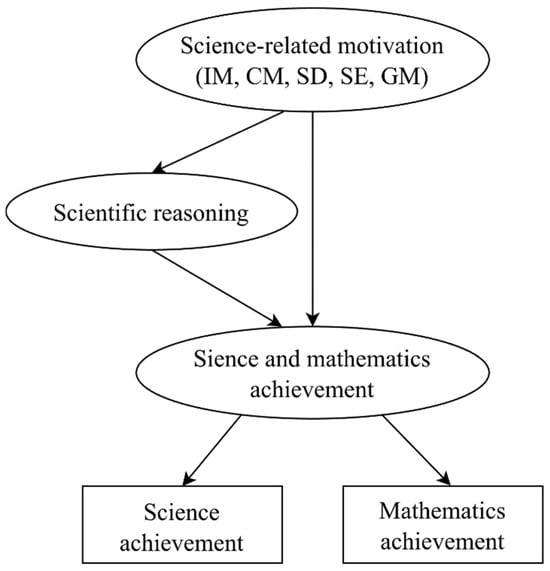
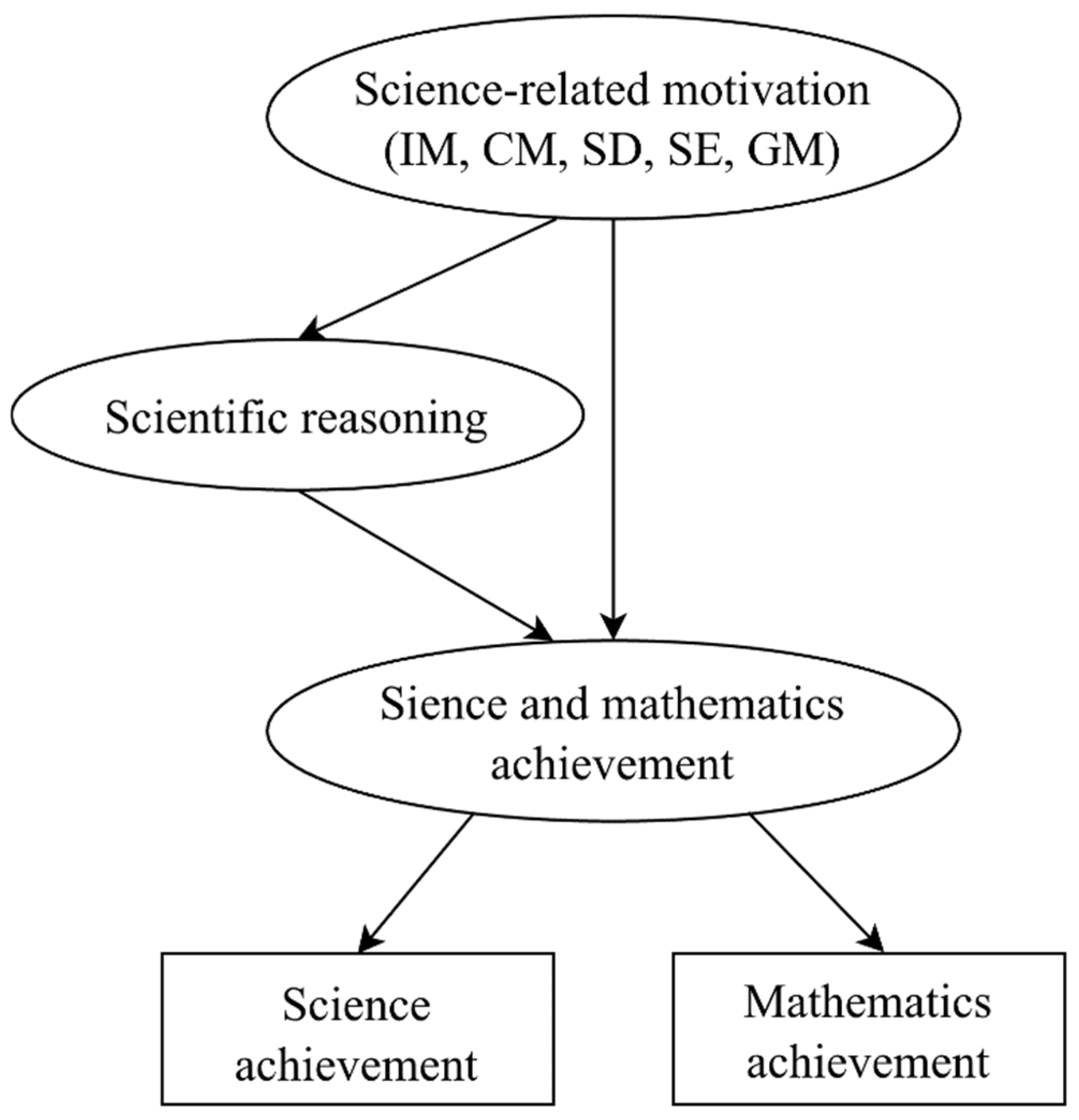
The present cross-sectional study examined the role of scientific reasoning in the relationships between dimensions of science-related motivation and science and mathematics achievement among fourth-grade students (Figure 1). Although motivation was assessed in the context of science learning, scientific reasoning was considered a cross-disciplinary cognitive competency relevant to learning in science and mathematics (Krell et al., 2022; OECD, 2019). Achievement was assessed using students’ grades in science and mathematics, the two STEM-related subjects taught at this stage.
Figure 1.
Theoretical mediation model linking science-related motivation, scientific reasoning, and science and mathematics achievement. Note. IM = intrinsic motivation, CM = career motivation, SD = self-determination, SE = self-efficacy, GM = grade motivation.
The following hypotheses were formulated:
H1.
Dimensions of science-related motivation will be associated with students’ scientific reasoning.
H2.
Scientific reasoning will be positively associated with students’ science and mathematics achievement.
H3.
The dimensions of science-related motivation will show significant indirect effects on science and mathematics achievement through scientific reasoning.
4. Methods
4.1. Participants
Data were collected from 2901 fourth-grade students (Mage = 10.84, SD = 0.65; boys: 50.9%, girls: 49.1%) as part of the Hungarian Educational Longitudinal Program (Csapó, 2007). Students from 103 schools across all seven statistical regions of Hungary participated in the study. Schools participated voluntarily in the program, and all fourth-grade classes in the participating schools were included in the study. The sample was not nationally representative. All students studied science and mathematics following the objectives and content of the national core curriculum.
4.2. Instruments
4.2.1. Science Motivation Questionnaire II
The SMQ II was developed by Glynn et al. (2011) for higher education students as a modification of earlier versions of the questionnaire. It has been used in many countries and disciplines, including secondary and elementary schools (Karaca et al., 2026). The SMQ II conceptualizes motivation to learn science as multidimensional and assesses five dimensions, with five items per dimension. Intrinsic motivation refers to the enjoyment of learning science for its own sake (e.g., “I enjoy learning science”). Self-efficacy captures students’ perceived ability to succeed in science (e.g., “I am confident I will do well on science tests”). Self-determination describes students’ sense of control over their science learning (e.g., “I use strategies to learn science well”). Grade motivation reflects a desire to earn high marks (e.g., “Getting a good science grade is important to me”). Finally, career motivation concerns the perceived relevance of science learning to further education and career choice (e.g., “Learning science will help me get a good job”). Participants rated each statement on a five-point Likert-type scale (0 = never, 4 = always) according to how often it applied to their science learning.
This study used the version of the SMQ II adapted for science education in Hungarian elementary schools (B. Németh et al., 2022). Given the younger age of the present participants, the questionnaire’s internal structure and reliability were examined in the fourth-grade sample. Following Glynn et al. (2011), item scores were summed within each subscale for descriptive analyses, resulting in a possible score range of 0–20 for each dimension. In the CFA and SEM analyses, the items were treated as ordinal indicators of the latent motivational dimensions. Because previous studies have reported varying levels of support for the structural validity of the SMQ II across research contexts, the present study followed Komperda et al.’s (2020) recommendations. Single- and multifactor confirmatory factor analyses (CFAs) were conducted to evaluate the instrument’s internal structure.
4.2.2. Science-K Inventory
The Science-K Inventory (SK-I) was designed to assess scientific reasoning skills in preschoolers and early elementary school children (Koerber & Osterhaus, 2019). The test comprises 30 multiple-choice items accompanied by a short story. It is divided into three components: experimentation, data interpretation, and understanding the nature of science (Table 1).
Table 1.
Structure of the Science-K Inventory.
Each component includes 10 items. In the experimentation section, participants select the most appropriate experiment to test a research question and complete tasks that require applying the CVS to test hypotheses. In the data interpretation section, participants identify covariation patterns (e.g., perfect, imperfect, non-covariation) in the data and use these patterns to form hypotheses. The third component assesses students’ understanding of what scientists do and the types of research questions they ask. Items are scored dichotomously, yielding a maximum total score of 30.
The SK-I was validated in German (Koerber & Osterhaus, 2019) and has also shown validity and reliability in other languages and cultures, including Chinese (Osterhaus et al., 2023) and Hungarian (Nagy & Korom, 2023). Previous studies used paper-based data collection, conducting interviews (presenting items in an illustrated booklet) for kindergarten children and group tests that were read aloud by an experimenter and shown in a PowerPoint presentation for primary school children (Koerber & Osterhaus, 2019; Nyberg et al., 2020; Osterhaus et al., 2023; Osterhaus & Koerber, 2023). The paper-based and computer-based versions of the SK-I, completed independently by students, have been demonstrated to be suitable for assessing scientific reasoning among fourth graders (Nagy & Korom, 2023). Previous validation studies suggest that although the test assesses several components of scientific reasoning, item responses reflect a common conceptual core (Koerber & Osterhaus, 2019; Nyberg et al., 2020).
4.2.3. Academic Achievement
Science and mathematics achievement were assessed using students’ end-of-year grades on a scale ranging from 1 (lowest) to 5 (highest). These two grades served as indicators of a common STEM-related achievement construct, reflecting the relevance of scientific reasoning to learning in both subjects.
4.3. Data Collection and Analysis
Data collection was conducted online via the Electronic Diagnostic Assessment platform (Csapó & Molnár, 2019). Students completed the test and questionnaire and answered background questions in the classroom under their teachers’ supervision. The SMQ II and SK-I were administered in November 2022, and students’ end-of-year science and mathematics grades from the previous school year were used.
The proportion of missing data was low for the variables included in the analysis. There were no missing values for the dichotomous scoring of the items of scientific reasoning or the total scores derived from them. There were some missing responses in the motivation questionnaire (3–11 per item) and a small number of missing values in the science and mathematics grades (18–24 cases). Given the low proportion of missing data, no imputation was applied.
Data analysis was performed using SPSS Statistics (version 23.0) and jamovi (version 2.6.2). Descriptive statistics were calculated, and internal consistency was evaluated using Cronbach’s alpha (α) and McDonald’s omega (ω). CFA was performed in jamovi (version 2.6.2) using the Rj Editor module and the lavaan package (version 0.6-18 in R 4.4.1). Because the motivational items were measured on an ordinal Likert-type scale and the scientific reasoning items were dichotomous, the WLSMV estimator was used for the CFA models. This choice followed the methodological recommendations of Komperda et al. (2020), who emphasized that WLSMV is more suitable for SMQ II data due to their ordinal (and often non-normal) distributions. Model fit was assessed using the comparative fit index (CFI), Tucker–Lewis index (TLI), root mean-square error of approximation (RMSEA), and standardized root mean-square residual (SRMR). For models estimated with WLSMV, scaled fit indices were reported. Following commonly used guidelines, CFI and TLI ≥ 0.90, and RMSEA and SRMR ≤ 0.08 were considered indicative of an acceptable fit (Hu & Bentler, 1999; Kline, 2016). However, given the ordinal nature of the data and recent concerns regarding the measurement properties of the SMQ II, relatively strict fit criteria were also considered: CFI and TLI ≥ 0.95 and RMSEA ≤ 0.05 were interpreted to indicate a good model fit (Hu & Bentler, 1999; Komperda et al., 2020).
To complement the CFA results, a dichotomous Rasch model was estimated for the SK-I using the SnowIRT module in jamovi (version 2.6.2). Item fit was evaluated using infit and outfit mean-square statistics, and person reliability was calculated.
The SEM analysis was based on 2844 students with complete data for all variables included in the model. Cases with missing values were excluded using listwise deletion. SEM was performed in jamovi (version 2.6.2) using the lavaan package (version 0.6-18 in R 4.4.1) via the Rj Editor. The WLSMV estimator was used with robust standard errors and a scaled and shifted test statistic. The SMQ-II items were treated as ordinal indicators, whereas the SK-I total score and science and mathematics grades were treated as continuous variables. Motivational dimensions were specified as latent variables indicated by their items, whereas scientific reasoning was included as an observed variable using the SK-I total score. Science and mathematics achievement was modeled as a latent construct indicated by science and mathematics grades. Both factor loadings were estimated freely, and the variance of the latent achievement factor was fixed to 1 for identification. The model fit was evaluated using scaled χ2, CFI, TLI, and RMSEA values, together with SRMR, applying the same criteria as described above. Direct, indirect, and total effects were estimated using SEM, and their statistical significance was evaluated using p-values and 95% Wald confidence intervals (CIs), calculated from robust standard errors. Standardized estimates and their corresponding confidence intervals were reported.
To evaluate clustering at the school level, we calculated the intraclass correlation coefficients (ICCs). The ICC values ranged from 0.055 to 0.193. As a sensitivity analysis, the same WLSMV model was re-estimated in Mplus, accounting for the clustering of students within 103 schools.
5. Results
5.1. Psychometric Properties of Measures
Before conducting structural analyses, the internal structure and reliability of both instruments were examined. These analyses also served as the basis for decisions regarding the representation of the constructs in the SEM.
5.1.1. Science Motivation Questionnaire II
The confirmatory factor analysis (N = 2870) showed that the assumed five-factor model (intrinsic motivation, career motivation, self-determination, self-efficacy, grade motivation) provided an acceptable fit for the sample, χ2(265) = 3442.77, p < 0.001, CFI = 0.937, TLI = 0.928, RMSEA = 0.065, SRMR = 0.048. The one-factor model showed a worse fit: χ2(275) = 13,307.03, p < 0.001; CFI = 0.740; TLI = 0.716; RMSEA = 0.129; SRMR = 0.104. Therefore, the five-factor model provided a substantially better fit than the one-factor model, although some fit indices fell short of the more stringent criteria for good model fit (Komperda et al., 2020). These results suggest that science motivation, as measured by the SMQ II, was not one-dimensional. Detailed CFA results are presented in Table S1 of the Supplementary Material. The standardized factor loadings ranged from 0.411 to 0.840, with most items showing relatively strong loadings. However, one grade motivation item (SMQ_GM_02, λ = 0.411) had a lower loading, indicating that acceptable overall model fit does not necessarily imply equally strong factor loadings across items. The estimates of internal consistency were satisfactory for all subscales (α = 0.77–0.85; ω = 0.82–0.89). Although the reliability indices for the overall questionnaire were high (α = 0.91; ω = 0.97), the unidimensional model’s poorer fit and the distinguishability of the latent factors suggest that the CFA results did not support the calculation and use of a single overall motivation score. Therefore, in line with recent recommendations (e.g., Komperda et al., 2020), the five motivational components were treated as separate constructs in the SEM.
5.1.2. Science-K Inventory
The internal structure of the SK-I was examined by comparing one-, three-, and seven-factor CFA models and a second-order CFA model (N = 2901). This approach reflected both previous findings (Koerber & Osterhaus, 2019; Nyberg et al., 2020; Osterhaus et al., 2023; Osterhaus & Koerber, 2023) and the instrument’s structure. Studies by test developers suggest that, in childhood, scientific reasoning can be interpreted as a general ability grounded in a common conceptual core, supporting a one-factor model (Koerber & Osterhaus, 2019). However, the instrument assesses three major components of scientific reasoning (experimentation, data interpretation, and understanding the nature of science), and tasks are organized into seven categories. Therefore, three- and seven-factor models were also tested. The one-factor model showed poor fit (χ2(405) = 4345, p < 0.001, CFI = 0.786, TLI = 0.770, RMSEA = 0.058, SRMR = 0.083). The three-factor model demonstrated an improved but not fully satisfactory fit (χ2(402) = 3433, p < 0.001, CFI = 0.835, TLI = 0.822, RMSEA = 0.051, SRMR = 0.074), whereas the seven-factor model showed an acceptable fit (χ2(384) = 1774, p < 0.001, CFI = 0.924, TLI = 0.914, RMSEA = 0.035, SRMR = 0.057). Item SK_I_DAT_07 showed a negative factor loading (λ = −0.237) (Table S2). We checked the scoring of this item against the original scoring key and found no errors. In the original German study (Koerber & Osterhaus, 2019), this item showed a positive but low item discrimination (0.14), suggesting that it may function differently in our sample.
A second-order CFA was estimated to examine whether a higher-order scientific reasoning ability could explain the seven-factor structure. This model showed a generally acceptable fit (χ2(398) = 2153, p < 0.001, CFI = 0.905, TLI = 0.896, RMSEA = 0.039, SRMR = 0.063). Most factors loaded strongly on the higher-order scientific reasoning factor (λ = 0.53–0.85), although weaker loadings were observed for confounded data (λ = 0.25) and covariation data (imperfect) (λ = 0.09) dimensions. Although the model’s fit was acceptable overall, these low loadings indicate that the general scientific reasoning factor did not adequately represent all dimensions. The results of the second-order CFA are presented in Table S3 of the Supplementary Material.
Following the methodology detailed by Koerber and Osterhaus (2019), we fitted a dichotomous Rasch model to further examine the instrument’s measurement properties. Infit values ranged from 0.872 to 1.147, and outfit values ranged from 0.687 to 1.200 (Table S4). All values fell within the commonly used range of 0.5–1.5. The WLE reliability was 0.74. Although the item-fit values were acceptable, the Rasch analysis did not establish unidimensionality. The total score showed satisfactory internal consistency (α = 0.77; ω = 0.79). Based on previous validation studies, the acceptable item-fit values and the test’s internal consistency, we retained the SK-I total score as a composite indicator of scientific reasoning rather than as a measure of a strictly unidimensional construct.
5.2. Descriptive Statistics and Correlations
Table 2 presents the descriptive statistics. Some variables, particularly grade motivation and academic grades, showed negative skewness. Of the motivational dimensions, grade motivation had the highest mean score, and career motivation had the lowest. The mean total score on the SK-I test was 61.34% (SD = 16.54). The mean end-of-year grades were relatively high in both science and mathematics.
Table 2.
Descriptive statistics of study variables.
The correlations between the study variables are presented in Table 3. Motivational dimensions were positively intercorrelated (r = 0.29–0.62). Scientific reasoning showed small positive correlations with self-efficacy, self-determination, intrinsic motivation, and grade motivation, but its association with career motivation was negative and weak. Scientific reasoning was moderately correlated with both science (r = 0.39) and mathematics achievement (r = 0.40).
Table 3.
Pearson correlations between study variables.
5.3. Testing the Mediation Model
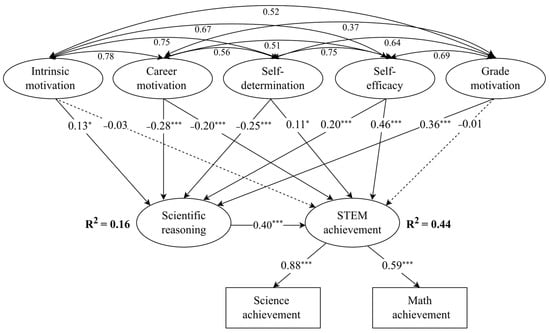
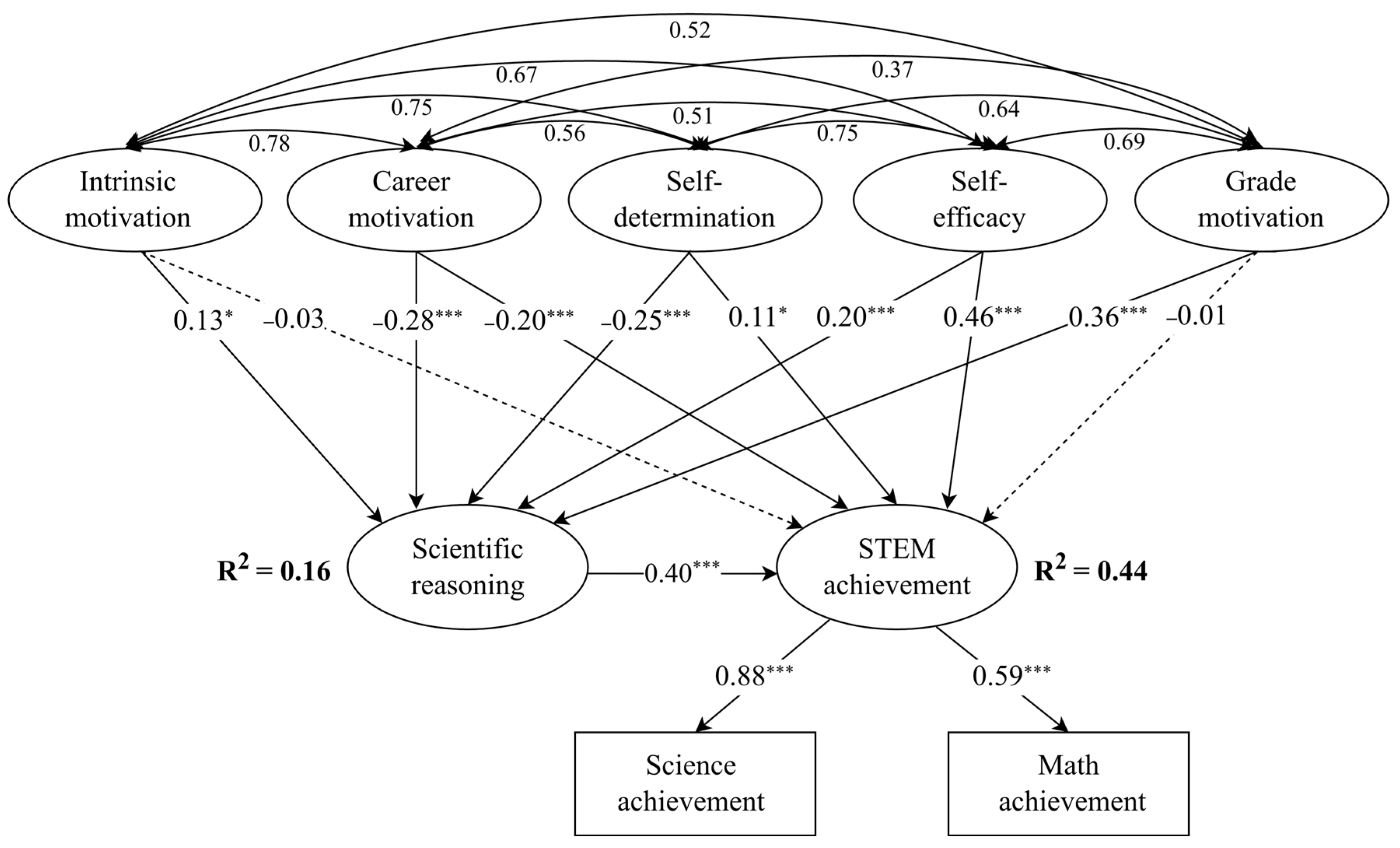
SEM was used to examine indirect associations between science-related motivation and science and mathematics achievement through scientific reasoning (Figure 2). Scientific reasoning was included as an observed variable representing the hypothesized mediator (SK-I total score). Science and mathematics achievement was modeled as a latent construct indicated by science and mathematics grades. The model (N = 2844) provided an acceptable, although not excellent, fit to the data, scaled χ2(330) = 3931.52, p < 0.001, CFI = 0.932, TLI = 0.922, RMSEA = 0.062, 90% CI [0.060, 0.064], and SRMR = 0.048. Both science and mathematics grades loaded significantly on the latent achievement factor. Scientific reasoning was positively associated with intrinsic motivation (β = 0.13, p < 0.05), self-efficacy (β = 0.20, p < 0.001), and grade motivation (β = 0.36, p < 0.001). Career motivation (β = −0.28, p < 0.001) and self-determination (β = −0.25, p < 0.001) were negatively associated with scientific reasoning. These associations were adjusted for the other motivational dimensions and should be interpreted cautiously. Scientific reasoning was positively associated with science and mathematics achievement (β = 0.40, p < 0.001).
Figure 2.
Relationship between science-related motivation, scientific reasoning, and science and mathematics achievement. Note. Standardized path coefficients are shown. Dashed lines indicate nonsignificant paths. All correlations among motivational dimensions are significant at * p < 0.05, *** p < 0.001.
Among the direct effects, self-efficacy showed the strongest positive association with science and mathematics achievement (β = 0.46, p < 0.001), whereas career motivation was negatively associated with achievement (β = −0.20, p < 0.001). Self-determination showed a small positive direct effect (β = 0.11, p = 0.012). The direct effects of intrinsic motivation and grade motivation were not significant.
Table 4 summarizes the direct, indirect, and total effects of the motivational dimensions on science and mathematics achievement. All five motivational dimensions had significant indirect effects through scientific reasoning. Positive indirect effects were found for intrinsic motivation (β = 0.05, p = 0.018), self-efficacy (β = 0.08, p < 0.001), and grade motivation (β = 0.14, p < 0.001), whereas the indirect effects of career motivation (β = −0.11, p < 0.001) and self-determination (β = −0.10, p < 0.001) were negative. The strongest indirect effect was observed for grade motivation. Self-efficacy had the strongest positive total effect on science and mathematics achievement (β = 0.53, p < 0.001), followed by grade motivation (β = 0.14, p < 0.001). In contrast, career motivation showed a negative total effect (β = −0.31, p < 0.001). Intrinsic motivation showed a significant positive indirect association with achievement, but its total effect was not significant. Self-determination showed opposing direct and indirect associations with achievement, resulting in a nonsignificant total effect. The model explained 16% of the variance in scientific reasoning and 44% of the variance in achievement.
Table 4.
Direct, indirect, and total effects of the variables.
The school-cluster-adjusted WLSMV analysis showed similar results. All five indirect effects remained significant, although the indirect association involving intrinsic motivation was close to the significance threshold (p = 0.049). The standardized indirect effects and 95% confidence intervals for the models with and without adjustment for school clustering are presented in Table S7.
We conducted additional analyses to better understand the negative coefficients for self-determination and career motivation. When examined separately, self-determination was positively associated with scientific reasoning (β = 0.067), and career motivation showed a weak negative association (β = −0.092). In the full model, both coefficients were negative (β = −0.250 and β = −0.283, respectively). The motivational factors were correlated (r = 0.369–0.776). Approximate variance inflation factors (VIFs), calculated from the latent factor correlation matrix, ranged from 2.03 to 4.12, indicating some overlap among the motivational dimensions.
To assess the robustness of the results, we also conducted sensitivity analyses. As part of this, we tested the model by excluding the negatively loading item (SK_I_DAT_07) from the SK-I total score. Furthermore, we used the total scores of the three SK-I domains (Experimentation, Data interpretation, Understanding the nature of science) separately in SEMs. Removing item SK_I_DAT_07 did not alter the results. All three subtests showed a positive association with academic performance. The indirect relationships remained significant for four of the five motivational dimensions, while intrinsic motivation showed a significant indirect relationship only regarding experimentation. The standardized coefficients and 95% confidence intervals for the three domain-specific models are presented in Table S5.
To examine whether the results were consistent across the two school subjects, we also estimated separate SEMs using either science or math grades as the outcome variable. Scientific reasoning showed a positive association with both science (β = 0.300, p < 0.001) and math performance (β = 0.318, p < 0.001). All five indirect associations remained significant in both models, with similar directions and magnitudes, although some direct associations differed between the two subjects. The standardized coefficients and 95% confidence intervals for the separate science and mathematics models are presented in Table S6.
Overall, the results were consistent with the three hypotheses: the motivational dimensions were associated with scientific reasoning (H1), scientific reasoning was positively associated with science and mathematics achievement (H2), and all five motivational dimensions showed significant indirect effects on achievement through scientific reasoning (H3).
6. Discussion
This study examined the role of scientific reasoning in the relationships between dimensions of science-related motivation and science and mathematics achievement among Hungarian fourth graders. Although the motivational dimensions differed in their direct effects on achievement, all five dimensions were indirectly related to science and mathematics achievement through scientific reasoning. However, the direction and magnitude of these relationships differed across motivational dimensions. These findings highlight the role of scientific reasoning in the associations between different dimensions of science-related motivation and achievement during elementary education.
Scientific reasoning was positively associated with achievement in science and mathematics. This finding aligns with previous studies (Lawson et al., 2007; Van Vo & Csapó, 2023) and is consistent with the view that scientific reasoning is relevant to learning across STEM domains rather than only to science. Its association with mathematics achievement further indicates its relevance beyond science learning (Bao et al., 2009; Osterhaus & Koerber, 2026). Notably, the significant indirect effects found in the present study differ from the findings of Van Vo and Csapó (2023), who found no significant indirect effects of science motivation on STEM achievement through scientific reasoning. However, several differences between the studies should be considered when interpreting these contrasting findings. Van Vo and Csapó (2023) examined older students in Vietnam and operationalized science motivation as a general construct, whereas the present study focused on Hungarian fourth-grade students and examined five motivational dimensions separately. Further research is needed to determine whether this difference is related to participants’ age, the operationalization of motivation, or other methodological differences between the studies.
The motivational dimensions showed different relationships with scientific reasoning and achievement. Self-efficacy showed the strongest total association with achievement, with significant direct and indirect associations. This aligns with previous research on its relationship with academic performance (Schöber et al., 2018). Students who feel confident in their ability to learn science may be more likely to take on challenging tasks and persevere even when difficulties arise (Bandura, 1986; Schunk & DiBenedetto, 2020). At the same time, not all dimensions of motivation showed equally strong associations with scientific reasoning and academic achievement. For example, the correlation between intrinsic motivation and scientific thinking was statistically significant but very weak (r = 0.04). One possible explanation is that self-efficacy is more closely linked to students’ perceptions of their ability to complete learning tasks, whereas intrinsic motivation primarily reflects their interest in and enjoyment of learning the natural sciences. Although this interest may encourage participation in science-related activities, it is not necessarily associated with the development of specific scientific reasoning skills. This interpretation is consistent with the findings of a longitudinal meta-analysis, which indicates that motivational constructs related to students’ beliefs about their abilities show stronger associations with academic achievement than other forms of motivation (Vu et al., 2024).
Interestingly, neither intrinsic nor grade motivation showed a significant direct association with science and mathematics achievement, suggesting that their associations with achievement may be indirect. Both intrinsic and grade motivation showed positive indirect associations with academic achievement through scientific reasoning. However, the total association for intrinsic motivation was not statistically significant. Moreover, its weak correlation with scientific reasoning suggests that this relationship may have limited practical relevance, despite being statistically significant. The indirect association was also less robust than for the other motivational dimensions. In contrast, career motivation was negatively associated with academic achievement, both directly and indirectly. One possible explanation is the participants’ age. The SMQ II was originally developed for college students (Glynn et al., 2011) and has primarily been used with older students. For fourth graders, however, future career choices may still be relatively abstract and distant, which could influence how career motivation relates to their current learning and academic achievement.
A similar explanation may apply to self-determination. Although self-determination is generally considered an important aspect of learning motivation (Deci & Ryan, 2012), younger students often have limited opportunities to direct their own learning. It is possible that self-determination functions differently at this age than in high school or higher education. Although self-determination showed a weak positive correlation with scientific reasoning, its association was negative in the SEM when the other motivational dimensions were considered. This finding should be interpreted cautiously, given the overlap among the motivational dimensions. The additional analyses suggest that the negative coefficients may partly reflect shared variance among motivational dimensions. Therefore, these coefficients should not be interpreted as evidence that self-determination and career motivation negatively affect scientific reasoning. Self-determination also showed a positive direct and a negative indirect association with achievement, resulting in a nonsignificant total association. These opposing associations suggest that its relationship with achievement is more complex than either association alone would indicate. Although the adapted SMQ II showed acceptable psychometric properties in the present sample, younger students may interpret some items differently from older students. Further research is needed to examine how fourth graders understand career motivation and self-determination.
The results also support the SMQ II’s multidimensional structure. The five-factor model fit substantially better than the one-factor model, although its CFI and TLI values remained below the more stringent fit criteria. The motivational dimensions differed in their relationships with scientific reasoning and academic achievement. These differences would have remained hidden if only a general motivation score had been used. These findings favor the separate interpretation of the five motivational dimensions.
The results regarding scientific reasoning were somewhat different. The seven-factor model provided the best fit. The second-order CFA suggested a broader scientific reasoning factor but some dimensions showed weak loadings. The Rasch analysis showed acceptable item-fit values but did not establish unidimensionality. The CFA extends previous psychometric work on the SK-I by examining its factor structure. This suggests that scientific reasoning comprises several interrelated skills, although some dimensions are less strongly connected to the broader competence. The negative factor loading of SK_I_DAT_07 suggests that this item may function differently in our sample, although the reason remains unclear. One possible explanation is that three of the four confounded data items require students to recognize that the evidence is inconclusive, while SK_I_DAT_07 requires them to maintain the original claim because the evidence supports it. Future studies should examine whether the specific dimensions of scientific reasoning show different associations with motivation and achievement.
Motivational and cognitive factors provided complementary information about achievement in science and mathematics. Different dimensions of science-related motivation showed different associations with scientific reasoning and achievement, while scientific reasoning was consistently linked to achievement in both subjects. Distinguishing between motivational dimensions revealed patterns that would not be apparent from a general measure of science motivation. The study extends previous research on scientific reasoning, motivation, and achievement to elementary education and further supports the relevance of scientific reasoning to achievement in both science and mathematics at this early stage.
From an educational perspective, the results highlight the importance of fostering scientific reasoning from the outset of formal STEM education (Krell et al., 2022; Nyberg et al., 2022). One way to foster scientific reasoning is through inquiry-based learning. This approach can support its development even in elementary school by engaging students in activities such as experimentation, hypothesis testing, data interpretation, and evidence evaluation (Lazonder & Harmsen, 2016; Pedaste et al., 2015; Schlatter et al., 2020, 2022). The results also point to the importance of considering motivational factors in early STEM education. Supporting students’ self-efficacy may be particularly relevant to science and mathematics learning. The different relationships observed for the motivational dimensions suggest that motivation should not be treated as a single factor when considering its role in early STEM learning.
7. Limitations and Future Research
This study had several limitations. Because the data were cross-sectional, the indirect effects should be interpreted as statistical associations within the hypothesized model rather than evidence of causal or developmental mechanisms. The grades used to measure achievement were obtained from the previous school year, and previous academic success may influence students’ motivational beliefs and their scientific reasoning performance. Future longitudinal studies may clarify how these variables relate and how their relationships develop over time.
Another limitation concerns the measurement of motivation. Although the SMQ II showed generally satisfactory psychometric properties in the present study, some dimensions may have had different meanings for fourth-grade students. Career motivation and self-determination may function differently at this age than among older students. Future research should further examine the suitability of these motivational constructs for younger students.
Furthermore, science and mathematics achievement were measured using school grades. Although such grades are important indicators of student performance, they may also reflect factors beyond academic achievement. Future research could therefore use standardized tests to assess achievement in science and mathematics.
Scientific reasoning was measured using the SK-I total score. Although the test showed acceptable item-fit values and satisfactory internal consistency, the CFA results indicated a multidimensional structure. Future research could examine whether these dimensions show different associations with motivation and achievement.
Finally, the results were based solely on Hungarian data. Future studies should examine whether similar patterns emerge in other cultural and educational contexts.
8. Conclusions
This study highlights the role of scientific reasoning in the relationships between science-related motivation and science and mathematics achievement among elementary school students. The findings indicate that dimensions of science-related motivation show different associations with achievement, while all five dimensions were indirectly linked to science and mathematics achievement through scientific reasoning. Self-efficacy showed the strongest positive total association with achievement, whereas other motivational dimensions showed more complex patterns, including opposing direct and indirect associations. By focusing on elementary school students and distinguishing between dimensions of science-related motivation, the study extends our understanding of the role of scientific reasoning in early STEM learning and its links with motivational factors. It contributes to exploring the varying roles of motivational factors and to a more nuanced pedagogical interpretation.
Supplementary Materials
The following supporting information can be downloaded at https://www.mdpi.com/article/10.3390/educsci16122002/s1, Table S1. Confirmatory factor analysis (CFA) results for the Science Motivation Questionnaire II (SMQ II); Table S2. Confirmatory factor analysis (CFA) results for the Science-K Inventory (SK-I); Table S3. Second-order confirmatory factor analysis (CFA) results for the Science-K Inventory (SK-I); Table S4. Item fit statistics (infit and outfit mean-square statistic [MNSQ]) for the Science-K Inventory (SK-I); Table S5. Standardized coefficients (β) and 95% confidence intervals from models examining the three SK-I components separately; Table S6. Standardized coefficients (β) and 95% confidence intervals from models examining science and mathematics achievement separately; Table S7. Standardized indirect effects (β) and 95% confidence intervals for the models with and without adjustment for school clustering.
Author Contributions
Conceptualization, E.K.; Methodology, E.K. and M.T.N.; Validation, E.K.; Formal analysis, E.K. and M.T.N.; Investigation, E.K. and M.T.N.; Writing—original draft, E.K. and M.T.N.; Writing—review & editing, E.K. and M.T.N.; Visualization, M.T.N.; Supervision, E.K.; Project administration, E.K.; Funding acquisition, E.K. All authors have read and agreed to the published version of the manuscript.
Funding
This research was funded by Research Program for Public Education Development of the Hungarian Academy of Sciences, Project No. KOZOKT2025-21.
Institutional Review Board Statement
The study was conducted in accordance with the Declaration of Helsinki, and approved by the Institutional Ethics Committee of the Doctoral School of Education, University of Szeged, Hungary (protocol code 26/2024; date of approval: 9 December 2024).
Informed Consent Statement
Informed consent was obtained from all subjects involved in the study. The educational institution informed students and parents, and the school coordinated completion of the parents’ consent forms.
Data Availability Statement
The original contributions presented in this study are included in the article. Further inquiries can be directed to the corresponding author.
Acknowledgments
Many thanks to all students and teachers for their work.
Conflicts of Interest
The authors declare no conflicts of interest.
References
- Anderman, E. M. (2020). Achievement motivation theory: Balancing precision and utility. Contemporary Educational Psychology, 61, 101864. [Google Scholar] [CrossRef] [Scilit]
- Bandura, A. (1986). Social foundations of thought and action: A social cognitive theory. Prentice-Hall. [Google Scholar]
- Bao, L., Cai, T., Koenig, K., Fang, K., Han, J., Wang, J., Liu, Q., Ding, L., Cui, L., Luo, Y., Wang, Y., Li, L., & Wu, N. (2009). Learning and scientific reasoning. Science, 323(5914), 586–587. [Google Scholar] [CrossRef] [Scilit] [PubMed]
- Bicak, B. E., Borchert, C. E., & Höner, K. (2021). Measuring and fostering preservice chemistry teachers’ scientific reasoning competency. Education Sciences, 11(9), 496. [Google Scholar] [CrossRef] [Scilit]
- B. Németh, M., Tóth, E., Csíkos, C., & Korom, E. (2022). A természettudomány tanulásának motivációi a 6. és a 8. évfolyamon. [Science learning motivation in grades 6 and 8]. Magyar Tudomány, 183(11), 1407–1419. [Google Scholar] [CrossRef] [Scilit]
- Csapó, B. (2007). Hosszmetszeti felmérések iskolai kontextusban—Az első átfogó magyar iskolai longitudinális kutatási program elméleti és módszertani keretei [Longitudinal assessments in school context: Theoretical and methodological frames of the first large-scale school-related longitudinal program in Hungary]. Magyar Pedagógia, 107(4), 321–355. [Google Scholar]
- Csapó, B., & Molnár, G. (2019). Online diagnostic assessment in support of personalized teaching and learning: The eDia system. Frontiers in Psychology, 10, 1522. [Google Scholar] [CrossRef] [Scilit] [PubMed]
- Dawson, C., Julku, H., Pihlajamäki, M., Kaakinen, J. K., Schooler, J. W., & Simola, J. (2024). Evidence-based scientific thinking and decision-making in everyday life. Cognitive Research: Principles and Implications, 9(1), 50. [Google Scholar] [CrossRef] [Scilit] [PubMed]
- Deci, E. L., & Ryan, R. M. (2012). Self-determination theory. In P. A. M. Van Lange, A. W. Kruglanski, & E. T. Higgins (Eds.), Handbook of theories of social psychology (Vol. 1, pp. 416–437). Sage. [Google Scholar] [CrossRef] [Scilit]
- DeWitt, J., Osborne, J., Archer, L., Dillon, J., Willis, B., & Wong, B. (2013). Young children’s aspirations in science: The unequivocal, the uncertain and the unthinkable. International Journal of Science Education, 35(6), 1037–1063. [Google Scholar] [CrossRef] [Scilit]
- Dunbar, K. N., & Fugelsang, J. (2005). Scientific thinking and reasoning. In K. J. Holyoak, & R. G. Morrison (Eds.), The Cambridge handbook of thinking and reasoning (pp. 705–725). Cambridge University Press. [Google Scholar]
- Dunbar, K. N., & Klahr, D. (2012). Scientific thinking and reasoning. In K. J. Holyoak, & R. G. Morrison (Eds.), The Oxford handbook of thinking and reasoning. Oxford Handbooks Online. [Google Scholar] [CrossRef] [Scilit]
- Eccles, J. S., & Wigfield, A. (2002). Motivational beliefs, values, and goals. Annual Review of Psychology, 53(1), 109–132. [Google Scholar] [CrossRef] [Scilit] [PubMed]
- Education Office [Oktatási Hivatal]. (2020). Kerettanterv az általános iskola 1–4. évfolyama számára [Framework curriculum for grades 1–4 of primary school]. Available online: https://www.oktatas.hu/kozneveles/kerettantervek/2020_nat/kerettanterv_alt_isk_1_4_evf (accessed on 15 September 2026).
- Eshach, H., & Fried, M. N. (2005). Should science be taught in early childhood? Journal of Science Education and Technology, 14(3), 315–336. [Google Scholar] [CrossRef] [Scilit]
- Ferrara, G., La Versa, F., Rossi, C., Giarratano, G., Mindrescu, V., Pedone, F., Fazio, C., & Battaglia, O. R. (2026). Impact of spaced learning on educational outcomes in science teaching. Education Sciences, 16(6), 826. [Google Scholar] [CrossRef] [Scilit]
- Fischer, F., Kollar, I., Ufer, S., Sodian, B., Hussmann, H., Pekrun, R., Neuhaus, B., Dorner, B., Pankofer, S., Fischer, M., Strijbos, J.-W., Heene, M., & Eberle, J. (2014). Scientific reasoning and argumentation: Advancing an interdisciplinary research agenda in education. Frontline Learning Research, 2(3), 28–45. [Google Scholar] [CrossRef]
- Fortus, D. (2014). Attending to affect. Journal of Research in Science Teaching, 51(7), 821–835. [Google Scholar] [CrossRef] [Scilit]
- Glynn, S. M., Brickman, P., Armstrong, N., & Taasoobshirazi, G. (2011). Science motivation questionnaire II: Validation with science majors and nonscience majors. Journal of Research in Science Teaching, 48(10), 1159–1176. [Google Scholar] [CrossRef] [Scilit]
- Government of Hungary. (2020). Government Decree No. 5/2020 (I. 31.) amending Government Decree No. 110/2012 (VI. 4.) on the issuance, introduction and application of the National Core Curriculum. Magyar Közlöny. Available online: https://njt.hu/jogszabaly/2020-5-20-22 (accessed on 15 September 2026).
- Grabau, L. J., & Ma, X. (2017). Science engagement and science achievement in the context of science instruction: A multilevel analysis of U.S. students and schools. International Journal of Science Education, 39(8), 1045–1068. [Google Scholar] [CrossRef] [Scilit]
- Graham, S. (2020). An attributional theory of motivation. Contemporary Educational Psychology, 61, 101861. [Google Scholar] [CrossRef] [Scilit]
- Greene, B. A., Miller, R. B., Crowson, H. M., Duke, B. L., & Akey, K. L. (2004). Predicting high school students’ cognitive engagement and achievement: Contributions of classroom perceptions and motivation. Contemporary Educational Psychology, 29(4), 462–482. [Google Scholar] [CrossRef] [Scilit]
- Honicke, T., & Broadbent, J. (2016). The influence of academic self-efficacy on academic performance: A systematic review. Educational Research Review, 17, 63–84. [Google Scholar] [CrossRef] [Scilit]
- Hu, L. T., & Bentler, P. M. (1999). Cutoff criteria for fit indexes in covariance structure analysis: Conventional criteria versus new alternatives. Structural Equation Modeling: A Multidisciplinary Journal, 6(1), 1–55. [Google Scholar] [CrossRef] [Scilit]
- Inhelder, B., & Piaget, J. (1958). The growth of logical thinking from childhood to adolescence: An essay on the construction of formal operational structures. Routledge & Kegan Paul. [Google Scholar]
- Jansen, M., Scherer, R., & Schroeders, U. (2015). Students’ self-concept and self-efficacy in the sciences: Differential relations to antecedents and educational outcomes. Contemporary Educational Psychology, 41, 13–24. [Google Scholar] [CrossRef] [Scilit]
- Karaca, D., Namdar, B., Nalbantoğlu, F. G., Tümer, B., & Aydin, B. (2026). A reliability generalization meta-analysis of the Science Motivation Questionnaire II. International Journal of Science and Mathematics Education, 24, 16. [Google Scholar] [CrossRef] [Scilit]
- Kind, P., & Osborne, J. (2017). Styles of scientific reasoning: A cultural rationale for science education? Science Education, 101(1), 8–31. [Google Scholar] [CrossRef] [Scilit]
- Klahr, D., & Dunbar, K. (1988). Dual space search during scientific reasoning. Cognitive Science, 12(1), 1–48. [Google Scholar] [CrossRef] [PubMed]
- Kline, R. B. (2016). Principles and Practice of Structural Equation Modeling (4th ed.). Guilford Press. [Google Scholar]
- Koerber, S., & Osterhaus, C. (2019). Individual differences in early scientific thinking: Assessment, cognitive influences, and their relevance for science learning. Journal of Cognition and Development, 20(4), 510–533. [Google Scholar] [CrossRef] [Scilit]
- Koerber, S., Osterhaus, C., Mayer, D., Schwippert, K., & Sodian, B. (2015). The development of scientific thinking in elementary school: A comprehensive inventory. Child Development, 86(1), 327–336. [Google Scholar] [CrossRef] [Scilit] [PubMed]
- Komperda, R., Hosbein, K. N., Phillips, M. M., & Barbera, J. (2020). Investigation of evidence for the internal structure of a modified Science Motivation Questionnaire II (mSMQ II): A failed attempt to improve instrument functioning across course, subject, and wording variants. Chemistry Education Research and Practice, 21(3), 893–907. [Google Scholar] [CrossRef] [Scilit]
- Köksal, Ö., Sodian, B., & Legare, C. H. (2021). Young children’s metacognitive awareness of confounded evidence. Journal of Experimental Child Psychology, 205, 105080. [Google Scholar] [CrossRef] [Scilit] [PubMed]
- Köksal-Tuncer, Ö., & Sodian, B. (2018). The development of scientific reasoning: Hypothesis testing and argumentation from evidence in young children. Cognitive Development, 48, 135–145. [Google Scholar] [CrossRef] [Scilit]
- Krell, M., Vorholzer, A., & Nehring, A. (2022). Scientific reasoning in science education: From global measures to fine-grained descriptions of students’ competencies. Education Sciences, 12(2), 97. [Google Scholar] [CrossRef] [Scilit]
- Kuhn, D. (2010). What is scientific thinking and how does it develop? In U. Goswami (Ed.), The Wiley-Blackwell handbook of childhood cognitive development (1st ed., pp. 497–523). Wiley. [Google Scholar] [CrossRef] [Scilit]
- Lawson, A. E. (2004). The nature and development of scientific reasoning: A synthetic view. International Journal of Science and Mathematics Education, 2(3), 307–338. [Google Scholar] [CrossRef] [Scilit]
- Lawson, A. E., Banks, D. L., & Logvin, M. (2007). Self-efficacy, reasoning ability, and achievement in college biology. Journal of Research in Science Teaching, 44(5), 706–724. [Google Scholar] [CrossRef] [Scilit]
- Lazonder, A. W., & Harmsen, R. (2016). Meta-analysis of inquiry-based learning: Effects of guidance. Review of Educational Research, 86(3), 681–718. [Google Scholar] [CrossRef] [Scilit]
- Lee, C. S., Hayes, K. N., Seitz, J., DiStefano, R., & O’Connor, D. (2016). Understanding motivational structures that differentially predict engagement and achievement in middle school science. International Journal of Science Education, 38(2), 192–215. [Google Scholar] [CrossRef] [Scilit]
- Legare, C. H. (2012). Exploring explanation: Explaining inconsistent evidence informs exploratory, hypothesis-testing behavior in young children. Child Development, 83, 173–185. [Google Scholar] [CrossRef] [Scilit] [PubMed]
- Liou, P. Y., Wang, C. L., Lin, J. J. H., & Areepattamannil, S. (2021). Assessing students’ motivational beliefs about learning science across grade level and gender. The Journal of Experimental Education, 89(4), 605–624. [Google Scholar] [CrossRef] [Scilit]
- Luo, M., Sun, D., Zhu, L., & Yang, Y. (2021). Evaluating scientific reasoning ability: Student performance and the interaction effects between grade level, gender, and academic achievement level. Thinking Skills and Creativity, 41, 100899. [Google Scholar] [CrossRef] [Scilit]
- Michaelides, M. P., Brown, G. T. L., Eklöf, H., & Papanastasiou, E. C. (2019). Introduction to motivational profiles in TIMSS mathematics. In Motivational profiles in TIMSS mathematics (IEA Research for Education, Vol. 7, pp. 1–7). Springer. [Google Scholar] [CrossRef] [Scilit]
- Morris, B. J., Croker, S., Masnick, A. M., & Zimmerman, C. (2012). The emergence of scientific reasoning. In H. Kloos, B. J. Morris, & J. Amaral (Eds.), Current topics in children’s learning and cognition (pp. 61–82). InTech. [Google Scholar] [CrossRef] [Scilit] [PubMed]
- Mujtaba, T., Sheldrake, R., Reiss, M. J., & Simon, S. (2018). Students’ science attitudes, beliefs, and context: Associations with science and chemistry aspirations. International Journal of Science Education, 40(6), 644–667. [Google Scholar] [CrossRef] [Scilit]
- Nagy, M. T., & Korom, E. (2023). Measuring scientific reasoning of fourth graders: Validation of the Science-K Inventory in paper-based and computer-based testing environments. Journal of Baltic Science Education, 22(6), 1050–1062. [Google Scholar] [CrossRef] [Scilit]
- National Research Council. (2012). Education for life and work: Developing transferable knowledge and skills in the 21st century. National Academies Press. [Google Scholar] [CrossRef] [Scilit] [PubMed]
- Nehring, A., Nowak, K. H., zu Belzen, A. U., & Tiemann, R. (2015). Predicting students’ skills in the context of scientific inquiry with cognitive, motivational, and sociodemographic variables. International Journal of Science Education, 37(9), 1343–1363. [Google Scholar] [CrossRef] [Scilit]
- Nyberg, K., Koerber, S., & Osterhaus, C. (2020). How to measure scientific reasoning in primary school: A comparison of different test modalities. European Journal of Science and Mathematics Education, 8(3), 136–144. [Google Scholar] [CrossRef] [Scilit] [PubMed]
- Nyberg, K., Koerber, S., & Osterhaus, C. (2022). Self-effective scientific reasoning? Differences between elementary and secondary school students. Frontline Learning Research, 10(1), 25–45. [Google Scholar] [CrossRef] [Scilit]
- OECD. (2019). PISA 2018 Assessment and analytical framework. OECD Publishing. [Google Scholar] [CrossRef] [Scilit]
- Opitz, A., Heene, M., & Fischer, F. (2017). Measuring scientific reasoning—A review of test instruments. Educational Research and Evaluation, 23(3–4), 78–101. [Google Scholar] [CrossRef] [Scilit]
- Osborne, J., Simon, S., & Collins, S. (2003). Attitudes towards science: A review of the literature and its implications. International Journal of Science Education, 25(9), 1049–1079. [Google Scholar] [CrossRef] [Scilit]
- Osterhaus, C., & Koerber, S. (2023). The complex associations between children’s scientific reasoning and advanced theory of mind. Child Development, 94(1), e18–e42. [Google Scholar] [CrossRef] [Scilit] [PubMed]
- Osterhaus, C., & Koerber, S. (2026). Domain-general scientific reasoning abilities in kindergarten independently predict elementary school children’s mathematics ability. British Journal of Developmental Psychology, 44(1), 134–145. [Google Scholar] [CrossRef] [Scilit] [PubMed]
- Osterhaus, C., Lin, X., & Koerber, S. (2023). Measuring scientific reasoning in kindergarten and elementary school: Validating the Chinese version of the Science-K Inventory. Educational Research for Policy and Practice. [Google Scholar] [CrossRef] [Scilit]
- Pedaste, M., Mäeots, M., Siiman, L. A., de Jong, T., van Riesen, S. A. N., Kamp, E. T., Manoli, C. C., Zacharia, Z. C., & Tsourlidaki, E. (2015). Phases of inquiry-based learning: Definitions and the inquiry cycle. Educational Research Review, 14, 47–61. [Google Scholar] [CrossRef] [Scilit]
- Potvin, P., & Hasni, A. (2014). Interest, motivation and attitude towards science and technology at K-12 levels: A systematic review of 12 years of educational research. Studies in Science Education, 50(1), 85–129. [Google Scholar] [CrossRef] [Scilit]
- Ryan, R. M., & Deci, E. L. (2000). Self-determination theory and the facilitation of intrinsic motivation, social development, and well-being. American Psychologist, 55(1), 68–78. [Google Scholar] [CrossRef] [PubMed]
- Schlatter, E., Molenaar, I., & Lazonder, A. W. (2020). Individual differences in children’s development of scientific reasoning through inquiry-based instruction: Who needs additional guidance? Frontiers in Psychology, 11, 904. [Google Scholar] [CrossRef] [Scilit] [PubMed]
- Schlatter, E., Molenaar, I., & Lazonder, A. W. (2022). Adapting scientific reasoning instruction to children’s needs: Effects on learning processes and learning outcomes. International Journal of Science Education, 44(17), 2589–2612. [Google Scholar] [CrossRef] [Scilit]
- Schöber, C., Schütte, K., Köller, O., McElvany, N., & Gebauer, M. M. (2018). Reciprocal effects between self-efficacy and achievement in mathematics and reading. Learning and Individual Differences, 63, 1–11. [Google Scholar] [CrossRef] [Scilit]
- Schunk, D. H., & DiBenedetto, M. K. (2020). Motivation and social cognitive theory. Contemporary Educational Psychology, 61, 101832. [Google Scholar] [CrossRef] [Scilit]
- van der Graaf, J., Segers, E., & Verhoeven, L. (2015). Scientific reasoning abilities in kindergarten: Dynamic assessment of the control of variables strategy. Instructional Science, 43(3), 381–400. [Google Scholar] [CrossRef] [Scilit]
- Van Vo, D., & Csapó, B. (2023). Exploring inductive reasoning, scientific reasoning and science motivation, and their role in predicting STEM achievement across grade levels. International Journal of Science and Mathematics Education, 21(8), 2375–2398. [Google Scholar] [CrossRef] [Scilit]
- Von Davier, M., Kennedy, A., Reynolds, K., Fishbein, B., Khorramdel, L., Aldrich, C., Bookbinder, A., Bezirhan, U., & Yin, L. (2024). TIMSS 2023 international results in mathematics and science. TIMSS & PIRLS International Study Center, Boston College. [Google Scholar] [CrossRef] [Scilit]
- Vu, T. V., Scharmer, A. L., van Triest, E., van Atteveldt, N., & Meeter, M. (2024). The reciprocity between various motivation constructs and academic achievement: A systematic review and multilevel meta-analysis of longitudinal studies. Educational Psychology, 44(2), 136–170. [Google Scholar] [CrossRef] [Scilit]
- Wang, X. (2013). Why students choose STEM majors: Motivation, high school learning, and post-secondary context of support. American Educational Research Journal, 50(5), 1081–1121. [Google Scholar] [CrossRef] [Scilit]
- Zimmerman, C. (2007). The development of scientific thinking skills in elementary and middle school. Developmental Review, 27(2), 172–223. [Google Scholar] [CrossRef] [Scilit]
- Zimmerman, C., & Klahr, D. (2018). Development of scientific thinking. In J. T. Wixted (Ed.), Stevens’ handbook of experimental psychology and cognitive neuroscience (pp. 223–248). Wiley & Sons, Inc. [Google Scholar] [CrossRef] [Scilit]

Disclaimer/Publisher’s Note: The statements, opinions and data contained in all publications are solely those of the individual author(s) and contributor(s) and not of MDPI and/or the editor(s). MDPI and/or the editor(s) disclaim responsibility for any injury to people or property resulting from any ideas, methods, instructions or products referred to in the content. |
© 2026 by the authors. Licensee MDPI, Basel, Switzerland. This article is an open access article distributed under the terms and conditions of the Creative Commons Attribution (CC BY) license.