


Abstract
This systematic literature review synthesises research on mathematics shadow education to examine how mathematics support outside formal schooling is described in relation to students’ learning in mathematics and how its relationship with formal schooling is interpreted in the included studies. Shadow education is defined as educational support provided alongside formal schooling, including both traditional tutoring and digitally mediated support. Guided by the PCC framework and reported in accordance with PRISMA and ENTREQ, a systematic search of ERIC, Education Database, Scopus, and Web of Science was conducted in September 2024 and identified 31 peer-reviewed qualitative studies involving students aged 13–19 years. Extracted data were analysed using semantic, inductive, and reflexive thematic analysis. The synthesis shows that support in mathematics is described as providing learning opportunities that extend beyond academic performance, including developing mathematical understanding; strengthening students’ sense of agency and capability; offering relationally and emotionally accessible learning environments; connecting and disconnecting learning across contexts and broadening students’ views of possible futures involving mathematics. Across studies, mathematics support relates to formal schooling in complementary, compensatory, contrasting, and substitutive ways, while some studies describe connections between learning contexts, including transfer of learning to the classroom and links across contexts. Taken together, the findings position mathematics shadow education as a learning context rather than a uniform form of support, with diverse relationships to formal schooling.
1. Introduction
Various forms of supplementary mathematics support are available outside formal schooling (Karakus et al., 2024). These forms of support are part of the wider concept of shadow education, which traditionally refers to private, fee-paying supplementary instruction in academic subjects taught in mainstream schools (Bray, 2013; Smyth, 2009). However, the concept has also been used as an umbrella concept for a wider range of educational activities outside formal schooling (Kobakhidze & Suter, 2020). The boundaries of shadow education are not clear-cut, and researchers have used different definitions and operationalisations to capture different forms of educational support (Suter & Győri, 2021; W. Zhang & Bray, 2020). Yung et al. (2023) discuss how these boundaries have been reconsidered in relation to private and public provision, supplementary and mainstream education, and academic and non-academic activities. Luo and Chan (2022) further highlight how increasingly diverse modes of delivery complicate the definition of shadow education, raising questions about whether online tutoring and AI-mediated instruction should be considered part of the phenomenon.
Against this conceptual background, research on shadow education has examined the concept from a range of perspectives, yet it remains only partially understood (Mikhaylova, 2022). Previous research has mainly focused on three recurring areas: the factors generating a need for support, the nature and organisation of different forms of support, and the effects of such support on students’ academic outcomes (Bray, 2013; Dierkes, 2017; Entrich, 2018). Across these areas, research has primarily examined participation, access, educational inequality, and measurable educational outcomes (W. Zhang & Bray, 2020; Hajar & Karakus, 2022). Consequently, much of what is currently known about shadow education concerns who participates, why students participate, and whether participation is associated with improved academic outcomes.
Research on the impact of mathematics shadow education on students’ academic achievement has given us many insights (W. Zhang & Bray, 2020). Previous studies have predominantly relied on quantitative approaches, often using grades or other measurable indicators of mathematics performance (Han & Suh, 2023). While some studies report positive effects of tutoring on mathematics achievement (Nickow et al., 2020; Pellegrini et al., 2021), others suggest that such effects are limited, conditional, or statistically non-significant (He et al., 2021; Y. Zhang et al., 2022; Guill et al., 2022; Han & Suh, 2023).
Although this body of research has generated important knowledge, it offers limited insight into the forms of learning that occur within these settings and how students experience them (Bray, 2013; Fitzmaurice & Mac an Bhaird, 2023). In this regard, Bray (2013) argues that understanding shadow education requires attention not only to whether support affects achievement but also to the kinds of learning such interventions promote. This suggests that understanding mathematics shadow education requires considering learning dimensions that extend beyond measurable academic outcomes, including students’ mathematical understanding, the challenges they may experience in learning mathematics, and the motivational and affective aspects of their engagement with the subject. These dimensions are particularly relevant for students in the age range covered by this review. A recent review by Dowker (2026) suggests that mathematics anxiety and other negative attitudes and emotions toward mathematics tend to increase during the secondary school years. This provides a reason to consider affective dimensions alongside mathematical learning when examining support used by students aged 13–19. Previous research suggests that motivational and affective factors shape students’ engagement with mathematics support (Guill et al., 2022), and that teachers’ interactions with students, attention to affective aspects of learning, and student-centred approaches to students’ affective experiences and engagement are relevant in mathematics classrooms (Murphy & Ingram, 2023).
Furthermore, active participation and cognitive engagement in support settings are important for students’ learning in mathematics (Wischgoll et al., 2019), and the impact of support may depend on how students engage with the learning opportunities provided (Prendergast et al., 2022). Mathematical learning also involves more than procedural knowledge. It includes conceptual understanding of mathematical concepts and the relationships between them, as well as metacognitive awareness of one’s own thinking (Cai et al., 2026). These dimensions offer a broader perspective on mathematical learning and are relevant when examining how mathematics support outside formal schooling describes learning. Taken together, these perspectives point to the need to examine how learning opportunities are described and what forms of mathematical learning they involve.
Understanding mathematics shadow education also requires attention to its relationship with formal schooling. Mathematics support outside formal schooling can be connected to school mathematics but may relate to it in different ways. Such support may complement classroom instruction, but in some cases, it may also serve as an alternative to, or a substitute for, school mathematics (Prendergast et al., 2022). The relationship also concerns how learning interactions in support settings compare with those in the classroom. Research suggests that students value tutors who are approachable, patient, encouraging, and nonjudgmental, contributing to a learning environment that may foster participation in ways that differ from ordinary classroom interaction (Fitzmaurice & Mac an Bhaird, 2023).
Addressing these gaps requires attention to both how students’ learning is described in mathematics support outside formal schooling and how this support relates to formal schooling in mathematics. Qualitative research is well suited to exploring meanings and developing a rich understanding of complex social phenomena within their contexts (Creswell & Poth, 2018). Accordingly, this review synthesises qualitative studies of mathematics support outside formal schooling, part of mathematics shadow education, to better understand the character of previously studied mathematics support and its relationship to formal schooling. The review addresses the following research questions: RQ1. How is mathematics support outside formal schooling described in relation to students’ learning in mathematics? RQ2. How can the relationship between mathematics support outside formal schooling and formal schooling in mathematics be interpreted in the included studies?
2. Methods
To systematically examine qualitative research on mathematics support outside formal schooling and address the qualitative research questions, we used the PCC framework (Population, Concept, Context; Peters et al., 2020) to develop our search strategy. The review process and reporting followed the PRISMA 2020 statement (Page et al., 2021) for study identification, selection, eligibility, and inclusion. The study selection process is presented in a PRISMA flow diagram (see Figure 1). To ensure transparency and rigor in the qualitative synthesis, the ENTREQ statement (Tong et al., 2012) guided reporting of data extraction, synthesis, and researcher reflexivity. The extracted data were analysed using reflexive thematic analysis (RTA), following Braun et al. (2019) and Braun and Clarke (2021).
Figure 1.
PRISMA flow diagram.
2.1. Identification
We conducted a systematic literature search in ERIC, Education Database, Scopus, and Web of Science. The search strategy was developed using the PCC framework (Peters et al., 2020), focusing on three key elements: (1) students aged 13–19 years (population), (2) academic support in mathematics (concept), and (3) support provided outside formal schooling (context). Each element was created with multiple related keywords, which were then combined into a comprehensive search string (see Appendix A). Although the search strategy was designed to address the research questions, it was intentionally broad at the initial stage to ensure sensitivity and reduce the risk of overlooking relevant studies due to variation in terminology across databases and studies. Initial searches indicated that a large proportion of studies on shadow education in mathematics were quantitative in design. In line with the review’s aim, the search strategy was refined to identify qualitative studies specifically. To support this, we used the CADTH (2024) qualitative research filter for Scopus and adapted it to the search syntax of the other databases. The search was conducted in September 2024. No restrictions were placed on publication year; all available articles, regardless of date, were eligible for inclusion. To ensure quality and credibility, we included only articles published in peer-reviewed journals indexed in the databases used for the search. Only articles written in English were considered. A university librarian supported the search.
2.2. Study Selection (Screening)
In total, 1336 records remained after duplicates were removed, and their titles and abstracts were screened to identify studies that met the inclusion and exclusion criteria. The screening process was guided by four inclusion and three exclusion criteria. Title and abstract screening and full-text assessment were conducted by one of the authors (the first author). At the beginning of the screening process, the first and third authors independently screened an initial subset of records at the title and abstract stage and subsequently compared their decisions to establish a shared understanding of the inclusion and exclusion criteria. Following this initial comparison, the first author screened the remaining records and assessed full-text eligibility. Studies for which eligibility was uncertain were discussed with the other two authors before a final decision was made. Since most screening and eligibility assessments were conducted by the first author, the selection process may have been subject to selection bias. Inclusion criteria were mathematics support; support provided outside formal schooling; participants aged 13–19 years; and peer-reviewed qualitative research (for mixed-methods studies, only the qualitative component was considered). The review included mathematics support across different settings and formats, provided that it took place outside formal schooling. Exclusion criteria included support provided due to disability or special educational needs; teacher education or teacher-focused support; and a primary focus on evaluating or developing computer-based support programs. Studies focusing on mathematics support related to disabilities or special educational needs were excluded because the review focused on mathematics support outside formal schooling in general, rather than support targeting these specific needs. At this stage, studies that were clearly irrelevant or did not fulfil the basic criteria, such as those focusing on students of the wrong age, teacher education, support for students with disabilities, or evaluation of computer-based interventions, were excluded. Consequently, 35 records proceeded to full-text review (see Figure 1).
2.3. Eligibility and Inclusion
The 35 remaining reports were fully assessed for eligibility, and the inclusion and exclusion criteria were reapplied. Four reports were excluded for the following reasons: one study was quantitative (not clearly stated in the abstract); another focused on support within formal schooling rather than outside it; and two publications were based on the same data set (a conference abstract and an earlier article). Disagreements regarding study eligibility were resolved through discussion between the first and third authors. As a result, 31 studies (labeled “[Included in the Systematic Literature Review]” in the reference list) were included in the review, spanning publications from 2008 to 2024. The included studies covered a range of geographical contexts, although nearly half were conducted in North America and approximately one-quarter in Africa. The remaining studies were conducted in different countries across Europe, Asia, and Oceania, each with only one or two studies. An overview of the 31 included studies, including their main characteristics, key findings, and contributions to the overarching themes identified for RQ1 and RQ2, is provided in Appendix B.
2.4. Data Extraction and Qualitative Synthesis
Reflexive thematic analysis (RTA) was conducted in accordance with Braun et al. (2019) and Braun and Clarke (2021), using a semantic, inductive approach and with attention to researcher reflexivity throughout. The analysis focused on the research questions: RQ1. How is mathematics support outside formal schooling described in relation to students’ learning in mathematics? RQ2. How can the relationship between mathematics support outside formal schooling and formal schooling in mathematics be interpreted in the included studies?
All included studies were first read thoroughly to gain an overall understanding of the data. All 31 included studies were considered for both syntheses. In a second step, text segments relevant to the research questions were identified and extracted as meaning units. For RQ1, we extracted data on what the studies said about students’ learning in mathematics in the context of support outside formal schooling. For RQ2, we extracted data on the relationship between mathematics support outside formal schooling and formal schooling in mathematics.
These meaning units were documented and organized in a structured matrix, with each unit linked to the corresponding study and research question (RQ1 or RQ2). Data extraction was conducted by the first author. The other authors followed the process throughout and contributed through questions, feedback, and discussions regarding the extracted material. Following data extraction, the meaning units were coded at a semantic level, staying close to the original wording, and each meaning unit was assigned one or more codes. An illustrative selection of these semantic codes is presented in Figure 2 (RQ1) and Figure 3 (RQ2), as the total number of codes was too large to report in full. The analysis progressed iteratively through repeated comparison and refinement of codes; for RQ1, codes were first grouped into sub-themes before being consolidated into overarching themes, whereas for RQ2, codes were grouped directly into overarching themes. Throughout the analytic process, all authors were engaged in regular discussions about coding decisions and the development of sub-themes and overarching themes. These reflexive discussions were used to question and refine interpretations and to ensure a coherent analytic narrative across the studies. For RQ1, the inductive coding process identified five overarching themes describing how mathematics support outside formal schooling was portrayed in relation to students’ learning in mathematics (see Figure 2). For RQ2, the analysis identified six overarching themes capturing how the relationship between mathematics support outside formal schooling and formal schooling in mathematics could be interpreted in the included studies (see Figure 3).
Figure 2.
Semantic codes, sub-themes and overarching themes used in the analysis of RQ1: a representative subset of the identified codes.
Figure 3.
Semantic codes and overarching themes used in the analysis of RQ2: a representative subset of the identified codes.
The quality of qualitative research can be discussed in relation to different aspects, such as trustworthiness, transparency, or transferability (Stenfors et al., 2020). However, views of research quality may differ across qualitative paradigms. In our study, we have not conducted a formal methodological quality assessment of the included studies. Limitations of the synthesis include the interpretive nature of qualitative analysis and variation in focus across the included studies. The synthesis was reported in accordance with the ENTREQ statement (Enhancing Transparency in Reporting the Synthesis of Qualitative Research; Tong et al., 2012) to enhance transparency and rigor in reporting qualitative evidence synthesis. The ENTREQ checklist was used to guide decisions about what information to report regarding the search strategy, the selection and description of the included studies, data extraction, and the qualitative analytic procedure.
This review was not registered, and no review protocol was prepared.
3. Results
The analysis identified five overarching themes describing how mathematics support outside formal schooling is portrayed in relation to students’ learning in mathematics (RQ1), and six overarching themes reflecting how the relationship between mathematics support outside formal schooling and formal schooling in mathematics can be interpreted in the included studies (RQ2). In line with the reflexive approach to thematic analysis, the themes represent the researchers’ interpretation of patterns of meaning across the included studies. The following sections present these interpretations, illustrated with selected quotations.
3.1. Mathematics Support Outside Formal Schooling in Relation to Students’ Learning
Together, the five overarching themes suggest that mathematics support outside formal schooling was described as relating to students’ learning in several ways: deepening their mathematical understanding through broader ways of working with mathematics; reshaping their sense of agency and capability; experiencing relationally accessible and emotionally safe support for learning; connecting and disconnecting learning beyond the classroom; and expanding their visions of future possibilities. Each theme is presented in turn below.
3.1.1. Mathematics Support Deepens Students’ Understanding of Mathematics Through Broader Ways of Working with Mathematics
Across several of the included studies, mathematics support was described as making mathematical ideas more understandable by helping students move beyond procedures towards a clearer grasp of why they work (Fraser & Hasan, 2019; Gil-Quintana et al., 2020; Muir, 2014; Nachiappan et al., 2012; Ni Shuilleabhain et al., 2021; Rega, 2012; Wolff, 2009). This is illustrated in one study, where a student describes support as leading to deeper understanding and improved problem-solving: “I have a deeper understanding on why certain things work. I have improved my problem-solving techniques… I learned a lot about how to attack problems that I knew only a little about” (Hicks et al., 2022, p. 47). Support is explicitly framed, in one study, as “not a ‘quick remedy’ for examinations, but rather a process of developing a deep understanding of concepts” and of “developing a culture of reflection on concepts that they find difficult to understand” (Naidoo & Paideya, 2015, p. 8). This movement beyond procedural or exam-oriented work is reflected in a student’s comment: “I see how it is used rather than just doing questions to pass an exam” (Ni Shuilleabhain et al., 2021, p. 146). Taken together, these accounts suggest that mathematics support was described as deepening students’ understanding of mathematics by helping them understand why mathematical ideas work, not only how procedures are carried out.
Mathematics support was also described as making difficult mathematical content more accessible by providing opportunities for students to revisit ideas, ask questions, and receive explanations suited to their needs (Azan & Arnott, 2024; Rega, 2012). While individual support allowed students to ask questions and receive explanations suited to their needs, digital video resources offered opportunities to revisit explanations at their own pace. In a study of YouTube-based support, learning opportunities are described as being supported by clear, slow, step-by-step explanations (Gil-Quintana et al., 2020), while in another study, a student explains that video tutorials make it possible to “just play back the video if you don’t understand what’s happening” (Muir, 2014, p. 844). Broader ways of working are further illustrated by students’ opportunities to work through problems step by step, explain their thinking, and use mathematical ideas beyond memorised procedures (Nelson-Johnson, 2007; Weber et al., 2010; Wolff, 2009). This emphasis on mathematical reasoning is further illustrated by a study in which students were encouraged to develop general methods rather than solve isolated tasks: “Such questions encourage students to come up with a general method for determining the length of a given rod rather than solving nine separate problems” (Weber et al., 2010, p. 107). Support also appears to facilitate the expression of mathematical thinking. As one study notes: “The kids here have a hard time explaining how they do their work. Explaining it to the tutor helps” (Wolff, 2009, p. 14).
Across the included studies, mathematics support is described as enabling students to work with mathematics through visual, technological, hands-on, and non-traditional forms of activity (Nelson-Johnson, 2007; Ni Shuilleabhain et al., 2021; Pocan et al., 2023; Williams-LaNier, 2015). One study suggests that visualisation offered students another way of approaching mathematical topics, which some found easier to follow; a student describes learning through augmented reality (AR) by saying: “We haven’t used such a thing before. It was an interesting first use. I was amazed because it was three-dimensional, and I was learning from it” (Pocan et al., 2023, p. 700). The same study suggests that “visual stimuli and technological opportunities may have eased learning processes as a result of AR activities” (Pocan et al., 2023, p. 703). A similar shift away from text- and worksheet-based instruction is described in another study, where students asked for more engaging, activity-based forms of learning (Nelson-Johnson, 2007, p. 115).
The included studies also describe collaborative forms of working with mathematics. Collaboration appears to involve more than simply working together; it includes exchanging ideas, comparing strategies, discussing solutions, and engaging in joint problem-solving (Brodie, 2022; Contreras Gullickson & Clarkson, 2019; Fraser & Hasan, 2019; Mthethwa, 2023; Naidoo & Paideya, 2015; Nelson-Johnson, 2007; Pocan et al., 2023; Weber et al., 2010). In contrast to classroom mathematics, described as “an individual activity,” support in the club becomes “a social activity to be shared” (Brodie, 2022, p. 245). Similarly, students expressed positive views about: “defending one’s ideas, concentrating on the question together, and learning different solutions” (Pocan et al., 2023, p. 704). In another study, one student explains: “I am eager to find out whether my friends have a simpler method that I might use in solving the problem in the future. This is the first time that I have been given the opportunity to share” (Fraser & Hasan, 2019, p. 36). The same pattern appears in studies of peer learning, where students valued encountering “different questions and different angles of thinking” that opened up easier or alternative methods of solving problems (Naidoo & Paideya, 2015, p. 7). Digital forms of support also seem to broaden the work with mathematics by creating opportunities for collaboration and exchange beyond face-to-face settings; for example, “discussing questions in WhatsApp groups enabled information exchange between peers” (Pocan et al., 2023, p. 702). Together, these accounts illustrate how opportunities to share ideas, compare approaches, and explore different solutions were described in both face-to-face and digitally mediated forms of support.
3.1.2. Mathematics Support Reshapes Students’ Agency and Sense of Capability in Mathematics
Reduced anxiety appears to strengthen students’ sense that participation in mathematics is possible (Fraser & Hasan, 2019; Ni Shuilleabhain et al., 2021; Pocan et al., 2023; Weber et al., 2010). This is reflected, for instance, in one study where students’ contributions were met positively, and they were not immediately told whether their answers were correct, which may have reduced fears of being judged and allowed them to participate more freely (Weber et al., 2010). A similar pattern can be seen among students who had moved beyond feelings of failure and were thereby more motivated to participate (Pocan et al., 2023). Supportive social and pedagogical environments were also described as making participation in mathematics more possible. In one study, “Both the students and the teacher established a sincere communication. Therefore, learning was easier and better in a pressure-free environment” (Pocan et al., 2023, p. 702).
Several studies also described increased classroom participation, suggesting that mathematics support may be associated with greater confidence to participate in mathematics lessons (Azan & Arnott, 2024; Mthethwa, 2023; Naidoo & Paideya, 2015; Ni Shuilleabhain et al., 2021; Nelson-Johnson, 2007). As remarked by one student: “I feel as if I’ve more confidence when I’m doing maths in class rather than lacking it and sitting back in class” (Ni Shuilleabhain et al., 2021, p. 145). Furthermore, having the confidence to ask questions and express ideas in class appears to be an additional outcome of engaging with such support (Nelson-Johnson, 2007). Collaborative work likewise appears important, with students stating that “group work boosts your confidence” and that discussing answers in pairs makes them “feel more sure of [their] answer” (Naidoo & Paideya, 2015, p. 6).
A recurring pattern in the material is that support is linked to students’ perceptions of what they can do and achieve in mathematics (Brodie, 2022; Gil-Quintana et al., 2020; Hicks et al., 2022; Ni Shuilleabhain et al., 2021; Roberts & Spangenberg, 2020). One student, reflecting on their participation in the out-of-school program Maths Sparks, explains: “I think that after Maths Sparks, I’m a bit more confident in solving a maths problem” (Ni Shuilleabhain et al., 2021, p. 145). A similar sense of capability can be seen in another student’s reflection on a summer mathematics camp: “Because Number Theory classes weren’t taught at a fast pace and we started from the basics, I felt as if I was at the same level as my peers for the first week” (Hicks et al., 2022, p. 50). In another study, learners in the club were described as developing “more productive dispositions” and becoming “more willing to persevere and learn from their mistakes and thus enjoy mathematics” (Brodie, 2022, p. 245). In this way, mathematics support was associated with students seeing themselves as more capable in mathematics and with their willingness to remain engaged and continue working with mathematics. This sense of capability is also reflected in students becoming more autonomous and assuming greater responsibility for their learning (Azan & Arnott, 2024; Contreras Gullickson & Clarkson, 2019; Iachetti, 2022; Lu et al., 2019; Mthethwa, 2023; Naidoo & Paideya, 2015; Muir, 2014; Svahn & Bowden, 2019; Weber et al., 2010).
Students are described not only as becoming more autonomous in their learning but also as taking greater initiative in mathematical activity itself; for instance, one study describes an increase in student-led commognition, meaning that students increasingly led the mathematical communication and reasoning across the tutoring sessions (Lu et al., 2019). In another study, “in all of the analysed examples the students are oriented to as having full epistemic authority over the problem at hand, with no focus on the tutors evaluating the students’ knowledge or accomplishments beyond the current mathematical problem” (Svahn & Bowden, 2019, p. 210). This is also expressed in how students described themselves in club settings, where “learners spoke about themselves more agentically”. They described “how they felt challenged by the tasks, remained focused on and enjoyed the mathematics they were learning and how they were positioned differently by the club facilitators, as thinkers who could do and enjoy mathematics” (Brodie, 2022, p. 245).
This increased agency is also reflected in students’ opportunities to influence mathematical work. This is illustrated by one study where students’ contributions were described as shaping subsequent investigations and leading them “to take a more proactive role in determining what mathematics was investigated” (Weber et al., 2010, p. 108).
Although several studies described increased student autonomy in mathematics support settings, this was not consistent across all accounts. In a study of private tutoring, support was instead described as potentially undermining students’ independence (Rega, 2012). Despite being experienced as a “second chance” that made concepts easier to understand, private tutoring “did not strengthen the ability of students to become autonomous in doing homework,” as students preferred to complete assignments in the presence of their tutor rather than attempt them independently. The tutor was perceived as a “learning crutch”, and “all of them, except [one student], did not make any significant efforts to proceed independently when they encountered learning challenges” (Rega, 2012, p. 55).
3.1.3. Mathematics Support as Relationally Accessible and Emotionally Safe Support for Learning
The included studies suggest that students’ access to support was associated not only with the help provided, but also with the relationships through which it was offered. In studies of tutoring and mentor-like support, relationships characterised by closeness, trust, and personal connection were described as making support easier to approach (Azan & Arnott, 2024; Abuya et al., 2019; Contreras Gullickson & Clarkson, 2019; Parker, 2018; Wolff, 2009). In some accounts, these relationships were explicitly contrasted with more formal teacher-student relationships in school. One student describes it as: “by having a tutor, they became more like a mentor/friend” (Azan & Arnott, 2024, p. 80), suggesting that support became easier to approach because it felt like more than academic help alone. Something similar appears in another study, where participants were described as connecting socially and coming to see their “mentutors” more as mentors than as tutors (Contreras Gullickson & Clarkson, 2019, p. 300). This difference also becomes visible in relation to school, as one account suggests that “it is easy for them to cope with you as a mentor as opposed to how she can cope with a teacher in school” (Abuya et al., 2019, p. 444). Beyond being easier to approach, support is also described as resting on relationships marked by trust, respect, and personal connection (Mthethwa, 2023; Parker, 2018; Pocan et al., 2023; Wolff, 2009). One example comes from a study in which support “provided opportunities for trust and relationship building between tutors and tutees: ‘You can’t lose the personal touch. There’s mutual respect between the tutor and student’” (Wolff, 2009, p. 8). In other studies, communication was likewise described as polite, supportive, and marked by a warm and tolerant atmosphere (Mthethwa, 2023, p. 7; Pocan et al., 2023, p. 704).
These relational qualities also appear to create an emotionally safe environment in which students feel noticed, cared for, and guided (Brodie, 2022; Brown, 2017; Ni Shuilleabhain et al., 2021; Williams-LaNier, 2015). For instance, one study describes how “having a mentor helped him focus on academics, math in particular. The mentor understood Louis’ issues and needs and was able to provide appropriate guidance and motivation for him to seek out the assistance he needed to improve his math achievement after school” (Brown, 2017, p. 89). This sense of being personally supported is also reflected in another student’s account: “I’m not the best at math and can’t make it to tutoring all the time. Mr. Lopez keeps me on track, making sure I get to my math teacher whenever there is free time to help me catch up—he looks out [for me]” (Brown, 2017, p. 88-89). A similar positive view of the relational quality of support can be seen in another student’s account: “I liked the people. I liked the way they handled and helped the students” (Williams-LaNier, 2015, p. 71).
Beyond individual relationships with mentors and tutors, some studies also highlighted students’ sense of belonging to the wider support setting (Brown, 2017; Lee et al., 2009; Williams-LaNier, 2015). In one organised out-of-school support setting, students, tutors, and staff knew one another by name, and sessions were deliberately designed to feel family-like (Williams-LaNier, 2015). This sense of belonging was described as an approach to reaching “the whole child” and supporting learning through a family-oriented environment (Williams-LaNier, 2015, p. 66). Relationships could also extend beyond the immediate support setting, with one account describing how participants “made lifelong friendships beyond the academics through the program” (Lee et al., 2009, p. 144).
3.1.4. Mathematics Support Connecting and Disconnecting Students’ Learning Beyond the Classroom
The included studies describe how mathematics support can connect mathematical activity across contexts, including between school and out-of-school settings, and create continuity across time and learning environments. One student describes tutoring as something that helps to “string together everything we did in the day” (Azan & Arnott, 2024, p. 74), suggesting that support links classroom learning to further work and reflection after school. Similar continuity is shown in a study by Sorensen (2011), where teacher messages later in the day reminded students of what they had learned and were described as “an effective method of reinforcing concepts covered in class” (Sorensen, 2011, p. 86). This idea of continuity across settings is reinforced by Pocan et al. (2023), who explicitly frame seamless learning as “connecting the in-class learning with out-of-class learning environments by planning and establishing an uninterrupted connection” (Pocan et al., 2023, p. 702). The study further notes that “the uninterrupted continuation of in-class learning in out-of-class learning environments can be another factor that increases student success” (Pocan et al., 2023, p. 702). In other cases, support is described not only as review but also as helping students develop understanding and carry mathematical strategies into later work (Nelson-Johnson, 2007). Further, students described using “different strategies [they] learned in the after-school program to arrive at solutions” when attempting to solve problems independently (Nelson-Johnson, 2007, p. 116). Together, these examples illustrate how mathematics support was described as enabling students to continue working with and applying mathematical ideas beyond a single lesson context.
Mathematics also becomes available beyond the lesson itself through forms of support that extend interaction across time and space. In one study, WhatsApp interaction promoted out-of-school communication after school hours, sometimes initiated by learners before the teacher joined (Mthethwa, 2023, p. 7), and was described as taking place “not restricted by time nor space” (Mthethwa, 2023, p. 10). Similar examples illustrate how support allows students to return to classroom content outside lessons. A student explained: “I know I can stay after and get whatever information I missed in class…it’s the same math” (Brown, 2017, p. 74), while another study describes private tutoring as a “supplementary lesson” for reviewing “the same content presented in the classroom” (Rega, 2012, p. 52). These studies point to support as a way of sustaining mathematical activity across time and settings.
At the same time, the included studies suggest that mathematics support did not always sustain continuity across contexts. In some cases, support was described as associated with reduced student engagement in classroom mathematics. One study found that, for the students, “It was not strictly necessary to engage in a deep understanding of the lesson explained by the teacher in the classroom. The student knew that the same subject matter was presented later in the comfort of their homes by another professional, with the advantage of simplification and individualization” (Rega, 2012, p. 53). The same study also reports that students were not truly engaged in the learning process but were instead motivated by external factors, such as parental expectations. It further notes that some students took school less seriously because they knew they had access to a private tutor, which led them to be more distracted during school time and to pay less attention than they should (Rega, 2012, p. 53). Another study found that students perceived after-school tutorials as repetitive and boring when the same topics taught during regular school hours were repeated, which reduced their engagement in the lesson (Adusei & Sarfo, 2020). These studies illustrate different forms of disconnection between supplementary support and classroom learning. While Rega (2012) links access to private tutoring with reduced student engagement during classroom lessons, Adusei and Sarfo (2020) describe how repeating content already covered in regular lessons can reduce students’ engagement in after-school tutorials. Together, these accounts suggest that the issue may not be repetition alone, but also whether support is meaningfully connected to what students are expected to learn in class.
This disconnection may also take the form of focusing on passing examinations rather than understanding, as one teacher explains: “I teach students techniques required for them to pass Mathematics examinations not necessarily understand” (Samson et al., 2020, p. 470). The same study describes mathematical activity as being spread across regular schooling, extra classes, and private tuition. Since parts of the curriculum were sometimes not fully addressed during regular classroom instruction but instead reserved for supplementary instruction, students’ engagement with mathematical ideas became divided across different learning occasions (Samson et al., 2020). Heinrich et al. (2010) similarly found that the planned curriculum in supplementary education frequently differed from the curriculum taught in school, and that connections between the two often occurred by chance.
The included studies also describe cases in which frequent or intensive support was experienced as disruptive and appeared to interfere with students’ attention and engagement in learning. In one study, after-school tutorials added further mathematics-related activity beyond the regular school day, illustrating how extensive support can take up a substantial amount of students’ time (Adusei & Sarfo, 2020). A similar pattern appears in a study of mobile support for learning mathematics, where students initially appreciated the messages but later described them as excessive and disruptive to their learning: “I liked it at first, but then the messages got kind of annoying as I was receiving 2–3 a day” (Sorensen, 2011, p. 83), and “A little too many […] it was annoying and distracted me” (Sorensen, 2011, p. 84).
3.1.5. Mathematics Support Expands Students’ Visions of Future Possibilities
The included studies describe ways in which mathematics support can expand students’ visions of future possibilities in and through mathematics (Abuya et al., 2019; Durham et al., 2024; Hicks et al., 2022). Through an after-school algebra for engineering programme, participants developed a stronger desire to learn new STEM-related skills and to take steps towards STEM careers (Durham et al., 2024). Other studies suggest that this is supported through encounters with people who connect mathematics to other fields and through encouragement that frames education as a pathway to a better life (Abuya et al., 2019; Hicks et al., 2022). This future-oriented dimension is particularly evident when support provides students with role models who encourage them to envision educational and career pathways for themselves: “You know a mentor is like a role model, a mentor is somebody you would like to talk to. Like when you want to do something, you look up to her and you see that she has achieved something…they are motivated to work towards that course” (Abuya et al., 2019, p. 443). For some students, these aspirations involved making more concrete educational choices, such as selecting more advanced mathematics courses to strengthen their knowledge. As one student explained: “Next year I will be taking Algebra II and trig Honors… after this camp I felt like it would be a good idea to formally take an algebra course to make sure that I had solidified the basics” (Hicks et al., 2022, p. 50). Together, these studies illustrate different ways in which mathematics support was associated with students’ future possibilities: by connecting mathematics to STEM-related skills and careers, by providing role models who encouraged educational and career aspirations, and by prompting more concrete educational choices, such as taking more advanced mathematics courses.
3.2. The Relationship Between Mathematics Support Outside Formal Schooling and Formal Schooling
The reflexive thematic analysis identified six overarching themes capturing different ways in which the relationship between mathematics support outside formal schooling and formal schooling in mathematics could be interpreted: complementary, contrasting, compensatory, substitutive, transfer across learning contexts, and continuity across learning contexts. Each theme is presented in turn below.
3.2.1. Complementary
In a substantial part of the reviewed studies, the relationship between mathematics support outside formal schooling and formal schooling could be interpreted as complementary. Across the studies, this complementary role takes several forms and is closely aligned with formal schooling. It primarily extends and reinforces regular classroom instruction by providing additional time, practice, and targeted help with the same curricular content. Support settings give students more time for classroom tasks and homework, more chances to rehearse or anticipate upcoming content, and further explanations of the mathematics taught in school.
One notable pattern is support for “more of the same” mathematics. After-school tutorials, extra classes, and private tuition extend the time available for working with the same curricular content as in school, allowing students to catch up, keep pace, or even move ahead of their classmates (Adusei & Sarfo, 2020; Brown, 2017; Lee et al., 2009; Nachiappan et al., 2012; Parker, 2018; Rega, 2012; Thomas, 2014). As one student explains: “It helps me to finish the term’s syllabus very quickly and revise” (Adusei & Sarfo, 2020, p. 486). Similarly, a student in an after-school programme notes: “I know I can stay after and get whatever information I missed in class it’s the same math” (Brown, 2017, p. 74). In some cases, students even describe gaining a lead on classroom instruction: “Sometimes on the Saturday class, I would get information that was much later covered at school. So I was ahead of my class most of the time” (Lee et al., 2009, p. 145). Across studies, students report doing most of their studying in study halls, after-school programmes, or tuition centres, joining study groups, and seeking extra help from tutors and mentors to strengthen their mathematics skills (Adusei & Sarfo, 2020; Brown, 2017; Nachiappan et al., 2012; Parker, 2018; Rega, 2012; Thomas, 2014). In these studies, private tutoring and extra classes are described as supplementary lessons that offer opportunities to review classroom content, ask questions when something is not understood in school, learn what the teacher taught, and have it reinforced through training.
While much of the support focuses on repetition and additional practice, some studies also highlight a complementary role in which support is aimed at deepening students’ understanding of school content (Gil-Quintana et al., 2020; Iachetti, 2022; Naidoo & Paideya, 2015). Here, the focus is not only on increasing time spent with mathematics, but also on making the material clearer and more accessible, sometimes through adapted language, real-world connections, or tailored explanations. Another important complementary aspect is the flexibility that asynchronous resources, such as recorded video lessons, offer. As one study notes, asynchronous video content gives learners “the possibility of listening to him as many times as needed, achieving in this way a greater understanding” (Gil-Quintana et al., 2020, p. 15). The use of simple, straightforward language tailored to the audience also supports students who might otherwise struggle with complex explanations in the regular classroom (Gil-Quintana et al., 2020). Thus, complementary support differed in how it extended classroom learning: through additional practice with the same content, alternative explanations that made the content more accessible, or opportunities to revisit material at an individual pace.
Complementary support can also include organizational and social aspects that reinforce and expand the learning opportunities provided in the regular classroom. For instance, students may benefit from study spaces outside the home or from supportive interactions with adults and peers who foster engagement and persistence (Abuya et al., 2019; Roberts & Spangenberg, 2020; Thomas, 2014). As one study notes, supportive relationships are described as “…facilitating a learning climate that is friendly…” and offering additional support for classroom learning (Roberts & Spangenberg, 2020, p. 11).
3.2.2. Compensatory
Another way the relationship between mathematics support outside formal schooling and formal schooling could be interpreted is as compensatory. In these cases, support is described as addressing perceived shortcomings in regular classroom instruction or helping students recover content and skills associated with gaps in their prior knowledge. Compensatory support can thus address both shortcomings in the instruction described in the studies and students’ individual learning needs. On the one hand, studies show that private tuition or after-school support compensates for poor-quality or insufficiently covered instruction in regular classrooms (Brown, 2017; Fraser & Hasan, 2019; Samson et al., 2020). In one study, “All students interviewed had similar views about the poor quality of teaching during their mathematics classes at school, including not being exposed to different methods to convey concepts, not participating and being involved in the learning process, not being monitored and not having their needs met” (Fraser & Hasan, 2019, p. 33). In addition, private tuition “helps them to cover the work not covered during normal school days” (Samson et al., 2020, p. 469). On the other hand, compensatory support is also used by students who have fallen behind or lack foundational knowledge (Brown, 2017; Rega, 2012). As one student explains: “I am behind in my knowledge and need to keep up” (Rega, 2012, p. 52). Further, “They perceived that the role of the tutor was someone who could help them recover subject content and skills that should have been attained in the previous grades” (Rega, 2012, p. 53).
3.2.3. Contrasting
The relationship between mathematics support outside formal schooling and formal schooling can also be interpreted in terms of contrasting approaches to mathematics teaching and learning. Here, mathematics is approached differently from how it is handled in formal schooling, both in the way activities are organized and in what is considered meaningful mathematical engagement.
One example is the different approach to learning in the support environment, where students collaborate and discuss, compared to the more individual structure of the classroom: “In class, mathematics was an individual activity, and they wanted it to be easy and well explained by the teachers, whereas in the club, mathematics was challenging and interesting, a social activity to be shared” (Brodie, 2022, p. 245). Furthermore, another study highlights that students often experience cooperative group work as enjoyable and engaging, appreciating the opportunity to discuss and solve problems together: “It was a different way of learning math. The focus was more student-centered” (Nelson-Johnson, 2007, p. 120).
The contrasting nature of support is also expressed through a different view of mathematics itself, where the focus shifts from procedures to understanding and reasoning (Brodie, 2022; Hicks et al., 2022; Weber et al., 2010). For example, one student describes how mathematical statements that were previously taken for granted became objects of explanation and proof: “I assumed statements such as n × 0 = 0 and −(−a) = a were true rather than attempting to prove or understand these statements” (Hicks et al., 2022, p. 47). In addition, some support environments encourage students to take a more active role in shaping mathematical activity, for example, by posing problems and developing general methods (Weber et al., 2010). In such settings, students are often positioned as having epistemic authority, with tutors supporting rather than directing the mathematical work, and student-led communication is seen as especially conducive to knowledge construction (Lu et al., 2019; Svahn & Bowden, 2019).
The description of the relationship between support and formal schooling as a contrast also extends to the purpose of learning (Durham et al., 2024; Ni Shuilleabhain et al., 2021). In one support setting, students explore and apply mathematics rather than focusing primarily on examination and assessment: “I was more open to learning because I knew that there would be no exam or test at the end” (Ni Shuilleabhain et al., 2021, p. 146). Students describe seeing mathematics in new ways and connecting it to real-life situations (Wolff, 2009). The contrast between support settings and formal schooling thus concerns not only how mathematical activity is organised, but also what is valued in mathematical work and what the activity is intended to achieve.
3.2.4. Substitutive
Substitutive support refers to alternatives that replace, rather than complement or extend, classroom instruction. From this perspective, tuition may become the primary site of mathematics learning (Nachiappan et al., 2012), meaning that support outside school can function as a substitute for engaging with formal schooling. This is visible in one study, where students did not find it strictly necessary to engage deeply with the lessons explained by the teacher in the classroom, since the same subject matter was presented later in the comfort of their homes: “Some students explained that in some ways they took school less seriously because they knew they had access to the private tutor… they allow themselves more distractions during school time” (Rega, 2012, p. 53). In this account, access to private tutoring shifts some responsibility for learning mathematics away from classroom instruction, as students rely on tutoring rather than fully engaging with mathematics lessons in school.
3.2.5. Transfer Across Learning Contexts
The relationship between mathematics support outside formal schooling and formal schooling can also be interpreted in terms of transfer across learning contexts, in which skills and strategies developed through support are brought into the school environment. One student explicitly describes how strategies learned in an after-school programme are later applied when solving problems in the classroom: “I have learned that math is not so difficult when you learn the rules and how to apply them. I do not hate math now. I have less fear because I understand the rules better. I can do a lot more now on my own. I now will attempt to solve problems and use different strategies I learned in the after-school program to arrive at solutions. It is unbelievable! Math can be fun” (Nelson-Johnson, 2007, p. 116). Another study similarly describes how skills developed through mentoring and tutoring may be transferred to formal mathematics classrooms (Contreras Gullickson & Clarkson, 2019). Transfer can also involve mathematical understanding developed through support. One student explained, “I now understand a lot more of the skills and concepts, and I am not as lost in my math class. I like math more after attending the After-School Program and getting the foundation I needed to understand many of the processes in math. I improved in math” (Nelson-Johnson, 2007, p. 117). Transfer across learning contexts thus involved both applying strategies developed through mathematics support outside formal schooling and using strengthened mathematical understanding to engage with mathematics in school.
3.2.6. Continuity Across Learning Contexts
A further way of interpreting the relationship between mathematics support outside formal schooling and formal schooling is in terms of continuity across learning contexts. While transfer across learning contexts focuses on what students bring back from support into school, continuity across learning contexts focuses on how learning is maintained and connected across time and settings. In some studies, mathematics support outside formal schooling is connected to students’ ongoing schoolwork, allowing mathematical content to be revisited, reinforced, or extended across contexts (Mthethwa, 2023; Muir, 2014; Pocan et al., 2023; Sorensen, 2011). Tutoring can also be coordinated with students’ schoolwork. For example, a student describes planning a tutoring session in relation to an upcoming test: “But generally, we’ll be, like, planning the week and say, ‘Well, I know I’ve got a test on let’s say Friday. Why don’t we have a tutor session on Thursday the day before?” (Azan & Arnott, 2024, p. 74). The connection between learning contexts is made particularly explicit in the concept of seamless learning. One study defines seamless learning as “connecting the in-class learning with out-of-class learning environments by planning and establishing an uninterrupted connection” (Pocan et al., 2023, p. 702). Digital tools can support such continuity by enabling mathematical interaction to continue across school and out-of-school settings. For example, one study notes that “Teachers and learners used WhatsApp not restricted by time nor space” and describes how learners interacted “both within and outside of the classroom” (Mthethwa, 2023, p. 10). The same study reports that “interaction promoted out-of-school communication after school hours” (Mthethwa, 2023, p. 7).
Continuity can also involve students being able to return to and work further with mathematical explanations beyond the original learning situation. Online tutorials and platforms such as YouTube can support this continuity by allowing students to return to explanations beyond the immediate support session (Muir, 2014). For example, one student explains that “with a regular teacher you can’t ask them to repeat… but you can just play back the video if you don’t understand what’s happening” (Muir, 2014, p. 844). Similarly, one student described how a digital resource “helped me sum up what we learned that day” outside class (Sorensen, 2011, p. 83). These examples illustrate how digital resources allow students to return to mathematical explanations and continue working with content beyond the original learning situation. More broadly, continuity across learning contexts involved the coordination of support with schoolwork, continued interaction across settings, and opportunities to revisit mathematical content.
4. Discussion
This review synthesises accounts from qualitative studies to deepen understanding of mathematics learning within shadow education. It highlights how support provided outside formal schooling is described as a learning context rather than simply as additional instruction. Overall, mathematics support is described in the included studies as providing opportunities for students to develop their mathematical understanding, participate in mathematical activities, develop confidence in their mathematical abilities, experience mathematics in different ways, and broaden their future visions.
Previous research on shadow education has largely focused on participation, access, educational inequality, and academic outcomes (e.g., Bray, 2013; Han & Suh, 2023; W. Zhang & Bray, 2020). While these perspectives have generated important knowledge about different perspectives of shadow education, this review shifts attention to how learning is described within mathematics shadow education research. Focusing on learning therefore brings attention to aspects of students’ mathematical learning that may not be captured by academic outcomes alone. In our synthesis, we find that learning within mathematics support extends beyond academic performance: students are described as having opportunities to develop understanding, engage in mathematical reasoning, collaborate with others, take responsibility for their learning, and develop greater confidence in their mathematical abilities (e.g., Azan & Arnott, 2024; Brodie, 2022; Mthethwa, 2023). These descriptions are consistent with the broader perspectives on mathematics learning not being limited to procedural knowledge, but also including conceptual understanding (Cai et al., 2026). The accounts also highlight the social and emotional conditions in which students engage with mathematics. Opportunities to discuss mathematical ideas with others, receive explanations adapted to individual needs, and experience supportive relationships may be important conditions for how students participate in and engage with mathematics. This is well in line with previous research, which highlights the role of motivational and affective factors in students’ engagement with mathematics support and mathematics learning in classroom settings (Guill et al., 2022; Murphy & Ingram, 2023). Taken together, these findings point to the interconnected nature of cognitive, emotional, motivational, and social dimensions of learning, suggesting that students’ opportunities to engage with mathematical ideas cannot be considered separately from their confidence, motivation, and relationships with others.
The accounts in the included studies also draw attention to the role of those providing mathematics support in shaping students’ learning experiences. Through supportive relationships, explanations adapted to students’ needs, and encouragement to ask questions and express ideas, tutors and instructors may contribute to learning environments in which students feel more comfortable participating and engaging with mathematics (e.g., Azan & Arnott, 2024; Brown, 2017; Mthethwa, 2023; Weber et al., 2010). Such interactions may support students’ motivation and engagement in mathematics learning. The ways in which support is provided may also shape whether it encourages students to take an active role in their learning and how they connect with mathematics learning in school.
However, the included studies describe different emphases in the learning opportunities associated with mathematics support. Some descriptions of mathematics support emphasize opportunities for students to develop conceptual understanding, engage in reasoning, work with proofs, solve problems, and participate in mathematical discussions (e.g., Hicks et al., 2022; Ni Shuilleabhain et al., 2021). In contrast, one study also reports accounts of examination-oriented support, including learning techniques aimed at passing mathematics examinations (Samson et al., 2020). Taken together, our study points to a broad range of ways in which mathematics support outside formal schooling is described in relation to students’ learning. The accounts encompass different aspects of mathematical learning, as well as students’ experiences of participation, capability, and dependence on support. They also illustrate that support described as helping students understand mathematics does not necessarily coincide with greater independence in learning.
The broad range is also reflected in the relationship between mathematics support and formal schooling; across the included studies, it is described in several ways. This adds nuance to the view in previous research that shadow education can complement formal schooling (Bray, 2013; Prendergast et al., 2022). The included studies also describe a complementary relationship, in which support extends and reinforces learning that takes place within formal schooling (e.g., Adusei & Sarfo, 2020; Brown, 2017). At the same time, the synthesis shows that the relationship can take other forms. In some studies, mathematics shadow education is described as compensatory, addressing gaps in students’ learning or aspects of mathematics not sufficiently addressed in school instruction (e.g., Fraser & Hasan, 2019; Rega, 2012). In other cases, mathematics support is described as contrasting with school mathematics, where different approaches and forms of mathematical participation provide learning opportunities that differ from those offered in school (e.g., Durham et al., 2024; Nelson-Johnson, 2007). One study describes a substitutive relationship, in which shadow education is a central or primary site for mathematics learning and thereby partly takes over functions otherwise associated with school instruction (e.g., Nachiappan et al., 2012). Rega (2012) illustrates how a substitutive relationship between student and support may lead to not only reduced engagement in school-based mathematics learning but also reduced student agency. However, the relationship between mathematics support and formal schooling is also described through connections between the learning contexts. In some studies, these connections are described in terms of strategies or learning from support settings being brought back into the classroom (e.g., Contreras Gullickson & Clarkson, 2019). This can be understood as transboundary learning, a perspective in which learning moves across and is shaped by multiple learning contexts (Kim & Jo, 2025). Other studies describe a more continuous relationship, where learning is connected across the boundaries of school and support (Mthethwa, 2023; Pocan et al., 2023). Such continuity can be understood as seamless learning, in which learning extends across different learning contexts and can be supported by digital resources (Wong & Looi, 2011). Taken together, the findings across the two research questions suggest that the learning opportunities afforded by mathematics support are shaped by how such support relates to formal mathematics education.
An important consideration is that the included studies approached mathematics support from different perspectives. Students’ learning and the relationship with formal schooling were not necessarily the primary focus of the original studies; these aspects were identified and interpreted in relation to the review questions, and the extent to which they were addressed varied across the included studies. The absence of a formal methodological quality assessment means that differences in the quality of the included studies could not be systematically evaluated, which may affect confidence in the synthesis and conclusions. The geographical distribution of the included studies (almost half were from North America) may also have influenced the synthesis. Furthermore, since most screening and data extraction were conducted by the first author, the possibility of selection bias and researcher influence on data extraction cannot be ruled out. These limitations should be considered when interpreting the findings. However, the aim of this review was not to provide a statistically representative account of how mathematics support is described in research on mathematics shadow education, but rather to identify and illustrate the diversity of descriptions across the included studies.
Considered together, this synthesis contributes to a more nuanced understanding of mathematics support as a learning context rather than a uniform form of educational support. The included studies show how different forms and purposes of support, ways of organising learning, and relationships with formal schooling relate to different learning opportunities. These include opportunities for mathematical understanding, participation, and independence, but also tensions involving dependence on support and reduced engagement in school mathematics. This highlights the importance of considering the different ways in which mathematics shadow education is related to students’ learning.
The review focused on students aged 13–19, an intentional choice to capture perspectives from students in and around upper secondary school age. The findings may therefore not reflect the description of support related to the mathematical learning of younger or older students and cannot automatically be generalised to these age groups. While social inequality was not a focus of this review, some included studies concerned disadvantaged or underrepresented student groups. Further research could examine how social background shapes access to and experiences of mathematics support, and whether such support reduces or reinforces educational inequalities.
These findings point to the importance of considering not only what forms of mathematics support are provided, but also the functions they serve and how they relate to formal mathematics education. Further research could therefore explore how different forms of mathematics support are organized and how their relationship to formal schooling may shape students’ opportunities for mathematical learning. Such research may contribute to a more nuanced understanding of mathematics shadow education alongside formal mathematics education.
Author Contributions
Conceptualization, L.M.S., A.-L.E. and R.G.; methodology, L.M.S., A.-L.E. and R.G.; formal analysis, L.M.S., A.-L.E. and R.G.; investigation, L.M.S., A.-L.E. and R.G.; data curation, L.M.S.; writing—original draft preparation, L.M.S.; writing—review and editing, L.M.S., A.-L.E. and R.G.; visualization, L.M.S. All authors have read and agreed to the published version of the manuscript.
Funding
This research received no external funding.
Data Availability Statement
The data supporting the conclusions of this article are available upon reasonable request from the corresponding author.
Acknowledgments
A first draft of the analysis in this paper was presented as a poster at the PME 49 conference in Helsinki, 27 July–1 August 2026.
Conflicts of Interest
The authors declare no conflicts of interest.
Abbreviations
The following abbreviations are used in this manuscript:
| ENTREQ | Enhancing Transparency in Reporting the Synthesis of Qualitative Research |
| CADTH | Canadian Agency for Drugs and Technologies in Health |
| PCC | Population Concept Context |
| PRISMA | Preferred Reporting Items for Systematic Reviews and Meta-Analyses |
| RTA | Reflexive Thematic Analysis |
Appendix A
- Search Strategy Protocol—Databases Searched. The asterisk (*) was used as a truncation symbol to retrieve variations of word endings
ERIC (ProQuest) n = 778
Date coverage: 1966–current
Date of search: 10 September 2024
Search Mode: Advanced search/Command Line Search
| Query | Results |
| title(“after school*” OR afterschool OR after-school OR “extended school day” OR help-seeking OR “help seeking” OR ((academic OR homework OR mathematics OR student) NEAR/1 support) OR ((compensatory OR individual OR private OR shadow OR supplementary) NEAR/1 (education OR instruction)) OR “out of school” OR “study center*” OR “study centre*” OR tuition* OR tutor*) OR abstract(“after school*” OR afterschool OR after-school OR “extended school day” OR help-seeking OR “help seeking” OR ((academic OR homework OR mathematics OR student) NEAR/1 support) OR ((compensatory OR individual OR private OR shadow OR supplementary) NEAR/1 (education OR instruction)) OR “out of school” OR “study center*” OR “study centre*” OR tuition* OR tutor*) OR subject(“after school*” OR afterschool OR after-school OR “extended school day” OR help-seeking OR “help seeking” OR ((academic OR homework OR mathematics OR student) NEAR/1 support) OR ((compensatory OR individual OR private OR shadow OR supplementary) NEAR/1 (education OR instruction)) OR “out of school” OR “study center*” OR “study centre*” OR tuition* OR tutor*) | 76,112 |
| MAINSUBJECT.EXACT.EXPLODE(“Academic Support Services”) OR MAINSUBJECT.EXACT.EXPLODE(“After School Education”) OR MAINSUBJECT.EXACT.EXPLODE(“After School Programs”) OR MAINSUBJECT.EXACT.EXPLODE(“Compensatory Education”) OR MAINSUBJECT.EXACT.EXPLODE(“Extended School Day”) OR MAINSUBJECT.EXACT.EXPLODE(“Help Seeking”) OR MAINSUBJECT.EXACT.EXPLODE(“Individual Instruction”) OR MAINSUBJECT.EXACT.EXPLODE(“Private Education”) OR MAINSUBJECT.EXACT.EXPLODE(“Study Centers”) OR MAINSUBJECT.EXACT.EXPLODE(“Supplementary Education”) OR MAINSUBJECT.EXACT.EXPLODE(“Tutors”) OR MAINSUBJECT.EXACT.EXPLODE(“Tutoring”) | 25,758 |
| #1 OR #2 | 76,112 |
| title(math OR mathematic*) OR abstract(math OR mathematic*) OR subject(math OR mathematic*) | 140,057 |
| MAINSUBJECT.EXACT.EXPLODE(“Mathematics”) | 57,858 |
| #4 OR #5 | 160,179 |
| title(“grade 7” OR “grade 8” OR “grade 9” OR “grade 10” OR “grade 11” OR “grade 12” OR “high school*” OR “secondary school*” OR “secondary education*”) OR abstract(“grade 7” OR “grade 8” OR “grade 9” OR “grade 10” OR “grade 11” OR “grade 12” OR “high school*” OR “secondary school*” OR “secondary education*”) OR subject(“grade 7” OR “grade 8” OR “grade 9” OR “grade 10” OR “grade 11” OR “grade 12” OR “high school*” OR “secondary school*” OR “secondary education*”) | 490,906 |
| title(“Empirical Research” OR interview OR “Interviews as Topic” OR “Personal Narratives” OR “Focus Groups” OR narration OR “Nursing Methodology Research” OR “Narrative Medicine” OR interview* OR qualitative OR theme* OR thematic OR “ethnological research” OR ethnograph* OR ethnomedicine OR ethnonursing OR phenomenol* OR “grounded theor*” OR “grounded study” OR “grounded studies” OR “grounded research” OR “grounded analysis” OR “grounded analyses” OR “life stor*” OR emic OR etic OR hermeneutic* OR heuristic* OR semiotic* OR “data saturat*” OR “participant observ*” OR “social construct*” OR postmodern* OR post-structural* OR “post structural*” OR poststructural* OR “post modern*” OR post-modern* OR feminis* OR “action research” OR “cooperative inquir*” OR “co operative inquir*” OR humanistic OR existential OR experiential OR paradigm* OR “field study” OR “field studies” OR “field research” OR “field work” OR “human science” OR “social science” OR “biographical method” OR “theoretical sampl*” OR (purpos* NEAR/3 sampl*) OR (focus NEAR/3 group*) OR open-ended OR narrative* OR textual OR texts OR “semi-structured” OR “life world*” OR “life-world*” OR “conversation analysis” OR “personal experience*” OR “theoretical saturation” OR “conversation analyses” OR “lived experience” OR “life experience*” OR “cluster sampl*” OR “observational method*” OR “content analysis” OR “constant comparative” OR “constant comparison” OR (discourse* NEAR/3 analysis) OR (discourse* NEAR/3 analyses) OR (discurs* NEAR/3 analysis) OR (discurs* NEAR/3 analyses) OR heidegger* OR colaizzi* OR spiegelberg* OR merleau* OR husserl* OR foucault* OR ricoeur OR glaser* OR “van manen*” OR “van kaam*” OR (corbin* NEAR/2 strauss*)) OR abstract(“Empirical Research” OR interview OR “Interviews as Topic” OR “Personal Narratives” OR “Focus Groups” OR narration OR “Nursing Methodology Research” OR “Narrative Medicine” OR interview* OR qualitative OR theme* OR thematic OR “ethnological research” OR ethnograph* OR ethnomedicine OR ethnonursing OR phenomenol* OR “grounded theor*” OR “grounded study” OR “grounded studies” OR “grounded research” OR “grounded analysis” OR “grounded analyses” OR “life stor*” OR emic OR etic OR hermeneutic* OR heuristic* OR semiotic* OR “data saturat*” OR “participant observ*” OR “social construct*” OR postmodern* OR post-structural* OR “post structural*” OR poststructural* OR “post modern*” OR post-modern* OR feminis* OR “action research” OR “cooperative inquir*” OR “co operative inquir*” OR humanistic OR existential OR experiential OR paradigm* OR “field study” OR “field studies” OR “field research” OR “field work” OR “human science” OR “social science” OR “biographical method” OR “theoretical sampl*” OR (purpos* NEAR/3 sampl*) OR (focus NEAR/3 group*) OR open-ended OR narrative* OR textual OR texts OR “semi-structured” OR “life world*” OR “life-world*” OR “conversation analysis” OR “personal experience*” OR “theoretical saturation” OR “conversation analyses” OR “lived experience” OR “life experience*” OR “cluster sampl*” OR “observational method*” OR “content analysis” OR “constant comparative” OR “constant comparison” OR (discourse* NEAR/3 analysis) OR (discourse* NEAR/3 analyses) OR (discurs* NEAR/3 analysis) OR (discurs* NEAR/3 analyses) OR heidegger* OR colaizzi* OR spiegelberg* OR merleau* OR husserl* OR foucault* OR ricoeur OR glaser* OR “van manen*” OR “van kaam*” OR (corbin* NEAR/2 strauss*)) OR subject(“Empirical Research” OR interview OR “Interviews as Topic” OR “Personal Narratives” OR “Focus Groups” OR narration OR “Nursing Methodology Research” OR “Narrative Medicine” OR interview* OR qualitative OR theme* OR thematic OR “ethnological research” OR ethnograph* OR ethnomedicine OR ethnonursing OR phenomenol* OR “grounded theor*” OR “grounded study” OR “grounded studies” OR “grounded research” OR “grounded analysis” OR “grounded analyses” OR “life stor*” OR emic OR etic OR hermeneutic* OR heuristic* OR semiotic* OR “data saturat*” OR “participant observ*” OR “social construct*” OR postmodern* OR post-structural* OR “post structural*” OR poststructural* OR “post modern*” OR post-modern* OR feminis* OR “action research” OR “cooperative inquir*” OR “co operative inquir*” OR humanistic OR existential OR experiential OR paradigm* OR “field study” OR “field studies” OR “field research” OR “field work” OR “human science” OR “social science” OR “biographical method” OR “theoretical sampl*” OR (purpos* NEAR/3 sampl*) OR (focus NEAR/3 group*) OR open-ended OR narrative* OR textual OR texts OR “semi-structured” OR “life world*” OR “life-world*” OR “conversation analysis” OR “personal experience*” OR “theoretical saturation” OR “conversation analyses” OR “lived experience” OR “life experience*” OR “cluster sampl*” OR “observational method*” OR “content analysis” OR “constant comparative” OR “constant comparison” OR (discourse* NEAR/3 analysis) OR (discourse* NEAR/3 analyses) OR (discurs* NEAR/3 analysis) OR (discurs* NEAR/3 analyses) OR heidegger* OR colaizzi* OR spiegelberg* OR merleau* OR husserl* OR foucault* OR ricoeur OR glaser* OR “van manen*” OR “van kaam*” OR (corbin* NEAR/2 strauss*)) | 446,325 |
| #3 AND #6 AND #7 AND #8 | 778 |
Education Database (ProQuest) n = 425
Date coverage: 1988–current
Date of search: 10 September 2024
Search Mode: Advanced search/Command Line Search
| Query | Results |
| title(“after school*” OR afterschool OR after-school OR “extended school day” OR help-seeking OR “help seeking” OR ((academic OR homework OR mathematics OR student) NEAR/1 support) OR ((compensatory OR individual OR private OR shadow OR supplementary) NEAR/1 (education OR instruction)) OR “out of school” OR “study center*” OR “study centre*” OR tuition* OR tutor*) OR abstract(“after school*” OR afterschool OR after-school OR “extended school day” OR help-seeking OR “help seeking” OR ((academic OR homework OR mathematics OR student) NEAR/1 support) OR ((compensatory OR individual OR private OR shadow OR supplementary) NEAR/1 (education OR instruction)) OR “out of school” OR “study center*” OR “study centre*” OR tuition* OR tutor*) OR subject(“after school*” OR afterschool OR after-school OR “extended school day” OR help-seeking OR “help seeking” OR ((academic OR homework OR mathematics OR student) NEAR/1 support) OR ((compensatory OR individual OR private OR shadow OR supplementary) NEAR/1 (education OR instruction)) OR “out of school” OR “study center*” OR “study centre*” OR tuition* OR tutor*) | 93,508 |
| MAINSUBJECT.EXACT(“After school programs”) OR MAINSUBJECT.EXACT(“Tutoring”) | 15,385 |
| #1 OR #2 | 93,508 |
| title(math OR mathematic*) OR abstract(math OR mathematic*) OR subject(math OR mathematic*) | 133,807 |
| MAINSUBJECT.EXACT(“Mathematics”) | 32,668 |
| #4 OR #5 | 133,807 |
| title(“grade 7” OR “grade 8” OR “grade 9” OR “grade 10” OR “grade 11” OR “grade 12” OR “high school*” OR “secondary school*” OR “secondary education*”) OR abstract(“grade 7” OR “grade 8” OR “grade 9” OR “grade 10” OR “grade 11” OR “grade 12” OR “high school*” OR “secondary school*” OR “secondary education*”) OR subject(“grade 7” OR “grade 8” OR “grade 9” OR “grade 10” OR “grade 11” OR “grade 12” OR “high school*” OR “secondary school*” OR “secondary education*”) | 326,279 |
| title(“Empirical Research” OR interview OR “Interviews as Topic” OR “Personal Narratives” OR “Focus Groups” OR narration OR “Nursing Methodology Research” OR “Narrative Medicine” OR interview* OR qualitative OR theme* OR thematic OR “ethnological research” OR ethnograph* OR ethnomedicine OR ethnonursing OR phenomenol* OR (“grounded theory”) OR “grounded study” OR “grounded studies” OR “grounded research” OR “grounded analysis” OR “grounded analyses” OR (“life stories” OR “life story”) OR emic OR etic OR hermeneutic* OR heuristic* OR semiotic* OR “data saturat*” OR (“participant observation” OR “participant observer”) OR (“social construct” OR “social construction” OR “social constructionism” OR “social constructionist” OR “social constructionists” OR “social constructions” OR “social constructive” OR “social constructivism” OR “social constructivist” OR “social constructivists” OR “social constructs”) OR postmodern* OR post-structural* OR (“post structural” OR “post structuralism” OR “post structuralist” OR “post structuralists”) OR poststructural* OR (“post modern” OR “post modernism” OR “post modernist” OR “post modernists” OR “post modernity”) OR post-modern* OR feminis* OR “action research” OR “cooperative inquir*” OR “co operative inquir*” OR humanistic OR existential OR experiential OR paradigm* OR “field study” OR “field studies” OR “field research” OR “field work” OR “human science” OR “social science” OR “biographical method” OR “theoretical sampl*” OR (purpos* NEAR/3 sampl*) OR (focus NEAR/3 group*) OR open-ended OR narrative* OR textual OR texts OR “semi-structured” OR (“life world” OR “life worldwide”) OR “life-world*” OR “conversation analysis” OR (“personal experience” OR “personal experiences”) OR “theoretical saturation” OR “conversation analyses” OR “lived experience” OR (“life experience” OR “life experienced” OR “life experiences”) OR (“cluster sampling”) OR (“observational method” OR “observational methods”) OR “content analysis” OR “constant comparative” OR “constant comparison” OR (discourse* NEAR/3 analysis) OR (discourse* NEAR/3 analyses) OR (discurs* NEAR/3 analysis) OR (discurs* NEAR/3 analyses) OR heidegger* OR colaizzi* OR spiegelberg* OR merleau* OR husserl* OR foucault* OR ricoeur OR glaser* OR (“van manen”) OR (“van kaam”) OR (corbin* NEAR/2 strauss*)) OR abstract(“Empirical Research” OR interview OR “Interviews as Topic” OR “Personal Narratives” OR “Focus Groups” OR narration OR “Nursing Methodology Research” OR “Narrative Medicine” OR interview* OR qualitative OR theme* OR thematic OR “ethnological research” OR ethnograph* OR ethnomedicine OR ethnonursing OR phenomenol* OR (“grounded theory”) OR “grounded study” OR “grounded studies” OR “grounded research” OR “grounded analysis” OR “grounded analyses” OR (“life stories” OR “life story”) OR emic OR etic OR hermeneutic* OR heuristic* OR semiotic* OR “data saturat*” OR (“participant observation” OR “participant observer”) OR (“social construct” OR “social construction” OR “social constructionism” OR “social constructionist” OR “social constructionists” OR “social constructions” OR “social constructive” OR “social constructivism” OR “social constructivist” OR “social constructivists” OR “social constructs”) OR postmodern* OR post-structural* OR (“post structural” OR “post structuralism” OR “post structuralist” OR “post structuralists”) OR poststructural* OR (“post modern” OR “post modernism” OR “post modernist” OR “post modernists” OR “post modernity”) OR post-modern* OR feminis* OR “action research” OR “cooperative inquir*” OR “co operative inquir*” OR humanistic OR existential OR experiential OR paradigm* OR “field study” OR “field studies” OR “field research” OR “field work” OR “human science” OR “social science” OR “biographical method” OR “theoretical sampl*” OR (purpos* NEAR/3 sampl*) OR (focus NEAR/3 group*) OR open-ended OR narrative* OR textual OR texts OR “semi-structured” OR (“life world” OR “life worldwide”) OR “life-world*” OR “conversation analysis” OR (“personal experience” OR “personal experiences”) OR “theoretical saturation” OR “conversation analyses” OR “lived experience” OR (“life experience” OR “life experienced” OR “life experiences”) OR (“cluster sampling”) OR (“observational method” OR “observational methods”) OR “content analysis” OR “constant comparative” OR “constant comparison” OR (discourse* N/3 analysis) OR (discourse* NEAR/3 analyses) OR (discurs* NEAR/3 analysis) OR (discurs* NEAR/3 analyses) OR heidegger* OR colaizzi* OR spiegelberg* OR merleau* OR husserl* OR foucault* OR ricoeur OR glaser* OR (“van manen”) OR (“van kaam”) OR (corbin* NEAR/2 strauss*)) OR subject(“Empirical Research” OR interview OR “Interviews as Topic” OR “Personal Narratives” OR “Focus Groups” OR narration OR “Nursing Methodology Research” OR “Narrative Medicine” OR interview* OR qualitative OR theme* OR thematic OR “ethnological research” OR ethnograph* OR ethnomedicine OR ethnonursing OR phenomenol* OR (“grounded theory”) OR “grounded study” OR “grounded studies” OR “grounded research” OR “grounded analysis” OR “grounded analyses” OR (“life stories” OR “life story”) OR emic OR etic OR hermeneutic* OR heuristic* OR semiotic* OR “data saturat*” OR (“participant observation” OR “participant observer”) OR (“social construct” OR “social construction” OR “social constructionism” OR “social constructionist” OR “social constructionists” OR “social constructions” OR “social constructive” OR “social constructivism” OR “social constructivist” OR “social constructivists” OR “social constructs”) OR postmodern* OR post-structural* OR (“post structural” OR “post structuralism” OR “post structuralist” OR “post structuralists”) OR poststructural* OR (“post modern” OR “post modernism” OR “post modernist” OR “post modernists” OR “post modernity”) OR post-modern* OR feminis* OR “action research” OR “cooperative inquir*” OR “co operative inquir*” OR humanistic OR existential OR experiential OR paradigm* OR “field study” OR “field studies” OR “field research” OR “field work” OR “human science” OR “social science” OR “biographical method” OR “theoretical sampl*” OR (purpos* NEAR/3 sampl*) OR (focus NEAR/3 group*) OR open-ended OR narrative* OR textual OR texts OR “semi-structured” OR (“life world” OR “life worldwide”) OR “life-world*” OR “conversation analysis” OR (“personal experience” OR “personal experiences”) OR “theoretical saturation” OR “conversation analyses” OR “lived experience” OR (“life experience” OR “life experienced” OR “life experiences”) OR (“cluster sampling”) OR (“observational method” OR “observational methods”) OR “content analysis” OR “constant comparative” OR “constant comparison” OR (discourse* NEAR/3 analysis) OR (discourse* NEAR/3 analyses) OR (discurs* NEAR/3 analysis) OR (discurs* NEAR/3 analyses) OR heidegger* OR colaizzi* OR spiegelberg* OR merleau* OR husserl* OR foucault* OR ricoeur OR glaser* OR (“van manen”) OR (“van kaam”) OR (corbin* NEAR/2 strauss*)) | 483,053 |
| #3 AND #6 AND #7 AND #8 | 425 |
Scopus (Elsevier) n = 308
Date of search: 10 September 2024
Search Mode: Advanced search
| Query | Results | |
| #1 | TITLE-ABS-KEY (“after school*” OR afterschool OR after-school OR “extended school day” OR help-seeking OR “help seeking” OR ((academic OR homework OR mathematics OR student) W/1 support) OR ((compensatory OR individual OR private OR shadow OR supplementary) W/1 (education OR instruction)) OR “out of school” OR “study center*” OR “study centre*” OR tuition* OR tutor*) | 167,565 |
| #2 | TITLE-ABS-KEY (math OR mathematic*) | 2,841,756 |
| #3 | TITLE-ABS-KEY (“grade 7” OR “grade 8” OR “grade 9” OR “grade 10” OR “grade 11” OR “grade 12” OR “high school*” OR “secondary school*” OR “secondary education*”) | 242,710 |
| #4 | TITLE-ABS-KEY (“Empirical Research” OR interview OR “Interviews as Topic” OR “Personal Narratives” OR “Focus Groups” OR narration OR “Nursing Methodology Research” OR “Narrative Medicine” OR interview* OR qualitative OR theme* OR thematic OR “ethnological research” OR ethnograph* OR ethnomedicine OR ethnonursing OR phenomenol* OR “grounded theor*” OR “grounded study” OR “grounded studies” OR “grounded research” OR “grounded analysis” OR “grounded analyses” OR “life stor*” OR emic OR etic OR hermeneutic* OR heuristic* OR semiotic* OR “data saturat*” OR “participant observ*” OR “social construct*” OR postmodern* OR post-structural* OR “post structural*” OR poststructural* OR “post modern*” OR post-modern* OR feminis* OR “action research” OR “cooperative inquir*” OR “co operative inquir*” OR humanistic OR existential OR experiential OR paradigm* OR “field study” OR “field studies” OR “field research” OR “field work” OR “human science” OR “social science” OR “biographical method” OR “theoretical sampl*” OR (purpos* W/3 sampl*) OR (focus W/3 group*) OR open-ended OR narrative* OR textual OR texts OR “semi-structured” OR “life world*” OR “life-world*” OR “conversation analysis” OR “personal experience*” OR “theoretical saturation” OR “conversation analyses” OR “lived experience” OR “life experience*” OR “cluster sampl*” OR “observational method*” OR “content analysis” OR “constant comparative” OR “constant comparison” OR (discourse* W/3 analysis) OR (discourse* W/3 analyses) OR (discurs* W/3 analysis) OR (discurs* W/3 analyses) OR heidegger* OR colaizzi* OR spiegelberg* OR merleau* OR husserl* OR foucault* OR ricoeur OR glaser* OR “van manen*” OR “van kaam*” OR (corbin* W/2 strauss*)) | 5,070,407 |
| #5 | #1 AND #2 AND #3 AND #4 | 308 |
Web of Science Core Collection (Clarivate) n = 92
Included indexes: SCI-Expanded 1945–present, SSCI
1956-present, AHCI 1975-present, ESCI 2019–present
Date of search: 10 September 2024
Search Mode: Exact search
| Query | Results | |
| #1 | TS=(“after school*” OR afterschool OR after-school OR “extended school day” OR help-seeking OR “help seeking” OR ((academic OR homework OR mathematics OR student) NEAR/1 support) OR ((compensatory OR individual OR private OR shadow OR supplementary) NEAR/1 (education OR instruction)) OR “out of school” OR “study center*” OR “study centre*” OR tuition* OR tutor*) | 79,577 |
| #2 | TS=(math OR mathematic*) | 637,510 |
| #3 | TS=(“grade 7” OR “grade 8” OR “grade 9” OR “grade 10” OR “grade 11” OR “grade 12” OR “high school*” OR “secondary school*” OR “secondary education*”) | 151,072 |
| #4 | TS=(“Empirical Research” OR interview OR “Interviews as Topic” OR “Personal Narratives” OR “Focus Groups” OR narration OR “Nursing Methodology Research” OR “Narrative Medicine” OR interview* OR qualitative OR theme* OR thematic OR “ethnological research” OR ethnograph* OR ethnomedicine OR ethnonursing OR phenomenol* OR “grounded theor*” OR “grounded study” OR “grounded studies” OR “grounded research” OR “grounded analysis” OR “grounded analyses” OR “life stor*” OR emic OR etic OR hermeneutic* OR heuristic* OR semiotic* OR “data saturat*” OR “participant observ*” OR “social construct*” OR postmodern* OR post-structural* OR “post structural*” OR poststructural* OR “post modern*” OR post-modern* OR feminis* OR “action research” OR “cooperative inquir*” OR “co operative inquir*” OR humanistic OR existential OR experiential OR paradigm* OR “field study” OR “field studies” OR “field research” OR “field work” OR “human science” OR “social science” OR “biographical method” OR “theoretical sampl*” OR (purpos* NEAR/3 sampl*) OR (focus NEAR/3 group*) OR open-ended OR narrative* OR textual OR texts OR “semi-structured” OR “life world*” OR “life-world*” OR “conversation analysis” OR “personal experience*” OR “theoretical saturation” OR “conversation analyses” OR “lived experience” OR “life experience*” OR “cluster sampl*” OR “observational method*” OR “content analysis” OR “constant comparative” OR “constant comparison” OR (discourse* NEAR/3 analysis) OR (discourse* NEAR/3 analyses) OR (discurs* NEAR/3 analysis) OR (discurs* NEAR/3 analyses) OR heidegger* OR colaizzi* OR spiegelberg* OR merleau* OR husserl* OR foucault* OR ricoeur OR glaser* OR “van manen*” OR “van kaam*” OR (corbin* NEAR/2 strauss*)) | 2,788,291 |
| #5 | #1 AND #2 AND #3 AND #4 | 92 |
Results
| Total number of references: | 1603 |
| Duplicates identified with Deduplicator, Institute for Evidence-Based Healthcare, Bond University, https://sr-accelerator.com/#/deduplicator accessed on 10 September 2024. Focus: Relaxed | 226 |
| References transferred to Rayyan for TIAB screening | 1377 |
Appendix B
- Overview of Included Studies and Their Contributions to the Overarching Themes. The checkmark (✔) indicates that the study contributes to the theme.
| Author Year Country | The Articles’ Key Findings | Overarching Themes RQ1 | Overarching Themes RQ2 | |||||||||
| 3.1.1 | 3.1.2 | 3.1.3 | 3.1.4 | 3.1.5 | 3.2.1 | 3.2.2 | 3.2.3 | 3.2.4 | 3.2.5 | 3.2.6 | ||
| Abuya et al. (2019) Kenya | The after-school programme combined mathematics support and mentoring, strengthening girls’ confidence, motivation to stay in school and educational aspirations. |  | | | ||||||||
| Adusei and Sarfo (2020) Ghana | Extra math classes supported students’ understanding and performance but also involved stress, reduced free time and unequal access due to costs. | | | |||||||||
| Azan and Arnott (2024) Canada | Private online tutoring blurred the boundaries between tutoring and school math, with learning taking place across both contexts. | | | | | | ||||||
| Brodie (2022) South Africa | The mathematics club fostered positive relationships with mathematics through collaborative and creative problem-solving. | | | | | |||||||
| Brown (2017) United States | After-school tutoring increased students’ engagement, understanding and motivation through small-group instruction, repetition and supportive relationships. | | | | | |||||||
| Contreras Gullickson & Clarkson (2019) United States | Informal math learning communities. Tutoring and mentoring strengthen students’ mathematical identities, confidence, participation and sense of belonging. | | | | | |||||||
| Durham et al. (2024) United States | BOAST resources inspired STEM interest and strengthened students’ motivation and self-confidence. Their impact depended on students’ engagement. | | | |||||||||
| Fraser and Hasan (2019) The United Arab Emirates | One-to-one tutoring compensated for unclear and passive school math instruction by providing feedback, improving understanding and reducing anxiety. | | | | ||||||||
| Gil-Quintana et al. (2020) Italy | YouTube supported self-directed math learning through accessible, asynchronous instruction, while social networks enabled peer support and content sharing. | | | | ||||||||
| Heinrich et al. (2010) United States | Mathematics support in SES varied considerably in quality and format, with limited individual guidance and weak links to school mathematics. | | | |||||||||
| Hicks et al. (2022) United States | The mathematics camp strengthened students’ confidence and future aspirations. Support needs to be responsive to individual experiences | | | | | |||||||
| Iachetti (2022) United States | After-school math programmes complemented regular instruction, but their implementation depended on teacher support, programme structure and adaptation to students’ needs. | | | |||||||||
| Lee et al. (2009) United States | Project EXCITE strengthened students’ confidence and interest in mathematics and prepared them for advanced high school studies. | | | |||||||||
| Lu et al. (2019) China | Online one-to-one tutoring showed a shift from teacher-led to student-led mathematical communication, supporting knowledge construction over time. | | | |||||||||
| Mthethwa (2023) South Africa | WhatsApp provided flexible, asynchronous mathematics support beyond school hours and served as an alternative to classroom teaching. | | | | | | ||||||
| Muir (2014) Australia | Online resources; mainly for occasional, self-directed support, valuing the flexibility to pause/repeat videos. While valuing teachers’ personal feedback. | | | | ||||||||
| Nachiappan et al. (2012) Malaysia | Tuition, homework and independent study supported students’ cognitive development and academic progress. | | | | | |||||||
| Naidoo and Paideya (2015) South Africa | SI was considered adaptable to upper-secondary school, but successful implementation requires adequate support, guidance and resources. | | | | ||||||||
| Nelson-Johnson (2007) United States | Greater engagement, more positive attitudes and better understanding of mathematical concepts through interactive, collaborative problem-solving. | | | | | | ||||||
| Ni Shuilleabhain et al. (2021) Ireland | Maths Sparks offered alternative problem-solving experiences that encouraged continued engagement with math, contrasting with school experiences shaped by limited opportunities and a focus on test results. | | | | ||||||||
| Parker (2018) United States | Individualised mentoring and subject-specific tutoring, in math, were considered central to student success, despite practical and organisational challenges. | | | |||||||||
| Pocan et al. (2023) Turkey | Mobile-supported tools supported individual and social learning, making algebra more accessible and engaging beyond the classroom. | | | | | | ||||||
| Rega (2012) Italy | Private tutoring provided individualised support and repetition of school mathematics but could also reduce students’ sense of responsibility for their schoolwork. | | | | | | | |||||
| Roberts and Spangenberg (2020) South Africa | Peer tutors used varied strategies to engage learners, stimulate mathematical inquiry and strengthen their confidence and motivation. | | | |||||||||
| Samson et al. (2020) Kenya | Performance ranking was associated with increased math tuition, including individual, group and holiday sessions, with unequal. | | | |||||||||
| Sorensen (2011) United States | Sms support provided reminders, repetition, guidance, but some students found the messages excessive or disruptive. | | | |||||||||
| Svahn and Bowden (2019) Sweden | Help-seeking involved recurring interactional patterns and the use of verbal, bodily and material resources to address students’ difficulties. | | | |||||||||
| Thomas (2014) United States | Afterschool tutoring and personal motivation helped participants manage math during their school years and develop confidence in their mathematical preparedness for adult life. | | ||||||||||
| Weber et al. (2010) United States | Open-ended problem-solving tasks and supportive social norms fostered students’ mathematical autonomy, participation and deeper understanding. | | | | ||||||||
| Williams-LaNier (2015) United States | The SES was valued for combining academic support and social activities, providing students with a safe and motivating environment beyond regular instruction. | | | | ||||||||
| Wolff (2009) United States | Virtual tutoring supported mathematical exploration and communication through interactive tools. | | | |||||||||
References
- Abuya, B. A., Muhia, N., & Mokaya, P. (2019). Experiences of girls and mentors with an urban kenyan afterschool support program. Journal of Educational Research and Practice, 9(1), 31, [Included in the Systematic Literature Review]. [Google Scholar] [CrossRef] [Scilit]
- Adusei, H., & Sarfo, J. O. (2020). After-school mathematics tutorials in Ghana: A qualitative study on senior high students’ psychosocial experiences. European Journal of Contemporary Education, 9(3), 484, [Included in the Systematic Literature Review]. [Google Scholar] [CrossRef] [Scilit]
- Azan, A., & Arnott, S. (2024). From the peripheral to the transboundary: Documenting the lived experiences of students and parents with online math tutoring services. Canadian Journal of Family and Youth/Le Journal Canadien de Famille et de la Jeunesse, 16(2), 67–90, [Included in the Systematic Literature Review]. [Google Scholar] [CrossRef] [Scilit]
- Braun, V., & Clarke, V. (2021). One size fits all? What counts as quality practice in (reflexive) thematic analysis? Qualitative Research in Psychology, 18(3), 328–352. [Google Scholar] [CrossRef] [Scilit]
- Braun, V., Clarke, V., Hayfield, N., & Terry, G. (2019). Thematic analysis. In P. Liamputtong (Ed.), Handbook of research methods in health social sciences (pp. 843–860). Springer. [Google Scholar] [CrossRef] [Scilit]
- Bray, M. (2013). Shadow education: Comparative perspectives on the expansion and implications of private supplementary tutoring. Procedia, Social and Behavioral Sciences, 77, 412–420. [Google Scholar] [CrossRef] [Scilit]
- Brodie, K. (2022). Learning mathematics in an after-school mathematics club. African Journal of Research in Mathematics, Science and Technology Education, 26(3), 237–247, [Included in the Systematic Literature Review]. [Google Scholar] [CrossRef] [Scilit]
- Brown, E. L. (2017). The impact of after school tutoring on math achievement: Perceptions of African American males and those who teach them. ProQuest LLC. [Included in the Systematic Literature Review]. [Google Scholar]
- CADTH. (2024). Qualitative studies-scopus. In Canada’s drug agency search filters database. Canada’s Drug Agency. Available online: https://searchfilters.cda-amc.ca/link/94 (accessed on 16 November 2026).
- Cai, J., Ding, M., & Hwang, S. (2026). Fostering students’ mathematical understanding: Toward a theoretical framework. Asian Journal for Mathematics Education, 5(2), 117–137. [Google Scholar] [CrossRef] [Scilit]
- Contreras Gullickson, E. A., & Clarkson, L. M. (2019, July 7–12 [Included in the Systematic Literature Review]. ). Interrogating equity and pedagogy: Access to mathematics in an informal learning space. 43rd Conference of the International Group for the Psychology of Mathematics Education, Pretoria, South Africa. [Google Scholar]
- Creswell, J. W., & Poth, C. N. (2018). Qualitative inquiry & research design: Choosing among five approaches (4th ed.). Sage Publications. [Google Scholar]
- Dierkes, J. (2017). Shadow education and the curriculum and culture of schooling in South Korea. By Young Chun Kim. Pacific Affairs, 90(4), 827–829. [Google Scholar]
- Dowker, A. (2026). Mathematics anxiety: Effects of age, gender and culture. British Journal of Educational Psychology, 96(2), 896–921. [Google Scholar] [CrossRef] [Scilit]
- Durham, R. E., Falk, M. L., Daniels, A. G., Reigel, A., Sparks, A., Williams, M., & Yanisko, E. J. (2024). Encouraging STEM careers among minoritized high school students: The interplay between socio-environmental factors and other social cognitive career constructs. Education Sciences, 14(7), 789, [Included in the Systematic Literature Review]. [Google Scholar] [CrossRef] [Scilit]
- Entrich, S. (2018). Shadow education and social inequalities in Japan—Evolving patterns and conceptual implications. Springer. [Google Scholar] [CrossRef] [Scilit]
- Fitzmaurice, O., & Mac an Bhaird, C. (2023). Effective tutoring in mathematics learning support: The student perspective. International Journal of Mathematical Education in Science and Technology, 54(3), 416–432. [Google Scholar] [CrossRef] [Scilit]
- Fraser, B. J., & Hasan, A. A. (2019). One-to-one tutoring and mathematics students’ achievement in the United Arab Emirates. Learning and Teaching in Higher Education: Gulf Perspectives, 16(1), 27–44, [Included in the Systematic Literature Review]. [Google Scholar] [CrossRef] [Scilit]
- Gil-Quintana, J., Malvasi, V., Castillo-Abdul, B., & Romero-Rodríguez, L. M. (2020). Learning leaders: Teachers or youtubers? Participatory culture and STEM competencies in Italian secondary school students. Sustainability, 12(18), 7466, [Included in the Systematic Literature Review]. [Google Scholar] [CrossRef] [Scilit]
- Guill, K., Ömerogullar, M., & Köller, O. (2022). Intensity and content of private tutoring lessons during German secondary schooling: Effects on students’ grades and test achievement. European Journal of Psychology of Education, 37(37), 1093–1114. [Google Scholar] [CrossRef] [Scilit]
- Hajar, A., & Karakus, M. (2022). A bibliometric mapping of shadow education research: Achievements, limitations, and the future. Asia Pacific Education Review, 23(2), 341–359. [Google Scholar] [CrossRef] [Scilit]
- Han, S., & Suh, H. (2023). The effects of shadow education on high school students’ creative thinking and academic achievement in mathematics: The case of the Republic of Korea. Educational Studies, 49(2), 314–333. [Google Scholar] [CrossRef] [Scilit]
- He, Y., Zhang, Y., Ma, X., & Wang, L. (2021). Does private supplementary tutoring matter? The effect of private supplementary tutoring on mathematics achievement. International Journal of Educational Development, 84, 102402. [Google Scholar] [CrossRef] [Scilit]
- Heinrich, C. J., Meyer, R. H., & Whitten, G. (2010). Supplemental education services under no child left behind: Who signs up, and what do they gain? Educational Evaluation and Policy Analysis, 32(2), 273–298, [Included in the Systematic Literature Review]. [Google Scholar] [CrossRef] [Scilit]
- Hicks, M. D., Warshauer, H., & Warshauer, M. (2022). Gifted black girls’ perceptions of support provided by a summer math camp. The High School Journal, 106(1), 37–54, [Included in the Systematic Literature Review]. [Google Scholar] [CrossRef] [Scilit]
- Iachetti, A. (2022). Improving students scores on state mathematics assessments [Doctoral dissertation, Saint Elizabeth University]. [Included in the Systematic Literature Review]. [Google Scholar]
- Karakus, M., Tlessov, A., Hajar, A., & Courtney, M. (2024). Illuminating the shadows: The role of private supplementary tutoring on student math performance in PISA 2022. Large-Scale Assessments in Education, 12(1), 42. [Google Scholar] [CrossRef] [Scilit]
- Kim, Y. C., & Jo, J. (2025). Global shadow education phenomena and transboundary learning culture: Definition, practices, and new ideas for school success. Beijing International Review of Education, 7(1–2), 18–32. [Google Scholar] [CrossRef] [Scilit]
- Kobakhidze, M. N., & Suter, L. E. (2020). The global diversity of shadow education. European Journal of Education, 55(3), 316–321. [Google Scholar] [CrossRef] [Scilit]
- Lee, S.-Y., Olszewski-Kubilius, P., & Peternel, G. (2009). Follow-up with students after 6 years of participation in project EXCITE. The Gifted Child Quarterly, 53(2), 137–156, [Included in the Systematic Literature Review]. [Google Scholar] [CrossRef] [Scilit]
- Lu, J., Zhang, X., & Stephens, M. (2019). Visualizing the commognitive processes in computer-supported one-to-one tutoring. Interactive Learning Environments, 27(5–6), 645–654, [Included in the Systematic Literature Review]. [Google Scholar] [CrossRef] [Scilit]
- Luo, J., & Chan, C. K. Y. (2022). Influences of shadow education on the ecology of education—A review of the literature. Educational Research Review, 36, 100450. [Google Scholar] [CrossRef] [Scilit]
- Mikhaylova, T. (2022). Shifting shadows: Private tutoring and the formation of education in imperial, soviet and post-soviet Russia [Doctoral dissertation, Uppsala University]. [Google Scholar]
- Mthethwa, L. C. (2023). Changing pedagogy in rural secondary schools through the technology, pedagogy, content, and spaces (TPeCS) knowledge framework. South African Journal of Education, 43(Suppl. S1), S1–S12, [Included in the Systematic Literature Review]. [Google Scholar] [CrossRef] [Scilit]
- Muir, T. (2014). Google, Mathletics and Khan academy: Students’ self-initiated use of online mathematical resources. Mathematics Education Research Journal, 26(4), 833–852, [Included in the Systematic Literature Review]. [Google Scholar] [CrossRef] [Scilit]
- Murphy, S., & Ingram, N. (2023). A scoping review of research into mathematics classroom practices and affect. Teaching and Teacher Education, 132, 104235. [Google Scholar] [CrossRef] [Scilit]
- Nachiappan, S., Marimuthu, V., Andi, H. K., & P. K. Veeran, V. (2012). Academic activities after school that help secondary school children’s cognitive development through hermeneutic analysis. Asian Social Science, 8(10), 223, [Included in the Systematic Literature Review]. [Google Scholar] [CrossRef] [Scilit]
- Naidoo, J., & Paideya, V. (2015). Exploring the possibility of introducing supplemental instruction at secondary school level. South African Journal of Education, 35(2), 1–10, [Included in the Systematic Literature Review]. [Google Scholar] [CrossRef] [Scilit]
- Nelson-Johnson, D. P. (2007). A mixed methods study of the effects of constructivist and traditional teaching on students in an after-school mathematics program [Doctoral dissertation, Fielding Graduate University]. [Included in the Systematic Literature Review]. [Google Scholar]
- Nickow, A., Oreopoulos, P., & Quan, V. (2020). The impressive effects of tutoring on PreK-12 learning: A systematic review and meta-analysis of the experimental evidence. National Bureau of Economic Research, Inc. [Google Scholar]
- Ni Shuilleabhain, A., Cronin, A., & Prendergast, M. (2021). Maths Sparks engagement programme: Investigating the impact on under-privileged pupils’ attitudes towards mathematics. Teaching Mathematics and its Applications: An International Journal of the IMA, 40(2), 133–153, [Included in the Systematic Literature Review]. [Google Scholar] [CrossRef] [Scilit]
- Page, M. J., McKenzie, J. E., Bossuyt, P. M., Boutron, I., Hoffmann, T. C., Mulrow, C. D., Shamseer, L., Tetzlaff, J. M., Akl, E. A., Brennan, S. E., Chou, R., Glanville, J., Grimshaw, J. M., Hróbjartsson, A., Lalu, M. M., Li, T., Loder, E. W., Mayo-Wilson, E., McDonald, S., … Moher, D. (2021). The PRISMA 2020 statement: An updated guideline for reporting systematic reviews. BMJ, 372, n71. [Google Scholar] [CrossRef] [Scilit]
- Parker, L. W. (2018). Program coordinators’ perceptions of mentoring programs and the success of at-promise students in selected North Carolina public school districts [Doctoral dissertation, Fayetteville State University]. [Included in the Systematic Literature Review]. [Google Scholar]
- Pellegrini, M., Lake, C., Neitzel, A., & Slavin, R. E. (2021). Effective programs in elementary mathematics: A meta-analysis. AERA Open, 7, 1–29. [Google Scholar] [CrossRef] [Scilit]
- Peters, M. D. J., Marnie, C., Tricco, A. C., Pollock, D., Munn, Z., Alexander, L., McInerney, P., Godfrey, C. M., & Khalil, H. (2020). Updated methodological guidance for the conduct of scoping reviews. JBI Evidence Synthesis, 18(10), 2119–2126. [Google Scholar] [CrossRef] [Scilit]
- Pocan, S., Altay, B., & Yasaroglu, C. (2023). The effects of mobile technology on learning performance and motivation in mathematics education. Education and Information Technologies, 28(1), 683–712, [Included in the Systematic Literature Review]. [Google Scholar] [CrossRef] [Scilit]
- Prendergast, M., O’Meara, N., Duffy, L., & O’Rourke, I. (2022). Delving into the shadow: Mathematics teachers’ perspectives on the impact of private supplementary tutoring in Ireland. Asian Journal for Mathematics Education, 1(3), 323–337. [Google Scholar] [CrossRef] [Scilit]
- Rega, A. (2012). An exploratory qualitative study of Italian high school students who receive private tutoring in mathematics. AASA Journal of Scholarship & Practice, 9(1), 48, [Included in the Systematic Literature Review]. [Google Scholar]
- Roberts, A. K., & Spangenberg, E. D. (2020). Peer tutors’ views on their role in motivating learners to learn mathematics. Pythagoras, 41(1), 13, [Included in the Systematic Literature Review]. [Google Scholar] [CrossRef] [Scilit]
- Samson, M. N., Simon, K., & Milcah, N. (2020). Performance ranking in school mathematics in Kenya: A device that conceals and naturalizes inappropriate teaching strategies. Educational Research and Reviews, 15(8), 465–472, [Included in the Systematic Literature Review]. [Google Scholar] [CrossRef] [Scilit]
- Smyth, E. (2009). Buying your way into college? Private tuition and the transition to higher education in Ireland. Oxford Review of Education, 35(1), 1–22. [Google Scholar] [CrossRef] [Scilit]
- Sorensen, C. (2011). Learning with mobile technologies: The use of out-of class short message system text messaging to support the classroom learning of high school algebra [Doctoral dissertation, University of South Florida]. [Included in the Systematic Literature Review]. [Google Scholar]
- Stenfors, T., Kajamaa, A., & Bennett, D. (2020). How to …assess the quality of qualitative research. The Clinical Teacher, 17(6), 596–599. [Google Scholar] [CrossRef] [Scilit]
- Suter, L. R., & Győri, J. G. (2021). The contribution of research on out-of-school-time on educational theories and practice: A review of European research between 1999 and 2019. Hungarian Educational Research Journal, 11(3), 311–335. [Google Scholar] [CrossRef] [Scilit]
- Svahn, J., & Bowden, H. M. (2019). Interactional and epistemic challenges in students’ help-seeking in sessions of mathematical homework support: Presenting the problem. Classroom Discourse, 12(3), 193–213, [Included in the Systematic Literature Review]. [Google Scholar] [CrossRef] [Scilit]
- Thomas, D. W. (2014). African Americans’ perceptions of their mathematics experiences from middle school to adulthood [Doctoral dissertation, Walden University]. [Included in the Systematic Literature Review]. [Google Scholar]
- Tong, A., Flemming, K., McInnes, E., Oliver, S., & Craig, J. (2012). Enhancing transparency in reporting the synthesis of qualitative research: ENTREQ. BMC Medical Research Methodology, 12(1), 181. [Google Scholar] [CrossRef] [Scilit]
- Weber, K., Radu, I., Mueller, M., Powell, A., & Maher, C. (2010). Expanding participation in problem solving in a diverse middle school mathematics classroom. Mathematics Education Research Journal, 22(1), 91–118, [Included in the Systematic Literature Review]. [Google Scholar] [CrossRef] [Scilit]
- Williams-LaNier, C. A. (2015). An analysis of parent, student, and staff satisfaction with supplemental educational services (SES) to improve student achievement among at-risk high school students in failing schools [Doctoral dissertation, Eastern Michigan University]. [Included in the Systematic Literature Review]. [Google Scholar]
- Wischgoll, A., Pauli, C., & Reusser, K. (2019). High levels of cognitive and motivational contingency with increasing task complexity results in higher performance. Instructional Science, 47(3), 319–352. [Google Scholar] [CrossRef] [Scilit]
- Wolff, E. F. (2009). Virtual tutoring pilot program: Questions and considerations for the future. Journal of Online Learning and Teaching, 5(2), 325, [Included in the Systematic Literature Review]. [Google Scholar]
- Wong, L. H., & Looi, C. K. (2011). What seams do we remove in mobile-assisted seamless learning? A critical review of the literature. Computers & Education, 57(4), 2364–2381. [Google Scholar] [CrossRef] [Scilit]
- Yung, K.-W.-H., Entrich, S. R., & Bautista, A. (2023). Shadow education: New areas of inquiry in teaching, learning and development (Educación en la sombra: Nuevas áreas de estudio sobre enseñanza, aprendizaje y desarrollo). Infancia y Aprendizaje, 46(4), 707–727. [Google Scholar] [CrossRef] [Scilit]
- Zhang, W., & Bray, M. (2020). Comparative research on shadow education: Achievements, challenges, and the agenda ahead. European Journal of Education, 55(3), 322–341. [Google Scholar] [CrossRef] [Scilit]
- Zhang, Y., Cui, C., He, Y., & Wang, L. (2022). Does private supplementary tutoring matter in Chinese students’ learning of mathematics: A longitudinal study. ZDM, 54(3), 737–747. [Google Scholar] [CrossRef] [Scilit]
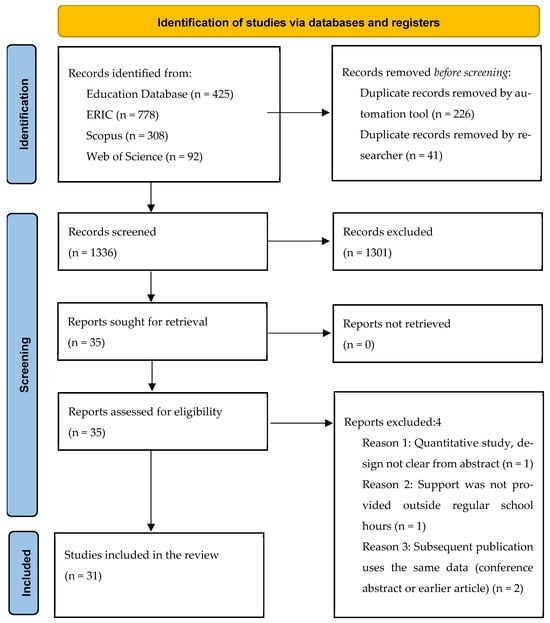
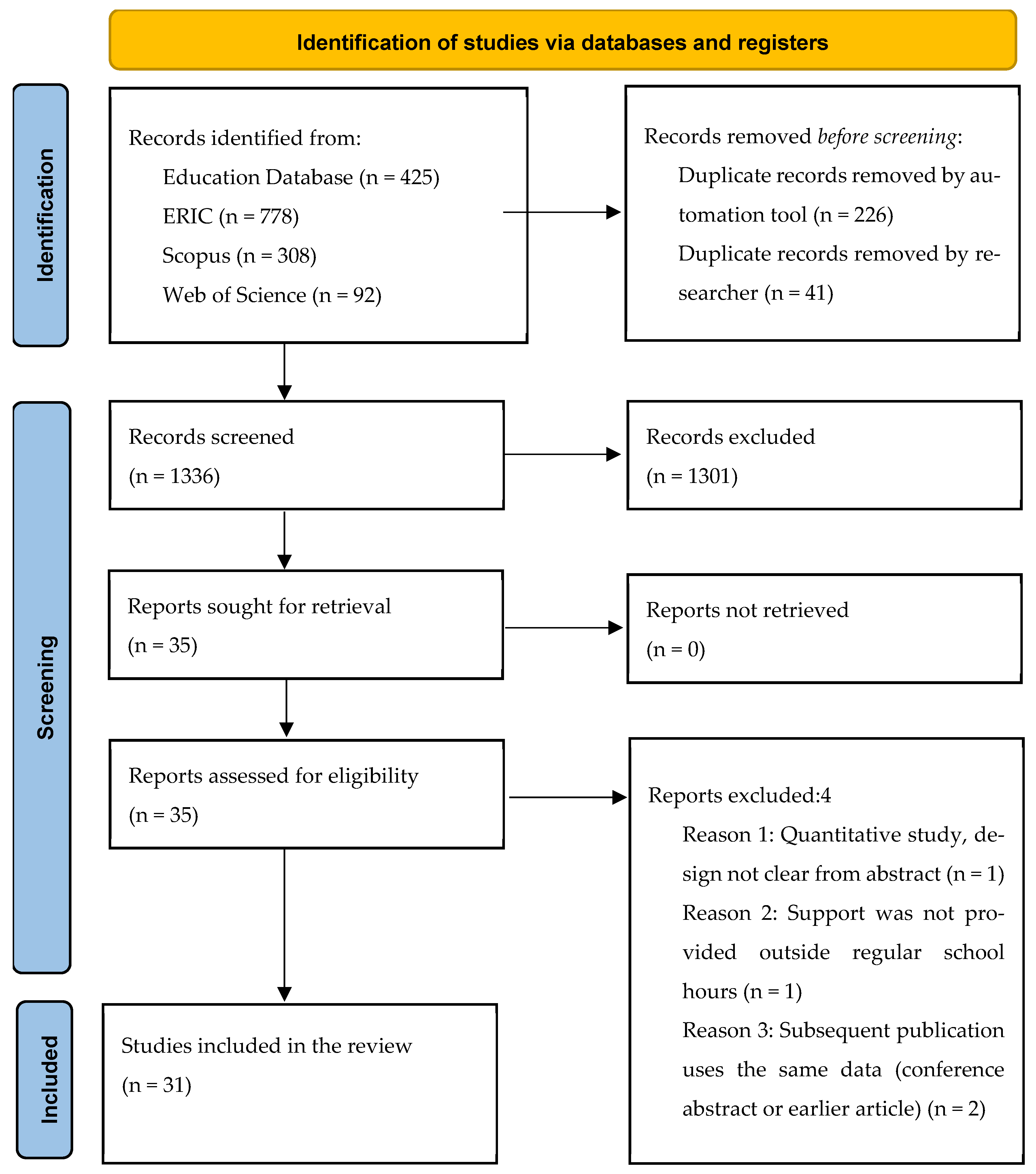
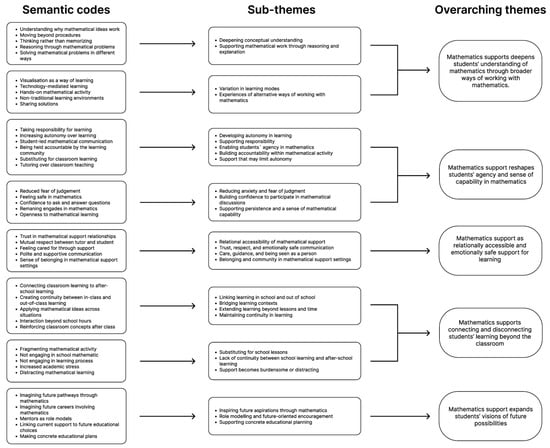
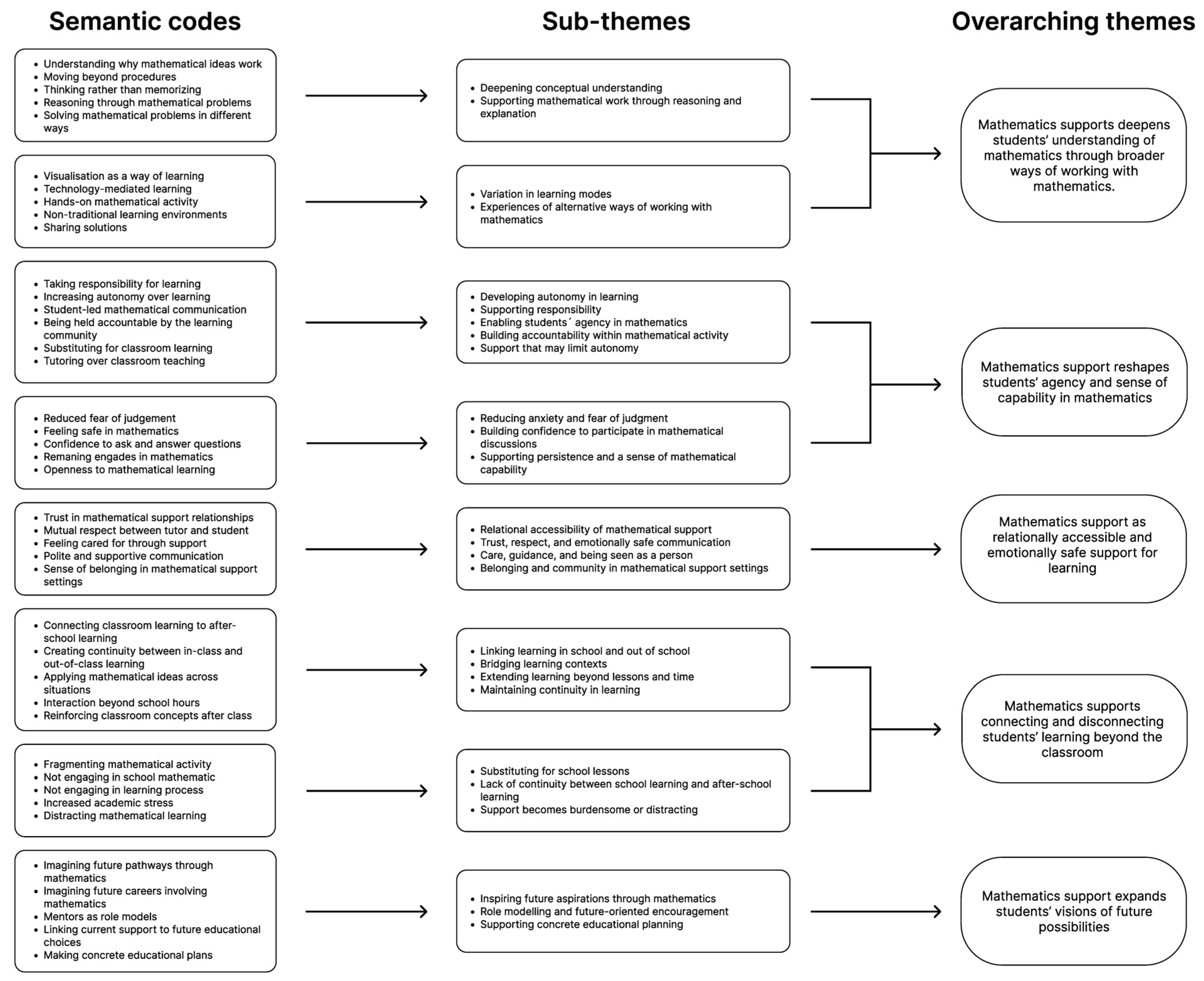
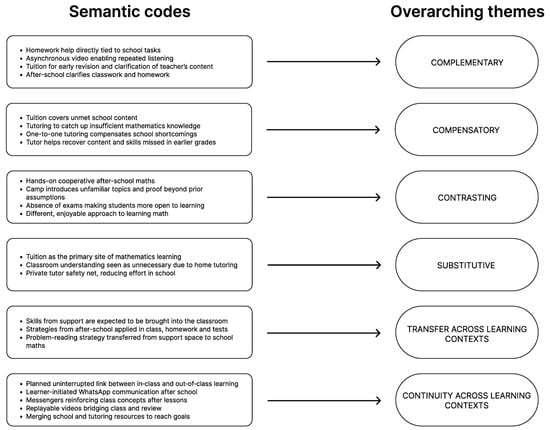
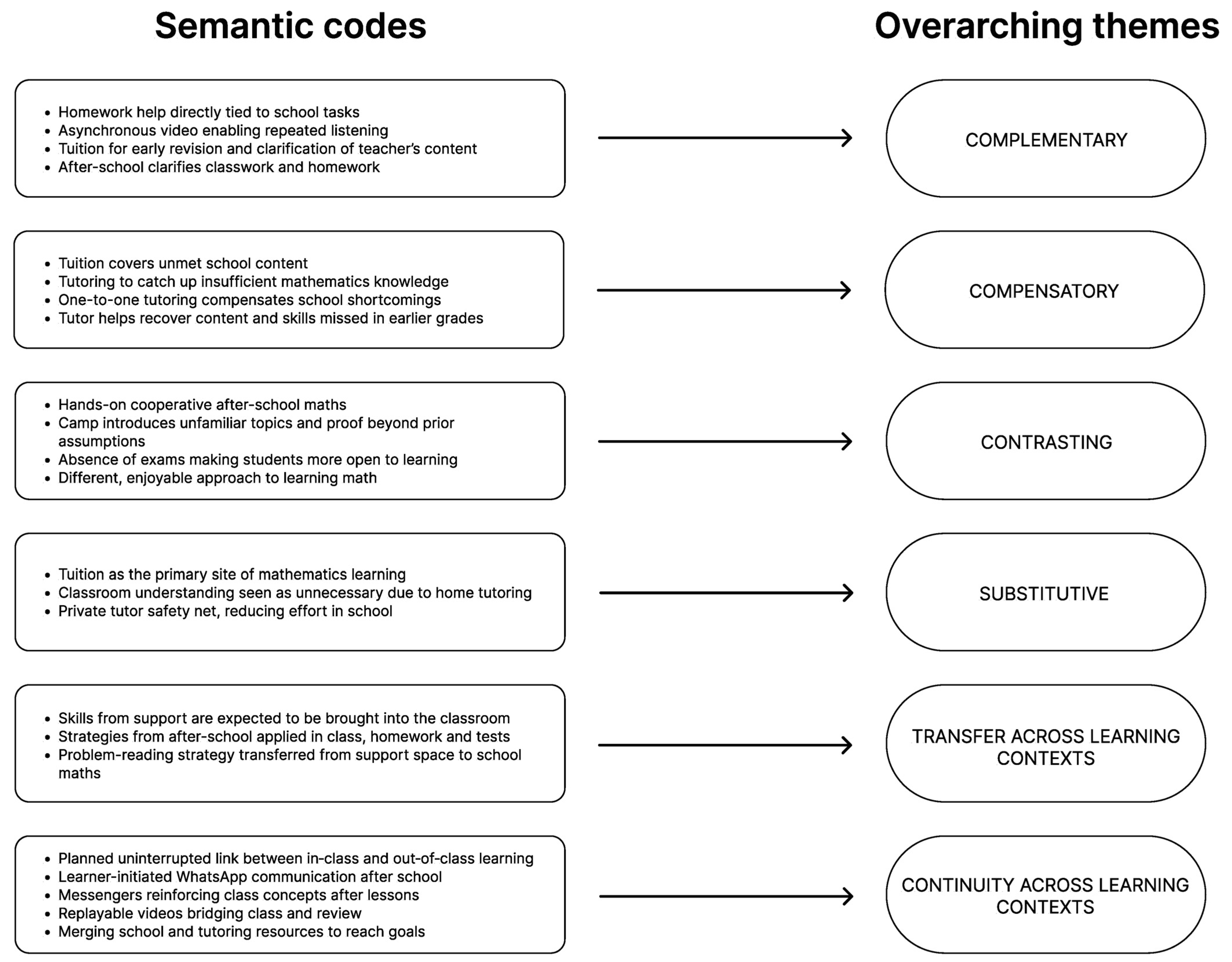
Disclaimer/Publisher’s Note: The statements, opinions and data contained in all publications are solely those of the individual author(s) and contributor(s) and not of MDPI and/or the editor(s). MDPI and/or the editor(s) disclaim responsibility for any injury to people or property resulting from any ideas, methods, instructions or products referred to in the content. |
© 2026 by the authors. Licensee MDPI, Basel, Switzerland. This article is an open access article distributed under the terms and conditions of the Creative Commons Attribution (CC BY) license.