


Abstract
Critical thinking is a central goal of higher education, yet its development requires pedagogical structures that create opportunities to examine and reconsider reasoning. This study developed a Socratic–memetic didactic model integrating Socratic questioning and Internet memes within critical-thinking education. A qualitative, interpretive model-development approach was employed, comprising three stages: theory-informed construction of the initial model based on critical-thinking, Socratic, multimodal, and didactic-modelling principles; structured appraisal by five purposively selected experts; and refinement informed by their feedback. Expert feedback was analyzed qualitatively, with Likert-type ratings providing supplementary descriptive information. The appraisal identified four areas requiring greater specification: meme selection and use, teacher preparation and pedagogical mediation, contextual flexibility and student participation, and implementation, ethical, and evaluative guidance. These findings informed operational refinement rather than fundamental restructuring. The resulting proposal comprises an interconnected pedagogical architecture and an eight-stage instructional progression in which Socratic questioning is intended to guide the examination of reasoning, while culturally situated Internet memes are proposed as resources for cognitive confrontation, interpretation, and multimodal representation. The model offers a theoretically grounded approach to organizing opportunities for critical inquiry in higher education. Its instructional effectiveness remains to be evaluated through future empirical research.
1. Introduction
Critical thinking is widely recognized as a central learning outcome in higher education, particularly in contexts characterized by information overload, rapidly circulating digital content, and increasing demands for students to evaluate evidence, interpret competing claims, and justify their reasoning (Baloa & Navas, 2024; Bezanilla-Albisua et al., 2018; Facione, 2023; Halpern, 1998). However, its development in university classrooms remains uneven and is frequently addressed implicitly rather than through intentionally designed pedagogical experiences (Abanades, 2024; Carter et al., 2016; López et al., 2022; UNESCO, 2023). This challenge is therefore not only cognitive but also pedagogical, as opportunities for questioning, argumentation, reflection, and evidence-based reasoning depend partly on how learning experiences are structured (Li et al., 2022; Saputra et al., 2019).
Among the pedagogical approaches associated with critical thinking, Socratic questioning has received considerable attention because of its emphasis on dialogue, examination of assumptions, justification of claims, and reconsideration of initial positions. Previous research has linked Socratic approaches to analysis, inference, argumentation, and reflective discussion (Abrami et al., 2015; Delić & Bećirović, 2016; Dinkins & Cangelosi, 2019; Paul & Elder, 2020; Yang et al., 2013). Simultaneously, Internet memes have increasingly been examined as educational resources because of their familiarity within students’ digital cultures and their potential to support interpretation, participation, and engagement (Suárez-Guerrero et al., 2022; Tu et al., 2023; Ugalingan et al., 2022; Yánez Soria et al., 2025). These findings suggest opportunities to connect the interpretive and communicative characteristics of memes with pedagogical approaches aimed at fostering critical inquiry (Altukruni, 2022; Antón-Sancho et al., 2022; DeCook, 2018; Denisova, 2016; Riser et al., 2020).
The pedagogical relevance of integrating Socratic questioning and Internet memes lies in their complementary educational functions. While Socratic questioning promotes engagement with thought processes through dialogue, memes introduce culturally grounded multimodal perspectives that can stimulate critical inquiry. However, their meaningful integration requires more than the simultaneous use of these in-class activities; it demands a coherent didactic structure that links educational goals, teaching processes, participant roles, and contextual conditions (Frohn, 2025; Martynova, 2019; Rodriguez Sandoval et al., 2022).
Against this background, the present study aimed to develop and refine a theoretically grounded Socratic–memetic didactic model for fostering critical thinking in higher education. An initial proposal was constructed by integrating principles from critical thinking education, Socratic pedagogy, multimodal communication, and didactic modelling. Five experts subsequently appraised its conceptual and pedagogical structure, and their feedback informed its refinement.
The study’s original contribution is a theoretically grounded didactic architecture that assigns complementary instructional functions to Socratic questioning and Internet memes within an eight-stage progression. Rather than treating these elements as separate teaching strategies, the model integrates dialogic examination, cognitive confrontation through contrasting memes, reflective reconsideration, and multimodal production into a coherent instructional process. Accordingly, the study was guided by the following research question: What components and instructional stages should constitute a theoretically grounded Socratic–memetic didactic model designed to foster critical thinking in higher education?
2. Theoretical Framework
Critical thinking and its pedagogical development can be approached from multiple perspectives. For this study, the framework draws on selected perspectives concerning critical thinking, Socratic questioning, multimodal communication, and didactic model design that are particularly relevant to the development of the Socratic–memetic model. Together, these perspectives provide the conceptual basis for the pedagogical structure.
2.1. Critical Thinking as a Multidimensional Educational Practice
Within this framework, Facione’s (1990, 2023) conceptualization provides the primary cognitive reference through six interrelated skills: interpretation, analysis, evaluation, inference, explanation, and self-regulation. Halpern (1998, 2014) emphasized the purposeful application of cognitive skills and strategies, while Paul and Elder (2008, 2020) highlight the importance of questioning assumptions, evaluating reasoning, and applying intellectual standards to one’s own and others’ thinking. Together, these perspectives frame critical thinking as involving both cognitive processes and deliberate examination of reasoning.
In educational settings, critical thinking is shaped by dispositional, emotional, social, and contextual conditions that influence students’ engagement in questioning, argumentation, and reflection (Bezanilla-Albisua et al., 2018; Facione, 2023; Paul & Elder, 2008). This multidimensional perspective is particularly relevant in higher education, where students engage with disciplinary knowledge, peers, instructors, and complex information environments. Accordingly, the Socratic–memetic model conceptualizes critical thinking as an intentional and reflective practice supported by pedagogical mediation, providing opportunities for students to articulate positions, examine evidence, consider alternative perspectives, and reconsider their reasoning.
2.2. Socratic Questioning as a Dialogic Mechanism for Critical Thinking
Socratic questioning provides a dialogic foundation for the model. Rather than transmitting predetermined conclusions, CT uses purposeful questioning to examine assumptions, clarify concepts, evaluate evidence, and consider alternative perspectives (Paul & Elder, 2008, 2020). Questioning therefore functions not merely as a classroom-participation technique but as a mechanism through which students articulate and examine their reasoning.
A particularly relevant principle for the present model is the Socratic elenchus, understood as a dialogic process of cognitive confrontation in which an initial claim is confronted through questioning, examples, or counterexamples to expose possible contradictions or inconsistencies in reasoning (Candiotto, 2018; Dutilh Novaes, 2022). In this sense, cognitive confrontation is not understood primarily as demonstrating that a student is wrong, but as creating an opportunity to recognize limitations in an initial position and to reconsider or reconstruct the reasoning that supports it.
Research in educational contexts has associated Socratic approaches with critical-thinking processes, such as analysis, inference, argumentation, reflection, and reconsideration of initial positions (Abrami et al., 2015; Delić & Bećirović, 2016; Dinkins & Cangelosi, 2019; Yang et al., 2013). Building on this progressive character, the Socratic–memetic model positions questioning as a continuous form of pedagogical mediation rather than an isolated classroom activity. Throughout the instructional sequence, the instructor guides students to articulate their initial positions, examine their assumptions and evidence, consider alternative perspectives, and reconsider their reasoning, while allowing them to construct and challenge their own interpretations.
2.3. Internet Memes as Multimodal Cultural Artifacts
A second central component concerns the incorporation of Internet memes. From a cultural perspective, memes are not simply humorous images but digitally circulating artifacts through which meanings, positions, values, and interpretations are reproduced and transformed (Shifman, 2014). Their communicative power frequently depends on the interaction of visual and textual elements, cultural references, humor, irony, and contextual knowledge (Antón-Sancho et al., 2022; Zhu et al., 2024). Interpreting a meme therefore often requires readers to infer meanings that are not explicitly stated and connect them to broader social and cultural contexts.
From a multimodal perspective, memes combine semiotic resources through which meaning is constructed (Kress, 2010). Educational research has examined Internet memes as resources for student engagement and classroom interaction (Lin & Sun, 2023; Tu et al., 2023), multimodal interpretation and argumentation (Ugalingan et al., 2022), and the representation or assessment of learning (Suárez-Guerrero et al., 2022). These studies illustrate different pedagogical applications of memes, although their findings do not establish that meme-based activities necessarily improve critical thinking skills.
The model also incorporates memes created by students as an opportunity to summarize, convey, and discuss the viewpoints developed through Socratic dialogue.
2.4. Didactic Models as Structured Pedagogical Frameworks
In the educational literature, didactic models are distinguished from more general pedagogical models based on their role in organizing educational goals, instructional components, and the relationships among them (Font et al., 2010; Herrera Gutiérrez & Villafuerte Álvarez, 2023; Rivilla, 1982; Villafuerte et al., 2026). These components may include objectives, content, methods, resources, participant roles, the course of instruction, and mechanisms for monitoring learning (Frohn, 2025; Martynova, 2019; Rodriguez Sandoval et al., 2022). Accordingly, the Socratic–memetic approach is conceptualized as a didactic model that integrates these elements into a coherent pedagogical architecture rather than treating Socratic questioning and Internet memes as isolated strategies.
Another theoretical consideration underlying the lesson sequence is the productive cognitive confrontation. Conflicting perspectives can encourage learners to question their initial assumptions and reconsider their reasoning processes. This is consistent with research on sociocognitive conflict, which suggests that such encounters can promote learning as long as attention remains focused on the task at hand or the knowledge being addressed (Butera et al., 2019). Within the proposed model, opposing memes are intended to introduce competing perspectives, while Socratic questioning supports their interpretations and critical examinations.
3. Materials and Methods
3.1. Study Design and Development Process
This study adopted a qualitative, interpretative approach within an iterative model-development process to develop and refine a theoretically grounded Socratic–memetic didactic model for higher education. This methodological approach was appropriate because the study aimed to integrate theoretical principles and expert judgments rather than measure the effectiveness of instruction. In line with qualitative research, the analysis focused on the substantive meaning of the experts’ observations and their implications for the conceptual coherence, pedagogical organization, and feasibility of the model (Creswell & Poth, 2018).
The model development process consisted of three phases: theory-guided creation of the initial draft (Section 3.2), structured evaluation by five carefully selected experts (Section 3.3), and refinement based on their qualitative feedback and the model’s theoretical foundations (Section 4.3). Qualitative observations formed the primary basis for refinement, whereas numerical evaluations provided supplementary descriptive information.
3.2. Theory-Informed Construction of the Initial Model
The original Socratic–memetic didactic model was developed as part of a theory-informed design process in which the conceptual perspectives discussed in Section 2 were translated into pedagogical functions and an instructional sequence. Rather than conducting a systematic literature review, this study integrated complementary theoretical foundations using a relational approach to develop a conceptual framework (Jabareen, 2009).
Four design decisions guided this process: establishing critical thinking as the pedagogical goal (Facione, 1990, 2023), positioning Socratic questioning as the central dialogic mechanism (Paul & Elder, 2008, 2020), incorporating Internet memes as culturally situated multimodal resources (Kress, 2010; Shifman, 2014), and organizing these elements into an interconnected didactic structure (Frohn, 2025; Martynova, 2019; Rodriguez Sandoval et al., 2022). The model also defines teachers as facilitators of inquiry and students as active participants, with reflection and contextual adaptability integrated into the design.
These principles informed an eight-stage instructional sequence that progressed from initial questioning and clarification to cognitive confrontation, critical evaluation, reflective reformulation, multimodal production, and closure. The stages are organized according to their pedagogical functions rather than assigned exclusively to individual critical thinking skills. Table 1 presents the initial structure submitted for expert appraisal.
Table 1.
Initial structure of the Socratic–memetic didactic model.
3.3. Expert Appraisal
The original model underwent a formative expert review to examine its conceptual clarity, theoretical and pedagogical coherence, pedagogical relevance, structure, and feasibility. Expert evaluation provides an opportunity to assess a proposed framework based on the informed judgments of specialists in relevant fields (Escobar-Pérez & Cuervo-Martínez, 2008). In this study, the evaluation focused on identifying areas for further development of the model rather than determining statistical consensus, psychometric validity, or didactic effectiveness of the model.
3.3.1. Expert Participants and Selection Criteria
Five university experts participated in the evaluation. They were selected using a targeted, criteria-based sampling method that preferred participants whose knowledge and experience are relevant to the research objective (Palinkas et al., 2015). The selection was based on academic and professional expertise in the fields of critical thinking, higher education, pedagogy, educational innovation and technology, social media and digital visual resources. Relevant professional competence was assessed based on research, teaching, scholarly output, and professional engagement in these areas. None of the experts were involved in the model’s initial development or the evaluation instrument’s design.
Previous research provides examples of how relatively small groups of experts have been used for various development and evaluation purposes. For example, interviews with four experts were used to examine a proposed higher education model (Allah Pitchay et al., 2025), while six experts participated in the content evaluation of an educational assessment instrument (Rodríguez Medina et al., 2021). Although these studies differ in their objectives and methods, they illustrate the use of carefully selected experts in educational research. In the present study, the appropriateness of the five-member expert panel was assessed in terms of the assessment’s developmental purpose, the participants’ relevant subject-matter expertise, and the qualitative depth of their feedback—rather than in terms of numerical representativeness.
Table 2 provides an overview of the experts’ fields of expertise and their academic experience. Affiliations with institutions and any potentially identifying professional details were omitted to protect the participants’ confidentiality.
Table 2.
General profile of experts participating in the expert appraisal.
3.3.2. Appraisal Procedure and Materials
Expert appraisal began in late April 2026. Each expert received a personal invitation, a detailed document describing the theoretical foundations, pedagogical structure, components, and initial lesson plan of the model, and a visual presentation created in Canva that summarized the key elements. The experts then completed a structured evaluation tool provided through Google Forms.
The instrument was developed specifically for this study to examine the conceptual, pedagogical, and implementation-related characteristics of the model. Its design was based on criteria commonly used in educational evaluation and expert reviews, particularly coherence, relevance, and feasibility (Gadke et al., 2021; López Quiroz, 2016; Rodríguez Medina et al., 2021). Prior to its use, the doctoral advisor reviewed the instrument, and three fellow doctoral students tested its comprehensibility and user-friendliness in a pilot test, which led to minor revisions. These colleagues were not the same as the five experts who subsequently evaluated the model, and their feedback was not included in the analysis of the expert evaluation. The preliminary review and pilot test were intended to improve the instrument’s clarity and user-friendliness, but not to establish its psychometric validity.
The instrument comprised nine dimensions: (1) conceptual clarity, (2) theoretical and conceptual coherence, (3) pedagogical relevance, (4) pedagogical organization, (5) pedagogical interaction and student-centeredness, (6) integration of educational resources, (7) development of complex competencies, (8) feasibility, and (9) overall evaluation. These dimensions served as structural criteria for examining the model as an integrated pedagogical approach rather than as independent psychometric constructs. The items within each dimension referred to specific features of the model, allowing for the consideration of both numerical ratings and qualitative observations regarding the same aspects of the approach. The complete instrument, including the original wording of the items, questions, response scale, and options for the overall evaluation, is included in Supplementary Material S1.
Closed-ended items were rated using a four-point Likert-type scale ranging from 1 (does not meet the criteria) to 4 (fully meets the criteria), with intermediate categories of 2 (partially meets the criteria), and 3 (adequately meets the criteria). Each section also included an open-ended question and a field for additional comments on the questionnaire. Qualitative responses formed the primary basis for model refinement, and numerical ratings provided supplementary descriptive information. This combination of structured ratings and open-ended feedback is consistent with previous expert appraisal procedures used in the evaluation of educational models (Zamora-de-Ortiz et al., 2020).
All experts were invited to an optional follow-up meeting to clarify or supplement their responses. One expert participated and submitted an annotated version of the model with additional comments. The remaining experts did not request a meeting. Additional written feedback, including email correspondence, was retained when it was elaborated on an expert’s appraisal. The five complete questionnaires constituted the primary evidence, while the follow-up meeting, annotated document, and additional correspondence were treated as supplementary evidence rather than equivalent sources available to all participants.
3.3.3. Analysis of Expert Feedback
The experts’ feedback was analyzed using a qualitative content analysis approach based on Elo and Kyngäs (2008), taking into account the phases of preparation, organization, and reporting to identify observations relevant to model refinement. The analysis was predominantly inductive, as the categories were derived from the experts’ observations rather than predetermined. The theoretical foundations and didactic components of the model subsequently provided the context for interpreting the categories and evaluating their implications for refinement. The primary qualitative data consisted of responses to open-ended questions as well as fields for suggestions at the section level of the structured evaluation instrument. Supplementary information from the follow-up meeting, annotated document, or written communication was included when it clarified, elaborated on, or supplemented an expert’s structured response. The experts’ feedback was analyzed in the language in which it was originally provided. Excerpts from responses originally written in Spanish and reproduced in English were translated for publication, with the translated text cross-checked against the original comment to preserve the intended meaning.
During the preparatory phase, the experts’ written comments and relevant supplementary feedback were compiled and reviewed to familiarize ourselves with the material. During the organizational phase, the qualitative material was organized into an analysis matrix and examined across all experts to identify recurring concerns, conceptual similarities, and recommendations related to specific components or instructional phases of the model. The first author assigned descriptive codes to meaningful sections of the expert feedback. Subsequently, related codes were compared and grouped into higher-level categories based on their content similarities and the pedagogical issues they addressed. This process resulted in four overarching areas for further development, which are presented in Section 4.2. Table 3 contains illustrative examples of how the experts’ written observations were assigned descriptive codes and linked to the overarching areas for further development. During the reporting phase, these categories were used to structure the findings and explain their implications for further model development. Qualitative coding and matrix organization were performed manually using Microsoft Excel for Microsoft 365, version 2608.
Table 3.
Selected Examples of Descriptive Coding of Expert-Appraisal Responses.
The resulting coding and category structure was reviewed by the second author, who served as the doctoral advisor, with particular attention paid to the consistency between the experts’ original observations, the assigned codes, and the overarching interpretive categories of the study. Where differences in interpretation arose, both authors discussed the relevant comments and revised the analytical structure, as necessary. Recommendations were evaluated based on their substantive relevance to conceptual coherence, pedagogical structure, clarity, and feasibility of the model, rather than solely on how frequently they were mentioned by the experts.
Following this joint review, an additional peer debriefing session was held with a researcher experienced in qualitative methodology who was not part of the author team and had not been involved in the model development, expert evaluation, or initial coding. During the discussion, the alignment between the experts’ observations, descriptive codes, and four areas for refinement, as well as the analytical assumptions and alternative interpretations, were critically examined. The feedback was then discussed by both authors, and the resulting interpretive decisions were documented to strengthen the credibility, reflexivity, and transparency of the analysis.
Likert-type ratings were treated as supplementary descriptive information rather than a standalone branch of quantitative analysis. Given the ordinal nature of the four-point scale and the small, purposefully selected panel of five experts, the ratings were summarized using medians, ranges, and response frequencies calculated from the aggregated item-level responses within each rating dimension. These summaries described the distribution of the ratings rather than comparisons among the experts or statistical consensus. The numerical information was examined alongside the qualitative comments, which formed the primary basis for model refinement. No inferential analyses, psychometric validation, or statistical estimation of consensus were performed.
The analysis matrix also supported the traceability between the experts’ observations and the subsequent decisions regarding refinement, as shown in Section 4.3.
4. Results
4.1. Descriptive Overview of the Expert Appraisal
Across all nine evaluation dimensions, the five experts generally rated the original Socratic–memetic didactic model positively. As shown in Table 4, the median rating at the item level across all dimensions was 4, with ranges varying between 3 and 4 and 1–4. The responses focused on categories 3 (meets the criteria adequately) and 4 (meets the criteria fully), although lower ratings were recorded for some dimensions.
Table 4.
Distribution of expert appraisal ratings: medians, ranges, and frequencies.
At the item level, all five experts assigned the highest rating to the items concerning the model’s potential to foster critical thinking and the appropriateness of proceeding to a subsequent empirical examination. These responses were interpreted as expert appraisals of the proposal’s developmental readiness rather than evidence of its effectiveness. Items concerning meme selection guidance and autonomous learning also revealed areas requiring closer examination. These observations were considered alongside the experts’ qualitative comments, which informed the subsequent refinement of the model.
At the conclusion of the appraisal, all five experts selected “approved with minor revisions” as their overall judgment of the proposal. None selected approval without revisions or rejection. The qualitative observations and recommendations underlying these appraisal patterns are examined in Section 4.2 below.
4.2. Expert-Identified Areas for Refinement
Qualitative analysis of the experts’ comments identified four interrelated areas in which the initial model required greater clarification or specification: (1) meme selection and use, (2) teacher preparation and pedagogical mediation, (3) contextual flexibility and student participation, and (4) implementation, ethics, and evaluative guidance. These concerns were directed primarily toward how the model would be interpreted and enacted in educational settings rather than toward the rejection of its underlying theoretical rationale. The findings below describe the concerns and recommendations identified through expert appraisals. The design decisions made in response to these are presented separately in Section 4.3.
4.2.1. Meme Selection and Use
Meme selection emerged as one of the most recurrent areas requiring greater specificity. Experts questioned whether the initial proposal sufficiently explained the types of memes appropriate for pedagogical use and how instructors should identify suitable resources. One expert explicitly noted that “the type of memes needs to be clarified” [authors’ translation], while another questioned how cultural bias would be addressed in their selection criteria.
Practical guidance was another recurring concern, particularly for instructors who may be unfamiliar with meme culture or locating suitable materials. Suggestions included illustrative examples, a repository of memes, and resources for identifying potential stimuli. At the same time, one expert cautioned against making such examples prescriptive, emphasizing the need for instructors to exercise professional judgment in relation to disciplinary and sociocultural contexts. The issue, then, was not simply access to memetic resources, but clearer guidance for selecting and using them appropriately.
4.2.2. Teacher Preparation and Pedagogical Mediation
A second recurring area concerned teacher preparation and pedagogical mediation. Experts emphasized that the enactment of the model was closely connected to how instructors organized and mediated the learning process. Their observations identified several aspects requiring greater specification, including familiarity with Socratic questioning, understanding the pedagogical purpose of memes, facilitating classroom dialogue, and encouraging students to examine and justify their positions rather than merely express opinions. Experts also raised concerns about instructors’ ability to sustain questioning and participation across different classroom dynamics.
In relation to implementation, experts identified the need for clearer guidance to support instructors who may be unfamiliar with the model or with the pedagogical use of Internet memes. Their recommendations included practical resources, illustrative examples, and simulated applications that could help clarify how Socratic questioning, memetic resources, and classroom interaction should be organized during instruction.
4.2.3. Contextual Flexibility and Student Participation
Experts also emphasized that implementation could not be considered independently of the educational context. One expert stated that “the model should be flexible enough to allow for professional discretion,” while others identified factors such as group size, student interest and participation, course characteristics, available time, and instructor familiarity as conditions that could influence enactment. Complementary written feedback cautioned against treating the model as an independent intervention whose functioning could be separated from institutional context, educator preparation, and student expectations.
Student participation was also raised in relation to the dialogic and student-centered character of the model. Experts noted that students’ willingness and opportunities to contribute to discussions and engage with the resources presented are relevant to its enactment. Some comments also raised the possibility of involving students in aspects of resource selection within appropriate pedagogical parameters.
Additionally, the experts’ appraisals revealed uncertainties regarding autonomous learning. This item received the lowest descriptive rating in the structured appraisal, and one expert explicitly questioned the extent to which autonomy could be attributed to a model whose reflective processes relied substantially on questioning, dialogue, and interaction with others. Because autonomous learning was not a central objective of the proposed model, these observations were interpreted primarily as indicating the need for greater precision regarding the scope of competencies attributed to the model rather than requiring a modification of its dialogic orientation.
4.2.4. Implementation, Ethical, and Evaluative Guidance
The fourth area concerns the level of guidance required for responsible and feasible implementation. Experts noted that the pedagogical purpose of memes should be made explicit to prevent their use from being perceived as insufficiently rigorous or inappropriate.
Ethical and evaluative considerations also required greater specification. Complementary feedback recommended expanding the ethical guidance associated with implementation, particularly in relation to the use of digital cultural resources. One expert also questioned whether the proposed implementation “indicators” functioned as indicators in a sufficiently observable sense and suggested more explicit forms of documenting classroom interactions and teacher questioning. These observations highlighted the need to distinguish between general descriptions of desirable classroom processes and concrete guidance for observing, reflecting on, or formatively assessing implementation.
4.3. Integration of Expert Feedback into Model Refinement
The expert-appraisal findings were translated into model-refinement decisions by examining each recommendation in relation to the corresponding element of the initial proposal and its theoretical rationale. Based on feedback from experts, the model’s pedagogical functions and the guidelines for its implementation were further developed. As Table 5 shows, most of the changes involved clarifying or specifying elements that were already included in the original proposal rather than introducing new components.
Table 5.
Traceability of expert-appraisal findings and model-refinement decisions.
Not all of the experts’ recommendations were adopted. For example, the responsibility of instructors for selecting memes during the cognitive engagement phase was retained to ensure pedagogical coherence and sociocultural appropriateness. Nevertheless, students actively participate by interpreting, questioning, and critiquing these memes, as well as by creating their own multimodal representations. This decision reflects the model’s orientation, which emphasizes pedagogical coherence rather than the automatic adoption of expert suggestions.
4.4. Components of the Expert-Refined Socratic–Memetic Didactic Model
The expert-refined Socratic–memetic didactic model integrates interrelated components related to its educational purpose, pedagogical strategies, multimodal resources, participant roles, reflection, formative assessment, and contextual conditions. These components constitute the model’s pedagogical architecture, whereas the eight-stage sequence presented in Section 4.5 organizes their instructional implementation.
To support responsible implementation, Table 6 provides an ethical and pedagogical checklist for selecting and using Internet memes. The checklist translates the model’s ethical considerations into practical questions that instructors can consider before and during classroom use.
Table 6.
Ethical and Pedagogical Checklist for Selecting and Using Internet Memes.
Table 7 summarizes the didactic components of the model, their characteristics, and their pedagogical functions.
Table 7.
Didactic elements and their expression in the expert-refined Socratic–memetic model.
4.5. Instructional Stages of the Expert-Refined Socratic–Memetic Didactic Model
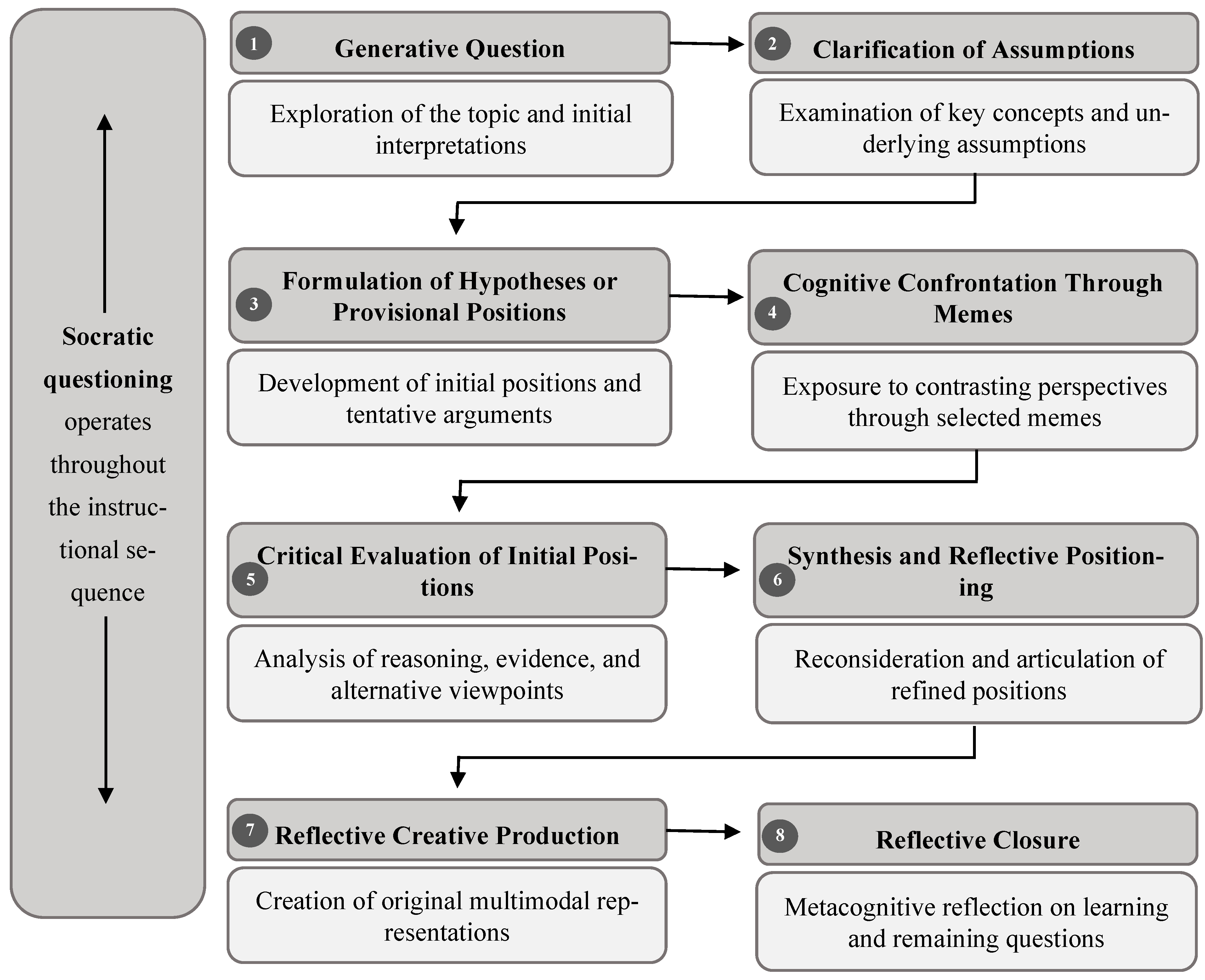
The components described in Section 4.4 are implemented through an eight-step instructional sequence (Figure 1). The sequence progresses from the formulation of initial viewpoints through their critical examination and re-evaluation to multimodal presentation and reflection. The stages provide a flexible pedagogical progression rather than a rigid script, with Socratic dialogue operating throughout. An illustrative classroom application of the eight-stage instructional sequence is provided in Appendix A.
Figure 1.
Eight-Stage Instructional Progression of the Socratic–memetic Didactic Model.
Table 8 summarizes the pedagogical functions of the eight stages, the corresponding forms of teacher mediation, and their relationships with the components of the model.
Table 8.
Pedagogical Organization of the Eight Instructional Stages.
Within the eight-stage Socratic–memetic sequence, students’ reasoning can be assessed formatively through their contributions to existing instructional activities. Drawing on Facione’s (1990) critical-thinking framework, Table 9 presents a proposed approach developed for the present model, linking observable evidence of reasoning to assessment criteria and corresponding Socratic follow-up questions. During classroom discussions, instructors examine students’ responses in relation to these criteria and use their observations to guide immediate feedback. For example, an unsupported claim may prompt a request for evidence, an unexamined assumption may lead to further questioning, and an alternative perspective may invite students to reconsider their conclusions. In larger classes, this assessment is necessarily selective rather than an exhaustive evaluation of every student. It does not involve assigning scores or grades but supports session-specific formative feedback. Assessing improvements in overall critical-thinking ability would require a separate empirical assessment design.
Table 9.
Proposed formative assessment of students’ reasoning within the Socratic–memetic model.
5. Discussion
The original contribution of this study lies in the development of a theoretically grounded and expert-refined didactic architecture that integrates Socratic questioning and Internet memes through complementary pedagogical functions. Previous research has examined Socratic pedagogy and the educational use of memes largely as separate approaches, with the latter frequently associated with student engagement and digital culture (Abrami et al., 2015; Paul & Elder, 2020; Suárez-Guerrero et al., 2022; Yánez Soria et al., 2025; Yang et al., 2013). Rather than merely combining these resources, the proposed model organizes Socratic dialogue, cognitive confrontation through contrasting memes, reflective reconsideration, and multimodal production within a coherent, eight-stage instructional progression.
The first contribution concerns the organization of critical thinking processes within the context of an instructional sequence. Critical thinking is not understood here as the isolated outcome of a specific activity but rather as a recurring practice of formulating, examining, justifying, and reconsidering arguments (Aston, 2023; Paul & Elder, 2020). The model translates these processes into interconnected pedagogical functions supported by dialogue, cognitive engagement, multimodal interpretations, and reflection. Therefore, its contribution lies in specifying instructional conditions that aim to make critical thinking an explicit focus of classroom activities without assuming that participation will necessarily lead to measurable improvements in critical thinking skills.
A second contribution concerns the epistemic role attributed to Internet memes. Although previous research has examined Internet memes as resources for student engagement and interaction in the classroom (Lin & Sun, 2023; Tu et al., 2023), the proposed model views them as a means of engaging with claims, assumptions, contradictions, and alternative perspectives. It is important to distinguish between two complementary functions: memes selected by teachers open perspectives for critical engagement, while multimodal artifacts created by learners offer opportunities to summarize and communicate perspectives developed within the framework of inquiry-based learning. By integrating these functions into a theoretically grounded didactic architecture, the model illustrates how culturally situated digital resources can support critical inquiry without their characteristics dictating instructional design (Martynova, 2019). Whether these intended functions are implemented in classroom practice remains an empirical question.
Beyond these conceptual contributions, the expert evaluation provides an important methodological insight: Theoretical coherence does not automatically provide sufficient guidance for implementation in the classroom. The evaluation contributed to a more precise specification of meme selection, teacher preparation, pedagogical mediation, contextual adaptability, and ethical and evaluative considerations. These refinements did not constitute evidence of instructional effectiveness; rather, they helped clarify how the model’s theoretical principles could inform proposed instructional decisions. The distinction between conceptual coherence and operational guidance is therefore relevant to the development and evaluation of didactic models in a broader sense.
A related aspect concerns the distinction between the intended educational goals and the competencies assessed as part of the expert evaluation. The inclusion of a competency in an assessment tool does not necessarily mean that it is considered an intended learning outcome. In this study, this distinction was particularly relevant to autonomous learning, which, although considered in the evaluation, was not positioned as a central goal of the model. Maintaining consistency between the theoretical foundations, stated goals, evaluation criteria, and expected outcomes is crucial for interpreting the scope of expert-supported further development.
6. Limitations and Future Research
Several limitations should be considered when interpreting this study. First, the expert evaluation involved five specialists who were purposively selected to contribute complementary expertise to refining the model. A larger panel or one with a different composition might have provided additional subject-matter and contextual perspectives. Accordingly, the evaluation should be understood as a formative assessment of the model rather than a definitive validation of its pedagogical structure.
Second, the study did not include classroom implementation or a direct assessment of students’ learning progress. Although expert feedback informed the refinement of the model’s conceptual coherence, pedagogical organization, and implementation guidance, its instructional effectiveness remains to be examined empirically.
Future research should examine how the model, as refined by experts, functions in various disciplinary, institutional and sociocultural contexts. Comparative classroom implementations could examine how student characteristics, group dynamics, teacher preparation, and the interpretation of memetic resources influence the implementation of the model, while also assessing whether the underlying pedagogical relationships can be maintained across various contexts.
Future studies should examine the extent to which participation in the Socratic–memetic sequence is related to students’ critical thinking processes, including interpretation, analysis, evaluation, inference, explanation, and self-regulation. Qualitative classroom observations and appropriate measures of critical thinking could help examine the contribution of Socratic questioning, contrasting memes, and multimodal artifacts created by students while distinguishing observable manifestations of reasoning from measurable changes in critical thinking skills.
7. Conclusions
This study developed a theoretically grounded Socratic–memetic didactic model and refined its pedagogical architecture through expert appraisal. The study’s key contribution is the functional integration of Socratic questioning, contrasting Internet memes, and reflective multimodal production within an eight-stage instructional progression designed to make the examination of reasoning an explicit pedagogical process.
The expert review provided insights into greater operational specificity regarding the selection of memes, teacher facilitation, contextual adaptability, and ethical and evaluative guidelines. As a theoretically grounded proposal refined by experts, the model requires empirical investigation to examine its implementation in the classroom and its potential contribution to the development of students’ critical thinking.
Supplementary Materials
The following supporting information can be downloaded at: https://www.mdpi.com/article/10.3390/educsci16111940/s1: Supplementary Material S1: Expert-Appraisal Instrument: Socratic-Memetic Pedagogical Model for the Development of Critical Thinking in Higher Education.
Author Contributions
Conceptualization, M.R.-G. and G.V.-U.; methodology, M.R.-G. and G.V.-U.; investigation, M.R.-G.; formal analysis, M.R.-G. and G.V.-U.; writing—original draft preparation, M.R.-G.; writing—review and editing, M.R.-G. and G.V.-U.; supervision, G.V.-U. All authors have read and agreed to the published version of the manuscript.
Funding
This research received no external funding.
Institutional Review Board Statement
The research project was reviewed and approved by the Comité Institucional de Ética en la Investigación (CIEI) of Tecnológico de Monterrey (approval code: P-EHE-202604-005; approval date: 24 April 2026).
Informed Consent Statement
Informed consent for participation was obtained from all the experts involved in the study.
Data Availability Statement
The data presented in this study are available upon request from the corresponding author. The data are not publicly available because of participant confidentiality.
Acknowledgments
Generative artificial intelligence was used in the preparation of this manuscript to assist with linguistic editing, as well as the structuring and revision of selected passages. It was not used to generate research data, perform primary coding of expert feedback, or make analytical decisions. All AI-generated content was reviewed and revised by the authors, who assume full responsibility for the final manuscript. The authors also thank Tecnológico de Monterrey for providing Article Processing Charge support for this research.
Conflicts of Interest
The authors declare no conflicts of interest.
Appendix A. Illustrative Classroom Application of the Socratic-Memetic Didactic Model
This appendix illustrates a hypothetical 60-min implementation of the eight-stage Socratic–memetic didactic model in an undergraduate classroom setting. The lesson addresses the impact of artificial intelligence (AI) on education. These examples illustrate instructional decisions and possible student responses rather than empirical evidence of the model’s effectiveness.
Table A1.
Eight-stage classroom implementation example.
- ⮚
- Illustrative Memetic Resources for Stage 4
- Meme A. ChatGPT as an Alternative Source of Academic Explanation: The meme presents a student expressing the view that ChatGPT explains academic topics more clearly than their college instruction, accompanied by a humorous reaction. It suggests that AI-generated explanations may be perceived as more accessible than conventional teaching.
- Meme B. The Risks of Dependence on ChatGPT: The meme depicts a surgeon during a brain operation alongside a satirical statement suggesting that ChatGPT has reached its usage limit. It exaggerates the consequences of relying on AI in situations requiring independent professional knowledge and judgment.
These contrasting examples invite students to examine their assumptions about effective learning, independent reasoning, and dependence on AI. Instructors should assess the appropriateness of both examples for their students and educational contexts before use.
- ⮚
- Illustrative Socratic dialogue (hypothetical)
- Instructor: “What do you think these two memes are trying to communicate about the use of ChatGPT?”
- Student A: “The first suggests that ChatGPT can help students understand difficult topics, while the second shows what could happen if someone depends on it too much.”
- Instructor: “Does relying on ChatGPT necessarily mean that someone lacks the knowledge to perform a task independently?”
- Student C: “Not necessarily. Someone might use ChatGPT as additional support while still understanding what they are doing.”
This hypothetical exchange illustrates how instructors can encourage students to examine assumptions and consider alternative interpretations without prescribing a conclusion.
References
- Abanades, M. (2024). Estudio de la competencia del pensamiento crítico: Análisis del concepto y trascendencia en el mundo educativo y laboral. European Public & Social Innovation Review, 9, 1–16. [Google Scholar] [CrossRef] [Scilit]
- Abrami, P. C., Bernard, R. M., Borokhovski, E., Waddington, D. I., Wade, C. A., & Persson, T. (2015). Strategies for teaching students to think critically: A meta-analysis. Review of Educational Research, 85(2), 275–314. [Google Scholar] [CrossRef] [Scilit]
- Allah Pitchay, A., Abdul Rahman, M., & Azhar, Z. (2025). Alleviating financial education debt through Zakah: Proposing HOPE model to public higher education institution. Qualitative Research in Financial Markets, 17(5), 1088–1112. [Google Scholar] [CrossRef] [Scilit]
- Altukruni, R. (2022). A systematic literature review on the integration of internet memes in EFL/ESL classrooms. Arab World English Journal, 13(4), 237–250. [Google Scholar] [CrossRef] [Scilit]
- Antón-Sancho, Á., Nieto-Sobrino, M., Fernández-Arias, P., & Vergara-Rodríguez, D. (2022). Usability of memes and humorous resources in virtual learning environments. Education Sciences, 12(3), 208. [Google Scholar] [CrossRef] [Scilit]
- Aston, K. J. (2023). ‘Why is this hard, to have critical thinking?’ Exploring the factors affecting critical thinking with international higher education students. Active Learning in Higher Education, 25(3), 537–550. [Google Scholar] [CrossRef] [Scilit]
- Baloa, N. M., & Navas, E. (2024). Desarrollo del Pensamiento Crítico en la Educación Superior: Retos y Estrategias Efectivas. Ciencia Latina Revista Científica Multidisciplinar, 8(5), 8914–8925. [Google Scholar] [CrossRef] [Scilit]
- Bezanilla-Albisua, M. J., Poblete-Ruiz, M., Fernández-Nogueira, D., Arranz-Turnes, S., & Campo-Carrasco, L. (2018). El Pensamiento Crítico desde la Perspectiva de los Docentes Universitarios. Estudios Pedagógicos (Valdivia), 44(1), 89–113. [Google Scholar] [CrossRef] [Scilit]
- Butera, F., Sommet, N., & Darnon, C. (2019). Sociocognitive conflict regulation: How to make sense of diverging ideas. Current Directions in Psychological Science, 28(2), 145–151. [Google Scholar] [CrossRef] [Scilit]
- Candiotto, L. (2018). Plato’s dialogically extended cognition. In P. Meineck, W. M. Short, & J. Devereaux (Eds.), The Routledge handbook of classics and cognitive theory (1st ed., pp. 202–215). Routledge. [Google Scholar] [CrossRef] [Scilit]
- Carter, A. G., Creedy, D. K., & Sidebotham, M. (2016). Efficacy of teaching methods used to develop critical thinking in nursing and midwifery undergraduate students: A systematic review of the literature. Nurse Education Today, 40, 209–218. [Google Scholar] [CrossRef] [Scilit] [PubMed]
- Creswell, J. W., & Poth, C. N. (2018). Qualitative inquiry & research design: Choosing among five approaches (4th ed). SAGE. [Google Scholar]
- DeCook, J. R. (2018). Memes and symbolic violence: #Proudboys and the use of memes for propaganda and the construction of collective identity. Learning, Media and Technology, 43(4), 485–504. [Google Scholar] [CrossRef] [Scilit]
- Delić, H., & Bećirović, S. (2016). Socratic method as an approach to teaching. European Researcher, 111(10), 511–517. [Google Scholar] [CrossRef] [Scilit]
- Denisova, A. (2016). Political memes as tools of dissent and alternative digital activism in the Russian-language twitter [Ph.D. thesis, University of Westminster]. [Google Scholar] [CrossRef]
- Dinkins, C. S., & Cangelosi, P. R. (2019). Putting Socrates back in Socratic method: Theory-based debriefing in the nursing classroom. Nursing Philosophy, 20(2), e12240. [Google Scholar] [CrossRef] [Scilit] [PubMed]
- Dutilh Novaes, C. (2022). Two types of refutation in philosophical argumentation. Argumentation, 36(4), 493–510. [Google Scholar] [CrossRef] [Scilit] [PubMed]
- Elo, S., & Kyngäs, H. (2008). The qualitative content analysis process. Journal of Advanced Nursing, 62(1), 107–115. [Google Scholar] [CrossRef] [Scilit] [PubMed]
- Escobar-Pérez, J., & Cuervo-Martínez, Á. (2008). Validez de contenido y juicio de expertos: Una aproximación a su utilización. Avances en Medición, 6, 27–36. [Google Scholar]
- Facione, P. (1990). A statement of expert consensus for purposes of educational assessment and instruction. American Philosophical Association. Available online: https://scispace.com/pdf/critical-thinking-a-statement-of-expert-consensus-for-zqkwsd1swr.pdf (accessed on 30 August 2026).
- Facione, P. (2023). Critical thinking: What it is and why it counts. Insight Assessment. Available online: https://insightassessment.com/iaresource/critical-thinking-what-it-is-and-why-it-counts/ (accessed on 15 July 2026).
- Font, V., Planas, N., & Godino, J. D. (2010). Modelo para el análisis didáctico en educación matemática. Infancia y Aprendizaje, 33(1), 89–105. [Google Scholar] [CrossRef] [Scilit]
- Frohn, J. (2025). Modelling inclusive education. The didactic model for inclusive teaching and learning as a heuristic for inclusion research and teacher education. Journal of Research in Special Educational Needs, 25(3), 514–526. [Google Scholar] [CrossRef] [Scilit]
- Gadke, D. L., Kratochwill, T. R., & Gettinger, M. (2021). Incorporating feasibility protocols in intervention research. Journal of School Psychology, 84, 1–18. [Google Scholar] [CrossRef] [Scilit] [PubMed]
- Halpern, D. F. (1998). Teaching critical thinking for transfer across domains: Disposition, skills, structure training, and metacognitive monitoring. American Psychologist, 53(4), 449–455. [Google Scholar] [CrossRef] [PubMed]
- Halpern, D. F. (2014). Thought and knowledge: An introduction to critical thinking (5th ed.). Psychology Press, Taylor & Francis Group. [Google Scholar]
- Herrera Gutiérrez, C., & Villafuerte Álvarez, C. A. (2023). Estrategias didácticas en la educacion. Horizontes. Revista de Investigación En Ciencias de La Educación, 7(28), 758–772. [Google Scholar] [CrossRef] [Scilit]
- Jabareen, Y. (2009). Building a conceptual framework: Philosophy, definitions, and procedure. International Journal of Qualitative Methods, 8(4), 49–62. [Google Scholar] [CrossRef] [Scilit]
- Kress, G. R. (2010). Multimodality: A social semiotic approach to contemporary communication. Routledge. [Google Scholar] [CrossRef] [Scilit]
- Li, S., Tang, S., Geng, X., & Liu, Q. (2022). Constructing a critical thinking evaluation framework for college students majoring in the humanities. Frontiers in Psychology, 13, 1017885. [Google Scholar] [CrossRef] [Scilit] [PubMed]
- Lin, X., & Sun, Q. (2023). Student-generated memes as a way to facilitate online discussion for adult learners. Psychology in the Schools, 60(12), 4826–4840. [Google Scholar] [CrossRef] [Scilit]
- López, M., Moreno, E. M., Uyaguari, J. F., & Barrera, M. P. (2022). El desarrollo del pensamiento crítico en el aula: Testimonios de docentes ecuatorianos de excelencia. Revista Digital Del Doctorado En Educación de La Universidad Central de Venezuela, 8(15), 161–180. [Google Scholar] [CrossRef] [Scilit]
- López Quiroz, M. I. (2016). Criterios de coherencia y pertinencia para la evaluación inicial de planes y programas de pregrado: Una propuesta teórico- metodológica. Revista de Estudios y Experiencias En Educación, 10(19), 49–71. [Google Scholar] [CrossRef] [Scilit]
- Martynova, R. (2019). Types of didactic models of the learning process. Science and Education, 2019(4), 15–22. [Google Scholar] [CrossRef] [Scilit]
- Palinkas, L. A., Horwitz, S. M., Green, C. A., Wisdom, J. P., Duan, N., & Hoagwood, K. (2015). Purposeful sampling for qualitative data collection and analysis in mixed method implementation research. Administration and Policy in Mental Health and Mental Health Services Research, 42(5), 533–544. [Google Scholar] [CrossRef] [Scilit] [PubMed]
- Paul, R., & Elder, L. (2008). The art of Socratic questioning, part III. Journal of Developmental Education, 31(3), 34–35. Available online: https://files.eric.ed.gov/fulltext/EJ832681.pdf (accessed on 10 July 2026).
- Paul, R., & Elder, L. (2020). The miniature guide to critical thinking concepts and tools (8th ed.). Rowman & Littlefield. [Google Scholar]
- Riser, D. K., Clarke, S. D., & Stallworth, A. N. (2020). Scientific memes: Using the language of social media to improve scientific literacy and communication in lifespan development. Psychology Learning & Teaching, 19(3), 275–289. [Google Scholar] [CrossRef] [Scilit]
- Rivilla, A. M. (1982). Elaboración de un modelo didáctico: Base para la realización eficiente de la tarea docente. Revista Española de Pedagogía, 40(157), 75–104. [Google Scholar] [CrossRef] [Scilit]
- Rodriguez Sandoval, M. T., Bernal Oviedo, G. M., & Rodriguez-Torres, M. I. (2022). From preconceptions to concept: The basis of a didactic model designed to promote the development of critical thinking. International Journal of Educational Research Open, 3, 100207. [Google Scholar] [CrossRef] [Scilit]
- Rodríguez Medina, M. A., Poblano-Ojinaga, E. R., Alvarado Tarango, L., González Torres, A., & Rodríguez Borbón, M. I. (2021). Validación por juicio de expertos de un instrumento de evaluación para evidencias de aprendizaje conceptual. RIDE Revista Iberoamericana Para La Investigación y El Desarrollo Educativo, 12(22), e240. [Google Scholar] [CrossRef] [Scilit]
- Saputra, M. D., Joyoatmojo, S., Wardani, D. K., & Sangka, K. B. (2019). Developing critical-thinking skills through the collaboration of jigsaw model with problem-based learning model. International Journal of Instruction, 12(1), 1077–1094. [Google Scholar] [CrossRef] [Scilit]
- Shifman, L. (2014). Memes in digital culture. The MIT Press. [Google Scholar]
- Suárez-Guerrero, C., Passeron, E., Herrera-Urízar, G., & Gamboa Cordero, Y. M. (2022). Memes como instrumento de evaluación del aprendizaje. Un caso en la universidad. REDU. Revista de Docencia Universitaria, 20(2), 165–180. [Google Scholar] [CrossRef] [Scilit]
- Tu, K., Sun, A., & Levin, D. M. (2023). Using memes to promote student engagement and classroom community during remote learning. Biochemistry and Molecular Biology Education, 51(2), 202–205. [Google Scholar] [CrossRef] [Scilit] [PubMed]
- Ugalingan, G. B., Flores, G. M. L., Garinto, L. A. B., & Mante-Estacio, M. J. (2022). The pedagogy of multiliteracy and multimodality through memes. International Journal of Media and Information Literacy, 7(1), 264–271. [Google Scholar] [CrossRef] [Scilit]
- UNESCO. (2023). Survey on the impact of online disinformation and hate speech (Ipsos). Available online: https://www.unesco.org/sites/default/files/medias/fichiers/2023/11/unesco_ipsos_survey.pdf (accessed on 12 August 2026).
- Villafuerte, J. S., Flores, R. A., Galarza, S. A., & Andrade, J. S. (2026). Educar para cuestionar: La ciudadanía crítica como defensa de la democracia. Sage Sphere Higher Education, 4(1), 1–20. [Google Scholar] [CrossRef] [Scilit]
- Yang, Y.-T. C., Chuang, Y.-C., Li, L.-Y., & Tseng, S.-S. (2013). A blended learning environment for individualized English listening and speaking integrating critical thinking. Computers & Education, 63, 285–305. [Google Scholar] [CrossRef] [Scilit]
- Yánez Soria, D. P., Cordones Cortez, D. A., & Romero Obando, M. F. (2025). Los memes en el desarrollo del pensamiento crítico. Revista Científica de Innovación Educativa y Sociedad Actual “ALCON”, 5(4), 76–85. [Google Scholar] [CrossRef] [Scilit]
- Zamora-de-Ortiz, M. S., Serrano-Pastor, F. J., & Martínez-Segura, M. J. (2020). Validez de contenido del modelo didáctico P-VIRC (preguntar-ver, interpretar, recorrer, contar) mediante el juicio de expertos. Formación Universitaria, 13(3), 43–54. [Google Scholar] [CrossRef] [Scilit]
- Zhu, D., Kuang, Y., Yang, Y., & Gao, Z. (2024). A brief discussion on how memetics guides the user experience design of cultural and creative products. In L. C. Jain, V. E. Balas, Q. Wu, & F. Shi (Eds.), Frontiers in artificial intelligence and applications. IOS Press. [Google Scholar] [CrossRef] [Scilit]

Disclaimer/Publisher’s Note: The statements, opinions and data contained in all publications are solely those of the individual author(s) and contributor(s) and not of MDPI and/or the editor(s). MDPI and/or the editor(s) disclaim responsibility for any injury to people or property resulting from any ideas, methods, instructions or products referred to in the content. |
© 2026 by the authors. Licensee MDPI, Basel, Switzerland. This article is an open access article distributed under the terms and conditions of the Creative Commons Attribution (CC BY) license.