


Abstract
Intercultural competence (IC) is essential for educators in diverse societies, yet the mechanisms through which it develops remain insufficiently understood. This study proposes and empirically tests a mediation model in which social proximity serves as a mediator linking openness to experience, intergroup contact, and social media use to IC among student teachers. The model was tested among 242 student teachers in the deeply divided context of Israel, that participated in the TEC (Technology, Education, and Cultural Diversity) program. Participants completed validated questionnaires measuring openness, intergroup contact, social media use, social proximity, and IC. Data were analyzed using correlations, multiple regression, and structural equation modelling. Findings showed that openness to experience and social proximity were the strongest positive predictors of IC. Intergroup contact predicted IC only indirectly through social proximity. Social media use showed a dual pattern, negatively predicting IC directly while exerting a positive indirect effect through social proximity. No significant differences in IC emerged between Jewish majority and Arab minority participants within this TEC-based sample; whether structured intercultural programs effectively help reduce such group disparities remains a question for longitudinal and comparative research The findings highlight the importance of fostering social proximity and meaningful intercultural engagement in teacher education and advance theoretical understanding of IC development.
1. Introduction
Education must reflect the dynamics of modern society, which is characterized by substantial diversity and heterogeneity. In this context, educators have the responsibility to address contemporary issues in the controlled classroom environment to prepare students for the challenges of the outside world. Thus, among other skills, teachers’ intercultural competence (IC)—their capacity to teach students from cultural backgrounds different from their own)—is essential for promoting inclusive and meaningful education. However, little is known about the interplay of personality, interpersonal, and digital factors in jointly predicting IC, particularly in deeply divided societies. This study sought to address this gap by exploring how concepts such as social proximity, openness, intergroup contact, and social media use affected IC among student teachers in Israel.
Israel was chosen to serve as the example of the profound diversity educators face, as diversity in Israel extends across ethnic, religious, and sociopolitical lines. The population includes diverse Jewish and Arab groups differing in ethnicity, religion, religiosity, and cultural background, including in the Jewish group immigrants from Ethiopia and the former Soviet Union (Bar-Tal et al., 2011; Hasson et al., 2017; Ismail et al., 2022). This diversity is reflected in a segmented educational system composed of Jewish and Arabic-speaking sectors, both of which include ethnically and religiously diverse classrooms (Sabbagh & Resh, 2014; Abu-Saad, 2019; Dar & Resh, 2003; Ben-Eliezer, 2008). In such a socially and culturally fragmented society, educators require a combination of self-awareness, interpersonal sensitivity, specific cultural knowledge, and cross-cultural communication skills. The way those skills develop in educational contexts, however, remains underexplored among the population of pre-service educators.
The current research proposes a mediation model in which social proximity mediates the relationships between openness to experience, intergroup contact, and social media use, on the one hand, and IC, on the other. Recent research suggests that perceived social proximity, different from mere contact, between different groups is key for prosocial orientation across group boundaries (Schütt, 2023), thus making social proximity a theoretically appropriate mechanism to explain how individual and contextual factors may shape IC. Applying the concept of social proximity can help bridge personality psychology, social media use, and intercultural education, offering a more comprehensive understanding of the multidimensional forces shaping IC among student teachers. Further, in an era characterized by rapid technological advancements that greatly influence educational practices and learning processes, this study also assesses the impact of social media on student teachers’ IC. This is particularly relevant given the growing role of social media in shaping intergroup relations.
2. Literature Review
2.1. Intercultural Competence (IC)
IC is often discussed alongside related constructs such as intercultural communicative competence, intercultural sensitivity, and transcultural communication (Sinicrope et al., 2007). However, scholars differentiate between the passive acquisition of multicultural knowledge and the active application of intercultural skills. Theoretical understanding alone does not guarantee effective intercultural engagement (Hammer et al., 2003; Golden & Baram, 2012; Shonfeld et al., 2025b). Thus, IC is not merely a cognitive process but also a behavioural and affective one. It is a skill that develops gradually and requires intentional reflection and practice as groups and individuals respond to cultural differences in a progression from denial to integration, as described in M. J. Bennett’s (2017) developmental model of intercultural sensitivity.
IC encompasses the ability to show respect for individuals from different cultural backgrounds, respond without judgment, and accept diverse sources of knowledge. It requires demonstrating empathy, engaging in self-reflection, and exercising adaptability and mediation skills. The practice of IC also involves participating in constructive cross-cultural dialogue and navigating ambiguity with openness and flexibility (Shapira et al., 2023). More recent research also finds that people who are more interculturally competent tend to experience less technological anxiety (Shonfeld et al., 2025a), implying that comfort with social media use may go hand in hand with intercultural sensitivity.
As can be seen, IC has become a necessary skill for navigating the contemporary, diverse global world. A micro-reflection of today’s social complexities is the classroom, with its pupils and teacher representing society’s rich cultural and ethnic diversities and where the place of IC is as important as it is challenging to implement. In such a novel and complex context, teachers must consciously work to understand and accept diverse worldviews, a process that challenges ingrained biases and demands ongoing personal reflection (Shapira & Mola, 2024). This is why working with educators is of utmost importance for fostering a harmonious, diverse society. Yet despite this rich conceptualisation, the mechanisms through which IC develops remain underexplored in the context of teacher education.
2.2. Factors Shaping IC
In heterogeneous societies, intergroup relations are often shaped by perceptions of threat, as outgroups may be viewed as challenging the ingroup’s security, status, or cultural identity (Canetti-Nisim et al., 2008; Meeusen & Jacobs, 2017). According to intergroup threat theory, these threats may be realistic, relating to resources or power, or symbolic, relating to values, religion, or identity (Stephan et al., 2015). Such perceptions encourage homophily, the tendency to prefer similar others, which strengthens ingroup cohesion but may also deepen social divisions (Lee, 2015; McPherson et al., 2001; Schütt, 2023). At the same time, homophily fosters social proximity, reflected in emotional closeness, mutual understanding, and concern for others’ well-being (Lee, 2015; McPherson et al., 2001; Schütt, 2023). Research suggests that perceived social proximity, beyond mere intergroup contact, plays a key role in promoting prosocial attitudes and behaviours across group boundaries (Schütt, 2023). Experimental studies further demonstrate that even perceived similarity can increase generosity and altruistic behaviour through enhanced social proximity (Lee, 2015; McPherson et al., 2001; Schütt, 2023). In educational contexts, virtual world interventions among Jewish and Arab students in Israel increased social proximity toward outgroup members (Hoter & Shapira, 2022), while online collaborative learning similarly promoted IC among diverse teachers (Zidan & Shonfeld, 2025). Together, these findings position social proximity as a theoretically important mechanism through which intercultural interactions may translate into the development of IC. It is important to note that social proximity primarily concerns perceived closeness to and willingness to engage with outgroup members, with interpersonal warmth reflecting this sense of closeness (IJzerman & Semin, 2009). IC, in turn, concerns the broader ability to navigate cultural differences through reflection, adaptability, and effective communication (Shapira et al., 2023). Although the constructs share an emphasis on understanding others’ perspectives, feeling close to outgroup members and being willing to live or work alongside them do not necessarily imply the ability to navigate intercultural interactions effectively.
Intercultural interactions inherently involve novelty and uncertainty and therefore require openness to experience. Within the Big Five personality framework (Costa & McCrae, 1992), openness refers to curiosity, receptiveness to new ideas, and willingness to engage with unfamiliar perspectives (Kaya et al., 2024). Individuals high in openness tend to demonstrate greater interest in multicultural encounters, lower prejudice, and stronger appreciation of cultural diversity (Blais-Rochette et al., 2022; Kayiş & Akcaoğlu, 2021; Menadue et al., 2021). Such characteristics are closely associated with the development of IC, which includes culturally relevant knowledge, flexibility, open-mindedness, and positive attitudes toward others (Deardorff, 2021; Savicki, 2023). Evidence from the field of teacher education further supports this relationship, as openness to experience was found to be the strongest predictor of intercultural sensitivity among Turkish student teachers (Aksin, 2023).
Social media also plays an increasingly important role in shaping intergroup relations. Digital platforms may facilitate intercultural dialogue and social cohesion by enabling communication across geographical and cultural boundaries (Lee, 2015; Serrat, 2017). However, they may simultaneously reinforce homophily and segregation through algorithmic echo chambers and interactions with like-minded peers (An, 2022; Lee, 2015; McPherson et al., 2001). Research has shown that social media can contribute to political polarization and the reinforcement of intergroup biases (Y. Chen & Volker, 2016; Paik et al., 2023), while patterns of racial and ethnic segregation online often mirror those found offline (Hofstra et al., 2017; McPherson et al., 2001). Thus, social media may either foster or hinder intercultural understanding depending on whether it promotes or inhibits social proximity across group boundaries.
Intergroup contact theory suggests that meaningful interactions between groups can reduce prejudice, increase empathy, and decrease anxiety and hostility (Pettigrew & Tropp, 2006, 2008; Tam et al., 2008). Such contact may improve intergroup attitudes by increasing knowledge of the outgroup and encouraging perspective-taking (Pettigrew & Tropp, 2008). Yet, positive outcomes depend heavily on contextual conditions, particularly in fragmented societies characterized by alienation and homophily (Lee, 2015; McPherson et al., 2001; Schütt, 2023). In Israel, intergroup contact between Jews and Arabs has been shown to reduce prejudice when Allport’s (1954) optimal conditions for optimizing intergroup contact (equal status, common goals, intergroup cooperation, and institutional support) are met (Pettigrew & Tropp, 2006). However, majority and minority groups often experience contact differently (Dovidio et al., 2017), and intergroup encounters may also evoke fear, anger, or alienation depending on the sociopolitical context and structural inequalities (Lev et al., 2024; Rosen & Perkins, 2013; Shdema et al., 2018; Šlebir & Zupančič, 2024). A systematic review further emphasized that the quality of contact, rather than its mere occurrence, is what reduces interethnic distance (Šlebir & Zupančič, 2024). These findings suggest that contact alone may be insufficient; rather, the social proximity emerging from positive intergroup experiences may be the mechanism through which IC develops.
2.3. The Current Study
To explore how social proximity, openness to experience, intergroup contact, and social media use affect IC, we examined these factors in two groups of student teachers in Israel, also taking into account the effect of their belonging to the Jewish or Arab group.
Our research hypotheses were:
H1.
Results may vary depending on Jewish or Arab group status.
H2.
Social proximity will be positively associated with IC.
H3.
Openness to experience will be positively associated with IC.
H4.
The social media use will be positively associated with IC.
H5.
Intergroup contact with other cultures will be positively associated with IC.
H6.
Social proximity will mediate the relationships between openness, intergroup contact, and social media use, on the one hand, and the development of IC, on the other.
The present study contributes to the literature by extending the conceptualization of student teachers’ IC beyond traditional frameworks of intergroup contact. While prior research emphasizes Allport’s (1954) contact hypothesis as the pathway for reducing prejudice and fostering trust, this study integrates additional individual and contextual factors—namely, social proximity, openness to experience, social media use, and Jewish versus Arab group status. Situated within the complex sociocultural fabric of Israeli society, this research offers novel insights into how student teachers navigate diversity in both offline and online contexts, thereby advancing theoretical models of IC in fragmented and heterogeneous societies.
3. Methods
The present study employed a quantitative, cross-sectional research design to examine individual and contextual predictors of IC among student teachers. Specifically, the study investigated the roles of social proximity, openness to experience, social media use, and intergroup contact, while accounting for relevant demographic variables. Data were collected through a structured self-report questionnaire, and the analytic strategy combined descriptive statistics, group comparisons, regression analyses, and structural equation modelling to test both direct and indirect associations among the study variables.
3.1. Participants
The sample comprise 242 student teachers enrolled in teacher education colleges across Israel. All participants were recruited through the TEC (Technology, Education, and Cultural Diversity) program, in which they enrolled in an academic course that involved collaborative learning among students from different colleges. Of approximately 400 students invited to participate, 242 students provided consent and completed the study questionnaire. The sample consisted predominantly of female participants (n = 224, 92.6%), with a smaller proportion of male participants (n = 18, 7.4%). Participants represented diverse religious backgrounds, including Jewish (n = 88, 36.4%) and non-Jewish: Muslim (n = 147, 60.7%), Druze (n = 5, 2.1%), and Christian (n = 2, 0.8%). Their age ranged from 19 to 55 (M = 24.86, SD = 6.04). Regarding religiosity, participants identified as secular (n = 28, 11.6%), traditional (n = 105, 43.4%), or religious (n = 107, 44.2%).
Regarding prior experience in culturally diverse courses, 18.6% (n = 45) had no such experience, 57.0% (n = 138) reported limited experience, and 23.6% (n = 57) had extensive experience. When asked about the cultural diversity of their residential area, 26.4% (n = 64) described it as diverse, 30.2% (n = 73) as slightly diverse, 31.0% (n = 75) as not diverse, and 12.0% (n = 29) as highly diverse. In terms of workplace cultural diversity, 40.5% (n = 98) reported frequent interactions with culturally diverse groups, 33.5% (n = 81) had occasional interactions, and 25.6% (n = 62) reported no such interactions. The discrepancies between the total sample size (n = 242) and the numbers reported for specific variables and analyses reflect missing responses, as not all participants completed every questionnaire item.
The research was approved by the MOFET Research Authority. Written consent from participants was obtained, after assurance from the researchers that participation was voluntary and anonymous.
3.2. Instruments
All the tools were originally written in English. We translated them to Hebrew and Arabic. The translation was conducted by two bilingual experts specializing in multicultural education. Beyond ensuring linguistic equivalence, the process involved multiple rounds of review to assess cognitive appropriateness and contextual relevance, with particular attention to the local sociocultural context.
3.2.1. Intercultural Competence Scale (IC; Shonfeld et al., 2025b)
The IC scale is a 16-item self-report scale (Cronbach’s α = 0.931, McDonald’s ω = 0.930), assessing one’s ability to navigate and interact effectively in culturally diverse environments on a 5-point Likert scale ranging from 1 (not at all) to 5 (to a very large extent). A sample item is “I have the ability to listen to different points of view.”
3.2.2. Social Proximity Scale (SP; Bogardus, 1933; Parrillo & Donoghue, 2005)
The SP scale is an 8-item self-report scale (Cronbach’s α = 0.965, McDonald’s ω = 0.965), measuring perceived closeness and engagement with individuals from different cultural backgrounds on a 5-point Likert scale ranging from 1 (not at all) to 5 (to a very large extent). Sample items are: “I can understand (the other’s group) point of view”; “I am willing to live near them; “I am willing to work together with them”.
3.2.3. Intergroup Contact Questions
Intergroup contact was assessed using three items capturing participants’ exposure to culturally diverse settings: (a) prior participation in courses with members of other cultural groups (0 = none, 1 = a few courses, 2 = more than three courses); (b) perceived cultural diversity of their residential area (1 = not diverse, 2 = slightly diverse, 3 = diverse, 4 = very diverse); and (c) prior work in environments involving members of other cultural groups (1 = none, 2 = once or twice, 3 = many times).
Because the items used different response scales, each was standardized using its sample mean and standard deviation (z-scores). The standardized scores were then averaged to create a composite intergroup contact index. Equal weighting was applied because the three indicators represent distinct but complementary contexts of potential intercultural exposure, with no theoretical justification for prioritizing one context over another. Higher scores indicated greater overall reported exposure to culturally diverse environments. The measure was conceptualized as a composite index of contextual exposure rather than a reflective psychometric scale.
3.2.4. Openness to Experience Scale (OE; McCrae & Costa, 1992)
The OE scale is a 10-item self-report subscale from the Big Five Inventory (Cronbach’s α = 0.869, McDonald’s ω = 0.862), assessing one’s receptivity to new ideas and experiences on a 5-point Likert scale ranging from 1 (not at all) to 5 (to a very large extent). A sample item is: “I would describe myself as a curious person.”
3.2.5. Social Media Scale (SM; Yeap et al., 2015)
The SM scale is a 9-item self-report scale (Cronbach’s α = 0.930, McDonald’s ω = 0.927), examining one’s inclination to engage in communications through social media and on a 5-point Likert scale ranging from 1 (not at all) to 5 (to a very large extent). The original questionnaire referred to Internet use but we adapted it to refer to social media use. For example, the item: I have used the Internet to make myself feel better when I’ve felt upset” was changed to “I have used social media to make myself feel better when I’ve felt upset.”
3.3. Procedure
The participants filled out the online questionnaire during a face-to-face meeting at the MOFET Institute.
3.4. Data Analysis
Given the limited representation of Druze and Christians in our sample, we combined these smaller groups with Muslims into a broader category of Arab non-Jewish participants. This adjustment allowed us to have a more balanced comparison between Jewish and non-Jewish participants. Three categorical variables related to intergroup contact were analysed: participation in joint courses with other cultural groups, perceived cultural diversity of the residential area, and workplace exposure to cultural diversity. Since the intergroup contact measure was conceived as a composite index of exposure across distinct contexts (academic, residential, and occupational), it was not treated as a latent psychometric scale. The three items represent different sources of intergroup contact that are not theoretically expected to be highly intercorrelated. Accordingly, internal consistency indices (e.g., Cronbach’s α) were not computed, as low inter-item correlations would reflect meaningful contextual differentiation rather than measurement unreliability.
A multiple linear regression was conducted to examine the extent to which social proximity, openness to experience, social media use, and intergroup contact predicted IC, above and beyond age, gender, and ethnicity.
An observed-variable path model was estimated within the structural equation modeling (SEM) framework to examine the direct and indirect associations of openness to experience, social media use, and intergroup contact with intercultural competence (IC), with social proximity specified as a mediator. Although IC, openness to experience, social proximity, and social media use represent theoretically latent psychological constructs, they were operationalized using observed composite scores derived from their respective self-report scales. Intergroup contact was similarly represented by an observed composite index of exposure across different contexts. Age, gender, and ethnicity were included as control variables predicting social proximity. The model was estimated using maximum likelihood with robust standard errors in the lavaan package (Rosseel, 2012) in R. Indirect and total effects were calculated using defined parameters in lavaan, with 95% confidence intervals estimated using robust standard errors. Missing data were handled using listwise deletion. Four participants had missing age data and were therefore excluded from the regression and path analyses, resulting in a final analytical sample of 238 participants.
4. Results
Table 1 presents descriptive statistics for the main study variables, including social media use, social proximity, openness, intergroup contact, and IC.
Table 1.
Descriptive Statistics for Study Variables (N = 242).
Intergroup contact represents a standardized composite score, with higher values indicating greater exposure to culturally diverse experiences.
As shown in Table 1, mean scores for openness to experience (M = 3.78, SD = 0.69) and IC (M = 3.86, SD = 0.76) were well above the scale midpoint of 3, indicating that participants generally described themselves as open to new experiences and interculturally competent. Social proximity (M = 3.08) was close to the midpoint, and social media use (M = 2.86) was just slightly below it, indicating moderate levels of both. Social proximity also showed the widest dispersion among the scale scores (SD = 1.13), suggesting that participants differed considerably in how close they felt to members of the other group. Scores on all four scales covered the full range from 1 to 5. As shown in Table 1, participants reported relatively high levels of openness and IC, alongside moderate levels of social media use and social proximity. Intergroup contact exhibited greater variability, reflecting differences in participants’ exposure to culturally diverse groups.
Table 2 presents the results of independent samples t tests comparing Jewish and non-Jewish participants on social media use, social proximity, openness, intergroup contact, and IC.
Table 2.
Group Differences Between Jewish and Non-Jewish Participants on Study Variables.
As shown in Table 2, the two groups differed significantly on two of the five study variables, partially supporting H1. Non-Jewish participants reported greater social media use, t(240) = −2.57, p = 0.011, d = −0.344, and greater social proximity, t(240) = −4.12, p < 0.001, d = −0.551, than Jewish participants. The difference in social proximity was the largest observed, with non-Jewish participants scoring above the scale midpoint (M = 3.30) and Jewish participants below it (M = 2.69). That is, Arab participants reported feeling closer to their Jewish peers than Jewish participants reported feeling toward their Arab peers. No significant group differences emerged in openness (Jewish M = 3.77; non-Jewish M = 3.79), intergroup contact (Jewish M = 0.10; non-Jewish M = −0.06), or IC (Jewish M = 3.77; non-Jewish M = 3.92). Thus, despite differing in social proximity, the two groups reported similar levels of openness and IC.
The Pearson bivariate correlations provide an overview of the associations among key constructs. Table 3 summarizes the correlations between all main study variables and the demographic measures.
Table 3.
Correlations between the Main Study Variables.
Openness to experience was positively correlated with intergroup contact, r(240) = 0.166, p = 0.010, social media use, r(240) = 0.279, p < 0.001, social proximity, r(240) = 0.327, p < 0.001, and IC, r(240) = 0.386, p < 0.001. Intergroup contact was associated with higher social proximity, r(240) = 0.206, p = 0.001, and IC, r(240) = 0.155, p = 0.016. Social media use was also positively correlated with social proximity, r(240) = 0.257, p < 0.001. Notably, social proximity was strongly associated with IC, r(240) = 0.428, p < 0.001. These findings are consistent with H2 and H3, which posited that social proximity and openness to experience would be positively associated with participants’ IC. Age was negatively correlated with ethnicity, r(236) = −0.354, p < 0.001. The level of social media use was negatively correlated with age, r(236) = −0.145, p = 0.026. Because several demographic variables were associated with our key study variables, we adopted a conservative analytic approach and controlled for demographic factors in all models.
To examine the predictors of IC, we estimated a multiple regression model in which openness to experience, social media use, social proximity, and intergroup contact were entered as focal predictors, while age, gender, and ethnicity were included as control variables. This model tested the unique contribution of each predictor to IC above and beyond demographic factors. The model was statistically significant, F(7, 230) = 16.534, p < 0.001, and explained approximately 33.5% of the variance in IC.
Openness to experience (β = 0.343, p < 0.001), social media use (β = −0.292, p < 0.001), and social proximity (β = 0.344, p < 0.001) were significant predictors. Age (β = 0.079, p = 0.193), gender (β = 0.038, p = 0.497), ethnicity (β = 0.087, p = 0.168), and intergroup contact (β = 0.053, p = 0.343) were not statistically significant predictors. These results are summarized in Table 4.
Table 4.
Regression Results Predicting Intercultural Competence.
In accordance with H2 and H3,, these findings suggest that participants with stronger social proximity and higher openness to experience report higher levels of IC. However, contrary to H4, greater social media use was associated with lower levels of intercultural competence, after accounting for the other predictors.
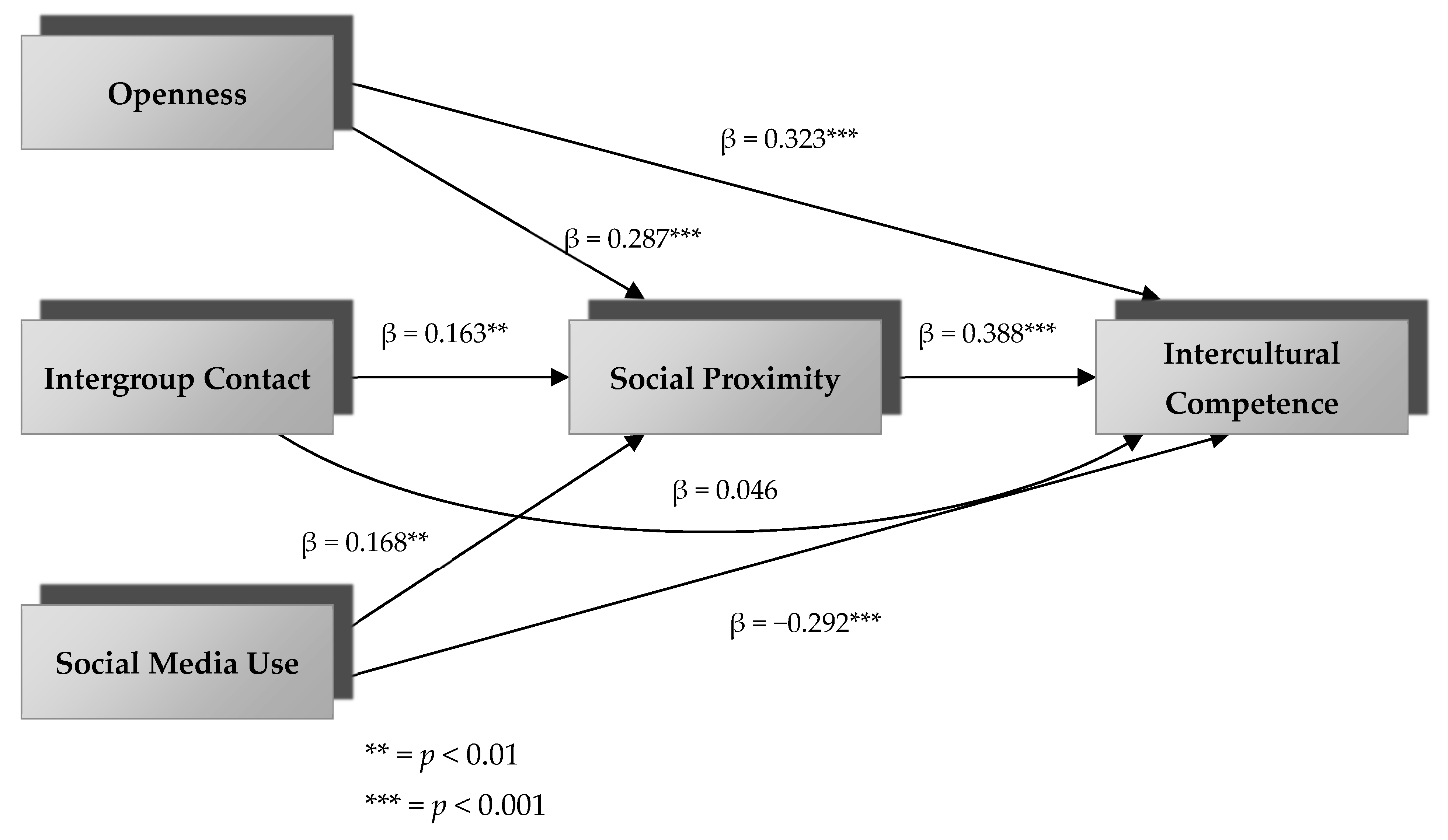
To further examine the relationships among the study variables and to test the proposed indirect pathways, we estimated a structural equation model (SEM). The model was designed to assess both the direct and indirect associations between openness to experience, intergroup contact, and social media use with IC, with social proximity specified as a mediator. This approach allowed us to simultaneously evaluate the overall structure of the relationships among these constructs and to test whether social proximity served as a statistical mediator linking individual dispositions and experiences to IC. The structural equation model fit the data well, χ2(3) = 3.283, p = 0.350, CFI = 0.998, TLI = 0.991, RMSEA = 0.020 (90% CI [0.000, 0.113]), SRMR = 0.013. The fit indices were generally consistent with good model fit. The model explained 32.6% of the variance in IC (see Figure 1).
Figure 1.
Mediation Model of Intercultural Competence.
Openness to experience significantly predicted social proximity (β = 0.287, p < 0.001) and IC (β = 0.323, p < 0.001). Intergroup contact predicted social proximity (β = 0.163, p = 0.006), but not IC (β = 0.046, p = 0.340). Social media use was positively associated with social proximity (β = 0.168, p = 0.004) and negatively associated with IC (β = −0.292, p < 0.001). Social proximity significantly predicted IC (β = 0.388, p < 0.001).
The mediation analysis revealed a significant positive indirect association between openness to experience and IC through social proximity, β = 0.111, 95% CI [0.057, 0.165], p < 0.001. The direct association was also positive and significant, β = 0.323, 95% CI [0.204, 0.443], p < 0.001, resulting in a significant positive total effect, β = 0.435, 95% CI [0.311, 0.558], p < 0.001. These findings suggest that greater openness to experience was associated with higher IC both directly and indirectly through greater social proximity.
Intergroup contact also demonstrated a significant positive indirect association with IC through social proximity, β = 0.063, 95% CI [0.017, 0.110], p = 0.008. Although the direct association was not statistically significant, β = 0.046, 95% CI [−0.048, 0.141], p = 0.337, the total effect was positive and significant, β = 0.110, 95% CI [0.002, 0.217], p = 0.045. This pattern suggests that the relationship between intergroup contact and IC was primarily reflected in the indirect pathway through social proximity.
Social media use exhibited a more complex pattern. Its indirect association with IC through social proximity was positive and significant, β = 0.065, 95% CI [0.017, 0.113], p = 0.008, whereas its direct association with IC was negative and significant, β = −0.292, 95% CI [−0.398, −0.187], p < 0.001. The total effect remained significantly negative, β = −0.227, 95% CI [−0.345, −0.110], p < 0.001. This pattern represents inconsistent mediation, whereby the positive indirect association through social proximity partially offsets, but does not reverse, the negative direct association between social media use and IC.
5. Discussion
The present study examined the extent to which social proximity, openness to experience, social media use, and intergroup contact predicted IC among student teachers in a culturally diverse and divided society like Israel, thereby making two principal contributions to the field. First, it introduces a research instrument that integrates five scales to assess different dimensions of intercultural competence among student teachers. Second, and most centrally, it proposes an empirically grounded model (see Figure 1) that demonstrates the interactions between these variables, offering a conceptual framework for understanding the multifaceted nature of IC in educational contexts. In the proposed model, social proximity serves as the statistical mediator, providing an indirect pathway that links personality, interpersonal contact, and social media use to IC. Unlike prior studies that treat these variables as independent predictors, the model presented in this study specifies how these variables jointly relate to IC, representing the study’s core theoretical contribution to the IC literature.
In what follows, we discuss each hypothesis in turn, examining how the findings align with or extend existing literature. We begin with H1, before turning to the mediation structure tested in H6 and then to the individual predictors addressed by H2 through H5.
H1 was partially supported: the two groups differed in social media use and social proximity but not in openness, intergroup contact, or IC. More broadly, our findings indicate that demographic variables such as age, gender, and ethnicity did not emerge as significant predictors of the other variables in most of the tested models. These results differ from past research that indicates that group status shapes intergroup contact in ways that differ between majority and minority members (Dovidio et al., 2017) or that minority teachers in Israel—Arabs and second-generation immigrants—showed greater empathy toward minority students (Shapira & Mola, 2024). In the current study, except for social media use and social proximity among the non-Jewish student teachers, no significant group differences were observed in the levels of intergroup contact and IC. The higher social proximity reported by non-Jewish participants reflects other findings among Arab and Jewish student teachers in Israel, where Arab students consistently reported greater willingness for more closeness and more frequent intergroup interactions than their Jewish peers (Sindiani et al., 2024). Because all participants were enrolled in the TEC program, the absence of group differences in intergroup contact and IC should be assumed as a characteristic of this TEC-based sample rather than as universal evidence of an equalizing effect. One possible explanation is a homogenization of intergroup contact within this shared academic context, attributable to common curricula, institutional culture, or context-specific societal norms. Previous research on the TEC students showed positive effects on intercultural attitudes after taking courses with the TEC model (Walther et al., 2015; Zidan & Shonfeld, 2025), which is compatible with this interpretation. In their study, Walther et al. (2015) found that a year of online collaborative learning in mixed groups reduced prejudice among both religious Jewish and Arab Muslim student teachers, and that lower prejudice was associated with relational communication and with social and task attraction among group members rather than with identification with the group. However, as the present study included neither a non-TEC comparison group nor a pre-program baseline, the possible equalizing role of structured intercultural education remains a hypothesis for future longitudinal or comparative research. Within these limits, the absence of group differences in IC is consistent with the mediation model, in which social proximity, rather than ethnic group status, was associated with IC.
The study’s combined findings provided strong support for H6, which suggested that social proximity would mediate the relationships between openness to experience, intergroup contact, and social media use, on the one hand, and IC, on the other. In line with that, the findings supported H2: social proximity was not merely associated with IC but also functioned as a statistical mediator for all three predictors. However, this mediation was not uniform across predictors. For openness to experience, social proximity partially mediated the association between openness and IC. The findings showed that openness still had a strong direct effect on IC, alongside a significant indirect effect through social proximity. This is consistent with the broader literature on the Big Five personality traits, which shows that open individuals are not only inclined towards intercultural engagement but also actively cultivate the relational closeness that makes such engagement transformative (Blais-Rochette et al., 2022; Kayiş & Akcaoğlu, 2021). For intergroup contact, the mediation was full, as it predicted IC only indirectly through social proximity. This pattern is in line with evidence that cross-group friendships are more strongly related to positive intergroup attitudes than contact that lacks such closeness (Killen et al., 2022). Moreover, our findings are consistent with and extend Pettigrew and Tropp’s (2006, 2008) contact hypothesis in an important direction: it suggests that the association between contact and IC may depend less on contact per se than on the sense of psychological closeness that contact, under the right conditions, makes possible. Allport’s (1954) structural conditions for optimizing intergroup contact—equal status, common goals, intergroup cooperation, and institutional support—may therefore be best understood as the scaffolding within which social proximity can develop, rather than as direct causes of IC in themselves. Furthermore, social media use showed the most complex pattern: a significant negative direct effect on IC coexisted with a positive indirect effect via social proximity. This duality aligns with the homophily literature (Lee, 2015; McPherson et al., 2001), which shows that online environments tend to reinforce existing group boundaries, yet it also aligns with evidence that digitally mediated contact can foster genuine cross-cultural closeness when it is intentionally structured to do so (Zidan & Shonfeld, 2025). These findings extend the current research by suggesting that social proximity may be a candidate mechanism, particularly relevant to how contact and social media use relate to IC. In this sense, the mediation model (Figure 1) positions social proximity not merely as a correlate of intergroup exposure but as a candidate mechanism through which exposure may relate to IC, a proposition that longitudinal research should test.
The finding that openness to experience was the only predictor with both a significant positive direct and an indirect association with IC supported H3 and aligned with previous literature emphasizing openness to experience as a foundational personality trait conducive to intercultural sensitivity and adaptability (Aksin, 2023). More recent evidence points in the same direction. Among university students working in intercultural groups, openness and cultural intelligence were the strongest predictors of cognitive engagement, with about half of the effect of openness operating through cultural intelligence (Poort et al., 2023). Likewise, a meta-analysis of dispositional predictors of cross-cultural adjustment found openness to be positively related to cultural, work, and interactional adjustment (Han et al., 2022). Importantly, although these traits are generally considered stable, they can still be shaped over time (Mühlig-Versen et al., 2012). Therefore, fostering openness to experience among student teachers is both possible and potentially valuable to their IC, as they will ultimately teach in diverse classrooms with students who differ from them.
Although H4 predicted a positive association between social media use and IC, it was not supported in its direct form: the direct association was negative, and only the indirect pathway through social proximity was positive. Importantly, this finding represents a pattern of inconsistent mediation, in which the direct and indirect associations operate in opposite directions. Although the total association between social media use and IC remained negative, the positive indirect pathway through social proximity partially offset this relationship. This suggests that the association between preferences for online interaction and IC may be more nuanced than a single overall coefficient would indicate. Whereas a stronger preference for online interaction was negatively associated with IC when accounting for social proximity, the same preference was positively associated with social proximity, which in turn was associated with higher IC. Given the cross-sectional nature of the data, these findings should be interpreted as evidence of competing statistical pathways rather than causal mechanisms.
This dual role of social media in the mediation model reflects a tension well documented in the literature. While some studies suggest that social networks may reproduce social divisions and reinforce segregation (McPherson et al., 2001; Lee, 2015; Waytz & Gray, 2018), others highlight their potential to foster and sustain meaningful cross-cultural relationships (G.-M. Chen & Zhang, 2010; Zidan & Shonfeld, 2025). The finding that IC is associated with lower technology anxiety (Shonfeld et al., 2025a) adds a further layer: individuals who use social media to maintain social proximity with outgroup members may still report higher IC despite broader negative associations. These findings suggest that the role of social media depends largely on how it is used, for example as a substitute for or supplement to face-to-face engagement. This distinction is particularly relevant because the scale used here captures a preference for online over face-to-face interaction. Among university students, such a preference has been linked to weaker conversational and empathic skills (Romero-López et al., 2021), which may help explain the negative direct association with IC. At the same time, a meta-analysis of online intergroup contact interventions found that online contact reduces prejudice, particularly when based on cooperation (Imperato et al., 2021), which may account for the positive pathway through social proximity in a program built on online collaborative learning. Further supporting this, Yang et al. (2025) found that intrinsically motivated engagement with culturally specific digital content enhances IC traits like attitudes, knowledge, and skills, while externally imposed exposure weakens these effects. This suggests that the positive indirect pathway of social media through social proximity, as identified in the present model, may be driven by motivated, meaningful digital use rather than by passive or incidental online exposure. Similar findings about students’ attitudes towards other cultures underscore the complex interplay among various factors and how these interactions contribute to IC (Zidan & Shonfeld, 2025).
H5 was supported only indirectly: intergroup contact was positively correlated with IC, but this association was not significant after controlling for the other predictors, and it operated through social proximity. These findings carry broader implications for contact theory. Meaningful contact under Allport’s (1954) conditions has been shown to reduce prejudice by increasing knowledge of the outgroup, decreasing perceived threat, and enabling perspective-taking (Pettigrew & Tropp, 2008; Tam et al., 2008). The present findings are consistent with the possibility that these processes operate through social proximity, a candidate mechanism that structured intercultural programs have the potential to cultivate. Evidence from a coexistence program for Jewish Israeli and Palestinian youth supports this potential: being assigned to the same activity group increased the likelihood of forming close relationships far more for outgroup than for ingroup pairs, suggesting that structured shared activities can counteract homophily (White et al., 2021). Therefore, it is important to strengthen programs that foster meaningful intergroup contact, such as the TEC model (Zidan & Shonfeld, 2025), as well as other initiatives that expose student teachers to different cultural groups throughout their teaching education and training programs.
Taken as a whole, this study’s findings position social proximity not only as a correlate of IC but also as a candidate mechanism linking personality, contact, and social media use within a single explanatory framework. The present findings contribute to knowledge about IC by highlighting the pivotal mediating role of social proximity in linking individual dispositions such as openness to experience (Weinberger & Bakshy, 2015), situational factors such as intergroup contact (Allport, 1954; Pettigrew & Tropp, 2006), and technological contexts such as social media use (An, 2022; Lee, 2015; McPherson et al., 2001; Serrat, 2017) to student teachers’ IC. This integrative perspective advances existing models of IC (Deardorff, 2006; J. M. Bennett & Bennett, 2004) by suggesting that IC is not merely a function of direct exposure to diversity or individual openness but may also depend on perceived social proximity across group boundaries, as captured in Figure 1. The results also refine the theoretical understanding of digital environments, suggesting that social media use is not uniformly associated with higher or lower IC; its association with IC may depend on whether it is accompanied by meaningful social proximity (Hoter & Shapira, 2022). By situating social proximity as the candidate mechanism connecting personal, interpersonal, and technological dimensions, this study provides a conceptual bridge between classical intergroup contact theory (Allport, 1954), personality-based approaches to IC (Weinberger & Bakshy, 2015), and contemporary research on online interactions in teacher education (Shapira & Amzalag, 2024).
In sum, the mediation model presented in Figure 1 offers teacher educators and policy makers a theoretically grounded and empirically supported map of the pathways through which IC can be cultivated—one that moves beyond single-variable explanations towards a holistic understanding of how personality, contact, and social media use jointly relate to the IC of future teachers, to be confirmed in longitudinal research.
5.1. Practical Implications of the Study
The mediation model presented in Figure 1 suggests that IC is associated with several interrelated factors rather than any single variable, a pattern that teacher education programs can take into account by fostering openness, structuring meaningful contact, and curating digital environments that foster social proximity across group boundaries. Thus, beyond its theoretical contribution, the model may offer a practical roadmap for teacher educators and policymakers seeking to cultivate IC in divided societies. The model’s central finding that social proximity statistically mediates the associations of openness, intergroup contact, and social media use with IC suggests that interventions targeting these variables in isolation may be insufficient. Rather, programs may be more effective if they work across all three pathways, with the deliberate cultivation of social proximity as the connective thread.
Specifically, teacher education curricula should incorporate intentional pedagogical strategies, such as experiential learning, critical dialogue, and exposure to diverse narratives, that nurture receptiveness to new perspectives and ideas. Moreover, given the central mediating role of social proximity observed in this study, policy initiatives and institutional frameworks should encourage collaborative learning environments (Weinberger & Shonfeld, 2020) and intercultural partnerships that foster psychological closeness among individuals from different cultural backgrounds. The nuanced association between social media use and IC further suggests the need for designing clear guidelines and professional development programs that equip student teachers to leverage digital platforms in ways that enhance, rather than replace, authentic face-to-face intercultural interactions (Hoter & Yazbak Abu Ahmad, 2018). Finally, the finding that intergroup contact alone does not directly predict IC may carry important policy implications. Programs and policies should move beyond superficial exposure and instead create structured, reflective, and sustained opportunities for meaningful intercultural engagement, supported by facilitation and guided reflection.
The TEC model illustrates what this pathway may look like in practice. Student teachers who have participated in TEC model programs intended to help them improve their attitudes towards other cultures were found to have improved their social proximity through intergroup online activities using advanced environments such as MOODLE, Zoom, and others, as well as virtual worlds (Hoter & Yazbak Abu Ahmad, 2018; Walther et al., 2015; Zidan & Shonfeld, 2025). However, collaborative learning does not come naturally to students, and teachers must learn both the pedagogy and techniques to monitor and support student engagement throughout these types of courses. Without this guidance, passive students may miss out on the full experience of collaborative work and might fall short of experiencing the impact on their IC (Zidan & Shonfeld, 2025).
5.2. Limitations and Future Research
While the study’s sample size was adequate, the heavy skew toward female participants and one religious majority group may limit generalizability. Moreover, all participants were recruited within the TEC program, whose structured intercultural activities may themselves shape both social proximity and IC. The findings should therefore be generalized primarily to student teachers engaged in structured intercultural programs, and future research should include comparison groups from outside such programs as well as pre-program baseline measures. In addition, although social proximity and IC were moderately correlated (r = 0.428), discriminant validity was not directly assessed. Some overlap in item content may therefore contribute to their association and should be considered when interpreting the mediation findings. Future research should directly assess the discriminant validity of the two scales and examine whether the indirect associations persist when overlapping items are excluded. Future studies should also aim for more should aim for more gender-balanced and religiously diverse samples to examine potential moderation effects. Additionally, causality cannot be inferred exclusively from a cross-sectional design. Longitudinal research would clarify the temporal dynamics between personality traits, social use, and IC. Finally, qualitative methods such as interviews or ethnographic observations could provide richer insights into the lived experiences behind these quantitative trends.
6. Conclusions
This study examined how openness to experience, intergroup contact, and social media use relate to the IC of student teachers in the context of a deeply divided society, such as Israel, and whether social proximity mediates these associations. According to our findings, openness to experience and social proximity emerged as the strongest positive predictors of IC across the different cultural groups. Social proximity statistically mediated the associations of all three predictors with IC. Mediation was partial for openness to experience and full for intergroup contact, while social media use was negatively associated with IC directly but positively through social proximity. Within this TEC-based sample, Jewish and non-Jewish participants did not differ significantly in IC.
Theoretically, these findings bring personality traits, intergroup contact, and social media use together within a single model and point to social proximity as a candidate mechanism linking them to IC. This suggests that exposure to diversity may matter less for IC by itself than for the sense of psychological closeness it makes possible.
Practically, the findings suggest that teacher education programs aiming to develop IC should combine three strands: fostering openness to new perspectives and ideas, structuring meaningful and sustained intergroup contact rather than mere exposure, and guiding student teachers to use digital platforms in ways that build, rather than replace, closeness across group boundaries.
Because the design was cross-sectional and all participants were enrolled in the TEC program, these conclusions describe associations within this population rather than causal effects. Longitudinal and comparative studies, including participants outside structured intercultural programs, are needed to test whether cultivating social proximity fosters the development of IC over time. As future teachers will face increasingly diverse classrooms, understanding how closeness across group boundaries is built remains an essential task for teacher education in divided societies.
Author Contributions
Conceptualization, M.S., N.S., Y.W. and W.Z.; methodology, M.S. and W.Z.; validation, M.S., Y.W. and W.Z.; formal analysis, M.S. and W.Z.; investigation, M.S., N.S., Y.W. and W.Z.; resources, M.S. and W.Z.; writing-original draft preparation, M.S., N.S., Y.W. and W.Z.; writing—review and editing, M.S., N.S., Y.W. and W.Z.; visualization, M.S.; supervision, M.S.; project administration, N.S.; funding acquisition, Y.W. All authors have read and agreed to the published version of the manuscript.
Funding
This research was supported by The MOFET Institute, Tel Aviv, Israel.
Institutional Review Board Statement
The study was conducted in accordance with the Declaration of Helsinki, and approved by the Moffet institute committee (protocol code IRB24010, 31 December 2024).
Informed Consent Statement
Informed consent was obtained from all subjects involved in the study.
Data Availability Statement
The data presented in this study is available on request from the corresponding author.
Acknowledgments
The authors gratefully acknowledge the financial support provided by the MOFET Institute for this research. Their funding was instrumental in enabling the successful completion of this study. We extend our sincere appreciation to the MOFET Institute for their commitment to advancing educational research and their confidence in our work.
Conflicts of Interest
The authors declare no conflict of interest.
References
- Abu-Saad, I. (2019). Palestinian education in the Israeli settler state: Divide, rule and control. Settler Colonial Studies, 9(1), 96–116. [Google Scholar] [CrossRef] [Scilit]
- Aksin, A. (2023). Five-factor personality traits as predictors of intercultural sensitivity among Turkish preservice teachers. Heliyon, 9(7), e17867. [Google Scholar] [CrossRef] [Scilit]
- Allport, G. W. (1954). The nature of prejudice. Addison-Wesley. [Google Scholar]
- An, W. (2022). Friendship network formation in Chinese middle schools: Patterns of inequality and homophily. Social Networks, 68, 218–228. [Google Scholar] [CrossRef] [Scilit]
- Bar-Tal, D., Rosen, Y., & Nets-Zehngu, R. (2011). Peace education in societies involved in intractable conflicts: Goals, conditions, and directions. In Handbook on peace education (pp. 21–43). Psychology Press. [Google Scholar]
- Ben-Eliezer, U. (2008). Multicultural society and everyday cultural racism: Second generation of Ethiopian Jews in Israel’s ‘crisis of modernization’. Ethnic and Racial Studies, 31(5), 935–961. [Google Scholar] [CrossRef] [Scilit]
- Bennett, J. M., & Bennett, M. J. (2004). Developing intercultural sensitivity: An integrative approach to global and domestic diversity. In D. Landis, J. M. Bennett, & M. J. Bennett (Eds.), Handbook of intercultural training (pp. 147–165). SAGE. [Google Scholar]
- Bennett, M. J. (2017). Developmental model of intercultural sensitivity. In Y. Y. Kim (Ed.), The international encyclopedia of intercultural communication. Wiley. [Google Scholar] [CrossRef] [Scilit]
- Blais-Rochette, C., Miranda, D., & Kljajic, K. (2022). A meta-analysis on personality and cultural attitudes. Canadian Psychology/Psychologie Canadienne, 63(1), 1–15. [Google Scholar] [CrossRef] [Scilit]
- Bogardus, E. S. (1933). A social distance scale. Sociology and Social Research, 17, 265–271. [Google Scholar]
- Canetti-Nisim, D., Ariely, G., & Halperin, E. (2008). Life, pocketbook, or culture: The role of perceived security threats in promoting exclusionist political attitudes toward minorities in Israel. Political Research Quarterly, 61(1), 90–103. [Google Scholar] [CrossRef] [Scilit]
- Chen, G.-M., & Zhang, K. (2010). New media and cultural identity in the global society. In R. Tai (Ed.), Media and cultural transformation in China (pp. 235–250). Routledge. [Google Scholar]
- Chen, Y., & Volker, B. (2016). Social capital and homophily both matter for labor market outcomes—Evidence from replication and extension. Social Networks, 45, 18–31. [Google Scholar] [CrossRef] [Scilit]
- Costa, P. T., & McCrae, R. R. (1992). Revised NEO personality inventory and NEO five-factor inventory: Professional manual. Psychological Assessment Resources. [Google Scholar]
- Dar, Y., & Resh, N. (2003). Social disadvantage and students’ perceived injustice in socially integrated schools in Israel. Social Justice Research, 16(2), 109–133. [Google Scholar] [CrossRef] [Scilit]
- Deardorff, D. K. (2006). Identification and assessment of intercultural competence as a student outcome of internationalization. Journal of Studies in International Education, 10(3), 241–266. [Google Scholar] [CrossRef] [Scilit]
- Deardorff, D. K. (2021). Manual for developing intercultural competencies: Story circles. Routledge. [Google Scholar]
- Dovidio, J. F., Love, A., Schellhaas, F. M. H., & Hewstone, M. (2017). Reducing intergroup bias through intergroup contact: Twenty years of progress and future directions. Group Processes and Intergroup Relations, 20(5), 606–620. [Google Scholar] [CrossRef] [Scilit]
- Golden, D., & Baram, H. (2012). Hanochachut hachamakmaka shel “rav-tarbutiyot”: Pe’anuach u’peula bsadeh hachinuch [The elusive presence of “multi-culturalism”: Deciphering and action in the field of education]. Mifgash L’avodah Chinuchit-Socialit, 35, 15–36. (In Hebrew) [Google Scholar]
- Hammer, M. R., Bennett, M. J., & Wiseman, R. (2003). Measuring intercultural sensitivity: The intercultural development inventory. International Journal of Intercultural Relations, 27(4), 421–443. [Google Scholar] [CrossRef] [Scilit]
- Han, Y., Sears, G. J., Darr, W. A., & Wang, Y. (2022). Facilitating cross-cultural adaptation: A meta-analytic review of dispositional predictors of expatriate adjustment. Journal of Cross-Cultural Psychology, 53(9), 1054–1096. [Google Scholar] [CrossRef] [Scilit]
- Hasson, Y., Porat, R., Shani, D., & Halperin, E. (2017). Intergroup relations within Israeli society. The Applied Center for Psychology of Social Change. Available online: https://en.achord.huji.ac.il/sites/default/files/achord/files/hasson_et_al_2017_intergroup_relations_within_israeli_society.pdf (accessed on 2 November 2026).
- Hofstra, B., Corten, R., van Tubergen, F., & Ellison, N. B. (2017). Sources of segregation in social networks: A novel approach using Facebook. American Sociological Review, 82(3), 625–656. [Google Scholar] [CrossRef] [Scilit]
- Hoter, E., & Shapira, N. (2022). Simulations in virtual worlds: Improving intergroup relations and social proximity. Intercultural Education, 33(4), 435–454. [Google Scholar] [CrossRef] [Scilit]
- Hoter, E., & Yazbak Abu Ahmad, M. (2018). Designing pedagogy for virtual worlds in multicultural environments. In E. Kapros, & M. Koutsombogera (Eds.), Designing for the user experience in learning systems (pp. 65–80). Springer International Publishing. [Google Scholar]
- IJzerman, H., & Semin, G. R. (2009). The thermometer of social relations: Mapping social proximity on temperature. Psychological Science, 20(10), 1214–1220. [Google Scholar] [CrossRef] [Scilit]
- Imperato, C., Schneider, B. H., Caricati, L., Amichai-Hamburger, Y., & Mancini, T. (2021). Allport meets internet: A meta-analytical investigation of online intergroup contact and prejudice reduction. International Journal of Intercultural Relations, 81, 131–141. [Google Scholar] [CrossRef] [Scilit]
- Ismail, A., Schiff, M., Pat-Horenczyk, R., & Benbenishty, R. (2022). Perceived academic challenges of Jewish and Arab undergraduates during the first wave of COVID-19. International Journal of Psychology, 58(1), 7–15. [Google Scholar] [CrossRef] [Scilit]
- Kaya, F., Aydin, F., Schepman, A., Rodway, P., Yetişensoy, O., & Demir Kaya, M. (2024). The roles of personality traits, AI anxiety, and demographic factors in attitudes toward artificial intelligence. International Journal of Human–Computer Interaction, 40(2), 497–514. [Google Scholar] [CrossRef] [Scilit]
- Kayiş, A. R., & Akcaoğlu, M. Ö. (2021). Big five and dark triad personality traits as predictors of multicultural attitude and efficacy. Current Issues in Personality Psychology, 9(3), 215–228. [Google Scholar] [CrossRef] [Scilit]
- Killen, M., Luken Raz, K., & Graham, S. (2022). Reducing prejudice through promoting cross-group friendships. Review of General Psychology, 26(3), 361–376. [Google Scholar] [CrossRef] [Scilit]
- Lee, S. Y. (2015). Homophily and social influence among online casual game players. Telematics and Informatics, 32(6), 656–666. [Google Scholar] [CrossRef] [Scilit]
- Lev, S., Darawshy, N. A. S., & Weiss-Dagan, S. (2024). When the outside penetrates the inside: The relationship between Palestinian Israeli and Jewish Israeli social workers in mixed cities during the events of May 2021. European Journal of Social Work, 27(6), 1127–11309. [Google Scholar] [CrossRef] [Scilit]
- McCrae, R. R., & Costa, P. T. (1992). Discriminant validity of NEO-PIR facet scales. Educational and Psychological Measurement, 52(1), 229–237. [Google Scholar] [CrossRef] [Scilit]
- McPherson, M., Smith-Lovin, L., & Cook, J. M. (2001). Birds of a feather: Homophily in social networks. Annual Review of Sociology, 27, 415–444. [Google Scholar] [CrossRef] [Scilit]
- Meeusen, C., & Jacobs, L. (2017). Television news content of minority groups as an intergroup context indicator of differences between target-specific prejudices. Mass Communication and Society, 20(2), 213–240. [Google Scholar] [CrossRef] [Scilit]
- Menadue, E. A., Castillo, P. A., & Bernardo, A. B. I. (2021). Does polyculturalism explain the relationship between personality, thinking style, and prejudice in Australia? Australian Psychologist, 56(5), 406–416. [Google Scholar] [CrossRef] [Scilit]
- Mühlig-Versen, A., Bowen, C. E., & Staudinger, U. M. (2012). Personality plasticity in later adulthood: Contextual and personal resources are needed to increase openness to new experiences. Psychology and Aging, 27(4), 855–866. [Google Scholar] [CrossRef] [Scilit]
- Paik, A., Pachucki, M. C., & Tu, H. F. (2023). Defriending in a polarized age: Political and racial homophily and tie dissolution. Social Networks, 74, 31–41. [Google Scholar] [CrossRef] [Scilit]
- Parrillo, V. N., & Donoghue, C. (2005). Updating the Bogardus social distance studies: A new national survey. The Social Science Journal, 42(2), 257–271. [Google Scholar] [CrossRef] [Scilit]
- Pettigrew, T. F., & Tropp, L. R. (2006). A meta-analytic test of intergroup contact theory. Journal of Personality and Social Psychology, 90(5), 751–783. [Google Scholar] [CrossRef] [Scilit]
- Pettigrew, T. F., & Tropp, L. R. (2008). How does intergroup contact reduce prejudice? Meta-analytic tests of three mediators. European Journal of Social Psychology, 38(6), 922–934. [Google Scholar] [CrossRef] [Scilit]
- Poort, I., Jansen, E., & Hofman, A. (2023). Cultural intelligence and openness to experiences pave the way for cognitive engagement in intercultural group work. Journal of Studies in International Education, 27(2), 277–297. [Google Scholar] [CrossRef] [Scilit]
- Romero-López, M., Pichardo, C., De Hoces, I., & García-Berbén, T. (2021). Problematic internet use among university students and its relationship with social skills. Brain Sciences, 11(10), 1301. [Google Scholar] [CrossRef] [Scilit]
- Rosen, Y., & Perkins, D. (2013). Shallow roots require constant watering: The challenge of sustained impact in educational programs. International Journal of Higher Education, 2(4), 91–100. [Google Scholar] [CrossRef] [Scilit]
- Rosseel, Y. (2012). Lavaan: An R package for structural equation modeling. Journal of Statistical Software, 48(2), 1–36. [Google Scholar] [CrossRef] [Scilit]
- Sabbagh, C., & Resh, N. (2014). Citizenship orientations in a divided society: A comparison of three groups of Israeli junior-high students—Secular Jews, religious Jews, and Israeli Arabs. Education, Citizenship and Social Justice, 9(1), 34–54. [Google Scholar] [CrossRef] [Scilit]
- Savicki, V. (2023). Developing intercultural competence and transformation: Theory, research, and application in international education. Taylor & Francis. [Google Scholar]
- Schütt, C. A. (2023). The effect of perceived similarity and social proximity on the formation of prosocial preferences. Journal of Economic Psychology, 99, 102678. [Google Scholar] [CrossRef] [Scilit]
- Serrat, O. (2017). Knowledge solutions: Social network analysis. Asian Development Bank. [Google Scholar] [CrossRef] [Scilit]
- Shapira, N., & Amzalag, M. (2024). How can multiculturalism be celebrated through teacher training in Israel? Frontiers in Education, 9, 1333697. [Google Scholar] [CrossRef] [Scilit]
- Shapira, N., & Mola, S. (2024). There is a crack in everything. That’s how the light gets in reflective observation through encounters with statements of ‘White’ teachers and ‘Black’ students. International Journal of Intercultural Relations, 103, 102054. [Google Scholar] [CrossRef] [Scilit]
- Shapira, N., Shonfeld, M., Friedman, D., & Falah, J. F. (2023). Educators in Israel Define Cultural Competence. Frontiers in Education, 8, 120. [Google Scholar] [CrossRef] [Scilit]
- Shdema, I., Haj-Yahya, N., & Schnell, I. (2018). The social space of Arab residents of mixed Israeli cities. Geografiska Annaler, Series B: Human Geography, 100(4), 359–376. [Google Scholar] [CrossRef] [Scilit]
- Shonfeld, M., Abu Ahmad, M. Y., Liverant, R. C., & Amichai-Hamburger, Y. (2025a). Reducing technological anxiety through intercultural competence. Technology, Knowledge and Learning, 31, 1763–1782. [Google Scholar] [CrossRef] [Scilit]
- Shonfeld, M., Shapira, N., Falah, J. F., & Friedman, D. (2025b). Looking for an agreed-upon definition of teachers’ intercultural competence in a divided society. International Journal of Intercultural Relations, 108, 102223. [Google Scholar] [CrossRef] [Scilit]
- Sindiani, M., Hellerstein, D., Sky, B., Ben Zaken, S., & Arnon, M. (2024). Subtle yet encouraging developments: Exploring intergroup relations between Arab and Jewish college students over seven years. Frontiers in Education, 9, 1403926. [Google Scholar] [CrossRef] [Scilit]
- Sinicrope, C., Norris, J., & Watanabe, Y. (2007). Understanding and assessing intercultural competence: A summary of theory, research, and practice (technical report for the foreign language program evaluation project). Studies in Second Language Acquisition, 26, 1–58. [Google Scholar]
- Stephan, W. G., Ybarra, O., & Rios, K. (2015). Intergroup threat theory. In T. Nelson (Ed.), Handbook of prejudice, stereotyping, and discrimination (pp. 255–278). Psychology Press. [Google Scholar]
- Šlebir, M., & Zupančič, R. (2024). Factors of ethnic distance: A systematic scoping review. Journal of Ethnic and Cultural Studies, 11(2), 211–228. [Google Scholar] [CrossRef] [Scilit]
- Tam, T., Hewstone, M., Kenworthy, J. B., Cairns, E., Marinetti, C., Geddes, L., & Parkinson, B. (2008). Post conflict reconciliation: Intergroup forgiveness and implicit biases in Northern Ireland. Journal of Social Issues, 64(2), 303–320. [Google Scholar] [CrossRef] [Scilit]
- Walther, J. B., Hoter, E., Ganayem, A., & Shonfeld, M. (2015). Computer-mediated communication and the reduction of prejudice: A controlled longitudinal field experiment among Jews and Arabs in Israel. Computers in Human Behavior, 52, 550–558. [Google Scholar] [CrossRef] [Scilit]
- Waytz, A., & Gray, K. (2018). Does online technology make us more or less sociable? A preliminary review and call for research. Perspectives on Psychological Science, 13(4), 473–491. [Google Scholar] [CrossRef] [Scilit]
- Weinberger, Y., & Bakshy, I. (2015). Teacher empathy: The complete act. Scholar-Practitioner Quarterly, 9(1), 109–122. [Google Scholar]
- Weinberger, Y., & Shonfeld, M. (2020). Students’ willingness to practice collaborative learning. Teaching Education, 31(2), 127–143. [Google Scholar] [CrossRef] [Scilit]
- White, S. M., Schroeder, J., & Risen, J. L. (2021). When “enemies” become close: Relationship formation among Palestinians and Jewish Israelis at a youth camp. Journal of Personality and Social Psychology, 121(1), 76–94. [Google Scholar] [CrossRef] [Scilit]
- Yang, K. C. C., Kang, Y., Ge, L., Gilardi, F., & Whyke, T. W. (2025). The impact of live-streamed Jewish cultural heritage content on cross-cultural competence in the U.S. Journal of Ethnic and Cultural Studies, 12(5), 296–324. [Google Scholar] [CrossRef] [Scilit]
- Yeap, J. A. L., Ramayah, T., Kurnia, S., Halim, H. A., & Ahmad, N. H. (2015). The assessment of Internet addiction among university students: Some findings from a focus group study/Procjena ovisnosti o internetu sveucilisnih studenata: Neki rezultati proucavane grupe. Tehnicki Vjesnik—Technical Gazette, 22(1), 105–111. [Google Scholar] [CrossRef] [Scilit]
- Zidan, W., & Shonfeld, M. (2025). The impact of online collaborative learning in a multicultural environment on attitudes change. In M. Shonfeld, A. Ganayem, & E. Hoter (Eds.), Mitkavnim leravtarbutiut behinuch [Online and multiculturalism in education]. MOFET. (In Hebrew) [Google Scholar]

Disclaimer/Publisher’s Note: The statements, opinions and data contained in all publications are solely those of the individual author(s) and contributor(s) and not of MDPI and/or the editor(s). MDPI and/or the editor(s) disclaim responsibility for any injury to people or property resulting from any ideas, methods, instructions or products referred to in the content. |
© 2026 by the authors. Licensee MDPI, Basel, Switzerland. This article is an open access article distributed under the terms and conditions of the Creative Commons Attribution (CC BY) license.