


Abstract
Medical students often perceive biophysics as irrelevant to clinical training. This study assessed first-year medical students’ attitudes toward biophysics using the Colorado Learning Attitudes about Science Survey (CLASS), with attention to gender differences. A cross-sectional survey was administered to 198 first-year medical students (110 women, 88 men) at a Colombian university during the biophysics course in 2018. Favourability scores were calculated for eight CLASS categories and analyzed by gender using Mann–Whitney U tests with 95% confidence intervals. Overall favourability was 49.0% (95% CI: [46.8%, 51.1%]), with no significant gender difference (U = 5213.5, p = 0.351, r = −0.08, 95% CI [−0.24, 0.09]). After Bonferroni correction (adjusted α = 0.0056), a significant gender difference was confirmed only in Personal Interest (men: 58.0%, women: 43.9%, p = 0.001). The difference in Real-World Connections (men: 64.2%, women: 54.3%, p = 0.048) did not survive correction. The lowest scores were in Applied Conceptual Understanding (34.4%) and Problem Solving Sophistication (37.1%). These 2018 baseline results indicate unfavorable attitudes toward conceptual application of biophysics, with women reporting lower personal interest; given the stability of epistemological beliefs and the absence of formal curricular reform since then, these patterns likely remain informative, though follow-up assessment is warranted. Biophysics curricula should emphasize clinical applications and employ active learning strategies to enhance engagement.
1. Introduction
1.1. The Growing Importance of Physics in Medical Practice
The accelerating integration of technology into healthcare has fundamentally transformed medical practice. Modern diagnostic and therapeutic procedures increasingly rely on physics-based technologies, including ultrasound imaging, magnetic resonance imaging (MRI), computed tomography (CT), radiation therapy, laser surgery, electrophysiological monitoring, genetic and genomic (“Looking forward 25 years”, 2019/2020; Hilborn & Friedlander, 2013). Despite this technological evolution, a persistent disconnect exists between medical students’ perceptions of the relevance of physics and the actual role of physics principles in contemporary medicine (DeFranco & Sowa, 2014; Smithers, 1949).
The medical community has reached broad consensus regarding the urgent need to strengthen science and technology foundations among medical students (Christensen et al., 2013; Saavedra & Segarra, 2021; Kritsadatan & Wattanakasiwic, 2011). Christensen et al. proposed curriculum reforms that prominently incorporate medical equipment and instrumentation into physics instruction, arguing that such integration better prepares students for technology-intensive clinical environments (Christensen et al., 2013). Nevertheless, research consistently demonstrates that medical students tend to view biophysics coursework as peripheral to their core medical education (Saavedra & Segarra, 2021; Kritsadatan & Wattanakasiwic, 2011). This negative perception extends to related disciplines, including biochemistry, where similar attitudes have been documented (Fulton et al., 2023; White & Ghobadi, 2023).
1.2. Biophysics as a Bridge Between Physics and Medicine
Biophysics represents an interdisciplinary field that applies physical concepts, experimental methods, and quantitative approaches to understanding biological systems (The Biophysical Society, 2023; Welch, 2009). In cardiovascular biophysics, fluid mechanics principles illuminate circulatory dynamics; in bioelectricity, electrical physics explains the generation and propagation of action potentials through neural networks; in biomechanics, Newtonian mechanics governs musculoskeletal movement analysis (Welch, 2009). These applications demonstrate that physics is not merely ancillary to medicine but fundamental to understanding human physiology and pathophysiology.
These connections between physics and medicine are increasingly recognized within contemporary medical education. Recent evidence suggests that when physics concepts are taught through clinically relevant and interdisciplinary contexts, students perceive greater educational value and develop a more coherent understanding of the relationship between physical principles and medical practice. In a pilot study involving medical students, Wang et al. (2026) reported that an interdisciplinary curriculum integrating plasma physics with clinical applications improved students’ understanding of emerging medical technologies and reinforced the perceived relevance of physics for professional practice. These findings support the view that contextualized approaches may help bridge the traditional gap between basic sciences and clinical training (Wang et al., 2026).
However, students’ preconceived notions about physics create significant learning barriers that diminish motivation and engagement (Hammer, 1994). Traditional pedagogical approaches, particularly those emphasizing rote memorization of equations without conceptual understanding, have contributed to negative attitudes toward physics in health sciences education (Docktor & Mestre, 2014). This pedagogical legacy, common in many Latin American educational systems, has produced generations of students who view physics as an abstract discipline disconnected from practice (Rada-Crespo et al., 2022).
1.3. Student Beliefs and Attitudes Toward Physics
Research on student beliefs and attitudes toward physics has predominantly focused on engineering and physical science majors (Perkins et al., 2006). Comparatively few studies have examined these attitudes among medical students, despite the critical importance of physics understanding for modern medical practice. Early investigations revealed that medical students’ beliefs about physics diverge more substantially from expert physicists’ views than do engineering students’ beliefs (Adams et al., 2006). Perkins et al. demonstrated that engineering students with high self-assessed interest in physics hold beliefs more closely aligned with physics experts compared to medical students (Perkins et al., 2006). Furthermore, significant variations in physics attitudes exist across different engineering disciplines, suggesting that perceived disciplinary relevance strongly influences student beliefs (Miranda & Rada, 2018). These findings underscore the importance of making explicit connections between physics principles and domain-specific applications in professional education.
1.4. Gender Considerations in STEM Education
Gender disparities in science, technology, engineering, and mathematics (STEM) fields have received considerable attention in educational research (Eccles & Wang, 2016; Cheryan et al., 2017). Studies indicate that female students are less likely to pursue STEM careers, and those who do often report being motivated more by occupational values than intrinsic interest in science (Eccles & Wang, 2016). However, international assessments of adolescent achievement in science, mathematics, and reading demonstrate that female students perform comparably to or better than male students in science in approximately two-thirds of countries (Stoet & Geary, 2018/2020) This apparent paradox—comparable or superior performance alongside lower participation rates—has been termed the “gender-equality paradox” (Stoet & Geary, 2018/2020). Eccles’ expectancy-value theory suggests that career choices are influenced not only by ability but also by subjective task values, perceived costs, and sociocultural factors (Eccles & Wang, 2016; Eccles, 2007). Understanding gender differences in attitudes toward physics within medical education may illuminate factors that influence engagement and persistence in scientifically demanding aspects of medical training.
1.5. Research Gap and Study Objectives
While extensive research has examined physics attitudes among engineering students, limited evidence exists regarding medical students’ beliefs about physics, particularly in Latin American contexts. Furthermore, few studies have systematically investigated gender differences in physics attitudes among medical students using validated instruments. The Colorado Learning Attitudes about Science Survey (CLASS) provides a standardized, psychometrically validated tool for assessing student beliefs about physics and learning physics (Adams et al., 2006). Originally developed for engineering and science students, CLASS has been adapted for various educational contexts, including medical education (Moustafa et al., 2012; Alhadlaq et al., 2009). This study addresses these gaps by examining first-year medical students’ attitudes toward biophysics at a Colombian university, with specific attention to gender differences. Our research questions are:
- What are the overall attitudes and beliefs of first-year medical students toward biophysics, as measured by CLASS favourability scores?
- Do significant gender differences exist in attitudes toward biophysics across different CLASS categories?
- How do Colombian medical students’ attitudes compare to those of engineering students and medical students in other countries?
Understanding these attitudes is essential for developing evidence-based pedagogical strategies that enhance student engagement with biophysics content, ultimately improving preparation for technology-intensive medical practice. Although data were collected in 2018, this study addresses a persistent and documented gap in the literature on physics attitudes in Latin American health sciences education. Comparable validated studies in this region remain scarce, and the existing international benchmarks derive from even earlier work (Adams et al., 2006; Alhadlaq et al., 2009), underscoring the continued relevance of this contribution. We acknowledge that the interval between data collection and submission reflects logistical delays unrelated to the research design; nonetheless, the pre-pandemic timing provides a historical reference point for future comparative research. This study does not evaluate specific teaching methodologies or assess achievement of course learning objectives; rather, it provides baseline data on student beliefs that can inform curriculum development and instructional design.
2. Materials and Methods
2.1. Study Design and Setting
This cross-sectional survey study was conducted at an accredited medical school on the northern coast of Colombia during the first and second semesters of 2018. In Colombia, the undergraduate medical degree is a six-year program that follows directly after high school graduation, without pre-medical training. The first three years consist of intensive theoretical coursework, after which students begin clinical rotations at university hospitals and medical centers. Students receive their general medical degree after completing a mandatory one-year internship, with further specialization pursued through postgraduate study.
Biophysics is a mandatory first-year course offered in the second semester. The course covers fundamental physics principles applied to biological systems, including mechanics, fluid dynamics, thermodynamics, electricity, optics, and radiation physics, with an emphasis on physiological applications and medical instrumentation.
2.2. Participants and Sampling
The target population consisted of first-year medical students enrolled in a biophysics course during the study period (n = 261). Inclusion criteria were: (1) enrolled as an undergraduate medical student, (2) registered in the biophysics course, (3) voluntary participation, (4) correct response to a verification question embedded in the survey to ensure attentive completion, and (5) complete survey responses to all 42 CLASS items.
Of the 261 enrolled students, 241 (92.3%) agreed to participate. After applying quality control criteria (verification question and completeness), 198 students (75.9% of enrolled; 82.2% of volunteers) comprised the final analytical sample. The sample included 110 women (55.6%) and 88 men (44.4%), aged 17 to 22 years. No students self-identified as belonging to other gender categories. Figure 1 presents the participant flow diagram.
Figure 1.
Participant flow diagram.
2.3. Instrument: Colorado Learning Attitudes About Science Survey (CLASS)
The CLASS survey is a validated instrument designed to measure student beliefs and attitudes toward physics and learning physics, using expert physicists’ responses as a reference standard (Adams et al., 2006). The survey consists of 42 Likert-scale items (1 = strongly disagree to 5 = strongly agree) organized into eight conceptual categories, plus an Overall category that includes all items. Table 1 presents the CLASS categories and their descriptions.
Table 1.
CLASS Categories and Descriptions (Adams et al., 2006).
2.4. Translation and Validation
The CLASS survey was originally developed in English. For the present study, the Spanish version reported by Miranda and Rada (2018) was used. That version had previously been applied to investigate physics-related attitudes among engineering students in Colombia and was reviewed for linguistic accuracy, clarity, and cultural appropriateness. The Spanish translation’s internal consistency reliability was assessed using Cronbach’s alpha coefficient. The obtained value of α = 0.814 indicates good internal consistency, as values between 0.70 and 0.90 are considered acceptable to excellent for survey instruments (Tavakol & Dennick, 2011).
2.5. Favourability Scoring
Following the CLASS methodology (Adams et al., 2006; PhysPort, 2023) favourability represents the degree of agreement between student responses and expert physicist responses. For each survey item, expert physicists have established a “favorable” response direction (either agreement or disagreement, depending on the item). A student’s response is scored as favorable if it matches the expert consensus.
Favourability percentage for each category is calculated as:
Favourability (%) = (Number of favorable responses/Total number of items in category) × 100,
Higher favourability scores indicate greater alignment between student beliefs and expert physicist beliefs. Favourability scores were calculated for each student, then averaged across all students, female students, and male students for each CLASS category.
2.6. Data Collection Procedure
The CLASS survey was administered online during the second week of the biophysics course, before substantial course content had been delivered. This timing was chosen to capture students’ pre-existing beliefs and attitudes rather than attitudes shaped by the specific course experience. The survey platform included:
- A brief description of the study objectives;
- An informed consent statement requiring explicit agreement to participate;
- Demographic questions (age, gender);
- A verification question to ensure attentive completion;
- The 42 CLASS items in randomized order to minimize order effects.
Students completed the survey voluntarily outside of class time. No course credit or compensation was provided for participation. Survey responses were anonymous, with no identifying information collected beyond demographic variables.
2.7. Statistical Analysis
Descriptive statistics (means, standard errors, and 95% confidence intervals) were calculated for favourability scores in each CLASS category for the overall sample and by gender.
Gender differences in favourability scores were assessed using the Mann–Whitney U test, a non-parametric alternative to the independent samples t-test appropriate for ordinal data and non-normal distributions (Mann & Whitney, 1947). The Mann–Whitney U test compares the distribution of ranks between groups; 95% bootstrap confidence intervals (percentile method, 10,000 resamples) were calculated for the rank-biserial effect size r. To control for familywise error rate across nine comparisons (eight categories plus Overall), Bonferroni correction was applied, yielding an adjusted significance threshold of α = 0.0056 (0.05/9). For categories showing significant gender differences, effect sizes were calculated using the rank-biserial correlation coefficient. Item-level gender comparisons were conducted using Mann–Whitney U tests, consistent with the non-parametric rationale applied at the category level. Effect sizes for item-level comparisons are reported as rank-biserial correlations.
We note that because CLASS categories share overlapping items (e.g., item 25 appears in Personal Interest, Problem Solving General, and Problem Solving Sophistication simultaneously), the categories are not statistically independent. A MANOVA treating all categories jointly was considered but deemed inappropriate given this structural overlap and the ordinal nature of the underlying data. The Bonferroni correction applied here follows standard practice in CLASS research (Adams et al., 2006; Alhadlaq et al., 2009).
Items for the item-level analysis (Section 3.4) were selected based on two a priori criteria: (1) belonging to categories with statistically significant or potentially relevant gender differences (Personal Interest and Real World Connections), and (2) exhibiting comparatively large effect sizes within those categories.
All statistical analyses were conducted using SPSS version 25.0 (IBM Corp., Armonk, NY, USA). Data were screened for missing values and outliers prior to analysis. Because SPSS does not provide a built-in bootstrap procedure for rank-biserial effect sizes, 95% bootstrap confidence intervals for the effect size r (percentile method, 10,000 resamples) were computed in R (version 4.3; R Core Team, 2023) using the boot package.
2.8. Ethical Considerations
At the time of data collection, the institution’s policy stipulated that surveys collecting non-identifiable demographic data for educational research purposes did not require full ethics committee review, provided that informed consent was obtained. All participants provided informed consent electronically before accessing the survey. Participation was voluntary, and students were informed that their responses would not affect their course grades. Data were stored securely and analyzed in aggregate form only, with no individual identification possible.
3. Results
3.1. Category-Level Patterns
Table 2 summarizes favourability percentages for the overall sample and for each gender across the CLASS categories, including 95% confidence intervals. Three categories showed favourability values above 58%: Real World Connections (58.7%), Problem Solving Confidence (59.1%), and Sense Making/Effort (60.2%). The highest favourability was observed in Sense Making/Effort (60.2%, 95% CI [56.9%, 63.5%]), suggesting that students generally recognize the importance of making sense of physics concepts and investing effort in understanding them.
Table 2.
CLASS Favourability scores by category and gender.
Three categories showed favourability values close to 50%: Personal Interest (50.2%), Problem Solving General (51.0%), and Overall (49.0%). These results indicate that approximately half of the students expressed favourable views in these dimensions.
The lowest favourability percentages were observed for Applied Conceptual Understanding (34.4%), Problem Solving Sophistication (37.1%), and Conceptual Connections (41.2%). These findings suggest comparatively lower alignment with expert-like views regarding conceptual understanding, conceptual reasoning, and the application of physics concepts to explain phenomena and solve problems.
3.2. Overall Favourability Scores
The overall favourability across all scored items was 49.0% (95% CI: [46.8%, 51.1%]), indicating that medical students’ beliefs aligned with expert physicists’ beliefs approximately half the time. This overall level of favourability masks substantial variation across categories.
Table 2 also presents the gender comparison using the Mann–Whitney U test with bootstrap confidence intervals (percentile method, 10,000 resamples) for the effect size r. The overall score (OVERALL) did not differ significantly between men and women (U = 5213.5, p = 0.351, r = −0.08, 95% CI [−0.24, 0.09]), suggesting that general attitudes toward physics are comparable across genders in this population.
However, when attitudes were examined by category, Personal Interest (PI) showed a statistically significant gender difference favouring men (U = 6143.5, p = 0.001, r = −0.27, 95% CI [−0.42, −0.11]). Because the confidence interval excludes zero, this result provides evidence of a reliable difference between genders. Male students reported greater personal interest in physics and stronger motivation to engage with the subject.
Real World Connections (RWC) also showed a gender difference (U = 5608.5, p = 0.048, r = −0.16, 95% CI [−0.31, −0.00]). However, this result did not remain significant after Bonferroni correction for multiple comparisons. Furthermore, the effect size was small, suggesting that the practical magnitude of the difference was limited.
The remaining six dimensions (PSG, PSC, PSS, SM/E, CC, and ACU) showed no significant gender differences. In all cases, effect sizes were small and their confidence intervals included zero, indicating substantial overlap between male and female students’ attitudes. Taken together, these findings suggest that gender differences in attitudes toward physics are not generalized but are concentrated primarily in students’ personal interest in discipline. This pattern is consistent with findings reported in other non-physics-specialized university populations (Adams et al., 2006). In the present sample, gender differences were concentrated primarily in dimensions related to personal interest and perceived relevance of physics rather than in problem-solving dimensions.
3.3. Gender Differences in Attitudes
The overall favourability did not differ significantly between men and women (U = 5213.5, p = 0.351, r = −0.08, 95% CI [−0.24, 0.09]), indicating comparable attitudes toward physics across genders.
To account for multiple comparisons across the nine CLASS categories, Bonferroni correction was applied (adjusted α = 0.0056). Under this criterion, Personal Interest (PI) was the only category showing a robust gender difference. Men obtained higher scores than women (U = 6143.5, p = 0.001, r = −0.27, 95% CI [−0.42, −0.11]). The effect size was small to moderate, and the confidence interval excluded zero, providing evidence of a reliable difference. This finding suggests that male medical students report greater personal interest in physics and stronger intrinsic motivation to learn the subject.
Real World Connections (RWC) yielded a nominally significant result in the unadjusted analysis (U = 5608.5, p = 0.048, r = −0.16, 95% CI [−0.31, −0.00]). However, this result did not remain significant after Bonferroni correction and should therefore be interpreted cautiously. Although male students tended to report stronger connections between physics and real-world applications, the observed effect was small.
For the remaining six categories, no statistically significant gender differences were observed (all p > 0.05). Effect sizes were uniformly small and confidence intervals included zero, suggesting comparable attitudes between male and female students regarding problem-solving approaches, confidence, conceptual understanding, and sense-making.
3.4. Analysis of Specific Survey Items
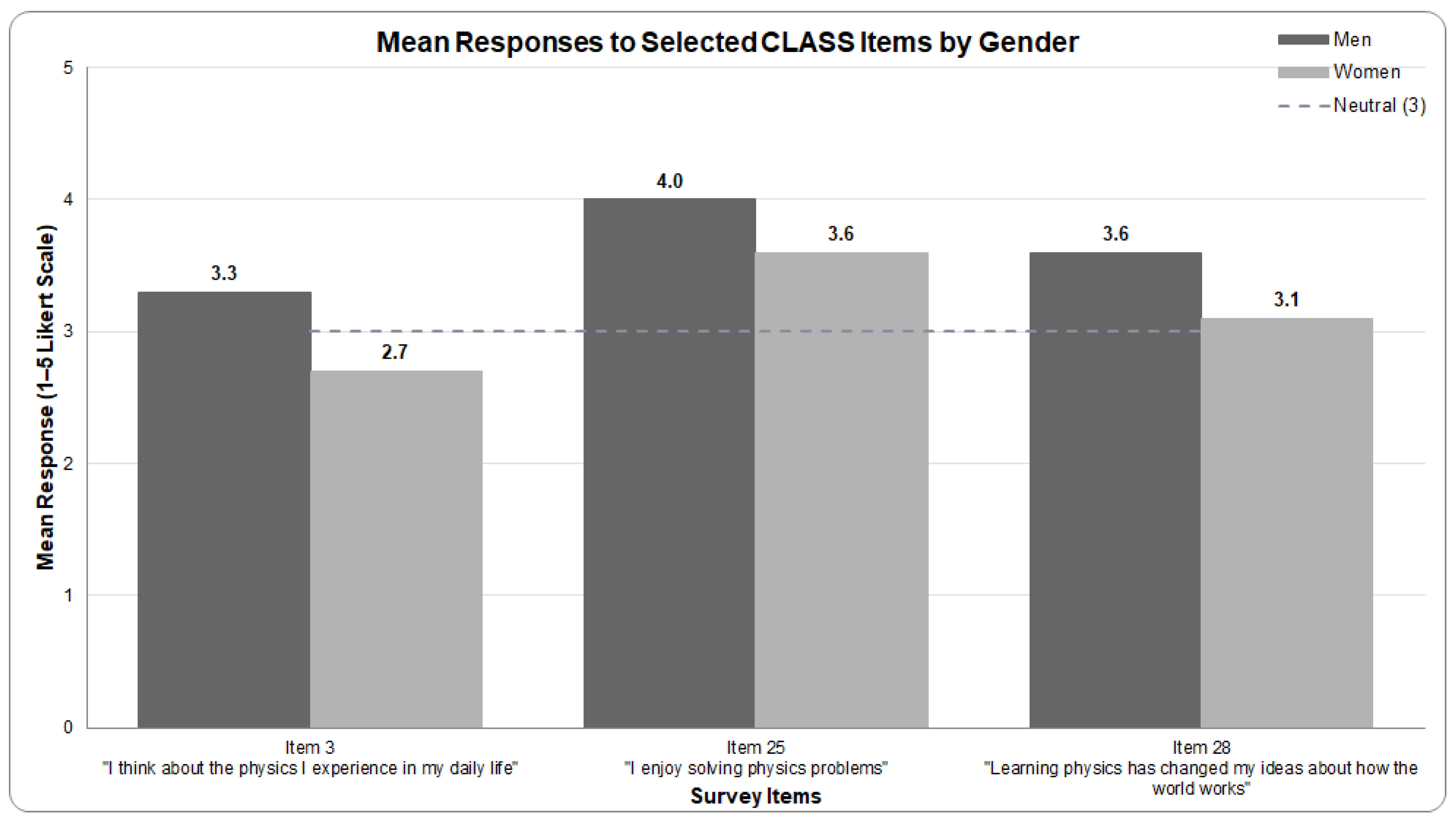
To further examine the differences observed in Personal Interest and Real World Connections, three items were for item-level analysis based on two criteria: (1) belonging to categories with statistically significant or potentially relevant gender differences, and (2) exhibiting comparatively large effect sizes within those categories. The selected items were (Figure 2):
- Item 3 (PI): “I think about the physics I experience in my daily life”;
- Item 25 (PI): “I enjoy solving physics problems”;
- Item 28 (RWC): “Learning physics has changed my ideas about how the world works”.
Figure 2.
Mean responses to selected CLASS items by gender.
Gender differences were assessed using Mann–Whitney U tests, consistent with the non-parametric approach applied at the category level:
- Item 3: Men median = 3.0, Women median = 3.0; U = 5940.0, p = 0.005, rank-biserial r = −0.227 (small effect);
- Item 25: Men median = 3.0, Women median = 3.0; U = 5913.5, p = 0.006, rank-biserial r = −0.222 (small effect);
- Item 28: Men median = 4.0, Women median = 3.0; U = 6480.0, p < 0.001, rank-biserial r = −0.339 (medium effect).
These item-level findings are consistent with the category-level analyses and indicate that gender differences are particularly associated with students’ personal engagement with physics and perceptions of its relevance to everyday life. Among the three items, Item 28 showed the largest effect size, suggesting that perceptions of physics as a framework for understanding the world may represent the dimension where gender differences are most pronounced in this sample.
3.5. Comparative Visualization of All Categories by Gender
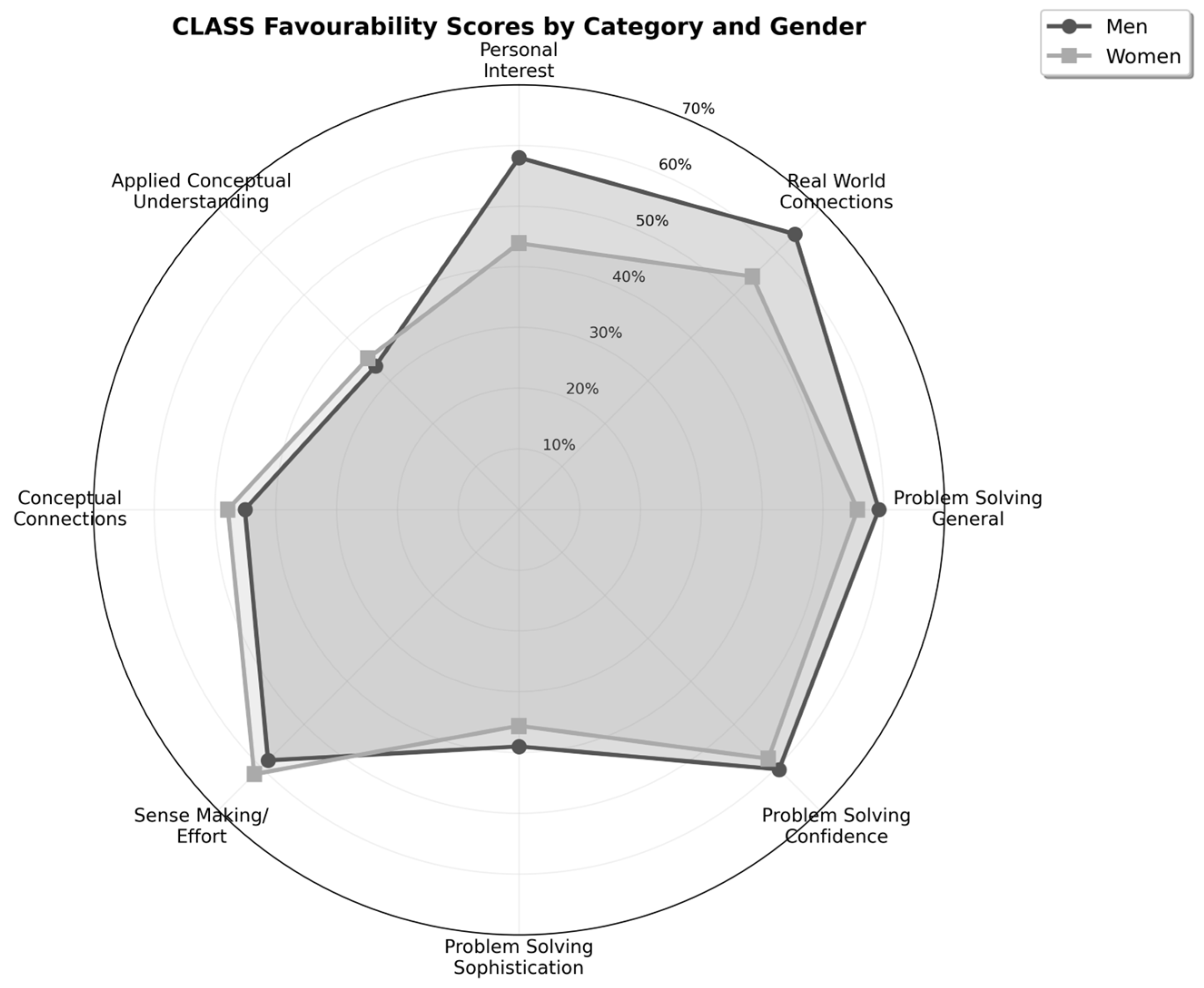
Figure 3 presents a radar chart comparing favourability scores across all eight CLASS categories by gender. This visualization clearly illustrates the overall similarity in profile shape between genders, with notable divergence in the Personal Interest and Real World Connections dimensions.
Figure 3.
Radar chart of CLASS favourability by category and gender.
The radar chart reveals that both male and female students show similar patterns of strengths (Sense Making/Effort, Problem Solving Confidence) and weaknesses (Applied Conceptual Understanding, Problem Solving Sophistication), with the primary gender differences concentrated in affective and relevance-perception domains rather than cognitive or metacognitive domains.
4. Discussion
4.1. Overall Attitudes Toward Biophysics
The overall favourability of 49.0% (95% CI: [46.8%, 51.1%]) indicates that Colombian medical students’ beliefs about physics align with expert physicists’ beliefs approximately half the time. This moderate alignment is consistent with findings from other medical student populations (Moustafa et al., 2012; Alhadlaq et al., 2009) and reflects the different professional trajectories and epistemological frameworks of medical students versus physicists. Medical students approach physics instrumentally, as a tool for understanding physiological processes and medical technologies, whereas physicists view physics as a fundamental discipline worthy of study for its own sake (Adams et al., 2006). The highest favourability in Sense Making/Effort (60.2%) is encouraging, as it demonstrates that students recognize the importance of conceptual understanding and are willing to invest effort in making sense of physics principles. This finding suggests that medical students are not inherently opposed to studying physics; rather, they may lack clear connections between physics concepts and their perceived professional needs.
Conversely, the lowest favourability scores in Applied Conceptual Understanding (34.4%) and Problem Solving Sophistication (37.1%) reveal a critical gap: medical students do not fully appreciate the importance of conceptual understanding for explaining phenomena and solving problems, they instead favor formula-based approaches. This finding aligns with research documenting the persistence of superficial learning approaches in physics education, particularly when students perceive physics as peripheral to their core professional identity (Docktor & Mestre, 2014; Hammer, 1994).
4.2. Gender Differences: Personal Interest and Real World Connections
After Bonferroni correction for multiple comparisons, only the gender difference in Personal Interest (14.1 percentage points, r = −0.269) was statistically robust. The difference in Real World Connections (9.9 percentage points, r = −0.159) was marginal and did not survive correction (adjusted p = 0.433). We acknowledge that both effect sizes are small by standard benchmarks (Cohen, 1988), indicating that gender explains only a modest proportion of variance in physics attitudes. Individual variation within each gender substantially exceeds between-gender differences.
The robust finding in Personal Interest aligns with broader patterns documented in STEM education research, where female students often report lower interest in physics despite comparable or superior performance (Eccles & Wang, 2016; Stoet & Geary, 2018/2020). One possible interpretation, drawn from Eccles’ expectancy-value theory, is that female medical students may perceive physics as less central to their professional identity as future physicians (Eccles & Wang, 2016; Eccles, 2007). However, we emphasize that these theoretical mechanisms (cultural coding of physics as masculine, specialty stereotyping, sense of belonging) are not measured by the CLASS instrument and remain speculative interpretations that would require direct investigation through qualitative or mixed-methods research.
Regarding Real World Connections, the marginal and non-robust nature of this finding limits the strength of interpretive claims. While the direction of the difference (men reporting greater perceived real-world relevance) is consistent with prior literature, we caution against building pedagogical recommendations on a result that does not withstand multiple comparison correction. Future research with larger samples should examine whether this trend is replicable.
Importantly, no significant gender differences emerged in the six remaining categories, including all three problem-solving categories, Sense Making/Effort, Conceptual Connections, and Applied Conceptual Understanding. This pattern suggests that gender differences are concentrated in affective and relevance-perception domains rather than cognitive or metacognitive domains. Both male and female students demonstrate similar confidence in problem-solving, similar recognition of the need for sense-making, and similar (albeit low) appreciation for conceptual understanding. This finding is consistent with international achievement data showing comparable science performance between genders (Stoet & Geary, 2018/2020).
4.3. Comparison with Engineering Students
Table 3 compares our findings with CLASS results from Colombian engineering students (Miranda & Rada, 2018) and medical students from Saudi Arabia (Alhadlaq et al., 2009) and the United States (Adams et al., 2006).
Table 3.
Comparison of CLASS favourability scores across studies and disciplines *.
Several patterns emerge from this comparison. First, engineering students demonstrate higher favourability than medical or premeds students across most categories, with the largest differences in Personal Interest and Real-World Connections (approximately 15–20 percentage points). This is unsurprising given that engineering students have chosen a physics-intensive career path and likely possess stronger intrinsic interest in physics. The similarity in Conceptual Connections and Applied Conceptual Understanding scores (<5 percentage points difference) between engineering and medical students is striking, suggesting a general challenge in Colombian undergraduate education regarding conceptual approaches to physics, regardless of discipline.
Second, comparing medical students across countries reveals both similarities and differences. The Overall favourability is similar between Colombian (50.1%) and Saudi Arabian (52.5%) medical students, but notably higher for U.S. premeds students (59.0%). This may reflect differences in pre-medical preparation, as U.S. medical students complete a four-year undergraduate degree (often including substantial science coursework) before entering medical school, whereas Colombian and Saudi Arabian students enter medical school directly after secondary education.
Third, gender patterns vary across countries. In our Colombian study and the U.S. study, men show higher Personal Interest favourability than women (14–21 percentage points difference). However, in the Saudi Arabian study, men and women show identical Personal Interest favourability (58.0%). This cross-cultural variation suggests that gender differences in physics attitudes are not universal but are influenced by sociocultural contexts, educational systems, and cultural norms regarding gender roles in STEM fields (Stoet & Geary, 2018/2020).
4.4. Implications for Biophysics Curriculum Design
These findings have several important implications for biophysics curriculum design in medical education:
4.4.1. Emphasize Clinical Relevance and Applications
The low favourability in Applied Conceptual Understanding and the gender gap in Real World Connections suggest that biophysics curricula should explicitly and repeatedly connect physics principles to clinical applications. Rather than presenting physics as an abstract prerequisite, courses should be organized around clinically relevant problems and medical technologies. For example:
- Cardiovascular system: Integrate fluid mechanics with hemodynamics, blood pressure measurement, and cardiovascular imaging (Doppler ultrasound, angiography);
- Respiratory system: Connect gas laws and diffusion with pulmonary function testing, mechanical ventilation, and oxygen therapy;
- Nervous system: Link electrical circuits and membrane potentials with electroencephalography (EEG), electrocardiography (ECG), and cardiac pacemakers;
- Musculoskeletal system: Apply mechanics and biomechanics to orthopedic injuries, prosthetics, and rehabilitation;
- Medical imaging: Explore the physics of X-rays, CT, MRI, ultrasound, and nuclear medicine throughout the course.
These connections should not be mentioned in passing but should form the organizing framework for the course, with physics principles introduced in the context of medical problems rather than as abstract theory later “applied” to medicine (Christensen et al., 2013).
4.4.2. Implement Active Learning and Case-Based Approaches
Traditional lecture-based physics instruction has proven ineffective for promoting deep conceptual understanding and positive attitudes (Freeman et al., 2014; Docktor & Mestre, 2014). Active learning strategies, including case-based learning, problem-based learning, and team-based learning, have demonstrated superior outcomes in medical education (McLean, 2016; Mintzes & Walter, 2020).
Biophysics case studies should present authentic clinical scenarios that require physics reasoning for diagnosis or treatment decisions. For example, a case might include a patient with suspected pulmonary embolism, requiring students to understand the physics of ventilation-perfusion matching, gas exchange, and pulmonary imaging to interpret diagnostic tests correctly. Such cases make the relevance of physics immediately apparent and may be particularly effective for addressing the gender gap in perceived real-world connections.
4.4.3. Incorporate Hands-On Experience with Medical Technologies
Direct interaction with medical devices and technologies can make physics principles tangible and relevant (Christensen et al., 2013). Biophysics laboratories should include opportunities to:
- Operate and troubleshoot medical equipment (e.g., ECG machines, pulse oximeters, blood pressure monitors);
- Analyze real physiological data using physics principles;
- Explore the physics underlying diagnostic imaging through simulations or demonstrations;
- Design simple medical devices or diagnostic tools as course projects.
Such hands-on experience may be particularly effective for increasing female students’ interest and perceived relevance, as research suggests that women value practical, application-oriented learning experiences in STEM fields (Eccles, 2007).
4.4.4. Address Gender Differences Through Inclusive Pedagogy
The significant gender differences in Personal Interest and Real World Connections call for intentional efforts to create inclusive learning environments. Given that this is a small effect (r = −0.269), interventions should be broad and inclusive rather than targeted narrowly, as within-gender variation is large. Strategies include:
- Diverse examples and role models: Feature female physicians and medical physicists who use physics in their work; include clinical examples from diverse specialties, including those with higher female representation;
- Collaborative learning: Structure group work to ensure equitable participation and value diverse perspectives;
- Growth mindset messaging: Emphasize that physics ability is developed through effort, not innate talent, to counter stereotypes (Dweck, 2006);
- Explicit relevance statements: Regularly articulate connections between physics content and diverse medical careers;
- Formative feedback: Provide frequent, specific feedback that focuses on learning progress rather than performance comparisons.
4.4.5. Develop Conceptual Understanding, Not Just Procedural Fluency
The low favourability in Applied Conceptual Understanding and Problem Solving Sophistication indicates that students undervalue conceptual understanding relative to formula-based problem-solving. This likely reflects prior educational experiences emphasizing algorithmic problem-solving over conceptual reasoning (Docktor & Mestre, 2014; Miranda & Rada, 2018).
Biophysics instruction should explicitly teach and assess conceptual understanding through:
- Conceptual questions: Include qualitative reasoning questions on assessments, not just quantitative calculations;
- Explanation prompts: Require students to explain the physics underlying phenomena, not just calculate numerical answers;
- Peer instruction: Use techniques like think–pair–share to promote conceptual discussion (Mazur, 1997);
- Concept inventories: Administer validated conceptual assessments to diagnose and address misconceptions (Hestenes et al., 1992).
4.5. Limitations
Several limitations should be considered when interpreting these findings:
4.5.1. Single Institution and Cultural Context
This study was conducted at a single Colombian university, limiting generalizability to other institutions, regions, or countries. Colombian medical education has specific characteristics (e.g., direct entry from secondary school, six-year program structure) that may influence student attitudes. Replication in diverse educational contexts is needed to assess the generalizability of findings.
4.5.2. Cross-Sectional Design
The cross-sectional design captures attitudes at a single time point (beginning of the biophysics course) and cannot assess how attitudes change over time or in response to instruction. Longitudinal studies administering CLASS at multiple time points (e.g., beginning and end of course, or across multiple years of medical school) would provide valuable insights into attitude development and the impact of curricular interventions.
4.5.3. Self-Report Measures
CLASS relies on self-reported beliefs and attitudes, which may be subject to social desirability bias or limited self-awareness. Students’ stated beliefs may not fully correspond to their actual learning behaviors or conceptual understanding. Triangulating CLASS data with other measures (e.g., performance assessments, classroom observations, interviews) would strengthen conclusions.
4.5.4. Binary Gender Classification
This study assessed gender as a binary variable (male/female), as no students in the sample self-identified as belonging to other gender categories. Future research should include more inclusive gender assessment to capture the experiences of all students. Additionally, gender is only one dimension of diversity; intersectional approaches considering race, ethnicity, socioeconomic status, and other identities would provide a more nuanced understanding of equity in physics education.
4.5.5. Limited Scope of CLASS
While CLASS provides valuable data on beliefs and attitudes, it does not assess actual conceptual understanding, problem-solving ability, or academic performance. The relationship between CLASS scores and learning outcomes is complex and context-dependent (Adams et al., 2006). Future research should examine how attitudes relate to performance, persistence, and career choices in medical education.
4.5.6. Translation and Cultural Adaptation
Although the Spanish translation of CLASS demonstrated good internal consistency reliability (α = 0.814), full validation including factor analysis and comparison with the original English version was not conducted. Cultural differences in interpretation of survey items may affect comparability with studies using the English version.
4.5.7. Temporal Considerations
Data for this study were collected in 2018. We acknowledge that the interval between data collection and submission (2026) reflects delays unrelated to the research design, including institutional and logistical factors in the preparation of this manuscript. We do not claim this temporal gap was planned or methodologically strategic. However, the data retain analytical value for two reasons: (1) epistemological beliefs measured by CLASS are shaped by deep-rooted educational traditions rather than short-term fluctuations (Adams et al., 2006; Docktor & Mestre, 2014), and (2) the pre-pandemic timing provides a historical reference point for future comparative research. Readers should interpret these results in the context of the 2018 collection period.
It is important to clarify the extent to which the educational context has remained stable since data collection. No formal curricular reform has been implemented in the biophysics course or the broader medical program since 2018. However, informed in part by the patterns identified in this dataset, instructors have since introduced informal pedagogical adjustments, including application exercises and clinical case discussions that incorporate medical technologies relevant to the physics topics covered in the course. These adjustments partially anticipate several of the recommendations discussed in Section 4.4 (e.g., clinical case-based learning, hands-on engagement with medical technologies), but they do not constitute a systematic curricular redesign, and their impact on student attitudes has not been formally assessed. Consequently, the structural conditions that shaped the attitudes reported here have likely persisted to a substantial degree, which supports the continued relevance of these findings as a baseline. We therefore present these results explicitly as a 2018 baseline rather than a claim about present-day student attitudes, and we recommend that a follow-up CLASS administration be conducted to determine whether attitudes, and particularly the gender difference in Personal Interest, have shifted in the intervening period.
4.6. Future Research Directions
Several promising directions for future research emerge from this study:
- Longitudinal studies: Track changes in attitudes throughout medical school and into residency to understand how clinical experiences influence perceptions of physics relevance;
- Intervention studies: Rigorously evaluate the impact of curriculum reforms (e.g., case-based learning, technology integration) on attitudes and learning outcomes;
- Qualitative research: Conduct interviews or focus groups to deeply explore the reasons behind gender differences in interest and perceived relevance;
- Multi-institutional studies: Compare attitudes across institutions with different curricular approaches to identify effective practices;
- Relationship to outcomes: Examine how CLASS scores relate to academic performance, specialty choice, and competence with medical technologies in clinical practice;
- Intersectional analyses: Investigate how gender intersects with other identities (e.g., race, socioeconomic status) to influence physics attitudes;
- Cross-cultural comparisons: Expand international comparisons to understand how educational systems and cultural contexts shape attitudes toward physics in medical education.
5. Conclusions
This study provides empirical evidence, based on data collected in 2018, that first-year Colombian medical students at that time held moderately favorable attitudes toward biophysics overall (49.0% favourability, 95% CI: [46.8%, 51.1%]) yet reveal substantial weaknesses in appreciating the importance of conceptual understanding and sophisticated problem-solving approaches. The relatively high score in Sense Making/Effort (60.2%) suggests receptivity to well-designed instruction, but the low favourability in Applied Conceptual Understanding (34.4%) and Problem Solving Sophistication (37.1%) underscores a critical gap in valuing conceptual reasoning in physics learning.
After Bonferroni correction for multiple comparisons, a significant gender difference was confirmed in Personal Interest (men: 58.0%, women: 43.9%, p = 0.001, r = −0.269), with male students reporting greater intrinsic interest in physics. A marginal difference in Real World Connections (men: 64.2%, women: 54.3%, unadjusted p = 0.048) did not survive correction and should be considered a trend warranting further investigation. Importantly, these differences did not extend to cognitive or metacognitive categories, suggesting that female students’ lower interest reflects perceptions of relevance rather than ability. The modest effect sizes indicate that gender explains only a small proportion of variance, and pedagogical interventions should be broad and inclusive.
Comparison with engineering students and medical students from other countries reveals that the challenges identified in this study are not unique to Colombian medical education but reflect broader patterns in physics education for health sciences. The similarity in low conceptual understanding scores across disciplines and countries suggests systemic issues in how physics is taught and learned in undergraduate education.
These results have significant implications for biophysics curriculum design. To foster engagement and deeper learning, courses should: (1) explicitly link physics principles to clinical applications and medical technologies, (2) adopt active learning strategies such as case-based and problem-based approaches, (3) provide hands-on experiences with medical devices, (4) implement inclusive pedagogy to address gender differences in interest and perceived relevance, and (5) prioritize conceptual understanding over procedural formula application. In addition, curriculum reforms that integrate medical instrumentation into physics teaching have been shown to better prepare students for technology-intensive clinical environments (Christensen et al., 2013; Hilborn & Friedlander, 2013). We note that, since data collection, the course has already incorporated informal adjustments broadly consistent with recommendations (1) and (3) above, namely application exercises and clinical case discussions involving medical technologies; a formal evaluation of these adjustments, together with a follow-up CLASS administration, would help establish whether they have measurably shifted student attitudes relative to the 2018 baseline reported here.
As medical practice increasingly relies on physics-based technologies—from advanced imaging modalities to minimally invasive surgical techniques and precision medicine—the importance of a robust physics foundation for physicians becomes a professional imperative. Addressing medical students’ negative attitudes toward biophysics is therefore not only an educational concern but also a matter of preparing future doctors for the technological demands of 21st-century medicine. By redesigning biophysics curricula to foreground clinical relevance, employ evidence-based pedagogies, and create inclusive learning environments, medical educators can contribute to strengthening medical training worldwide and advancing the scientific reasoning skills essential for lifelong learning and professional excellence. These findings, while rooted in the Colombian context, resonate with global challenges in health sciences education and underscore the need for international dialogue on how physics can be taught more effectively to future physicians.
Author Contributions
Conceptualization, O.H., J.C.M. and T.R.-C.; methodology, O.H. and D.R.-D.; formal analysis, O.H. and T.R.-C.; data curation, J.C.M.; writing—original draft preparation, D.R.-D., S.K.M. and T.R.-C.; writing—review and editing, O.H., D.R.-D., S.K.M. and T.R.-C.; supervision, S.K.M. and T.R.-C. All authors have read and agreed to the published version of the manuscript.
Funding
This research received no external funding.
Institutional Review Board Statement
Ethical review and approval were waived for this study due to the nature of the data collection procedure. The study involved an anonymous, voluntary online survey administered to adult university students (aged 17–22 years) for educational research purposes only. No sensitive personal data, clinical information, or identifiable information were collected beyond basic demographic variables (age and gender). At the time of data collection (2018), the institutional policy of the university stipulated that educational surveys collecting non-identifiable data from adult participants did not require formal Research Ethics Committee review, provided that informed consent was obtained from all participants prior to accessing the survey. All participants were fully informed of the study’s purpose, the voluntary nature of their participation, and the confidentiality of their responses before providing electronic consent. No course credit, compensation, or coercion was involved. The study was conducted in accordance with the ethical principles of the Declaration of Helsinki.
Informed Consent Statement
Informed consent was obtained from all subjects involved in the study. Participants were informed of the study’s purpose, the voluntary nature of participation, and the confidentiality of responses before accessing the survey. Electronic consent was obtained from all participants.
Data Availability Statement
The data presented in this study are available on request from the corresponding author. The data are not publicly available due to privacy and ethical restrictions.
Acknowledgments
The authors thank the medical students who participated in this study and the physics education experts who reviewed the Spanish translation of the CLASS survey. Grammarly AI (Version 1.2.300.1) was used to assist with grammar and spelling checking of the English text. Claude AI (Anthropic, Model: Claude Sonnet 5.5) was used as a supplementary tool to review manuscript structure and formatting against journal submission requirements. The intellectual content, data analysis, interpretation of results, and conclusions are solely the responsibility of the authors. All AI-assisted content was reviewed and validated by the authors.
Conflicts of Interest
The authors declare no conflicts of interest.
References
- Adams, W. K., Perkins, K. K., Podolefsky, N. S., Dubson, M., Finkelstein, N. D., & Wieman, C. E. (2006). New instrument for measuring student beliefs about physics and learning physics: The Colorado learning attitudes about science survey. Physical Review Special Topics—Physics Education Research, 2, 010101. [Google Scholar] [CrossRef] [Scilit]
- Alhadlaq, H., Alshaya, F., Alabdulkareem, S., Alrashed, M., & Alshaya, A. (2009). Measuring students’ beliefs about physics in Saudi Arabia. In 2009 physics education research conference; AIP conference proceedings (Vol. 1179, pp. 69–72). American Institute of Physics. [Google Scholar] [CrossRef] [Scilit]
- Cheryan, S., Ziegler, S. A., Montoya, A. K., & Jiang, L. (2017). Why are some STEM fields more gender balanced than others? Psychological Bulletin, 143, 1–35. [Google Scholar] [CrossRef] [Scilit]
- Christensen, W., Johnson, J. K., Van Ness, G. R., Nissen, S., & Hart, C. (2013). Developing and assessing curriculum on the physics of medical instruments. CBE—Life Sciences Education, 12, 250–261. [Google Scholar] [CrossRef] [Scilit][Green Version]
- Cohen, J. (1988). Statistical power analysis for the behavioral sciences (2nd ed.). Lawrence Erlbaum Associates. [Google Scholar]
- DeFranco, D. B., & Sowa, G. (2014). The importance of basic science and research training for the next generation of physicians and physician scientists. Molecular Endocrinology, 28, 1919–1929. [Google Scholar] [CrossRef] [Scilit]
- Docktor, J. L., & Mestre, J. P. (2014). Synthesis of discipline-based education research in physics. Physical Review Special Topics—Physics Education Research, 10, 020119. [Google Scholar] [CrossRef] [Scilit]
- Dweck, C. S. (2006). Mindset: The new psychology of success. Random House. [Google Scholar]
- Eccles, J. S. (2007). Where are all the women? Gender differences in participation in physical science and engineering. In S. J. Ceci, & W. M. Williams (Eds.), Why aren’t more women in science? Top researchers debate the evidence (pp. 199–210). American Psychological Association. [Google Scholar] [CrossRef] [Scilit]
- Eccles, J. S., & Wang, M. T. (2016). What motivates females and males to pursue careers in mathematics and science? International Journal of Behavioral Development, 40, 100–106. [Google Scholar] [CrossRef] [Scilit]
- Freeman, S., Eddy, S. L., McDonough, M., Smith, M. K., Okoroafor, N., Jordt, H., & Wenderoth, M. P. (2014). Active learning increases student performance in science, engineering, and mathematics. Proceedings of the National Academy of Sciences, 111, 8410–8415. [Google Scholar] [CrossRef] [Scilit]
- Fulton, T. B., Collins, S., van der Schaaf, M., & O’Brien, B. C. (2023). Connecting biochemistry knowledge to patient care in the clinical workplace: Senior medical students’ perceptions about facilitators and barriers. Teaching and Learning in Medicine, 35, 39–50. [Google Scholar] [CrossRef] [Scilit]
- Hammer, D. (1994). Epistemological beliefs in introductory physics. Cognition and Instruction, 12, 151–183. [Google Scholar] [CrossRef] [Scilit]
- Hestenes, D., Wells, M., & Swackhamer, G. (1992). Force concept inventory. The Physics Teacher, 30, 141–158. [Google Scholar] [CrossRef] [Scilit]
- Hilborn, R. C., & Friedlander, M. J. (2013). Biology and physics competencies for pre-health and other life sciences students. CBE—Life Sciences Education, 12, 170–174. [Google Scholar] [CrossRef] [Scilit][Green Version]
- Kritsadatan, N., & Wattanakasiwic, P. (2011). Freshmen and physics teacher expectations in learning physics. In ACSME proceedings 2011: Teaching for diversity—Challenges and strategies (pp. 101–106). UniServe Science. [Google Scholar]
- Looking forward 25 years: The future of medicine. (2019). Nature Medicine, 25, 1804–1807, (Corrigendum in 2020, Nature Medicine, 26–30). [Google Scholar] [CrossRef] [Scilit]
- Mann, H. B., & Whitney, D. R. (1947). On a test of whether one of two random variables is stochastically larger than the other. Annals of Mathematical Statistics, 18, 50–60. [Google Scholar] [CrossRef] [Scilit]
- Mazur, E. (1997). Peer instruction: A user’s manual. Prentice Hall. [Google Scholar]
- McLean, S. F. (2016). Case-based learning and its application in medical and health-care fields: A review of worldwide literature. Journal of Medical Education and Curricular Development, 3, JMECD.S20377. [Google Scholar] [CrossRef] [Scilit]
- Mintzes, J. J., & Walter, E. M. (2020). Active learning in college science: The case for evidence-based practice. Springer International Publishing. [Google Scholar] [CrossRef] [Scilit]
- Miranda, J. C., & Rada, T. (2018). An examination of the beliefs about physics and learning physics among engineering students. The International Journal of Engineering Education, 34, 1427–1435. [Google Scholar]
- Moustafa, H., Abbas, N., Eiswee, A., & Elshazly, M. (2012). Assessing problem-based learning: A case study of a medically oriented biophysics problem-based learning course. Journal of Problem Based Learning in Higher Education, 1, 34–48. [Google Scholar]
- Perkins, K. K., Gratny, M. M., Adams, W. K., Finkelstein, N. D., & Wieman, C. E. (2006). Towards characterizing the relationship between students’ interest in and their beliefs about physics. In AIP conference proceedings (Vol. 818, pp. 137–140). American Institute of Physics. [Google Scholar] [CrossRef] [Scilit]
- PhysPort. (2023). Colorado learning attitudes about science survey. Available online: https://www.physport.org/assessments/assessment.cfm?A=CLASS (accessed on 2 May 2023).
- Rada-Crespo, T., Hernández, O., Rueda-Delgado, D., & Miranda, J. C. (2022). Percepción del aprendizaje de la física en diferentes programas de ingeniería. Revista Mexicana de Física E, 19, 020202. [Google Scholar] [CrossRef] [Scilit]
- R Core Team. (2023). R: A language and environment for statistical computing (Versión 4.3) [Software de Computación]. R Foundation for Statistical Computing. Available online: https://www.r-project.org/ (accessed on 19 September 2026).
- Saavedra, B., & Segarra, P. (2021). Interest in physics courses for biological and health science students in high school. Journal of Physics: Conference Series, 1929, 012025. [Google Scholar] [CrossRef] [Scilit]
- Smithers, D. W. (1949). On teaching physics to medical students. Brithis Medical Journal, 2(4626), 512–515. [Google Scholar] [CrossRef] [Scilit][Green Version]
- Stoet, G., & Geary, D. C. (2018). The gender-equality paradox in science, technology, engineering, and mathematics education. Psychological Science, 29, 581–593, (Corrigendum in 2020, Psychological Science, 31(1), 110–111. https://doi.org/10.1177/0956797619892892). [Google Scholar] [CrossRef] [Scilit]
- Tavakol, M., & Dennick, R. (2011). Making sense of Cronbach’s alpha. International Journal of Medical Education, 2, 53–55. [Google Scholar] [CrossRef] [Scilit]
- The Biophysical Society. (2023). What is biophysics? Available online: https://www.biophysics.org/what-is-biophysics (accessed on 28 November 2023).
- Wang, N., Zhang, C. C., Gao, J., Fu, C. Y., Yang, X. Y., & Yang, C. (2026). Bridging physics and clinical practice: A pilot study on plasma medicine education for medical students. BMC Medical Education, 26, 406. [Google Scholar] [CrossRef] [Scilit]
- Welch, G. R. (2009). Physiology, physiomics, and biophysics: A matter of words. Progress in Biophysics and Molecular Biology, 100, 4–17. [Google Scholar] [CrossRef] [Scilit]
- White, B., & Ghobadi, K. (2023). Models of clinical integration into basic science education for first-year medical students. Medical Teacher, 45, 333–335. [Google Scholar] [CrossRef] [Scilit]



Disclaimer/Publisher’s Note: The statements, opinions and data contained in all publications are solely those of the individual author(s) and contributor(s) and not of MDPI and/or the editor(s). MDPI and/or the editor(s) disclaim responsibility for any injury to people or property resulting from any ideas, methods, instructions or products referred to in the content. |
© 2026 by the authors. Licensee MDPI, Basel, Switzerland. This article is an open access article distributed under the terms and conditions of the Creative Commons Attribution (CC BY) license.