


Abstract
Digital technologies are becoming increasingly embedded in undergraduate dental curricula, with the potential to support learning and skills development. This scoping review mapped recent evidence on the implementation and educational applications of contemporary digital technologies in undergraduate dental education. A literature search was conducted in PubMed, Scopus, and Web of Science to identify studies published between 2021 and 2025. The review was conducted in accordance with the PRISMA-ScR reporting guidelines and included studies investigating digital technologies in undergraduate dental education. A total of 24 studies met the inclusion criteria. The identified technologies included virtual reality and simulation-based learning systems, digital and 3D-printed educational models, digital assessment and feedback systems, web-based learning platforms, artificial intelligence applications, CAD/CAM technologies, and digital clinical devices. Across the included studies, the reported educational outcomes most commonly concerned practical performance, knowledge acquisition, student engagement, self-assessment, and satisfaction, with many studies focusing on short-term preclinical or learner-reported outcomes. Virtual simulation and digital assessment systems were the most extensively investigated technologies. The available evidence suggests that digital technologies may support undergraduate dental education when used as adjuncts to conventional teaching methods. However, the effectiveness of specific blended-learning models requires direct comparative evaluation. Future research should prioritize longitudinal and methodologically rigorous studies examining long-term knowledge retention, clinical competence, educational quality, and the transfer of acquired skills to professional practice.
1. Introduction
1.1. Background
The rapid digital transformation of healthcare has substantially reshaped the education and training of future dental professionals. Contemporary dental practice increasingly relies on technologies such as computer-aided design and computer-aided manufacturing (CAD/CAM), intraoral scanning, virtual treatment planning, artificial intelligence (AI), and three-dimensional (3D) printing (Balhaddad et al., 2023; Lobo et al., 2025; Ossowska et al., 2022; Suese, 2020). Accordingly, undergraduate dental education is gradually moving beyond predominantly conventional teaching approaches toward technology-enhanced learning environments that more closely reflect the workflows and competencies required in modern clinical practice (Ohyama et al., 2025).
The development of practical skills remains a central component of undergraduate dental education. However, safe and effective patient care requires not only procedural proficiency but also theoretical knowledge, clinical reasoning, and sound decision-making. Consequently, dental curricula should promote the integrated development of psychomotor, cognitive, and evaluative competencies rather than treating practical and theoretical learning as separate domains (Leadbeatter & Peck, 2018).
The educational value of digital technologies can also be understood through established theories of learning. Experiential learning emphasizes active participation, reflection, and repeated practice, while constructivist approaches suggest that learners actively build knowledge through interaction with educational content and authentic learning experiences. Digital learning environments may support these processes through simulation-based training, immediate feedback and opportunities for self-directed learning (Gupta et al., 2024; Li et al., 2021).
1.2. Educational Applications of Digital Technologies
A broad range of digital technologies has been introduced into preclinical and clinical dental training, including virtual reality simulators, digital assessment systems, 3D-printed educational models, CAD/CAM workflows, AI-based applications, and web-based learning platforms. These technologies may offer several educational advantages, including standardized learning experiences, objective assessment, enhanced visualization of anatomical structures, greater accessibility of educational resources, and opportunities for individualized feedback (Khurshid, 2023).
Beyond technical skill development, digital technologies may also contribute to student engagement, motivation, critical thinking, and professional digital competence. As digital workflows become an integral component of contemporary dental practice, familiarity with these technologies is increasingly recognized as an important learning outcome in higher education (Nassani et al., 2024). In this context, the educational value of digital technologies should be considered not only in terms of knowledge and technical skill acquisition, but also in relation to their potential to support reflective learning, clinical decision-making, learner autonomy, and the overall quality of undergraduate dental education.
1.3. Purpose of the Review
Previous reviews have examined individual digital technologies or specific aspects of technology-enhanced dental education (Zitzmann et al., 2020; Abu Arqub et al., 2024). However, these reviews were either published before the rapid expansion of contemporary digital technologies, such as artificial intelligence and advanced digital educational tools, or focused on specific dental disciplines or selected educational interventions rather than providing a broad overview across undergraduate dental education. Accordingly, the rapidly evolving landscape of digital technologies has created a need for an updated mapping of the available evidence. Given the diversity of digital technologies, educational settings, study designs, and reported educational outcomes, this review was designed as a scoping review to map the existing literature rather than quantitatively synthesize intervention effects. Accordingly, its aim was to map the current evidence on the implementation and educational applications of digital technologies in undergraduate dental education. Guided by the Population–Concept–Context (PCC) framework, the review addressed the following questions:
- (1)
- Which digital technologies have been implemented in undergraduate dental education?
- (2)
- In which educational settings (preclinical or clinical) have these technologies been applied?
- (3)
- What educational outcomes have been reported, including knowledge acquisition, practical skill development, learner engagement, and clinical competence?
- (4)
- What gaps remain in the current evidence to guide future research?
The findings of this review may inform educators, curriculum developers, and researchers involved in the design, implementation, and evaluation of technology-enhanced dental curricula.
2. Materials and Methods
A scoping review methodology was adopted to map the available evidence regarding the use of digital technologies in undergraduate dental education. Owing to the broad scope of the review and the heterogeneity of the included educational technologies, study designs, and outcome measures, this methodology was considered appropriate for addressing the review objectives. The review was conducted and reported in accordance with the PRISMA-ScR guidelines (Tricco et al., 2018). A review protocol was not prospectively registered, which should be considered a methodological limitation.
2.1. Literature Search Strategy
We searched PubMed (NCBI), Scopus (Elsevier, Amsterdam, The Netherlands), and Web of Science Core Collection (Clarivate, Philadelphia, PA, USA). The review question and eligibility criteria followed the Population–Concept–Context (PCC) framework from the Joanna Briggs Institute (Peters et al., 2020). The population was undergraduate dental students, the concept was the use of digital technologies, and the context was undergraduate dental education. For the purposes of this review, digital technologies were defined as digitally mediated tools, systems, devices, or workflows used to support teaching, learning, simulation, assessment, feedback, treatment planning, or clinical training in undergraduate dental education. These included virtual and mixed reality systems, digital simulation, digital and 3D-printed educational models, digital assessment and feedback systems, artificial intelligence applications, CAD/CAM workflows, web-based learning platforms, intraoral scanning, and other digital clinical devices when used for an educational purpose. The search combined terms related to undergraduate dental education, digital technologies, practical skills, and knowledge acquisition, along with specific technologies (e.g., virtual reality, simulation, artificial intelligence, 3D printing, CAD/CAM, digital assessment systems, web-based learning, and digital clinical devices). The PubMed search was conducted on 10 January 2026, the Scopus search on 12 January 2026, and the Web of Science Core Collection search on 15 January 2026. No subsequent update search was performed. The searches covered studies published from January 2021 to December 2025. Studies published after this period were used only to contextualize and compare findings in the Discussion and were not included in data charting or synthesis. Full search strategies are provided in Appendix A.
2.2. Inclusion and Exclusion Criteria
The studies included in this review were selected based on predefined inclusion and exclusion criteria (Table 1). Eligible studies were peer-reviewed, full-text original research articles published in English between 2021 and 2025. They focused on undergraduate dental students and investigated the implementation or educational use of digital technologies, as defined above, within undergraduate dental education, reporting outcomes such as practical skill development, knowledge acquisition, assessment, learner engagement, or learning performance.
Table 1.
Inclusion and exclusion criteria.
Publications were excluded if they did not concern dental education, evaluated exclusively non-digital teaching interventions, or focused on populations other than undergraduate dental students. Eligible studies were required to include undergraduate dental students as the principal learner population. Studies could also involve faculty members, teachers, assessors, clinicians, or other educational personnel where these individuals contributed to teaching, supervision, or evaluation, provided that outcomes for undergraduate dental students were reported separately or represented the principal focus of the study. Review articles, meta-analyses, conference papers, letters, commentaries, and other non-original publications were also excluded. This rigorous selection process ensured a relevant and focused evaluation of digital innovations in the context of dental education.
2.3. Data Charting and Analysis
The study selection process followed the PRISMA-ScR framework and comprised identification, screening, eligibility assessment, and inclusion. After duplicate removal, two reviewers independently screened the titles and abstracts according to the predefined eligibility criteria. Potentially eligible articles were subsequently assessed independently in full text by the same two reviewers. Inter-reviewer agreement at the full-text eligibility assessment stage was substantial (Cohen’s κ = 0.76). When discrepancies occurred at either stage, both reviewers re-evaluated the study against the eligibility criteria and resolved disagreements through discussion until consensus was reached.
Data were independently charted by two reviewers using a standardized data extraction form. The extracted information included the author and year of publication, country, study design, participant characteristics, sample size, educational setting, digital technology, comparator where applicable, outcome measures, outcome type, and reported educational outcomes. No automation tools were used during study selection or data charting, and the authors were not contacted for additional information.
Owing to the considerable methodological and educational heterogeneity of the included studies with respect to educational technologies, study designs, and outcome measures, a quantitative synthesis was not appropriate. Therefore, the findings were synthesized descriptively and organized thematically according to the type of digital technology and the reported educational outcomes. Educational outcomes were additionally classified according to the Kirkpatrick model (Reaction, Learning, Behavior, and Results) to provide a standardized framework for comparing the level of educational evaluation across the studies (Kirkpatrick & Kirkpatrick, 2006).
Educational setting and Kirkpatrick outcome level were classified independently. Studies were categorized as preclinical or clinical according to the setting in which the educational activity occurred. Kirkpatrick Level 1 (Reaction) included learner perceptions, satisfaction, acceptance, confidence, and perceived preparedness; Level 2 (Learning) included measured knowledge, skills, or performance within an educational or training setting; Level 3 (Behavior) required evidence of sustained transfer of learning to authentic clinical or workplace practice; and Level 4 (Results) referred to broader patient-, institutional-, or system-level outcomes. A clinical educational setting or a single live-person performance assessment was therefore not, by itself, classified as Level 3.
No meta-analysis, formal assessment of statistical heterogeneity, sensitivity analyses, or effect measures were undertaken. No formal methodological quality appraisal, risk-of-bias assessment, or certainty-of-evidence evaluation was performed.
3. Results
3.1. Study Selection
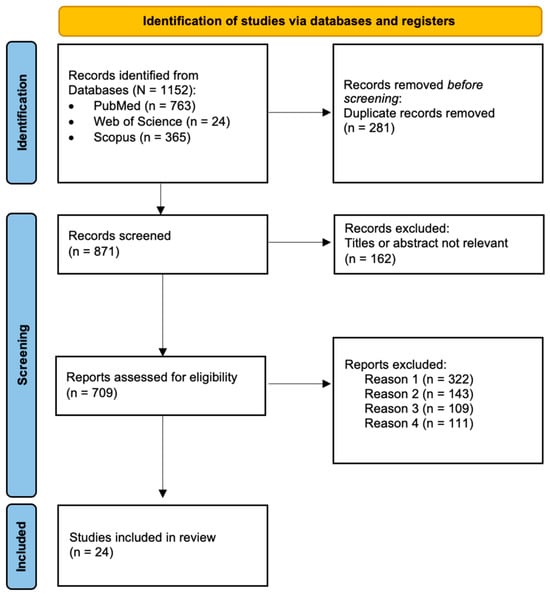
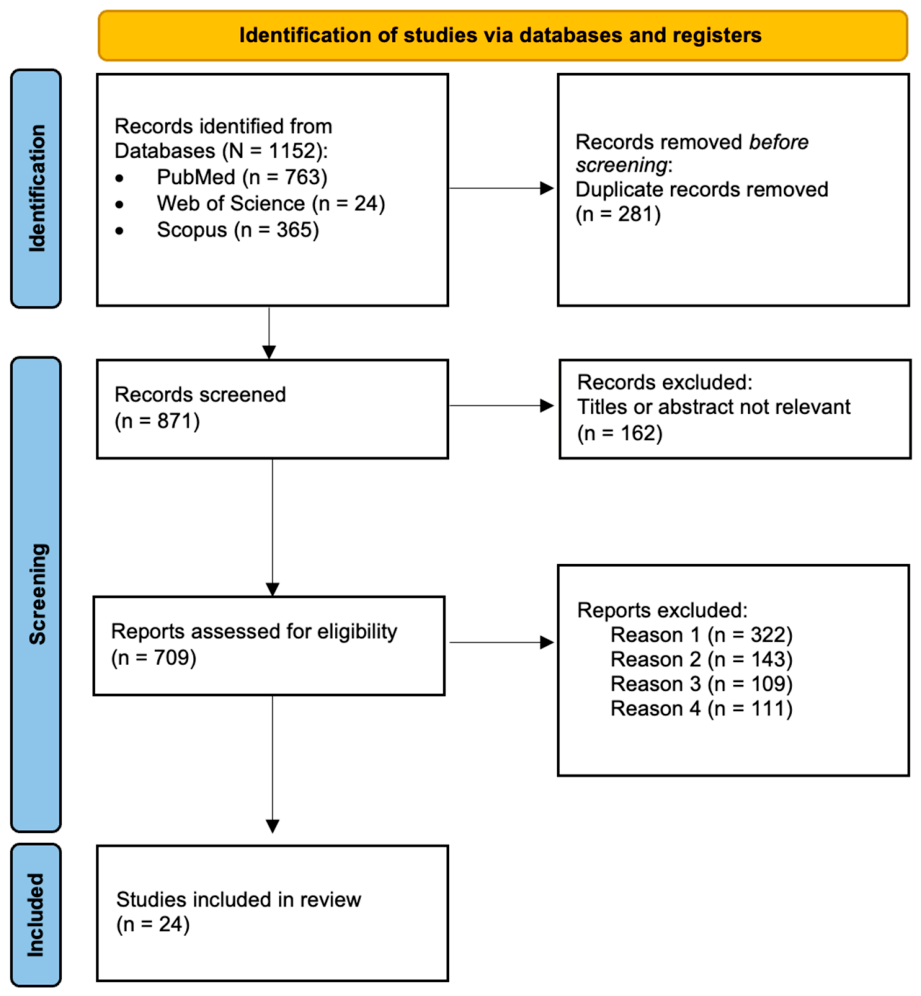
The study selection process is illustrated in the PRISMA-ScR flow diagram (Figure 1).
Figure 1.
PRISMA-ScR diagram illustrating the identification, screening, eligibility assessment, and inclusion of studies.
A total of 1152 records were identified through searches of PubMed, Scopus, and Web of Science. After duplicate removal, titles and abstracts were screened, followed by full-text assessment of potentially eligible articles. Studies were excluded for the following reasons:
- Reason 1: Irrelevant population (not focused on undergraduate dental students);
- Reason 2: Non-digital intervention (conventional teaching methods only);
- Reason 3: Insufficient reporting of educational outcomes;
- Reason 4: Ineligible publication type or study design (e.g., reviews, editorials, conference abstracts, or protocols).
Ultimately, 24 studies met the inclusion criteria and were included in the descriptive synthesis.
3.2. Characteristics of Included Studies
The characteristics of the included studies are summarized in Table 2, including country, study design, participant characteristics, educational setting, digital technologies, comparator, outcome measures, outcome type, outcome evaluation level, and the main educational outcomes.
Table 2.
Characteristics of the included studies, including country, study design, participants, educational setting, digital technology, comparator, outcome measures, outcome type, level of outcome evaluation, and main educational outcomes.
3.3. Key Findings
The included studies investigated seven main categories of digital technologies (Table 3): virtual reality, mixed reality, and simulation-based learning (n = 8); digital and 3D-printed educational models (n = 5); digital assessment and feedback systems (n = 7); digital learning platforms and web-based applications (n = 3); artificial intelligence applications (n = 1); CAD/CAM technologies and digital workflows (n = 1); and electronic facebows and other digital clinical devices (n = 1). Because the technology categories were non-mutually exclusive, studies evaluating more than one digital technology were represented in each relevant category; consequently, the category totals exceed the total number of included studies (n = 24).
Table 3.
Distribution of included studies according to the type of digital technology used in dental education.
Virtual reality, mixed reality, and simulation-based learning technologies, together with digital assessment and feedback systems, represented the most frequently investigated categories. These technologies were primarily used to support practical skills development, provide objective assessment, and facilitate immediate feedback. The reported outcomes primarily concerned students’ technical performance, knowledge acquisition, self-assessment, engagement, satisfaction, and perceived learning effectiveness.
Studies investigating digital and 3D-printed educational models highlighted their educational value as alternatives or complements to conventional teaching materials. Digitally designed and additively manufactured models may offer advantages in terms of accessibility, standardization, and opportunities for repeated practice, with reported outcomes related to accessibility, standardization, and practical learning.
The available evidence suggested that interactive digital environments were perceived as engaging learning tools and provided flexible access to educational resources.
Studies evaluating CAD/CAM technologies and digital workflows reported positive student perceptions regarding preparedness for clinical practice and their understanding of digital clinical workflows.
Emerging technologies, including artificial intelligence applications and electronic facebows, showed potential educational applications. AI-based tools may support personalized learning and automated feedback; however, the available evidence remains limited because of the small number of studies and the lack of long-term evaluation.
Overall, the included studies encompassed a broad range of digital educational applications. Most were conducted in preclinical educational settings and evaluated Level 2 (Learning) outcomes according to the Kirkpatrick model, primarily focusing on knowledge acquisition, practical skill development, self-assessment, and learner engagement. In contrast, relatively few studies were conducted in clinical educational settings. No included studies reported outcomes corresponding to Kirkpatrick Level 3 (Behavior) or Level 4 (Results).
4. Discussion
The findings of this scoping review demonstrate the growing diversity of digital technologies used in undergraduate dental education. The reported outcomes encompassed practical performance, knowledge acquisition, learner engagement, self-assessment, and student satisfaction. However, many studies focused on short-term preclinical performance or learner-reported outcomes, which should not be interpreted as evidence of improved clinical competence or transfer to patient care. These findings are consistent with contemporary educational principles that emphasize active learning, formative assessment, technology-enhanced education, and the development of professional competencies required for modern clinical practice. However, several studies emphasized that digital technologies should complement rather than replace conventional teaching methods, suggesting that these technologies may be most appropriately integrated as adjuncts to established educational approaches (McAlpin et al., 2025; Dzyuba et al., 2025; Algarni et al., 2024; Bevizova et al., 2024).
The included studies covered both preclinical and clinical educational settings; however, most focused on preclinical training. The predominance of preclinical Level 2 evidence, together with the absence of Level 3 and Level 4 outcomes, indicates that the current literature mainly captures immediate learning effects rather than the transfer of learning to clinical behavior or patient care. To facilitate interpretation from a curricular perspective, the findings are discussed below according to their principal educational context.
4.1. Digital Technologies in Preclinical Education
Virtual reality, mixed reality, and simulation-based learning technologies were among the most extensively investigated digital educational approaches identified in this review. Most studies in this category primarily evaluated Level 2 (Learning) outcomes related to knowledge acquisition and practical skill development, alongside learner-reported outcomes such as engagement and confidence. Studies by L. Stoilov et al. (2024), Sheng et al. (2022), and Wu et al. (2024) reported outcomes related to practical performance, knowledge acquisition, and learner perceptions in virtual learning environments. Among these studies, L. Stoilov et al. (2024) reported significantly higher preparation-examination scores following conventional phantom-head training than virtual simulation, suggesting that virtual simulation may be more appropriately used as an adjunct to conventional practical training. Collectively, the available evidence suggests that virtual learning technologies may support preclinical training by facilitating repeated practice, active learning, and immediate feedback. This interpretation is consistent with recent reviews supporting the educational value of VR while emphasizing the continued importance of hands-on training (Algarni et al., 2024; Bevizova et al., 2024; Dzyuba et al., 2025). The predominance of short-term Level 2 outcomes limits conclusions regarding retention, behavioral transfer, and long-term clinical performance.
Beyond simulation technologies, additive manufacturing has emerged as another important area of digital innovation in dental education. The reported outcomes primarily related to anatomical understanding, practical skill development, and psychomotor training, whereas evidence regarding transfer to clinical performance remained limited. Collectively, the available evidence suggests that digital and 3D-printed models may support anatomical understanding, practical skill development, and positive learning experiences in dental education (Petre et al., 2023; Hu et al., 2023; Duan et al., 2024; Karagkounaki et al., 2025; Fayyaz et al., 2024). For contextual comparison only, Dzhondrova et al. (2026), published after the predefined eligibility period and after completion of the database searches, reported improved performance in tooth-carving exercises and greater understanding of tooth morphology among students trained with 3D-printed models. However, no significant improvement was observed in theoretical examination scores, suggesting that the principal educational value of these models lies in spatial understanding, psychomotor development, and procedural rehearsal rather than in theoretical knowledge acquisition alone. Taken together, the included studies suggest that 3D-printed educational models may facilitate preclinical practical training by providing realistic, standardized, and reproducible learning resources. The reproducibility of these models also enables more objective comparison of students’ practical performance. From a Kirkpatrick perspective, the preclinical evidence for 3D-printed models included both Level 1 (Reaction) outcomes, reflecting student perceptions and acceptance, and Level 2 (Learning) outcomes related to knowledge and practical skill development. However, evidence demonstrating transfer to clinical behavior (Level 3) or patient-related outcomes (Level 4) was absent. Direct comparison across studies remains difficult because of differences in model design, manufacturing methods, dental discipline, learning tasks, comparators, and assessment approaches. The generally modest sample sizes further limit the generalizability of the findings. Future studies should better define the intended educational purpose of 3D-printed models and evaluate outcomes that distinguish knowledge acquisition, procedural accuracy, manual skill development, and the transfer of learning to clinical performance.
Whereas 3D-printed models primarily support simulation-based learning, digital assessment technologies focus on providing objective feedback during practical training. Digital assessment and feedback systems primarily addressed practical skill development, self-assessment, and formative feedback, while evidence regarding their influence on long-term clinical performance remained limited. Across the included studies, these technologies were used to assess tooth preparations, visualize deviations from reference standards, and provide digitally generated feedback (Matthisson et al., 2022; Alsharif et al., 2024; Chen et al., 2024; Kim et al., 2023; Corne et al., 2023; Mai et al., 2024; M. Stoilov et al., 2021). Collectively, the findings suggest that digital assessment may reduce some of the variability and subjectivity associated with conventional evaluation. Reproducible measurements and visual feedback may help students identify procedural errors and facilitate self-correction. This interpretation is consistent with Patil et al. (2023), who reported that haptic and computer-supported feedback systems can support psychomotor skill development, self-correction, and more objective assessment. Within the Kirkpatrick framework, the evidence for digital assessment and feedback was concentrated predominantly at Level 2 (Learning), particularly in relation to self-assessment, practical performance, and skill acquisition. However, whether these reported benefits are sustained over time or translate into changes in clinical behavior (Level 3) remains unclear.
However, digital measurement should not be equated with a complete evaluation of clinical competence. An automated system may assess geometric accuracy or deviation from a predefined reference but may not adequately account for biological variation, clinical judgment, patient-specific considerations, or the rationale underlying a procedural decision. Digital assessment is therefore most appropriately understood as a supplement to expert feedback rather than as a replacement for academic or clinical judgment. A further limitation is that most studies examined immediate or short-term performance. It remains unclear whether the favorable short-term outcomes observed with digitally supported self-assessment translate into durable metacognitive skills or more consistent clinical performance over time. Longitudinal research is needed to determine whether students become less dependent on automated feedback as their competence develops and whether digitally acquired evaluative skills transfer to patient-based care.
Digital learning platforms were also evaluated in preclinical education. Sun et al. (2025) reported post-training knowledge of restorative concepts and high student satisfaction with the digital platform, with students also reporting benefits for self-directed learning. The findings suggest that digital platforms may extend learning beyond scheduled classroom or laboratory sessions by providing flexible access to educational materials, interactive exercises, and opportunities for self-directed learning. However, the limited evidence prevents firm conclusions regarding their effects on knowledge acquisition or practical competence, and further studies should evaluate their long-term educational impact.
Artificial intelligence represents one of the newest digital technologies introduced into undergraduate dental education. Evidence regarding artificial intelligence was limited to a single study, which primarily evaluated knowledge acquisition and practical skill development. Mahrous et al. (2023) reported higher removable partial denture design performance among students using the AI-based educational system, together with generally positive student perceptions. Although the primary evidence remains limited, these findings suggest that artificial intelligence may support personalized learning and provide immediate feedback during the learning process. This interpretation is supported by recent systematic reviews, which report that AI-powered educational interventions have the potential to improve knowledge acquisition and learner satisfaction while facilitating personalized learning and automated feedback (Wei et al., 2025; Alzahrani et al., 2025). However, these reviews also emphasize important challenges related to AI literacy, ethical considerations, data privacy, and the lack of institutional guidance for AI implementation in dental education (Uribe et al., 2024; Uribe et al., 2025).
Preclinical exposure to contemporary digital workflows was also explored through intraoral scanning and CAD/CAM education, with favorable student perceptions reported, although the evidence was based primarily on learner-reported outcomes rather than objective measures of skill acquisition (Zoidis et al., 2022).
Other digital technologies evaluated in preclinical education included digital carving exercises and electronic facebows. Maragha and Chehroudi (2024) reported Level 2 learning outcomes related to spatial understanding and manual dexterity, while Zhang et al. (2025) reported favorable learning effectiveness and teaching satisfaction following the use of electronic facebows. Although these findings suggest potential educational value, evidence for these technologies remains limited to individual studies.
4.2. Digital Technologies in Clinical Education
Compared with preclinical education, fewer studies evaluated digital technologies in clinical or clinically oriented teaching. The investigated applications included virtual treatment planning, patient-specific 3D-printed models, web-based course-management systems, and digital clinical workflows. Despite the diversity of these technologies, the clinical studies showed a relatively consistent pattern. Most used observational or survey-based designs and predominantly evaluated Kirkpatrick Level 1 (Reaction) outcomes, including student perceptions, acceptance, confidence, and perceived preparedness (Liebermann et al., 2024; Klink et al., 2024; Bjelopavlovic et al., 2024; Goob et al., 2022; Slaidina et al., 2025). Thus, the available evidence primarily supports the acceptability and perceived educational usefulness of digital technologies in clinical education rather than demonstrating objective improvements in clinical competence.
Across these interventions, digital technologies may support familiarization with contemporary clinical workflows, patient-specific planning, and the organization of clinical learning. However, differences in study design, educational application, and outcome assessment limit direct comparison between studies. Importantly, the predominance of Level 1 outcomes and the absence of Level 3 (Behavior) and Level 4 (Results) evidence leave uncertainty as to whether favorable learner perceptions translate into improved clinical performance or patient-related outcomes. Comparative and longitudinal studies incorporating objective measures of clinical competence and transfer to patient care are therefore needed.
4.3. Synthesis of Findings and Educational Implications
Taken together, the evidence base was more extensive for preclinical than for clinical applications of digital technologies. Within the Kirkpatrick framework, preclinical studies were concentrated predominantly at Level 2 (Learning), reflecting knowledge acquisition, practical skill development, and self-assessment, whereas clinical studies more commonly evaluated Level 1 (Reaction) outcomes, including perceptions, confidence, acceptance, and preparedness for digital workflows. No included studies evaluated Level 3 (Behavior) or Level 4 (Results) outcomes. Thus, across both educational contexts, evidence concerning sustained behavioral change, transfer of learning to independent clinical practice, and patient-related outcomes remains limited.
From the broader perspective of higher education in the digital age, the educational value of these technologies should extend beyond standardization, repeated practice, immediate feedback, and short-term performance. Virtual simulation, digital assessment systems, 3D-printed models, and digital clinical workflows may also provide opportunities for students to develop self-assessment, reflective learning, and greater autonomy in the learning process. However, these benefits should not be equated with the development of independent clinical judgment. Dental practice requires students to interpret patient-specific information, integrate biological and technical considerations, and make decisions in situations that cannot always be reproduced by standardized digital environments. The predominance of Kirkpatrick Level 1 and Level 2 outcomes in the current literature therefore highlights an important gap between successful engagement or preclinical performance and demonstrated transfer to clinical practice. From an educational quality perspective, digital technologies may be most valuable when integrated with expert supervision, reflective feedback, and authentic patient-based learning, thereby supporting rather than replacing the development of critical thinking and clinical decision-making.
The findings of this review are broadly consistent with previous reviews of technology-enhanced dental education. Abu Arqub et al. (2024) reported generally favorable outcomes related to student engagement, practical skills acquisition, and learning outcomes in prosthodontic education, while Zitzmann et al. (2020) highlighted the growing role of digital technologies in supporting undergraduate dental education. Similarly, Ardila and González-Arroyave (2023) specifically examined the use of CAD/CAM technologies in dental procedures performed by students, further illustrating the increasing integration of digital workflows into dental training. The present review extends these findings by mapping more recent evidence and demonstrating the expanding diversity of digital technologies implemented in undergraduate dental education.
The volume and characteristics of the available evidence varied across the evaluated technologies. Virtual reality and simulation-based learning were represented by the largest number of primary studies, with reported outcomes related to practical performance, learner engagement, and knowledge acquisition. Studies of 3D-printed educational models and digital assessment systems were also identified, whereas artificial intelligence, CAD/CAM technologies, web-based learning platforms, and other digital clinical technologies were represented by fewer studies.
Overall, the available evidence suggests that digital technologies may support knowledge acquisition, practical skill development, assessment processes, and student engagement. However, they appear most appropriately positioned as adjuncts to, rather than replacements for, conventional practical training. McAlpin et al. (2025) reported higher transfer-test scores following plastic manikin training compared with virtual reality simulation for local anesthesia administration, indicating that conventional teaching methods continue to play an important role in psychomotor skill development. Because the included studies did not directly evaluate formally designed blended-learning models, the effectiveness of specific combinations of digital and conventional teaching requires direct comparative evaluation.
4.4. Limitations
This review has several limitations. First, only studies published in English were included, which may have resulted in language bias. Second, the literature search was limited to PubMed, Scopus, and Web of Science Core Collection and did not include an education-focused database such as ERIC. In addition, the search relied on free-text terms without controlled vocabulary or truncation. These methodological choices may have reduced search sensitivity and may have resulted in the omission of relevant educational studies, particularly those indexed primarily in education-focused databases or described using alternative terminology. Furthermore, most studies evaluated short-term educational outcomes, whereas evidence regarding long-term knowledge retention, sustained clinical competence, and real-world patient outcomes remains limited. Because the primary objective of this scoping review was to map the available evidence rather than quantitatively synthesize intervention effects, no formal methodological quality appraisal, risk-of-bias assessment, certainty-of-evidence evaluation, meta-analysis, or formal assessment of statistical heterogeneity was performed. Therefore, the findings should be interpreted as a descriptive mapping of the current evidence rather than as a quantitative evaluation of the effectiveness, methodological quality, or certainty of the available evidence. Moreover, the included studies were conducted predominantly in a limited number of countries, particularly Germany, China, and South Korea, which may limit the generalizability of the findings to other educational systems and geographic regions. Finally, given the rapid evolution of digital technologies, additional educational approaches may have emerged after completion of the literature search.
4.5. Recommendations for Future Research
Based on the findings of this review and the identified limitations, several directions for future research can be proposed. Longitudinal studies are needed to evaluate the long-term impact of digital technologies on knowledge acquisition, practical skill development and clinical competence after graduation. Additional research should investigate the effectiveness of specific digital technologies across different educational contexts and dental disciplines to determine the conditions under which they provide the greatest educational benefit. Further investigation should also evaluate how digital technologies influence broader indicators of educational quality, including critical thinking, assessment practices, academic integrity, and professional digital competence in higher education. In addition, research should explore barriers and facilitators influencing the adoption of digital technologies among both students and educators. Future reviews should consider broader database coverage, including education-focused databases such as ERIC, together with more sensitive search strategies incorporating controlled vocabulary, additional free-text synonyms, and truncation where appropriate. Finally, further research should evaluate blended learning approaches that combine digital and traditional teaching methods to determine their effectiveness across different educational settings.
5. Conclusions
This scoping review demonstrates the growing diversity of digital technologies implemented in undergraduate dental education. The included studies primarily evaluated virtual simulation, digital assessment systems, 3D-printed educational models, artificial intelligence, and CAD/CAM workflows, with reported outcomes related to knowledge acquisition, practical performance, student engagement, self-assessment, and satisfaction. Most evidence concerned short-term preclinical learning or learner-reported outcomes, while evidence regarding sustained clinical competence, transfer to practice, and patient-related outcomes remained limited.
Digital technologies should be regarded primarily as adjuncts to conventional teaching approaches rather than as replacements for established educational methods. The effectiveness of specific blended-learning models cannot be established from the current evidence and requires direct comparative evaluation. Their educational value should therefore be considered not only in terms of preclinical learning outcomes, but also in relation to their capacity to support reflective practice, critical thinking, clinical judgment, and patient-specific decision-making when integrated with expert supervision and authentic clinical learning.
Future research should prioritize well-designed longitudinal studies evaluating the long-term effects of digital technologies on clinical competence, educational quality, and their effective integration into undergraduate dental curricula.
Author Contributions
Conceptualization, D.K. and M.D.-G.; methodology, D.K. and I.D.; validation, D.K., M.D.-G. and T.U.; formal analysis, D.K.; writing—original draft preparation, D.K.; writing—review and editing, I.D., I.L. and A.N.; visualization, D.K. and A.N.; supervision, T.U. All authors have read and agreed to the published version of the manuscript.
Funding
This research received no external funding.
Institutional Review Board Statement
Not applicable.
Informed Consent Statement
Not applicable.
Data Availability Statement
The raw data supporting the conclusions of this article will be made available by the authors on request.
Conflicts of Interest
The authors declare no conflicts of interest.
Appendix A. Search Strategies
Table A1.
Database-specific search strategies used for the scoping review (last database search completed 15 January 2026).
References
- Abu Arqub, S., Al-Shehri, N. A., Meyer, S., Asefi, S., & Al-Moghrabi, D. (2024). The effectiveness of technology-enhanced learning in prosthodontic education: A systematic review. European Journal of Dental Education, 28(4), 995–1015. [Google Scholar] [CrossRef] [Scilit] [PubMed]
- Algarni, Y. A., Saini, R. S., Vaddamanu, S. K., Quadri, S. A., Gurumurthy, V., Vyas, R., Baba, S. M., Avetisyan, A., Mosaddad, S. A., & Heboyan, A. (2024). The impact of virtual reality simulation on dental education: A systematic review of learning outcomes and student engagement. Journal of Dental Education, 88(11), 1549–1562. [Google Scholar] [CrossRef] [Scilit] [PubMed]
- Alsharif, H., Boyle, R., Maillou, P., & Cherukara, G. P. (2024). A study on digital tooth preparation assessment software in undergraduate pre-clinical skills teaching. BDJ Open, 10(1), 91. [Google Scholar] [CrossRef] [Scilit] [PubMed]
- Alzahrani, F. A., Alolaiwi, L., & Alshammari, S. A. (2025). Shaping the future of dental education: A scoping review of artificial intelligence (AI) integration strategies. Cureus, 17(5), e84921. [Google Scholar] [CrossRef] [Scilit] [PubMed]
- Ardila, C. M., & González-Arroyave, D. (2023). Efficacy of CAD/CAM technology in dental procedures performed by students: A systematic scoping review of randomized clinical trials. Heliyon, 9(4), e15322. [Google Scholar] [CrossRef] [Scilit] [PubMed]
- Balhaddad, A. A., Garcia, I. M., Mokeem, L., Alsahafi, R., Majeed-Saidan, A., Albagami, H. H., Khan, A. S., Ahmad, S., Collares, F. M., Della Bona, A., & Melo, M. A. S. (2023). Three-dimensional (3D) printing in dental practice: Applications, areas of interest, and level of evidence. Clinical Oral Investigations, 27(6), 2465–2481. [Google Scholar] [CrossRef] [Scilit] [PubMed]
- Bevizova, K., Falougy, H. E., Thurzo, A., & Harsanyi, S. (2024). Is virtual reality enhancing dental anatomy education? A systematic review and meta-analysis. BMC Medical Education, 24(1), 1395. [Google Scholar] [CrossRef] [Scilit] [PubMed]
- Bjelopavlovic, M., Goetze, E., Kämmerer, P. W., & Scheller, H. (2024). Interdisciplinary all-on-four® concept for mandibular jaw in dental education—Do students benefit from individual 3D printed models from real patient cases? International Journal of Implant Dentistry, 10(1), 10. [Google Scholar] [CrossRef] [Scilit] [PubMed]
- Chen, J., Luo, Y., Li, H., Zhang, X., Yang, Z., Yu, P., Huang, J., Li, J., & Wu, Z. (2024). Evaluating the effectiveness of a novel digital evaluation technology on dental preclinical crown preparation training. Journal of Dental Education, 88(7), 983–993. [Google Scholar] [CrossRef] [Scilit] [PubMed]
- Corne, P., Joseph, D., Hirtz, P., Durand, J. C., Fages, M., Vincent, M., & Balthazard, R. (2023). Study of the use in autonomy of intraoral scanning systems to optimise dental students’ performances in fixed prosthodontics practical learning in second year. European Journal of Dental Education, 27(4), 888–897. [Google Scholar] [CrossRef] [Scilit] [PubMed]
- Duan, M., Lv, S., Fan, B., & Fan, W. (2024). Effect of 3D printed teeth and virtual simulation system on the pre-clinical access cavity preparation training of senior dental undergraduates. BMC Medical Education, 24(1), 913. [Google Scholar] [CrossRef] [Scilit] [PubMed]
- Dzhondrova, I., Liondev, I., Galeva, H., Bogdanov, T., Uzunov, T., & Kirov, D. (2026). Evaluating the effectiveness of 3D-printed models in tooth morphology training for students. Journal of Dental Education. Advance online publication. [Google Scholar] [CrossRef] [Scilit] [PubMed]
- Dzyuba, N., Jandu, J., Yates, J., & Kushnerev, E. (2025). Virtual and augmented reality in dental education: The good, the bad and the better. European Journal of Dental Education, 29(3), 497–515. [Google Scholar] [CrossRef] [Scilit] [PubMed]
- Fayyaz, Y., Ali, M., Ullah, R., & Shaikh, M. S. (2024). Applications of 3D-printed teeth in dental education: A narrative review. Journal of Taibah University Medical Sciences, 19(4), 816–822. [Google Scholar] [CrossRef] [Scilit] [PubMed]
- Goob, J., Possert, P., Klören, M., Erdelt, K., Güth, J.-F., Edelhoff, D., & Liebermann, A. (2022). First evaluation of an app to optimize and organize the processes and assessments in dental clinical courses. BMC Medical Education, 22, 872. [Google Scholar] [CrossRef] [Scilit] [PubMed]
- Gupta, N., Ali, K., Jiang, D., Fink, T., & Du, X. (2024). Beyond autonomy: Unpacking self-regulated and self-directed learning through the lens of learner agency: A scoping review. BMC Medical Education, 24, 1519. [Google Scholar] [CrossRef] [Scilit] [PubMed]
- Hu, L., Rong, R., Song, W., Wu, H., Jia, S., He, Z., & Sa, Y. (2023). Patient-specific 3D printed models for enhanced learning of immediate implant procedures and provisionalization. European Journal of Dental Education, 27(3), 765–772. [Google Scholar] [CrossRef] [Scilit] [PubMed]
- Karagkounaki, A., Manoukakis, T., Margariti, I., Pavlou, C., & Hadjichristou, C. (2025). 3D printing in dental education: A review of its use across disciplines. Journal of Dental Education, 89(10), 1479–1486. [Google Scholar] [CrossRef] [Scilit] [PubMed]
- Khurshid, Z. (2023). Digital dentistry: Transformation of oral health and dental education with technology. European Journal of Dentistry, 17(4), 943–944. [Google Scholar] [CrossRef] [Scilit] [PubMed]
- Kim, Y.-K., Kim, J.-H., Jeong, Y., Yun, M.-J., & Lee, H. (2023). Comparison of digital and conventional assessment methods for a single tooth preparation and educational satisfaction. European Journal of Dental Education, 27(2), 262–270. [Google Scholar] [CrossRef] [Scilit] [PubMed]
- Kirkpatrick, D. L., & Kirkpatrick, J. D. (2006). Evaluating training programs: The four levels (3rd ed.). Berrett-Koehler Publishers. [Google Scholar]
- Klink, A., Engelskirchen, F., Kaucher-Fernandez, P., Huettig, F., & Roehler, A. (2024). Implementation of patient-individualized 3D-printed models in undergraduate students’ education for various prosthetic treatments: A cross-sectional survey study. Dentistry Journal, 12(7), 199. [Google Scholar] [CrossRef] [Scilit] [PubMed]
- Leadbeatter, D., & Peck, C. (2018). Are dental students ready for supercomplex dental practice? European Journal of Dental Education, 22(Suppl. 1), e116–e121. [Google Scholar] [CrossRef] [Scilit] [PubMed]
- Li, Y., Ye, H., Ye, F., Liu, Y., Lv, L., Zhang, P., Zhang, X., & Zhou, Y. (2021). The current situation and future prospects of simulators in dental education. Journal of Medical Internet Research, 23(4), e23635. [Google Scholar] [CrossRef] [Scilit] [PubMed]
- Liebermann, A., Bjelopavlovic, M., Rauch, A., Schlenz, M. A., & Erdelt, K. (2024). Assessment of a virtual prosthetic case planning environment for dental education—A multicentric analysis. European Journal of Dental Education, 28(1), 275–286. [Google Scholar] [CrossRef] [Scilit] [PubMed]
- Lobo, S., Argolinha, I., Machado, V., Botelho, J., Rua, J., Li, J., & Mendes, J. J. (2025). Advances in digital technologies in dental medicine: Enhancing precision in virtual articulators. Journal of Clinical Medicine, 14(5), 1495. [Google Scholar] [CrossRef] [Scilit] [PubMed]
- Mahrous, A., Botsko, D. L., Elgreatly, A., Tsujimoto, A., Qian, F., & Schneider, G. B. (2023). The use of artificial intelligence and game-based learning in removable partial denture design: A comparative study. Journal of Dental Education, 87(8), 1188–1199. [Google Scholar] [CrossRef] [Scilit] [PubMed]
- Mai, H. N., Ngo, H. C., Cho, S. H., & Lee, D. H. (2024). Automated scoring and augmented reality visualization software program for evaluating tooth preparations. The Journal of Prosthetic Dentistry, 131(6), 1104.e1–1104.e8. [Google Scholar] [CrossRef] [Scilit] [PubMed]
- Maragha, T., & Chehroudi, B. (2024). Assessment of the students’ performance and support needs in a novel digital carving exercise. Journal of Dental Education, 88(5), 614–622. [Google Scholar] [CrossRef] [Scilit] [PubMed]
- Matthisson, L., Zitzmann, N. U., Zaugg, L. K., & Joda, T. (2022). Potential of intraoral optical scanning to evaluate motor skills’ improvement for tooth preparation: A prospective cohort study. European Journal of Dental Education, 26(4), 669–675. [Google Scholar] [CrossRef] [Scilit] [PubMed]
- McAlpin, E., Levine, M., Brenner, C., Opazo, C., Bathini, S., Choi, S. J. V., Louisville, M., & Grandhi, U. (2025). Evaluating the effectiveness of a virtual reality simulation for preclinical local anaesthesia dental education. European Journal of Dental Education, 29(3), 542–553. [Google Scholar] [CrossRef] [Scilit] [PubMed]
- Nassani, L. M., Bencharit, S., Schumacher, F., Lu, W.-E., Resende, R., & Fernandes, G. V. O. (2024). The impact of technology teaching in the dental predoctoral curriculum on students’ perception of digital dentistry. Dentistry Journal, 12(3), 75. [Google Scholar] [CrossRef] [Scilit] [PubMed]
- Ohyama, H., Duong, M. L., Yancoskie, A. E., Smiley, A. B., Syed, A. Z., Reddy, M. S., & Bencharit, S. (2025). Challenges and opportunities in implementing digital technology in dental curriculum: A review and perspective. Cureus, 17(4), e83272. [Google Scholar] [CrossRef] [Scilit] [PubMed]
- Ossowska, A., Kusiak, A., & Świetlik, D. (2022). Artificial intelligence in dentistry—Narrative review. International Journal of Environmental Research and Public Health, 19(6), 3449. [Google Scholar] [CrossRef] [Scilit] [PubMed]
- Patil, S., Bhandi, S., Awan, K. H., Licari, F. W., Di Blasio, M., Ronsivalle, V., Cicciù, M., & Minervini, G. (2023). Effectiveness of haptic feedback devices in preclinical training of dental students—A systematic review. BMC Oral Health, 23(1), 739. [Google Scholar] [CrossRef] [Scilit] [PubMed]
- Peters, M. D. J., Marnie, C., Tricco, A. C., Pollock, D., Munn, Z., Alexander, L., McInerney, P., Godfrey, C. M., & Khalil, H. (2020). Updated methodological guidance for the conduct of scoping reviews. JBI Evidence Synthesis, 18(10), 2119–2126. [Google Scholar] [CrossRef] [Scilit] [PubMed]
- Petre, A. E., Pantea, M., Drafta, S., Imre, M., Țâncu, A. M. C., Liciu, E. M., Didilescu, A. C., & Pițuru, S. M. (2023). Modular digital and 3D-printed dental models with applicability in dental education. Medicina, 59(1), 116. [Google Scholar] [CrossRef] [Scilit] [PubMed]
- Sheng, J., Zhang, C., Gao, Z., Yan, Y., Meng, Y., Ren, S., Liu, B., & Zhang, B. (2022). Virtual versus jaw simulation in inlay preparation preclinical teaching: A randomised controlled trial. BMC Medical Education, 22(1), 841. [Google Scholar] [CrossRef] [Scilit] [PubMed]
- Slaidina, A., Ozolins, K., Berzina, S., & Abeltins, A. (2025). Patient-specific virtual simulation in the clinical training for prosthetic dentistry. European Journal of Dental Education, 29(3), 561–569. [Google Scholar] [CrossRef] [Scilit] [PubMed]
- Stoilov, L., Stephan, F., Stark, H., Enkling, N., Kraus, D., & Stoilov, M. (2024). Efficacy of virtual preparation simulators compared to traditional preparations on phantom heads. Dentistry Journal, 12(8), 259. [Google Scholar] [CrossRef] [Scilit] [PubMed]
- Stoilov, M., Trebess, L., Klemmer, M., Stark, H., Enkling, N., & Kraus, D. (2021). Comparison of digital self-assessment systems and faculty feedback for tooth preparation in a preclinical simulation. International Journal of Environmental Research and Public Health, 18(24), 13218. [Google Scholar] [CrossRef] [Scilit] [PubMed]
- Suese, K. (2020). Progress in digital dentistry: The practical use of intraoral scanners. Dental Materials Journal, 39(1), 52–56. [Google Scholar] [CrossRef] [Scilit] [PubMed]
- Sun, J., Zhang, X., Qin, Z., Tang, Z., Ruan, Y., Shen, Y., Zhu, Z., Yu, H., Shen, J., & Gan, X. (2025). Enhancing preclinical dental education through a VR-based digital platform for inlay tooth preparation. BMC Medical Education, 25(1), 1630. [Google Scholar] [CrossRef] [Scilit] [PubMed]
- Tricco, A. C., Lillie, E., Zarin, W., O’Brien, K. K., Colquhoun, H., Levac, D., Moher, D., Peters, M. D. J., Horsley, T., Weeks, L., Hempel, S., Akl, E. A., Chang, C., McGowan, J., Stewart, L., Hartling, L., Aldcroft, A., Wilson, M. G., Garritty, C., … Straus, S. E. (2018). PRISMA extension for scoping reviews (PRISMA-ScR): Checklist and explanation. Annals of Internal Medicine, 169(7), 467–473. [Google Scholar] [CrossRef] [Scilit] [PubMed]
- Uribe, S. E., Maldupa, I., Kavadella, A., El Tantawi, M., Chaurasia, A., Fontana, M., Marino, R., Innes, N., & Schwendicke, F. (2024). Artificial intelligence chatbots and large language models in dental education: Worldwide survey of educators. European Journal of Dental Education, 28(4), 865–876. [Google Scholar] [CrossRef] [Scilit] [PubMed]
- Uribe, S. E., Maldupa, I., & Schwendicke, F. (2025). Integrating generative AI in dental education: A scoping review of current practices and recommendations. European Journal of Dental Education, 29(2), 341–355. [Google Scholar] [CrossRef] [Scilit] [PubMed]
- Wei, H., Dai, Y., Yuan, K., Li, K. Y., Hung, K. F., Hu, E. M., Lee, A. H. C., Chang, J. W. W., Zhang, C., & Li, X. (2025). AI-powered problem- and case-based learning in medical and dental education: A systematic review and meta-analysis. International Dental Journal, 75(4), 100858. [Google Scholar] [CrossRef] [Scilit] [PubMed]
- Wu, S., Gao, L., Fu, J., Zhao, C., & Wang, P. (2024). The application of virtual simulation technology in scaling and root planing teaching. International Dental Journal, 74(2), 303–309. [Google Scholar] [CrossRef] [Scilit] [PubMed]
- Zhang, Y. Y., Yu, M. Q., He, Y. H., Liu, F., & Shen, J. F. (2025). Jaw relation recording and transferring: Using digital technology to augment its instruction in predoctoral prosthodontics. Journal of Dental Education, 89(2), 186–198. [Google Scholar] [CrossRef] [Scilit] [PubMed]
- Zitzmann, N. U., Matthisson, L., Ohla, H., & Joda, T. (2020). Digital undergraduate education in dentistry: A systematic review. International Journal of Environmental Research and Public Health, 17(9), 3269. [Google Scholar] [CrossRef] [Scilit] [PubMed]
- Zoidis, P., Motlagh, N., Tarte, S., Vaughan, C., Phu, L., Vandewater, L., Abujbara, N., De La Paz, G., Al-Shafadi, M., Oliveira, D., & Rocha, M. G. (2022). Dental students’ perspectives on three intraoral scanners and CAD/CAM systems before and after a pre-clinical elective course in digital dentistry. Journal of Clinical and Experimental Dentistry, 14(10), e803–e808. [Google Scholar] [CrossRef] [Scilit] [PubMed]

Disclaimer/Publisher’s Note: The statements, opinions and data contained in all publications are solely those of the individual author(s) and contributor(s) and not of MDPI and/or the editor(s). MDPI and/or the editor(s) disclaim responsibility for any injury to people or property resulting from any ideas, methods, instructions or products referred to in the content. |
© 2026 by the authors. Licensee MDPI, Basel, Switzerland. This article is an open access article distributed under the terms and conditions of the Creative Commons Attribution (CC BY) license.