


Abstract
Parent–child shared reading supports early language and literacy development, but favorable beliefs do not always translate into sustained, high-quality interaction. This cross-sectional study examined how four perceived barriers—time constraints, resource limitations, uncertainty about reading methods, and digital media interference—were associated with parents’ interactive shared-reading behavior and whether barriers were indirectly associated with behavior through parental attitudes. The analysis was informed by expectancy–value reasoning, with the barrier dimensions treated as cost-like constraints rather than as direct measures of the expectancy–value cost construct. Survey data from 309 parents and primary caregivers of preschool children in Taiwan were analyzed using partial least squares structural equation modeling (PLS-SEM) with a two-stage reflective–formative higher-order construct. Parents endorsed shared reading strongly (M = 3.41 on a four-point scale) but reported more moderate interactive practice (M = 2.71). Perceived barriers were associated with less favorable attitudes (β = −0.349, p < 0.001) and lower interactive shared-reading behavior (β = −0.407, p < 0.001), whereas attitudes were positively associated with behavior (β = 0.369, p < 0.001). The model explained 40.6% of the variance in behavior. The indirect association through attitudes was significant (β = −0.129, 95% CI [−0.193, −0.081]), while the direct association remained significant. Exploratory dimension-level analyses showed direct and indirect associations for time and method barriers, a direct association for digital media barriers, and no unique association for resource barriers. Method barriers were among the least strongly endorsed constraints yet showed the strongest association with behavior, suggesting that practical guidance in interactive reading, alongside time scaffolding, merits testing. Because the design is cross-sectional, the reported indirect effect is interpreted only as a contemporaneous statistical association and does not establish temporal ordering or causal mediation.
1. Introduction
Parent–child shared reading is a central component of the home literacy environment (HLE) and is associated with children’s language, emergent literacy, and later reading development. Classic longitudinal and meta-analytic work established these associations (Bus et al., 1995; Sénéchal & LeFevre, 2002; Mol & Bus, 2011), while more recent intervention and review evidence emphasizes that the developmental value of shared reading depends not only on exposure to books but also on the interaction that occurs around them (Dowdall et al., 2020; Meng, 2021; Grøver et al., 2023). Interactive book reading creates opportunities for joint attention, elaborative talk, questioning, and links between text and children’s experience. Accordingly, contemporary shared-reading research increasingly distinguishes the amount of reading from the quality of parent–child interaction during reading.
Shared reading is therefore not a unitary behavior. Frequency and routine capture how often families read, whereas interactional quality captures what parents and children do together once reading begins. Experimental evidence shows that teaching parents specific conversational strategies can change the quality of book-related talk (Riordan et al., 2022), and systematic reviews likewise identify prompting, expanding children’s responses, and sustaining reciprocal engagement as central features of interactive reading interventions (Lorio et al., 2022; Grøver et al., 2023). Observational research further suggests that reading frequency and the use of interactive strategies may diverge within the same family (DesJardin et al., 2023). This distinction is central to the present study because the retained outcome measure represents interactive shared-reading quality rather than reading frequency or the scheduling of fixed reading times.
Parents also differ in the beliefs and constraints that surround shared reading. Longitudinal evidence links more positive parental attitudes toward shared reading with a richer HLE and stronger child language outcomes (Niklas et al., 2020), while qualitative and mixed-method studies show that parents’ enjoyment, beliefs about benefits, and perceived feasibility shape the reading environment they create (Egan et al., 2025). At the same time, favorable attitudes do not guarantee regular or interactive practice. Studies of parents with young children identify time pressure, uncertainty about when and how to read, limited access to books, and competing demands as recurring barriers (Celik et al., 2023; Nan & Tian, 2025). These findings suggest that family literacy practice is better understood by considering beliefs and constraints together rather than treating either as sufficient on its own.
The cultural and technological context also matters. Research with Chinese kindergarteners shows that traditional and digital HLEs can be distinguished and that parental expectations, perceived abilities, and digital practices relate to literacy in context-specific ways (Yuan et al., 2024). Recent reviews comparing Chinese- and English-language research likewise emphasize sociocultural variation in parent–child reading practices and parental guidance (Zhou et al., 2026). Against this background, three gaps motivate the present study. First, shared-reading barriers are often described separately, leaving their joint contribution unclear. Second, relatively little work has examined whether parents’ evaluative attitudes form an indirect statistical pathway between perceived constraints and interactive reading. Third, evidence from Chinese-speaking family contexts remains comparatively limited. The present study addresses these gaps by modeling time, resource, method, and digital media barriers as a multidimensional higher-order construct and examining their associations with parental attitudes and interactive shared-reading behavior among parents of preschool children in Taiwan.
1.1. Interactive Shared Reading Within the Home Literacy Environment
The HLE includes literacy resources, routines, and interactions that children experience at home. Within this environment, interactive shared reading refers here to parent practices that actively involve the child in reciprocal, meaning-focused engagement during book reading—for example, directing joint attention to pictures or pages, pausing to discuss story content, eliciting the child’s ideas, responding to the child’s contributions, and sustaining undivided attention. This operational definition is intentionally narrower than broad measures of shared-reading frequency. It is consistent with recent work that treats interactional features such as questioning, elaboration, responsiveness, and child engagement as active ingredients of book sharing (Meng, 2021; Riordan et al., 2022; Grøver et al., 2023). Evidence from preschool samples similarly indicates that dialogic discussion and teaching strategies can be more informative than the number of books read alone (DesJardin et al., 2023; Sundqvist et al., 2024). The focal outcome in this study is therefore interactive shared-reading behavior, not reading frequency or scheduling.
1.2. Parental Reading Attitudes and the Rationale for Expectancy–Value Reasoning
Parental reading attitudes refer to favorable or unfavorable evaluations of shared reading and its perceived benefits, importance, and worth. Such evaluations are relevant across several motivational traditions. The theory of planned behavior treats attitude as one antecedent of intention and behavior (Ajzen, 1991), whereas expectancy–value theory describes value-related evaluations as part of the motivational basis for choice and engagement (Wigfield & Eccles, 2000; Eccles & Wigfield, 2020). Empirically, parental reading beliefs and attitudes are associated with the HLE and shared-reading practices (DeBaryshe, 1995; Weigel et al., 2006; Niklas et al., 2020), and recent work highlights parents’ enjoyment, embodiment, agency, and relationship goals in shaping positive evaluations of reading together (Kucirkova & Grøver, 2024; Egan et al., 2025). Importantly, the attitude items used in the present study were not designed as a direct measure of the expectancy–value subjective-task-value construct. Expectancy–value theory is therefore used as an interpretive reasoning framework rather than tested as a complete or direct measurement model.
Expectancy–value reasoning was selected because it provides a parsimonious way to organize a common family-literacy tension: parents may value shared reading while simultaneously experiencing costs that make engagement difficult. In expectancy–value models, value and cost are conceptually distinct considerations that may jointly shape choice and persistence (Wigfield & Eccles, 2000; Flake et al., 2015; Barron & Hulleman, 2015; Eccles & Wigfield, 2020). This logic maps onto the present research question by placing favorable parental evaluations and cost-like practical constraints within the same explanatory frame. The framework is used heuristically, however, because expectancy beliefs were not measured and neither the attitude scale nor the barrier scales were designed as validated expectancy–value instruments. The study therefore uses expectancy–value reasoning to motivate the expected directions of association rather than to test the theory as a complete measurement model.
H1.
Parental reading attitudes are positively associated with interactive shared-reading behavior.
1.3. Perceived Barriers as a Multidimensional Constraint System
Ecological perspectives suggest that family literacy practices are shaped by constraints operating at personal, household, and environmental levels (Bronfenbrenner, 1979). Four recurring barrier domains are examined here. Time barriers reflect work demands, fatigue, and scheduling conflicts; time pressure is among the most frequently reported obstacles to shared reading (Celik et al., 2023; Nan & Tian, 2025). Resource barriers concern access to age-appropriate books, suitable reading spaces, and convenient library or lending resources. Method barriers capture parents’ uncertainty about how to prompt discussion, sustain participation, connect stories with daily life, and adjust the activity to a child’s level—skills emphasized in contemporary interactive-reading interventions (Riordan et al., 2022; Lorio et al., 2022). Digital media barriers reflect competition from smartphones, tablets, television, and other screen-based activities. Digital HLE research suggests that digital and print experiences are distinct but interdependent parts of contemporary family literacy environments (Yuan et al., 2024), and preschool evidence links dialogic print-book interaction more consistently with vocabulary than passive or competing screen exposure (Sundqvist et al., 2024).
These four dimensions are conceptually heterogeneous and need not covary as interchangeable manifestations of a single latent trait. They are therefore specified as reflective first-order constructs that form a higher-order perceived-barriers composite (Sarstedt et al., 2019). Within the organizing lens described above, the four barrier dimensions are treated as cost-like constraints because they represent effort, opportunity, access, or situational interference that may make shared reading harder to initiate or sustain (Flake et al., 2015; Barron & Hulleman, 2015). This is an interpretive mapping rather than a direct operationalization of the expectancy–value cost construct. Greater perceived barriers are expected to be associated with lower interactive shared-reading behavior and with less favorable parental attitudes.
H2.
Perceived barriers are negatively associated with interactive shared-reading behavior.
H3.
Perceived barriers are negatively associated with parental reading attitudes.
1.4. Proposed Indirect Association and Hypotheses
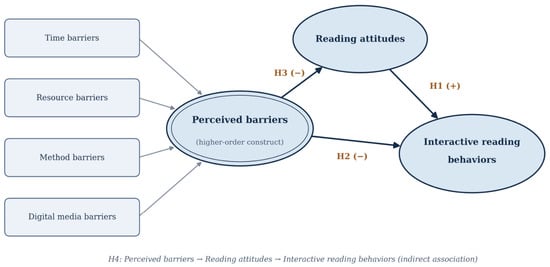
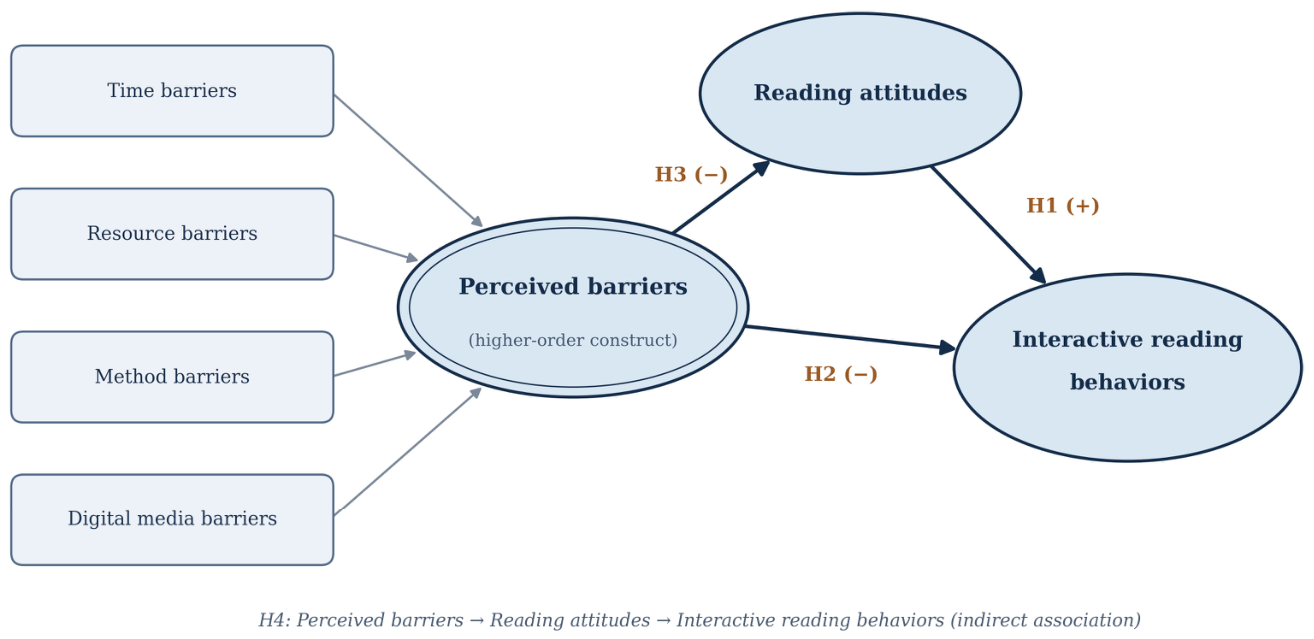
The proposed structural model links perceived barriers, parental reading attitudes, and interactive shared-reading behavior (Figure 1). A significant barrier → attitude → behavior indirect association would be consistent with the possibility that practical constraints and parental evaluations are statistically connected, while a remaining direct barrier–behavior association would indicate that attitudes do not account for the full relationship. This formulation complements prior work that places parental attitudes upstream of the HLE (Niklas et al., 2020) by examining a different, cross-sectional association in which perceived constraints covary with parental evaluations. Because all variables were measured at one time point, the proposed ordering is not evidence that barriers temporally precede attitudes or that attitudes causally transmit barrier effects. Accordingly, H4 tests a contemporaneous statistical indirect association; no temporal mediation process is estimated. The dimension-specific analyses are treated as exploratory and are not used as confirmatory tests of distinct mechanisms.
Figure 1.
Proposed research model. The higher-order perceived-barriers construct is formed by time, resource, method, and digital media barrier dimensions. Thin grey arrows denote the formative relationships between the four first-order barrier dimensions and the higher-order construct; bold arrows denote the hypothesized structural paths (H1–H3), with the expected sign in parentheses. H4 denotes the indirect association of perceived barriers with interactive reading behaviors through reading attitudes.
H4.
Perceived barriers are indirectly associated with interactive shared-reading behavior through parental reading attitudes.
2. Materials and Methods
2.1. Study Design, Participants, and Procedure
This cross-sectional survey included 309 parents or primary caregivers of preschool-aged children. Participants were recruited through nine preschools in Zhudong, Hengshan, and Qionglin townships in Hsinchu County, Taiwan, covering public, private, non-profit, and quasi-public provision. Quasi-public preschools are privately operated centers that have signed a cooperation agreement with the government, under which tuition is capped and partially subsidized in return for regulation of fees and staff pay; they occupy an intermediate position between fully public and fully private provision. The three townships collectively span differing local contexts. Official Hsinchu County profiles describe Zhudong as a commercial and transportation hub with a history of industrial development, Qionglin as a small township increasingly shaped by its satellite-residential role within the Hsinchu technology region, and Hengshan as a more rural township with agriculture, quarrying, and tourism in its local economic history (Hsinchu County Government, n.d.). The study area is therefore neither uniformly urban nor uniformly rural. Paper questionnaires (n = 227) were distributed through cooperating preschools and returned in sealed envelopes. An online questionnaire (n = 82) containing the identical item set was distributed through the same communities. The equivalence of the measurement model across administration modes was examined before the pooled model was interpreted.
Table 1 reports the characteristics of the sample. Respondents were predominantly women (n = 219, 70.9%), and most were the child’s mother (n = 213, 68.9%) or father (n = 83, 26.9%). Most were aged 31 to 40 (n = 186, 60.2%) and married and living with a spouse (n = 269, 87.1%). Educational attainment was concentrated at the bachelor’s level (n = 149, 48.2%); 30.1% had completed senior or vocational high school and 7.8% held a master’s degree or higher. Reported monthly household income covered the full range of response options, with the largest group in the NTD 40,001–60,000 band (n = 92, 29.8%); 27.2% reported less than NTD 40,000 and 20.4% reported NTD 80,001 or more. Service-sector (n = 122, 39.5%) and technology-sector (n = 101, 32.7%) employment predominated, alongside homemakers (n = 57, 18.4%). Children attended private (n = 121, 39.2%), quasi-public (n = 112, 36.2%), public (n = 66, 21.4%), and non-profit (n = 6, 1.9%) preschools. Access to public reading resources varied: 59.9% lived within 10 min of a public library, yet 54.0% reported holding no library borrowing card.
Table 1.
Participant characteristics (N = 309).
Participation was voluntary and anonymous. Before beginning the paper or online questionnaire, participants received written study information explaining the study purpose, voluntary participation, the intended research use of the data, the absence of direct identifiers, and the right to discontinue without consequence. Because the study used an anonymous, non-interventional questionnaire, no names, signatures, or other direct identifiers were collected, and participants were not asked to sign a separate consent form. Voluntary completion and return of the paper questionnaire or submission of the online questionnaire indicated informed consent. No children were directly enrolled as research participants. No committee-issued approval code or formal exemption determination was obtained. For transparency, the relevant Taiwanese regulatory framework is cited in the Institutional Review Board Statement (Human Subjects Research Act, 2019; Ministry of Health and Welfare, Taiwan, 2012).
2.2. Measures
The questionnaire used four-point response scales throughout, with no midpoint offered. Interactive shared-reading behavior was rated on a four-point frequency scale (1 = never, 2 = occasionally, 3 = often, 4 = always). Parental reading attitudes and all barrier items were rated on a four-point agreement scale (1 = strongly disagree, 2 = disagree, 3 = agree, 4 = strongly agree). Interactive shared-reading behavior was initially assessed with seven items. For this study, the construct is operationally defined as parent behavior that actively engages the child in reciprocal, meaning-focused interaction during book reading rather than as the frequency or scheduling of reading occasions. The retained five items address choosing books suited to the child’s age and interests, involving the child in page turning and picture identification, pausing to discuss story content, encouraging the child to express ideas, and maintaining undivided attention. Because the response scale records how often each practice occurs, the retained measure captures how frequently parents enact interactive reading practices during reading, which is distinct from how often or how regularly reading occasions take place. Parental reading attitudes were measured with eight items concerning perceived benefits for language development, reading interest, parent–child intimacy, and future learning, as well as the parent’s guiding role and the perceived worth of sustained investment. Perceived barriers comprised four eight-item subscales: time barriers, resource barriers, method barriers, and digital media barriers. Supplementary Table S2 reports the English content, mean, and standard deviation of every item.
All items were newly developed in Chinese by the authors rather than adapted from a single published instrument, and the instrument is the one used in a master’s thesis by one of the authors (Chen, 2026). Construct domains were mapped to prior literature before item writing: interactive-reading items reflected HLE and dialogic/interactive reading research (Sénéchal & LeFevre, 2002; Meng, 2021; Riordan et al., 2022; Grøver et al., 2023); attitude items reflected research on parental reading beliefs and evaluations (Ajzen, 1991; Niklas et al., 2020; Kucirkova & Grøver, 2024); and barrier items reflected recurring constraint categories in empirical and review literature (Celik et al., 2023; Nan & Tian, 2025), including contemporary digital HLE concerns (Yuan et al., 2024). Content validity was then examined by a five-member review panel comprising an assistant professor of early childhood education, an associate professor of educational technology, a preschool director, a practicing preschool teacher, and a parent of a preschool-aged child. Each member judged every item as retain, revise, or delete with respect to fit with the research aims, domain content, and clarity of wording, and supplied written revision suggestions. All five review forms were returned. Items were revised in accordance with the written comments; several items were reworded to be more specific, near-duplicate items were consolidated, and the response format of the two reading-occasion items was brought into line with the four-point format used elsewhere in the instrument. The revised questionnaire was then pilot-tested with 50 parents of preschool children in three townships of Changhua County that were selected to resemble the study area in settlement type but were excluded from the main survey. Pilot data were used for item analysis, exploratory factor analysis, and reliability estimation; pilot Cronbach’s alpha values were 0.852 for interactive shared-reading behavior, 0.963 for attitudes, and 0.884 to 0.964 across the four barrier dimensions. Minor wording refinements followed. Because the measures were newly developed, the present evidence supports their internal structure and content coverage in this sample but should not be interpreted as establishing cross-study scale equivalence.
To improve transparency for the author-developed measures, Supplementary Table S1 maps each construct to its operational content, conceptual and empirical basis, development evidence, measurement role, and principal validity caveat, and Supplementary Table S2 lists every item with its English content and descriptive statistics.
2.3. Data Screening
Three data-quality issues were addressed before analysis. First, one attitude item contained a single impossible value (33), which was recoded as missing. Second, 102 responses were recorded as 5 on scales whose maximum is 4. These were not distributed across the instrument: 101 of them fell on the two reading-occasion items, which were the only items whose response format changed between the expert-review draft (where they carried a five-option frequency scale) and the final questionnaire (where they were harmonized to the four-point format). Because it cannot be established from the returned forms which version a given respondent completed, and because the discarded fifth option of the draft scale denoted the lowest rather than the highest frequency, all out-of-range values were treated as unusable and recoded as missing rather than reassigned to an adjacent category. Third, item-level missingness was low. After the recodings, 288 of 14,523 substantive responses (2.0%) were missing, and these were handled with rounded item-mean replacement. Because the two affected items were subsequently excluded from the measurement model (see below), only one recoded value falls on an indicator that enters the reported analyses. A sensitivity analysis re-estimating the structural model with listwise deletion (N = 234) produced substantively identical results (barriers → attitudes β = −0.374; barriers → behaviors β = −0.413; attitudes → behaviors β = 0.378; indirect β = −0.142; R2 for behaviors = 0.431). A further sensitivity analysis using multiple stochastic imputation (20 imputed datasets generated with chained equations) yielded path coefficients within a narrow band around the reported estimates (barriers → attitudes: −0.352 to −0.346; barriers → behaviors: −0.416 to −0.404; attitudes → behaviors: 0.364 to 0.375; indirect: −0.132 to −0.126). Sample-size adequacy was evaluated with the inverse square root method (Kock & Hadaya, 2018): detecting the smallest coefficient of substantive interest in this study (≈0.16) at the 5% significance level requires a minimum of 242 cases, which the sample of 309 exceeds.
Two items concerning the scheduling of a fixed reading time were removed before the measurement model was estimated, and the outcome construct was accordingly narrowed to five items. The decision rests on two grounds. Conceptually, these two items were designed to record how frequently reading occasions occur—in the expert-review draft they carried an explicit frequency-of-occasions scale (daily, weekly, monthly)—whereas the construct of interest in this study is the interactional quality of reading once it begins. Retaining them would have blurred precisely the distinction the study sets out to draw. Empirically, they were also the weakest indicators of the seven by a wide margin: in a model retaining all seven items, their outer loadings were 0.464 and 0.435 against 0.798 to 0.903 for the retained five; they correlated strongly with each other (r = 0.89) but only 0.20 to 0.31 with the interactive-quality items, and they carried essentially all of the out-of-range values described above. Because this refinement was made after inspecting the data, it is treated as exploratory and is revisited in the limitations. A sensitivity analysis retaining all seven items yielded the same pattern of results (barriers → attitudes β = −0.349; barriers → behaviors β = −0.389; attitudes → behaviors β = 0.376; indirect β = −0.132; R2 for behaviors = 0.396), so no substantive conclusion depends on the removal.
2.4. Analytic Strategy
The hypothesized model was estimated with partial least squares structural equation modeling (PLS-SEM; Lohmöller, 1989). PLS-SEM was selected because the study emphasized prediction, included a reflective–formative higher-order construct, and examined direct and indirect associations (Hair et al., 2022). First-order reflective constructs were estimated using Mode A and the path-weighting scheme. The higher-order barriers construct was estimated with the two-stage approach: Stage 1 produced latent variable scores for the four first-order barrier dimensions, and Stage 2 used these scores as formative indicators of the higher-order construct (Sarstedt et al., 2019). H1–H4 constituted the theory-driven model. H4 was evaluated as a contemporaneous specific indirect effect; the model does not estimate temporal mediation. The subsequent dimension-specific model was explicitly exploratory; no separate confirmatory hypotheses were specified for differences among time, resource, method, and digital media barriers.
The primary PLS-SEM analyses were conducted in SmartPLS 4 (version 4.1.1.9; SmartPLS GmbH, Bönningstedt, Germany) using the path-weighting scheme. First-order reflective constructs were estimated using Mode A, and the reflective–formative higher-order barriers construct was estimated with the two-stage approach. Reliability, convergent validity, discriminant validity, formative-indicator collinearity, structural path coefficients, R2, and f2 were assessed following Hair et al. (2022). Measurement invariance across paper and online administration modes was evaluated with the MICOM procedure using 1000 permutations (Henseler et al., 2016). Full-collinearity variance inflation factors were examined as a diagnostic for severe common method bias (Kock, 2015). Direct and indirect associations were evaluated with 5000 bootstrap resamples (Preacher & Hayes, 2008). An exploratory first-order model estimated dimension-specific direct and indirect associations. Predictive performance was evaluated with PLSpredict using 10-fold cross-validation repeated 10 times and a linear-model benchmark (Shmueli et al., 2019). Python 3.12 (Python Software Foundation, Wilmington, DE, USA) was used for data screening, multiple-imputation sensitivity analyses, and an independent verification of the principal structural estimates; the SmartPLS 4 and Python analyses yielded substantively identical conclusions. The SmartPLS project file and reproducible Python scripts are available from the corresponding author upon reasonable request. Generative AI was not used for data collection, statistical analysis, or interpretation.
3. Results
3.1. Descriptive Statistics
Table 2 reports construct-level descriptive statistics on the four-point response metric. Parents held clearly favorable attitudes toward shared reading (M = 3.41, SD = 0.62); every attitude item averaged above 3.35, and the highest-rated item concerned strengthening parent–child closeness (M = 3.46). Reported interactive shared-reading behavior was more modest (M = 2.71, SD = 0.79), falling between “occasionally” and “often”. Within the behavior items, giving the child undivided attention was most frequent (M = 2.92) and choosing books matched to the child’s age and interests was least frequent (M = 2.57). The gap between strongly endorsed attitudes and more moderate reported practice is the pattern the structural model was designed to examine. The four barrier dimensions differed in reported severity. Digital media barriers were the most strongly endorsed (M = 2.85, SD = 0.54), followed by time barriers (M = 2.59, SD = 0.58), method barriers (M = 2.31, SD = 0.64), and resource barriers (M = 2.19, SD = 0.60). At the item level, the most strongly endorsed statements in the whole barrier set were that the child is easily drawn to phones, tablets, or television (M = 3.15) and that the parent worries about the effect of digital media on the child’s reading concentration (M = 3.01). Within method barriers, the most strongly endorsed items were feeling that reading aloud alone is not enough while being unsure how to do more (M = 2.45) and not knowing how to continue when the child becomes distracted (M = 2.38); the least endorsed was uncertainty about extending picture-book content to daily life (M = 2.22). Within resource barriers, no item reached 2.35, and difficulty obtaining age-appropriate books was the least endorsed item in the entire instrument (M = 2.05). Item-level statistics for all items are given in Supplementary Table S2. As the following sections show, this ordering by reported severity does not correspond to the ordering by association with behavior, and that contrast is taken up in the Discussion.
Table 2.
Descriptive statistics for study constructs (N = 309).
3.2. Reflective Measurement Model
Table 3 summarizes indicator loading ranges, internal consistency, and convergent validity. Cronbach’s alpha values ranged from 0.887 to 0.978, composite reliability ranged from 0.900 to 0.981, and all AVE values exceeded 0.50. Five indicators had loadings between 0.57 and 0.70; they were retained because the corresponding constructs maintained acceptable composite reliability and AVE and because the indicators contributed to content coverage (Hair et al., 2022). A robustness check that removed these five indicators and re-estimated the structural model produced virtually unchanged results (barriers → attitudes β = −0.353; barriers → behaviors β = −0.413; attitudes → behaviors β = 0.362; indirect β = −0.128), indicating that the substantive conclusions do not depend on the retention decision.
Table 3.
Reliability and convergent validity of first-order constructs (N = 309).
Discriminant validity was examined with the heterotrait–monotrait ratio (HTMT; Henseler et al., 2015) and the Fornell–Larcker criterion (Fornell & Larcker, 1981). All HTMT values were below 0.70 (maximum = 0.691, between resource and method barriers), and the square root of each construct’s AVE exceeded its correlations with the other constructs (Table 4).
Table 4.
Discriminant validity: Fornell–Larcker criterion and HTMT.
3.3. Higher-Order Construct and Common-Method Diagnostics
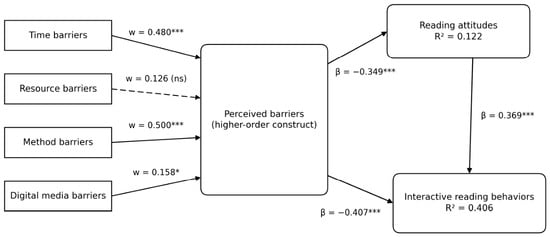
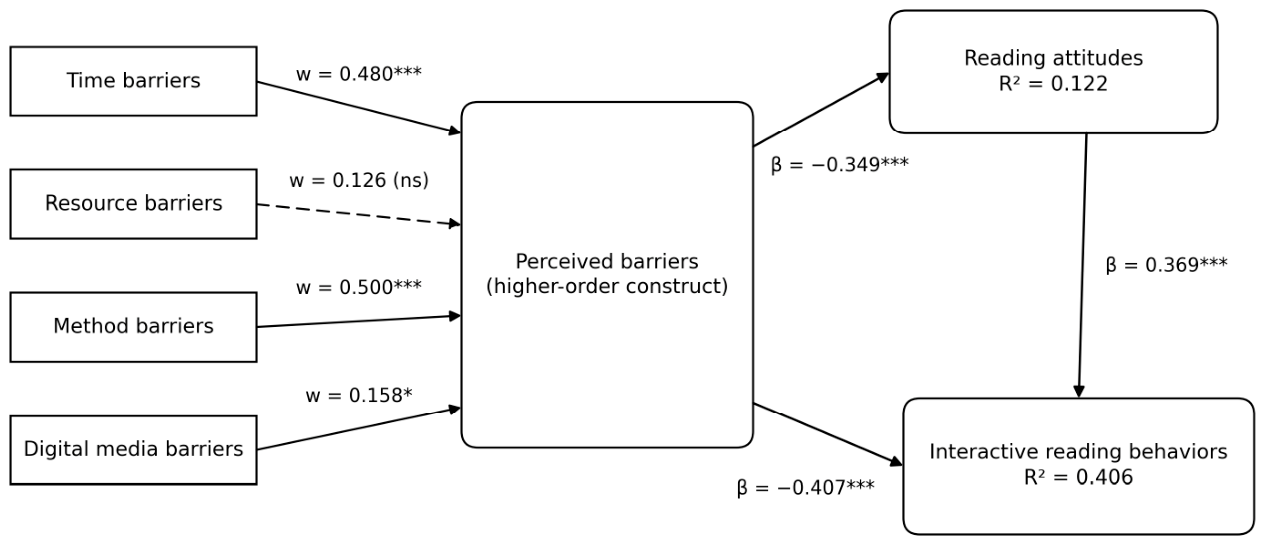
For the higher-order perceived-barriers construct, variance inflation factors among the four dimension-level indicators ranged from 1.13 to 2.08, indicating no problematic collinearity. The standardized outer weights, with 5000-resample percentile bootstrap confidence intervals, were 0.480 for time barriers (95% CI [0.236, 0.687]), 0.126 for resource barriers (95% CI [−0.182, 0.432]), 0.500 for method barriers (95% CI [0.212, 0.716]), and 0.158 for digital media barriers (95% CI [0.011, 0.354]). Time, method, and digital media barriers contributed significantly to the higher-order composite, whereas the resource-barrier weight did not differ significantly from zero. Substantive validity was evaluated through a priori domain specification from the family-literacy literature, expert review of item coverage during measure development, acceptable measurement properties of the first-order dimensions, low formative collinearity, and bootstrap assessment of the dimension weights. The resource dimension was retained because, in a formative specification, deleting a theoretically defined domain would narrow the meaning of the overall construct. A redundancy analysis could not be conducted because the questionnaire did not include an independent global measure of overall perceived barriers. The evidence therefore supports the content and structural plausibility of the higher-order composite in this sample but does not establish convergent validity through redundancy analysis.
Full-collinearity VIFs ranged from 1.14 to 2.09, below the 3.3 diagnostic threshold (Kock, 2015). These values do not indicate severe common method bias, although they cannot eliminate all bias associated with a single-source, self-report design.
3.4. Measurement Invariance Across Administration Modes
The MICOM procedure was conducted because data were collected in paper (n = 227) and online (n = 82) formats. Configural invariance was established by using identical indicators, data treatment, and model settings. Compositional invariance was supported for all six constructs: correlations between composites formed with group-specific weights ranged from 0.970 to above 0.999 and exceeded the corresponding 5% permutation quantiles. Partial measurement invariance was therefore established. Step 3 indicated differences in composite means for attitudes (p = 0.045) and behaviors (p = 0.004), with online respondents reporting more favorable attitudes and more frequent interactive reading; the difference for resource barriers was marginal (p = 0.054). Accordingly, full measurement invariance was not claimed, and administration-mode mean differences were not interpreted substantively.
3.5. Structural Model and Hypothesis Tests
Table 5 and Figure 2 present the structural model estimates. Perceived barriers were negatively associated with parental reading attitudes (β = −0.349, t = 6.18, p < 0.001), supporting H3, and with interactive shared-reading behaviors (β = −0.407, t = 8.65, p < 0.001), supporting H2. Reading attitudes were positively associated with behavior (β = 0.369, t = 7.78, p < 0.001), supporting H1. The effect of barriers on attitudes was small to moderate (f2 = 0.139), whereas the effects of barriers on behaviors (f2 = 0.245) and attitudes on behaviors (f2 = 0.201) were medium in magnitude (Cohen, 1988). The model explained 12.2% of the variance in attitudes and 40.6% of the variance in interactive reading behavior.
Table 5.
Structural model estimates and indirect-association test (bootstrap = 5000).
Figure 2.
Structural model results. Standardized structural coefficients (β), formative outer weights (w), and explained variance (R2) are shown. The dashed arrow denotes the nonsignificant resource-barrier weight (ns). * p < 0.05; *** p < 0.001; bootstrap = 5000 resamples.
3.6. Indirect Association Through Parental Attitudes
The indirect association between perceived barriers and behavior through parental attitudes was significant (β = −0.129, 95% CI [−0.193, −0.081]), supporting H4. The direct association remained significant after attitudes were included, indicating that the indirect pathway did not account for the full barrier–behavior association. The total statistical association equals the direct plus the specific indirect effect (−0.407 + (−0.129) = −0.536); therefore, the indirect component represents 24.1% of the magnitude of the total association (0.129/0.536). Because all variables were measured at one time point, this result is interpreted only as a contemporaneous statistical indirect association. No temporal mediation process or causal mechanism was tested.
3.7. Exploratory Dimension-Specific Associations
An exploratory first-order model examined the four barrier dimensions simultaneously (Table 6). Time barriers showed a significant direct association with behavior (β = −0.154, 95% CI [−0.275, −0.029]) and a significant indirect association through attitudes (β = −0.077, 95% CI [−0.131, −0.026]). Method barriers showed the same pattern and the largest direct association of the four dimensions (direct β = −0.208, 95% CI [−0.331, −0.065]; indirect β = −0.063, 95% CI [−0.131, −0.009]). Digital media barriers had a significant direct association with behavior (β = −0.097, 95% CI [−0.200, −0.004]) but no significant indirect association. Resource barriers had neither a significant direct nor indirect association after the other dimensions were controlled.
Table 6.
Exploratory direct and indirect associations of barrier dimensions with reading behavior.
3.8. Out-of-Sample Predictive Performance
All five behavior indicators had positive Q2predict values (0.146–0.216), and PLS-SEM produced lower RMSE values than the linear-model benchmark for every indicator (Table 7). Following the decision rules proposed by Shmueli et al. (2019), this pattern indicates high predictive performance for the focal outcome under the reported internal cross-validation procedure. This finding reflects internal cross-validated predictive performance; predictive performance in an independent sample has not been established and requires future external validation.
Table 7.
PLSpredict results for reading behavior indicators.
4. Discussion
This study examined how a multidimensional set of perceived barriers was associated with parents’ interactive shared-reading behavior and whether barriers were indirectly associated with behavior through parental attitudes. No temporal mediation process was tested; all direct and indirect paths are interpreted as contemporaneous statistical associations. Three findings are especially relevant when considered alongside recent family-literacy research.
First, perceived barriers were associated with interactive shared-reading behavior both directly and indirectly through parental attitudes. This pattern complements, rather than replicates, prior longitudinal evidence. Niklas et al. (2020) found that more positive parental attitudes predicted a richer HLE, which in turn predicted later child language competencies. The present study addresses a different question: parents reporting more constraints also reported less favorable attitudes and less interactive reading at the same measurement occasion. Taken together, the studies suggest that parental evaluations are embedded within a broader family-literacy system in which beliefs and practices are related to the conditions under which reading occurs. The present data cannot determine directionality—parents who encounter persistent constraints may evaluate reading less favorably, parents with less favorable attitudes may perceive more barriers, or reciprocal processes may operate. The significant direct association also indicates that favorable attitudes alone do not statistically absorb the practical constraints parents report.
Second, the exploratory dimension-level model showed different patterns across barrier types, and the ordering by strength of association did not match the ordering by how strongly parents endorsed each barrier. Digital media barriers were the barrier parents reported most strongly (M = 2.85), yet they carried only a modest direct association with behavior and no indirect association through attitudes. Method barriers were among the least strongly endorsed (M = 2.31) but showed the largest direct association of the four dimensions (β = −0.208) as well as a significant indirect association. In other words, the constraint parents notice most is not the constraint most closely tied to how they read with their children. Method barriers therefore deserve closer attention than their average severity alone would suggest. The specific items driving this dimension are informative: the two most strongly endorsed were feeling that simply reading aloud is not enough while being unsure how to do more (M = 2.45) and not knowing how to keep going when the child becomes distracted (M = 2.38). Both describe parents who are already willing to read and are looking for a way to do it better, rather than parents who reject shared reading. This is consistent with intervention research showing that parents can be taught to prompt, elaborate, and sustain book-related conversation (Riordan et al., 2022; Lorio et al., 2022), and it suggests that some of what parents report as a shortage of time may in part be uncertainty about what a short reading session should contain. The time finding is itself consistent with Celik et al. (2023), who identified time constraints as a prominent parent-reported barrier. The digital-media result is compatible with research treating digital and print experiences as distinct components of the contemporary HLE (Yuan et al., 2024) and with preschool evidence that dialogic print-book interaction is positively associated with vocabulary while screen exposure may compete with supportive literacy activity (Sundqvist et al., 2024). One possible explanation for the divergence between severity and association is that time pressure and unresolved method uncertainty consume more ongoing attentional resources than situational device competition, but cognitive bandwidth was not measured here; the scarcity perspective (Mullainathan & Shafir, 2013) is therefore offered only as a post hoc, theory-informed interpretation for future prospective testing.
Third, resource barriers did not show a unique direct or indirect association after the other barrier dimensions were controlled. This null unique effect should not be read as evidence that books or access are unimportant. In other settings, book ownership and access are associated with shared-reading frequency (Celik et al., 2023), and a recent meta-synthesis identified resource and access constraints as recurring challenges across families (Nan & Tian, 2025). Shared book reading has also been reported to mediate socioeconomic differences in emergent literacy among heritage-language learners (Shen & Del Tufo, 2022). The present result instead indicates that, within this Taiwanese sample and multivariable model, resource barriers did not explain additional variance beyond time, method, and digital media barriers. This difference from prior findings may reflect local provision, restricted variability, overlap among constraints, or sample composition. Replication across communities with wider socioeconomic and resource variation is needed before drawing substantive conclusions about the relative importance of material access.
The measurement refinement described in Section 2.3 further highlights the distinction between reading amount and interactional quality. The two removed items were written to capture how often reading occasions are arranged, and in the draft instrument they carried an explicit frequency-of-occasions response scale; they correlated strongly with each other but only weakly with the five interactive-quality items. This separation is consistent with contemporary work arguing that nuanced parent–child interaction adds information beyond the quantity of literacy exposure (Meng, 2021; Grøver et al., 2023) and with observational evidence that families can differ in strategy use even when reading frequency is relatively high (DesJardin et al., 2023). Nevertheless, because the two items were removed after the data had been inspected, this finding is exploratory, and a sensitivity analysis retaining all seven items is reported in Section 2.3. Future studies should prespecify separate constructs for reading frequency and interactive quality and test their distinct antecedents and child outcomes.
4.1. Theoretical Contributions
The study offers three cautious theoretical contributions. First, it uses cost-sensitive expectancy–value reasoning as an organizing lens for a specific motivational tension in family literacy: parents may place high value on shared reading while simultaneously experiencing practical costs that constrain engagement. This framework is useful because it brings favorable evaluations and cost-like constraints into the same conceptual account of engagement. The study does not directly test expectancy–value theory: the barrier scales are not a validated expectancy–value cost measure, the attitude scale is not a direct subjective-task-value instrument, and expectancy beliefs were not assessed. Second, modeling barriers as a formative higher-order composite while also examining the four dimensions separately distinguishes the overall burden of constraint from the exploratory question of which barrier types show unique associations. This representation is useful precisely because time, resources, methods, and digital interference are not interchangeable manifestations of one trait. Third, the study clarifies its behavioral outcome by focusing on interactive shared-reading quality. In line with recent work on parent–child interaction, this distinction treats how families read together as conceptually different from how often or how regularly they read. These contributions are theory-refining and theory-generating rather than confirmatory tests of a complete motivational theory.
4.2. Practical Implications
Pending longitudinal or experimental confirmation, the findings suggest two complementary directions for preschools, libraries, and family-literacy programs. The first is time scaffolding. Brief routines anchored to something families already do each day are likely to be easier to sustain than general encouragement to read more, particularly because time constraints recur across studies of parental barriers (Celik et al., 2023; Nan & Tian, 2025). The second is technique instruction, which the present results suggest may be the more promising of the two. Short demonstrations of how to ask a question about a picture, build on what a child says, link a story to something that happened that day, and regain a child’s attention when it wanders address method barriers directly and are consistent with intervention evidence that parents can learn to enrich book-related conversation (Riordan et al., 2022; Lorio et al., 2022). Because parents in this sample reported method difficulties at a relatively low level while those difficulties showed the strongest association with interactive reading, such guidance may be most useful when it is offered as a concrete demonstration of what a good ten minutes looks like rather than as remediation for parents assumed to be uninformed. Guidance on digital media may likewise be most useful when framed as concrete routine management, such as device-free reading windows, rather than as a claim that digital experiences are inherently harmful. Because the present study is observational and cross-sectional, these recommendations should be treated as intervention priorities to test rather than as demonstrated causal prescriptions.
4.3. Limitations and Future Research
Several limitations qualify the conclusions. First, the cross-sectional design does not establish temporal or causal ordering; the reported indirect effect is a contemporaneous statistical association and should not be interpreted as temporal or causal mediation. Longitudinal cross-lagged or intervention designs are needed to test whether changes in barriers precede changes in attitudes and interactive behavior. Second, all focal constructs were reported by the same respondent. Full-collinearity diagnostics did not indicate severe common method bias, but future studies should combine surveys with observation, reading logs, or child-language measures. Third, compositional invariance was supported across paper and online administration modes, but composite means differed between modes; self-selection may therefore remain. Fourth, the sample was drawn from three townships in one Taiwanese county and may not generalize to families with different socioeconomic, cultural, or resource conditions. Fifth, the behavior construct was narrowed after the data were inspected, and the dimension-specific structural model was exploratory; both features require preregistered replication, although a sensitivity analysis retaining all seven behavior items produced the same pattern of results. Sixth, a subset of responses to the two removed reading-occasion items could not be assigned to a response category with confidence because the response format of those items changed during instrument development; they were treated as missing, and the affected items do not enter the reported model. Seventh, although listwise-deletion and multiple-imputation sensitivity analyses produced substantively similar estimates, the primary missing-data treatment remains an analytic limitation. Eighth, the newly developed measures showed strong internal reliability and were supported by expert review and pilot testing, but the review panel’s judgments were recorded as categorical ratings with written comments rather than aggregated into a quantitative content-validity index, and independent validation, test–retest evidence, and cross-cultural measurement testing are still needed. Ninth, convergent validity of the formative higher-order barriers construct could not be evaluated through redundancy analysis because no independent global criterion was administered; the nonsignificant resource-barrier weight also warrants replication even though the dimension was retained for content validity. Tenth, the motivational framing is deliberately limited: perceived barriers were not direct expectancy–value cost measures, parental attitudes were not a validated subjective-task-value measure, and expectancy beliefs were not assessed. Finally, cognitive bandwidth was not measured, so the scarcity interpretation of the exploratory dimension pattern remains speculative. Future studies should directly assess parental efficacy/expectancy, child temperament and media habits, socioeconomic conditions, and both reading frequency and interactional quality.
5. Conclusions
Among 309 parents and primary caregivers of preschool children in Taiwan, higher perceived barriers were associated with less favorable parental reading attitudes and lower interactive shared-reading behavior. A significant contemporaneous statistical indirect association through attitudes was observed, but the cross-sectional design does not establish temporal ordering or causal mediation. Exploratory analyses indicated that time and method barriers showed both direct and indirect associations, digital media barriers showed a direct association, and resource barriers showed no unique association after the other dimensions were controlled. Notably, the barriers parents endorsed most strongly were not those most closely associated with interactive reading: method barriers ranked third of four in reported severity yet showed the strongest association with behavior. The findings suggest that family-literacy programs may benefit from testing time-scaffolding and concrete interactive-reading guidance, while future longitudinal and experimental studies should separately model reading frequency, routine, and interactional quality and directly test the motivational mechanisms proposed here.
Supplementary Materials
The following supporting information can be downloaded at https://www.mdpi.com/article/10.3390/educsci16101727/s1. Table S1. Construct-development and measurement-transparency map; Table S2. Item content and descriptive statistics.
Author Contributions
Conceptualization, C.C., M.C., C.-H.C. and Y.-L.C.; Methodology, C.C., M.C. and C.-H.C.; Software, C.-H.C.; Validation, C.C., M.C. and C.-H.C.; Formal analysis, C.C., M.C. and C.-H.C.; Investigation, C.-H.C. and Y.-L.C.; Resources, C.C., M.C. and C.-H.C.; Data curation, C.C. and Y.-L.C.; Writing—original draft, Y.-L.C.; Writing—review & editing, C.C., M.C. and C.-H.C.; Visualization, C.C., M.C. and C.-H.C.; Supervision, M.C.; Project administration, M.C. All authors have read and agreed to the published version of the manuscript.
Funding
This research received no external funding.
Institutional Review Board Statement
This study involved an anonymous, non-interventional questionnaire completed by adult parents or primary caregivers and collected no direct identifiers. No committee-issued approval code or formal exemption determination was obtained. The relevant Taiwanese regulatory framework includes the Human Subjects Research Act and the Ministry of Health and Welfare’s published scope of human subjects research projects exempt from ethics committee review (Human Subjects Research Act, 2019; Ministry of Health and Welfare, Taiwan, 2012). This statement is provided for transparency and should not be read as implying that a committee-issued exemption determination existed.
Informed Consent Statement
All participants were adult parents or primary caregivers and received written study information before beginning the questionnaire. Because the study used an anonymous, non-interventional questionnaire and collected no names, signatures, or other direct identifiers, signed consent was not obtained. Informed consent was indicated by voluntary completion and return of the paper questionnaire or submission of the online questionnaire. No children were directly enrolled as research participants, and no identifiable participant information is reported.
Data Availability Statement
Supplementary Tables S1 and S2 are available online with this article (see Supplementary Materials). The original Chinese questionnaire, de-identified data, SmartPLS project file, and analysis scripts supporting the findings are available from the corresponding author upon reasonable request. Public deposition of the participant-level dataset is restricted because the consent materials did not specify unrestricted public release.
Acknowledgments
The authors thank the participating parents and primary caregivers, the cooperating preschool staff, and the experts who assisted with questionnaire review. During manuscript preparation, the authors used ChatGPT (GPT-5.6 Sol; OpenAI, San Francisco, CA, USA) for language editing and organizational suggestions. The authors have reviewed and edited the output and take full responsibility for the content of this publication.
Conflicts of Interest
The authors declare no conflicts of interest.
References
- Ajzen, I. (1991). The theory of planned behavior. Organizational Behavior and Human Decision Processes, 50(2), 179–211. [Google Scholar] [CrossRef] [Scilit]
- Barron, K. E., & Hulleman, C. S. (2015). Expectancy-value-cost model of motivation. In J. D. Wright (Ed.), International encyclopedia of the social & behavioral sciences (2nd ed., Vol. 8, pp. 503–509). Elsevier. [Google Scholar]
- Bronfenbrenner, U. (1979). The ecology of human development: Experiments by nature and design. Harvard University Press. [Google Scholar]
- Bus, A. G., van Ijzendoorn, M. H., & Pellegrini, A. D. (1995). Joint book reading makes for success in learning to read: A meta-analysis on intergenerational transmission of literacy. Review of Educational Research, 65(1), 1–21. [Google Scholar] [CrossRef]
- Celik, P., Ozdereli, Z., Bayram Sen, M., Karakutuk, A., Baykal Altunkaya, G., & Celenk, N. (2023). Shared reading: Parental attitudes, practices and barriers in Turkey. Journal of Paediatrics and Child Health, 59(2), 264–270. [Google Scholar] [CrossRef] [Scilit] [PubMed]
- Chen, Y.-L. (2026). A survey study of parent–child shared reading behaviors and challenges among parents of preschool children in Zhudong, Hengshan, and Qionglin, Hsinchu County [Master’s thesis, Asia University]. (In Chinese) [Google Scholar]
- Cohen, J. (1988). Statistical power analysis for the behavioral sciences (2nd ed.). Lawrence Erlbaum. [Google Scholar]
- DeBaryshe, B. D. (1995). Maternal belief systems: Linchpin in the home reading process. Journal of Applied Developmental Psychology, 16(1), 1–20. [Google Scholar] [CrossRef] [Scilit]
- DesJardin, J. L., Stika, C. J., Eisenberg, L. S., Johnson, K. C., Ganguly, D. H., & Henning, S. C. (2023). Home literacy experiences and shared reading practices: Preschoolers with hearing loss. The Journal of Deaf Studies and Deaf Education, 28(2), 189–200. [Google Scholar] [CrossRef] [Scilit] [PubMed]
- Dowdall, N., Melendez-Torres, G. J., Murray, L., Gardner, F., Hartford, L., & Cooper, P. J. (2020). Shared picture book reading interventions for child language development: A systematic review and meta-analysis. Child Development, 91(2), e383–e399. [Google Scholar] [CrossRef] [Scilit] [PubMed]
- Eccles, J. S., & Wigfield, A. (2020). From expectancy-value theory to situated expectancy-value theory: A developmental, social cognitive, and sociocultural perspective on motivation. Contemporary Educational Psychology, 61, 101859. [Google Scholar] [CrossRef] [Scilit]
- Egan, S. M., Moloney, M., Pope, J., Breatnach, D., & Hoyne, C. (2025). From stories at bedtime to a love of reading: Parental practices and beliefs about reading with infants. Journal of Early Childhood Literacy, 25(1), 158–184. [Google Scholar] [CrossRef] [Scilit]
- Flake, J. K., Barron, K. E., Hulleman, C., McCoach, B. D., & Welsh, M. E. (2015). Measuring cost: The forgotten component of expectancy-value theory. Contemporary Educational Psychology, 41, 232–244. [Google Scholar] [CrossRef] [Scilit]
- Fornell, C., & Larcker, D. F. (1981). Evaluating structural equation models with unobservable variables and measurement error. Journal of Marketing Research, 18(1), 39–50. [Google Scholar] [CrossRef] [Scilit]
- Grøver, V., Snow, C. E., Evans, L., & Strømme, H. (2023). Overlooked advantages of interactive book reading in early childhood? A systematic review and research agenda. Acta Psychologica, 239, 103997. [Google Scholar] [CrossRef] [Scilit] [PubMed]
- Hair, J. F., Hult, G. T. M., Ringle, C. M., & Sarstedt, M. (2022). A primer on partial least squares structural equation modeling (PLS-SEM) (3rd ed.). Sage. [Google Scholar]
- Henseler, J., Ringle, C. M., & Sarstedt, M. (2015). A new criterion for assessing discriminant validity in variance-based structural equation modeling. Journal of the Academy of Marketing Science, 43(1), 115–135. [Google Scholar] [CrossRef] [Scilit]
- Henseler, J., Ringle, C. M., & Sarstedt, M. (2016). Testing measurement invariance of composites using partial least squares. International Marketing Review, 33(3), 405–431. [Google Scholar] [CrossRef] [Scilit]
- Hsinchu County Government. (n.d.). 13 townships and cities introduction. Available online: https://www.hchg.gov.tw/cp.aspx?n=101 (accessed on 1 September 2026).
- Human Subjects Research Act. (2019). Ministry of Health and Welfare, Taiwan. Available online: https://law.moj.gov.tw/ENG/LawClass/LawAll.aspx?pcode=L0020176 (accessed on 22 July 2026).
- Kock, N. (2015). Common method bias in PLS-SEM: A full collinearity assessment approach. International Journal of e-Collaboration, 11(4), 1–10. [Google Scholar] [CrossRef] [Scilit]
- Kock, N., & Hadaya, P. (2018). Minimum sample size estimation in PLS-SEM: The inverse square root and gamma-exponential methods. Information Systems Journal, 28(1), 227–261. [Google Scholar] [CrossRef] [Scilit]
- Kucirkova, N., & Grøver, V. (2024). The importance of embodiment and agency in parents’ positive attitudes towards shared reading with their children. Early Childhood Education Journal, 52(1), 221–230. [Google Scholar] [CrossRef] [Scilit] [PubMed]
- Lohmöller, J.-B. (1989). Latent variable path modeling with partial least squares. Physica-Verlag. [Google Scholar]
- Lorio, C. M., Delehanty, A. D., & Romano, M. K. (2022). A systematic review of parent–child shared book reading interventions for infants and toddlers. Topics in Early Childhood Special Education, 42(3), 222–233. [Google Scholar] [CrossRef] [Scilit]
- Meng, C. (2021). Parent–child interactions longitudinally mediate the association between shared literacy activities and emergent literacy and oral language skills. Reading and Writing, 34(6), 1593–1612. [Google Scholar] [CrossRef] [Scilit]
- Ministry of Health and Welfare, Taiwan. (2012). Scope of human subjects research projects exempt from ethics review committee review (Wei-Shu-Yi-Zi No. 1010265075, 5 July 2012). Available online: https://www.mohw.gov.tw/dL-16078-31bb0e95-2407-4323-9bbf-a62b7f8dcee3.html (accessed on 22 July 2026).
- Mol, S. E., & Bus, A. G. (2011). To read or not to read: A meta-analysis of print exposure from infancy to early adulthood. Psychological Bulletin, 137(2), 267–296. [Google Scholar] [CrossRef] [Scilit] [PubMed]
- Mullainathan, S., & Shafir, E. (2013). Scarcity: Why having too little means so much. Times Books. [Google Scholar]
- Nan, J., & Tian, Y. (2025). Parent–child shared book reading challenges and facilitators: A systematic review and meta synthesis. Frontiers in Psychology, 16, 1635956. [Google Scholar] [CrossRef] [Scilit] [PubMed]
- Niklas, F., Wirth, A., Guffler, S., Drescher, N., & Ehmig, S. C. (2020). The home literacy environment as a mediator between parental attitudes toward shared reading and children’s linguistic competencies. Frontiers in Psychology, 11, 1628. [Google Scholar] [CrossRef] [Scilit] [PubMed]
- Preacher, K. J., & Hayes, A. F. (2008). Asymptotic and resampling strategies for assessing and comparing indirect effects in multiple mediator models. Behavior Research Methods, 40(3), 879–891. [Google Scholar] [CrossRef] [Scilit] [PubMed]
- Riordan, J., Reese, E., Das, S., Carroll, J. L. D., & Schaughency, E. (2022). Tender Shoots: A randomized controlled trial of two shared-reading approaches for enhancing parent–child interactions and children’s oral language and literacy skills. Scientific Studies of Reading, 26(3), 183–203. [Google Scholar] [CrossRef] [Scilit]
- Sarstedt, M., Hair, J. F., Cheah, J.-H., Becker, J.-M., & Ringle, C. M. (2019). How to specify, estimate, and validate higher-order constructs in PLS-SEM. Australasian Marketing Journal, 27(3), 197–211. [Google Scholar] [CrossRef] [Scilit]
- Sénéchal, M., & LeFevre, J.-A. (2002). Parental involvement in the development of children’s reading skill: A five-year longitudinal study. Child Development, 73(2), 445–460. [Google Scholar] [CrossRef] [Scilit] [PubMed]
- Shen, Y., & Del Tufo, S. N. (2022). Parent–child shared book reading mediates the impact of socioeconomic status on heritage language learners’ emergent literacy. Early Childhood Research Quarterly, 59, 254–264. [Google Scholar] [CrossRef] [Scilit] [PubMed]
- Shmueli, G., Sarstedt, M., Hair, J. F., Cheah, J.-H., Ting, H., Vaithilingam, S., & Ringle, C. M. (2019). Predictive model assessment in PLS-SEM: Guidelines for using PLSpredict. European Journal of Marketing, 53(11), 2322–2347. [Google Scholar] [CrossRef] [Scilit]
- Sundqvist, A., Majerle, N., Heimann, M., & Koch, F.-S. (2024). Home literacy environment, digital media and vocabulary development in preschool children. Journal of Early Childhood Research, 22(4), 570–583. [Google Scholar] [CrossRef] [Scilit]
- Weigel, D. J., Martin, S. S., & Bennett, K. K. (2006). Contributions of the home literacy environment to preschool-aged children’s emerging literacy and language skills. Early Child Development and Care, 176(3–4), 357–378. [Google Scholar] [CrossRef] [Scilit]
- Wigfield, A., & Eccles, J. S. (2000). Expectancy–value theory of achievement motivation. Contemporary Educational Psychology, 25(1), 68–81. [Google Scholar] [CrossRef] [Scilit] [PubMed]
- Yuan, H., Kleemans, T., & Segers, E. (2024). The role of the traditional and digital home literacy environment in Chinese kindergartners’ language and early literacy. Early Childhood Research Quarterly, 67, 67–77. [Google Scholar] [CrossRef] [Scilit]
- Zhou, J., Lei, J., Chao, S., & Zhang, C. (2026). Revealing the unique themes in parent–child shared book reading behaviors: A systematic review of Chinese and English research 2005–2024. Behavioral Sciences, 16(4), 581. [Google Scholar] [CrossRef] [Scilit] [PubMed]

Disclaimer/Publisher’s Note: The statements, opinions and data contained in all publications are solely those of the individual author(s) and contributor(s) and not of MDPI and/or the editor(s). MDPI and/or the editor(s) disclaim responsibility for any injury to people or property resulting from any ideas, methods, instructions or products referred to in the content. |
© 2026 by the authors. Licensee MDPI, Basel, Switzerland. This article is an open access article distributed under the terms and conditions of the Creative Commons Attribution (CC BY) license.