


Abstract
This study presents an exploratory, generative AI (GenAI)-assisted full-text analysis of barriers to using GenAI in education within an arXiv corpus. A total of 19,756 records were retrieved using a keyword search and then screened for relevance using three large language models (LLMs), GPT-4o mini, Gemini 2.0 flash-lite, and Llama3-70B (Groq), through a voting mechanism. This yielded a corpus of 1998 education-relevant full-text articles. Using GPT-4o, learning and teaching scenarios (LTSs) were extracted using a structured 6As framework (Actor, Activity, AI Role, AI Interface, Assessment, Achievement) developed for this study. Barrier themes were derived separately by clustering a total of 4729 barrier descriptions, embedded using OpenAI’s embedding model. The descriptive results indicate: (i) STEM (science, technology, engineering, and mathematics) vs. non-STEM distributions of GenAI use cases are broadly comparable; (ii) approximately 75% of reported GenAI intervention outcomes were classified as non-negative across the different disciplines; and (iii) reported barriers show different descriptive patterns between STEM and non-STEM disciplines. STEM use cases more frequently report performance constraints, while non-STEM ones more frequently report privacy and workflow integration concerns. The observed disciplinary differences in extracted barriers suggest that approaches to supporting GenAI use may need to vary by disciplinary context. However, the findings are limited by arXiv coverage and limited human validation; future research should broaden source coverage and strengthen robust validation.
1. Introduction
Since the release of ChatGPT in November 2022, generative AI (GenAI) technologies have developed rapidly, represented by the latest Gemini 3 Pro model by Google and the ChatGPT 5.2 model by OpenAI, by the time of preparing this manuscript in December 2025. These rapid technological developments have been accompanied by a surge in popular applications across multiple domains, including education, as well as a dramatic shift in public attitudes towards their use in educational settings.
Initially, when ChatGPT first emerged, reports described heated debates and even bans by certain educational institutions, which labelled it a “threat” and a “plague on education” (Sullivan et al., 2023). However, while there is no consensus that GenAI is unequivocally beneficial, it is increasingly regarded by many stakeholders as a tool with significant potential. As a result, discussion has begun to move from the question of adoption per se towards questions of appropriate, effective, and responsible use, with parts of the education sector actively exploring its possibilities. GenAI powers advanced chatbots, virtual assistants, and content generation tools that are capable of producing human-like text for articles, reports, and creative writing (Belkina et al., 2025). It is believed that the size of the AI in education market will reach $32.27 billion by 2030 (Grand View Research, 2024).
Over the past few years, researchers have reported various success stories and use cases, with a significant number of them focused on tool evaluation (Fitzgerald et al., 2025) and pedagogy (Wang et al., 2025). Review articles are also emerging (Wang et al., 2025; Belkina et al., 2025), indicating structured syntheses of knowledge in the field, although the specific field of GenAI in education has only seen a few years of practice. However, these syntheses tend to focus on specific educational disciplines and, as a result, typically draw on a relatively limited corpus, often comprising fewer than 100 papers (Law, 2024). Recently, Zohourian et al. (2026) found significant associations between disciplinary grouping and certain GenAI-related concerns among 237 U.S. university students, with disciplines being STEM (science, technology, engineering, and mathematics), health and medicine, or non-STEM. However, from a sector perspective, it remains unclear whether there are broader patterns of differences in GenAI adoption barriers between STEM and non-STEM disciplines. Understanding the barriers, and particularly the barrier differences between different subjects, is the first step towards overcoming them.
This paper presents an exploratory large-scale analysis of barriers to the use of GenAI in education within an arXiv corpus. Specifically, it seeks to understand the distribution of GenAI use cases in different educational contexts, and their reported pedagogical outcomes. It also aims to identify the main barrier themes and compare reported barriers between STEM and non-STEM disciplines. It further explores how individual-level adoption models, such as the Technology Acceptance Model (TAM), help to interpret these barriers and argues for a more integrative framework that captures task-specific, institutional, and governance dimensions of GenAI use.
1.1. Understanding Barriers to GenAI in Education
GenAI has demonstrated profound impacts on education in different subject areas. Salman Khan, founder of the renowned Khan Academy, has described the AI revolution as one that will “forever change the way we learn and teach” (Khan, 2024). However, some scholars view GenAI as a threat to ethical behaviour and academic integrity (Sullivan et al., 2023). Others argue that such risks arise primarily when assessments remain in a pre-GenAI form, highlighting the growing need for authentic assessment in the age of GenAI (Felix & Webb, 2024). Beyond ethical concerns, the academic community also identifies barriers related to students’ over-reliance on GenAI, which may undermine the development of key skills such as academic writing and critical thinking (Chiu, 2024). At the same time, educators’ resistance to GenAI may limit their willingness and capacity to engage with technological developments and with the next generation of learners (Sullivan et al., 2023; Felix & Webb, 2024; Chiu, 2024). A common view in the literature is that GenAI represents another wave of technological change, comparable to earlier developments such as personal computers and the internet, which are likely to be gradually understood and normalised over time. In this reading, what remains critical is not the technology itself, but effective pedagogy and sustained teacher–learner interaction, namely ‘good teaching’ (Crawford et al., 2023). Nevertheless, there appears to be a gap in the literature in systematically investigating the barriers to using GenAI in an educational context.
Understanding influencing factors and barriers to using GenAI in education, how they evolve over time and how they differ across subjects has both practical and theoretical implications. Recent systematic reviews, meta-analyses and surveys have examined these issues. Tan (2026) reviewed 43 empirical studies, identifying a predominant focus on students and the TAM as the most frequently used theoretical model. The review also identified factors extending beyond individual perceptions, including technological, social, task-related and inhibiting factors. Yan and Jafri (2026), in a meta-analysis of 53 empirical studies, reported strong positive correlations between the intention to use GenAI and perceived usefulness and attitude. Drawing on a structured survey of 272 academic and professional service staff at a single university, Yang et al. (2026) identified differences in reported barriers across professional roles and STEM/non-STEM disciplines. On the practical level, these results will provide foundations for tool design in the context of education technologies. For example, the concerns over data privacy and copyrights, which are considered significant barriers (Daher & Hussein, 2024), will greatly impact how data are anonymised or pseudonymised, transferred and stored for LLMs. This is not only an ethical consideration, but a practical one to ensure compliance with legislation such as GDPR (General Datas Protection Regulation, a major EU law concerning data privacy). Practical considerations also include policy establishment. Established guidance such as that from UNESCO (United Nations Educational, Scientific and Cultural Organization) (UNESCO, 2025) and policies from governments at different levels (Chan, 2023; National Centre for Social Research, 2018) almost always encourage the use of GenAI in education. However, practically, the high-level guidance and policies must be adopted to specific local circumstances, and there is not a one-size-fits-all approach to advancing GenAI in education (Lee et al., 2025). The gaps must be filled through thorough investigation and detailed analysis of the barriers that stop the high-level guidance and policies from being implemented at the ground level in daily practice.
To understand the barriers shaping the adoption of GenAI in education, the literature commonly turns to established technology adoption frameworks that foreground the conditions under which educators engage with new tools. Among these, the TAM remains an influential reference point, including in recent analyses of GenAI in educational settings (Ghimire & Edwards, 2024). Individual-level models such as TAM and its variations, such as TAM2/3 and UTAUT (Unified Theory of Acceptance and Use of Technology), centre on users’ beliefs, attitudes, and intentions, emphasising constructs including perceived usefulness (PU), perceived ease of use (PEOU), and facilitating conditions (Williams et al., 2015; Venkatesh et al., 2003; Davis, 1989). These models have demonstrated strong explanatory power in settings involving relatively bounded technologies and well-defined tasks. However, the scale and scope of GenAI challenge the sufficiency of these models. Unlike earlier educational technologies, GenAI exhibits a more profound and potentially transformative reach, extending beyond classroom tools to questions of knowledge production, assessment, responsibility, and governance. While TAM constructs such as PU and PEOU remain relevant, they are not sufficiently complex to capture the institutional, disciplinary, and ethical dimensions that increasingly shape decisions around GenAI adoption.
We contribute to a growing body of work that has questioned the adequacy of treating technology adoption as a purely individual-level process driven by general perceptions of usefulness and ease of use (Shrivastava, 2025; Ayanwale, 2024). While individual acceptance models such as TAM and UTAUT capture important belief-based drivers of adoption, they systematically underplay the role of societal, organisational, and task-specific conditions in shaping technology uptake (FakhrHosseini et al., 2024). In complex education environments, adoption is influenced not only by user attitudes, but also by institutional embedding, regulatory context, cultural norms, and the degree to which technologies align with existing practices and responsibilities. This implies that generic acceptance models are ill-suited to contexts characterised by diffuse goals, automation, and multiple users, and that adoption should instead be analysed through more differentiated frameworks that combine individual, system-level, and societal factors. Empirical studies also show that educators’ responses to GenAI are shaped by concerns about academic integrity, fairness, accountability, assessment alignment, and institutional readiness alongside instrumental considerations (Zhao et al., 2025; Spathopoulou et al., 2025; McGrath et al., 2023). These concerns frequently operate at levels that TAM was not designed to explain, and they vary across disciplinary contexts in ways that cannot be reduced to individual attitudes alone (Zhang & Tang, 2025; McGrath et al., 2023). This gap between adoption models and empirical findings has led scholars to argue for analytical distinctions between patterns of GenAI use and perceived pedagogical impact, and the heterogeneous disciplinary and institutional barriers that continue to shape adoption decisions (Zhao et al., 2025; Zhang & Tang, 2025; McGrath et al., 2023). It is this distinction that informs the hypotheses developed below, which first address cross-disciplinary patterns of GenAI use and perceived impact, before turning to the discipline-specific barriers that complicate and constrain adoption in teaching and learning.
1.2. GenAI for Text Understanding and Literature Review
Existing reviews and synthesis of knowledge quite often fall into specific tool evaluations (Fitzgerald et al., 2025) in specific subject areas (Law, 2024). Although these empirical studies are relevant and valuable, they quite often have a small sample size (Belkina et al., 2025), so the conclusions drawn from them are not sufficiently representative to cover the education sector as a whole. Large-scale reviews exist. For example, Bozkurt (2023) built a corpus including 513 papers, and constructed a comprehensive network using abstracts and keywords. Ogunleye et al. (2024) surveyed 355 articles and performed bibliometric analysis and topic modelling to understand the current state and future trends of using GenAI in teaching and learning. Although the authors considered a relatively larger collection of relevant papers, they suffer from the problem that (1) they did not fully make use of the available full texts, but rather only analysed titles, abstracts and keywords, and (2) they focused on depicting current and existing trends, and lacked in-depth and forward-facing considerations from a developmental perspective, i.e., the barriers stopping GenAI adoption.
GenAI has been increasingly investigated as a means of supporting literature review tasks, demonstrating strong text summarising as well as text generating capabilities, comparable to and sometimes exceeding those of human experts (Zhang et al., 2024). In fact, researchers have both experimented with and evaluated literature review tasks making use of GenAI tools. Khine (2024) combined machine-generated extractive summaries of selected publications with human-written introductions to produce an edited volume. Schryen et al. (2025) examined GenAI’s potential in the literature review across six knowledge-development activities: research synthesis, evidence aggregation, critique, theory building, research-gap identification and research-agenda development. They emphasised a human-centred, synergistic approach in which GenAI complements researchers’ efforts, rather than replacing them. Sanghera et al. (2025) evaluated six LLMs and combinations of human and model screening decisions. They found that LLMs exhibited superior performance to human researchers in terms of sensitivity, precision, and balanced accuracy. More recently, Chen et al. (2026) applied LLM-assisted screening to 12,894 deduplicated records in a review of clinical LLM research. Validation against adjudicated human decisions on a random sample of 500 records yielded a sensitivity of 0.911 and specificity of 0.921. Broadly speaking, GenAI tools can quickly accelerate the initial scoping stage and improve efficiency. However, human expertise is still required in terms of designing and breaking down the overall process into small steps that can be easily performed by AI tools and verified by a human expert. Nevertheless, given the fast-growing body of literature on GenAI in education and the complexity of understanding the specific contexts of different subject disciplines, it is unfeasible for humans alone to review the literature, and a human-designed, AI-implemented and human-verified hybrid process will be possible and much more efficient and suitable.
Some recent LLM-assisted reviews have used titles and abstracts as inputs for screening or analysis (Chen et al., 2026; Sanghera et al., 2025). Chen et al. (2026) identified difficulties in obtaining machine-readable full texts as a limitation and acknowledged that abstract-based analysis may miss important methodological and contextual details. This highlights the importance of the arXiv preprint service. arXiv, originally launched in 1991, is widely considered a foundational pillar of the Open Science movement (McKiernan et al., 2016). It allows authors to self-archive versions of their work, which might otherwise be locked behind a paywall. Another benefit is that authors may choose to share their work before formal peer review, which can be a quick acceleration considering the fact that peer review is normally a long process. arXiv uses Creative Commons (CC) licences, which allow full-text articles to be extracted and analysed. Researchers have increasingly used arXiv to disseminate papers at scale, especially in computer science and related applied fields (Ginsparg, 2011). The centralised nature and full-text access, combined with CC licences, make it well suited for GenAI tools to discover new knowledge. arXiv is in fact an important data source for Stanford’s GenAI for Education Hub (Stanford University, 2025), which combines AI search with manual curation to provide GenAI for education use cases. For the present study, access to full texts was important for extracting learning and teaching scenarios (LTSs) and their reported barriers. arXiv’s freely accessible articles therefore provided a practical basis for assembling a large full-text corpus for this exploratory analysis.
1.3. Hypothesis Development
Early research on GenAI in education suggests two broad patterns that motivate our first hypotheses. First, despite disciplinary differences in epistemic norms and assessment practices, empirical studies consistently report widespread experimentation with GenAI tools across academic fields, with no clear evidence that use is confined to or dominated by particular disciplines. Studies show that students and staff deploy GenAI for a broad range of tasks, including drafting, summarisation, coding assistance, and problem solving across STEM, Social Sciences, and Humanities contexts (Zhang & Tang, 2025; Beckingham et al., 2024). Second, much of the early literature emphasises predominantly positive impacts of GenAI on teaching and learning, particularly in relation to efficiency gains, personalised feedback, and learner support, even while acknowledging unresolved ethical and pedagogical challenges (Zhao et al., 2025; Zhang & Tang, 2025). Together, these findings provide a cautious empirical basis for our first two hypotheses.
H1.
GenAI use cases are distributed approximately equally between STEM and non-STEM disciplines.
H2.
The reported pedagogical impacts of GenAI on teaching and learning are predominantly positive.
The literature on AI adoption in education challenges the adequacy of individual-based explanations that treat disciplinary variation primarily as differences in perceived usefulness and ease of use. Empirical studies show that faculty resistance to AI often reflects normative and epistemic concerns that are not reducible to instrumental assessments of efficiency or usability. McGrath et al. (2023) demonstrate that faculty scepticism is strongly shaped by perceptions of responsibility, fairness, and equity, with statistically significant differences across academic faculties, suggesting that adoption decisions are conditioned by moral and institutional judgments rather than individual cost–benefit calculations alone. Similarly, Spathopoulou et al. (2025) show that disciplinary differences structure how AI is understood and deployed, with content-based disciplines framing GenAI as pedagogically and ethically sensitive, while applied disciplines engage with it more pragmatically. Evidence from interdisciplinary evaluations of AI-generated content tools further indicates that implementation barriers are tied to discipline-specific conceptions of knowledge and skill formation, particularly in the Humanities and Social Sciences where concerns about bias, integrity, and erosion of disciplinary practice persist even when learning outcomes improve (Zhang & Tang, 2025). Qualitative work with early adopters reinforces this critique, showing that faculty across disciplines recognise efficiency gains yet remain constrained by concerns over student dependency and misalignment with assessment regimes, especially outside STEM contexts (Zhao et al., 2025). Taken together, this literature suggests that TAM-based approaches risk obscuring how GenAI adoption in education is shaped by disciplinary norms, professional identities, and governance expectations, calling into question one-size-fits-all adoption models and motivating a more institutionally and disciplinarily grounded account of GenAI barriers. This leads to our third and final hypothesis:
H3.
Perceived barriers to GenAI adoption vary systematically across subject areas.
2. Method
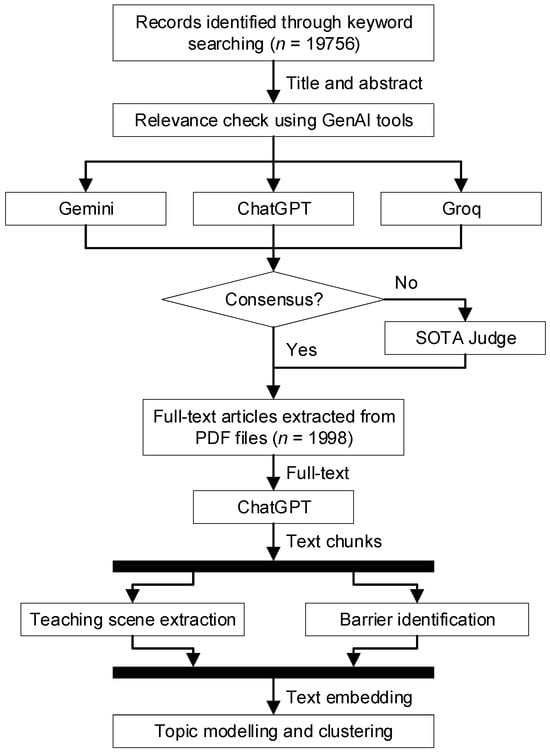
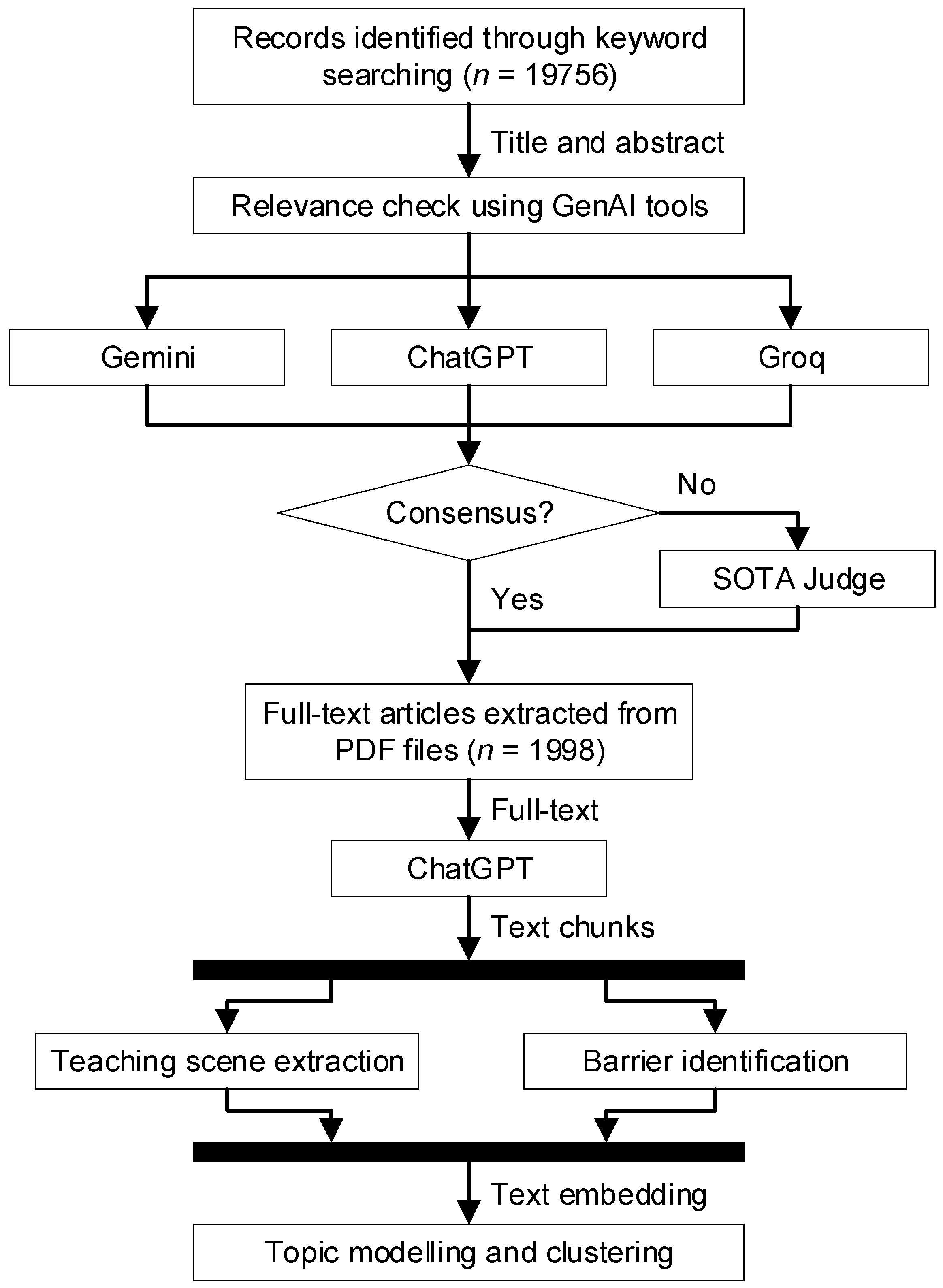
Overall, the study adopts an exploratory computational literature analysis design using arXiv records. The method combines automated API (Application Programming Interface) search on arXiv, full-text extraction and summarisation using GenAI tools, followed by topic modelling, clustering analysis and manual result interpretation. The overall flowchart can be seen in Figure 1.
Figure 1.
Flowchart of the overall method.
The initial search was conducted in June 2025, using the arXiv API (Cornell University, 2025) and a combination of keywords: AI AND (education OR teaching OR learning) AND [subject], where [subject] represents a list of high-level subjects taught in a Russell Group university, as seen in Table 1. For example, an arXiv API search using the query all:ai AND all:biology AND all:education retrieves metadata for records matching all three keywords, together with links to their full-text PDFs. The inclusion of [subject] is necessary because otherwise using “AI” will return many false positive results, such as machine learning articles, some of which were not related to education. For generality, Table 1 contains a comprehensive list of subject keywords used in the study, although some of them did not provide a match.
Table 1.
Keywords representing high-level subjects used in the search query.
Each matching paper undergoes further relevance assessment, using its title and abstract as input. We employed three commercial LLM providers—ChatGPT (GPT-4o mini), Gemini (Gemini 2.0 flash-lite), and Groq (Llama3-70B)—operating in parallel; each evaluates the article’s relevance to “AI in education” on a [0, 1] scale along with a brief justification. The scoring criteria encompass direct educational applications, teaching and learning implementations, educational research involving AI, and domain-specific applications across sciences, economics, humanities, and other fields. Papers receiving diverging scores trigger a secondary evaluation protocol. A state-of-the-art (SOTA) LLM (GPT-4o at the time of evaluation) acts as a judge, receiving the paper’s title, abstract, and anonymised scores from the three models. The judge evaluated each assessment based on accuracy, appropriateness, and consistency, selecting the most reliable scoring decision with a supporting rationale. This protocol is well-known as the LLM-as-a-judge approach and is widely used and accepted in LLM research due to the models’ broad capabilities (Zheng et al., 2023). This two-stage filtering mechanism balanced automated efficiency with quality control while mitigating individual model biases.
Articles that passed the threshold were then extracted in full text and sent to OpenAI’s LLM (GPT-4o) for language understanding and summarisation. This involved several different steps:
- Each article was first divided into smaller chunks to build vector databases. This is a typical operation in retrieval-augmented generation (RAG), as discussed in Gao et al. (2023), because of the context-length limits imposed by LLMs.
- The chunks were sent to the LLM for LTS extraction, summary generation and barrier formulation.
- All LTSs (n = 1998) and barriers (n = 4729) were then embedded using OpenAI’s text-embedding-3 model to convert the semantics to high-dimensional vector spaces.
- The high-dimensional vectors were then modelled using BERTopic (Grootendorst, 2022) for topic modelling (LTSs) and HDBSCAN (McInnes et al., 2017) for clustering (barriers). This was to understand the context of teaching and learning where barriers arise, as well as the barriers themselves.
Note that barriers are defined broadly as difficulties, constraints or concerns described in the full-text articles in relation to implementing or using GenAI in education. Although GenAI was prompted to identify barrier types, such as ethical or accessibility-related barriers, evidence categories such as observed difficulties, anticipated risks and author opinions were not explicitly coded. As such, barriers encompass both difficulties affecting implementation and everyday use, and challenges to adoption, including integration into existing systems.
A 6As framework (Actor, Activity, AI Role, AI Interface, Assessment, Achievement), shown in Table 2, is proposed to depict the LTSs in which GenAI is introduced and extended beyond the traditional teacher–learner dyad to form a teacher–AI–learner triad (Zhu & Li, 2025). It addresses the need to characterise the educational situations in which GenAI is used and barriers arise, and provides a structured description of who uses GenAI (Actor), for which educational tasks (Activity), what function it performs (AI Role), how users interact with it (AI Interface), how its use is evaluated (Assessment), and what outcomes are reported (Achievement). In addition, a 7th A, Artefact, is also used optionally to capture the context, such as background tasks and outcomes. ChatGPT has been instructed to follow the framework and produce a structured LTS summary using the pre-defined vocabulary shown in Table 2.
Table 2.
The 6As framework to depict lesson-level LTSs in the AI era.
3. Results
Keyword search gave 19,756 records, all of which returned titles and abstracts that went through the three GenAI models for relevance scoring. GenAI models reached an agreement on 1782 articles; however, there were disagreements on 2232 articles, which then went through the SOTA judging process. Out of a total of 2232, there were 222 articles that were judged to be relevant. Together with the articles with consensus (1782), this made a total of 2004. However, six of them later became unavailable (for reasons unknown, very likely withdrawn by authors), which left a total of 1998 articles (see Supplementary File S1 for the complete list of 1998 analysed articles).
H1.
GenAI use cases are distributed approximately equally between STEM and non-STEM disciplines.
The search query shown in Table 1 was constructed following a subject area/keywords structure. Practically, this resembles a Russell Group university’s faculty/department structure and makes it easier to map the extracted articles to discipline areas.
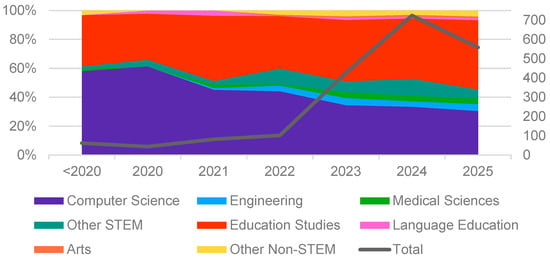
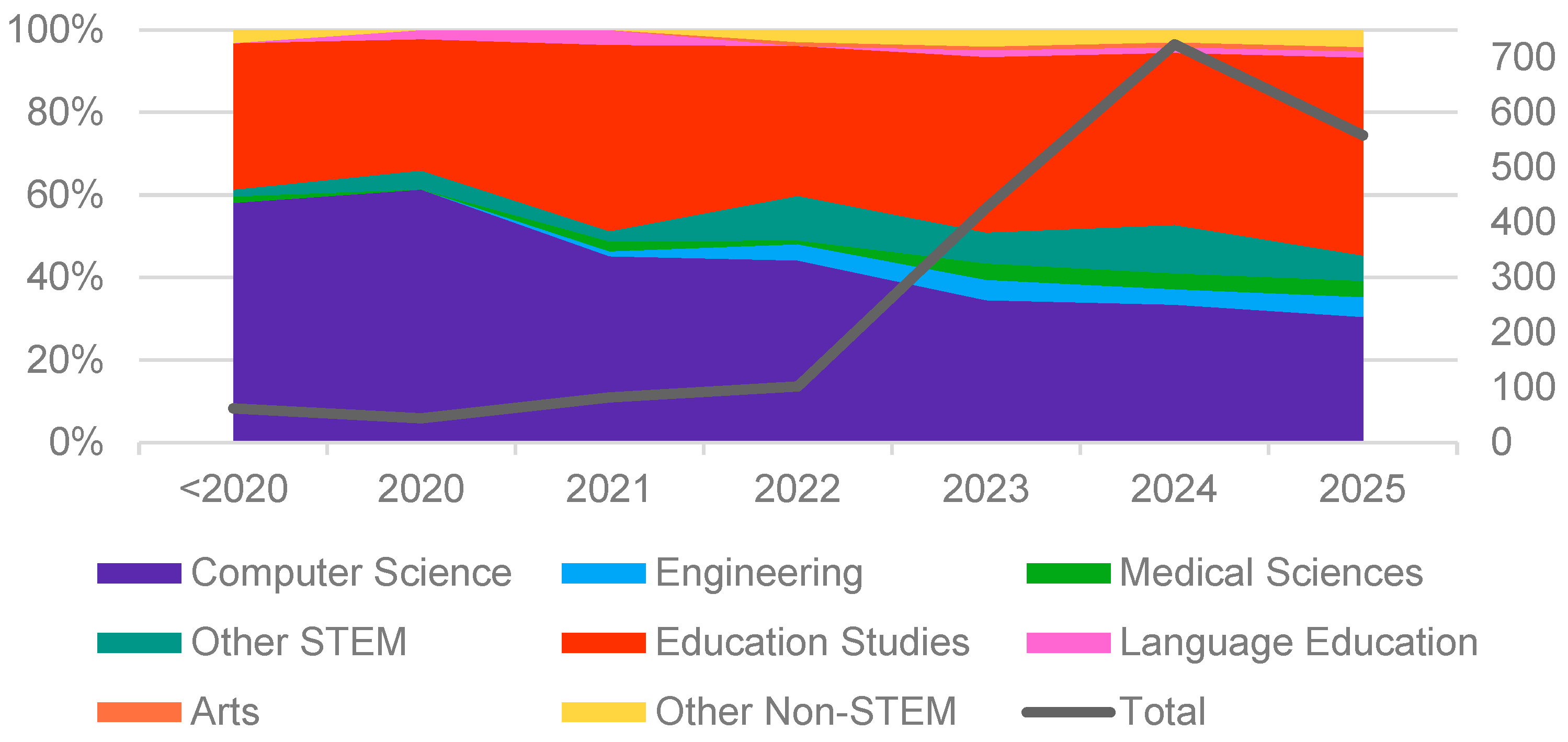
The total number of publications, shown in Figure 2 as the line plot using the right vertical axis, sees a dramatic increase after 2022, the release year of ChatGPT. This huge increase in the academic literature has been observed (Ng & Ho, 2025) and is also reflected on arXiv. For the percentage of different disciplines, shown in Figure 2 as the stacked area plot using the left vertical axis, education studies see some increase, and computer science lost some percentages; both were somehow significant in the past few years. At the same time, Engineering, Medical Sciences, Arts, and Language Education all had a steady increase, although these were small. Looking at both percentages and absolute values, there are significant differences between specific subject areas over the past few years.
Figure 2.
Total number of publications for each year and percentage changes for different disciplines.
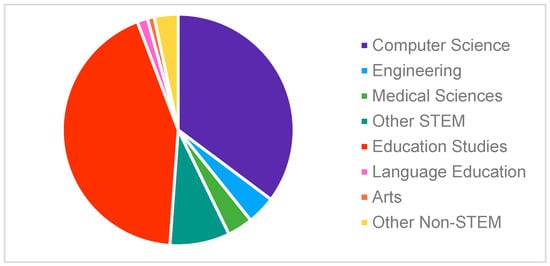
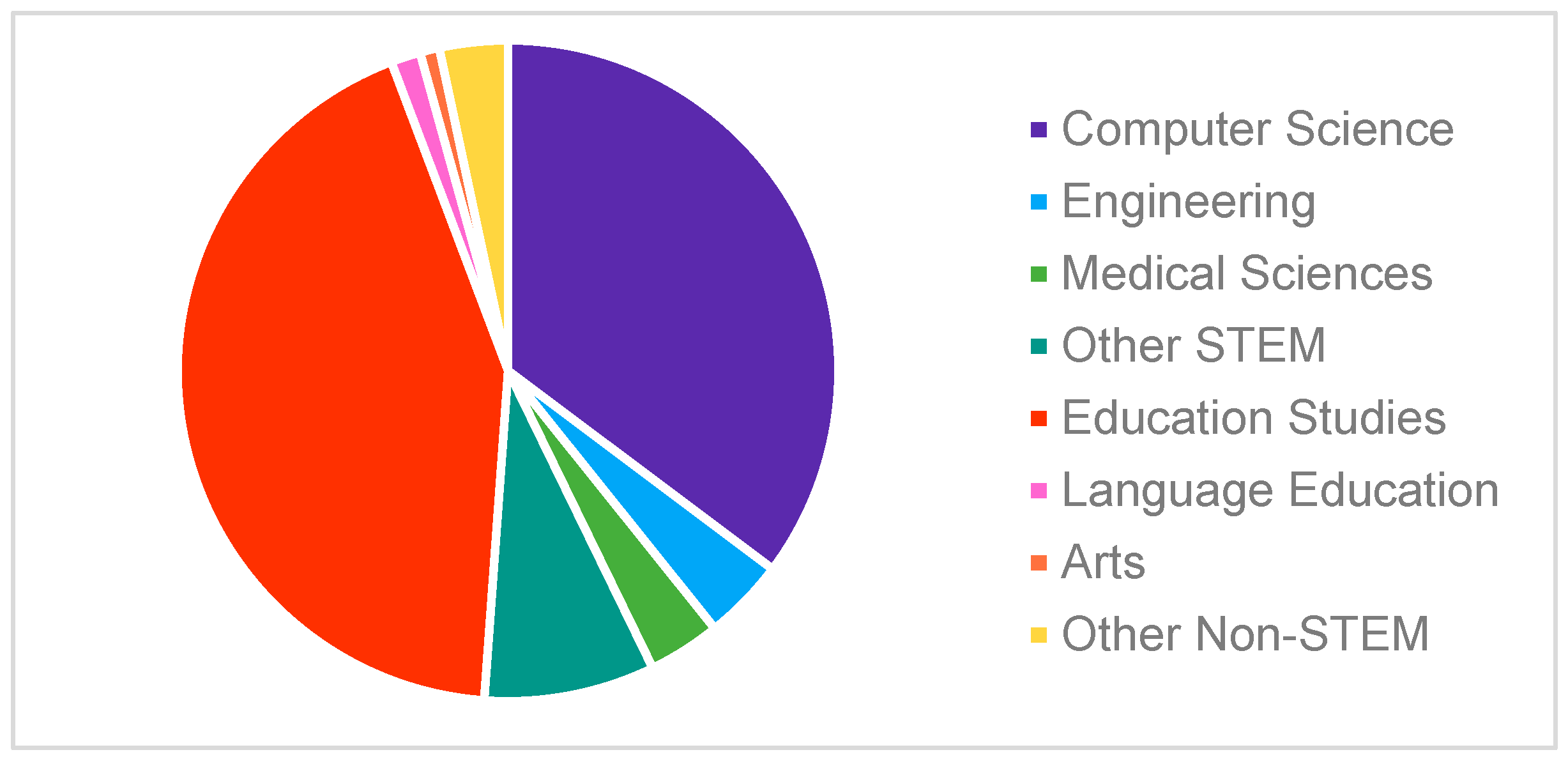
However, when these 1998 articles are divided using the STEM vs. non-STEM divider, the cumulative results are very different, as shown in Figure 3, in which cold colours denote STEM subjects and warm colours denote non-STEM ones, and it is roughly an equal division. It is therefore interesting to conclude that for specific subjects there are differences in terms of GenAI use cases. However, when all subjects are examined through the lens of STEM vs. non-STEM, the observed STEM/non-STEM distribution is descriptively consistent with H1 within this arXiv corpus.
Figure 3.
AI-relevant articles divided by discipline.
H2.
The reported pedagogical impacts of GenAI in teaching and learning are predominantly positive.
Examples of automatically extracted LTSs using ChatGPT following the 6As framework can be seen in Table 3, where the Ratas framework (Safilian et al., 2025) is a GenAI framework for automated answer grading. It was inferred from the paper that GenAI is used as a service “API-based design” and that GenAI has a role as an orchestrator as it coordinates “Downstream NLP (natural language processing) Tasks” in addition to other roles. On the other hand, the EducationQ framework (Shi et al., 2025) is a framework for GenAI-based teaching. It uses a “multi-turn dialogue” chat bot where AI has multiple roles except Orchestrator, unlike the former. These examples highlight how the 6As framework was used to extract LTSs.
Table 3.
Examples of LTSs extracted from the corpus.
Extracted LTSs were clustered using BERTopic with OpenAI text-embedding-3-large embeddings. UMAP (Uniform Manifold Approximation and Projection for Dimension Reduction) (McInnes et al., 2018) reduced the embeddings to 30 dimensions using 20 neighbours, a minimum distance of 0.05, cosine distance and a fixed random seed of 42. HDBSCAN (McInnes et al., 2017) clustering used a minimum cluster size of five, a minimum sample parameter of two, Euclidean distance, a cluster-selection epsilon of 0.5, an alpha of 0.7 and excess-of-mass cluster selection, with automatic topic reduction enabled in BERTopic. Parameters were selected from 11 configurations using a weighted criterion balancing the proportion of unclustered cases and variation in cluster sizes, balancing the identification of fine-grained thematic structure against cluster stability. The top four clusters, measured in size, are listed in Table 4 and denoted by S1 to S4, respectively. It is noted that the top four clusters represent 1512 cases out of 1998 (~76%), suggesting a high level of homogeneity, despite the fact that the cases come from a variety of discipline areas. In addition, key phrases such as “tutoring” and “chatbot” appear across different clusters, suggesting still limited means of using GenAI in the teaching/learning context. Of the previously mentioned examples, the Ratas framework (Safilian et al., 2025) falls into S1, while the EducationQ framework (Shi et al., 2025) is S2.
Table 4.
Top four clusters of the LTSs.
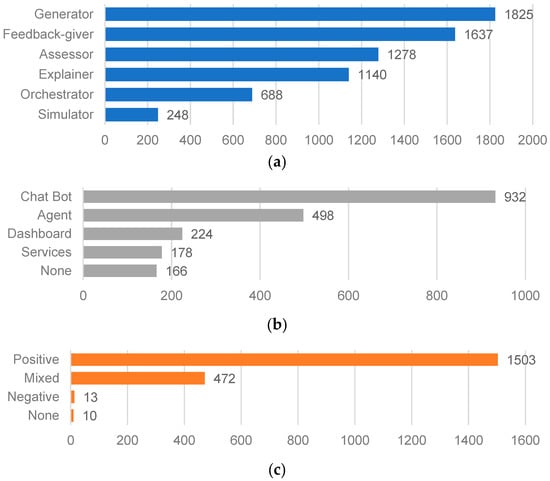
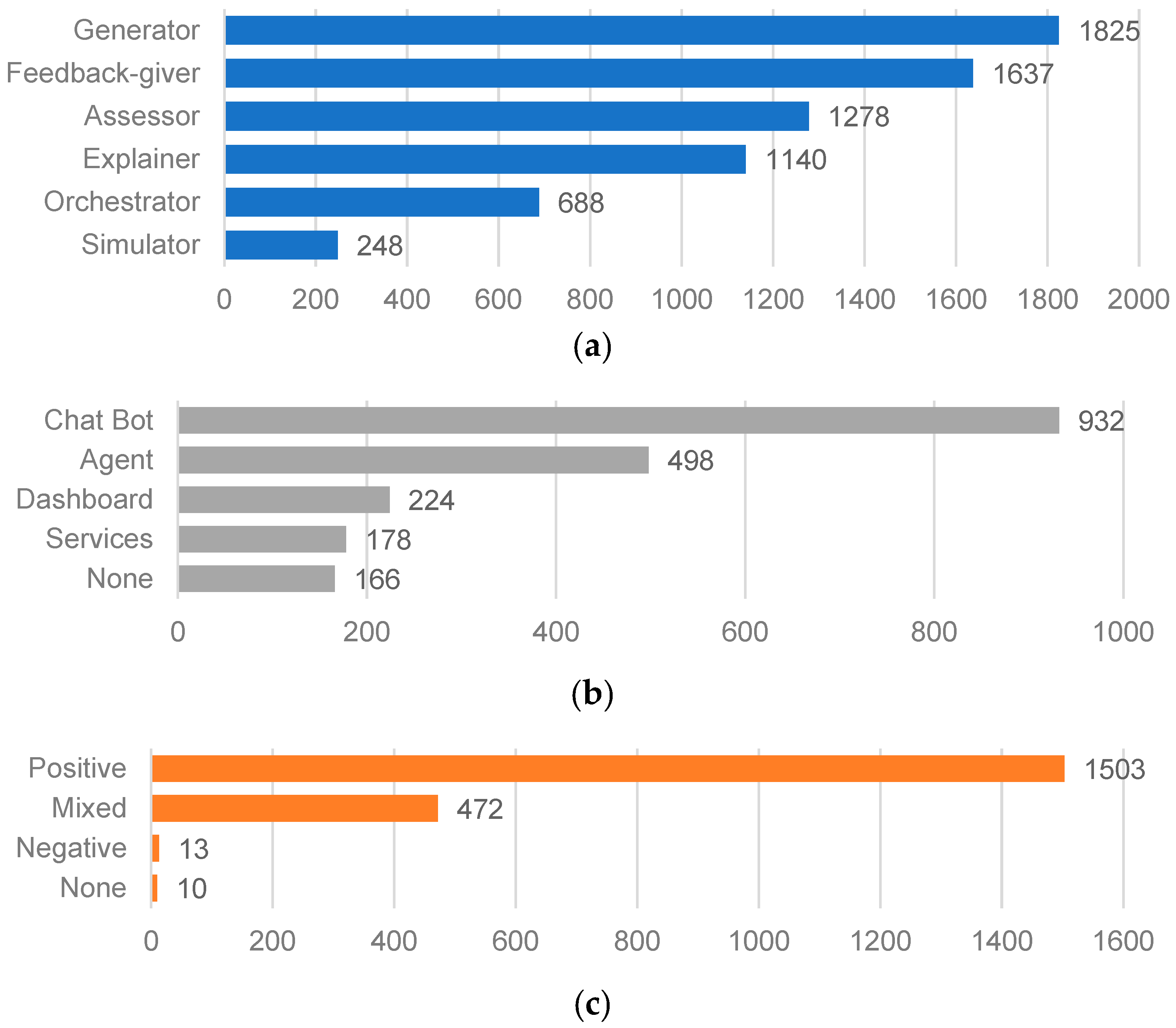
Simple counting AI roles in LTSs (Figure 4a) indicates that GenAI is rarely used for a single purpose. This is already evident from examples discussed in Table 3, and it makes sense because of GenAI’s broad and general capabilities. Figure 4b suggests that in terms of AI interfaces, the chat bot is still the dominant modality. Agents are when GenAI performs tasks for learners, large or small, triggered by user actions such as generating images from texts (Morita et al., 2025). Dashboards are when GenAI works with learners through multiple interfaces and different services instead of a single dialogue box, such as those used in coding software (Hassany et al., 2024). Figure 4c shows the overall achievements of all extracted LTSs. Of 1998 extracted LTSs, 1503 (approximately 75%) were classified as having non-negative reported outcomes. This descriptive result does not by itself establish H2’s claim of predominantly positive impacts. However, the negative achievements seem to come from research in which concerns significantly override benefits, such as those investigating AI-generated essay detection (Peng et al., 2023) and GenAI’s tendency towards sycophancy (Fanous et al., 2025). Although they represent only a tiny proportion, these are serious issues affecting GenAI intervention.
Figure 4.
Simple statistics in extracted LTSs: (a) AI role; (b) AI interface; (c) achievement.
H3.
Perceived barriers to GenAI adoption vary systematically across subject areas.
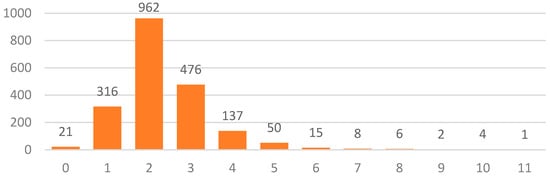
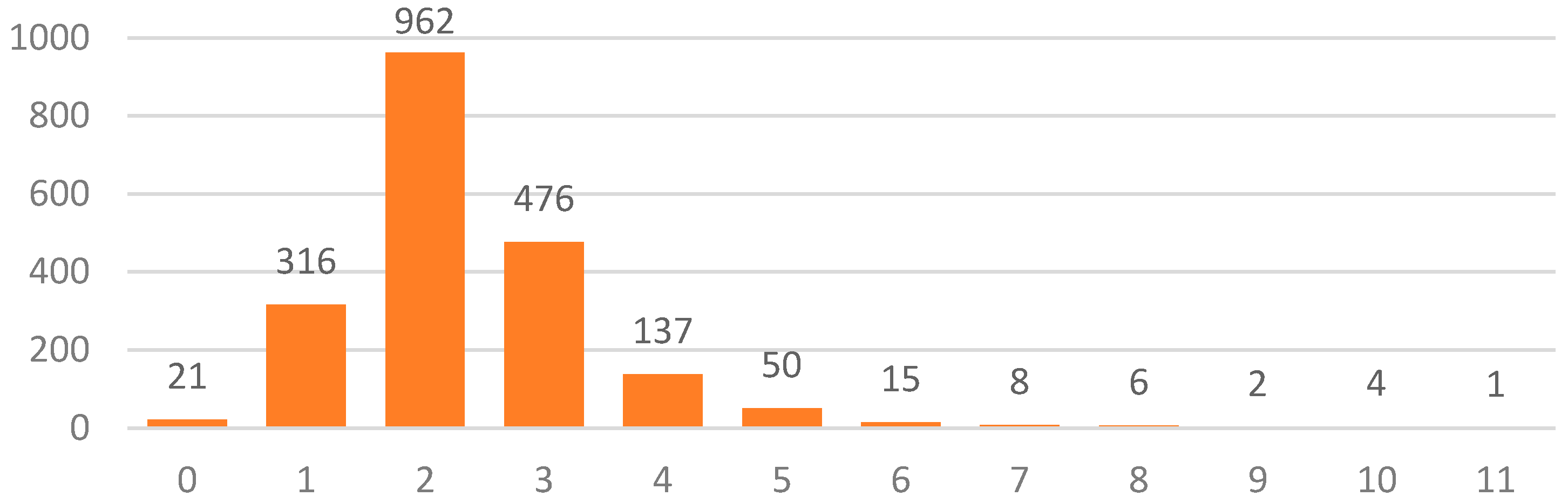
Altogether, 4729 barriers were extracted from 1998 articles. However, not all articles have the same number of barriers. Some have zero, most likely because they are review articles; a couple of articles have around ten barriers because they are books instead of ‘articles’ being uploaded and shared on arXiv. Most articles, on the other hand, have two barriers, as shown in Figure 5. Taking the Ratas framework (Safilian et al., 2025) as an example, there were two barriers identified, namely data availability and technical barriers, as shown in Table 5.
Figure 5.
Histogram showing the number of barriers per article.
Table 5.
Barriers identified in the paper about the Ratas framework (Safilian et al., 2025).
Table 6 shows the top 10 clusters, denoted by B1 to B10, derived using HDBSCAN, along with cluster size indicating relative abundance, name and brief description. Looking at the cluster sizes, it is evident that B1-B5 have a larger size compared with B6 and below. In fact, the top five clusters account for almost half of the barriers (48%, 2257/4729). In other words, collectively, B1–B5 are more significant concerns. At the same time, similar to the cases of clustering LTSs, some of the clusters are interconnected. For example, B5, B7, and B10 are all concerned with GenAI’s accuracy, although they have slightly different focuses, which is likely because of the slightly different semantic meanings in wording that are captured by the GenAI tools used for clustering. It is also interesting to observe that B2, over-reliance, and B8, resistance, co-exist in the top cluster list. The barriers identified from the Ratas framework (Safilian et al., 2025) shown in Table 5 belong to B6 and B10, respectively. Clustering used OpenAI text-embedding-3-large embeddings, reduced to 20 dimensions using UMAP with 15 neighbours, a minimum distance of 0.1, cosine distance and a fixed random seed of 42. HDBSCAN used a minimum cluster size of four, a minimum sample parameter of one, Euclidean distance, a cluster-selection epsilon of 0.6, an alpha of 0.5 and excess-of-mass cluster selection. These settings were selected from 16 configurations using a weighted criterion balancing the proportion of unclustered barriers and variation in cluster sizes. The selected configuration produced 73 clusters, with 349 of 4729 barriers (7.4%) remaining unclustered.
Table 6.
Top 10 clusters of the barriers to adopting GenAI in education.
When searching for articles in the corpus, a subject keyword such as “computer science” was included in the search string. Each article was therefore assigned a subject label, which was used to classify it as STEM or non-STEM. Each of the 4729 extracted barrier instances then inherited the disciplinary classification and publication year of its source article. For example, the two barriers shown in Table 5 were assigned to the STEM category and the year 2025, because the Ratas framework (Safilian et al., 2025) was classified as computer science and published in 2025. It is true that these barriers may very likely exist in a non-computer science context. Therefore, these labels indicate the provenance of the reported barriers rather than implying that the barriers are exclusive to a particular discipline and time.
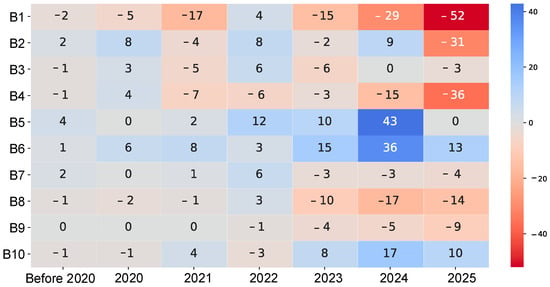
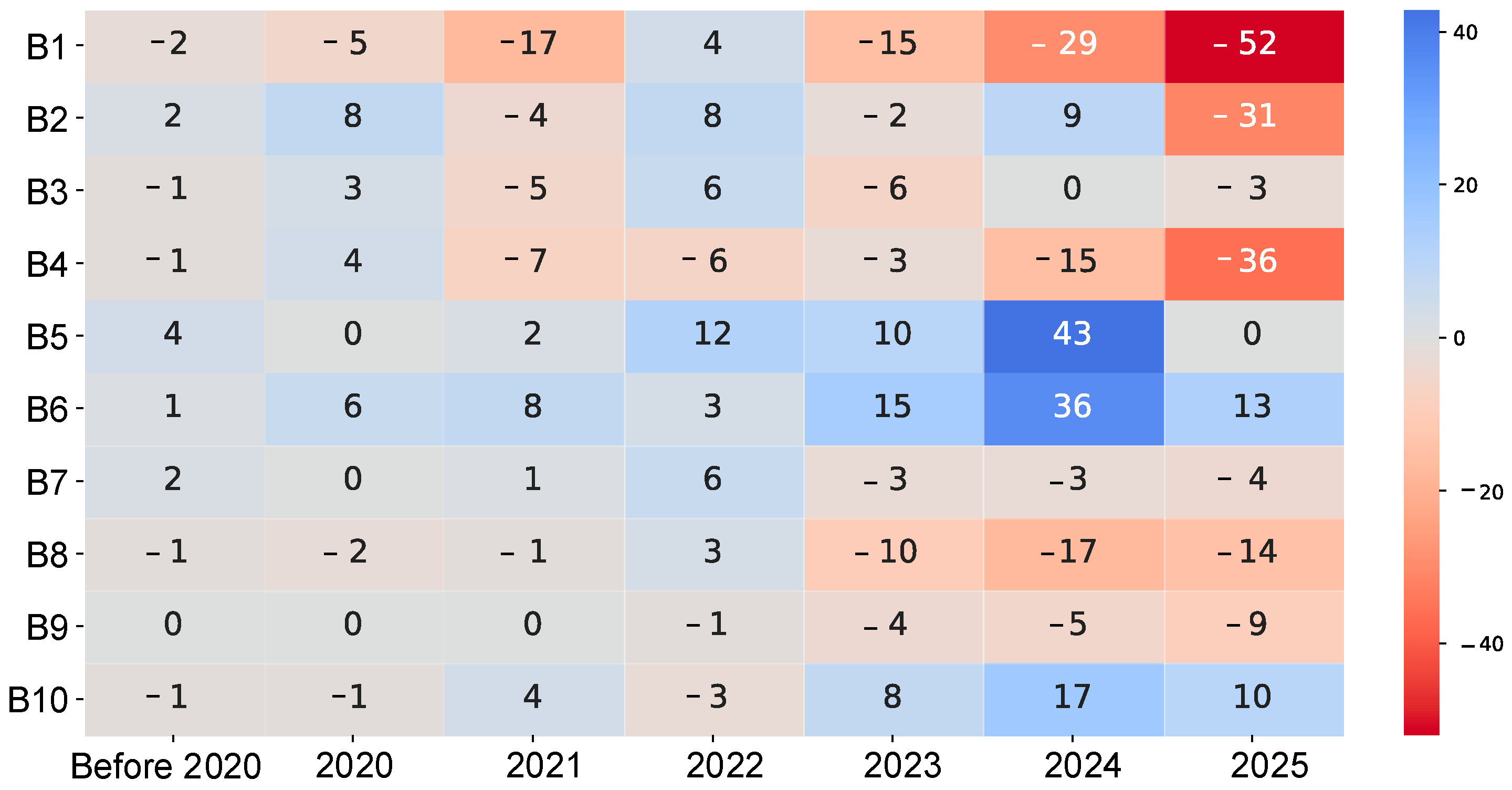
Counting the barrier distribution between STEM and non-STEM subjects, Figure 6 shows the differences (STEM minus non-STEM) between different clusters. The colour map was chosen such that, where the cell blocks in the heatmap show a blue colour, the corresponding barrier is more significant in STEM. And on the other hand, red colours denote barriers that are significant for non-STEM subjects. Figure 6 suggests that B1 (data privacy and bias) and B4 (integration with existing systems) are more significant for non-STEM subjects. It is expected that issues like privacy and bias are more prominent for Social Sciences; however, integration with existing systems is likely a problem for all learning management systems (LMSs). Integration may have been more problematic in non-STEM contexts because STEM users can often develop tools on demand, whereas non-STEM users are more reliant on existing infrastructure, making integration a more serious barrier. On the other hand, B5 (hallucinations and accuracy) and B6 (dataset availability and quality) are consistently more significant for STEM subjects. This may be because STEM subjects often require rigorous scientific evidence, creating a higher demand for accuracy and data quality. For less apparent patterns, B8 (resistance) and B9 (academic integrity) seem to be a more non-STEM issue. Examining the departmental composition helps to explain the large STEM–non-STEM difference for B1 in 2025 (−52). The 45 STEM barrier records comprised Computer Science (30), Engineering (8), Warwick Medical School (4), Psychology (2) and Physics (1). Of the 97 non-STEM records, 89 were classified as Social Sciences, predominantly Education Studies (83), with smaller contributions from Teacher Education (3) and Sociology (3). The remaining eight records were classified as Arts. B1 therefore occurs in both Social Sciences and Arts, although its non-STEM representation is concentrated in Education Studies. The departmental breakdowns for B4 in 2025 and B5 and B6 in 2024 similarly identify Computer Science and Education Studies as the largest contributors within STEM and non-STEM, respectively. The composition of these barriers is consistent with the overall subject composition shown in Figure 2. Note that the data collection happened in June 2025 and, as such, the last column in Figure 6 is not fully representative of the whole year.
Figure 6.
Differences in barrier counts between STEM and non-STEM subjects by barrier category and year (STEM minus non-STEM).
4. Discussion
4.1. Limitations of GenAI as a Literature Research Tool
It is important to note that GenAI technologies are evolving quickly. The SOTA model at the time of analysis (June 2025) was GPT-4o from OpenAI; however, it has evolved to version GPT-5.2 by the time of writing (December 2025). Nevertheless, it is hardly true to claim that GenAI offers ground truth in terms of text understanding. Hallucination, a well-documented failure mode of LLMs whose underlying mechanisms are only partially understood, is also observed in the current study. For example, Choi et al. (2020) was believed to have a positive achievement during LTS extraction by GPT-4o. However, what it says in the text is “We will follow up on this paper with a future paper detailing empirical experiments on the effects of Rocket on student behaviour and outcomes”, which translates into “potential positive feedback”. Hallucination proves that human-in-the-loop verification and curation are needed; however, in the current study, it is believed to be consistent with those observed in the literature at a small level. More importantly, considering the size of the corpus and number of barriers, the impact is expected to be negligible.
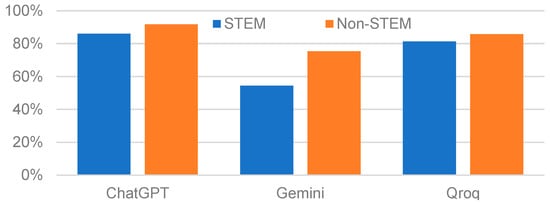
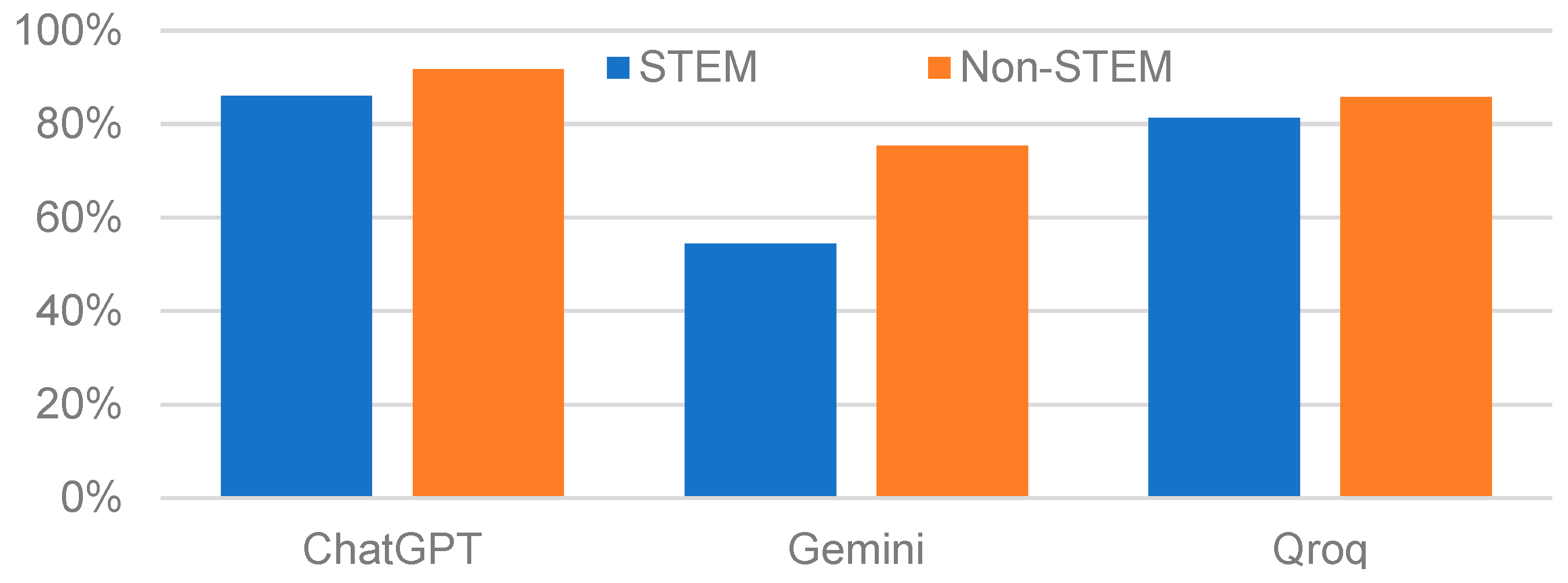
As mentioned previously in the Method Section, the LLM-as-a-judge approach is widely used and accepted. This approach is supported by research showing that LLM-as-a-judge is a scalable and explainable way to approximate human preferences, while remaining susceptible to position, verbosity and self-preference biases (Zheng et al., 2023). However, it is also known that LLM-as-a-judge has a self-preference bias (Zheng et al., 2023), which means it can systematically score outputs from itself or its model family higher than those from competitors, even under blinded pairwise setups. This self-preference is also observed in the current study. Treating the final selected 1998 article set as the ‘true’ label, the whole scoring problem becomes a binary classification problem. The three models from ChatGPT (GPT-4o mini), Gemini (Gemini 2.0 flash-lite), and Groq (Llama3-70B) show different accuracy and variations between STEM and non-STEM subjects, as seen in Figure 7. Overall, ChatGPT has the highest accuracy and clear evidence of self-preference bias. In terms of subject areas, non-STEM is better scored, and this is consistent between different models. However, as with hallucination, the exact reasons for self-preference bias are yet to be fully understood.
Figure 7.
Article relevance scoring accuracy for the three GenAI models.
4.2. Data Source and Human Validation
arXiv was selected as the data source because its centralised API, freely accessible full texts and coverage of GenAI-related research supported the automated processing and analysis pipeline. These features made arXiv a practical source for the present study, as well as for other research initiatives, such as unarXive (Saier & Färber, 2020) and Paperscape (George & Knegjens, n.d.). However, its use also introduces limitations. Although arXiv applies submission moderation and an endorsement system, these mechanisms do not constitute peer review or establish the methodological quality of individual studies. Its technical coverage is relevant to GenAI but may favour computational perspectives, influencing both the disciplinary composition of the corpus and the barriers represented. Web of Science, Scopus and education-specific databases were not searched. Extending the analysis to these sources was beyond the scope of this study and would require addressing differences in full-text accessibility, licencing conditions and data formats.
Human involvement in the automated pipeline was limited to manual inspection of a small number of outlying cases to check whether the implementation operated as intended. These checks did not constitute systematic validation of screening or extraction accuracy. The use of automation was informed by previous research demonstrating GenAI’s potential to support the literature analysis (Chen et al., 2026; Sanghera et al., 2025; Zhang et al., 2024). Limited manual checking also reflected the practical demands of examining extracted LTSs and barriers across a large corpus spanning diverse subject contexts, in which interpretation requires contextual expertise. Screening and extraction accuracy were not systematically evaluated against a human-labelled reference sample. Errors in study selection or interpretation may therefore remain, and the findings should be interpreted as exploratory, pending further validation.
4.3. Theoretical and Practical Implications
Our analysis of 1998 articles identified broadly comparable representation of GenAI use cases across STEM and non-STEM subjects and predominantly non-negative reported pedagogical outcomes. However, the distribution of reported barriers differed across these contexts. Hallucinations and accuracy limits (B5) and dataset availability and quality (B6) featured more prominently in STEM articles, while data privacy and bias (B1) and integration with existing systems (B4) featured more prominently in non-STEM articles.
The recent literature (Shrivastava, 2025; Ayanwale, 2024; FakhrHosseini et al., 2024; Yang et al., 2026) argues that dominant technology acceptance models, including TAM and its extensions, over-privilege individual-level beliefs while under-specifying the institutional and societal conditions that shape adoption in complex, AI-enabled environments. A multi-level framework, by contrast, views adoption as jointly conditioned by user-related factors, system characteristics, task specificity, and broader societal and regulatory contexts (Baig & Yadegaridehkordi, 2025; McGrath et al., 2023; Zhang & Tang, 2025). This framework provides a more appropriate analytical basis for understanding GenAI adoption in education, in which technologies are embedded within assessment regimes, governance structures, and disciplinary norms rather than used in isolation by individual users. In this paper, we use TAM and a multi-level framework to interpret the identified barriers, rather than empirically testing their constructs or the relationships between them.
The clusters in Table 6 reveal some of the levels at which these barriers operate. Data privacy and bias (B1), limited access to AI infrastructure (B3), integration with existing systems (B4), and academic integrity concerns (B9) relate to institutional, organisational, and governance conditions, including responsible data use, resource provision, workflow compatibility, and assessment rules. Hallucinations and accuracy limits (B5), dataset availability and quality (B6), inaccurate or unreliable outputs (B7), and model accuracy and reliability (B10) concern system capabilities and their suitability for educational tasks. Over-reliance on AI (B2) and resistance to adoption (B8) concern individual attitudes and behaviour. Together, these barriers support a multi-level interpretation of GenAI adoption that considers perceived usefulness and ease of use alongside technological capabilities, educational tasks, and institutional and governance conditions.
The relative prominence of these dimensions also varies across disciplines. In non-STEM subjects, such as the Humanities and Social Sciences, GenAI outputs directly intersect with questions of authorship, interpretation, and academic integrity (Zhao et al., 2025; Yang et al., 2026). As a result, adoption is shaped less by individual perceptions of ease or utility than by task-specific and societal factors, including concerns about data privacy and bias (B1), assessment alignment, and institutional readiness. Ambiguity around policies, acceptable use, and assessment redesign introduces friction that constrains adoption, even where individual users recognise potential benefits. While TAM offers a way to interpret these concerns in relation to PU and PEOU, the underlying barriers operate at institutional and normative levels that individual-level acceptance models do not directly theorise (FakhrHosseini et al., 2024).
In STEM disciplines, by contrast, greater familiarity with digital tools and established norms of computational verification may stabilise system-level expectations and reduce sensitivity to usability frictions. Here, task-specific factors can dominate adoption decisions, with PU potentially related to performance attributes such as accuracy (B5) and dataset availability (B6). These dynamics correspond more closely to the individual-level mechanisms emphasised in TAM, but they nonetheless remain embedded within broader disciplinary practices that define what constitutes valid and reliable output.
Taken together, these patterns support the argument that technology adoption in intelligent environments cannot be adequately explained through a single, generic acceptance model (FakhrHosseini et al., 2024). Instead, GenAI adoption in education emerges from the interaction of user beliefs, system affordances, task characteristics, and institutional context, with the relative salience of each dimension varying systematically across disciplines (Yang et al., 2026). This implies that adoption strategies should move beyond one-size-fits-all interventions focused on changing individual attitudes and instead address the specific task, governance, and infrastructural conditions that shape how usefulness and usability are interpreted in different disciplinary settings (Ghimire & Edwards, 2024).
Practically, our findings build on the existing literature and provide more concrete guidance on task suitability, institutional support and staff development. Whilst Tan’s (2026) review of 43 empirical studies identified factors extending beyond individual acceptance, including technological, social, quality and task-related considerations, and Yang et al. (2026) also highlighted the importance of institutional barriers, particularly among professional services staff, our findings help to translate these broader considerations into specific areas for support. For B1, the higher non-STEM counts were concentrated in Education Studies, although Arts also contributed records concerning bias, cultural representation and the ethical use of data. Relevant support could therefore include guidance on handling student information, evaluating biased outputs and recognising culturally inappropriate representations. The higher STEM counts for hallucinations and accuracy limitations (B5) and dataset availability and quality (B6) in 2024 suggest the value of support for checking generated code, verifying mathematical reasoning and evaluating outputs against suitable domain-specific datasets. These priorities, policies and staff development activities should be adapted to particular educational contexts rather than applied uniformly across all disciplines. Note that these factors were not directly examined in this study, and this interpretation requires further empirical testing.
5. Conclusions
This study reports a large-scale cross-disciplinary analysis of barriers to adopting GenAI in education. Drawing on 1998 arXiv full-text articles, the study explored three hypotheses and confirmed that: (i) the distribution of GenAI use cases is comparable between STEM and non-STEM subjects; (ii) reported GenAI interventions in teaching and learning are overwhelmingly non-negative; and (iii) the perceived barriers differ systematically between STEM and non-STEM contexts. Methodologically, the study illustrates an AI-assisted large-scale text-mining workflow with manual interpretation and limited inspection of selected outlying cases; these checks did not constitute systematic validation of screening or extraction accuracy. The 6As framework is also transferable in describing teacher–AI–learner triad LTSs at the lesson level.
Beyond its empirical contributions, the study also speaks to broader debates on how GenAI adoption in education should be conceptualised. Interpreted through TAM, the disciplinary differences suggest that reliability may be relevant to PU in STEM contexts, while ethical concerns and policy ambiguity may be relevant to PU, and integration with existing workflows to PEOU, in non-STEM contexts. While TAM provides a useful baseline for interpreting how barriers map onto PU and PEOU, our findings suggest that many of the most salient constraints, particularly in non-STEM contexts, operate at task-specific, institutional, and governance levels that individual-level acceptance models were not designed to capture. Consistent with recent calls for more integrative adoption frameworks, the results point to the need for multi-level approaches that account simultaneously for user perceptions, system performance, pedagogical tasks, and institutional context when analysing GenAI adoption across disciplines.
However, the methodological limitations include known failures associated with LLMs, such as hallucination and self-preference bias. Some clustering boundaries also reflect semantic overlap. Future work should triangulate results with additional repositories beyond arXiv, use advanced LLMs, and incorporate stronger human validation.
Supplementary Materials
The following supporting information can be downloaded at https://www.mdpi.com/article/10.3390/educsci16101707/s1. Supplementary File S1: The complete list of 1998 analysed articles.
Author Contributions
Conceptualisation, J.Y. and H.V.P.; methodology, J.Y., K.Ö. and H.V.P.; writing—original draft preparation, J.Y. and K.Ö.; writing—review and editing, H.V.P., C.O. and Y.A.; funding acquisition, J.Y. All authors have read and agreed to the published version of the manuscript.
Funding
This research was funded by the University of Warwick Education Fund.
Data Availability Statement
The data, including the programme source code and GenAI prompts that support the findings of this study, are available from the corresponding author upon reasonable request, subject to non-disclosure requirements.
Conflicts of Interest
The authors declare no conflict of interest..
Abbreviations
The following abbreviations are used in this manuscript:
| API | Application Programming Interface |
| CC | Creative Commons |
| GDPR | General Data Protection Regulation |
| GenAI | Generative artificial intelligence |
| LLM | Large language model |
| LMS | Learning management system |
| LTS | Learning and teaching scenario |
| NLP | Natural language processing |
| PEOU | Perceived ease of use |
| PU | Perceived usefulness |
| RAG | Retrieval-augmented generation |
| SOTA | State of the art |
| STEM | Science, technology, engineering, and mathematics |
| TAM | Technology Acceptance Model |
| UNESCO | United Nations Educational, Scientific and Cultural Organization |
| UTAUT | Unified Theory of Acceptance and Use of Technology |
References
- Ayanwale, M. A. (2024). Using diffusion theory of innovation to investigate perceptions of STEM and non-STEM students’ adoption of chatbot systems in higher education: A multiple group analysis. In 2024 IEEE global engineering education conference (EDUCON) (pp. 1–8). IEEE. [Google Scholar]
- Baig, M. I., & Yadegaridehkordi, E. (2025). Factors influencing academic staff satisfaction and continuous usage of generative artificial intelligence (GenAI) in higher education. International Journal of Educational Technology in Higher Education, 22(1), 5. [Google Scholar] [CrossRef] [Scilit]
- Beckingham, S., Lawrence, J., Powell, S., & Hartley, P. (2024). Using generative AI effectively in higher education. Routledge. [Google Scholar]
- Belkina, M., Daniel, S., Nikolic, S., Haque, R., Lyden, S., Neal, P., Grundy, S., & Hassan, G. M. (2025). Implementing generative AI (GenAI) in higher education: A systematic review of case studies. Computers and Education: Artificial Intelligence, 8, 100407. [Google Scholar] [CrossRef] [Scilit]
- Bozkurt, A. (2023). Unleashing the potential of generative AI, conversational agents and chatbots in educational praxis: A systematic review and bibliometric analysis of GenAI in education. International Council for Open and Distance Education. [Google Scholar]
- Chan, C. K. Y. (2023). A comprehensive AI policy education framework for university teaching and learning. International Journal of Educational Technology in Higher Education, 20(1), 38. [Google Scholar] [CrossRef] [Scilit]
- Chen, S. F., Alyakin, A., Seas, A., Yang, E., Choi, J. J., Lee, J. V., Chen, A. L., Warman, P. I., Bitolas, R. T., & Steele, R. J. (2026). LLM-assisted systematic review of large language models in clinical medicine. Nature Medicine, 32(3), 1152–1159. [Google Scholar] [CrossRef] [Scilit] [PubMed]
- Chi, M. T., & Wylie, R. (2014). The ICAP framework: Linking cognitive engagement to active learning outcomes. Educational Psychologist, 49(4), 219–243. [Google Scholar] [CrossRef] [Scilit]
- Chiu, T. K. (2024). The impact of generative AI (GenAI) on practices, policies and research direction in education: A case of ChatGPT and Midjourney. Interactive Learning Environments, 32(10), 6187–6203. [Google Scholar] [CrossRef] [Scilit]
- Choi, Y., Na, Y., Yoon, Y., Shin, J., Bae, C., Suh, H., Kim, B., & Heo, J. (2020). Choose your own question: Encouraging self-personalization in learning path construction. arXiv, arXiv:2005.03818. [Google Scholar]
- Cornell University. (2025). arXiv API basics-arXiv info. Available online: https://info.arxiv.org/help/api/basics.html (accessed on 28 December 2025).
- Crawford, J., Vallis, C., Yang, J., Fitzgerald, R., O’dea, C., & Cowling, M. (2023). Artificial intelligence is awesome, but good teaching should always come first. Journal of University Teaching & Learning Practice, 20(7), 01. [Google Scholar] [CrossRef] [Scilit]
- Daher, W., & Hussein, A. (2024). Higher education students’ perceptions of GenAI tools for learning. Information, 15(7), 416. [Google Scholar] [CrossRef] [Scilit]
- Davis, F. D. (1989). Perceived usefulness, perceived ease of use and user acceptance of information technology. MIS Quarterly, 13, 319–340. [Google Scholar] [CrossRef] [Scilit] [PubMed]
- FakhrHosseini, S., Chan, K., Lee, C., Jeon, M., Son, H., Rudnik, J., & Coughlin, J. (2024). User adoption of intelligent environments: A review of technology adoption models, challenges, and prospects. International Journal of Human–Computer Interaction, 40(4), 986–998. [Google Scholar] [CrossRef] [Scilit]
- Fanous, A., Goldberg, J., Agarwal, A., Lin, J., Zhou, A., Xu, S., Bikia, V., Daneshjou, R., & Koyejo, S. (2025, October 20–22). Syceval: Evaluating llm sycophancy. AAAI/ACM Conference on AI, Ethics, and Society (pp. 893–900), Madrid, Spain. [Google Scholar]
- Felix, J., & Webb, L. (2024). Use of artificial intelligence in education delivery and assessment. The Parliamentary Office of Science and Technology, 23, 1–21. [Google Scholar] [CrossRef] [Scilit]
- Fitzgerald, R., Kumar, J. A., Roe, J., Roehrer, E., & Yang, J. (2025). Framing the future with a research agenda for Artificial Intelligence in higher education. Journal of University Teaching and Learning Practice, 22(4), 1–12. [Google Scholar] [CrossRef] [Scilit]
- Gao, Y., Xiong, Y., Gao, X., Jia, K., Pan, J., Bi, Y., Dai, Y., Sun, J., Wang, H., & Wang, H. (2023). Retrieval-augmented generation for large language models: A survey. arXiv, arXiv:2312.10997. [Google Scholar]
- George, D., & Knegjens, R. (n.d.). Paperscape. Available online: https://paperscape.org/ (accessed on 14 August 2026).
- Ghimire, A., & Edwards, J. (2024). Generative AI adoption in classroom in context of technology acceptance model (TAM) and the innovation diffusion theory (IDT). arXiv, arXiv:2406.15360. [Google Scholar]
- Ginsparg, P. (2011). ArXiv at 20. Nature, 476(7359), 145–147. [Google Scholar] [CrossRef] [Scilit] [PubMed]
- Grand View Research. (2024). AI in education market size & share report, 2022–2030. Available online: https://www.grandviewresearch.com/industry-analysis/artificial-intelligence-ai-education-market-report (accessed on 25 December 2025).
- Grootendorst, M. (2022). BERTopic: Neural topic modeling with a class-based TF-IDF procedure. arXiv, arXiv:2203.05794. [Google Scholar]
- Hassany, M., Brusilovsky, P., Ke, J., Akhuseyinoglu, K., & Narayanan, A. B. L. (2024). Human-AI co-creation of worked examples for programming classes. arXiv, arXiv:2402.16235. [Google Scholar]
- Khan, S. (2024). Brave new words: How AI will revolutionize education (and why that’s a good thing). Viking. [Google Scholar]
- Khine, M. S. (2024). Artificial intelligence in education. Springer. [Google Scholar]
- Law, L. (2024). Application of generative artificial intelligence (GenAI) in language teaching and learning: A scoping literature review. Computers and Education Open, 6, 100174. [Google Scholar] [CrossRef] [Scilit]
- Lee, V. R., Parli, V., Hau, I., Hynes, P., & Zhang, D. (2025). Response to the department of education’s request for information on AI in education [Online]. Stanford University Human-Centered Artificial Intelligence. Available online: https://hai.stanford.edu/assets/files/hai-stanford-accelerator-for-learning-rfi-response-advancing-ai-in-education.pdf (accessed on 26 December 2025).
- McGrath, C., Pargman, T. C., Juth, N., & Palmgren, P. J. (2023). University teachers’ perceptions of responsibility and artificial intelligence in higher education-An experimental philosophical study. Computers and Education: Artificial Intelligence, 4, 100139. [Google Scholar] [CrossRef] [Scilit]
- McInnes, L., Healy, J., & Astels, S. (2017). hdbscan: Hierarchical density based clustering. Journal Open Source Software, 2(11), 205. [Google Scholar] [CrossRef] [Scilit]
- McInnes, L., Healy, J., & Melville, J. (2018). Umap: Uniform manifold approximation and projection for dimension reduction. arXiv, arXiv:1802.03426. [Google Scholar]
- McKiernan, E. C., Bourne, P. E., Brown, C. T., Buck, S., Kenall, A., Lin, J., Mcdougall, D., Nosek, B. A., Ram, K., & Soderberg, C. K. (2016). How open science helps researchers succeed. eLife, 5, e16800. [Google Scholar] [CrossRef] [Scilit] [PubMed]
- Morita, R., Watanabe, K., Zhou, J., Dengel, A., & Ishimaru, S. (2025, March 16–20). GenAIReading: Augmenting human cognition with interactive digital textbooks using large language models and image generation models. Augmented Humans International Conference 2025 (pp. 289–301), Abu Dhabi, United Arab Emirates. [Google Scholar]
- National Centre for Social Research. (2018). Generative AI Greece 2030. Available online: https://www.ekke.gr/en/research/outcomes/deliverables/43 (accessed on 7 July 2024).
- Ng, S.-L., & Ho, C.-C. (2025). Generative ai in education: Mapping the research landscape through bibliometric analysis. Information, 16(8), 657. [Google Scholar] [CrossRef] [Scilit]
- Ogunleye, B., Zakariyyah, K. I., Ajao, O., Olayinka, O., & Sharma, H. (2024). A systematic review of generative AI for teaching and learning practice. Education Sciences, 14(6), 636. [Google Scholar] [CrossRef] [Scilit]
- Peng, X., Zhou, Y., He, B., Sun, L., & Sun, Y. (2023, December 6–10). Hidding the ghostwriters: An adversarial evaluation of AI-generated student essay detection. 2023 Conference on Empirical Methods in Natural Language Processing (pp. 10406–10419), Singapore. [Google Scholar]
- Safilian, M., Beheshti, A., & Elbourn, S. (2025). Ratas framework: A comprehensive genai-based approach to rubric-based marking of real-world textual exams. arXiv, arXiv:2505.23818. [Google Scholar]
- Saier, T., & Färber, M. (2020). unarXive: A large scholarly data set with publications’ full-text, annotated in-text citations, and links to metadata. Scientometrics, 125(3), 3085–3108. [Google Scholar] [CrossRef] [Scilit]
- Sanghera, R., Thirunavukarasu, A. J., El Khoury, M., O’Logbon, J., Chen, Y., Watt, A., Mahmood, M., Butt, H., Nishimura, G., & Soltan, A. A. (2025). High-performance automated abstract screening with large language model ensembles. Journal of the American Medical Informatics Association, 32(5), 893–904. [Google Scholar] [CrossRef] [Scilit] [PubMed]
- Schryen, G., Marrone, M., & Yang, J. (2025). Exploring the scope of generative AI in literature review development. Electronic Markets, 35(1), 13. [Google Scholar] [CrossRef] [Scilit]
- Shi, Y., Liang, R., & Xu, Y. (2025). EducationQ: Evaluating LLMs’ teaching capabilities through multi-agent dialogue framework. arXiv, arXiv:2504.14928. [Google Scholar]
- Shrivastava, P. (2025). Understanding acceptance and resistance toward generative AI technologies: A multi-theoretical framework integrating functional, risk, and sociolegal factors. Frontiers in Artificial Intelligence, 8, 1565927. [Google Scholar] [CrossRef] [Scilit] [PubMed]
- Spathopoulou, F., Pitychoutis, K. M., & Papakonstantinidis, S. (2025). AI and higher education: Understanding faculty roles in teaching, research, and administration. Contemporary Educational Technology, 17(4), ep600. [Google Scholar] [CrossRef] [Scilit] [PubMed]
- Stanford University. (2025). Generative AI for education hub. Available online: https://scale.stanford.edu/ai (accessed on 30 December 2025).
- Sullivan, M., Kelly, A., & McLaughlan, P. (2023). ChatGPT in higher education: Considerations for academic integrity and student learning. Journal of Applied Learning & Teaching, 6, 31–40. [Google Scholar] [CrossRef] [Scilit]
- Tan, Q. (2026). Factors influencing the adoption of generative AI in education: A systematic review, proposed framework and future research agenda. British Educational Research Journal, 52(2), 1219–1247. [Google Scholar] [CrossRef] [Scilit]
- UNESCO. (2025). Six pillars for the digital transformation of education: A common framework. Available online: https://unesdoc.unesco.org/ark:/48223/pf0000391299.locale=en (accessed on 5 June 2025).
- Venkatesh, V., Morris, M. G., Davis, G. B., & Davis, F. D. (2003). User acceptance of information technology: Toward a unified view. MIS Quarterly, 27(3), 425–478. [Google Scholar] [CrossRef] [Scilit]
- Wang, X., Zainuddin, Z., & Chin, H. L. (2025). Generative artificial intelligence in pedagogical practices: A systematic review of empirical studies (2022–2024). Cogent Education, 12(1), 2485499. [Google Scholar] [CrossRef] [Scilit]
- Williams, M. D., Rana, N. P., & Dwivedi, Y. K. (2015). The unified theory of acceptance and use of technology (UTAUT): A literature review. Journal of Enterprise Information Management, 28(3), 443–488. [Google Scholar] [CrossRef] [Scilit]
- Yan, C. Y., & Jafri, N. B. (2026). Factors influencing the intention to use generative artificial intelligence in educational systems: A meta-analysis. BMC Psychology, 14(1), 308. [Google Scholar] [CrossRef] [Scilit] [PubMed]
- Yang, J., Öge, K., von Mühlenen, A., Akbulut, A. B., Carey, T. S., & Okorro, C. (2026). Multi-level barriers to generative AI adoption across disciplines and professional roles in higher education. Education Sciences, 16(6), 838. [Google Scholar] [CrossRef] [Scilit]
- Zhang, Y., Jin, H., Meng, D., Wang, J., & Tan, J. (2024). A comprehensive survey on process-oriented automatic text summarization with exploration of llm-based methods. arXiv, arXiv:2403.02901. [Google Scholar]
- Zhang, Y., & Tang, Q. (2025). Integrating AI-generated content tools in higher education: A comparative analysis of interdisciplinary learning outcomes. Scientific Reports, 15(1), 25802. [Google Scholar] [CrossRef] [Scilit] [PubMed]
- Zhao, X., Liu, C., Philippakos, Z., Zahra, F., & Aydeniz, M. (2025). Reflections on the merit and perils of AI in higher education: Five early adopter’s perspectives. International Journal of Technology in Education and Science, 9(4), 522–544. [Google Scholar] [CrossRef] [Scilit]
- Zheng, L., Chiang, W.-L., Sheng, Y., Zhuang, S., Wu, Z., Zhuang, Y., Lin, Z., Li, Z., Li, D., & Xing, E. (2023). Judging llm-as-a-judge with mt-bench and chatbot arena. Advances in Neural Information Processing Systems, 36, 46595–46623. [Google Scholar] [CrossRef] [Scilit]
- Zhu, Y., & Li, H. (2025). Enhancing college english education in China with AI: A teacher-AI-student triad model. English Language Teaching, 18(7), 1–15. [Google Scholar] [CrossRef] [Scilit]
- Zohourian, M., Pamidimukkala, A., & Kermanshachi, S. (2026). Cluster-based analysis of university students’ perceptions of generative AI across STEM and non-STEM fields. SN Social Sciences, 6(10), 467. [Google Scholar] [CrossRef] [Scilit]

Disclaimer/Publisher’s Note: The statements, opinions and data contained in all publications are solely those of the individual author(s) and contributor(s) and not of MDPI and/or the editor(s). MDPI and/or the editor(s) disclaim responsibility for any injury to people or property resulting from any ideas, methods, instructions or products referred to in the content. |
© 2026 by the authors. Licensee MDPI, Basel, Switzerland. This article is an open access article distributed under the terms and conditions of the Creative Commons Attribution (CC BY) license.