


Abstract
Bibliometric commentary increasingly frames the rise of generative artificial intelligence (AI) as a paradigm shift in AI-in-education (AIED) research, yet rarely distinguishes publication growth from genuine reconfiguration of the knowledge base or of teacher–learner roles. This study maps knowledge evolution in AIED from 2015 to 2025 by integrating four analytical strands across Web of Science and Scopus: scientometric mapping (including keyword and reference bursts and co-citation analysis), structural topic modeling (STM), design-weighted coding of full texts, and triangulation across these strands. Two transition windows emerged. The weaker 2019–2020 window (Jensen–Shannon divergence, JSD = 0.058; retained under the permutation rule but not under a stricter interval-based rule) reflects a research-front transition toward learning analytics and prediction, accompanied by knowledge-base reconfiguration but no detectable change in teacher–learner roles. The 2022–2023 window (JSD = 0.187, the period maximum) coincides with the generative-AI surge and couples a newly formed co-citation community with a topic-specific rise in coagency whose direction is clear but whose magnitude is imprecisely estimated. Because these effects concentrate in 36.6% of the weighted corpus and recent citations remain right-censored, we classify the change, under our pre-specified labeling scheme, as localized paradigm-level reconfiguration rather than a field-level paradigm shift. The label is an operational classification within that scheme, not an independent determination that a paradigm shift has occurred.
1. Introduction
In recent decades, artificial intelligence in education (AIED) has changed from a narrow research area within the field of intelligent tutoring to a more generalized and rapidly developing area comprising learning analytics, automatic evaluation, predictive modeling, conversational systems, and, finally, generative AI. Early commentary framed this development as a move from evolution to revolution in how intelligence is embedded in learning environments (Roll & Wylie, 2016), while systematic reviews of higher-education applications found that much of this research took place without theoretical or educational foundations (Zawacki-Richter et al., 2019). Further literature reviews helped clarify the technical boundaries of the field with regard to tutoring, learning, and assessment systems (L. Chen et al., 2020) and stated the vision, missions, and future research directions for AIED (Hwang et al., 2020). One of the constant problems with this body of literature is the problem of linking the technical and pedagogical aspects (X. Chen et al., 2020), along with efforts to reconnect with the previous educational literature (Williamson & Eynon, 2020). A related argument holds that AI-based educational technologies deliver pedagogical change only when designed from learning-science principles rather than from technical capability alone (Luckin & Cukurova, 2019), which is precisely why advances at the technological front cannot be read as evidence of change in teacher–learner roles. Collectively, these early studies not only laid out the potential benefits of intelligent design within the learning environment, but also the concern that technology would be ahead of the educational curve, an issue which still affects how the field is reviewed today.
With the development in the field, a range of different techniques for review emerged. Methods included the use of bibliometric and thematic reviews that arranged a decade of research by technique and result (Zhai et al., 2021) and the use of conceptual frameworks to reinterpret AIED through three different paradigms based on the location of intelligence and control between the learner and the system (Ouyang & Jiao, 2021). Two-decade bibliometric studies focused on the roles of participants, collaboration, and research trends (X. Chen et al., 2022), while empirical synthesis considered AI within the context of online higher education (Ouyang et al., 2022). Meanwhile, the role of an educator was highlighted with consideration of promises and challenges of AI for teachers (Celik et al., 2022) and the opportunities, challenges, and future recommendations across the broader landscape (Chiu et al., 2023). More recent state-of-the-field reviews (Crompton & Burke, 2023) and bibliometric topic-modeling approaches (Maphosa & Maphosa, 2023) expanded the scope of analysis, but most mapping studies used one database only, pre-specified technological phases, and arbitrary decisions regarding modeling parameters, including the number of topics, undermining the reproducibility of their claims about field evolution.
The development of ChatGPT made this hermeneutic task even more challenging. Rapid reviews highlighted its quick adoption in educational contexts (Lo, 2023). The analysis of large language models considered the pros and cons associated with their use in terms of inaccuracy, bias, and dependence (Kasneci et al., 2023). Case studies viewed chatbots as both opportunity and danger (Tlili et al., 2023). Meta-analytical reviews demanded more emphasis on ethics, collaboration, and methodology (Bond et al., 2024). The critical evaluation of current bibliometric research raised questions about the accurate reflection of the field’s organization (López-Chila et al., 2023). The review literature keeps growing through the use of systematic reviews of the empirical evidence (Wang et al., 2024), meta-reviews of the synthesis literature in its entirety (Fu et al., 2025), and mapping studies that state AIED is developing into a co-adaptive approach with a human-centered approach (Feng et al., 2025). Discipline-specific reviews of human-AI interaction, such as in the STEM educational domain, have taken this further into specific fields (Wu & Ouyang, 2026). In all of this literature, however, there remains one consistent omission: few studies clarify whether the perceived change in the role of AI is based on an actual pedagogical change or is simply a result of changes in the prevalence of certain research topics. Reviews rarely separate three distinct questions: whether more is being published, whether the underlying knowledge base is shifting, and whether the way AI enters the classroom is changing. Each of these layers may evolve separately, and thus, using one as proof of the other two overstates the evolution of the field.
This research attempts to fill this gap through the application of scientometric mapping across two database sources coupled with structural topic modeling and design-weighted analysis of complete texts. The dual database search mitigates the problem of bias arising from relying on one source of information, and the coding of complete texts allows linking bibliometric trends to the practical work performed by the AI in classrooms, an evidentiary link that abstract-only analyses cannot supply. To limit interpretive latitude, the evidence-labeling scheme was specified in an internal protocol before analysis (one deviation, concerning the window decision rule, is reported in Section 2.3), and stronger labels require convergent evidence from more layers. A phenomenon is labeled at the level supported by the evidence, using paradigm vocabulary in an operational sense defined in Section 2.4 rather than in the full Kuhnian sense (Kuhn, 2012). Four research questions are posed. RQ1: What were the trends in publication output and collaboration over 2015–2025? RQ2: When do statistically significant changes in topic occur, and do these correspond to bursts in keyword usage, reference usage, and co-citation networks? RQ3: How did educational tasks and teacher–learner roles change over the period? RQ4: Taken together, which level of change do these layers support, and what research agenda follows from the maturity of that evidence? The levels are ordered from weakest to strongest: publication growth, research-front transition, knowledge-base reconfiguration, localized paradigm-level reconfiguration, and field-level paradigm shift. The answers to these questions would not only provide an empirical description of the development of the body of knowledge in AIED but also a transferable framework for distinguishing reconfiguration from the growth that inevitably accompanies a maturing field.
2. Materials and Methods
2.1. Analytical Framework and Study Design
This study used a sequential mixed-methods design that moves from breadth to depth across four analytical strands: scientometric mapping (co-occurrence, burst, and co-citation analysis), topic modeling of abstracts, critical coding of a sample of full texts, and triangulation across these strands. The study included peer-reviewed literature published between January 2015 and December 2025, dated by year of formal publication; advance-online and final versions were treated as a single record. The boundaries of the domain were set according to the requirement that AI should play a role in education, either as a tool for teaching and learning, for analysis and prediction, or as a medium of interaction between teachers and students. Studies that solely involved the teaching of AI and computational thinking but not involving AI in the learning process were excluded. Studies that involved learning analytics and educational data mining were considered only where AI and machine learning constituted the underlying process.
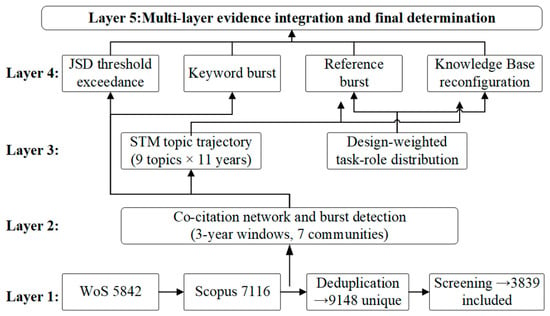
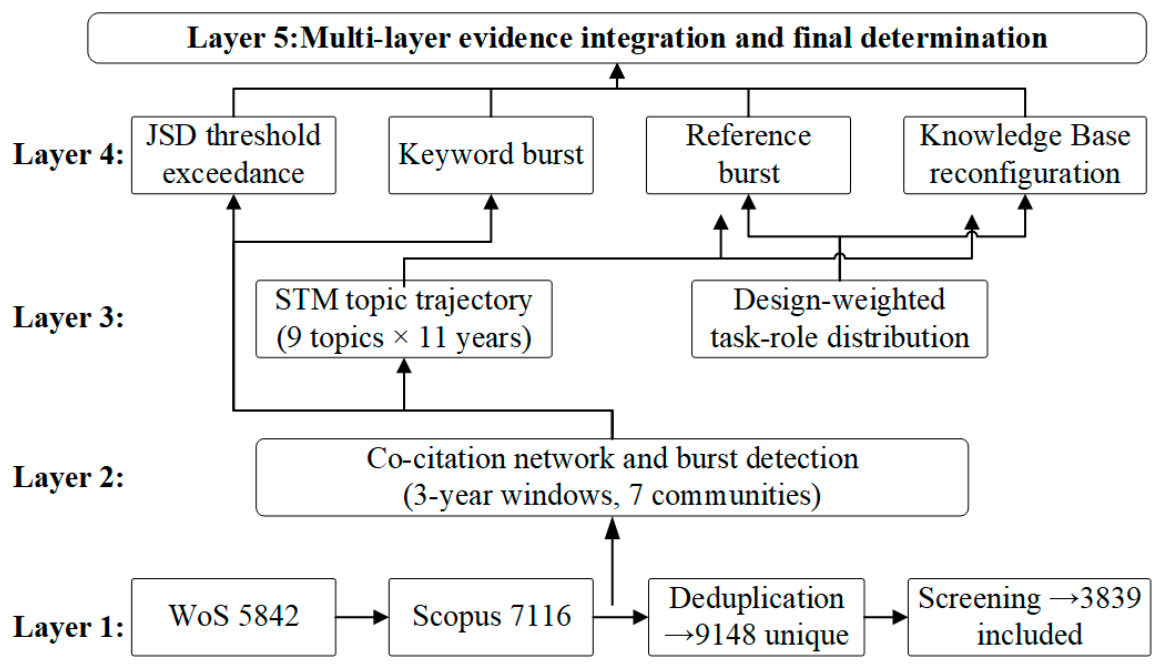
The four strands are treated as partially dependent lines of evidence. There is some overlap in the documents used by topic modeling and co-citation analyses, and they even use time as an element, thus validating each other but not considering them as separate pieces of evidence. The task and role classification derived from a random sample of full texts offers an independent validation of the application level. Figure 1 shows the five-layered framework of analysis which connects output growth, research front (the topics currently attracting attention, as distinct from the cited knowledge base) transition, knowledge base reconfiguration, and pedagogical role change to a pre-specified evidence-labeling scheme. Decision criteria for each label are defined in Section 2.4. Each level is responsible for answering its own question and providing its own burden of proof: output growth is based on numbers alone, research-front shift on the occurrence of a robust topic shift, knowledge-base configuration shift on burst and co-citation evidence, and role change on movement in design weighted coded full texts.
Figure 1.
Five-layer analytical framework linking scientometric mapping, topic and knowledge-base dynamics, and design-weighted role analysis to a pre-specified evidence-labeling scheme. Decision criteria for each label are defined in Section 2.4.
2.2. Data Sources, Search, and Screening
The literature sources used were selected from the Web of Science Core Collection and Scopus, limited only to research articles, reviews, and full conference papers containing peer-reviewed full text. The search strategy comprised four branches. Branch 1 targeted explicit AIED terminology such as “artificial intelligence in education” and “intelligent tutoring system.” Branch 2 combined technology terms (“artificial intelligence,” “generative AI,” “large language model,” “machine learning”) with strong educational context words (“education,” “teaching,” “student,” “classroom”). Branch 3 restricted “learning” to explicit educational phrases such as “learning outcome” and “learning environment” to avoid conflating educational learning with machine learning. In Branch 4, search terms for learning analytics and educational data mining were combined with co-occurrence of context terms for education. In the Web of Science, proximity and truncation operators were employed, but in Scopus, each technology–context combination was broken down into different branches using OR logic to avoid nested distance operators. Prior to conducting the systematic search, the strategy was applied to an item set containing intelligent tutoring, automated assessment, learning analytics, educational machine learning, chatbots, and generative AI to check for recall and identify any false positives. This was conducted using PRISMA 2020 (Page et al., 2021) and reporting PRISMA-S (Rethlefsen et al., 2021). The resulting branch-level retrieval counts are summarized in Table 1.
Table 1.
Search-branch composition across Web of Science and Scopus before screening.
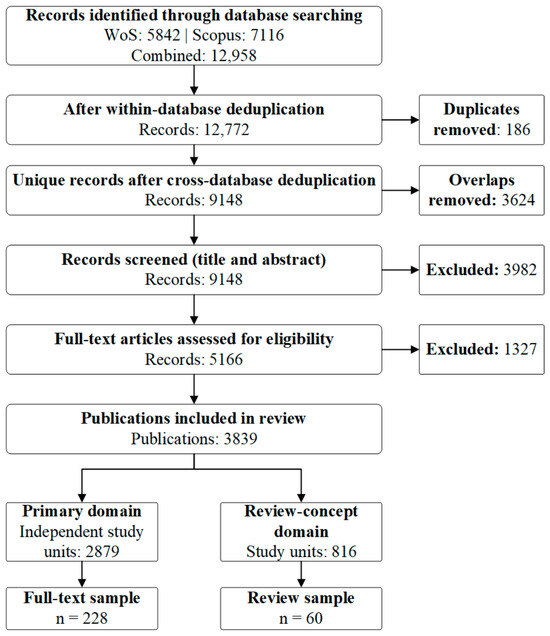
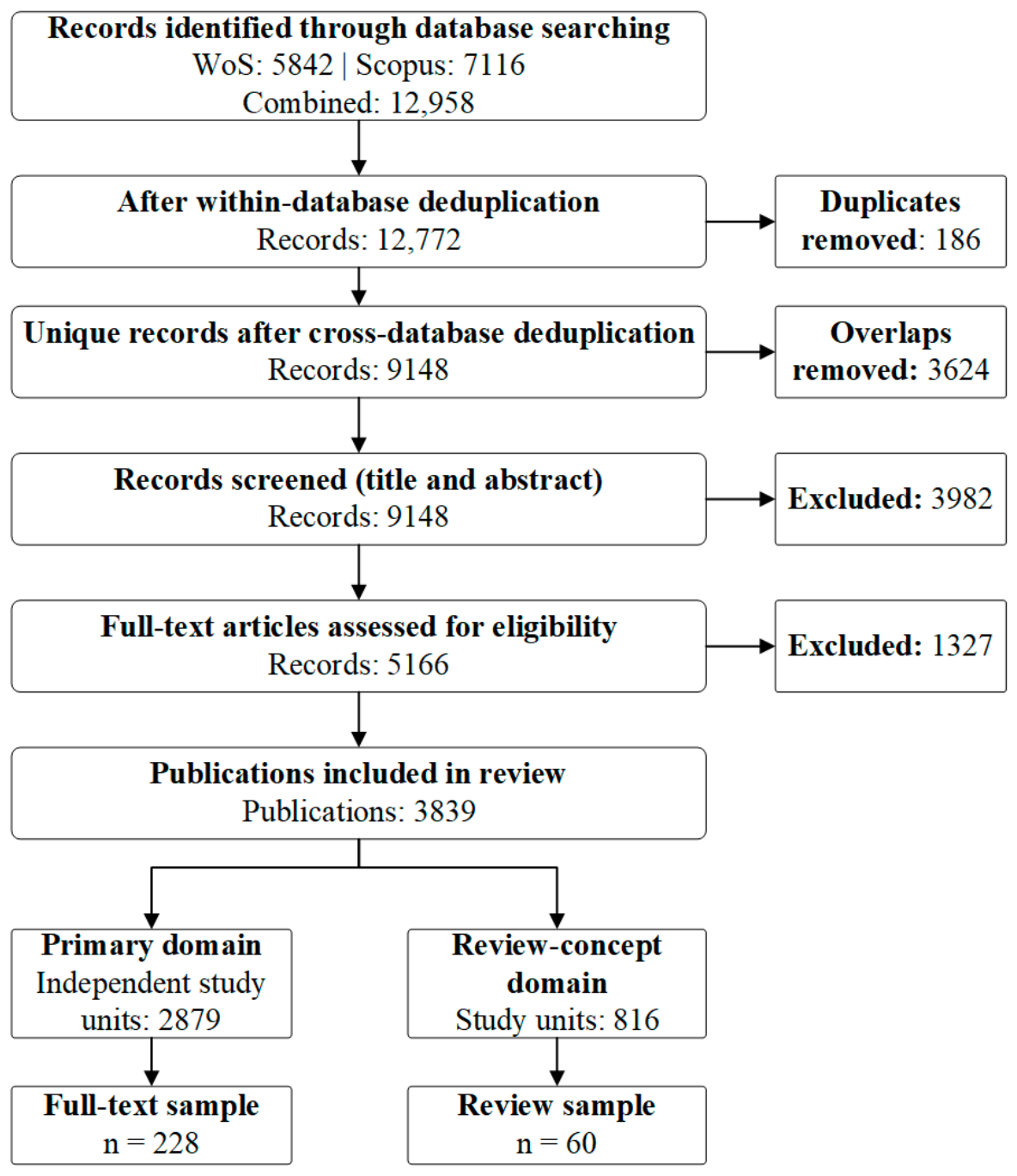
No language restriction was set, although non-English records had to have an English title, abstract, or keyword section. Such records were included in scientometric analysis and coverage analysis, while coding was performed on articles in English that could be properly evaluated by the research team. At title–abstract screening, one reviewer screened all records, and another reviewer checked for each exclusion and randomly selected 20% of the included articles. Conflicts were solved through discussion or by using a third reviewer, and both the exclusion-reversal rate and agreement on the random subset were recorded. Subsequently, two independent reviewers examined all identified full-text articles using the same inclusion criteria. All duplicate records were removed through DOI, title, author, and year. Potential conference-report families in the journals were identified based on title similarity, author, sample, AI tool, and study design. At least 10% of both linked and non-linked high-similarity records were validated manually. The flow diagram is illustrated in Figure 2.
Figure 2.
PRISMA 2020 flow of identification, screening, eligibility, and inclusion across the two databases, including report-family consolidation.
The four branches were designed to ensure that there is a balance between the recall and the precision of each branch. Branch 2 ensured maximum recall in that it used general terminology concerning technology together with a good educational context. On the other hand, Branch 3 specifically restricted the term “learning” to educational terms to avoid being contaminated with numerous machine learning records. Each database indexes a distinct literature and uses a different field structure. The search was therefore translated independently for each, and branch-level results were documented before consolidation so that the strategy can be audited branch by branch. The calibration set for the known item was created based on the most important records in all of the subdomains. A particular branch was considered only after it had successfully identified the known items without making excessive off-topic suggestions, and the wording of the branch was modified accordingly until this criterion was met. The screening cutoffs and exclusion criteria were predetermined in the protocol, and the reversal of exclusions during verification served as an indicator of the quality of screening. Report-family merging was treated as substantive rather than clerical. Counting a conference paper and its expanded journal version separately would inflate both publication and citation growth. The audited linkage accuracy is reported along with the final counts.
2.3. Scientometric Analysis and Structural Topic Modeling
Scientometric mapping included both co-occurrence and network visualization using VOSviewer (version 1.6.20) (Van Eck & Waltman, 2010), with burst and emerging trend analysis using CiteSpace (version 6.3.R1) (C. Chen, 2006). The analysis considered publication volume by year, sources used, collaborations at the level of countries and institutions, bursts of keywords and references, and co-citation analysis. Time-dependent network analysis used sliding windows. Change in topic composition was measured as the Jensen–Shannon divergence (JSD) between adjacent annual topic distributions and assessed by permutation; right-censoring of recent citation evidence was handled as described below. The modularity optimization technique was used to determine the community structure of the co-citation network, where the description of the communities involved their size, average formation year, and internal silhouette to flag still-consolidating clusters.
Structural topic models (Roberts et al., 2014) were fitted to the abstracts, with publication year entered as a smooth covariate using a restricted cubic spline function with database and document type as control variables. Models with six to twelve topics were compared using semantic coherence and residual dispersion. Topic assignments were validated independently by two raters on a sample of 50 abstracts that was coded blind, and the one with the greatest agreement and educational relevance was used. The sensitivity analyses involved various topic numbers, combinations of databases, and document selection criteria. All documents were classified based on their respective dominant topic, while robustness was examined using the posterior probability weighting and removal of uncertain documents. Transition windows were found using peaks of the JSD measure, and this was supplemented with document level bootstrapping to account for uncertainty as well as year label permutation to avoid false positives. Surviving windows were cross-validated against keyword bursts, reference bursts, and co-citation reconfiguration.
The reference distribution was built by randomly permuting publication-year labels across documents while holding the number of documents per year fixed, refitting the year-by-year topic proportions, and recomputing all ten adjacent-year JSD values. In each of 5000 permutations the largest of the ten values was retained, and the 95th percentile of this maximum distribution gave a single threshold of 0.0443. Because the threshold is derived from the maximum statistic, it controls the family-wise error rate across the ten comparisons and no further multiplicity adjustment was applied. A window was declared significant when its observed JSD exceeded 0.0443, equivalently when its permutation p-value was below 0.05. Bootstrap confidence intervals were obtained by resampling documents within years and are reported to describe the precision of each divergence estimate; they were not used as a second decision rule, since a lower bound near the threshold indicates a weakly rather than a non-significant window. This rule departs from the wording of the original submission, which described retaining only windows whose bootstrap interval lay well above the threshold. The analysis protocol, drafted internally before model fitting and not publicly preregistered or time-stamped, specified the permutation threshold as the significance criterion but did not state whether the bootstrap interval was a second condition; the original wording therefore described a stricter rule than the one applied, and we report the current rule as a deviation from that stated rule. We retain the permutation rule because the maximum-statistic threshold already controls the family-wise error rate, whereas requiring the interval’s lower bound to clear it adds a second criterion with no defined error rate. Because the choice affects only the 2019–2020 window, classifications under both rules are reported in Section 3.4. Robustness was defined operationally: a window had to remain significant under all 16 core and 22 extended specifications, which varied topic number, database composition, and document processing. Only windows meeting this criterion entered adjudication. In the case of the co-citation graph, the communities were characterized by their size, average formation year, and silhouette. A high silhouette with an early mean formation year indicates an established, well-separated base. A late mean formation year indicates a newer community whose citations are right-censored and therefore understated. The right-censoring problem went beyond mere mention to being built into the criteria for labeling, so that claims about newly formed clusters were labeled more conservatively than claims about established ones.
2.4. Full-Text Coding and Design-Weighted Models
Full texts were coded in two sampling domains: the primary application domain (N = 2879) and the review-concept domain (N = 816). Primary-domain units were stratified by four calendar segments × three dominant-topic families—tutoring and adaptive support (T1, T4), analytics and assessment (T2, T3, T5), and user-facing and generative applications (T6–T9)—giving 12 strata; the review-concept domain was stratified by calendar segment only (4 strata). Allocation was proportional to stratum size with a floor of 10 units per stratum. Across 2000 simulations, detecting a 15-percentage-point change in coagency at 80% power required 215 codable units at an assumed design effect of 1.30, inflated to 240 drawn units to allow for full-text loss.
Base weights were the inverse within-stratum selection probability, wh = Nh/nh. Of 240 primary units drawn, 12 were uncodable (unretrievable full text or out of scope on inspection), leaving n = 228; non-retrieval was treated as missing at random within stratum by multiplying base weights by the reciprocal of the stratum retrieval rate, and weights were then rescaled to the domain population. The review-concept domain followed the same procedure (64 drawn, 60 coded). Primary-domain weights ranged from 3.2 to 28.7 (CV = 0.52), implying an unequal-weighting design effect of 1 + CV2 = 1.27 and an effective sample size of about 180.
The primary variable, coagency, recorded whether end-users (teachers and learners interacting with the AI system) could initiate tasks, choose among options, and modify AI outputs. Secondary outcomes were direct user interaction, the dominant AI role (four categories), ordinal levels of teacher decision authority and learner agency, and educational tasks (multi-label). A 20% subsample was coded independently by two coders, with reliability targets of κ ≥ 0.70 for nominal and ordinal variables (weighted κ for the latter) and ICC(2,1) ≥ 0.75 for continuous variables. Table 2 provides the list of coding variables along with their operational definitions.
Table 2.
Core coding variables, measurement type, and analytic model.
The primary model was a design-weighted binomial logistic regression of coagency on calendar segment, incorporating stratification and inverse sampling weights. Two contrast types are reported and should not be conflated. Overall contrasts compare the first and last calendar segments (2015–2017 vs. 2024–2025) and summarize change across the period. Boundary-specific models split the sample at a single transition year and test whether the outcome differs before and after that boundary. The former cannot localize change to any one window. Boundary-specific models were fitted at both significant windows (publications before 2020 vs. 2020 onward; before 2023 vs. 2023 onward) for direct interaction and coagency. A non-significant boundary estimate is reported as no detectable change rather than as stability. The four-category AI role was analyzed with a weighted multinomial model, teacher authority and learner agency with weighted ordinal models, and direct interaction and each task label with weighted binomial models. Standard errors were estimated via design-based Taylor linearization, using 2000 stratified bootstrap repetitions. Percentage-point changes were computed as differences in design-weighted marginal predicted probabilities, with 95% CIs taken from the same bootstrap replications. Topic-time effects were analyzed using a global design-based Wald test, with Benjamini–Hochberg-corrected contrasts applied only to topics that had enough weight data. The evidence codes were specified in the internal protocol before analysis and reserved for the paradigms at the localized and field levels according to increasing joint evidence strength on output, research front, knowledge base, and pedagogic contribution. These labels are operational categories of this study’s classification scheme, not independently validated descriptions of the field. “Localized paradigm-level reconfiguration” denotes the specific evidence configuration in which a significant topic transition, burst and co-citation support, and a role change in at least one topic co-occur while coverage and aggregate role criteria remain unmet; it records what the evidence layers jointly permit us to say, and carries no claim that a paradigm shift has been independently established. The vocabulary is borrowed from Kuhn (2012) but the usage is deliberately narrower. We do not test for incommensurability, crisis in normal science, or textbook and training change, which are central to the Kuhnian account and lie beyond what bibliometric and coded-literature evidence can establish. Our labels refer only to measurable reconfiguration in the research front, the cited knowledge base, and coded teacher–learner roles. “Field-level paradigm shift” is accordingly an upper bound within this operational scheme rather than a claim that a Kuhnian revolution has occurred.
Apart from the window decision rule discussed in Section 2.3, the criteria were set before analysis. Publication growth requires only a rising annual count; a research-front transition requires an adjacent-year JSD above the permutation threshold that survives all sensitivity specifications; knowledge-base reconfiguration additionally requires convergent keyword and reference bursts plus a change in co-citation structure; localized paradigm-level reconfiguration additionally requires a significant post-FDR coagency change in at least one topic; and a field-level paradigm shift requires, beyond these, that the driving topics cover more than 50% of the weighted inference sample, that the point estimate of the aggregate coagency change be at least 20 percentage points, and that no driving community be right-censored (mean formation year within two years of the observation end). The two numerical thresholds are conventions: 50% is the weakest defensible reading of “field-level,” and 20 points was set above the 15-point effect the design was powered to detect, so that a negative result reflects a small change rather than low power. The protocol did not state whether the 20-point criterion applied to the point estimate or to the interval; we apply it to the point estimate and report the interval alongside, noting where the interval does not exclude the threshold.
Reliability was established prior to the primary coding process instead of being assumed. Calibration on 46 documents yielded agreements of κ = 0.78 on coagency, κ = 0.76 on role of AI, quadratic weighted κ = 0.887 on teacher’s authority and ICC(2,1) = 0.937 on duration of the study, all above the required level. Learner agency initially fell short at κ = 0.660. Disagreement was concentrated at a single ordinal boundary, between learners selecting from options the system supplied and learners setting the task or goal themselves: coders differed on 14 of the 19 discordant cases there, while the remaining levels were assigned consistently. Two sources accounted for most of these. First, studies reporting rich interaction—open-ended chat, multiple attempts, free-text prompting—were read by one coder as evidence of agency even where the system fixed the task, conflating volume of interaction with control over it. Second, papers describing learner control as an intended design feature without reporting whether learners exercised it were coded from the stated design rather than the reported use. The codebook was revised to anchor each level to what learners were reported to have done rather than to what the system afforded, to require an explicit statement of learner-initiated task selection before the higher level could be assigned, and to route design-intent-only cases to the lower level with a flag. After recoding 58 papers under the revised rules, agreement reached κ = 0.931. A subsequent check on 36 documents revealed that 91.7% of agreement was reached in terms of the whole coding process. In addition to the main dependent variables, there was a secondary level of role coding, along with some important dimensions (harm potential, transparency, fairness, accessibility, and privacy). These dimensions were coded only descriptively as part of the context rather than theoretically. The use of sampling weights and stratification was included in each of the models so that the results would be representative of the target population rather than the attained sample, while the bootstrap replication accounted for the stratified sampling design.
3. Results
Each subsection addresses one research question in turn, reporting descriptive findings first and interpretation separately. Effect estimates are given as odds ratios with 95% confidence intervals; percentage-point changes are reported on the probability scale with their own 95% confidence intervals.
3.1. Output Growth and Collaboration Structure (RQ1)
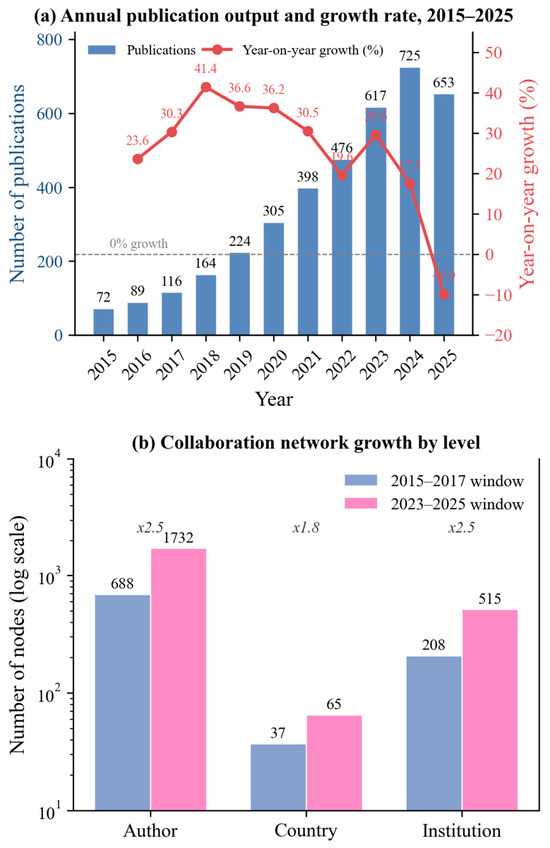
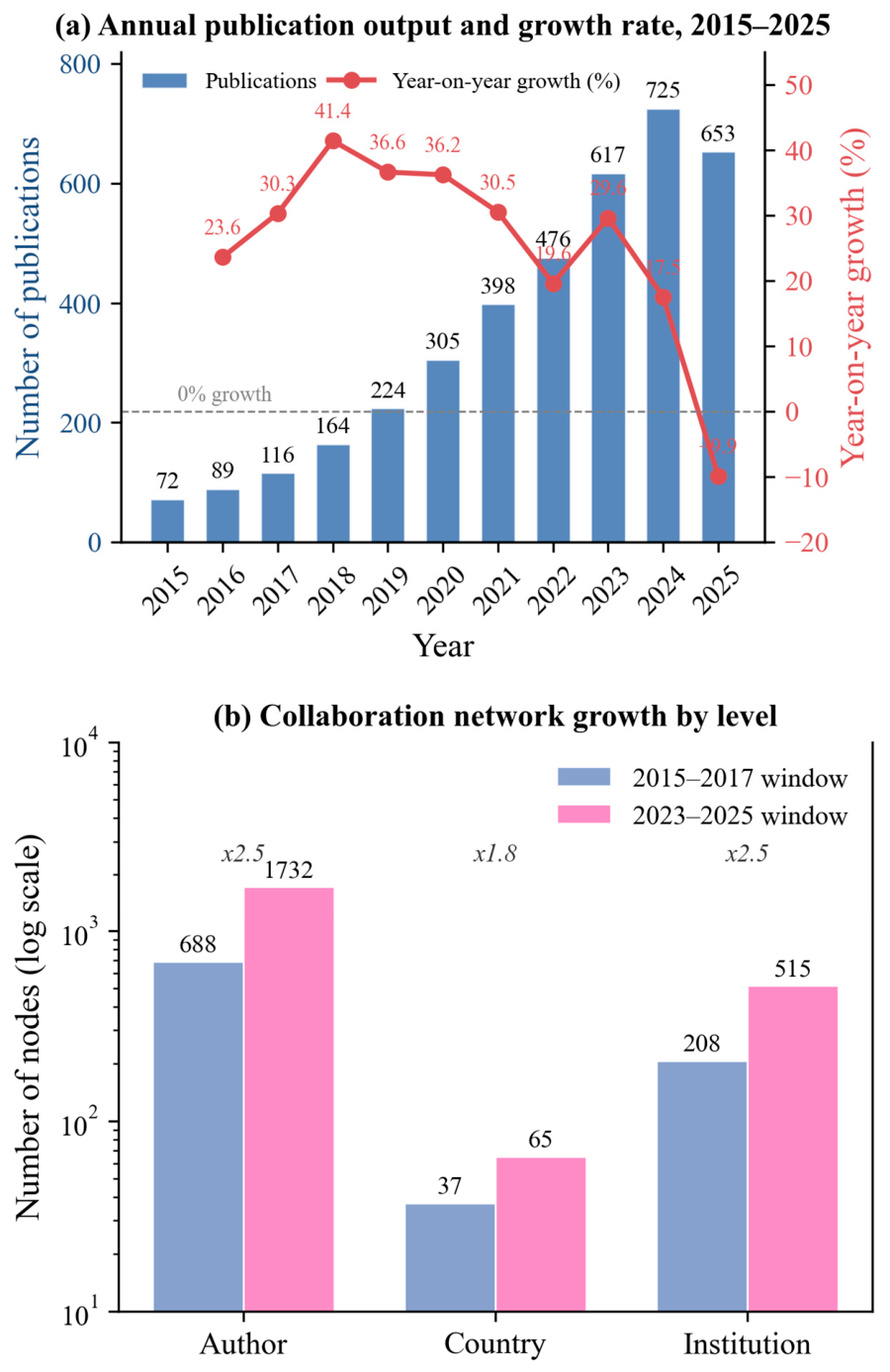
The two databases produced a total of 12,958 branch-deduplicated documents (5842 from Web of Science and 7116 from Scopus). Deduplication of the documents resulted in 9148 unique documents after excluding 186 duplicates within the database and 3624 duplicates between the databases. Title-abstract screening rejected 3982 documents, while full-text screening of 5166 documents rejected 1327 documents, thus leaving 3839 publications for inclusion in the study. Report-family consolidation narrowed this down to 3695 unique study units, including 2879 primary applications and 816 reviews or conceptual records. There were 228 primary studies and 60 review or conceptual samples in the critical coding. The yearly production of publications showed a steady increase from 72 in 2015 up to 725 in 2024, declining slightly to 653 in 2025. The annual growth rate fell from over 30% in the latter half of the 2010s to −9.9% in the last year, which is still accumulating, indicating sustained expansion with a flattening trajectory rather than contraction.
All collaboration networks became denser in terms of nodes at all network levels (Figure 3). The number of country nodes increased from 37 to 65, while the density of country networks increased from 0.126 to 0.209. The number of institution nodes increased from 208 to 515, while their density increased from 0.0049 to 0.0088. The number of authors nearly tripled from 688 to 1732, and author network density rose slightly from 0.0049 to 0.0053, while author centralization fell from 0.021 to 0.014. It shows that the field is being developed by many newcomers rather than by a small group of prominent researchers. According to the pre-specified labeling scheme, these results are interpreted only as growth of publications and collaborations rather than as a change in the research paradigm (Table 3).
Figure 3.
Annual publication output with year-on-year growth (a) and collaboration network node growth by level on a logarithmic scale (b), 2015–2025. The gray dashed horizontal line indicates 0% year-on-year growth and separates positive from negative growth.
Table 3.
Collaboration network indicators for the first (2015–2017) and last (2023–2025) windows.
The figures above are descriptive; read together, they carry three implications. Scopus made up 54.9% of the total number of records while Web of Science was 45.1%, and the overlap between the databases of 3624 records (28.0% of the total) shows that neither database on its own would cover the area: a one-database methodology would have failed to capture between a quarter and a third of relevant materials. Within-database redundancy was minimal (186 records), whereas cross-database overlap was substantial (3624 records), confirming that the two sources index largely distinct bodies of literature. The distinction between 2879 primary application studies and 816 review or conceptual pieces demonstrates that empirical research remains dominant, yet the significant number of reviews suggests that the field is self-reflective. The increase in nodes of countries and institutions along with increasing country network density from 0.126 to 0.209 illustrates the growing involvement of the international community, whereas decreasing author centralization in spite of threefold growth in authorship is the most explicit evidence that the field’s expansion results from an inflow of newcomers rather than the consolidation of a small core of researchers. This is the context for the topic and role analysis to come: it indicates that the field is bigger and more diffuse, but shows nothing so far about whether its knowledge foundation or teaching practices have changed.
3.2. Research-Front Transitions and Knowledge-Base Reconfiguration (RQ2)
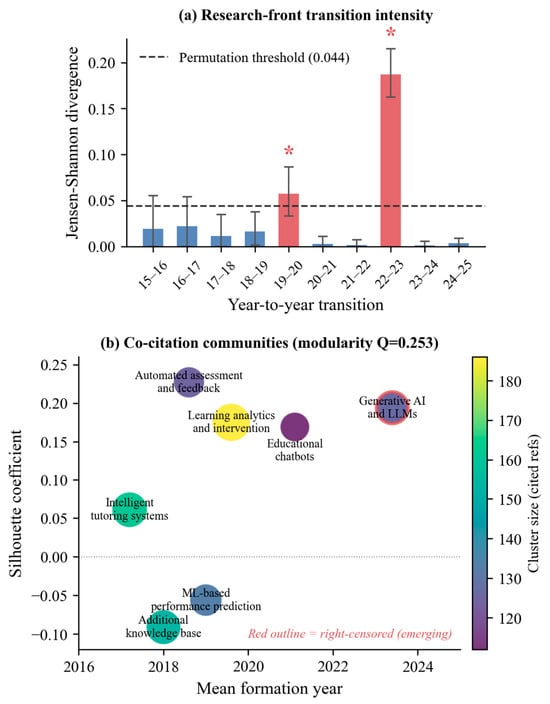
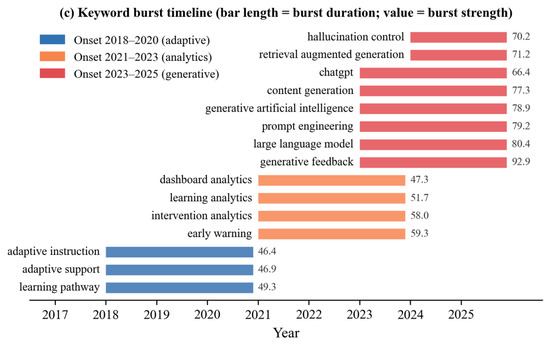
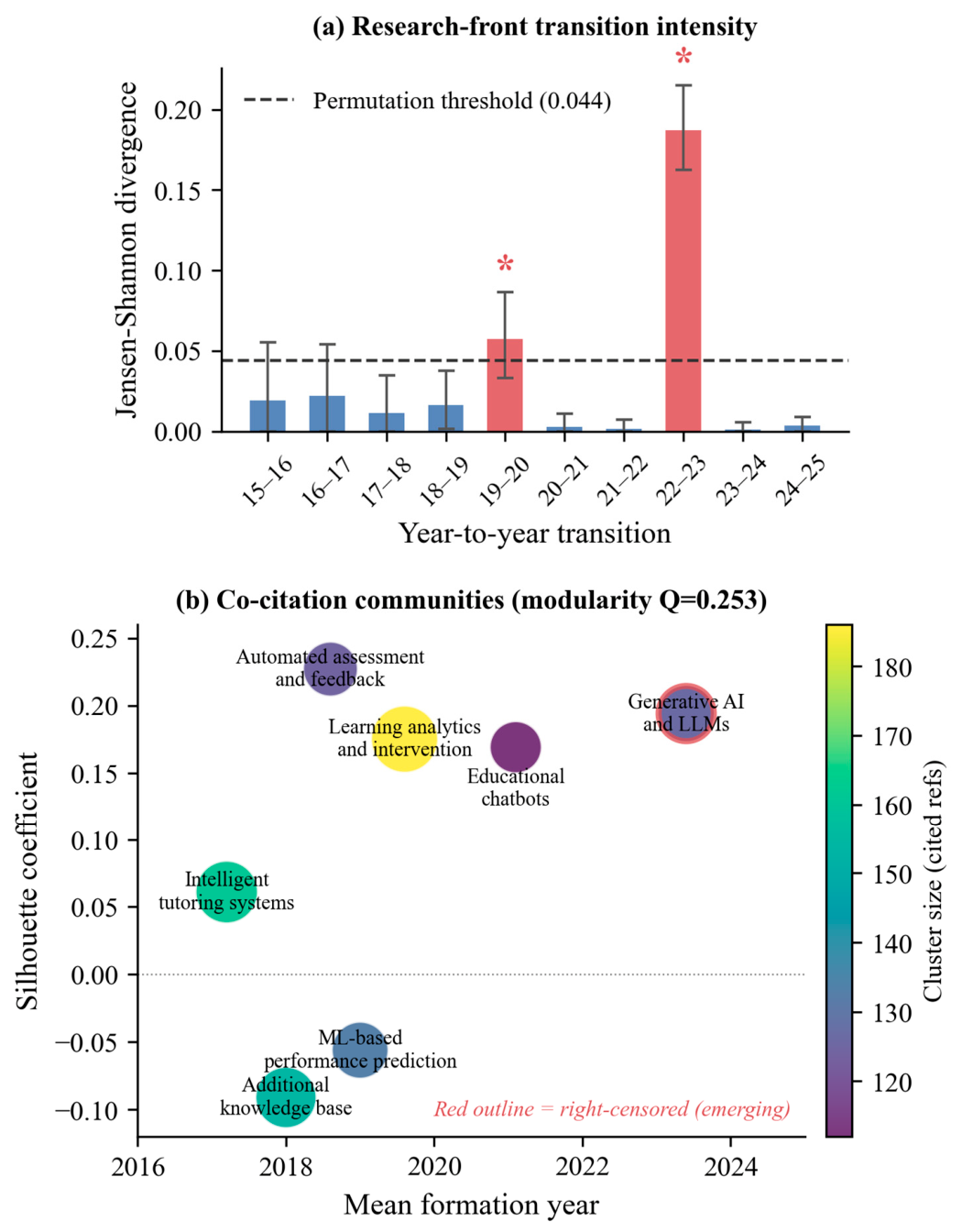
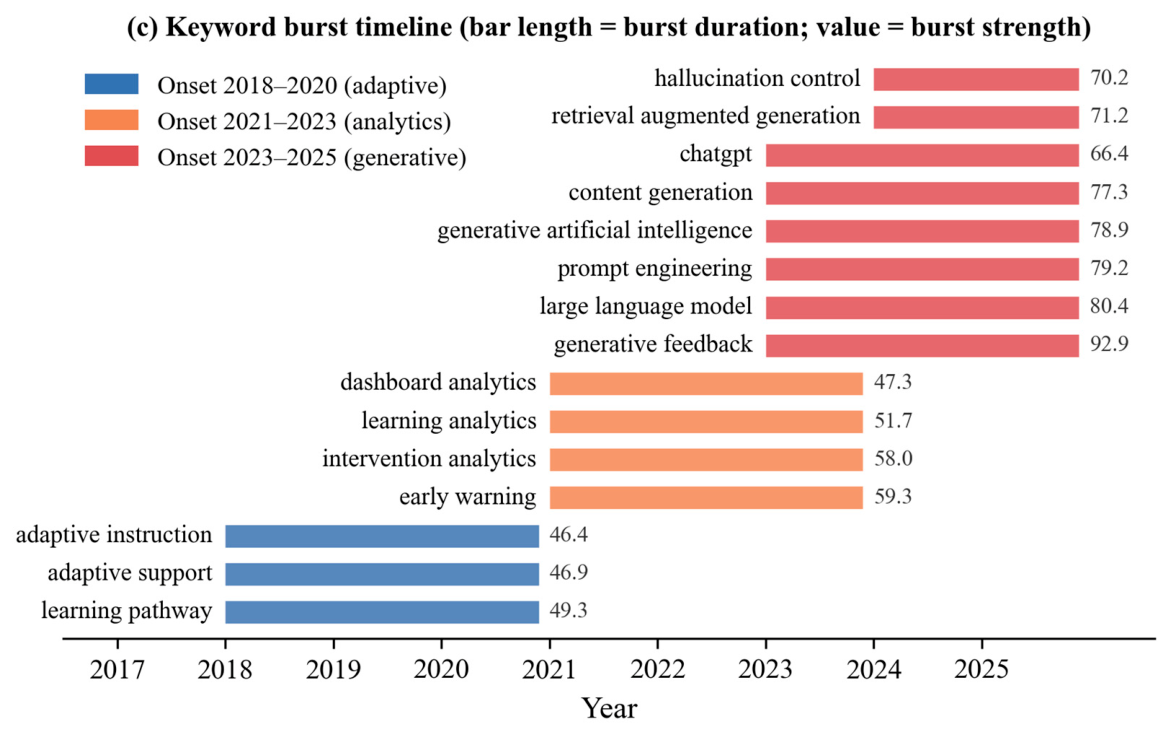
Two adjacent-year windows exceeded the permutation threshold of 0.0443 (Figure 4a). The 2019–2020 window reached JSD = 0.058 (95% CI 0.033–0.087; permutation p = 0.021) and the 2022–2023 window reached JSD = 0.187 (95% CI 0.162–0.215; permutation p < 0.001), the maximum of the series. The lower bootstrap bound for 2019–2020 falls just below the threshold, so this window is the weaker of the two, whereas the entire interval for 2022–2023 lies far above it. Under the stricter interval-based rule described in the original submission, 2019–2020 would not qualify as a transition window, whereas 2022–2023 would qualify under either rule. Both windows remained significant across all 16 core and 22 extended specifications. No other window was able to achieve statistical significance. The transition from 2019 to 2020 was corroborated by the presence of keyword bursts (such as adaptive support and learning pathways, 2018–2020; early warning and intervention analytics, 2021–2023) and reference bursts, as well as by co-citation reconfiguration, consistent with a genuine research-front migration toward learning analytics, prediction, and automated assessment rather than mere volume growth.
Figure 4.
Temporal evolution of the knowledge structure: JS divergence, co-citation communities, and keyword bursts. The dashed line marks the 0.0443 threshold, the 95th percentile of the maximum adjacent-year JSD under 5000 year-label permutations. * indicate transitions exceeding the permutation-derived threshold (p < 0.05).
The 2022–2023 window showed the maximum divergence of the study period, coinciding with strong bursts in generative-AI terminology. Generative feedback had a burst strength of 92.9, followed by large language models (80.4) and prompt engineering (79.2). The co-citation network (Figure 4b) revealed seven clusters of literature with a modularity of Q = 0.253, revealing a moderately well-separated partitioning. The existing communities based on learning analytics and interventions (186 references, average year 2019.6), intelligent tutoring systems (161, 2017.2), and automated assessments (124, 2018.6) were coexisting along with a recently emerged cluster of generative-AI and large-language-models (126 references, average year 2023.4, silhouette 0.194) that was flagged as right-censored.
The communities also differed in internal structure. The automated assessment community had the highest silhouette score (0.227). Similarly, the learning analytics and interventions community and the educational chatbots community had relatively high silhouette scores (0.175 and 0.169, respectively). However, the additional knowledge base community (−0.091) and the machine-learning performance prediction community (−0.056) had negative silhouette scores, suggesting that the clusters have transitional cores instead of defined cores. The generative-AI cluster combined a recent mean formation year with a comparatively high silhouette of 0.194. This same pattern of development emerges from the burst analysis on the keyword side, where bursts were found in adaptive support (46.9), adaptive instruction (46.4), and learning pathway (49.3) in the 2018–2020 era, in early warning (59.3), intervention analytics (58.0), and learning analytics (51.7) in the 2021–2023 era, and in generative feedback (92.9), large language model (80.4), prompt engineering (79.2), and generative artificial intelligence (78.9) in the 2023–2025 generative cluster. The onset order of these bursts tracks the topic trajectories described above. That the later bursts are stronger is consistent with, but does not establish, a more concentrated reorganization in 2022–2023.
Taken together, these patterns suggest the following reading. The 2019–2020 restructuring reallocated attention among existing topics, whereas 2022–2023 saw a new intellectual core form at the periphery, with a citation basis of its own rather than one gradually diverging from an existing cluster. The coexistence of established and new communities points to accumulation and recombination of the cited knowledge base rather than replacement: the knowledge base moved in both periods, but only in the later one did a new core emerge (Figure 4c).
3.3. Topic Trajectories, Tasks, and Teacher–Learner Roles (RQ3)
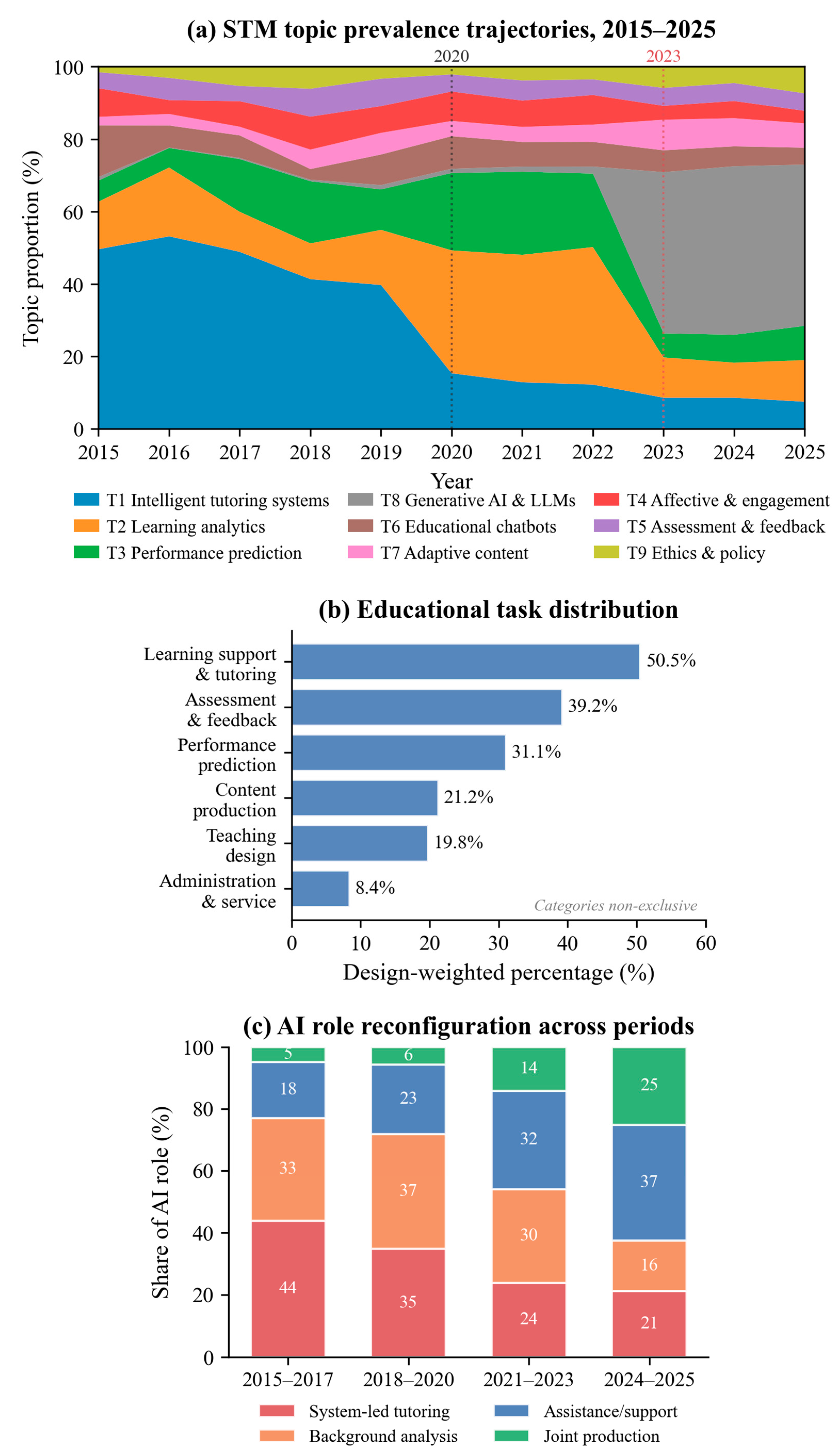
The structural topic model was able to identify nine topics, and both windows were consistent regardless of the topic and subsample manipulation. Among all documents in the corpus, the most frequently appearing topics were generative AI and LLM support (T8, 24.1%) and learning analytics and performance prediction (T2, 18.9%), followed by intelligent tutoring and adaptive support (T1, 16.1%) and automated assessment and feedback (T3, 12.8%). Topic trajectories shifted markedly (Figure 5a): T1 collapsed from 49.6% of attention in 2015 to 7.5% in 2025; T2 peaked at 37.9% in 2022 before falling to 11.4%; and T8 rose from below 2% through 2022 to 44.5% in 2023, holding near that level thereafter. The most common coding categories for the full-text sample included learning assistance and tutoring (50.5%), assessment and feedback (39.2%), performance prediction and analysis (31.1%), while administration was the least common at 8.4% (Figure 5b).
Figure 5.
Topic prevalence trajectories (2015–2025), educational-task distribution, and AI-role composition over time.
AI roles changed in all four eras (Figure 5c) in the following way: background analysis and prediction declined from 33.1% to 16.4%, tutoring roles by the system decreased from 43.9% to 21.2%, and assistance and decision support roles increased from 18.2% to 37.2%, while joint production was more than five times higher in the later period at 25.2% compared to 4.8%. Across the period as a whole—that is, comparing 2015–2017 with 2024–2025—coagency increased by +5.9 percentage points (95% CI [−10.5 to +22.3]; OR = 1.45, 95% CI 0.53–3.98, p = 0.481) and direct user interaction by +31.3 points (95% CI [+10.7 to +51.9]; OR = 4.30, 95% CI 1.64–11.27, p = 0.0030). These are overall contrasts, not tests of any single transition. Boundary-specific models detected no change at either window: at 2020, direct interaction OR = 1.62 (95% CI [0.78–3.37], p = 0.20) and coagency OR = 0.94 ([0.42–2.10], p = 0.88); at 2023, direct interaction OR = 1.15 ([0.42–3.18], p = 0.79) and coagency OR = 1.31 ([0.62–2.76], p = 0.48). The overall increase in direct interaction therefore cannot be attributed to either window. None of the ordinal measures of authority changed substantially: teacher decision authority increased by +8.1 percentage points (95% CI [−14.2 to +30.4]; OR = 1.42, 95% CI 0.54–3.71, p = 0.476) and learner agency by +13.9 points (95% CI [−1.8 to +29.6]; OR = 2.95, 95% CI 0.87–10.02, p = 0.082). The time × topic interaction was highly significant (design-based Wald test, p = 1.12 × 10⁻¹⁰), and among the FDR-corrected topic contrasts only T8 showed a significant change in coagency (OR = 27.91, 95% CI 2.83–275.14, q = 0.017). The interval spans two orders of magnitude, so the estimate supports the direction of the change but not its size; on the probability scale the same contrast corresponds to a rise of +38 percentage points with a 95% interval of +9 to +66. The imprecision follows directly from the design: T8 accounted for under 2% of the corpus through 2022, so only 7 of the 45 coded T8 units fall in the first two calendar segments, and the odds ratio is estimated from a sparse early cell. Since neither T6 (OR = 0.52, 95% CI 0.23–1.19, q = 0.090) nor T7 (OR = 0.40, 95% CI 0.14–1.16, q = 0.090) reached significance, the increase in coagency is found only for generative-AI applications rather than across other user-oriented topics (Table 4).
Table 4.
Corpus-wide prevalence and 2015–2025 endpoint proportions for the nine STM topics.
Two further descriptive patterns bear on how the role results should be read. First, the task profile is dominated by content-related functions, namely learning assistance (50.5%), assessment (39.2%), and prediction (31.1%), followed the other functions, content/resource creation (21.2%), teaching design and coordination (19.8%), and administration (8.4%). Therefore, the development of joint production is mainly restricted to the areas where AI either creates or assesses content. In the second place, the coding at a secondary level provides a more balanced picture than the role counts of dominant roles do, since the functions of secondary background analysis (19.8%), joint production (17.7%), assistance (16.0%), and system-led tutoring (14.2%) are all equally represented, indicating that most applications blend several roles rather than occupying a single one. From a descriptive standpoint, the coding identified key elements among some cases: potential harm (18.1%), transparency (13.9%), fairness (12.1%), accessibility (6.3%), and privacy (6.1%).
Interpreting these distributions: The coexistence of increased joint production with continued background and system-led roles fits a recombination rather than a replacement account. The contrast between a substantial increase in direct interaction and a small, non-significant change in coagency is the central observation—users interact with AI far more often without necessarily gaining more control over it. That the period-wide rise in direct interaction was significant while neither boundary model was suggests a gradual increase across segments rather than a step change at either window, although the wide boundary intervals do not exclude moderate changes at either point.
3.4. Integrated Adjudication of Change Against the Pre-Specified Criteria (RQ4)
This subsection applies the criteria defined in Section 2.4 to the evidence reported above; it is classificatory rather than descriptive (Table 5). For the 2019–2020 window, there was a significant shift in topic (JSD = 0.058 > 0.0443), but boundary-specific models at 2020 detected no change in direct interaction or coagency (Section 3.3), and no topic-level coagency contrast relevant to this window reached significance. In the absence of a detectable task-role change, the 2019–2020 window is labeled a research-front transition accompanied by a knowledge-base reconfiguration. This label depends on the decision rule. Under the interval-based rule the window would fail the topic criterion, and because each higher label presupposes it, the window would be classified as publication growth, with its keyword bursts, reference bursts, and co-citation reweighting reported descriptively only. The 2022–2023 classification is the same under either rule. On the other hand, the 2022–2023 window is characterized by the maximum JSD during the period (JSD = 0.187), a burst of generative-AI research, emergence of a new co-citation community, a significant interaction between time and topic, and T8-specific coagency growth, so it additionally satisfies the role-change criterion—though this criterion is met on the direction of the T8 effect, not on its magnitude, which remains imprecisely estimated. The role-change criterion is met through the topic-level T8 contrast. The overall direct-interaction and coagency contrasts span the whole period and are not attributed to either window, since neither boundary-specific model detected a change at 2020 or 2023.
Table 5.
Multi-layer evidence adjudication for the two significant transition windows.
However, the topic group selected from the perspective of the user (T6-T8, where only T8 experienced a significant change) covered 36.6% of the weighted inference sample (73 of 228 coded units, 32.0% unweighted), falling below the 50% coverage required for a field-level shift, and the point estimate of the aggregate coagency change (+5.9 points, 95% CI [−10.5 to +22.3]) fell short of the 20-percentage-point cutoff (Section 2.4). Because the upper bound exceeds 20 points, the data do not exclude a change of that size; the field-level label is nonetheless withheld, since the coverage criterion is independently unmet. T9 was excluded from this coverage set because it had too few early-segment coded units (2 of 9) for a topic-level coagency contrast (Section 2.4); this exclusion was made at adjudication rather than specified in the protocol, and including T9 raises coverage to 41.0% (82 of 228 coded units), still below 50%. In combination with the moderate-to-heavy right-censoring observed in the generative-AI community (average formation year 2023.4), this evidence configuration is classified under our scheme as localized paradigm-level reconfiguration rather than a field-level paradigm shift. The label reflects a pattern concentrated in T8 alongside a non-significant aggregate coagency change (OR = 1.45, 95% CI 0.53–3.98, p = 0.481); it summarizes the position of the 2022–2023 window within the labeling framework rather than certifying a paradigm shift on independent grounds. The two windows, therefore, are of a different order: one is concerned with allocating attention to the current analytical constructs while the other entails a whole new construction of knowledge and transformation of the applications process without a shift in decision-making. Neither window enables a clear division of 2015 to 2025 into stages because the presence of dying, peaking, and rising areas implies a recombination rather than linear progression.
The ruling also makes clear why there seems to be disagreement between the aggregate results and the topic-level results. The interaction between time and topic for the aggregate is statistically significant, which implies that coagency does not move in lockstep, and the contrasts using FDR-correction have found that the movement occurred nearly exclusively within Topic 8. The flat aggregate estimate of coagency is therefore the result of averaging a strong Topic 8 effect with flat or negative effects from other topics. The same reasoning holds true regarding the coverage: since the driving topics make up 36.6% of the weighted sample, any actual change within a minority of the corpus can be recognized as such but not exaggerated into something field-level, where the conflation of strength and scope would take place. Finally, the difference between the two windows at the role level, with no detectable change in 2019–2020 and a topic-specific change in 2022–2023, shows that the classification scheme does not simply confirm, but actually discriminates. Both windows passed the topic criterion under the permutation rule, yet they received different labels because only one showed movement in the deeper evidence layers. This was the desired behavior of the scheme designed to resist over-claiming.
4. Discussion
4.1. Knowledge Evolution and Layer-Specific Transitions
The following interpretation goes beyond what the analysis measures directly. The measured quantities are topic proportions, burst strengths, co-citation structure, and coded roles; statements about what these imply for the evolution of the field are inferences, reported as such. There is a difference in the windows, depending on the layers where the changes took place. The 2019–2020 window, the weaker of the two and sensitive to the decision rule, represents the restructuring of the research focus and knowledge base as AIED moved from classic intelligent tutoring to learning analytics, predictions, and assessments. Since boundary-specific models detected no change in task-role outcomes in 2020, the evidence for this window is confined to the research and knowledge layers, although the wide intervals do not exclude a moderate role change. The explanation for this phenomenon can be found in the description of AIED as an oscillating field between hype and consolidation, where expectation frequently outpaces durable contribution (Humble & Mozelius, 2022). The 2022–2023 window differs in kind: generative AI and large language models accompanied a rapid expansion, with topic distributions, bursty terms, citation clusters, and role coding converging within T8 on the evidence configuration our scheme labels localized paradigm-level reconfiguration.
However, neither approach supplanted the more traditional topics. Intelligent tutoring, learning analytics, and automated assessment remained relevant areas of focus, suggesting that the knowledge structures of AIED evolve through coexistence and combination of technology, tasks, and theory, as opposed to direct replacement. This accords with accounts of pedagogical intelligence that treat AI as incorporating, rather than replacing, existing educational knowledge (Díaz & Nussbaum, 2024). However, the existing system is proven to be effective in terms of instruction since studies suggest that intelligent tutoring systems can make students learn something valuable (Ma et al., 2014) and sometimes they can be close to human tutoring (Kulik & Fletcher, 2016), despite the comparative studies showing where they fail in comparison with human-to-human tutoring (VanLehn, 2011). The emergence of generative AI technologies should be perceived in this layered, coexisting structure. The 2022–2023 reconfiguration is more pronounced than that of 2019–2020. It nonetheless lacks the coverage and citation maturity required for a field-level label. The two windows therefore represent transitions at different layers.
The two windows being layer-specific would change the interpretation of the established story about paradigm evolution in AIED. Instead of the clear transition from tutoring to analytics and to generative AIED, it becomes apparent that the former paradigms are still around despite the development of newer bases, and thus, the structure of the field at any particular moment is an overlap of active approaches rather than a single dominant one. This has an immediate methodological implication for the process of reviewing: since there may be a peak in one field while other fields remain quietly robust, bibliometric prominence cannot be taken as an adequate measure of either displacement or maturity. The pre-specified classification scheme used here is one such method of doing so, but the important general point is that any claim of a paradigm shift must state the level at which the shift is claimed, the evidence on which it rests, and whether the term is used in a Kuhnian or an operational sense. In this way, the 2022–2023 period is more consistent with the rapid establishment of a new foundation in parallel with the old rather than on top of it, which is why its citation immaturity and bounded coverage matter so much for how strongly it can be labeled.
4.2. Educational Tasks, Teacher–Learner Roles, and Topic Composition
At the application layer, direct interaction increased by more than 31 percentage points between the first and last calendar segments, an increase not localized to either transition window, and the dominant AI role shifted from background analysis and system-led tutoring toward assistance and joint production, a pattern consistent with accounts of hybrid human–AI learning systems in which machines take over repetitive tasks (Molenaar, 2022). What is particularly notable about the results is the mismatch between these findings: as interaction and visibility increased, coagency did not significantly increase. Greater proximity between AI and users was not accompanied by a corresponding increase in decision-making authority processes, paralleling the findings that shifts in interaction between learners and instructors do not in and of themselves shift power (Seo et al., 2021) and that visibility alone does not defer to human judgement unless explicitly designed for (Khosravi et al., 2022). This is consistent with the argument that control over learning is a design decision grounded in the learning sciences rather than a by-product of technical capability (Luckin & Cukurova, 2019), and it offers one reading of why direct interaction rose substantially while coagency did not.
The strong time-by-topic interaction and the isolated T8 effect indicate that any redefinition of role is confined to generative-AI applications rather than spread across topics. Because the T8 interval is compatible with anything from a modest to a very large shift, this localization should be read as a statement about where change occurs, not about how much. The practical span of this interval is wide. Its lower end is compatible with generative-AI applications giving users only marginally more control than earlier systems, a difference that would be hard to detect in any single classroom; its upper end would imply that coagency has become close to standard in this cluster. These two readings carry different implications for practice, and the present evidence does not separate them. The defensible conclusion is therefore that the direction of change in T8 is established while its practical magnitude is not, which is a reason to treat the finding as a hypothesis for confirmatory work rather than as a basis for design or procurement decisions. The positive and non-significant trend in learner agency suggests a promising path to pursue, consistent with the literature showing that scaffolding can lead to AI’s fostering student agency (Darvishi et al., 2024), as well as human-in-the-loop perspectives which clearly delineate the locus of control (Memarian & Doleck, 2024). The conversational interface seems a likely place where gains may be found, considering educational chatbots’ ability to scaffold self-regulated learning, when purposefully designed (Guan et al., 2025). As the development of joint production roles is topic-based rather than field-level, these changes need to be broken down by topic and assessed via individual measures of teacher agency and learner agency rather than collapsed into a single interaction measure.
Task and secondary-role evidence makes this case more compelling. Given that joint production was highest in cases where AI generated or evaluated content and lowest in those where it coordinated teaching, the change in secondary roles reflects the affordances of generative AI, not a shift in pedagogical labor more broadly. Meanwhile, the balanced secondary role structure suggests that these new secondary roles are built on top of previous secondary roles, allowing an application to have two secondary roles at once. This is how overall coagency can remain constant despite the increase in T8 coagency: the field is gaining more interactive surface area at a greater rate than it is passing decision authority. In terms of policy and design, this means that even greater engagement with AI (even when visible) does not absolve the responsibility to incorporate contestation and human oversight. These need to be designed into the process, particularly for the applications of generative-AI where the interaction has been most rapid and where the body of evidence is youngest and least settled.
4.3. Conditional Interpretation, Structural Blind Spots, and Future Work
The claims supported by these data are conditional. In the sampled corpus, there was an increase in technology visibility and accessibility, there were more opportunities for help through open-ended tasks, and there was a topic-specific change in coagency confined to generative-AI applications. However, it would be incorrect to state these findings in broader terms of teacher authority, learner agency, or coagency across topics, and the causal mechanisms remain uncertain while recent citations are still accruing. These are three blind spots in the structure of the system. First, just because something can be found does not mean that the locus of decision authority has changed, which has been highlighted by many critical analyses of AIED discourse (Bearman et al., 2023). Second, the growth of research exceeds the building of evidence regarding classroom power distributions over the long term. Third, the uneven distribution of geography and disciplines leads to issues regarding how local results are transported elsewhere (Grassini, 2023).
The chatbot literature illustrates this problem: systematic reviews document rapid uptake the fast proliferation of their uses (Okonkwo & Ade-Ibijola, 2021), as well as the studies exploring the interactions between users and such systems (Kuhail et al., 2023). Meanwhile, these reviews consistently point at the lack of longitudinal and rigorous evaluations of such technologies (Labadze et al., 2023). Future research on the subject, however, needs to investigate whether such changes in roles take place in longer timespans, more diversified educational environments, and more convincing designs, while describing teachers’ and students’ agency via specific indicators. Aligning the research agenda with the maturity of the evidence implies that confirmatory and design-based studies should be conducted first in generative-AI settings, where the signal is strongest but the citation base is least established. Such studies would also need to be powered for estimation rather than detection: the T8 interval shows that establishing the existence of a coagency shift is far easier than measuring it, and narrowing it would require roughly four times the number of coded units in the early segments, or a prospective design in which those segments are sampled deliberately rather than in proportion to a corpus in which the topic was then rare.
These blind spots are not accidental but rather structural, arising out of how the evidence is constructed. Topics and bibliometrics come together easily because they rely on titles, abstracts, and citations, while control of decisions is more difficult to establish since it relies on lengthy classroom observation. The result is a temporal gap: the fastest signals, shifts in topics and citation patterns, move ahead of the slowest and least visible one, change in decision authority. The task of interpreting the latter half of the period therefore requires accounting for this temporal gap. This is what the right-censoring rules and the withheld field-level label are meant to do. An agenda of action emerges in concrete form. First, panels or longitudinal designs need to examine the same instruments over multiple semesters to determine if interactions become gains in agency. Second, the codes should differentiate between teacher authority and learner agency, for combining the two obscures precisely what is being redistributed. Third, geographical and educational-level diversity should increase coverage, so that local results can be put to the test for their generalizability. Followed together, such approaches would allow future synthesis to tell a change in pedagogy from a fad, a distinction this study has sought to operationalize.
4.4. Limitations and Alternative Explanations
Several limitations are applicable to these findings. The two databases differ in their coverage, while the application of language-specific metadata can lead to under-representation of studies published in other languages even in the absence of the language restriction. Linking across report families can be incorrect despite being validated, while the classification by topics depends on the modeling approach used, even if the two main windows survived all sensitivity settings. The 2019–2020 classification is further sensitive to the window decision rule: it holds under the permutation rule applied here but not under the stricter interval-based rule described in the original submission, and the analysis protocol was not publicly preregistered. Statistically, the T8 coagency odds ratio carries an interval spanning two orders of magnitude, so it supports a claim about direction but not about size; readers should not carry the point estimate of 27.91 forward, and any meta-analytic reuse of this result should use the interval rather than the point estimate. Right-censoring through 2024 and 2025 further limits inference on the most recent papers. Likewise, the aggregate coagency interval does not exclude a 20-point change, so the aggregate role criterion is unmet on the point estimate rather than excluded by the data. The revised learner-agency rule is also conservative by construction: applications that afford learner control but do not report its use are coded at the lower level, so any bias in this variable runs against finding an increase. Two features of the design limit inferential strength independently of the alternative explanation below: citations to 2023–2025 work are still accruing, and boundary-specific models at 2020 and 2023 were non-significant for both direct interaction and coagency (e.g., direct interaction at 2023, OR = 1.15, 95% CI [0.42–3.18], p = 0.79), with intervals too wide to exclude moderate change. Temporal coincidence between the generative-AI surge and the observed changes is therefore association, not attribution. An alternative hypothesis, which is that the perceived shift is just reflective of the increasing interest in generative-AI research topics rather than a true pedagogical shift, cannot be ruled out completely. That is exactly why there is no field-level label and the warnings raised for large language models in education are taken seriously.
5. Conclusions
The present study explored knowledge development in AIED between 2015 and 2025 using the scientometric mapping approach, structural topic modeling, burst and co-citation analysis, and design-weighted full-text coding with a pre-specified evidence-labeling scheme. The rate of output and collaborations increased constantly. However, this does not mean there were major developments. Two changes were identified at two distinct levels. The 2019–2020 window was classified as a research-front transition accompanied by knowledge-base reconfiguration, with no detectable accompanying change in teacher–learner roles. This classification rests on the permutation rule; under a stricter rule requiring the whole bootstrap interval to exceed the threshold, the 2019–2020 window would be classified as publication growth only. The 2022–2023 generative-AI window met the additional role criterion and was classified as localized paradigm-level reconfiguration. Neither window met our criteria for a field-level paradigm shift, as the topics driving the change covered 36.6% of the weighted sample, the aggregate coagency change was small and non-significant, and citations to recent work remain right-censored. The primary contribution is analytical: by separating publication expansion, research-front shift, knowledge-base reconfiguration, and pedagogical role change, we can say that the evidence points to a localized reconfiguration of roles associated with generative AI, of uncertain magnitude, rather than to a field-level restructuring of authority in AIED. Three features bound this claim: the aggregate coagency change was non-significant (+5.9 points, 95% CI [−10.5 to +22.3]; OR = 1.45, 95% CI 0.53–3.98, p = 0.481), the significant change was confined to Topic 8, and boundary-specific models at 2020 and 2023 detected no change in either direct interaction or coagency. Future studies need to explore whether the localized change has a chance to diffuse to other domains of research, using longer horizons, stronger causal designs, and separate indicators of teacher and learner agency.
In addition to its results, the study proposes a generalizable form of thinking about evolution in a dynamic area. Using a predetermined set of labels for evidence, demanding convergent signs within independent layers, and passing the right censoring through to the strength of claims allows us to say exactly which layer is evolved and how much, instead of resorting to the concept of paradigm shift at every increase in output. Applied to AIED across 2015–2025, the framework yields a specific classification. The field has grown and diversified, its research front and knowledge base were reconfigured twice, and role change was concentrated in a single application cluster associated with generative AI. Our criteria for field-level change were not met. This line needs holding onto, however, since there is a danger that overly ambitious statements about wholesale transformation could lead money, policy, and teaching down a path that is not yet backed by the evidence. Instead, the important point to be made here to the research, design, and teaching communities is that AIED progresses through recombination and that the job now is to turn increased interaction with AI into genuine, well-governed agency for teachers and learners.
Author Contributions
Conceptualization, S.W. and P.S.; methodology, S.W.; software, S.W.; validation, S.W. and P.S.; formal analysis, S.W.; investigation, S.W.; resources, S.W.; data curation, S.W.; writing—original draft preparation, S.W.; writing—review and editing, S.W. and P.S.; visualization, S.W.; supervision, P.S.; project administration, P.S. All authors have read and agreed to the published version of the manuscript.
Funding
This research received no external funding.
Institutional Review Board Statement
Not applicable.
Informed Consent Statement
Not applicable.
Data Availability Statement
The original contributions presented in this study are included in the article. Further inquiries can be directed to the corresponding author(s).
Conflicts of Interest
The authors declare no conflict of interest.
References
- Bearman, M., Ryan, J., & Ajjawi, R. (2023). Discourses of artificial intelligence in higher education: A critical literature review. Higher Education, 86(2), 369–385. [Google Scholar] [CrossRef] [Scilit]
- Bond, M., Khosravi, H., De Laat, M., Bergdahl, N., Negrea, V., Oxley, E., Pham, P., Chong, S. W., & Siemens, G. (2024). A meta systematic review of artificial intelligence in higher education: A call for increased ethics, collaboration, and rigour. International Journal of Educational Technology in Higher Education, 21(1), 4. [Google Scholar] [CrossRef] [Scilit]
- Celik, I., Dindar, M., Muukkonen, H., & Järvelä, S. (2022). The promises and challenges of artificial intelligence for teachers: A systematic review of research. TechTrends, 66(4), 616–630. [Google Scholar] [CrossRef] [Scilit]
- Chen, C. (2006). CiteSpace II: Detecting and visualizing emerging trends and transient patterns in scientific literature. Journal of the American Society for information Science and Technology, 57(3), 359–377. [Google Scholar] [CrossRef] [Scilit]
- Chen, L., Chen, P., & Lin, Z. (2020). Artificial intelligence in education: A review. IEEE Access, 8, 75264–75278. [Google Scholar] [CrossRef] [Scilit]
- Chen, X., Xie, H., Zou, D., & Hwang, G.-J. (2020). Application and theory gaps during the rise of artificial intelligence in education. Computers and Education: Artificial Intelligence, 1, 100002. [Google Scholar] [CrossRef] [Scilit]
- Chen, X., Zou, D., Xie, H., Cheng, G., & Liu, C. (2022). Two decades of artificial intelligence in education. Educational Technology & Society, 25(1), 28–47. [Google Scholar]
- Chiu, T. K., Xia, Q., Zhou, X., Chai, C. S., & Cheng, M. (2023). Systematic literature review on opportunities, challenges, and future research recommendations of artificial intelligence in education. Computers and Education: Artificial Intelligence, 4, 100118. [Google Scholar] [CrossRef] [Scilit]
- Crompton, H., & Burke, D. (2023). Artificial intelligence in higher education: The state of the field. International Journal of Educational Technology in Higher Education, 20(1), 22. [Google Scholar] [CrossRef] [Scilit]
- Darvishi, A., Khosravi, H., Sadiq, S., Gašević, D., & Siemens, G. (2024). Impact of AI assistance on student agency. Computers & Education, 210, 104967. [Google Scholar] [CrossRef] [Scilit]
- Díaz, B., & Nussbaum, M. (2024). Artificial intelligence for teaching and learning in schools: The need for pedagogical intelligence. Computers & Education, 217, 105071. [Google Scholar] [CrossRef] [Scilit]
- Feng, S., Zhang, H., & Gašević, D. (2025). Mapping the evolution of AI in education: Toward a co-adaptive and human-centered paradigm. Computers and Education: Artificial Intelligence, 9, 100513. [Google Scholar] [CrossRef] [Scilit]
- Fu, Y., Weng, Z., & Wang, J. (2025). Examining AI use in educational contexts: A scoping meta-review and bibliometric analysis. International Journal of Artificial Intelligence in Education, 35(3), 1388–1444. [Google Scholar] [CrossRef] [Scilit]
- Grassini, S. (2023). Shaping the future of education: Exploring the potential and consequences of AI and ChatGPT in educational settings. Education Sciences, 13(7), 692. [Google Scholar] [CrossRef] [Scilit]
- Guan, R., Raković, M., Chen, G., & Gašević, D. (2025). How educational chatbots support self-regulated learning? A systematic review of the literature. Education and Information Technologies, 30(4), 4493–4518. [Google Scholar] [CrossRef] [Scilit]
- Humble, N., & Mozelius, P. (2022). The threat, hype, and promise of artificial intelligence in education. Discover Artificial Intelligence, 2(1), 22. [Google Scholar] [CrossRef] [Scilit]
- Hwang, G.-J., Xie, H., Wah, B. W., & Gašević, D. (2020). Vision, challenges, roles and research issues of Artificial Intelligence in Education. Computers & Education: Artificial Intelligence, 1, 100001. [Google Scholar] [CrossRef] [Scilit]
- Kasneci, E., Seßler, K., Küchemann, S., Bannert, M., Dementieva, D., Fischer, F., Gasser, U., Groh, G., Günnemann, S., & Hüllermeier, E. (2023). ChatGPT for good? On opportunities and challenges of large language models for education. Learning and Individual Differences, 103, 102274. [Google Scholar] [CrossRef] [Scilit]
- Khosravi, H., Shum, S. B., Chen, G., Conati, C., Tsai, Y.-S., Kay, J., Knight, S., Martinez-Maldonado, R., Sadiq, S., & Gašević, D. (2022). Explainable artificial intelligence in education. Computers and Education: Artificial Intelligence, 3, 100074. [Google Scholar] [CrossRef] [Scilit]
- Kuhail, M. A., Alturki, N., Alramlawi, S., & Alhejori, K. (2023). Interacting with educational chatbots: A systematic review. Education and Information Technologies, 28(1), 973–1018. [Google Scholar] [CrossRef] [Scilit]
- Kuhn, T. S. (2012). The structure of scientific revolutions (4th ed., 50th anniversary ed.). University of Chicago Press. [Google Scholar]
- Kulik, J. A., & Fletcher, J. D. (2016). Effectiveness of intelligent tutoring systems: A meta-analytic review. Review of Educational Research, 86(1), 42–78. [Google Scholar]
- Labadze, L., Grigolia, M., & Machaidze, L. (2023). Role of AI chatbots in education: Systematic literature review. International Journal of Educational Technology in Higher Education, 20(1), 56, (Correction in 2024, International Journal of Educational Technology in Higher Education, 21, 28). [Google Scholar] [CrossRef] [Scilit]
- Lo, C. K. (2023). What is the impact of ChatGPT on education? A rapid review of the literature. Education Sciences, 13(4), 410. [Google Scholar] [CrossRef] [Scilit]
- López-Chila, R., Llerena-Izquierdo, J., Sumba-Nacipucha, N., & Cueva-Estrada, J. (2023). Artificial intelligence in higher education: An analysis of existing bibliometrics. Education Sciences, 14(1), 47. [Google Scholar] [CrossRef] [Scilit]
- Luckin, R., & Cukurova, M. (2019). Designing educational technologies in the age of AI: A learning sciences-driven approach. British Journal of Educational Technology, 50(6), 2824–2838. [Google Scholar] [CrossRef] [Scilit]
- Ma, W., Adesope, O. O., Nesbit, J. C., & Liu, Q. (2014). Intelligent tutoring systems and learning outcomes: A meta-analysis. Journal of Educational Psychology, 106(4), 901. [Google Scholar] [CrossRef] [Scilit]
- Maphosa, V., & Maphosa, M. (2023). Artificial intelligence in higher education: A bibliometric analysis and topic modeling approach. Applied Artificial Intelligence, 37(1), 2261730. [Google Scholar] [CrossRef] [Scilit]
- Memarian, B., & Doleck, T. (2024). Human-in-the-loop in artificial intelligence in education: A review and entity-relationship (ER) analysis. Computers in Human Behavior: Artificial Humans, 2(1), 100053. [Google Scholar] [CrossRef] [Scilit]
- Molenaar, I. (2022). Towards hybrid human-AI learning technologies. European Journal of Education, 57(4), 632–645. [Google Scholar] [CrossRef] [Scilit]
- Okonkwo, C. W., & Ade-Ibijola, A. (2021). Chatbots applications in education: A systematic review. Computers and Education: Artificial Intelligence, 2, 100033. [Google Scholar] [CrossRef] [Scilit]
- Ouyang, F., & Jiao, P. (2021). Artificial intelligence in education: The three paradigms. Computers and Education: Artificial Intelligence, 2, 100020. [Google Scholar] [CrossRef] [Scilit]
- Ouyang, F., Zheng, L., & Jiao, P. (2022). Artificial intelligence in online higher education: A systematic review of empirical research from 2011 to 2020. Education and Information Technologies, 27(6), 7893–7925. [Google Scholar] [CrossRef] [Scilit]
- Page, M. J., McKenzie, J. E., Bossuyt, P. M., Boutron, I., Hoffmann, T. C., Mulrow, C. D., Shamseer, L., Tetzlaff, J. M., Akl, E. A., & Brennan, S. E. (2021). The PRISMA 2020 statement: An updated guideline for reporting systematic reviews. BMJ, 372, n71. [Google Scholar] [CrossRef] [Scilit] [PubMed]
- Rethlefsen, M. L., Kirtley, S., Waffenschmidt, S., Ayala, A. P., Moher, D., Page, M. J., & Koffel, J. B. (2021). PRISMA-S: An extension to the PRISMA statement for reporting literature searches in systematic reviews. Systematic Reviews, 10(1), 39. [Google Scholar] [CrossRef] [Scilit]
- Roberts, M. E., Stewart, B. M., Tingley, D., Lucas, C., Leder-Luis, J., Gadarian, S. K., Albertson, B., & Rand, D. G. (2014). Structural topic models for open-ended survey responses. American Journal of Political Science, 58(4), 1064–1082. [Google Scholar] [CrossRef] [Scilit]
- Roll, I., & Wylie, R. (2016). Evolution and revolution in artificial intelligence in education. International Journal of Artificial Intelligence in Education, 26(2), 582–599. [Google Scholar] [CrossRef] [Scilit]
- Seo, K., Tang, J., Roll, I., Fels, S., & Yoon, D. (2021). The impact of artificial intelligence on learner–instructor interaction in online learning. International Journal of Educational Technology in Higher Education, 18(1), 54. [Google Scholar] [CrossRef] [Scilit] [PubMed]
- Tlili, A., Shehata, B., Adarkwah, M. A., Bozkurt, A., Hickey, D. T., Huang, R., & Agyemang, B. (2023). What if the devil is my guardian angel: ChatGPT as a case study of using chatbots in education. Smart Learning Environments, 10(1), 15. [Google Scholar] [CrossRef] [Scilit]
- Van Eck, N. J., & Waltman, L. (2010). Software survey: VOSviewer, a computer program for bibliometric mapping. Scientometrics, 84(2), 523–538. [Google Scholar] [CrossRef] [Scilit] [PubMed]
- VanLehn, K. (2011). The relative effectiveness of human tutoring, intelligent tutoring systems, and other tutoring systems. Educational Psychologist, 46(4), 197–221. [Google Scholar] [CrossRef] [Scilit]
- Wang, S., Wang, F., Zhu, Z., Wang, J., Tran, T., & Du, Z. (2024). Artificial intelligence in education: A systematic literature review. Expert Systems with Applications, 252, 124167. [Google Scholar] [CrossRef] [Scilit]
- Williamson, B., & Eynon, R. (2020). Historical threads, missing links, and future directions in AI in education. Learning, Media and Technology, 45(3), 223–235. [Google Scholar] [CrossRef] [Scilit]
- Wu, M., & Ouyang, F. (2026). Human-AI interactions (HAII) in STEM education: A systematic review from 2010 to 2025. Educational Research Review, 52, 100821. [Google Scholar] [CrossRef] [Scilit]
- Zawacki-Richter, O., Marín, V. I., Bond, M., & Gouverneur, F. (2019). Systematic review of research on artificial intelligence applications in higher education–where are the educators? International Journal of Educational Technology in Higher Education, 16(1), 39. [Google Scholar] [CrossRef] [Scilit]
- Zhai, X., Chu, X., Chai, C. S., Jong, M. S. Y., Istenic, A., Spector, M., Liu, J.-B., Yuan, J., & Li, Y. (2021). A review of artificial intelligence (AI) in education from 2010 to 2020. Complexity, 2021(1), 8812542. [Google Scholar] [CrossRef] [Scilit]

Disclaimer/Publisher’s Note: The statements, opinions and data contained in all publications are solely those of the individual author(s) and contributor(s) and not of MDPI and/or the editor(s). MDPI and/or the editor(s) disclaim responsibility for any injury to people or property resulting from any ideas, methods, instructions or products referred to in the content. |
© 2026 by the authors. Licensee MDPI, Basel, Switzerland. This article is an open access article distributed under the terms and conditions of the Creative Commons Attribution (CC BY) license.