


Abstract
Graduate employability is increasingly relevant in Higher Education, yet its relationship with university administrative and support service quality remains underexplored. This study investigates whether broader configurations of administrative performance, jointly considering service effectiveness perceived and cost efficiency, are associated with differences in graduate employability. Using longitudinal data from the Italian Good Practice project (2014–2023), we analyze 45 universities across five support service areas (General Administration, Teaching and Learning Support, Campus Facilities, Research Support, and Library Services) through Latent Profile Analysis to identify distinct performance profiles and their evolution over time. Multinomial regressions assess institutional and contextual characteristics linked to profile membership, while analysis of variance examines differences in graduate employment outcomes, expressed one and three years post-graduation, across profiles. The analysis discloses three profiles of performance, with perceived service effectiveness showing a significant correlation with graduate employability. Findings highlight the role of the quality of the university environment experienced by students as associated with graduate outcomes, thereby extending employability research beyond individual skills or career services.
1. Introduction
In higher education, graduate employability has become an increasingly relevant dimension of university performance and quality assessment (Batterley et al., 2026; Cheng et al., 2022). Although university performance is inherently multidimensional and encompasses a broader set of measures related to both effectiveness and efficiency (Salazar et al., 2025), universities are increasingly held accountable by governments and other stakeholders for their ability to support graduates’ transition into the labour market (Lin-Stephens et al., 2024). At the same time, employability outcomes have gained strategic relevance for higher education institutions themselves, particularly in a context of growing competition to attract and retain students (Bilovodska et al., 2026). Examining employability alongside other dimensions of university performance may therefore provide a more comprehensive understanding of institutional performance and of the heterogeneity that characterizes higher education institutions (Bruni et al., 2020).
Among the factors associated with graduate employability, previous research has highlighted the importance of teaching quality and social networks (Brown et al., 2022), as well as universities’ capacity to foster the development of soft skills (Ingusci et al., 2026). While these dimensions have received considerable attention, students’ university experience and subsequent outcomes may also be shaped by the quality of the institutional and administrative support they receive throughout their studies.
In this respect, the performance of administrative and support services may represent an additional, yet comparatively underexplored, dimension associated with graduate employability. Some of these services have a relatively direct connection with students and their transition into the labour market, including academic advising, student support, and career services (Caudle, 2025). More generally, well-functioning support services may enhance students’ university experience by facilitating their academic activities and participation in campus life, with potential implications for learning outcomes, social interactions, and well-being (Johnson et al., 2022; Mukhatayev et al., 2024).
However, administrative and support services may also be associated with employability through a more indirect institutional channel. Universities rely on a complex system of interconnected support functions, including services supporting teaching and research, ICT, libraries, and campus infrastructure. Although these functions do not directly target students’ transition into the labour market, their performance contributes to the organizational environment in which universities deliver their core academic activities (Arena et al., 2010; Rizos et al., 2022). From this broader perspective, administrative performance can be viewed as an expression of universities’ organizational capacity to support their institutional missions, potentially contributing indirectly to differences in student and graduate outcomes. Such a perspective also requires extending the assessment of service performance beyond students to include academic, research, and administrative staff as relevant stakeholders (Arena et al., 2009).
Despite its potential relevance, the relationship between administrative and support service performance and graduate employability remains relatively underexplored. Existing studies have predominantly focused on career services and other employability-oriented interventions (Caudle, 2025; Bradley et al., 2021), which represent only a subset of the broader support functions provided by universities. Consequently, less is known about whether broader configurations of administrative and support service performance are associated with differences in graduates’ subsequent labour-market outcomes.
Understanding this relationship requires a comprehensive assessment of administrative and support service performance. University administrative performance can be assessed along two complementary dimensions: the effectiveness of services, generally reflected in stakeholders’ perceptions of service quality, and the efficiency with which these services are provided (Casu & Thanassoulis, 2006; Alvarez-Sández et al., 2023). Considering these dimensions jointly is particularly important, as high perceived effectiveness does not necessarily imply that services are delivered efficiently, and vice versa. Their combination may therefore result in heterogeneous performance profiles across universities. However, existing research has rarely examined effectiveness and efficiency jointly, limiting our understanding of the different configurations through which administrative and support service performance may manifest across institutions.
An important aspect to consider while evaluating universities’ performance lies in the influence of several contextual and institutional factors that deeply shape their organisational capabilities and their interactions with the surrounding environment. Several studies pointed out the deep influence exerted by the institutional and socioeconomic conditions of the territory (Agasisti & Johnes, 2010; Bertoletti, 2025; Marrocu & Paci, 2024), which need to be taken into account while evaluating universities’ performance.
A further limitation of the existing evidence concerns its longitudinal dimension. Understanding university administrative performance requires not only identifying different configurations across institutions but also examining whether these configurations persist or evolve over time. Longitudinal evidence on higher education efficiency shows that institutional performance may change over time, supporting a dynamic rather than exclusively cross-sectional perspective (Agasisti et al., 2011).
The Italian higher education system provides a particularly relevant setting for such an analysis. Over recent decades, the system has undergone substantial changes in university governance, funding, and performance assessment, with increasing emphasis on institutional autonomy, accountability, and evaluation (Capano et al., 2016). This process was further reinforced by Law 240/2010 (the so-called Gelmini reform), which strengthened the role of quality and efficiency assessment and introduced organizational and governance changes within Italian universities. Within this evolving institutional framework, the Good Practice (GP) project provides a distinctive source of longitudinal and comparable data on Italian universities, annually measuring both the perceived effectiveness and cost efficiency of administrative and support services. Its longitudinal and multidimensional structure makes it possible to identify different configurations of university performance, examine their evolution over time, characterize them according to institutional features, and assess whether graduate employability differs across performance profiles.
Against this background, this study investigates the heterogeneity of administrative performance across Italian universities by jointly considering perceived service effectiveness and cost efficiency. Specifically, cost efficiency reflects the university perspective and refers to the resources required to provide administrative and support services, while perceived effectiveness reflects the users’ perspective and refers to their satisfaction with the services received. Using longitudinal data from the Good Practice project for the period 2014–2023, the analysis covers five areas of university support services: General Administration (GA), Teaching and Learning Support (TEACH), Campus Facilities and Infrastructure (CFI), Research Support (RES), and Library and Information Services (LIB), with a total of 45 distinct Higher Education Institutions (HEIs) analysed and a pooled sample of 288 observations over 10 years.
In detail, the study pursues three research objectives. (i) It identifies distinct university performance profiles based on the joint configuration of effectiveness and efficiency across the five service areas, also exploring the transition of HEIs across profiles over time. To this end, a Latent Profile Analysis is estimated on the normalized pooled sample, allowing universities to be classified according to multidimensional patterns of administrative performance. (ii) The study investigates which institutional and contextual characteristics are associated with membership in different performance profiles. Multinomial regression models are used to assess whether factors such as university size, geographical location, and other structural characteristics systematically distinguish universities belonging to different latent classes. (iii) The study examines whether the identified administrative performance profiles are associated with broader student outcomes. In particular, differences in graduate employability one and three years after graduation are assessed across profiles through analysis of variance. This final step allows us to explore whether universities characterized by different combinations of administrative effectiveness and efficiency also exhibit systematically different labour-market outcomes. The institution-level perspective adopted in this study should be considered in light of the structural characteristics of the data, particularly the unbalanced participation of HEIs over time and the aggregate nature of the available information.
The study contributes to the literature in several respects. First, it extends research on graduate employability beyond individual skills and employment-oriented interventions by examining whether graduate labour-market outcomes differ across broader configurations of administrative and support service performance. In doing so, it considers the potential role of the institutional environment and of the organizational capacity through which universities support their core academic missions. Second, the study contributes to the literature on university performance by moving beyond assessments based on individual indicators or single dimensions of performance. By jointly considering perceived effectiveness and cost efficiency across multiple support functions, it adopts a configurational perspective that captures heterogeneous patterns of administrative and support service performance across universities. Finally, the longitudinal analysis provides evidence on whether these performance profiles persist or evolve over time and on how their institutional composition differs, offering a dynamic perspective on heterogeneity in university performance.
As a preview of the results, three profiles of administrative services’ performance are identified and described based on universities’ overall efficiency and effectiveness scores. Perceived effectiveness emerges as significantly correlated with graduate outcomes, measured both one and three years after graduation.
2. Related Literature
2.1. Graduate Employability and University Performance
Graduate employability can be linked to university performance from two complementary perspectives. On the one hand, graduate employment outcomes can themselves be regarded as a dimension of university performance, reflecting the capacity of higher education institutions to prepare students for a successful transition into the labour market (Smith et al., 2000; Cheng et al., 2022; Batterley et al., 2026). From this perspective, employability has gained increasing relevance in the assessment of university quality and accountability, alongside more traditional measures of teaching and research performance. On the other hand, employability can be viewed as a broader outcome potentially associated with how effectively universities perform their core academic activities and provide the administrative and support services underpinning them. Indeed, graduates’ labour-market outcomes may reflect not only their individual characteristics and skills, but also the institutional environment in which their educational experience takes place and the capacity of universities to support teaching, learning, and other academic activities (Fabbris, 2007).
From this second perspective, the literature has identified several dimensions of the university experience that may contribute to graduate employability. Particular attention has been devoted to the quality of teaching and learning and to universities’ capacity to foster the development of skills, social and professional networks, and other forms of human and social capital valued in the labour market (Brown et al., 2022; Ingusci et al., 2026). Alongside these core educational activities, universities can support students’ transition into employment through dedicated services and initiatives, such as career guidance, employer engagement, and networking opportunities (Healy et al., 2022; Scandurra et al., 2024; Tomasuolo et al., 2024). More broadly, recent evidence suggests that graduate labour-market outcomes vary not only according to individual characteristics but also across higher education institutions and according to their characteristics (Bertoletti, 2025). This evidence points towards a broader institutional perspective on employability, in which graduate outcomes may be associated not only with teaching and explicitly employment-oriented initiatives, but also with the overall environment and support structures through which universities sustain their academic activities and students’ educational experience. Bertoletti (2025) makes a significant contribution in this direction, matching Eurograduate survey and ETER data for 8 EU countries. The author analyzes how Higher Education Institutions (HEIs) characteristics are associated with employment outcomes, by specifically looking at factors connected to HEIs’ size and mix of subjects, resources (such as student–teacher ratio), internationalization, reputation and location. Results show how institutional factors such as size, funding, research activity, and student–teacher ratios impact employment outcomes. Importantly for the current study, different clusters of HEIs also emerge from the study, showing how some institutions consistently face challenges in aligning academic training with labour market needs. However, while existing evidence suggests that institutional characteristics and university-level factors are associated with graduate employment outcomes, little is known about whether different configurations of university performance, particularly across administrative and support functions, are associated with different levels of graduate employability.
2.2. Measuring and Explaining University Support Services Performance
Within this broader institutional perspective, administrative and support services represent an important component of university performance, as they provide the organizational infrastructure underlying teaching, research, and other academic activities. These services include, among others, student administration, human resources, financial management, procurement, information technology, library services, facilities management, and other functions that enable universities to coordinate their activities and deliver their core missions. Their performance is therefore relevant not only because administrative services consume substantial organizational and financial resources, but also because their quality and reliability may affect the experience of students, academic staff, and other institutional stakeholders (Aithal & Maiya, 2023). Nevertheless, compared with universities’ core missions, the performance of administrative and support services has received relatively limited attention in the higher education literature (Casu & Thanassoulis, 2006).
The existing literature has approached the performance of these services through different, although partly complementary, analytical perspectives. One strand focuses on effectiveness and service quality from a user-oriented perspective. In this literature, administrative services are evaluated according to the extent to which they respond to users’ needs, provide timely and reliable support, and generate satisfactory experiences for students and staff (Arena et al., 2009; Rizos et al., 2022). From this viewpoint, a service can be considered effective when it fulfils its intended purpose and adequately supports the activities of its users, even when effectiveness is not directly observable through conventionally measurable output measures (Silva et al., 2017).
A second strand adopts an efficiency-oriented perspective and examines the relationship between the resources employed and the services produced. In this case, attention is directed towards the costs, staffing levels, time, and other inputs required to provide administrative services, as well as the ability of universities to deliver a given level of service while containing resource consumption (Jain & Gulati, 2025). Casu and Thanassoulis (2006), for example, analyse the cost efficiency of central administrative services in UK universities and show the relevance of comparing institutions according to the resources required to perform similar administrative functions. This approach is consistent with the broader literature on efficiency measurement in higher education, which commonly applies frontier methods and other quantitative techniques to assess whether institutions or organizational units obtain the maximum possible level of output from a given set of inputs (e.g., Agasisti & Haelermans, 2016). More recent reviews indicate that efficiency measurement in higher education administrative processes remains methodologically heterogeneous, with studies differing in their definitions of inputs and outputs, units of analysis, data sources, and estimation techniques (Alvarez-Sández et al., 2023).
The effectiveness and efficiency perspectives capture different aspects of administrative performance and should not be treated as interchangeable (Cowan, 1985). Effectiveness concerns whether services achieve their intended objectives and meet users’ requirements, whereas efficiency concerns the amount of resources required to achieve a given level of service. A university may therefore provide highly satisfactory administrative services while using relatively large amounts of staff or financial resources. Conversely, it may achieve low costs or high productivity while providing services that are poorly aligned with users’ needs. Improving one dimension may consequently involve trade-offs with another, although efficiency gains may also create the conditions for improving service quality when resources are reallocated or processes are redesigned.
Within this context, comparative performance assessment represents an important approach for evaluating administrative and support services, as the use of common indicators allows universities to benchmark their performance against other institutions and identify relative strengths and weaknesses (Arena et al., 2009; Casu & Thanassoulis, 2006). Comparable measures of resource use, costs, service outputs, and stakeholder perceptions can therefore provide a basis for assessing relative performance across institutions. However, when performance is multidimensional, comparisons based on individual indicators may provide only a partial representation of institutional differences. A profile-based perspective can instead capture different configurations of effectiveness and efficiency, allowing groups of universities characterized by similar patterns of performance to emerge from the data (Bertoletti, 2025).
Moreover, identifying distinct performance profiles raises the question of whether these configurations represent stable institutional patterns or evolve over time. Longitudinal approaches to university performance have shown that institutional efficiency can vary substantially over time, highlighting the value of a dynamic rather than purely cross-sectional assessment (Agasisti et al., 2011). Examining the evolution of performance profiles can therefore reveal whether universities persist in similar configurations or move towards different patterns over time.
The literature also differs in the level at which performance is assessed. Some studies examine individual processes or specific service units, while others develop broader performance measurement systems intended to compare several central administrative functions within or across universities. Arena et al. (2009) make an important contribution in this direction by developing a performance measurement system for university central administrative services. Their framework combines indicators of cost and quality and is designed to support comparison across different service areas and participating universities.
The heterogeneity underlying performance patterns may also reflect differences in institutional characteristics. University size and geographical location, for example, have been associated with differences in efficiency (Cantele et al., 2016), while European evidence supports the identification of groups of institutions sharing similar characteristics and performance patterns (Bruni et al., 2020; Agasisti & Haelermans, 2016).
Overall, existing research provides important foundations for assessing administrative and support services but remains fragmented across effectiveness- and efficiency-oriented approaches, service areas, and levels of analysis. A configurational and longitudinal perspective may therefore provide a more comprehensive understanding of the heterogeneity of administrative and support service performance across universities, linking this to crucial outcomes like graduate employability.
3. Materials and Methods
This section is structured into two parts: the first one introduces the case study and the data used; the second one illustrates the analytical steps employed to address the research objectives of this study.
3.1. Case Study and Data
The main data source for this study is the Good Practice (GP) Project, a collaborative benchmarking initiative launched in 1999 and coordinated by Politecnico di Milano to measure and compare the performance of administrative and support services across Italian universities on a yearly basis (Arena et al., 2009). The project provides participating institutions with standardized data collection protocols and indicators aimed at supporting performance comparison. Its traditional performance assessment framework is based on two complementary dimensions: efficiency and perceived effectiveness (users’ satisfaction, Sat.). Efficiency measures are constructed primarily from the costs of the activities performed by administrative and support services, with particular emphasis on the time devoted by administrative staff to each activity. This approach follows an activity-based costing logic, whereby personnel time is allocated to specific activities and subsequently related to the relevant service output or volume driver. Participating universities collect and submit these data using a common measurement protocol and a shared data-entry platform, which ensure a standardized approach across institutions. Perceived effectiveness is assessed through users’ satisfaction surveys administered to different groups of university stakeholders, including students, academic staff, and technical and administrative staff. Also in this case, the surveys are agreed and delivered with the same structure by all the participating universities. For each service area, the survey includes several questions addressing specific aspects of service provision, followed by an overall satisfaction question. This overall assessment is used in the present study as the measure of perceived effectiveness. The question is administered to all stakeholder groups relevant to the service considered; for example, overall satisfaction with Campus Facilities and Infrastructure services is assessed among students, academic staff, and technical and administrative staff. The value considered in the analysis is the average across the multiple stakeholders involved. All the efficiency and perceived effectiveness data are finally processed and analysed centrally by Politecnico di Milano and then shared with all the participating universities.
For the present study, GP data were collected for the period 2014–2023 and aggregated at the university-year level. The resulting unbalanced panel includes 288 university-year observations corresponding to 45 unique Italian universities (i.e., all the participating universities that collected both efficiency and perceived effectiveness data in the considered years). Since participation and data availability vary across editions of the project, universities are not necessarily observed in every year. The analysis classifies the entirety of activities covered by universities’ administrative staff into five broad domains of administrative and support services: General Administration (GA), Teaching and Learning Support (TEACH), Campus Facilities and Infrastructure (CFI), Research Support (RES), and Library and Information Services (LIB). These domains emerged from a complete mapping of administrative and support activities taking place in Italian universities, which were finally classified across these five broader areas. The resulting metrics thus cover all administrative activities run within the university, as well as transversal activities related to its interactions with the external community, which include third-party projects, support to entrepreneurial activities and the management of the university’s museums, archives, and cultural goods. For each domain, two indicators are considered as reported in Table 1: a unit-cost measure capturing cost efficiency and an aggregated users’ satisfaction measure capturing perceived effectiveness (on a 1 to 6 Likert scale where 6 represents the highest satisfaction with the service). Each service area is assessed through several specific items, which may vary slightly across stakeholder groups according to their interaction with the service. Each section concludes with a global satisfaction item asking respondents: “Considering the aspects examined, how satisfied are you?”. This global item, rather than an aggregation of the individual items within the section, is used as the measure of perceived effectiveness for each service. Stakeholder assessments were then averaged to obtain a single effectiveness measure for each service, thus preserving a balanced representation of efficiency and effectiveness in the LCA and limiting model complexity relative to the available sample size (Nylund-Gibson & Choi, 2018; Weller et al., 2020). Together, the five domains cover the full range of administrative and support activities included in the GP framework, encompassing both the administrative costs allocated to these activities (which cover the entirety of universities’ administrative staff costs) and the corresponding users’ satisfaction assessments. Subgroups of universities created on these indicators are then characterized by means of institutional and contextual characteristics, as reported in Table 2. These dimensions are introduced to account for the effect of contextual and institutional factors on universities’ performance (Agasisti & Johnes, 2010; Bertoletti, 2025; Marrocu & Paci, 2024). Finally, graduate employment rates at 1 and 3 years after graduation are used to assess differences in employability across profiles.
Table 1.
Indicators of efficiency and perceived effectiveness of administrative and support services.
Table 2.
Institutional and contextual characteristics and graduate employability outcomes.
Table 3 reports descriptive statistics for the variables included in the analysis and presented so far. Cost-efficiency indicators are all adjusted to inflation, and lower unit costs indicate higher efficiency. They show substantial variation across universities, particularly for Teaching and Learning Support and Research Support. Perceived effectiveness, measured through users’ satisfaction (Sat.) on a 1–6 Likert scale (where 6 represents highest effectiveness), is less dispersed: average scores range from 3.86 for Campus Facilities and Infrastructure to 4.51 for Library and Information Services. The sample also displays substantial heterogeneity in university size and administrative centralization. Northern universities account for 53.3% of the observations, followed by the South and Islands (24.6%) and the Centre (22.1%), broadly reflecting the geographical concentration of universities in the Italian higher education system (Ministry of University and Research, 2026). Finally, graduate employment increases markedly over time, from an average of 53.2% one year after graduation to 83.7% three years after graduation.
Table 3.
Descriptive statistics.
3.2. Methodology
This section discloses the analytical strategy pursued to address each research objective. First, the study aims to identify profiles of university performance based on both effectiveness and efficiency across all service areas. For this purpose, the study employs Latent Profile Analysis (LPA), a clustering method that identifies latent profiles of performance and provides for each observation its probabilities of belonging to each profile. This method has already been used for clustering universities (Lepori, 2022; Vernon & Yang, 2023), as it is better suited to handle unobserved heterogeneity in cluster size, shape, and covariance structure compared to traditional distance-based heuristic algorithms such as k-means.
Furthermore, the study investigates which institutional and contextual characteristics are associated with membership in the performance profiles identified through LPA. For this purpose, a multinomial regression model is used to assess whether institutional and contextual factors systematically distinguish universities belonging to different latent classes. Specifically, the study considers the variables presented in the previous section, namely university size, expressed as the logarithm of its number of students, the percentage of female students, the degree of centralisation of administrative services, and the geographical area.
Finally, we examine whether the identified administrative performance profiles are associated with broader graduate outcomes. This procedure is run through ANOVA tests, investigating whether significant differences exist between profiles in terms of graduate employment. This latter variable is expressed considering both 1-year and 3-year employment rates to account for the potential influence of administrative services’ performance in both the short- and medium-term.
4. Results and Discussion
This section reports and discusses the main results that emerged from the analysis. At first, Section 4.1 identifies clusters of universities based on administrative services’ performance in terms of efficiency and stakeholders’ perceived effectiveness. Then, Section 4.2 explores the determinants of each cluster in terms of university characteristics and graduate employability.
4.1. Defining and Characterizing Profiles of University Performance
Latent Profile Analysis (LPA) models including one to six profiles were estimated on the pooled university-year sample (288 observations), including each of the 10 performance metrics identified: 5 regarding administrative services effectiveness, and 5 that estimate administrative services efficiency. Before running LPA, to homogenise metrics accounting for measurement scale biases across all years, all performance values are normalised by the year. This procedure ensures comparability whilst focusing on relative performance patterns. Specifically, for each of the performance metrics identified, the normalisation is computed as follows:
where Xij is the raw value of the performance variable for university i in year j and is the arithmetic mean of the performance metric across all universities in year j. Using these resulting normalised variables in the LPA, to select the optimal number of performance profiles, Akaike Information Criterion (AIC), Bayesian Information Criterion (BIC), and Integrated Completed Likelihood (ICL) criteria are considered.
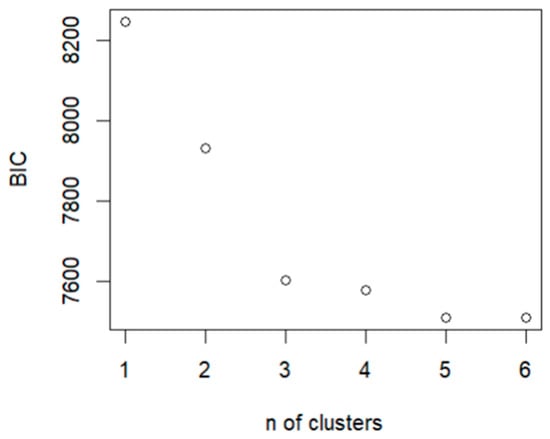
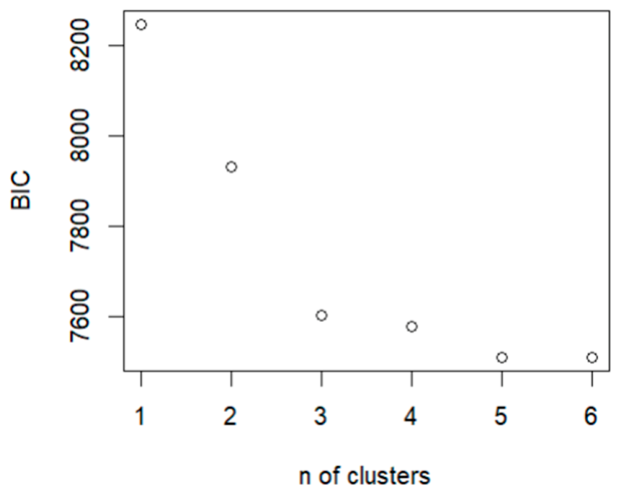
To determine the optimal number of latent profiles, we fitted Latent Profile Analysis (LPA) models with an increasing number of profiles (from one to six) and compared their fit using the AIC, BIC and ICL. Lower values of AIC and BIC, and higher values of ICL, indicate better fit. Table 4 compares the resulting statistics for each solution. As shown in the table, all criterion metrics selected (AIC, BIC and ICL) decreased progressively as the number of profiles increased, indicating improvements in model fit with additional profiles. To further illustrate the change in model fit across alternative solutions, Figure 1 displays the variation in BIC according to the number of profiles. The improvement of model fit becomes more limited beyond the three-profile solution, while the ICL supported a three-profile specification. Considering statistical fit together with model parsimony and interpretability, the three-profile solution was retained.
Table 4.
Latent Profile Analysis fit statistics. Each row reports the fit of a separate model estimated with the corresponding number of profiles.
Figure 1.
Variation in the Bayesian Information Criterion over the number of classes.
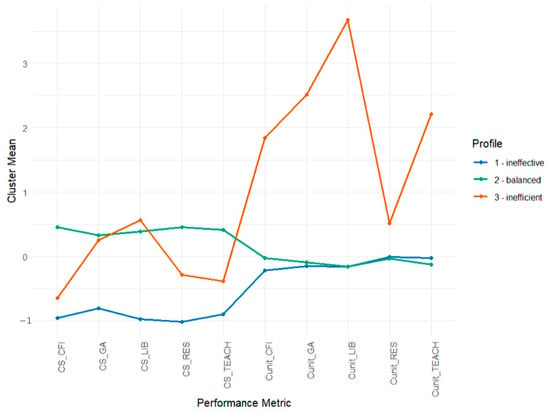
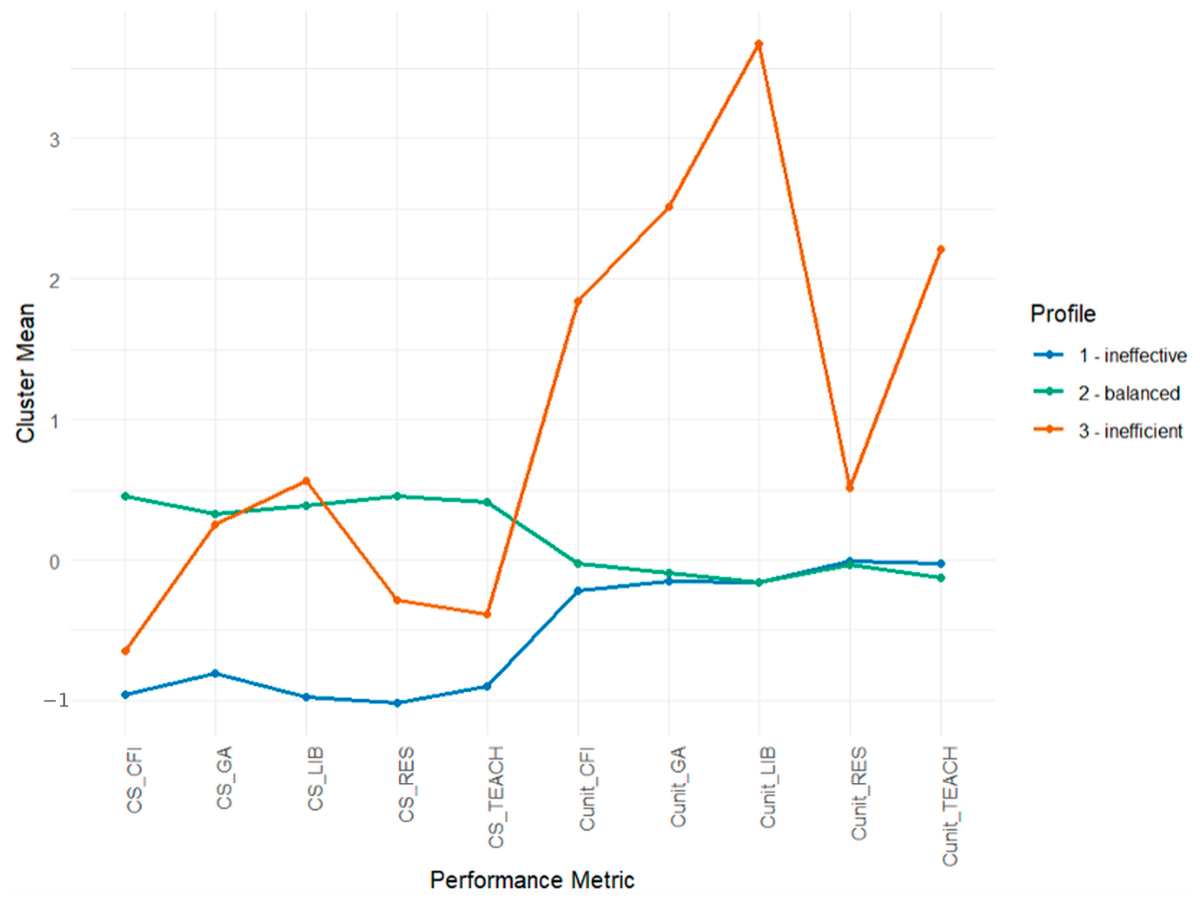
To characterize the three-profile solution, Figure 2 reports the mean normalized efficiency and perceived effectiveness scores for each profile. Given the year-specific normalization of performance metrics detailed in Section 3.2, cluster means near zero correspond to performance levels that approximate the annual average for each respective indicator. Considering this outcome, each profile is now described, discussed, and named.
Figure 2.
Mean normalized efficiency and perceived effectiveness scores across the three university administrative performance profiles. Note: Perceived effectiveness and efficiency indicators are reported separately, with service areas presented in the same order within each dimension. Connecting lines are included for visual comparison only and do not imply continuity across indicators.
- Profile 1, composed of 81 observations (28% of the pooled sample), is characterized by universities with scores lower than the average for all five effectiveness metrics considered, and average efficiency scores. It is therefore named as the ineffective profile.
- Profile 2 is the largest, composed of 194 observations (67% of the pooled sample). It describes a balanced profile characterized by universities with scores slightly higher than the average for all five effectiveness metrics considered, and average efficiency scores.
- Profile 3 is the smallest profile, composed of 13 observations (5% of the pooled sample). It is characterised by universities with average effectiveness performance and higher unitary costs (i.e., lower efficiency) for all five metrics considered. It is therefore named the inefficient profile.
Overall, in all the years considered, 39 distinct universities out of 45 are classified as ineffective at least once, 41 universities are classified as balanced at least once, and 9 are classified as inefficient at least once. This pattern suggests that effectiveness and efficiency capture distinct dimensions of university performance: lower effectiveness does not necessarily coincide with lower efficiency, while comparatively higher costs do not systematically translate into stronger outcomes.
Having identified the three profiles, we further examine whether their composition is associated with institutional and contextual characteristics. Table 5 presents the results of the multinomial regression, where ineffective and inefficient profiles are compared with respect to the balanced profile in terms of each institutional and contextual determinant. First, a likelihood ratio test was conducted to compare this specification to a null model. The full model significantly improved the fit, indicating that at least one of the included variables contributes meaningfully to explaining cluster assignment. Two dimensions emerge as particularly relevant: university size and geographical location. University size is negatively and significantly associated with membership in the inefficient rather than the balanced profile. Specifically, larger universities are less likely to belong to the inefficient profile, all else being equal, while size does not significantly distinguish ineffective from balanced universities. Given that the inefficient profile is defined primarily by higher unit costs, this result is consistent with previous evidence linking university size to cost efficiency and may reflect the role of economies of scale in the provision of administrative and support services (Bertoletti, 2025).
Table 5.
Multinomial regression of institutional and contextual characteristics associated with administrative performance profile membership.
Geographical location is also significantly associated with profile membership, although the pattern differs across the two underperforming profiles. Compared with universities located in the Centre, Northern universities are less likely to belong to the ineffective rather than the balanced profile. By contrast, universities located both in the North and in the South and Islands are more likely to belong to the inefficient and ineffective profiles relative to the balanced profile. This non-uniform geographical pattern suggests that territorial location may be associated differently with the effectiveness and efficiency dimensions of administrative performance. These findings should nevertheless be interpreted cautiously given the relatively small number of observations belonging to the inefficient profile. The relevance of geographical location is consistent with previous evidence documenting substantial territorial disparities within the Italian higher education system and showing that regional socioeconomic and institutional conditions can affect university performance (Agasisti & Johnes, 2010; Mariani & Torrini, 2022; Marrocu & Paci, 2024).
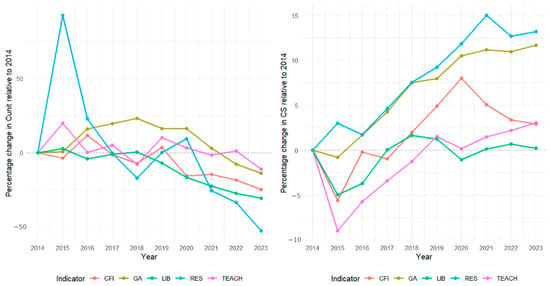
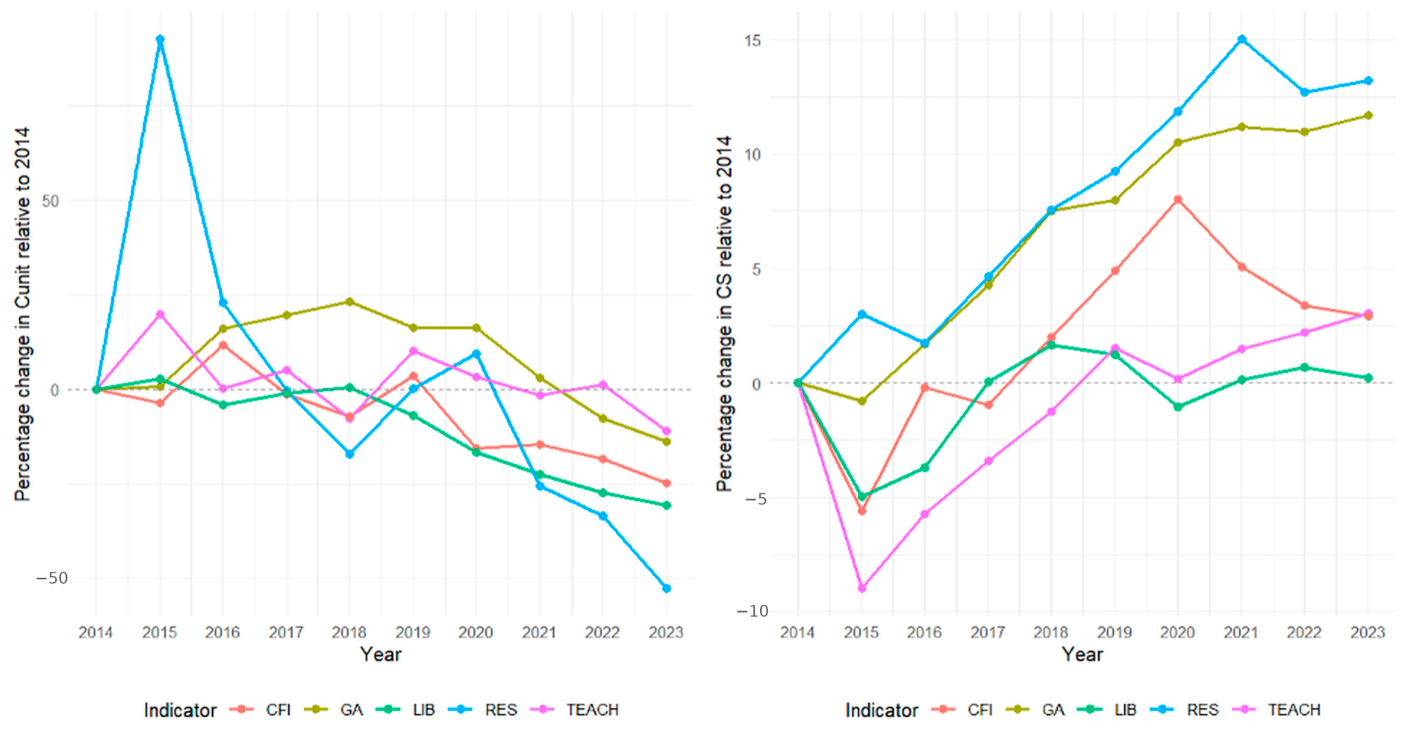
To contextualize the evolution of university profiles, we first examine the general trends in the two dimensions of administrative performance: efficiency and perceived effectiveness. Figure 3 displays the yearly averages of all metrics as percentage changes relative to their 2014 baseline values. Looking at the efficiency metrics, the graph shows a steady decline over time in all unit costs of the five administrative and support services considered, already adjusted for inflation, indicating a general improvement in efficiency over time, confirming other studies that highlighted this general positive trend (Agasisti et al., 2026). Likewise, the average effectiveness performance also improved over time in the sample considered, in line with some studies that observed similar trends focusing solely on students’ satisfaction (Langan & Harris, 2019). The case of research support (RES) is particularly noteworthy, as it shows improvements in both dimensions. Research support unit costs decline relative to the 2014 baseline, indicating increasing efficiency, while users’ satisfaction records the largest increase among the services considered. Thus, in this case, efficiency gains appear to coexist with an improvement in perceived effectiveness, providing no evidence of a trade-off between the two dimensions.
Figure 3.
Evolution of efficiency and perceived effectiveness indicators, from 2014 (baseline reference) to 2023. Note: Values represent yearly percentage changes relative to the 2014 baseline. Efficiency indicators are measured as unit costs; therefore, declining values indicate increasing efficiency.
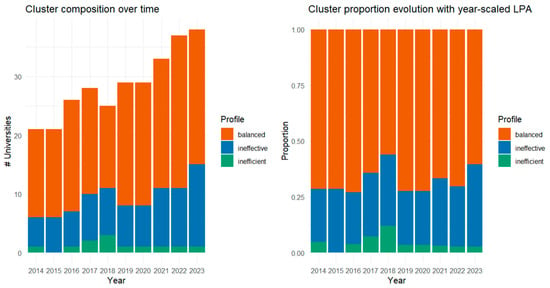
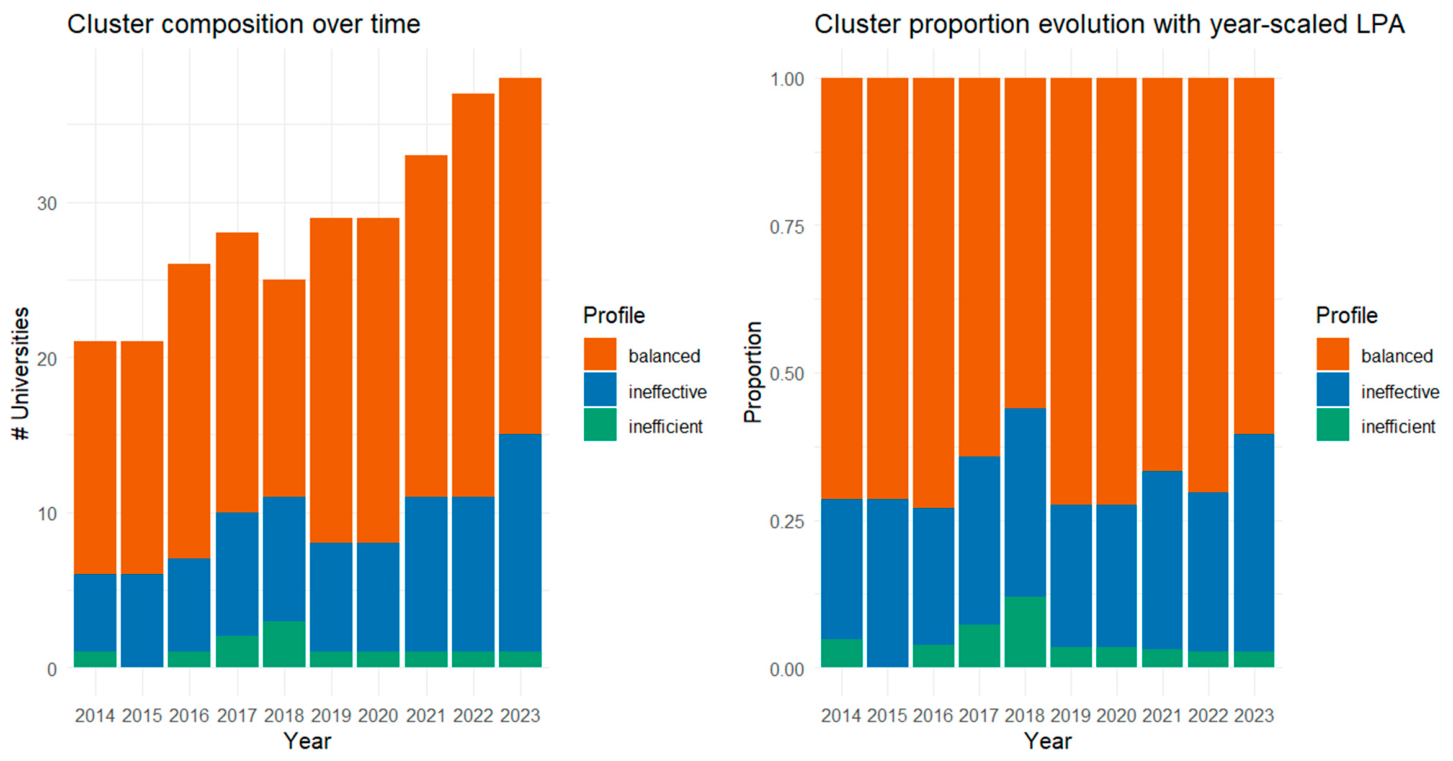
Against this backdrop of system-wide improvement, Figure 4 shows their year-by-year composition in both absolute (left panel) and relative (right panel) terms. As the number of HEIs participating in the project increases over time, the relative distribution of the three profiles remains generally stable. Because profiles are defined on the year-specific, normalized distribution of the performance metrics, the relative composition is directly comparable across years and is not mechanically affected by the growing number of observations. Notably, despite the substantial improvements in both efficiency and effectiveness documented in Figure 3, which confirm general trends emerging in the recent literature (Agasisti et al., 2026; Langan & Harris, 2019), the relative distribution of the three profiles remains generally stable over time. This stability suggests that the expansion of the sample does not substantially alter the overall pattern of performance across institutions, and that improvements have been broadly distributed rather than concentrated within a subset of universities. Some year-specific variations nevertheless emerge. In particular, inefficient HEIs increase in both absolute and relative terms in 2017–2018, while a slight increase in the proportion of ineffective universities can be observed in the most recent years (2021–2023).
Figure 4.
Evolution of university administrative performance profiles, 2014–2023: number of HEIs by profile (left panel) and relative profile composition (right panel).
The joint reading of Figure 3 and Figure 4 is particularly relevant. Since the profiles identify universities according to their relative position within the annual performance distribution, compositional changes in Figure 4 must be assessed against the system-wide trends in Figure 3. In particular, the slight growth in the share of ineffective HEIs in the most recent years should be interpreted in light of the general increase in users’ satisfaction observed across the sample. Since the profiles identify universities according to their relative position within the performance distribution, an HEI may be classified as ineffective even when its own effectiveness has not deteriorated in absolute terms, if the overall performance of the comparison group has improved more rapidly. The same reasoning applies to the inefficient profile in a context of declining unit costs.
Therefore, belonging to the ineffective or inefficient profiles in later years does not necessarily indicate a deterioration in university administrative services, but may instead reflect a progressively higher relative performance benchmark generated by a system-wide improvement. This interpretation is consistent with the broader benchmarking literature, which stresses the importance of assessing higher education performance comparatively and across multiple dimensions rather than interpreting individual indicators in isolation (OECD, 2019). It is also particularly relevant for administrative services, where efficiency and perceived quality represent distinct but complementary dimensions of performance (Arena et al., 2010).
4.2. Graduate Employment Rate
Having identified clusters of universities based on their administrative services’ performance, this section investigates whether belonging to a specific profile is associated with graduates’ employment rate, analysed as the main outcome of interest.
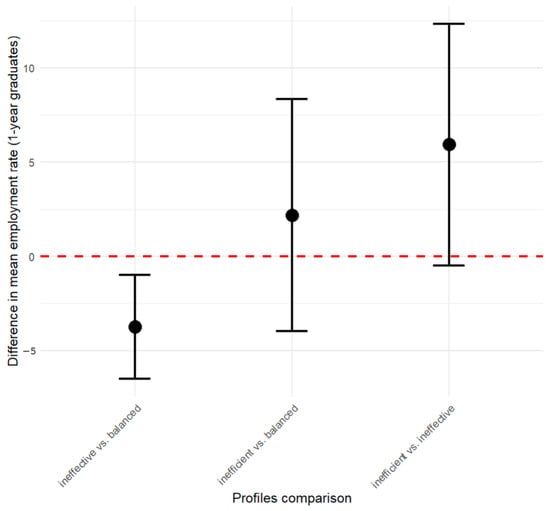
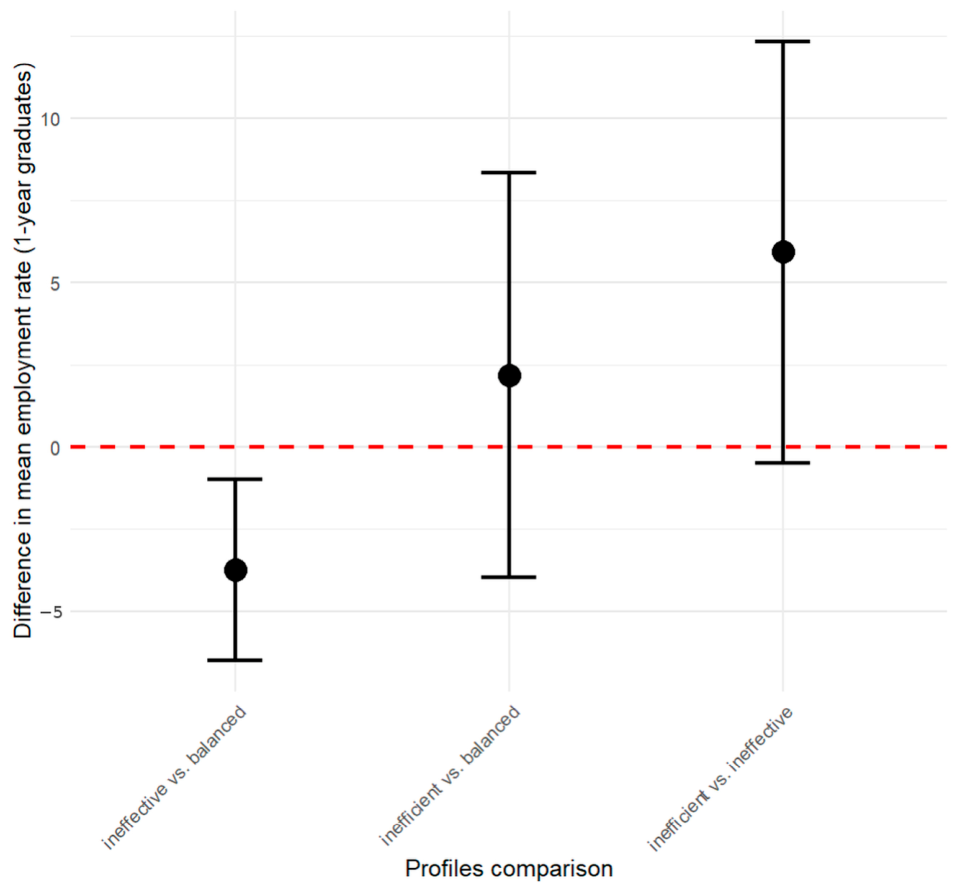
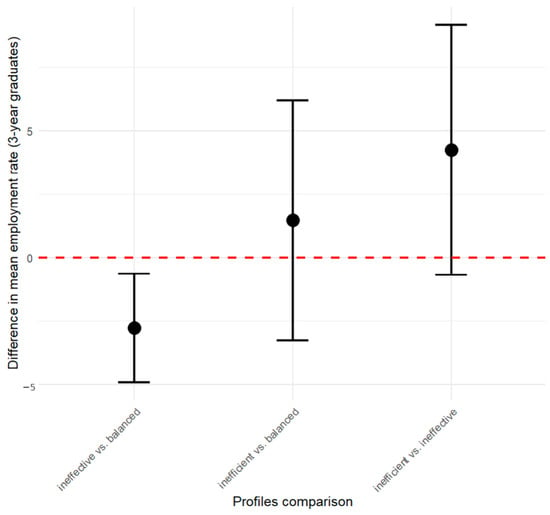
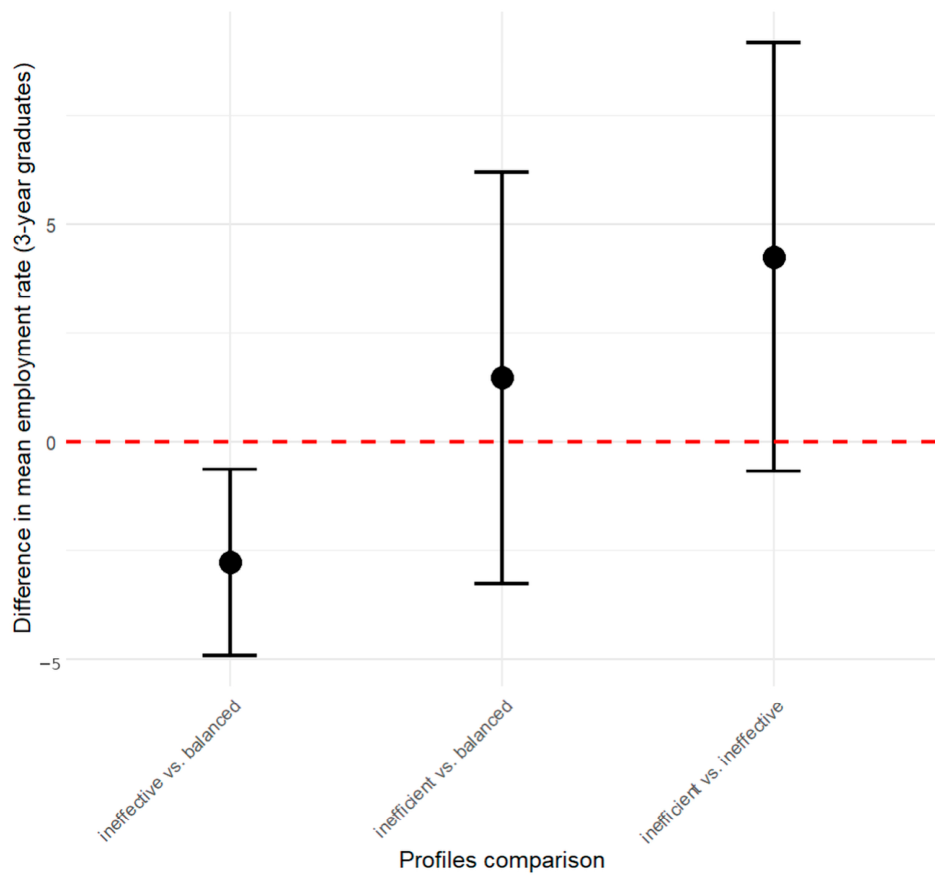
University profiles are compared in terms of graduates’ employment rates through ANOVA and post hoc pairwise comparisons (N = 278 due to missing variables for the employment rates). Figure 5 and Figure 6 show, respectively, the 95% confidence intervals of the differences in mean employment rate at the 1st and 3rd years across university performance clusters (balanced, ineffective, inefficient). Comparisons whose confidence intervals do not cross the dashed red line (zero difference) are statistically significant at the 95% confidence level. Bars above the zero (red dashed line) indicate that the first profile in the comparison has higher employment rates than the second, and vice versa.
Figure 5.
Tukey’s post hoc pairwise comparisons, conducted following a one-way ANOVA to assess differences 1-year graduates’ employment rates between university profiles. Note: Error bars represent 95% confidence intervals. Intervals not crossing zero (the dashed red line) indicate statistically significant differences.
Figure 6.
Tukey’s post hoc pairwise comparisons, conducted following a one-way ANOVA to assess differences 3-year graduates’ employment rates between university profiles. Note: Error bars represent 95% confidence intervals. Intervals not crossing zero (the dashed red line) indicate statistically significant differences.
Considering employment one year after graduation, universities belonging to the ineffective profile show significantly lower employment rates than those belonging to the balanced profile. Conversely, no statistically significant difference emerges between the inefficient and balanced profiles, nor between the inefficient and ineffective profiles. When employment is measured three years after graduation, the difference between the ineffective and balanced profiles remains significant and negative, while no significant differences emerge for the other pairwise comparisons. Thus, the association between university profiles and graduate employment appears stronger in the short term and tends to weaken as the time elapsed since graduation increases.
This finding is particularly meaningful when considering the multidimensional nature of administrative service performance. The distinction between ineffective and inefficient profiles suggests that the two dimensions considered in this study may relate differently to graduates’ outcomes. While the inefficient profile, characterized primarily by higher unit costs, does not show significantly different employment outcomes, the ineffective profile, characterized by lower levels of perceived effectiveness across administrative and support services, is associated with lower employment rates both one and three years after graduation. This does not necessarily imply a direct effect of administrative services on employability. Rather, perceived effectiveness may capture a broader dimension of the quality of the university service environment experienced by students. This interpretation is consistent with previous research emphasizing the relevance of students’ perceptions and satisfaction when assessing the quality of university administrative services (Arena et al., 2010). The stronger association observed for perceived effectiveness than for cost efficiency is consistent with a broader literature suggesting that students’ university experience and the quality of the institutional environment may remain relevant beyond graduation. Whelan and McGuinness (2017), for example, show that a positive higher education experience is associated with subsequent job satisfaction, while Abbas et al. (2023) find that higher education quality management systems are positively related to students’ employability attributes, partly through university-industry collaboration. More broadly, Scandurra et al. (2024) show that HEI-led employability initiatives can contribute to skills development and labour-market outcomes, although the available evidence remains heterogeneous and often focuses on specific programmes rather than the wider institutional environment. Our findings complement this literature by suggesting that the perceived effectiveness of administrative and support services may represent another relevant dimension of the university environment associated with graduates’ transition into employment. To our knowledge, however, previous studies have not directly examined the relationship between the overall performance of university administrative and support services and graduate employability, leaving no directly comparable evidence for this specific association.
The existence of a significant association in both the short and medium term observed after graduation is also noteworthy. This result may suggest that differences in the perceived quality of the university service environment are persistent over time, encompassing both graduates’ initial transition into the labour market and their subsequent employment trajectories. From a managerial perspective, these findings suggest that cost efficiency alone provides only a partial view of administrative performance. The stronger association of perceived effectiveness with graduate employability highlights the relevance of the quality of the service environment experienced by students, reinforcing the role of administrative and support services beyond their purely operational function. This interpretation should nevertheless be treated cautiously, since employability depends on a broad range of individual, institutional and contextual factors, and the present analysis does not identify the mechanisms through which administrative service performance may be related to employment outcomes. Evidence from the Italian context, for instance, points to the role of university support, skills development and students’ perceived employability in subsequent career outcomes, suggesting that the university environment may contribute to employability through multiple and potentially indirect channels (Martini et al., 2023). Importantly, this association should not be interpreted causally. Students are not randomly distributed across universities, and individual characteristics influencing university choice may also be associated with subsequent employment outcomes. Therefore, the observed relationship may partly reflect student selection in addition to differences in the university environment.
5. Conclusions
In a higher education context where graduate employability has a central role for universities’ attractiveness and quality assessment, the performance of administrative and support services may play an additional, yet still underexplored, role. To address this puzzle, this study identifies and characterizes profiles of universities’ administrative performance, investigating their link with graduate employability.
Combining unitary costs and perceived effectiveness in 45 Italian universities across five main service areas, efficiency and perceived effectiveness emerge as distinct but complementary dimensions of administrative performance. Specifically, the study uncovers three distinct profiles of administrative performance, capturing how efficiency and effectiveness combine across universities. While most HEIs display a balanced profile, with performance around the average across both dimensions, the analysis reveals two distinct forms of administrative underperformance: one characterized by systematically higher unit costs across services, and the other by systematically lower perceived effectiveness. This distinction shows that administrative underperformance is not a uniform phenomenon but may arise through different configurations of efficiency and effectiveness. Furthermore, while the system as a whole improves over time, this improvement does not appear to be accompanied by convergence across HEIs. Indeed, the relative incidence of the three profiles remains remarkably stable over time, despite the steady improvement observed in both efficiency and perceived effectiveness metrics. This suggests that universities have broadly moved towards higher levels of administrative performance while maintaining persistent relative differences: the performance benchmark shifts upwards, but heterogeneity across HEIs remains. Consequently, profile membership should be interpreted in relation to this evolving system-wide benchmark rather than as an indication of absolute improvement or deterioration.
The characterisation of the profiles further reveals that administrative performance is systematically associated with universities’ structural and contextual characteristics. In particular, university size is related to efficiency, with larger HEIs being less likely to display an inefficient profile, suggesting the relevance of scale in the provision of administrative and support services (Bertoletti, 2025). At the same time, the significant role of geographical location shows that administrative performance is embedded in the persistent territorial disparities characterising the Italian higher education system (Mariani & Torrini, 2022; Marrocu & Paci, 2024). These findings suggest that differences in administrative performance cannot be interpreted solely as the outcome of internal managerial practices but should also be understood in relation to the structural and territorial conditions in which universities operate (Lepori et al., 2013).
Most importantly, the analysis shows that different dimensions of administrative performance are differently associated with graduate outcomes. Perceived effectiveness displays a stronger association with graduate employability than cost efficiency. This finding extends the relevance of administrative performance beyond its conventional interpretation as a matter of internal efficiency: the perceived quality of administrative and support services may represent an important component of the broader university environment experienced by students and, as such, be associated with their subsequent transition into the labour market and initial professional career trajectories (Fabbris, 2007).
From a practical viewpoint, administrative and support services’ performance should therefore be seen as a multi-dimensional construct to be analysed and evaluated comparatively to the whole institutional system they operate in. These services should not be viewed merely as a cost component of university operations, but as a strategic dimension of HEIs’ performance, with perceived effectiveness showing a significant association with graduates’ employability.
From a managerial perspective, the findings highlight the importance of interpreting variations in administrative performance against an evolving sector-wide benchmark. University managers should complement internal, longitudinal performance monitoring with external benchmarking against peer institutions, using persistent relative gaps to identify areas in which improvement is not keeping pace with the sector. Moreover, the stronger association between perceived effectiveness and graduate employability suggests that particular managerial attention should be devoted to those administrative and support processes that shape students’ experience, as their relevance may extend beyond operational performance to outcomes related to students’ transition into the labour market.
From a policy perspective, the results point to the need for performance assessment frameworks that account simultaneously for absolute improvements and relative differences across HEIs. The general improvement observed in both efficiency and effectiveness suggests that the Italian university system has moved towards higher levels of administrative performance over time; nevertheless, the persistence of the three profiles indicates that such improvement has not translated into convergence across institutions. Performance monitoring systems should therefore be able to capture both the upward movement of system-wide benchmarks and the persistence of relative performance gaps.
This study has some limitations. First, some are related to the structure of the available dataset. The analysis focuses on Italian public universities participating in the Good Practice project, which may limit the generalizability of the findings to other institutional and national contexts. Moreover, participation in the project is unbalanced over time, with the number and composition of HEIs varying across years, potentially affecting longitudinal comparisons. Second, the institution-level perspective adopted in the study also entails some limitations. The analysis cannot account for student selection across universities, as unobserved individual characteristics may influence both university choice and employability. Therefore, the observed associations should not be interpreted as causal. Further limitations concern the scope and level of aggregation of the analysis. As the study focuses on the Italian higher education system, its findings may be more generalizable to comparable European contexts, while their applicability to substantially different higher education systems remains more limited. Future research could test the relationship between administrative performance and graduate outcomes in different national contexts and through cross-national comparisons, as well as consider other relevant dimensions of university performance, such as engagement with the external community. At the same time, the aggregation of different stakeholder groups may mask differences in their perceptions. Future research with larger samples could analyse these groups separately and assess whether different perceptions lead to different administrative performance profiles.
Author Contributions
Conceptualization, R.L. and M.S.; Methodology, R.L. and M.S.; Software, R.L.; Formal Analysis, R.L. and M.S.; Data Curation, R.L.; Writing—Original Draft Preparation, R.L. and M.S.; Writing—Review & Editing, R.L. and M.S. All authors have read and agreed to the published version of the manuscript.
Funding
This research received no external funding.
Institutional Review Board Statement
Not applicable.
Informed Consent Statement
All survey participants provided informed consent to the processing and use of their responses for research purposes, in accordance with the General Data Protection Regulation (GDPR).
Data Availability Statement
The data supporting the findings of this study are not publicly available.
Acknowledgments
The authors acknowledge the contribution of Nermin Karimova in supporting data preparation. The authors would also like to thank Michela Arnaboldi for her role as scientific director.
Conflicts of Interest
The authors declare no conflicts of interest.
References
- Abbas, J., Kumari, K., & Al-Rahmi, W. M. (2023). Quality management system in higher education institutions and its impact on students’ employability with the mediating effect of industry–academia collaboration. Journal of Economic and Administrative Sciences, 40(2), 325–343. [Google Scholar] [CrossRef] [Scilit]
- Agasisti, T., Bertoletti, A., & Coppeta, G. F. (2026). Policy responses to COVID-19 and the efficiency of Italian universities. Applied Economics, 58(39), 8343–8356. [Google Scholar] [CrossRef] [Scilit]
- Agasisti, T., Dal Bianco, A., Landoni, P., Sala, A., & Salerno, M. (2011). Evaluating the efficiency of research in academic departments: An empirical analysis in an Italian region. Higher Education Quarterly, 65(3), 267–289. [Google Scholar] [CrossRef] [Scilit]
- Agasisti, T., & Haelermans, C. (2016). Comparing efficiency of public universities among European countries: Different incentives lead to different performances. Higher Education Quarterly, 70(1), 81–104. [Google Scholar] [CrossRef] [Scilit]
- Agasisti, T., & Johnes, G. (2010). Heterogeneity and the evaluation of efficiency: The case of Italian universities. Applied Economics, 42(11), 1365–1375. [Google Scholar] [CrossRef] [Scilit]
- Aithal, P. S., & Maiya, A. K. (2023). Development of a new conceptual model for improvement of the quality services of higher education institutions in academic, administrative, and research areas. International Journal of Management, Technology, and Social Sciences (IJMTS), 8(4), 260–308. [Google Scholar] [CrossRef] [Scilit]
- Alvarez-Sández, D., Velázquez-Victorica, K., Mungaray-Moctezuma, A., & López-Guerrero, A. (2023). Administrative processes efficiency measurement in higher education institutions: A scoping review. Education Sciences, 13(9), 855. [Google Scholar] [CrossRef] [Scilit]
- Arena, M., Arnaboldi, M., & Azzone, G. (2010). Student perceptions and central administrative services: The case of higher education in Italy. Studies in Higher Education, 35(8), 941–959. [Google Scholar] [CrossRef] [Scilit]
- Arena, M., Arnaboldi, M., Azzone, G., & Carlucci, P. (2009). Developing a performance measurement system for university central administrative services. Higher Education Quarterly, 63(3), 237–263. [Google Scholar] [CrossRef] [Scilit]
- Batterley, M., Limniou, M., Mason, G., & Bode, C. (2026). How learning environments affect university students’ employability skills development: Students and staff views. Education Sciences, 16(1), 41. [Google Scholar] [CrossRef] [Scilit]
- Bertoletti, A. (2025). Examining the impact of higher education institutions on graduate employment outcomes: Insights from Eurograduate 2018 survey and ETER data. Publications Office of the European Union. [Google Scholar]
- Bilovodska, O., Prygara, O., Rudenko, N., Yarosh-Dmytrenko, L., Bliumska-Danko, K., & Ponomarenko, I. (2026). University rankings and students’ perception of educational quality as drivers of reputation and enrollment strategy in service marketing. In Data-centric business and applications: Modern trends in financial and innovation data processes 2025 (Vol. 2, pp. 193–210). Springer Nature. [Google Scholar]
- Bradley, A., Quigley, M., & Bailey, K. (2021). How well are students engaging with the careers services at university? Studies in Higher Education, 46(4), 663–676. [Google Scholar] [CrossRef] [Scilit]
- Brown, J. L., Hammer, S. J., Perera, H. N., & McIlveen, P. (2022). Relations between graduates’ learning experiences and employment outcomes: A cautionary note for institutional performance indicators. International Journal for Educational and Vocational Guidance, 22(1), 137–156. [Google Scholar] [CrossRef] [Scilit]
- Bruni, R., Catalano, G., Daraio, C., Gregori, M., & Moed, H. F. (2020). Studying the heterogeneity of European higher education institutions. Scientometrics, 125, 1117–1144. [Google Scholar] [CrossRef] [Scilit]
- Cantele, S., Guerrini, A., & Campedelli, B. (2016). Efficiency of Italian universities: The effect of controllable and non-controllable environmental and operational variables. International Journal of Public Policy, 12(3–6), 243–260. [Google Scholar] [CrossRef] [Scilit]
- Capano, G., Regini, M., & Turri, M. (2016). Changing governance in universities: Italian higher education in comparative perspective. Palgrave Macmillan. [Google Scholar]
- Casu, B., & Thanassoulis, E. (2006). Evaluating cost efficiency in central administrative services in UK universities. Omega, 34(5), 417–426. [Google Scholar] [CrossRef] [Scilit]
- Caudle, A. P. (2025). Graduate student perceptions of institutional support services [Doctoral dissertation, Tarleton State University]. [Google Scholar]
- Cheng, M., Adekola, O., Albia, J., & Cai, S. (2022). Employability in higher education: A review of key stakeholders’ perspectives. Higher Education Evaluation and Development, 16(1), 16–31. [Google Scholar] [CrossRef] [Scilit]
- Cowan, J. (1985). Effectiveness and efficiency in higher education. Higher Education, 14(3), 235–239. [Google Scholar] [CrossRef] [Scilit]
- Fabbris, L. (2007). Effectiveness of university education in Italy: Employability, competences, human capital. Springer Science & Business Media. [Google Scholar]
- Healy, M., Brown, J. L., & Ho, C. (2022). Graduate employability as a professional proto-jurisdiction in higher education. Higher Education, 83(5), 1125–1142. [Google Scholar] [CrossRef] [Scilit]
- Ingusci, E., De Carlo, E., Catalano, A. A., Semeraro, C. G., & Signore, F. (2026). Are university students ready to work? The role of soft skills and psychological capital in building sustainable employability. Education Sciences, 16(2), 181. [Google Scholar] [CrossRef] [Scilit]
- Jain, I., & Gulati, R. (2025). Efficiency in higher education: A review of research from 1977 to 2022. Higher Education Quarterly, 79(1), e70010. [Google Scholar] [CrossRef] [Scilit]
- Johnson, C., Gitay, R., Abdel-Salam, A. G., BenSaid, A., Ismail, R., Al-Tameemi, R. A. N., Romanowski, M. H., Al Fakih, B. M. K., & Al Hazaa, K. (2022). Student support in higher education: Campus service utilization, impact, and challenges. Heliyon, 8(12), e12559. [Google Scholar] [CrossRef] [Scilit]
- Langan, A. M., & Harris, W. E. (2019). National student survey metrics: Where is the room for improvement? Higher Education, 78, 1075–1089. [Google Scholar] [CrossRef] [Scilit]
- Lepori, B. (2022). The heterogeneity of European Higher Education Institutions: A configurational approach. Studies in Higher Education, 47(9), 1827–1843. [Google Scholar] [CrossRef] [Scilit]
- Lepori, B., Usher, J., & Montauti, M. (2013). Budgetary allocation and organizational characteristics of higher education institutions: A review of existing studies and a framework for future research. Higher Education, 65(1), 59–78. [Google Scholar] [CrossRef] [Scilit]
- Lin-Stephens, S., Leon, L. C., Manuguerra, M., Barkatsas, T., & Russell, L. (2024). Exploring factors contributing to graduate outcomes: Using career registration methodology (CRM) to track students’ employability activities, career readiness, and graduate outcomes. Education Sciences, 14(12), 1294. [Google Scholar] [CrossRef] [Scilit]
- Mariani, V., & Torrini, R. (2022). The geographic divides of the Italian higher education system (Questioni di Economia e Finanza (Occasional Papers), No. 675). Banca d’Italia.
- Marrocu, E., & Paci, R. (2024). The influence of regional contextual factors on public university efficiency in Italy (CRENoS Working Paper 24/24). CRENoS.
- Martini, M., Tomasuolo, M., & Cavenago, D. (2023). Enhancing objective and subjective career outcomes for graduates in Italy: Perceived employability and university support. In Handbook of research on sustainable career ecosystems for university students and graduates (pp. 361–385). IGI Global Scientific Publishing. [Google Scholar]
- Ministry of University and Research. (2026). Universities: Institutions by geographical area. USTAT. Available online: https://ustat.mur.gov.it/dati/didattica/italia/atenei (accessed on 15 June 2026).
- Mukhatayev, A., Omirbayev, S., Kassenov, K., & Idiyatova, Y. (2024). Quality assurance system of higher education in Kazakhstan through stakeholders’ eyes: An empirical study to identify its challenges. Education Sciences, 14(12), 1297. [Google Scholar] [CrossRef] [Scilit]
- Nylund-Gibson, K., & Choi, A. Y. (2018). Ten frequently asked questions about latent class analysis. Translational Issues in Psychological Science, 4(4), 440–461. [Google Scholar] [CrossRef] [Scilit]
- OECD. (2019). Benchmarking higher education system performance. OECD Publishing. [Google Scholar]
- Rizos, S., Sfakianaki, E., & Kakouris, A. (2022). Quality of administrative services in higher education. European Journal of Educational Management, 5(2), 115–128. [Google Scholar] [CrossRef] [Scilit]
- Salazar, H., Lima, Y., Argôlo, M., Barbosa, C. E., Lyra, A., & Souza, J. (2025). Fo-HECE: Future-oriented higher education degree employability. Education Sciences, 15(9), 1235. [Google Scholar] [CrossRef] [Scilit]
- Scandurra, R., Kelly, D., Fusaro, S., Cefalo, R., & Hermannsson, K. (2024). Do employability programmes in higher education improve skills and labour market outcomes? A systematic review of academic literature. Studies in Higher Education, 49(8), 1381–1396. [Google Scholar] [CrossRef] [Scilit]
- Silva, D. S., Moraes, G. H. S. M. D., Makiya, I. K., & Cesar, F. I. G. (2017). Measurement of perceived service quality in higher education institutions: A review of HEdPERF scale use. Quality Assurance in Education, 25(4), 415–439. [Google Scholar]
- Smith, J., McKnight, A., & Naylor, R. (2000). Graduate employability: Policy and performance in higher education in the UK. The Economic Journal, 110(464), F382–F411. [Google Scholar] [CrossRef] [Scilit]
- Tomasuolo, M., Martini, M., & Marafioti, E. (2024). The role of career services in sustaining students’ perceived employability: A quasi-experimental approach. In 10th international conference on higher education advances (HEAd’24) (pp. 887–895). Editorial Universitat Politècnica de València. [Google Scholar]
- Vernon, M. M., & Yang, F. M. (2023). Use of Latent profile analysis to model the translation of university research into health practice and policy: Exploration of proposed metrics. Research in Higher Education, 64, 1058–1070. [Google Scholar] [CrossRef] [Scilit]
- Weller, B. E., Bowen, N. K., & Faubert, S. J. (2020). Latent class analysis: A guide to best practice. Journal of Black Psychology, 46(4), 287–311. [Google Scholar] [CrossRef] [Scilit]
- Whelan, A., & McGuinness, S. (2017). Does a satisfied student make a satisfied worker? (IZA Discussion Paper No. 10698). Institute of Labor Economics (IZA).

Disclaimer/Publisher’s Note: The statements, opinions and data contained in all publications are solely those of the individual author(s) and contributor(s) and not of MDPI and/or the editor(s). MDPI and/or the editor(s) disclaim responsibility for any injury to people or property resulting from any ideas, methods, instructions or products referred to in the content. |
© 2026 by the authors. Licensee MDPI, Basel, Switzerland. This article is an open access article distributed under the terms and conditions of the Creative Commons Attribution (CC BY) license.