


Abstract
Project-based learning (PBL) combines student-centred learning with motor practice, but evidence on physical activity and motor performance in school physical education remains limited. This exploratory pilot study compared PBL with teacher-led instruction in two non-randomised cohorts comprising 53 girls: 27 fifth-grade pupils in basketball and 26 seventh-grade pupils in aerobics. Each cohort included one intact class per condition. Outcomes included pre–post basketball motor tests, final aerobics performance and physical activity records from subsets of pupils. Motor comparisons were exploratory, and wearable outcomes were summarised descriptively at the class and lesson levels. The baseline-adjusted obstacle dribble test comparison favoured the control class (experimental-minus-control difference: +4.01 s; 95% CI: 1.88 to 6.14; Holm-adjusted p = 0.002); the other two basketball comparisons remained inconclusive. The final aerobics score difference was −0.49 points on a 0–16 scale (95% CI: −3.75 to 2.78). Recorded running and walking differed little between basketball classes, while mean heart rate was lower in the experimental classes, especially in aerobics. Class membership was confounded with an instructional approach, preventing attribution of differences to PBL. The findings do not establish superior motor performance, equivalent outcomes or preservation of overall physical activity volume. Studies with multiple classes per condition and more complete measurement are needed.
1. Introduction
Physical education (PE) has traditionally been associated with teacher-led and direct instructional approaches in which teachers retain primary responsibility for selecting tasks, organising practice, and directing the learning process (Mosston & Ashworth, 2008; Shen & Shao, 2022). Within Mosston and Ashworth’s Spectrum of Teaching Styles, such instruction may draw predominantly on reproductive teaching styles, including the command style and other approaches in which pupils reproduce teacher-defined movement tasks, although the distribution of decision making varies across individual styles (Mosston & Ashworth, 2008). Contemporary conceptions of PE, however, increasingly extend learning beyond physical performance. Contemporary physical literacy frameworks integrate physical, affective, cognitive and social dimensions to support lifelong engagement in physical activity (Carl et al., 2026, UNESCO, 2015). Accordingly, student-centred and models-based approaches have gained prominence, with reviews indicating benefits across physical, cognitive, social, and affective learning domains, including motor and tactical learning, decision making, autonomy, cooperation, and responsibility (Fernandez-Rio & Iglesias, 2024; Shen & Shao, 2022).
Within this broader shift toward student-centred PE, girls in late primary and lower secondary education represent a particularly relevant population for examining how instructional approaches relate to pupils’ experiences and engagement. Previous research has identified sex- and age-related differences in PE experiences, with girls in some populations reporting lower intrinsic motivation and lower enjoyment than boys (Navarro-Patón et al., 2024). Differences have also been reported in activity participation, including greater participation of boys in basketball and soccer and of girls in dance, volleyball, and jump-rope activities (Tambalis et al., 2022). These findings represent group-level patterns rather than fixed individual preferences but provide relevant context for examining student-centred approaches across contrasting PE content.
Building on this emphasis on pupils’ experiences and participation, project-based learning (PBL) provides a framework for combining pupil choice, collaboration, and motor practice. Rooted in constructivist and social-constructivist perspectives, PBL engages pupils in investigating authentic challenges and collaboratively constructing solutions. Its key features include a challenging problem or question; sustained inquiry, authenticity, pupil voice and choice; reflection, critique and revision; and a final product or performance (Simonton et al., 2021). In PE, these principles can be applied through tasks in which pupils collaboratively select, organise, practise, evaluate, and refine learned movements into a final sequence or performance. Such activities combine motor practice with decision making, communication, creativity, and shared responsibility for the learning process (Luptáková, 2024; Luptáková & Antala, 2026; Simonton et al., 2021).
Meta-analytic evidence from education more broadly indicates positive effects of PBL on academic achievement, thinking skills, and affective outcomes (Zhang & Ma, 2023). However, evidence within school PE remains limited and varies by the outcome assessed (Simonton et al., 2021). Some studies have reported encouraging findings. PBL has supported the development of health-related fitness knowledge in fifth-grade PE (Hastie et al., 2017). Recent PE studies have reported favourable findings for enjoyment (Ginanjar et al., 2024) and social skills (Juniar et al., 2023), while a pilot study reported pre-to-post improvements in jump-rope motor skills among fourth-grade pupils following a PBL intervention (Luptáková et al., 2025). These findings concern different outcomes and do not establish a consistent advantage across motor performance, physical activity and pupils’ experiences. In particular, evidence concerning objectively measured lesson-level physical activity and physiological load remains scarce.
Evidence relevant to girls requires a distinction between PBL itself and other student-centred approaches. A recent systematic review of participatory action research and activist approaches with girls in PE and sport identified gender stereotypes, low confidence and limited opportunities as barriers to participation; co-created programmes supported meaningful participation and motivation (Reyes et al., 2026). These findings inform the rationale for pupil voice and shared decision making but do not establish the effects of PBL on girls’ motor performance or physical activity. Similarly, a recent PE meta-analysis reported favourable learning outcomes under cooperative learning, a related but distinct model (Boke et al., 2025). Direct PE research on PBL has reported greater enjoyment than conventional instruction (Ginanjar et al., 2024), but such findings do not by themselves demonstrate a female-specific benefit.
Gender-focused PBL research outside PE provides additional, indirect context. In a primary-school study integrating design thinking and making, self-reported efficacy improved particularly among girls (Santos et al., 2025). Conversely, a study of first-year high-school mathematics found that some girls enjoyed project work while also reporting confusion about its purpose and concerns about academic progress (Rijken & Fraser, 2024). Together, these findings suggest that responses may depend on the task, learning context and support provided. They should not be transferred directly to girls’ physical activity or motor outcomes in PE. The limited direct evidence, therefore, supports examining PBL in female PE cohorts without presuming that it will improve every outcome.
This question is particularly relevant because the collaborative processes central to PBL require lesson time for discussion, planning, decision making, peer feedback, reflection, and revision (Simonton et al., 2021). Although these processes are pedagogically meaningful, they may also interrupt or replace periods of physical practice. Similar concerns have been expressed in research on cooperative learning, where prolonged dialogue and reflection have been perceived as potentially reducing the time available for motor practice (Hortigüela-Alcalá et al., 2020). This potential tension is important because PE constitutes a meaningful opportunity for children to accumulate physical activity; children have been shown to achieve greater total and vigorous physical activity on days that include PE and to have a greater likelihood of meeting daily physical activity recommendations (Tambalis et al., 2022). It, therefore, remains unclear whether the time allocated to collaborative planning, decision making, and reflection within PBL alters pupils’ movement opportunities or physiological demands during PE.
Accordingly, the present study examined this issue through two parallel exploratory quasi-experimental interventions conducted with girls in different school grades and movement contexts. Fifth-grade girls developed a basketball ball-handling choreography, whereas seventh-grade girls created an aerobics routine. Although the activities and age groups differed, both interventions followed the same pedagogical structure: pupils collaboratively selected, sequenced, practised, evaluated, and refined learned movements to produce a final performance. Examining the same instructional contrast across two distinct movement contexts provided an opportunity to explore whether patterns associated with PBL were consistent across different PE content rather than specific to a single activity. In both cohorts, experimental groups completed the tasks through PBL, whereas control groups followed teacher-led instruction based predominantly on reproductive teaching styles from Mosston and Ashworth’s Spectrum, with the teacher retaining primary responsibility for task selection, sequencing, demonstration, and lesson organisation (Mosston & Ashworth, 2008). Given the exploratory pilot design, absence of random assignment and use of one intact class per condition, this study was hypothesis-generating rather than confirmatory, and no directional hypotheses were specified. The aim was to compare PBL and teacher-led instruction across two outcome domains: physical activity, assessed through recorded movement and physiological load, and motor performance, assessed through pre–post basketball motor skill tests and final aerobics performance scores.
2. Materials and Methods
2.1. Study Design and Participants
This exploratory pilot study comprised two parallel, two-group quasi-experimental interventions conducted during regular PE lessons in two Slovak primary schools. Each cohort consisted of two intact classes recruited and assigned to instructional conditions on the basis of availability: one class received PBL (experimental condition), and the other received conventional teacher-led instruction (control condition). Neither classes nor individual pupils were randomly assigned.
Within each cohort, the experimental and control classes were taught by different teachers. Teacher identity was, therefore, confounded with instructional condition and could not be modelled separately.
The total sample comprised 53 girls. The basketball cohort included 27 fifth-grade girls aged 10–11 years (experimental, n = 14; control, n = 13). The aerobics cohort included 26 seventh-grade girls (n = 13 per condition), with mean decimal ages of 13.39 years in the experimental class and 12.97 years in the control class. The cohorts differed in age, movement content and intervention structure and were analysed separately. The numbers contributing to each outcome depended on the availability of the required measurements.
Variation in the numbers contributing to the motor outcomes primarily reflected pupil absence. Wearable sample sizes were additionally limited by the number of devices available for each lesson. Outcome-specific sample sizes are reported in the corresponding tables and text.
2.2. Intervention Procedures
2.2.1. Basketball
The basketball unit comprised eight lessons in the experimental class and seven in the control class. The experimental class completed one additional lesson because the pupils wished to further refine their choreography. Lessons were scheduled twice per week and lasted 45 min. Both conditions focused on basketball ball handling and manipulative skills; exposure was, therefore, similar in content but unequal in lesson count.
In the PBL condition, pupils collaboratively created a movement choreography incorporating previously learned basketball elements and musical accompaniment. They selected, combined, practised and refined movements, while the teacher provided guidance as a facilitator. In the teacher-led condition, pupils practised the same general basketball content through reproductive teaching styles, with the teacher determining the tasks, organisation and progression of practice. The two conditions are compared in Table 1.
Table 1.
Comparison of the basketball intervention conditions.
2.2.2. Aerobics
The aerobics unit comprised six 45 min lessons, delivered twice per week. Neither the experimental nor the control group had previous experience with any form of aerobics. Consequently, in both classes, lessons 1 and 2 used teacher-led instruction in basic low- and high-impact aerobic movements, respectively. Instruction differentiated the two conditions during lessons 3–5, and final performances were assessed in lesson 6.
In the control condition, pupils learned and practised a teacher-designed routine consisting of three 32-count sequences, learning one sequence during each of lessons 3–5. Instruction was delivered frontally, with the teacher directing practice and providing corrective feedback. In the PBL condition, pupils worked in small groups to create routines of the same overall length. They selected and combined movements, documented their sequences, chose musical accompaniment, and practised and refined their routines through peer feedback. Written sequences were submitted at the end of each lesson, and the teacher supported the process as a facilitator. Pupils who were not exercising could contribute to planning. The control class performed its routine together, whereas the experimental groups performed separately.
2.3. Physical Activity
Movement and physiological load were monitored using wrist-worn Garmin Forerunner 55 devices (Garmin Ltd., Olathe, KS, USA), which provide movement-derived metrics and optical heart-rate measurements. An adult validation study compared this model with a chest-strap reference and found that heart-rate accuracy varied with exercise conditions (Moghaddam et al., 2026).
Monitoring involved subsets of each class, with up to four wearable records per basketball class and lesson and up to ten per aerobics class and lesson depending on wearable availability. Mean heart rate, expressed in beats per minute, was the outcome common to both cohorts.
For basketball, the combined duration of device-reported running and walking was calculated for each record. The percentage of recording time classified as running or walking was calculated as 100 × (running time + walking time)/total recording time. The total recording duration was also summarised.
For aerobics, time in each of the five device-defined heart-rate zones was converted to a percentage of the scheduled 45 min lesson: zone percentage = 100 × zone duration in seconds/2700. Zones 1–2 and zones 4–5 were also summed within each record. These percentages describe time assigned to the reported zones relative to scheduled lesson duration.
2.4. Motor Performance Outcomes
2.4.1. Basketball Motor Skills
Basketball motor skills were assessed before and after the intervention using three tests:
- Obstacle dribble test (American Alliance for Health, Physical Education, Recreation and Dance, 1984): Timed dribbling through a cone course involving changes of direction and hands.
- Body circles (HWLB30) (Jakovljevic et al., 2015): The number of complete ball circles around the head, waist, and knees performed in 30 s.
- Dribbling with changes of direction (Argaj, 1997): Timed completion of a cone course while dribbling.
2.4.2. Aerobics Performance
Final aerobics performance was assessed individually during lesson 6 by two independent raters: a PE teacher with more than ten years of teaching experience and the researcher. The original rubric comprised five criteria, each scored from 0 to 4: technical execution, rhythmic accuracy, spatial orientation, group synchronisation and aesthetic impression. The aesthetic impression criterion additionally included creativity in the experimental class. The general anchors ranged from 0 (unable to perform the routine) to 4 (excellent execution without errors). No baseline assessment was conducted due to the absence of previous experience with aerobics. The raters were not blinded to the instructional condition because the different performance formats made group allocation apparent: the control class performed a teacher-designed routine together, whereas the experimental pupils performed self-choreographed routines in separate groups. This lack of blinding may have introduced rating bias.
Inter-rater reliability for the common four-criterion score was estimated using a two-way random-effects, absolute-agreement, average-measures intraclass correlation coefficient [ICC(2,2)] because the reported score was the mean of the two raters’ assessments. Across the 18 pupils with final aerobics scores, the ICC(2,2) was 0.677, indicating moderate inter-rater reliability.
For the main comparison, the aesthetic impression criterion was excluded to improve comparability between conditions. The two raters’ scores were averaged within each of the four remaining criteria, and these averages were summed to yield a common score from 0 to 16. The original five-criterion total, ranging from 0 to 20, was retained for a sensitivity analysis. The classes performed different routines, and both scores combined individual execution with group performance criteria.
2.5. Statistical Analysis
The two cohorts were analysed separately by IBM SPSS Statistics (v23.0). Continuous outcomes were summarised using means and sample standard deviations (SDs). Because each condition was represented by one intact class per cohort, instructional approach was confounded with class. The reported motor performance tests used individual-level calculations and did not account for class or performance group clustering. Their p-values and confidence intervals (CIs) are, therefore, exploratory and conditional on the observed classes and model assumptions; they do not provide a valid general test of teaching method effects (Campbell et al., 2012). All tests were two-sided, with a nominal significance level of 0.05.
2.5.1. Basketball Motor Comparisons
Pre-test, post-test and improvement scores were summarised within each class using complete pairs. Improvement was defined as pre-test minus post-test for the timed outcomes and post-test minus pre-test for body circles (HWLB30), so positive values consistently indicated improvement. Within-class changes were evaluated using paired t-tests. Cohen’s dz was calculated as mean improvement divided by the SD of individual improvement scores; a positive dz indicated improvement. These unadjusted p-values and effect sizes describe within-class change, not the between-class instructional contrast (Lakens, 2013). The effect size was estimated using conventional cutoffs.
Each between-class comparison used a separate ordinary least-squares analysis of covariance (ANCOVA), with post-test performance as the outcome, instructional condition as the predictor (experimental = 1; control = 0), and the corresponding pre-test score as a covariate (Vickers & Altman, 2001). Models included an intercept and a common linear baseline slope, without a baseline-by-condition interaction. The condition coefficient estimated the baseline-adjusted experimental-minus-control difference. Conventional model-based standard errors and t-distribution CIs were used. The model assumes a linear baseline–follow-up relationship, a common slope and an appropriate residual distribution; the CIs do not correct for clustering.
Raw and Holm-adjusted p-values were reported for the three basketball ANCOVA contrasts. Holm adjustment was restricted to this prespecified family of three basketball ANCOVA comparisons. The single aerobics comparison represented a separate cohort and outcome and was not included in this family, whereas wearable outcomes were summarised descriptively without inferential tests. The reported 95% CIs were unadjusted. Partial eta squared was calculated as ηp2 = t2/(t2 + dfresidual), using the condition coefficient’s t statistic and residual degrees of freedom (the complete-pair sample size minus three). For adjusted differences, negative values favoured the experimental class on timed tasks and positive values favoured it on body circles (HWLB30). Effect sizes were interpreted alongside differences in the original units and their uncertainty.
2.5.2. Aerobics Performance Comparisons
The final common four-criterion scores were compared using Welch’s independent-samples t-test with Satterthwaite degrees of freedom. The experimental-minus-control mean difference and its 95% CI were calculated using the unequal-variance standard error. Hedges’ g was calculated as the mean difference divided by the pooled within-class SD, multiplied by the exact small-sample correction J(ν), where ν = nE + nC − 2 and J(ν) = Γ(ν/2)/[√(ν/2) × Γ((ν − 1)/2)]. A positive g indicated higher experimental-class performance. The original five-criterion score was analysed using the same procedure as a sensitivity analysis. No baseline adjustment or learning-gain estimate was possible, and a non-significant comparison was not interpreted as evidence of equivalence.
2.5.3. Wearable Summaries and Sensitivity Analyses
For each wearable outcome, eligible record-level values were first averaged within each class and lesson. These lesson means were then averaged with equal weight across available lessons. The reported SDs describe variation between lesson means, rather than between individual pupils. Between-class differences were expressed in the original units: beats per minute, minutes or percentage points. No independent-record significance tests, confidence intervals or standardised teaching-effect sizes were calculated for wearable outcomes because participant linkage and independent class replication were unavailable.
The lesson profiles display the class means from the available records; the connecting lines indicate the lesson sequence, not the within-pupil change. Aerobics lessons 3–5 were summarised separately to describe the phase during which instruction differed. The basketball sensitivity analysis repeated the summary of running and walking duration. The combined percentage of scheduled lesson time represented in the five reported aerobics heart-rate zones was calculated by summing their durations and dividing by 45 min.
2.6. Ethical Considerations
This study was conducted in accordance with applicable ethical principles for research involving minors. This study was reviewed and received favourable ethical clearance (approval no. 07/2026; dated 19 June 2026) from the Ethics Committee of the Faculty of Physical Education and Sport, Comenius University in Bratislava, Slovakia. All research activities conformed to the established guidelines of the Declaration of Helsinki. Permission was obtained from the participating schools. Written informed consent was obtained from parents or legal guardians, and pupils provided assent. Participation was voluntary, and pupils could withdraw without consequences.
2.7. Use of Generative Artificial Intelligence
ChatGPT (GPT-5.6 Sol; OpenAI)was used to assist with manuscript drafting and revision, language editing and reference editing. The reported observations originated from the study records; no synthetic participant observations were generated for the reanalysis.
3. Results
3.1. Motor Performance: Basketball
The direction of change differed across tests (Table 2). The obstacle dribble test completion time increased by 3.70 s in the experimental class and decreased by 2.94 s in the control class. Both classes improved in body circles (HWLB30) and dribbling with changes of direction. The experimental class had a larger mean improvement in dribbling with changes of direction but also a slower baseline time: 45.72 s compared with 35.88 s in the control class.
Table 2.
Basketball motor performance among pupils with complete pre–post data.
In the exploratory ANCOVA, the baseline-adjusted experimental-minus-control difference in the obstacle dribble test time was +4.01 s (95% CI: 1.88 to 6.14; p < 0.001; Holm-adjusted p = 0.002; ηp2 = 0.422), favouring the control class. For body circles (HWLB30), the adjusted difference was +4.18 repetitions (95% CI: −1.40 to 9.76; p = 0.130; Holm-adjusted p = 0.130; ηp2 = 0.156).
For dribbling with changes of direction, the adjusted difference was −3.78 s (95% CI: −7.75 to 0.18; p = 0.060; Holm-adjusted p = 0.121; ηp2 = 0.173), favouring the experimental class at the point-estimate level. Thus, the larger unadjusted improvement in this class did not translate into a nominally significant baseline-adjusted contrast.
The p-values and confidence intervals reported here and below are exploratory, conditional class comparisons. With only one class per condition in each cohort, teaching method effects cannot be separated from other classroom differences. The intervals are not adjusted for multiple comparisons.
3.2. Motor Performance: Aerobics
The common four-criterion score was 11.45 (SD: 2.92) points in the experimental class (n = 10) and 11.94 (SD: 3.42) in the control class (n = 8). The difference was −0.49 points (95% CI: −3.75 to 2.78; Welch p = 0.753; Hedges’ g = −0.148). This retrospective 0–16 score averaged two raters’ assessments of technical execution, rhythmic accuracy, spatial orientation and group synchronisation.
The aesthetic impression criterion was excluded because it additionally included creativity in the experimental class. Using the original 20-point total gave 14.40 (SD: 3.57) versus 14.88 (SD: 4.17), with a difference of −0.48 points (95% CI: −4.46 to 3.51; Welch p = 0.802; g = −0.118). These results describe the final performance and do not establish equivalence between classes.
3.3. Recorded Physical Activity
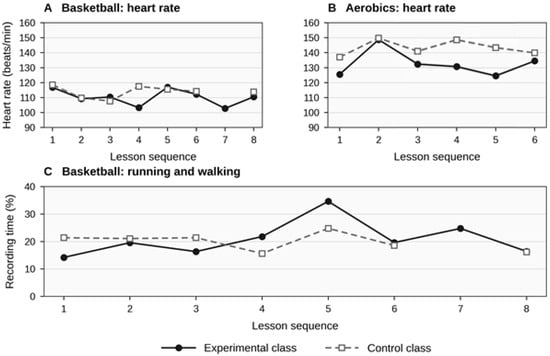
Wearable outcomes were averaged within each class and lesson, and then across lessons with equal lesson weights (Table 3). In basketball, the mean HR was 110.26 (SD: 5.32) beats/min in the experimental class and 113.85 (SD: 3.93) beats/min in the control class (difference: −3.58 beats/min). The device-reported running time was also lower in the experimental class: 2.53 (SD: 0.78) versus 2.96 (SD: 0.51) min (difference: −0.43 min). The walking time was higher: 3.96 (SD: 1.74) versus 3.09 (SD: 0.58) min (difference: +0.87 min). Consequently, combined running and walking occupied 20.90% versus 19.85% of the recording time (difference: +1.06 percentage points); the corresponding durations were 6.49 versus 6.04 min (difference: +0.44 min). The recording intervals averaged approximately 31 min. The higher walking time, therefore, offset the lower running time in the combined measure; the lower running time alone did not indicate a lower combined duration of recorded running and walking.
Table 3.
Lesson-level summaries of recorded movement and heart-rate outcomes.
In aerobics, the mean HR was 132.71 (SD: 8.75) beats/min in the experimental class and 143.28 (SD: 5.04) beats/min in the control class (difference: −10.56 beats/min). Time in HR zones 1–2 accounted for 34.76% (SD: 11.58) versus 20.09% (SD: 5.36) of the 45 min lesson (difference: +14.66 percentage points). Conversely, time in HR zones 4–5 accounted for 15.47% (SD: 10.21) versus 26.12% (SD: 7.02) (difference: −10.65 percentage points). Thus, the experimental class showed a lower mean HR, more time in the lower-HR zones and less time in the higher-HR zones. These descriptive comparisons do not establish the causes of the between-class differences. Individual-zone results are presented in Table 4.
Table 4.
Aerobics time in each device-defined heart-rate zone.
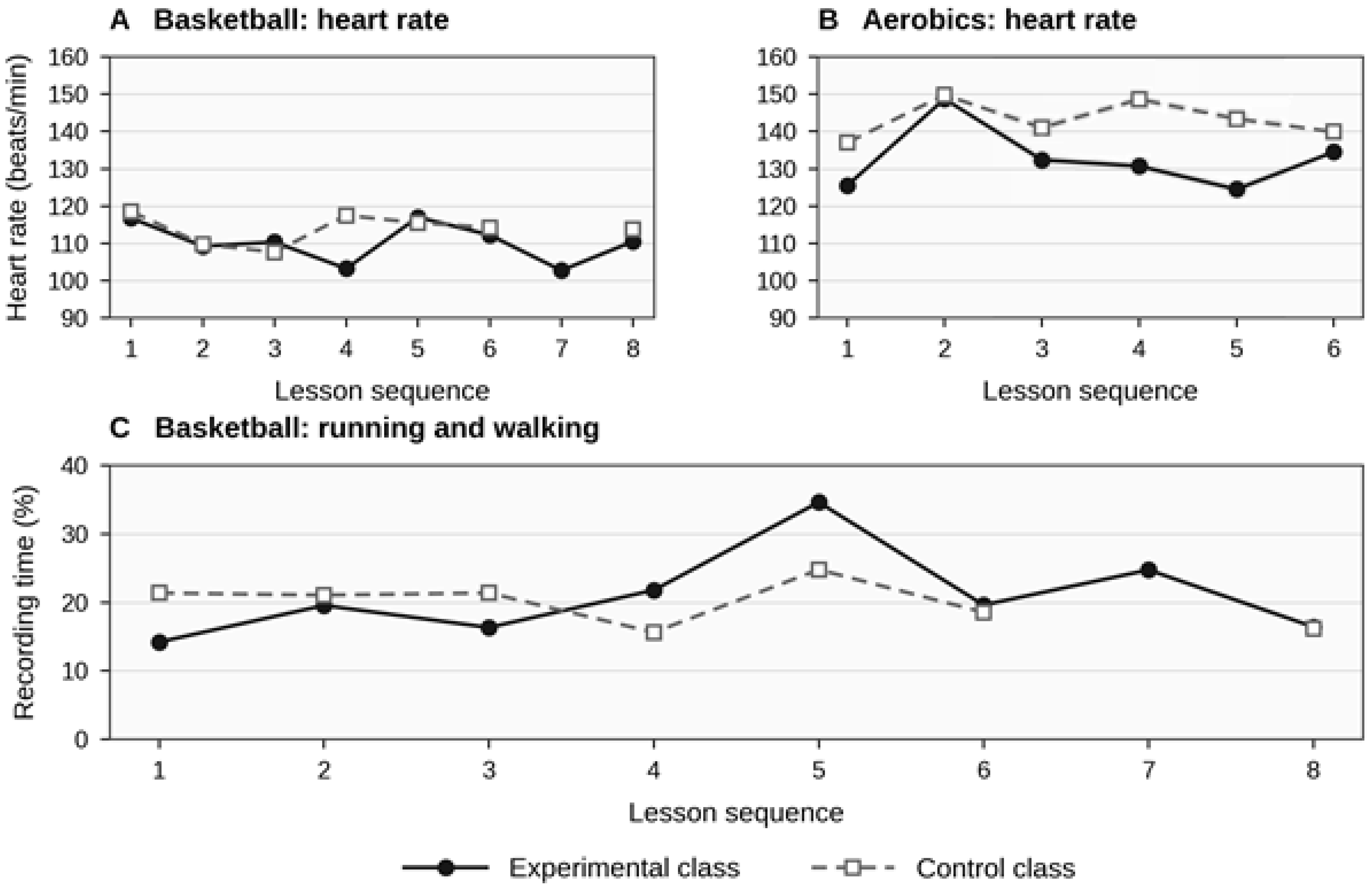
Class-level patterns in the wearable-derived activity variables are shown in Figure 1. Each point represents a class mean from available wearable records. Heart-rate panels A–B share a vertical scale. Shading marks aerobics lessons 3–5, when teaching approaches differed. Panel C uses consistent time records. Control basketball data are unavailable at sequence 7. Lines indicate lesson sequence, not participant-level pairing. Panel B shows higher control-class mean heart rates, whereas the ordering in panel C varies across lessons and does not indicate a consistent control-class advantage in combined running and walking.
Figure 1.
Activity variables of both cohorts. (A) Mean heart rate during basketball lessons; (B) mean heart rate during aerobics lessons; (C) mean percentage of recording time spent running and walking during basketball lessons.
During aerobics lessons 3–5, heart rate averaged 129.19 (SD: 4.15) versus 144.33 (SD: 3.90) beats/min (difference: −15.14). Including inconsistent basketball movement records yielded 6.57 versus 6.08 min (difference: +0.49), close to the quality-checked +0.44 min.
The five reported aerobics heart-rate zones together represented 72.31% versus 68.39% of scheduled lesson time. The remaining time was not represented in these zones and cannot be classified as inactivity. These percentages do not establish total recording duration or overall physical activity volume.
4. Discussion
The present exploratory pilot study examined motor performance and physical activity in two separate cohorts receiving PBL or conventional teacher-led PE. The findings do not establish a general advantage of either approach. In basketball, the baseline-adjusted obstacle dribble test comparison favoured the control class, whereas the other two adjusted comparisons remained uncertain. In aerobics, the observed difference in final performance was small but imprecisely estimated. Wearable records showed slightly more running and walking in the experimental basketball class, alongside lower mean heart rates in the experimental classes, particularly in aerobics. These patterns warrant separate consideration of motor performance, recorded movement and physiological load. Because each cohort included only one class per condition, the comparisons cannot isolate teaching method effects from other classroom differences.
The basketball findings illustrate why within-class change and between-class comparisons must be distinguished. Both classes improved in body circles (HWLB30) and dribbling with changes of direction, but the experimental class had substantially slower dribbling with changes of direction times at baseline. The obstacle dribble test performance moved in opposite directions, worsening in the experimental class and improving in the control class. Baseline imbalance, regression to the mean and task-specific practice may have contributed to these patterns, although their respective roles cannot be determined here. A possible task-specific explanation is that teacher-directed practice provided more repetitions closely aligned with timed obstacle dribbling, whereas choreography development distributed practice across selected ball-handling elements. However, repetitions, practice intensity and time devoted to individual skills were not quantified, so this explanation cannot be tested. The additional experimental lesson also does not establish greater exposure to the particular skill assessed.
After accounting for baseline performance, the obstacle dribble test comparison favoured the control class, whereas the evidence for body circles (HWLB30) and dribbling with changes of direction remained inconclusive. The larger unadjusted gains on some tasks in the experimental class should, therefore, not be interpreted as evidence of superior motor performance with PBL. These contrasting task patterns highlight the importance of examining specific motor outcomes when evaluating an instructional approach.
In aerobics, the small observed difference in final performance was imprecisely estimated and cannot establish equivalence between approaches. The absence of a baseline assessment also prevents conclusions about learning gains. The common score combined technical and group performance criteria, so it should not be interpreted solely as an individual motor skill measure. Excluding the criterion that additionally assessed creativity in the experimental class improved comparability, but the revised score requires validation. The similar pattern obtained with the original score does not resolve these measurement limitations.
Evidence from related student-centred pedagogies provides context for these findings but cannot establish a benefit of PBL in the present cohorts. A recent meta-analysis found favourable physical, cognitive, affective and social outcomes for cooperative learning (CL) compared with traditional instruction (Boke et al., 2025), complementing earlier systematic review evidence (Bores-García et al., 2021). Individual studies have examined visual–motor integration and selective attention (Akil et al., 2024), or basketball passing and dribbling under different CL grouping strategies (Yang et al., 2021). These models, comparators and outcomes differ from the present PBL intervention and its sport-specific tests. Their findings, therefore, cannot explain the adverse obstacle dribble test pattern or establish that PBL should improve all motor tasks.
Interpreting PBL-specific evidence also requires attention to the outcomes assessed. Recent PE research has reported favourable enjoyment and social skill outcomes (Ginanjar et al., 2024; Juniar et al., 2023), which are distinct from timed motor performance and physiological load. Meta-analytic evidence across education indicates generally favourable learning outcomes under PBL, with variation across contexts and implementation characteristics (Zhang & Ma, 2023). A separate meta-analysis reported positive but heterogeneous motivational outcomes across problem-based, project-based and case-based learning (Wijnia et al., 2024). These findings support evaluating several learning domains, but do not imply that PBL improves every motor task or preserves every dimension of physical activity.
The two cohorts extend this investigation across different areas of PE content. Research on pedagogical models has predominantly addressed team sports, with body expression and individual activity contexts less represented (Fernandez-Rio & Iglesias, 2024). Including basketball and aerobics, therefore, broadens the range of activities considered. Nevertheless, age, school, movement content, assessment and intervention structure differed simultaneously between the cohorts. In addition, basketball included pre–post testing, whereas aerobics was assessed only after instruction. The observed patterns cannot establish that the effect of PBL differs between basketball and aerobics; the cohorts represent parallel exploratory examinations, not a direct test of moderation by activity type.
Physical activity is an equally important part of the evaluation. Collaborative planning, discussion, decision making, reflection and revision require time within a PBL lesson (Simonton et al., 2021). Research on CL, a distinct model that shares collaborative processes, has raised related concerns about opportunities for motor practice. Hortigüela-Alcalá et al. (2020), for example, described pre-service teachers’ perceptions that extended dialogue and reflection could reduce practice time. Reviews of student-centred pedagogical models also identify organisational demands and time available for skilled practice as implementation challenges (Evangelio Caballero et al., 2018; Fernandez-Rio & Iglesias, 2024). These concerns provide a rationale for measuring movement during instruction; they do not establish how much pupils will move.
Descriptive comparisons showed little difference in combined running and walking between the basketball classes. Running alone was lower in the experimental class, but walking was higher; these opposing components explain why a lower running time did not correspond to a lower combined percentage. The ordering of the classes varied across lessons. Differences in selected tasks, transitions or rehearsal could contribute to this pattern, but these lesson components were not observed systematically. In addition, the recordings did not cover entire lessons, and running/walking classifications may omit stationary ball handling and other basketball movements. Neither the individual components nor their sum establishes equivalence in overall activity volume or identifies a teaching method effect. Favourable physical outcomes reported for CL provide context for further investigation, rather than confirmation of maintained movement in these PBL lessons (Boke et al., 2025; Bores-García et al., 2021).
The heart-rate records indicated lower physiological load in the experimental classes, especially in aerobics, where more time was recorded in the lower device-defined zones and less in the higher zones. The difference was particularly evident during lessons 3–5, when the instructional approaches differed. Teacher-led rehearsal may have involved more continuous exercise at an externally set tempo, whereas project work combined rehearsal with planning, corrections and negotiation. This interpretation is consistent with the intervention structure but remains a hypothesis because the duration and intensity of these lesson components were not measured. There is also a difference shown during the initial teacher-led phase, indicating that the later contrast cannot be attributed solely to PBL. Variation in the pupils represented in the wearable records, pre-existing fitness differences and measurement error offer additional possible explanations. Stress, tension and nervousness were not assessed, and the heart-rate records alone cannot establish whether emotional arousal differed between classes. Consequently, lower heart rate cannot be interpreted as evidence of lower motivation, greater relaxation or poorer learning, nor can higher heart rate establish better instruction. The observed contrasts remain descriptive; heart rate does not directly quantify movement volume, and time unrepresented in the reported zones cannot be classified as inactivity.
This distinction between movement and physiological intensity matters when placing the findings in a public-health context. The World Health Organization recommends an average of at least 60 min of MVPA per day across the week for children and adolescents aged 5–17 years (World Health Organization, 2020). PE guidance has also recommended MVPA during at least 50% of lesson time (Centers for Disease Control and Prevention, 2011). The present lesson recordings and device-defined heart-rate zones do not permit assessment of whether pupils met this daily recommendation or how much validated MVPA they accumulated during PE.
From a practical perspective, teachers implementing PBL may protect opportunities for motor practice by time-limiting planning phases, assigning planning roles before activity begins, preparing music and equipment in advance, and alternating short decision-making intervals with sustained rehearsal blocks. The project may also be structured around progressive lesson-level milestones, with a specific psychomotor objective to be achieved by the end of each lesson. The teacher can verify completion of this intermediate objective and provide targeted feedback before pupils progress to the next stage of the project. These strategies should be monitored rather than assumed to preserve physiological load or improve motor performance, because the present study did not test individual organisational strategies. Reviews similarly emphasise structured implementation rather than simply increasing pupil choice (Bores-García et al., 2021; Fernandez-Rio & Iglesias, 2024; Simonton et al., 2021).
Study Limitations and Future Directions
Interpretation is limited by one class per condition, small female-only convenience samples and brief interventions. Exposure was unequal between conditions in basketball, whereas both aerobics classes completed six lessons. Teaching approach is, therefore, confounded with class membership, and the statistical comparisons remain exploratory. Short implementation periods also constrain evaluation of complex pedagogies, and duration has been identified as a moderator of PBL outcomes (Bores-García et al., 2021; Fernandez-Rio & Iglesias, 2024; Zhang & Ma, 2023). Because different teachers taught the experimental and control classes, potential teacher effects cannot be separated from class or instructional condition effects.
Measurement limitations include incomplete motor test data and the absence of a baseline aerobics assessment. Basketball wearable recordings did not cover entire lessons, and wearable records in either cohort could not be reliably linked to the same pupils over time, limiting their interpretation to descriptive class summaries. In aerobics, time outside the five reported heart-rate zones could not be characterised from the zone summaries alone. The validation evidence for Forerunner 55 (Moghaddam et al., 2026) comes from adults, so its applicability to children and school PE remains uncertain. Future studies need multiple classes per condition, longer interventions with comparable exposure, pre–post assessment, analyses that account for clustering, and validated activity monitoring with consistent participant identification. To distinguish proposed mechanisms, future studies should also record time allocated to practice, planning and transitions, alongside perceived exertion and measures of stress or anxiety. Incomplete motor test data primarily reflected pupil absence, while wearable coverage was also constrained by device availability. The aerobics raters could not be blinded because the performance format revealed condition, creating a potential source of rating bias.
The inter-rater reliability for the common aerobics score was ICC(2,2) = 0.677. This estimate does not indicate high agreement and, therefore, adds measurement uncertainty to the aerobics findings.
Future studies should also extend assessment beyond physical activity and motor outcomes to include affective and social dimensions of learning. These outcomes were outside the scope of the present investigation, but existing PE research provides good reason to examine them alongside physical outcomes. Direct PBL studies have reported favourable findings for enjoyment (Ginanjar et al., 2024) and social skills (Juniar et al., 2023). The broader educational potential of PBL has also been discussed conceptually (Simonton et al., 2021). Research on the related but distinct CL model similarly suggests a small positive overall effect on intrinsic motivation, although the available evidence is heterogeneous and of limited quality (Fernández-Espínola et al., 2020). Adequately powered PBL studies could, therefore, assess enjoyment, motivation, perceived autonomy, cooperation, and peer relationships together with objective physical activity and motor performance outcomes to provide a more comprehensive evaluation of pedagogical effectiveness. For girls specifically, evidence from participatory PE and sport approaches and from PBL in other subjects supports examining perceived competence, opportunities for choice and clarity of task purpose, while keeping the instructional models and contexts distinct (Reyes et al., 2026; Rijken & Fraser, 2024; Santos et al., 2025). Because the present samples included only girls, this study cannot establish sex- or gender-related differences in response to PBL.
5. Conclusions
The present exploratory study found different patterns across motor performance and wearable-derived outcomes in two PE cohorts. In basketball, the baseline-adjusted obstacle dribble test comparison favoured the control class; neither of the other adjusted motor comparisons established an advantage for PBL. In aerobics, the small observed difference in final performance was too imprecise to establish equivalence, and the absence of baseline scores prevented assessment of learning gains. Descriptive differences in recorded running and walking between the basketball classes were small, while heart-rate records indicated lower physiological load in the experimental classes, especially in aerobics. These findings do not demonstrate that PBL preserves overall physical activity volume or provides superior motor performance.
Because each condition was represented by a single class within each cohort, the observed differences cannot be attributed specifically to the teaching approach. The findings raise questions for further evaluation of PBL, particularly how project organisation relates to task-specific practice, recorded movement and physiological load. Replicated studies with multiple classes per condition and comparable baseline and follow-up measures are needed before conclusions about effectiveness, equivalence or broader applicability can be drawn.
Author Contributions
Conceptualization, G.L. and J.A.; methodology, G.L. and J.A.; formal analysis, J.A.; investigation, J.P. and E.H.; data curation, J.P. and E.H.; writing—original draft preparation, G.L. and J.A.; writing—review and editing, G.L., J.A., J.P., E.H. and B.A.; visualization, J.A.; supervision, G.L.; project administration, B.A.; funding acquisition, B.A. All authors have read and agreed to the published version of the manuscript.
Funding
This study was supported by the Slovak Scientific Grant Agency (VEGA) under grant number 1/0748/26, titled “Project-Based Learning in Physical and Sport Education and Its Impact on the Motor, Cognitive, and Affective Development of Pupils in Primary and Lower Secondary Education”.
Institutional Review Board Statement
The study was reviewed and received favourable ethical clearance from the Ethics Committee of the Faculty of Physical Education and Sport, Comenius University in Bratislava, Slovakia (Approval no. 07/2026, dated 19 June 2026).
Informed Consent Statement
Informed consent was obtained from all the legal guardians of the subjects involved in this study.
Data Availability Statement
The raw data supporting the conclusions of this article will be made available by the authors on request.
Conflicts of Interest
The authors declare no conflicts of interest.
Abbreviations
The following abbreviations are used in this manuscript:
| PBL | Project-Based Learning |
| CL | Cooperative Learning |
| PE | Physical Education |
| MVPA | Moderate-to-Vigorous Physical Activity |
References
- Akil, M., Tokay, B., & Güngör, M. G. (2024). Cognitive health outcomes of fundamental motor skill applications in children through cooperative learning method. BMC Psychology, 12, 522. [Google Scholar] [CrossRef] [Scilit] [PubMed]
- American Alliance for Health, Physical Education, Recreation and Dance. (1984). Basketball for boys and girls: Skills test manual. American Alliance for Health, Physical Education, Recreation and Dance. [Google Scholar]
- Argaj, G. (1997). Hodnotenie pohybového prejavu žiaka a špeciálnej pohybovej výkonnosti vo vybraných športových odvetviach najčastejšie vyučovaných na školách—Basketbal. In B. Antala (Ed.), Hodnotenie v školskej telesnej výchove (základy teórie a praxe) (pp. 94–98). Univerzita Komenského v Bratislave. [Google Scholar]
- Boke, H., Aygun, Y., Tufekci, S., Yagin, F. H., Canpolat, B., Norman, G., Prieto-González, P., & Ardigò, L. P. (2025). Effects of cooperative learning on students’ learning outcomes in physical education: A meta-analysis. Frontiers in Psychology, 16, 1508808. [Google Scholar] [CrossRef] [Scilit] [PubMed]
- Bores-García, D., Hortigüela-Alcalá, D., Fernandez-Rio, F. J., González-Calvo, G., & Barba-Martín, R. (2021). Research on cooperative learning in physical education: Systematic review of the last five years. Research Quarterly for Exercise and Sport, 92(1), 146–155. [Google Scholar] [CrossRef] [Scilit] [PubMed]
- Campbell, M. K., Piaggio, G., Elbourne, D. R., & Altman, D. G. (2012). CONSORT 2010 statement: Extension to cluster randomised trials. BMJ, 345, e5661. [Google Scholar] [CrossRef] [Scilit] [PubMed]
- Carl, J., Barnett, L. M., Jerebine, A., Mazzoli, E., Mouton, A., Barratt, J., Elsborg, P., Green, N., Niederberger, M., Sum, R. K.-W., & The GloPL Consortium. (2026). The global physical literacy action framework: Process and outcomes. Sports Medicine. Advance online publication. [Google Scholar] [CrossRef] [Scilit] [PubMed]
- Centers for Disease Control and Prevention. (2011). School health guidelines to promote healthy eating and physical activity. MMWR Recommendations and Reports, 60(RR-5), 1–76. Available online: https://www.cdc.gov/mmwr/preview/mmwrhtml/rr6005a1.htm (accessed on 12 June 2026). [PubMed]
- Evangelio Caballero, C., Sierra-Díaz, M. J., González-Víllora, S., & Fernández-Río, F. J. (2018). The sport education model in elementary and secondary education: A systematic review. Movimento, 24(3), 931–946. [Google Scholar] [CrossRef] [Scilit]
- Fernandez-Rio, J., & Iglesias, D. (2024). What do we know about pedagogical models in physical education so far? An umbrella review. Physical Education and Sport Pedagogy, 29(2), 190–205. [Google Scholar] [CrossRef] [Scilit]
- Fernández-Espínola, C., Abad Robles, M. T., Collado-Mateo, D., Almagro, B. J., Castillo Viera, E., & Giménez Fuentes-Guerra, F. J. (2020). Effects of cooperative-learning interventions on physical education students’ intrinsic motivation: A systematic review and meta-analysis. International Journal of Environmental Research and Public Health, 17(12), 4451. [Google Scholar] [CrossRef] [Scilit] [PubMed]
- Ginanjar, S., Samsudin, Resmana, D., & Anugrah, S. M. (2024). Comparing project-based learning with conventional models: Enhancing students’ enjoyment of physical education. Edu Sportivo: Indonesian Journal of Physical Education, 5(1), 64–81. [Google Scholar] [CrossRef] [Scilit] [PubMed]
- Hastie, P. A., Chen, S., & Guarino, A. J. (2017). Health-related fitness knowledge development through project-based learning. Journal of Teaching in Physical Education, 36(1), 119–125. [Google Scholar] [CrossRef] [Scilit]
- Hortigüela-Alcalá, D., Hernando-Garijo, A., González-Víllora, S., Pastor-Vicedo, J. C., & Baena-Extremera, A. (2020). “Cooperative learning does not work for me”: Analysis of its implementation in future physical education teachers. Frontiers in Psychology, 11, 1539. [Google Scholar] [CrossRef] [Scilit] [PubMed]
- Jakovljevic, S., Pajic, Z., Gardasevic, B., & Jankovic, N. (2015). The impact of stationary ball-handling drills on fundamental offensive basketball skills in 13 and 14-year-old basketball players. Facta Universitatis, Series: Physical Education and Sport, 13(3), 393–402. Available online: https://casopisi.junis.ni.ac.rs/index.php/FUPhysEdSport/article/download/1137/999 (accessed on 15 May 2026).
- Juniar, D. T., Suherman, A., Tarigan, B., & Mahendra, A. (2023). Effects of project-based learning model and cooperative learning model in improving student social skills in physical education. Jurnal Pendidikan Jasmani dan Olahraga, 8(1), 49–57. [Google Scholar] [CrossRef] [Scilit]
- Lakens, D. (2013). Calculating and reporting effect sizes to facilitate cumulative science: A practical primer for t-tests and ANOVAs. Frontiers in Psychology, 4, 863. [Google Scholar] [CrossRef] [Scilit] [PubMed]
- Luptáková, G. (2024). Aktívne učenie sa žiakov v telesnej a športovej výchove—Vybrané prístupy a koncepcie. In B. Antala (Ed.), Didaktika telesnej a športovej výchovy pre základné a stredné školy: Vybrané kapitoly (pp. 226–269). Slovenská vedecká spoločnosť pre telesnú výchovu a šport. [Google Scholar]
- Luptáková, G., Andrásyová, S., Seman, F., & Ružbarská, B. (2025). Project-based learning for motor skill development: Promoting student-centered learning in jumping rope activities in primary physical education. In G. Leko (Ed.), Profesionalni razvoj kineziologa: Zbornik radova 33. Međunarodne ljetne škole kineziologa (pp. 420–423). Hrvatski kineziološki savez. [Google Scholar]
- Luptáková, G., & Antala, B. (2026). Didaktika telesnej a športovej výchovy—Internacionalizácia telesnej výchovy a športu na školách. Slovenská vedecká spoločnosť pre telesnú výchovu a šport. [Google Scholar]
- Moghaddam, M., Collins, J. P., Gardner, C. E., & Rabel, M. C. (2026). Impact of anatomical placement on the accuracy of wearable heart rate monitors during rest and various exercise intensities. Sensors, 26(1), 176. [Google Scholar] [CrossRef] [Scilit] [PubMed]
- Mosston, M., & Ashworth, S. (2008). Teaching physical education (1st ed.). Spectrum Institute for Teaching and Learning. Available online: https://spectrumofteachingstyles.org/index.php?id=16 (accessed on 15 May 2026).
- Navarro-Patón, R., Rodríguez-Negro, J., Muíño-Piñeiro, M., & Mecías-Calvo, M. (2024). Gender and educational stage differences in motivation, basic psychological needs and enjoyment: Evidence from physical education classes. Children, 11(12), 1503. [Google Scholar] [CrossRef] [Scilit] [PubMed]
- Reyes, L., Camacho-Miñano, M. J., García López, L. M., & Oliver, K. L. (2026). Participatory approaches with girls in physical activity contexts: A systematic review. Journal of Teaching in Physical Education. Advance online publication. [Google Scholar] [CrossRef] [Scilit]
- Rijken, P. E., & Fraser, B. J. (2024). Effectiveness of project-based mathematics in first-year high school in terms of learning environment and student outcomes. Learning Environments Research, 27, 241–263. [Google Scholar] [CrossRef] [Scilit]
- Santos, P., El Aadmi, K., Calvera-Isabal, M., & Rodríguez, A. (2025). Fostering students’ motivation and self-efficacy in science, technology, engineering, and design through design thinking and making in project-based learning: A gender-perspective study in primary education. International Journal of Technology and Design Education, 35, 1293–1319. [Google Scholar] [CrossRef] [Scilit]
- Shen, Y., & Shao, W. (2022). Influence of hybrid pedagogical models on learning outcomes in physical education: A systematic literature review. International Journal of Environmental Research and Public Health, 19(15), 9673. [Google Scholar] [CrossRef] [Scilit]
- Simonton, K. L., Layne, T. E., & Irwin, C. C. (2021). Project-based learning and its potential in physical education: An instructional model inquiry. Curriculum Studies in Health and Physical Education, 12(1), 36–52. [Google Scholar] [CrossRef] [Scilit]
- Tambalis, K. D., Arnaoutis, G., & Sidossis, L. S. (2022). Teaching subjects and participation rates in physical education courses among children aged 10 to 12 years. European Journal of Physical Education and Sport Science, 7(6), 21–34. [Google Scholar] [CrossRef] [Scilit]
- UNESCO. (2015). Quality physical education (QPE): Guidelines for policy-makers. Available online: https://unesdoc.unesco.org/ark:/48223/pf0000231101 (accessed on 12 June 2026).
- Vickers, A. J., & Altman, D. G. (2001). Statistics notes: Analysing controlled trials with baseline and follow up measurements. BMJ, 323, 1123–1124. [Google Scholar] [CrossRef] [Scilit] [PubMed]
- Wijnia, L., Noordzij, G., Arends, L. R., Rikers, R. M. J. P., & Loyens, S. M. M. (2024). The effects of problem-based, project-based, and case-based learning on students’ motivation: A meta-analysis. Educational Psychology Review, 36, 29. [Google Scholar] [CrossRef] [Scilit]
- World Health Organization. (2020). WHO guidelines on physical activity and sedentary behaviour. Available online: https://www.who.int/publications/i/item/9789240015128 (accessed on 12 June 2026).
- Yang, C., Chen, R., Chen, X., & Lu, K.-H. (2021). The efficiency of cooperative learning in physical education on the learning of action skills and learning motivation. Frontiers in Psychology, 12, 717528. [Google Scholar] [CrossRef] [Scilit]
- Zhang, L., & Ma, Y. (2023). A study of the impact of project-based learning on student learning effects: A meta-analysis study. Frontiers in Psychology, 14, 1202728. [Google Scholar] [CrossRef] [Scilit] [PubMed]

Disclaimer/Publisher’s Note: The statements, opinions and data contained in all publications are solely those of the individual author(s) and contributor(s) and not of MDPI and/or the editor(s). MDPI and/or the editor(s) disclaim responsibility for any injury to people or property resulting from any ideas, methods, instructions or products referred to in the content. |
© 2026 by the authors. Licensee MDPI, Basel, Switzerland. This article is an open access article distributed under the terms and conditions of the Creative Commons Attribution (CC BY) license.