


Abstract
This article examines how students experience and build relational ties in online higher education. Using a hermeneutic phenomenological approach, it analyses students’ lived and desired relationships across four domains: the online campus, the degree programme, teachers, and peers. One hundred and forty-four students completed an open-ended questionnaire. Their narratives informed the Relational Proximity Matrix (RPM), a framework used to map connections and distinguish transformative, functional, and residual modes of proximity. Findings indicate strong affective and supportive ties among peers, whereas interactions with teachers and the online campus are often formal or instrumental. The study concludes that relational proximity, rather than access alone, depends critically on recognition, reciprocity, and pedagogical care. The RPM offers a heuristic orientation that may inform educational design and support educators and institutions in cultivating practices that enhance relational quality.
1. Introduction
Online higher education requires conceptual models that grasp the complexity of today’s challenges. Too often, online learning is framed instrumentally, as a set of tools. Yet it is lived, embodied, and affective, constituted through relational ecologies in which lived experience, emotional connection, and a sense of belonging shape engagement and academic outcomes (Bayne, 2015; Gourlay, 2021; Hayes, 2021; Dulfer et al., 2024; Blackie & Luckett, 2025).
Critical-relational pedagogies provide a reframing of educational theory and practice within ecologies configured by digital saturation, environmental disruption, and changing conditions of human life (Braidotti, 2013; Gourlay, 2021, 2022; Jandrić, 2023a, 2023b). This approach calls for an ontological rethinking of human agency in education, not as a self-contained or autonomous force, but as distributed, relational, and deeply situated in context (Hayes, 2021; Damşa & Jornet, 2017; Jornet & Damşa, 2021). By moving beyond dualistic rationales, such as analogue versus digital, theory versus practice, mind versus body, and individual versus collective, this approach opens space for new conceptual frameworks grounded in fluid ontology (Ingold, 2015; Roth & Jornet, 2018) and post-humanist thought (Jandrić, 2017; Jandrić et al., 2018; Stommel, 2014; Gourlay, 2020). These perspectives shift the focus toward understanding learning as an ongoing, relational, and contingent process (Riddle & Hickey, 2023), embedded in dynamic ecologies of meaning (Cope & Kalantzis, 2021; González-Sanmamed et al., 2020).
This article examines online education through a relational lens, focusing on a central issue: how pedagogical relationships are enacted and perceived by students in online higher education. Drawing on Bayne’s (2015) and Gourlay’s (2022) theories of distributed presence, Biesta’s (2013) ethics of pedagogical responsibility, and postdigital perspectives from Jandrić and Knox (2022) and Fawns (2022), this study addresses the following research question:
- What forms of relationality do students develop towards the campus, the degree programme, teachers, and peers in online higher education?
1.1. Theoretical Framework
1.1.1. From Presence to Proximity
In the digital era, the very concept of ‘presence’ is inherently problematic as it can no longer be equated with physical co-location or constant visibility. The influential Community of Inquiry (CoI) framework (Garrison et al., 2000) was an early attempt to address this challenge by positing that effective learning requires the interaction of three key elements: Teaching Presence, Social Presence, and Cognitive Presence. However, the CoI’s primary focus on these discrete, observable dimensions proves conceptually insufficient to fully account for the subjective, affective, and fundamentally relational agency that students deploy in constructing bonds across the educational ecosystem of online higher education.
Working within the CoI framework, Quintas-Mendes, Morgado, and Amante (Quintas-Mendes et al., 2010) discussed presence, particularly Social Presence, to foster proximity in computer-mediated communication (CMC) and to mitigate transactional distance (Moore, 1993) with practical implications for course design. While relevant to the early Web 2.0/LMS contexts in which they were produced, subsequent theoretical, methodological, and technological developments warrant further extension and refinement of the framework (Nizzolino & Canals, 2024).
A significant theoretical shift in the analysis of presence in online education emerged from 2014 onwards. In the study they developed, Bayne et al. (2014) argue that presence should be understood as a topological and political condition, shaped by intensity and ongoing identity negotiation. Following this, and contributing to the discussion, Gourlay (2022) develops this through the concept of social topologies—regional, networked, fluid, and ‘fire’ spaces—emphasising that presence in postdigital learning is intermittent, unstable, episodic, affective, and influenced by broader ecological forces (Mol & Law, 1994; Law & Mol, 2001). Building on this perspective, Hayes (2021) advances that presence in online education is not only a technical condition but also a social, material, and affective location.
Other scholars such as Zamora and Bali (2025), van Manen (2016a), and Veletsianos and Houlden (2020) advocate an empathic conception of presence rooted in care, listening, and the humanisation of digital interaction, supported by inclusive institutional conditions and radical flexibility responsive to students’ diverse realities.
Taken together, these perspectives invite us to view presence not as a fixed state, but as an emergent, ethical, and relational practice, continually reconfigured through the entanglement of agents, technologies, spaces, and the conditions of participation available to each learner (Fawns, 2022; see Table 1).
Table 1.
Dimensions of presence in online higher education.
Rather than models that equate presence with attendance or static participation in course design, this study situates presence within the domain of relational proximity as characterised in Table 1.
1.1.2. Relational Proximity
The significance of human relationships, relational proximity and belonging for learning and student success has been consistently demonstrated across higher education research. Internationally, Felten and Lambert’s influential synthesis on relationship-rich education shows that relationally dense environments are foundational for students’ engagement, integration and persistence (Felten & Lambert, 2020). This line of work builds on earlier sociological analyses, such as McCabe’s (2016; 2023) examination of students’ friendship constellations, which revealed how peer networks shape emotional support, academic engagement and pathways of success. More recent European scholarship has advanced this relational turn, with Karen Gravett’s work being particularly influential. Gravett conceptualises relationality as a situated, emergent and more-than-human practice, showing how pedagogical relationships are shaped by material, temporal and affective entanglements within postdigital learning ecologies (Jandrić et al., 2018; Gravett, 2022; Gravett et al., 2024). Her recent studies also demonstrate how belonging is enacted topologically across digital and non-digital atmospheres, and how students’ and teachers’ practices are co-constituted through shifting proximities and encounters in hybrid learning environments (Gravett et al., 2023).
The recent expansion and normalisation of online and hybrid provision in higher education brought renewed urgency to understanding how proximity, presence and connection are enacted in digital learning ecosystems. As a result, relational dimensions are increasingly regarded not as peripheral considerations but as central to sustaining engagement, wellbeing and meaningful participation in higher education. Taken together, these contributions foreground relationality not merely as an interpersonal dimension of higher education, but as a constitutive condition of participation and engagement. Despite this substantial body of work, the specific concept of relational proximity remains comparatively underdeveloped in research on online education, where relational processes tend to be framed through narrower constructs, typically ‘presence’ operationalised via interactional or communication-based models.
When framed as an ontological, ethical, and pedagogical condition, research is exceedingly sparse, thus exposing a critical conceptual lacuna that this study aims to address. This concept has emerged within distributed, affective, and identity-rich ecologies, where mutual recognition, shared agency, and collective intentionality shape the learning experience (Bayne et al., 2020; Hayes, 2021). Viewed from this perspective, relational proximity operates as a conceptual bridge between distributed presence and the sense of belonging, foregrounding the quality of online connections (Korthals Altes et al., 2023).
The Relational Proximity Matrix (RPM), introduced below, offers a practical heuristic that integrates affective, volitional, and identity dimensions, privileging quality over frequency in ways intended to inform pedagogical practice and institutional strategy. More than merely a by-product of effective design, relational proximity is framed as an ethical commitment and a collective responsibility central to fostering learning ecologies conducive to inclusive participation and sustained belonging (Edwards & Hardie, 2025).
Our empirical research expands this discussion by placing the students’ voices at the centre of understanding and fostering relational quality in digital education. Rather than measuring the frequency of interaction or perceived immediacy, relational proximity thus emphasises the quality, depth, and meaning of human connections. Recognising the importance of examining the concept within specific contexts of practice, this study advances the RPM as an analytical framework that supports the interpretation of students’ voices, understood here as central agents in shaping meaningful online learning environments.
1.1.3. The Relational Proximity Matrix (RPM)
The RPM operationalizes Relational Proximity by distinguishing between transformative, functional, and residual forms of proximity, thus providing a nuanced interpretation of the lived and desired connections reported by students.
Anchored in the theoretical model outlined previously and informed by the voices of the students, the matrix is organised into three categories that are not bounded or mutually exclusive but rather interwoven within broader relational ecologies:
- Transformative Proximity—relationships that reconfigure students’ positions and/or practices, fostering belonging and commitment.
- Functional Proximity—relationships that reconfigure an instrumental or informational role, but with limited recognition and reciprocity.
- Residual Proximity—minimal or purely formal connections, characterised by sporadic interaction, low recognition and limited affective engagement; presence remains largely unrealised.
In addition to providing an analytical framework for interpreting relational dynamics, the matrix is conceived as a practical heuristic intended to guide educational design and to support educators and institutions in fostering relational quality.
2. Materials and Methods
2.1. Research Aims and Questions
This study aims to analyse how students enrolled in an online university construct and experience relational connections within their academic environment. Particular attention is paid to the quality of these connections and to how they contribute to students’ relational proximity with the online campus, the degree programme, teachers, and peers.
The study is primarily guided by the following research question (RQ): What forms of relationality do students build with the online campus, the degree programme, teachers, and peers in online distance education? A subsidiary question (SQ) examines how different configurations of relational proximity are expressed in students’ lived and desired connections across these four domains. To address these questions, the research pursued three objectives: (a) to explore, from students’ perspectives and through the lens of relational proximity, how educational relationships are constructed in online higher education; (b) to identify configurations of relational proximity across the online campus, the degree programme, teachers, and peers; and (c) to examine how these configurations influence students’ sense of relational proximity and belonging.
2.2. Participants
The study involved 144 students enrolled in undergraduate and master’s programmes at a fully online distance university in 2021. Participants belonged to naturally occurring academic and social groups and were recruited through informal digital communication channels (e.g., WhatsApp student groups).
The sample was highly predominantly female (81.3%) and between the ages of 22 and 67 years. The age range of 41–50 years was largest (45.1%), followed by 31–40 years (31.9%). Recruitment followed a purposive, peer-generated snowball procedure, and the study makes no claim of statistical representativeness of the wider student population. Disaggregated institutional enrolment data by gender were not available for the academic year of data collection; therefore, the gender distribution reported here should be interpreted as a characteristic of this sample rather than a representation of the institution. The predominance of female participants can be partly explained by the composition of the sample, as many respondents were enrolled in the undergraduate programme in Education, a field with a longstanding gender imbalance in which women continue to be overrepresented. In addition, distance higher education tends to attract high rates of adult women students who combine studies with work and family obligations, a feature typically observed in open-university settings (Moreira, 2008; Rossi & Fontes, 2022).
Although the questionnaire was open to students from both undergraduate and postgraduate programmes, the sample is overwhelmingly composed of undergraduate participants. The three most represented programmes—Education (56.9%), Management (19.4%) and Applied Languages (16.0%)—are all undergraduate degrees, with only one respondent enrolled in a postgraduate programme (Master’s in Educational Supervision). Accordingly, the patterns reported in this study primarily reflect undergraduate learners’ perceptions of relational proximity and should be interpreted with this in mind.
A detailed breakdown of the sample’s sociodemographic characteristics is presented below (see Table 2).
Table 2.
Sociodemographic Characteristics of the Sample.
2.3. Pedagogical Context
The pedagogical model of the institution in which this study took place is guided by four core principles: student-centred learning, flexibility, interaction, and digital inclusion. Teaching and learning are fully online and predominantly asynchronous. Asynchrony functions as a deliberate design principle, rather than a logistical compromise, shaping both curriculum organisation and temporal patterns of learner participation. Learning pathways are pre-structured and scaffolded to support autonomous study, typically through sequenced activities, staged assessment and iterative feedback cycle.
In first-cycle (undergraduate) programmes, which represent the large majority of the participants, synchronous sessions may occur, yet they are not configured as a routine or mandatory pedagogical expectation. Peer interaction is encouraged, although it is not systematically formalised as a continuous element of learning design. Consequently, communication between students and teachers is chiefly mediated through asynchronous, rather than sustained real-time dialogue.
This pedagogical ecosystem provides a distinctive context for examining how students experience presence and relational proximity in flexible, distributed and predominantly asynchronous learning environments.
2.4. Hermeneutic Phenomenological Analysis
The research project adopted a two-phase analytical design. In Phase 1, procedures derived from Grounded Theory (GT) were applied to systematically generate and codify emergent categories of students’ narratives (Aires et al., 2022). This initial, data-driven analysis was supported by NVivo 12 (QSR International, Melbourne, VIC, Australia), which facilitated the coding of students’ open-ended responses. This stage provided an essential foundation for the hermeneutic phenomenological analysis undertaken in Phase 2 and presented in this study.
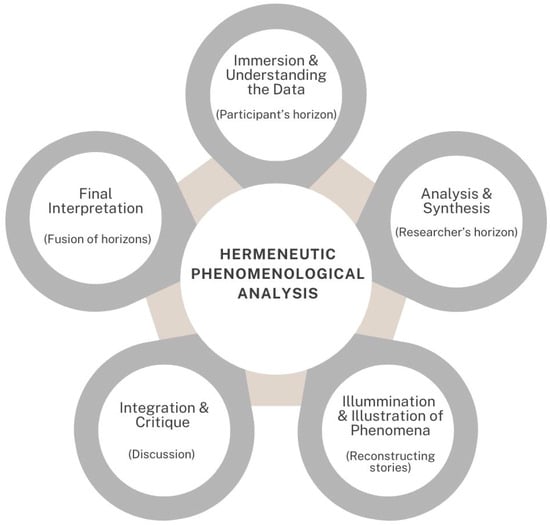
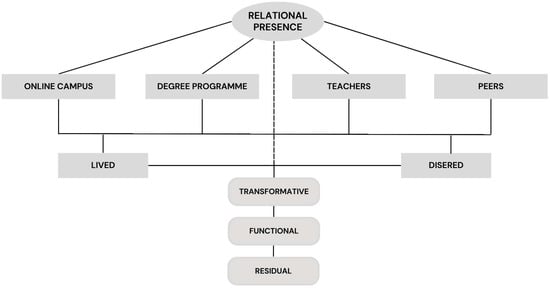
In Phase 2, the analysis was guided by a hermeneutic phenomenological approach (Gadamer, 1975; van Manen, 2016b) and drew on a practical framework for hermeneutic analysis (Alsaigh & Coyne, 2021) (see Figure 1). The process began with immersion in, and understanding of, the data, focusing on participants’ accounts, each treated as the unit of analysis, and clarifying what was at stake (the participant’s horizon) It then progressed to analysis and synthesis, where part-whole readings and reflexive writing refined emerging insights (the researcher’s horizon). Subsequently, the illumination and illustration of phenomena involved reconstructing narratives that exemplified key patterns. These insights were then integrated and critically examined in dialogue with the literature and through the contrast between lived and desired connections. Finally, a fusion of horizons produced a deep interpretation, which was ultimately shaped into the Relational Proximity Matrix (RPM) and its categories of analysis—transformative, functional, and residual proximity.
Figure 1.
Hermeneutic phenomenological analysis. Note: Adapted from (Alsaigh & Coyne, 2021).
Engaging with students’ narratives within the hermeneutic circle, the RPM emerged as a reflexive synthesis of students’ voices, theoretical traditions, and the researcher’s positioning. The validity of the analysis was assessed in terms of its plausibility and the interpretive density of the pedagogical insights.
2.5. Data Collection Tool
Consistent with the exploratory design of the study adopted earlier (Aires et al., 2022), data were collected using an online questionnaire created with Google Forms. The questionnaire comprised 19 open-ended questions, inviting online students to reflect freely and authentically on their academic experiences. Given the theoretical framework employed and the sample’s educational level, this tool was deemed appropriate for eliciting in-depth, reflexive narratives in the students’ own words.
The questionnaire was administered in two sequential stages. This deliberate decision was consistent with the project’s exploratory phase, allowing for the inclusion of a larger and more diverse group of students, while simultaneously generating rich textual data grounded in their lived experience. Furthermore, the written format provided participants with time for reflexive articulation, thus fostering authenticity in their narratives.
The first stage of data collection focused on narratives of positive and negative experiences in student–teacher relationships, providing insights into the emotional, pedagogical, and communicative dimensions of online education. The second stage invited participants to reflect on three key dimensions: (1) the meanings attributed to the online campus; (2) their lived connections with the online campus, degree programme, peers, and teachers; and (3) their desired connections with each of these domains. This two-stage design provided both breadth and depth, supporting a robust analysis of relational proximity.
A total of 144 valid responses were collected (94 in the first stage and 50 in the second). Students were enrolled in different programmes. The use of naturally occurring, discipline-specific peer networks contributed to the ecological validity of the data. The study was conducted in accordance with international ethical guidelines for educational research (AERA, 2011) and the host institution’s ethics charter. Participation was anonymous and voluntary, and informed consent was obtained at the beginning of the questionnaire. The research protocol was formally registered with the principal investigator’s affiliated research centre (anonymised).
3. Results and Discussion
The data analysis adopted a hermeneutic-phenomenological stance (van Manen, 2016b) and was informed by contemporary methodological guides within this tradition (Alsaigh & Coyne, 2021). Building on the descriptive analysis conducted in the previous phase (Aires et al., 2022), this study iteratively returned to the corpus and to the central research question, interpreting the data within the hermeneutic–phenomenological circle and through the lens of the proposed conception of Relational Proximity (Figure 1).
3.1. Relational Proximity: Dimensions and Categories
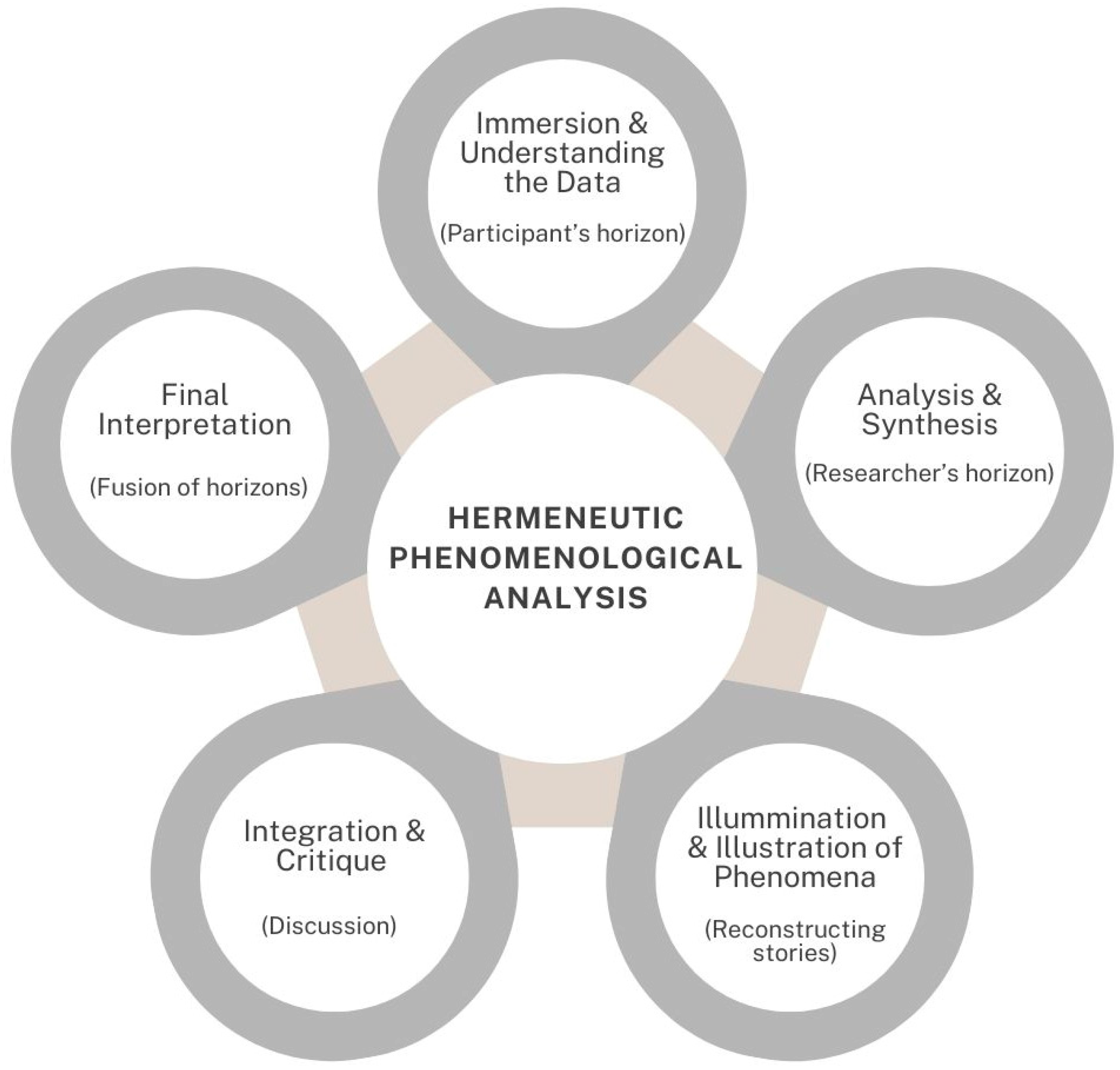
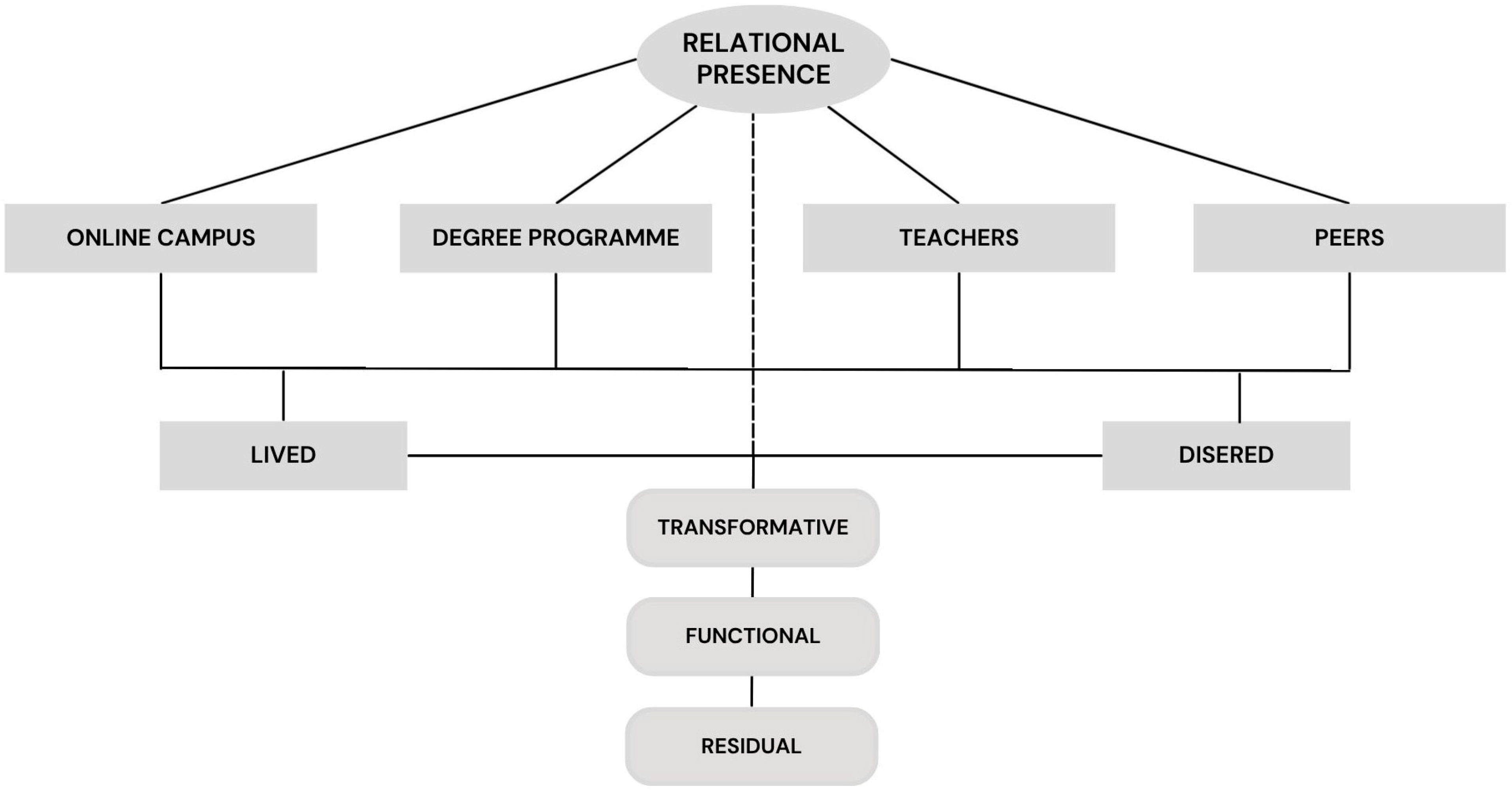
Analysis was sustained by whole movements across the four focal domains: Online Campus, Degree Programme, Teachers, and Peers, considering both students’ Lived and Desired connections. Through an iterative process of interpretation on students’ voices within the hermeneutic-phenomenological circle, three core categories of proximity were identified—Transformative, Functional, and Residual, which play a central role in structuring the Relational Proximity Matrix (RPM) (Figure 2).
Figure 2.
Relational Proximity: Analytical Framework.
3.2. Student Voices Informing the Relational Proximity Matrix
The development of the Relational Proximity Matrix (RPM) was deeply shaped by the interpretive patterns emerging from the students’ narratives across both phases of the study. These narratives consistently mapped the three identified categories—Transformative, Functional, and Residual Proximity—onto the four interdependent domains of relational experience: Online Campus, Programme, Teachers, and Peers. Rather than abstract constructs, those categories were explicitly grounded in recurring student accounts, exposing not only what was lived or experienced, but also what was desired or expected in their academic relationships. As adult learners, students inevitably draw on earlier educational experiences when articulating both lived and desired proximity. While the study did not collect detailed sociodemographic variables, the diversity of students’ learning trajectories provides an interpretive backdrop shaping how relational dynamics in online higher education are perceived and imagined. Given the mature profile of the students, we acknowledge that the distinction between lived and desired proximity operates primarily as an analytical device, enabling a clearer identification of relational gaps within the online learning ecosystem.
3.2.1. Relational Proximity in the Online Campus
The online campus serves as the primary gateway through which students connect with the university and access learning resources. Student accounts demonstrate that this space is experienced as predominantly functional and technical, rather than relational or dialogic.
Lived Experiences
Students’ lived experiences of the online campus reveal a form of relational proximity characterised by a minimal sense of connection, which is primarily functional and instrumental in nature. Although elements of transformation are present, particularly in fostering a sense of community and interaction, the online campus is largely perceived as a platform for resource access rather than a relational environment:
“It is a website or several websites that support the student”.[E98]
“Being connected with an online university community”.[E021]
“I’m connected anywhere at any time”.[E096]
“It means that I must keep myself constantly updated and take responsibility for my presence there.”[E110]
Desired Experiences
In contrast, students desired the online campus to foster a stronger sense of presence and engagement, serving as a space for relational encounters between peers and teachers. They reimagine it as a visible and engaging community environment supported by regular interactive events, asynchronous opportunities, and responsive feedback:
“It should be a space of interaction between students and teachers”.[E101]
“More outreach/communication (like student associations and events) to connect more students into a happier, more effective learning community”.[E115]
“The presence of everyone and of the university”.[E119]
“It could be a place that wasn’t just for receiving materials and handing in assignments”.[E127]
Analysis using the Relational Proximity Matrix (RPM) suggests the campus is experienced primarily as an instrumental platform rather than a relational space. This reflection aligns with Gourlay’s (2021) view that presence in digital learning spaces is often seen as a matter of visibility and function, rather than of relationship and affect. Desired proximity, however, projects a clear move toward functional–transformative configurations, where the campus is reimagined as a site of community, visibility, and dialogical engagement.
3.2.2. Relational Proximity in the Degree Programme
Students’ narratives about the Degree Programme (the Programme) consistently emphasised its value as a supportive academic structure, while simultaneously revealing limitations in relational depth.
Lived Experiences
Students perceived the Programme as a relationally meaningful structure that was well recognised, flexible, and highly supportive. However, their accounts also indicated limited relational depth and affective engagement. These lived experiences highlight the Programme’s strong capacity to foster functional community and engagement, which positions this domain as predominantly Functional Proximity, but with emerging elements of Transformative Proximity.
“Guidance, orientation, interaction and support”.[E15]
“Being able to pursue a course while having a full-time job”.[144]
“It represents my present: learning behind a computer, trying to enhance my skills, and managing to balance it with my professional life.”[136]
“Autonomy in managing my available time. But a much greater responsibility and willpower.”[138]
Desired Experiences
Students expressed a strong desire for a feedback-rich and collaborative Programme, aiming to foster deeper interaction, co-creation, and stronger identity building. They consistently called for more dialogical and participatory forms of engagement, projecting the Programme towards transformative configurations of relational proximity:
“We need more feedback and more follow-up in the course”.[E20]
“Make synchronous classes and/or tutorials available, focused on the most relevant points of each topic”.[E122]
“Virtual student status, with eligibility for merit scholarships. More teacher-student interaction.”[E129]
“The possibility for teachers to have the time to schedule more synchronous classes at different times throughout the day, week, or month.”[E125]
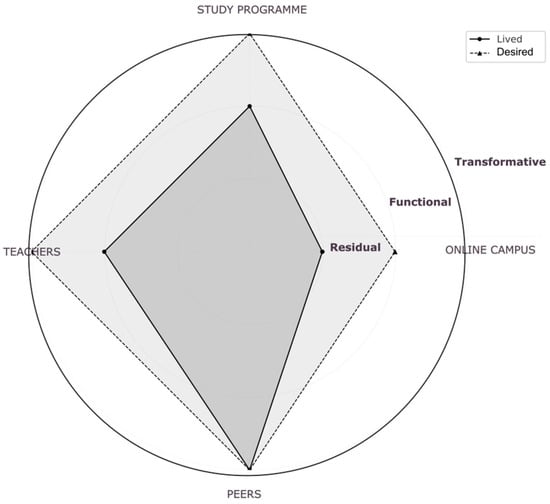
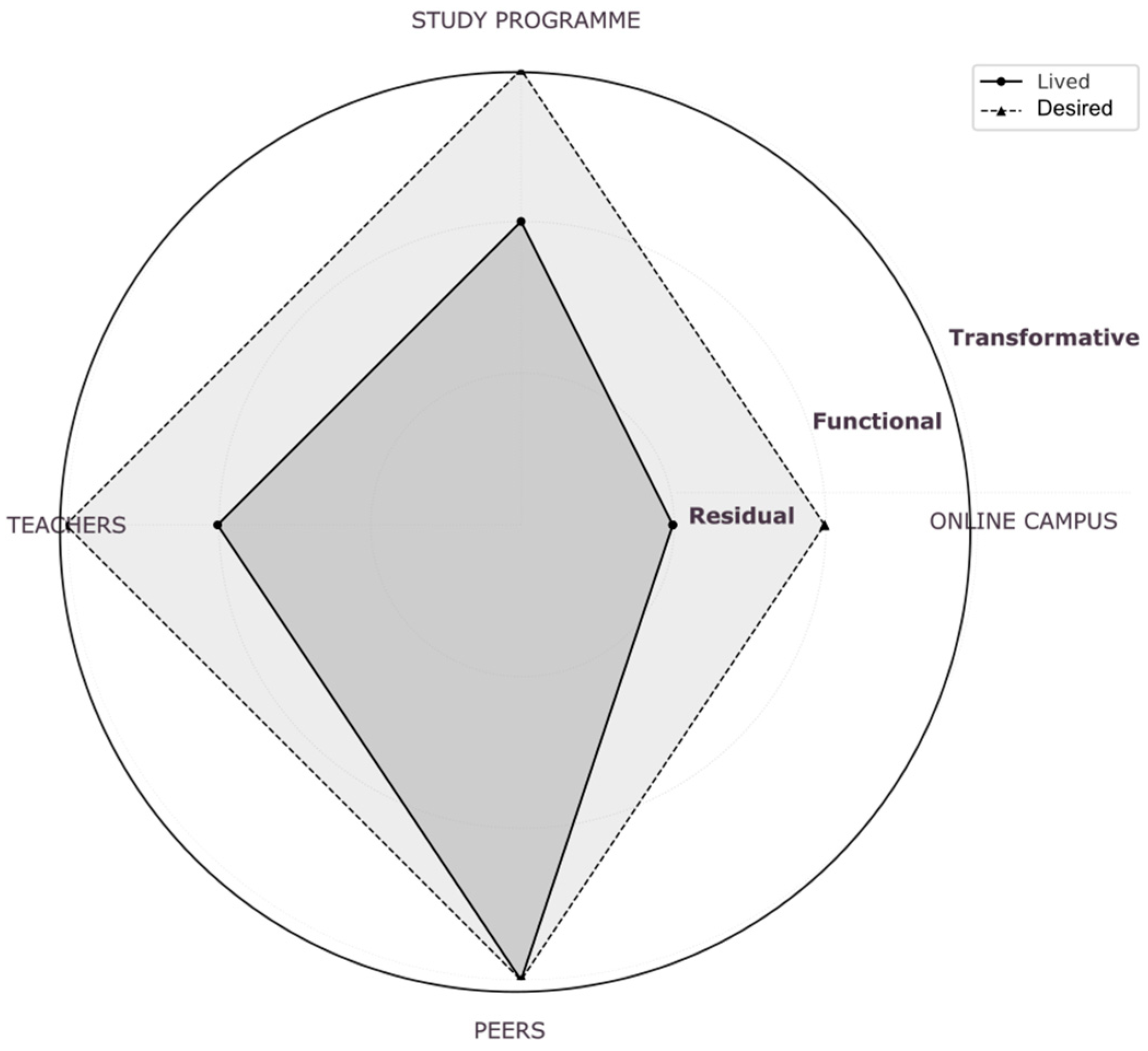
Through the lens of the Relational Proximity Matrix (RPM), the Programme emerges as a domain situated between Functional and Transformative Proximity. Students experience it as supportive yet relationally limited, while their desired projections highlight more transformative forms of feedback, collaboration, and co-creation. This contrast points to the Programme’s significant potential to sustain stronger academic belonging (Figure 3).
Figure 3.
Relational proximity: Synthesis. Note: Radar chart comparing lived and desired proximity across all four domains. The radial scale represents categories of proximity: residual (inner), functional (middle), and transformative (outer). The filled polygon indicates lived proximity, while the dashed outline indicates desired proximity. Higher positions reflect stronger proximity.
3.2.3. Relational Proximity with Teachers
Accounts of teacher–student relationships highlight a prevalent sense of relational distance, though some narratives also recognise crucial moments of valuable guidance and support.
Lived Experiences
Students’ experiences with teachers frequently reveal low levels of relational proximity, characterised by distance, limited presence, and a lack of emotional engagement. However, when relational proximity is experienced, it is consistently reported positively, emphasising the high value students place on personalised guidance and care:
“In these last semesters, the experiences regarding teachers were very distant”.[E03]
“There is closeness; teachers reply”.[E59]
“Essentially the same as being connected with classmates, but in this case they clearly have a duty to provide formal information that supports the student.”[E98]
“It is very important. It means knowing that at any time I can speak to each of them. Then it’s just a matter of waiting for their reply, which is generally very quick.”[E106]
Desired Experiences
Students called for stronger relational proximity with teachers, marked by visible care, sustained dialogue, and greater emotional engagement. They seek relationships that move beyond transactional duties to become more intersubjective, fostering mutual recognition and personalised feedback:
“Teachers should be more present and available for us”.[E25]
“Basically, the same as being connected to colleagues, but in which they clearly have a duty to provide formal information”.[E122]
“More warmth and empathy from teachers in their communication with students.”[E100]
“More video content or video lectures. Ultimately, being able to see the teachers’ faces and hear their voices as they explain certain topics.”[E108]
The RPM-oriented analysis suggests that lived proximity with teachers is sometimes characterised as residual–functional, reflecting distance and limited reciprocity (see Figure 3). Desired proximity, by contrast, is consistently Transformative, as students call for pedagogical relationships grounded in presence, sustained dialogue, and care. This issue calls for a more nuanced interpretation. Although the asynchronous design of courses supports flexibility and autonomy, students’ references to some teachers’ “absence” point to the limits of flexibility when not accompanied by an intentional pedagogy of presence and proximity. Drawing on Cain, Sheehan, and Taouk (Cain et al., 2024), the challenge appears to lie not in the literal absence of teachers, nor in a lack of interaction, but in the absence of relational cues, subtle markers of presence, attention, and care (Bali, 2015; Zamora & Bali, 2025). This underscores the importance of designing for the experience of relational proximity in asynchronous environments. Such an emphasis reflects Hayes’s (2021) idea that agency grows through relationships and Biesta’s (2013) view of the educational relation as an ethical encounter in which teaching becomes possible only through the response to the other as subject.
3.2.4. Relational Proximity with Peers
Peer relations stand out as the most affective and supportive domain of students’ online experience. This pattern aligns with Bayne’s (2015) postdigital notion of distributed presence and with Gravett’s relational pedagogy framework, in which belonging is understood as relationally enacted and situated in practice rather than individually experienced (Gravett, 2022; Gravett & Ajjawi, 2022).
Lived Experiences
Across the peer domain, students described their connections as supportive, meaningful and emotionally grounding. These relationships were frequently portrayed as a source of continuity, motivation and belonging within an otherwise dispersed learning environment. Rather than being limited to task coordination or academic exchange, peer relations were framed as affective and relational anchors:
“We support each other and clarify doubts together”.[E27]
“Being able to share both struggles and joys”.[E127]
“It is important to feel a sense of belonging to a community, as well as to collaborate in one’s studies.”[E111]
“It is important in narrowing the distance and preventing us from feeling detached from the classroom or the playground, since we share our studies and much of the personal side that brings us together. It encourages us to work collaboratively.”[E115]
Such accounts indicate that peer proximity operates predominantly at a transformative level: it enables shared meaning-making, emotional support and relational recognition. In phenomenological terms, peers are experienced as ‘being-with’, a relational mode in which learning unfolds through co-presence, solidarity and reciprocal affirmation rather than through procedural collaboration alone.
Desired Experiences
When reflecting on what could be strengthened in peer relationships, most students did not ask for new forms of proximity but rather for the strengthening or consolidation of what was already lived. Most of the requests focused on sustaining and formalising collaborative dynamics, particularly through increased opportunities for structured interaction:
“It would be good to have more group activities”.[E30]
“Create specific online groups by course unit”.[E146]
“Nothing to highlight.”[E129]
“Monthly meetings”.[E102]
Responses such as “nothing to add” or “no further changes needed” are analytically relevant. They do not signal a lack of desire, but rather a saturation of fulfilment: for these students, lived proximity already matched what they valued. Where change was articulated, it typically took the form of functional proposals (e.g., additional meetings or defined communication spaces), not because proximity was absent, but because relational flourishing required intentional scaffolding and continuity.
In the peer dimension, the RPM suggests that lived proximity is largely transformative, grounded in belonging, mutual support, and relational recognition. Desired proximity mainly reflects a wish to continue, stabilise, or give greater structure to existing connections rather than to transform them. The prevalence of these responses indicates that, for many students, what is lived already aligns with what is desired, reinforcing the idea that lived–desired proximity is experienced as a continuum rather than as two separate states.
3.3. Synthesising Relational Proximity
Across the four domains, the RPM-oriented analysis indicates that lived proximity on the Online Campus and with Teachers remains largely Functional–Residual. These relational patterns are not unexpected given the pedagogical orientations in place for undergraduate programmes: asynchronous participation affords flexibility and autonomy, yet the extent to which it supports relational immediacy, emotional resonance, and dialogical presence depends on the quality of communication and the relational practices established. As such, what appears as ‘distance’ in students’ voices may reflect not only relational expectations but also the structural affordances and constraints built into the programme’s pedagogical framework. By contrast, the Programme tends towards a functional–transformative pattern, while Peer relationships are predominantly transformative.
Remarkably, except for the Campus, desired proximity consistently projects all domains towards more transformative forms of relational presence and belonging (see Figure 3). Students clearly seek a shift from merely functional or minimal interactions to relationships characterised by dialogue, attentiveness and sustained presence. The Programme occupies an intermediate position: it possesses a strong functional base, yet structured dialogue (e.g., debates, synchronous sessions or tutorials) could unlock transformative possibilities. Peer relations are already experienced as highly transformative; the main request is not reinvention but light, reliable institutional support to sustain the relational proximity already co-created (see Figure 3).
Taken together, the RPM-oriented analysis suggests patterns of relational strength alongside areas where proximity may be fragile or underdeveloped within this particular online learning context. Rather than claiming a generalised diagnosis of online education, the findings provide a situated conceptual lens that may support reflection and redesign towards more participatory and care-oriented practices. The analysis foregrounds students’ expectations of a coherent relational ethos in which presence signifies dialogue, recognition, reciprocity and care, rather than monitoring. Within such an ethos, belonging becomes tangible through pedagogical design, institutional practices and shared relational responsibility across the learning community.
The findings also illuminate how meaningful connection in online education is articulated as a central condition for engagement, learning and persistence, particularly in relation to teachers, who are perceived as pivotal in shaping relational experience. Building on Fawns’ (2022) view of learning as relational and entangled, and consistent with recent relational perspectives in postdigital higher education (e.g., Gravett, 2022; Gravett & Ajjawi, 2022), the RPM conceptualises proximity as a dynamic and ethical condition rather than a technical or merely communicational variable.
In summary, the construction and application of the Relational Proximity Matrix mark a progression from a descriptive mapping of lived and desired experiences toward a heuristic proposal capable of informing pedagogical redesign.
4. Conclusions
To address our research question—how students experience and build relational ties in online higher education—we find that relational proximity, rather than access alone, is fundamentally grounded in presence, recognition, reciprocity, and pedagogical care. Drawing on 144 student narratives, this hermeneutic–phenomenological study mapped relational ties across the Online Campus, Programme, Teachers, and Peers using the Relational Proximity Matrix (RPM). Viewed through the RPM, lived proximity tended to manifest as functional–residual on the Online Campus, largely functional, with some ambivalence, in teacher–student relations, functional–transformative in the Programme, and already leaning towards transformative proximity among Peers. Desired proximity, however, reimagines the relational dynamics within the Programme, Teachers, and Peers in more transformative configurations, emphasising recognition, reciprocity, and pedagogical care as key dimensions of belonging.
As a theoretical contribution, this study aligns with emerging calls within postdigital and relational scholarship (e.g., Gravett, 2022; Felten & Lambert, 2020) to reconsider how presence and relational proximity operate as pedagogical and institutional concerns in online higher education. Drawing on postdigital accounts of presence (Bayne, 2015; Hayes, 2021; Gourlay, 2021), the analysis reinforces the argument that presence cannot be restricted to physical co-location or measurable activity. Rather, presence emerges as an affective, distributed, and relational condition, shaped by material arrangements, temporal rhythms, and ethical orientations. Gourlay’s analysis of the performative and unstable nature of presence resonates with students’ ambivalent relationships with their teachers, while Hayes’s notion of postdigital positionality is reflected in the tensions students express between autonomy and care, and between flexibility and neglect. Bayne’s call to move beyond instrumental logics of measurement and control is extended here through the introduction of the RPM, which offers a more integrative framework for analysing co-constructed and situated relationships.
Translating this theoretical perspective into research practice required methodological reconfiguration. In this process, the Relational Proximity Matrix (RPM) was developed not as a prescriptive tool but as a practical heuristic, offering guidance for pedagogical and institutional decision-making while leaving space for contextual adaptation. The RPM offers a set of guiding possibilities across teaching models, curriculum design, student engagement, staff development and evaluation. In teaching and curriculum design, it may serve as a reflective lens, prompting questions such as whether the learning environment supports proximity, recognition and meaningful connection among peers, teachers, the programme and the online campus. For student engagement, it could be used alongside feedback processes or learning analytics to support relational awareness and timely pedagogical interventions where appropriate. In teacher development, the RPM may foster reflective practice and relational sensitivity, providing a structured yet adaptable frame for ongoing professional learning. At an institutional level, relational considerations may complement existing quality assurance frameworks. As a research and innovation agenda, the RPM could be further developed through piloting in diverse contexts, multimodal inquiry and equity-oriented approaches.
The contribution of RPM to innovation lies in integrating affective, temporal, and institutional dimensions into analysis, yielding a flexible model for relational redesign in online higher education. The findings suggest that existing pedagogical models may benefit from being revisited through a relational lens, particularly in contexts where presence and belonging appear uneven or fragile. Instead of content-driven, linear models, educators are encouraged to cultivate ecologies of learning that support dialogic, affective, and reciprocal participation. Learning environments may be understood, designed and sustained as relational spaces in which emotional connection, mutual recognition and shared identity can emerge. At the institutional level, the analysis points to possibilities for reimagining the Online Campus as a relational space, where presence is actively cultivated through visibility, tangibility and interaction. These findings further highlight the potential value of supporting teachers as relational agents, recognising the emotional and dialogic work inherent in online teaching. As with other forms of hermeneutic–phenomenological inquiry, these propositions are not intended as universal prescriptions, but as analytically situated insights that may inform reflection, adaptation and future empirical exploration. More broadly, the study gestures toward an ethic of care as a productive orientation for thinking about higher education, where relationality may inform pedagogical models, curriculum practices, institutional policies and pedagogical leadership.
These patterns should be understood in relation to the pedagogical context in which the study was conducted: a fully online and predominantly asynchronous model that affords flexibility and autonomy, yet requires different strategies to foster dialogue, immediacy and relational presence. In this sense, students’ accounts do not simply express individual preference, but reveal how relational proximity is co-constructed—and sometimes limited—by the temporal, relational and structural affordances of the pedagogical framework.
Limitations and Future Research
This study has certain limitations, yet it strongly points to promising avenues for future research. Data were collected via an open-ended questionnaire which, while appropriate for an exploratory phase and sufficient for the development of the Relational Proximity Matrix (RPM), necessarily limited the dialogic depth typically associated with hermeneutic–phenomenological studies. Future work should, therefore, incorporate interviews, discussion groups, and other dialogic methods to capture additional layers of meaning and interaction within these relational dynamics.
The analysis draws on a purposively sampled group of students from a single higher education institution, which naturally limits the scope for generalisation. The sample also slightly over-represents female students, which may influence how relational closeness is articulated, particularly in expressions of care, support, and the desire for greater dialogic presence from teachers. This gendered emphasis should therefore be considered when interpreting the findings. To strengthen the empirical foundation of the RPM, future research should adopt multi-site and longitudinal designs, complemented by multimodal approaches (e.g., participatory co-design), to systematically explore how relational dynamics evolve over time and across diverse cultural and institutional contexts. As the RPM is currently presented as an exploratory and analytically driven framework, its further development will benefit from iterative examination and empirical expansion. Future work may also draw on mixed-methods designs to examine how the RPM operates not only as a conceptual heuristic, but also as a potential analytical and developmental tool to support teacher practice, institutional design, and relational evaluation in online learning.
This study conclusively reaffirms that students in online higher education do not merely seek access or information; they fundamentally seek connection, visibility, and care. By operationalizing relational proximity through the RPM, teachers and institutions are invited to respond with intentional design, ethical commitment, and reinvigorated pedagogical imagination. In postdigital contexts marked by fragmentation and complexity, the design of presence must be understood not as a technological solution but as an ethical–relational promise, one that recognises students not only as system users but, more importantly, as participants within a shared academic community in which they matter.
Conceptualising presence as relational proximity and presenting the RPM as a framework for relational analysis, this study thereby combines both conceptual and applied merit and provides a robust roadmap for pedagogical, curricular, and institutional innovation in online higher education.
Funding
This research was financed by national funds through FCT—Fundação Para a Ciência e a Tecnologia, I.P., through the projects UIDB/04372/2020 and UIDP/04372/2020.
Institutional Review Board Statement
The study was conducted in accordance with the Declaration of Helsinki and approved by the Ethics Committee of LE@D—Laboratory of Distance Education and eLearning (CE-Doc. 23/10).
Informed Consent Statement
Informed consent was obtained from all subjects involved in the study.
Data Availability Statement
The qualitative datasets (transcripts) are not publicly available due to confidentiality restrictions. However, de-identified excerpts supporting the findings are available from the corresponding author upon reasonable request.
Acknowledgments
The author gratefully acknowledges the participation of the students in this study. The author used ChatGPT (OpenAI, GPT-4, 2025) and Gemini (Google) to assist in refining and optimising the English (UK) language and academic coherence. The author has critically reviewed and approved the resulting content and takes full responsibility for the integrity and accuracy of the work.
Conflicts of Interest
The author declares no conflicts of interest.
References
- AERA. (2011). Code of ethics. Educational Researcher, 40(3), 145–156. [Google Scholar] [CrossRef] [Scilit]
- Aires, L., Maia, S., & Carneiro, A. C. (2022). Distance educational relationship and senses of belonging: The voices of students. Digital Education Review, (42), 101–117. [Google Scholar] [CrossRef] [Scilit]
- Alsaigh, R., & Coyne, I. (2021). Doing hermeneutic phenomenology research underpinned by Gadamer’s philosophy: A framework to facilitate data analysis. International Journal of Qualitative Methods, 20, 16094069211047820. [Google Scholar] [CrossRef] [Scilit]
- Bali, M. (2015, April 20). Pedagogy of care—Gone massive. Hybrid Pedagogy. Available online: https://hybridpedagogy.org/pedagogy-of-care-gone-massive/ (accessed on 6 March 2023).
- Bayne, S. (2015). Teacherbot: Interventions in automated teaching. Teaching in Higher Education, 20(4), 455–467. [Google Scholar] [CrossRef] [Scilit]
- Bayne, S., Evans, P., Ewins, R., Knox, J., Lamb, J., Macleod, H., O’Shea, C., Ross, J., Sheail, P., & Sinclair, C. (2020). The manifesto for teaching online. MIT Press. [Google Scholar] [CrossRef] [Scilit]
- Bayne, S., Gallagher, M. S., & Lamb, J. (2014). Being ‘at’ university: The social topologies of distance students. Higher Education, 67(5), 569–583. [Google Scholar] [CrossRef] [Scilit]
- Biesta, G. J. J. (2013). The beautiful risk of education. Paradigm. [Google Scholar]
- Blackie, M., & Luckett, K. (2025). Embodiment matters in knowledge building. Science & Education, 34, 717–730. [Google Scholar] [CrossRef] [Scilit]
- Braidotti, R. (2013). The posthuman. Polity Press. [Google Scholar]
- Cain, M., Sheehan, H., & Taouk, S. (2024). “It doesn’t feel like we’ve had the chance to really connect”: The crucial need for social presence in fully asynchronous teacher education. Teaching and Teacher Education, 152, 104789. [Google Scholar] [CrossRef] [Scilit]
- Cope, B., & Kalantzis, M. (2021). Pedagogies for digital learning: From transpositional grammar to the literacies of education. In B. Cope, & M. Kalantzis (Eds.), Multimodal literacies across digital learning contexts (pp. 21–40). Routledge. [Google Scholar]
- Damşa, C., & Jornet, A. (2017). Revisiting learning in higher education—Framing notions redefined through an ecological perspective [Special issue]. Frontline Learning Research, 4(4), 39–47. [Google Scholar] [CrossRef] [Scilit]
- Dulfer, N., Gowing, A., & Mitchell, J. (2024). Building belonging in online classrooms: Relationships at the core. Teaching in Higher Education, 30(4), 1024–1040. [Google Scholar] [CrossRef] [Scilit]
- Edwards, C., & Hardie, L. (2025). How to develop a sense of belonging in online distance learning? In J. Baxter, H. Selby-Fell, & A. Gilbert (Eds.), Creativity and critique in digital learning and teaching. Palgrave Macmillan. [Google Scholar] [CrossRef] [Scilit]
- Fawns, T. (2022). An entangled pedagogy: Looking beyond the pedagogy—Technology dichotomy. Postdigital Science and Education, 4(3), 711–728. [Google Scholar] [CrossRef] [Scilit]
- Felten, P., & Lambert, L. M. (2020). Relationship-rich education: How human connections drive success in college. Johns Hopkins University Press. [Google Scholar]
- Gadamer, H.-G. (1975). Truth and method. Sheed & Ward. [Google Scholar]
- Garrison, D. R., Anderson, T., & Archer, W. (2000). Critical inquiry in a text-based environment: Computer conferencing in higher education. The Internet and Higher Education, 2(2–3), 87–105. [Google Scholar] [CrossRef] [Scilit]
- González-Sanmamed, M., Sangrà, A., Souto-Seijo, A., & Estévez, I. (2020). Learning ecologies in the digital era: Challenges for higher education. Publicaciones, 50, 83–102. [Google Scholar] [CrossRef] [Scilit]
- Gourlay, L. (2020). Posthumanism and the digital university. Bloomsbury Publishing. [Google Scholar]
- Gourlay, L. (2021). There is no ‘virtual learning’: The materiality of digital education. Journal of New Approaches in Educational Research, 10(1), 57–66. [Google Scholar] [CrossRef] [Scilit]
- Gourlay, L. (2022). Presence, absence, and alterity: Fire space and Goffman’s selves in postdigital education. Postdigital Science and Education, 4, 57–69. [Google Scholar] [CrossRef] [Scilit]
- Gravett, K. (2022). Relational pedagogies. Bloomsbury Publishing. [Google Scholar]
- Gravett, K., & Ajjawi, R. (2022). Belonging as situated practice. Studies in Higher Education, 47(7), 1386–1396. [Google Scholar] [CrossRef] [Scilit]
- Gravett, K., Ajjawi, R., & O Shea, S. (2023). Topologies of belonging in the digital university. Pedagogy, Culture & Society, 33, 597–611. [Google Scholar] [CrossRef] [Scilit]
- Gravett, K., Taylor, C. A., & Fairchild, N. (2024). Pedagogies of mattering: Re-conceptualising relational pedagogies in higher education. Teaching in Higher Education, 29(2), 388–403. [Google Scholar] [CrossRef] [Scilit]
- Hayes, S. (2021). Postdigital positionality: Developing powerful inclusive narratives for learning, teaching, research and policy in higher education. Brill. [Google Scholar]
- Ingold, T. (2015). The life of lines. Routledge. [Google Scholar]
- Jandrić, P. (2017). From anthropocentric humanism to critical posthumanism in digital education. In Learning in the age of digital reason. Sense Publishers. [Google Scholar] [CrossRef] [Scilit]
- Jandrić, P. (2023a). Postdigital dialogues: Education beyond human exceptionalism. Springer. [Google Scholar] [CrossRef] [Scilit]
- Jandrić, P. (Ed.). (2023b). Encyclopedia of postdigital science and education. Springer Nature Switzerland AG. [Google Scholar] [CrossRef] [Scilit]
- Jandrić, P., & Knox, J. (2022). The postdigital turn: Philosophy, education, research. Policy Futures in Education, 20(7), 780–795. [Google Scholar] [CrossRef] [Scilit]
- Jandrić, P., Knox, J., Besley, T., Ryberg, T., Suoranta, J., & Hayes, S. (2018). Postdigital science and education. Educational Philosophy and Theory, 50(10), 893–899. [Google Scholar] [CrossRef] [Scilit]
- Jornet, A., & Damşa, C. (2021). Unit of analysis from an ecological perspective: Beyond the individual/social dichotomy. Learning, Culture and Social Interaction, 31, 100329. [Google Scholar] [CrossRef] [Scilit]
- Korthals Altes, T., Muftugil-Yalcin, S., & Slootman, M. (2023). Belonging in online synchronous classrooms: Experiences of minoritized students in Dutch higher education during the COVID-19 pandemic. Education Sciences, 13(10), 986. [Google Scholar] [CrossRef] [Scilit]
- Law, J., & Mol, A. (2001). Situating technoscience: An inquiry into specialities. Environment and Planning D: Society and Space, 19(5), 609–621. [Google Scholar] [CrossRef] [Scilit]
- McCabe, J. (2016). Connecting in college: How friendship networks matter for academic and social success. University of Chicago Press. [Google Scholar]
- McCabe, J. (2023). Friendships and student success in college. Journal of Postsecondary Student Success, 2(3), 5–22. [Google Scholar] [CrossRef] [Scilit]
- Mol, A., & Law, J. (1994). Regions, networks and fluids: Anaemia and social topologies. Social Studies of Science, 24(4), 641–671. [Google Scholar] [CrossRef] [Scilit] [PubMed]
- Moore, M. G. (1993). Theory of transactional distance. In D. Keegan (Ed.), Theoretical principles of distance education (pp. 22–29). Routledge. [Google Scholar]
- Moreira, I. M. M. (2008, June 25–28). Ensino superior a distância em Portugal: Uma aproximação sociográfica [Paper presentation]. VI Portuguese Congress of Sociology, Portuguese Sociological Association (APS), Lisbon, Portugal. Available online: https://aps.pt/wp-content/uploads/2017/08/DPR4926d7d5aae7f_1.pdf (accessed on 25 May 2023).
- Nizzolino, S., & Canals, A. (2024). Measuring learning presence as fourth dimension in the community of inquiry survey: Defining self-regulation items and subscales through a Heutagogical approach. Education Sciences, 14(8), 862. [Google Scholar] [CrossRef] [Scilit]
- Quintas-Mendes, A., Morgado, L., & Amante, L. (2010). Comunicação mediatizada por computador e educação online: Da distância à proximidade. In M. Silva, L. Pesce, & A. Zuin (Eds.), Educação online: Cenário, formação e questões didático-metodológicas. WAK Editora. [Google Scholar]
- Riddle, S., & Hickey, A. (2023). Reclaiming relationality in education policy: Towards a more authentic relational pedagogy. Critical Studies in Education, 64(3), 267–282. [Google Scholar] [CrossRef] [Scilit]
- Rossi, T. R., & Fontes, M. B. (2022). Ensino superior a distância como possibilidade de mobilidade intergeracional: O caso de mulheres adultas da Universidade Aberta do Brasil (UAB). EaD em Foco, 12(2), e1660. [Google Scholar] [CrossRef] [Scilit]
- Roth, W.-M., & Jornet, A. (2018). From object-oriented to fluid ontology: A case study of the materiality of design work in agile software development. Computer Supported Cooperative Work, 27, 37–75. [Google Scholar] [CrossRef] [Scilit]
- Stommel, J. (2014, November 17). Critical digital pedagogy: A definition. Hybrid Pedagogy. Available online: https://hybridpedagogy.org/critical-digital-pedagogy-definition/ (accessed on 8 February 2023).
- van Manen, M. (2016a). Pedagogical tact: Knowing what to do when you don’t know what to do. Routledge. [Google Scholar] [CrossRef] [Scilit]
- van Manen, M. (2016b). Researching lived experience: Human science for an action sensitive pedagogy (2nd ed.). Routledge. [Google Scholar]
- Veletsianos, G., & Houlden, S. (2020). Radical flexibility and relationality as responses to education in times of crisis. Postdigital Science and Education, 2(3), 849–862. [Google Scholar] [CrossRef] [Scilit]
- Zamora, M., & Bali, M. (2025). From socially just care to socially just distributed ecosystems of care. Journal of Learning Development in Higher Education, (35). [Google Scholar] [CrossRef] [Scilit]

Disclaimer/Publisher’s Note: The statements, opinions and data contained in all publications are solely those of the individual author(s) and contributor(s) and not of MDPI and/or the editor(s). MDPI and/or the editor(s) disclaim responsibility for any injury to people or property resulting from any ideas, methods, instructions or products referred to in the content. |
© 2025 by the author. Licensee MDPI, Basel, Switzerland. This article is an open access article distributed under the terms and conditions of the Creative Commons Attribution (CC BY) license.