1. Introduction
Education has long been recognized as the cornerstone of economic progress, social cohesion, and human development. Yet, in the twenty-first century, an era defined by technological disruption, demographic shifts, and skill polarization (
Arocena et al., 2022), the question is no longer whether education matters, but which dimensions of education most effectively translate into sustained economic growth. Within the European Union (EU), this question has gained renewed urgency as policymakers work to balance economic competitiveness with social inclusion and long-term sustainability (
M. A. Niță, 2023). Decades of research affirm that educational attainment improves individual productivity, employability, and innovation capacity (
Bykova et al., 2024;
Pal, 2023;
Isac et al., 2023;
Sheehan & Shi, 2019). Beyond formal education, participation in lifelong learning and adult training has emerged as a strategic necessity, equipping workers to adapt to automation, digitalization, and the green transition (
Mustafa & Lleshi, 2024). Consequently, flagship EU initiatives such as Europe 2020, the European Skills Agenda, and the European Education Area 2025 underscore education’s transformative role in achieving competitive, inclusive, and resilient economies (
Silander, 2023;
Păun et al., 2020).
However, while the importance of education is well acknowledged, the extent to which it drives measurable economic growth across EU member states remains ambiguous. The existing literature, though extensive, tends to adopt narrow or homogenous perspectives, focusing primarily on schooling attainment or enrollment rates as singular proxies for human capital (
Baltador et al., 2024;
Hanif & Arshed, 2016;
Hanushek & Woessmann, 2021;
Kotásková et al., 2018;
Zafar et al., 2022). These approaches often obscure the multifaceted ways in which education contributes to economic growth, overlooking how lifelong learning systems, adult participation, and sustained public investment collectively reinforce economic dynamism in advanced economies. Moreover, many cross-country studies rely on global datasets dominated by non-EU contexts, neglecting intra-European heterogeneity in educational outcomes, institutional capacity, and fiscal priorities. For instance, Nordic countries consistently record high rates of adult learning participation and educational expenditure, while several Southern and Eastern European nations lag behind (
Hajighasemi et al., 2022). The COVID-19 pandemic further magnified these disparities, disrupting education systems, labor markets, and innovation ecosystems across the continent. As the EU accelerates its digital and green transitions, such inequalities risk undermining the inclusive growth agenda (
Şerban & Mitrică, 2024;
Chatzipanagiotou & Katsarou, 2023;
Cornelia Dura et al., 2025;
Iordache et al., 2021).
Against this backdrop, there is a critical need for region-specific empirical analyses that capture the multidimensional contribution of education to economic growth within the EU. Responding to this gap, the present study examines how educational attainment, lifelong learning participation, and government expenditure on education jointly shape GDP growth across EU member states. Using a panel dataset from Eurostat (2013–2022) and employing fixed-effects regression models with robust estimators, the analysis isolates the distinct and combined effects of these educational dimensions while controlling for country-specific heterogeneity. The inclusion of both pre- and post-pandemic data allows for an assessment of education’s stabilizing role in periods of economic volatility and structural transformation.
This study contributes to the literature in several substantive ways. First, it adopts a holistic analytical framework that integrates multiple dimensions of education: formal attainment, lifelong learning, and fiscal commitment, offering a more comprehensive understanding of the education–growth nexus. Second, it provides empirical evidence grounded in the EU context, addressing the scarcity of regionally focused analyses in post-crisis and transition economies. Third, it contributes to Human Capital Theory by situating education within a broader socioeconomic ecosystem, illustrating how continuous learning and public investment enhance national resilience and productivity. Finally, the study offers policy-relevant insights for aligning education systems with the EU’s sustainable growth objectives, emphasizing that education is not merely a social good but a strategic economic investment.
The remainder of this paper is structured as follows:
Section 2 presents the theoretical framework and hypotheses;
Section 3 describes the materials and methods;
Section 4 reports the empirical results;
Section 5 discusses the findings;
Section 6 concludes with implications, and
Section 7 presents the limitations and directions for future research.
2. Theoretical Framework and Hypotheses Development
This study is anchored in Human Capital Theory, which posits that education, skills, and training constitute deliberate investments in human capital that enhance individual productivity and, in turn, drive broader economic growth (
D. Niță & Stoicuța, 2025;
Ogbeifun & Shobande, 2022). At the macroeconomic level, this implies that nations that prioritize education and skill development are more likely to experience sustained improvements in innovation, efficiency, and output, ultimately reflected in GDP growth.
In line with the first objective, Human Capital Theory provides a strong foundation for explaining the relationship between educational attainment and GDP. Individuals who achieve higher levels of formal education acquire advanced knowledge, problem-solving abilities, and technical competencies that translate into increased labor productivity and innovative capacity (
Mamanazarov et al., 2025;
Duah et al., 2025). Consequently, educational attainment becomes a vital determinant of economic performance, as better-educated workforces are more adaptable to technological change and global competition.
Addressing the second objective, Human Capital Theory also underscores the role of adult learning and continuous training in sustaining economic growth. In a knowledge-driven economy, where skills quickly become obsolete, adult learning enables workers to refresh, update, and expand their competencies (
Uzoagu, 2022). By promoting lifelong learning, economies can maintain a competitive edge, as ongoing human capital development supports adaptability, creativity, and long-term productivity gains.
Finally, the third objective, which examines the role of government educational expenditure, is also strongly linked to Human Capital Theory. Public investment in education represents a systemic approach to expanding and strengthening national human capital. When governments allocate resources to improve the quality, accessibility, and inclusivity of education, they ensure that opportunities for skill acquisition are available to a broader segment of society (
Kousar et al., 2023). This not only enhances aggregate productivity but also contributes to reducing inequality by equipping marginalized groups with tools to participate meaningfully in economic activities. Taken together, Human Capital Theory provides a robust lens for understanding how educational attainment, adult learning, and government educational expenditure reinforce one another in shaping economic growth. By situating these elements as interconnected investments in human capital, the theory highlights the central role of education in fostering innovation, resilience, and sustainable development (
Dura & Driga, 2017).
2.1. Educational Attainment and Economic Growth
Educational attainment refers to the highest level of education completed by individuals within a population, often measured in terms of years of schooling, literacy rates, or the proportion of the labor force with secondary or tertiary qualifications (
Okbay et al., 2022). On the other hand, economic growth, typically measured by Gross Domestic Product (GDP), reflects the increase in a nation’s output of goods and services over time and serves as a key indicator of national productivity and welfare (
Cristea et al., 2021).
The relationship between educational attainment and GDP lies in the productivity-enhancing effect of knowledge and skills (
D. Niță et al., 2025). Individuals with higher levels of education are better equipped with cognitive and technical abilities, enabling them to contribute more effectively to innovation, efficiency, and the overall competitiveness of the economy (
Al Dulaimi et al., 2022). As a result, countries with higher average levels of education tend to experience stronger and more sustainable economic growth.
This nexus is best explained through Human Capital Theory, which posits that education is an investment in human capital, similar to how firms invest in physical capital. By equipping individuals with skills and knowledge, education raises their productivity, which in turn contributes to aggregate economic output (
Altwaijri et al., 2024). The theory underscores the idea that higher educational attainment enhances the stock of human capital available in an economy, thereby improving labor productivity and GDP growth.
Empirical evidence strongly supports this theoretical perspective.
Valero (
2021) demonstrated that education is a major contributor to economic growth, showing that investments in education translate into higher productivity, innovation, and improved labor market outcomes that collectively stimulate GDP. Similarly,
Marto et al. (
2022) found that the percentage of individuals with tertiary education exerts a positive and statistically significant impact on GDP per capita, underscoring the critical role of advanced education in enhancing national economic performance. In parallel,
Maneejuk and Yamaka (
2021) revealed that while secondary school enrollment rates contribute positively to economic growth by expanding the pool of semi-skilled labor and strengthening foundational skills, it is higher education that serves as the key driver of long-term growth and sustainability. Their findings emphasize that tertiary education equips individuals with advanced knowledge, technical expertise, and innovative capabilities, which are essential for driving productivity, fostering technological progress, and maintaining competitiveness in an increasingly knowledge-based global economy.
Apostu et al. (
2022) investigated the role of tertiary education in economic expansion using panel regression across 30 European countries (2003–2020). Their results reveal a positive and statistically significant effect of higher education on economic growth, reinforcing the link between advanced educational attainment and macroeconomic development.
Goczek et al. (
2021) analyzed panel data from 58 countries to explore how education quality contributes to economic growth. By applying econometric techniques that explicitly address reverse causality, the authors demonstrated that improvements in earlier educational quality significantly enhance long-term economic performance. Their findings underscore the critical role of foundational education in strengthening human capital and stimulating GDP growth. Similarly,
Castelló-Climent and Hidalgo-Cabrillana (
2012), using cross-country econometric analysis, argue that educational quality shapes both the extensive margin (access to education) and intensive margin (investment per student). Their study concludes that higher-quality education enhances the composition of human capital and is a key determinant of sustainable economic growth. Collectively, these studies reinforce the argument that educational attainment, particularly at the tertiary level, is indispensable for sustained GDP growth and overall economic resilience. Given this theoretical and empirical foundation, it is expected that higher levels of educational attainment among the population will positively and significantly impact economic growth. Accordingly, it was hypothesized that:
Hypothesis 1. Educational attainment has a positive and significant effect on economic growth.
2.2. Adult Learning Participation and Economic Growth
Adult learning participation refers to the ongoing involvement of adults in structured educational activities, such as professional training, vocational programs, lifelong learning initiatives, and skills development courses (
Boeren et al., 2023). It emphasizes continuous skill renewal and adaptability in response to evolving labor market needs. Adult learning plays a pivotal role in sustaining economic growth in a rapidly changing, knowledge-driven economy. By refreshing and upgrading skills, adult education enhances workforce flexibility, productivity, and employability, ensuring that individuals can adapt to technological advancements and shifting economic demands (
Ogbu, 2025). This, in turn, reduces structural unemployment and fosters inclusive participation in economic activities.
The Human Capital Theory provides strong support for this relationship. It posits that continuous learning and training represent reinvestments in human capital that maintain and enhance worker productivity throughout the life cycle (
Mustafa & Lleshi, 2024). In contexts where industries are evolving rapidly, adult learning enables workers to remain competitive, innovate, and contribute effectively to economic output (
Edwards-Fapohunda, 2024). Thus, adult learning participation not only strengthens individual economic prospects but also stimulates aggregate economic growth.
Empirical evidence reinforces this link.
Valero (
2021) showed that countries with higher rates of adult learning participation tend to record stronger economic performance, as continuous skill development directly correlates with productivity gains. Similarly,
Molnár et al. (
2024) found that adult education programs contribute positively to GDP growth by reducing skill obsolescence and promoting innovation across industries. Furthermore,
Vrdoljak (
2024) emphasized that lifelong learning is a cornerstone of sustained economic resilience, particularly in advanced economies where technological change demands constant adaptation.
Edwards-Fapohunda (
2024) applied a mixed-methods approach, combining quantitative analysis with qualitative interviews, to evaluate the influence of adult education programs in New York City. The results indicate that adult education enhances employability, career progression, civic engagement, and social inclusion. These findings suggest that lifelong learning contributes not only to individual empowerment but also to broader community wellbeing and economic growth. Collectively, these findings indicate that adult learning is not only beneficial at the individual level but also an essential determinant of national economic performance. Consequently, it was hypothesized that:
Hypothesis 2. Adult learning participation has a positive and significant effect on economic growth.
2.3. Government Educational Expenditure and Economic Growth
Government educational expenditure refers to the financial resources allocated by the state toward education, including funding for infrastructure, teacher salaries, training programs, learning materials, and student support services (
Kushebayev & Nygymetov, 2022). It represents a systemic investment in human capital formation. Investment in education through public expenditure directly contributes to human capital development by ensuring equitable access to quality education, reducing illiteracy, and equipping individuals with skills necessary for innovation and productivity (
Sibomana et al., 2025). This, in turn, enhances the quality of the workforce, promotes inclusive participation in the economy, and stimulates long-term growth. Moreover, higher educational expenditure can generate positive spillover effects by fostering social inclusion, reducing poverty, and supporting technological progress (
Khurshid et al., 2023).
The Human Capital Theory reinforces this link by emphasizing that government spending on education is not a cost but an investment that yields future economic returns (
Almutairi, 2024). By allocating resources to education, governments increase the stock of human capital available in the economy, thereby raising labor productivity, innovation capacity, and overall competitiveness (
Abdeldayem et al., 2021). In this sense, public educational investment serves as a catalyst for sustainable economic development.
Empirical evidence substantiates this relationship.
Žalėnienė and Pereira (
2021) demonstrated that higher government spending on education significantly contributes to GDP growth by improving both access and quality. Similarly,
Özdoğan Özbal (
2021) found that educational expenditure positively impacts economic performance in both developing and developed countries by enhancing human capital accumulation. More recently,
Sultana et al. (
2022) revealed that sustained investment in education fosters inclusive economic growth, particularly in emerging economies where access to quality education remains uneven.
Rahman and Anis (
2023) conducted a panel-data analysis of 63 countries (1981–2010) and demonstrated a strong positive correlation between public education expenditure and economic development, even when controlling for inflation, unemployment, FDI, exports, and capital formation. Their study confirms the robustness of the education–growth nexus across diverse economic contexts. Similarly,
Ziberi et al. (
2022) examined how public education expenditure influences economic growth in North Macedonia using World Bank data from 1917 to 2020. Their econometric findings show that government spending on education has a positive and significant impact on economic growth, emphasizing the long-term return on public investment in human capital.
Le and Tran (
2021), using Vietnam’s national statistics (2006–2019) and employing VAR and Granger causality models, found a bidirectional relationship between government education spending and economic growth, with effects materializing after a two-year lag. This suggests a dynamic feedback loop in which investment in education and economic performance reinforce each other. These studies consistently affirm that government educational expenditure is a fundamental driver of economic progress. On account of this, it was hypothesized that:
Hypothesis 3. Government educational expenditure has a positive and significant effect on economic growth.
3. Materials and Methods
3.1. Data and Sample
The dataset used in this study was sourced from Eurostat, the official statistical office of the European Union, which provides harmonized and internationally comparable macro-level indicators across all member states. Eurostat’s databases are widely recognized for their methodological consistency and reliability, making them an appropriate foundation for cross-country research within the EU (
Marchand et al., 2019). Specifically, this study draws from two major sources: the Education and Training Indicators Database and the National Accounts Database, which collectively offer comprehensive coverage of education, social inclusion, and macroeconomic performance variables.
The study employs an unbalanced panel dataset spanning the period 2013–2022, capturing a decade of significant economic and educational transformation across the EU. The final dataset integrates macroeconomic indicators including Gross Domestic Product (GDP) and government expenditure on education as a share of GDP, with educational and social metrics such as tertiary educational attainment rates, adult participation in lifelong learning, and social inclusion indicators. This multidimensional structure enables a more holistic examination of how educational systems and public investment jointly shape economic outcomes.
The panel comprises 270 country-year observations (27 EU member states × 10 years), ensuring sufficient variability across both temporal and cross-sectional dimensions for robust econometric analysis. The inclusion of countries with diverse socioeconomic and institutional profiles, from large, advanced economies such as Germany and France to smaller and emerging EU members such as Estonia, Latvia, and Slovenia, facilitates comparative insights into how variations in education systems and public spending translate into differences in growth trajectories. The integration of multiple Eurostat indicators across economic and educational dimensions ensures comprehensiveness and internal consistency, allowing the study to capture both direct and indirect effects of education on economic growth. Previous empirical studies have similarly employed panel data techniques to investigate the influence of education on economic growth (
Rahman & Anis, 2023;
Apostu et al., 2022;
Goczek et al., 2021;
Castelló-Climent & Hidalgo-Cabrillana, 2012).
All data were sourced from publicly available Eurostat repositories, ensuring full replicability and transparency of the analysis. For contextual interpretation, country names were retained during descriptive analysis but anonymized during statistical modeling to ensure neutrality and comparability. Overall, the dataset provides a robust empirical foundation for examining the multidimensional nexus among education, social inclusion, and economic growth within the EU.
3.2. Measurement Constructs
The dependent variable for this study is GDP, which captures the overall economic output and growth of a country. GDP reflects the market value of all final goods and services produced within a nation and is widely recognized as a central indicator of economic performance and societal well-being (
Cohen Kaminitz, 2023). In line with prior research (e.g.,
Marto et al., 2022;
Wang, 2023), GDP is operationalized using total GDP, measured in absolute Euro terms to represent aggregate national economic output.
The independent variables of the study are educational attainment, adult participation in learning, and government educational expenditure, all of which represent critical dimensions of human capital investment. Tertiary educational attainment is defined as the proportion of the working-age population (25–64 years) that has successfully completed tertiary-level education, including bachelor’s, master’s, or doctoral degrees. This measure reflects the stock of advanced human capital available to the labor market, enhancing innovation capacity, productivity, and long-term competitiveness. Adult participation in learning, on the other hand, refers to the percentage of adults aged 25–64 who engage in formal or non-formal education and training activities during a reference period, typically four weeks prior to the survey. This construct highlights the extent to which individuals continuously update their skills to adapt to evolving labor market demands and technological change. Government educational expenditure captures systemic investments in education by the state, reflecting public commitment to human capital formation. It captures the proportion of GDP attributable to education-related investments and activities. All indicators were sourced from the Eurostat Education Database, which provides reliable cross-country and longitudinal data on education and training.
To enhance the robustness of the analysis and isolate the unique effects of the key predictors, two control variables were incorporated into the model. The first is the poverty rate, expressed as the percentage of the population living below the national poverty line. Poverty represents a key structural constraint that can undermine the economic benefits of educational investments by limiting access to learning opportunities and reducing the capacity of individuals to contribute productively to the economy (
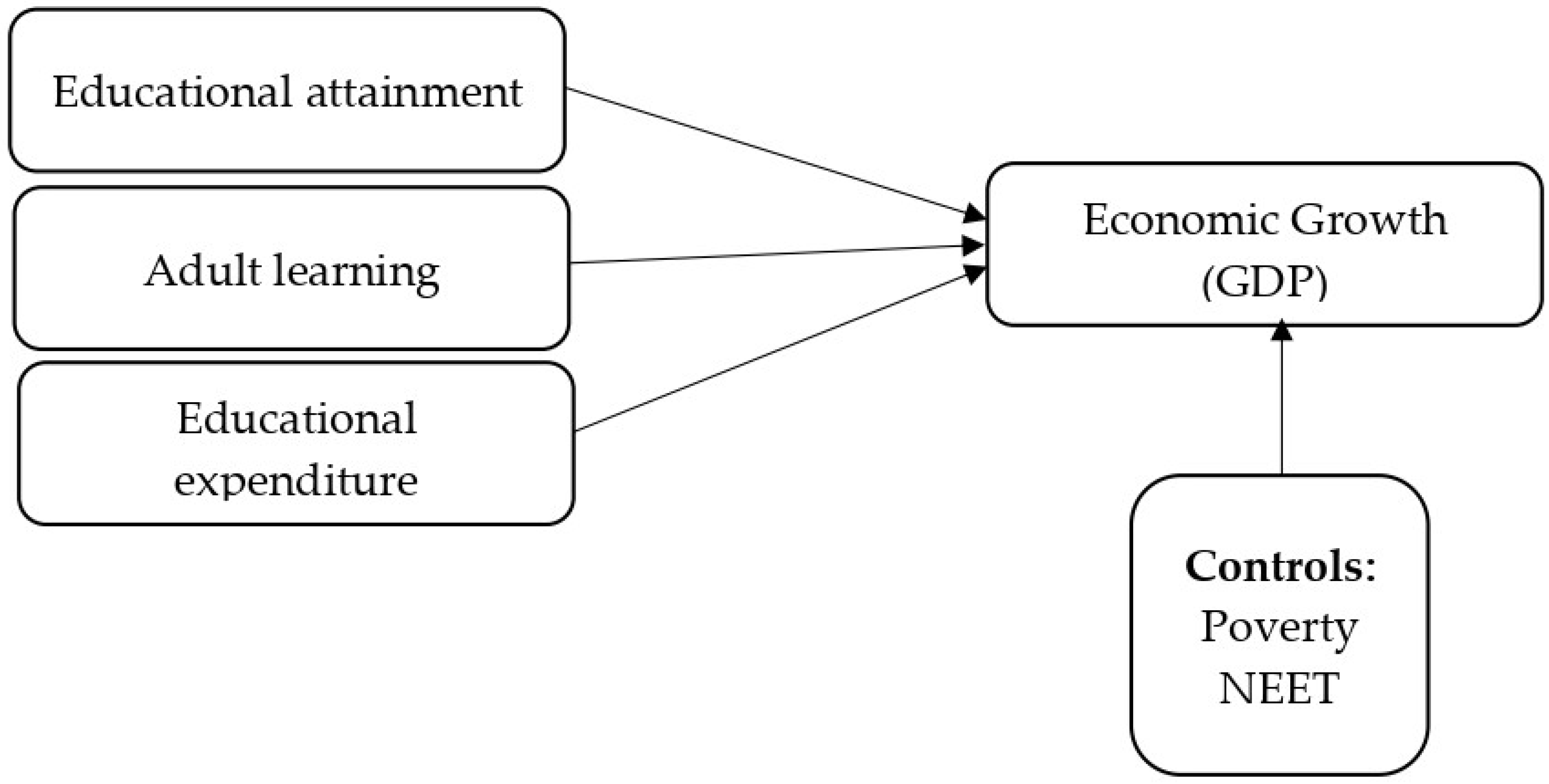
Shah & Mushtaq, 2024). The second control variable is the percentage of young people aged 15–24 who are neither in employment, education, nor training (NEET). This indicator captures labor market exclusion among youth, reflecting underutilized human capital and potential social vulnerabilities that directly affect economic growth. Consequently, the following conceptual framework and equation as shown in
Figure 1 and Equation (1) was developed.
3.3. Preliminary Analysis and Robustness Tests
3.3.1. Descriptive Analysis
The dataset consists of six key variables: GDP, educational attainment, adult learning, educational expenditure, poverty, and youth not in employment, education, or training (NEET).
The descriptive statistics reveal meaningful patterns across the variables. GDP exhibits a mean of 11.285 with relatively low variation (Std. Dev = 1.540), suggesting stability across observations, although the Jarque–Bera probability (0.022) indicates a departure from normality. Educational attainment appears normally distributed (
p = 0.129), with a mean of 41.947 and a median of 42.050, reflecting a balanced distribution. Adult learning, however, displays wide variability (Std. Dev = 8.616), positive skewness (0.803), and significant non-normality (
p = 0.000). Educational expenditure is stable (Std. Dev = 1.454) but fails the normality test (
p = 0.003). Poverty shows high dispersion (Std. Dev = 10.383) yet remains normally distributed (
p = 0.244). NEET averages 10.041, with moderate variation (Std. Dev = 4.853) and non-normal distribution (
p = 0.028). Although some variables deviate from normality, the large sample size ensures the robustness of subsequent estimations under the central limit theorem. The results of the descriptive analysis are presented in
Table 1.
3.3.2. Normality Test
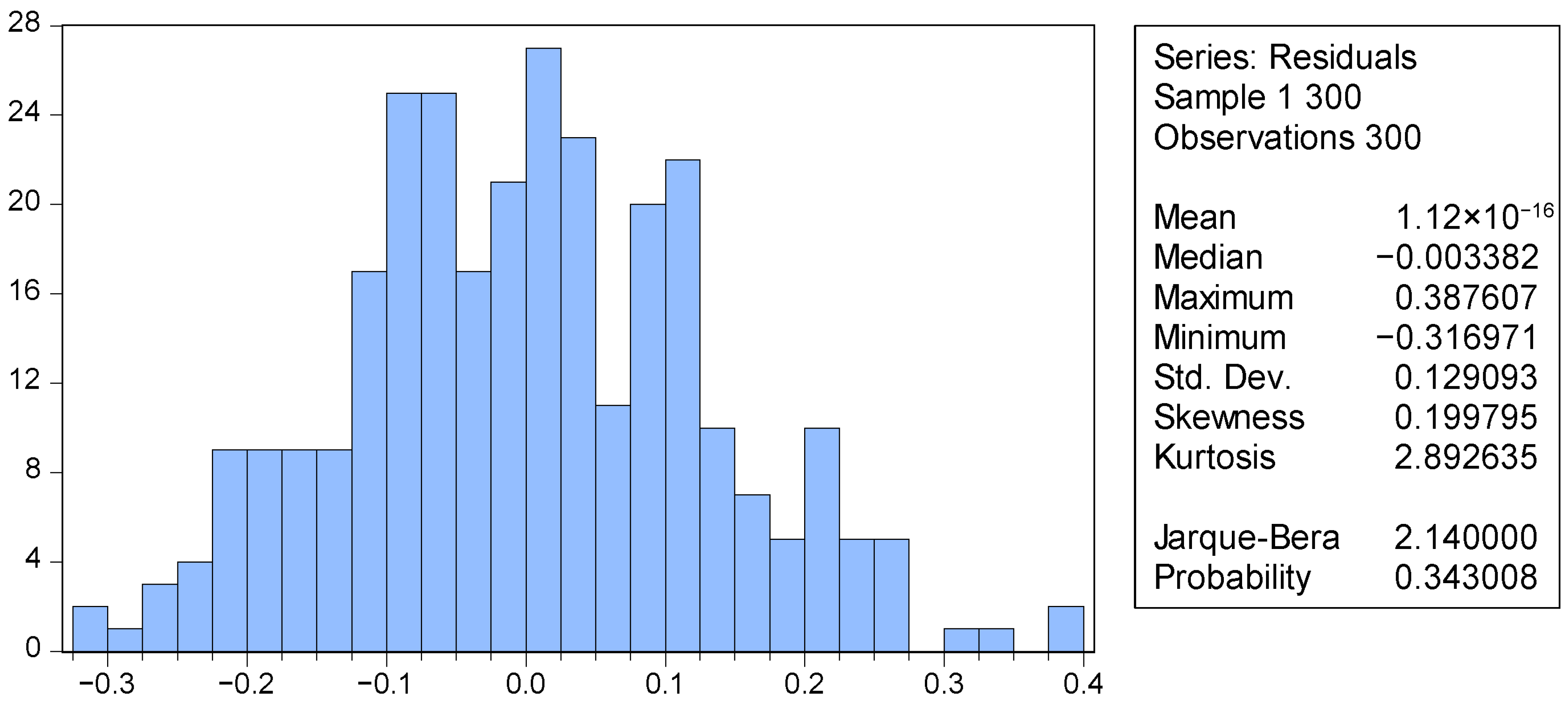
The normality of the residuals in this study was assessed using the Jarque–Bera test, with evaluation based on the associated probability value. A model is deemed to satisfy the normality assumption when the probability value exceeds the chosen significance level (α = 0.05). Although individual variables such as GDP, adult learning, educational expenditure, and NEET were not normally distributed, the overall model fulfilled the normality assumption, as indicated by a Jarque–Bera probability value of 0.343, which is greater than the 0.05 threshold. The detailed results of the test are presented in
Figure 2.
3.3.3. Multicollinearity Test
The results of the variance inflation factor (VIF) test demonstrate that multicollinearity is not a concern in the dataset. All VIF values fall within the range of 1.115 to 1.592, far below the conventional thresholds of 10 (
Sirait et al., 2025). This indicates that the explanatory variables are not highly correlated and each contributes unique explanatory power to the model. The following equation was used in computing the VIF:
where R
2j comes from regressing the jth independent variable on all the other independent variables.
Table 2 presents the results of the multicollinearity test.
3.3.4. Correlation Analysis
The correlation analysis highlights several noteworthy relationships. GDP shows weak positive associations with adult learning (0.196) and educational expenditure (0.193), but a negative correlation with NEET (−0.179), suggesting that higher GDP is associated with lower youth disengagement. Educational attainment correlates moderately with adult learning (0.404) but shows minimal correlation with GDP (0.069). Adult learning is positively related to both educational attainment (0.404) and educational expenditure (0.266), while being negatively associated with poverty (−0.244) and NEET (−0.342), indicating its potential role in improving social outcomes. Educational expenditure is positively linked with GDP (0.193) and adult learning (0.266), but negatively correlated with NEET (−0.209), implying that investment in education reduces youth exclusion. Poverty demonstrates only weak associations, with a slight negative correlation with adult learning (−0.244) and NEET (−0.086). Overall, NEET exhibits consistent negative correlations with key socioeconomic and educational variables, particularly adult learning and educational expenditure.
Table 3 features the results of the correlation analysis.
3.3.5. Hausman Test
The Hausman specification test was employed to determine the appropriate estimator between the fixed effects (FE) and random effects (RE) models. The test produced a Chi-Square statistic of 19.473 (df = 5, p = 0.002), which is statistically significant at the 1% level. This result rejects the null hypothesis that the random effects model is consistent, thereby indicating that the fixed effects estimator is the preferred specification for the analysis.
At the variable level, the Hausman test further highlights key discrepancies between the FE and RE coefficients. Educational attainment, adult learning, educational expenditure, and NEET all show significant differences (
p-values of 0.020, 0.023, 0.000, and 0.022, respectively), reinforcing the superiority of the fixed effects specification. Poverty, on the other hand, does not differ significantly between models (
p = 0.160), suggesting robustness across estimators. Taken together, these results underscore the importance of controlling for unobserved heterogeneity across panels, validating the use of the fixed effects approach in the subsequent regression analysis. The results of the Hausman test are presented in
Table 4.
4. Results and Discussion
To ensure the robustness of the estimations against heteroskedasticity and cross-sectional dependence, the fixed-effects model was re-estimated using White cross-section robust standard errors. The results, summarized in
Table 5, confirm that all explanatory variables exert statistically significant effects on economic growth (GDP), thereby validating the model’s overall consistency and robustness.
The analysis reveals that educational attainment exerts a positive and statistically significant effect on GDP (β = 0.207; p < 0.01). This finding implies that improvements in the proportion of individuals completing formal education translate into measurable gains in economic performance, reflecting the productivity-enhancing role of a more educated workforce. Accordingly, Hypothesis 1 is supported. Similarly, adult learning participation demonstrates a significant positive effect on GDP (β = 0.308; p < 0.01), underscoring the macroeconomic importance of lifelong learning and continuous skills upgrading. This result affirms Hypothesis 2 and highlights the value of ongoing education in sustaining labor market adaptability and innovation within rapidly evolving economies. Among all predictors, government educational expenditure emerges as the most influential determinant of GDP (β = 1.067; p < 0.01). This strong and significant relationship reinforces the notion that public investment in education acts as a strategic catalyst for long-term growth, reflecting both its direct impact on human capital formation and its multiplier effects across sectors. Consequently, Hypothesis 3 is accepted. Conversely, poverty displays a significant negative association with GDP (β = −0.103; p < 0.05), aligning with theoretical expectations that high poverty levels erode human capital accumulation, reduce labor productivity, and constrain aggregate demand. Likewise, the NEET rate negatively and significantly affects GDP (β = −0.405; p < 0.01), revealing that youth disengagement represents a critical loss of productive potential. This result emphasizes the structural challenge of integrating young populations into education and employment systems to sustain inclusive economic growth.
The overall model exhibits strong explanatory power, with an R-squared value of 0.693 and an adjusted R-squared of 0.691, indicating that approximately 69% of the variation in GDP across EU member states and over time is explained by the included variables. This level of explanatory strength is consistent with comparable macroeconomic panel studies, reflecting a robust model specification that effectively captures the influence of educational attainment, lifelong learning, and public investment on economic growth. The F-statistic (3085.687,
p < 0.01) confirms the joint statistical significance of the predictors. Moreover, the Durbin–Watson statistic (1.969) approximates the ideal benchmark value of 2 (
Ashoor et al., 2021), suggesting that model residuals are free from serious autocorrelation. These diagnostics collectively reinforce the reliability and internal validity of the estimated coefficients.
Taken together, these findings affirm that educational attainment, lifelong learning, and public expenditure in education are central engines of growth, while poverty and youth inactivity act as counterforces that dampen economic momentum. The results lend strong empirical support to the view that comprehensive education policies, complemented by social inclusion measures, are essential for achieving resilient and sustainable growth trajectories across the European Union.
5. Discussion
The findings of this study provide compelling evidence that education, poverty reduction, and youth engagement are key structural drivers of economic growth. The results underscore that strengthening human capital, reducing socioeconomic vulnerability, and ensuring meaningful youth participation in education and labor markets collectively contribute to more resilient and dynamic economies. By re-estimating the fixed effects model with White cross-section robust standard errors, the results reveal consistent and statistically significant relationships that both support and extend existing theoretical and empirical insights.
First, the analysis confirmed that educational attainment exerts a positive and significant effect on economic growth. This result aligns with the Human Capital Theory (
Altwaijri et al., 2024), which posits that higher levels of education enhance labor productivity and innovation capacity. It also corroborates the empirical findings of
Valero (
2021),
Marto et al. (
2022), and
Maneejuk and Yamaka (
2021), who demonstrated that while secondary education broadens the skilled labor base, it is tertiary education that drives long-term productivity and competitiveness. The present study reinforces these insights by showing that economies investing in higher levels of formal education are better positioned to sustain growth in an increasingly knowledge-based global economy. Second, the results underscore the importance of adult learning participation as a determinant of growth, with a positive and significant effect on GDP. This highlights the necessity of continuous skill renewal in adapting to rapid technological and labor market changes. Consistent with the Human Capital Theory (
Mustafa & Lleshi, 2024), adult learning can be understood as a reinvestment in human capital that maintains worker productivity across the life cycle. Empirical evidence from
Valero (
2021),
Molnár et al. (
2024), and
Vrdoljak (
2024) similarly supports this link, showing that lifelong learning reduces skill obsolescence and fosters innovation. The present findings extend this literature by demonstrating that the benefits of adult education persist even when controlling for other educational and socioeconomic variables.
Most notably, the study reveals that government educational expenditure is the most influential predictor of GDP. This provides strong support for the argument that educational spending is not a mere cost but a strategic investment in national productivity and competitiveness (
Almutairi, 2024;
Abdeldayem et al., 2021). Prior studies by
Žalėnienė and Pereira (
2021),
Özdoğan Özbal (
2021), and
Sultana et al. (
2022) similarly found that educational expenditure positively impacts growth by expanding access, improving quality, and fostering inclusiveness. This study suggests that government spending generates amplified spillover effects, including poverty reduction, social cohesion, and technological advancement (
Khurshid et al., 2023). This underscores the need for governments, especially in resource-constrained contexts, to prioritize sustained and well-targeted education financing as a foundation for long-term economic stability.
In contrast to the positive role of education, the study highlights the detrimental effects of poverty and youth disengagement (NEET) on growth. Poverty was found to negatively and significantly affect, confirming theoretical expectations that high poverty rates undermine human capital formation and productivity. This aligns with the broader literature that views poverty as both a cause and a consequence of weak economic performance, as it limits access to education, health, and productive opportunities (
Cerra et al., 2021). Similarly, NEET exerted a strong negative effect, indicating that youth disengagement from both education and labor markets constitutes a severe structural barrier to growth. This finding resonates with the view that young people represent a vital source of dynamism, skills, and innovation (
Valero, 2021), and that persistent NEET rates deprive economies of their demographic dividend, thereby constraining sustainable development (
Cieslik et al., 2022).
Accordingly, the findings collectively validate the study’s hypotheses and contribute to the broader discourse on education, poverty, and growth. The results reinforce the theoretical foundations of Human Capital Theory, while also extending the literature by simultaneously examining multiple dimensions of education including formal attainment, adult learning, and government expenditure, alongside structural challenges such as poverty and NEET. Importantly, the results demonstrate that education, in its various forms, is not only individually significant but collectively constitutes the primary driver of economic performance, whereas poverty and youth disengagement act as significant drags on growth.
6. Conclusions
This study investigated the dynamic relationship between education, poverty, youth disengagement, and economic growth across EU member states using a panel fixed-effects model corrected for heteroskedasticity. The empirical results demonstrate that educational attainment, adult learning participation, and government expenditure on education exert positive and statistically significant effects on GDP, with public investment in education emerging as the strongest determinant of growth. Conversely, poverty levels and NEET rates (youth not in education, employment, or training) were found to significantly impede economic performance, reflecting the structural barriers that erode human capital accumulation and constrain national productivity.
These findings make several important contributions to the literature. First, they reaffirm the central role of education as a strategic engine of macroeconomic growth, while simultaneously illuminating the adverse impact of poverty and youth disengagement on economic progress. Second, the study advances the debate by integrating three complementary dimensions of education: formal attainment, lifelong adult learning, and government expenditure into a single, multidimensional analytical framework. This approach provides a holistic understanding of how education functions both as an individual capability and a systemic public investment, interacting with broader social and institutional factors to shape economic outcomes.
The novelty of this study stems from its comprehensive examination of how education, poverty reduction, and youth engagement interact synergistically to drive sustainable economic growth. Rather than treating these factors in isolation, the study demonstrates their interconnected influence, offering a more holistic understanding of the human-capital foundations of long-term development. While prior research has often analyzed these variables in isolation, this study demonstrates that the transformative potential of education is maximized when (1) governments sustain investment in education, (2) individuals actively engage in lifelong learning, and (3) systemic barriers such as poverty and youth disengagement are mitigated concurrently. By situating education within a broader developmental and institutional context, the study generates new empirical and theoretical insights into how integrated policy interventions can strengthen national resilience and inclusive growth.
In conclusion, the findings underscore that education is not merely a social good but a strategic economic imperative. To harness its full potential, policymakers must prioritize education financing, expand adult learning and reskilling systems, and implement targeted programs to reduce poverty and youth inactivity. Collectively, these efforts will reinforce human capital formation, stimulate productivity, and support the transition toward a resilient, knowledge-driven, and inclusive European economy. The study thus enriches the Human Capital Theory by embedding education within a multidimensional, socially inclusive framework and provides actionable guidance for policymakers seeking to align education policy with long-term economic sustainability.
6.1. Policy Implications
From a policy perspective, the results emphasize the urgent need for governments to prioritize education financing as a central pillar of national development strategies. The particularly positive and significant effect of educational expenditure on GDP demonstrates that investment in education is not simply a social service but a decisive economic growth strategy. Governments must therefore safeguard and expand education budgets even in times of fiscal constraint, ensuring equitable access to quality education at all levels. Beyond financing, the results suggest that the expansion of tertiary education opportunities is vital for building long-term competitiveness, as higher education equips individuals with advanced skills and innovative capacity. Equally important is the institutionalization of lifelong learning policies, which enable adults to adapt to technological change and shifting labor market demands. The study also underscores the need for integrated poverty reduction and youth engagement strategies, since persistent deprivation and high NEET rates threaten to undermine the benefits of educational investment. Social protection systems, employment initiatives, and targeted youth entrepreneurship programs are therefore necessary complements to education reforms if nations are to achieve inclusive and sustainable growth.
6.2. Theoretical Implications
The findings reinforce the central propositions of Human Capital Theory, which argues that education is a productive form of capital that yields returns in the form of higher productivity, innovation, and aggregate output. However, this study extends the theory by showing that the benefits of human capital formation are conditional on the removal of structural barriers such as poverty and youth disengagement. In this way, the study moves beyond traditional formulations that treat education as an isolated driver of growth, and instead demonstrates that human capital accumulation must be understood within a broader socioeconomic context. Moreover, by analyzing education as a three-dimensional construct comprising attainment, lifelong adult learning, and government expenditure, the study advances a more comprehensive framework for understanding how different forms of educational investment interact to shape macroeconomic performance. This multidimensional view contributes to the theoretical literature by bridging the gap between individual-level educational outcomes and systemic policy interventions.
6.3. Practical/Managerial Implications
The practical and managerial implications of the study extend to firms, educational institutions, and industry leaders. For businesses, the significant positive effect of adult learning on growth highlights the importance of investing in continuous training and skills development as part of strategic management rather than as a discretionary cost. Firms that support reskilling and upskilling programs are likely to benefit from enhanced employee productivity, greater adaptability to technological change, and improved competitiveness in global markets. Educational institutions, particularly universities and vocational training centers, can draw on these findings to align curricula more closely with labor market demands, thereby ensuring that graduates are equipped with the relevant competencies needed to contribute effectively to the economy. Finally, the study suggests that closer collaboration between governments and the private sector is essential. Public–private partnerships in training and workforce development can amplify the impact of public investment in education while also helping to integrate young people who are at risk of exclusion from education and employment. By reducing NEET rates and building resilient human capital systems, such partnerships can unlock untapped talent pools and contribute to inclusive national growth.
7. Limitations, and Future Research Suggestions
While this study provides valuable insights into the relationship between education, poverty, youth disengagement, and economic growth, several limitations should be acknowledged. First, the analysis relies on secondary panel data, which, although robust, may not fully capture the qualitative dimensions of education such as teaching quality, learning outcomes, or informal skill acquisition. These unobserved factors could influence the strength of the relationships observed, suggesting that the results should be interpreted with some caution. Second, the study is constrained by its focus on a set of measurable variables, meaning that other potential determinants of growth, such as technological adoption, governance quality, and institutional capacity, were not explicitly included in the model. Their omission may have resulted in an incomplete picture of the broader dynamics of economic performance. Third, the study adopts a macro-level perspective, which limits its ability to capture heterogeneity across regions, demographic groups, or sectors of the economy. As such, the findings provide strong general patterns but may not fully account for micro-level variations in the education–growth nexus.
These limitations open important avenues for future research. Subsequent studies could enrich the analysis by incorporating qualitative measures of education, such as indicators of curriculum relevance, teacher competence, and learning environments, to provide a more nuanced understanding of how education drives economic growth. Future work could also extend the model to include institutional and governance factors, given their crucial role in mediating the effectiveness of educational investment and poverty reduction strategies. Moreover, comparative studies across different regions or income groups could shed light on how contextual differences shape the relationship between education, poverty, and growth. Micro-level analyses, particularly those employing household-level or firm-level data, would also be valuable in unpacking how individual and organizational investments in education and training translate into broader macroeconomic outcomes. Finally, longitudinal studies that trace the long-term effects of educational reforms, adult learning initiatives, and public expenditure on economic resilience would help clarify the sustainability of the observed relationships.