


Abstract
Gamification is being increasingly applied in various contexts, including higher education, to enhance student engagement and academic performance. Despite the growing body of empirical research on this topic, questions remain regarding its effectiveness in improving tangible academic outcomes. This study explored the impact of gamification on 1056 university students in Business Management through two controlled quasi-experimental settings. Official academic performance indicators were used to assess the influence of gamification on results. The findings demonstrate significant positive effects of gamification on all performance indicators. However, no significant changes were observed in attendance rates, as the percentage of non-attending students remained unchanged under both experimental conditions. These results contribute to the understanding of how gamification can shape academic outcomes and highlight areas for further investigation in educational settings.
1. Introduction
Early empirical work identified the motivational strengths of gamification elements and emphasized the value these features add to virtual learning platforms like Moodle (Swacha, 2021). By tracking students’ progress and offering consistent feedback, gamified interfaces have been linked to improvements in both student engagement and perceived enjoyment (Rodríguez-Martínez, 2021).
Studies focusing on cognitive and psychomotor development in children have suggested that game-based interventions could benefit younger populations by bolstering motor skills and cognitive abilities (Prabhudesai et al., 2023). In Higher Education (HE), gamification is increasingly regarded as a vital strategy for designing and delivering educational services and tools, with a particular focus on strengthening student motivation, autonomy, and academic persistence (Rivera & Garden, 2021; Xi & Hamari, 2019).
In addition, research indicates that well-structured gamified courses may lead to statistically significant improvements in outcomes such as exam performance and course completion (M. Li et al., 2023; Zeng et al., 2024). For instance, a recent meta-analysis showed that incorporating gamified features into classroom activities can lead to measurable gains in student engagement, often translating into higher participation rates (Lampropoulos & Sidiropoulos, 2024).
Despite these encouraging findings, scholarly consensus on the efficacy of gamification remains elusive. Some studies have reported contradictory results, highlighting inconclusive or marginally positive effects on objective performance metrics (Almeida et al., 2023; Rachels & Rockinson-Szapkiw, 2018). Variations in course design, learner profiles, disciplinary content, and the specific game elements employed can all influence the outcomes of gamified interventions (Hanus & Fox, 2015; Skritsovali, 2023). In addition, individual differences, such as personality traits or prior subject knowledge, may moderate the effectiveness of gaming features (Hanus & Fox, 2015; Smiderle et al., 2020). The divergent results reported across studies illustrate the complexity of gamification. Researchers have emphasized the importance of aligning game elements, such as competition, collaboration, surprise activities, or narrative arcs, with course objectives and students’ needs (Lampropoulos & Sidiropoulos, 2024). Moreover, emerging evidence suggests that duration and modality (e.g., face-to-face vs. online gamification) can moderate the impact of gamification, further complicating generalized claims of success (M. Li et al., 2023). From an institutional perspective, the ultimate aim of any educational innovation is to benefit both educators and students, giving top priority to student achievement (M. Li et al., 2023; Rivera & Garden, 2021).
Clarifying whether and how gamification strategies effectively elevate academic performance, beyond merely stimulating motivation, remains a critical step. Equally vital is the thoughtful integration of these strategies into existing curricular structures, as well as the careful matching of game elements to course-level learning outcomes. For instance, collaborative challenges might be more suited to courses that aim to develop teamwork skills, whereas competitive features may be advantageous in contexts that foster individual accountability (Lee & Hammer, 2011).
Based on these theoretical foundations and supported by the work of Zeng et al. (2024), the following research question has been addressed: whether gamification in HE invariably leads to improved final grades or only to enhanced motivation and participation. This study seeks to contribute to the growing body of gamification literature by examining its effects on objective academic outcomes through quasi-experimental data drawn from two university courses. Official performance metrics, such as pass rates and final grades, are employed to yield robust and generalizable insights (Zainuddin et al., 2020). In doing so, this research offers empirical evidence on whether gamification can genuinely enhance learning achievements in HE, and under what conditions its implementation is most beneficial.
Ultimately, the findings will help inform evidence-based instructional design, thereby supporting educators’ efforts to optimize both teaching practices and student learning experiences. The results may also guide institutional decision-makers in determining the best practices for embedding gamified components in HE curricula and for scaling up those methods that most reliably improve academic performance.
Building on this introductory overview, the following section elaborates the theoretical underpinnings of gamification in higher education, offering a structured analysis of its key mechanisms, design principles, and contextual moderators.
2. Theoretical Background
Gamification has evolved from a niche instructional tactic into a recognized strategy within HE for enhancing student motivation and performance. As academic institutions strive to balance innovation with measurable outcomes, understanding how gamification functions within different pedagogical frameworks becomes increasingly important. This section outlines the theoretical foundations that underpin gamification’s impact on learning, detailing its mechanisms, design considerations, and the contextual factors that moderate its effectiveness in fostering academic success.
2.1. The Effects of Gamification in HE on Outcome Indicators
Gamification in HE has garnered attention for its potential to foster engagement skills, heighten motivation, and spark greater interest in the learning process (Legaki et al., 2019; Rivera & Garden, 2021). While these benefits align well with student and educator objectives, the overriding concern in most academic settings is still to bolster actual learning achievements, as measured by tangible performance outcomes. Academic performance thus emerges as one of the clearest indicators of the effectiveness of gamification strategies in developing students’ knowledge and competencies.
Recent scholarly work highlights the growing interest among researchers and education professionals in exploring the interplay between gamification, motivation, and enhanced learning outcomes (Skritsovali, 2023). Indeed, there is an increasing call for empirical validation, anchored in rigorous quantitative analyses, to substantiate claims about gamification’s benefits (P. Buckley & Doyle, 2017; Hanus & Fox, 2015; Maican et al., 2016; Markopoulos et al., 2015). Within this framework, various game elements such as perceived collaboration, competition, feedback, self-expression, and sense of control have been identified as key drivers of students’ intrinsic motivation (Luarn et al., 2023; Smiderle et al., 2020).
Furthermore, recent research illustrates how integrating gamification into instructional contexts can significantly improve students’ motivation to learn, raise academic achievement levels, and reinforce critical skill sets across diverse educational domains (Huseinović, 2024). In some fields of Science, Technology, Engineering, and Math (STEM-oriented fields), robotics-based gamification approaches have been linked to heightened creativity and motivation (Chen et al., 2023), thereby underlining the interdisciplinary benefits of game-like features. In parallel, systematic reviews point to the positive impact of gamification on language acquisition, particularly in English language education, where it effectively boosts student engagement and participation (Lee & Hammer, 2011; Fitria, 2022). Despite these promising findings, the evidence base remains somewhat fragmented.
According to Koivisto and Hamari (2019)’s large-scale review, around 35.7% of studies in education reported fully positive outcomes, whereas 32.1% document mixed but generally favorable effects. Nonetheless, the heterogeneity of designs and metrics often complicates conclusive interpretations. While several works note measurable gains in academic performance (Legaki et al., 2019; W. Li et al., 2012; Nadi-Ravandi & Batooli, 2022), others question the magnitude of those gains. For instance, one study found that participants using traditional exercises performed on par with peers in gamified settings, suggesting that enjoyment alone does not guarantee better outcomes (Domínguez et al., 2013; van der Kooij et al., 2019). Similarly, it has been reported that although motivation and engagement increased, grades were unaffected or showed little improvement (Barata et al., 2014).
Notably, several researchers call for distinctions between different dimensions of “academic performance” (Domínguez et al., 2013; Ke, 2011). In some contexts, gamified approaches may promote higher-order thinking and practical skill development while leaving foundational theory underexplored. Consequently, the literature reflects mixed and at times contradictory assessments of gamification’s impact on academic success (Bai et al., 2020).
Another critical factor is the breadth of gamification’s design and measurement approaches (Hung, 2017). Given the myriad ways in which educators implement game mechanics, ranging from simple point systems to intricate narrative-based frameworks, identifying a “one-size-fits-all” model remains challenging. Thus, specifying the precise game elements and performance indicators is crucial to avoid inconclusive or misleading interpretations (Sailer & Homner, 2020; Yıldırım & Şen, 2021).
When the intervention is clearly delineated and consistently measured, gamification can yield notable improvements in academic outcomes (Lampropoulos & Sidiropoulos, 2024). Still, the multitude of criteria used to evaluate gamified learning often introduces variability that complicates the comparison and replication of results (Inocencio, 2018; Zeng et al., 2024). Thus, there remains a pressing need for standardized metrics, such as pass rates, success rates, or improvements in exam averages, to ensure a reliable basis for assessing gamification’s efficacy. Indeed, the work by Lampropoulos and Sidiropoulos (2024) advocates the use of conventional educational indicators (e.g., success rate, excellence rate, dropout rate) to gauge whether gamification strategies genuinely align with institutional objectives. Such standardization provides both educators and administrators with clearer insight into whether and how gamification fulfills its pedagogical promise.
While these findings illuminate the broad potential of gamification to influence academic outcomes, the specific ways in which game elements are selected, balanced, and integrated remain critical to achieving consistent results. The following section examines key considerations in gamification design and explores how the strategic application of these principles can optimize educational impact.
2.2. Gamification Design
Gamification can exert a significant impact on students’ academic performance, provided that the applications are developed under appropriate cognitive frameworks, anchored in well-defined game elements, and supplemented by consistent teacher guidance throughout the learning process (Holguín García et al., 2020). Indeed, thoughtful design stands out as one of the most essential components: only carefully conceived gamification has the potential to positively influence academic outcomes (Su, 2016).
When executed effectively, gamification substantially enhances student motivation, engagement, and overall learning success (Huseinović, 2024; Yang, 2023). For instance, in educational settings, the integration of gamified strategies has been shown to boost learners’ listening, speaking, reading, and writing skills, thereby improving academic results (Coello-Contreras, 2023). Research also indicates that gamification can energize learners to participate more actively, leading to higher performance and the fulfillment of educational objectives (Moliner-Heredia & Abellán-Nebot, 2023).
In the design of gamification, it is crucial to emphasize the strategic selection of game elements, both in type and quantity, although additional factors must also be accounted for. Recent findings highlight significant moderating variables such as user profile, disciplinary area, instructional design principles, the duration of the “playful” intervention, and the broader learning environment (M. Li et al., 2023).
2.2.1. Game Elements
A thorough understanding of game elements is foundational for effective gamification design. In the literature, “game element” refers to discrete features, such as points, badges, leaderboards, and narratives, whose purpose is to inject engagement and enjoyment into non-gaming contexts (Huotari & Hamari, 2017). Through these elements, educators can transform traditional educational activities into more compelling experiences, thereby fueling students’ intrinsic motivation and overall involvement in the learning process.
Multiple studies indicate that the most frequently deployed elements include achievements, avatars, badges, boss fights, collections, combats, content unlocks, gifts, leaderboards, levels, points, challenges, and social graphics (P. Buckley & Doyle, 2017; Lampropoulos & Sidiropoulos, 2024; Schöbel et al., 2020). However, the quantity of elements used does not automatically correlate with better results; rather, a well-reasoned strategy is crucial to optimize the academic impact of gamification (Armier et al., 2016).
For instance, Zeng et al. (2024) report that specific groupings, like Points, Badges, and Leaderboards, or Points, Badges, Leaderboards, and Feedback, significantly enhance academic performance. Conversely, the combination of Levels, Badges, and Leaderboards might produce adverse effects if it fails to resonate with course objectives or student motivations. Moreover, examining individual elements in isolation can be equally revealing. Research on achievements, for example, found that they improved performance when they were fewer in number but sufficiently challenging (Groening & Binnewies, 2019).
Nevertheless, an exclusively item-by-item focus can obscure the big picture. In practice, successful gamification emerges not only from individual elements but also from their synergy. Each component should mesh with the others, collectively reinforcing the desired behaviors and learning outcomes. Educators and researchers alike thus advocate a comprehensive approach, mapping various game mechanics to clearly define instructional goals and learner profiles. Such an approach ensures that the elements complement, rather than compete with, one another, thereby maximizing the motivational benefits.
Several models and frameworks such as the CIG-SCARF (Competence, Independence, Generosity—Status, Certainty, Autonomy, Relatedness, Fairness), MDM (Mechanics, Dynamics, and Motivation), MDA (Mechanics, Dynamics, Aesthetics), and MDC (Mechanics, Dynamics, Components; shown in Table 1 as an example) aim to systematize the design, helping practitioners achieve a more structured, coherent deployment of game elements (Blohm & Leimeister, 2013; Nah et al., 2019; Werbach & Hunter, 2012).
Table 1.
Model MDC (Mechanics, Dynamics, Components).
In this way, both research and practice avoid the pitfalls of an ad hoc or “checklist” mentality, emphasizing instead a holistic methodology that integrates the mechanics, dynamics, and components of gamification in an educationally meaningful manner (J. Buckley et al., 2018; Seaborn & Fels, 2015).
Still, one must guard against the reductionist practice of “pointsification”, which equates gamification solely with the addition of points and rewards (Hellberg & Moll, 2023). Although awarding points or badges may spur engagement in the short term, such a narrow focus often neglects deeper motivational drivers, like collaboration, personal growth, creativity, and a sense of autonomy (Luarn et al., 2023; Piasecki, 2021). Indeed, research confirms that a richer, more multidimensional design can better sustain student interest and foster genuine learning gains.
In line with this, M. Li et al. (2023) highlight the value of combining multiple blocks of elements rather than relying on a single mechanism or scattered features. Their findings emphasize that interactions among categories, such as competition, collaboration, and narrative, can yield a more significant influence on students’ academic performance than any individual element would on its own. Consequently, from both a research and application standpoint, cohesive integration of game elements remains key to harnessing gamification’s full educational potential.
2.2.2. Discipline
Although research on gamified learning has traditionally centered on computer science courses (Tsai et al., 2020; Zeng et al., 2024), it is increasingly evident that discipline-specific nuances can yield varied responses to gamification strategies. Indeed, certain fields seem more predisposed to benefit from game-based approaches than others. Empirical findings show that Science subjects exhibit the strongest gains in learning outcomes through gamification (M. Li et al., 2023; Zeng et al., 2024), followed by Mathematics, Engineering/Computer Science, and the Social Sciences (M. Li et al., 2023).
In Business education, gamified methods have demonstrated notable success in improving students’ entrepreneurial intention, knowledge acquisition, and overall engagement. For instance, business simulations and gamified training programs have been shown to increase entrepreneurial inclination, particularly among students initially less inclined to pursue entrepreneurship. Beyond fostering entrepreneurial skills, gamification in undergraduate business programs promotes practical experience, peer collaboration, and the development of adaptive competencies, thereby preparing learners to face unpredictable real-world scenarios (Skritsovali, 2023). Furthermore, the advantages of gamified approaches extend beyond formal university contexts: small business owners who participate in such programs report enhanced learning outcomes and greater satisfaction, highlighting the wider applicability of game-based methodologies in work-based learning environments (Zhao & Fang, 2023).
2.2.3. User Type
At first glance, one might suspect that the autonomous learning environment characteristic of higher education, where learners receive less direct supervision, would lessen the impact of gamification (Hockings et al., 2018). Yet, empirical data suggests otherwise: while gamification shows positive learning effects across all educational levels (Zeng et al., 2024), university students may actually derive even greater benefits from well-crafted game-based interventions (M. Li et al., 2023). This heightened efficacy could stem from their more advanced cognitive and metacognitive skills, which enable them to engage more deeply with sophisticated tasks and game mechanics. As a result, higher education learners often leverage gamified frameworks to bolster self-regulation, maintain motivation, and ultimately attain higher levels of academic performance.
2.2.4. Duration
The duration of gamification plays a pivotal role in shaping the effectiveness of educational interventions. Some research suggests that shorter gamified experiences, even those spanning under a single week, can yield noticeable improvements in engagement and performance (Lei et al., 2022; M. Li et al., 2023; Sailer & Homner, 2020). This brevity may capitalize on the novelty effect, whereby students remain highly motivated during the initial phase of a gamified activity. Conversely, other studies highlight the value of longer implementations, spanning an entire semester (approximately 20 weeks), which appear to foster more sustained learning gains (Kim & Castelli, 2021). Hence, no universal rule governs the ideal length for a gamification intervention; rather, instructors should tailor the duration to the course’s objectives, student population, and subject matter to optimize engagement and academic performance.
2.2.5. Type of Interaction
In response to the constraints imposed by the pandemic, higher education institutions turned to online teaching as a primary mode of course delivery, thereby prompting the use of online and hybrid gamification strategies alongside the traditional face-to-face approach. Although some studies suggest that in-person methodologies can enhance student performance, others report mixed findings (Denny et al., 2018). More recent research, however, converges on the notion that face-to-face gamification has a stronger influence on learning outcomes than either fully online or blended implementations (Lei et al., 2022; Zeng et al., 2024). This assertion is further supported by Lampropoulos and Sidiropoulos (2024), whose work demonstrates that face-to-face gamification excels on standardized higher education metrics such as success rate, excellence rate, average grade, and retention rate.
Despite certain inconsistencies across the literature, well-structured and carefully implemented gamification is generally expected to enhance student performance, curb dropout rates, and lower absenteeism. In designing these interventions, instructors have typically chosen specific sets of game elements based on theoretical grounding, an understanding of student profiles, and the curricular content in question—decisions often guided by teacher experience and training.
Although gamification is widely associated with increased engagement in higher education, its specific effects on absenteeism and dropout remain a subject of ongoing research. Empirical studies suggest that weekly gamified activities, such as quizzes and competitive tasks, can positively influence student attendance, especially when integrated within supportive institutional frameworks (Escriche-Escuder et al., 2020). Moreover, the effectiveness of gamification in reducing dropout rates increases significantly when implemented alongside personalized academic advising, mentorship programs, or early-alert systems. For instance, Campillo-Ferrer et al. (2020) emphasize that game-based learning environments promote active participation and reduce disengagement, while Khaldi et al. (2023) highlight that combining gamification with academic counseling strategies can reinforce persistence in at-risk students. These findings suggest that although gamification contributes to student retention and attendance, it is most effective when embedded within a holistic pedagogical approach.
In this study, we advance two hypotheses regarding official academic indicators:
H1:
The application of gamification tools improves students’ academic performance.
H2:
The use of gamification strategies reduces student non-attendance, particularly in final assessments.
Understanding how each game element interacts with learning objectives lays the groundwork for implementing these strategies in authentic classroom settings. In the next section, we outline the quasi-experimental methodology used to evaluate these gamification designs, detailing how they were introduced, measured, and compared across student cohorts.
3. Materials and Methods
This research forms part of a former Teaching Innovation Group at the University of Extremadura called Active Learning and Gamification in HE. Alongside gamification, this group has explored multiple pedagogical innovations, including flipped classroom, visual thinking, and design thinking. Central to its mission is the advancement of educational practices and outcomes through innovative instructional strategies.
To investigate the impact of gamification on students’ results, we implemented in the academic year 2023–2024 a quasi-experimental approach featuring both pre and post measurements. The primary objective was to assess how a gamification-based learning environment (independent variable) influenced the academic results (dependent variable) among university students. Unlike fully randomized controlled trials, quasi-experimental designs do not grant absolute control over independent variables or the precise conditions in which they are applied. Instead, this study relied on a pre–post structure, using a prior cohort as a quasi-control and capitalizing on a shared institutional context rather than random group assignment.
A quasi-experimental format was chosen primarily for practical and organizational reasons often found in real-world educational contexts. These included the non-feasibility of random assignment due to existing class rosters that could not be reorganized, scheduling limitations that compelled the use of intact classes for data collection, resource allocation issues arising from inconsistent availability of technology and training across departments, and institutional resistance in environments where traditional pedagogical methods were firmly established, making fully randomized or strictly controlled designs difficult to implement.
Although these constraints limited the study’s ability to achieve absolute experimental rigor, they enhanced the ecological validity of the findings by reflecting the genuine complexities of educational environments. The quasi-experimental setup thus enabled meaningful causal inferences regarding gamification’s effectiveness while recognizing that results might be context-specific and not automatically generalizable to all settings.
Regarding ethical concerns and alignment with open science protocols, a dataset has been deposited in https://figshare.com/s/08811d7fc589a36b8853 (accessed on 1 August 2025), a publicly available database. Considering that the study involved humans, it required ethical approval from the university. The ethical approval code obtained is 1632025. It is worth saying that Generative artificial intelligence (GenAI) has been used in this paper exclusively for superficial text editing.
3.1. Sample
To examine the effects of gamification on academic outcomes, this study drew upon two samples originating from distinct cohorts within the Business Administration (BA) curriculum at the University of Extremadura. The selection of undergraduate students enrolled in the BA program as the study sample is justified on both pedagogical and logistical grounds. BA curricula commonly include active methodologies such as business simulations, project-based learning, and case studies, making them particularly suitable for the integration of gamified teaching strategies. In addition, the hybrid nature of the BA program, spanning both quantitative and qualitative domains, provides a flexible academic environment for measuring multidimensional learning outcomes. Students in these programs are typically digital natives, familiar with technology and game mechanics, which enhances their engagement with gamified interventions. Furthermore, this study capitalized on large and stable cohorts and consistent teaching teams across academic years, allowing for greater control over instructor effects and ensuring the internal validity of the quasi-experimental design. The selected courses, Human Resource Management and Marketing Management, are core subjects with a strong practical orientation, providing a natural context for the use of game-based elements without compromising curricular integrity.
These cohorts were selected to ensure diversity and mitigate potential biases, with student groups comprising individuals who had completed at least one subject involving gamification. In total, 1056 students were analyzed, all of whom were enrolled in one of two compulsory subjects:
Subject 1—Human Resources Management—part of the BA module. This course is taught during the fifth semester (out of eight) and carries six credits. It is offered in four different sections, split between morning and afternoon sessions, leading to a total enrollment of 556 students across the two academic years under study
Subject 2—Marketing Management—a core subject in the Marketing module, also worth six credits, taught in the fourth semester. It is divided into five sections across morning and afternoon shifts, with a combined enrollment of 500 students over two academic years.
Although the academic years differed for each sample, both subjects were taught by the same instructors, ensuring consistency in course content, rigor, and assessment methods. Data collection encompassed two consecutive academic cycles for each subject, one without gamification (pre) and one with a gamified intervention (post). This setup produced two distinct cohorts, facilitating a robust comparison of academic performance under varying instructional approaches.
3.2. Data Collection
Data for this study were derived from official academic records published by the University of Extremadura’s Indicators Observatory. Each instructor, specialized in the course material, taught the assigned subject without altering its content or difficulty relative to previous years; the only variation was the introduction of gamification elements in the experimental cohort. To capture changes in student performance, the following six indicators were collected: percentage of pass rates (out of the total enrolled), percentage of failures (out of the total enrolled), percentage of non-attendance (out of the total enrolled), percentage of first-time pass rates (excluding repeating students), subject performance rate, and subject success rate. It is necessary to clarify the meaning of the last indicators:
- -
- Performance Rate (official university definition). This metric represents the ratio between the total number of credits successfully completed by students in a given academic year (excluding adapted, recognized, or validated credits) and the total number of credits in which they were enrolled. Credits earned through international scholarship programs are not considered. The Performance Rate is calculated for First and Second Cycle studies, as well as for bachelor’s and master’s degrees, using the following formula: (Number of credits passed/Number of credits enrolled) × 100.
- -
- Success Rate (official definition for university studies): The percentage ratio between the total number of credits passed (excluding adapted, recognized, or validated credits) during the academic year under study by students in a study program and the total number of credits
- -
- Success Rate (official university definition). This metric indicates the ratio between the total number of credits passed (excluding adapted, recognized, or validated credits) and the total number of credits attempted within a single academic year. Credits are counted once only, even if a student has taken multiple exams for the same course during that year, and any credits earned under international scholarships are not included. The calculation applies to First and Second Cycle studies, as well as bachelor’s and master’s degrees, according to the following formula: (Number of credits passed/Number of credits attempted) × 100.
By maintaining a consistent curricular content and instructional standards, aside from the incorporation of gamification, this design allows for a more reliable comparison of outcomes between the pre-gamification and post-gamification cohorts.
3.3. Procedure and Analysis
Each quasi-experiment was carried out independently, one in Human Resource Management and another in Marketing Management. For both courses, student performance was evaluated using official criteria specified in the subject syllabus, as approved by the center’s Quality Committee. Throughout the experimental period, core elements such as course content, assessment strategies, instructor assignments, and class schedules remained unchanged. Thus, any observed differences between pre-gamification and post-gamification cohorts could be attributed primarily to the introduction of gamified learning.
In both subjects, the curriculum objectives were pursued in the usual manner in both the pre- and post-gamification academic years. The University of Extremadura’s official data, compiled through its organizational structures, served as the basis for quantitative outcome indicators. During the academic year when gamification was implemented, the teaching team followed a structured plan built on Werbach and Hunter’s (2012) MDC framework. This approach ensured a systematic application of game elements and a clearer measurement of their impact on student performance.
In designing the gamified experience, instructors imposed a minimum threshold of 60% usage for each category of the MDC model, D, M, and C, along with an overall utilization rate of at least 75%. Two distinct gamification designs were thus independently developed to align with the respective subject content and student profiles, each belonging to different modules of the broader BA curriculum. This careful design process was key to maintaining pedagogical consistency while exploring how gamification might differently affect academic outcomes in two distinct learning environments.
3.4. Gamification Design: Human Resources Management and Marketing Management
In this course, a simulated Human Resources environment was created to immerse students in practical, profession-oriented experiences. Each participant designed a unique avatar, complete with a fictional company name and logo, to collaborate within a “virtual consultancy.” Students advanced through five distinct career stages (Novice, Candidate, Associate, Junior Consultant, and Partner), which provided a clear progression path and opportunities to earn recognition as they completed tasks. Periodically, unannounced activities took place in class, enabling learners to accumulate points and meet specific objectives; interim results were displayed to foster a sense of competition and collective engagement. At the end of the semester, students could exchange earned distinctions for intangible rewards, thus strengthening their motivation to remain active and excel throughout the course.
Drawing upon Werbach and Hunter’s MDC framework, the design achieved an 80% usage of identified game components. For dynamics, classroom activities introduced surprise challenges under time constraints to enhance curiosity and emotional involvement. Mechanics included competition, cooperation, and regular feedback, guided by thematic blocks to allow learners to gauge their progress in real time. Components such as medals, crowns, and level-based progression helped students visualize achievements and maintain momentum. Additionally, teamwork was promoted through cooperative tasks, and winners benefited from special “resources,” such as the chance to propose potential exam questions or access extra course-related advantages.
By integrating these game elements into each topic and module, the Human Resource Management course offered a more tangible, hands-on environment. Students not only engaged more deeply with course content but also connected with peers through group tasks, peer feedback, and shared achievements. The holistic, narrative-driven design, centered around a consulting firm storyline, helped transform routine academic objectives into an evolving experience, motivating higher participation rates and fostering stronger academic outcomes.
In the Marketing Management course, students are introduced to a narrative inspired by the 1999 film The Matrix, inviting them to “free their minds” from impulsive consumerism. As part of this thematic structure, learners advance through various levels, earning badges for completing tasks both in and out of the classroom. At the end of each theoretical session, a Kahoot! competition rewards top performers with special benefits, facilitated by a system of custom-designed “cards”. These cards can grant advantages such as additional time, extra points, or even the opportunity to propose exam questions. Points accumulated from class activities and Kahoot! results can be redeemed for a range of tangible and intangible rewards, thereby reinforcing student participation.
Building on Werbach and Hunter’s MDC model, the Dynamics category (100%) leverages structured constraints, like time limits and selective access within the virtual classroom, to spark curiosity and promote mastery. Emotional engagement is further fueled through competitive leaderboards and the intrinsic satisfaction of earning badges. The Mechanics layer (90%) incorporates challenges, chance, cooperation, and competition: marketing-based puzzles and group case studies, which not only enrich conceptual understanding but also foster collaborative and creative problem-solving. Timely feedback, both automated and manual, allows students to track their progress and refine strategies on a weekly basis. Lastly, Components (66.6%) such as achievements, levels, badges, and a point economy formalize these interactions and reward structures. Students can trade or invest points at the in-course “Hacker’s Shop,” underscoring the applied marketing skills of negotiation and strategic resource allocation.
To ensure fairness and comparability, the same type of objective, single-choice exams were administered to both the pre- and post-gamification cohorts, maintaining identical scoring criteria. A preliminary descriptive analysis examined overall student performance indicators (e.g., pass rate, attendance), followed by a Z-test to compare independent data from the two cohorts. By combining a quasi-experimental methodology with a richly gamified course design, this study aims to shed light on how systematically deployed game elements can influence learning outcomes in higher education, particularly within the context of marketing.
Table 2.
General information about the experiments.
Table 3.
Sample: Students enrolled in each study group.
Table 4.
Design for Human Resources Management.
4. Results
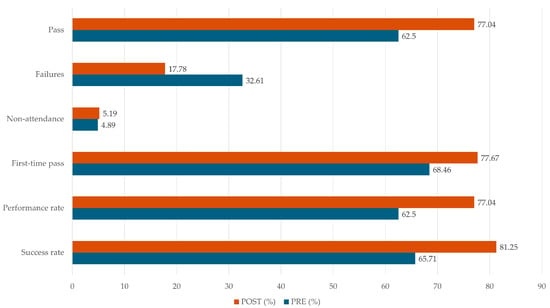
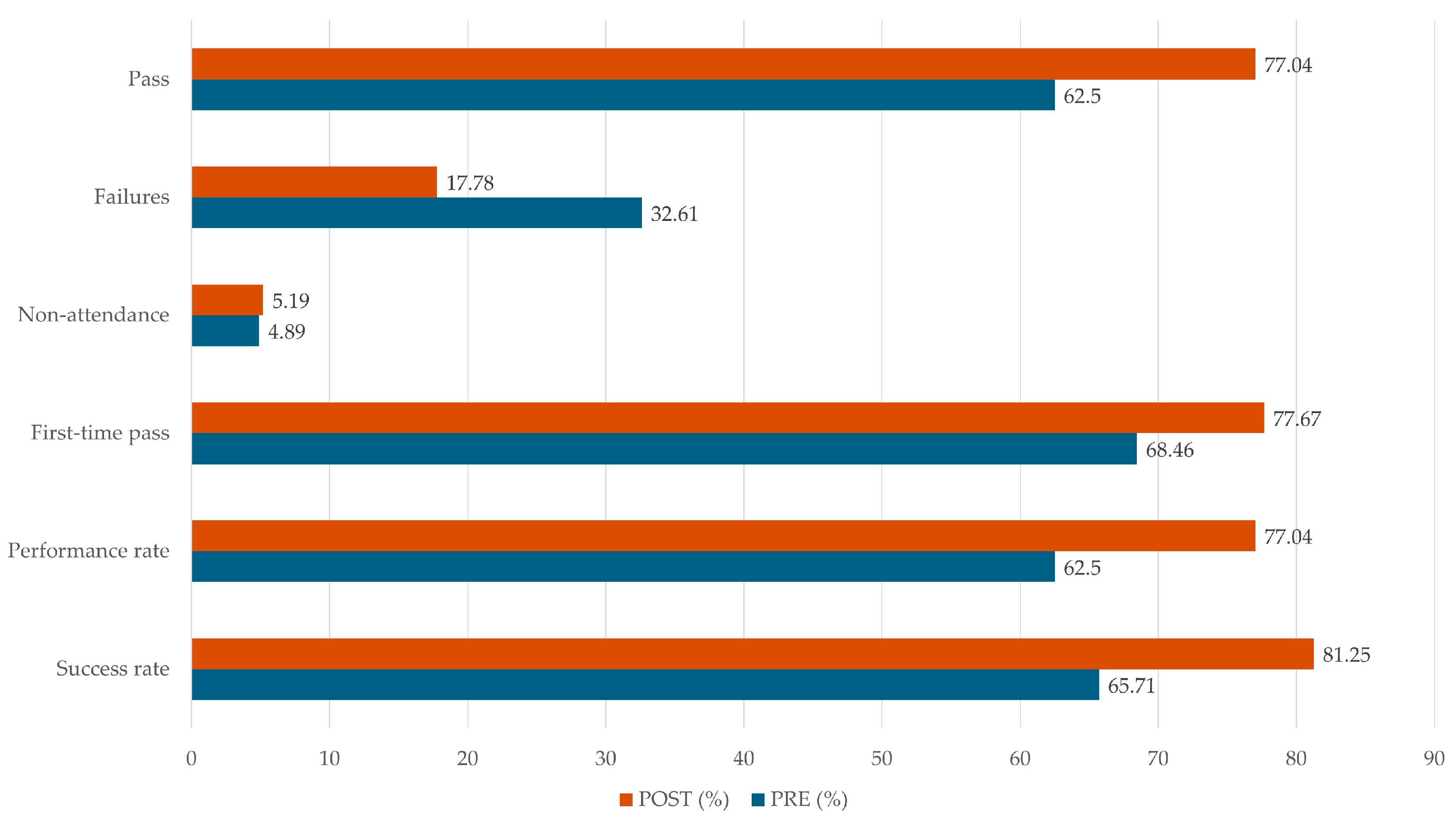
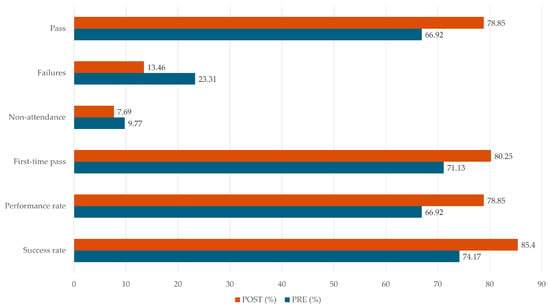
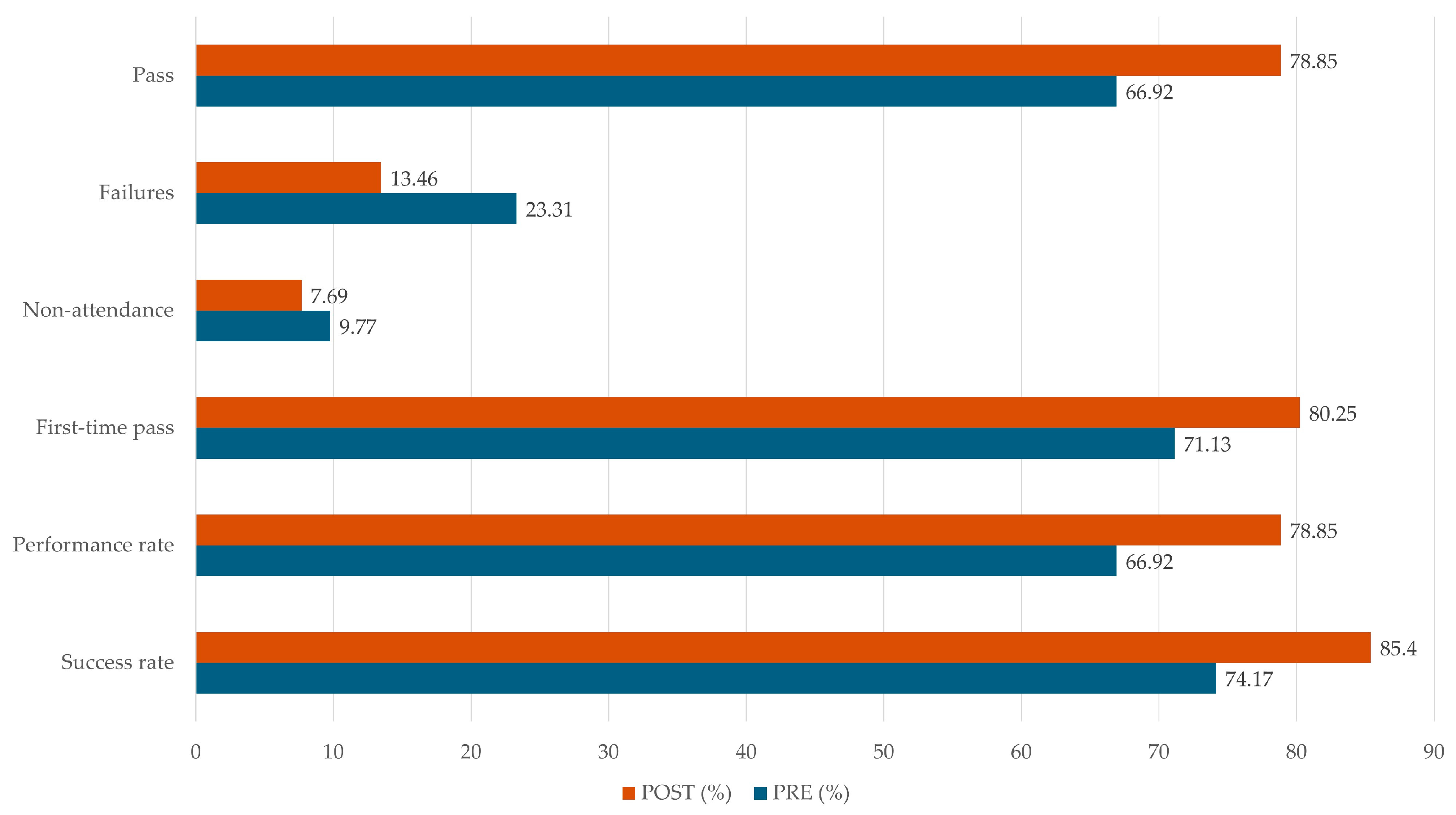
A preliminary descriptive analysis was conducted to evaluate the academic outcomes in both Human Resource Management (Figure 1) and Marketing Management (Figure 2). As illustrated in these figures, the introduction of gamification generally corresponds to an increase in pass rates, first-time pass rates, and success/performance rates, alongside a decrease in failures.
Figure 1.
Academic results of the subject Human Resources Management.
Figure 2.
Academic results for the subject Marketing Management.
Table 5 presents the results of the Z-test comparisons for the proportions of pass, failure, non-attendance, and first-time passes in each cohort (pre- vs. post-gamification). In addition, we have included a new column reporting the effect sizes (Cohen’s d) for each indicator (Cohen, 1998). These values offer insight into the magnitude of the differences observed and their practical relevance. According to standard interpretation guidelines, d = 0.2 is considered a small effect, d = 0.5 a medium effect, and d ≥ 0.8 a large effect. In our case, negative values indicate that the mean was higher in the post-gamification group, suggesting better outcomes. Most of the effect sizes found fall within the large range, particularly in performance rate and success rate, reinforcing the practical impact of the gamified interventions.
Table 5.
Z-Test and Effect Sizes (Cohen’s d) for Academic Indicators.
For Marketing Management, the Z-test indicates that changes in pass, failure, and first-time pass proportions are significant at the 99% level (except first-time passes, significant at 95%), all favoring the gamified group. The difference in non-attendance is not statistically significant. Performance and success rates were also analyzed and found to be significant at the 99% level, again favoring the gamification condition. In the case of Human Resource Management, significant differences at the 99% level were observed for pass, failure, and first-time pass rates, consistently favoring the gamified cohort, while non-attendance showed no statistical significance. Similarly, performance and success rates in this subject exhibit 99% significance, once more indicating an advantage for the post-gamification group. Taken together, these findings support H1 (gamification positively impacts students’ academic performance), while H2 (gamification reduces the percentage of non-attending students) is rejected. In other words, the gamified interventions consistently improved the measured performance metrics yet did not significantly influence students’ decisions to attend or miss class.
5. Discussion
Gamification continues to show considerable promise in transforming learning across diverse contexts, particularly HE (Lampropoulos & Sidiropoulos, 2024). Recent research has focused on its design, implementation, and outcomes, underscoring its capacity to improve academic performance metrics, such as pass rates, success rates, and course-specific achievements, when game elements are cohesively integrated. Nevertheless, the existing body of empirical evidence remains partial, highlighting the need to explore both the contexts and complementary strategies that most effectively leverage gamification’s potential.
Our study aimed to address these gaps by examining six core indicators, pass percentage, failure percentage, non-attendance, first-time passes, course performance rate, and course success rate, among 1056 BA students. The data revealed statistically significant gains in outcomes like first-time pass rates and overall course performance in the gamified cohorts, aligning with findings from Bai et al. (2020) and M. Li et al. (2023), which also report substantial improvements in academic results under carefully planned game-based interventions. In contrast, works such as Barata et al. (2014) and van der Kooij et al. (2019) observed minimal or inconclusive changes in final grades, suggesting that the effectiveness of gamification can depend heavily on factors such as course design, discipline, and student demographics.
Despite these affirmative results, one key issue remains unresolved: absenteeism. Our study’s non-attendance rates remained effectively unchanged, mirroring the experiences of some other researchers who have observed that gamification alone may not suffice to influence students who have already disengaged (Domínguez et al., 2013; Sailer & Homner, 2020). This finding is especially relevant in light of the growing number of studies pointing to early, proactive interventions as a way to reduce dropout and absenteeism. For instance, research on the use of Kahoot! in a Physiotherapy course revealed substantial reductions in absenteeism when combined with engaging, quiz-based participation (Escriche-Escuder et al., 2020). These insights resonate with broader evidence that the integration of personalized tutoring, academic counseling, and attendance incentives can deepen student commitment when merged with game mechanics (Campillo-Ferrer et al., 2020; Khaldi et al., 2023).
Hence, although gamification proves adept at enhancing the achievements of active participants, replicating the cross-disciplinary consistency reported in meta-analyses (Legaki et al., 2019; Sailer & Homner, 2020), it appears less capable of re-engaging students who have fundamentally opted out. One plausible explanation might lie in the short duration of interventions; a single semester could be insufficient for altering entrenched behaviors. Another possibility involves the complexity of personal factors like motivation, workload, and life circumstances, which gamification elements cannot always address directly.
These mixed results suggest an emerging consensus: gamification by itself is a powerful but incomplete tool. Strengthening student retention and minimizing absenteeism likely requires early interventions that integrate personalized tutoring (offering targeted support for academically vulnerable students), academic counseling (to address psychosocial barriers), and attendance incentives (ranking systems, non-monetary rewards, etc.). Studies increasingly point to the combined effect of these methods alongside gamification as a way to bolster attendance, foster a sense of community, and promote sustained engagement (Khaldi et al., 2023).
In sum, our findings reinforce the validity of H1, which posits that gamification can improve academic performance, while challenging H2, which anticipates a decline in absenteeism. Despite robust enhancements in learning outcomes, mirroring the results of Bai et al. (2020), there remains a cohort of learners largely unresponsive to gamified strategies alone. Future inquiries might usefully focus on longer-term or multi-semester implementations, as well as on customizing gamification for different learner profiles and incorporating early alert systems and counseling-based interventions. Taken together, these steps may more effectively convert non-attendance into consistent engagement, ensuring that the benefits of gamification extend to all students rather than merely those who are already inclined to participate.
6. Conclusions
This study advances the literature on gamification by employing a quasi-experimental design to assess its impact on academic performance in HE. Focusing on two social science courses, it demonstrates that a comprehensive, semester-long, and mainly offline gamification strategy can significantly increase pass rates, first-time pass rates, course performance, and overall success rates. These findings highlight the promise of a well-structured gamification approach, encompassing balanced and thoughtfully integrated game elements, to meaningfully boost student achievement.
Additionally, the research underscores that gamification alone did not significantly alter absenteeism rates, indicating that while it effectively elevates the performance of students who already attend classes, it may not suffice to engage those who have fundamentally opted out. As a result, this study offers evidence of gamification’s value in enhancing learning outcomes but also pinpoints its inherent limitations, especially in addressing systemic challenges like persistent dropout or non-attendance.
This study has practical Implications. From an institutional perspective, educators and policymakers seeking to leverage gamification should consider pairing it with complementary interventions, such as early-warning systems, targeted academic counseling, and attendance incentives, to capture the attention of students prone to disengagement. Implementing these support measures alongside gamified coursework may help create a more inclusive and effective learning environment. By integrating both motivational game elements and proactive retention strategies, HE institutions can more thoroughly realize gamification’s potential to promote robust academic success across a diverse student body.
While this study presents valuable insights, several limitations deserve emphasis. First, the lack of segmentation by individual learner characteristics, such as personality traits, player types, or differing motivational profiles, constrains our ability to determine precisely which students gain the most (or least) from gamification. Future research could incorporate detailed analytics or psychometric tools to classify participants according to these variables, shedding light on how certain subgroups respond to specific game elements. Second, the one-semester duration may have introduced a novelty effect that temporarily heightened student engagement. Although neither course was repeated after successful completion, mitigating concerns about long-term repetition biases, extending the gamified intervention beyond a single academic term could more definitively establish its sustainability. Longer or multi-semester studies would clarify whether the improvements observed here persist over time or simply reflect the initial allure of a new instructional method. Third, our sample involved two offline courses within the social sciences, both housed in a BA program, limiting the representativeness and generalizability of our findings. Although the parallel positive outcomes suggest a degree of robustness, institution-specific factors (e.g., the university’s academic culture, student demographics) may have shaped the results. Caution is therefore warranted in applying these conclusions to other fields, modalities (online/hybrid), or broader geographic contexts. Future research might explore how gamification’s impact varies across disciplines, learning environments, and durations to more fully understand its potential. Finally, our non-attendance data highlights the need for complementary engagement strategies. Although gamification clearly improved performance for those already attending, it had minimal impact on students who opted not to participate. Investigations into integrating gamification with early-warning systems, peer mentorship programs, or other targeted interventions (e.g., personalized counseling) could help convert non-attendees into engaged learners, thereby enhancing both retention and overall academic success.
Author Contributions
Conceptualization, M.B.-M., M.I.S.-H., J.L.T.-J. and O.R.G.-L.; methodology, M.B.-M., M.I.S.-H., J.L.T.-J. and O.R.G.-L.; formal analysis, M.B.-M., J.L.T.-J. and O.R.G.-L.; data curation, J.L.T.-J. and O.R.G.-L.; writing—original draft preparation, M.B.-M. and M.I.S.-H.; writing—review and editing, M.I.S.-H. All authors have read and agreed to the published version of the manuscript.
Funding
This research received no external funding.
Institutional Review Board Statement
This study was conducted in accordance with the Declaration of Helsinki and approved by the Ethics Committee of the University of Extremadura (protocol code 1632025, and date of approval 13 June 2025) for studies involving humans.
Informed Consent Statement
Informed consent was obtained from all subjects involved in this study.
Data Availability Statement
Aligned with open science protocols, a dataset has been deposited in https://figshare.com/s/08811d7fc589a36b8853 (accessed on 1 June 2025).
Acknowledgments
The authors acknowledge the voluntary participation of the students. We are also grateful to the University of Extremadura for providing the license to use Microsoft Copilot, which was used exclusively for proofreading.
Conflicts of Interest
The authors declare no conflicts of interest.
Abbreviations
The following abbreviations are used in this manuscript:
| BA | Business administration |
| HE | Higher education |
| MDC | Mechanics, dynamics, components |
References
- Almeida, C., Kalinowski, M., Uchoa, A., & Feijo, B. (2023). Negative effects of gamification in education software: Systematic mapping and practitioner perceptions. Information and Software Technology, 156, 107142. [Google Scholar] [CrossRef] [Scilit]
- Armier, D. D., Shepherd, C. E., & Skrabut, S. (2016). Using game elements to increase student engagement in course assignments. College Teaching, 64(2), 64–72. [Google Scholar] [CrossRef] [Scilit]
- Bai, S., Hew, K. F., & Huang, B. (2020). Does gamification improve student learning outcome? Evidence from a meta-analysis and synthesis of qualitative data in educational contexts. Educational Research Review, 30, 100322. [Google Scholar] [CrossRef] [Scilit]
- Barata, G., Gama, S., Jorge, J. A. P., & Gonçalves, D. J. V. (2014, October 19–21). Relating gaming habits with student performance in a gamified learning experience. First ACM SIGCHI Annual Symposium on Computer-Human Interaction in Play (pp. 17–25), Toronto, ON, Canada. [Google Scholar]
- Blohm, I., & Leimeister, J. M. (2013). Gamification design of IT-based enhancing services for motivational support and behavioral change. Business & Information Systems Engineering, 5(4), 275–278. [Google Scholar] [CrossRef] [Scilit]
- Buckley, J., DeWille, T., Exton, C., Exton, G., & Murray, L. (2018). A gamification–motivation design framework for educational software developers. Journal of Educational Technology Systems, 47(1), 101–127. [Google Scholar] [CrossRef] [Scilit]
- Buckley, P., & Doyle, E. (2017). Individualising gamification: An investigation of the impact of learning styles and personality traits on the efficacy of gamification using a prediction market. Computers & Education, 106, 43–55. [Google Scholar] [CrossRef] [Scilit]
- Campillo-Ferrer, J. M., Miralles-Martínez, P., & Sánchez-Ibáñez, R. (2020). Gamification in higher education: Impact on student motivation and the acquisition of social and civic key competencies. Sustainability, 12(12), 4822. [Google Scholar] [CrossRef] [Scilit]
- Chen, I. T., Lin, S.-K., & Chung, H.-C. (2023). Gamified educational robots lead an increase in motivation and creativity in Stem education. Journal of Baltic Science Education, 22(3), 427–438. [Google Scholar] [CrossRef] [Scilit]
- Coello-Contreras, R. (2023). Gamification as a methodological strategy and its impact on the academic performance of university students. Lecture Notes in Networks and Systems, 619, 272–286. [Google Scholar] [CrossRef] [Scilit]
- Cohen, J. (1998). Statistical power analysis for the behavioral sciences (2nd ed.). Routledge. [Google Scholar]
- Denny, P., McDonald, F., Empson, R., Kelly, P., & Petersen, A. (2018, April 21–26). Empirical support for a causal relationship between gamification and learning outcomes. Conference on Human Factors in Computing Systems, Montreal, QC, Canada. [Google Scholar] [CrossRef] [Scilit]
- Domínguez, A., Saenz-De-Navarrete, J., de-Marcos, L., Fernández-Sanz, L., Pagés, C., & Martínez-Herráiz, J.-J. (2013). Gamifying learning experiences: Practical implications and outcomes. Computers & Education, 63, 380–392. [Google Scholar] [CrossRef] [Scilit]
- Escriche-Escuder, A., Martín-San Agustín, R., Baño-Alcaraz, A., & Casaña Granell, J. (2020). Effect of a gamified education intervention with Kahoot on the levels of absenteeism from the degree in physiotherapy. Available online: https://riuma.uma.es/xmlui/handle/10630/19642 (accessed on 1 June 2025).
- Fitria, T. N. (2022). The impact of gamification on students’ motivation: A Systematic Literature Review. LingTera, 9(2), 47–61. [Google Scholar] [CrossRef] [Scilit]
- Groening, C., & Binnewies, C. (2019). “Achievement unlocked!”-The impact of digital achievements as a gamification element on motivation and performance. Computers in Human Behavior, 97, 151–166. [Google Scholar] [CrossRef] [Scilit]
- Hanus, M. D., & Fox, J. (2015). Assessing the effects of gamification in the classroom: A longitudinal study on intrinsic motivation, social comparison, satisfaction, effort, and academic performance. Computers & Education, 80, 152–161. [Google Scholar] [CrossRef] [Scilit]
- Hellberg, A. S., & Moll, J. (2023). A point with pointsification? Clarifying and separating pointsification from gamification in education. Frontiers in Education, 8, 1212994. [Google Scholar] [CrossRef] [Scilit]
- Hockings, C., Thomas, L., Ottaway, J., & Jones, R. (2018). Independent learning—What we do when you’re not there. Teaching in Higher Education, 23(2), 145–161. [Google Scholar] [CrossRef] [Scilit]
- Holguín García, F. Y., Holguín Rangel, E. G., & García Mera, N. A. (2020). Gamificación en la enseñanza de las matemáticas: Una revisión sistemática. Telos: Revista de Estudios Interdisciplinarios en Ciencias Sociales, 22(1), 62–75. [Google Scholar] [CrossRef] [Scilit]
- Hung, A. C. Y. (2017). A critique and defense of gamification. Journal of Interactive Online Learning, 15(1), 57–72. [Google Scholar]
- Huotari, K., & Hamari, J. (2017). A definition for gamification: Anchoring gamification in the service marketing literature. Electronic Markets, 27(1), 21–31. [Google Scholar] [CrossRef] [Scilit]
- Huseinović, L. (2024). The effects of gamification on student motivation and achievement in learning English as a foreign language in higher education. MAP Education and Humanities, 4(1), 10–36. [Google Scholar] [CrossRef] [Scilit]
- Inocencio, F. (2018). Using gamification in education: A systematic literature review. ICIS 2018 Proceedings. Available online: https://aisel.aisnet.org/icis2018/behavior/Presentations/3 (accessed on 1 August 2025).
- Ke, F. (2011). A qualitative meta-analysis of computer games as learning tools (pp. 1619–1665). IGI Global. [Google Scholar]
- Khaldi, A., Bouzidi, R., & Nader, F. (2023). Gamification of e-learning in higher education: A systematic literature review. Smart Learning Environments, 10(1), 1–31. [Google Scholar] [CrossRef] [Scilit]
- Kim, J., & Castelli, D. M. (2021). Effects of gamification on behavioral change in education: A meta-analysis. International Journal of Environmental Research and Public Health, 18(7), 3550. [Google Scholar] [CrossRef] [Scilit] [PubMed]
- Koivisto, J., & Hamari, J. (2019). The rise of motivational information systems: A review of gamification research. International Journal of Information Management, 45, 191–210. [Google Scholar] [CrossRef] [Scilit]
- Lampropoulos, G., & Sidiropoulos, A. (2024). Impact of gamification on students’ learning outcomes and academic performance: A longitudinal study comparing online, traditional, and gamified learning. Education Sciences, 14(4), 367. [Google Scholar] [CrossRef] [Scilit]
- Lee, J. J., & Hammer, J. (2011). Gamification in education: What, how, why bother? Academic Exchange Quarterly, 15(2), 146. [Google Scholar]
- Legaki, N. Z., Xi, N., Hamari, J., & Assimakopoulos, V. (2019, January 8–11). Gamification of the future: An experiment on gamifying education of forecasting. 52nd Hawaii International Conference on System Sciences, Maui, HI, USA. [Google Scholar]
- Lei, H., Chiu, M. M., Wang, D., Wang, C., & Xie, T. (2022). Effects of game-based learning on students’ achievement in science: A meta-analysis. Journal of Educational Computing Research, 60(6), 1373–1398. [Google Scholar] [CrossRef] [Scilit]
- Li, M., Ma, S., & Shi, Y. (2023). Examining the effectiveness of gamification as a tool promoting teaching and learning in educational settings: A meta-analysis. Frontiers in Psychology, 14, 1253549. [Google Scholar] [CrossRef] [Scilit]
- Li, W., Grossman, T., & Fitzmaurice, G. (2012, October 7–10). GamiCAD: A gamified tutorial system for first time autocad users. 25th Annual ACM Symposium on User Interface Software and Technology (pp. 103–112), Cambridge, MA, USA. [Google Scholar]
- Luarn, P., Chen, C.-C., & Chiu, Y.-P. (2023). The influence of gamification elements in educational environments. International Journal Of Game-Based Learning, 13(1), 1–12. [Google Scholar] [CrossRef] [Scilit]
- Maican, C., Lixandroiu, R., & Constantin, C. (2016). Interactivia.ro–A study of a gamification framework using zero-cost tools. Computers in Human Behavior, 61, 186–197. [Google Scholar] [CrossRef] [Scilit]
- Markopoulos, A. P., Fragkou, A., Kasidiaris, P. D., & Davim, J. P. (2015). Gamification in engineering education and professional training. International Journal of Mechanical Engineering Education, 43(2), 118–131. [Google Scholar] [CrossRef] [Scilit]
- Moliner-Heredia, R., & Abellán-Nebot, J. V. (2023). Evaluation of the impact of gamification on students’ performance and engagement in manufacturing engineering courses. International Journal of Mechanical Engineering Education, 51(3), 174–193. [Google Scholar] [CrossRef] [Scilit]
- Nadi-Ravandi, S., & Batooli, Z. (2022). Gamification in education: A scientometric, content and co-occurrence analysis of systematic review and meta-analysis articles. Education and Information Technologies, 27(7), 10207–10238. [Google Scholar] [CrossRef] [Scilit]
- Nah, F. F.-H., Eschenbrenner, B., Claybaugh, C. C., & Koob, P. B. (2019). Gamification of enterprise systems. Systems, 7(1), 13. [Google Scholar] [CrossRef] [Scilit]
- Piasecki, S. (2021). Gamification in educational contexts: A critical view on mechanisms and methodology. Research Anthology on Developments in Gamification and Game-Based Learning, 4, 1847–1877. [Google Scholar] [CrossRef] [Scilit]
- Prabhudesai, C., Joshi, N., Khadilkar, P., Neve, N., & Jadhav, G. (2023). Gamification: A new learning process for kids. In Exergaming intervention for children, adolescents, and elderly people (pp. 16–30). IGI Global. [Google Scholar] [CrossRef] [Scilit]
- Rachels, J. R., & Rockinson-Szapkiw, A. J. (2018). The effects of a mobile gamification app on elementary students’ Spanish achievement and self-efficacy. Computer Assisted Language Learning, 31(1–2), 72–89. [Google Scholar] [CrossRef] [Scilit]
- Rivera, E. S., & Garden, C. L. P. (2021). Gamification for student engagement: A framework. Journal of Further and Higher Education, 45(7), 999–1012. [Google Scholar] [CrossRef] [Scilit]
- Rodríguez-Martínez, B. A. (2021). La gamificación como predictores de la integración en la enseñanza. Revista Docentes 2.0, 11(2), 57–65. [Google Scholar] [CrossRef] [Scilit]
- Sailer, M., & Homner, L. (2020). The gamification of learning: A meta-analysis. Educational Psychology Review, 32(1), 77–112. [Google Scholar] [CrossRef] [Scilit]
- Schöbel, S. M., Janson, A., Söllner, M., Lowry, P. B., Petter, S., & Leimeister, J. M. (2020). Capturing the complexity of gamification elements: A holistic approach for analysing existing and deriving novel gamification designs. European Journal of Information Systems, 29(6), 641–668. [Google Scholar] [CrossRef] [Scilit]
- Seaborn, K., & Fels, D. I. (2015). Gamification in theory and action: A survey. International Journal of Human-Computer Studies, 74, 14–31. [Google Scholar] [CrossRef] [Scilit]
- Skritsovali, K. (2023). Learning through playing: Appreciating the role of gamification in business management education during and after the COVID-19 pandemic. Journal of Management Development, 42(5), 388–398. [Google Scholar] [CrossRef] [Scilit]
- Smiderle, R., Rigo, S. J., Marques, L. B., Peçanha de Miranda Coelho, J. A., & Jaques, P. A. (2020). The impact of gamification on students’ learning, engagement and behavior based on their personality traits. Smart Learning Environments, 7(1), 1–11. [Google Scholar] [CrossRef] [Scilit]
- Su, C.-H. (2016). The effects of students’ motivation, cognitive load and learning anxiety in gamification software engineering education: A structural equation modeling study. Multimedia Tools and Applications, 75(16), 10013–10036. [Google Scholar] [CrossRef] [Scilit]
- Swacha, J. (2021). State of research on gamification in education: A bibliometric survey. Education Sciences, 11(2), 69. [Google Scholar] [CrossRef] [Scilit]
- Tsai, C. Y., Lin, H.-S., & Liu, S. C. (2020). The effect of pedagogical GAME model on students’ PISA scientific competencies. Journal of Computer Assisted Learning, 36(3), 359–369. [Google Scholar] [CrossRef] [Scilit]
- van der Kooij, K., van Dijsseldonk, R., van Veen, M., Steenbrink, F., de Weerd, C., & Overvliet, K. E. (2019). Gamification as a sustainable source of enjoyment during balance and gait exercises. Frontiers in Psychology, 10, 294. [Google Scholar] [CrossRef] [Scilit]
- Werbach, K., & Hunter, D. (2012). For the win: How game thinking can revolutionize your business. Wharton Digital Press. [Google Scholar]
- Xi, N., & Hamari, J. (2019). Does gamification satisfy needs? A study on the relationship between gamification features and intrinsic need satisfaction. International Journal of Information Management, 46, 210–221. [Google Scholar] [CrossRef] [Scilit]
- Yang, S. Z. (2023). Gamification’s effect on academic motivation and progress. Lecture Notes in Education Psychology and Public Media, 7(1), 43–48. [Google Scholar] [CrossRef] [Scilit]
- Yıldırım, İ., & Şen, S. (2021). The effects of gamification on students’ academic achievement: A meta-analysis study. Interactive Learning Environments, 29(8), 1301–1318. [Google Scholar] [CrossRef] [Scilit]
- Zainuddin, Z., Chu, S. K. W., Shujahat, M., & Perera, C. J. (2020). The impact of gamification on learning and instruction: A systematic review of empirical evidence. Educational Research Review, 30, 100326. [Google Scholar] [CrossRef] [Scilit]
- Zeng, J., Sun, D., Looi, C. K., & Fan, A. C. W. (2024). Exploring the impact of gamification on students’ academic performance: A comprehensive meta-analysis of studies from the year 2008 to 2023. British Journal of Educational Technology, 55(6), 2478–2502. [Google Scholar] [CrossRef] [Scilit]
- Zhao, F., & Fang, X. (2023). Gamification supporting small business owners? Work-based learning. Journal of Information Technology Education-Research, 22, 177–197. [Google Scholar] [CrossRef] [Scilit]

Disclaimer/Publisher’s Note: The statements, opinions and data contained in all publications are solely those of the individual author(s) and contributor(s) and not of MDPI and/or the editor(s). MDPI and/or the editor(s) disclaim responsibility for any injury to people or property resulting from any ideas, methods, instructions or products referred to in the content. |
© 2025 by the authors. Licensee MDPI, Basel, Switzerland. This article is an open access article distributed under the terms and conditions of the Creative Commons Attribution (CC BY) license (https://creativecommons.org/licenses/by/4.0/).