


Abstract
Sustainable development helps countries grow by giving importance to environmental, social, and governance factors. Therefore, sustainable development is essential for improving the well-being of societies and protecting our natural resources for the long term. This study focuses on the improvement of policy recommendations for achieving sustainable development. To this end, this research examines the impact of globalization, financial development, and capital formation on sustainable development in Türkiye for the period 1972–2022. The study employs the unit root, cointegration, and causality tests. The findings reveal that globalization, banking sector development, and fixed capital formation are cointegrated with environmental sustainability, namely the load capacity factor. In the short term, load capacity factor and globalization are the cause of each other. Also, an asymmetric relationship is determined between globalization and fixed capital formation and load capacity factor. However, the impact of globalization and fixed capital formation on environmental sustainability is distorting. The outcomes of this study implied that the policymaker should make appropriate policies regarding the improved about Türkiye’s environmental quality and sustainable development.
1. Introduction
The fact that emissions, which are the source of environmental pollution, cannot be reduced to the desired extent despite increasing awareness and struggles against global warming and environmental disruption indicates that environmental and climate issues will continue to be among the most important problems of the century we are in (Xu et al., 2022). The 2024 progress report on the Sustainable Development Goals (SDGs) reveals that we are still far from achieving the goals set globally. The report lists the COVID-19 pandemic, international trade and political tensions, economic and financial instability, and the growing impacts of climate change, which have emerged since 2015, when the 17 SDGs were set, among the main threats to the achievement of these goals (Progress towards the Sustainable Development Goals, 2024). The increasing need for energy in parallel with economic growth across the world leads to the continued consumption of conventional energy resources that are more easily accessible at lower costs. Various studies show that fossil fuels have an important share in meeting the energy demand created by rapid growth, especially in developing countries (Apergis & Payne, 2011; Y. Khan & Hassan, 2024). Obtaining energy from non-renewable sources, which is the driving force of development, has detrimental consequences on ecosystem and human health by causing biodiversity depletion, water stress and global emissions (Du et al., 2024).
It is certain that economic growth is an indispensable goal for achieving better living standards. Diversified needs and demand, along with developing technology, transportation and communication facilities, also trigger this growth. However, it is also stated that industrialization and economic growth put significant pressure on the environment (Pata & Isik, 2021). It is observed that environmental degradation starts to emerge especially at the initial phase of economic development (Apergis et al., 2021). Nevertheless, further economic growth may reverse environmental degradation by allowing the replacement of environmentally harmful technologies with new ones (Saboori et al., 2012). What is important here is to establish ecological sustainability by ensuring that economic development, resources and the ecological environment are harmoniously coordinated (Zhang et al., 2025). Xu et al. (2022) emphasize that it is important to discuss the position of globalization vis-à-vis environmental concerns in promoting economic growth. Ecological footprint (EF) is among the most comprehensive indicators used to measure environmental degradation (Galli et al., 2020). EF quantifies the amount of the self-renewal capacity of biosphere required by a specific activity (Caetano et al., 2025) and enables for a direct association of socioeconomic progress with ecosystem resources (Jiang et al., 2025). It is also widely used in empirical studies. However, it has been argued that EF is insufficient for measuring environmental sustainability, arguing that it does not adequately capture the full impact of humans on the environment, particularly on the regeneration capacity of ecosystem and ability to produce sustainable resources (Duran & Saqib, 2024). At this point, the load capacity factor (LCF) is proposed as a more inclusive and holistic indicator (Siche et al., 2010). This metric, which takes into account biocapacity as well as ecological footprint, measures the supply and demand aspects of nature together (Du et al., 2024). Thus, the capacity of nature to regenerate the loss caused by human demand on nature is calculated (Rees & Wackernagel, 2023). One of the key benefits of using the LCF variable in sustainability-focused studies is its ability to reveal whether the ecological footprint caused by economic and financial development exceeds nature’s capacity for renewal. This is considered to provide a suitable indicator for analyzing the impact of financial development and investment-based growth processes on sustainability. In this respect, LCF is regarded to be superior to emission-based indicators.
Ritchie et al. (2023) state that the most important cause of climate change today is human-induced greenhouse gas emissions; on the other hand, they point out that various countries have been able to grow by reducing their CO2 emissions in response to the increase on a global scale. It is noteworthy that greenhouse gas emissions are on a downward trend in many European countries. However, Türkiye is one of the countries that have not been able to accompany this transformation and is following a similar trend with Asian countries led by China and India. As of December 2024, 59.8% of total installed capacity is derived from renewable sources (Republic of Türkiye Ministry of Energy and Natural Resources, 2024), but this is not enough to reduce GHG production. Data from the Turkish Statistical Institute (TUIK) indicate that more than 70% of total greenhouse gas emissions come from energy (TUIK, 2024). Considering its young population and population growth rate, as well as its industrialization policies and growth potential, it can be predicted that the increase in production capacity and the need for energy will continue. These developments bring Türkiye, like other developing countries, to a point worthy of research in terms of the nexus between globalization and sustainable environment.
Economic globalization and financial development are closely linked to environmental sustainability through multiple structural and technological channels. Financial development may increase environmental pressure by expanding economic activity and resource use, while also supporting environmental improvement by facilitating green investment and technological upgrading (Altıntas et al., 2024a). Similarly, globalization can intensify production scale but also contribute to environmental quality improvements through the diffusion of cleaner technologies and enhanced efficiency (Altıntas et al., 2024b). The literature further shows that these effects are often indirect and operate through mechanisms such as technological innovation and institutional quality (Zhao et al., 2023; Adebayo et al., 2024, 2025). Overall, the relationship is complex, context-dependent, and may vary across countries and development stages.
This study is based on globalization, banking sector development, and fixed capital formation which are among the important channels that feed economic growth. However, the environmental impacts caused by greenhouse gas emissions during the generation of energy needed for development should not be ignored. In order to reveal these relationships, the interaction of LCF with globalization and financial development is the subject of the analysis. Thus, it is intended to provide a perspective on the sustainability of development efforts. When approached from a conceptual framework, financial development, globalization, and capital formation are expected to impact environmental sustainability through various channels. Firstly, financial deepening and the development of the banking sector can encourage investment, thereby supporting increased production and growth. However, with the growing need for energy, increased environmental pressure and disruption to the ecological balance may occur. On the other hand, with the development of the financial system, it may be possible to develop financial instruments that facilitate access to clean energy sources and increase resource efficiency. This could support ecological sustainability. The mechanism by which globalization affects the environment can be realized through the scale effect. Increased exports can expand industrial production, thereby increasing energy demand and, in the case of a fossil fuel-based production structure, triggering environmental degradation. Of course, there are also mechanisms through which globalization can contribute to improving ecological balance. In particular, technology transfer focused on clean technologies can reduce environmental pressures.
In line with this purpose, firstly, studies examining the relationships among globalization, banking sector development and fixed capital formation representing financial development with the LCF representing sustainable development are reviewed. Then, the data and methodology are introduced. Next, analysis results and their interpretation are presented. In the last part of the study, the findings are discussed and policy recommendations are made. No prior research has, to our knowledge, investigated the association between financial variables and LCF as an indicator of sustainable development for Türkiye, using symmetric and asymmetric time series methods. Sustainable development is the combination of economic development with improvements in environmental and social areas. Sustainable development not only helps countries to grow economically in an environmentally and socially compatible manner but also leads to the conservation of important natural resources for future generations. Given this importance, this research is expected to contribute to the literature by analyzing the asymmetric effect of financial development, banking sector development and investments on sustainable development in Türkiye. In addition, the study is expected to reveal the potential relationships between these variables and accordingly contribute to taking the necessary measures for a sustainable development. Given that the effects of financial and global developments on the environment may be spread over time, it is necessary to distinguish between the effects of temporary shocks and permanent structural changes. Therefore, the impact of temporary situations such as sudden credit developments, financial shocks, and fluctuations in foreign trade has been attempted to be captured through short-term analyses. On the other hand, since the effects of permanent investments, transformations in production technology, and structural changes in the financial system will emerge in the long term, meaningful relationships in terms of structure and sustainability have been investigated through long-term analyses. The findings revealed the existence of long-term relationships between globalization, fixed capital formation and banking sector development and environmental sustainability. In the short term, globalization and environmental sustainability interact. The findings provide important economic implications and allow policy recommendations to be developed accordingly.
The study consists of five sections in total. After the introduction, the current literature is reviewed. Then, the third section introduces the data, model, and methodology. The fourth section discusses and compares the empirical findings with the existing literature. In the last section, a brief conclusion is followed by policy implications, and includes some suggestions for future studies.
2. Review of Literature
This section presents the studies that examine the relationship between the LCF, which is considered as an indicator of environmental sustainability within the scope of the study, and financial globalization (GLO), banking sector development (BSD) and fixed capital formation (FIX), respectively.
When the literature is evaluated in terms of financial globalization and the LCF, which is an indicator of environmental sustainability, there are different opinions on whether there is a positive or negative relationship between the two variables. Looking at the studies that find a positive relationship between financial globalization and LCF; Xu et al. (2022) in Brazil; Akadiri et al. (2022) in India; Raihan et al. (2023) in Mexico; Adebayo et al. (2024) in Germany; Islam et al. (2024) in the top 10 nuclear energy consuming economies including the United States, China, Russia, Canada, France, Spain, South Korea, Ukraine, Germany and Sweden; Adebayo et al. (2024) in the United States; Jin et al. (2024) in Germany, they found that as the level of financial globalization increases, the LCF will increase; in other words, environmental quality will increase and ecological damage will decrease. In addition, Awosusi et al. (2022) found that in South Africa, globalization helps improve environmental sustainability by increasing LCF; Du et al. (2024) found that in 6 ASEAN countries, namely Indonesia, Singapore, Malaysia, Philippines, Thailand and Vietnam, social globalization has a positive impact on the level of LCF and these indicators have the potential to affect environmental quality in the long term; Ben-Salha and Zmami (2024) found that economic globalization has detrimental effects on the environment in 14 MENA countries; Simsek et al. (2025) found that globalization in E-7 countries are very important factors in reducing environmental destruction and enhancing environmental quality; Raihan et al. (2025) found that globalization in Thailand has a positive impact on LCF in both short and long term. According to the findings of these studies highlighting the positive relationship between financial globalization and the capacity factor, as financial globalization increases, financial markets deepen, access to clean technology becomes easier, access to low-interest green loans becomes easier, the number of foreign investments that enable more efficient and lower-emission energy use increases, and ultimately these developments lead to the efficient use of resources, a reduction in environmental degradation, and an increase in the load capacity factor. When the studies finding a negative relationship between financial globalization and the LCF are examined, Ibrahim et al. (2024) in the United States of America; Liu et al. (2024) in G-20 countries; and Akhter et al. (2024) in the United States of America revealed that as the level of financial globalization increases, the LCF will decrease or environmental degradation will increase. In addition, Agila et al. (2022) found that trade globalization decreases the LCF in South Korea; Pata et al. (2023) found that globalization has a negative impact on LCF in the long term in 11 LAC countries, thus reducing environmental quality; and Jahanger et al. (2024) concluded that globalization is negative and significant in reducing LCF in 10 SDG countries. According to the results obtained from these studies highlighting the negative relationship between financial globalization and the load capacity factor; as financial globalization increases, clean technology investments increase; however, if production growth exceeds green investment growth, environmental regulations and control mechanisms become insufficient, and if environmental standards are relaxed in order to attract more foreign investment, dirty capital inflows increase, leading to increased environmental degradation and a decrease in the load capacity factor.
In terms of banking sector development and LCF, there are different studies suggesting a positive or negative relationship between the related variables. X. Wang et al. (2023) in Germany; Prempeh et al. (2023) in 11 ECOWAS countries; Altıntas et al. (2024a) in Malaysia; Pang et al. (2024) in the United States of America argued that as the banking sector develops, the LCF increases; in other words, environmental sustainability and environmental quality improve. In addition, Tekbas (2024) in Türkiye found that the development of the banking sector has a negative and decreasing effect on CO2 emissions and thus contributes positively to environmental sustainability. According to these studies emphasizing the positive relationship, as the banking sector develops, access to financing that will facilitate companies’ transition to sustainability becomes easier in the longer term and at lower interest rates, and the more efficient use of green, social, and sustainable loans is ensured. Environmental risks are managed and priced more effectively by banks, and ultimately these developments lead to environmental improvements and an increase in the load capacity factor. Contrary to these studies; Altıntas et al. (2024b) concluded in their study in Sudan that as the banking sector develops, the LCF decreases and environmental sustainability worsens. Similarly to these results, Samour et al. (2022) found that the development of the banking sector in South Africa has a negative impact on environmental quality through GDP and energy factors; Radulescu et al. (2022) found that banking development in OECD countries reduces ecological sustainability; Mehmood (2023) found that the development of the banking sector in N-11 countries, represented by excess lending from banks to the private sector, increases CO2 emissions through economic growth and energy consumption and harms environmental sustainability. In addition, Yang et al. (2023); Al Shiam et al. (2024) in BRICS countries; Ali et al. (2024) in France; financial development; and Zhao et al. (2023) concluded that significant and positive increases in stock market development in BRICS-T countries reduce the level of LCF and negatively affect environmental and ecological quality and harm environmental sustainability.
In terms of fixed investments and LCF, W. Wang et al. (2013) argue that as firms focus on sustainability, the need to invest in new technologies with lower carbon footprint and/or energy consumption has led firms to adjust their production or distribution capacity levels. When we look at the studies examining the association between fixed investments and LCF, it is seen that the studies examining the nexus between fixed investments and LCF are quite limited and the studies are mostly focused on the relationship between foreign direct investments and LCF. In this context, Latif and Faridi (2023) found that FDI and environmental quality (LCF) exhibit statistically significant long-term cointegration relationships in 48 Asian economies; Soto and Edeh (2024) in Spain; Ganda (2024) in 37 Sub-Saharan African (SSA) countries; Sarabdeen et al. (2024) in 112 selected countries; and Adebayo et al. (2025) in the United States found that FDI has a significant negative impact on the LCF and negatively affects ecological quality in both the short and long term. According to these studies, which argue that the environmental carrying capacity factor will decrease as the banking sector develops, it becomes easier for companies to use credit. If the volume of credit increases excessively, consumption will increase excessively, which will lead to the rapid depletion of natural resources, waste, and an increase in emission rates and environmental risks, causing the carrying capacity factor to decrease. In addition, Kartal et al. (2023) found that renewable energy R&D investments in Japan support the environment, but nuclear energy R&D investments have no impact on the environment; Çaglar et al. (2024) found that with regard to renewable energy R&D investments in Türkiye; Yıldırım et al. (2024) found that with regard to foreign capital investments in BRICS countries; Fatima et al. (2024) found that green investment in G11 countries positively and significantly affects LCF and improves environmental quality; and Ayad et al. (2024) found that FDI-LCF nexus in 16 Middle East and North African countries exhibits an inverted U-shape. Considering the literature examining the relationship between fixed investments and the carrying capacity factor, no clear framework has been established. In other words, it has been interpreted that as fixed investments increase and production capacity rises, natural resources may be overconsumed, accelerating environmental degradation and reducing the carrying capacity factor. From another perspective, if fixed investments are made in waste and energy efficiency, environmental regulation, and energy technology, these developments will lead to a reduction in environmental degradation.
3. Data and Methodology
In this section, the data used in the study are introduced, basic information on the type and sources of the data and the econometric methods applied are given. The first aim of this research is to examine whether financial developments have an impact on sustainable environment. The other objective of the research is to examine the existence of long-term and short-term causality between financial developments and sustainable environment through time series analysis. In the research, the associations between the variables are tested using annual data for the period 1972–2022 for Türkiye. Since the last data announced at the time of the study belonged to 2022, the last period was determined in this way. Data on variables are obtained from secondary data sources. In addition, except for the LCF, all other values have been logarithmically transformed to overcome the problem of heteroscedasticity in the analyses.
The definitions and abbreviations of the variables and data sources shown in Table 1.
Table 1.
Definition of variables.
In the research, the LCF, which represents the sustainable environment and is a variable that has been widely used in the literature recently, has been preferred (Adebayo et al., 2025). The use of carbon emissions in examining environmental sustainability leads to the consideration of the supply side of nature (Guneysu, 2023). However, the LCF allows both the supply (biocapacity) and demand (ecological footprint) sides of nature to be considered in the examination of environmental sustainability and allows a more comprehensive evaluation of environmental sustainability (Siche et al., 2010). Therefore, the LCF representing sustainable environment is preferred in many empirical studies (Adebayo et al., 2025; Erdas et al., 2025; Altıntas et al., 2024a; Ozkan et al., 2024; Guloglu et al., 2023; Latif & Faridi, 2023; Xu et al., 2022). Financial globalization index (Ulucak et al., 2020; Xu et al., 2022; Jin et al., 2024; Çatık et al., 2024), banking sector development (Erdas et al., 2025; Altıntas et al., 2024b; Prempeh et al., 2023; Xu et al., 2022; Bayar et al., 2022), fixed capital formation (Aydin et al., 2023; Jin et al., 2024) are preferred in many empirical studies. The variables subject to analysis have been chosen based on these studies.
A three-stage process was followed to explore the association between banking sector development, financial globalization, fixed capital formation and LCF. First, a unit root test was conducted to investigate whether the variables contain unit roots. After the unit root test, cointegration tests were conducted to determine whether there is a long-term relationship between the variables. In the last stage, symmetric and asymmetric causality tests were applied to investigate the direction of short-term causality relations between variables. The stationarity of the variables is tested by Carrion-i-Silvestre et al. (2009)1 unit root test with multiple structural breaks. The presence of a long-term relationship between the variables is investigated with Maki (2012)2, Carrion-i-Silvestre and Sanso (2006)3 and Hatemi-J (2008)4 cointegration tests with breaks. The short-term causality analysis between the variables was conducted in two stages. In the first stage, symmetric causality relationships between variables were investigated using single and cumulative Fourier Approximation Granger and Toda–Yamamoto causality tests based on the bootstrap technique. For this purpose, Enders and Jones (2016)5 and Gormus et al. (2018)6 symmetric causality tests were utilized. However, in the Granger and Toda–Yamamoto symmetric causality tests used in the analysis of variables, the effects of positive and negative shocks are considered to be the same. In these tests, the direction and magnitude of shocks are assumed to have the same effect on causality between variables. However, there are many studies showing that the effects of positive and negative shocks are different from each other. Therefore, in the second stage, the asymmetric causality test based on the bootstrap technique introduced by Hatemi-J (2012)7 was applied to reveal the negative and positive shocks between the variables. The analyses in the study were carried out using Gauss 24.0 package program.
The descriptive statistics of financial globalization, banking sector development, fixed capital formation and LCF for Türkiye are provided in Table 2.
Table 2.
Descriptive analysis of the variables.
Table 2 shows that the mean and median values of the LCF are well below 1. It is understood that the highest value that the variable can reach is approximately 1.2, but it decreased to 0.435 in the relevant period. The GLO has a maximum value of 50.45 and a minimum value of 6.45, which are significant differences. The average value is 32.16. These differences reveal the variability in the country’s level of globalization and are affected by fluctuations in economic, social and political integration. The BSD has a maximum value of 75.2 and a minimum value of 13.6. The average is 30.9. The difference between the values of private sector loans, which represent the development of the banking sector, points to the fluctuations in the growth and financialization of the Turkish economy in the relevant period. As for the FIX, the mean value is 22.63, the maximum value is 29.86 and the minimum value is 14.39. The mean value above 20 indicates that Türkiye has a high growth rate, the maximum value of 29.86 indicates that this growth has accelerated significantly in certain periods, but the minimum value of 14.39 indicates a low growth rate. A low standard deviation indicates a more stable situation in the context of this indicator. The standard deviation, which is an indicator of volatility, shows that the BSD has the highest value compared to the average. This indicates that there were significant fluctuations in the amount of loans to the private sector in the analyzed period. Such volatility in credits is an understandable result in the analysis period, which includes periods of expansion, contraction, opening up and even crises and pandemics, and in which structural breaks are quite high. The acceleration in credit growth following the crises in 2000 and 2001 is particularly effective here. FIX, on the other hand, seems to have relatively low volatility. LCF and GLO variables, on the other hand, have a similar level of volatility compared to their averages.
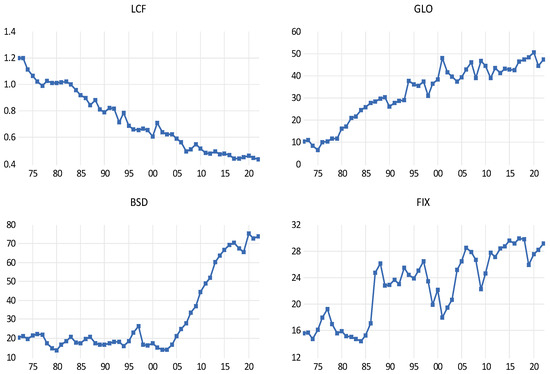
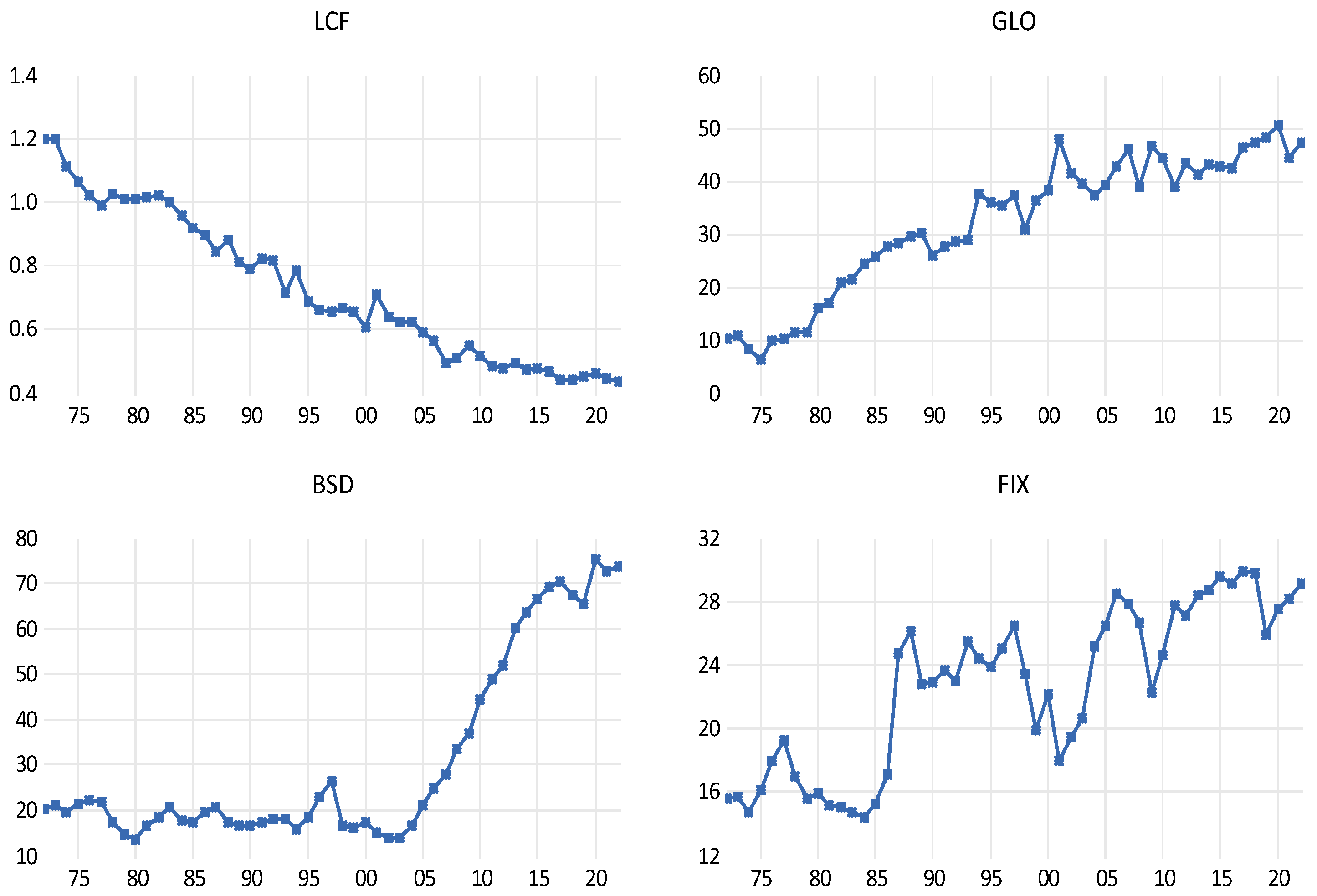
The graphical representation of the variables over the years is presented in Figure 1.
Figure 1.
Time-series plots of the selected variables. Source: Created by the authors. Note: The x-axis represents the period from 1975 to 2020.
As seen in Figure 1, the LCF in Türkiye was approximately 1.4 in 1972, approaching 0.4 in the last quarter of 2022. The LCF, which is an indicator of environmental sustainability in Türkiye, has a decreasing trend between 1972 and 2022. This situation is due to the fact that biocapacity has decreased more than the ecological footprint over the years; in other words, it can be said that the demand side of nature has increased faster than the supply side. The LCF is measured as biocapacity/ecological footprint. LCF is measured as biocapacity/ecological footprint. A load capacity lower than 1 means that the existing environmental condition is non-sustainable, while a load capacity higher than 1 means that the system is sustainable (Siche et al., 2010; Pata et al., 2021). As can be seen in Figure 1, the LCF in Türkiye fell below 1 after 1983. The fact that the ecological footprint was greater than the biocapacity after 1983 indicates that environmental sustainability was not achieved. As a result, it shows that there has been an increasing environmental degradation in Türkiye after 1983. Financial globalization has shown an upward trend between 1972 and 2022. Today, the increase in foreign capital inflow, the increase in portfolio investments and the growth of international trade as a result of technological developments are thought to have an effect on this increase. The development of the banking sector generally exhibits an upward trend. When we look at the development of the banking sector, it followed a horizontal course between 1972 and 2003, while it showed an upward trend after 2003. The strengthening of the banking sector and the provision of capital adequacy ratios have been the most fundamental factors in this trend. When we look at FIX, although an upward trend is generally seen, structural breaks are seen in both downward and upward directions. Although a decline was observed in FIX in the following years, it followed a normal course after 1994. It can be said that the downward breaks in fixed capital formation are due to the economic crises and systematic risks. The most striking situation is that while all the indicators related to economic growth and globalization are upward, environmental sustainability is gradually declining. It would be appropriate to use cointegration and causality tests to analyze the relationship between these trends presented with graphics.
4. Results and Discussion
In this section, the findings of the unit root test to test whether the variables contain a unit root, the findings of the cointegration tests to test the existence of long-term relationships between variables, and the results and interpretations of the causality tests to reveal the existence of short-term relationships are included.
Before analysis of long- and short-term relationships between variables, unit root tests were performed to determine whether the variables contained a unit root. In order to determine the stationarity of the variables, the Carrion-i-Silvestre et al. (2009) structural break unit root test was used for the constant term and trend model and the Carrion-i-Silvestre et al. (2009) results are given in Table 3.
Table 3.
The results of unit root test.
The results of structural break unit root test indicate that all variables are not stationary in level values and contain unit roots at 1% and 5% confidence levels for the model with constant and trend in all test statistics. As a result, it was determined that all variables contain unit roots in level values and that they are stationary when the first difference is taken. After determining that the variables are not stationary in level values, i.e., they contain unit roots, analyses were applied to determine the long- and short-term relationships between the variables. As can be seen in the Carrion-i-Silvestre et al. (2009) test results, significant structural breaks occurred on the variables as of different dates. For this reason, the Maki (2012) test, which allows structural breaks, was used in our study, and the results were tried to be confirmed with the Carrion-i-Silvestre and Sanso (2006) and Hatemi-J (2008) break cointegration tests.
Diagnostic tests were performed between selected variables before proceeding to the cointegration and causality tests. The consistency conditions/diagnostic tests (autocorrelation, heteroskedasticity, AR Characteristic, and normality test) required for the cointegration and causality test are ensured in the analysis. Also, VIF values of the variables were below the value of 3.20 (values ranged from 1.73 to 3.19) which indicates that multicollinearity was not an issue.
The cointegration test results applied to the first-degree stationary variables LCF, GLO, BSD and FIX are given in Table 4. According to the Maki (2012) test result, there is a long-term relationship at a significance level of 1% between LCF and GLO, LCF and BSD and LCF and FIX. According to the OLS and DOLS test statistics of the Carrion-i-Silvestre and Sanso (2006) test, a long-term relationship at a significance level of 1% was detected between LCF and GLO and LCF and FIX. However, no long-term relationship was found between LCF and BSD. According to the ADF and Zt test statistics of the Hatemi-J (2008) test, a long-term relationship at a significance level of 1% was detected between LCF and GLO and 10% was detected between LCF and BSD. However, when the Zα test statistic is taken into consideration, the H0 hypothesis that there is no cointegration between the variables is accepted. When the size and power properties of this test are examined, the Zt test statistic has the best power and size properties (Gregory & Hansen, 1996). Therefore, according to the Zt test statistic, it can be concluded that there is a long-term cointegration relationship between LCF and GLO and LCF and BSD. Thus, the LCF-GLO cointegration relationship determined by Maki (2012) is supported by all tests, the LCF-FIX cointegration relationship is supported by the Carrion-i-Silvestre and Sanso (2006) test and the LCF-BSD cointegration relationship is supported by the Hatemi-J (2008) test. When all cointegration test results are taken into consideration; the H0 hypothesis that there is at least one cointegration for LCF and GLO, BSD and FIX at different confidence levels is rejected. When the significant break dates in all cointegration tests are examined, they differ. Depending on the differences in structural break dates, it can be said that structural breaks depend on developments in the Turkish economy.
Table 4.
The results of cointegration test.
When the graphs in Figure 1 are examined, it is understood that the long-term relationship between LCF and GLO is negative. In this case, the effects such as industrialization, unconscious and uncontrolled consumption of natural resources, and dependence on fossil fuels that occur together with globalization result in the renewal rate of nature not being sufficient to compensate for environmental damage, i.e., a decrease in LCF. The relationship between GLO and LCF varies according to the countries examined. Agila et al. (2022), Pata et al. (2023), Ibrahim et al. (2024), Liu et al. (2024), Akhter et al. (2024), and Jahanger et al. (2024) can be given as examples of studies that found negative relationships between LCF-GLO similar to this study.
It is also seen that the long-term relationship between LCF and BSD is significant. It is understood that there is a cointegration relationship between the ratio of loans given to the private sector to GDP and environmental sustainability. It is observed in the graphs that LCF decreased, while BSD increased rapidly especially after 2003. It is thought that the increase in BSD is a result of the positive impact of the restructuring programs carried out after the 2000–2001 crises on the development of the banking sector. The fact that the increase in loans given to the private sector is accompanied by the decrease in LCF raises suspicions that these loans are used by the private sector without considering environmental impacts and that the necessary precautions are not taken. Examples of studies that obtained similar findings include Samour et al. (2022), Radulescu et al. (2022), Mehmood (2023), Yang et al. (2023), Zhao et al. (2023), Altıntas et al. (2024a), Al Shiam et al. (2024), and Ali et al. (2024).
As with other variables, a long-term relationship was observed between LCF and FIX. The decrease in LCF is accompanied by an increasing trend in FIX. However, it should be noted that there are quite significant negative breaks in the increasing trend in the FIX variable. The fact that the graphs of these variables, which move together in the long term, show a reverse movement again suggests that economic growth puts environmental sustainability at risk. Limited by the findings obtained, it can be said that fixed capital formation is directed towards investments that provide energy needs with fossil fuels or lead to intensive industrial production instead of green technologies. Similar findings were obtained by Soto and Edeh (2024), Ganda (2024), Sarabdeen et al. (2024), Adebayo et al. (2025).
In this study, in order to analyze the dynamic relationships between the variables in a more robust and reliable manner, the stationarity properties of the series are first examined. In this context, the unit root test results used to determine whether the series contain a unit root are reported in Table 3. After ensuring the stationarity condition, cointegration analysis is conducted to investigate the existence of a long-run relationship among the variables, and the findings are presented in Table 4 (cointegration test results). In the analysis of causality relationships between LCF and GLO, BSD and FIX variables, among which a long-term relationship was detected, Enders and Jones (2016) Fourier Granger causality and Gormus et al. (2018) Fourier Toda–Yamamoto causality tests were used. Table 5 shows the results of the single and cumulative Fourier Granger and Toda–Yamamoto causality tests based on the bootstrap technique between the examined variables. Finally, to provide a more detailed understanding of the direction of causality and the time-varying nature of dynamic interactions among the variables, the Fourier-frequency Granger causality test and the Toda–Yamamoto causality test are employed, and the results are reported in Table 5. This methodological framework allows for a comprehensive evaluation of both short-run and long-run relationships.
Table 5.
The results of Fourier-frequency Granger and Toda–Yamamoto causality tests.
According to the results of the single Fourier-frequency Granger causality test, a bidirectional causal relationship was detected between LCF and GLO. According to the results of the single Fourier-frequency Toda–Yamamoto causality test, a unidirectional causal relationship from the FIX to the LCF, a unidirectional causal relationship from the LCF to the GLO was found. On the other hand, according to the results of the single Fourier-frequency Toda–Yamamoto causality test, no causal relationship was found between the other variables. According to the results of the cumulative Fourier-frequency Toda and Yamamoto causality test, a bidirectional causal relationship was detected only between LCF and GLO. On the other hand, according to the results of the cumulative Fourier-frequency Granger causality test, no causal relationship was found between LCF and BSD and FIX. As a result, symmetric causality tests provide strong evidence that there is a bidirectional relationship between the LCF and the GLO. Symmetric causality tests also provide evidence that FIX is a cause of the LCF.
In three of the four separate causality tests applied, LCF was found to be the cause of globalization, and in two, globalization was found to be the cause of LCF. The causality relationship between globalization and LCF means that the increase in production and consumption increases environmental pressure, and global trade and industrialization accelerate the consumption of natural resources and environmental degradation. Christmann and Taylor (2001) stated that even if the administrators of developing countries intend to make regulations to protect the environment, this is not possible due to economic and technological inadequacies. Although there are those who argue that globalization provides the opportunity to transfer environmentally friendly technologies along with direct investments and supports governments’ ability to protect the environment (Song et al., 2024), the situation exhibited in developing Asian countries such as China and India, which have become the world’s production base with foreign investments in recent years, reveals the negative relationship between globalization and environmental indicators (Ling et al., 2022; Kartal & Pata, 2023). The findings obtained for Türkiye in this study are also in the same direction. On the other hand, the fact that LCF is the cause of globalization can be explained through the biocapacity component of LCF. Accordingly, it is understood that Türkiye’s natural resource wealth is an important factor encouraging globalization.
Granger and Toda–Yamamoto causality tests measure the relationship between two variables by assuming that the effects of positive and negative shocks on variables are at the same level. However, there may be asymmetric, in other words hidden, relationships between variables. Therefore, it is necessary to investigate whether there is an asymmetric relationship between variables. For this, it should be tested how variables respond to positive and negative shocks. Based on this, the asymmetric causality test developed by Hatemi-J (2012), which examines positive and negative shocks separately on causality, was applied. Table 6 shows the results of Hatemi-J (2012) asymmetric causality test.
Table 6.
The results of Hatemi-J (2012) asymmetric causality test.
In the Hatemi-J (2012) test, where positive and negative shocks are considered, only two significant relationships were found between LCF and GLO, BSD and FIX. According to the Hatemi-J (2012) asymmetric causality test results, a one-sided asymmetric causality relationship was found from the GLO to the LCF at a significance level of 10%. The causality relationship in question occurs from the positive shock of the GLO to the negative shock of the LCF. Similarly, at 5% significance level, a one-way asymmetric causality relationship was found from the FIX to the LCF. The causality relationship in question occurs from the positive shock of the FIX to the negative shock of the LCF. As a result, the results of the Hatemi-J (2012) asymmetric causality test show that there is a one-way relationship from the positive shocks of GLO and FIX to the negative shocks of the LCF. This finding confirms the comments and evaluations we have made so far.
These results also reveal that globalization and fixed investments negatively affect environmental sustainability in Türkiye. Especially when considering its characteristic of being a developing country, foreign trade-oriented economic growth increases environmental damage. The decrease in biocapacity as well as the increase in the ecological footprint are the results of globalization and fixed capital formation in Türkiye.
Short-term causality tests also show that there is a bidirectional interaction between LCF and globalization. Accordingly, while globalization creates deteriorating effects on the environment, LCF triggers globalization. At this point, it can be said that Türkiye’s diversity of natural resources, richness of agricultural and forest areas are a driving factor in terms of opening up to foreign markets and receiving foreign investment. As a matter of fact, asymmetric tests clearly show that increases in globalization and fixed investments are the cause of decreases in LCF. These findings imply that investments that increase economic growth and production capacity have detrimental effects on the environment, either by reducing biocapacity or increasing the ecological footprint. Building public or private infrastructure projects and production facilities without reducing agricultural and forest areas, emphasizing the use of renewable energy sources, energy-efficient buildings and production facilities, and a zero-waste approach in production can reverse the negative relationship. In addition, measures such as carbon taxes and tax advantages for green investments can also be beneficial.
5. Conclusions
Globalization, in addition to supporting financial development, makes it possible to achieve sustainable economic development through strengthening institutional quality (Shahbaz et al., 2018). Türkiye has also initiated a financial and economic liberalization process since the 1980s, and structural reforms and regulations initiated especially after the crises experienced in 2000 and 2001 have accelerated Türkiye’s globalization process (Ozcan et al., 2022). Türkiye is a country with high growth potential and attractive for foreign investments due to its geopolitical location and rich natural resources. However, rapid increase in population and economic growth has led to the need for more energy, while carbon emissions have raised rapidly with urbanization and industrialization. Since globalization, fixed capital formation and financial development are not goals that can be abandoned, environmental technology innovation and environmental laws and related regulations should be prominent options to dispose of their negative effects. The cointegration and causality analyses conducted show that the variables in question are related to LCF and that the increase in globalization, banking sector development and fixed capital formation have a deteriorating impact on sustainable environment.
The findings confirm the long-term relationship between LCF and globalization, banking sector development, and fixed capital formation. Thus, it is possible to say that the impact of the relevant variables on the environment stems from permanent structural transformations rather than temporary shocks. The strongest result obtained in the study is the long-term relationship between LCF and GLO. This relationship is confirmed by all three tests, which allow for different break structures.
While it is possible to say that the LCF-FIX relationship is also strong, it has been found that this relationship weakens under regime change. This result may stem from the fact that fixed capital investments exhibit a cumulative and continuous structure rather than being regime-dependent. This approach may explain why the long-term relationship was detected by the tests of Maki (2012) and Carrion-i-Silvestre and Sanso (2006) but not captured by Hatemi-J (2008). In other words, while the LCF-FIX relationship is supported under multiple structural breaks, it is not as pronounced under the regime change approach.
When evaluating the LCF-BSD relationship, significant results were obtained in the Maki (2012) test, partially significant results in the Hatemi-J (2008) test, and insignificant results in the Carrion-i-Silvestre and Sanso (2006) test. This finding indicates that the LCF-BSD relationship is sensitive to structural breaks but that parameter stability is weak and sensitive to banking reforms.
The structural break dates revealed by cointegration tests also provide important insights into understanding the relationships under investigation. The period 1977–1981 corresponds to industrialization and energy transformation, the 1988–1994 period corresponds to the era of opening up to the outside world and financial liberalization, the 1998–2001 period corresponds to economic crises, the 2005–2006 period corresponds to banking reform, and the 2011–2012 period corresponds to the aftermath of the global financial crisis. Therefore, it is possible to say that cointegration relationships were shaped alongside structural transformations.
When short-term relationships are examined, it is understood that globalization and capital formation shape environmental sustainability. While symmetric tests reveal bidirectional causality between LCF and GLO, asymmetric tests show that positive shocks on GLO and FIX cause negative shocks on LCF. These results indicate that environmental sustainability in Turkey is sensitive to periods of economic expansion.
In this study, it is found that globalization and the LCF as a sustainable environment indicator move together in the long term. However, this movement is in the opposite direction. In other words, it is seen that the pressures on the environment increase as Türkiye globalizes. This relationship demonstrates that the globalization process in Türkiye has primarily operated through scale effects from an environmental perspective. In other words, as production and trade volumes increase, energy demand rises. Due to continued dependence on fossil fuels, nature’s capacity for self-renewal becomes insufficient, and LCF declines. The first way to eliminate the negative effects of urbanization and industrialization on sustainable environment may be to prevent the transformation of forest and agricultural areas into power plants, mining areas and tourism regions. Secondly, it is known that Türkiye, which is dependent on foreign sources in the context of conventional energy, has rich renewable energy resources. Substituting carbon-based energy use with renewable equivalents will reduce the country’s external dependency in energy and will also ensure that growth and development continue without causing environmental degradation (Raihan & Tuspekova, 2022).
One of the important issues that should be emphasized is that LCF is found to be the cause of globalization. This finding may mean that agricultural lands and forests, which are the main elements in measuring biocapacity in Türkiye, are being opened to industrialization. This situation, which is encouraged in terms of economic development, should be discussed carefully when evaluated together with the contribution of globalization to environmental degradation. In this context, the development of environmental protection laws and the strengthening of their implementation are of vital importance for a sustainable future. In addition, in regions opening up to industrialization and urbanization, it may be suggested that environmentally friendly technologies should be prioritized, even made mandatory, and additional taxes should be imposed, especially in investments coming from abroad. In addition, compliance with the legislation and standards developed by the International Organization for Standardization (ISO), the United Nations Environment Program (UNEP), the European Union and the OECD, etc., should be a prerequisite for all investments. In this way, while Türkiye’s economic growth and global integration are increased, environmental protection can also be made possible.
This study provides novel empirical evidence on the connection between environmental sustainability and globalization, investment and financial development. The fact that these variables are related to environmental sustainability reveals that it is important for policymakers to focus on these issues. The development of environmental policies should be coordinated with public and economic development policies that will have an impact on globalization, financial development and investments. At this point, it should be emphasized that these factors have a negative relationship with environmental sustainability. Environmental conditions can be improved by benefiting from globalization and financial improvements through public awareness campaigns, support for civil society organizations, and commitment to international environmental agreements. Also, the policymaker should make appropriate policies regarding the improved well-established financial globalization and capital formation structure that does not deteriorate Türkiye’s environmental sustainability.
This study has some limitations. First of all, the study covers only Türkiye. Despite this, important policy implications have been obtained. Expanding the study to include other developing countries may provide results regarding the generalizability of the findings to developing countries. In addition, various comparisons can be made regarding developing countries. The relationship between globalization and economic sustainability can also be analyzed comparatively for developed and developing countries. On the other hand, the findings obtained from the study are of course limited by the variables used. There are different indicators that can measure both sustainability and globalization. The findings obtained from this study can be evaluated using these indicators. Moreover, while the econometric methods used in the study are a valuable technique for detecting relationships, alternative econometric methods can provide further insights into the globalization–finance–investment–environmental sustainability relationship.
Author Contributions
Conceptualization, M.L.E., G.G.Y. and G.S.; methodology, G.G.Y., Z.A.; software, M.L.E.; validation, Z.A., G.S. and Z.E.; formal analysis, G.G.Y., Z.E.; investigation, Z.A., G.S. and Z.E.; resources, M.L.E., G.G.Y., Z.A., G.S. and Z.E.; data curation, M.L.E., G.G.Y.; writing—original draft preparation, G.G.Y., Z.A., G.S. and Z.E.; writing—review and editing, M.L.E., G.G.Y. and Z.A.; visualization, G.S.; supervision, M.L.E., G.G.Y.; project administration, M.L.E., G.G.Y. and Z.A.; funding acquisition, G.S., Z.E. All authors have read and agreed to the published version of the manuscript.
Funding
This research received no external funding.
Institutional Review Board Statement
Not applicable.
Informed Consent Statement
Not applicable.
Data Availability Statement
https://databank.worldbank.org/source/world-development-indicators (accessed on 20 January 2025), http://data.footprintnetwork.org (accessed on 20 January 2025).
Acknowledgments
The authors have reviewed and edited the output and take full responsibility for the content of this publication.
Conflicts of Interest
The funders had no role in the design of the study; in the collection, analyses, or interpretation of data; in the writing of the manuscript; or in the decision to publish the results.
Notes
| 1 | For a detailed formulation of unit root tests, please see Carrion-i-Silvestre et al. (2009) GLS-based unit root test. |
| 2 | For a detailed formulation of cointegration test, please see Maki (2012) cointegration test. |
| 3 | For a detailed formulation of cointegration test, please see Carrion-i-Silvestre and Sanso (2006) cointegration test. |
| 4 | For a detailed formulation of cointegration tests, please see Hatemi-J (2008) cointegration test. |
| 5 | For a detailed formulation of based on bootstrap symmetric causality test, please see Enders and Jones (2016) test. |
| 6 | For a detailed formulation of based on bootstrap causality test, please see Gormus et al. (2018) test. |
| 7 | For a detailed formulation of based on bootstrap asymmetric causality test, please see Hatemi-J (2012) tests. |
References
- Adebayo, T. S., Eweade, B. S., Ozkan, O., & Uzun, O. D. (2025). Effects of energy security and financial development on load capacity factor in the USA: A wavelet kernel-based regularized least squares approach. Clean Technologies and Environmental Policy, 27, 4215–4232. [Google Scholar] [CrossRef] [Scilit]
- Adebayo, T. S., Meo, M. S., Eweade, B. S., & Ozkan, O. (2024). Examining the effects of solar energy innovations, information and communication technology and financial globalization on environmental quality in the United States via quantile-on-quantile KRLS analysis. Solar Energy, 272, 112450. [Google Scholar] [CrossRef] [Scilit]
- Agila, T. A. B., Khalifa, W. M. S., Akadiri, S. S., Adebayo, T. S., & Altuntas, M. (2022). Determinants of load capacity factor in South Korea: Does structural change matter? Environmental Science and Pollution Research, 29, 69932–69948. [Google Scholar] [CrossRef] [Scilit] [PubMed]
- Akadiri, S. S., Adebayo, T. S., Riti, J. S., Awosusi, A. A., & Inusa, E. M. (2022). The effect of financial globalization and natural resource rent on load capacity factor in India: An analysis using the dual adjustment approach. Environmental Science and Pollution Research, 29, 89045–89062. [Google Scholar] [CrossRef] [Scilit] [PubMed]
- Akhter, A., Al Shiam, S. A., Ridwan, M., Abir, S. I., Shoha, S., Nayeem, M. B., Choudhury, M. T. H., Hossain, M. S., & Bibi, R. (2024). Assessing the impact of private investment in AI and financial globalization on load capacity factor: Evidence from United States. Journal of Environmental Science and Economics, 3(3), 99–127. [Google Scholar] [CrossRef] [Scilit]
- Ali, M., Soomro, S. A., Bakari, H., Samour, A., & Tursoy, T. (2024). Does nuclear energy consumption contribute to load capacity factor? Modeling the effects of public debt and financial development in France. Nuclear Engineering and Technology, 57, 103414. [Google Scholar] [CrossRef] [Scilit]
- Al Shiam, S. A., Abir, S. I., Saha, D., Shoha, S., Hossain, H., Dolon, M. S. A., Rahman, H., Ahsan, M. T., Akhter, A., & Ridwan, M. (2024). Assessing the impact of ai innovation, financial development, and the digital economy on load capacity factor in the BRICS region. Journal of Environmental Science and Economics, 3, 102–126. [Google Scholar] [CrossRef] [Scilit]
- Altıntas, N., Açıkgoz, F., Okur, M., Ozturk, M., & Aydın, A. (2024a). Renewable energy and banking sector development impact on load capacity factor in Malaysia. Journal of Cleaner Production, 434, 140143. [Google Scholar] [CrossRef] [Scilit]
- Altıntas, N., Yeniyurt, M., Canbay, S., & Awdalkrem, A. (2024b). Analyzing banking sector development and renewable energy consumption impact on load capacity factor in Sudan. Discover Energy, 4, 13. [Google Scholar] [CrossRef] [Scilit]
- Apergis, N., Gozgor, G., & Lau, C. K. (Marco). (2021). Globalization and environmental problems in developing countries. Environmental Science and Pollution Research, 28, 33719–33721. [Google Scholar] [CrossRef] [Scilit] [PubMed]
- Apergis, N., & Payne, J. E. (2011). Renewable and non-renewable electricity consumption–growth nexus: Evidence from emerging market economies. Applied Energy, 88, 5226–5230. [Google Scholar] [CrossRef] [Scilit]
- Awosusi, A. A., Kutlay, K., Altuntas, M., Khodjiev, B., Agyekum, E. B., Shouran, M., Elgbaily, M., & Kamel, S. (2022). A roadmap toward achieving sustainable environment: Evaluating the impact of technological innovation and globalization on load capacity factor. International Journal of Environmental Research and Public Health, 19(6), 3288. [Google Scholar] [CrossRef] [Scilit] [PubMed]
- Ayad, H., Lefilef, A., Jahanger, A., & Balsalobre-Lorente, D. (2024). Reinvestigate the effect of foreign direct investment on environmental quality in the MENA region: Is there any difference using the load capacity factor? Journal of the Knowledge Economy, 15, 14810–14840. [Google Scholar] [CrossRef] [Scilit]
- Aydin, M., Degirmenci, T., Gurdal, T., & Yavuz, H. (2023). The role of green innovation in achieving environmental sustainability in European Union countries: Testing the environmental Kuznets curve hypothesis. Gondwana Research, 118, 105–116. [Google Scholar] [CrossRef] [Scilit]
- Bayar, Y., Gavriletea, M. D., Estes, J., & Pintea, M. O. (2022). Impact of banking sector development and environment on population health: Evidence from EU transition countries. Economic Research-Ekonomska Istraživanja, 36(1), 2076140. [Google Scholar] [CrossRef] [Scilit]
- Ben-Salha, O., & Zmami, M. (2024). The impact of human capital on the load capacity factor in the Middle East and North Africa. Economics and Environment, 91(4), 940. [Google Scholar] [CrossRef] [Scilit]
- Caetano, R. V., Marques, A. C., & Afonso, T. L. (2025). From carbon leakage to (re)industrialisation: An assessment of the ecological footprint of imports in developed countries. Journal of Cleaner Production, 487, 144627. [Google Scholar] [CrossRef] [Scilit]
- Carrion-i-Silvestre, J. L., Kim, D., & Perron, P. (2009). GLS-based unit root tests with multiple structural breaks under both the null and alternative hypotheses. Econometric Theory, 25, 1754–1792. [Google Scholar] [CrossRef] [Scilit]
- Carrion-i-Silvestre, J. L., & Sanso, A. (2006). Tests the null of cointegration with structural breaks. Oxford Bulletin Economics and Statistics, 68(5), 623–646. [Google Scholar] [CrossRef] [Scilit]
- Christmann, P., & Taylor, G. (2001). Globalizaton and the environment: Determinants of firm self-regulation in China. Journal of International Business Studies, 32, 439–458. [Google Scholar] [CrossRef] [Scilit]
- Çaglar, A. E., Gokçe, N., & Balsalobre-Lorente, D. (2024). Towards the vision of going green: The role of different energy research and development investments, urbanization and income in load capacity factor. Sustainable Energy Technologies and Assessments, 68, 103888. [Google Scholar] [CrossRef] [Scilit]
- Çatık, A. N., Bucak, Ç., Ballı, E., Manga, M., & Destek, M. A. (2024). How do energy consumption, globalization, and income inequality affect environmental quality across growth regimes? Environmental Science and Pollution Research, 31, 10976–10993. [Google Scholar] [CrossRef] [Scilit] [PubMed]
- Dreher, A. (2006). Does globalization affect growth? Evidence from a new index of globalization. Applied Economics, 38(10), 1091–1110. [Google Scholar] [CrossRef] [Scilit]
- Du, J., Yang, X., Long, D., & Xin, Y. (2024). Modelling the influence of natural resources and social globalization on load capacity factor: New insights from the ASEAN countries. Resources Policy, 91, 104816. [Google Scholar] [CrossRef] [Scilit]
- Duran, I. A., & Saqib, N. (2024). Load capacity factor and environmental quality: Unveiling the role of economic growth, green innovations, and environmental policies in G20 economies. International Journal of Energy Economics and Policy, 14(6), 287–294. [Google Scholar] [CrossRef] [Scilit]
- Enders, W., & Jones, P. (2016). Grain prices, oil prices, and multiple smooth breaks in a var. Studies in Nonlinear Dynamics & Econometrics, 20(4), 399–419. [Google Scholar] [CrossRef] [Scilit]
- Erdas, M. L., Çaglar, A. E., Uche, E., & Ahmed, Z. (2025). A new frontier in understanding the dynamics of environmental sustainability in the context of finance and low carbon energy investment: Evidence from artificial intelligence and Fourier approach. Energy, 315, 134419. [Google Scholar] [CrossRef] [Scilit]
- Fatima, T., Razzaq, A., Nghiem, X.-H., & Meo, M. S. (2024). How environmental policy stringency, green investment, and renewable energy contribute to environmental pollution and load capacity factor in G11 countries? Natural Resources Forum, 49, 3967–3983. [Google Scholar] [CrossRef] [Scilit]
- Galli, A., Iha, K., Pires, S. M., Mancini, M. S., Alves, A., Zokai, G., Lin, D., Murthy, A., & Wackernagel, M. (2020). Assessing the ecological footprint and biocapacity of Portuguese cities: Critical results for environmental awareness and local management. Cities, 96, 102442. [Google Scholar] [CrossRef] [Scilit]
- Ganda, F. (2024). Analysing the impacts of FDI, material footprint and ICT on the load capacity factor in Sub-Saharan African countries. Frontiers in Environmental Science, 12, 1419307. [Google Scholar] [CrossRef] [Scilit]
- GFN. (2024). Global footprint network. Available online: http://data.footprintnetwork.org (accessed on 20 January 2025).
- Gormus, A., Nazlioglu, S., & Soytas, U. (2018). High-yield bond and energy markets. Energy Economics, 69, 101–110. [Google Scholar] [CrossRef] [Scilit]
- Gregory, A. W., & Hansen, B. E. (1996). Residual-based tests for cointegration in models with regime shifts. Journal of Econometrics, 70, 99–126. [Google Scholar] [CrossRef] [Scilit]
- Guloglu, B., Caglar, A. E., & Pata, U. K. (2023). Analyzing the determinants of the load capacity factor in OECD countries: Evidence from advanced quantile panel data methods. Gondwana Research, 118, 92–104. [Google Scholar] [CrossRef] [Scilit]
- Guneysu, Y. (2023). The effect of financial development, globalization, and industrialization on load capacity factor in Turkey. Gumushane University Journal of Social Sciences Institute, 14(3), 934–946. [Google Scholar]
- Hatemi-J, A. (2008). Tests for cointegration with two unknown regime shifts with an application to financial market integration. Empirical Economics, 35, 497–505. [Google Scholar] [CrossRef] [Scilit]
- Hatemi-J, A. (2012). Asymmetric causality tests with an application. Empirical Economics, 43(1), 447–456. [Google Scholar] [CrossRef] [Scilit]
- Ibrahim, S. S., Samour, A., Almassri, H., & Kurowska-Pysz, J. (2024). Renewable energy, financial globalization and load capacity factor in the US: Ecological neutrality in the context of natural resources. Geological Journal, 59, 3017–3032. [Google Scholar] [CrossRef] [Scilit]
- Islam, S., Raihan, A., Paul, A., Ridwan, M., Rahman, M. S., Rahman, J., Tanchangya, T., Bibi, R., Sumaira, & Al Jubayed, A. (2024). Dynamic impacts of sustainable energies, technological innovation, economic growth, and financial globalization on load capacity factor in the top nuclear energy-consuming countries. Journal of Environmental and Energy Economics, 3, 1–14. [Google Scholar] [CrossRef] [Scilit]
- Jahanger, A., Ogwu, S. O., Onwe, J. C., & Awan, A. (2024). The prominence of technological innovation and renewable energy for the ecological sustainability in top SDGs nations: Insights from the load capacity factor. Gondwana Research, 129, 381–397. [Google Scholar] [CrossRef] [Scilit]
- Jiang, R., Fei, L., & Kang, S. (2025). Analysis and prediction of urban agglomeration ecological footprint based on improved three-dimensional ecological footprint and shared socioeconomic pathways. Ecological Indicators, 170, 113079. [Google Scholar] [CrossRef] [Scilit]
- Jin, X., Ahmed, Z., Pata, U. K., Kartal, M. T., & Erdogan, S. (2024). Do investments in green energy, energy efficiency, and nuclear energy R&D improve the load capacity factor? An augmented ARDL approach. Geoscience Frontiers, 15, 101646. [Google Scholar] [CrossRef] [Scilit]
- Kartal, M. T., & Pata, U. K. (2023). Impacts of renewable energy, trade globalization, and technological innovation on environmental development in China: Evidence from various environmental indicators and novel quantile methods. Environmental Development, 48, 100923. [Google Scholar] [CrossRef] [Scilit]
- Kartal, M. T., Pata, U. K., Destek, M. A., & Çaglar, A. E. (2023). Environmental effect of clean energy research and development investments: Evidence from Japan by using load capacity factor. Journal of Cleaner Production, 416, 137972. [Google Scholar] [CrossRef] [Scilit]
- Khan, Y., & Hassan, T. (2024). Promoting sustainable development: Evaluating the influence of natural resources, high-tech export and corruption on CO2 emissions in developing economies. Resources Policy, 88, 104511. [Google Scholar] [CrossRef] [Scilit]
- Latif, N., & Faridi, M. Z. (2023). Examining the impact of financial development on load capacity factor (LCF): System GMM analysis for Asian economies. Frontiers in Energy Research, 10, 1063212. [Google Scholar] [CrossRef] [Scilit]
- Ling, G., Razzaq, A., Guo, Y., Fatima, T., & Shahzad, F. (2022). Asymmetric and time-varying linkages between carbon emissions, globalization, natural resources and financial development in China. Environment, Development and Sustainability, 24, 6702–6730. [Google Scholar] [CrossRef] [Scilit] [PubMed]
- Liu, Z., Mehmood, U., & Nassani, A. A. (2024). How do energy efficiency, technology, natural resources and globalization impact environmental sustainability? Fresh evidence from load capacity curve theory. Frontiers in Environmental Science, 12, 1447808. [Google Scholar] [CrossRef] [Scilit]
- Maki, D. (2012). Tests for cointegration allowing for an unknown number of breaks. Economic Modelling, 29(5), 2011–2015. [Google Scholar] [CrossRef] [Scilit]
- Mehmood, U. (2023). Environmental sustainability through renewable energy and banking sector development: Policy implications for N-11 countries. Environmental Science and Pollution Research, 30, 22296–22304. [Google Scholar] [CrossRef] [Scilit] [PubMed]
- Ozcan, B., Danish, & Temiz, M. (2022). An empirical investigation between renewable energy consumption, globalization and human capital: A dynamic auto-regressive distributive lag simulation. Renewable Energy, 193, 195–203. [Google Scholar] [CrossRef] [Scilit]
- Ozkan, O., Destek, M. A., & Aydin, S. (2024). Evaluating the nexus between energy transition and load capacity factor in Germany: Evidence from novel quantile-based approaches. International Journal of Sustainable Development & World Ecology, 31(6), 707–725. [Google Scholar] [CrossRef] [Scilit]
- Pang, X., Fatima, S., Yagis, O., Haseeb, M., & Hossain, M. E. (2024). Assessing the load capacity curve hypothesis considering the green energy transition, banking sector expansion, and import price of crude oil in the United States. Natural Resource Modeling, 37, e12413. [Google Scholar] [CrossRef] [Scilit]
- Pata, U. K., Aydın, M., & Haouas, I. (2021). Are natural resources abundance and human development a solution for environmental pressure? Evidence from top ten countries with the largest ecological footprint. Resources Policy, 70, 101923. [Google Scholar] [CrossRef] [Scilit]
- Pata, U. K., & Isik, C. (2021). Determinants of the load capacity factor in China: A novel dynamic ARDL approach for ecological footprint accounting. Resources Policy, 74, 102313. [Google Scholar] [CrossRef] [Scilit]
- Pata, U. K., Kartal, M. T., Dam, M. M., & Kaya, F. (2023). Navigating the impact of renewable energy, trade openness, income, and globalization on load capacity factor: The case of Latin American and Caribbean (LAC) countries. International Journal of Energy Research, 2023, 6828781. [Google Scholar] [CrossRef] [Scilit]
- Prempeh, K. B., Yeboah, S. A., Danso, F. K., & Frimpong, J. M. (2023). Banking sector development and environmental degradation in the economic community of West African States: Do technology effects matter? Future Business Journal, 9, 106. [Google Scholar] [CrossRef] [Scilit]
- Progress towards the Sustainable Development Goals. United nations general assembly economic and social council, 2024 session, A/79/79-E/2024/54. (2024). Available online: https://sdgs.un.org/goals (accessed on 7 February 2025).
- Radulescu, M., Balsalobre-Lorente, D., Joof, F., Samour, A., & Tursoy, T. (2022). Exploring the impacts of banking development, and renewable energy on ecological footprint in OECD: New evidence from method of moments quantile regression. Energies, 15(24), 9290. [Google Scholar] [CrossRef] [Scilit]
- Raihan, A., Khan, R., Alam, M. M., Voumik, L. C., Ahmed, S., & Rahman, H. (2025). Energy-economy-environment nexus toward sustainable development: The function of globalization and technological innovation on load capacity factor in Thailand. Environmental Processes, 12, 1. [Google Scholar] [CrossRef] [Scilit]
- Raihan, A., Rashid, M., Voumik, L. C., Akter, S., & Esquivias, M. A. (2023). The dynamic impacts of economic growth, financial globalization, fossil fuel, renewable energy, and urbanization on load capacity factor in Mexico. Sustainability, 15(18), 13462. [Google Scholar] [CrossRef] [Scilit]
- Raihan, A., & Tuspekova, A. (2022). Role of economic growth, renewable energy, and technological innovation to achieve environmental sustainability in Kazakhstan. Current Research in Environmental Sustainability, 4, 100165. [Google Scholar] [CrossRef] [Scilit]
- Rees, W. E., & Wackernagel, M. (2023). Ecological footprint accounting: Thirty years and still gathering steam. Environment: Science and Policy for Sustainable Development, 65(5), 5–18. [Google Scholar] [CrossRef] [Scilit]
- Republic of Türkiye Ministry of Energy and Natural Resources. (2024). Bilgi merkezi. Available online: https://enerji.gov.tr/bilgi-merkezi-enerji-elektrik (accessed on 10 February 2025).
- Ritchie, H., Rosado, P., & Roser, M. (2023). CO2 and greenhouse gas emissions. Available online: https://ourworldindata.org/co2-and-greenhouse-gas-emissions (accessed on 7 February 2025).
- Saboori, B., Sulaiman, J., & Mohd, S. (2012). Economic growth and CO2 emissions in Malaysia: A cointegration analysis of the environmental kuznets curve. Energy Policy, 51, 184–191. [Google Scholar] [CrossRef] [Scilit]
- Samour, A., Moyo, D., & Tursoy, T. (2022). Renewable energy, banking sector development, and carbon dioxide emissions nexus: A path toward sustainable development in South Africa. Renewable Energy, 193, 1032–1040. [Google Scholar] [CrossRef] [Scilit]
- Sarabdeen, M., Elhaj, M., & Alofaysan, H. (2024). Do digital adaptation, energy transition, export diversification, and income inequality accelerate towards load capacity factors across the globe? Energies, 17(16), 3981. [Google Scholar] [CrossRef] [Scilit]
- Shahbaz, M., Shahzad, S. J. H., & Mahalik, M. K. (2018). Is globalization detrimental to CO2 emissions in Japan? New threshold analysis. Environ Model Assess, 23, 557–568. [Google Scholar] [CrossRef] [Scilit]
- Siche, R., Pereira, L., Agostinho, F., & Ortega, E. (2010). Convergence of ecological footprint and emergy analysis as a sustainability indicator of countries: Peru as case study. Communications in Nonlinear Science and Numerical Simulation, 15, 3182–3192. [Google Scholar] [CrossRef] [Scilit]
- Simsek, O., Guler, İ., Ozbek, S., Adalı, Z., & Naimoglu, M. (2025). Exploring the impact of globalization, economic complexity, urbanization, and real income on environmental degradation in E-7 countries. Ege Academic Review, 25(1), 201–220. [Google Scholar] [CrossRef] [Scilit]
- Song, M., Anees, A., Rahman, S. U., & Ali, M. S. E. (2024). Technology transfer for green investments: Exploring how technology transfer through foreign direct investments can contribute to sustainable practices and reduced environmental impact in OIC economies. Environmental Science and Pollution Research, 31, 8812–8827. [Google Scholar] [CrossRef] [Scilit] [PubMed]
- Soto, G. H., & Edeh, J. (2024). Assessing the foreign direct investment-load capacity factor relationship in Spain: Can FDI contribute to environmental quality? Environment, Development and Sustainability, 27, 16181–16203. [Google Scholar] [CrossRef] [Scilit]
- Tekbas, M. (2024). The relationship between banking sector development and CO2 emission in the sustainable development process of turkey [special issue]. Journal of Emerging Economies and Policy, 9, 66–77. [Google Scholar]
- TUIK. (2024, June 5). Sera gazi emisyon İstatistikleri, 1990–2022. In Haber bülteni. Vol. 53701. Available online: https://data.tuik.gov.tr/Bulten/Index?p=Sera-Gazi-Emisyon-Istatistikleri-1990-2022-53701 (accessed on 5 January 2025).
- Ulucak, Z. S., Ilkay, S. Ç., Ozcan, B., & Gedikli, A. (2020). Financial globalization and environmental degradation nexus: Evidence from emerging economies. Resources Policy, 67, 101698. [Google Scholar] [CrossRef] [Scilit]
- Wang, W., Ferguson, M. E., Hu, S., & Souza, G. C. (2013). Dynamic capacity investment with two competing technologies. Manufacturing & Service Operations Management, 15(4), 616–629. [Google Scholar] [CrossRef] [Scilit]
- Wang, X., Sarwar, B., Haseeb, M., Samour, A., Hossain, M. E., Kamal, M., & Khan, M. F. (2023). Impact of banking development and renewable energy consumption on environmental sustainability in Germany: Novel findings using the bootstrap ARDL approach. Heliyon, 9, e20584. [Google Scholar] [CrossRef] [Scilit] [PubMed]
- WDI. (2024). World development indicators. Available online: https://databank.worldbank.org/source/world-development-indicators (accessed on 20 January 2025).
- Xu, D., Salem, S., Awosusi, A. A., Abdurakhmanova, G., Altuntas, M., Oluwajana, D., Kirikkaleli, D., & Ojekemi, O. (2022). Load capacity factor and financial globalization in Brazil: The role of renewable energy and urbanization. Frontiers in Environmental Science, 9, 823185. [Google Scholar] [CrossRef] [Scilit]
- Yang, M., She, D., Abbas, S., Ai, F., & Adebayo, T. S. (2023). Environmental cost of financial development within the framework of the load capacity curve hypothesis in the BRICS economies: Do renewable energy consumption and natural resources mitigate some burden? Geological Journal, 58, 3915–3927. [Google Scholar] [CrossRef] [Scilit]
- Yıldırım, M., Destek, M. A., & Manga, M. (2024). Foreign investments and load capacity factor in BRICS: The moderating role of environmental policy stringency. Environmental Science and Pollution Research, 31, 11228–11242. [Google Scholar] [CrossRef] [Scilit] [PubMed]
- Zhang, C., Wang, Q., & Li, R. (2025). Revisiting the relationship between geopolitical risk and ecological footprint: A comprehensive analysis based on dual machine learning. Journal of Environmental Management, 374, 124125. [Google Scholar] [CrossRef] [Scilit] [PubMed]
- Zhao, W. X., Samour, A., Yi, K., & Al-Faryan, M. A. S. (2023). Do technological innovation, natural resources and stock market development promote environmental sustainability? Novel evidence based on the load capacity factor. Resources Policy, 82, 103397. [Google Scholar] [CrossRef] [Scilit]

Disclaimer/Publisher’s Note: The statements, opinions and data contained in all publications are solely those of the individual author(s) and contributor(s) and not of MDPI and/or the editor(s). MDPI and/or the editor(s) disclaim responsibility for any injury to people or property resulting from any ideas, methods, instructions or products referred to in the content. |
© 2026 by the authors. Licensee MDPI, Basel, Switzerland. This article is an open access article distributed under the terms and conditions of the Creative Commons Attribution (CC BY) license.