


Abstract
Foreign Direct Investment (FDI, hereafter) as a determinant of economic growth has received significant attention in both the theoretical and empirical research literature due to its numerous benefits. However, the FDI–growth relationship is rarely researched for the economy of Saudi Arabia. Amid this backdrop in the literature, this paper focuses on Saudi Arabia to provide fresh, comprehensive evidence about the FDI–growth relationship. Our analysis is based on time series data for the period 1975–2023, which were collected from credible global sources. For estimation, the study adopted ARDL modeling, which is suitable for time series data as it produces both long-run relationships and short-run dynamics simultaneously. Our results show that FDI inflows have a positive and statistically significant influence on economic growth in the long run. Similarly, in the long run, both human capital and trade openness have also improved the long-run growth of Saudi Arabia. Furthermore, a positive and statistically significant influence of natural resources on economic growth is observed in the long run. Moreover, the results show that total factor productivity and domestic investment have not had the desirable influences on economic growth. The short-run results show that the growth performance of Saudi Arabia could be explained by natural resources, domestic investment and human capital. The causality analysis also confirmed a one-way relationship running from FDI inflows towards economic growth. Our results have a significant policy implication for the policymakers of Saudi Arabia.
1. Introduction
Over the years, Foreign Direct Investment (FDI, hereafter) has uplifted the growth and development process of numerous economies. FDI inflows have expanded globally in recent years. Mergers and acquisitions, the rise in multinational firms, the shift towards privatization and internal pressures are the main causes of the expansion of FDI flows worldwide (Ehmaidat & Jajuga, 2023). Global FDI flows reached 802 billion US dollars in the first half of 2024 (OECD, 2024). FDI inflows have increased by 80 percent to the OECD area and decreased by 20 percent to non-OECD areas. Several benefits are associated with the inflows of FDI. For instance, Pegkas (2015) endorsed that FDI inflows improve the growth performance of the recipient economies by enhancing productivity through the channels of increased investment, advanced technologies and management skills. FDI inflows also contribute to the growth process by creating more employment opportunities and encourage constructive competition among domestic and international producers, due to which the growth process flourishes. Silajdzic and Mehic (2015) endorsed that FDI inflows support the economic performance of the host economies through spillovers and technological improvement. Finally, Makki and Somwaru (2004) documented that FDI inflows facilitate technology transfer, improve the quality of human capital and institutions and further enhance domestic investment in the economy. All these benefits of FDI are bound to improve the economic performance of the host economies.
However, empirical studies have not shown consistent evidence about the true impact of FDI inflows on economic growth. Despite the strong and convincing evidence about the positive influence of FDI inflows on economic growth, there are still notable disagreements among researchers about the exact impact of FDI on economic growth (Belloumi & Alshehry, 2018). Some studies have provided evidence about the positive impacts of FDI on economic growth. For instance, Ayenew (2022) focused on 31 African economies using the GMM approach and showed that only FDI inflows matter for achieving higher economic growth. Similarly, in the context of transition economies, Silajdzic and Mehic (2015) reported a positive relationship between FDI inflows and economic growth. On the other hand, some studies have reported a negative influence that FDI inflows have on economic growth. For instance, Saqib et al. (2013) and Rahman (2015) reported the negative influences of FDI on economic growth in the case of Pakistan and Bangladesh respectively. These contradictory findings point towards the fact the role of FDI inflows may be conditional on some other important factors. For instance, Chaudhury et al. (2020) endorsed that the role of FDI inflows on the growth process of economies may be dependent on the level of inflation, the quality of infrastructure, investment rate and trade openness of the host economy.
Saudi Arabia, like all other economies, is trying to attract FDI inflows due to their growth-enhancing benefits. Attracting FDI inflows are aligned with the Kingdom’s vision of 2030, as pointed out by Samargandi et al. (2022). However, Saudi Arabia has faced several challenges to attract FDI inflows over the years. For instance, Albaheth (2023) highlighted several challenges faced by Saudi Arabia to attract FDI inflows including legislative structure and trade-related policies such as inflexible tariffs over the years. However, the authorities have taken several measures to attract FDI inflows in recent times. After accession into WTO, FDI inflows to Saudi Arabia have increased significantly as pointed out by Samargandi et al. (2022) and Kayani and Alzaid (2024). The official statistics show that FDI inflows amounted to SAR96 bn ($25.5 bn) in 2023, which is greater than the target of the national investment strategy (NIS) by 16 percent (SPA, 2025). FDI inflows in 2023 grew by 50 percent compared to 2022 while the stock of FDI increased by 13 percent compared to 2022.
In the context of Saudi Arabia, some researchers have conducted research studies to highlight the role of FDI inflows from the perspective of higher economic growth. However, the results are mixed and contradictory. For instance, Kayani and Alzaid (2024) and Al Khathlan (2014) reported that FDI inflows are unable to explain the growth of Saudi Arabia. On the other hand, Ehmaidat and Jajuga (2023) provided evidence that FDI has impacted economic growth of Saudi Arabia positively and significantly. Similarly, the study of Alshehry (2015) demonstrated that the positive influences of FDI on growth in Saudi Arabia were realized mainly after the year 2000. Finally, Belloumi and Alshehry (2018) showed that the economic growth of Saudi Arabia is negatively influenced by increased FDI inflows. These observed contradictory findings regarding the connection between FDI and economic growth calls for more academic research in the context of Saudi Arabia. Still, it is not clear whether FDI improves or slows down the growth process.
Hence, this research study attempts to present convincing and robust evidence about the impact that FDI has on economic growth using data from Saudi Arabia. Examining the role of FDI inflows is indeed important as it is aligned with the Kingdom’s vision of 2030. The attraction of FDI is indeed aligned with the Kingdom’s vision 2030, which strongly emphasizes the process of economic diversification. Economic diversification is a preferred growth model specifically for all resource-rich countries including the KSA. Therefore, this study adds to the current body of knowledge on the determinants of economic growth in Saudi Arabia by providing updated evidence on the role of FDI inflows, human capital, trade openness, natural resources, domestic investment, and productivity. Similarly, we are also interested in assessing the direction of the relationship between FDI inflows and economic growth. Previous studies have not researched the direction of causality between FDI and economic growth extensively. In other words, research studies on the direction of causality and the causal linkages between FDI and growth in the case of the KSA are scarce. Moreover, in addition to the FDI-led growth hypothesis, our study is also going to test the resource-blessing hypothesis and the trade-led growth hypothesis for Saudi Arabia. We hope that our results will add to the literature on the relationship between FDI inflows and economic growth in the context of Saudi Arabia.
Despite the growing literature on FDI and economic growth, the evidence for Saudi Arabia remains inconclusive. Existing studies report positive, negative, and insignificant effects of FDI on growth, while limited attention has been devoted to examining the long-run dynamics and direction of association using recent data. Furthermore, previous studies have rarely incorporated FDI, trade openness, human capital, natural resources, domestic investment, and total factor productivity within a unified empirical framework. This study addresses these gaps by providing updated evidence for Saudi Arabia over the period 1975–2023.
This study is segmented as follows. Relevant key statistics are shown in Section 2. The relevant literature is comprehensively discussed in Section 3. Model derivation and estimating strategy are presented in Section 4. Section 5 includes results and discussions while Section 6 includes causality analysis. Section 7 includes results, implications and limitations.
2. Literature Review
The relationship between FDI and economic growth has been the most important and the most debated topic in the academic research literature over the last few decades. Numerous studies have been carried out by renowned researchers to assess the exact relationship between FDI and economic growth. Some studies have focused on the different regions and groups (Raza et al., 2021; Bilas, 2020) while others have focused on individual economies (Rahman, 2015; Al Khathlan, 2014) to study the influence of FDI inflows on economic growth. However, still there are significant disagreements among the researchers about the ultimate impact of FDI inflows on economic growth. Still some studies believe that FDI inflows promote economic growth (Ayenew, 2022; Har et al., 2008; Bilas, 2020). On the other hand, some other studies believe that FDI inflows negatively impact the growth of the host economies (Rahman, 2015; Lensink & Morrissey, 2006; Ayanwale, 2007).
Empirical evidence about the positive influence of FDI on economic growth is extensive. Raza et al. (2021) focused on OECD economies and utilized data for the period 1996–2013. Their results are based on the fixed effects, and the GMM estimator confirmed the positive impact of FDI inflows on economic growth. Similarly, Bilas (2020) focused on 13 European economies for the period 2002–2018 and applied the panel ARDL modeling. Their results displayed a positive relationship between FDI inflows and economic growth. Moreover, Seyoum et al. (2015) focused on 23 African economies and demonstrated a two-way causality between the inflows and FDI and economic performance. These cross-country studies have provided firm evidence about the influence of FDI inflows on economic growth.
There are some studies where researchers have provided evidence about the negative impact of FDI inflows on economic growth. For instance, Rahman (2015) demonstrated a negative influence of FDI on economic growth by focusing on Bangladesh using multiple regression modeling. Similarly, the study of Lensink and Morrissey (2006) also provided comprehensive negative impact of FDI on economic growth. Their analysis and modeling are based on cross-sectional, panel data and instrumental variable techniques. Finally, Saqib et al. (2013) proved that the economic growth of Pakistan is negatively impacted by FDI inflows.
Some studies reported that the role of FDI in altering the growth performance is conditional on some other factors. For example, Chaudhury et al. (2020) documented that the role of inflation, trade openness and investment may alter the role of FDI in the host economies. Similarly, Osei and Kim (2020) focused on the role of domestic credit and concluded that too much credit is not necessary for impacting the FDI–growth relationship. Moreover, the quality of institutions and the availability of natural resources may also impact the FDI–growth relationship specifically in the developing and emerging economies.
Some researchers have tried to assess the impact of FDI on economic performance by focusing on Saudi Arabia. For example, Belloumi and Alshehry (2018) utilized data from 1970 to 2015 to identify the role of domestic investment and FDI on economic growth. Their results indicated a negative bidirectional relationship between FDI and non-oil GDP. Similarly, Al Khathlan (2014) applied cointegration techniques and used data from 1980 to 2010 to assess the response of economic growth to increased FDI inflows. The results of the study showed that FDI inflows have cast an insignificant positive influence on economic performance. On the other hand, Al Shammre and Alshahrani (2024) deviated from the traditional literature and tested the influence of economic growth on FDI for Saudi Arabia using data from 1980 to 2023. Their findings demonstrated a positive influence of economic growth on FDI inflows.
This brief review of the literature shows that the relationship between FDI inflows and economic growth is not settled yet due to the contradictory findings reported by different studies. Still, it is not clear whether FDI inflows really matter for achieving long-run growth. The literature is also silent on the issue of causality between FDI and economic growth. Moreover, the FDI-led growth hypothesis also needs attention in the context of Saudi Arabia as the prior literature has produced mix results. Therefore, amid all these backdrops, the present study tries to focus on Saudi Arabia and establish a robust relationship between FDI and economic growth and further address the issue of causality. The present study is expected to contribute to the literature and help the policymakers to formulate appropriate policies regarding FDI inflows and economic growth.
2.1. Hypotheses of the Research
Based on the literature review discussed in the previous section, the study designed the following hypotheses for testing.
2.1.1. FDI and Economic Growth
H1.
There is a positive relationship between FDI and economic growth.
2.1.2. Control Variables and Economic Growth
H2.
There is a positive relationship between domestic investment and economic growth.
H3.
There is a positive relationship between human capital and economic growth.
H4.
There is a positive relationship between natural resources and economic growth.
H5.
There is a positive relationship between trade openness and economic growth.
H6.
There is a positive relationship between total factor productivity and economic growth.
3. Statistics on Variables
In this section, we intend to highlight and discuss some statistics of selected variables (Table 1). For this purpose, we have shown historical statistics. Data for the study period were divided into two parts to provide more in-depth insights. FDI inflows into Saudi Arabia declined by −4.468 percentage points during 1975–1999. However, data for the 2000–2023 show that FDI inflows have increased into Saudi Arabia by 2.146 percentage points. The observed increase in FDI in recent decades is indeed a good sign for the economy.
Table 1.
The statistics of the variables.
Income per capita according to statistics declined by 58 percent during 1975–1999. However, recent data show that income per capita has risen by more than 6 percent. This increase in income in recent decades could be explained by the effective policies put in place by policymakers. The process of economic diversification may have played a significant role in improving the income level. Moreover, domestic investment has increased in Saudi Arabia throughout the study period. According to the figures, domestic investment increased marginally by 2.096 percentage points during 1975–1999 and by more than 10 percentage points between 2000 and 2023. Domestic investment is a key factor for long-term growth and hence the observed increase in investment is a good sign for future economic performance.
Further, the statistics show that the contribution of natural resources to the GDP declined during both time periods. In the first half of the period, the contribution of natural resources to GDP declined by more than 26 percentage points, while during the second half, the contribution of natural resources to GDP declined by more than 20 percentage points. The observed noticeable decline in the dependence of natural resources is the reflection of effective economic diversification happened in Saudi Arabia. Economic diversification is one of the key elements of vision 2030 of the Kingdom.
In terms of trade liberalization, the Saudi Arabian economy has witnessed a steady decline in its trade openness degree. The trade openness significantly declined between 1975 and 1999. However, data from recent decades show a marginal decline in trade openness. The current value of open trade is still reasonable as it is higher than in most of the developing countries. The previous literature shows that trade openness has also played a role in improving the growth performance of Saudi Arabia.
The statistics further highlighted that human capital has improved a lot during the study period. Data from the first half show that human capital increased by more than 40 percent, which shows the commitment of policymakers to increasing human capital, as it is key for long-run growth. On the other hand, human capital increased by more than 20 percent during the second part of the period (2000–2023). This observed enhancement in human capital could explain the better quality of life of Saudi Arabia largely. Finally, the performance of Saudi Arabia in improving its total factor productivity (TFP) is not impressive. TFP significantly decreased by more than 49 percent between 1975 and 1999. However, recent decades show that TFP has increased by more than 6 percent, which is a good sign for the economy.
4. Model and Estimation Strategy
4.1. The Econometric Model
Assessing the influence of FDI on economic growth by focusing on Saudi Arabia is the prime objective of this study. However, economic growth modeling must include all main growth-improving factors. For example, both human capital and domestic investment are integral parts of economic growth models (Tahir & Azid, 2015). Similarly, openness to trade is also considered an important factor for growth performance (Frankel & Romer, 1999; Dollar, 1992). Further, Baier et al. (2006) endorsed that TFP is important from the perspective of growth. Based on these arguments, the following functional form is designed for analysis.
The functional form shown above indicates that the economic growth of the KSA is dependent on investment, education, FDI, natural resources, trade and total factor productivity. In the next step, the study used the natural logarithm to transform the coefficients into elasticities and address the likely non-linearity among the variables. Hence, the functional form is converted into an econometric time series model by adding the error term and subscript (t) as shown by model-2.
Real growth of “GDP per capita” is used for measuring the dependent variable. Investment in the domestic economy is measured by “gross fixed capital formation as % of GDP” while FDI inflows are approximated by “FDI inflows as a % of GDP”. For measuring natural resources, the study used “total natural resources rent as % of GDP”. Furthermore, for trade openness we have used “trade as a % of GDP” while total factor productivity (TFP) is approximated using “TFP level at current PPPs (USA = 1)”. Finally, human capital is measured using the human capital index.
For data collection, we have used the most authentic sources. Data on human capital and TFP are sourced from the “Penn World Tables”. On the other hand, data on all other variables including the dependent and independent variables are taken from the “World Development Indicators (WDIs)”. The time covers the period 1976–2024. In Table 2, we have provided comprehensive information about the data and variables.
Table 2.
Variables and data.
4.2. Estimation Strategy
Time series data are used extensively in applied economics studies as they provide detailed insights about a particular economy. Most of the time, time series data violate the assumption of stationarity of “Ordinary Least Squares” (Tahir, 2020). Hence, OLS-based regression is no longer reliable in the presence of non-stationarity.
Some solutions such as cointegration tools are available in the case of non-stationary variables. The cointegration techniques work well when the variables are non-stationary. Among the cointegration tools, the Engle–Granger test (Engle & Granger, 1987), which is suitable for two variables, has received significant attention in the literature. For the multiple variables, the Johansen (1988) test is more efficient, and it produces valid results. On the other hand, Pesaran et al. (2001) suggested a new cointegration tools known as the “Autoregressive Distributed Lag Model (ARDL)”. The ARDL technique is also known as the “Bound Testing” is suitable for variables when their order is not uniform.
4.3. ARDL Framework
The ARDL technique, owing to its multiple benefits, has been used frequently in time series analysis. Among its benefits, handling variables with diverse orders, producing short-run and long-run estimates simultaneously and working efficiently with limited observations received significant attention (Tahir, 2020; Ahmad et al., 2019). The ARDL has two important steps. The first step deals with the establishment of the long-run relationship. The second step generally in the ARDL framework is to capture short-run dynamics. The transformation of model-2 into the ARDL framework is shown below.
In model 3, the variables linked with the ( measures short-run dynamics (). Similarly, the parameters are used for long-run impacts. In the ARDL estimation, the presence of cointegration can be assessed by testing hypothesis. The two hypotheses provided below are used in the literature to accept or reject the possibility of cointegration.
The null hypothesis (N.H) does not accept cointegration, while the alternative hypothesis (A.H) accepts cointegration. Narayan (2004) proposed values, which are known as the “lower limit” and “upper limit”. If the calculated F-test value exceeds the “upper limit”, the presence of cointegration will be accepted and the (N.H) will be rejected and vice versa.
5. Results and Discussion
5.1. Analysis of Unit Roots
Findings of unit roots extracted using the “Augmented Dickey Fuller (ADF)” are shown in Table 3. The findings showed that some variables are stationary both at level and first difference (FDI, human capital, TFP), while some others are stationary only at first difference (economic growth, openness, natural resources, investment). Hence, the use of ARDL technique is justified because of different integration levels.
Table 3.
Findings of unit roots.
5.2. Selection of Lags
The ARDL modeling is generally very sensitive to the number of lags. For this purpose, the study ran the VAR model to assess the suitable number of lags. Several criteria including the AIC indicated one lag is sufficient for the ARDL estimation as depicted in Table 4. Therefore, the study used only one lag while running the ARDL test.
Table 4.
Lag determination for ARDL.
5.3. Discussion on Bound Test
The results of cointegration are shown in Table 5. Cointegration was confirmed based on the results for all of the models except for the model where natural resources were used as a dependent variable. The bound test values are larger than the critical values shown at the bottom of Table 3. Hence, we accept the cointegrating relationship.
Table 5.
Bound testing.
The ARDL testing confirmed the cointegrating relationship and hence the (N.H) was rejected. After confirming the long-run relationship, in the next step, the study specified the “error correction model (ECM)”. The ECM, according to the prior literature, assess the short-run dynamics and further provide valuable information about the adjustment speed. Hence, the study specified the ECM as indicated by Equation (4).
In the ECM, the penultimate term ( is known as the “error correction term (ECT)” and it reflects the adjustment speed. In an ideal situation, the “ECT” term should take a negative coefficient with statistical significance. All other variables are discussed earlier. The negative coefficient of ECT indicates that convergence towards equilibrium.
5.4. Discussion on Long-Run Results
The results regarding FDI and economic growth along with control variables are shown in Table 6. The results showed that FDI has improved the economic growth of Saudi Arabia significantly in the long run with statistical significance. However, it is important to mention that the quantitative influence of FDI on economic growth is modest. The FDI-led growth hypothesis is accepted in the case of Saudi Arabia. Some previous studies have also provided sound empirical evidence to support the FDI-led growth hypothesis. For instance, Le et al. (2024) carried out a detailed study on the FDI–growth relationship and demonstrated that a one percent rise in FDI inflows impacts the growth performance by 9.3 percent, which is excellent. Similarly, Poonam et al. (2024) also endorsed the validity of FDI-led growth hypothesis in India. Moreover, our results are also consistent with the findings of Alshehry (2015), who provided evidence about the affirmative influence of FDI on economic growth in Saudi Arabia. Thus, it is suggested that FDI inflows need to be encouraged by providing a supportive platform for foreign investors.
Table 6.
Results for the long run.
Similarly, we also found evidence supporting the “resource-blessing hypothesis”. The results displayed a statistically significant positive influence of natural resources on economic growth, which is consistent with the “resource-blessing hypothesis”. This finding of our study is supported by the study of Alkhathlan (2013), who endorsed a positive influence of resources on economic growth in Saudi Arabia. Furthermore, our results are also consistent with Hayat and Tahir (2021). The observed findings and the literature evidence suggests that Saudi Arabia is still enjoying the “resource-blessing hypothesis”. However, the findings should be interpreted with caution as this study has not paid explicit attention to the resource-curse hypothesis. Also, the present study did not control for underlying conditions including the oil price dynamics. The economic diversification is the wise strategy for avoiding the “resource-curse hypothesis” in the future, as emphasized by Aljarallah (2021).
Domestic investment has expectedly contributed positively to the economic performance of Saudi Arabia. The findings reflected that the relationship between investment and growth is positive but not significant. Investment is the key factor of growth in light of the theoretical and empirical literature. Some previous notable studies also showed a positive influence that investment has on growth (Adams, 2009; Tahir & Azid, 2015). The insignificant impact of investment implies that the current level of investment is not sufficient to enhance the growth process. Therefore, encouraging investment in the domestic economy would improve the performance of Saudi Arabia. Moreover, human capital has also helped the economy of Saudi Arabia to secure growth in the long run. The results show that human capital has improved the economic growth of Saudi Arabia significantly. The prior literature has also demonstrated a positive influence that education has on growth (Kanval et al., 2024; Barro, 2001). The policymakers of Saudi Arabia are therefore advised to invest heavily in the education sector for long-term growth.
Moreover, our analysis indicated that TFP has not had a desirable influence on the economic growth of Saudi Arabia. The insignificant role of TFP does not demonstrate its irrelevancy for economic performance. The possible reasons could be that the level of TFP has still not reached a level where it can alter growth performance. In other words, the current TFP level is relatively low. Hence, some good policies towards education and innovation would enhance the level of TFP. In addition, it is possible that the TFP of PWT may not be able to capture the TFP effectively across countries due to a country’s specific factors. Therefore, the policymakers of Saudi Arabia are required to pay some more attention to enhance the level of education and research activities by making significant investment.
Finally, our results show that trade openness has impacted the growth performance of Saudi Arabia positively. Further, the analysis shows that the positive impact of trade on growth is statistically significant as well. Previous studies have also repeatedly demonstrated a positive relationship between trade openness and economic growth (Edwards, 1998, Blessing et al., 2024, Tahir & Azid, 2015). Our results are also supported by Islam et al. (2022), who demonstrated a positive impact of trade on growth for Saudi Arabia. Therefore, it is suggested that policymakers in Saudi Arabia take noticeable steps to liberalize international trade and eventually achieve the objective of long-run sustainable growth.
5.5. Discussion on Short-Run Findings
The short-run findings are displayed in Table 7. Both FDI and trade openness are insignificant. This means that both FDI and trade openness are long-term determinants of economic growth. Hence, in the short run, both may not contribute to the growth process. Therefore, policymakers could use them as tools for keeping the long-run growth in perspective.
Table 7.
Short-run dynamics.
Moreover, in the short run, we found that the growth of Saudi Arabia could be explained effectively by natural resources, investment and education level. The TFP is positive but insignificant in the estimated model. Finally, the “ECT” term is negative and significant. The coefficient of “ECT” is (−0.796), which shows that the model corrected itself with a speed of 79 percent per annum, which is remarkable.
5.6. Diagnostics Checking
Testing the validity of the model is important in the ARDL framework. Therefore, the present study also tested the validity of the estimated models using several testing methods as shown in Table 8. The autocorrelation was tested using the LM test and the heteroscedasticity was approximated using the White test. Both tests confirmed the absence of both problems. Similarly, the Jarque–Bera test accepted the normality of the variables. Lastly, the Ramsey test rejected issues linked with the functional form used.
Table 8.
Diagnostic analysis.
5.7. Stability Analysis
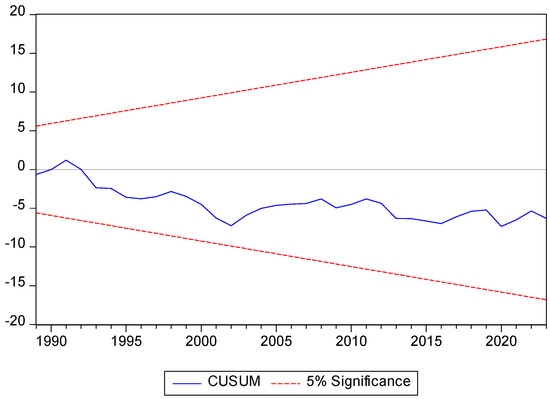
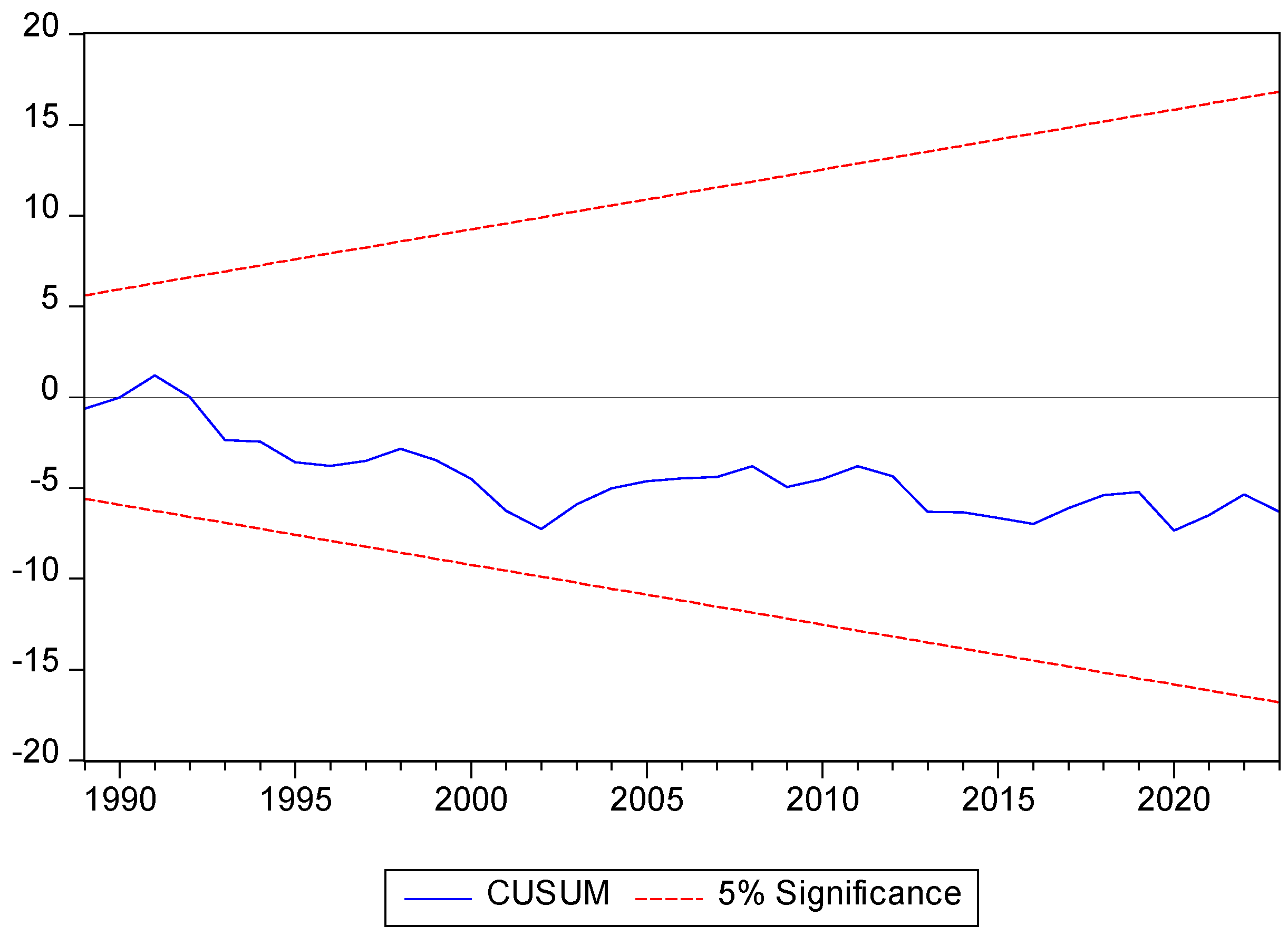
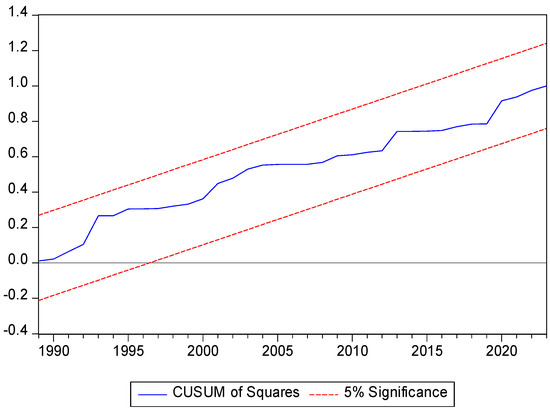
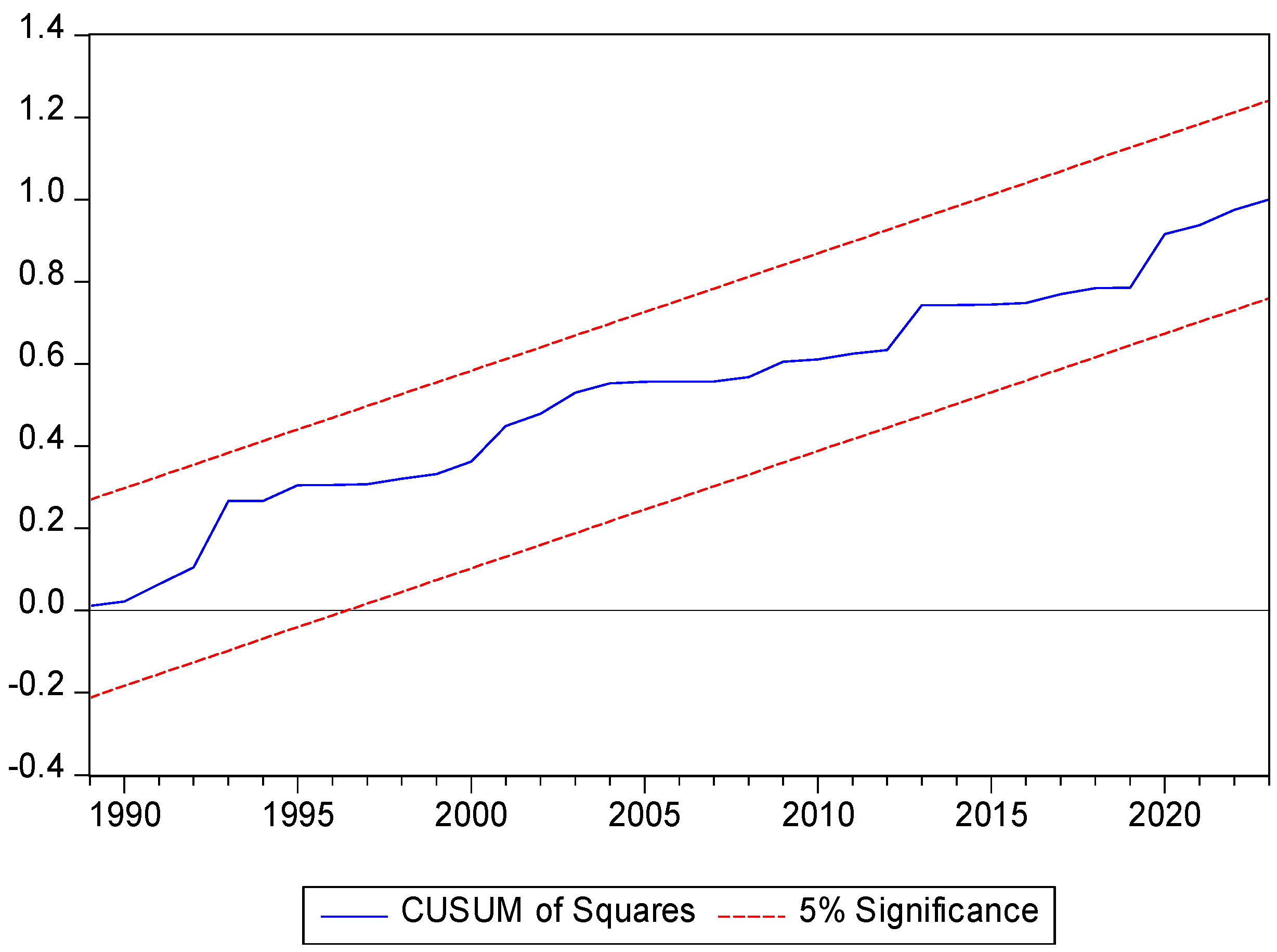
The stability analysis is assessed using the “CUSUM test” and the square of “CUSUM test”. In Figure 1 and Figure 2 provided below shows the outcome of CUSUM test and the square of CUSUM test respectively. The graphical illustrations of both tests confirmed the stability. The obtained lines are well inside the critical limits.
Figure 1.
CUSUM test.
Figure 2.
Square of CUSUM test.
6. Causality Analysis
The findings of causality testing are shown in Table 9. The results displayed a one-way causal relationship running from education, natural resources and FDI towards economic growth. Similarly, both natural resources and TFP are also unidirectionally linked with domestic investment. Moreover, TFP connected with FDI inflows unilaterally. Finally, the results displayed a two-way causal relationship between TFP and economic growth for Saudi Arabia.
Table 9.
Causality testing.
7. Conclusions, Implications and Limitations
7.1. Conclusions
This research article tested the FDI-led growth hypothesis, which is extensively researched globally but least researched for Saudi Arabia. Historical time series data from 1975 to 2023 collected from credible sources are analyzed with the help of the ARDL cointegration technique.
Our results supported the validity of both FDI-led growth and trade-led growth hypotheses for Saudi Arabia only in the long run. In the short run, however, both FDI-led growth and trade-led growth hypotheses were not supported. It implies that both trade and FDI are the long-term determinants of growth. Similarly, our results are broadly consistent with the “resource-blessing hypothesis” both in the short run as well as in the long run. Similarly, we found that human capital has a robust positive impact on growth both in the short run as well as in the long run. Furthermore, we found that TFP is still irrelevant in explaining the growth of Saudi Arabia, maybe due to its relatively low level. Finally, the results revealed that domestic investment has improved economic growth only in the short run, while in the long run its impact on growth is positive but insignificant.
7.2. Policy Implications
In this section, the study outlines some important policy suggestions based on the robust results.
- (1)
- It is suggested that the policymakers of Saudi Arabia shall take immediate measures to liberalize international trade aggressively and further provide supportive platform to international investors for attracting FDI inflows. Both trade and FDI inflows are bound to enhance the long-run growth, as endorsed by the results.
- (2)
- The results provided significant evidence about the positive education–growth relationship. Therefore, significant investment in the education sector must be made to enhance its contribution towards economic growth.
- (3)
- Similarly, encouraging more investment in the domestic economy will add to the growth process enormously. The results showed that investment has a limited role in economic performance as the current investment level is not sufficient.
- (4)
- Finally, the study suggests that the process of economic diversification needs to be aggressively embraced by the policymakers. Although, natural resources have significantly improved the growth of Saudi Arabia, the resource depletion phenomena are getting more visibility worldwide and Saudi Arabia is not an exception.
7.3. Limitations and Future Research Directions
Some unavoidable limitations of the article are highlighted below.
- (1)
- The generalization of findings could be on a limited basis, as Saudi Arabia has a unique political and economic structure. Therefore, potential researchers may do some similar research exercises by focusing on other similar kinds of economies to address the issue of results generalization.
- (2)
- The models designed for analysis may not produce similar results in other settings. Therefore, it is suggested that future researchers test our designed models by utilizing data from other resource-rich economies to assess the robustness of our models.
- (3)
- Although the ARDL framework captures both short-run dynamics and long-run equilibrium relationships, it does not fully eliminate potential endogeneity concerns arising from reverse causality between FDI inflows and economic growth. Therefore, the findings should be interpreted as evidence of dynamic associations rather than definitive causal effects.
- (4)
- The current study has only used a few control variables and could not pay significant attention to structural breaks. Future research studies are advised to add some more control variables to our models and incorporate the structural breaks to assess the robustness of our results.
Author Contributions
Conceptualization, M.T. and S.Q.A.S.; Methodology, M.J., S.S.A. and O.A.; Formal Analysis, R.H.U. and S.F., Validation, M.T., R.H.U., S.F. and S.Q.A.S.; Investigation, S.S.A., O.A. and M.J.; Data Curation, M.T., S.Q.A.S. and S.S.A.; Software, M.T., O.A. and M.J.; Writing—original draft preparation, M.T., S.Q.A.S., S.S.A., M.J. and O.A.; Review and Editing, S.F., R.H.U., S.S.A. and M.T.; Visualization, R.H.U. and S.F.; Project Administration, S.S.A., O.A. and M.J. All authors have read and agreed to the published version of the manuscript.
Funding
The authors received no external funding for this research.
Institutional Review Board Statement
Not applicable.
Informed Consent Statement
Not applicable.
Data Availability Statement
Data will be provided upon receiving a suitable request from the corresponding author.
Conflicts of Interest
The authors declare no conflict of interest.
References
- Adams, S. (2009). Foreign direct investment, domestic investment, and economic growth in Sub-Saharan Africa. Journal of Policy Modeling, 31(6), 939–949. [Google Scholar] [CrossRef] [Scilit]
- Ahmad, N., Du, L., Tian, X. L., & Wang, J. (2019). Chinese growth and dilemmas: Modelling energy consumption, CO2 emissions and growth in China. Quality & Quantity, 53(1), 315–338. [Google Scholar] [CrossRef] [Scilit]
- Albaheth, H. E. (2023). Increasing FDI inflows into Saudi Arabia through bilateral investment treaties. Croatian International Relations Review, 29(93), 73–90. [Google Scholar]
- Aljarallah, R. A. (2021). An assessment of the economic impact of natural resource rents in Kingdom of Saudi Arabia. Resources Policy, 72, 102070. [Google Scholar] [CrossRef] [Scilit]
- Al Khathlan, K. (2014). Foreign direct investment inflows and economic growth in Saudi Arabia: A co-integration analysis. Review of Economics & Finance, 4, 70–80. [Google Scholar]
- Alkhathlan, K. A. (2013). Contribution of oil in economic growth of Saudi Arabia. Applied Economics Letters, 20(4), 343–348. [Google Scholar] [CrossRef] [Scilit]
- Al Shammre, A. S., & Alshahrani, M. N. (2024). A dynamic analysis of sustainable economic growth and FDI inflow in Saudi Arabia using ARDL approach and VECM technique. Energies, 17(18), 4663. [Google Scholar] [CrossRef] [Scilit]
- Alshehry, A. S. (2015). Foreign direct investments and economic growth in Saudi Arabia: A cointegration analysis. Developing Country Studies, 5(6), 69–76. [Google Scholar]
- Ayanwale, A. B. (2007). FDI and economic growth: Evidence from Nigeria. African Economic Research Consortium. [Google Scholar]
- Ayenew, B. B. (2022). The impact of foreign financial inflows on the economic growth of Sub-Saharan African countries: An empirical approach. Cogent Economics & Finance, 10(1), 2123888. [Google Scholar] [CrossRef] [Scilit]
- Baier, S. L., Dwyer, G. P., Jr., & Tamura, R. (2006). How important are capital and total factor productivity for economic growth? Economic Inquiry, 44(1), 23–49. [Google Scholar] [CrossRef] [Scilit]
- Barro, R. J. (2001). Human capital and growth. American Economic Review, 91(2), 12–17. [Google Scholar] [CrossRef] [Scilit]
- Belloumi, M., & Alshehry, A. (2018). The impacts of domestic and foreign direct investments on economic growth in Saudi Arabia. Economies, 6(1), 18. [Google Scholar] [CrossRef] [Scilit]
- Bilas, V. (2020). FDI and economic growth in EU13 countries: Cointegration and causality tests. Journal of Competitiveness, 12(3), 47. [Google Scholar] [CrossRef] [Scilit]
- Blessing, A., Egbon, P. C., & Obi, C. K. (2024). Reevaluating the linkage between trade openness and economic growth in Nigeria. World Journal of Advanced Research and Reviews, 22(3), 902–911. [Google Scholar] [CrossRef] [Scilit]
- Chaudhury, S., Nanda, N., & Tyagi, B. (2020). Impact of FDI on economic growth in South Asia: Does nature of FDI matter? Review of Market Integration, 12(1–2), 51–69. [Google Scholar] [CrossRef] [Scilit]
- Dollar, D. (1992). Outward-oriented developing economies really do grow more rapidly: Evidence from 95 LDCs, 1976–1985. Economic Development and Cultural Change, 40(3), 523–544. [Google Scholar] [CrossRef] [Scilit] [PubMed]
- Edwards, S. (1998). Openness, productivity and growth: What do we really know? The Economic Journal, 108(447), 383–398. [Google Scholar] [CrossRef] [Scilit]
- Ehmaidat, A., & Jajuga, K. (2023). Foreign direct investment in Saudi Arabia. Journal of Contemporary Issues in Business and Government, 29(3), 605–622. [Google Scholar]
- Engle, R. F., & Granger, C. W. (1987). Co-integration and error correction: Representation, estimation, and testing. Econometrica, 55, 251–276. [Google Scholar] [CrossRef] [Scilit]
- Frankel, J. A., & Romer, D. (1999). Does trade cause growth? American Economic Review, 89(3), 379–399. [Google Scholar] [CrossRef] [Scilit]
- Har, W. M., Teo, K. L., & Yee, K. M. (2008). FDI and economic growth relationship: An empirical study on Malaysia. International Business Research, 1(2), 11–18. [Google Scholar] [CrossRef] [Scilit]
- Hayat, A., & Tahir, M. (2021). Natural resources volatility and economic growth: Evidence from the resource-rich region. Journal of Risk and Financial Management, 14(2), 84. [Google Scholar] [CrossRef] [Scilit]
- Islam, M. S., Alsaif, S. S., & Alsaif, T. (2022). Trade openness, government consumption, and economic growth nexus in Saudi Arabia: ARDL cointegration approach. SAGE Open, 12(2), 1–11. [Google Scholar] [CrossRef] [Scilit]
- Johansen, S. (1988). Statistical analysis of cointegration vectors. Journal of Economic Dynamics and Control, 12(2–3), 231–254. [Google Scholar] [CrossRef] [Scilit]
- Kanval, N., Ihsan, H., Irum, S., & Ambreen, I. (2024). Human capital formation, foreign direct investment inflows, and economic growth: A way forward to achieve sustainable development. Journal of Management Practices, Humanities and Social Sciences, 8(3), 48–61. [Google Scholar] [CrossRef] [Scilit]
- Kayani, F. N., & Alzaid, O. (2024). Navigating the classical relationship between foreign direct investment and economic growth: A case of Saudi Arabia. International Journal of Sustainable Development & Planning, 19(11), 4315–4322. [Google Scholar] [CrossRef] [Scilit]
- Le, H. T. P., Pham, H., Do, N. T. T., & Duong, K. D. (2024). Foreign direct investment, total factor productivity, and economic growth: Evidence in middle-income countries. Humanities and Social Sciences Communications, 11(1), 1388. [Google Scholar] [CrossRef] [Scilit]
- Lensink, R., & Morrissey, O. (2006). Foreign direct investment: Flows, volatility, and the impact on growth. Review of International Economics, 14(3), 478–493. [Google Scholar] [CrossRef] [Scilit]
- Makki, S. S., & Somwaru, A. (2004). Impact of foreign direct investment and trade on economic growth: Evidence from developing countries. American Journal of Agricultural Economics, 86(3), 795–801. [Google Scholar] [CrossRef] [Scilit]
- Narayan, P. K. (2004). Reformulating critical values for the bounds F-statistics approach to cointegration: An application to the tourism demand model for Fiji. Discussion Paper No. 02/04. Department of Economics, Monash University. [Google Scholar]
- OECD. (2024). FDI in figures. Organisation for Economic Co-Operation and Development. Available online: https://www.oecd.org/content/dam/oecd/en/publications/reports/2024/10/fdi-in-figures-october-2024_faad0bae/fcdc2fb2-en.pdf (accessed on 27 January 2025).
- Osei, M. J., & Kim, J. (2020). Foreign direct investment and economic growth: Is more financial development better? Economic Modelling, 93, 154–161. [Google Scholar] [CrossRef] [Scilit]
- Pegkas, P. (2015). The impact of FDI on economic growth in Eurozone countries. The Journal of Economic Asymmetries, 12(2), 124–132. [Google Scholar] [CrossRef] [Scilit]
- Pesaran, M. H., Shin, Y., & Smith, R. J. (2001). Bounds testing approaches to the analysis of level relationships. Journal of Applied Econometrics, 16(3), 289–326. [Google Scholar] [CrossRef] [Scilit]
- Poonam, Ravinder, & Saini, V. P. (2024). Understanding the role of exports and FDI in remittances-growth nexus in globalised India. The Indian Economic Journal, 74(3), 522–535. [Google Scholar] [CrossRef] [Scilit]
- Rahman, A. (2015). Impact of foreign direct investment on economic growth: Empirical evidence from Bangladesh. International Journal of Economics and Finance, 7(2), 178–185. [Google Scholar] [CrossRef] [Scilit]
- Raza, S. A., Shah, N., & Arif, I. (2021). Relationship between FDI and economic growth in the presence of good governance system: Evidence from OECD countries. Global Business Review, 22(6), 1471–1489. [Google Scholar]
- Samargandi, N., Alghfais, M. A., & AlHuthail, H. M. (2022). Factors in Saudi FDI inflow. SAGE Open, 12(1), 1–12. [Google Scholar] [CrossRef] [Scilit]
- Saqib, N., Masnoon, M., & Rafique, N. (2013). Impact of foreign direct investment on economic growth of Pakistan. Advances in Management & Applied Economics, 3(1), 35–45. [Google Scholar] [CrossRef] [Scilit]
- Seyoum, M., Wu, R., & Lin, J. (2015). Foreign direct investment and economic growth: The case of developing African economies. Social Indicators Research, 122, 45–64. [Google Scholar]
- Silajdzic, S., & Mehic, E. (2015). Knowledge spillovers, absorptive capacities and the impact of FDI on economic growth: Empirical evidence from transition economies. Procedia—Social and Behavioral Sciences, 195, 614–623. [Google Scholar] [CrossRef] [Scilit]
- SPA. (2025). FDI inflow into Saudi Arabia exceeds the national investment strategy by 16% in 2023. Saudi Press Agency. Available online: https://www.spa.gov.sa/en/N2193676 (accessed on 28 January 2025).
- Tahir, M. (2020). Trade and life expectancy in China: A cointegration analysis. China Economic Journal, 13(3), 322–338. [Google Scholar] [CrossRef] [Scilit]
- Tahir, M., & Azid, T. (2015). The relationship between international trade openness and economic growth in the developing economies: Some new dimensions. Journal of Chinese Economic and Foreign Trade Studies, 8(2), 123–139. [Google Scholar] [CrossRef] [Scilit]

Disclaimer/Publisher’s Note: The statements, opinions and data contained in all publications are solely those of the individual author(s) and contributor(s) and not of MDPI and/or the editor(s). MDPI and/or the editor(s) disclaim responsibility for any injury to people or property resulting from any ideas, methods, instructions or products referred to in the content. |
© 2026 by the authors. Licensee MDPI, Basel, Switzerland. This article is an open access article distributed under the terms and conditions of the Creative Commons Attribution (CC BY) license.