


Abstract
This study investigates the structural relationship between inflation and key macroeconomic fundamentals in Türkiye, an emerging economy characterized by persistently high and divergent inflation dynamics. Using monthly data for the 2011–2024 period, we apply the Kapetanios, Shin, and Snell (KSS) nonlinear cointegration framework, which captures asymmetric adjustment dynamics that standard linear models fail to detect. The aggregate model reveals no long-run cointegration between inflation and monetary and fiscal fundamentals, indicating that conventional transmission channels have weakened and inflation has become decoupled from its traditional determinants. Pairwise analyses show that this decoupling is not complete; rather, the relationship persists in a fragmented, nonlinear, and variable-specific manner. Short-run Granger causality tests further reveal that only fiscal expansion and real money supply retain explanatory power over inflation, while the policy rate proves ineffective. Collectively, these findings indicate that inflation in Türkiye has increasingly evolved into an endogenous and self-reinforcing process, shaped more by policy incoherence than by any single macroeconomic driver. Restoring a coordinated, rule-based monetary and fiscal policy framework emerges as a necessary condition for re-establishing the link between inflation and macroeconomic fundamentals and ensuring durable price stability.
1. Introduction
Understanding the factors underpinning inflation has been a central and enduring question in macroeconomic research, attracting extensive theoretical and empirical scrutiny. Heightened pressures and persistent supply-side disruptions during the COVID-19 pandemic have renewed the importance of this debate in macroeconomic literature. The literature frequently identifies exogenous macroeconomic shocks as major contributors to the formation and persistence of inflation. Therefore, policy responses to inflation have predominantly focused on managing exogenous macroeconomic variables, reflecting the prevailing view in the literature that such shocks are primary drivers of price dynamics.
However, inflation may not always arise as a result of traditional macroeconomic variables. Furthermore, inflation may not be manageable solely by controlling certain macroeconomic variables. Indeed, Soybilgen and Eroğlu (2019) state that the Central Bank of the Republic of Turkey (CBRT)’s policy framework changed over time before and after the global crisis, and that the emphasis placed on inflation also varied depending on external conditions. On the other hand, Ulug et al. (2023) argue that monetary policy lost its effectiveness in curbing inflation after 2018. Gürkaynak et al. (2024) state that the unorthodox policy mix implemented in Türkiye starting in 2020 turned inflation into a self-reinforcing structure. The findings of Gürkaynak et al. (2024) are supported by Miller (2025). These findings indicate that inflation is the result of a systematic deterioration rather than a sudden break in traditional macroeconomic variables. These studies highlight that systematic deterioration in the management of macroeconomic variables can push inflation to a point where it becomes uncontrollable.
The existing literature falls short of empirically testing the extent to which the unorthodox policy mix implemented, particularly after 2018, has undermined the structural link between traditional macroeconomic variables and inflation. The primary motivation of this study is the hypothesis that, in periods lacking a comprehensive and inflation-focused macroeconomic policy framework, the transmission power of key variables such as money supply, interest rates, and government spending on inflation may weaken. In this context, the study also aims to investigate whether inflation may itself act as a driving force shaping these macroeconomic variables, rather than being solely determined by them. The existing literature does not sufficiently discuss whether it is still possible to control inflation by intervening solely in these variables, nor does it adequately address the nonlinear nature of this decoupling.
In this context, our study provides empirical evidence of the loosening of this interaction and the gradual erosion of the guiding influence of traditional macroeconomic variables on inflation. This structure, which has moved away from a comprehensive macroeconomic policy framework and where unorthodox approaches have become dominant, does not follow a linear trajectory by its very nature. On the contrary, this process exhibits a complex dynamic in which institutional anchors have weakened and traditional transmission mechanisms have become dysfunctional, responding according to the magnitude of deviations. Standard linear unit root and cointegration tests, which assume that the relationship between variables is constant and symmetric over time, are insufficient to capture these nonlinear and policy-induced vulnerabilities in the Turkish economy.
Based on this empirical necessity, the study opted for the Kapetanios, Shin, and Snell (KSS) test, which provides a nonlinear cointegration model. The primary economic rationale for choosing the KSS test is that the model assumes the rate at which variables return to equilibrium is not constant; rather, it may vary at an exponential rate depending on the magnitude of the deviations from equilibrium. This methodological flexibility provides the most suitable technical framework for examining the case of Türkiye, where unorthodox policies have been implemented, and the link between macroeconomic fundamentals and price stability has weakened in an asymmetric manner. Consequently, the selection of the KSS method is not merely a statistical preference but a result of the effort to empirically test the characteristic features of the inflation regime in Türkiye.
In this study, a monthly dataset covering the period from January 2011, when the CBRT launched its new monetary policy framework, to April 2024 was used to analyze the dynamics of the relationship between inflation and key macroeconomic variables in Türkiye. The empirical analysis process was structured in a phased approach. In the first stage, the existence of a long-run equilibrium relationship between inflation and selected macroeconomic variables, such as money supply, interest rate, government spending, exchange rate, and industrial production index, was investigated using the KSS nonlinear cointegration test. Moving beyond the aggregate model, the transmission channels between inflation and these variables were analyzed using bivariate analysis, and the nature of the specific relationships between the variables was examined in the subsequent stage. Based on the cointegration results, the short-term dynamics among the variables were modeled using the exponential smooth transition autoregressive (ESTAR) model; the system’s rate of return to equilibrium and the interaction of short-term deviations were observed. Finally, to determine the direction of the interaction between the variables and to support the empirical findings, the Granger causality test was applied to test the predictive power of macroeconomic variables on inflation. The empirical results show that inflation in Türkiye does not exhibit a stable long-run relationship with conventional macroeconomic variables in the aggregate model, indicating a weakening of the overall transmission mechanism. However, pairwise analyses suggest that this relationship has not completely disappeared but instead operates in a fragmented, channel-specific manner. The short-run causality findings further reveal that only fiscal variables, and to a limited extent, monetary aggregates, retain explanatory power over inflation dynamics, while other channels remain ineffective. Overall, the results indicate that the interaction between inflation and macroeconomic fundamentals persists, but in a nonlinear, unstable, and non-systematic form.
2. Literature Review
In the last two decades, there has been increasing emphasis on the idea that inflation is a global phenomenon. It implies that a significant portion of domestic inflation dynamics is driven by common international factors rather than purely domestic conditions (Neely & Rapach, 2011; Bianchi & Civelli, 2015; Auer et al., 2019). The spread of globalization and the increase in trade volumes also strengthen the idea that inflation is a global phenomenon. Ciccarelli and Mojon (2010) show that the reason for the deviation of domestic inflation in developed countries from global inflation is the divergence in the monetary policy stance of countries. While Mumtaz and Surico (2012) point out that monetary growth is the most important driver of global inflation, they attribute the divergence of inflation across countries to productivity differences.
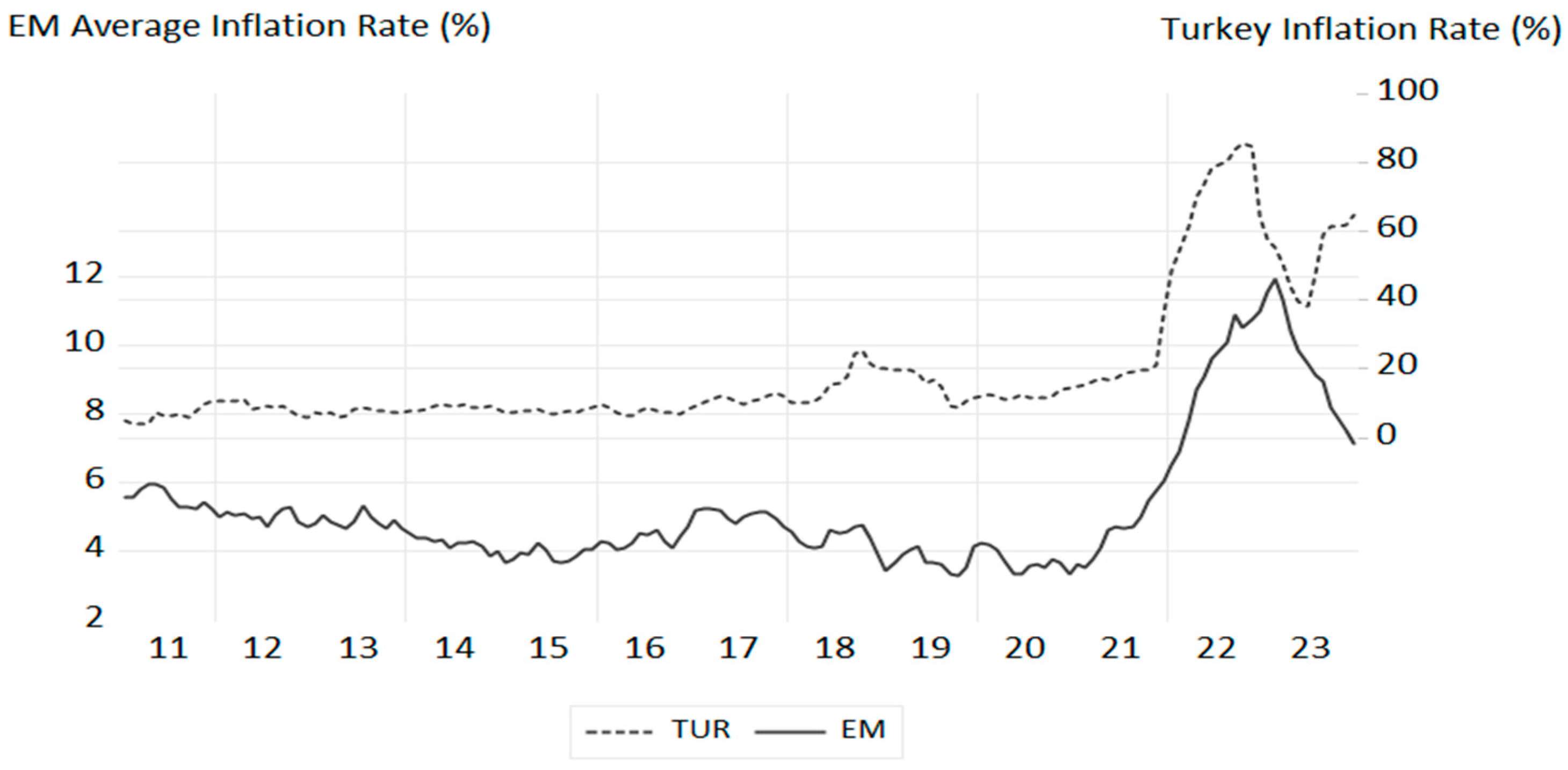
Borio and Filardo (2007) and Mumtaz and Surico (2012) argue that global prices, such as raw material and energy prices, affect domestic inflation. Melitz and Ottaviano (2008) state that inflation is a global phenomenon, and the growth of trade volumes and trade openness feeds global inflation. Asadollah et al. (2024) show that both advanced and emerging economies are affected by global inflation, and the main determinant of global inflation is supply chain disruptions. After all, many studies support the hypothesis that inflation is a global phenomenon and that emerging economies are more affected, but the significant factors of inflation divergence from the global level have not yet been explained. Kamber and Wong (2020) argue that the explanatory power of exogenous shocks for trend inflation in emerging economies is quite high. They state that the institutional structures and policy preferences of emerging economies are likely to accelerate the pass-through of global inflation to domestic inflation. Another reason that differentiates inflation in emerging economies from advanced economies is the backward-looking nature of expectations in emerging economies. Accordingly, once inflation increases globally, this situation has a stronger effect on long-term inflation in emerging economies. During 2021–2023, inflation in major emerging economies such as Brazil, Mexico, and South Africa rose in line with global price pressures but remained within the 5–12 percent range, whereas Türkiye’s inflation rate increased far more dramatically and persistently (IMF, 2023).
During the same period, Türkiye’s inflation exceeded 30–80 percent annually, clearly separating it from the 5–12 percent band observed in other emerging economies as depicted in Figure 1. In Figure 1, the dashed line represents Türkiye’s annual inflation rate, while the solid line represents the average annual inflation rate of 15 emerging economies. As can be clearly seen from the graph, Türkiye’s inflation rate diverges significantly from that of other emerging economies.
Figure 1.
Inflation Rates of Türkiye and Emerging Markets.
Even though many studies have been conducted on the drivers of inflation in Türkiye, there is no consensus. The studies conducted in the early 2000s suggest that the main cause of inflation in Türkiye is budget deficits. Kibritcioglu and Dibooglu (2001) analyze the Turkish inflationary process through econometric models employing key macroeconomic indicators. Their results reveal that the persistent nature of inflation mainly stems from the monetization of chronic fiscal deficits, whereas exchange rate and cost shocks play only a transitory role. Hence, the study concludes that weak fiscal discipline and fiscal dominance over monetary policy constitute the fundamental source of sustained inflation in Türkiye. Karacal and Bahmani-Oskooee (2008) analyze the drivers of inflation for the period 1987–2003, applying the ARDL model. The findings indicate that financing budget deficits through an expansion of the money supply accelerates inflation, and the real exchange rate appreciation also contributed to inflationary pressures. Ari et al. (2013) examined inflation dynamics for the period 1990–2011 using the Johansen cointegration method and found that an increase in money supply increases the inflation rates in the long run. Özdemir and Saygılı (2009) show that monetary aggregates (M1–M2), excess liquidity indicators, and short-term interest rates exert significant long-run effects on inflation within the P-star model framework. Kara and Öğünç (2008) document a sharp decline in exchange rate pass-through in Türkiye over 2001–2004, the initial phase of the inflation-targeting regime. Ulug et al. (2023) examine the effects of ultra-loose monetary policy on inflation in Türkiye. The time-varying causality test findings show that the dynamics of the high inflation between 2017 and 2022 are the deterioration in the stance of monetary policy, the resulting deterioration in expectations, and the increase in the exchange rate. Bilici and Çekin (2020) investigate inflation persistence with the TVP forecasting method between 1990 and 2018. They found that structural changes in monetary policy reduce inflation persistence.
Due to the CBRT’s inflation strategy, the dominant view in the literature on the sources of inflation in Türkiye often emphasizes that monetary factors are the most important drivers. Mishkin (2007) also emphasizes the importance of the inflation targeting strategy and how it prevents the acceleration of inflation by anchoring expectations. However, the study of Yilmazkuday (2022) showed that monetary factors are not as effective on inflation as other variables for the period 2005–2021, with the drivers of inflation being analyzed with the structural Vector Auto Regression (SVAR) method. The study indicates the most important factors affecting inflation in the long run are oil prices and exchange rates. Furthermore, the monetary policy effect on inflation was found to be significant, but limited in Türkiye. A study conducted by Kocoglu (2023) also aligns with the findings of Yilmazkuday (2022). The study examines the determinants of inflation in Türkiye from the perspective of the New Keynesian Phillips Curve using the Quantile Autoregressive Distributed Lag (QARDL) model, and the impact of the output gap, oil prices, and exchange rates on inflation was investigated. The findings of the model incorporate the asymmetric components of oil prices and the output gap and indicate a positive relationship between oil prices, exchange rates, and inflation. According to the findings, increasing oil prices have a greater impact on inflation than decreasing oil prices, and the effect of the output gap on inflation is stronger in periods of positive output gaps. Therefore, the study argues that the effectiveness of monetary policy may be limited during periods of rising oil prices and widening output gaps. Similarly, Özgür and Akkoç (2022) argue that energy-dependent production is one of the main determinants of inflation, while Özmen and Özşahin (2023) found that the global energy and non-energy prices are parallel to the structural breaks in Türkiye’s domestic inflation with time-varying causality tests.
Gürkaynak et al. (2024) present findings that directly contradict those discussed in their study for the period Q1 2003 to Q3 2021. Employing both empirical and theoretical models, the authors examine the dynamics of exchange rates, monetary policy, and inflation. Their analysis constructs a New Keynesian model in which the Taylor rule is sensitive to regime shifts. The study investigates the transition from a tight to a loose monetary policy framework and argues that the primary driver of inflation is the weak monetary policy stance. The causality tests indicate that while inflation and the exchange rate share a common trend, the causal relationship between them remains weak. Additionally, the study posits that inflation is primarily driven by domestic factors rather than global determinants.
To summarize, the studies on the determinants and drivers of inflation in Türkiye have yielded varying results across different periods. The studies conducted before the adoption of the inflation-targeting regime suggest that budget deficits were the primary determinant of inflation (Kibritcioglu & Dibooglu, 2001; Karacal & Bahmani-Oskooee, 2008). After the implementation of inflation targeting, monetary policy emerged as the key driver (Kara & Öğünç, 2008; Özdemir & Saygılı, 2009). On the other hand, most recent studies argue that cost-push factors such as exchange rates and oil prices have become the primary contributors to inflation (Yilmazkuday, 2022; Kocoglu, 2023; Özmen & Özşahin, 2023). Additionally, some recent work suggests that the main reason for the surge in inflation between 2017 and 2022 is the deterioration in the monetary policy stance (Ulug et al., 2023; Gürkaynak et al., 2024). Consequently, these studies approached the determinants of inflation from different perspectives and, despite the lack of consensus, yielded important empirical findings.
In the reviewed literature, including the studies mentioned above, the striking point here is that the drivers of inflation have largely been analyzed through linear modeling approaches. However, considering the complex and evolving nature of inflation dynamics, identifying a statistically significant long-term or short-term coefficient between inflation and macroeconomic variables does not necessarily imply that the variable in question is a fundamental driver of inflation. The presence of a common trend or a structural effect influencing both variables is highly plausible. As a result, identifying the real drivers of inflation is a challenging task. Analyzing this phenomenon through linear models falls short of capturing the intricate interrelations among macroeconomic factors and tends instead to obscure the underlying problem. For this reason, nonlinear approaches are becoming increasingly important to understand. The KSS nonlinear test, with its exponential smooth transition property, provides a more effective in capturing the inflation dynamics that distinguish Türkiye from other emerging market economies.
The methods in this study are structured in three main stages. First, linearity tests were carried out, followed by unit root testing. Then, cointegration models were estimated, and causality relationships were examined through a short-run error correction framework. The study ends with a conclusion. Unlike most existing studies, which predominantly examine whether monetary, fiscal, or cost-push factors drive inflation, our analysis reveals that inflation itself exerts causal effects on these variables. This result highlights that Türkiye’s inflationary process is not merely imported from traditional macroeconomic drivers but has increasingly decoupled from macroeconomic fundamentals. In doing so, the study not only advances methodological approaches but also reframes the policy discussion by showing that inflation in Türkiye destabilizes other macroeconomic indicators rather than being persistently driven by them.
3. Methodology and Empirical Findings
3.1. Data
The variables used in the empirical analysis consist of monthly series covering the period from January 2011 to April 2024. To reduce volatility and obtain a more accurate price dynamic, the logarithm of the consumer price index excluding alcohol and tobacco products was used as an inflation indicator.
The variables selected to explain inflation were determined to represent the main transmission channels prominent in the literature. The weighted average cost of funding (WACF) was used to represent monetary policy. The M2 series was chosen to represent the money supply, and to eliminate the risk of spurious correlations due to the inclusion of nominal magnitudes in price level changes, it was deflated with the CPI to make it real. In this way, an attempt was made to isolate the real effect of the money supply on inflation. To represent the level of real economic activity, the logarithm of the monthly industrial production index (IND), which is widely used in the literature, was included in the model. To represent the fiscal policy channel, real government expenditures (GOV) were used, and this variable was also analyzed after removing price effects. Finally, the real exchange rate (RER) was preferred over the nominal exchange rate to represent the exchange rate channel. Since the nominal exchange rate includes changes in the price level, it can mechanically correlate with inflation, creating misleading relationships. By using the real exchange rate, this mechanical correlation is supposed to be eliminated, and the competitiveness of the exchange rate and its true impact on prices are measured more accurately. All variables were used in logarithmic form and gained from CBRT’s data distribution system.
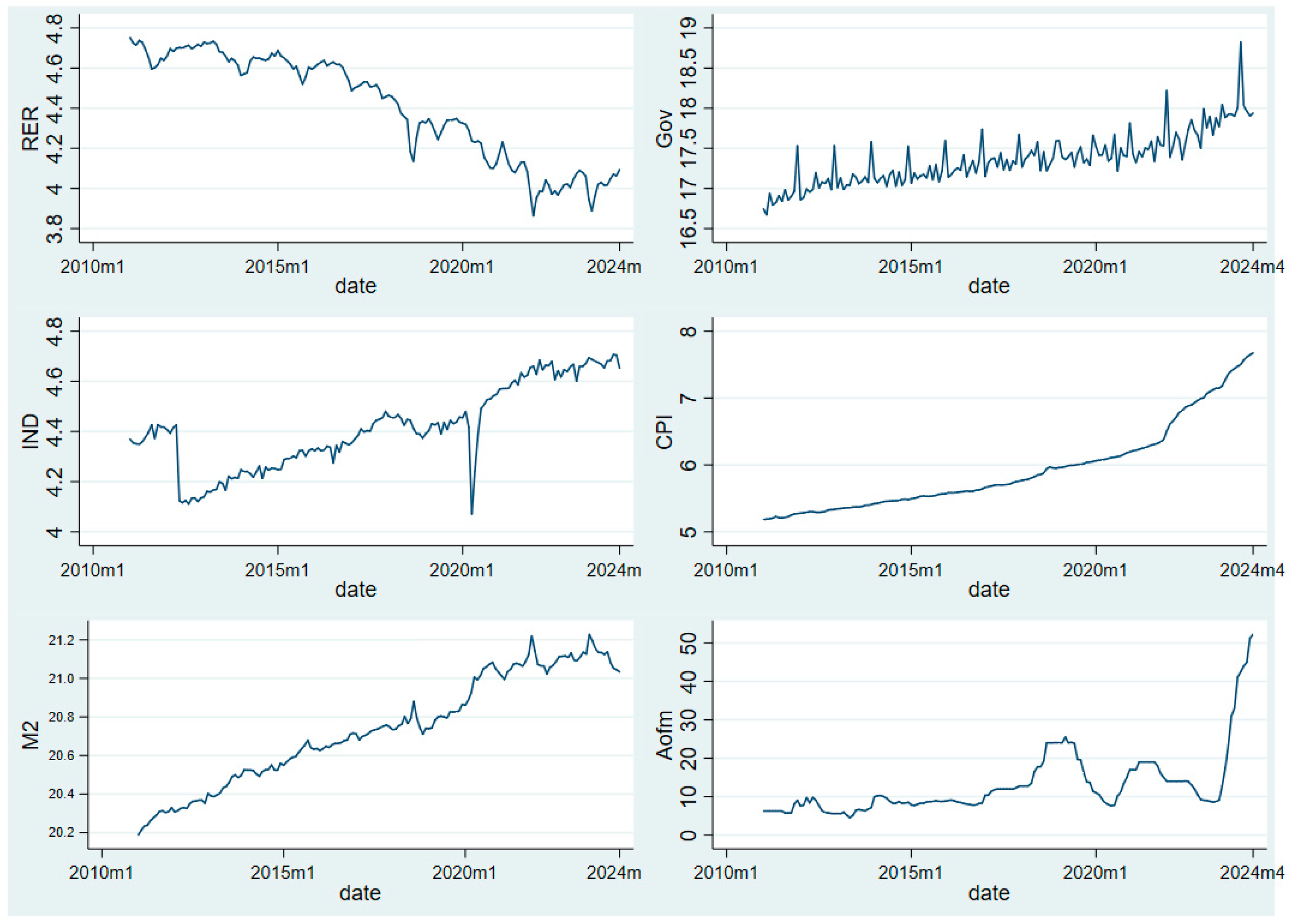
The selection of variables used to measure the CPI also takes into account the volatile nature of the Turkish economy, which is susceptible to external shocks, as well as the complex ways in which market mechanisms respond to those shocks. Throughout the period examined, inflationary pressures manifested through multiple channels in Türkiye. The 2018 currency crisis, the sharp rise in prices (particularly food prices) during and after the COVID-19 pandemic, and the decline in manufacturing sector value-added all contributed to making the alignment of monetary and fiscal policies increasingly challenging. As a result, the variables chosen for this study are not only grounded in existing academic literature but also capture the particular economic conditions Türkiye experienced over the period in question. Figure 2 illustrates the time dynamics of the key macroeconomic variables (WACF, RER, M2, CPI, GOV, and IND) included in the empirical analysis.
Figure 2.
Time Series Paths of the Variables.
3.2. Linearity Test
It is assumed that the linearity of all time series would not reflect real-world experiences. Especially in economics, since political, social, financial, and economic changes or shocks are known to exhibit nonlinear behavior. Some studies in the literature confirm that linear methods become inadequate when macroeconomic time series are exposed to such shocks. For instance, Balke (2000) examined credit shocks using a nonlinear time series impulse response analysis and emphasized the importance of nonlinearity. Enders and Siklos (2001) noted that variables such as real gross domestic product, unemployment, and industrial production display nonlinear adjustment behavior arising from their asymmetric features, which makes them well-suited for nonlinear modeling approaches.
Hence, testing the linearity of variables is one of the main steps of econometric analysis to apply suitable unit root tests and cointegration tests. The results will be misleading if nonlinear time series are used in the unit root and cointegration tests, which are based on linear techniques. Upon this, beginning with the linearity test of variables would be a crucial step for shaping the following analysis of the study, Malcioğlu and Aydin (2016).
In this paper, analysis was performed using the linearity test, which was introduced to the literature in the study conducted in 2008 by Harvey et al. (2008). This test is the updated version of the previously developed linearity test, Harvey and Leybourne (2007), with better finite sample size and power features. The test differs from other linearity tests by essentially testing the linearity without making any assumptions about the stationarity of the series, Yılnacı and Tıraşoğlu (2016).
In this test, linearity is calculated by taking the weighted average of two different linearity approaches, as Ws and Wu. In Equation (1), Ws performs linearity analysis, assuming that the series is stationary, and Wu assumes that it is not a stationary process. λ is a weight parameter and is calculated as shown in Equation (2), Yılnacı and Tıraşoğlu (2016).
In Equation (2), g is the constant variable and ranges between 0 and 1. U indicates unit root test statistics, and S indicates linearity test statistics. U can be calculated using the standard Dickey–Fuller test and the S nonparametric stationarity statistic proposed by Harris et al. (2003). If the data is linear, diverge and λ converge to zero, and if the data has unit converge to zero and λ converge to 1, Harvey et al. (2008). Ws test statistics in Equation (1) can be calculated by applying the Taylor expansion on the first-order autoregressive model and obtaining Equation (3). Then, Equation (3) was transformed with observed Yt in the data creation process and obtained Equation (4).
Equation (4) indicates the null hypothesis tests linearity (H0,S: β2 = β3 = 0) against a nonlinear alternative hypothesis (H1,S: β2 ≠ β3 ≠ 0) with the Wald test formula for WS in Equation (5), that and indicate the sum of the error squares of the restricted and unrestricted OLS regression.
In order to obtain WU statistics, a second-order Taylor expansion is applied to a nonlinear AR(1) model for a time series with stationary first differences (I(1), which is shown in Equation (6). Then, it was rewritten to test linearity with the data creation process and obtained Equation (7). Lastly, using Equation (7), the null hypothesis tests linearity (H0,U: β2 = β3 = 0) against a nonlinear alternative hypothesis (H1,U: β2 ≠ β3 ≠ 0) with the Wald test formula for Wu in Equation (8), where and indicate the sum of error squares of restricted and unrestricted models. Both Ws and Wu statistics are chi-square-distributed with 2 degrees of freedom (Malcioğlu & Aydin, 2016).
3.3. Unit Root Tests
In this section, we apply both linear and nonlinear unit root tests to variables regarding the results obtained with the linearity test. To apply suitable tests to detect unit root, linearity test results of variables are considered. Therefore, for linear time series, Dickey and Fuller (1979) and Phillips and Perron (1988) tests were applied that the equations, respectively, shared as follows:
For non-linear time series, Kapetanios et al. (2003) and Sollis (2009) applied unit root tests with the aim of obtaining robust results that account for non-linearity in the series and smooth transition processes (Chen, 2014; Çağlayan Akay et al., 2020). Kapetanios et al. (2003) proposed a new framework for testing the null hypothesis of a unit root (γ = 0) against a globally stationary ESTAR process in the following equation:
In Equation (11), since gamma is not identifiable under the null, it is evident that testing the null hypothesis directly is not possible. To solve this issue, t-type test statistics were derived, and the first-order Taylor expansion was applied to the ESTAR model; then, Equation (12) was obtained. At this stage, while testing δ = 0 against δ < 0, it was necessary to develop asymptotic critical values of the t-statistics (tNL) via stochastic simulations to overcome non-normal distribution (Kapetanios et al., 2003).
The unit root test assumes a symmetric effect at any point. Sollis (2009) extended this symmetric assumption in the ESTAR process and developed asymmetric ESTAR (AESTAR). This method can apply symmetric or asymmetric nonlinearity, while the null hypothesis indicates a unit root. Sollis (2009) extended Equation (12) by adding a new term and obtained Equation (13) and tested the non-stationarity with asymptotic critical values of F statistic (H0: ϕ1 = ϕ2 = 0) (Sollis, 2009).
3.4. Cointegration Analysis
Kapetanios et al. (2006) proposed a cointegration test by implementing general non-linear exponential smooth transition regression (ESTAR ECM) and an Engle and Granger (1987)-type pragmatic residual-based two-stage approaches. The method tests the null hypothesis of no cointegration (H0: θ = 0) against the alternative of cointegration (H1: θ ≠ 0), and two operational test statistics are developed with their derivatives: FNEC (tNEC) and , provide F-type test statistics of ESTR ECM and tNEG, and tNEC provides Engle & Granger statistic for linear cointegration. To obtain FNEC, which is shown in Equation (16), a first-order Taylor expansion was applied to the following conditional nonlinear STR ECM Equation (14) and obtained auxiliary testing regression Equation (15) to consider the F-type test for δ1 = δ2 = δ3 = 0. SSR0 and SSR1 are the sum of squared residuals, respectively, with and without restrictions. The derived version of in Equation (18), developed by restricted auxiliary testing regression in Equation (17), imposing δ1 = δ2 = 0. For the tNEG and tNEC statistics, δ1 = 0 and δ3 = 0 were tested, respectively, in Equations (19) and (20). According to the method, provides the strongest test results among others. The test can be applied to raw, demeaned, and detrended data.
4. Empirical Findings
The initial analysis at the level I(0) demonstrated that the variables IND and M2 exhibited linear behavior, whereas WACF, CPI, EX, and GOV were found to be nonlinear. After first differencing the entire series to achieve the I(1) level, the standard Augmented Dickey–Fuller (ADF) and Phillips–Perron (PP) unit root tests were applied to the linear variables, confirming that IND and M2 became stationary.
Since the WACF, CPI, EX, and GOV variables were found to be nonlinear, the first difference was taken, and Harvey and Leybourne’s linearity test was re-applied to reassess their linearity properties. According to the linearity test results at the I(1) level, the GOV and IND variables were found to be linear, while the CPI and EX variables remained nonlinear. Accordingly, to eliminate unit roots at the I(1) level, the ADF and PP tests were employed for the GOV and IND variables, whereas the KSS and Sollis tests were applied to the CPI and EX. All variables were rendered stationary at the I(1) level based on the unit root tests applied according to their respective linearity properties. Table 1 presents the results of the linearity tests, while Table 2 reports the results of the unit root test tests.
Table 1.
Linearity Test Results.
Table 2.
Unit Root Test Results.
Following linearity and unit root tests, the KSS cointegration test was conducted to explain the long-term relationship between CPI and the macroeconomic variables under analysis. To deep dive into this idea, first, a main model was constructed with CPI as the dependent variable and the other explanatory variables (EX, WACF, GOV, IND, M2) as independent. Subsequently, binary models were constructed with CPI.
The main model in Equation (21) is constructed with CPI as the dependent variable and monetary and fiscal indicators as independent variables reveals, based on the KSS test results, no evidence of long-run cointegration depicted in Table 3. This implies that, unlike what would be expected in a well-functioning macroeconomic system, inflation in Türkiye does not share a stable long-run trajectory with money supply, exchange rates, government expenditures, interest-rate proxies, and industrial production. Rather than indicating a permanent link, the transmission channels between fundamentals and prices appear to have weakened or become inconsistent over time. This divergence from earlier findings in the Turkish literature suggests that monetary and fiscal policies have lost their effectiveness in anchoring inflation dynamics during the analysis period. Consequently, inflation has increasingly decoupled from fundamentals, pointing to an endogenous, self-perpetuating process in which policy instruments fail to establish durable control over price stability.
Table 3.
Main Model KSS Test Result.
Given that the main model revealed no cointegration between CPI and the set of monetary and fiscal indicators, it became necessary to examine whether this absence of a long-run relationship reflects a complete decoupling from fundamentals or the masking of individual channels when variables are considered jointly. To address this, we conducted pairwise models between CPI and other variables. This step allows us to identify whether specific transmission channels retain a long-run or short-run connection with inflation, even if the joint system does not. In this way, the pairwise results complement the main model: while the lack of cointegration in the aggregate model highlights the absence of policy coordination and a systemic linkage, the pairwise findings show which individual channels may still exert influence on inflation dynamics.
Consequently, ten sub-models were constructed, each incorporating one of the variables, CPI, WACF, IND, EX, and M2 as the dependent and independent variables. In addition to testing cointegration, these models also investigated short-run relationships through the error correction model and assessed short-run causality using the Granger causality test.
Table 4 indicates F*NEC test results for pairwise equations for raw, demeaned, and detrended data. The non-stationary nature of CPI and other variables and their strong trending nature necessitated a comparison of the test results. Since CPI and its fiscal and monetary driving factors show deterministic trends, applying the KSS test to the raw data may provide cointegration spuriously due to shared trending behavior. This issue is known as spurious regression (Newbold & Granger, 1974). Hence, this study discusses the detrended results, which provide stronger evidence of a true relationship beyond common deterministic trends.
Table 4.
Pairwise Model Test Results.
The obtained statistics were compared with the critical values, and the null hypothesis of no cointegration relationship was tested against the alternative hypothesis. According to the findings, in the model where CPI is the dependent variable and EX is the independent variable, no cointegration relationship was detected across the detrended case.
The first pair model observes the relationship between CPI and WACF. The models were built as CPI is the dependent variable and WACF is the independent variable, while the second specification reverses this setup. The KSS results indicate that the long-run cointegration from WACF to CPI is a statistically significant detrended model, whereas the reverse relationship (from CPI to WACF) is significant. The fact that the relationship between the WACF and the CPI is significant in both the demeaned and detrended models indicates that monetary policy has a structural effect on inflation. However, the fact that the test statistic in the detrended model (27.49) is significantly higher than that in the demeaned model (17.16) demonstrates that this effect is more successful at correcting deviations from the trend rather than controlling for the main trend. This reflects the difficulty of monetary policy in anchoring the inflation target.
These findings suggest that monetary policy in Türkiye affects inflation only through deviations from its long-run trend; that is, it responds effectively to short-term or unexpected inflationary fluctuations but fails to anchor the overall inflation trend. In contrast, inflation exerts a persistent influence on the policy rate, implying that the long-run equilibrium of the policy rate is largely driven by inflation dynamics. This result supports the findings of Gürkaynak et al. (2024), who emphasize the increasing dominance of short-term inflation expectations and the weakening of monetary policy credibility in shaping inflation outcomes.
For the CPI and EX pair, the asymmetric KSS tests indicate no long-run cointegration from the real exchange rate to CPI across all specifications, whereas the reverse direction (from CPI to the real exchange rate) is significant in the detrended model. This suggests that persistent inflation dynamics in Türkiye have been followed by exchange-rate adjustments that restore external competitiveness, rather than the real exchange rate being a long-run driver of the price level. Methodologically, the result is also consistent with the RER (real exchange rate) definition, which implies a mechanical link from CPI to RER.
These results contrast with Berument and Pasaogulları (2003), who argue that real-exchange-rate depreciations are inflationary in the long run. In our sample period, however, a suite of policy interventions such as FX (foreign exchange)-protected deposits, repeated FX interventions, administered price practices, tax adjustments on imports, and macroprudential credit controls systematically suppressed exchange-rate pass-through and broke the long-run cointegration from the real exchange rate to CPI. Hence, the absence of a long-run from EX to CPI link in our KSS tests is empirically consistent with the Turkish policy regime of 2011–2024, even though the reverse link (from CPI to EX) remains significant due to mechanical and competitiveness-adjustment channels.
The bidirectional long-run relationship between GOV and CPI is fully consistent with the broader findings of this study and with the macroeconomic regime that characterized Türkiye after 2018. During this period, a fiscal–monetary feedback loop emerged, whereby expansionary fiscal policy fueled price increases, and persistent inflation in turn inflated budget expenditures through indexation and nominal rigidities. This self-reinforcing mechanism indicates that inflation in Türkiye has become not only a monetary phenomenon but also a fiscal one. The empirical evidence of symmetric cointegration between GOV and CPI thus reflects a regime-consistent interaction, strengthening the internal coherence of our overall results.
The bidirectional long-run relationship identified between real government expenditures and inflation is consistent with the presence of fiscal dominance in Türkiye’s post 2018 policy regime. This pattern aligns with Ahmed et al. (2021), who documented that in emerging market economies, higher public debt levels constrain monetary tightening and induce a non-linear association between debt and policy rates. While their evidence captures the stock dimension of fiscal dominance through debt accumulation, our findings highlight its flow dimension, operating via fiscal spending behavior. In the Turkish case, expansionary fiscal policy has exerted persistent upward pressure on prices, while sustained inflation has mechanically inflated real expenditures through indexation and politically motivated adjustments. The resulting fiscal–monetary feedback mechanism reflects a regime in which fiscal policy has become an endogenous driver of inflation dynamics, thereby weakening the monetary authority’s capacity to anchor expectations.
Given that industrial production (IND) serves as a high-frequency proxy for real output, the IND–CPI nexus primarily reflects the interaction between aggregate demand dynamics and inflationary pressures. The existence of cointegration from IND to CPI in the detrended specifications implies that short-run fluctuations in real activity generate temporary demand-side pressures on prices, consistent with the cyclical interpretation of the Phillips curve. Conversely, the persistent and trend-level cointegration running from CPI to IND suggests that chronic inflation has evolved into a structural impediment to output growth, operating through cost-push effects, heightened uncertainty, and distortions in resource allocation. Accordingly, the relationship appears demand-driven in the short run but cost- and supply-driven in the long run, a pattern that closely characterizes the structural transformation of Türkiye’s macroeconomic regime in the post-2018 period.
The relationship between CPI and M2 results indicates that real money balances influence inflation only when trend components are removed, suggesting that liquidity shocks induce transitory price pressures without anchoring the long-run price level. In contrast, inflation exerts a persistent and statistically robust effect on real money balances across all specifications, implying that nominal money growth endogenously adjusts to maintain desired real balances within a high-inflation environment. Employing real rather than nominal aggregates helps mitigate spurious level correlations and aligns the findings with the conventional money demand framework.
Overall, the long-run evidence suggests that between 2011 and 2024, Türkiye’s monetary policy gradually ceded its dominant role in shaping inflation, while fiscal dynamics and price behavior became mutually reinforcing. Real monetary aggregates and the real exchange rate influenced prices only through short-lived deviations, whereas inflation exerted persistent and directional feedback effects on these variables. The bidirectional cointegration between government spending and inflation underscores the increasing fiscal contribution to price formation, while the asymmetric relationship between industrial output and CPI indicates a shift from temporary demand-driven pressures to structural cost-push effects. Taken together, these results portray a macroeconomic regime in which inflation has emerged as the leading variable, driving adjustments in monetary, fiscal, and real-sector behavior. This reflects a shift from active policy control to reactive policy adjustment in Türkiye’s economic environment after 2018.
Following the long-run pairwise cointegration results, the next step aims to capture the short-run dynamics and causality patterns among the variables. For this purpose, an error correction framework (ECM) is employed using detrended series, which allows us to isolate genuine short-run adjustments by removing the influence of common deterministic trends. As emphasized by Newbold and Granger (1974) and later by Banerjee et al. (1993), analyzing nonstationary or trend-dominated data may lead to spurious regression results that overstate the strength of relationships. Therefore, working with detrended series ensures that the estimated short-run coefficients reflect true adjustment processes toward equilibrium rather than co-movements driven by shared trends. In line with the literature, a negative and statistically significant short-run adjustment coefficient indicates that deviations from equilibrium are corrected over time, implying that short-run disequilibria tend to converge to a stable long-run path. he results of the short-run nonlinear error correction model are presented in Table 5.
Table 5.
Non-Linear Error Correction Models Results.
When the short-run error-correction coefficients are considered together with the long-run KSS results, the adjustment dynamics become clearer. The variables show long-run cointegration with CPI, such as the policy rate, government spending, industrial output, and real money balances, also have significant and negative short-run adjustment terms, indicating an active return to equilibrium. In contrast, government spending and output display insignificant coefficients, suggesting structural and institutional delays in their short-run responses. The significant coefficient for the exchange rate, despite the absence of long-run cointegration, reflects temporary policy reactions rather than genuine equilibrium adjustment. Overall, these results suggest that in Türkiye, the adjustment mechanism functions mainly within cointegrated relationships, while non-cointegrated variables exhibit short-term fluctuations without durable correction. The results of the short-run Granger Causality test are presented in Table 6.
Table 6.
Granger Causality Test Results.
The short-run Granger causality results reveal that the policy rate (WACF) does not exert a significant influence on consumer prices, nor does inflation trigger an immediate policy rate response. This finding underscores the limited short-term effectiveness of monetary policy in steering inflation during the period under review. In contrast, fiscal policy, represented by real government spending (GOV), displays a significant causal effect on inflation, suggesting that fiscal expansion directly contributes to short-run price pressures. The real exchange rate (EX) is found to be driven by inflation rather than driving it, pointing to a passive exchange rate adjustment in response to domestic price dynamics rather than external competitiveness. Neither industrial production (IND) nor inflation shows short-run causality in either direction, implying that real activity and prices are weakly connected in the short term, likely due to structural rigidities or lagged output responses. Finally, the bidirectional causality between real money supply (M2) and inflation highlights the presence of endogenous monetary feedback, where liquidity expansions fuel price increases while inflation, in turn, erodes real balances and prompts monetary adjustment. Collectively, these results depict a short-run inflation process dominated by fiscal behavior and monetary accommodation, rather than by active interest rate management or output-driven pressures.
5. Conclusions
This study analyzes the determinants of inflation in Türkiye over the period 2011–2024 using the nonlinear cointegration approach proposed Kapetanios et al. (2003). In the first stage, the long-run relationships between the consumer price index (CPI) and real government spending (GOV), the monetary policy rate (WACF), the real exchange rate (EX), industrial production (IND), and real money supply (M2) are examined.
The empirical evidence obtained from nonlinear cointegration and causality tests indicates that inflation in Türkiye during the 2011–2024 period does not share a stable long-run relationship with the standard set of monetary and macroeconomic variables. Relating Türkiye’s growth journey to monetary and fiscal policies, inflation has been a very dominant factor for many years. The Turkish economy, particularly from mid-2018 onwards and becoming more pronounced during the October 2021–May 2023 period, exhibits a structure intertwined with a high exchange rate-high inflation spiral. This situation prevents economic growth from translating into social welfare, creating a vicious cycle. Türkiye’s inability to create strong harmony between monetary and fiscal policy elements in the face of rising inflation is also damaging long-term relationships. The absence of cointegration in the aggregate main model suggests that the traditional transmission channels linking prices with monetary and fiscal indicators have weakened and lost their joint effectiveness. In other words, inflation has become decoupled from fundamentals, implying that the overall policy mix in Türkiye fails to operate in a coordinated and mutually reinforcing manner. Under such policy incoherence, no single variable can systematically drive inflation dynamics because the macroeconomic system itself does not generate a stable equilibrium framework for prices.
These findings also provide insight into the broader question raised in the introduction regarding whether inflation in Türkiye remains a variable driven by conventional macroeconomic fundamentals or whether it has evolved into a process that increasingly shapes and governs these variables itself. The failure to detect a stable relationship even within the flexible nonlinear structure of the KSS model, which allows for exponential and smooth transition dynamics, suggests that the weakening of the link between inflation and conventional macroeconomic variables cannot be attributed to model misspecification or linearity constraints. Rather, it points to a deeper structural transformation in which inflation increasingly operates as an endogenous and self-reinforcing process, potentially shaping, rather than being shaped by key macroeconomic variables.
The failure to find a cointegration relationship between inflation and key macroeconomic variables indicates that the long-term relationship between these variables has systematically weakened, but it does not demonstrate that the relationship has completely disappeared. In this context, the possibility arises that the relationship may operate in a fragmented and variable-specific manner through specific transmission channels rather than through a holistic structure. For this reason, the relationship between inflation and the exchange rate, interest rate, government spending, industrial production index, and M2 variables has been analyzed individually using the KSS cointegration model.
The results of the pairwise KSS tests indicate that the relationship between macroeconomic variables and inflation has not completely broken down; even in the absence of a general equilibrium relationship, the transmission mechanism between macroeconomic variables and inflation continues. However, this mechanism operates in a nonlinear, asymmetric manner and at a bilateral level.
The Granger causality test was applied to analyze whether the bivariate relationships stem solely from a common trend or whether they actually possess explanatory power for one another. The results of the short-run causality test indicate that only changes in government spending and the money supply explain changes in inflation. Although a long-term relationship is observed in the detrended models (excluding government spending), the failure to capture causality suggests that the guiding role of macroeconomic variables on inflation has significantly weakened in the short term and that the policy transmission mechanism has lost its effectiveness. This pattern implies that short-run fiscal impulses have played a dominant role in sustaining inflation, whereas the monetary transmission mechanism has weakened considerably.
Importantly, these findings should not be interpreted as evidence that macroeconomic fundamentals have no role in inflation dynamics. Rather, the results indicate that the relationship between inflation and its conventional determinants has become unstable, fragmented, and variable-specific. This distinction directly addresses the concern that the absence of cointegration may reflect model limitations rather than a structural break. By employing a nonlinear framework that explicitly allows for asymmetric and state-dependent adjustments, the analysis demonstrates that the weakening of the inflation–fundamentals link persists even when such nonlinearities are considered. Therefore, the findings point to a structural deterioration in the transmission mechanism rather than a purely statistical artifact.
In this respect, the contribution of this study differs from the existing literature in two main dimensions. First, while a large part of the empirical literature on Türkiye relies on linear models and identifies specific drivers such as monetary expansion, exchange rate pass-through, or cost-push factors, the present study shows that no single variable consistently explains inflation dynamics within a unified framework. Second, by adopting a nonlinear cointegration approach, the study demonstrates that inflation increasingly exhibits endogenous and self-reinforcing characteristics, not in the sense of being fully detached from macroeconomic variables, but in the sense that it interacts with them in a non-systematic and regime-dependent manner. This result refines, rather than overstates, the argument on decoupling by showing that the issue lies in the loss of a stable and coordinated transmission structure.
From a policy perspective, the findings imply that restoring the effectiveness of the transmission mechanism requires more than adjustments in individual policy instruments. The absence of a stable long-run relationship and the limited short-run causality suggest that isolated monetary tightening or discretionary fiscal expansion cannot systematically anchor inflation. Instead, a consistent and coordinated policy framework is required, in which monetary and fiscal authorities jointly operate within a credible and rule-based structure. In this context, fiscal discipline, predictable policy actions, and the restoration of institutional credibility emerge as necessary conditions for re-establishing the link between inflation and macroeconomic fundamentals. Without such coordination, policy interventions are likely to remain fragmented and insufficient to ensure durable price stability.
Author Contributions
Conceptualization, B.B. and İ.İ.F.; methodology, İ.İ.F.; software, İ.İ.F.; validation, B.B. and İ.İ.F.; formal analysis, İ.İ.F.; investigation, B.B. and İ.İ.F.; resources, B.B. and İ.İ.F.; data curation, İ.İ.F.; writing—original draft preparation, B.B.; writing—review and editing, B.B. and İ.İ.F.; visualization, B.B.; supervision, B.B.; project administration, B.B.; funding acquisition, none. All authors have read and agreed to the published version of the manuscript.
Funding
This research received no external funding.
Institutional Review Board Statement
Not applicable.
Informed Consent Statement
Not applicable.
Data Availability Statement
The data used in this study are publicly available from official sources, including the Central Bank of the Republic of Türkiye (CBRT) and the Turkish Statistical Institute (TurkStat). The processed data and codes used for analysis are available from the corresponding author upon reasonable request.
Conflicts of Interest
The authors declare no conflict of interest.
References
- Ahmed, R., Aizenman, J., & Jinjarak, Y. (2021). Inflation and exchange rate targeting challenges under fiscal dominance. Journal of Macroeconomics, 67, 103281. [Google Scholar] [CrossRef] [Scilit]
- Ari, A., Yılmaz, A., Cergibozan, R., & Ozcan, Y. (2013). The inflation dynamics of the Turkish economy in 1990–2011 period. Available online: https://www.semanticscholar.org/paper/The-Inflation-Dynamics-of-the-Turkish-Economy-in-Ar%C4%B1-Y%C4%B1lmaz/760b342c6aa59544d42373e1cc4a6e05ed1bade7 (accessed on 31 March 2026).
- Asadollah, O., Carmy, L. S., Hoque, M. R., & Yilmazkuday, H. (2024). Geopolitical risk, supply chains, and global inflation. The World Economy, 47(8), 3450–3486. [Google Scholar] [CrossRef] [Scilit]
- Auer, R. A., Levchenko, A. A., & Sauré, P. (2019). International inflation spillovers through input linkages. The Review of Economics and Statistics, 101(3), 507–521. [Google Scholar] [CrossRef] [Scilit]
- Balke, N. S. (2000). Credit and economic activity: Credit regimes and nonlinear propagation of shocks. Review of Economics and Statistics, 82(2), 344–349. [Google Scholar] [CrossRef] [Scilit]
- Banerjee, A., Dolado, J. J., Galbraith, J. W., & Hendry, D. (1993). Co-integration, error correction, and the econometric analysis of non-stationary data. Oxford University Press. [Google Scholar]
- Berument, H., & Pasaogulları, M. (2003). Effects of the real exchange rate on output and inflation: Evidence from Turkey. The Developing Economies, 41(4), 401–435. [Google Scholar] [CrossRef] [Scilit]
- Bianchi, F., & Civelli, A. (2015). Globalization and inflation: Evidence from a time-varying VAR. Review of Economic Dynamics, 18(2), 406–433. [Google Scholar] [CrossRef] [Scilit]
- Bilici, B., & Çekin, S. E. (2020). Inflation persistence in Turkey: A TVP-estimation approach. The Quarterly Review of Economics and Finance, 78, 64–69. [Google Scholar] [CrossRef] [Scilit]
- Borio, C. E. V., & Filardo, A. J. (2007). Globalisation and inflation: New cross-country evidence on the global determinants of domestic inflation (BIS Working Paper No. 227). Bank for International Settlements. [Google Scholar] [CrossRef] [Scilit]
- Chen, S. W. (2014). Smooth transition, non-linearity and current account sustainability: Evidence from the European countries. Economic Modelling, 38, 541–554. [Google Scholar] [CrossRef] [Scilit]
- Ciccarelli, M., & Mojon, B. (2010). Global inflation. Review of Economics and Statistics, 92(3), 524–535. [Google Scholar] [CrossRef] [Scilit]
- Çağlayan Akay, E., Oskonbaeva, Z., & Bülbül, H. (2020). What do unit root tests tell us about unemployment hysteresis in transition economies? Applied Economic Analysis, 28(84), 221–238. [Google Scholar] [CrossRef] [Scilit]
- Dickey, D. A., & Fuller, W. A. (1979). Distribution of the estimators for autoregressive time series with a unit root. Journal of the American Statistical Association, 74(366a), 427–431. [Google Scholar] [CrossRef] [Scilit] [PubMed]
- Enders, W., & Siklos, P. L. (2001). Cointegration and threshold adjustment. Journal of Business & Economic Statistics, 19(2), 166–176. [Google Scholar] [CrossRef] [Scilit]
- Engle, R. F., & Granger, C. W. J. (1987). Co-integration and error correction: Representation, estimation, and testing. Econometrica, 55(2), 251. [Google Scholar] [CrossRef] [Scilit]
- Gürkaynak, R. S., Kısacıkoğlu, B., & Lee, S. S. (2024). Exchange rate and inflation under weak monetary policy: Turkey verifies theory. Economic Policy, 38(115), 519–560. [Google Scholar] [CrossRef] [Scilit]
- Harris, D., McCabe, B., & Leybourne, S. (2003). Some limit theory for autocovariances whose order depends on sample size. Ecometric Theory, 19(5), 829–864. [Google Scholar] [CrossRef] [Scilit]
- Harvey, D. I., & Leybourne, S. J. (2007). Testing for time series linearity. The Econometrics Journal, 10(1), 149–165. [Google Scholar] [CrossRef] [Scilit]
- Harvey, D. I., Leybourne, S. J., & Xiao, B. (2008). A powerful test for linearity when the order of integration is unknown. Studies in Nonlinear Dynamics & Econometrics, 12(3), 1–24. [Google Scholar] [CrossRef] [Scilit]
- International Monetary Fund. (2023). Managing expectations: Inflation and monetary policy. In World economic outlook 2023: A rocky recovery (Chapter 2). IMF. Available online: https://www.imf.org/en/Publications/WEO (accessed on 20 June 2024).
- Kamber, G., & Wong, B. (2020). Global factors and trend inflation. Journal of International Economics, 122, 103265. [Google Scholar] [CrossRef] [Scilit]
- Kapetanios, G., Shin, Y., & Snell, A. (2003). Testing for a unit root in the nonlinear STAR framework. Journal of Econometrics, 112(2), 359–379. [Google Scholar] [CrossRef] [Scilit]
- Kapetanios, G., Shin, Y., & Snell, A. (2006). Testing for cointegration in nonlinear smooth transition error correction models. Econometric Theory, 22(02), 279–303. [Google Scholar] [CrossRef] [Scilit]
- Kara, H., & Öğünç, F. (2008). Inflation targeting and exchange rate pass-through: The Turkish experience. Emerging Markets Finance and Trade, 44(6), 52–66. [Google Scholar] [CrossRef] [Scilit]
- Karacal, M., & Bahmani-Oskooee, M. (2008, July 5–6). Inflation and dollarization in Turkey. Warsaw International Economic Meeting (pp. 5–6), Warsaw, Poland. [Google Scholar]
- Kibritcioglu, A., & Dibooglu, S. (2001). Inflation, output, and stabilization in a high inflation economy: Turkey, 1980–2000 (Working Paper No. 01-0112). University of Illinois at Urbana-Champaign. [Google Scholar] [CrossRef] [Scilit]
- Kocoglu, M. (2023). Drivers of inflation in Turkey: A new Keynesian Phillips curve perspective. Economic Change and Restructuring, 56(4), 2825–2853. [Google Scholar] [CrossRef] [Scilit]
- Malcioğlu, G., & Aydin, M. (2016). Borsa İstanbul’da piyasa etkinliğinin analizi: Harvey doğrusallık testi [Analysis of market efficiency at Borsa İstanbul: Harvey linearity test]. Journal of Accounting, Finance and Auditing Studies, 2(1), 112–122. [Google Scholar] [CrossRef] [Scilit]
- Melitz, M. J., & Ottaviano, G. I. P. (2008). Market size, trade, and productivity. Review of Economic Studies, 75(1), 295–316. [Google Scholar] [CrossRef] [Scilit]
- Miller, A. D. (2025). The economic and social consequences of unorthodox monetary policies in Turkey: A case study of “Erdoğanomics” being a bridge too far to both its nation, and to its people. International Journal of Financial Management and Economics, 8(2), 1270–1284. [Google Scholar] [CrossRef] [Scilit]
- Mishkin, F. S. (2007). Inflation dynamics. International Finance, 10(3), 317–334. [Google Scholar] [CrossRef] [Scilit]
- Mumtaz, H., & Surico, P. (2012). Evolving international inflation dynamics: World and country-specific factors. Journal of the European Economic Association, 10(4), 716–734. [Google Scholar] [CrossRef] [Scilit]
- Neely, C. J., & Rapach, D. E. (2011). International comovements in inflation rates and country characteristics. Journal of International Money and Finance, 30(7), 1471–1490. [Google Scholar] [CrossRef] [Scilit]
- Newbold, P., & Granger, C. W. J. (1974). Experience with forecasting univariate time series and the combination of forecasts. Journal of the Royal Statistical Society: Series A (General), 137(2), 131. [Google Scholar] [CrossRef] [Scilit]
- Özdemir, K. A., & Saygılı, M. (2009). Measures of excess liquidity and inflation cycles in Turkey. İktisat İşletme ve Finans, 24(281), 31–59. [Google Scholar] [CrossRef] [Scilit]
- Özgür, Ö., & Akkoç, U. (2022). Inflation forecasting in an emerging economy: Selecting variables with machine learning algorithms. International Journal of Emerging Markets, 17(8), 1889–1908. [Google Scholar] [CrossRef] [Scilit]
- Özmen, İ., & Özşahin, Ş. (2023). Effects of global energy and price fluctuations on Turkey’s inflation: New evidence. Economic Change and Restructuring, 56(4), 2695–2728. [Google Scholar] [CrossRef] [Scilit]
- Phillips, P. C. B., & Perron, P. (1988). Testing for a unit root in time series regression. Biometrika, 75(2), 335–346. [Google Scholar] [CrossRef]
- Sollis, R. (2009). A simple unit root test against asymmetric STAR nonlinearity with an application to real exchange rates in Nordic countries. Economic Modelling, 26(1), 118–125. [Google Scholar] [CrossRef] [Scilit]
- Soybilgen, B., & Eroğlu, B. A. (2019). Time-varying Taylor rule estimation for Turkey with flexible least square method. Boğaziçi Journal: Review of Social, Economic and Administrative Studies, 33(2), 122–139. [Google Scholar] [CrossRef] [Scilit]
- Ulug, M., Işık, S., & Mert, M. (2023). The effectiveness of ultra-loose monetary policy in a high inflation economy: A time-varying causality analysis for Turkey. Economic Change and Restructuring, 56(4), 2855–2887. [Google Scholar] [CrossRef] [Scilit]
- Yilmazkuday, H. (2022). Drivers of Turkish inflation. The Quarterly Review of Economics and Finance, 84, 315–323. [Google Scholar] [CrossRef] [Scilit]
- Yılancı, V., & Tıraşoğlu, M. (2016). Türkiye’nin makroekonomik zaman serilerinin doğrusallığının testi. Çankırı Karatekin Üniversitesi İktisadi ve İdari Bilimler Fakültesi Dergisi, 6(2), 1–16. (In Turkish) [Google Scholar]

Disclaimer/Publisher’s Note: The statements, opinions and data contained in all publications are solely those of the individual author(s) and contributor(s) and not of MDPI and/or the editor(s). MDPI and/or the editor(s) disclaim responsibility for any injury to people or property resulting from any ideas, methods, instructions or products referred to in the content. |
© 2026 by the authors. Licensee MDPI, Basel, Switzerland. This article is an open access article distributed under the terms and conditions of the Creative Commons Attribution (CC BY) license.