4.2.1. RGFR Determination Policy
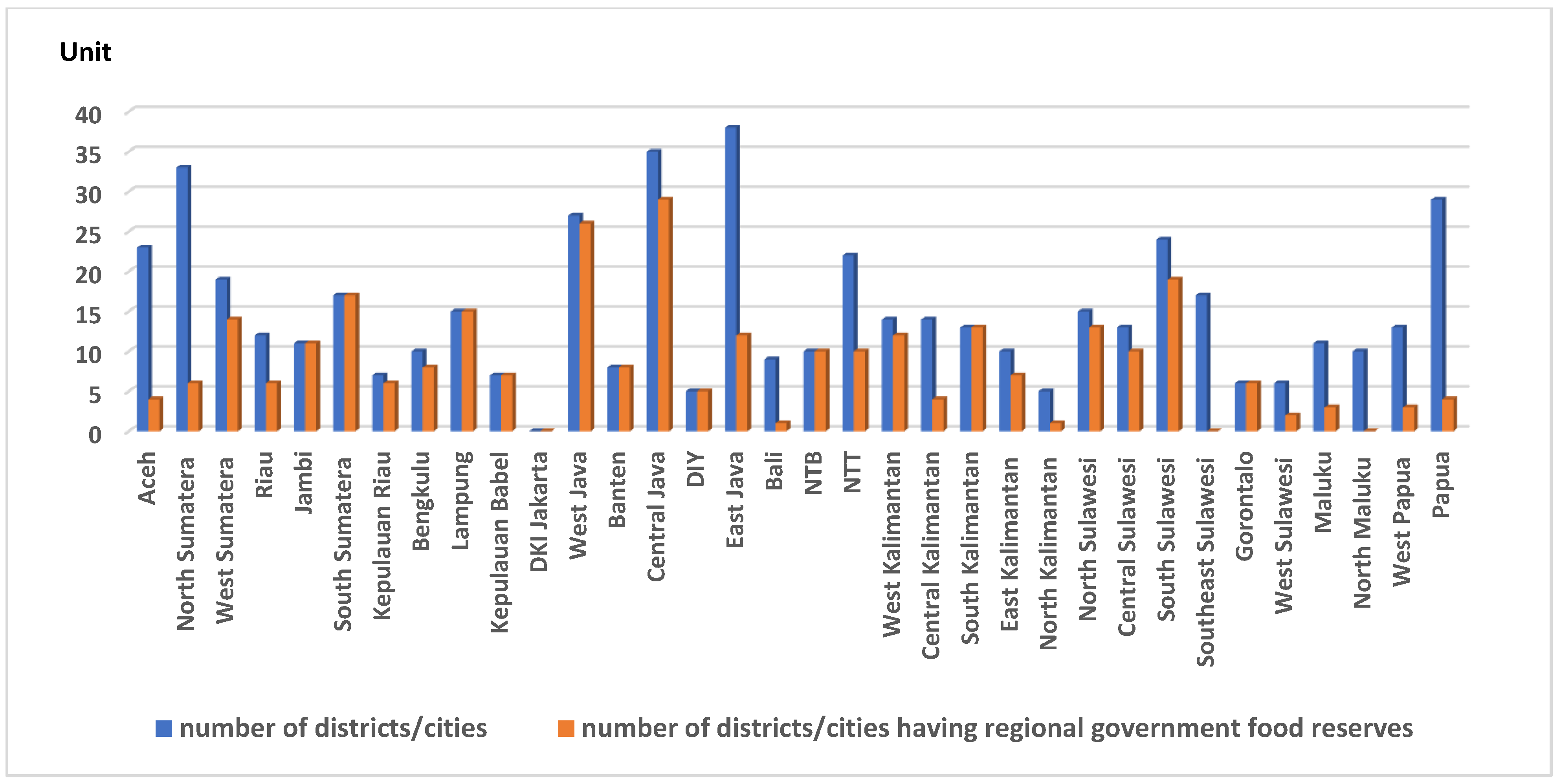
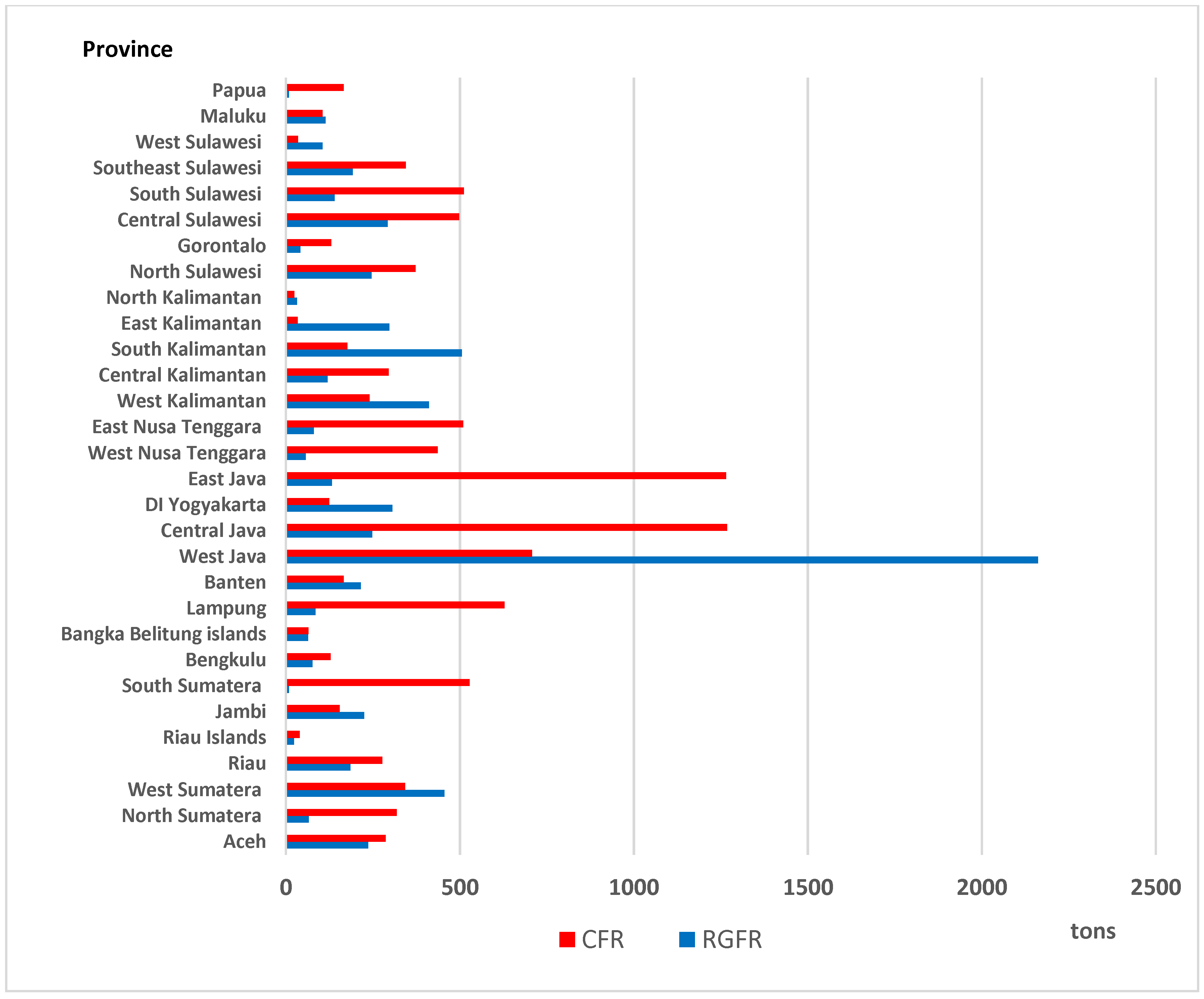
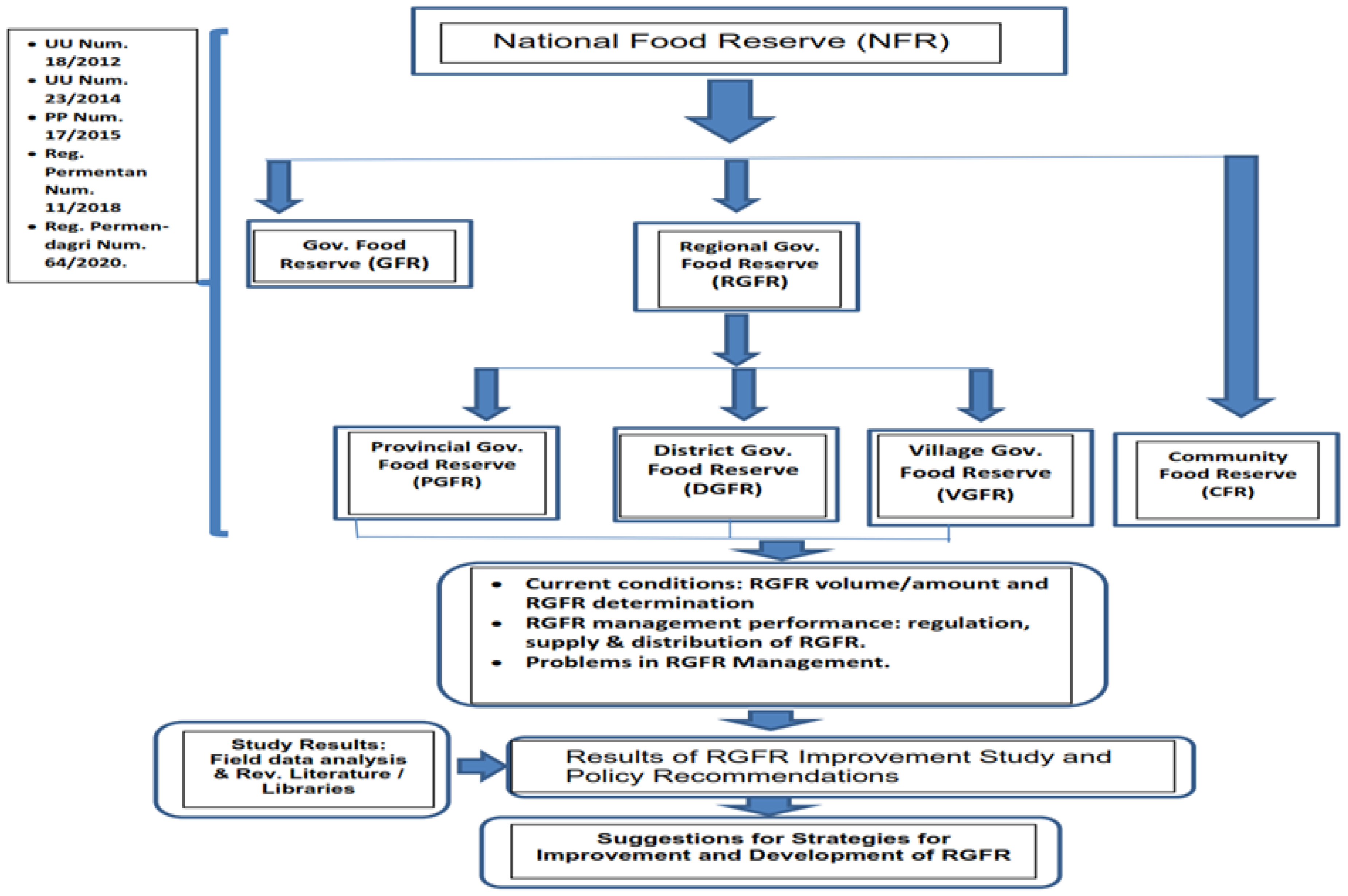
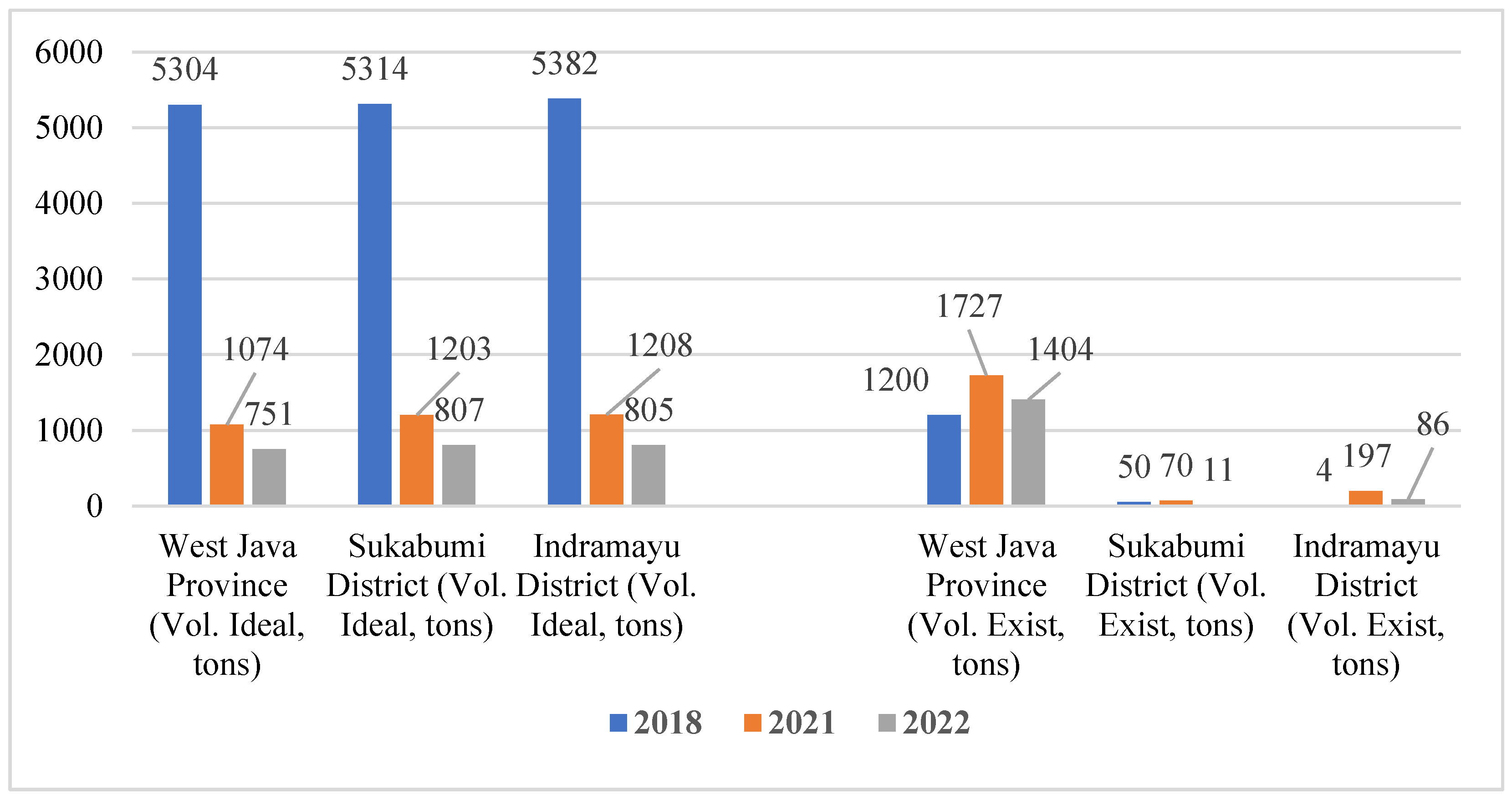
At the provincial level, the volume of rice reserves has been regulated through gubernatorial decrees, while at the district and city levels, they are governed by regent or mayoral regulations. Nationally, the National Food Agency (NFA) has proposed the following upper and lower limits for provincial rice reserves: (1) for a volume of ≤200 tons in eight provinces (Riau Islands, Bangka Belitung Islands, North Kalimantan, Gorontalo, West Sulawesi, Maluku, North Maluku, West Papua); (2) for a volume of ≥1000 tons in six provinces (North Sumatra, West Java, Banten, East Java, Central Java, and South Sulawesi); and (3) for 200 ≤ x ≤ 1000 tons in 20 other provinces.
In West Java Province, Subang District did not have a local government food reserve until 2020 (
National Food Security Agency [NFSA], 2021). Continued advocacy successfully encouraged the Subang District government to allocate a food reserve budget. However, severe floods and landslides affecting nearly 90% of the region delayed its implementation in 2020. Despite being the third-largest rice producer in West Java—after Indramayu and Karawang—the district still has no food reserves.
Based on Governor Regulation Number 37 of 2017, it is also stipulated that: (1) the determination of food reserves aims to ensure the availability of rice as a staple food in the region; (2) the source of the reserve resources comes from the Regional Revenue and Expenditure Budget of the regional government; (3) the distribution of food reserves in the region is primarily to food-insecure communities in West Java following natural disasters or emergencies; (4) the distribution targets include food-insecure communities in the West Java region; and (5) the reserve volume comprises both the remaining stock from the previous year and the current year’s allocation.
The government places strong emphasis on food reserves and price stability, a policy direction also observed globally. For instance,
Ahmad et al. (
2021) found that many African countries stabilize staple food prices by increasing grain reserves and protecting domestic markets from global imports. In Indonesia,
Rusono (
2020) reported that rice stock management by the Logistics Affairs Agency has contributed to stabilizing prices at both the farmer and consumer level. This policy should be complemented by the establishment of an adequate price incentive system for farmers or farmer groups engaged in rice cultivation, thereby ensuring that the Logistics Affairs Agency’s rice procurement efforts proceed effectively and remain sustainable. At the international level, however, food security policies have not always produced the intended outcomes. In Colombia and Kyrgyzstan, for example, policies on food availability and access during 2000–2018 did not succeed in reducing food imports and strengthening the national production and export industry (
Bozsik et al., 2022). Based on the results of this analysis, it has been suggested that it is necessary to integrate food security with monetary and trade policies in the two countries. Similar challenges persist in Indonesia, as
Khotimah (
2018) and
Naufal (
2019) found that domestic rice production had a significant negative impact during the period 1980–2016 and had a partial effect on rice imports. However, Indonesia’s rich biological resource diversity provides an opportunity to strengthen sustainable food security (
Indah & Setyaningsih, 2020).
More recently, the global food system has been further strained by external shocks.
Udmale et al. (
2020) noted that COVID-19 disrupted supply chains among food producers worldwide, prompting calls for more sustainable development pathways. Similarly,
De Vos et al. (
2023) reported that several countries in Africa and Asia remain vulnerable to disruptions in cereal production. The global experience underlines the importance of resilience-oriented policies in addressing both short-term shock and long-term food security challenges. In line with this,
Chang et al. (
2023) identified four key post-pandemic challenges: agricultural production, food transport, price stabilization, and contactless food purchasing. Consequently, post-pandemic urban food policies now focus on strengthening emergency reserves, improving household food access, and enhancing food utilization.
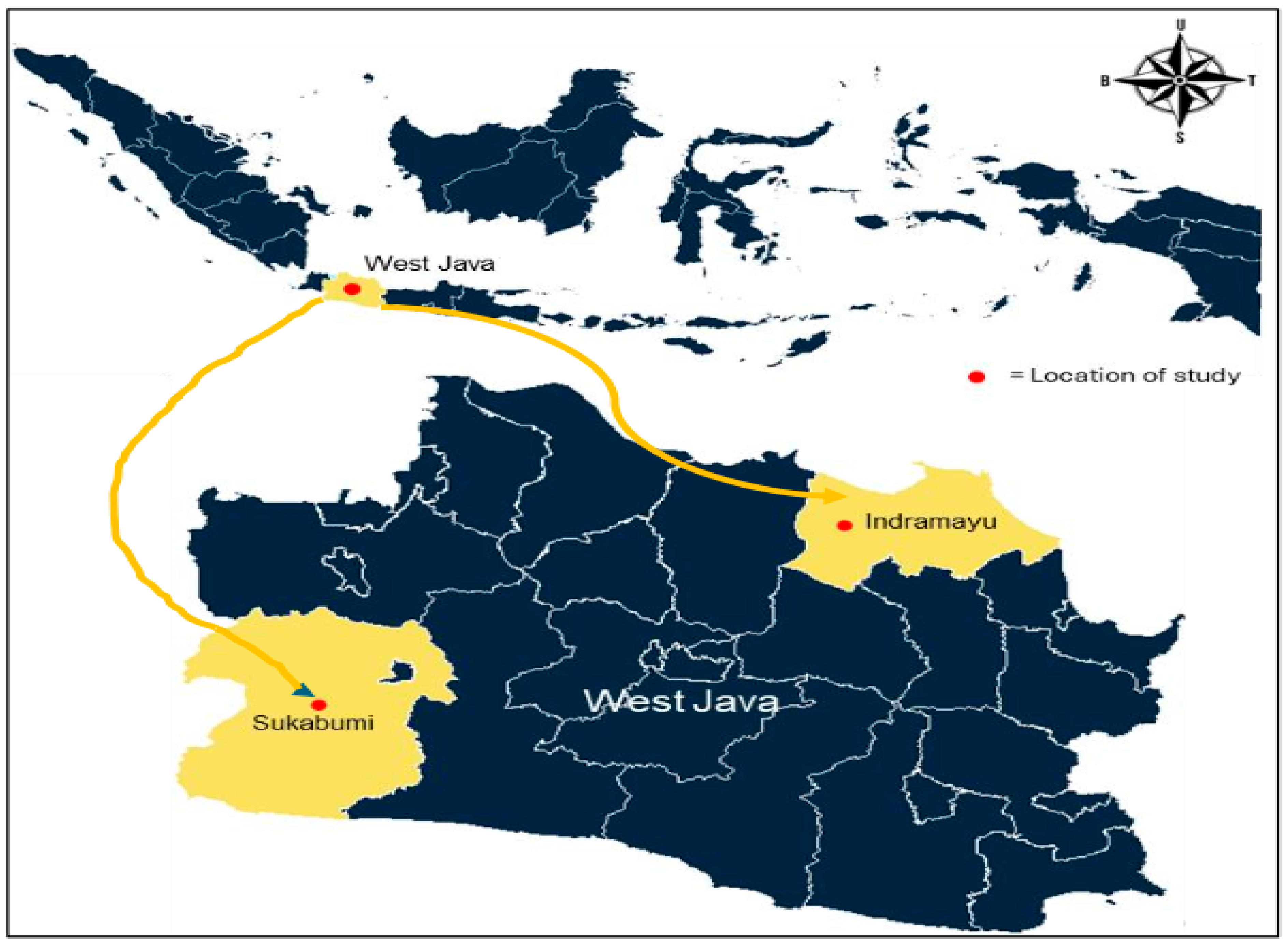
In Sukabumi District, Regional Regulation Number 3 of 2021 on food security regulates food availability, reserves, and distribution. The regulation emphasizes that food security is essential to fostering quality, healthy, active, and productive human development through diversified consumption based on local resources. This must be supported by food that is sufficient, safe, high-quality, nutritious, sustainable, diverse, equitably distributed, and affordable to the community.
The management of regional government food reserves is further regulated by Regent Regulation Number 65/2020, while village-level reserves are governed by Regent Regulation Number 32/2022. The objectives outlined in Regulation Number 65/2020 are to: (a) enhance the availability of staple food reserves to maintain supply stability across time and regions; (b) meet the food needs of populations affected by post-disaster emergencies; and (c) improve food access for temporarily food-insecure groups, particularly those in isolated areas or facing emergencies caused by disasters, transportation disruptions, or chronic food insecurity. The primary targets of these reserves are communities experiencing food insecurity or emergencies.
In Indramayu District, the legal basis for implementing the distribution of food reserves is Regent Regulation Number 83 of 2022. This regulation provides guidelines for providing and distributing staple foods, managing regional rice reserves, and addressing food insecurity after disasters or emergencies. These local policies align with Kuzmin’s findings in Russia, which stress the role of government food pricing in reducing domestic price fluctuations (
Chaireni et al., 2020). Since food price fluctuations often stem from imbalances between supply and demand, strengthening food buffers, reserves, and diversification is key to addressing this issue.
4.2.2. RGFR Development Policy Through Community Food Barn Development
An essential aspect of food security is the sufficiency of availability in both quantities and types. Food availability can be fulfilled by three sources: (1) domestic production capability, (2) food imports, and (3) food reserve management (
National Food Security Agency [NFSA], 2021). Food reserves are a source of supply to fill the gap between production and domestic/regional necessities. A fully stocked grain reserve could substantially mitigate severe food insecurity, potentially reducing hunger prevalence from 53.8% to 48.1% during crises. However, the reduction remains limited, influenced by factors such as the relationship between hunger rates and per capita income under varying price conditions. The reserve’s optimal level of protection can be attained by a 14.4% increase in per capita income. An annual growth rate of 1.8% is necessary to span two typical grain price cycles, each lasting approximately 7.5 years. Furthermore, it is worth noting that the occurrence of stockouts has been found to have a modest impact on the reduction in hunger rates, with an average decrease of 51.6%. This protection against hunger can be achieved by a 5.2% intensify in income per capita (
Aguilar & Miranda, 2014).
Food problems include surplus, shortages, household-level food insecurity, and emergencies such as natural disasters or severe famine, which are often beyond human control.
Fauzi et al. (
2019) noted that national food issues involve ensuring access to sufficient, quality food at affordable prices, especially in rural areas. In this context,
Ambarwati et al. (
2023) highlighted the strategic role of community food barns in enabling rural households to store harvests, secure food during lean seasons, and generate income through sales when prices rise.
Empirical evidence demonstrates the effectiveness of food barns at the community level. In Bondowoso District, it was found that communities built food barns to reduce reliance on government aid and support vulnerable groups. During the COVID-19 pandemic, these barns contributed to village resilience (
Pramudita et al., 2020). Similarly,
Bahua (
2011) noted that food barns in rural areas help stabilize food security by storing harvests for later sale at fair prices. The COVID-19 crisis further revealed the importance of such a mechanism.
Barrett (
2020) reported that disrupted food distribution due to access restrictions impacted availability, prices, and quality.
Masniadi et al. (
2020) and
Berek (
2018) also highlighted the pandemic and climate anomalies as key threats to rural food security. Community food barns play a strategic role by storing rice during peak harvests and supplying food during lean seasons.
Sari et al. (
2022) confirmed that COVID-19 affected food security through disrupted labor mobility, reduced purchasing power, and restricted distribution. Consistent with this,
Yulia et al. (
2021) found that food barns strengthen collective reserves and ensure food access, with initiatives developed through government programs and local wisdom.
According to the
National Food Security Agency (
NFSA, 2022), the Ministry of Agriculture has promoted the establishment of community food barns since 2009, and the program continued through 2022. By 2021, there were 8718 community food barns, consisting of 4868 units built through special allocation funds for the agricultural sector spread across 388 districts/cities in 33 provinces. Meanwhile, 3188 units were funded by regional budgets, and 662 units were constructed independently by communities.
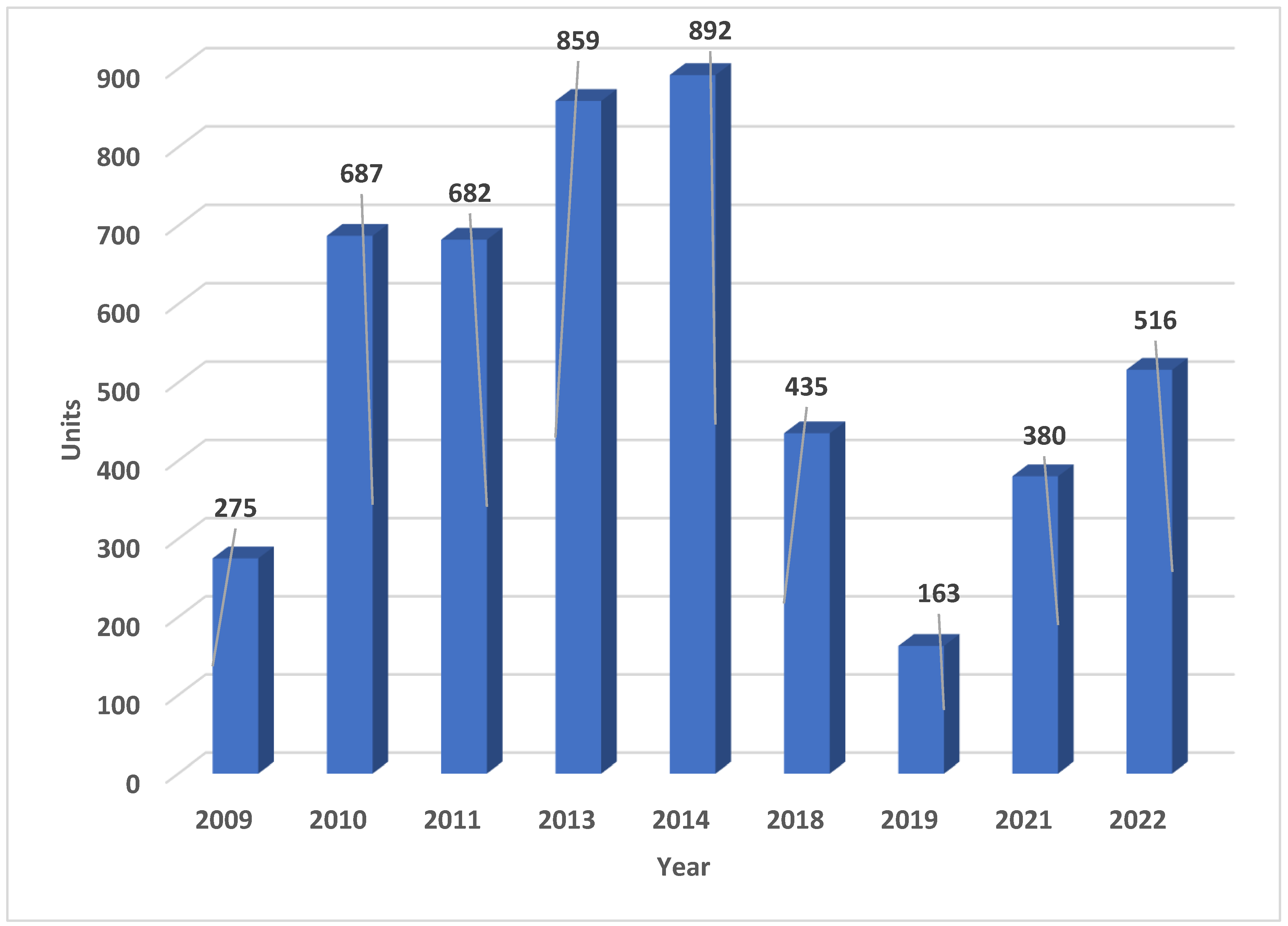
Figure 5 illustrates the national development of community food barns built by the Ministry of Agriculture during 2009–2022. The construction trend was intermittent, with no new barns in 2012, 2015, 2017, and 2020. In 2009, a total of 687 units were built, increasing to 859 in 2013 and 892 units in 2014. Thereafter, the numbers declined, with 435 units in 2016, 163 in 2019, and 380 in 2021, before rising again to 516 in 2022 (
Figure 6). These fluctuations indicate that the development of community food barns is strongly dependent on budget capacity.
Over 12 years (2009–2021), the Ministry of Agriculture built 4373 community food barns dispersed throughout Indonesia. These barns function to manage stocks during the harvest season or famine, strengthen community food reserves, anticipate food price fluctuations, and mitigate the impact of natural and social disasters while also promoting community welfare through productive economic business activities. The concept of community food barn development is united by farmer group-based synergy with economic/financial institutions and the involvement of regional organizations and village officials. Cumulatively, from 2009 to 2022, the community food reserves of West Java Province amounted to 18.48% of the total food reserves of the Indonesian community from 1926 units of food storage (
Table 7).
At the policy level,
Suroso (
2017) identified two approaches to food reserve management in Pati District, Central Java. At the macro level, the policy focuses on developing regional food barns near areas vulnerable to food reserve deficits while ensuring efficient distribution to mitigate food insecurity risks during disasters. At the micro level, it emphasizes establishing community food barns, prioritizing villages without existing facilities. Similarly,
Sawitri Dj and Made Sudarma (
2018) revealed that food barns at Tabanan District play an essential role in maintaining food security, especially in the community. Its role in maintaining food security is to store food for farmers, overcome food shortages if farmers experience crop failure/famine seasons, and increase group income. Social assistance funds provided by the government can be directed to support the development of food barns (
Chiaraluce et al., 2023). In addition, program innovation from the government is required to support the sustainability of community food barns.
The development of community food barns aims to increase the quantity of group food reserves to ensure the availability and affordability of food by facilitating the provision of government assistance to community food barn groups for the management of food reserves based on productive economic efforts. Therefore, the development of food reserves in the regions must also be supported by the development of community food barns.
In West Java Province, the implementation of the IDR 50 million aid program for community food barns varies at the district level. Provincial and district/city governments still need to establish standard rules for community food barn activities such as rice savings and loan activities. The mechanism of saving and lending rice is handed over to each administrator. Generally, community food barns receiving development aid operate on a loan system of one to six months, with a seasonal interest rate of 10%. In contrast, in Sukabumi and Indramayu, food barns primarily function as rice storage, allowing farmers to store grain during harvest when prices are low.
In Sukabumi District, the development of regional food reserves is pursued through village-level reserves and community food barns. Although infrastructure has been provided, additional capital is needed for stocking, as farmer groups often sell their entire harvest immediately. In 2022, six barns with a combined capacity of 150 tons were established in rice production center villages such as Jampang Tengah, Jampang Kulon, Ciracap, Sagaranten, and Pabuaran sub-regencies. This aligns with
Wulansari et al. (
2021), who emphasized the potential of integrating local wisdom in food barn management to strengthen national food security. Reports indicate that 70–80% of Sukabumi’s barns remain active, as indicated by regular reports from managers to the Food Security Service on income and expenditure. One example is the Rempug Tani food barn, which received IDR 60 million in capital to build a warehouse (50–60 tons capacity) and purchase equipment. Initially, members borrowed rice to address food shortages, but over time, loans shifted toward farming purposes. Currently, loans are allowed only for seed purchases, with a maximum of 100 kg. Loans are repaid in rice at the next harvest, with a 5% interest.
In Indramayu District, the Food Security Service Office submits weekly reports on regional government food reserves to the NFSA. These reports summarize the latest reserve conditions, detailing the reporting period, initial stock, procurement, distribution, reserve stock, and implementation for two commodity types—rice and grain (in kilograms). In practice, logistics agencies only release rice from warehouses, while transportation costs (pickup and delivery) are covered by the Food Security Service Office through the regional budget. The Food Security and Agriculture Office maintains a one-year contract with a logistics agency, with payments made once rice is available. No dedicated maintenance budget exists, though it is anticipated that logistics agencies will allocate one in the future. During distribution, village officials repackage the rice from logistics agencies into smaller portions for delivery to target communities.
In 2022, the Food Security and Agriculture Office built five units in five sub-regencies: Jatibarang, Loh Bener, Gabus Wetan, Terisi, and Kroya, each with a capacity of 100 tons. The regional government’s food reserve program generally consists of two types of facilities—food barns and rice milling units. Each food barn includes three components: (1) a rice milling unit, (2) a bed dryer with a capacity of 3 tons/day, and (3) a drying floor with a capacity of 3 tons
4.2.3. Provision and Distribution of RGFR and CFR
In Sukabumi District, Regent Regulation Number 32 of 2022 outlines the procedures for managing village government food reserves. The regulation aims to: (1) support the provision of commodity and/or staple food reserves as village government food stocks; and (2) prevent and address food insecurity, respond to emergencies, fires, natural and non-natural disasters, post-disaster recovery, food crises, isolated areas, prolonged famine, and crop failures.
The regulation further specifies a structured distribution mechanism. First, the Village Head identifies communities experiencing food insecurity and/or emergencies and submits a request for food assistance to the Regent through the Sub-district Head. Second, the Regent instructs the regional apparatus responsible for food affairs to facilitate distribution. Third, the Regent orders the regional apparatus handling food affairs to distribute food reserves. Fourth, the Head of the Regional Apparatus handling food affairs submits a request for the distribution of food assistance to the provider. Fifth, the provider carries out distribution to the village/sub-district office to the distribution point according to needs. Sixth, the village distributes the distribution of food reserves to the community registered as recipients of assistance. Seventh, the cost of distributing food reserves to the distribution point is borne by the regional government. Finally, the regional food agency prepares a report on the assistance handover to the village head, with the sub-district head duly notified.
In Indramayu District, the procurement of food reserves is in collaboration with the Indramayu Logistics Affairs Agency. In Indramayu District, the procurement of food reserves in 2020 was 51 tons, in 2021 it was 25 tons, and in 2022 it was 60 tons. In 2022, the food reserve budget was available for the procurement of 60 tons of rice. In contrast, the Regent’s Regulation sets a minimum of 100 tons, with the shortfall arising from limited budget capacity.
In the provision of these food reserves, they collaborate with the West Java Logistics Affairs Agency, considering the availability of warehouses in each district to facilitate distribution. In Sukabumi District, 70% of food reserves since 2022 have been supplied through partnerships with regional companies, with the remainder in collaboration with the district’s Logistics Affairs Agency. In contrast, Indramayu District sources all its food reserves through the Logistics Affairs Agency.
In Sudan, the institution responsible for managing food grain reserves is the Food Reserve Corporation Strategic Agency (SRC). This agency is expected to focus more on policies for procurement, distribution, and the addition of food reserves to prevent distortion of the domestic food market and to develop independence from political and social influences. The SRC plays a pivotal role in establishing a robust information system, encompassing stocks, domestic production, and domestic and foreign food prices. This initiative is expected to enhance the SRC’s coordination with other domestic and international government institutions involved in grain purchases, food aid, and food security (
Ahmed et al., 2012).




 ,
,