Article

Global Attention and Market Resilience: Evidence from the Gaza Conflict and Israeli Financial Assets


by
Nikolaos Papanikolaou
1,*,
Evangelos Vasileiou
1 and
Themistoclis Pantos
2
1
Department of Accounting and Finance (ACCFIN), School of Management and Economics Sciences (SEMS), Hellenic Mediterranean University (HMU), Estavromenos, 71410 Heraklion, Crete, Greece
2
Finance Management and Investments Department, Lincoln University, 401 15th Street, Oakland, CA 94612, USA
*
Author to whom correspondence should be addressed.
Economies 2026, 14(2), 61; https://doi.org/10.3390/economies14020061
Submission received: 31 December 2025 / Revised: 9 February 2026 / Accepted: 10 February 2026 / Published: 14 February 2026

Abstract

This study investigates how the origin and language of public attention influence financial markets during geopolitical conflict, using Israel’s experience during the 2023–2025 Gaza War as a case study. We use Google Trends data—in Hebrew, English, and Arabic, sourced both worldwide and domestically—to explain fluctuations in the Tel Aviv Stock Exchange’s TA-35 Index and the Israeli shekel’s exchange rates (USD/ILS and EUR/ILS). The results uncover a striking asymmetry: international searches, especially those in Hebrew and English, have significant power to explain Israeli market performance, while local, domestic searches are largely insignificant. Specifically, global Hebrew attention is positively associated with the shekel appreciating, suggesting that expressions of confidence or solidarity from the diaspora may actively reinforce market stability. In contrast, spikes in global English-language searches correspond with lower equity returns and temporary shekel depreciation, consistent with heightened international risk perception. These findings demonstrate that transnational behavioral networks and diaspora attention critically shape financial resilience during war. By integrating behavioral finance, conflict economics, and computational analytics, this research shows that the geographic and linguistic origin of attention, not just its sheer volume, is the key determinant of market reactions in times of crisis.
JEL Classification:
G14; G41; F52; C22

1. Introduction

1.1. Purpose

The purpose of this study is to examine how public attention during the Gaza conflict influences Israeli financial markets, specifically the TA-35 index and the Israeli shekel (ILS). By distinguishing online search activity by both language (Hebrew, Arabic, and English) and geographic origin (Worldwide vs. Israel), the research seeks to uncover whether different linguistic and regional audiences interpret and respond to geopolitical uncertainty in distinct ways. The study aims to demonstrate that these nuances in public attention—rather than aggregate interest alone—offer meaningful insights into how investors perceive and react to geopolitical risk.

1.2. Design/Methodology/Approach

This study investigates how variations in public attention during geopolitical conflict influence financial market behavior in Israel. Using online search activity as a proxy for public interest in the Gaza conflict, the analysis explores its relationship with movements in the Israeli stock market (TA-35) and the Israeli shekel (ILS). Searches are disaggregated by geography (Worldwide vs. Israel) and language (Hebrew, Arabic, and English) to identify how linguistic and spatial factors shape investor responses. An EGARCH (1,1) asymmetric model enables us to quantify the impact of each factor on the Israeli assets.

1.3. Findings

Results demonstrate that both the language and geographic origin of search activity significantly affect market outcomes. Hebrew-language searches originating outside Israel are positively associated with Israeli market performance, suggesting expressions of confidence or solidarity from Hebrew-speaking communities abroad. In contrast, global English-language searches exhibit a strong negative relationship with both the TA-35 and the ILS, reflecting heightened risk perception among international investors. Local Hebrew searches show limited explanatory power, while Arabic-language searches display no statistically significant effects.

1.4. Research Limitations/Implications

The study focuses on a single conflict and relies on Google search data, which may not fully capture broader online or offline attention dynamics. Future research could extend the framework by integrating data from multiple platforms (e.g., YouTube, Google News, social media) and employing advanced statistical techniques such as Principal Component Analysis (PCA) or Factor Analysis (FA) to derive composite attention indices. Incorporating Natural Language Processing (NLP) and sentiment analysis would further enhance understanding of how tone and framing influence investor behavior under geopolitical stress.

1.5. Originality/Value

This paper provides novel empirical evidence that public attention is not a homogeneous construct; its impact on financial markets depends critically on both language and location. By revealing that global Hebrew-language searches exert a supportive influence while English-language searches signal heightened risk aversion, the study highlights the informational and emotional asymmetries embedded in global attention flows. The findings contribute to the growing literature linking information dynamics, investor sentiment, and financial market responses during crises.
The Efficient Market Hypothesis (EMH) asserts that financial markets reflect all available information at any given time, implying that prices adjust instantaneously and investors behave as rational agents (Fama, 1970). Nevertheless, decades of behavioral finance research have cast doubt on this idealized assumption, emphasizing that actual market behavior often deviates from strict rationality. Human decisions are shaped by cognitive limitations, emotional reactions, and psychological biases that systematically influence investment choices (Kahneman & Tversky, 1979; Barberis & Thaler, 2003; Shiller, 2003; Hirshleifer, 2015; Thaler & Ganser, 2015; Brooks & Byrne, 2008). These behavioral distortions tend to intensify during periods of heightened uncertainty, when fear, overconfidence, or selective interpretation of news can lead to significant mispricing (Daniel et al., 1998; Baker & Wurgler, 2007; De Bondt & Thaler, 1985). Geopolitical tensions and war therefore provide a particularly insightful setting to explore how emotions and information interact to shape investor behavior and financial outcomes.
Over the past decade, advances in computational tools—especially in Natural Language Processing (NLP) and machine learning—have enabled researchers to quantify qualitative variables such as public sentiment and attention from online activity (Tetlock, 2007; Bollen et al., 2011; I. E. Fisher et al., 2016; Algaba et al., 2020; Sharifani et al., 2022). Among these tools, Google Trends has proven especially useful as a behavioral indicator of collective interest, concern, or anxiety (Preis et al., 2013; Da et al., 2011). The intensity of Google searches can serve as a proxy for public attention, reflecting the degree to which societies engage with ongoing events. When interpreted properly, search data offer valuable insight into how investors and the broader public react to uncertainty, particularly during crises. A growing body of empirical evidence confirms that spikes in search intensity often precede movements in returns, liquidity, and volatility, suggesting that shifts in collective attention contain predictive power for financial markets (Bijl et al., 2016; Nowzohour & Stracca, 2020; Zakeri et al., 2022).
Periods of armed conflict provide an especially rich environment for studying how information flows and sentiment affect market dynamics. Historical and contemporary studies show that wars tend to amplify volatility, create asymmetric reactions to news, and heighten investor sensitivity to risk (Choudhry, 2010; Hudson & Urquhart, 2015; Fang & Shao, 2022; Vasileiou, 2023; Wu et al., 2023). For instance, Choudhry (2010) found that World War II announcements produced immediate and directionally biased price changes in the U.S. stock market, whereas Hudson and Urquhart (2015) observed that the British market displayed smaller but more persistent reactions. More recent evidence by Ahmed and Sleem (2024) on the 2023–2024 Israel–Palestine conflict indicates an initial wave of negative abnormal returns and volatility surges in the Tel Aviv market, followed by gradual normalization as uncertainty declined. Despite these insights, relatively little is known about how the source and language of war-related information affect investor responses. This gap limits understanding of how domestic and global perceptions—often shaped by different media ecosystems—translate into market behavior.
The conflict between Israel and Palestine—particularly the 2023–2025 Gaza War—offers a unique window into these market dynamics. It is a conflict deeply rooted in regional politics, yet it simultaneously grips the world’s attention, making it the perfect case for studying how the origin and framing of information sway markets. Researchers have long shown that the Israeli–Palestinian conflict gets a massive, often outsized, share of international media coverage compared to other global events (Segev and Blondheim, 2010). Recent events only reinforce this: the Tel Aviv market reacted sharply at first, but investor behavior changed as the informational landscape and the overall tone of reporting shifted (Ahmed & Sleem, 2024). This strongly suggests that it is not just what the news says, but also its geographic source and linguistic framing that truly matter for market sentiment and pricing.
The established research on wartime media bias shows why this divergence matters. During the Russo-Ukrainian War, for example, Russian and Western media promoted conflicting narratives: Russian state outlets downplayed losses to maintain morale, while Western reporting emphasized Ukrainian hardship and Russian aggression (Makeev & Bastos, 2025). Furthermore, H. O. Fisher (2023) noted that Western coverage was often dominated by “war journalism,” which zeroes in on blame and confrontation, instead of “peace journalism,” which seeks a more balanced view. This difference in framing is significant. It actively molds public sentiment, shifts how people perceive risk, and ultimately influences financial markets. Given this, it is highly probable that Israeli and foreign investors interpret the exact same conflict events through distinct cognitive and emotional filters, primarily shaped by their media exposure and cultural identity.
In this context, the present study examines how war-related Google search activity—interpreted as a measure of public attention—affects the Israeli equity and bond markets during the 2023–2025 Israel–Palestine conflict. A central focus lies in distinguishing between domestic and international searches, enabling an assessment of whether the origin of attention influences market dynamics. To capture additional nuance, search data are further divided into linguistic categories—Hebrew, Arabic, and English—each reflecting different informational and cultural lenses. Hebrew-language queries may mirror domestic solidarity or optimism; Arabic-language searches may capture regional anxiety or political tension; and English-language searches likely embody a global humanitarian or geopolitical perspective (Das & Singh, 2023).
Methodologically, the study employs an Exponential Generalized Autoregressive Conditional Heteroskedasticity (EGARCH) framework (Nelson, 1991; Floros, 2008) to model volatility asymmetries commonly observed in markets under stress. To avoid distortions from correlated predictors, we compute Variance Inflation Factors (VIFs) (Hsieh et al., 2003) and exclude variables exhibiting multicollinearity. This combination enhances both the interpretability and the robustness of the results, allowing a more credible link between behavioral signals and market volatility to be drawn.
This research contributes to several strands of literature. First, it provides evidence that search-based behavioral indicators—especially when disaggregated by language and geography—can capture meaningful variations in investor sentiment during crises. Second, by integrating sentiment proxies into EGARCH models, it extends traditional volatility modeling to include psychological dimensions of financial behavior. Third, it highlights how national narratives and linguistic framing influence perceptions of risk, contributing to a broader understanding of financial resilience under geopolitical stress. More broadly, the results challenge the assumption of fully efficient markets, showing that financial systems are embedded in emotional and informational networks that shape their reactions to uncertainty.
The remainder of the paper is organized as follows. Section 2 overviews the data and presents the descriptive statistics, Section 3 outlines the econometric methodology and reports the empirical findings, and Section 4 concludes with key insights and policy implications.

2. Descriptive Statistics and Data Overview

To empirically assess our hypotheses, we examine whether the proposed relationships hold by analyzing search trends related to the Gaza War across three languages using Google Trends. Google Trends is a publicly available platform that aggregates a sample of Google search queries and reports the relative popularity of specific search terms over time and across geographic areas. Rather than providing absolute search volumes, the platform reports a normalized index ranging from 0 to 100, where 100 represents the peak search interest for a given term within the selected time frame and region. This normalization enables meaningful comparisons across time and across different search terms. Prior research widely uses Google Trends data as a real-time proxy for public attention, information-seeking behavior, and issue salience, particularly in the context of major political events and crises. Specifically, we analyze language-specific search terms related to the Gaza War across three languages:
  • Hebrew: חרבות ברזל (“Iron Swords”), the primary term used by Hebrew speakers;
  • English: the term Gaza War; and
  • Arabic: حرب غزة, the Arabic equivalent of Gaza War.
These language-specific search terms serve as our explanatory variables and capture variations in public attention and discourse across linguistic and regional contexts.
As dependent variables, we analyze key indicators of the Israeli financial market. Specifically, we examine:
  • The TA-35 Index, the flagship index of the Tel Aviv Stock Exchange, which tracks the share prices of the 35 companies with the largest market capitalization (TASE, 2025)1; and
  • The foreign exchange (FX) rates of one Israeli New Shekel (ILS) against the U.S. dollar (USDILS) and the euro (EURILS).
The weekly returns are calculated using the following formula:
r t = P t P t 1 1 ,
where P t denotes the price of asset P at time t , and P t 1 represents its price in the preceding week. The assets considered in this study are the TA-35 Index, USD/ILS, and EUR/ILS exchange rates.
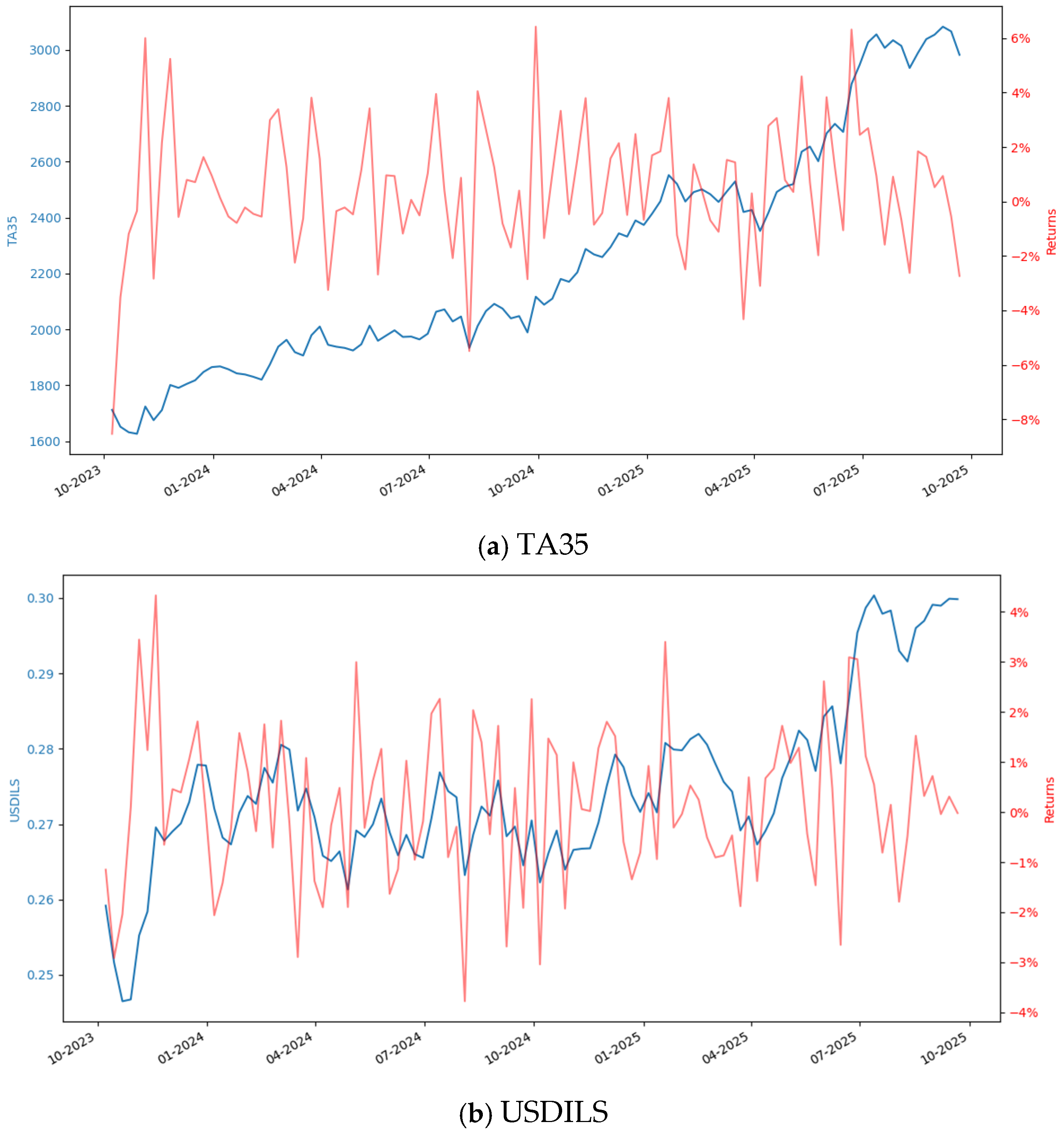
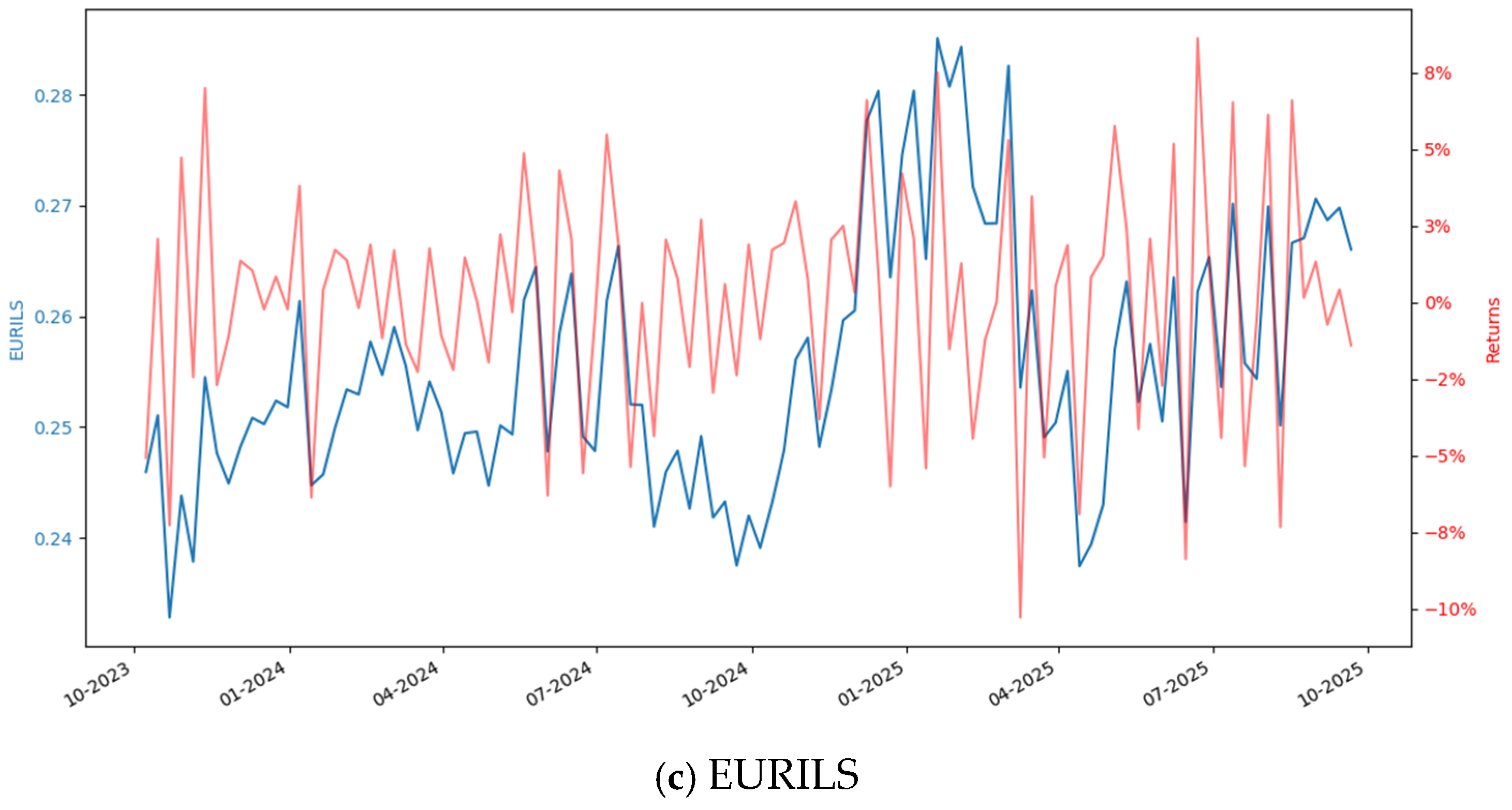
Figure 1 illustrates the weekly performance of these financial indicators over the study period October 2023–September 2025 (source: yahoo finance). The left vertical axis presents the TA-35 and FX index values, while the right vertical axis shows their corresponding weekly returns2. As Figure 1 demonstrates, volatility varies substantially across the period, indicating that an ordinary least squares (OLS) model may not be appropriate due to volatility clustering. Moreover, the data suggest evidence of a leverage effect, as declines in prices are associated with increased volatility (i.e., larger spikes in daily returns).
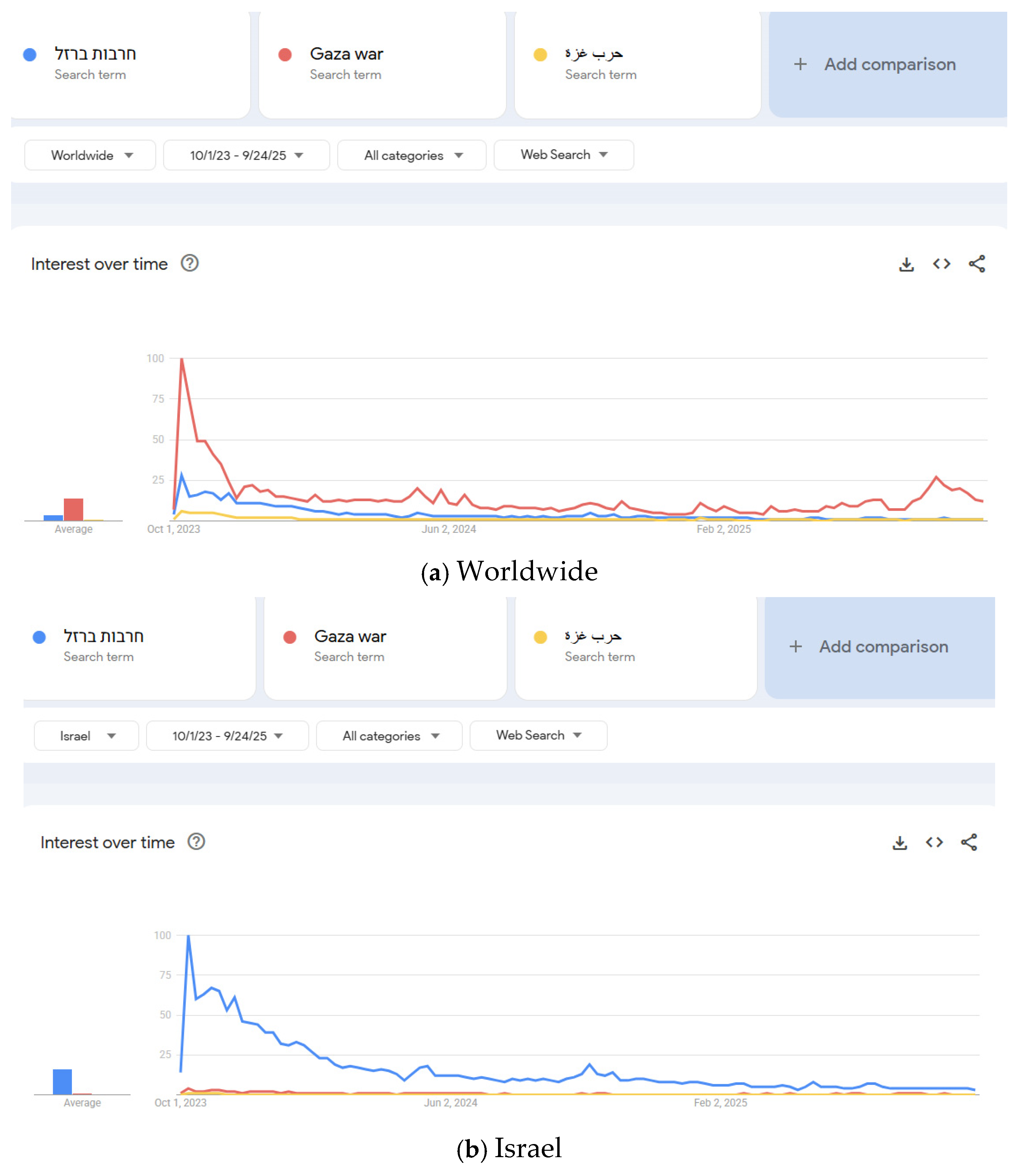
Figure 2 depicts the relative interest in Gaza War-related searches, based on Google Trends data for the selected search terms, separating by geographical origin (Israel vs. worldwide) and by language. The Google Trends indices are measured at a weekly frequency. Globally, searches in English are the most prevalent, followed by Hebrew and then Arabic. Within Israel, Hebrew-language searches dominate throughout the period.
Table 1 presents the descriptive statistics of the dependent and independent variables. The time series of the TA35 (TA35_r), EUR/ILS and USD/ILS return series (EURILS_r and USDILS_r) do not exhibit statistical significance according to the Shapiro–Wilk test, which was employed owing to its superior sensitivity in small samples.
The acronyms of the independent variables comprise two components: the first denotes the language (Heb: Hebrew; Eng: English; Arab: Arabic), while the second indicates the origin (ww: worldwide; Isr: Israel). The descriptive statistics indicate that none of the independent variables follow a normal distribution.
Subsequently, the correlation structure of the data is examined (Table 2). The empirical results reveal weak correlations between the dependent and independent variables, weak-to-moderate positive correlations among the dependent variables, and strong-to-extremely strong positive correlations among the explanatory variables. The latter finding suggests potential multicollinearity concerns within the explanatory set.
To investigate this issue, Variance Inflation Factor (VIF) tests were conducted, with the results summarized in Table 3. The VIF is defined as:
V I F x i = 1 1 R i 2 ,
where R i 2   represents the coefficient of determination from the regression of predictor x i on all other explanatory variables.
According to conventional thresholds, a VIF value up to 5 indicates an acceptable level of collinearity, values between 5 and 10 suggest moderate multicollinearity, and values exceeding 10 denote severe multicollinearity.
Table 3 reports the VIF results for both the initial model specification and the adjusted model after removing problematic variables. For the worldwide dataset, Arabic searches were excluded, as they exhibited the highest VIF values and represented the least popular query category according to Google Trends. For the Israeli dataset, all variables were retained since no substantial multicollinearity was detected.

3. Empirical Evidence

The preliminary data show that a linear model may not be appropriate for our analysis due to autocorrelation and heteroscedasticity issues. The EGARCH(1,1) model consists of a mean equation:
r t = α 0 + α H e b Heb t + α E n g Eng t + α A r a b Arab t + ϵ t ,
where r t denotes the return of the variable of interest (TA35, USD/ILS, or EUR/ILS) at time t . The intercept α 0 captures the baseline return, while α H e b , α E n g , and α A r a b measure the effect of search intensity in Hebrew, English, and Arabic, respectively, on the returns. The residual ϵ t represents the portion of returns not explained by the search variables and follows the normal distribution. The conditional variance follows:
l n ( h t ) = c 0 + c 1 ( ϵ t 1 h t 1 2 π ) + c 2 ϵ t 1 h t 1 + c 3 l n ( h t 1 ) ,
with c 1 representing the magnitude of shocks, c 2   representing leverage effects, and c 3   representing volatility persistence.
Table 4 reports the results of the GARCH estimations that examine how public attention—measured through Google search activity in different languages and from various regions—relates to the performance of Israeli financial markets and exchange rates during the Gaza conflict.
Before turning to the specific results, several general patterns appear across all estimated models. The intercept term (α0) is positive and highly significant in every specification, especially for the TA-35 index and the global versions of the exchange rate models. This indicates that, despite the conflict, the Israeli stock market still experienced moderate growth, while the shekel either held steady or slightly appreciated against both the U.S. dollar and the euro. These results may reflect investor expectations of a favorable resolution to the conflict or optimism about post-war recovery.
Diagnostic tests support the robustness of the models. The Q-statistics and ARCH LM tests show no remaining serial correlation or ARCH effects, suggesting that the EGARCH(1,1) structure captures the volatility behavior effectively. The Akaike Information Criterion (AIC) values are negative and stable, and the large, significant c3 coefficients (approximately 0.75–0.93) confirm persistent volatility, reinforcing the models’ reliability.

3.1. TA-35 Index

As shown in Table 4a, aside from the positive and highly significant intercept (α0), the only variable with a consistent and significant impact on TA-35 returns is global English-language search intensity, which shows a negative relationship. This means that periods of heightened global attention to the conflict coincide with declines in Israeli stock prices. These findings are reasonable from the perspective of investor behavior, as investors may seek to shift their international capital toward safer assets or, alternatively, to express disapproval of Israel’s actions3.
Search activity in Hebrew is statistically insignificant in both versions of the model. However, the positive sign in the global specification may suggest a slight stabilizing influence. Arabic-language searches show no meaningful relationship with the index.
The negative and significant c2 coefficients in both models confirm the presence of a leverage effect, where negative returns lead to greater volatility. This asymmetric behavior is common in equity markets during times of geopolitical uncertainty, as negative news tends to amplify investor caution and risk aversion.

3.2. USD/ILS Exchange Rate

According to Table 4b, the intercept (α0) in the global model is positive and statistically significant, indicating that the shekel strengthened modestly against the U.S. dollar during the sample period. Among the explanatory variables, global Hebrew-language search intensity has a positive and highly significant effect on the USD/ILS rate, implying that an increase in Hebrew searches corresponds with a stronger shekel. This pattern may reflect optimism for a win on the battlefield and/or solidarity among Hebrew-speaking communities abroad—a kind of “rally-around-the-flag” response that supports investor confidence4.
Domestic Hebrew searches, by contrast, have no significant effect, suggesting that international rather than local sentiment is more influential. Global English-language search intensity shows a negative and significant coefficient, meaning that when international attention (in English) rises, the shekel tends to weaken. This likely stems from global media coverage highlighting conflict escalation or humanitarian concerns, which investors interpret as adverse geopolitical signals. Once global factors are included, domestic English-language searches lose significance.
Both models exhibit strong volatility persistence, supported by large and significant c3 coefficients. In the Israel-based model, the negative and significant c2 coefficient points to asymmetric volatility: depreciation shocks (a weaker shekel) provoke stronger volatility responses than appreciation shocks. Overall, the findings suggest that English-language information flows from abroad increase uncertainty, while Hebrew-language attention—especially from global sources—helps maintain market confidence and currency stability.

3.3. EUR/ILS Exchange Rate

Table 4c shows that in the global model, the intercept (α0) is positive and highly significant, indicating that the shekel appreciated against the euro during the sample period. Global Hebrew-language search activity has a positive and significant effect on the EUR/ILS rate, meaning that greater Hebrew attention from abroad is associated with a stronger shekel. This may suggest that positive sentiment within Hebrew-speaking communities outside Israel indirectly helps stabilize expectations in the foreign exchange market.
On the other hand, global English-language search intensity has a negative and significant effect, implying that heightened international focus on the conflict tends to coincide with shekel depreciation. This supports the idea that global coverage emphasizing geopolitical risk triggers temporary capital outflows or defensive investor behavior.
Volatility in both models shows strong persistence, as indicated by large and significant c3 coefficients. The positive and significant c2 coefficients suggest that appreciation shocks increase volatility more than depreciation shocks—opposite to what is seen in equity markets. This may reflect investor caution during periods of shekel appreciation, when positions are reassessed.
In summary, global information flows appear to exert a stronger influence on financial markets than domestic search activity during the Gaza conflict. Global English-language searches are associated with negative effects on the TA-35 index and with depreciation pressures on the Israeli shekel against both the USD and the EUR, reflecting heightened international risk perceptions and increased market volatility. In contrast, global Hebrew-language searches are positively linked to the shekel, indicating a stabilizing effect that may reflect confidence or supportive attention from Hebrew-speaking communities abroad. Domestic search activity shows limited or non-significant effects across all examined markets, while Arabic-language searches do not exhibit a measurable impact. Overall, these findings demonstrate that public attention, when filtered by language and geographic origin, can meaningfully shape financial market dynamics, highlighting the importance of monitoring international information flows during periods of geopolitical uncertainty.

4. Concluding Remarks and Discussion

Understanding how public attention evolves during periods of conflict provides valuable insight into investor behavior under geopolitical uncertainty. This study examines how interest in the Gaza conflict, measured through online search activity, relates to movements in the Israeli stock market (TA-35) and the Israeli shekel (ILS), distinguishing searches by both geography (Worldwide vs. Israel) and language (Hebrew, Arabic, and English).
Our findings demonstrate that these distinctions are crucial. Global Hebrew-language searches are positively associated with Israeli financial market performance, suggesting that attention from Hebrew-speaking communities abroad may reflect confidence or solidarity. In contrast, global English-language searches exhibit a significant negative relationship with market outcomes, indicating that heightened international attention may increase perceived risk and encourage capital withdrawal. Domestic Hebrew searches and Arabic-language searches show limited or non-significant effects, highlighting the dominant role of global information flows during periods of geopolitical tension.
We acknowledge that the interpretation of language-specific effects relies on theoretically grounded behavioral mechanisms, such as diaspora support reflected in Hebrew searches and heightened risk perception captured by English searches. Nevertheless, these interpretations remain partly inferential. Future research could strengthen these findings by incorporating sentiment analysis, natural language processing, and media-coverage indicators to differentiate positive and negative framing and provide a more direct assessment of how information tone shapes investor behavior.
Although this study employs a limited set of search terms per language, expanding this measurement lies beyond the scope of the present work. Future research could analyze broader sets of keywords and apply dimension-reduction techniques such as Principal Component Analysis (PCA) to construct composite attention indices and systematically evaluate the relative influence of domestic and international information sources.
While the analysis focuses on Israel, the implications extend to other economies facing geopolitical risk. Public attention, filtered by language and geographic origin, can meaningfully influence financial markets. The contrast between local and international audiences suggests that global attention may amplify uncertainty, whereas locally framed information can shape sentiment within specific groups. This highlights the importance of both the source and framing of information in translating public attention into economic outcomes.
Future extensions could also incorporate additional information platforms—such as YouTube, Google News, and social media—and employ techniques like PCA, Factor Analysis, and NLP to better capture the underlying drivers of attention and sentiment. Such developments would move the literature beyond measuring search volume toward understanding how the tone and framing of information shape market reactions during geopolitical crises.

Author Contributions

Conceptualization, N.P., E.V. and T.P.; Methodology, N.P., E.V. and T.P.; Software, N.P., E.V. and T.P.; Validation, N.P., E.V. and T.P.; Formal analysis, N.P., E.V. and T.P.; Investigation, N.P., E.V. and T.P.; Resources, N.P., E.V. and T.P.; Data curation, N.P., E.V. and T.P.; Writing—original draft, N.P.; Writing—review & editing, E.V. and T.P.; Visualization, N.P., E.V. and T.P.; Supervision, E.V. and T.P.; Project administration, E.V. and T.P. All authors have read and agreed to the published version of the manuscript.

Funding

This research received no external funding.

Institutional Review Board Statement

Not applicable.

Informed Consent Statement

Not applicable.

Data Availability Statement

Data is unavailable due to the use of them for future research.

Conflicts of Interest

The authors declare no conflict of interest.

Notes

1
https://market.tase.co.il/en/market_data/index/142/about. accessed for this research on 1 October 2023.
2
The weekly returns are calculated using the following formula:
r t = P t P t 1 1 ,
where P t   denotes the price of asset P at time t , and P t 1   represents its price in the preceding week. The assets considered in this study are the TA-35 Index, USD/ILS, and EUR/ILS exchange rates.
3
If the latter is the case, such behavior would not align with the Efficient Market Hypothesis (EMH), which assumes that investors act fully rationally and base decisions solely on financial information.
4
Similar to the previously mentioned note, a “rally-around-the-flag” response may not be consistent with the EMH assumption of rational investor behavior.

References

  1. Ahmed, W. M., & Sleem, M. A. (2024). Attention to Israel’s war on Gaza and stock price behavior: Evidence from the Tel Aviv market. Journal of Economic Studies, 52, 1519–1539. [Google Scholar] [CrossRef]
  2. Algaba, A., Ardia, D., Bluteau, K., Borms, S., & Boudt, K. (2020). Econometrics meets sentiment: An overview of methodology and applications. Journal of Economic Surveys, 34(3), 512–547. [Google Scholar] [CrossRef]
  3. Baker, M., & Wurgler, J. (2007). Investor sentiment in the stock market. Journal of Economic Perspectives, 21(2), 129–151. [Google Scholar] [CrossRef]
  4. Barberis, N., & Thaler, R. (2003). A survey of behavioral finance. In Handbook of the economics of finance (Vol. 1, pp. 1053–1128). Elsevier. [Google Scholar]
  5. Bijl, L., Kringhaug, G., Molnár, P., & Sandvik, E. (2016). Google searches and stock returns. International Review of Financial Analysis, 45, 150–156. [Google Scholar] [CrossRef]
  6. Bollen, J., Mao, H., & Zeng, X. (2011). Twitter mood predicts the stock market. Journal of Computational Science, 2(1), 1–8. [Google Scholar] [CrossRef]
  7. Brooks, C., & Byrne, A. (2008). Behavioral finance: Theories and evidence. McGraw-Hill. [Google Scholar]
  8. Choudhry, T. (2010). World War II events and the Dow Jones industrial index. Journal of Banking & Finance, 34(5), 1022–1031. [Google Scholar] [CrossRef]
  9. Da, Z., Engelberg, J., & Gao, P. (2011). In search of attention. Journal of Finance, 66(5), 1461–1499. [Google Scholar] [CrossRef]
  10. Daniel, K., Hirshleifer, D., & Subrahmanyam, A. (1998). Investor psychology and security market under-and overreactions. The Journal of Finance, 53(6), 1839–1885. [Google Scholar] [CrossRef]
  11. Das, R., & Singh, T. D. (2023). Multimodal sentiment analysis: A survey of methods, trends, and challenges. ACM Computing Surveys, 55(13s), 1–38. [Google Scholar] [CrossRef]
  12. De Bondt, W. F., & Thaler, R. (1985). Does the stock market overreact? The Journal of Finance, 40(3), 793–805. [Google Scholar] [CrossRef]
  13. Fama, E. F. (1970). Efficient capital markets: A review of theory and empirical work. The Journal of Finance, 25(2), 383–417. [Google Scholar] [CrossRef]
  14. Fang, Y., & Shao, Z. (2022). The Russia-Ukraine conflict and volatility risk of commodity markets. Finance Research Letters, 50, 103264. [Google Scholar] [CrossRef]
  15. Fisher, H. O. (2023). Media objectivity and bias in western coverage of the Russian-Ukrainian conflict [Master’s thesis, Södertörn University]. [Google Scholar]
  16. Fisher, I. E., Garnsey, M. R., & Hughes, M. E. (2016). Natural language processing in accounting, auditing and finance: A synthesis of the literature with a roadmap for future research. Intelligent Systems in Accounting, Finance and Management, 23(3), 157–214. [Google Scholar] [CrossRef]
  17. Floros, C. (2008). Modelling volatility using GARCH models: Evidence from Egypt and Israel. Middle Eastern Finance and Economics, 2, 31–41. [Google Scholar]
  18. Hirshleifer, D. (2015). Behavioral finance. Annual Review of Financial Economics, 7(1), 133–159. [Google Scholar] [CrossRef]
  19. Hsieh, F. Y., Lavori, P. W., Cohen, H. J., & Feussner, J. R. (2003). An overview of variance inflation factors for sample-size calculation. Evaluation & the Health Professions, 26(3), 239–257. [Google Scholar] [CrossRef]
  20. Hudson, R., & Urquhart, A. (2015). War and stock markets: The effect of World War Two on the British stock market. International Review of Financial Analysis, 40, 166–177. [Google Scholar] [CrossRef]
  21. Kahneman, D., & Tversky, A. (1979). Prospect theory: An analysis of decision under risk. Econometrica, 47(2), 263–291. [Google Scholar] [CrossRef]
  22. Makeev, M., & Bastos, M. (2025). Behind the enemy news: Issue salience in the Russo-Ukrainian War. Dynamics of Asymmetric Conflict, 1–23. [Google Scholar] [CrossRef]
  23. Nelson, D. B. (1991). Conditional heteroskedasticity in asset returns: A new approach. Econometrica: Journal of the Econometric Society, 59, 347–370. [Google Scholar] [CrossRef]
  24. Nowzohour, L., & Stracca, L. (2020). More than a feeling: Confidence, uncertainty, and macroeconomic fluctuations. Journal of Economic Surveys, 34(4), 691–726. [Google Scholar] [CrossRef]
  25. Preis, T., Moat, H. S., & Stanley, H. E. (2013). Quantifying trading behavior in financial markets using Google Trends. Scientific Reports, 3(1), 1684. [Google Scholar] [CrossRef] [PubMed]
  26. Segev, E., & Blondheim, M. (2010). The footprint of the Palestinian-Israeli conflict in online world news: The puzzle of salience. Dynamics of Asymmetric Conflict, 3(2), 72–85. [Google Scholar] [CrossRef]
  27. Sharifani, K., Amini, M., Akbari, Y., & Aghajanzadeh Godarzi, J. (2022). Operating machine learning across natural language processing techniques for improvement of fabricated news model. International Journal of Science and Information System Research, 12(9), 20–44. [Google Scholar]
  28. Shiller, R. J. (2003). From efficient markets theory to behavioral finance. Journal of Economic Perspectives, 17(1), 83–104. [Google Scholar] [CrossRef]
  29. Tetlock, P. C. (2007). Giving content to investor sentiment: The role of media in the stock market. The Journal of Finance, 62(3), 1139–1168. [Google Scholar] [CrossRef]
  30. Thaler, R. H., & Ganser, L. (2015). Misbehaving: The making of behavioral economics. W. W. Norton & Company. [Google Scholar]
  31. Vasileiou, E. (2023). Abnormal returns and anti-leverage effect in the time of Russo-Ukrainian War 2022: Evidence from oil, wheat and natural gas markets. Journal of Economic Studies, 50(5), 1063–1072. [Google Scholar] [CrossRef]
  32. Wu, F. L., Zhan, X. D., Zhou, J. Q., & Wang, M. H. (2023). Stock market volatility and Russia–Ukraine conflict. Finance Research Letters, 55, 103919. [Google Scholar] [CrossRef]
  33. Zakeri, B., Paulavets, K., Barreto-Gomez, L., Echeverri, L. G., Pachauri, S., Boza-Kiss, B., Zimm, C., Rogelj, J., Creutzig, F., Ürge-Vorsatz, D., Victor, D., Bazilian, M., Fritz, S., Gielen, D., McCollum, D., Srivastava, L., Hunt, J., & Pouya, S. (2022). Pandemic, war, and global energy transitions. Energies, 15(17), 6114. [Google Scholar] [CrossRef]
Figure 1. Weekly Performance of the TA35, USDILS, and EURILS.
Economies 14 00061 g001aEconomies 14 00061 g001b
Figure 2. Public interest for Gaza war in Hebrew, English, and Arabic depending on the search origin using Google trends. (Note: Data are obtained from Google Trends (weekly frequency) using the selected search terms; values represent normalized search interest (0–100)).
Economies 14 00061 g002
Table 1. Summary Statistics of the Variables Employed in the Empirical Analysis.
TA35_rUSDILS_rEURILS_rHeb_wwEng_wwArab_wwHeb_IsrEng_IsrArab_Isr
Mean0.00480.00140.0014.126213.67961.296115.56310.86410.0922
Std0.02440.01420.03784.58413.24451.010817.02690.65750.25
Min−0.0853−0.0326−0.1027140.5300
Max0.06420.0360.086128100610041
Skewness−0.24950.0875−0.27932.56994.11333.13472.44271.91452.6997
Kurtosis4.28092.53822.917910.580423.432512.42959.43348.45439.2553
Shapiro–Wilk0.97860.99150.98060.6608 ***0.5586 ***0.4755 ***0.6707 ***0.771 ***0.4114 ***
ADF−8.83 ***−9.461 ***−10.603 ***−5.716 ***−4.6829 ***−6.4974 ***−6.131 ***−4.2567 ***−4.5768 ***
Observations103103103103103103103103103
Note: *** indicates statistical significance at the 1% confidence levels.
Table 2. Correlation Matrix.
TA35_rUSDILS_rEURILS_rHeb_wwEng_wwArab_wwHeb_IsrEng_IsrArab_Isr
TA35_r10.4730.185−0.184−0.326−0.201−0.178−0.198−0.162
USDILS_r0.47310.365−0.017−0.117−0.052−0.016−0.025−0.019
EURILS_r0.1850.3651−0.060−0.064−0.100−0.061−0.013−0.042
Heb_ww−0.184−0.017−0.06010.8210.9040.9960.8580.785
Eng_ww−0.326−0.117−0.0640.82110.8870.8190.7890.800
Arab_ww−0.201−0.052−0.1000.9040.88710.9050.8130.861
Heb_Isr−0.178−0.016−0.0610.9960.8190.90510.8590.787
Eng_Isr−0.198−0.025−0.0130.8580.7890.8130.85910.718
Arab_Isr−0.162−0.019−0.0420.7850.8000.8610.7870.7181
Table 3. Variance Inflation Factors (VIFs) for the Independent Variables.
Initial VIFs
WorldwideIsrael
Hebrew5.5144.952
English4.7383.894
Arabic8.4112.674
VIFs After removing problematic variables
Hebrew3.0754.952
English3.0753.894
Arabic 2.674
Table 4. Econometric Estimates of Global vs. Domestic Google Interest.
(a) TA35
GlobalIsrael
Mean Equation
α00.011979 ***
(0.002055)
0.010014 ***
(0.001945)
αHeb0.000176
(0.000371)
−0.000116
(0.000162)
αEng−0.000644 **
(0.000253)
−0.003702
(0.004391)
αArab 0.005236
(0.012144)
Conditional Variance
c−1.302939 ***
(1.4 × 10−103)
−1.191899 ***
(0.010138)
c1−0.710968 ***
(1.21 × 10⁻⁵)
−0.635036 ***
(0.023026)
c2−0.173572 ***
(0.062269)
−0.167132 **
(0.069085)
c30.755759 ***
(9.8 × 10−105)
0.778884 ***
(1.0 × 10−104)
Q-stat, LM (F-statistic), and AIC
Q10.11100.0041
ARCH LM1
(F-statistic)
0.1707740.003737
AIC−4.791033−4.721882
(b) USDILS
GlobalIsrael
Mean Equation
α00.002754 **
(0.001224)
0.001477
(0.001963)
αHeb0.000819 ***
(6.55 × 10⁻⁵)
−7.60 × 10⁻⁵
(0.000189)
αEng−0.000339 ***
(1.67 × 10⁻⁷)
−0.001885
(0.003347)
αArab 0.010253
(0.011720)
Conditional Variance
c−16.72955 ***
(3.2 × 10−103)
−0.542893 ***
(0.043891)
c10.513541 ***
(0.107177)
−0.357060 ***
(0.057681)
c20.034994
(0.092174)
−0.220886 **
(0.097949)
c3−0.890974 ***
(2.2 × 10−103)
0.899761 ***
(1.8 × 10−104)
Q-stat, LM (F-statistic), and AIC
Q10.00190.3875
ARCH LM1
(F-statistic)
0.0575350.009554
AIC−5.717966−5.471658
(c) EURILS
GlobalIsrael
Mean Equation
α00.009909 ***
(0.003698)
0.004665
(0.004695)
αHeb0.002381 ***
(0.000575)
0.000275
(0.000306)
αEng−0.000838 ***
(0.000324)
−0.001922
(0.007067)
αArab 0.006594
(0.016070)
Conditional Variance
c−1.147971 **
(0.501650)
−0.204118 *
(0.115305)
c1−0.154744
(0.211684)
−0.259703 *
(0.137848)
c20.770120 ***
(0.208533)
0.385344 ***
(0.081063)
c30.799444 ***
(0.079881)
0.931480 ***
(4.44 × 10⁻⁶)
Q-stat, LM (F-statistic), and AIC
Q10.45840.3200
ARCH LM1
(F-statistic)
0.3109700.567411
AIC−3.764025−3.555488
Note: ***, ** and * denote statistical significance at the 1%, 5% and 10% levels, respectively. Standard errors are reported in parentheses.
Disclaimer/Publisher’s Note: The statements, opinions and data contained in all publications are solely those of the individual author(s) and contributor(s) and not of MDPI and/or the editor(s). MDPI and/or the editor(s) disclaim responsibility for any injury to people or property resulting from any ideas, methods, instructions or products referred to in the content.