


Abstract
The Syrian civil war forced millions of people to flee their homes, with Jordan becoming one of the principal host countries. The resulting refugee influx placed considerable pressure on public services, labor markets, infrastructure, and household resources. This paper asks a narrower empirical question: whether Jordan’s aggregate recorded remittance inflows exhibited a detectable change following the Syrian refugee influx. Using annual World Development Indicators data for 1980–2020, we combine structural-break analysis with comparative counterfactual methods. The outcome is the logarithm of the remittance-to-nominal-GDP ratio. Structural break tests provide no statistically significant evidence of a break in the growth rate of this ratio around the Syrian crisis. Comparative estimates provide more nuanced evidence. Using South Asian economies as a GCC-remittance-corridor benchmark, the synthetic difference-in-differences (SDiD) estimate is approximately −0.50 log points and is stable when India is excluded. Comparisons with MENA economies provide weaker and donor-sensitive evidence. The results therefore do not support a detectable increase in Jordan’s aggregate recorded remittance inflows following the refugee influx. Because official balance-of-payments statistics do not identify the nationality of remittance senders or recipients, the findings cannot establish whether Syrian refugees received financial support from relatives abroad.
Keywords:
international migration; Syrian refugees; Jordan; remittance inflows; structural breaks; synthetic difference-in-differences JEL Classification:
C12; C22; F22
1. Introduction
Immigration, especially forced migration, has academic as well as practical policy implications. The civil war in Syria caused one of the largest forced movements of humanity in recent history. A sudden and large influx of refugees moved into neighboring countries such as Turkey, Lebanon, Jordan, and Egypt, with some migrating into Europe and other regions as well.1 Azose and Raftery (2019) show that this was the largest migration event in the 2010–2015 period. The sheer size of the refugee movement emphasizes the importance of understanding its economic consequences. Carefully studying this migration episode can also help policy makers prepare for similar incidents. Forced migration poses serious challenges for refugees, host-country populations and governments, and relatives of refugees who live abroad. While refugees often find themselves in difficult economic conditions, relatives abroad may provide financial support in the form of remittances (Amuedo-Dorantes & Pozo, 2012), reflecting altruistic, insurance, and household risk-sharing motives (Mishra, 2006; Dash, 2020; Jijin et al., 2021).2 Remittances can therefore be an important private coping mechanism during displacement. For example, Edelbloude et al. (2017) find evidence of a relationship between remittances and the Arab Spring in Tunisia.
This paper examines whether the Syrian refugee crisis was followed by an observable change in aggregate remittance inflows to Jordan. Refugee influxes bring a number of social and economic challenges, and remittances from relatives can potentially improve the economic circumstances of displaced households while reducing some pressure on host-country resources. There is a large diaspora of Syrians living in the Gulf Cooperation Council (GCC) countries (Bel-Air, 2016; Nilsson & Ramadan, 2020). In principle, Syrian expatriates could redirect some financial support toward relatives who moved to Jordan rather than toward households remaining in Syria. Such transfers could potentially generate an observable increase in Jordan’s aggregate recorded remittance inflows. Owing to institutional and labor-market conditions in the GCC, expatriate workers remit a large share of their earnings to their home countries. Such resources may amount to serious financial sums for the receiving countries (Naufal & Vargas-Silva, 2010; Genc, 2022). Therefore, we are interested in finding out whether the Syrian crisis (massive refugee influx) affected Jordanian remittance inflows. The empirical question, however, must be stated carefully. In the empirical section of the paper, due to data availability concerns, we use the official balance-of-payments statistics, which do not distinguish remittance inflows by the nationality of the sender or recipient. Consequently, the aggregate Jordanian data cannot directly identify transfers made by members of the Syrian diaspora to Syrian refugees in Jordan. Financial support may also be channeled through informal mechanisms such as hawala or other informal-value transfers and is therefore unlikely to be fully captured in official statistics. Accordingly, we do not claim to estimate a Syrian-specific remittance effect. Instead, we ask the narrower and observable question of whether Jordan’s aggregate recorded remittance dynamics exhibited a detectable change following the refugee influx. This framing also means that the analysis should not be necessarily interpreted as whether Syrian refugees did or did not receive financial support.
The rest of the paper is organized as follows. Section 2 provides background on Syrian refugees in Jordan and reviews the relevant literature on migration and remittances. Section 3 introduces the data and empirical strategy, including structural-break and comparative analyses. Section 4 discusses the results and their interpretation, with particular attention to the distinction between aggregate remittance dynamics and Syrian-specific transfers, and concludes the paper with final remarks.
2. Background and Literature Review
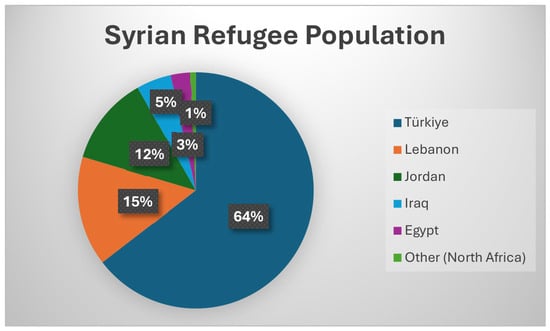
As shown in Figure 1, as of 31 January 2023, there was a sizable number of Syrians living in Jordan as refugees, accounting for approximately 12 percent of Syrians residing in the Middle East and North Africa (MENA) region. Although this share is smaller than the share living in Turkey, the size of the Jordanian economy is much smaller than the Turkish economy.3 The refugee population therefore represented a substantial demographic and economic shock for Jordan and placed additional demands on economic and public resources.
Figure 1.
Syrian refugee population in the MENA region. Data as of 31 January 2023. Source: https://data.unhcr.org/en/situations/syria (accessed on 31 January 2023).
Although Jordan has been a “refugee haven” for other populations for a long time (Chatelard, 2010), the economic consequences of the Syrian refugee influx cannot be overstated (Ajluni & Kawar, 2014; Al-Qadi & Lozi, 2017; World Bank, 2018; Leopardi & Trentin, 2022). Studies have examined labor-market participation, employment, public services, fiscal pressures, and the integration of refugees into economic activity (Stave & Hillesund, 2015; Fakih & Ibrahim, 2016; Hartnett, 2019; Segnana et al., 2024). The evidence is heterogeneous, reflecting differences across sectors, locations, and groups affected by the influx.
Other than economic problems, the crisis also caused social complications by stretching the sharing of scarce resources (Olwan & Shiyab, 2012; Lozi, 2013; Abdih & Geginat, 2014; Francis, 2015; Alshoubaki & Harris, 2018; World Bank, 2018; Alrababa’h et al., 2021). There are also concerns about the environmental impacts of the Syrian refugee population in Jordan (Khawaldah & Alzboun, 2022).
Nevertheless, remittances could provide a source of private financial support during displacement. In the specific case of Syrian refugees, relatives and other members of transnational networks may have redirected financial support toward Jordan rather than Syria. Strong kinship connections and transnational livelihoods provide a plausible mechanism for such transfers (Zuntz, 2021). Syrians and Iraqis living in the GCC and elsewhere may send money to relatives who moved to Jordan (Doocy et al., 2012; Voon, 2014). In addition, Saif and Debartolo (2007) and Lozi (2013) observe that some relatively more affluent refugees brought wealth to Jordan and established businesses. An important qualification concerns the channels through which financial support may be transmitted. Hawala is an informal value-transfer system that can operate outside or alongside conventional banking channels. Research documents its importance during the Syrian conflict and among displaced Syrians, including in Jordan (El Qorchi et al., 2003; Guran, 2020; Tobin, 2024). Consequently, some financial support received by Syrian refugees in Jordan may not be readily identifiable in official remittance statistics.
The Syrian diaspora is not the only source of remittance inflows for Jordan. There are also a substantial number of Jordanians in the GCC countries as expatriate workers (Bel-Air, 2016; Nilsson & Ramadan, 2020). Remittances are important for Jordan, as in many labor-sending economies, and may compensate for the loss of skilled labor (David & Marouani, 2013). Yet the economic effects of remittances are country-specific (Barajas et al., 2009; Fayissa & Nsiah, 2010; Dastidar, 2017). Where remittances are a major source of foreign exchange, they may also be associated with Dutch disease, as observed in Egypt, Jordan, Lebanon, and Syria (Saab & Ayoub, 2010). Nilsson and Ramadan (2020) also examine the distributional consequences of migration and remittances around the Mediterranean.
All in all, the significant size of the Syrian population living in Jordan as refugees, together with a large Syrian diaspora in GCC countries and elsewhere, provides a credible motivation for studying the dynamics of remittance inflows in Jordan. The key issue for the present paper is not whether Syrian households received support, which the aggregate data cannot reveal, but whether any resulting change was large enough to be detectable in Jordan’s national remittance statistics.
Despite the extensive literature on the economic consequences of Syrian refugees in Jordan, comparatively little attention has been devoted to whether the refugee influx altered aggregate remittance inflows into the host country. Existing studies examine labor markets, public services, fiscal pressures, and refugee welfare, whereas the potential role of diaspora remittances as an adjustment mechanism has received comparatively little empirical attention. Because official balance-of-payments data do not identify the nationality of senders or recipients, however, aggregate statistics can evaluate only whether national remittance inflows changed following the refugee episode, not whether Syrian diaspora transfers changed.
Finally, the existing studies have largely focused on the labor-market, fiscal, and social consequences of Syrian refugees in Jordan. To our knowledge, no study has examined whether the refugee influx produced a measurable change in Jordan’s aggregate remittance inflows using structural-break and comparative counterfactual methods. Since official remittance statistics do not distinguish transfers made by Syrian and Jordanian migrants, the present study evaluates whether the refugee crisis generated a detectable shift in aggregate remittance behavior at the national level.
This paper contributes to the literature in three respects. First, it examines whether the Syrian refugee crisis altered the trajectory of Jordan’s aggregate remittance inflows. Second, rather than assuming that a structural change occurred, it combines structural-break techniques with comparative estimators to assess whether post-2011 remittance dynamics departed from their expected path. Third, it explicitly recognizes the limitations of aggregate balance-of-payments data, interpreting the results as evidence on aggregate remittance behavior rather than refugee-specific transfers.
3. Data and Empirical Strategy
We collect annual data from the World Development Indicators for the period 1980–2020 on remittance inflows (BX.TRF.PWKR.CD.DT) and GDP (NY.GDP.MKTP.CD) for Jordan and the comparison countries mentioned below.4 Remittance inflows are personal remittances received in the country, measured in current US dollars. These data measure recorded aggregate remittance flows and do not allow us to identify the transfer mechanism or the nationality of individual senders or recipients. Like the remittance variables, the GDP is also nominal and measured in US dollars. The main outcome used in this study is the logarithm of the remittance-to-nominal-GDP ratio, defined in Equation (1), i.e., the log ratio of current-dollar remittance inflows to nominal GDP.
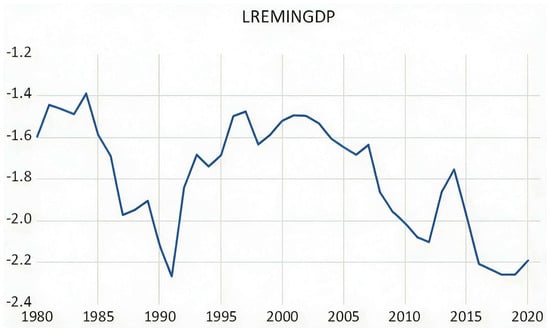
where stands for remittance inflows and represents the Gross Domestic Product. Figure 2 presents the outcome variable generated by Equation (1).
Figure 2.
Log ratio of current-dollar remittance inflows to nominal GDP ().
A summary statistics table for the variables and countries involved in the analysis is provided in Table A1 in Appendix A. The variables are remittance inflows (), the nominal GDP (), and the ratio of remittance inflows to GDP () for Jordan, Bangladesh, India, Pakistan, Sri Lanka, Egypt, Tunisia, and Morocco over 1980–2020. The levels of and vary widely across countries, reflecting differences in economic size and migration patterns: India records the largest average inflows (about USD 27.5 billion) and GDP (about USD 943 billion), whereas Tunisia and Jordan have much smaller averages in both series. More importantly for economic interpretation, the mean ratios show that remittances constitute a non-trivial share of economic activity in several of these economies. Jordan stands out with an average remittance inflows-to-GDP ratio of 0.17 (17%), ranging from 10% to 25% over the sample period, indicating a substantial and persistent dependence on workers’ remittances. Egypt, Sri Lanka, and Morocco also exhibit relatively high averages (around 6–7%), while Bangladesh and Pakistan are close to 5%. By contrast, India’s average ratio is only about 2%, suggesting that although the absolute volume of remittances is large, their macroeconomic weight relative to GDP is modest. The standard deviations of are fairly small relative to the means in most countries, implying that the remittance share of GDP is relatively stable over time, but the min–max ranges (e.g., 0.02–0.11 for Bangladesh; 0.03–0.15 for Egypt) confirm that there is meaningful time variation that can be exploited in econometric analysis. The summary statistics reveal substantial heterogeneity across countries and reinforce the importance of treating the comparison groups as benchmarks rather than identical macroeconomic twins.
In terms of econometrics, we address the question in two complementary ways. First, we investigate whether the Jordanian remittance inflows-to-GDP ratio exhibits evidence of structural change around the Syrian crisis. Second, we carry out comparative counterfactual analyses to assess whether Jordan’s post-2011 trajectory differs from trajectories observed in selected benchmark countries. The empirical design is intended to identify detectable changes in aggregate remittance dynamics; it does not identify a causal Syrian-specific remittance effect.
Our first approach is a search for structural change. A structural break occurs when the underlying relationship governing an economic variable changes, resulting in a shift in the parameters of the data-generating process. Such changes are often associated with major exogenous events, policy interventions, financial crises, or institutional changes that permanently or persistently alter the behavior of the series. In econometric terms, a structural break refers to a change in the underlying data-generating process, whereby one or more parameters of the estimated model—such as the intercept, slope coefficients, or error variance—shift at an (unknown) point in time. Consequently, observations before and after the break are no longer generated by the same stochastic process. The Bai and Perron (1998, 2003) methodology identifies multiple structural breaks by estimating unknown break dates and testing parameter stability. In our application, the Syrian refugee episode is treated as a possible source of instability in Jordan’s aggregate remittance series. A statistically significant break around the relevant period would provide evidence of a change in the series, although it would not by itself establish that the refugee influx caused that change. Because official balance-of-payments statistics do not distinguish remittances by nationality, the analysis concerns aggregate recorded inflows rather than Syrian diaspora transfers.
A structural break or its absence is not, by itself, a counterfactual test. We therefore compare Jordan with two benchmark groups. The first consists of Bangladesh, India, Pakistan, and Sri Lanka, which share important exposure to the GCC remittance corridor.5 Like Jordan, these economies receive substantial remittance flows from GCC labor markets (Naufal, 2011; Cooray, 2014; Doherty et al., 2014; Naufal & Genc, 2015; Chitgupi, 2019; Genc, 2022). These countries are useful as a corridor-based comparison because they are exposed to common external remittance conditions, although they differ from Jordan in economic size, migrant composition, labor markets, exchange-rate regimes, and other macroeconomic characteristics In other words, we compare countries that share the same external remittance shock environment, not countries that are identical in every macroeconomic dimension. Jordan is highly exposed to GCC-driven income flows, and the IMF explicitly notes that Jordan’s macroeconomic situation is closely tied to the GCC through remittances, FDI, grants, and trade spillovers. That means South Asian countries can be useful as a “remittance system” comparison group, even if they are not close macroeconomic twins of Jordan (Espinoza et al., 2013). This is as a corridor-based comparison. We therefore refer to this group as a GCC-remittance-corridor benchmark rather than perfect untreated control. As a second benchmark, we consider Tunisia, Morocco, and Egypt from the MENA region.6 This group better reflects Jordan’s regional macroeconomic environment, but the comparators themselves experienced important political and economic changes around 2011. We therefore interpret the MENA group as a regional benchmark, not as a clean counterfactual. While South Asia captures exposure to the same GCC remittance corridor, the MENA comparators better match Jordan’s macroeconomic environment.
Unit-Root Tests
We first establish the time-series properties of the log remittance inflows-to-GDP ratio ().
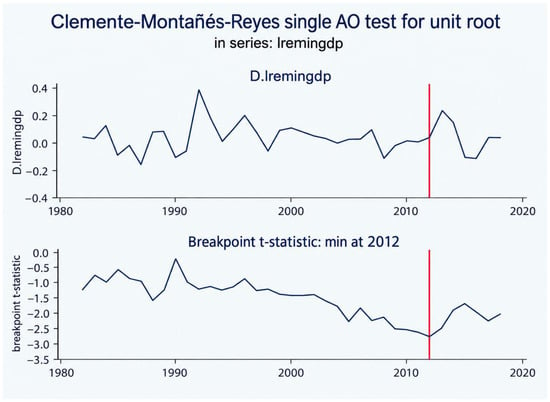
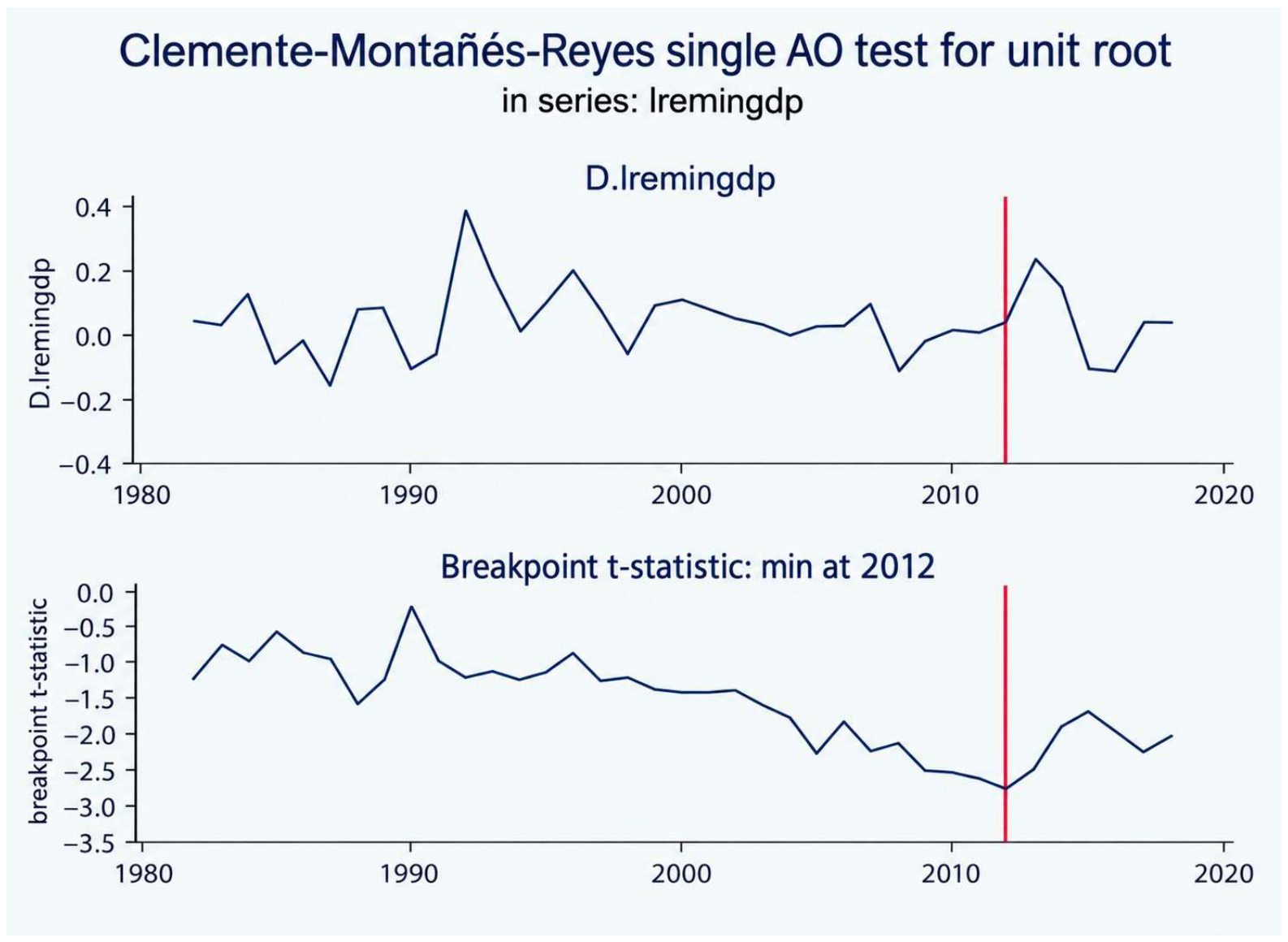
As is customary, we carry out the traditional unit-root tests, i.e., ADF and KPSS tests, whose results are presented in Table 1.7 We find that the outcome variable () is integrated of order one. Due to the possibility of structural changes over the long sample period, we also investigate the likely impact of such changes on the unit-root results using the Clemente et al. (1998) procedure.8 Although the CMR procedure indicates a possible break around 2012 as shown in Figure 3, it is not statistically significant.
Table 1.
Traditional unit-root tests on log of the remittance inflows to GDP.
Figure 3.
Clemente–Montanes–Reyes (CMR) on () with single break.
Structural Break Tests
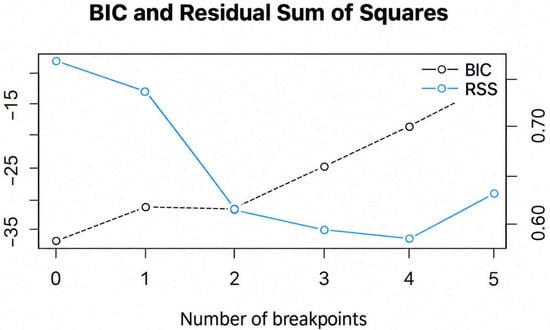
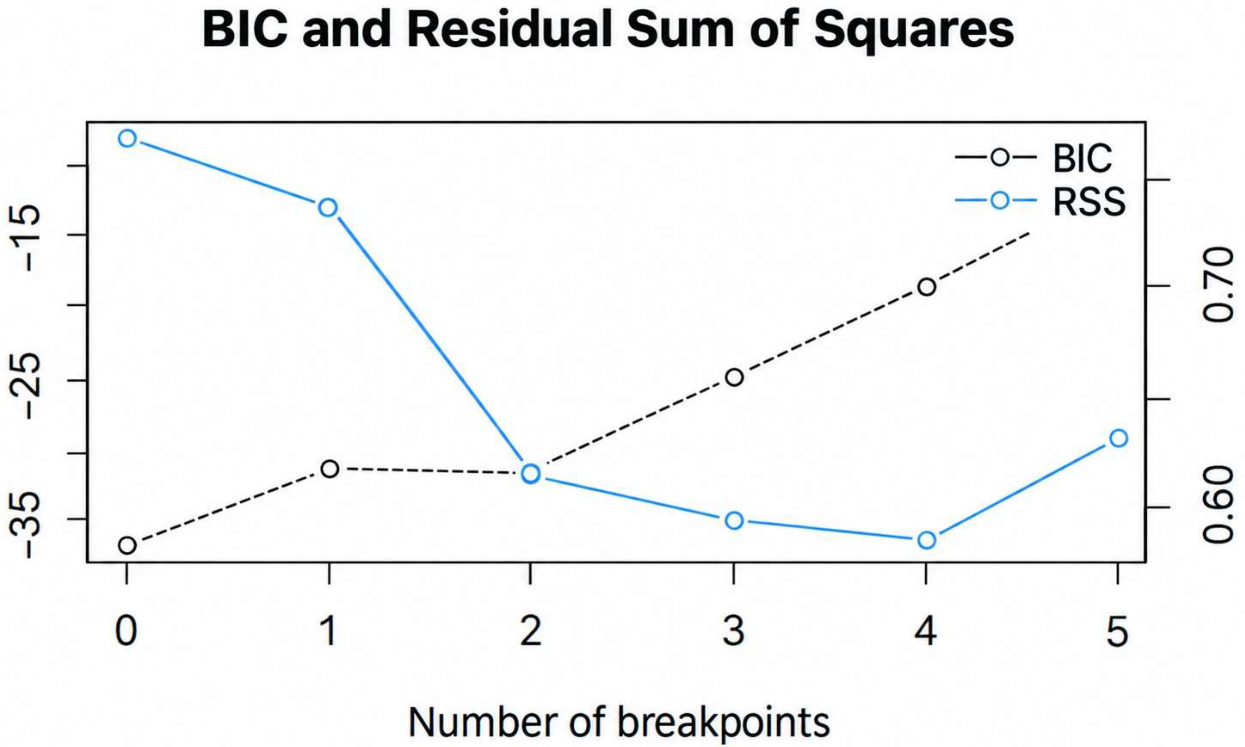
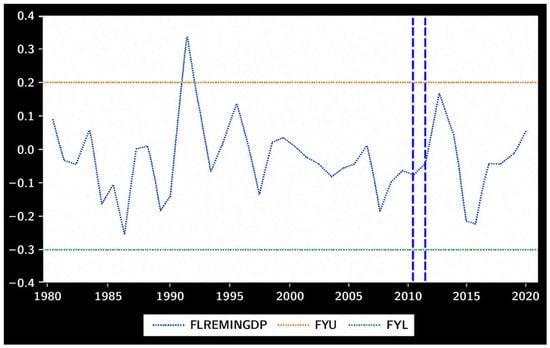
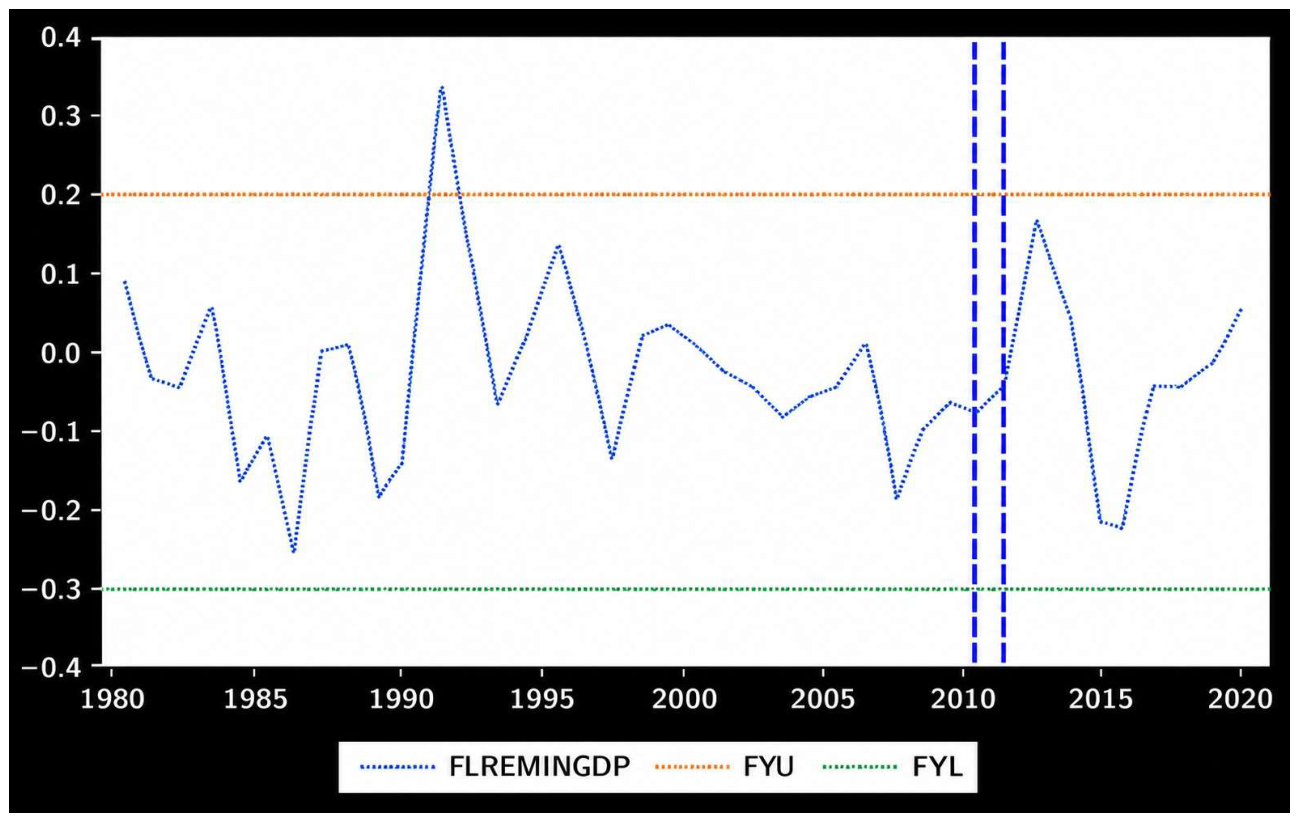
Since the level of the remittance inflows-to-GDP ratio is non-stationary, we take its first difference, which is stationary, and investigate the possibility of a structural break in the growth rate of the remittance inflows-to-GDP ratio using the Bai and Perron (1998, 2003) tests. As shown in Figure 4,9 the results do not indicate statistically significant evidence of a structural break in the growth rate of the remittance inflows-to-GDP ratio. The Genc and Arzaghi (2011) test10 arrives at a similar conclusion (Figure 5). These results indicate that we do not detect a statistically significant structural change in the growth process around the Syrian refugee episode. They do not imply that the average level of remittances was unchanged, nor do they rule out smaller or gradual changes that the test may have limited power to detect in a sample of 41 annual observations.
Figure 4.
Bai–Perron structural break tests.
Figure 5.
Genc and Arzaghi (2011) test. FYU and FYL denote the upper and lower 5% confidence bounds, respectively, for the first difference in the remittance inflows-to-GDP ratio. The shaded area denotes the post-2011 refugee episode.
The structural-break analyses therefore provide no statistically significant evidence of a discrete break in Jordan’s aggregate remittance inflows-to-GDP growth process around the Syrian crisis. This finding motivates the comparative analysis below, because a single-country time-series test cannot establish what Jordan’s trajectory would have been in the absence of the refugee episode.
Counterfactual Analysis
Although the structural-break analysis does not detect a statistically significant change in data, this result does not identify whether Jordan’s post-2011 trajectory differed from the trajectories that might reasonably be expected in the absence of the refugee episode. We therefore use the two benchmark groups described above for comparative analysis.
We employ three comparative estimators: conventional difference-in-differences (DiD), synthetic control (SC), and synthetic difference-in-differences (SDiD). SDiD combines features of DiD and synthetic control by weighting units and time periods to improve the pre-treatment approximation (Abadie et al., 2010, 2015; Abadie, 2021; Arkhangelsky et al., 2021). The counterfactual control group is constructed in such a way that the pre-treatment difference between the control and treatment groups is minimized by optimally weighing the influence of control group members (Arkhangelsky et al., 2021). While this process replicates the procedure of SC, the estimation of treatment is conducted in a similar fashion to DiD (Berman & Israeli, 2022). Unlike conventional DiD, SDiD does not require parallel trends between the treated unit and the unweighted comparison group, and it is robust to additive unit-level differences in outcome levels (Arkhangelsky et al., 2021; Rambachan & Roth, 2023). SDiD is not assumption-free, however: its validity depends on the weighted comparison units closely reproducing Jordan’s pre-2011 trajectory and continuing to approximate it in the absence of the displacement episode. In addition, SDiD differs from SC in that it does not require a lengthy pre-treatment period, and it may also tolerate some endogeneity in the pre-treatment period (Berman & Israeli, 2022). Furthermore, the SDID method allows constructing reliable counterfactuals even when the levels of the outcome are different between the treatment and the control samples (Campos et al., 2022). However, it is worth noting that we use SDiD as the primary comparative estimator because it is designed to accommodate differences in outcome levels and to improve pre-treatment fit through unit and time weights. We therefore treat DiD and SC as informative sensitivity estimators rather than as interchangeable confirmations of a single causal effect. Drawing on the relevant literature (Arkhangelsky et al., 2021), we present below the objective functions optimized by each of the three methods:
- Difference-in-Differences (DiD)
- Synthetic Control (SC)
- Synthetic Difference-in-Differences (SDiD)
The comparative estimations use a balanced panel containing 41 annual observations for each country over 1980–2020. Our variable of interest (outcome variable) is the log of the ratio of remittance inflows into a country divided by the nominal GDP of that country (the remittance inflows-to-GDP ratio). We adopt the treatment (shock) date as 2011, which is the beginning of the Syrian civil war.12 Similar dates were adopted by Akgunduz et al. (2015), Balkan and Tumen (2016) and Genc et al. (2022) for the Turkish case. We present our findings in Table 2 as well as in Figure 6 and Figure 7 by employing all three estimation methods, that is, DiD, SC, and SDiD with and without India in the first control group, Group 1, and with or without Egypt in the second group, Group 2. As India is one of the largest remittance receiving countries in the world, we run our estimations with and without it to eliminate any undue influence exerted by India. When India is included, the largest weight goes to Sri Lanka with 43%, Pakistan and India have comparable weights of around 27–30%. Bangladesh’ share is negligible around 0–1%. If India is removed from the group, weights are approximately 59%, 27% and 13% for Sri Lanka, Pakistan, and Bangladesh, respectively.
Table 2.
Counterfactual experiments.
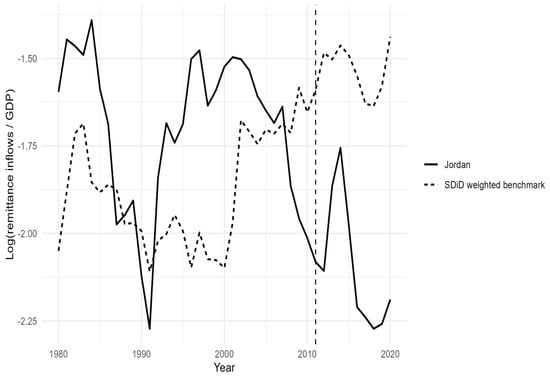
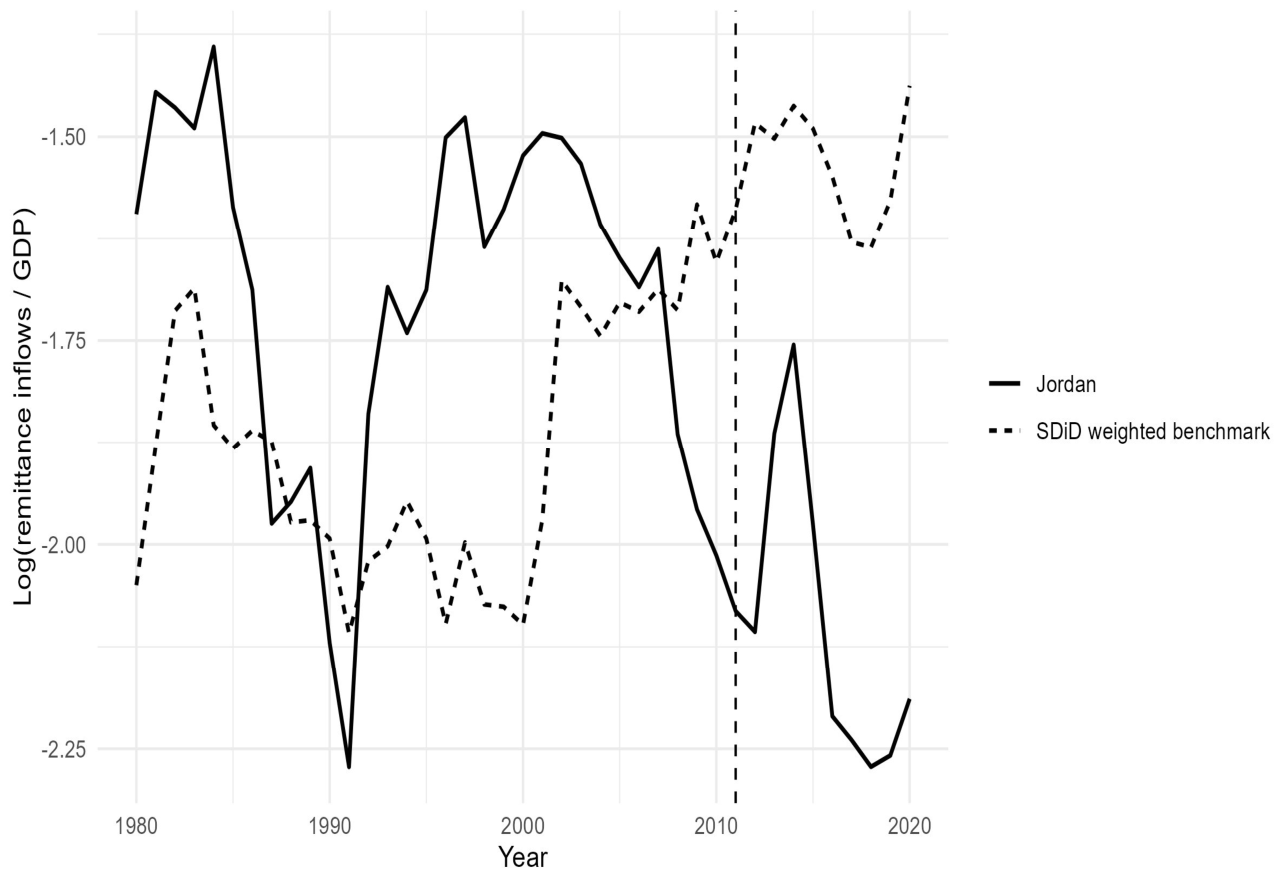
Figure 6.
Counterfactual experiments with India in the benchmark group.
Figure 7.
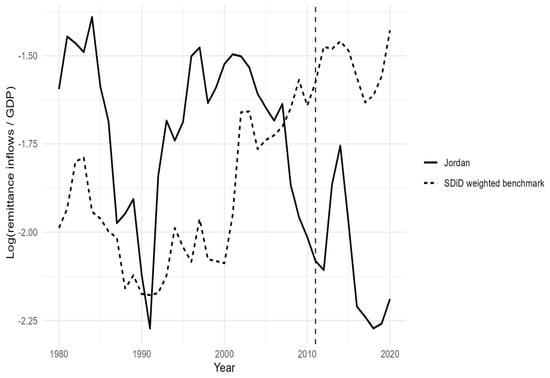
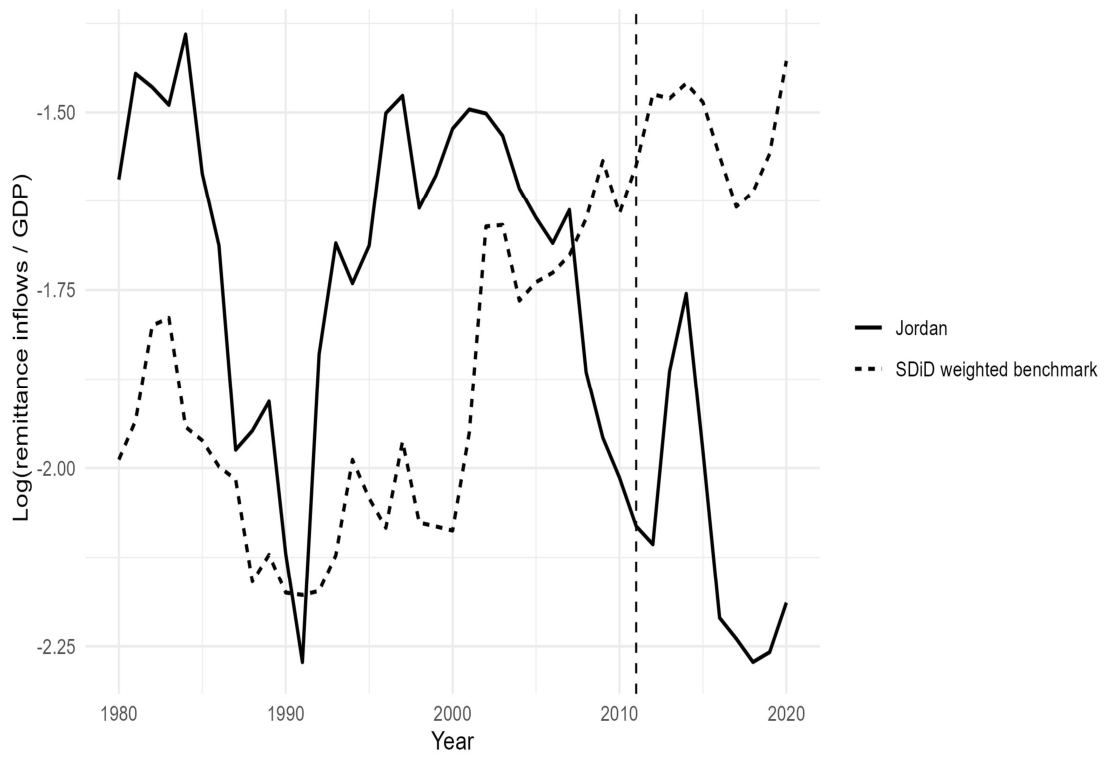
Counterfactual experiments without India in the benchmark group.
Table 2 and Figure 6 and Figure 7 report the comparative estimates. For the South Asian benchmark, with India included, DiD gives an estimate of −0.88, SC gives +0.46, and SDiD gives −0.57. When India is excluded, the corresponding estimates are −0.85, +0.46, and −0.56, respectively. Thus, the SDiD estimate is remarkably stable to the exclusion of India, whereas the conventional synthetic-control estimate has the opposite sign.13 The SDiD estimate of approximately −0.56 is a log-point difference relative to the weighted counterfactual. Expressed as a percentage difference, exp(−0.56)−1 ≈ −0.43, or approximately 43 percent lower in the remittance inflows-to-GDP ratio relative to the counterfactual. This is not a claim that Jordan’s actual remittance receipts fell by 43%; it is a relative difference in the logged remittance inflows-to-GDP ratio. In other words, in the post-treatment period, on average, Jordan’s log remittance inflows-to-GDP ratio was lower than that of the weighted benchmark. One has to note, however, that the conventional placebo-based standard errors are supplementary model-based measures; the small donor pool means that the associated t-statistics should not be treated as the primary finite-sample evidence of statistical significance. The in-space placebo exercise described below yields a permutation p-value of 0.125. We therefore do not characterize the SDiD estimates as statistically significant under the primary finite-sample criterion. Furthermore, although it is not strictly necessary for SDiD as much as DiD, we find that the pre-treatment diagnostics show that the weighted benchmarks do not reproduce Jordan’s pre-2011 trajectory exactly. For the South Asian benchmark, the level-adjusted pre-treatment RMSE (root mean square error) is approximately 0.29 with India included and 0.28 without India. Visually speaking, Figure 6 and Figure 7 portray the difference in the remittance inflows-to-GDP ratios in the benchmark and treatment groups.
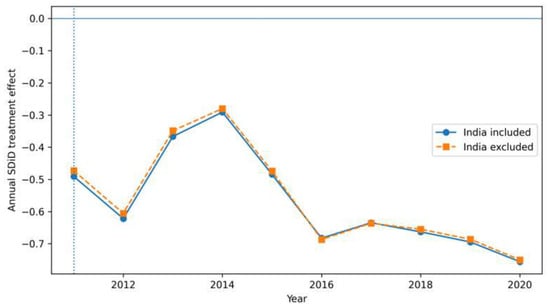
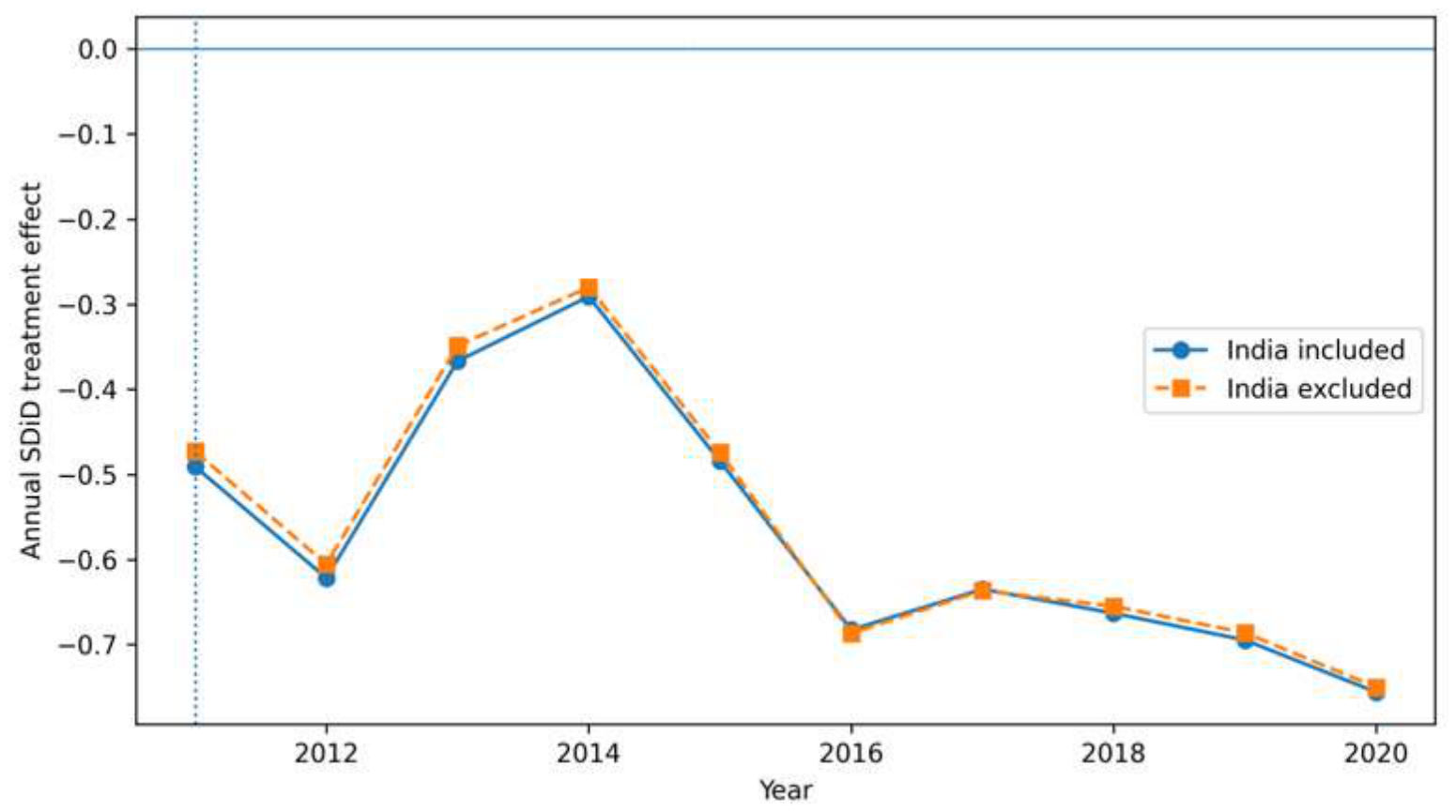
Figure 8 presents a more detailed graph of the treatment effect on an annual basis. The estimated differences become more negative in the later post-2011 years. Because these later years also coincide with substantial changes in GCC labor markets, oil prices, regional economic conditions, and macroeconomic developments in the comparison countries, we do not interpret this temporal pattern as evidence of a delayed causal effect of the refugee influx.
Figure 8.
Yearly treatment effects.
Table 2 also shows the results for the second comparison group, Group 2. For the sake of econometric clarification, we observe that the model assigns the highest structural importance to Tunisia with an optimal weight of about 46%, followed closely by Morocco at 42%. Egypt provides the remaining 12% to fine-tune the pre-treatment baseline. Excluding Egypt from the group redistributes the weights as 45% to Morocco and 55% to Tunisia. The resulting weights indicate that the estimated synthetic benchmark is constructed primarily from Tunisia and Morocco, with Egypt receiving a smaller weight. This distribution illustrates the sensitivity of the synthetic benchmark to donor composition and supports our interpretation of the MENA group as a regional benchmark rather than a clean counterfactual. The MENA benchmark in Table 2 provides weaker and more donor-sensitive evidence. With Egypt included, the estimate is −0.43. Excluding Egypt produces −0.42. The sensitivity to Egypt reinforces the point that the MENA group is a regional benchmark rather than a clean untreated counterfactual. The results provide no evidence of an additional increase in Jordan’s remittance inflows-to-GDP ratio relative to the MENA benchmark.14 Overall, the comparative evidence is consistent with the conclusion that Jordan did not experience a detectable aggregate increase in recorded remittance inflows after 2011. However, it is not sufficient to establish a causal decline attributable to the refugee influx.
The post-2010 period also coincided with major changes in the global and GCC economies. Remittance flows from GCC countries may respond to oil prices, construction and labor demand, migration policies, exchange rates, and regional economic cycles. South Asian recipients may have benefited differently from these developments than Jordan. For this reason, the later relative divergence between Jordan and the South Asian benchmark should not be interpreted as evidence that Syrian refugees failed to attract remittances. At most, the aggregate data indicate that any Syrian-related increase was not large enough to produce a detectable increase in Jordan’s recorded remittance inflows-to-GDP ratio relative to the selected benchmarks.
Comparison to Findings in the Literature
When we compare our findings with previous studies, the literature on the economic effects of Syrian migration in Jordan is much more developed for labor markets, public services, fiscal pressures, and welfare than for remittance inflows. The broader literature on Syrian migration in Turkey has examined a variety of outcomes (Akgunduz et al., 2015; Tumen, 2016; Genc et al., 2022). In the Jordanian context, Voon (2014) and Zuntz (2021) document transnational economic relationships and provide reasons to expect financial support to displaced households. Our results do not contradict the existence of such support. Instead, they indicate that aggregate recorded remittance inflows to Jordan do not show a statistically detectable increase large enough to distinguish the country clearly from the selected benchmarks. This distinction is important because micro-level support can coexist with a null aggregate effect.
4. Discussion and Conclusions
This paper examines whether the Syrian refugee influx was followed by a detectable change in Jordan’s aggregate recorded remittance inflows. The distinction between aggregate and Syrian-specific transfers is central to the interpretation. Official balance-of-payments statistics do not identify the nationality of remittance senders or recipients, and informal channels such as hawala may not be fully captured. The paper therefore does not estimate the amount of remittances received by Syrian refugees in Jordan and does not claim to identify a causal effect of Syrian immigration on refugee-specific transfers.
Jordan experienced a substantial refugee influx after the onset of the Syrian conflict, creating a plausible mechanism through which diaspora support could have been redirected toward households in Jordan. We investigate this possibility using the aggregate remittance inflows-to-GDP ratio, structural break tests, and comparative benchmark analyses. The structural break tests provide no statistically significant evidence of a discrete break in the growth process around the episode. Comparative analysis is more nuanced. The South Asian GCC-remittance-corridor benchmark produces a negative SDiD estimate of approximately −0.56 log points, stable when India is excluded, but the conventional synthetic-control estimate has the opposite sign. The MENA comparison is weaker and sensitive to whether Egypt is included. The in-space placebo permutation p-value of 0.125 should also not be described as conventional statistical significance. Taken together, the evidence does not support a simple claim that the Syrian refugee influx caused a particular percentage decline in Jordanian remittance receipts. Rather, it indicates that Jordan did not experience a detectable aggregate remittance increase relative to the selected benchmarks, while the later relative divergence warrants cautious interpretation.
Our findings should not be interpreted as evidence that Syrian households in Jordan received no financial support. Any Syrian-specific transfers may have been small relative to Jordan’s total remittance flows, offset by changes in other remittance components, or transmitted through channels that are not captured in official statistics. The aggregate outcome also remains exposed to other post-2011 developments, including regional instability, GCC labor-market and oil cycles, and domestic policy changes. These factors limit a strong causal interpretation of the post-2011 differences.
The policy implication is therefore narrower than a claim that remittances failed to support refugees. Rather, the aggregate evidence suggests that remittance inflows cannot be assumed to generate a sufficiently large national-level financial offset to the resource pressures associated with a sudden refugee influx. Host countries may therefore need to rely on a diversified set of resources, including international assistance, domestic fiscal measures, and policies that facilitate formal financial transfers, while recognizing that private diaspora support may occur outside aggregate recorded remittance statistics.
The principal limitation of the study is the aggregate nature of the data and the resulting identification problem. More disaggregated data that identify the nationality of senders and recipients would provide a much more direct test of refugee-specific remittance behavior. Household surveys could also identify the transfer channel, including banks, formal money-transfer operators, and informal mechanisms such as hawala. Future research could combine such microdata with refugee exposure measures and richer information on sending-country conditions. Such evidence would make it possible to distinguish a genuinely absent remittance response from a response that is simply too small, too diffuse, or too informal to be detected in national balance-of-payments data.
Supplementary Materials
The following supporting information can be downloaded at https://www.mdpi.com/article/10.3390/economies14100476/s1.
Author Contributions
Conceptualization, I.H.G., G.N. and B.M.A.-F.; Methodology, I.H.G., G.N. and B.M.A.-F.; Software, I.H.G., G.N. and B.M.A.-F.; Validation, I.H.G., G.N. and B.M.A.-F.; Formal analysis, I.H.G., G.N. and B.M.A.-F.; Data curation, I.H.G., G.N. and B.M.A.-F.; Writing—original draft, I.H.G., G.N. and B.M.A.-F.; Writing—review & editing, I.H.G., G.N. and B.M.A.-F. All authors have read and agreed to the published version of the manuscript.
Funding
This research received no external funding.
Institutional Review Board Statement
Not applicable.
Informed Consent Statement
Not applicable.
Data Availability Statement
Data used in this study is available online in Supplementary Materials File.
Conflicts of Interest
The authors declare no conflict of interest. This paper represents the opinions of the authors and does not mean to represent the position or opinions of the American University of Sharjah.
Appendix A
Table A1.
Summary statistics.
Table A2.
In-space placebo test.
Notes
| 1 | See “Refugees of the Syrian Civil War” at https://en.wikipedia.org/wiki/Refugees_of_the_Syrian_Civil_War (accessed on 9 December 2020). |
| 2 | We do not mean that all remittances are altruistic in nature. Some remittances are in fact self-interest-driven (Buch & Kuckulenz, 2010). |
| 3 | See Tumen (2016), Altindag et al. (2020), Genc et al. (2022) for a study of the impact of Syrian refugees on various aspects of the Turkish economy. |
| 4 | We use the Stata 19 command “wbopendata” to gather the data for this study. The command can be used via “ssc install wbopendata, replace”. Reference: https://datahelpdesk.worldbank.org/knowledgebase/articles/889464-wbopendata-stata-module-to-access-world-bank-data (accessed on 12 September 2026). |
| 5 | Another potential comparison country is Nepal. But we do not include Nepal as it has an extensive number of gaps in remittance data. |
| 6 | Lebanon is excluded because of insufficient data. |
| 7 | In the interest of space, we do not provide many features of the tests, but they are available upon request. Yet, it suffices to say that the unit-root results are generated via the EViews 14 “uroot” command. |
| 8 | These results are obtained via the Stata command “clemao1.” |
| 9 | To produce this graph, we employed the R command “breakpoints” where the first difference in is run against a constant with five likely breakpoints. The command is part of the “strucchange” library. Reference: https://cran.r-project.org/web/packages/strucchange/index.html (accessed on 12 September 2026). |
| 10 | This test is conducted by following the method identified in the source paper. |
| 11 | The counterfactual analysis is conducted via the R command “synthdid.” Reference: https://synth-inference.github.io/synthdid/ (accessed on 12 September 2026). |
| 12 | We also experimented with dates around 2011 for the reason that the crisis might have unfolded over several years. Our results remain qualitatively the same. |
| 13 | As seen in Table 2, there are differences in the estimated values for the synthetic control (SC) and synthetic difference-in-differences (SDiD) methods for Group 1. The differing results obtained from SC and SDiD methods are not necessarily contradictory because the two estimators identify different treatment effects under different weighting schemes. While SC constructs a synthetic Jordan that best reproduces the pre-treatment trajectory and compares the post-treatment evolution against this synthetic counterfactual, SDiD combines synthetic weighting with difference-in-differences estimation to identify an average treatment effect after accounting for both unit- and time-specific heterogeneity. Consequently, differences in the estimated effects are not uncommon and reflect methodological differences rather than inconsistencies in the data. |
| 14 | As an additional robustness exercise, an in-space placebo test is conducted by sequentially assigning treatment to each control country while maintaining the original intervention year (2011). Due to small control country lists, we combine Group 1 and Group 2 countries, and re-estimate the model anew. The results are in Table A2 in Appendix A. Jordan exhibits the largest treatment effect in absolute value among all countries in the sample, whereas the placebo estimates are uniformly smaller in magnitude. This finding suggests that the estimated effect is specific to Jordan rather than a general feature of the estimation procedure. Because the comparison pool consists of only seven control countries, however, the randomization inference is necessarily limited. The implied permutation p-value is 0.125 (1/8), which reflects the coarse nature of inference in small samples rather than the absence of an economically meaningful treatment effect. The in-space placebo test method is also used for Group 2 in Table 2. |
References
- Abadie, A. (2021). Using synthetic controls: Feasibility, data requirements, and methodological aspects. Journal of Economic Literature, 59(2), 391–425. [Google Scholar] [CrossRef] [Scilit]
- Abadie, A., Diamond, A., & Hainmueller, J. (2010). Synthetic control methods for comparative case studies: Estimating the effect of california’s tobacco control program. Journal of the American Statistical Association, 105(490), 493–505. [Google Scholar] [CrossRef] [Scilit]
- Abadie, A., Diamond, A., & Hainmueller, J. (2015). Comparative politics and the synthetic control method. American Journal of Political Science, 59(2), 495–510, (Correction in 2026, American Journal of Political Science. https://doi.org/10.1111/ajps.70083). [Google Scholar] [CrossRef] [Scilit]
- Abdih, Y., & Geginat, C. (2014). The economic impact of the Syrian conflict on Jordan. Available online: http://www.imf.org/external/np/blog/nafida/093014.pdf (accessed on 1 May 2026).
- Ajluni, S., & Kawar, M. (2014). The impact of the Syrian refugee crisis on the labour market in Jordan: A preliminary analysis. Available online: https://www.ilo.org/wcmsp5/groups/public/---arabstates/---ro-beirut/documents/publication/wcms_242021.pdf (accessed on 1 May 2026).
- Akgunduz, Y. E., van den Berg, M., & Hassink, W. (2015). The impact of refugee crises on host labor markets: The case of the Syrian refugee crisis in Turkey (IZA Discussion Paper, No 8841). Institute for the Study of Labor (IZA). [Google Scholar]
- Al-Qadi, N., & Lozi, B. (2017). The impact of middle east conflict on the Jordanian economy. International Journal of Academic Research in Business and Social Sciences, 7(7), 345–355. [Google Scholar] [CrossRef] [Scilit] [PubMed]
- Alrababa’h, A., Dillon, A., Williamson, S., Hainmueller, J., Hangartner, D., & Weinstein, J. (2021). Attitudes toward migrants in a highly impacted economy: Evidence from the Syrian refugee crisis in Jordan. Comparative Political Studies, 54(1), 33–76. [Google Scholar] [CrossRef] [Scilit]
- Alshoubaki, W. E., & Harris, M. (2018). The impact of Syrian refugees on Jordan: A framework for analysis. Journal of International Studies, 11(2), 154–179. [Google Scholar] [CrossRef] [Scilit]
- Altindag, O., Bakis, O., & Rozo, S. V. (2020). Blessing or burden? Impacts of refugees on businesses and the informal economy. Journal of Development Economics, 146. [Google Scholar] [CrossRef] [Scilit]
- Amuedo-Dorantes, C., & Pozo, S. (2012). Remittance income volatility and labor supply in Mexico. Southern Economic Journal, 79(2), 257–276. [Google Scholar] [CrossRef] [Scilit]
- Arkhangelsky, D., Athey, S., Hirshberg, D. A., Imbens, G. W., & Wager, S. (2021). Synthetic difference-in-differences. American Economic Review, 111(12), 4088–4118. [Google Scholar] [CrossRef] [Scilit]
- Azose, J. J., & Raftery, A. E. (2019). Estimation of emigration, return migration, and transit migration between all pairs of countries. Proceedings of the National Academy of Sciences of the United States of America, 116(1), 116–122. [Google Scholar] [CrossRef] [Scilit] [PubMed]
- Bai, J., & Perron, P. (1998). Estimating and testing linear models with multiple structural changes. Econometrica, 66, 47–78. [Google Scholar] [CrossRef] [Scilit]
- Bai, J., & Perron, P. (2003). Computation and analysis of multiple structural change models. Journal of Applied Econometrics, 18(1), 1–22. [Google Scholar] [CrossRef] [Scilit]
- Balkan, B., & Tumen, S. (2016). Immigration and prices: Quasi-experimental evidence from Syrian refugees in Turkey. Journal of Population Economics, 29(3), 657–686. [Google Scholar] [CrossRef] [Scilit]
- Barajas, A., Chami, R., Fullenkamp, C., Gapen, M., & Monteil, P. (2009). Do workers’ remittances promote economic growth? (IMF Working Paper 09/153). International Monetary Fund. [Google Scholar]
- Bel-Air, F. (2016). Migration profile: Jordan. Working Paper. Robert Shuman Center for Advanced Studies, Migration Policy Center. [Google Scholar]
- Berman, R., & Israeli, A. (2022). The value of descriptive analytics: Evidence from online retailers. Marketing Science, 41(6), 1029–1182. [Google Scholar] [CrossRef] [Scilit]
- Buch, C. M., & Kuckulenz, A. (2010). Worker remittances and capital flows to developing countries. International Migration, 48(5), 89–117. [Google Scholar] [CrossRef] [Scilit]
- Campos, N. F., Coricelli, F., & Franceschi, E. (2022). Institutional integration and productivity growth: Evidence from the 1995 enlargement of the European union. European Economic Review, 142, 104014. [Google Scholar] [CrossRef] [Scilit]
- Chatelard, G. (2010). Jordan: A refugee haven. Migration Policy Institute Online Journal, halshs-00514403. Available online: https://shs.hal.science/halshs-00514403 (accessed on 1 May 2026).
- Chitgupi, A. (2019). Drivers of international remittance flows: Role of risk and age dependency variables. Working Paper. Institute for Social and Economic Change (ISEC). [Google Scholar]
- Clemente, J., Montanes, A., & Reyes, M. (1998). Testing for a unit root in variables with a double change in the mean. Economics letters, 59(2), 175–182. [Google Scholar] [CrossRef] [Scilit]
- Cooray, A. (2014). Do low-skilled migrants contribute more to home country income? Evidence from south Asia. The B.E. Journal of Economic Analysis and Policy, 14(3), 1185–1212. [Google Scholar] [CrossRef] [Scilit]
- Dash, R. K. (2020). Impact of remittances on domestic investment: A panel study of six south Asian countries. South Asia Economic Journal, 21(1), 7–30. [Google Scholar] [CrossRef] [Scilit]
- Dastidar, G. S. (2017). Impact of remittances on economic growth in developing countries: The role of openness. Global Economy Journal, 17(2), 20160066. [Google Scholar] [CrossRef] [Scilit]
- David, A., & Marouani, M. A. (2013). The labor mobility-employment nexus: A general equilibrium analysis for Jordan (Working Paper 824). ERF. [Google Scholar]
- Doherty, M., Leung, B., Lorenze, K., & Wilmarth, A. (2014). Understanding South Asian labor migration. Prepared for United States Government Office of South Asia Analysis, Workshop in International Public Affairs. La Follette School of Public Affairs, University of Wisconsin Maddison. [Google Scholar]
- Doocy, S., Burnham, G., Biermann, E., & Tileva, M. (2012). Household economy and livelihoods among Iraqi refugees in Syria. Journal of Refugee Studies, 25(2), 282–300. [Google Scholar] [CrossRef] [Scilit]
- Edelbloude, J., Sers, C. F., & Makhlouf, F. (2017). Do remittances respond to revolution? The evidence from Tunisia. Research in International Business and Finance, 42, 94–101. [Google Scholar] [CrossRef] [Scilit]
- El Qorchi, M., Maimbo, S. M., & Wilson, J. F. (2003). Informal funds transfer systems: An analysis of the informal hawala system (IMF Occasional Paper No. 222). International Monetary Fund. [Google Scholar]
- Espinoza, R. A., Fayad, G., & Prasad, A. (2013). The macroeconomics of the Arab states of the gulf. Oxford University Press. Available online: https://www.elibrary.imf.org/display/book/9780199683796/9780199683796.xml (accessed on 18 August 2026).
- Fakih, A., & Ibrahim, M. (2016). The impact of Syrian refugees on the labor market in neighboring countries: Empirical evidence from Jordan. Defence and Peace Economics, 27(1), 64–86. [Google Scholar] [CrossRef] [Scilit]
- Fayissa, B., & Nsiah, C. (2010). The impact of remittances on economic growth and development in Africa. The American Economist, 55(2), 92–103. [Google Scholar] [CrossRef] [Scilit]
- Francis, A. (2015). Jordan’s refugee crisis. Working Paper. Carnegie Endowment for International Peace. [Google Scholar]
- Genc, I. H. (2022). Are Indian subcontinent remittance markets connected to each other? Journal of Asian Economics, 80, 101476. [Google Scholar] [CrossRef] [Scilit]
- Genc, I. H., & Arzaghi, M. (2011). A confidence interval test for the detection of structural breaks. Journal of the Franklin Institute, 348(7), 1615–1626. [Google Scholar] [CrossRef] [Scilit]
- Genc, I. H., Naufal, G., & Gahramanov, E. (2022). Impact of Syrian refugees on Turkish prices. Journal of Refugee Studies, (35)1, 139–158. [Google Scholar] [CrossRef] [Scilit]
- Guran, G. (2020). Brokers of order: How money moves in wartime Syria [Ph.D. dissertation, Princeton University]. [Google Scholar]
- Hartnett, A. S. (2019). The effect of refugee integration on migrant labor in Jordan. Review of Middle East Studies, 52(2), 263–282. [Google Scholar] [CrossRef] [Scilit]
- Jijin, P., Mishra, A. K., & Nithin, M. (2021). Macroeconomic determinants of remittances to India. Economic Change and Restructuring, 55, 1229–1248, (Correction in 2026, Economic Change and Restructuring, 59, 13. https://doi.org/10.1007/s10644-025-09955-3. [Google Scholar] [CrossRef] [Scilit]
- Khawaldah, H., & Alzboun, N. (2022). Socio-economic and environmental impacts of Syrian refugees in Jordan: A Jordanians’ perspective. Heliyon, 8, e10005. [Google Scholar] [CrossRef] [Scilit] [PubMed]
- Leopardi, F. S., & Trentin, M. (2022). The international ‘debt crisis’ of the 1980s in the middle east and north Africa: A review, an outline. Middle Eastern Studies, 58(5), 699–711. [Google Scholar] [CrossRef] [Scilit]
- Lozi, B. (2013). The effect of refugees on host country economy: Evidence from Jordan. Interdisciplinary Journal of Contemporary Research in Business, 5(3), 114–126. [Google Scholar]
- Mishra, P. (2006). Emigration and wages in source countries: Evidence from Mexico (IMF Working Paper WP/06/86). International Monetary Fund. [Google Scholar]
- Naufal, G. S. (2011). Labor migration and remittances in the GCC. Labor History, 52(3), 307–322. [Google Scholar] [CrossRef] [Scilit]
- Naufal, G. S., & Genc, I. H. (2015). Structural change in MENA remittance flows. Emerging Markets Finance and Trade, 51(6), 1175–1178. [Google Scholar] [CrossRef] [Scilit][Green Version]
- Naufal, G. S., & Vargas-Silva, C. (2010). Remitters in Dubai. Swiss Journal of Economics and Statistics, 146(4), 769–780. [Google Scholar] [CrossRef] [Scilit]
- Nilsson, B., & Ramadan, R. (2020). Migration and inequalities around the mediterranean sea. LIS Working Paper Series, No. 788. Luxembourg Income Study (LIS). [Google Scholar]
- Olwan, M. Y., & Shiyab, A. (2012). Forced migration of Syrians to Jordan: An exploratory study. Available online: https://cadmus.eui.eu/handle/1814/23502 (accessed on 1 May 2026).
- Rambachan, A., & Roth, J. (2023). A more credible approach to parallel trends. The Review of Economic Studies, 90(5), 2555–2591. [Google Scholar] [CrossRef] [Scilit]
- Saab, G., & Ayoub, M. (2010). The Dutch disease syndrome in Egypt, Jordan, Lebanon, and Syria: A comparative study. Competitiveness Review: An International Business Journal, 20(4), 343–359. [Google Scholar] [CrossRef] [Scilit]
- Saif, I., & Debartolo, D. (2007). The Iraq war’s impact on growth and inflation in Jordan. Center for Strategic Studies, University of Jordan. [Google Scholar]
- Segnana, J., Lopez-Acevedo, G., Robertson, R., & Rodrigues, J. (2024). The economic impact of the Syrian refugee migration on Jordan: An integration perspective. Available online: https://openknowledge.worldbank.org/server/api/core/bitstreams/6ec98d33-6ee2-4199-8f3b-ffe5b2c3ff57/content (accessed on 1 May 2026).
- Stave, S. E., & Hillesund, S. (2015). Impact of the influx of Syrian refugees on the Jordanian labour market: Findings from the governorates of Amman, Irbid and Magraq. International Labour Office and Fafo Institute for Applied International Studies, ILO. [Google Scholar]
- Tobin, S. A. (2024). Moving money: Syrian refugees surviving displacement in Jordan. Journal of South Asian and Middle Eastern Studies, 47(3), 36–56. [Google Scholar] [CrossRef] [Scilit]
- Tumen, S. (2016). The economic impact of Syrian refugees on host countries: Quasi-experimental evidence from Turkey. American Economic Review, 106(5), 456–460. [Google Scholar] [CrossRef] [Scilit]
- Voon, F. (2014). Living in the shadows: Jordan home visits report 2014. United Nations High Commissioner for Refugees. [Google Scholar]
- World Bank. (2018). Jordan’s economic outlook. Available online: https://www.worldbank.org/en/country/jordan/publication/economic-outlook-october-2018.print (accessed on 1 May 2026).
- Zuntz, A.-C. (2021). Refugees’ transnational livelihoods and remittances: Syrian mobilities in the middle east before and after 2011. Journal of Refugee Studies, 34(2), 1400–1422. [Google Scholar] [CrossRef] [Scilit]

Disclaimer/Publisher’s Note: The statements, opinions and data contained in all publications are solely those of the individual author(s) and contributor(s) and not of MDPI and/or the editor(s). MDPI and/or the editor(s) disclaim responsibility for any injury to people or property resulting from any ideas, methods, instructions or products referred to in the content. |
© 2026 by the authors. Licensee MDPI, Basel, Switzerland. This article is an open access article distributed under the terms and conditions of the Creative Commons Attribution (CC BY) license.