


Abstract
A cascaded dual-parameter fiber-optic sensor is presented, in which a single-mode–no-core–single-mode (SNS) multimode-interference (MMI) interferometer is integrated with a fiber Bragg grating (FBG) to achieve simultaneous refractive index (RI) and temperature sensing. The SNS segment, fabricated by fusion splicing a no-core fiber (NCF) between two single-mode fibers, exploits MMI to generate spectral features that are highly responsive to ambient RI changes. Meanwhile, the FBG serves as an independent temperature reference, owing to its negligible RI sensitivity. Based on the beam propagation method, the MMI characteristics in the NCF are analyzed. By combining the simulation results with the experimental spectra, the NCF length is optimized by comprehensively considering the interference-fringe visibility, free spectral range, and spectral separation from the FBG wavelength. Experimental results show that the maximum RI sensitivity of the SNS interferometric structure reaches 136.29 nm/RIU, with a corresponding temperature sensitivity of 9.14 pm/°C. The FBG exhibits a temperature sensitivity of 9.83 pm/°C while remaining virtually unresponsive to surrounding RI variations. By establishing a dual-parameter sensitivity matrix, RI and temperature variations can be simultaneously demodulated, enabling effective temperature compensation for RI sensing. The sensor requires no tapering, etching, or surface modification and can be fabricated using only conventional fiber-cleaving and fusion-splicing processes. With its simple fabrication, compact structure, low cost, and good mechanical stability, the sensor shows promising potential for temperature-compensated RI sensing, biochemical detection, liquid-concentration monitoring, and environmental sensing.
1. Introduction
Refractive index (RI), as a fundamental physical parameter describing the optical properties of materials, can reflect information such as liquid concentration, compositional variation, and interfacial state. Accurate RI measurement is therefore of great significance in chemical analysis, biomedical detection, food processing, environmental monitoring, and petrochemical industries [1,2,3,4,5]. Compared with conventional RI measurement methods, optical fiber RI sensors offer advantages including small size, corrosion resistance, immunity to electromagnetic interference, remote and online detection capability, and ease of integration, making them an important research topic in RI sensing in recent years [6,7,8].
To date, various optical fiber RI sensing structures based on different sensing mechanisms have been proposed, including long-period fiber gratings, micro/nano fibers, tapered fibers, Mach–Zehnder interferometers, surface plasmon resonance fiber sensors, and fiber sensors based on multimode interference (MMI) [9,10,11]. Among them, MMI RI sensors constructed with a single-mode–no-core–single-mode (SNS) fiber configuration have attracted considerable attention owing to their simple fabrication, compact configuration, and pronounced RI response [11,12,13]. Xiao et al. [11] fabricated an SNS MMI RI sensor by splicing a section of no-core fiber (NCF) between two single-mode fibers (SMFs), and RI sensitivities of 132.9 nm/RIU and 292.22 nm/RIU were experimentally obtained in the RI ranges of 1.33–1.389 and 1.389–1.4185, respectively. Liu et al. [12] constructed a multipoint refractometer by cascading two NCF sections with different lengths, achieving sensitivities of 148.60 and 119.27 nm/RIU in the range of 1.329–1.367. Razali et al. [13] further optimized the NCF structure by tailoring the self-imaging length and achieved RI sensitivities of 104.64 nm/RIU and 241.30 nm/RIU in the RI ranges of 1.300–1.360 and 1.360–1.400, respectively. These studies demonstrate that the RI sensing performance can be effectively improved by properly designing the length of the NCF and its multimode interference conditions.
However, the interference spectrum of an SNS structure is affected by not only the surrounding RI but also ambient temperature variations. Therefore, when RI measurement relies solely on the interference peaks or dips of the SNS structure, temperature cross-sensitivity may introduce measurement errors, which limits the practical application of the sensor in complex environments. To address this issue, introducing an independent temperature reference unit in addition to the RI-sensitive interferometric structure is an effective strategy for distinguishing RI variations from temperature perturbations. Among the available approaches, cascading a multimode interference structure with a fiber Bragg grating (FBG) is a feasible and effective scheme. Since the guided mode of an FBG is mainly confined within the fiber core, an unetched and surface-unmodified FBG is insensitive to variations in the surrounding RI but exhibits a stable response to temperature. Therefore, it can be employed as a temperature compensation unit.
In recent years, dual-parameter sensors based on cascaded NCF or interferometric structures and FBGs have been reported. Bai et al. [14] proposed an NCF-FBG-NCF (NFN) structure, in which two NCF sections were used to enhance the MMI effect and simultaneously obtain RI and temperature information. The device achieved an RI sensitivity of −109.573 nm/RIU over the range of 1.333–1.398 RIU, while its temperature sensitivity was measured to be 14 pm/°C. Liu et al. [15] reported a dual-parameter sensor based on a tapered NCF cascaded with an FBG. The tapered structure enhanced the modulation of the interference spectrum by the surrounding RI, thereby improving the RI response. For the interferometric loss dip, the measured sensitivities to refractive index and temperature were 201.72 nm/RIU and 87.4 pm/°C, respectively, whereas the FBG showed a temperature sensitivity of 13.5 pm/°C. Liu et al. [16] integrated a Fabry–Perot interferometer (FPI) with an FBG to construct an FPI-FBG composite sensing structure. The FPI exhibited RI and temperature sensitivities of 1210.49 nm/RIU and −189 pm/°C, respectively, whereas the FBG exhibited a temperature sensitivity of 11 pm/°C and negligible sensitivity to the surrounding RI. By combining the high RI sensitivity of the FPI with the independent temperature response of the FBG, this structure enabled effective separation of the RI and temperature response channels and improved the feasibility of dual-parameter demodulation.
Based on the above background, this paper proposes and experimentally demonstrates a dual-parameter fiber-optic sensor based on a cascaded SNS interferometer and an FBG, with the design optimized through simulation and experiments to enable simultaneous measurement of RI and temperature. In the proposed structure, the SNS interferometer functions as the RI sensing channel, whereas the FBG is sensitive to temperature but insensitive to the surrounding RI, allowing the temperature-induced drift in RI measurement to be compensated. The beam propagation method is employed to analyze the MMI behavior in the NCF, and the effects of different NCF lengths on the interference spectra are compared to guide the sensor design. Subsequently, SNS structures with different NCF lengths are fabricated, and their transmission spectra are comparatively tested to determine the appropriate NCF length for the experiment. Experimental results show that, in the RI range of 1.332–1.392 RIU, the maximum RI sensitivity of the SNS interference dip is 136.29 nm/RIU. In the temperature range of 25–50 °C, both the SNS interference dips and the FBG exhibit good linear temperature responses. Owing to its negligible response to the surrounding RI, the FBG can provide effective temperature compensation. A sensitivity matrix is further established based on the measured sensitivities to independently resolve RI and temperature variations, thereby verifying the simultaneous dual-parameter measurement capability of the sensor. The proposed sensor requires no tapering, chemical etching, or complicated micro/nanofabrication, and therefore has the advantages of simple structure, convenient fabrication, low cost, and good mechanical stability. It has potential applications in liquid concentration detection, biochemical analysis, and environmental monitoring.
2. Sensing Principle and Sensor Fabrication
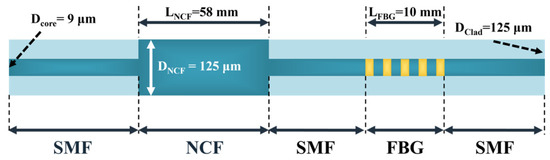
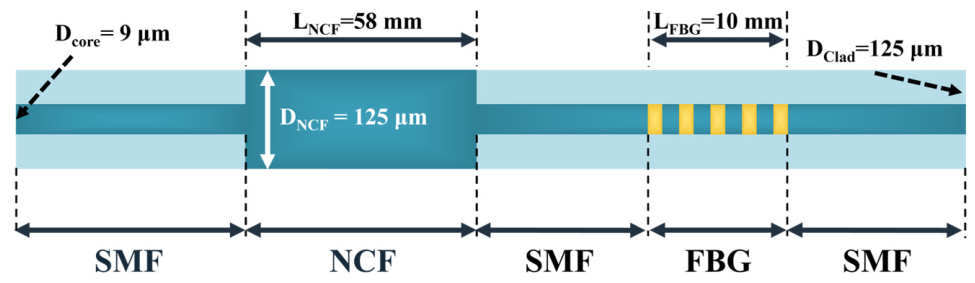
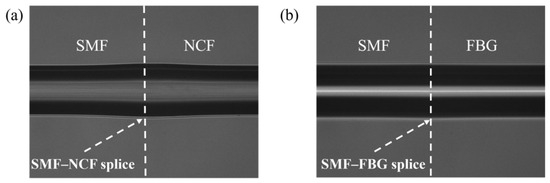
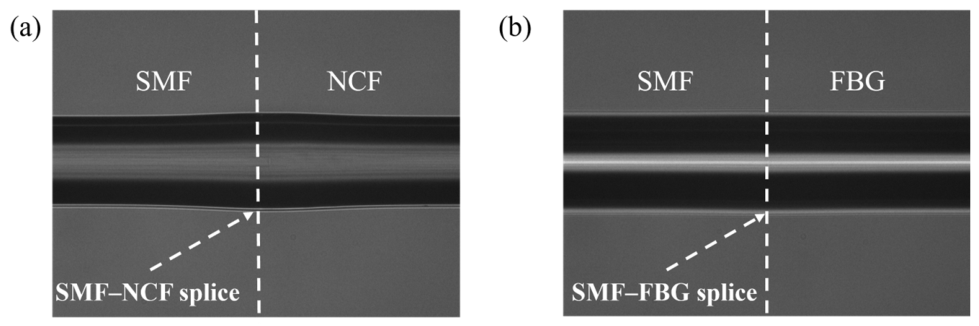
The structure of the designed cascaded SNS-FBG fiber-optic sensor is shown in Figure 1. The SNS interferometer is fabricated by fusion splicing a 58 mm-long segment of NCF (CL0/125-0/250) between two SMFs (G652D), both supplied by Yangtze Optical Fiber & Cable Co., Ltd., Wuhan, China. The SNS interferometer is used as the primary RI-sensitive channel; however, its interference dips are also affected by temperature variations owing to the thermo-optic effect and the temperature-dependent RI change in the surrounding liquid. An FBG (Wuxi Ruike Huatai Electronics Co., Ltd., Wuxi, China) is cascaded with the SNS structure and used as an RI-insensitive temperature reference channel for temperature compensation. The fabrication process of the sensor is as follows: First, the SMF (core/cladding = 9/125 μm) and NCF (diameter = 125 μm) are cleaved using a precision fiber cleaver (CT-32, Fujikura Ltd., Tokyo, Japan) to ensure flat and clean end faces. Then, a fusion splicer (66S+, Fujikura Ltd., Tokyo, Japan) is used to splice the NCF between two SMFs, forming the SNS fiber interferometer. Figure 2a shows a side-view image of the SMF–NCF splice captured by the imaging system of the fusion splicer, with the dashed line indicating the splice interface. The image demonstrates good fiber alignment and satisfactory splice quality. Subsequently, the prepared SNS structure is cascaded with an FBG (core/cladding = 9/125 μm) with a center wavelength of approximately 1560 nm, a grating length of 10 mm, a 3 dB bandwidth of approximately 0.2 nm, and a reflectivity value higher than 99%. Similarly, Figure 2b shows a side-view image of the SMF–FBG splice captured by the imaging system of the fusion splicer. Compared with tapered, etched, or complex micro/nanostructured sensors, the cascaded SNS-FBG structure used in this work only requires conventional fiber cleaving and fusion splicing, offering a simple fabrication process and good structural stability.
Figure 1.
Schematic diagram of the proposed sensor structure.
Figure 2.
Fabricated sensor. (a) Microscopic image of the SMF-NCF splice; (b) microscopic image of the SMF-FBG splice; the dashed lines indicate the splice interface.
When the incident light propagates from the input SMF into the NCF, several propagation modes are excited because of the diameter mismatch between the SMF core and the NCF cross section [17]. These modes possess different effective refractive indices and propagation constants, resulting in continuous phase accumulation during propagation along the NCF. At the output end, the modes are recoupled into the SMF, forming a transmission spectrum with interference peaks or dips. Since the outer surface of the NCF is directly exposed to the liquid under test, variations in the surrounding RI modify the mode-field distribution and the effective RI difference among the NCF modes is altered, leading to wavelength displacement of the SNS interference fringes, including both peaks and dips [18]. Therefore, the surrounding RI can be measured by monitoring the central wavelength shift in the SNS interference dip.
In the SNS structure, the output intensity generated by the interference between the fundamental mode and higher-order modes excited in the NCF can be expressed as [19]
where IB and IH correspond to the optical intensities associated with the fundamental mode and the higher-order mode, respectively, and Δφ describes their accumulated phase difference, which can be calculated as follows:
where Δneff = − is the effective refractive-index difference between the two modes, L is the NCF length, and λ0 is the center wavelength. When Δφ = (2m + 1)π, destructive interference occurs, and the wavelength of the m-th dip is given by
An FBG is a fiber device with a periodic RI modulation along the fiber axis. When broadband light is incident on the FBG, the wavelength satisfying the Bragg condition is reflected, producing a characteristic Bragg wavelength in the reflection spectrum. The corresponding Bragg wavelength is defined as [20]
where neff is the effective RI of the core mode in the grating region and Λ is the grating period. When an FBG is subjected to temperature variations, the Bragg wavelength shift can be expressed as [21]
where Pe is the effective photoelastic coefficient, ε is the axial strain, and α is the thermal expansion coefficient of the fiber. In this work, no axial strain is applied to the sensor. In addition, the FBG is not subjected to cladding etching or surface modification, and its guided mode is mainly confined within the fiber core. Therefore, variations in the surrounding liquid RI have little influence on the Bragg wavelength. As a result, the FBG can be used as an independent temperature sensing channel to compensate for the temperature cross-sensitivity in SNS-based RI measurement.
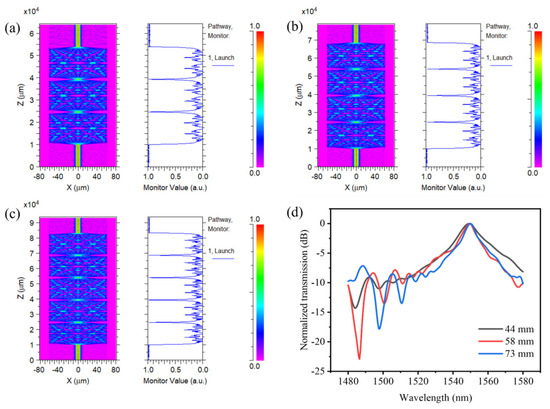
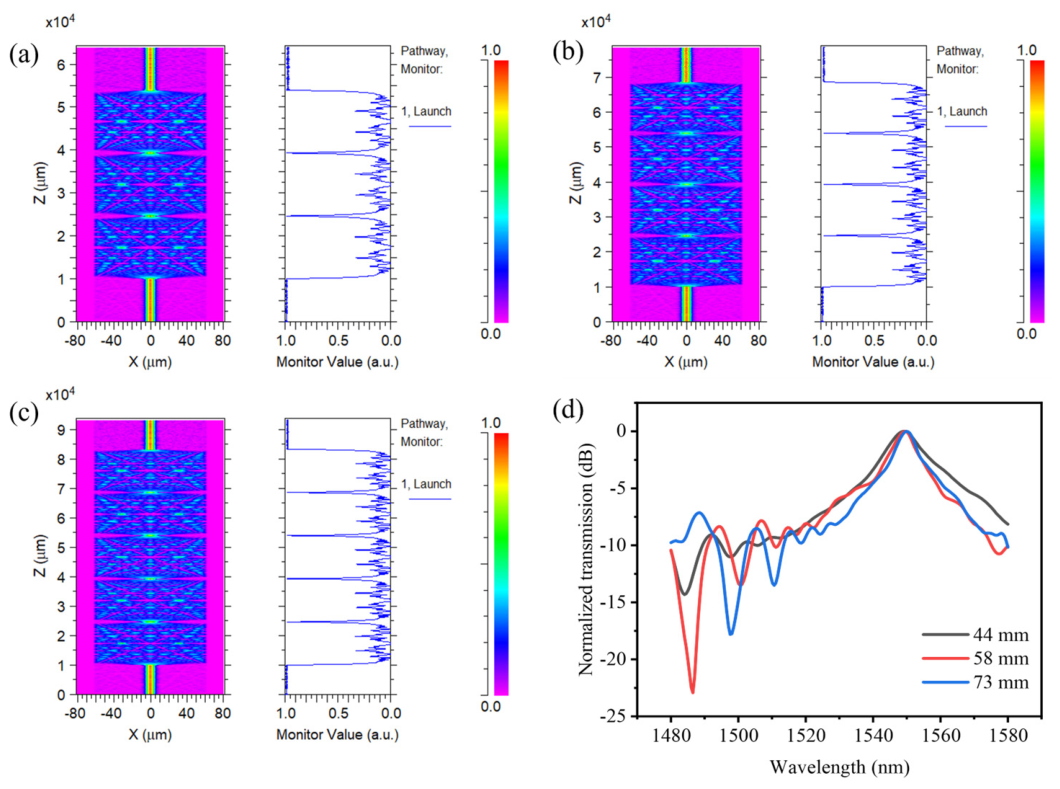
To analyze the influence of NCF length on the SNS interference characteristics, the beam propagation method is employed to model optical-field distribution and spectral response of the SNS structure [22]. Table 1 summarizes the main geometrical and optical parameters used in the BPM simulations. The RI values are determined based on the material parameters of silica near 1550 nm. The NCF and the SMF cladding are assigned the same RI, while the SMF core is assigned a higher RI to support single-mode transmission. The simulation results are shown in Figure 3a–c. When the input light enters the NCF from the SMF, multiple modes are excited because of mode mismatch. These modes coherently superpose in the NCF and form periodic focusing and divergence along the propagation direction, exhibiting typical MMI self-imaging characteristics. For NCF lengths of 44, 58, and 73 mm, the self-imaging period is essentially consistent. To further investigate the spectral response of the SNS structure, the transmission spectra of SNS structures with different NCF lengths are simulated over the wavelength range of 1480–1580 nm. As shown in Figure 3d, clear interference features and resonance dips are observed in the simulated spectra, confirming the MMI mechanism in the SNS structure. It should be noted that the simulated resonance dip positions show certain deviations from the experimentally measured spectra. These deviations mainly arise from the idealized assumptions in the model and practical factors in the actual device, including dimensional tolerances, deformation or misalignment at the splice interfaces, and additional losses. Therefore, the simulation is mainly used to explain the MMI mechanism and assist in the selection of the NCF length, whereas the sensing sensitivities are determined from the experimental spectra. Specifically, a shorter NCF leads to fewer interference fringes in the operating wavelength range and a larger free spectral range. In contrast, an excessively long NCF results in overly dense interference fringes, increasing the difficulty of spectral demodulation and potentially causing overlap with the characteristic wavelength of the FBG. In comparison, a 58 mm NCF produces clear interference fringes in the 1480–1580 nm band while maintaining good spectral separation from the FBG Bragg wavelength near 1560 nm.
Table 1.
Simulation parameters for the beam propagation method.
Figure 3.
Simulated optical-field distributions in NCFs with different lengths: (a) 44 mm; (b) 58 mm; (c) 73 mm; (d) simulated transmission spectra of SNS structures with different NCF lengths.
3. Experimental Results and Discussion
3.1. Experimental Setup
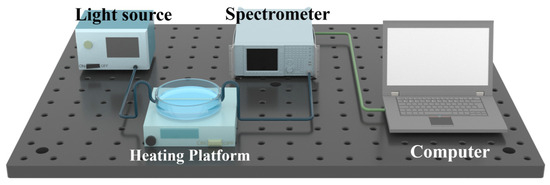
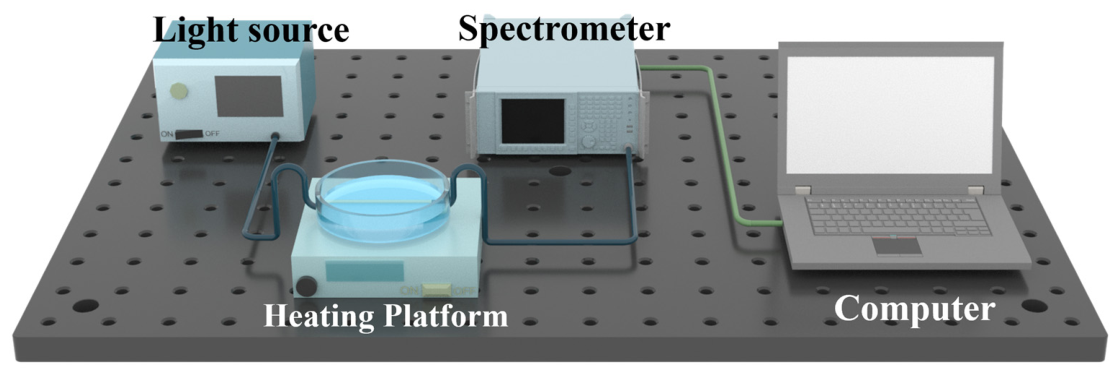
The experimental setup of the sensing system is shown in Figure 4. It consists of a broadband light source (SuperK COMPACT, NKT Photonics, Hamamatsu Photonics, Hamamatsu, Japan), an optical spectrum analyzer (OSA; AQ6370E, Yokogawa, Tokyo, Japan), a temperature-controlled stage, and a computer. During the experiment, the light emitted from the broadband source is injected into the SNS interferometer cascaded with the FBG. At the output side, the sensor is coupled to an OSA to enable real-time acquisition and observation of the transmission spectrum. The SNS sensing region and the FBG are placed together on the temperature-controlled stage to provide a stable and controllable temperature environment. By recording the shifts in the central wavelengths of the SNS interference dips and the FBG resonance peak, the sensing responses to RI and temperature changes are evaluated.
Figure 4.
Schematic diagram of the experimental setup.
To obtain standard solutions with different RIs, glucose aqueous solutions with different mass fractions are used as RI calibration media. Glucose aqueous solutions exhibit a monotonic and stable increase in RI with increasing mass fraction and are easy to prepare; therefore, they are widely used as calibration media for fiber-optic RI sensors [23,24,25]. In the experiment, seven groups of glucose aqueous solutions are prepared using the mass-fraction method. The total mass of each solution is fixed at 100 g. An electronic balance with an accuracy of 0.001 g (MA204E, Mettler Toledo, Greifensee, Switzerland) is used to weigh the corresponding masses of anhydrous glucose and deionized water. After complete dissolution, the solutions are sealed and allowed to stand. After each solution temperature stabilizes at 25 °C, the RI of each solution is determined with an Abbe refractometer to ensure accurate RI calibration. The obtained RI range is 1.332–1.392 RIU. The preparation parameters and RI calibration results are listed in Table 2.
Table 2.
Preparation parameters and measured RI values of the calibration solutions.
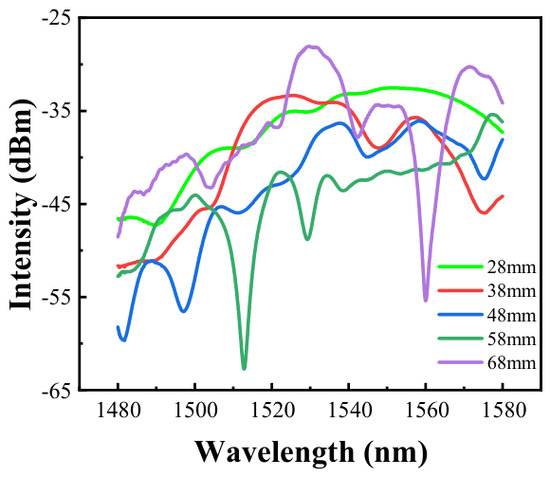
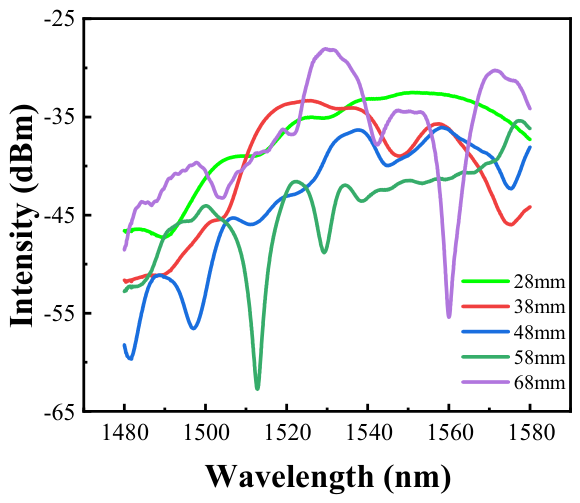
The NCF length is a key parameter affecting the MMI spectral characteristics of the SNS structure. To determine the suitable NCF length for the experimental system, SNS structures with NCF lengths of 28, 38, 48, 58, and 68 mm are fabricated, and their transmission spectra are measured in pure water at 25 °C, as shown in Figure 5. The results show that when L = 28 mm, only a few interference fringes appear in the operating wavelength band, and complete and clear interference dips are difficult to obtain. For L = 38 and 48 mm, interference features can be observed, but the extinction ratios of the dips are relatively low, which is unfavorable for subsequent wavelength demodulation. When L = 58 mm, clear interference dips are obtained in the 1480–1580 nm wavelength band, and good spectral separation is maintained from the FBG Bragg wavelength near 1560 nm. When L = 68 mm, the interference fringes become denser and the spacing between adjacent dips decreases, which may increase the difficulty of wavelength identification and dual-parameter demodulation. Considering the clarity of the interference fringes, extinction ratio, and spectral separation from the FBG feature, an NCF length of 58 mm is selected for the following experiments.
Figure 5.
Transmission spectra of SNS structures fabricated with five NCF lengths (28, 38, 48, 58, and 68 mm), measured in pure water at 25 °C.
3.2. Refractive-Index Response
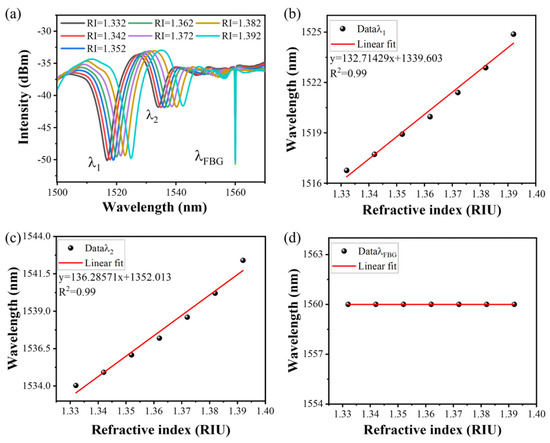
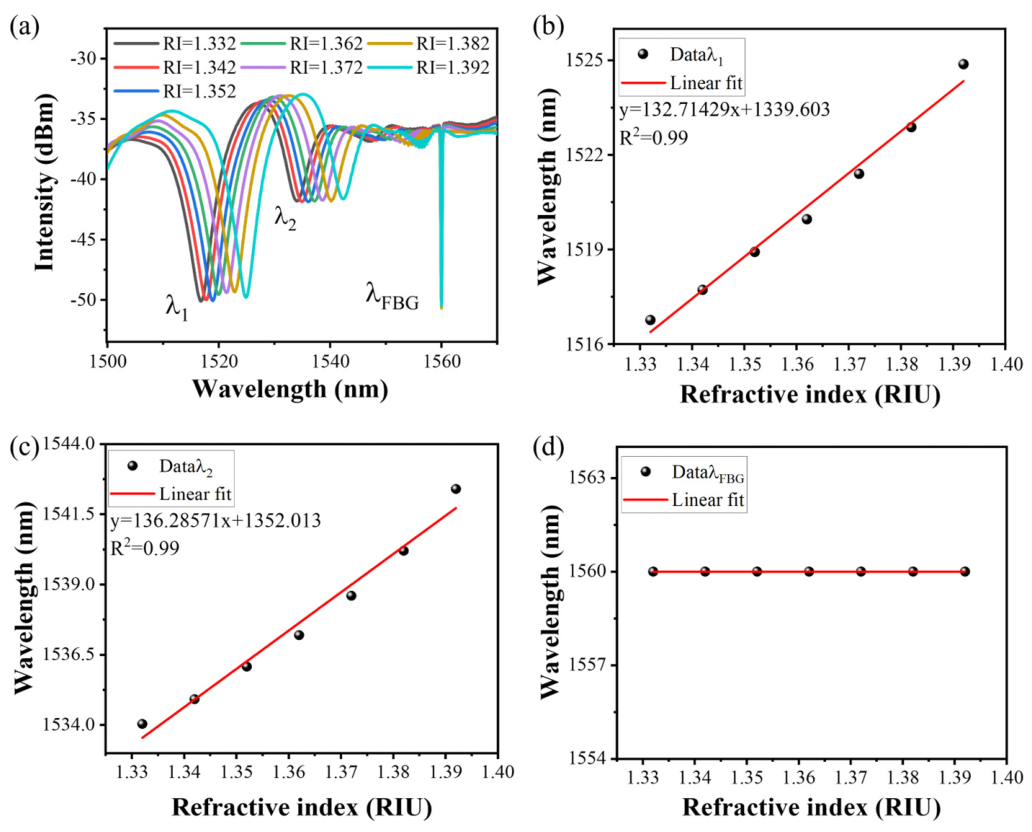
The RI response is evaluated by gradually immersing the cascaded SNS-FBG sensor in glucose aqueous solutions with calibrated RI values ranging from 1.332 to 1.392 RIU. During the measurement, the ambient temperature is kept constant at 25 °C. The transmission spectra are recorded after stabilization, and the results are shown in Figure 6a. λ1 and λ2 denote the two selected resonance dips in the SNS interference spectrum, and their wavelength positions are defined as the wavelengths corresponding to the minimum transmission intensity within the respective local spectral ranges recorded by the OSA. As the surrounding RI increases from 1.332 to 1.392 RIU, the wavelengths of the SNS interference dips λ1 and λ2 both red-shift. This behavior is attributed to the RI-induced modification of the boundary condition of the NCF and the effective refractive-index difference between guided modes, which changes the phase-matching condition of the MMI. Linear fitting is performed for the center wavelengths of the two SNS interference dips, as shown in Figure 6b,c. The RI sensitivities of the two interference dips are 132.71 nm/RIU and 136.29 nm/RIU, respectively, with R2 values of 0.99 for both dips, indicating a good linear RI response of the SNS structure. By comparison, the FBG resonance wavelength λFBG exhibits only a negligible variation when the sensor is exposed to solutions with different refractive indices, as illustrated in Figure 6d. This result indicates that the FBG has an extremely weak response to changes in the ambient RI. Therefore, in the cascaded sensing structure, the SNS interference dips can be used as the RI-sensitive channel, whereas the FBG can serve as the reference channel for temperature compensation.
Figure 6.
RI sensing performance: (a) transmission spectra at various RI values; (b,c) RI-dependent wavelength fitting results of SNS interference dips 1 and 2, respectively; (d) variation in the FBG peak center wavelength with RI.
3.3. Temperature Response
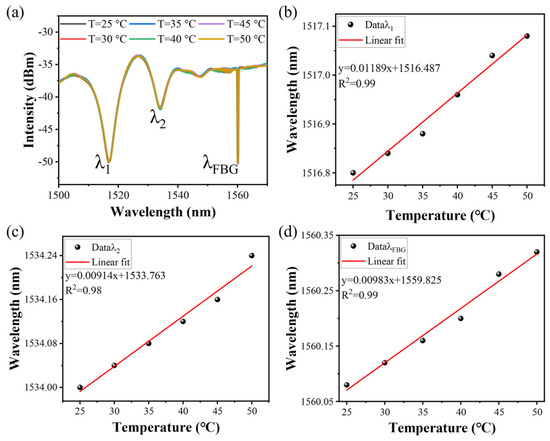
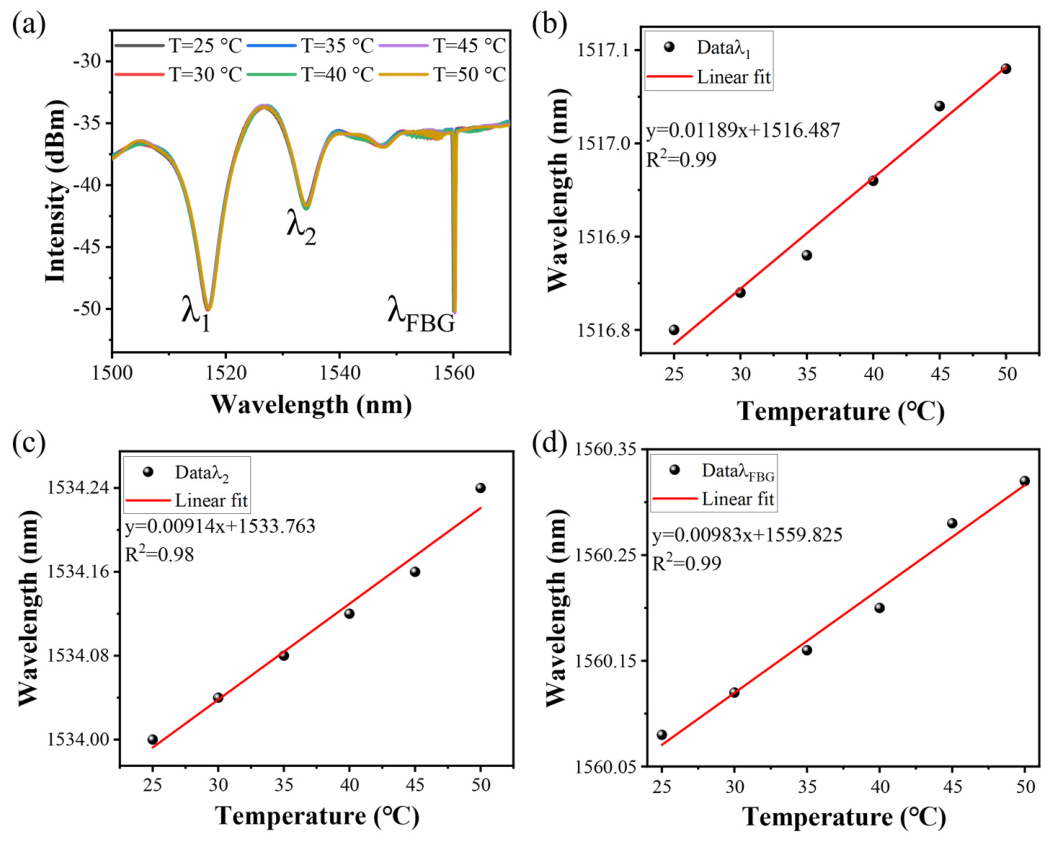
To analyze the temperature response of the sensor, the same solution with an RI of 1.332 RIU at 25 °C is used, and the entire SNS-FBG structure is placed on a temperature-controlled stage. It should be noted that the RI of aqueous solutions decreases with increasing temperature. Therefore, the measured wavelength shift in the SNS interference dip represents a combined temperature response, including both the intrinsic thermal response of the fiber structure and the contribution induced by the temperature-dependent RI variation in the surrounding liquid [26]. The temperature is gradually raised from 25 to 50 °C in 5 °C increments. At each temperature point, the sensor is allowed to stabilize for approximately 5 min before the transmission spectrum is recorded. The corresponding spectral evolution is presented in Figure 7a.
Figure 7.
Temperature sensing performance: (a) transmission spectra under various temperatures; (b,c) temperature-dependent wavelength fitting results of SNS interference dips 1 and 2, respectively; (d) variation in the FBG peak center wavelength with temperature.
With increasing temperature, both the SNS interference dips and the FBG Bragg wavelength shift toward longer wavelengths. For the SNS structure, temperature variations affect both the thermo-optic effect and the thermal expansion effect of the fiber material, thereby changing the modal effective refractive-index difference and the phase-matching condition in the NCF, ultimately leading to wavelength shifts in the interference dips. Linear fitting is performed for the wavelengths λ1 and λ2 of the two SNS interference dips, with the results displayed in Figure 7b,c. The corresponding temperature sensitivities are 11.89 pm/°C and 9.14 pm/°C, with R2 values of 0.99 and 0.98, respectively. Meanwhile, the temperature sensitivity of the FBG characteristic peak λFBG is 9.83 pm/°C. Because the FBG is approximately insensitive to the surrounding RI while exhibiting a stable linear response to temperature, it can be used as a temperature reference unit to compensate for the temperature cross-sensitivity in SNS-based RI measurement. It should be noted that the RI and temperature response data presented in Figure 6 and Figure 7 are obtained from single forward quasi-static measurements. These results are mainly used to characterize the static response of the sensor and verify the feasibility of simultaneous dual-parameter sensing.
3.4. Sensitivity Matrix and Dual-Parameter Demodulation
The experimental results indicate that the wavelength displacement of the SNS interference dip is influenced by both the surrounding RI and temperature, whereas the FBG characteristic peak λFBG is predominantly affected by temperature and exhibits negligible sensitivity to the surrounding RI. To realize dual-parameter demodulation of RI and temperature, the SNS interference dip λ2 with higher RI sensitivity and the FBG characteristic peak λFBG are selected to establish the sensitivity matrix. To maintain unit consistency, the temperature sensitivities measured in pm/°C are converted to nm/°C. Thus, the matrix can be expressed as [27]
where Δλ2 and ΔλFBG denote the wavelength variations in the SNS interference dip λ2 and the FBG resonance peak λFBG, respectively. Meanwhile, ΔRI and ΔT correspond to the variations in the surrounding RI and temperature, respectively. After matrix inversion, these two parameters can be determined as follows:
Thus, simultaneous demodulation of RI and temperature can be achieved. This result demonstrates that the cascaded SNS-FBG structure can utilize the temperature-reference function of the FBG to compensate for temperature-induced drift in the SNS RI sensing process, thereby improving the accuracy of RI measurement. Table 3 compares the performance of the proposed sensor with typical fiber-optic sensors for simultaneous RI and temperature measurement. It should be noted that the sensor resolutions are calculated using R = Δλmin/Ssensitivity, where Ssensitivity represents the sensitivity to the corresponding measurand. To facilitate comparison, Δλmin, defined as the minimum wavelength resolution of the OSA, is uniformly taken as 0.02 nm. Compared with high-sensitivity sensors relying on complex processes such as tapering or etching, the proposed cascaded SNS-FBG sensor maintains the original fiber diameter and can be fabricated using only standard cleaving and fusion-splicing processes, offering advantages in fabrication simplicity, and mechanical stability. Meanwhile, the sensor combines competitive RI sensitivity, a compact sensing structure, and relatively low temperature cross-sensitivity. In addition, temperature-compensated RI measurement can be achieved by using the RI-insensitive FBG channel. Therefore, the proposed sensor is suitable for liquid RI detection and related temperature-compensated sensing applications. Although the present sensor is implemented using silica fibers in the near-infrared region, the cascaded SNS-FBG concept could, in principle, be extended to fluoride-fiber platforms operating in the mid-infrared (MIR) region. MIR operation enables access to fundamental molecular vibrational absorption bands, thereby providing chemical selectivity beyond conventional RI measurement, as recently demonstrated in MIR fluoride-fiber sensing devices [28]. In future work, through further optimization of the fiber structure and sensing system, the proposed sensing scheme is expected to be extended to fluoride-fiber platforms operating in the MIR region, thereby improving both sensitivity and chemical selectivity.
Table 3.
Performance comparison between the proposed sensor and typical RI-temperature fiber-optic sensors.
4. Conclusions
In this work, a dual-parameter fiber-optic sensor is developed for RI and temperature detection by cascading an optimized 58 mm SNS interferometric section with a 1560 nm FBG. Through simulation analysis and spectral comparison of SNS structures with different NCF lengths, the 58 mm NCF is selected by considering the interference-fringe visibility, free spectral range, and spectral separation from the FBG Bragg wavelength. Experimental results show that, in the RI range of 1.332–1.392 RIU, the RI sensitivities of the two SNS interference dips are 132.71 nm/RIU and 136.29 nm/RIU, respectively. During the temperature-response measurement, the two SNS interference dips exhibit temperature sensitivities of 11.89 pm/°C and 9.14 pm/°C, respectively, whereas the FBG shows a corresponding sensitivity of 9.83 pm/°C. Moreover, the FBG exhibits negligible sensitivity to changes in the ambient RI. Based on the measured sensitivity coefficients, a dual-parameter demodulation matrix is established to separate RI and temperature variations, enabling temperature-compensated RI sensing. The proposed sensor has the advantages of simple fabrication, good mechanical strength, and no requirement for tapering, etching, or other special processing. Therefore, it shows promising application potential in dual-parameter sensing scenarios such as food quality monitoring, industrial fermentation, and water salinity detection.
Author Contributions
Conceptualization, H.L. and H.W.; methodology, B.C., Y.H. and Y.W.; software, Y.H. and Y.W.; validation, Y.H. and Y.W.; formal analysis, B.C.; investigation, B.C. and H.W.; resources, H.L. and H.W.; data curation, B.C.; writing—original draft preparation, H.L. and H.W.; writing—review and editing, B.C., Y.H., Y.W., H.L. and H.W.; visualization, B.C. and H.W.; supervision, H.L. and H.W.; project administration, Y.H. and H.W.; funding acquisition, H.L. and H.W. All authors have read and agreed to the published version of the manuscript.
Funding
The authors gratefully acknowledge the Foundation for Cultivated Young Talents of Fujian Province, China (2025350430); Science foundation of Jimei University (ZQ2024078); Science foundation of Jimei University (ZQ2024082).
Institutional Review Board Statement
Not applicable.
Informed Consent Statement
Not applicable.
Data Availability Statement
The data presented in this study are included in the article.
Conflicts of Interest
Author Yudong Wang was employed by the Xiamen Branch, China Mobile Communications Group Fujian Co., Ltd. The remaining authors declare that the research was conducted in the absence of any commercial or financial relationships that could be construed as a potential conflict of interest.
Abbreviations
The following abbreviations are used in this manuscript:
| SNS | Single-mode–no-core–single-mode |
| MMI | Multimode interference |
| FBG | Fiber Bragg grating |
| RI | Refractive index |
| NCF | No-core fiber |
| SMF | Single-mode fiber |
| NFN | No-core fiber–fiber Bragg grating–no-core fiber |
| FPI | Fabry–Perot interferometer |
| FPI–FBG | Fabry–Perot interferometer–fiber Bragg grating |
| SNS–FBG | Single-mode–no-core–single-mode–fiber Bragg grating |
References
- Wu, Q.; Semenova, Y.; Yan, B.; Ma, Y.; Wang, P.; Yu, C.; Farrell, G. Fiber refractometer based on a fiber Bragg grating and single-mode–multimode–single-mode fiber structure. Opt. Lett. 2011, 36, 2197–2199. [Google Scholar] [CrossRef] [Scilit] [PubMed]
- Zhao, Y.; Cai, L.; Li, X.-G.; Meng, F.-C. Liquid concentration measurement based on SMS fiber sensor with temperature compensation using an FBG. Sens. Actuators B Chem. 2014, 196, 518–524. [Google Scholar] [CrossRef] [Scilit]
- Li, L.; Xia, L.; Wuang, Y.; Ran, Y.; Yang, C.; Liu, D. Novel NCF-FBG interferometer for simultaneous measurement of refractive index and temperature. IEEE Photon. Technol. Lett. 2012, 24, 2268–2271. [Google Scholar] [CrossRef] [Scilit]
- Li, J. A review: Development of novel fiber-optic platforms for bulk and surface refractive index sensing applications. Sens. Actuators Rep. 2020, 2, 100018. [Google Scholar] [CrossRef] [Scilit]
- Sequeira, F.; Duarte, D.; Bilro, L.; Rudnitskaya, A.; Pesavento, M.; Zeni, L.; Cennamo, N. Refractive index sensing with D-shaped plastic optical fibers for chemical and biochemical applications. Sensors 2016, 16, 2119. [Google Scholar] [CrossRef] [Scilit] [PubMed]
- Wolfbeis, O.S. Fiber-optic chemical sensors and biosensors. Anal. Chem. 2006, 78, 3859–3874. [Google Scholar] [CrossRef] [Scilit] [PubMed]
- Elsherif, M.; Salih, A.E.; Gutiérrez Muñoz, M.; Alam, F.; AlQattan, B.; Antonysamy, D.S.; Zaki, M.F.; Yetisen, A.K.; Park, S.; Wilkinson, T.D.; et al. Optical fiber sensors: Working principle, applications, and limitations. Adv. Photon. Res. 2022, 3, 2100371. [Google Scholar] [CrossRef] [Scilit]
- Xiao, Y.-Y.; Cai, X.-P.; Chen, H. Simultaneous measurement of temperature and refractive index based on microfiber knot resonators and FBGs. Optik 2019, 191, 116–120. [Google Scholar] [CrossRef] [Scilit]
- Shu, X.; Gwandu, B.A.L.; Liu, Y.; Zhang, L.; Bennion, I. Sampled fiber Bragg grating for simultaneous refractive-index and temperature measurement. Opt. Lett. 2001, 26, 774–776. [Google Scholar] [CrossRef] [Scilit] [PubMed]
- Kersey, A.D.; Davis, M.A.; Patrick, H.J.; LeBlanc, M.; Koo, K.P.; Askins, C.G.; Putnam, M.A.; Friebele, E.J. Fiber grating sensors. J. Light. Technol. 1997, 15, 1442–1463. [Google Scholar] [CrossRef] [Scilit]
- Xiao, G.; Zhang, K.; Yang, Y.; Yang, H.; Guo, L.; Li, J.; Yuan, L. Graphene oxide sensitized no-core fiber step-index distribution sucrose sensor. Photonics 2020, 7, 101. [Google Scholar] [CrossRef] [Scilit]
- Liu, X.; Zhang, X.; Liu, Y.; Liu, Z.; Peng, W. Multi-point fiber-optic refractive index sensor by using coreless fibers. Opt. Commun. 2016, 365, 168–172. [Google Scholar] [CrossRef] [Scilit]
- Razali, N.M.; Lokman, M.Q.; Zuikafly, S.N.F.; Ahmad, F.; Abdul Rahman, M.A.; Yahaya, H.; Harun, S.W. No-core fiber by self-image length optimization for optical based refractive index sensor. Opt. Fiber Technol. 2022, 74, 103133. [Google Scholar] [CrossRef] [Scilit]
- Bai, Y.; Yin, B.; Liu, C.; Liu, S.; Lian, Y.; Jian, S. Simultaneous measurement of refractive index and temperature based on NFN structure. IEEE Photon. Technol. Lett. 2014, 26, 2193–2196. [Google Scholar] [CrossRef] [Scilit]
- Liu, Y.; Xie, S.; Zheng, Y.; Yang, X. Simultaneous measurement of refractive index and temperature based on tapered no-core fiber cascaded with a fiber Bragg grating. Results Opt. 2022, 9, 100300. [Google Scholar] [CrossRef] [Scilit]
- Liu, Y.-G.; Liu, X.; Zhang, T.; Zhang, W. Integrated FPI-FBG composite all-fiber sensor for simultaneous measurement of liquid refractive index and temperature. Opt. Lasers Eng. 2018, 111, 167–171. [Google Scholar] [CrossRef] [Scilit]
- Wang, Q.; Farrell, G.; Yan, W. Investigation on single-mode–multimode–single-mode fiber structure. J. Light. Technol. 2008, 26, 512–519. [Google Scholar] [CrossRef] [Scilit]
- Oliveira, R.; Aristilde, S.; Osório, J.H.; Franco, M.A.R.; Bilro, L.; Nogueira, R.N.N.; Cordeiro, C.M.B. Intensity liquid level sensor based on multimode interference and fiber Bragg grating. Meas. Sci. Technol. 2016, 27, 125104. [Google Scholar] [CrossRef] [Scilit]
- Zhang, J.; Li, Y.Q. High-sensitivity refractive index sensor based on FMF-CLF-FMF optical fiber structure. J. Appl. Opt. 2023, 44, 462–468. [Google Scholar] [CrossRef] [Scilit]
- Rath, S.; Koushik, S.S.S.D.; Nanjunda, S.B. Probing non-radiative quantum relaxation in fluorophores using an optical fiber Bragg grating photothermal sensor. Commun. Chem. 2026, 9, 78. [Google Scholar] [CrossRef] [Scilit] [PubMed]
- Liu, Z.; Tam, H.-Y. Industrial and medical applications of fiber Bragg gratings (Invited Paper). Chin. Opt. Lett. 2016, 14, 120007. [Google Scholar] [CrossRef] [Scilit]
- Yang, W.; Zhang, S.; Geng, T.; Li, L.; Li, G.; Gong, Y.; Zhang, K.; Tong, C.; Lu, C.; Sun, W.; et al. High sensitivity refractometer based on a tapered-single mode-no core-single mode fiber structure. Sensors 2019, 19, 1722. [Google Scholar] [CrossRef] [Scilit] [PubMed]
- Mar-Abundis, N.; Fuentes-Rubio, Y.A.; Domínguez-Cruz, R.F.; Guzmán-Sepúlveda, J.R. Sugar detection in aqueous solution using an SMS fiber device. Sensors 2023, 23, 6289. [Google Scholar] [CrossRef] [Scilit] [PubMed]
- Novais, S.; Ferreira, C.I.A.; Ferreira, M.S.; Pinto, J.L. Optical fiber tip sensor for the measurement of glucose aqueous solutions. IEEE Photon. J. 2018, 10, 6803609. [Google Scholar] [CrossRef] [Scilit]
- Fang, Y.-L.; Wang, C.-T.; Chiang, C.-C. A small U-shaped bending-induced interference optical fiber sensor for the measurement of glucose solutions. Sensors 2016, 16, 1460. [Google Scholar] [CrossRef] [Scilit] [PubMed]
- Alberto, N.J.; Marques, C.A.; Pinto, J.L.; Nogueira, R.N. Three-parameter optical fiber sensor based on a tilted fiber Bragg grating. Appl. Opt. 2010, 49, 6085–6091. [Google Scholar] [CrossRef] [Scilit]
- Zhao, C.-L.; Yang, X.; Demokan, M.S.; Jin, W. Simultaneous temperature and refractive index measurements using a 3–slanted multimode fiber Bragg grating. J. Light. Technol. 2006, 24, 879–883. [Google Scholar] [CrossRef] [Scilit]
- Anelli, F.; Venck, S.; Cozic, S.; Prudenzano, F. S-Tapered Fluoride Optical Fiber for Refractive Index Sensing in the Mid-Infrared. J. Light. Technol. 2025, 43, 5982–5988. [Google Scholar] [CrossRef] [Scilit]
- Liu, Q.; Wang, S.-W.; Fu, X.-H.; Fu, G.-W.; Jin, W.; Bi, W.-H. Refractive index insensitive temperature sensor based on waist-enlarged few mode fiber bitapers. Optoelectron. Lett. 2017, 13, 25–28. [Google Scholar] [CrossRef] [Scilit]

Disclaimer/Publisher’s Note: The statements, opinions and data contained in all publications are solely those of the individual author(s) and contributor(s) and not of MDPI and/or the editor(s). MDPI and/or the editor(s) disclaim responsibility for any injury to people or property resulting from any ideas, methods, instructions or products referred to in the content. |
© 2026 by the authors. Licensee MDPI, Basel, Switzerland. This article is an open access article distributed under the terms and conditions of the Creative Commons Attribution (CC BY) license.