


Abstract
To activate conscious reflection regarding personal identity and identity-building processes in our daily lives is an increasing social concern. With this aim, we designed an Alternate Reality Game that invites participants to collectively explore these themes. Participants played with a prototype, evoking themes of identity through emergent dynamics from gameplay and interpersonal interactions. We analyzed participants’ appropriation of the prototype through logged activity, direct observation and interviews. The identified dynamics enabled iterative redesign and further exploration of the players’ interaction and behaviors. From this process, we synthesized four design insights as our main findings that may guide further research in the field: (1) how to explore design–play–reflect as a co-design process supported on individual appropriation, (2) how ARGs generate reflective social phenomena, such as varied social identity and power narratives, (3) how ARG design can open doors to balance power dynamics, and (4) how ARG designs can become generative social theories. Our main contributions, alongside the designed prototype, are these four insights, and their potential scalability to other ARG designs that seek to provoke social phenomena and collaborative interventions.
1. Introduction
It is more important than ever within our society to activate a conscious and active reflection on personal identity, processes of identity-building, the third parties involved and subsequent dangers. From this, we propose an Alternate Reality Game (ARG) experience that invites its participants to collectively reflect about and discuss these themes. ARGs have a history as spaces for reflection on real-world problems, such as the case with World Without Oil [1]. As a type of transmedia storytelling game played across multiple channels, ARGs are usually ubiquitous to the players’ daily lives, blurring the lines between the game and reality [2,3,4].
Our goal was to create an ARG experience as a “social laboratory” [5], leading participants to reflect upon the aforementioned themes through its narrative layer, core mechanics and emergent dynamics. These dynamics would result from participants’ interactions, becoming co-creators of the experience by iterative, social exchanges through the prototype. To evaluate our design proposal, we developed a prototype through an iterative Research Through Design (RtD) approach [6] through six rehearsals. We conducted a content analysis of the rehearsals, through direct observation, automated logging, and participant interviews (individually and in-group). These allowed us to analyze how participants appropriated the experience and the emergent interaction dynamics, from which we synthesized four design insights: (1) how to explore design–play–reflect as a co-design process supported on individual appropriation, (2) how ARGs generate reflective social phenomena, such as varied social identity and power narratives, (3) how ARG design can open doors to balance power dynamics, and (4) how ARG designs can become generative social theories. This study represents a solid preliminary experience into gathering design knowledge regarding ARGs’ potential as social transformational tools, which allow the player to be a co-creator of social transformation.
The article is structured as follows: Section 1 introduces the main theme and origins of ARGs, reflecting on its history and prior examples; Section 2 introduces the developed prototype as our main material of research, used as an iterative process of RtD in five rehearsals (whose protocol is also explained); Section 3 focuses on the content analysis process and the obtained results from the rehearsals, the individual and group interviews, and final open feedback; and Section 4 presents the discussion and retrieved design insights, concluding with limitations and future work that this study opens for further research.
1.1. The Alternate Reality Games
Although it may be impossible to pinpoint the exact origin of the ARG genre, several projects commonly described as ARGs—as well as some boundary projects—can be seen as milestones in the genre’s development. These include (1) Ong’s Hat in the 80s [7] as a piece of collaborative fiction, considered “new media” at the time; (2) ILoveBees [8], whose widespread attention reached both mainstream audiences and academic researchers; (3) World Without Oil [1], aiming to enact social change and question real world problems regarding sustainability; and (4) Conspiracy for Good [9], aiming to fight social and environmental injustice.
1.2. Origins of the ARG Genre
Adam Martin [10] stated that ARGs can be many things, “from the latest innovation in interactive storytelling to a new form of ultra-realistic video game”. An ARG is commonly described as a form of transmedia storytelling game, where players collaboratively solve puzzles and piece together a narrative distributed across multiple channels by the game’s creators. This process often encompasses using the world around them for the experience, thus blurring the lines between reality and fiction. These channels can be physical (phone calls, mail, books, billboards) as well as digital (web pages, forums, videos, emails) [2,3,4]. The narrative can be pre-defined, or a collaborative effort, with puppetmasters adjusting their initial plans based on player action and feedback [3]. A principle that is common to many ARGs is their attempt at disguising that they are a game, instead presenting themselves as part of the real world (the so-called “This Is Not A Game” philosophy [11]). To make progress, players communicate and collaborate amongst themselves, sharing information, interpretations and conjectures to make sense of the narrative [2,4]. Players often construct their own means of communication, mainly through web-based forums [3]. The potential of ARGs stems from the emergent social dynamics of inter-player relationships to their self-organization and management as an emergent community.
Projects such as World Without Oil [1] and Brooke Thompson’s SMB: Missed Steaks (around 2005) [10] have proven potential for social awareness and change. These examples led the players to ask questions about the real world by superimposing a layer of fiction over it, while showing players the value of collaborative effort and open discourse in finding solutions to a problem. ARGs can thus be important tools to make players realize their real-world agency through their own agency within the fictional game world. The boundaries of the “magic circle” [12] protect players from real-world consequences, but also create a significant gap between reality and fiction. That is where ARGs excel: their proximity to reality makes the actions taken by the players feel more tangible and transferable to real-life situations, using “their own experience and knowledge rather than playing the role of a fictional character” [13].
1.3. ARGs and Social Transformation
ARGs are also very adaptable regarding their themes. Despite tending towards conspiratorial plots and mysteries [14], there is space for thematic variety: in World Without Oil [1], for example, players were asked to imagine themselves in a world facing an oil crisis. ARGs often require figuring out identities and relationships, understanding how events are related and how they shape those involved. The frequent impossibility of meeting characters face-to-face sparks in players a desire to characterize them and understand their place in the fictional world. This mystery provokes questioning of their motivations and values, but also rethinking assumptions discovered during this process.
This process goes interestingly against what is common nowadays regarding identity personalization within the web environment. According to Reviglio, personalization creates “filter bubbles and strengthen[s] echo chambers that restrain the exposure to diverse, challenging and serendipitous information” [15]. This shields us from facing questions such as “who am I? or who are you? or who is she?” [16], which hinders reflection regarding personal identity (one’s behavior, presentation and beliefs) [16], how it is built, and how third parties may be exploiting it. Kellner [17], although stating that modern identity (at a personal level) is much more multifaceted, transitory, and self-reflexive, also states that it is still circumscribed by a combination of roles and norms: nationality, ethnicity, profession (and the hierarchies within), family relations, political views, religion, sexuality, fandoms, etc. We will explore the descriptors of these roles within the presented game design proposal as ‘labels’.
We believe that ARGs become a potential and suitable space to make players question those processes of sensemaking and identity building, how they present themselves to others, and how their interpersonal interactions shape the world around them.
2. Materials and Methods
2.1. The “Bubbles” Design Case
The main research question that guided this project was: how could we iteratively design an ARG experience that raises questions of individual and collective identity? We intended for the gameplay experience to lead the participants to question and discuss these themes, while also co-designing the prototype. This process would eventually lead them to become more aware of their potential to enact change in the real world, transcending social paradigms in the long-term.
2.2. Research Methodology
We followed a Research Through Design (RtD) approach [6], by which design researchers iteratively create a series of artifacts. We conceive these artifacts “through an active process of ideating, iterating, and critiquing potential solutions” [6] towards a resolution. Through this approach, design researchers can discover opportunities for new technological developments and improvements, and the problem framing done during the artifacts’ conception can help to “identify important gaps in behavioral theory and models” [6].
2.3. Design Proposal and Process
We focused on designing a web-based prototype that works as a standalone ARG experience centered on the themes of identity. We designed the mechanics and narrative to be very open-ended, to potentiate the emergence of narratives and dynamics based on participant interaction and feed subsequent iterations. We aimed for dynamics that could lead to collective reflection and instigate participation. Simultaneously, we developed a narrative layer that would tie the mechanics and justify them in-universe, while also presenting instigating in-narrative scenarios and dilemmas.
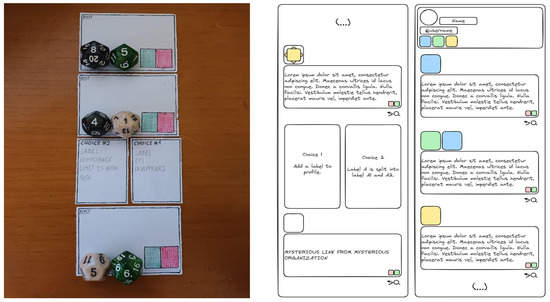
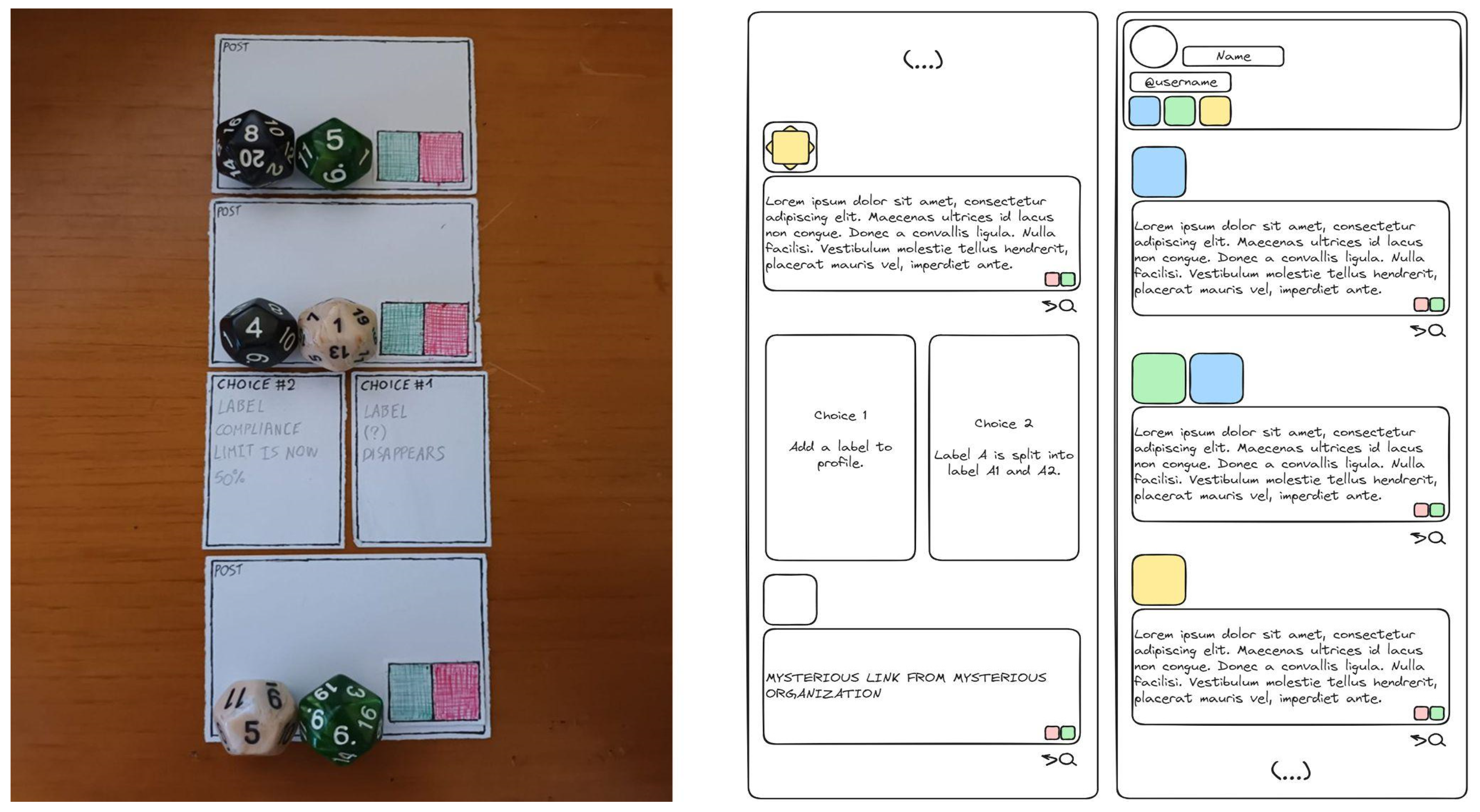
The final experience consists of an online, fictional social media platform—“Bubbles!” (Figure 1)—whose interactions represent abstract versions of social actions: agreement/disagreement, sharing of opinions, judgment, reconciliation (that includes the acceptance of different perspectives and mutual learning), categorization, etc. Following this line of thought, we assume the concept of “identity bubbles” as emergent filter bubbles [15], shaped by the labels that change through these social actions. The behaviors and topics discussed by the participants with these labels, in turn, might create an identity for that bubble.
Figure 1.
Left: first paper prototype; right: early interface sketches for the platform (showing the color-coded labels).
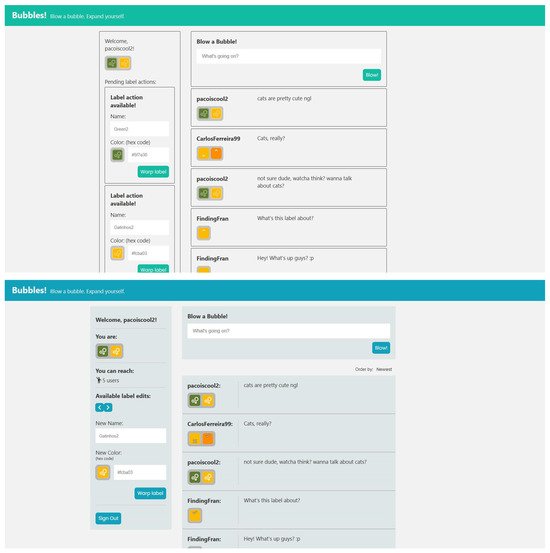
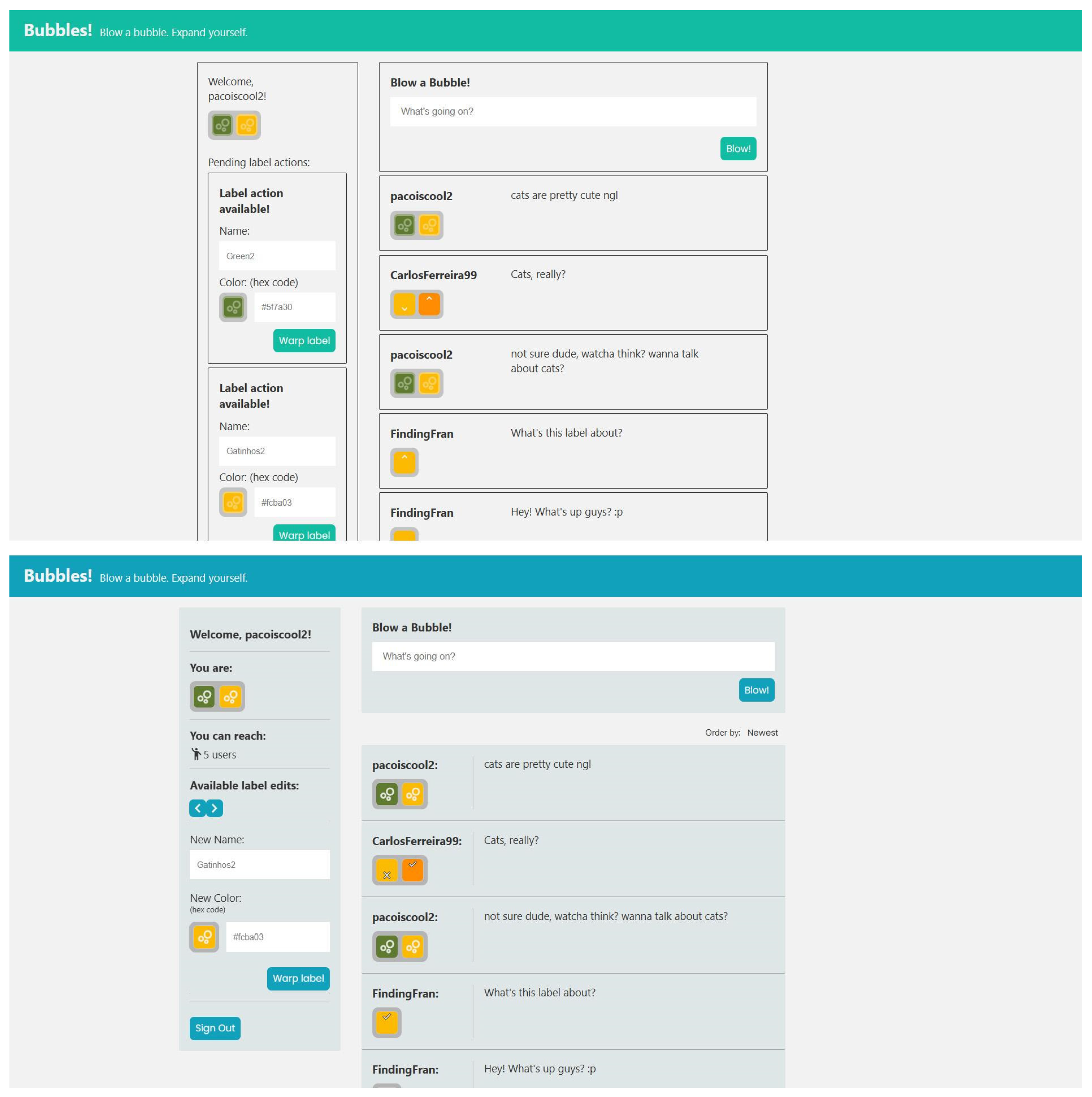
Once registered, each participant is assigned two labels (out of three), and heads to a feed of posts (Figure 2) from other users with at least one label in common. From the onset, there are already a series of posts from fictional users, which constitutes the initial narrative layer.
Figure 2.
Top: the main feed page and its features, as of Rehearsal 0; bottom: the same elements as of Rehearsal 5.
For each post in the feed, participants can upvote or downvote each of its labels: if they become the top scorer of one, that label is highlighted and they are allowed to change its name and color (paralleling celebrities/influencers); if their score lowers too much, they receive a “Wellness Check” (WC)—a questionnaire that aims to evaluate a participant’s conformity with and knowledge of a given label (paralleling judgment or pressure to conform). The participant is prompted with five pairs of posts, to identify which belong to the label being evaluated. There are four possible consequences (ordered from higher to lower scores): (1) only downvotes resetting, (2) upvotes and downvotes resetting, (3) swapping one label for another, or (4) losing the label completely. If a participant loses all labels, effectively cutting them off from everyone, they instead see one of four encoded messages from a “[DELETED]” user. When decoded and ordered, these messages present a reflection on what it could mean to have no labels from the perspective of a mysterious character who also reached this “limbo”. Participants can then choose to play again, resetting their account and receiving two random labels.
After each rehearsal, we iterated upon the prototype and our interventions during the experience. After Rehearsal 0, we focused on fixing experience-breaking technical issues and improving the response times of the platform. We also added a Non-Playable Character (NPC) roleplayed by the puppetmaster, which would allow us to interact with participants during the experience, and instigate polarization, reflection and questioning, while also helping them to explore and understand the mechanics. We wrote a brief script with a series of predicted player actions and matching responses, but this device was quickly turned obsolete and abandoned by how open-ended the dynamics were. After Rehearsal 1, we focused on resolving lingering technical issues that caused inconsistencies. We also added a second NPC, so the two could try to polarize the participants into groups and lead into discussions and reflections on polarizing, identity-centric subjects (such as race, gender or politics). There were no significant changes beyond Rehearsal 2, except for the appearance of a third improvised NPC in R5, emerging from participants’ idea to try to talk to a character from the game’s narrative setup.
2.4. Protocol for the ARG Rehearsals
To develop and evaluate our design proposal, we conducted six in-person gameplay rehearsals, encompassing a total of 29 participants (Table 1). To discover the possible “social generativity” [18] of a multiplayer game design model, we needed to rehearse its social interaction potential, as the ARG’s dynamics must be seen as emergent (and not fully anticipated) socio-technical phenomena, dependent on the technical media and the human multiplayer performance. Through this perspective, participants must be treated as co-designers, or “designers in play-time”, as put forward by Roque [19]. The rehearsals homed in on an exploratory, co-creative and iterative process to explore the potential of this experience, and its emergent forms of interaction.
The rehearsals consisted of a free-form exploration of the prototype that lasted about an hour. We initiated them by giving very limited information to the participants, to avoid contamination and invite a free playtest. The puppetmaster team served as facilitators of an experience, as “bonsai artists”: (1) watching, maintaining and moderating the participants’ exploration and sensemaking processes, (2) providing support, (3) facilitating and stimulating interesting patterns and dynamics that emerged, and (4) “pruning” harmful and experience-breaking elements. As “participant-theorists” [18], the rehearsals were intentionally exploratory and of a co-creative nature, where the puppetmaster’s interventions and subjectivity are assumed. We gathered information through automated logging, direct observation (interpreting participants’ actions and responding accordingly) and interviews. After each rehearsal, we compiled the logs and interviews to iterate upon the prototype.
After the experience, each participant was interviewed individually through a questionnaire, which began with a demographic profile section, including gender, age and gaming habits. The second section contained a shortened variant of the Player Experience Inventory (PXI) [20], focused on extracting feedback on what we considered the three most relevant constructs of psychosocial consequences: meaning, curiosity and mastery. Lastly, we concluded the individual interviews with a series of questions (Appendix A.1), which provided us with a clearer image of the participant’s individual perception, its meaning, how they played, key emotional moments, and any unfulfilled expectations.
We also conducted group interviews (Appendix A.2) to extract the group’s perception and interpretation, eliciting unrealized plans of action or emergent ones during the discussion. This interview was done last to separate individual and group perceptions and evaluate how the group discussion facilitated interpretation and reflection. We sought to gather if a focused, out-of-character, sensemaking environment would lead to a complementary understanding of the experience and reflection, mimicking what occurs in ARG forums. From R2 onward, we added an open question, to seek further curiosities, misconceptions and suggestions for future iterations.
Table 1.
Rehearsal demographics.
3. Results, Content Analysis and Findings
The content analysis was conducted, following a qualitative process that included:
(1) Researchers’ observation notes during the rehearsals;
(2) The players’ generated textual message exchanges;
(3) The activity logs saved in the database (encompassing upvotes, downvotes, changes made to labels, undertaking of WCs and their score);
(4) The in-play context cues gathered during the interviews.
“Where quantitative content analysis is helpful in answering “what” questions, qualitative content analysis can be helpful in answering “why” questions and analyzing perceptions” [21,22], which is the methodological perspective that we followed for retrieving and interpreting behavioral evidence.
The collected data was cross-checked and compiled to reconstitute the perceived sequence of events, homing in on peaks of activity in any of the data sources, preferably more than one, to ensure consistency. This process-oriented approach allowed us to identify sequences of related actions, emerging as, or expressing, behavioral dynamics during gameplay, which enabled us to relate them to the intended game design experience. As such, we followed an inductive process by coding behavioral evidence not as isolated actions or events, but as organized wholes. This led us to define thematic groups for classifying meaningful gameplay dynamics, which reflect back on the way that participants interpreted and appropriated the design proposal. In turn, this helped us to formulate design insights related to the emergent co-design in-play, social and power dynamics and sensemaking phenomena, and particularly how the concept of identity was evoked during them (which was the only deductive theme that we sought).
The research team conducted post-rehearsal gatherings, where the first author shared his analysis of the rehearsal narrative, and together they discussed the emergent dynamics and their meaning. The potential for subjective interpretations was mitigated by cross-checking with the participants’ individual interviews. This practice allowed researchers to compare the experience of meaning as reported by each participant to that of the researcher/puppetmaster’s overarching view of the sequence of events. Consistency was then ensured by limiting our claims to inducible intentions that were coherent with all data sources analyzed by the three authors.
In Section 3.1 we present a summarized profile of each gameplay rehearsal. In Section 3.2, we summarize the results from content analysis, by synthesizing each theme, followed by a set of illustrative evidence examples.
3.1. Rehearsal Narratives and Iterative Improvements
Rehearsal 0: In the first rehearsal, participants were mainly focused on understanding the game’s mechanics, with very few moments of collaboration and discussion between them. All of them reported technical issues, which influenced our interventions as puppetmasters that might have led to incorrect conclusions.
Improvements: In the next rehearsals, we progressively tried to avoid sense-breaking interventions and distributed database changes more evenly throughout each round. A first NPC was also added.
Rehearsal 1: Technical issues still emerged, leading to inconsistent actions and behaviors that hindered the participants’ guesses and sense-making. The participants were even less active and cooperative than in R0. In this rehearsal, we were unable to instill polarization and discussion through the NPC’s actions.
Improvements: We introduced a second NPC, so that their exchanges could allow moments to divide the participants and incite discussions.
Rehearsal 2: Right from the beginning, the participants started freely exploring the platform, cooperating to understand the game’s mechanics and sharing lighthearted banter. One of the participants (P2.1) had previous knowledge of ARGs, which might have influenced and improved the flow of the experience, leading sensemaking attempts across the group (encouraging others to do the same, even to a lesser extent) and sharing their findings. The NPCs enabled discussions on harmless yet polarizing topics (e.g., cats vs. dogs/sports clubs), which did not evolve into deeper discussions. Discussions on the story, meaning and goals came mostly post-game, during the interviews and the open feedback session.
Rehearsal 3: Signs of oral communication were observed, but they were insufficient to lead to arguments and discussion. Overall, the participants collaborated with each other, but with less oral communication. This may have been to some early WCs (and consequent loss of labels), which might have hindered their communication. This rehearsal was very similar to R2, except for the unexpected “collective suicide” plan near the end, where the group collectively decided to downvote everyone so everyone would lose their labels.
Rehearsal 4: In this rehearsal, participants seemed less interested in sense-making attempts, treating the game as a normal social media platform. Some participants asked about the mechanics, proposing brief interpretations that were not followed up on. The two most active participants (with 35.6% and 24.5% of posts, respectively) were, on the contrary, heavily focused on discussing varied topics in lighthearted banter, which may have shifted the focus of the others into imitating social media-like behavior. In the end, although they did not show contact or interest in the experience’s narrative and characters, they discussed important aspects of identity and culture wars (e.g., gendered vs. gender-neutral language, mentions of terms such as “woke” and “grifters”, and other important/polarizing topics), either within the game or in the post-game interviews.
Rehearsal 5: This was a particular rehearsal compared to others, as participants began quickly and were constantly talking to each other verbally. It was a longer rehearsal, although not planned, which might have been influenced by the number of participants (8), age bracket, background, contact with the narrative’s themes and overall familiarity with ARGs. The participants seemed to be more invested in exploring the narrative than in the previous rehearsals. There was even a purposeful and unexpected initiative of contacting a character from the narrative, which we (as puppetmasters) decided to pursue, phasing out the other two NPCs to properly focus on roleplaying a new third character/NPC.
Improvements: We improvised a third NPC that emerged from the participants’ experience and exploration of the prototype.
3.2. Content Analysis of Rehearsal Gameplay Activity
Co-design processes: Through the following examples, we illustrate how participants often entered into collaborative processes, collectively entering into sense-making phenomena by editing and changing the game materials, and suggesting new possible materials for future iterations.
- •
- In all rehearsals, the participants often asked others for help, posed questions, proposed and tested conjectures, and made requests (e.g., editing labels or voting on each other’s posts in a certain way). They also often reported their findings back to the group and, in rarer instances, summarized the group’s collective knowledge. In R3, when a participant theorized that everyone would have to lose their labels to progress, the group coordinated an effort to downvote all of each other’s labels. In R5, these behaviors were present, but they were often directed at solving impediments to narrative understanding. In R5, the frequent oral communication allowed for trivial resolution of WCs by collaboratively looking for the messages that it featured; when part of a character’s message was “censored”, participants discussed ways of overcoming this.
- •
- Whenever labels were edited (color or name), small exchanges were common, from recognizing the change, short discussions about related topics (e.g., R0, R3), to rare occasions that sparked moments of lengthier, more polarized roleplay. In R2, this manifested as a divergence between a “BARBECUE” label, and the “BAKERY ROBBERY GROUP”, created in response and roleplayed accordingly.
Emergent social phenomena: The following evidence illustrates how diverse social phenomena emerged (usually unexpected) by communicating in and out of the platform, “breaking character” and experimenting with multiple forms of expression beyond regular text.
- •
- In the first five rehearsals, participants only communicated in-platform, limiting oral interactions to side comments or interjections. In R5, participants quickly began talking orally, and much of that rehearsal’s activity happened in this manner.
- •
- Whenever they could not reach any other participants (e.g., R0, R3) when sent to the end-game screen, participants often displayed stress or anxiety through their messages, which transformed into happiness or relief when resolved.
- •
- Occasionally, participants “broke character” or discussed out-of-game events, using each other’s real names (e.g., R0, R4, R5), directly calling out or addressing the puppetmasters (e.g., R3), or mentioning other people or events.
- •
- Participants tried using unexpected forms of expression in-platform, such as using kaomoji or ASCII art (R0), or using Morse and binary to encode their messages (R3). In R4, although they could not do it, participants expressed a desire to be able to post GIFs and “tag” other users. Playful moments also emerged, such as when they started completing song lyrics together (R0).
- •
- The participants’ clear investment in the narrative layer in R5 prompted us to change our roleplay approach, “introducing” one of the narrative’s characters as an NPC. This caused surprise and excitement among the participants, who were eager to consult her as if she were an “oracle”. This relationship evolved into parity and collaboration as players collectively brought themselves up to the NPC’s level of knowledge.
Emergent identity-related and sensemaking phenomena: Throughout the rehearsals, participants actively engaged in discussions regarding the play experience and mechanics, the meaning of the labels, who the users were, and if they were all players. We can see in the following examples how participants made labels and conversation topics emerge through their textual exchanges, with some discussions evoking topics and terms related to identity.
- •
- Early player efforts were concerned with understanding the basic mechanics and elements of the platform. Some isolated participants (e.g., R0, R3) began with the narrative instead; in R5, this behavior was seen in most participants (7/8), understanding how elements of the experience informed the story. During R3, a participant’s repeated interest in the narrative was unmet by the others, causing noticeable frustration.
- •
- Some participants (e.g., R1, R4, R5) directly engaged in discussions about the meaning of a label’s name. In R1, there was an interesting exchange between an NPC and a participant about what it could mean to be a “blue person”. In R4, the exchange started with “why are you green?” and what that meant, with one participant proposing interpretations for it (lettuce and sustainability) and a brief discussion on its real meaning. In R5, some participants discussed the meaning of the “lobster” label in the narrative, theorizing a connection to the movie The Lobster (2015).
- •
- At one point in R3, an NPC expressed distaste for a label’s color, prompting a participant to call them “kinda racist”. This prompted a discussion about what exactly about it was racist, momentarily attributing it to a label and drawing comparisons to real-world political figures.
- •
- Some participants questioned if all users were “real” (e.g., R2, R5), sometimes suspecting puppetmasters to be “bots” or “artificial intelligence”.
- •
- Some participants deliberately used gender-neutral language (R2, R4), despite none of them identifying as non-binary. In R5, we subverted a participant’s assumption of the “special” NPC’s gender, reinforcing the experience’s theme; the character corrected them, which prompted a brief discussion on misgendering.
- •
- Some identity-related terms emerged, especially in R4. After failing a WC, one participant ranted and called “Bubbles!” a “woke reddit”. “Woke” has become an online “catch-all” for content related to identity politics, left-wing ideology, and culture wars. This participant also called the uncooperative/polarizing NPC a “baiter” and a “grifter”, recognizing their status as a purposefully de-stabilizing or polarizing element. One participant in R3 expressed distaste for the separation caused by the labels, stating that “it’s difficult to try to talk just to the ones that have our color, it shouldn’t be divided”.
- •
- In R5, participants were able to draw clearer conclusions about the themes and message, with one directly theorizing that “they don’t want us to be ourselves, they want us to be in a group”, or later, “I think they want to control us”.
Power dynamics: Participants showed awareness of existing power imbalances during gameplay, striving to level them in some occasions and maintaining self-moderation behaviors that resisted polarization. In other cases, these imbalances helped in coordinating the group’s activities, where “leaders” that were seemingly more experienced directed collective efforts. Some illustrative cases follow:
- •
- There were participants (e.g., R2, R5) which took on noticeable leading roles, coordinating the aforementioned group efforts and proposing most conjectures. In R2, this “leader” was knowledgeable about ARGs. In R5, participants brought up parallels to other ARG experiences during the rehearsal.
- •
- Participants also showed a capacity for self-moderation. In R4, one participant changed a label name to an expletive; when asked to change it, they obliged. There were moments in R5 where participants spoke over each other, causing a participant to be ignored for an extended period. Once participants became aware of this, they corrected the injustice and reconciled, directly telling more “dominant” participants to be quieter and wait their turn (who later apologized).
- •
- Attempts at polarizing the group on any given topic were varied, but not too fruitful. In R2 and R3, participants expressed preference over one side before de-escalation (a discussion about football clubs led to a more heated discussion, but eventually faded). In R5, polarization attempts generated visible excitement and discourse, but were mostly overrun by narrative-related topics.
3.2.1. Content Analysis of Individual Interviews
From the post-gameplay individual interviews, participants highlighted the collaborative sensemaking opportunities that the game design enabled, shared their views on emergent labels and themes, drew comparisons to other social media platforms, and were surprised by the existence of NPCs. Particularly, several participants felt the experience to be “incomplete”, not reaching its final goal. For example:
- •
- In several rehearsals (e.g., R0, R1, R5), participants described the experience as “a unique social experience” or “a collective mystery game”, where collaborative sensemaking communication was crucial, valuing both their exploration as well as others’. Participants often praised the experience’s chatting and opinion-sharing characteristics (e.g., R2, R5). Interacting with the group—and the emergent dynamics (both cooperative and competitive)—were often highlighted (e.g., R2, R3, R4, R5), and participants reported feeling happy in those moments (R5). Most participants in R3 said that they were actively trying to understand how the experience worked, while others mentioned following others’ requests. In R4, the two most active participants admitted to trying to engage the other participants in conversations, but that the topics rarely “stuck”, adding that the constant flow of messages may have caused this. In R5, participants focused heavily on the “mystery” present, comparing it to the open-endedness of RPGs.
- •
- Two participants in R4 admitted to voting on labels based on if they “fit” the message or their personal values. Two others mentioned adjusting their speech based on labels or topics introduced by other participants, influenced by the “tags” received.
- •
- Several participants (e.g., R3, R4, R5) drew comparisons with other social media platforms (X, Reddit, Discord), saying that the labels were community-voted versions of hashtags (X) or tags (Reddit).
- •
- Participants (e.g., in R1) generally enjoyed the inclusion of NPCs, with two characterizing it as a surprising addition (one considering it a mediator, another as “more disruptive”).
- •
- Several participants (e.g., R2, R3, R5) thought that the experience felt incomplete, or that they did not reach its final goal, with lingering questions about the narrative or the mechanics. One participant in R3 stressed their frustration that the others did not accompany them in their investment in the narrative. In R3 and R5, some still felt a lack of guidance or a sense of incompleteness, as if more events were supposed to have taken place, mentioning “a mystery [yet] to solve”.
Regarding the interpretation of the experience, the following meanings emerged: a kind of social media, playing at cooperation and democracy, a communication/socialization game, and a discussion and social critique of groups and rights. Some comments are below:
- •
- In R2: “social interaction”; “cooperation”; “democracy”; behaving or not according to a group’s expectations; social media, “how they influence our way of thinking about things” and how “people also can’t exist outside those [social] media”; creating community and how “subgroups” are formed; “discussion” as sharing opinions and evaluating others’ opinions; or what the initial “void” of an empty forum creates.
- •
- In R3: One participant characterized it as a “communication game”. Many mentioned how changes in the labels reflected changes in users and their interests, and vice versa. One participant called the experience a “social commentary” on labels and how easily people change opinions based on others. Another interpreted it as the challenges of communication and collaboration “as a community” toward a common, unknown goal.
- •
- In R4: A gamified social media platform; socialization; evaluating social interactions; “categorizing people”; “cataloging speech”; and “understanding how people align themselves with others” and “meeting people”.
- •
- In R5: “communication”; “trying to think more about things because they aren’t so crystal clear”, representing that “in society we try to impose groups a lot, and that many times there are no "right" groups”; “groups in society”; “that not everyone fits into a preset group”; “there are no labels”; “a person needs to fit into what’s available and learn how to live with that”; behaviors on social media; censorship; “an environment of control”; “a chat app with different groups that critiques the labels that society imposes on people, sometimes without knowing them, solely based on appearances”; “why we need these so-called "labels"”; and “it is common, mainly on the internet but also in real life, for us to always have these things that define us: our tastes, our distastes, and it’s always like that, we can’t simply be people, normal, that despite not having anything in common with each other, we can still talk” and “a union of different people working toward a common goal”.
3.2.2. Content Analysis of Group Interviews
During the post-gameplay group interviews, participants were very active in discussing their interpretation of the experience, praising its openness and explorative nature, and the narrative layer to be uncovered. Oftentimes, this discussion environment led the group to reach a clearer collective understanding of the experience. It was during this reflective evaluation step that participants consciously debated the disparities between the online users and the real participants, theorizing who the puppetmasters were, and if/how they were involved in the experience. Some observations follow:
- •
- In all rehearsals, participants were active in discussing their interpretations of the experience’s features, often trying to reach an agreement or a better collective understanding by sharing their different perspectives. Participants discussed their divergences, either eventually coming to an agreement or “agreeing to disagree”. If a mechanic had not been experienced by all participants, those who did described it to the others (e.g., R4). In earlier rehearsals (R0, R1), they generally had more trouble reaching any conclusions on features.
- •
- Participants of R5 thought that collaboration was “obviously” needed, (e.g., when solving the WCs); one added that “it was confusing, but you could easily manage it with everyone, we needed that team work for it to be done”.
- •
- Some participants in R4 admitted to occasionally downvoting someone “without even looking at the tag” when a certain person bothered them or made them angry.
- •
- Some participants (e.g., in R0, R1) valued the level of abstraction and open-endedness. One participant in R0 added that future improvements should embrace “the freedom and exploratory nature of the game”.
- •
- Participants (e.g., R0, R2, R5) identified the narrative layer as a crucial factor of the experience, and even a learning tool (in R0). Regarding the end-game messages, in R2, they were identified as being important in understanding the experience; in R3, one participant believed that they were meant to reflect on having no labels; and in R5, participants discussed their meaning and significance to the narrative, drawing parallels to real-life scenarios.
- •
- In R0, R1, and R3, some participants thought that playing again would not be very helpful, since they could not understand the experience’s goal. In later rehearsals (e.g., R2, R4, R5), interest in a second run grew, and some participants specifically stated that the group discussion was crucial in understanding what more they could have done.
- •
- In R2, participants compared the number of users and participants, theorizing about the puppetmasters’ involvement. In R3, participants tried to guess who the NPCs were, resulting in a playful moment where they “pointed fingers” at each other.
- •
- One participant in R5 described the experience’s goal as “breaking the system”.
3.2.3. Content Analysis of Open Feedback Section
In the final open feedback, participants were mostly curious about the intended goal and meaning of the designed experience, discussing aspects of the design intent and narrative continuation. For example:
- •
- Participants were curious about different topics, asking to read through the completed end-game message (e.g., R2, R3, R5), wanting to know about the experience’s end-goal and meaning (e.g., R2, R3, R5), or further clarification on certain mechanics (R2, R5). In both R2 and R5, several participants were very enthused to know that the experience was meant to be an ARG. In R3 and R5, when told that the experience was about identity and labels, some expressed happiness that their personal interpretations were close; in R5, one participant thought the genre was befitting of the topic, and others were curious about aspects of its inception, ideas, design, and hints of a possible narrative continuation.
- •
- In R3, some participants were curious about some messages being changed during the experience. They eventually concluded that this was done by the puppetmasters to moderate their exploits of the platform, and they apologized.
4. Discussion and Design Insights
This study proposes a game design and prototype of an Alternate Reality Game for exploring social identity, as a mixed-media exploration of technology for potential social intervention. The analysis revealed various players’ dynamics, while engaging in diverse social exchanges to grasp the game’s goals, themes and intentions. Alongside the designed prototype, we propose a list of design insights, based on the analysis, as our findings within this case study.
4.1. Design-in-Play: Co-Design Process Built on Participants’ Appropriations
We designed by rehearsing: multiple types of intervention came from unpredicted dynamics during gameplay and the need to respond to them. In later rehearsals, accidents turned into intentions, attempting to purposefully recreate certain scenarios.
Given the experience’s open-endedness, the design could and should not be all-encompassing, embracing realized dynamics, thought-of but unrealized dynamics, and yet unthought-of dynamics. The metaphor of a “bonsai artist” comes to mind: the participants choose which dynamics (branches) to explore and invest their energy into, resulting in an emergent contour of interactions that the puppetmaster, as the bonsai artist, shapes during the experience. Our task, locally in each rehearsal and globally as we iterate, is to be observant, to facilitate and moderate the emergence process, feeding or pruning dynamics as they further our goal of boosting the “becoming-aware” process in identities.
Oftentimes, it was fruitful to ignore established “rules” due to promising emergent dynamics or new appropriations, particularly in R5. Introducing and roleplaying as the new NPC yielded very positive results and revealed unexpected design opportunities.
The experience’s open-endedness and improvisation speaks to the “design-in-play” aspect of the experience: participants are co-designers, as are we, the puppetmasters. Both adapt to what each interprets as the other’s intentions into real-time interventions. These live responses generated significant interest from participants, which helps to keep them focused and invested.
The examples described in R3 and R5 demonstrate this: in the former, this was when all participants coordinated to lose all labels; in the latter, it was how the frequent oral communication helped solving the WCs, or their intention of communicating with characters that were not present (that led to the improvised third NPC). Label editing (as in the “BARBECUE” and “BAKERY ROBBERY GROUP” feud in R2) is also an example of how these experimental exchanges sparked moments of different polarization levels and created unforeseen dynamics. In R4, they also expressed a desire to be able to post GIFs and “tag” other users, which we also consider as co-design. In summary, when we bring participants into the design process, we surpass the limited vision of the individual designer by embracing others’ subjective experience, culture and worldview, increasing the design space that can be explored.
4.2. ARGs Generate Emergent Social, Identity and Power Narratives
ARGs, as roleplay experiences (even when closed-ended), allow for the interpretation of roles, where the immersion into an alternate reality and the participants’ roleplay (even as “themselves”) may generate an emergent narrative. Here, we not only have each participant’s interpretation of static materials, but the collective interpretations that emerge from group discussion and the multitude of narratives that emerge from action. The social phenomena that occurred in R5 by frequent oral communication (beyond the platform) is a direct example of emergent social exchange. Participants also “broke character” in R0, R4 and R5, collectively completed song lyrics in R0, or tried unexpected forms of in-platform expression, such as the Morse and binary encoding in R3.
Discussions on social media, culture wars, internet culture, other games and ARGs, tensions between participants and possible emergent themes are all materials brought by participants’ subjective experience and superimposed onto it. Thus, they led to the construction of participants’ own narratives of exploration and social reflection. We saw some participants reflect about what the labels meant (as with the “blue person” in R1 or the “green” in R4 linked to sustainability, the link to racism in R3, or left-wing and “woke” ideology in R4), creating meaning and narratives around the “neutral” structure of the platform.
4.3. ARG Design Can Open Doors to Balance Power Dynamics
This open-ended experience plays with participants’ agency and collective choices, especially when dealing with the concept of identity. It opens new opportunities for research regarding different power dynamics, and how those can be played with and balanced during the experience.
The importance of this balance was clear when certain participants took leading roles in R2 and R5, or when power imbalances in R5 emerged, but they eventually resolved to correct those injustices. Different power places, tendencies, stereotypes and injustices can then easily emerge in such a gameplay environment, where they can be deconstructed and lead to a collective social reflection.
4.4. ARG Design Proposal as Generative Theory
The design proposal for an ARG can become a generative theory [18]. Based on the previous three insights, it creates (1) a series of conditions for the emergence of social phenomena, (2) the balancing of power dynamics, and (3) an alternate reality co-designed by the participants that explore it. By designing this experience, we begin to build a theory about how people organize themselves and their actions (social phenomena) in these kinds of experiences, although we are aware that this was a particular and contextual experience to generalize such results.
Based on our contextual study, we can already empirically demonstrate this potential generativity, through the already mentioned examples of emergent social phenomena and power (re)balancing. Moreover, in the interviews, the participants praised the collaborative sense-making interactions, and identified a multitude of emergent themes (such as “democracy”, “community”, “categorizing people”, and “understanding how people align themselves with others”, amongst others), affirming that these affected their behavior during play.
As they actively stated in the group interviews, participants felt active in the gameplay by sharing their different perspectives (either converging or not), how the narrative layer can be a crucial learning tool to be unveiled together, or how the experience’s goal can be seen as “breaking the system”.
The present case study has already allowed us to create an infrastructure (the experience) that influences the social phenomena within it, leading to the emergence of expected and unexpected phenomena, which can be subject to further study and as a seed to a generative theory of collective identity reflection.
4.5. Limitations and Future Work
This case study is not without its limitations. In hindsight:
- •
- The 1 h time limit is likely too short to exhaust the experience’s potential; oftentimes, participants were still familiarizing themselves with mechanics or had unrealized plans by the time the rehearsal was finished. In addition, a longer experience could also lead the participants closer to the identity theme.
- •
- A larger number of puppetmasters could explore improvisations in a more timely manner, ensuring in-sync and efficient communication between them.
- •
- The puppetmaster’s improvisation, despite its inherent subjectivity, is crucial during play to instigate new and timely interventions. However, it must be balanced as to not remove the participant’s agency, which represents one of the main challenges of such an approach.
- •
- Previous inter-participant relationships, or previous contact with ARGs or mystery-solving scenarios, might affect how the players appropriate and explore the game. However, despite no clear indication of participants’ previous contact with ARGs in R3 and R4, participants were still able to appropriate the prototype in diverse ways. We could argue that R4 was the most successful in evoking themes of identity, despite that apparent lack of contact.
- •
- The study’s primary goal of reflecting about identity was not yet reached: it was only evoked. High-level reflection in games is incredibly rare, as stated in [23], where they “observed very few instances of transformative and critical reflection”, and little to no evidence was found in previous work within the field. However, the applied design intended to abstract the experience, avoiding easily identified or characterizable starting labels, to incite this reflection. Participants clearly identified “groups in society”, “labels” and “social media” and the importance of their questioning. However, the identification of identity and self-reflection as a possible solution remained only evocative.
Future work involves different formats of rehearsals, such as doing them online and for longer periods of time, or introducing guidance to accelerate the initial sensemaking and progress faster into complex dynamics. Given our goal toward identity reflection and emancipation, a second goal includes rehearsals with younger participants (mid-adolescence), given the intense identity development at that stage [24].
Coming back to our initial research question, this study was able to develop an iterative RtD experience with ARG participants. The resulting gameplay was successful in evoking the theme of identity, although not yet thoroughly debated. As such, there is the potential opened by this early-stage prototype, alongside the proposed four design insights, which serve as the main findings of this research.
These insights are intended to be used not only in identity-related ARGs, but in other ARG designs that seek to provoke specific kinds of social phenomena. As such, we can continue to address the limitations and further iterate on them within identity. However, we believe that similar ARG designs can be explored in varied social interventions (pertaining to gender, race, ageism, politics, ethics, sustainability or other sensible topics), where our co-design in-play and emergent phenomena insights can be further explored in broader or more focused contexts. These ARG designs, as social and collaborative interventions, may lead to socio-technical transitions towards a transcendence of the status quo.
Author Contributions
Conceptualization, G.A, M.S. and L.R.; methodology, G.A, M.S. and L.R.; software, G.A.; validation, G.A, M.S. and L.R.; formal analysis, G.A.; investigation, G.A.; resources, G.A.; data curation, G.A, M.S. and L.R.; writing—original draft preparation, G.A..; writing—review and editing, G.A, M.S. and L.R.; visualization, G.A.; supervision, M.S. and L.R.; project administration, G.A, M.S. and L.R. All authors have read and agreed to the published version of the manuscript.
Funding
This work is funded by national funds through FCT–Foundation for Science and Technology, I.P., within the scope of the research unit UID/00326-Centre for Informatics and Systems of the University of Coimbra, https://doi.org/10.54499/UID/00326/2025.
Informed Consent Statement
Informed consent was obtained from all individuals involved in the study. Written informed consent has been obtained from the participants to publish this paper.
Data Availability Statement
The collected and recorded evidence during this study is not publicly available due to the protection of the participants’ identity, but it can be made available from the corresponding author upon reasonable request.
Acknowledgments
We would like to thank the 29 individuals that participated in our gameplay rehearsals and provided the analyzed evidence for this study.
Conflicts of Interest
The authors declare no conflict of interest.
Abbreviations
The following abbreviations are used in this manuscript:
| ARG | Alternate Reality Game |
| NPC | Non-Playable Character |
| RtD | Research Through Design |
| WC | Wellness Check |
Appendix A
Appendix A.1. Questions for Individual Interviews
- •
- “How would you tell a friend what happened here?”
- •
- “What did you try to do?”
- •
- “Describe a moment that surprised you.”
- •
- “Describe a moment in which you felt anxious.”
- •
- “Describe a moment in which you felt happy.”
- •
- “What did the experience mean to you?”
(Starting with Rehearsal 2, we added a follow-up to this question.)
- •
- “If you had to guess what the main topic or theme of the experience is, what would you say?”
- •
- “What else did you expect, and when?”
Appendix A.2. Questions for Group Interviews
- •
- “How did the labels work?”
- •
- “How did the ‘check’ and ‘cross’ buttons work?”
- •
- “How did the questionnaires work?”
- •
- “What did it mean for someone to have the “bubbles” icon?”
- •
- “How do you interpret the long binary code message?”
- •
- “Did any of you try to do something with that code when it appeared?”
- •
- “Do you feel like a second playthrough would help improve your performance or understanding of the experience?”
- •
- “Do you have anything to add that does not fit any of these questions?”
(Starting with Rehearsal 2, we introduced two more questions.)
- •
- “What collective efforts emerged?”
- •
- “What is your opinion on the participants that were not present?”
References
- World Without Oil. 2007. Available online: https://worldwithoutoil.org/metahome.htm (accessed on 4 March 2026).
- Bonsignore, E.; Moulder, V.; Neustaedter, C.; Hansen, D.; Kraus, K.; Druin, A. Design tactics for authentic interactive fiction: Insights from alternate reality game designers. In Proceedings of the SIGCHI Conference on Human Factors in Computing Systems (2014, April); Association for Computing Machinery: New York, NY, USA, 2014; pp. 947–950. [Google Scholar]
- Kim, J.Y.; Allen, J.P.; Lee, E. Alternate reality gaming. Commun. ACM 2008, 51, 36–42. [Google Scholar] [CrossRef]
- O’Hara, K.; Grian, H.; Williams, J. Participation, collaboration and spectatorship in an alternate reality game. In Proceedings of the 20th Australasian Conference on Computer-Human Interaction: Designing for Habitus and Habitat (2008, December); Association for Computing Machinery: New York, NY, USA, 2008; pp. 130–139. [Google Scholar]
- Henricks, T.S. Play and the Human Condition; University of Illinois Press: Champaign, IL, USA, 2015. [Google Scholar]
- Zimmerman, J.; Forlizzi, J.; Evenson, S. Research through design as a method for interaction design research in HCI. In Proceedings of the SIGCHI Conference on Human Factors in Computing Systems; Association for Computing Machinery: New York, NY, USA, 2007; pp. 493–502. [Google Scholar]
- Ong’s Hat. Available online: https://en.wikipedia.org/wiki/Ong%27s_Hat (accessed on 4 March 2026).
- I Love Bees. 2004. Available online: https://en.wikipedia.org/wiki/I_Love_Bees (accessed on 4 March 2026).
- Conspiracy for Good. 2010. Available online: https://www.conspiracyforgood.com/ (accessed on 4 March 2026).
- Martin, A.; Thompson, B.; Chatfield, T. Alternate Reality Games White Paper; International Game Developers Association (IGDA): Sacramento, CA, USA, 2006; Available online: https://www.christydena.com/wp-content/uploads/2007/11/igda-alternaterealitygames-whitepaper-2006.pdf (accessed on 4 March 2026).
- Szulborski, D. This Is Not a Game: A Guide to Alternate Reality Gaming; Incunabula: Seattle, WA, USA, 2005. [Google Scholar]
- Huizinga, J. Homo Ludens: A Study of the Play-Element in Culture; Beacon Press: Boston, MA, USA, 1949. [Google Scholar]
- Lee, T. This Is Not a Game: Alternate Reality Gaming and Its Potential for Learning. Futurelab Report. 2006. Available online: http://www.futurelab.org.uk/resources/publications-reports-articles/web-articles/Web-Article477 (accessed on 1 July 2025).
- Askwith, I.; Jenkins, D.H.; Green, D.J.; Crosby, T. This Is Not (Just) an Advertisement. 2006. Available online: https://static1.squarespace.com/static/57240a6b4d088e4abb587a4d/t/5c4512c64fa51abcc0a85007/1548030666173/ivanaskwith_thisisnotjustanadvertisement.pdf (accessed on 1 July 2025).
- Reviglio, U. Serendipity as an emerging design principle of the infosphere: Challenges and opportunities. Ethics Inf. Technol. 2019, 21, 151–166. [Google Scholar] [CrossRef] [Scilit]
- Drummond, J.J. Self-identity and personal identity. Phenomenol. Cogn. Sci. 2021, 20, 235–247. [Google Scholar] [CrossRef] [Scilit]
- Kellner, D. Media Culture: Cultural Studies, Identity and Politics Between the Modern and the Post-Modern; Routledge: New York, NY, USA, 2003. [Google Scholar]
- Gergen, K.J. Toward generative theory. J. Personal. Soc. Psychol. 1978, 36, 1344. [Google Scholar] [CrossRef]
- Roque, L. A sociotechnical conjecture about the context and development of multiplayer online game experiences. In Proceedings of DiGRA 2005 Conference: Changing Views: Worlds in Play; DiGRA: Vancouver, BC, Canada, 2005. [Google Scholar]
- Vanden Abeele, V.; Spiel, K.; Nacke, L.; Johnson, D.; Gerling, K. Development and validation of the player experience inventory: A scale to measure player experiences at the level of functional and psychosocial consequences. Int. J. Hum.-Comput. Stud. 2020, 135, 102370. [Google Scholar] [CrossRef] [Scilit]
- Julien, H.; Given, L.; Olson, H.; Mayring, P. Content analysis. In The SAGE Encyclopedia of Qualitative Research Methods; SAGE Publications, Inc.: New York, NY, USA, 2008. [Google Scholar] [CrossRef] [Scilit]
- Ahmed, S.K.; Mohammed, R.A.; Nashwan, A.J.; Ibrahim, R.H.; Abdalla, A.Q.; MAmeen, B.M.; Khdhir, R.M. Using thematic analysis in qualitative research. J. Med. Surg. Public Health 2025, 6, 100198. [Google Scholar] [CrossRef] [Scilit]
- Mekler, E.D.; Iacovides, I.; Bopp, J.A. ‘A Game that Makes You Question…’: Exploring the Role of Reflection for the Player Experience. In Proceedings of the 2018 Annual Symposium on Computer-Human Interaction in Play, Melbourne, VIC, Australia; Association for Computing Machinery: New York, NY, USA, 2018; pp. 315–327. [Google Scholar] [CrossRef] [Scilit]
- Granic, I.; Morita, H.; Scholten, H. Beyond screen time: Identity development in the digital age. Psychol. Inq. 2020, 31, 195–223. [Google Scholar] [CrossRef] [Scilit]
Disclaimer/Publisher’s Note: The statements, opinions and data contained in all publications are solely those of the individual author(s) and contributor(s) and not of MDPI and/or the editor(s). MDPI and/or the editor(s) disclaim responsibility for any injury to people or property resulting from any ideas, methods, instructions or products referred to in the content. |
© 2026 by the authors. Licensee MDPI, Basel, Switzerland. This article is an open access article distributed under the terms and conditions of the Creative Commons Attribution (CC BY) license.