Artificial Intelligence in Web Accessibility: Towards a Theory of LLM-Assisted Remediation for Visual Disabilities
Abstract
1. Introduction
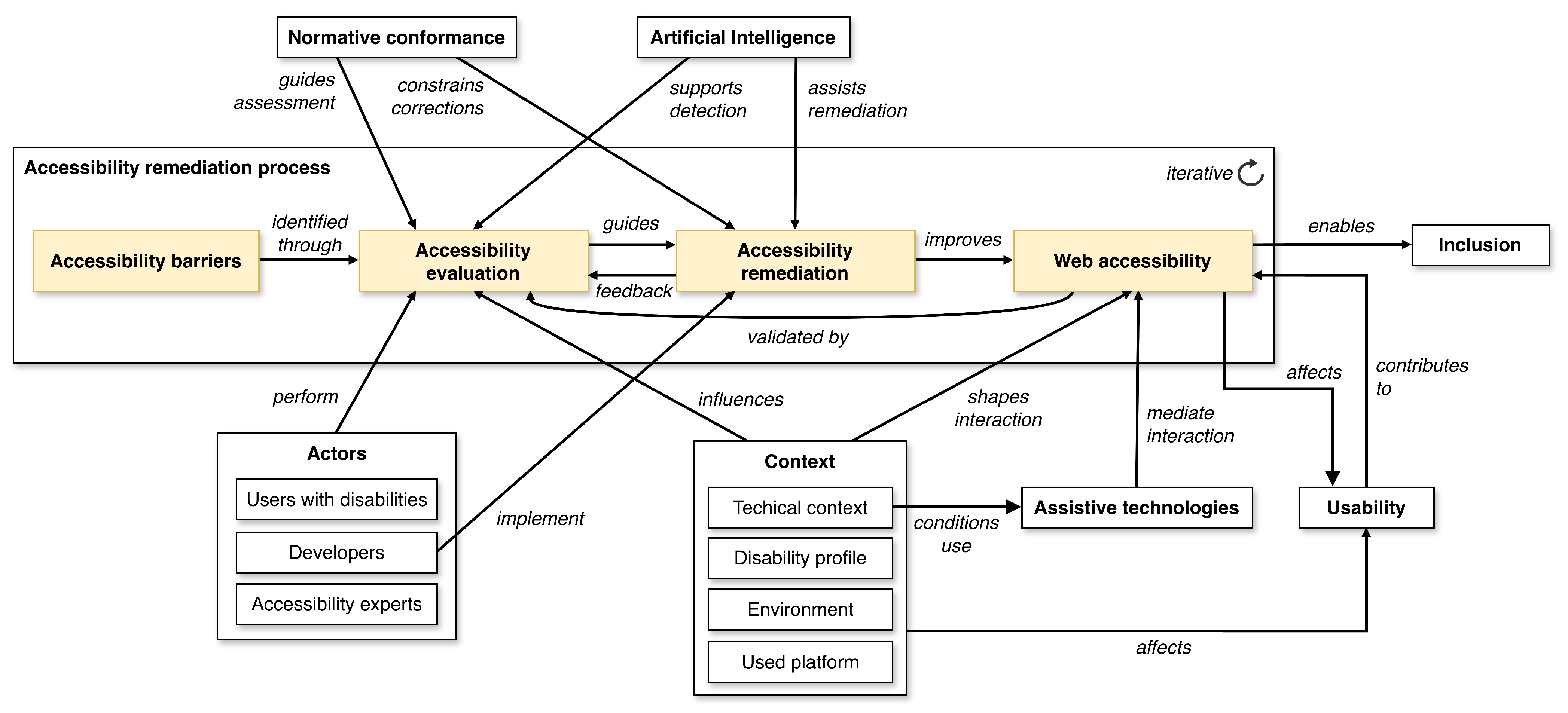
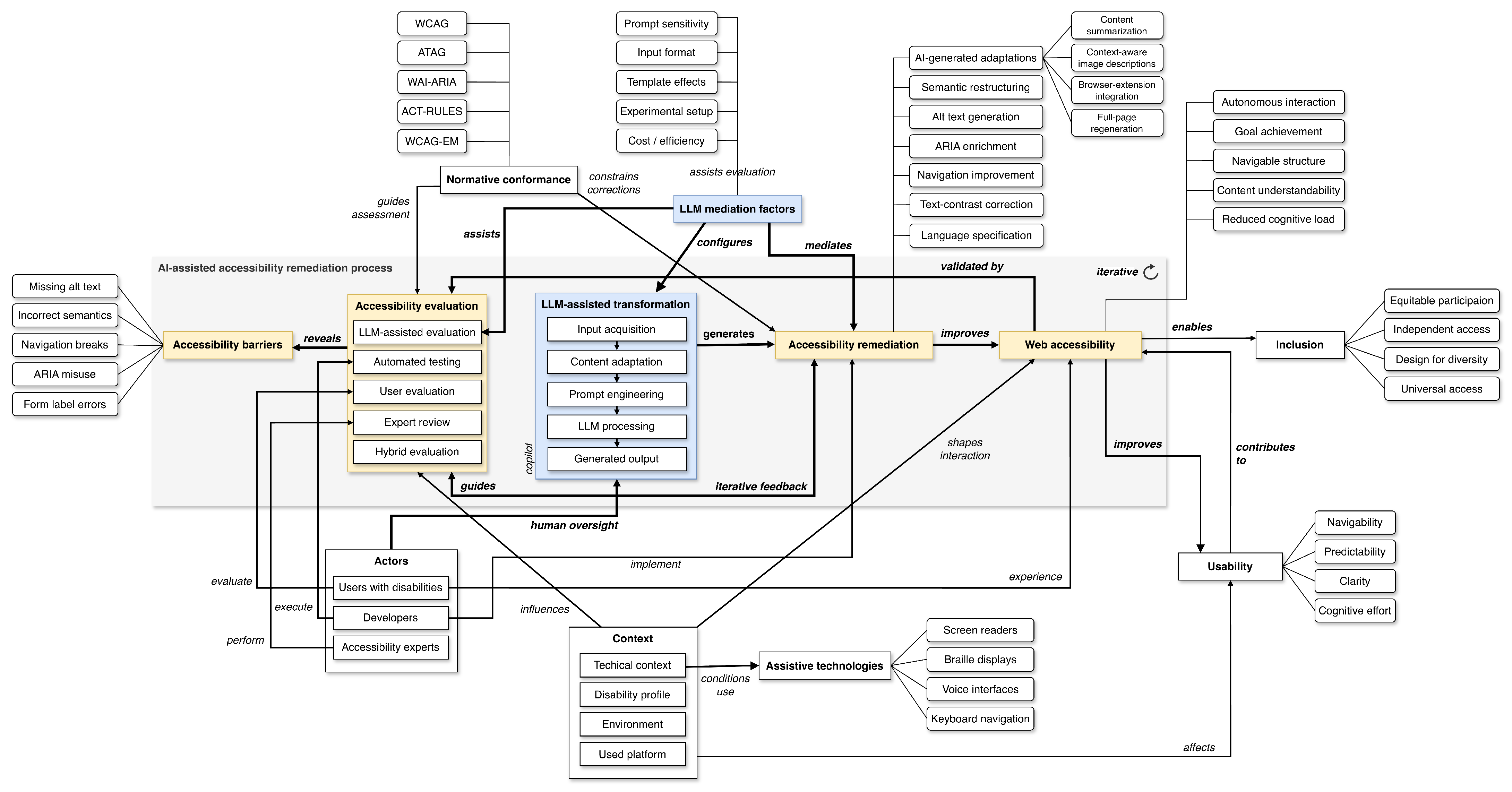
- First, unlike prior studies that primarily focus on isolated techniques (e.g., automated evaluation tools or specific task solutions), this work formulates a process theory that explains accessibility as an emergent outcome of iterative evaluation and remediation cycles using LLMs within web development contexts.
- Second, the theory explicitly conceptualizes LLMs as an intervention mechanism embedded within the remediation process, rather than as a standalone tool, thereby clarifying its role in supporting, mediating, and transforming accessibility practices.
- Third, the proposed theory provides a unifying conceptual foundation that integrates user-centered observations, accessibility standards, and AI capabilities, offering a basis for systematically guiding future models, methods, and empirical studies in LLM-assisted accessibility engineering.
- In particular, this work contributes to a broader research effort aimed at developing a conceptual model for accessibility remediation [34], where the theory serves as its explanatory foundation.

2. Research Design
2.1. Phases
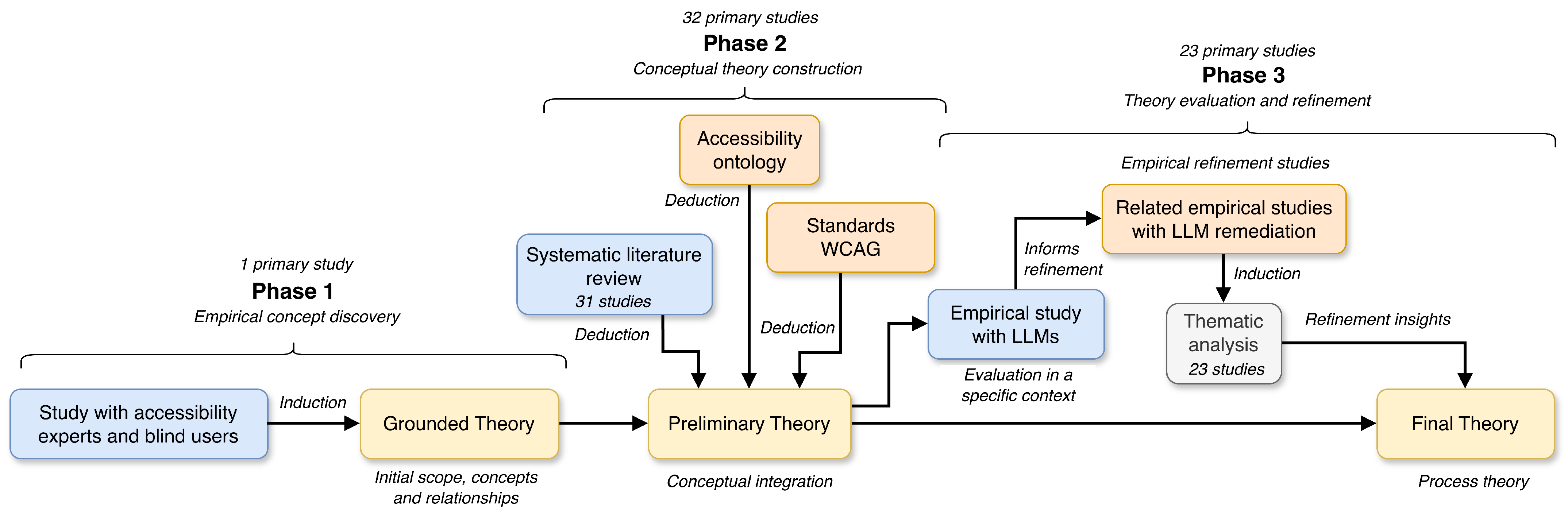
- Phase 1 provides inductive empirical grounding through qualitative analysis of blind user experiences interacting with web systems [12].
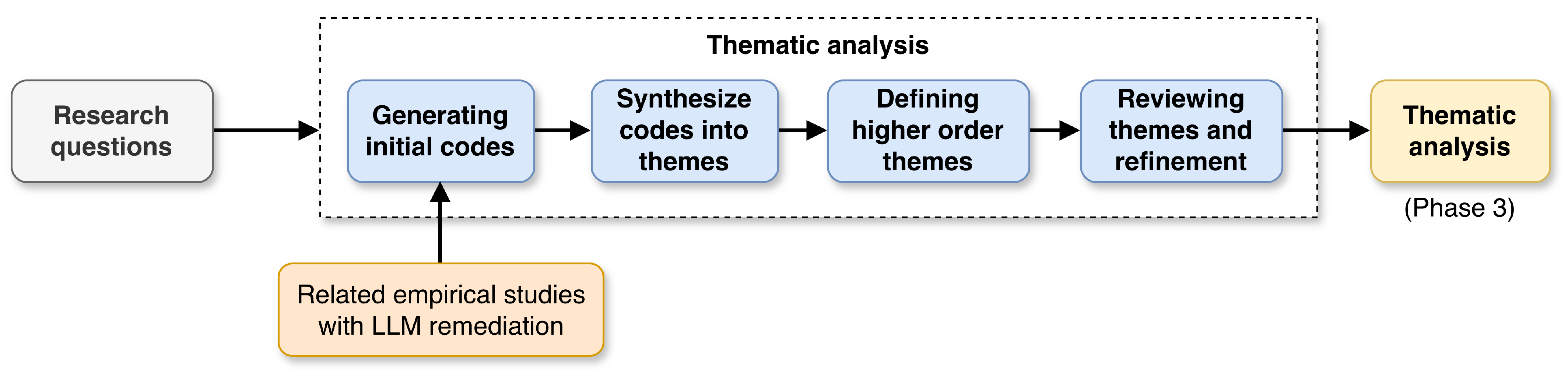
- Phase 3 refines this preliminary theory through additional empirical evidence derived from a previously published empirical study conducted by the authors [6], as well as recent related studies reflecting the current state of the art in LLM-based accessibility remediation [16,21,23,24,25,26,27,44,45,46,47,48,49,50,51,52,53,54], enabling the elaboration and validation of the proposed concepts and relationships.
2.2. Terminology
3. Phase 1: Inductive Theory Construction Through Grounded Theory
- RQ1: How do users with visual impairments experience accessibility barriers when interacting with web environments through screen readers?
- RQ2: Which characteristics or interaction conditions facilitate accessible use of web systems from the perspective of users with visual impairments?
3.1. Data Collection for Grounded Theory Construction
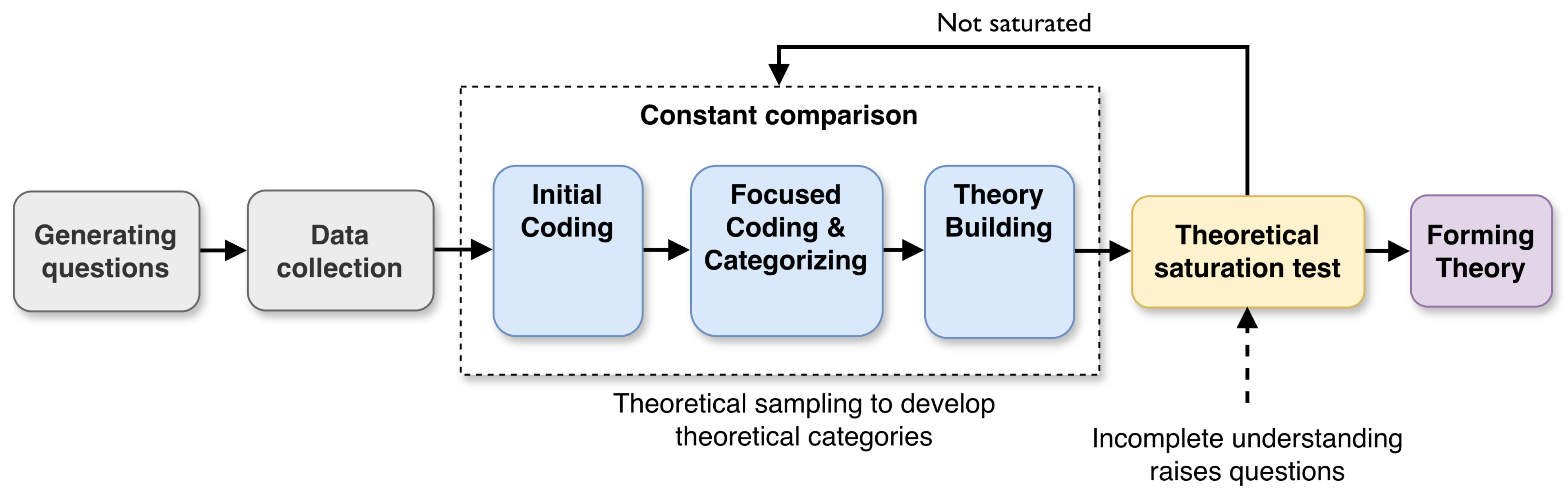
3.2. Initial and Focused Coding
3.3. Emerging Concepts
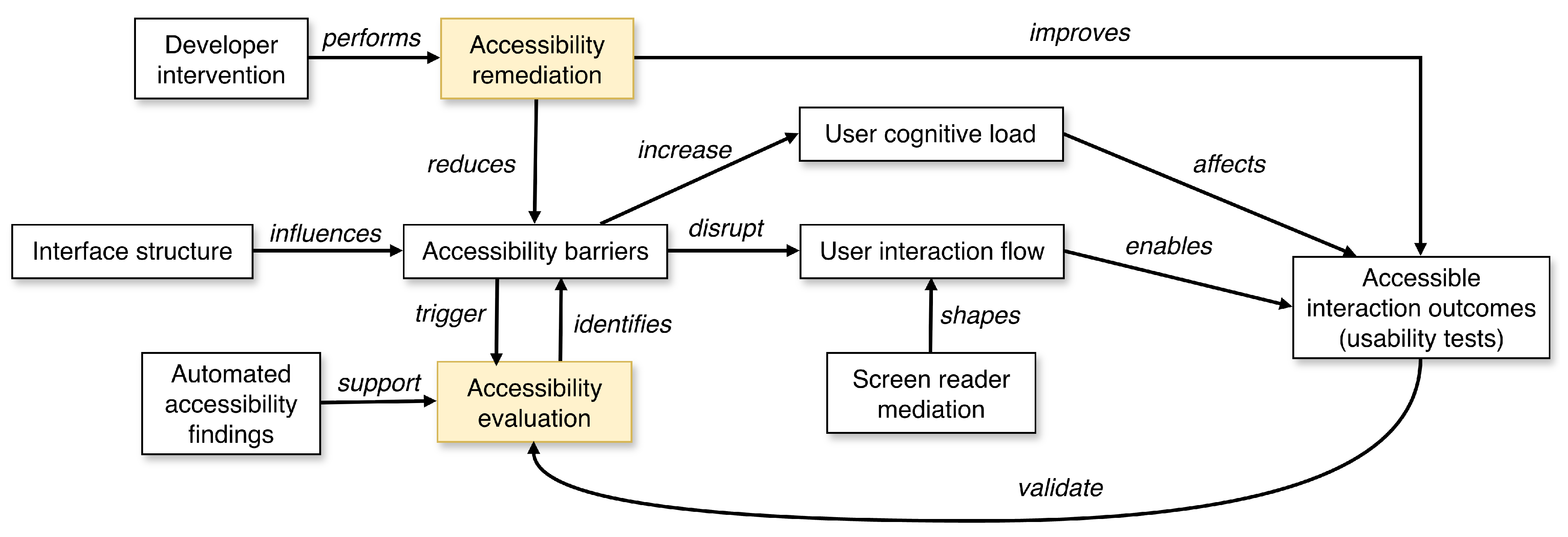
3.4. Relationships Between Concepts

4. Phase 2: Preliminary Theory Through Deductive Integration
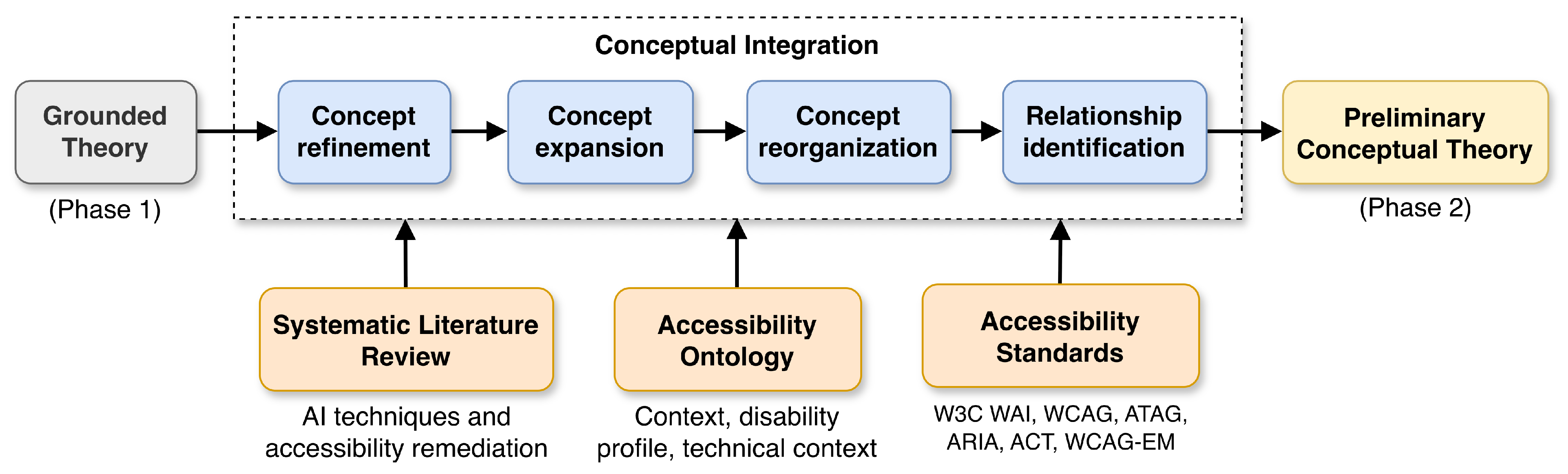
4.1. Integrated Concepts
4.2. Integrated Relationships

5. Phase 3: Refinement of the Process Theory
5.1. Data Collection for Theory Refinement
Implications for Theory Refinement
5.2. Thematic Synthesis Procedure
- RQ1: How is LLM-assisted web accessibility remediation operationalized in empirical studies in terms of evaluation, remediation strategies, and human involvement?
- RQ2: What methodological, technical, and contextual factors influence the effectiveness of LLM-supported accessibility evaluation and remediation?
5.3. Refined Concepts
5.4. Refined Relationships


6. Discussion
6.1. Evaluation
6.1.1. Plausibility
6.1.2. Internal Coherence
6.1.3. Generality
6.1.4. Explanatory Power
6.1.5. Utility
6.1.6. Qualitative Evaluation Criteria
6.2. Empirical Support with Existing Work
6.3. Theoretical Positioning
6.4. Comparison to Prior Theories and Models
- First, it shifts the focus from static integration factors to a dynamic remediation process, explicitly modeling the interaction between evaluation methods, remediation actions, and accessibility outcomes.
- Second, it incorporates artificial intelligence as an active intervention mechanism within this process, capturing how LLM-based techniques transform accessibility workflows.


6.5. Threats to Validity
6.5.1. Internal Validity
6.5.2. External Validity and Scope
6.5.3. Construct Validity
6.5.4. Limitations of LLM-Based Evidence
6.5.5. Researcher Bias
- First, the inductive findings from Phase 1 were systematically compared with the existing literature and accessibility standards during Phase 2, providing a form of triangulation between empirical data and prior knowledge.
- Second, the theory was further refined through additional empirical evidence in Phase 3, following an elaborative coding approach that mapped new observations onto the existing conceptual structure.
- Third, constant comparison was applied across data sources to reduce inconsistencies and reinforce conceptual coherence.
7. Conclusions and Future Work
Author Contributions
Funding
Institutional Review Board Statement
Informed Consent Statement
Data Availability Statement
Conflicts of Interest
Abbreviations
| LLM | Large Language Model |
| AI | Artificial Intelligence |
| W3C | World Wide Web Consortium |
| WCAG | Web Content Accessibility Guidelines |
| WAI | Web Accessibility Initiative |
| ARIA | Accessible Rich Internet Applications |
| RQ | Research Question |
| BW | Barrier Walkthrough |
| SEPI | Sección de Estudios de Posgrado e Investigación |
| UPIITA | Unidad Profesional Interdisciplinaria en Ingeniería y Tecnologías Avanzadas |
References
- Henry, S.L. Introduction to Web Accessibility. Available online: https://www.w3.org/WAI/fundamentals/accessibility-intro/ (accessed on 7 March 2026).
- Henry, S.L. WCAG 2 Overview. Available online: https://www.w3.org/WAI/standards-guidelines/wcag/ (accessed on 7 March 2026).
- WebAIM. The WebAIM Million. Available online: https://webaim.org/projects/million/ (accessed on 7 March 2026).
- Martins, B.; Duarte, C. Large-scale study of web accessibility metrics. Univers. Access Inf. Soc. 2024, 23, 411–434. [Google Scholar] [CrossRef] [Scilit]
- WebAIM. Screen Reader User Survey #10 Results. Available online: https://webaim.org/projects/screenreadersurvey10/ (accessed on 7 March 2026).
- Vera-Amaro, G.; Rojano-Cáceres, J.R. Accessible Web Content Generation Using LLMs: An Empirical Study on Prompting Strategies and Template-Guided Remediation. IEEE Lat. Am. Trans. 2025, 23, 1230–1239. [Google Scholar] [CrossRef] [Scilit]
- Alsaeedi, A. Comparing Web Accessibility Evaluation Tools and Evaluating the Accessibility of Webpages: Proposed Frameworks. Information 2020, 11, 40. [Google Scholar] [CrossRef] [Scilit]
- Fischer, T.; Lundell, B.; Gamalielsson, J. Coverage of web accessibility guidelines provided by automated checking tools. Univers. Access Inf. Soc. 2025, 24, 3615–3637. [Google Scholar] [CrossRef] [Scilit]
- Ismailova, R.; Inal, Y. Comparison of Online Accessibility Evaluation Tools: An Analysis of Tool Effectiveness. IEEE Access 2022, 10, 58233–58239. [Google Scholar] [CrossRef] [Scilit]
- Luján-Mora, S.; Masri, F. Evaluation of Web Accessibility: A Combined Method. In Information Systems Research and Exploring Social Artifacts; IGI Global: Hershey, PA, USA, 2013; pp. 314–331. [Google Scholar] [CrossRef] [Scilit]
- Acosta-Vargas, P.; Rybarczyk, Y.; Perez, J.; Gonzalez, M.; Jimenes, K.; Leconte, L.; Esparza, D. Towards Web Accessibility in Telerehabilitation Platforms. In Proceedings of the 2018 IEEE Third Ecuador Technical Chapters Meeting (ETCM), Cuenca, Ecuador, 15–19 October 2018; IEEE: New York, NY, USA, 2018; pp. 1–6. [Google Scholar] [CrossRef] [Scilit]
- Vera-Amaro, G.; Rojano-Cáceres, J.R. Accessibility Challenges for Blind Users Authoring in Content Management Systems: An Empirical Study. IEEE Rev. Iberoam. de Tecnol. del Aprendiz. 2026, 21, 268–278. [Google Scholar] [CrossRef] [Scilit]
- Alghamdi, A.M.; Aljedaani, W.; Jalali, H.; Ludi, S.; Eler, M.M. Understanding developer challenges and trends in web accessibility: A stack overflow analysis. Univers. Access Inf. Soc. 2025, 24, 1701–1717. [Google Scholar] [CrossRef] [Scilit]
- Lazar, J. A Born-Accessible Model of Software and Digital Content Development. In Proceedings of the INTERACT Conference 2023 Keynote, York, UK, 28 August–1 September 2023. [Google Scholar]
- Zhao, W.X.; Zhou, K.; Li, J.; Tang, T.; Wang, X.; Hou, Y.; Min, Y.; Zhang, B.; Zhang, J.; Dong, Z.; et al. A Survey of Large Language Models. arXiv 2023, arXiv:2303.18223. [Google Scholar]
- Aljedaani, W.; Habib, A.; Aljohani, A.; Eler, M.; Feng, Y. Does ChatGPT Generate Accessible Code? Investigating Accessibility Challenges in LLM-Generated Source Code. In Proceedings of the 21st International Web for All Conference, Singapore, 13–14 May 2024; Association for Computing Machinery: New York, NY, USA, 2024; pp. 165–176. [Google Scholar] [CrossRef] [Scilit]
- Hemmat, A.; Sharbaf, M.; Kolahdouz-Rahimi, S.; Lano, K.; Tehrani, S.Y. Research directions for using LLM in software requirement engineering: A systematic review. Front. Comput. Sci. 2025, 7, 1519437. [Google Scholar] [CrossRef] [Scilit]
- Husein, R.A.; Aburajouh, H.; Catal, C. Large language models for code completion: A systematic literature review. Comput. Stand. Interfaces 2025, 92, 103917. [Google Scholar] [CrossRef] [Scilit]
- Li, Y.; Shi, J.; Zhang, Z. An Approach for Rapid Source Code Development Based on ChatGPT and Prompt Engineering. IEEE Access 2024, 12, 53074–53087. [Google Scholar] [CrossRef] [Scilit]
- Othman, A.; Dhouib, A.; Nasser Al Jabor, A. Fostering websites accessibility: A case study on the use of the Large Language Models ChatGPT for automatic remediation. In Proceedings of the 16th International Conference on PErvasive Technologies Related to Assistive Environments (PETRA ’23); Association for Computing Machinery: New York, NY, USA, 2023; pp. 707–713. [Google Scholar] [CrossRef] [Scilit]
- Delnevo, G.; Andruccioli, M.; Mirri, S. On the Interaction with Large Language Models for Web Accessibility: Implications and Challenges. In Proceedings of the 2024 IEEE 21st Consumer Communications & Networking Conference (CCNC), Las Vegas, NV, USA, 6–9 January 2024; IEEE: New York, NY, USA, 2024; pp. 1–6. [Google Scholar] [CrossRef] [Scilit]
- Suh, H.; Tafreshipour, M.; Malek, S.; Ahmed, I. Human or LLM? A Comparative Study on Accessible Code Generation Capability. arXiv 2025, arXiv:2503.15885. [Google Scholar] [CrossRef] [Scilit]
- López-Gil, J.M.; Pereira, J. Turning manual web accessibility success criteria into automatic: An LLM-based approach. Univers. Access Inf. Soc. 2025, 24, 837–852. [Google Scholar] [CrossRef] [Scilit]
- Duarte, C.; Costa, M.; Seixas Pereira, L.; Guerreiro, J. Expanding Automated Accessibility Evaluations: Leveraging Large Language Models for Heading-Related Barriers. In Proceedings of the Companion Proceedings of the 30th International Conference on Intelligent User Interfaces, Cagliari, Italy, 24–27 March 2025; ACM: New York, NY, USA, 2025; pp. 39–42. [Google Scholar] [CrossRef] [Scilit]
- Pedemonte, G.; Leotta, M.; Ribaudo, M. Improving Web Accessibility With an LLM-Based Tool: A Preliminary Evaluation for STEM Images. IEEE Access 2025, 13, 107566–107582. [Google Scholar] [CrossRef] [Scilit]
- Srivastava, D.; Afsal, C.P.; Kuppusamy, K.S. NAVIGATE: LLM-Based Web Content Summarization to Improve Accessibility for Persons with Visual Impairments. In Proceedings of the Conference on Intelligent Human Centered Computing; Springer: Singapore, 2026; pp. 36–46. [Google Scholar] [CrossRef] [Scilit]
- Calì, E.; Fulcini, T.; Coppola, R.; Laudadio, L.; Torchiano, M. A Prototype VS Code Extension to Improve Web Accessible Development. arXiv 2025, arXiv:2503.09673. [Google Scholar] [CrossRef] [Scilit]
- Gregor, S. The Nature of Theory in Information Systems. MIS Q. 2006, 30, 611–642. [Google Scholar] [CrossRef] [Scilit]
- Baxter, G.; Sommerville, I. Socio-technical systems: From design methods to systems engineering. Interact. Comput. 2011, 23, 4–17. [Google Scholar] [CrossRef] [Scilit]
- Sjøberg, D.I.K.; Dybå, T.; Anda, B.C.D.; Hannay, J.E. Building Theories in Software Engineering. In Guide to Advanced Empirical Software Engineering; Springer: London, UK, 2008; pp. 312–336. [Google Scholar] [CrossRef] [Scilit]
- Stol, K.J.; Fitzgerald, B. Uncovering theories in software engineering. In Proceedings of the 2013 2nd SEMAT Workshop on a General Theory of Software Engineering (GTSE), San Francisco, CA, USA, 26–26 May 2013; IEEE: New York, NY, USA, 2013; pp. 5–14. [Google Scholar] [CrossRef] [Scilit]
- Ralph, P. Toward Methodological Guidelines for Process Theories and Taxonomies in Software Engineering. IEEE Trans. Softw. Eng. 2019, 45, 712–735. [Google Scholar] [CrossRef] [Scilit]
- Baltes, S.; Diehl, S. Towards a theory of software development expertise. In Proceedings of the 2018 26th ACM Joint Meeting on European Software Engineering Conference and Symposium on the Foundations of Software Engineering; ACM: New York, NY, USA, 2018; pp. 187–200. [Google Scholar] [CrossRef] [Scilit]
- Vera-Amaro, G.; Rojano-Cáceres, J.R. Towards a Conceptual Model for AI-Driven Web Accessibility Remediation: A Prompt-Based Approach. In Proceedings of the 2025 13th International Conference in Software Engineering Research and Innovation (CONISOFT), La Paz, Mexico, 27–31 October 2025; IEEE: New York, NY, USA, 2025; pp. 288–297. [Google Scholar] [CrossRef] [Scilit]
- Di Penta, M.; Tamburri, D.A. Combining Quantitative and Qualitative Studies in Empirical Software Engineering Research. In Proceedings of the 2017 IEEE/ACM 39th International Conference on Software Engineering Companion (ICSE-C), Buenos Aires, Argentina, 20–28 May 2017; IEEE: New York, NY, USA, 2017; pp. 499–500. [Google Scholar] [CrossRef] [Scilit]
- Johnson, R.B.; Onwuegbuzie, A.J.; Turner, L.A. Toward a Definition of Mixed Methods Research. J. Mix. Methods Res. 2007, 1, 112–133. [Google Scholar] [CrossRef] [Scilit]
- Vera-Amaro, G.; Rojano-Cáceres, J.R. Towards accessible website design through artificial intelligence: A systematic literature review. Inf. Softw. Technol. 2025, 186, 107821. [Google Scholar] [CrossRef] [Scilit]
- Campbell, A.; Adams, C.; Montgomery, R.B. All WCAG 2.2 Understanding Docs. Available online: https://www.w3.org/WAI/WCAG22/Understanding/ (accessed on 7 March 2026).
- Nurthen, J.; Cooper, M.; Henry, S.L. WAI-ARIA Overview. Available online: https://www.w3.org/WAI/standards-guidelines/aria/ (accessed on 7 March 2026).
- Abou-Zahra, S.; Henry, S.L. Accessibility Conformance Testing (ACT) Overview. Available online: https://www.w3.org/WAI/standards-guidelines/act/ (accessed on 7 March 2026).
- Henry, S.L. Authoring Tool Accessibility Guidelines (ATAG) Overview. Available online: https://www.w3.org/WAI/standards-guidelines/atag/ (accessed on 7 March 2026).
- Henry, S.L.; Abou-Zahra, S. WCAG-EM Overview: Website Accessibility Conformance Evaluation Methodology. Available online: https://www.w3.org/WAI/test-evaluate/conformance/wcag-em/ (accessed on 7 March 2026).
- Bendaly Hlaoui, Y.; Zouhaier, L.; Ben Ayed, L. Model driven approach for adapting user interfaces to the context of accessibility: Case of visually impaired users. J. Multimodal User Interfaces 2019, 13, 293–320. [Google Scholar] [CrossRef] [Scilit]
- Fathallah, N.; Hernández, D.; Staab, S. AccessGuru: Leveraging LLMs to Detect and Correct Web Accessibility Violations in HTML Code. In Proceedings of the 27th International ACM SIGACCESS Conference on Computers and Accessibility; ACM: New York, NY, USA, 2025; pp. 1–22. [Google Scholar] [CrossRef] [Scilit]
- Abu Doush, I.; Kassem, R. Can generative AI create accessible web code? A benchmark analysis of AI-generated HTML against accessibility standards. Univers. Access Inf. Soc. 2025, 24, 3483–3506. [Google Scholar] [CrossRef] [Scilit]
- Lin, W.; Adewale, B.; Li, M.; Nasir, M.; Sultana, A.; Khokhar, R.H.; Zhang, Y. Dynamic Web Page Modification for Accessibility Using AI and Large Language Models. In Computer and Information Science and Engineering; Springer: Cham, Switzerland, 2025; Volume 1192, pp. 33–46. [Google Scholar] [CrossRef] [Scilit]
- Andruccioli, M.; Bassi, B.; Delnevo, G.; Salomoni, P. Leveraging Large Language Models for Sustainable and Inclusive Web Accessibility. Big Data Cogn. Comput. 2025, 9, 247. [Google Scholar] [CrossRef] [Scilit]
- Moterani, G.; Lin, W.R. Breaking the Linear Barrier: A Multi-Modal LLM-Based System for Navigating Complex Web Content. In Proceedings of the 2025 IEEE 49th Annual Computers, Software, and Applications Conference (COMPSAC), Toronto, ON, Canada, 8–11 July 2025; IEEE: New York, NY, USA, 2025; pp. 2066–2075. [Google Scholar] [CrossRef] [Scilit]
- Doush, I.A.; Kassem, R. Evaluating AI-Generated Web Code for Accessibility Compliance: A Metric-Driven Approach. In Proceedings of the 11th International Conference on Software Development and Technologies for Enhancing Accessibility and Fighting Info-Exclusion; ACM: New York, NY, USA, 2024; pp. 338–344. [Google Scholar] [CrossRef] [Scilit]
- Panchanadikar, R.; Bhosekar, M.S.; Dixon, E. Can Generative AI Create Accessible Websites? In Proceedings of the 27th International ACM SIGACCESS Conference on Computers and Accessibility; ACM: New York, NY, USA, 2025; pp. 1–6. [Google Scholar] [CrossRef] [Scilit]
- Huynh, G.K.; Lin, W. SmartCaption AI—Enhancing Web Accessibility with Context-Aware Image Descriptions Using Large Language Models. In Proceedings of the 2024 International Conference on Computer and Applications (ICCA), Cairo, Egypt, 17–19 December 2024; IEEE: New York, NY, USA, 2024; pp. 1–7. [Google Scholar] [CrossRef] [Scilit]
- Paternò, F.; Vinci, M.; Manca, M.; Iannuzzi, N. How an LLM Can Improve Automatic Web Accessibility Validation ? In Proceedings of the 16th Biannual Conference of the Italian SIGCHI Chapter; ACM: New York, NY, USA, 2025; pp. 1–8. [Google Scholar] [CrossRef] [Scilit]
- Aljedaani, W.; Eler, M.M.; Parthasarathy, P.D. Enhancing Accessibility in Software Engineering Projects with Large Language Models (LLMs). In Proceedings of the 56th ACM Technical Symposium on Computer Science Education V. 1; ACM: New York, NY, USA, 2025; Volume 1, pp. 25–31. [Google Scholar] [CrossRef] [Scilit]
- Afsal, C.P.; Kuppusamy, K.S. WEBSumm: A Chrome Extension for Summarizing Web Content Using LLMs for Visually Impaired Users. SN Comput. Sci. 2025, 6, 171. [Google Scholar] [CrossRef] [Scilit]
- Glaser, B.G.; Strauss, A.L. The Discovery of Grounded Theory; Routledge: London, UK, 1999; pp. 1–271. [Google Scholar] [CrossRef] [Scilit]
- Stol, K.J.; Ralph, P.; Fitzgerald, B. Grounded theory in software engineering research. In Proceedings of the 38th International Conference on Software Engineering; ACM: New York, NY, USA, 2016; pp. 120–131. [Google Scholar] [CrossRef] [Scilit]
- Corbin, J.M.; Strauss, A.L. Basics of Qualitative Research: Techniques and Procedures for Developing Grounded Theory, 4th ed.; Sage Publications: Thousand Oaks, CA, USA, 2015; p. 431. [Google Scholar]
- Charmaz, K. Constructing Grounded Theory: A Practical Guide Through Qualitative Analysis; Sage Publications: Thousand Oaks, CA, USA, 2006; p. 223. [Google Scholar]
- Ferreira, S.B.L.; da Silveira, D.S.; Capra, E.P.; Ferreira, A.O. Protocols for Evaluation of Site Accessibility with the Participation of Blind Users. Procedia Comput. Sci. 2012, 14, 47–55. [Google Scholar] [CrossRef] [Scilit]
- Nielsen, J. Why You Only Need to Test with 5 Users. Nielsen Norman Group. 2000. Available online: https://www.nngroup.com/articles/why-you-only-need-to-test-with-5-users/ (accessed on 2 May 2026).
- Vera-Amaro, G.; Rojano-Cáceres, J.R. Dataset for Accessibility Challenges for Blind Users Authoring in Content Management Systems: An Empirical Study. Mendeley Data. 2026. Available online: https://data.mendeley.com/datasets/wsfmmw6294/3 (accessed on 2 May 2026).
- Vera-Amaro, G.; Vera-Amaro, R.; Mata-Rivera, F.; Rojano-Cáceres, J.R. Supplementary Material for Artificial Intelligence in Web Accessibility: Towards a Theory of AI-Assisted Remediation for Visual Disabilities. Mendeley Data. 2026. Available online: https://data.mendeley.com/datasets/w5pz4pzvrb/1 (accessed on 2 May 2026).
- Vera-Amaro, G.; Rojano-Cáceres, J.R. Dataset for Paper Towards Accessible Website Design through Artificial Intelligence: A Systematic Literature Review. Mendeley Data. 2025. Available online: https://data.mendeley.com/datasets/brgfhwndz6/2 (accessed on 2 May 2026).
- Abou-Zahra, S. How People with Disabilities Use the Web. W3C Web Accessibility Initiative (WAI), World Wide Web Consortium (W3C). 2024. Available online: https://www.w3.org/WAI/people-use-web/ (accessed on 2 May 2026).
- Henry, S.L.; Abou-Zahra, S.; White, K. Accessibility, Usability, and Inclusion. W3C Web Accessibility Initiative (WAI), World Wide Web Consortium (W3C). 2016. Available online: https://www.w3.org/WAI/fundamentals/accessibility-usability-inclusion/ (accessed on 2 May 2026).
- Petrie, H.; Kheir, O. The Relationship between Accessibility and Usability of Websites. In Proceedings of the SIGCHI Conference on Human Factors in Computing Systems (CHI ’07); Association for Computing Machinery: New York, NY, USA, 2007; pp. 397–406. [Google Scholar] [CrossRef] [Scilit]
- Brajnik, G. Beyond Conformance: The Role of Accessibility Evaluation Methods. In Proceedings of the Web Information Systems Engineering—WISE 2008 Workshops; Springer: Berlin/Heidelberg, Germany, 2008; Volume 5176, pp. 63–80. [Google Scholar] [CrossRef] [Scilit]
- Brajnik, G. Web Accessibility Testing: When the Method Is the Culprit. In Proceedings of the Lecture Notes in Computer Science (Including Subseries Lecture Notes in Artificial Intelligence and Lecture Notes in Bioinformatics); Springer: Berlin/Heidelberg, Germany, 2006; Volume 4061, pp. 156–163. [Google Scholar] [CrossRef] [Scilit]
- JAWS. JAWS®—Freedom Scientific. Freedom Scientific. 2024. Available online: https://www.freedomscientific.com/products/software/jaws/ (accessed on 2 May 2026).
- NVDA. About NVDA. NV Access. 2024. Available online: https://www.nvaccess.org/about-nvda/ (accessed on 2 May 2026).
- Apple. Accessibility—Vision—Apple; Apple Inc.: Cupertino, CA, USA, 2024; Available online: https://www.apple.com/accessibility/vision/ (accessed on 2 May 2026).
- Microsoft. Complete Guide to Narrator; Microsoft Corporation: Redmond, WA, USA, 2024; Available online: https://support.microsoft.com/en-us/windows/complete-guide-to-narrator-e4397a0d-ef4f-b386-d8ae-c172f109bdb1 (accessed on 2 May 2026).
- Russell, S.; Norvig, P. Artificial Intelligence: A Modern Approach, 4th ed.; Pearson: Hoboken, NJ, USA, 2020. [Google Scholar]
- Acosta-Vargas, P.; Acosta-Vargas, G.; Salvador-Acosta, B.; Jadán-Guerrero, J. Addressing Web Accessibility Challenges with Generative Artificial Intelligence Tools for Inclusive Education. In Proceedings of the 2024 Tenth International Conference on eDemocracy & eGovernment (ICEDEG), Lucerne, Switzerland, 24–26 June 2024; IEEE: New York, NY, USA, 2024; pp. 1–7. [Google Scholar] [CrossRef] [Scilit]
- Power, C.; Freire, A.P.; Petrie, H.; Swallow, D. Guidelines are Only Half of the Story: Accessibility Problems Encountered by Blind Users on the Web. In Proceedings of the SIGCHI Conference on Human Factors in Computing Systems (CHI ’12); Association for Computing Machinery: New York, NY, USA, 2012; pp. 433–442. [Google Scholar] [CrossRef] [Scilit]
- Vera-Amaro, G.; Rojano-Cáceres, J.R. Dataset for Accessible Web Content Generation Using LLMs: An Empirical Study on Prompting Strategies and Template-Guided Remediation. Mendeley Data. 2025. Available online: https://data.mendeley.com/datasets/zybws98spf/2 (accessed on 2 May 2026).
- Cruzes, D.S.; Dyba, T. Recommended Steps for Thematic Synthesis in Software Engineering. In Proceedings of the 2011 International Symposium on Empirical Software Engineering and Measurement, Banff, AB, Canada, 22–23 September 2011; IEEE: New York, NY, USA, 2011; pp. 275–284. [Google Scholar] [CrossRef] [Scilit]
- Ahmed, A.; Fresco, M.; Forsberg, F.; Grotli, H. From Code to Compliance: Assessing ChatGPT’s Utility in Designing an Accessible Webpage—A Case Study. arXiv 2025, arXiv:2501.03572. [Google Scholar] [CrossRef] [Scilit]
- Bassi, B.; Delnevo, G.; Franco, M.; Gaggi, O.; Gatto, S.; Mirri, S.; Olaiya, K. An Assessment of LLM-Based Auditing and Validation for Web Accessibility. In Proceedings of the 2025 International Conference on Information Technology for Social Good; ACM: New York, NY, USA, 2025; pp. 297–305. [Google Scholar] [CrossRef] [Scilit]
- Gu, M.; Wang, Z.; Lai, S.; Gao, Z.; Zhou, S.; Bu, J. Towards Scalable Web Accessibility Audit with MLLMs as Copilots. In Proceedings of the AAAI Conference on Artificial Intelligence (AAAI 2026); Association for the Advancement of Artificial Intelligence: Washington, DC, USA, 2026; pp. 38515–38523. Available online: https://arxiv.org/abs/2511.03471 (accessed on 2 May 2026).
- Huang, C.; Ma, A.; Vyasamudri, S.; Puype, E.; Kamal, S.; Garcia, J.B.; Cheema, S.; Lutz, M. ACCESS: Prompt Engineering for Automated Web Accessibility Violation Corrections. arXiv 2024, arXiv:2401.16450. [Google Scholar] [CrossRef] [Scilit]
- Saldana, J. The Coding Manual for Qualitative Researchers; SAGE Publications Ltd.: London, UK, 2025. [Google Scholar] [CrossRef] [Scilit]
- Aljedaani, W.; Parthasarathy, P.D.; Joshi, S.; Eler, M.M. Accessibility Insights from Student’s Software Engineering Projects. In Proceedings of the 56th ACM Technical Symposium on Computer Science Education V. 1; ACM: New York, NY, USA, 2025; Volume 1, pp. 39–45. [Google Scholar] [CrossRef] [Scilit]
- Vollenwyder, B.; Petralito, S.; Iten, G.H.; Brühlmann, F.; Opwis, K.; Mekler, E.D. How compliance with web accessibility standards shapes the experiences of users with and without disabilities. Int. J. Hum.-Comput. Stud. 2023, 170, 102956. [Google Scholar] [CrossRef] [Scilit]
- Lazar, J.; Dudley-Sponaugle, A.; Greenidge, K.D. Improving web accessibility: A study of webmaster perceptions. Comput. Hum. Behav. 2004, 20, 269–288. [Google Scholar] [CrossRef] [Scilit]
- Farrelly, G. Practitioner barriers to diffusion and implementation of web accessibility. Technol. Disabil. 2011, 23, 223–232. [Google Scholar] [CrossRef] [Scilit]
- Agangiba, M.; Kabanda, S. Towards a Conceptual Framework for E-Government Accessibility for Persons with Disabilities in Developing Countries. In Proceedings of the CONF-IRM 2016 Conference; Association for Information Systems: Atlanta, GA, USA, 2016; Available online: https://aisel.aisnet.org/confirm2016/49/ (accessed on 2 May 2026).
- Chadli, F.E.; Moumen, A.; Gretete, D. Factors & Theoretical Models Related to Web Accessibility Integration: A Systematic Literature Review. In Proceedings of the 2025 International Conference on Circuit, Systems and Communication (ICCSC), Fez, Morocco, 19–20 June 2025; IEEE: New York, NY, USA, 2025; pp. 1–7. [Google Scholar] [CrossRef] [Scilit]
- Putnam, C.; Dahman, M.; Rose, E.; Cheng, J.; Bradford, G. Best Practices for Teaching Accessibility in University Classrooms. ACM Trans. Access. Comput. 2016, 8, 13. [Google Scholar] [CrossRef] [Scilit]
- Churchill, E.F. Putting accessibility first. Interactions 2018, 25, 24–25. [Google Scholar] [CrossRef] [Scilit]
- Shneiderman, B. Promoting Universal Usability with Multi-Layer Interface Design. In Proceedings of the 2003 Conference on Universal Usability (CUU ’03); Association for Computing Machinery: New York, NY, USA, 2002; pp. 1–8. [Google Scholar] [CrossRef] [Scilit]
- Alghamdi, A.M.; Aljedaani, W.; Ludi, S.; Javed, Y. Automating Accessibility Compliance: Leveraging Machine Learning to Analyze Developer Challenges with WCAG Guidelines. In Proceedings of the 2025 8th International Conference on Data Science and Machine Learning Applications (CDMA), Riyadh, Saudi Arabia, 16–17 February 2025; IEEE: New York, NY, USA, 2025; pp. 61–66. [Google Scholar] [CrossRef] [Scilit]


| Quote | Source | Code | Category | Category Description |
|---|---|---|---|---|
| “Encountered dead ends when interacting with the toolbar, leading to frustration and inefficient navigation.” | P1 | Structural navigation breakdown | Accessibility barriers | Obstacles that prevent blind users from interacting effectively with web interfaces. |
| “Emphasized that many accessibility barriers were related to the lack of proper semantic structure.” | P5 | Missing semantic structure | ||
| “Forms contained multiple action buttons placed unpredictably.” | P2 | Unlabeled controls | ||
| “Save buttons appearing unpredictably without clear screen reader cues.” | P1 | Misplaced action buttons | ||
| “Faced confusion when navigating between the toolbar and the main menu.” | P1 | Interface region organization | Interface structure | Organization of interface elements, menus, toolbars, and page regions. |
| “The toolbar was challenging to navigate due to confusion with the main menu’s structure.” | P2 | Toolbar structure complexity | ||
| “Observed that block-based interfaces introduced additional complexity.” | P5 | Editor structure complexity | ||
| “Navigation challenges were observed when using the main menu.” | P1 | Menu hierarchy structure | ||
| “Faced inconsistent navigation flows between different sections.” | P1 | Task navigation sequence | Interaction flow | Sequence of actions required to complete authoring tasks. |
| “Experienced difficulty locating key functions, particularly the publish button.” | P1 | Control discovery process | ||
| “Forms had multiple action buttons placed arbitrarily.” | P3 | Form interaction process | ||
| “The participant was unable to create a new page and could only edit existing ones.” | P1 | Content editing workflow | ||
| “The participant managed to expand menus using a combination of screen reader commands.” | P2 | Screen reader navigation strategies | Screen reader mediation | How assistive technologies interpret and present interface information. |
| “Relied heavily on the Tab key to explore all elements, making navigation inefficient.” | P3 | Keyboard exploration behavior | ||
| “This participant felt very comfortable on the first day of training, especially when the instructor did not use assistive technology.” | P4 | Mouse exploration | ||
| “Relied heavily on the Tab key to navigate through elements, which made the process slow and inconsistent.” | P1 | Tab sequential navigation | ||
| “Observed that participants relied heavily on linear navigation (Tab key), which increased cognitive load and task completion time” | P5 | Excessive sequential navigation | User cognitive load | Mental effort required to navigate and interpret the interface. |
| “Navigating between sections was confusing because save buttons appeared inconsistently.” | P2 | Interface disorientation | ||
| “Installing plugins was time-consuming and unintuitive, requiring repetitive searches and reviews.” | P1 | Control search effort | ||
| “Struggled to understand the difference between toolbar and menu functions.” | P1 | Ambiguous feedback interpretation | ||
| “Automated tools were used to detect accessibility violations and errors.” | WAVE | Automated accessibility detection | Accessibility evaluation | Activities used to identify accessibility problems. |
| “Manual evaluation was conducted using a structured heuristic method to assess accessibility barriers.” | BW | Manual barrier identification | ||
| “This task-based usability inspection evaluates accessibility involving blind participants directly.” | BW | Screen reader interaction testing | ||
| “Structural issues were identified through inspection of HTML and accessibility elements.” | BW | Structural markup inspection | ||
| “WAVE errors (WCAG violations such as missing labels or headings).” | WAVE | Wave detected errors | Automated accessibility findings | Errors and alerts detected by automated accessibility tools. |
| “WAVE alerts (potential issues requiring manual review).” | WAVE | Wave detected alerts | ||
| “WAVE provided warnings about structural accessibility issues.” | WAVE | Structural markup warnings | ||
| “Alerts indicated potential issues requiring further inspection.” | WAVE | Potential accessibility risks | ||
| “Learned the importance of adding alternative text to images.” | P1 | Adding missing labels | Accessibility remediation actions | Code or interface modifications intended to remove barriers. |
| “Heading structures were inconsistent and not logically organized.” | P2 | Improving heading structure | ||
| “The widget screen was difficult to manage due to its block-based design; disabling blocks improved accessibility.” | P3 | Simplifying interface structure | ||
| “Navigation improved after learning keyboard shortcuts.” | P1 | Improving keyboard navigation | ||
| “Switching to HTML view enabled users to identify and fix issues.” | P2 | Code modification | Developer intervention | Human actions taken to repair or improve accessibility. |
| “The participant managed to modify the site’s main menu and locate the save button, but found it complicated.” | P2 | Markup correction | ||
| “Disabling the block editor and switching to the classic TinyMCE editor enabled the participant to independently publish a new page.” | P1 | Interface restructuring | ||
| “Install a plugin to generate alt text automatically usgin AI improved accessibility and workflow efficiency.” | P1 | Plugin configuration | ||
| “After disabling the block editor and switching to the classic TinyMCE editor, the participant was able to publish a new page independently.” | P2 | Successful task completion | Accessible interaction outcomes | Successful and efficient interaction with web systems. |
| “After the instructor introduced screen reader-based training, the participant’s navigation efficiency significantly improved.” | P4 | Improved control discoverability | ||
| “The widget area was hard to use due to its block-based layout; installing a plugin to disable blocks made navigation smoother.” | P2 | Reduced navigation effort | ||
| “After training with the instructor using a screen reader, the participant was able to follow instructions more effectively.” | P3 | Accessible content authoring |
| Study | Year | LLM Application Scenario | Participants | Participants with Disabilities |
|---|---|---|---|---|
| [26] | 2026 | Generation of accessible summaries from HTML content through contextual prompting | None | None |
| [44] | 2025 | Prompting, generation, and evaluation for HTML accessibility correction using role-prompting, contextual prompting, zero-shot, and ReAct | None | None |
| [46] | 2025 | LLM-based generation for dynamic webpage accessibility modification | None | None |
| [45] | 2025 | Prompting, generation, and evaluation of AI-generated HTML against accessibility standards | 2 | None |
| [25] | 2025 | Prompt-based generation of accessible descriptions for STEM images | 35 | 1 (blind) |
| [78] | 2025 | Prompting, generation, and evaluation of accessible webpages using zero-shot and prompt chaining | 4 | None |
| [6] | 2025 | Scraping, prompting, generation, and evaluation using HTML/Markdown inputs, prompt engineering, and template guidance | 4 | 2 (blind) |
| [79] | 2025 | Prompting, generation, and evaluation of LLM-based accessibility auditing | None | None |
| [23] | 2025 | Prompting and evaluation to automate manual accessibility success criteria | None | None |
| [47] | 2025 | Evaluation-focused use of LLMs for sustainable and inclusive web accessibility | None | None |
| [27] | 2025 | Generation and evaluation through a VS Code extension using prompt chaining and role-prompting | 3 | None |
| [48] | 2025 | Generation of accessible navigation support using JSON-based input | None | None |
| [50] | 2025 | Prompting, generation, and evaluation of AI-generated accessible websites | 2 | None |
| [80] | 2025 | Evaluation-focused use of multimodal LLMs as accessibility audit copilots | None | None |
| [24] | 2025 | Evaluation of heading-related accessibility barriers using contextual prompting and zero-shot prompting | None | None |
| [52] | 2025 | Scraping and evaluation using LLM-supported automatic validation | 1 | None |
| [53] | 2025 | Generation and evaluation of accessibility support in software engineering contexts | 215 | None |
| [54] | 2025 | Generation of accessible summaries through a browser extension for visually impaired users | 22 | 22 (visually impaired) |
| [51] | 2024 | Generation of context-aware image descriptions for accessibility | 3 | None |
| [81] | 2024 | Scraping, prompting, and generation for automated correction of accessibility violations | None | None |
| [49] | 2024 | Prompting, generation, and evaluation of AI-generated code for accessibility compliance | 2 | None |
| [16] | 2024 | Generation and evaluation of LLM-generated accessible code | 88 | None |
| [21] | 2024 | Evaluation of interaction with LLMs for accessibility-related tasks | None | None |
| Source | Code | Theme | Higher Theme | Central Topic |
|---|---|---|---|---|
| [16] | Inconsistent accessibility compliance | Accessibility quality of generated code | Human oversight and validation | LLM-assisted web accessibility remediation |
| [16] | Generated code accessibility gaps | |||
| [16] | Need for post-generation review | |||
| [50] | Full-website generation quality | |||
| [45] | Benchmarking generated HTML | |||
| [52] | Tool augmentation rather than replacement | Human-in-the-loop auditing | ||
| [80] | LLM copilot role | |||
| [6,25,27,45,49,50,51,52,53,54,78,83] | Human oversight requirement | |||
| [80] | AI as support mechanism | |||
| [54] | Target-user evaluation | Direct user validation | ||
| [25] | User feedback on generated descriptions | |||
| [6,25,54] | Participation of users with disabilities | |||
| [21,23,24,44,47,53,79,80,81] | Automation-dominant evaluation | Evaluation imbalance | ||
| [6,25] | Limited participation of users with disabilities | |||
| [6,50,52,53,78] | Different outcomes in evaluations | |||
| [6] | Hybrid automated and human evaluation | Validation of remediation outcomes | ||
| [78] | Tool-based validation | |||
| [78] | Hybrid conformance checking | |||
| [44] | Automated validator integration | |||
| [45] | Manual checklist validation | |||
| [48] | Post-correction validation |
| Source | Code | Theme | Higher Theme | Central Topic |
|---|---|---|---|---|
| [23] | Manual-to-automatic conversion | Extension of accessibility evaluation | LLM-supported evaluation | LLM-assisted web accessibility remediation |
| [23] | Automation of manual success criteria | |||
| [23] | LLM-based conformance judgment | |||
| [24] | Semantic barrier interpretation | |||
| [24] | Coverage beyond conventional tools | |||
| [44] | Multimodal accessibility detection | LLM-assisted accessibility auditing | ||
| [52] | LLM-augmented evaluation | |||
| [79] | LLM as accessibility auditor | |||
| [46] | Scalable multimodal auditing | |||
| [47] | LLM beyond traditional validators | |||
| [47] | HTML-based conformance assessment |
| Source | Code | Theme | Higher Theme | Central Topic |
|---|---|---|---|---|
| [21] | HTML barrier correction | LLM-based code correction | LLM-supported remediation | LLM-assisted web accessibility remediation |
| [20] | Automatic HTML correction | |||
| [20] | WCAG-oriented repair | |||
| [20] | Score improvement after remediation | |||
| [44] | LLM-assisted violation correction | |||
| [48] | Deployment-oriented automatic remediation | |||
| [48] | Fine-tuned correction model | |||
| [78] | Accessible webpage generation | LLM-based content generation | ||
| [46] | Full-page accessibility regeneration | |||
| [46] | HTML/CSS transformation | |||
| [50] | Shot-based accessible generation | |||
| [50] | Website generation | |||
| [24,26,44] | Context interpretation | |||
| [44,79,81] | Reasoning patterns | |||
| [6,52,81] | Temperature and decoding strategies | |||
| [21] | Hallucination handling |
| Source | Code | Theme | Higher Theme | Central Topic |
|---|---|---|---|---|
| [45] | WCAG-based benchmarking | Normative grounding of experiments | Methodological and pipeline factors | LLM-assisted web accessibility remediation |
| [45] | Benchmarking generated HTML | |||
| [79] | Identifying hallucinations | |||
| [45] | Normative grounding | |||
| [6,44,78,81] | Pipeline dependence | Operational and pipeline constraints | ||
| [6,52,81] | Scraping dependence | |||
| [47] | HTML as primary input | |||
| [21] | Practical limitations of LLM interaction | |||
| [52] | Heading-related evaluation | Pipeline orchestration | ||
| [6] | Input transformation | |||
| [44] | Pipeline stages | |||
| [6] | Scraping results evaluation | |||
| [6] | Prompting strategy effects | Prompt engineering for remediation | ||
| [6] | Input representation effects | |||
| [6,21,44,81] | Hallucination mitigation | |||
| [24,26,44] | Context augmentation | |||
| [6] | Template effects | |||
| [21] | Standard prompting | |||
| [6,44] | Retrieval-augmented generation | |||
| [79] | Chain-of-verification | Verification-oriented prompting | ||
| [44,81] | ReAct prompting | |||
| [24,26,44] | Contextual prompting | |||
| [27,44,45,79] | Chain-of-thought | |||
| [6] | Template-guided correction | Structured remediation design | ||
| [6,21,44,46,78,81] | HTML restructuring | |||
| [25,26,27,48,51,54] | Component-level modification | |||
| [26,46,48,54] | Format normalization |
| Source | Code | Theme | Higher Theme | Central Topic |
|---|---|---|---|---|
| [51] | Context-aware alt text | Specialized accessible content generation | User-facing accessibility support | LLM-assisted web accessibility remediation |
| [51] | Image description generation | |||
| [25] | Specialized image accessibility | |||
| [26,46,48,54] | Restructured layouts | |||
| [27] | IDE-integrated accessibility support | Developer-oriented accessibility assistance | ||
| [27] | Developer tooling | |||
| [48] | Browser extensions development | |||
| [46] | Multi-disability adaptation | User-facing adaptation | ||
| [26] | Web summarization | |||
| [26] | Browser extension support | |||
| [26] | Support for visually impaired users | |||
| [6,46,50] | Full-page generation | |||
| [54] | User-centered summarization |
| WCAG Failure Type | % of Home Pages |
|---|---|
| Low contrast text | 79.1% |
| Missing alternative text for images | 55.5% |
| Missing form input labels | 48.2% |
| Empty links | 45.4% |
| Empty buttons | 29.6% |
| Missing document language | 15.8% |
Disclaimer/Publisher’s Note: The statements, opinions and data contained in all publications are solely those of the individual author(s) and contributor(s) and not of MDPI and/or the editor(s). MDPI and/or the editor(s) disclaim responsibility for any injury to people or property resulting from any ideas, methods, instructions or products referred to in the content. |
© 2026 by the authors. Licensee MDPI, Basel, Switzerland. This article is an open access article distributed under the terms and conditions of the Creative Commons Attribution (CC BY) license.
Share and Cite
Vera-Amaro, G.; Vera-Amaro, R.; Mata-Rivera, M.F.; Rojano-Cáceres, J.R. Artificial Intelligence in Web Accessibility: Towards a Theory of LLM-Assisted Remediation for Visual Disabilities. Technologies 2026, 14, 287. https://doi.org/10.3390/technologies14050287
Vera-Amaro G, Vera-Amaro R, Mata-Rivera MF, Rojano-Cáceres JR. Artificial Intelligence in Web Accessibility: Towards a Theory of LLM-Assisted Remediation for Visual Disabilities. Technologies. 2026; 14(5):287. https://doi.org/10.3390/technologies14050287
Chicago/Turabian StyleVera-Amaro, Guillermo, Rodolfo Vera-Amaro, Miguel Felix Mata-Rivera, and José Rafael Rojano-Cáceres. 2026. "Artificial Intelligence in Web Accessibility: Towards a Theory of LLM-Assisted Remediation for Visual Disabilities" Technologies 14, no. 5: 287. https://doi.org/10.3390/technologies14050287
APA StyleVera-Amaro, G., Vera-Amaro, R., Mata-Rivera, M. F., & Rojano-Cáceres, J. R. (2026). Artificial Intelligence in Web Accessibility: Towards a Theory of LLM-Assisted Remediation for Visual Disabilities. Technologies, 14(5), 287. https://doi.org/10.3390/technologies14050287