


Abstract
The mining industry is going through a big digital change because of the use of new technologies that are meant to make work safer, more productive, and more environmentally friendly. AI-driven digital twins (AI-DTs) are one of these new ideas. They combine real-time data collection with smart analytics to make it possible for decisions to be made in a predictive, adaptive, and autonomous way. This paper provides a thorough systematic literature review (SLR) of AI-DT applications in mining operations, encompassing studies published from 2015 to 2025. According to the PRISMA method, 68 primary studies were chosen and looked at from many angles, such as publication trends, demographic analysis, research methods, data sources, mining domains, and the AI techniques that were used. The findings reveal an increasing scholarly interest in AI-DTs, characterized by a significant prevalence of machine learning and deep learning methodologies, alongside a preference for real-world sensory data to augment model accuracy. Most applications deal with physical assets, processing plants, and operational systems. Subsurface environments, on the other hand, are still not well understood. The review also points out some major problems with data integration, scalability, interoperability, and the fact that there has not been much large-scale industrial validation. Based on these findings, the paper points out important areas of research that need more work and suggests ways to move forward with the development and use of AI-DTs in mining. In conclusion, this study gives researchers and practitioners a clear plan for how to use AI-DTs to make mining operations more efficient, resilient, and long-lasting.
1. Introduction
The extraction of valuable minerals and raw materials from the Earth, such as metals (e.g., iron and copper), industrial minerals, and energy resources, is known as mining [1]. It is a fundamental sector that sustains contemporary economies by providing necessary materials for manufacturing, infrastructure, and cutting-edge technologies. The global shift to renewable energy systems, which relies on vital minerals like copper, nickel, and lithium, has made mining even more important in recent years [2].
The introduction of cutting-edge computational tools to increase productivity, safety, and sustainability is driving a rapid digital change in the mining sector [3]. In the past, mining operations planned, monitored, and controlled extraction processes using expert heuristics and static simulation models [4]. However, the complexity, unpredictability, and real-time dynamics present in contemporary mining contexts are difficult for these traditional methods to convey. Digital Twin (DT) technology has become a major facilitator of cyber–physical integration as part of the larger Mining 4.0 paradigm. It provides a synchronized virtual representation of physical assets that continuously reflects their state, behavior, and performance through real-time data streams from sensors, Internet of Things (IoT) infrastructures, and remote monitoring systems [5].
A digital twin is a real-time virtual representation of a physical object that is kept up to date by a continuous information flow that synchronizes the simulation with its physical counterpart [6]. As a result, it creates a closed-loop architecture that combines digital and physical systems, allowing for real-time monitoring, predictive analysis, and decision support. To put it another way, digital twins establish a continuous feedback loop by synchronizing real-time data from geological models and IoT devices. This enables leaders to swiftly change courses in response to changing conditions, the condition of machinery, or changes in the market. Accurately simulating high-stakes situations, such as assessing mine slope stability or ventilation effectiveness, without any real-world danger is a major advantage [7]. Digital twins emphasize bidirectional connection between the actual and virtual domains, which facilitates not only observation but also prediction, optimization, and autonomous control of complicated tasks, in contrast to traditional simulation [8]. Because of this, they are extremely pertinent to mining systems that involve a variety of activities, such as haulage, processing, environmental management, and geological exploration and extraction.
The incorporation of Artificial Intelligence (AI) further augments digital twins by embedding learning, reasoning, and adaptive decision capabilities into virtual representations. We labeled the AI-driven digital twin as “AI-DT”. AI techniques such as machine learning (ML), evolutionary computing (EC), deep learning (DL), reinforcement learning, and neural networks (NN), also commonly known as Artificial Neural Networks (ANN) enable digital twins to process large volumes of multimodal data, detect patterns, forecast equipment failures, and optimize operational parameters under uncertainty [5,9]. For example, hybrid AI-driven digital twins that combine data-driven models with physical knowledge have been shown to enhance predictive maintenance and energy efficiency in harsh industrial settings, including mining assets like mills, conveyors, and ventilation systems [4].
Despite these advances, many mining processes still depend heavily on human intervention, and the adoption of AI-DTs in mining remains in its early stages, with existing research largely scattered across isolated applications rather than unified frameworks [10]. Recent reviews highlight both the transformative potential of integrating AI with digital twin systems and the substantial challenges that remain, including data integration, model scalability, and system interoperability in complex mining environments [3,5,10]. Furthermore, evidence from the literature indicates a significant imbalance in the adoption of digital twin technologies across engineering domains. For instance, a recent study by Nobahar et al. [10] reported that manufacturing and construction sectors dominate digital twin research, accounting for approximately 66% of published studies, whereas the mining sector represents only about 4%. This disparity underscores the relative immaturity of digital twin applications in mining and highlights a critical need for more focused research efforts. This gap further emphasizes the importance of providing a comprehensive synthesis of state-of-the-art methodologies, architectural paradigms, and emerging trends to guide future research and industrial deployment. Accordingly, this study aims to address this need by offering a structured overview and roadmap for leveraging AI-driven digital twins toward more resilient, efficient, and sustainable mining operations.
2. Background
2.1. Mining Industry and Engineering
Mining plays a fundamental role in modern society because it provides the raw materials needed for infrastructure, manufacturing, and energy production [1]. For example, iron ore is essential for steel production, which supports construction and transportation systems, while coal remains a key energy source in many countries. The mining value chain consists of several main stages [11]. The first stage is exploration, where geological surveys, remote sensing, and data analysis are used to identify potential mineral deposits. This is followed by development, which includes mine planning, feasibility studies, and infrastructure construction. The extraction stage involves operations such as drilling, blasting, loading, and hauling, either in surface or underground mines. After extraction, the material undergoes processing (mineral processing), where valuable minerals are separated from waste using techniques such as crushing, grinding, and flotation. The final stage is refining, in which processed materials are further purified into high-quality, market-ready products. These stages form an interconnected system requiring continuous coordination and optimization [1,10,11].
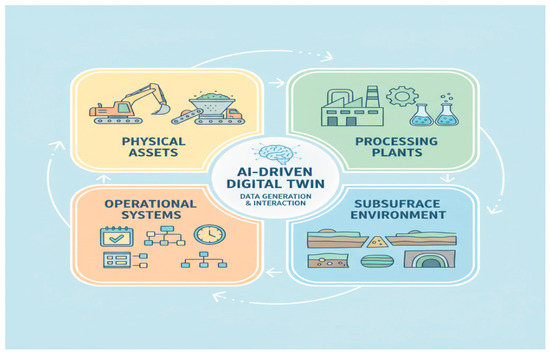
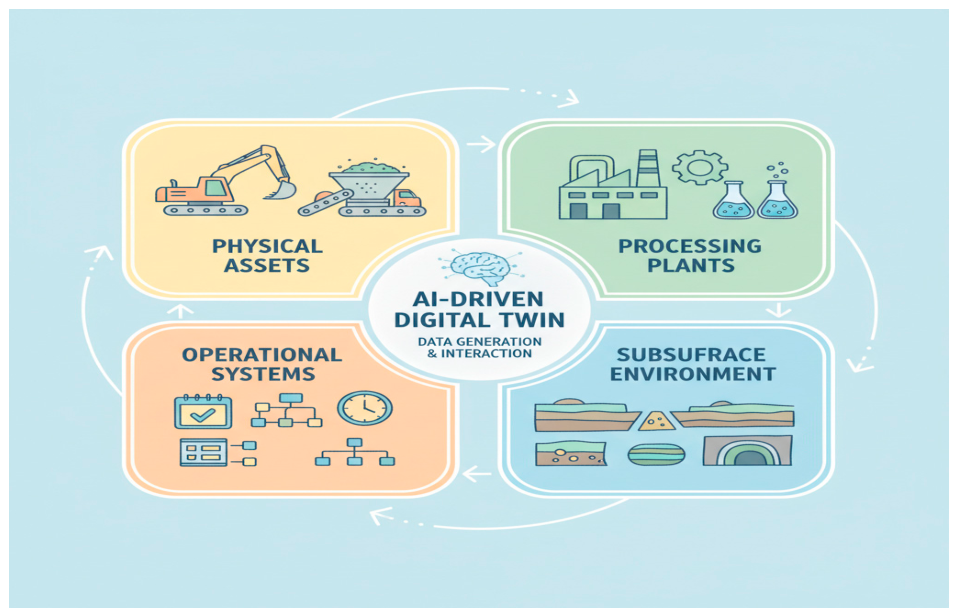
Mining operations can be conceptualized into several interconnected domains, which are particularly relevant for AI-driven digital twin applications. First, physical assets include heavy equipment such as excavators, haul trucks, crushers, and conveyors, which are essential for material extraction and transportation. Second, processing plants represent facilities where raw ore is transformed through various physical and chemical processes. Third, the subsurface environment includes geological formations, ore bodies, and underground conditions, which are inherently uncertain and require continuous monitoring and modeling. Finally, operational systems involve planning, scheduling, and logistics processes that coordinate activities across the mining lifecycle. These domains reflect the complex and integrated nature of mining systems, where equipment, processes, geological data, and operational decisions interact and generate large volumes of heterogeneous data [8,10,12]. Figure 1 illustrates the functional overlap between these mining domains.
Figure 1.
Categorization of mining domains.
Despite its importance, mining is a complex and challenging industry. Operations are often conducted in harsh environments, including remote locations with limited infrastructure. There are also significant safety risks associated with heavy machinery and underground conditions. Environmental concerns are another major issue, including land disturbance, water consumption, and greenhouse gas emissions [13,14]. Additionally, mining operations generate large volumes of data from sensors and equipment, but historically, much of this data has not been fully leveraged for decision-making [10]. In this context, technology plays a critical role in transforming the mining industry toward what is often referred to as “Mining 4.0.” Advances in sensors, IoT, data analytics, and AI enable real-time monitoring, predictive maintenance, and optimization of mining operations. Among these technologies, digital twins—particularly when integrated with AI—are emerging as powerful tools for creating virtual representations of mining systems. These tools support improved decision-making, enhanced operational efficiency, reduced downtime, and increased safety. Consequently, advanced digital technologies are essential for addressing current challenges and ensuring the long-term sustainability of mining operations [2,10].
2.2. AI-DT Architecture
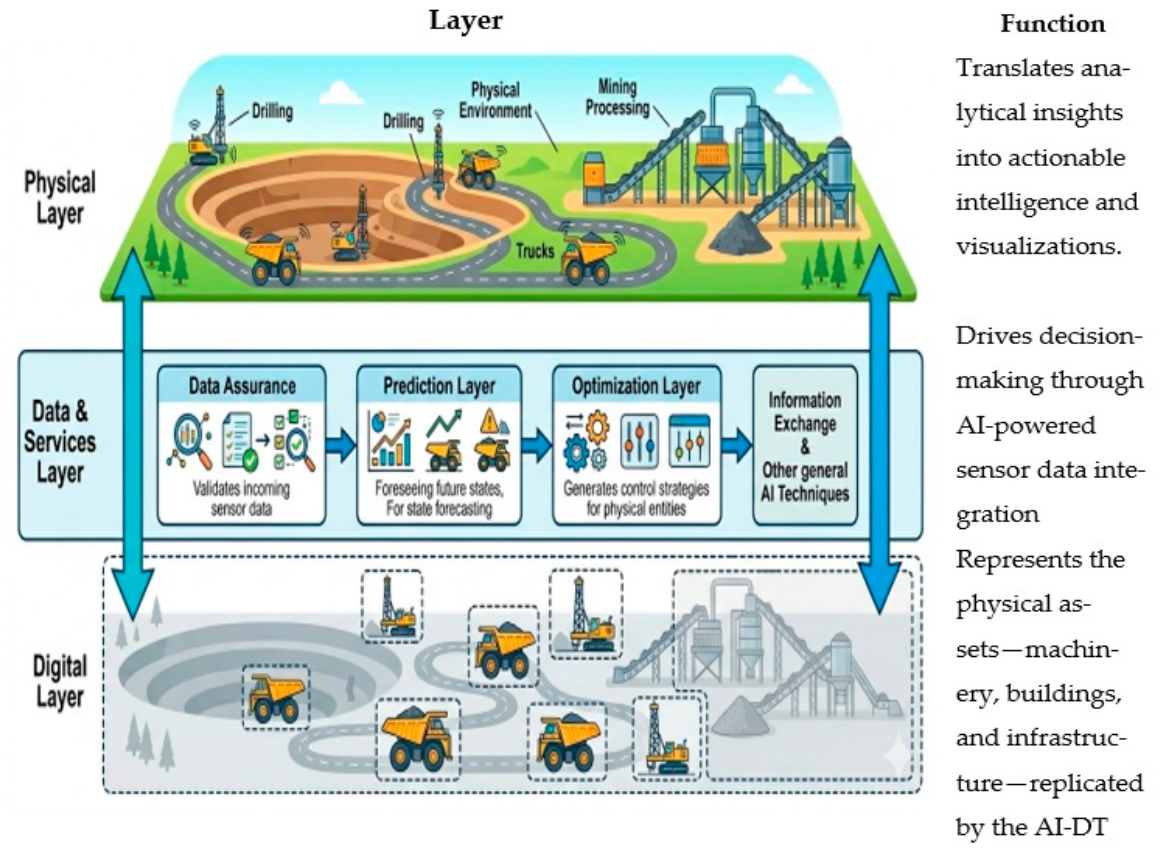
The architecture of AI-DT systems adopts a layered design to ensure compliance with quality requirements. From a software systems perspective, this layered arrangement supports stepwise and incremental development, allowing functionalities to be introduced progressively as each layer is implemented [15]. Such an architectural style enhances flexibility, maintainability, and portability. Essentially, the system is structured into a hierarchy of layers, where each layer groups related functionalities. Higher layers depend on the services provided by lower layers, while foundational layers deliver core capabilities that are utilized across the entire system [15].
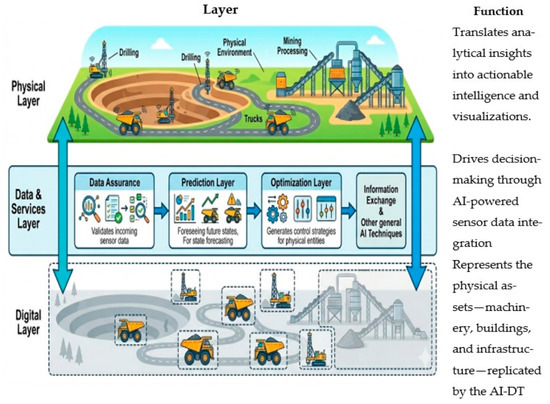
Figure 2 depicts a simplified AI-DT architecture and its primary functionalities. While AI-DT maintains the fundamental physical and digital layers of a traditional DT, it expands the intermediary data and services layer with specialized AI sub-layers. Due to space constraints, these sub-layers—which facilitate model training, continuous learning, and data exchange—are represented here as a unified layer. This augmented structure enables the AI-DT to manage the complex, dynamic, and data-intensive tasks that go beyond the scope of conventional twins. Within the unified AI sub-layer shown in Figure 2, the logical relationship operates as a sequential pipeline: The Data Assurance Layer first validates incoming sensor data, which is then passed to the Prediction Layer for state forecasting. These insights finally feed into the Optimization Layer, which generates the control strategies necessary to adjust physical entities like drill rigs or haul trucks.
Figure 2.
AI-DT layers and their functions.
3. Existing Reviews
Several researchers have conducted reviews on this topic. Don et al. [3] explored the literature on mining industry-related DT applications published during the last two decades; this included research trends, opportunities, and challenges. Rojas et al. [4] analyzed recent advancements in AI-driven predictive monitoring for mining applications. Ali et al. [5] presented a review of technological innovations across the mining lifecycle to understand how Mining 4.0 technologies can be applied to build a safer, and more sustainable mining sector. Yusupbekov et al. [7] researched how digital twin technology can help increase optimization and effectiveness for the mining industry. Nobahar et al. [10] provided insights into fully integrated digital twin mining systems, which will significantly improve mining efficiency and sustainability. Yang et al. [16] analyzed the commonly used architectures for digital twins in the construction domain in the literature and summarized the commonly used technologies to implement architectures such AI, ML, CPS, IoT, VR, and AR. Madahana et al. [17] provided an overview of the current landscape of digital twin systems in mining operations.
In conclusion, AI-driven DT integration within the mining sector remains an under-researched area. Existing reviews often overlook specific AI techniques and algorithms [3,7,10,17] or rely on a limited range of electronic databases [4]. Other researchers narrow their reviews to a specific engineering application such construction [16], or maintenance [4], or have discussed technological innovations broadly without a dedicated focus on DT [5,16]. Few studies have analyzed venue and publication trends. To address these limitations, this work provides a comprehensive SLR guided by PRISMA protocols. Our objective is to synthesize, classify, and analyze the existing research on AI/ML-based digital twins in the mining industry including an overview of the existing AI techniques/algorithms that are commonly used in DT implementation.
4. Materials and Methods
A systematic literature review (SLR) provides a structured and rigorous approach for identifying, evaluating, synthesizing, and interpreting high-quality research related to a specific topic or research question [18]. It plays a crucial role in uncovering research gaps and guiding future investigations. In this study, the SLR was conducted following the PRISMA (Preferred Reporting Items for Systematic Reviews and Meta-Analyses) guidelines [19]. The process consisted of four main stages: identification, screening, eligibility, and inclusion. Relevant studies were initially collected from electronic databases during December 2025 and January 2026. In the screening phase, titles, abstracts, and keywords were examined to remove irrelevant records. Subsequently, full-text papers were assessed in the eligibility stage. Finally, articles that satisfied the inclusion criteria were selected for analysis of AI-DT components in mining. The review was carried out by a team of four academic researchers. One member designed the review protocol, which was then critically evaluated by the remaining authors, and all team members contributed to each stage of the review process.
4.1. RQs Definition and Search Protocol
To clearly define the scope of this study, five principal research questions (RQs) were formulated. These questions, together with their underlying motivations, are presented in Table 1. We formulated the search strategy for our RQs using the terms: digital twin, virtual twin, mining, mineral processing, AI, and machine learning with Boolean operators “AND” and “OR”, asterisks, and parentheses used to refine the results.
Table 1.
RQs and rationale.
4.2. Data Source Identification
The defined search strategy was systematically applied across all selected databases. These search queries enabled the identification of relevant studies focusing on AI-DT applications in mining. Prior to conducting the formal review, preliminary searches were performed to determine the most suitable and reliable data sources. The selected databases were chosen due to their strong coverage of high-quality publications in engineering and technology domains. Accordingly, five major repositories were included in this study: IEEE, MDPI, Springer, Wiley, and ScienceDirect. These specific databases were selected due to their recognized authority at the intersection of mining engineering, resource development, and computer science. While IEEE and ScienceDirect provide a deep reservoir of technical engineering studies, MDPI and Springer ensure a broad representation of recent, open-access advancements in digitalization and sustainable mining practices.
4.3. Quality Assessment
A quality assessment was carried out in accordance with the approach suggested by [17] to confirm that the chosen studies offered adequate data for trustworthy extraction. Using a four-item questionnaire, we assessed each paper’s descriptive detail and methodological strength. This tool was developed to fit our objectives after being synthesized from literature. Four weighted criteria were used to evaluate study quality, as indicated in Table 2, and each was given a binary value (1 for met, 0 for not met). A total score between 0 and 4 was obtained by adding these. The final analysis only included studies that had a minimum score of 2. Consensus-based discussions or, if required, consultation with an impartial expert were used to settle any disagreements.
Table 2.
Quality assessment criteria.
4.4. Article Selection Workflow
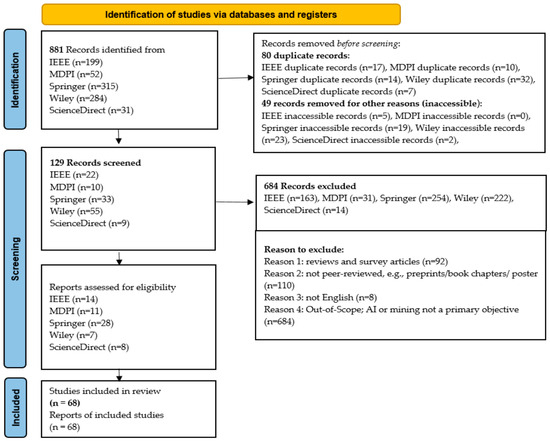
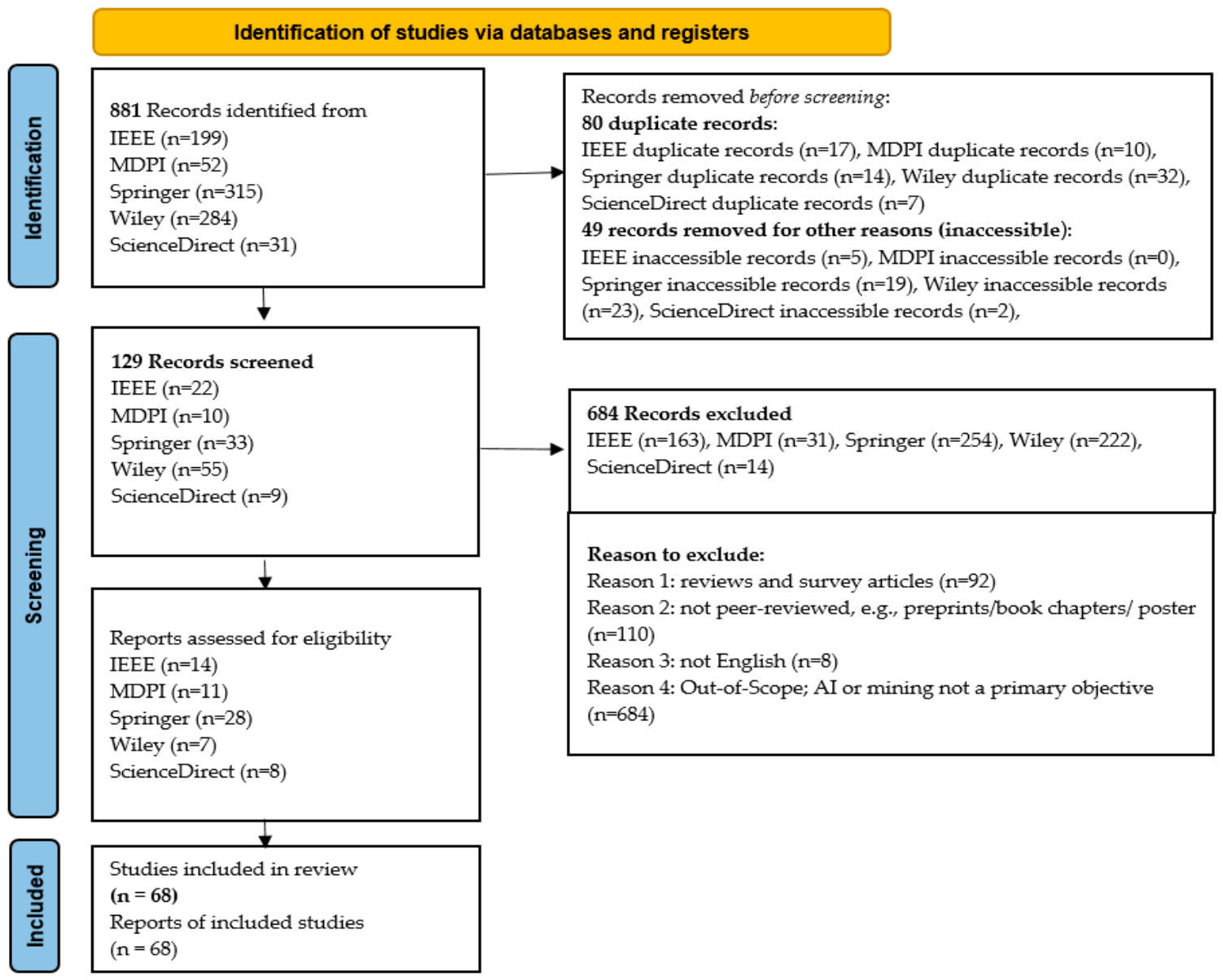
The review process followed both iterative and incremental principles. It was iterative that each database was examined individually before proceeding to the next. It was incremental because the review evolved progressively, expanding from an initial subset of studies into a comprehensive dataset. Study selection was primarily based on evaluating titles, abstracts, and keywords. Only English-language publications from 2015 to early 2025 were considered; this timeframe captures the surge in AI and digital twin advancements in mining that began in 2015 and continues to the present day [9,10]. Exclusion criteria included studies unrelated to the topic, non-peer-reviewed materials, duplicate entries, and non-research outputs such as theses or reports. When uncertainty remained after the initial screening, full-text articles were reviewed. The overall selection procedure, including inclusion and exclusion at each stage, is illustrated in Figure 3. From an initial pool of 881 records, 68 studies were ultimately identified as primary studies. Table 3 outlines the specific details of every iteration, organized by study number for easy reference.
Figure 3.
Review process: adherence to PRISMA guidelines.
Table 3.
Study selection results (2015–2025).
4.5. Data Extraction
As illustrated in Figure 3, information extraction was carried out using a standardized form (see Table 4). This form was designed based on research objectives and search criteria to ensure consistent data collection across all selected studies. It captured key information such as study title, authors, publication source, year, country of origin, research objectives, methodology (including validation approach, dataset type, mining domain, and AI techniques), identified challenges, suggested research directions, and reported results. This structured extraction process ensured comprehensive and systematic analysis of the selected literature.
Table 4.
Data extraction form.
5. Results and Discussion
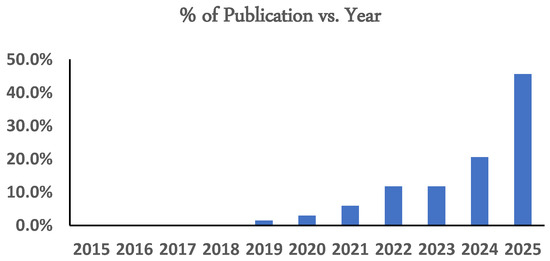
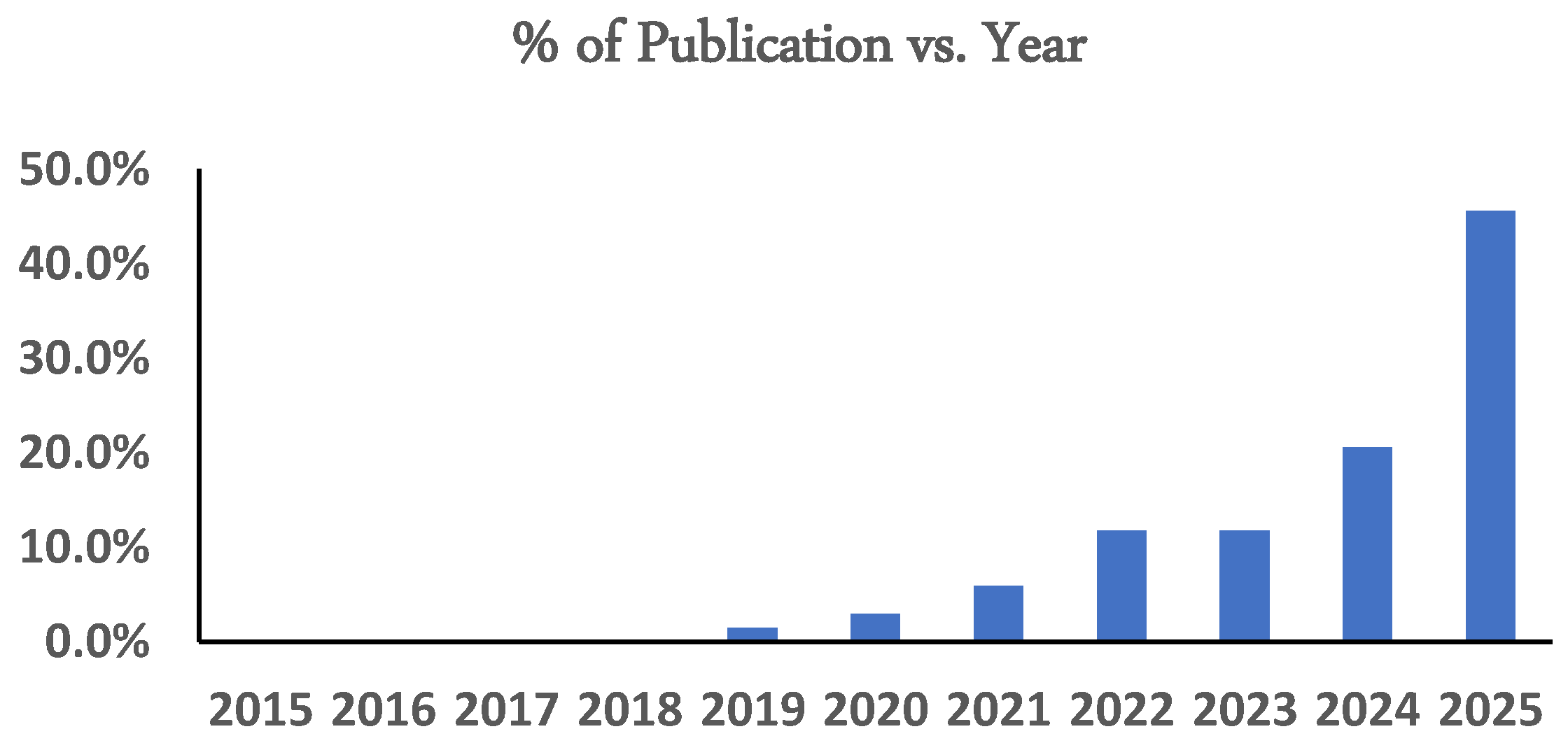
The analysis begins by examining the dominant research trends in the AI-DT field, spanning both information technology and mining-related applications. The chronological distribution and publication sources for the included research are illustrated in Figure 4. Our analysis reveals a consistent upward trajectory in the volume of empirical work concerning this topic. The trend line confirms a positive growth rate in publications over time, underscoring the escalating significance of integrating AI-DTs within the mining sector in recent years.
Figure 4.
Publication trends of AI-DT in mining.
5.1. Distribution Analysis: Venues and Source Origins (RQ 1)
To answer RQ 1, this study analyzes publication outlets and document types within the AI-DT research domain. The analysis focuses on studies sourced from five databases listed in Table 2. These publications fall into three categories: journal articles, conference papers, and workshop contributions. As shown in Table 5, journal publications dominate the field, accounting for 54 studies (n = 54, 79.4%), while conference and workshop papers represent (n = 13, 19.1%) and (n = 1, 1.5%) studies, respectively. This dominance is likely due to the rigorous validation requirements and detailed reporting typically associated with AI-DT research, making journals more suitable for such work. Nevertheless, as the field matures, an increase in specialized conferences and workshops focusing on AI applications in mining is expected. Furthermore, IEEE and Springer collectively account for 62% of the selected studies (n = 42), indicating their strong presence in this domain. In contrast, Wiley contributes the smallest share; this likely reflects its broader multidisciplinary focus on health, life, and social sciences (https://www.wiley.com/en-gb/research/; (accessed on 20 April 2026), whereas the technical engineering integration essential for AI-DTs is more concentrated in specialized technical databases.
Table 5.
Distribution of papers across venues.
The results of Table 5 show that Springer is the primary venue for publications in AI-DT in mineral processing, followed with IEEE. Table 6 identifies the key journals which publish papers on this subject. It represents the primary study venues that recurred twice or more, identifying the most prevalent publication outlets in the dataset. Scientific Reports leads the field with nine publications, followed by The International Journal of Advanced Manufacturing Technology and Applied Sciences with five and three papers, respectively. Energies, Discover Internet of Things, Results in Engineering, and Minerals Engineering follow with two papers each.
Table 6.
Publication venues with multiple selected studies.
5.2. Demographic Trends (RQ 2)
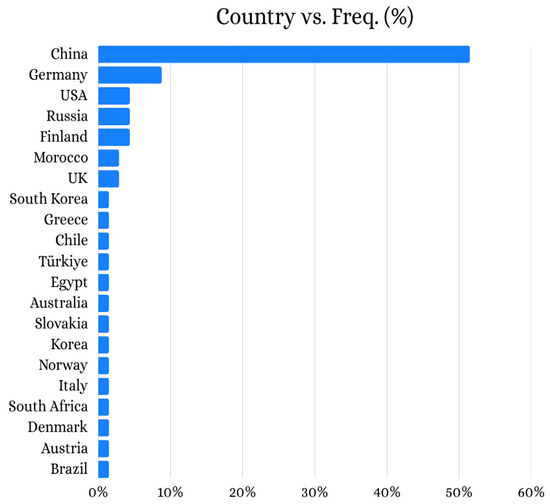
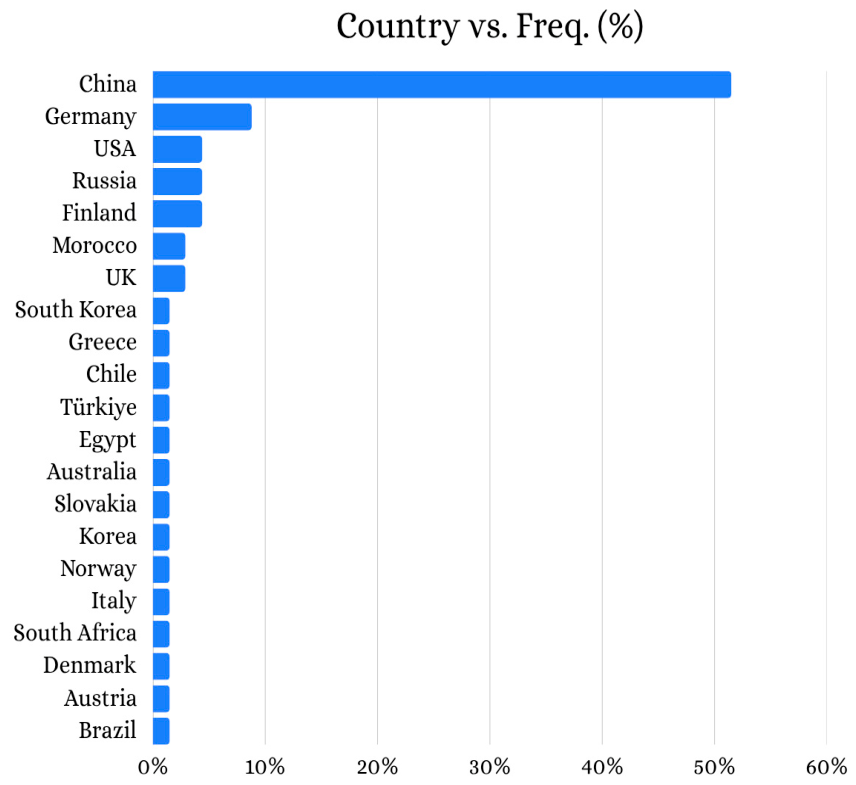
To determine the most active countries in AI-DT research within mineral engineering, author affiliation data were analyzed. This analysis addresses RQ2 by identifying the geographical distribution of research contributions. The country of the first author was used as a proxy for the origin of the study, regardless of any subsequent affiliation changes. This approach is widely adopted in bibliometric studies, as the first author is often considered the primary contributor, and their affiliation typically reflects the location where the research was conducted. Although alternative methods exist, this approach ensures consistency with prior studies and reduces potential bias arising from multi-author collaborations (e.g., [89,90]). Figure 5 presents the countries of affiliation for the studies we considered. Regarding RQ 2, the results show that China is the most frequently associated country, accounting for over half of the studies (51.5%). This is followed by Germany at 8.8%, while the US, Russia, and Finland each contributed 4.4%. Researchers from Morocco and the UK followed with a 2.9% share each. The remaining articles were distributed across several countries with one publication (1.5%) each, as illustrated in Figure 5.
Figure 5.
Country of publication.
It is evident that research activity is highly concentrated in China, which accounts for over 50% of the total affiliations. This finding has been confirmed by previous studies [3]. This imbalance highlights a geographical skew in the current body of knowledge. Furthermore, the results underscore the need for broader international engagement in AI-DT research within the mining sector. Mineral-rich countries with limited or no representation in the literature—such as Indonesia and the Democratic Republic of Congo [91,92]—as well as emerging players like Saudi Arabia, where mining is rapidly expanding as part of Vision 2030 [93], warrant increased research attention. Expanding contributions from these regions would provide more diverse operational contexts and enhance the generalizability of AI-DT solutions.
5.3. Analysis Based on Empirical Strategy and Dataset (RQ 3.1 and RQ 3.2)
As this review focuses on empirical research, only studies providing a validation of results were included. The distribution of research strategies, as detailed in Table 7 (RQ 3.1), reveals that experimentation was the most prevalent approach, utilized by 23 studies (33.8%). This was followed by case studies, which accounted for 19 articles (27.9%). While simulations represented 15 studies (22.1%), a smaller subset of the literature (10.3%) relied on purely conceptual or framework-based theoretical validations. The remaining studies (5.9%) adopted a hybrid approach, combining simulations with either case studies or experimental methods to triangulate their findings. The prevalence of experimentation and case studies (both contribute approximately 62%) reflects the industry’s cautious approach toward AI-DT adoption; given the high capital risk in mining, empirical evidence from controlled trials or site-specific implementations is essential for proving Return on Investment (ROI). However, many proposed methods still remain confined to simulation-based studies (e.g., [22,32,34,37]), lacking large-scale industrial demonstrations under harsh environmental conditions.
Table 7.
Study strategy used.
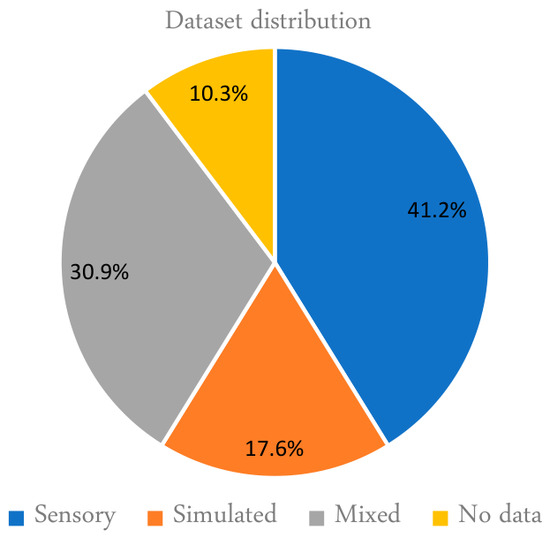
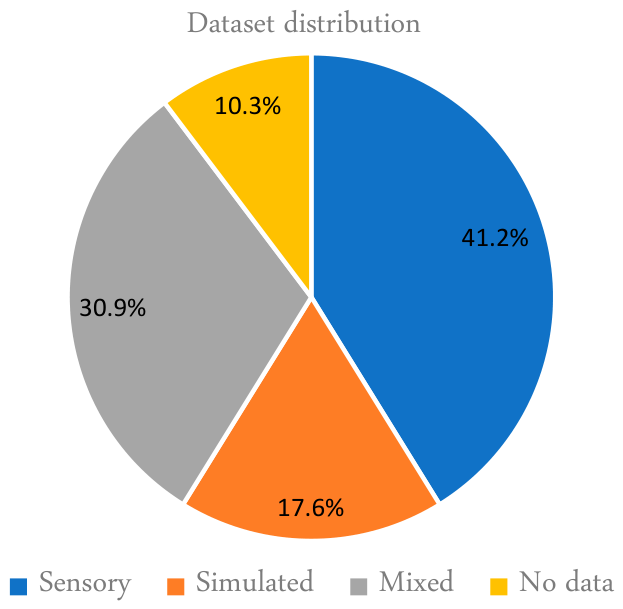
Figure 6 shows the main sources of the dataset that have been adopted by researchers (RQ3.2). The figure reveals a clear preference for real-world data. Four distinct categories were identified: sensory, simulated, mixed, and no-data. Sensory data is the most prevalent, accounting for 41.2% (n = 28) of the studies, followed by mixed datasets at 30.9% (n = 21). While simulated data alone accounts for 17.6% (n = 12), the “no-data” category remains the least represented at 10.3% (n = 7). This high reliance on sensory and mixed data (totaling over 70%) underscores the industry’s shift toward high-fidelity digital twins that prioritize real-time operational accuracy over purely theoretical modeling.
Figure 6.
Dataset sources.
5.4. Analysis Based on Mining Domain and AI Techniques (RQ 3.3 and RQ 3.4)
Table 8 illustrates the target domains identified in the reviewed literature (RQ 3.3). While the primary set consists of 68 papers, the total frequency across domains is 71. This discrepancy is due to three specific studies [20,59,77] that addressed multiple domains. Specifically, ref. [20] covered processing plants and physical assets, ref. [59] addressed processing plants and operational systems, and ref. [77] focused on both physical assets and operational systems.
Table 8.
Target mining domains.
There is a dominance of “Surface-Level” DTs in mineral processing. Physical assets (35.2%), processing plants (28.2%), and operational systems (28.2%) comprise over 91% of the current literature. This concentration stems from two primary sources: (a) data accessibility, as heavy machinery and plants are already IoT-instrumented, providing ‘low-hanging fruit’ for AI integration; and (b) immediate ROI, where clear financial gains from predictive maintenance and increased recovery rates incentivize adoption.
Table 9 shows the underlying AI techniques used in primary studies (RQ 3.4). While the primary dataset consists of 68 papers, the total frequency of techniques used is 73. This is attributed to five studies [46,69,70,74,79] that employed a hybrid approach combining ML and EC. In this analysis, these studies are counted within both respective categories. Consequently, the 67 instances of ML include these five hybrid papers.
Table 9.
The underlying AI techniques which the researchers applied to AI-DT in mining operations.
Rather than being explicitly coded for every task, ML—a specialized field within AI—enables algorithms to identify patterns and derive decisions directly from data [9]. Building on this, DL functions as a sub-sector of ML that processes information through multi-layered, hierarchical frameworks to refine its expertise and understanding of complex environments [9]. While some of the papers mentioned above utilize ML/DL in the proposed digital twin in a very general manner especially in the conceptual framework-based papers (shown in Table 7), several specify exactly NNs, is most suitable for the problem at hand.
NNs (or ANN) are a subset of AI inspired by the human brain’s architecture. These machine learning models consist of layered “neurons” that identify patterns within data by adjusting internal weights and biases to transform inputs into accurate outputs [9]. In the context of mining, a NN is a sophisticated “digital brain” used to predict and optimize complex, messy industrial processes that are hard [20,21,22,23,24,25,26,27,28,29,30,31,32,33,34,35,36,37,38,39,40,41,42,43,44,45,46,47,48,49,50,51,52,53,54,55,56,57,58,59,60,61,62,63,65,66,67,68,69,70,71,72,73,74,75,76,77,78,79,80,81,82,83,84,85,86,87] to model with traditional math. Instead of relying on a rigid formula, the network looks at historical sensor data—like ore hardness, chemical feeds, and moisture levels—to learn exactly how those variables affect your final yield. Because mining data is often “noisy” and non-linear (meaning a small change in one variable can cause a huge, unpredictable change in another [9]). While a human operator cannot track 50 variables at once, a NN can, finding the “sweet spot” for efficiency that keeps the plant running at peak performance. Therefore, NNs are found in many examples in the AI-DT in the mining literature (e.g., [20,27,28,37,38]). Use of this technique in mining provides high predictive capability including fault detection (auger rigs), airflow prediction (ventilation), and energy optimization (ore processing). In addition, it supports adaptive systems (self-learning twins) [28].
However, their disadvantages have also been studied several times. For instance, NN suffers from computational cost, DT model design effort, and need for large training datasets [37]. Another disadvantage of NNs with AI-DT in mining applications is the overfitting in mining airflow case [38]. In general, traditional/pure NN is becoming less competitive because of the above limitations and the traditional drawbacks such as noise and data scarcity [69]; there is a need to shift toward hybrid NNs as a practical industrial solution [64,69,74,86]. To mitigate the challenges of data scarcity in training, several investigators have developed hybrid architectures that integrate NN with FL. Within these frameworks, fuzzy rules function as a synthetic data engine, producing the foundational augmented samples required to train the NN effectively [94]. Others recommend an offline training approach for the DT model, with the resulting insights integrated into cloud-based decision-making. Within the context of autonomous manufacturing, ML/DL-driven DTs are utilized specifically for identifying system faults [95].
FL is a frequently utilized branch of AI within these studied methods. According to [96,97], FL is particularly effective for digital twin applications because it can model fluid, real-world variables rather than just binary states. Furthermore, it allows complex human knowledge to be converted into accessible, language-based rules, making the system more intuitive and adaptable. Despite this, FL was chosen by a single study in this SLR [64], combining FL with NNs (Bi-LSTM). The authors used FL to overcome uncertainty and vagueness limitations. The paper, however, explicitly stated that “The degree of creeping is a vague concept” and human judgment is subjective (i.e., FL methods provide structured evaluation).
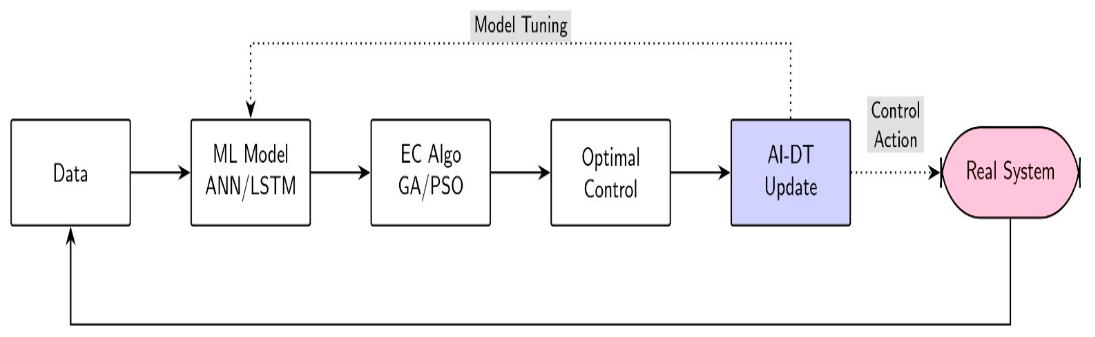
Regarding EC, there were five studies that combine EC with ML (shown in Table 9). Optimization algorithms were used in these studies: locust search [69], particle swam optimization (PSO) [46,70,79], salp swarm algorithm [46], or genetic algorithm [74]. What we are seeing is consistent with how these methods work in practice. Like FL, EC is not used alone in AI-DTs for mining and mineral processing; the reason might be that EC lacks predictive capability and real-time efficiency. It is almost always hybridized with machine learning (especially NNs), which provides the system model that EC optimizes. Most studies in this SLR implicitly follow the pipeline shown in Figure 7.
Figure 7.
Conceptual pipeline diagram.
5.5. Analysis Based on Challenges (RQ 4)
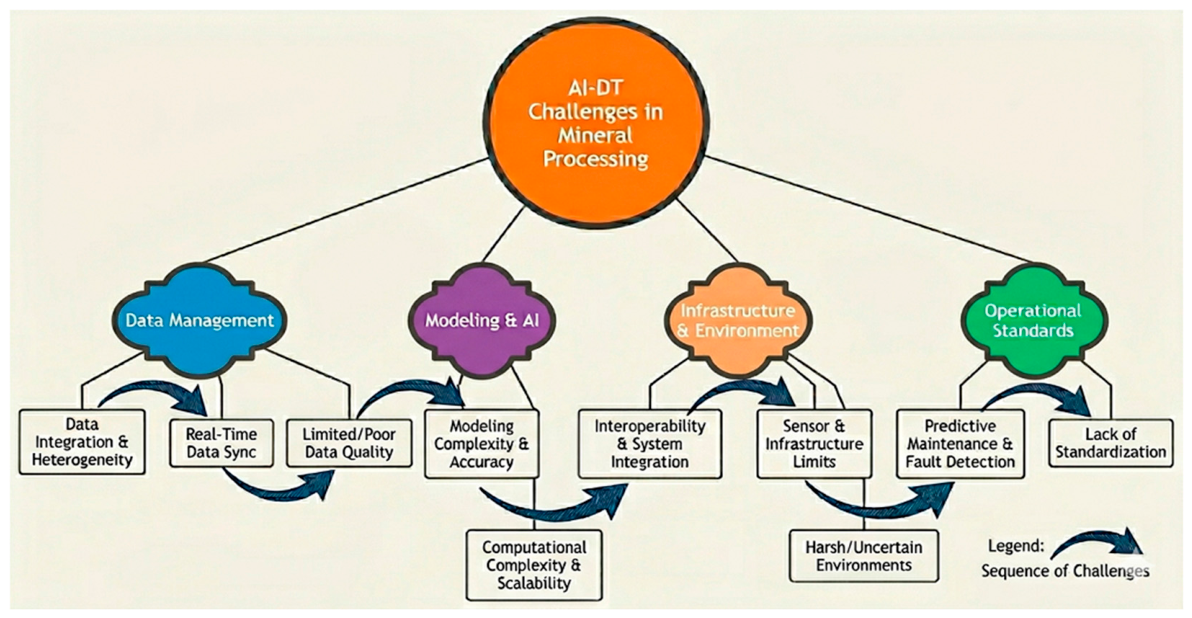
Despite this progress, several critical challenges persist in the domain of AI-DTs for mining. Figure 8 provides an overview of the ten most frequent challenges encountered during the utilization of AI-DTs (RQ 4). They are, in order, Data Integration and Heterogeneity, Real-Time Data Processing and Synchronization, Limited/Poor Data Quality and Availability, Modeling Complexity and Accuracy, Interoperability and System Integration, Computational Complexity and Scalability, Sensor and Infrastructure Limitations, Harsh/Uncertain Mining Environments, Predictive Maintenance and Fault Detection, and Lack of Standardization.
Figure 8.
Major challenges in the implementation of AI-DTs in mineral processing. Numerical labels denote the frequency of occurrence, where a rank of 1 represents the most encountered challenge and 10 represents the least frequent.
Table 10 summarizes the challenges identified in this study. It includes a detailed description of each issue, along with the corresponding metrics such as the number of studies in which the challenge appears, its frequency, and its relative percentage. For clarity and conciseness, the most critical challenges have been grouped into four main categories as shown in Figure 8: Data Management, Modeling and AI, Infrastructure and Environment, and Operational Standards.
Table 10.
The common challenges of AI-DT in mining application.
Implementing AI-driven digital twins in mining operations involves a complex web of technical and environmental hurdles, beginning with the foundational issue of data management (Challenges 1, 2, and 3). Algorithmic generalizability and rigorous validation are currently impeded by the unavailability of normalized datasets sourced from heterogeneous operational contexts, a problem exacerbated by interoperability issues stemming from heterogeneous sensor technologies and incompatible data formats. Because many mining plants utilize uneven data acquisition routines, creating high-quality training sets for AI/ML models is exceptionally difficult [98]. This struggle is further intensified by the physical realities of the mining environment; maintaining data integrity in dusty, high-vibration settings introduces significant complexities in cleaning and preprocessing, where sensor degradation or corrupted readings frequently lead to model underperformance and a deficiency of reliable ground-truth labels [99,100].
Beyond data quality, the computational requirements (Challenge 6) for these advanced architectures often clash with the limited edge-computing capabilities found at remote or subterranean sites [101]. While lower-complexity models like random forests or SVMs (used by some studies [20,39]) can reduce latency, they often lack the sophistication to capture nuanced patterns under variable load conditions [102,103]. Cloud-based alternatives are rarely a panacea, as robust connectivity is seldom guaranteed in deep-earth or isolated locations, necessitating a delicate balance between model complexity and hardware constraints through lightweight architecture or model compression [99,104]. Furthermore, the lack of standardized (Challenge 10), openly available datasets tailored to these harsh environments (Challenge 8) continues to hinder reproducibility and large-scale benchmarking across the industry [105,106]. Even when models are successfully deployed, their “black box” nature remains a barrier for on-site technicians; without explainable AI approaches to provide interpretability, it is difficult to bridge the gap between predictive maintenance (Challenge 9) and automated action decisions [100]. Finally, the prohibitive cost of deploying extensive sensor networks (Challenge 7) and robust digital twin platforms remains a significant barrier for small- and medium-scale operations, leaving the development of scalable, federated approaches as a critical, yet largely unresolved, challenge for the future of the industry [107].
Several additional challenges were identified but excluded from the primary table due to space constraints and lower frequency (appearing in fewer than five studies). These include categories addressed by four papers—Cybersecurity, Privacy, and Trust [25,44,75,76]; the Simulation–Reality Gap [22,55,58,69]; Complex System Coordination [30,40,50,77]; and Energy Optimization [26,37,82,84]—as well as those addressed by three papers, such as AI Model Limitations [74,81,87], Resource Constraints [25,36,83], and Workforce Skill Gaps [20,31,83].
5.6. Analysis on Research Directions (RQ5)
This review identifies several critical gaps in the current literature that warrant further investigation to enhance the implementation and effectiveness of AI-driven digital twins (AI-DTs) in mining operations. Based on the analyzed studies, four research directions are proposed in response to RQ5:
- Cost-aware predictive maintenance and fault diagnosis: A significant portion of the reviewed studies (n = 16, 23.5%) highlights the need to address the economic aspects of predictive maintenance and fault diagnosis in AI-DT applications [20,24,27,41,46,52,54,55,57,58,62,65,69,70,72,79]. Future research should focus not only on improving the accuracy of failure prediction and diagnostic models but also on evaluating their cost-effectiveness. Key areas include AI-driven maintenance strategies, condition monitoring, and optimization of maintenance scheduling under economic constraints.
- Data integration and interoperability: Data integration and interoperability with enterprise systems are emphasized by many studies (n = 15, 22.1%) [20,25,28,29,41,42,43,51,53,56,60,62,71,73,78]. This research direction focuses on enabling the seamless integration of heterogeneous data sources, including IoT devices, sensors, and legacy systems. Future efforts should aim to develop robust interoperability frameworks and unified platforms that support real-time data exchange and consistent data governance across the mining value chain.
- Scalability and high-performance architectures: Several studies (n = 12, 17.6%) identify scalability and computational performance as key challenges [24,25,26,43,47,49,53,57,65,70,76,84]. Research in this area should focus on designing scalable AI-DT architectures capable of handling large-scale, high-velocity datasets while maintaining computational efficiency. This includes leveraging distributed computing, edge–cloud integration, and high-performance computing frameworks to support real-time and large-scale deployment.
- Development of standardized quality metrics: There is a clear need to systematically evaluate the quality of AI-DTs in mining operations through the development of standardized metrics capable of quantifying multiple dimensions of performance. These include both technological attributes (e.g., model accuracy, system reliability, computational efficiency) and mineral-processing-related outcomes (e.g., process optimization, recovery rates). However, designing and implementing such metrics remains challenging due to the inherent complexity of digital twinning, which involves the integration of diverse technologies and the application of interdisciplinary knowledge. Core enabling technologies in this domain include modeling, big data analytics, machine learning, and simulation.
In summary, these research directions provide a structured roadmap for advancing the development and deployment of AI-DTs in mining operations, addressing both technical and practical challenges identified in the literature.
6. Limitations and Future Work
As highlighted earlier, systematic literature reviews offer several advantages over traditional reviews, including improved transparency, broader coverage of studies, and reduced bias. However, despite these strengths, the methodology also presents practical challenges. During this study, several limitations were encountered that complicated its implementation. First, while every effort was made to be comprehensive, this review may not encompass every existing study within the academic or industrial sectors. To minimize this risk and ensure a representative sample, our search strategy focused on five reputable literature databases known for high-quality, peer-reviewed content. Second, Omission of some keywords in the search string (e.g., “deep learning”) may have narrowed the results. Third, the criteria for selecting or rejecting studies may be influenced by the researcher’s subjective perspective (bias).
While this study provides a comprehensive overview, the descriptive nature of the current analysis presents an opportunity for future research. Transitioning from descriptive summaries to statistical inference or advanced modeling techniques would significantly deepen the analytical rigor. For example, implementing predictive modeling to forecast annual publication trends could provide a more robust trajectory of global research output. Furthermore, there is a clear need for localized studies in nations with significant or emerging mining sectors—such as Indonesia, Congo, and Saudi Arabia—that were not prominently featured in this dataset. To support these future efforts, all datasets and methodological templates used in this review are available upon request to facilitate replication and comparative analysis.
7. Conclusions
This paper presents a comprehensive review of AI-driven digital twin (AI-DT) applications in the mining sector. Using a systematic literature review approach, 68 studies published between 2015 and 2025 were analyzed. The findings indicate that (1) journal publications dominate this research area compared to conferences and workshops, with Scientific Reports emerging as the most frequent publication venue. (2) China was identified as the leading contributor in terms of research output. (3) The most common empirical strategy was experimentation followed by case study; sensory data were the most widely used datasets, followed by a mixture of sensory and simulated data. (4) Most of the current literature worked at three mining domains: physical assets, processing plants, and operational systems, and ML methods have demonstrated a more substantial impact on this area of study compared to alternative intelligent approaches such as evolutionary computing and fuzzy logic, with the neural networks paradigm as the most common ML technique. (5) The top 10 challenges of AI-DT in mining field identified were: Data Integration and Heterogeneity, Real-Time Data Processing and Synchronization, Limited/Poor Data Quality and Availability, Modeling Complexity and Accuracy, Interoperability and System Integration, Computational Complexity and Scalability, Sensor and Infrastructure Limitations, Harsh/Uncertain Mining Environments, Predictive Maintenance and Fault Detection, and Lack of Standardization. (6) The four key emerging research avenues are: cost-aware predictive maintenance and fault diagnosis, data integration and interoperability, scalability and high-performance architectures, and development of standardized quality metrics.
The outcomes of this study provide valuable insights for mining companies, AI practitioners, regulatory bodies, and other stakeholders seeking to understand the current capabilities and applications of AI-DTs. The advancement of AI-DTs signifies a fundamental shift in mining engineering, where data is no longer a byproduct but a core asset for real-time safety and environmental optimization. Future integration of these systems is expected to reduce operational risks in harsh environments and significantly lower the carbon footprint of extraction through more precise resource management. Moreover, the findings establish a strong basis for future research by highlighting key challenges and areas requiring further investigation. The study also discusses its limitations and outlines potential directions for advancing research in this rapidly developing field.
Author Contributions
Conceptualization; methodology; software; validation; formal analysis, S.A.E. and A.I.A.; investigation; resources; data curation; writing—original draft preparation, R.A. and M.A.; writing—review and editing; visualization. M.A., A.I.A. and R.A.; supervision; project administration; funding acquisition, S.A.E. and A.I.A. All authors have read and agreed to the published version of the manuscript.
Funding
The authors extend their appreciation to Northern Border University, Saudi Arabia, for supporting this work through project number (NBU-CRP-2026-1564).
Institutional Review Board Statement
Not applicable.
Informed Consent Statement
Not applicable.
Data Availability Statement
The original contributions presented in this study are included in the article. Further inquiries can be directed to the corresponding author.
Acknowledgments
During the preparation of this manuscript, the authors used ChatGPT (GPT-5.2, OpenAI) for improving language clarity and readability and for generating initial versions of Figure 1, Figure 2, Figure 7 and Figure 8. All outputs were critically reviewed, edited, and validated by the authors, who take full responsibility for the content of this publication.
Conflicts of Interest
The authors declare no conflicts of interest.
References
- Hartman, H.L.; Mutmansky, J.M. Introductory Mining Engineering, 2nd ed.; Wiley: Hoboken, NJ, USA, 2002. [Google Scholar]
- World Economic Forum. Digital Twins Can Boost Mining Output and Support The Energy Transition. Available online: https://www.weforum.org/stories/2023/06/digital-twins-mining-energy-transition/ (accessed on 23 March 2026).
- Don, M.G.; Wanasinghe, T.R.; Gosine, R.G.; Warrian, P.J. Digital Twins and Enabling Technology Applications in Mining: Research Trends, Opportunities, and Challenges. IEEE Access 2025, 13, 6945–6963. [Google Scholar] [CrossRef] [Scilit]
- Rojas, L.; Peña, A.; Garcia, J. AI-Driven Predictive Maintenance in Mining: A Systematic Literature Review on Fault Detection, Digital Twins, and Intelligent Asset Management. Appl. Sci. 2025, 15, 3337. [Google Scholar] [CrossRef] [Scilit]
- Ali, M.A.; Mohammed Ali, M.I.; Osman, A.A. AI-driven Mining 4.0: A Systematic Review of Smart, Sustainable, and Autonomous Technologies across the Mining Lifecycle. Curr. J. Appl. Sci. Technol. 2025, 44, 125–139. [Google Scholar] [CrossRef] [Scilit]
- VanDerHorn, E.; Mahadevan, S. Digital Twin: Generalization, characterization and implementation. Decis. Support Syst. 2021, 145, 113524. [Google Scholar] [CrossRef] [Scilit]
- Yusupbekov, N.; Adilov, F.; Ivanyan, A.; Abdurasulov, F. Application of digital twin technologies in mining industrial branch. E3S Web Conf. 2023, 417, 05016. [Google Scholar] [CrossRef] [Scilit]
- Hazrathosseini, A.; Moradi Afrapoli, A. The advent of digital twins in surface mining: Its time has finally arrived. Resour. Policy 2023, 80, 103155. [Google Scholar] [CrossRef] [Scilit]
- Russell, S.J.; Norvig, P. Artificial Intelligence: A Modern Approach, 4th ed.; Pearson: Harlow, UK, 2022. [Google Scholar]
- Nobahar, P.; Xu, C.; Dowd, P.; Shirani Faradonbeh, R. Exploring digital twin systems in mining operations: A review. Green Smart Min. Eng. 2024, 1, 474–492. [Google Scholar] [CrossRef] [Scilit]
- Wills, B.A.; Finch, J. Wills’ Mineral Processing Technology, 8th ed.; Elsevier: Oxford, UK, 2015. [Google Scholar] [CrossRef] [Scilit]
- Qu, J.; Kizil, M.S.; Yahyaei, M.; Knights, P.F. Digital twins in the minerals industry: A comprehensive review. Min. Technol. 2023, 132, 267–289. [Google Scholar] [CrossRef] [Scilit]
- Wu, J.; Ansari, U. From CO2 Sequestration to Hydrogen Storage: Further Utilization of Depleted Gas Reservoirs. Reserv. Sci. 2025, 1, 19–35. [Google Scholar] [CrossRef] [Scilit]
- Tahir, M.U.; Guo, S. Preliminary Investigation of Fracture Behavior during Carbon Dioxide Fracturing of Natural Hydrogen Reservoir with Hard-Core Imperfections. Reserv. Sci. 2026, 2, 34–51. [Google Scholar] [CrossRef] [Scilit]
- Sommerville, I. Software Engineering, 10th ed.; Pearson Education Limited: Harlow, UK, 2015. [Google Scholar]
- Yang, Z.; Tang, C.; Zhang, T.; Zhang, Z.; Doan, D.T. Digital Twins in Construction: Architecture, Applications, Trends and Challenges. Buildings 2024, 14, 2616. [Google Scholar] [CrossRef] [Scilit]
- Madahana, M.C.I.; Marakalala, M.; Ekoru, J.E.D. Integrated digital twin systems in mining operations: A holistic review of the current state, challenges, and future prospects. In Proceedings of the 2025 IEEE 16th Annual Ubiquitous Computing, Electronics & Mobile Communication Conference (UEMCON), Yorktown Heights, NY, USA, 22–24 October 2025; pp. 0479–0485. [Google Scholar]
- Petersen, K.; Vakkalanka, S.; Kuzniarz, L. Guidelines for conducting systematic mapping studies in software engineering: An update. Inf. Softw. Technol. 2015, 64, 1–18. [Google Scholar] [CrossRef] [Scilit]
- Page, M.J.; McKenzie, J.E.; Bossuyt, P.M.; Boutron, I.; Hoffmann, T.C.; Mulrow, C.D.; Shamseer, L.; Tetzlaff, J.M.; Akl, E.A.; Brennan, S.E.; et al. The PRISMA 2020 statement: An updated guideline for reporting systematic reviews. BMJ 2021, 372, 71. [Google Scholar] [CrossRef] [Scilit] [PubMed]
- Palsaniya, R.C. AI-Driven Machine Learning for Enhancing Nanomanufacturing Equipment Output. In Proceedings of the 2025 IEEE 20th Nanotechnology Materials and Devices Conference (NMDC), Virtual Conference, 9–11 October 2025. [Google Scholar] [CrossRef] [Scilit]
- Lee, J.; Park, J.; Hong, S.; Hwang, I.; Hwang, S.; Jang, Y.J.; Shin, D.; Lee, J. Autonomous Robot Orchestration Solution for OHT with Active Q Routing and Digital Twin FA: Factory Automation. IEEE Trans. Semicond. Manuf. 2025, 38, 404–413. [Google Scholar] [CrossRef] [Scilit]
- Xue, X.; Yu, X.; Zhou, D.; Wang, X.; Bi, C.; Wang, S.; Wang, F.-Y. Computational Experiments for Complex Social Systems: Integrated Design of Experiment System. IEEE/CAA J. Autom. Sin. 2024, 11, 1175–1189. [Google Scholar] [CrossRef] [Scilit]
- Zhao, Z.; Li, D.; She, J.; Zhang, H.; Zhou, Y.; Zhao, L. Construction and Application of Digital Twin Model of Hydropower Plant Based on Data-driven. In Proceedings of the 2021 3rd International Workshop on Artificial Intelligence and Education (WAIE), Xi’an, China, 19–21 November 2021; pp. 121–125. [Google Scholar] [CrossRef] [Scilit]
- Lu, D.; Gao, G.; Shen, Y.; Tong, Z. Design of Gearbox Monitoring System Based on Edge Computing. In Proceedings of the 2022 4th International Conference on Artificial Intelligence and Advanced Manufacturing (AIAM), Hamburg, Germany, 7–9 October 2022. [Google Scholar] [CrossRef] [Scilit]
- Mal’tsev, P.A.; Shatilova, N.A.; Abramkin, S.E.; Podkina, M.E. Designing a Digital Twin in Oil and Gas Technologies: Technology Integration. In Proceedings of the 2024 XXVII International Conference on Soft Computing and Measurements (SCM), Saint-Petersburg, Russia, 22–24 May 2024. [Google Scholar] [CrossRef] [Scilit]
- Wang, J.; Liu, J.; Lin, C. Energy Efficiency Optimisation Method for Intelligent Manufacturing Workshop Combined with Big Data Analysis. In Proceedings of the 2025 International Conference on Mechatronics, Robotics, and Artificial Intelligence (MRAI), Jinan, China, 19–21 June 2025. [Google Scholar] [CrossRef] [Scilit]
- Li, Y. Fault Prediction and Diagnosis System for Large-diameter Auger Rigs Based on Digital Twin and BP Neural Network. In Proceedings of the 2022 IEEE 6th Advanced Information Technology, Electronic and Automation Control Conference (IAEAC), Beijing, China, 3–5 October 2022. [Google Scholar] [CrossRef] [Scilit]
- Karnauhov, A.; Kozhubaev, Y.; Ilin, A.; Ivanov, V. Intelligent Management of Business Processes in the Energy, Oil and Gas Industries of Russia. In Proceedings of the 2025 XXVIII International Conference on Soft Computing and Measurements (SCM), Saint Petersburg, Russia, 28–30 May 2025. [Google Scholar] [CrossRef] [Scilit]
- Huang, M.; Zhao, T.; Jin, G.; Mu, X.; Liu, H. Intelligent Wireless Self-Sustained Sensing Cubic Node Toward AIOT Ready Smart City. In Proceedings of the 2023 IEEE 22nd International Conference on Micro and Nanotechnology for Power Generation and Energy Conversion Applications (PowerMEMS), Abu Dhabi, United Arab Emirates, 11–14 December 2023. [Google Scholar] [CrossRef] [Scilit]
- Liu, K.; Chen, L.; Li, L.; Ren, H.; Wang, F.-Y. MetaMining: Mining in the Metaverse. IEEE Trans. Syst. Man Cybern. Syst. 2023, 53, 3858–3869. [Google Scholar] [CrossRef] [Scilit]
- Risso, N.; Saavedra, M.; Zhang, J. Mine2Twin: A Synergistic Industry-Academia Collaboration to Improve Engineering Skills for Industry 5.0. In Proceedings of the 2025 IEEE Global Engineering Education Conference (EDUCON), London, UK, 22–25 April 2025. [Google Scholar] [CrossRef] [Scilit]
- Ai, Y.; Liu, Y.; Gao, Y.; Zhao, C.; Cheng, X.; Han, J.; Tian, B.; Chen, L.; Wang, F.-Y. PMWorld: A Parallel Testing Platform for Autonomous Driving in Mines. IEEE Trans. Intell. Veh. 2024, 9, 1402–1414. [Google Scholar] [CrossRef] [Scilit]
- Zeng, W. Research on Intelligent Ventilation System Based on Digital Twins. In Proceedings of the 2024 IEEE 3rd World Conference on Applied Intelligence and Computing (AIC), Gwalior, India, 27–28 July 2024. [Google Scholar] [CrossRef] [Scilit]
- Zhou, R.; Jiang, J.; Qin, J.; Du, N.; Shi, H.; Wang, Y. Global Mechanical Response Sensing of Corrugated Compensators Based on Digital Twins. Appl. Sci. 2023, 13, 4048. [Google Scholar] [CrossRef] [Scilit]
- Teutscher, D.; Weber-Carstanjen, T.; Simonis, S.; Krause, M.J. Predicting Filter Medium Performances in Chamber Filter Presses with Digital Twins Using Neural Network Technologies. Appl. Sci. 2025, 15, 4933. [Google Scholar] [CrossRef] [Scilit]
- Xue, X.; Wan, H.; Zhang, H.; Yang, J.; Wang, Y.; Yang, W.; Chen, F. Virtual Measurement of Explosion-Proof Performance: Application of an Improved RBF-GMSE-Based Surrogate Model to the Safety Performance Characterization of Coal Mine Equipment. Appl. Sci. 2025, 15, 9765. [Google Scholar] [CrossRef] [Scilit]
- Dli, M.; Puchkov, A.; Meshalkin, V.; Abdeev, I.; Saitov, R.; Abdeev, R. Energy and Resource Efficiency in Apatite-Nepheline Ore Waste Processing Using the Digital Twin Approach. Energies 2020, 13, 5829. [Google Scholar] [CrossRef] [Scilit]
- Karagianni, M.; Benardos, A. Machine Learning Techniques to Model and Predict Airflow Requirements in Underground Mining. Mater. Proc. 2023, 5, 17. [Google Scholar] [CrossRef] [Scilit]
- Peña-Graf, F.; Órdenes, J.; Wilson, R.; Navarra, A. Discrete Event Simulation for Machine-Learning Enabled Mine Production Control with Application to Gold Processing. Metals 2022, 12, 225. [Google Scholar] [CrossRef] [Scilit]
- Huang, Z.; Ge, S.; He, Y.; Wang, D.; Zhang, S. Research on the Intelligent System Architecture and Control Strategy of Mining Robot Crowds. Energies 2024, 17, 1834. [Google Scholar] [CrossRef] [Scilit]
- Kurt, A.; Kahraman, M.M. From Reactive to Resilient: A Hybrid Digital Twin and Deep Learning Framework for Mining Operational Reliability. Mining 2026, 6, 7. [Google Scholar] [CrossRef] [Scilit]
- Nad, A.; Jooshaki, M.; Tuominen, E.; Michaux, S.; Kirpala, A.; Newcomb, J. Digitalization Solutions in the Mineral Processing Industry: The Case of GTK Mintec, Finland. Minerals 2022, 12, 210. [Google Scholar] [CrossRef] [Scilit]
- El Bazi, N.; Mabrouki, M.; Laayati, O.; Ouhabi, N.; El Hadraoui, H.; Hammouch, F.-E.; Chebak, A. Generic Multi-Layered Digital-Twin-Framework-Enabled Asset Lifecycle Management for the Sustainable Mining Industry. Sustainability 2023, 15, 3470. [Google Scholar] [CrossRef] [Scilit]
- Liu, Y.; Shen, Y.; Fan, L.; Tian, Y.; Ai, Y.; Tian, B.; Liu, Z.; Wang, F.-Y. Parallel Radars: From Digital Twins to Digital Intelligence for Smart Radar Systems. Sensors 2022, 22, 9930. [Google Scholar] [CrossRef] [Scilit]
- Xie, J.; Ge, F.; Cui, T.; Wang, X. A virtual test and evaluation method for fully mechanized mining production system with different smart levels. Int. J. Coal Sci. Technol. 2022, 9, 41. [Google Scholar] [CrossRef] [Scilit]
- Zayed, S.M.; Attiya, G.; El-Sayed, A.; Sayed, A.; Hemdan, E.D. An Efficient Fault Diagnosis Framework for Digital Twins Using Optimized Machine Learning Models in Smart Industrial Control Systems. Int. J. Comput. Intell. Syst. 2023, 16, 69. [Google Scholar] [CrossRef] [Scilit]
- Cai, W.; Yang, F.; Yao, B.; Li, C.; Sun, G. An adaptive k-means clustering algorithm based on grid and domain centroid weights for digital twins in the context of digital transformation. J. Big Data 2025, 12, 130. [Google Scholar] [CrossRef] [Scilit]
- Dong, X.; Li, S.; Ma, R.; Tian, W.; Zhao, K.; Xiang, H.; Zhu, J.; Qiu, Y. Cloud-based slope risk monitoring and early warning system for open-pit coal mines: A case study of Zhonglian Runshi. Sci. Rep. 2025, 15, 44396. [Google Scholar] [CrossRef] [Scilit] [PubMed]
- Wang, L.; Li, X.; Guo, X. Design and application of interactive system of intelligent power-grid command network based on digital twin and MATLAB. Discov. Internet Things 2025, 5, 104. [Google Scholar] [CrossRef] [Scilit]
- Chen, L.; Xie, Y.; He, Y.; Ai, Y.; Tian, B.; Li, L.; Ge, S.; Wang, F.-Y. Autonomous mining through cooperative driving and operations enabled by parallel intelligence. Commun. Eng. 2024, 3, 75. [Google Scholar] [CrossRef] [Scilit]
- Pribiš, R.; Drahoš, P.; Kozák, Š.; Beňo, L.; Kučera, E.; Haffner, O.; Pajpach, M. Design and validation of a flexible framework for developing generic digital twins for Industry 4.0. Sci. Rep. 2025, 15, 44495. [Google Scholar] [CrossRef] [Scilit]
- Mo, F.; Rehman, H.U.; Chaplin, J.C.; Sanderson, D.; Ratchev, S. Digital twin-based self-learning decision-making framework for industrial robots in manufacturing. Int. J. Adv. Manuf. Technol. 2025, 139, 221–240. [Google Scholar] [CrossRef] [Scilit]
- Saleem, H.A.; Ayalew, A.T. Enhancing environmental sustainability and operational efficiency in a case study of limestone quarry in an arid climate. Sci. Rep. 2025, 15, 18884. [Google Scholar] [CrossRef] [Scilit]
- Wang, M.; Su, X.; Song, H.; Wang, Y.; Yang, X. Enhancing predictive maintenance strategies for oil and gas equipment through ensemble learning modeling. J. Pet. Explor. Prod. Technol. 2025, 15, 46. [Google Scholar] [CrossRef] [Scilit]
- Liu, W.; Han, B.; Zheng, A.; Zheng, Z.; Chen, S.; Jia, S. Fault diagnosis of reducers based on digital twins and deep learning. Sci. Rep. 2024, 14, 24406. [Google Scholar] [CrossRef] [Scilit]
- Zhu, M.; Han, X. Human-machine-environment collaborative control architecture and dynamic reliability optimization of coal mine longwall face driven by the Kuanghong system. Discov. Appl. Sci. 2025, 7, 1386. [Google Scholar] [CrossRef] [Scilit]
- Tan, J.; Radhi, R.M.; Shirini, K.; Gharehveran, S.S.; Parisooz, Z.; Khosravi, M.; Azarinfar, H. Innovative framework for fault detection and system resilience in hydropower operations using digital twins and deep learning. Sci. Rep. 2025, 15, 15669. [Google Scholar] [CrossRef] [Scilit]
- Wu, M.; Zhou, H.; Yao, R.; Ren, S. Life prediction and health assessment of aero-engine gas path using digital twin and deep learning. Complex Intell. Syst. 2025, 11, 399. [Google Scholar] [CrossRef] [Scilit]
- Hürkamp, A.; Gellrich, S.; Dér, A.; Herrmann, C.; Dröder, K.; Thiede, S. Machine learning and simulation-based surrogate modeling for improved process chain operation. Int. J. Adv. Manuf. Technol. 2021, 117, 2297–2307. [Google Scholar] [CrossRef] [Scilit]
- Lee, Y.; Shin, J.; Lee, W. Manufacturing process analysis framework for process mining: Case study of fully automated factory applications. Int. J. Adv. Manuf. Technol. 2025, 136, 5641–5664. [Google Scholar] [CrossRef] [Scilit]
- Kang, W.; Zhang, X.; Zhang, J.; Chen, X.; Huang, H.; He, B.; Qin, W.; Zhu, H. Multimodal data generative fusion method for complex system health condition estimation. Sci. Rep. 2025, 15, 20026. [Google Scholar] [CrossRef] [Scilit]
- Li, K.; Wang, Y.; Wang, G.; Karimi, H.R.; Zhan, W. Physical information entropy-driven performance deterioration diagnosis for control systems of coal power plant. Int. J. Adv. Manuf. Technol. 2025, 140, 2669–2689. [Google Scholar] [CrossRef] [Scilit]
- Zhu, Y.; Tian, Y.; Gong, P.; Yi, K.; Zhao, T. Prediction of instability of formwork concrete pier based on big data machine learning for secondary mining without coal pillar mining. Sci. Rep. 2025, 15, 17048. [Google Scholar] [CrossRef] [Scilit]
- Li, S.; Xie, J.; Wang, X.; Ge, F. Prediction of the creeping of AFC based on fuzzy reasoning and Bi-LSTM fusion iteration. Artif. Intell. Rev. 2024, 57, 142. [Google Scholar] [CrossRef] [Scilit]
- Haghshenas, A.; Hasan, A.; Osen, O.; Mikalsen, E.T. Predictive digital twin for offshore wind farms. Energy Inform. 2023, 6, 1. [Google Scholar] [CrossRef] [Scilit]
- Seipolt, A.; Buschermöhle, R.; Haag, V.; Hasselbring, W.; Höfinghoff, M.; Schumacher, M.; Wilbers, H. Reinforcement learning and digital twin-driven optimization of production scheduling with the digital model playground. Discov. Internet Things 2024, 4, 34. [Google Scholar] [CrossRef] [Scilit]
- Zhang, J.; Wan, C.; Wang, J.; Chen, C.; Wang, T.; Xu, K. Research on the high precision hydraulic column stress monitoring method. Sci. Rep. 2025, 15, 832. [Google Scholar] [CrossRef] [Scilit]
- Ambrogio, G.; Filice, L.; Gagliardi, F. Smart manufacturing platform based on input-output empirical relationships for process monitoring. Int. J. Mater. Form. 2024, 17, 45. [Google Scholar] [CrossRef] [Scilit]
- Cai, C.; Jiang, Z.; Wu, H.; Wang, J.; Liu, J.; Song, L.; Zhu, L.; Han, J. Study of deep multimodal information fusion-based digital twin method for gearbox fault diagnosis. Int. J. Adv. Manuf. Technol. 2025, 138, 3529–3542. [Google Scholar] [CrossRef] [Scilit]
- Lin, Z.; Fan, Y.; Tan, J.; Li, Z.; Yang, P.; Wang, H.; Duan, W. Tool wear prediction based on XGBoost feature selection combined with PSO-BP network. Sci. Rep. 2025, 15, 3096. [Google Scholar] [CrossRef] [Scilit]
- Binder, C.; Neureiter, C.; Lüder, A. Towards a domain-specific information architecture enabling the investigation and optimization of flexible production systems by utilizing artificial intelligence. Int. J. Adv. Manuf. Technol. 2022, 123, 49–81. [Google Scholar] [CrossRef] [Scilit]
- Peng, W.; Hou, J.; Guo, W.; Li, J.; Duan, T. Virtual-real combination evaluation method and digital twin technology exploration for deep-sea corrosion. npj Mater. Degrad. 2025, 9, 125. [Google Scholar] [CrossRef] [Scilit]
- Chen, Y.-F.; Arendt, F.; Bornhöft, H.; de Camargo, A.S.S.; Deubener, J.; Diegeler, A.; Gogula, S.; Contreras Jaimes, A.T.; Kempf, S.; Kilo, M.; et al. Ontology-Based Digital Infrastructure for Data-Driven Glass Development. Adv. Eng. Mater. 2025, 27, 2401560. [Google Scholar] [CrossRef] [Scilit]
- Ma, Y.; Li, W.; Liu, J.; Shang, G.; Yang, H.; Gong, J.; Nagy, Z.K.; Benyahia, B. Digital design and optimization of the integrated synthesis and crystallization process using data-driven approaches. AIChE J. 2025, 71, e18931. [Google Scholar] [CrossRef] [Scilit]
- Vorbröcker, M.; Schiffner, S.; Kögler, M. A Framework for the Development of Soft Sensors for Process Plants. Chem. Ing. Tech. 2025, 97, 618–624. [Google Scholar] [CrossRef] [Scilit]
- Lee, J.; Azamfar, M.; Singh, J.; Siahpour, S. Integration of digital twin and deep learning in cyber-physical systems: Towards smart manufacturing. IET Collab. Intell. Manuf. 2020, 2, 34–36. [Google Scholar] [CrossRef] [Scilit]
- Mitchell, D.; Baniqued, P.D.E.; Zahid, A.; West, A.; Abadi, B.N.R.; Lennox, B.; Liu, B.; Kizilkaya, B.; Flynn, D.; Francis, D.J.; et al. Lessons learned: Symbiotic autonomous robot ecosystem for nuclear environments. IET Cyber-Syst. Robot. 2023, 5, e12103. [Google Scholar] [CrossRef] [Scilit]
- Bai, Y.; You, J.B.; Lee, I.K. Design and Optimization of Smart Factory Control System Based on Digital Twin System Model. Math. Probl. Eng. 2021, 2021, 2596946. [Google Scholar] [CrossRef] [Scilit]
- Liu, Q.; Liu, S.; Dai, Q.; Yu, X.; Teng, D.; Wei, M. Data-Driven Approaches for Diagnosis of Incipient Faults in Cutting Arms of the Roadheader. Shock. Vib. 2021, 2021, 8865068. [Google Scholar] [CrossRef] [Scilit]
- Mwanza, J.; Mashumba, P.; Telukdarie, A. A Framework for Monitoring Stability of Tailings Dams in Real-time Using Digital Twin Simulation and Machine Learning. Procedia Comput. Sci. 2024, 232, 2279–2288. [Google Scholar] [CrossRef] [Scilit]
- Friederich, J.; Francis, D.P.; Lazarova-Molnar, S.; Mohamed, N. A framework for data-driven digital twins of smart manufacturing systems. Comput. Ind. 2022, 136, 103586. [Google Scholar] [CrossRef] [Scilit]
- Mörzinger, B.; Loschan, C.; Kloibhofer, F.; Bleicher, F. A modular, holistic optimization approach for industrial appliances. Procedia CIRP 2019, 79, 551–556. [Google Scholar] [CrossRef] [Scilit]
- Boareto, P.A.; Loures, E.d.F.R.; Santos, E.A.P.; Deschamps, F. Generative assistant for digital twin simulations. Procedia CIRP 2024, 126, 129–134. [Google Scholar] [CrossRef] [Scilit]
- Laayati, O.; El Hadraoui, H.; El Maghraoui, A.; Guennouni, N.; Mekhfioui, M.; Chebak, A. Metaheuristic-optimized forecasting in a smart Edge—Fog—Cloud energy management framework: An industrial mining case study. Results Eng. 2025, 27, 107303. [Google Scholar] [CrossRef] [Scilit]
- Nasiri, M.; Iqbal, S.; Särkkä, S. Physics-informed machine learning for grade prediction in froth flotation. Miner. Eng. 2025, 227, 109297. [Google Scholar] [CrossRef] [Scilit]
- Seppi, M.; Linnosmaa, J.; Zeb, A. Physics-informed machine learning surrogate models: Enhancing data-driven forecasting for digital twins in mineral processing. Miner. Eng. 2020, 161, 109424. [Google Scholar] [CrossRef] [Scilit]
- Yan, S.; Zhang, F.; Pei, A.; Guo, X.; Wu, H. Research on intelligent prediction model of hydraulic support load based on digital twin and multi-agent framework. Results Eng. 2025, 28, 107182. [Google Scholar] [CrossRef] [Scilit]
- Wilson, C.; Marchetti, F.; Di Carlo, M.; Riccardi, A.; Minisci, E. Classifying intelligence in machines: A taxonomy of intelligent control. Robotics 2020, 9, 64. [Google Scholar] [CrossRef] [Scilit]
- Ebad, S.A.; Darem, A.A.; Abawajy, J.H. Measuring software obfuscation quality—A systematic literature review. IEEE Access 2021, 9, 99024–99038. [Google Scholar] [CrossRef] [Scilit]
- Ebad, S.A.; Alhashmi, A.; Amara, M.; Miled, A.B.; Saqib, M. Artificial intelligence-based software as a medical device (AI-SaMD): A systematic review. Healthcare 2025, 13, 817. [Google Scholar] [CrossRef] [Scilit]
- Statista. Mining Industry in Indonesia—Statistics and Facts; Statista: Hamburg, Germany, 2024; Available online: https://www.statista.com/topics/12572/mining-industry-in-indonesia/ (accessed on 1 April 2026).
- Reuters. Congo Halts Artisanal Copper and Cobalt Processing Amid Corruption Crackdown; Reuters: London, UK, 23 December 2025. [Google Scholar]
- Saudipedia. Mining in Saudi Arabia; Saudipedia: Riyadh, Saudi Arabia, 2024; Available online: https://saudipedia.com/en/article/994/economy-and-business/energy-and-natural-resources/mining-in-saudi-arabia (accessed on 1 April 2026).
- Lermer, M.; Reich, C. Creation of digital twins by combining fuzzy rules with artificial neural networks. In Proceedings of the IECON 2019-45th Annual Conference of the IEEE Industrial Electronics Society, Lisbon, Portugal, 14–17 October 2019; Volume 1, pp. 5849–5854. [Google Scholar] [CrossRef] [Scilit]
- Xu, Y.; Sun, Y.; Liu, X.; Zheng, Y. A digital-twin-assisted fault diagnosis using deep transfer learning. IEEE Access 2019, 7, 19990–19999. [Google Scholar] [CrossRef] [Scilit]
- Thompson, J.; Roecker, S.; Grunwald, S.; Owens, P. Chapter 21: Digital soil mapping: Interactions with and applications for hydropedology. In Hydropedology; Lin, H., Ed.; Academic Press: Boston, MA, USA, 2012; pp. 665–709. [Google Scholar]
- Huang, Y. Automatic process control for the food industry: An introduction. In Robotics and Automation in the Food Industry; Woodhead Publishing Series in Food Science, Technology and Nutrition; Caldwell, D.G., Ed.; Woodhead Publishing: Cambridge, UK, 2013; pp. 3–20. [Google Scholar] [CrossRef] [Scilit]
- Bauler, V.; Cordioli, J.; Silva, D.; Braga, D. Bearing Fault Detection in Conveyor Belt Drums Using Machine Learning. In Proceedings of the Annual Conference of the Prognostics and Health Management Society, Nashville, TN, USA, 9–10 November 2024; PHM: Nashville, TN, USA. [CrossRef] [Scilit]
- Sandhu, H.K.; Bodda, S.S.; Gupta, A. Deep learning framework for post-hazard condition monitoring of nuclear safety systems. In Proceedings of the 13th International Workshop on Structural Health Monitoring (IWSHM), Stanford, CA, USA, 15–17 March 2022. [Google Scholar] [CrossRef] [Scilit]
- Jang, J.G.; Noh, C.M.; Kim, S.S.; Shin, S.C.; Lee, S.S.; Lee, J.C. Vibration data feature extraction and deep learning-based preprocessing method for highly accurate motor fault diagnosis. J. Comput. Des. Eng. 2023, 10, 204–220. [Google Scholar] [CrossRef] [Scilit]
- Rafezi, H.; Hassani, F. Drill bit wear monitoring and failure prediction for mining automation. Int. J. Min. Sci. Technol. 2023, 33, 289–296. [Google Scholar] [CrossRef] [Scilit]
- Singh, S. Machine learning: Approaches to predicting reliability and developing maintenance strategies. Mater. Res. Proc. 2023, 27, 308. [Google Scholar] [CrossRef] [Scilit]
- Velez Sanchez, H.; Hurtado Cortes, L.L. Data Collection: Use and Transformation in Predictive Maintenance Models. In Lecture Notes in Networks and Systems; Springer: Cham, Switzerland, 2022. [Google Scholar] [CrossRef] [Scilit]
- Gunckel, P.; Lobos, G.; Rodriguez, F.; Bustos, R.; Godoy, D. Methodology proposal for the development of failure prediction models applied to conveyor belts of mining material using machine learning. Reliab. Eng. Syst. Saf. 2025, 256, 110709. [Google Scholar] [CrossRef] [Scilit]
- Aliyu, R.; Mokhtar, A.A.; Hussin, H. Classification of Pump Failure Using a Decision Tree Technique. In Lecture Notes in Mechanical Engineering; Springer Nature: Singapore, 2024. [Google Scholar] [CrossRef] [Scilit]
- Rosati, R.; Romeo, L.; Cecchini, G.; Tonetto, F.; Viti, P.; Mancini, A.; Frontoni, E. From knowledge-based to big data analytic model: A novel IoT and machine learning based decision support system for predictive maintenance in Industry 4.0. J. Intell. Manuf. 2023, 34, 107–121. [Google Scholar] [CrossRef] [Scilit]
- Pazmino, R.; Pavon, W.; Armstrong, M.; Simani, S. Performance Evaluation of Fractional Proportional–Integral–Derivative Controllers Tuned by Heuristic Algorithms for Nonlinear Interconnected Tanks. Algorithms 2024, 17, 306. [Google Scholar] [CrossRef] [Scilit]

Disclaimer/Publisher’s Note: The statements, opinions and data contained in all publications are solely those of the individual author(s) and contributor(s) and not of MDPI and/or the editor(s). MDPI and/or the editor(s) disclaim responsibility for any injury to people or property resulting from any ideas, methods, instructions or products referred to in the content. |
© 2026 by the authors. Licensee MDPI, Basel, Switzerland. This article is an open access article distributed under the terms and conditions of the Creative Commons Attribution (CC BY) license.