


Abstract
The Internet of Things (IoT) increasingly requires software that can plan, coordinate and act across heterogeneous devices, and the limits of static rules and batch prediction pipelines in such settings are becoming visible. This critical analytical review examines how agentic artificial intelligence (AI), defined as systems that maintain an internal model of their environment, pursue explicit multi-step goals and adapt to unanticipated change, has been applied to IoT. A search of IEEE Xplore, ACM Digital Library, arXiv and Google Scholar retained fifteen studies, each coded against this definition. We contribute (1) a two-dimensional deployment-configuration taxonomy that separates reasoning locus from coordination topology; (2) a domain synthesis that distinguishes conceptual, simulation, prototype and operational evidence; (3) the IoT Agent Readiness Level (IARL), a Technology Readiness Level (TRL)-derived assessment profile with level-specific evidence requirements and a rating procedure; and (4) a research agenda of five open problems with study designs and expert-judgement horizons. Of the nine system studies, one reports a multi-month operational pilot (IARL 7) and none reaches IARL 8. This single data point does not establish a field-wide shift, but it locates the next evidentiary gap at safety-qualified, multi-site operation. Whether agentic approaches outperform prediction combined with predefined workflows remains untested in the reviewed literature.
1. Introduction
The Internet of Things (IoT) connects billions of physical devices—industrial sensors, medical monitors, urban infrastructure nodes, agricultural equipment, and consumer appliances—into a shared communication fabric. Industry analysts forecast that the number of connected IoT devices will reach about 39 billion by 2030 [1]. At the same time, Gartner forecasts that by 2028 at least 15% of day-to-day work decisions will be made autonomously through agentic AI and that 33% of enterprise software applications will include agentic AI, while also expecting more than 40% of agentic AI projects to be cancelled by the end of 2027 because of escalating costs, unclear value or inadequate risk controls [2,3]. Despite this growth in device counts, AI adoption in manufacturing settings remains substantially lower than in service industries, with recent survey data estimating penetration of large AI models in manufacturing at approximately 4%, compared with 34% in sales and marketing functions [4]. Whether this gap requires agentic approaches, or can be closed by prediction combined with predefined workflows, is an open question that Section 8.3.1 addresses.
A class of AI systems referred to as agentic AI is positioned to close this gap. An agentic system perceives its environment through sensor readings or API data, reasons across multiple steps using stored context, and executes actions through actuators or programmatic calls—without requiring step-by-step human instruction for each operation. The trajectory from rule-based tool-type agents characteristic of early industrial automation, through the assistive agents of process-automation software, to the collaborative and autonomous agents now emerging in manufacturing and logistics represents a change in kind, not merely in degree [5].
Despite active research, the literature on agentic AI in IoT contexts remains dispersed. Relevant contributions appear in multi-agent systems conferences, IoT engineering journals, reinforcement learning workshops, and preprints on Large Language Models. Terminology is inconsistent: the same underlying concept appears variously as agentic AI, autonomous agents, intelligent agents, and LLM-driven IoT controllers. Existing surveys address agent-based IoT [6,7,8], agentic AI in general [9,10] and the Internet of Agents [11]. To our knowledge, as of 5 April 2026, none combines a deployment-configuration taxonomy, an evidence-graded readiness profile and a research agenda for IoT. This paper makes four contributions:
- A two-dimensional deployment-configuration taxonomy that separates reasoning locus from coordination topology and names three archetypes: cloud-orchestrated (A1), edge-deployed (A2) and federated multi-agent (A3) (Section 3).
- A cross-domain evidence synthesis covering smart cities, industrial IoT, healthcare, home automation, and e-commerce, which grades evidence as operational, prototype or real-data simulation, synthetic simulation, or conceptual (Section 4).
- An IoT Agent Readiness Level (IARL) assessment profile for deployment maturity: a nine-level ordinal scale derived from NASA’s technology readiness levels, with level-specific evidence requirements (Section 6).
- A research agenda of five open problems, each stated as a specific research question with a proposed study design, a designated research community, and an expert-judgement time horizon (Section 7).
The remainder of the paper is organized as follows. Section 2 provides definitions, positions the review relative to prior surveys and discusses the computing continuum. Section 3 presents the two-dimensional deployment-configuration taxonomy. Section 4 reviews application domains. Section 5 examines enabling technologies. Section 6 discusses deployment challenges and introduces the IARL. Section 7 sets out the research agenda. Section 8 discusses broader implications and limitations. Section 9 concludes.
1.1. Scope and Review Approach
This paper is a critical analytical review, not a systematic review in the PRISMA sense [12]. Its primary objective is framework development (the taxonomy and the IARL), and its evidence base is a curated corpus, not an exhaustive census. The review window is 2014–2025. We report the corpus by era: precursors (up to 2017), agent-based IoT (2018–2021) and LLM-agentic (2022–2025). The boundaries are conventions: 2018 marks a cluster of agent-IoT surveys and architectures [13,14] and the arrival of pre-trained language models such as BERT [15]; 2022 marks tool-using, reasoning-and-acting LLM agents [16], the more direct enabler of the agentic systems studied here.
1.2. Search Strategy and Inclusion Criteria
Four databases were searched: IEEE Xplore, ACM Digital Library, arXiv, and Google Scholar. The following search strings were used in combination on title, abstract and keywords: ‘IoT AND agent-based’; ‘autonomous agent AND Internet of Things’; ‘multi-agent IoT’; ‘LLM IoT control’; ‘AIoT agents’; ‘agentic AI edge deployment’; ‘MARL smart manufacturing IoT’; and ‘federated learning IIoT multi-agent’. The initial search returned approximately 50 candidate papers, of which fifteen were retained after applying the following criteria: (i) the paper must describe a system in which software agents perceive IoT data and take autonomous action; (ii) it must be published in a peer-reviewed venue or as a verifiable preprint; (iii) it must address at least one recognized IoT application domain; (iv) it must present a concrete architectural or technical contribution; (v) papers must be written in English; (vi) papers analyzing IoT data without an agent autonomy component are excluded; (vii) papers focused solely on networking protocols, without agent coordination logic, are excluded; and (viii) existing survey articles are excluded unless they propose an original taxonomy or framework. The search was run on 5 April 2026, and the first author screened titles, abstracts and full texts between 5 and 24 April 2026. Per-database record counts were not logged at the time of the search and cannot be reconstructed, so no flow diagram is reported; this is a limitation (Section 8.4). Six reviews were retained under the exception in criterion (viii) because each proposes a taxonomy or framework used in this review: the Internet of Agents architecture of Wang et al. [11]; the agent capability classification and cloud–edge–device layering of Hu et al. [5]; the analysis of IoT systems by degree of intelligence and autonomy of Pico-Valencia et al. [14]; the multi-LLM edge-intelligence architecture of Luo et al. [17]; the classification of MARL applications in smart factories of Bahrpeyma and Reichelt [18]; and the four-paradigm MARL taxonomy of Zhang, D. et al. [19]. The search follows PRISMA 2020 [12] reporting conventions for transparency only; the review is not registered and is not exhaustive.
1.3. Quality Assessment of Included Studies
Study quality was characterized by two attributes, both reported in Table 1, and was used only to qualify how much weight a study carries in the synthesis. No study was excluded on quality grounds. (1) Evidence level: operational deployment; hardware prototype or testbed; real-data simulation; synthetic simulation; or conceptual (defined in Section 4). Reviews and surveys are labelled secondary. (2) Access: whether the full text or only the abstract was available to the authors. Relevance was applied at screening as an inclusion criterion and is not scored. Citation counts played no part in inclusion or weighting. Table 1 below summarizes the fifteen studies that form the evidence base of this review.
Table 1.
Primary studies included in the review—era, study type and evidence level.
1.4. Operational-Definition Conformance
Each study was coded against the three criteria of the operational definition in Section 2.2: (i) internal representation of the environment, (ii) explicit multi-step goals, and (iii) adaptation to unanticipated change without a pre-programmed rule. Codes are Met, Partial, Not met or Not determinable. The first author coded the studies, and the codes were reviewed with the second author. Studies meeting all three criteria are agentic; studies meeting some are agent-based precursors; studies whose agents are the object of an enabling mechanism (for example, resource offloading) are enabling infrastructure; secondary studies are reviews (Table 2). Codes for studies available only as abstracts (†) are provisional. On this coding, one of the nine system studies ([26]) is classed as agentic, and the others are agent-based precursors, agent-based automation, multi-agent reinforcement learning (MARL) or enabling infrastructure. The corpus is therefore mostly a record of agent-based IoT, with a small agentic frontier.
Table 2.
Coding of the included studies against the operational definition (Section 2.2).
2. Materials and Methods
This section establishes the conceptual foundation on which the rest of the review rests. It defines the IoT, characterizes agentic AI in relation to earlier AI paradigms, and situates this review relative to the most closely related prior surveys.
2.1. The Internet of Things: A Brief Orientation
The IoT is a network of physical objects—industrial sensors, medical monitors, household appliances, and urban infrastructure components—that collect, transmit, and respond to data with varying degrees of automation. Architecturally, the IoT spans three functional layers: a physical layer of sensing and actuation devices; a communication layer of wired and wireless networks; and an application layer of data processing, analytics, and service logic. These properties—device heterogeneity, variable communication protocols, energy constraints, and strict timing requirements—define the operational environment in which agentic AI must function.
In the Internet of Things (IoT) ecosystem, Generative AI and Agentic AI form a powerful complementary pairing, transforming connected devices from passive data collectors into proactive operational systems. Generative AI acts as the cognitive and analytical layer, translating complex telemetry, sensor outputs, and environmental data into accessible human language, predictive insights, or synthetic simulations. Agentic AI serves as the autonomous execution engine that takes those insights, formulates multi-step plans, and directly interfaces with physical hardware or APIs to close the loop without requiring constant human intervention. Together, they enable intelligent IoT environments—such as smart factories or autonomous buildings—that can continuously interpret live conditions, generate optimal strategies, and autonomously execute physical adjustments in real time.
2.2. Defining Agentic AI: From BDI Theory to Current Practice
The concept of a software agent traces back to the Belief–Desire–Intention (BDI) model of Bratman [28], which was formalized for computer science by Wooldridge and Jennings [29]. A BDI agent holds beliefs about its environment, desires representing goal states, and intentions—the committed plans it pursues. This structure maps directly onto contemporary LLM-based agentic systems. The perception–reasoning–action cycle was formalized in the ReAct architecture [16] and is now widely used in LLM-based deployments. A useful practical decomposition for agentic systems is the five-module architecture of Perception, Planning, Memory, Execution, and Communication [9]. Russell and Norvig [30] provide the general AI framing; Wooldridge [31] grounds it in multi-agent systems theory.
Operational Definition: For the purposes of this review, an agentic AI system is defined as a software entity that (i) maintains an internal representation of its environment, (ii) pursues one or more explicit, multi-step goals, and (iii) can adapt its plan or action sequence in response to unanticipated changes in sensor data or the operational environment without requiring a pre-programmed rule for that specific contingency. Table 3 places agentic AI in relation to the reactive and predictive paradigms it is designed to supplement or replace.
Table 3.
Reactive, predictive, and agentic AI in IoT contexts—key distinctions.
Agentic AI is distinguished here from three neighbouring notions. Agent-based automation, including conventional multi-agent systems, uses agent abstractions to structure software but typically executes pre-programmed rules; it need not maintain a model of the environment, pursue open-ended multi-step goals or adapt to contingencies not anticipated by any rule. Multi-agent reinforcement learning (MARL) learns policies by optimizing a reward; it adapts within the conditions it was trained for but typically lacks explicit goals and plans. Federated learning is a training protocol, not an agent architecture: a federated predictive-maintenance pipeline is agentic only if the agents that act on its predictions also meet the three criteria. Studies that meet some but not all criteria are treated as agent-based precursors.
2.3. Positioning Relative to Prior Surveys
Several recent works address territories closely related to this review. Ali et al. [10] survey AIoT agent architectures broadly, cataloguing use cases without proposing an overarching deployment taxonomy. Hu et al. [5] trace the evolution of manufacturing agents from reactive to agentic AI, proposing a cloud–edge–device deployment taxonomy. Zhang, D. et al. [19] provide a rigorous theoretical classification of multi-agent reinforcement learning approaches. Wang et al. [11] introduce the Internet of Agents (IoA) as infrastructure for large-scale heterogeneous agent federation. This review differs from these four works in three respects: it proposes a deployment architecture taxonomy specific to IoT constraints; it introduces the IARL as an ordinal assessment profile for deployment maturity; and it formulates a research agenda with specific study designs and time horizons. Table 4 summarizes these differences.
Table 4.
Comparison of this review with related surveys.
2.4. The Computing Continuum and the Evolution Toward Agentic IoT
The edge–cloud dichotomy of early IoT architectures has been largely superseded by the notion of a computing continuum, in which resources from constrained devices through gateways and edge or fog nodes to cloud data centres are orchestrated as one dynamically composed substrate [32,33]. Work on orchestration in the device–edge–cloud continuum argues that it needs local autonomy and intelligence rather than purely centralized control [32]. This review therefore treats cloud and edge as positions on a continuum, and the reasoning locus axis of the taxonomy (Section 3) is defined in these terms.
The agent-based IoT lineage predates LLM-based agents. Surveys of agent-based computing for IoT documented the use of agent abstractions for smart-object design, interoperability and simulation [6,7]. A systematic review framed this as the agentification of the IoT and identified open problems of intelligence, autonomy, security, privacy and interoperability [8]. The Internet-of-Agents literature extends the lineage to agents built on large models [11]. We therefore report the corpus in three eras (Section 1.1) and treat studies from the first two as precursors unless they meet all three criteria of the operational definition.
3. A Two-Dimensional Taxonomy of Agentic IoT Deployment Configurations
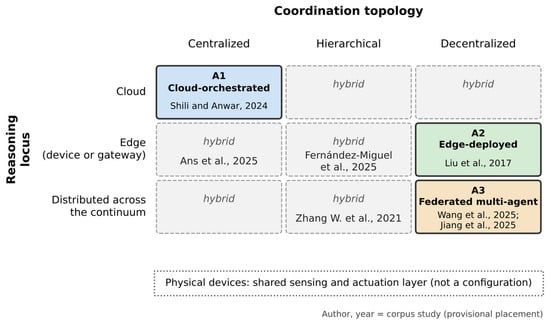
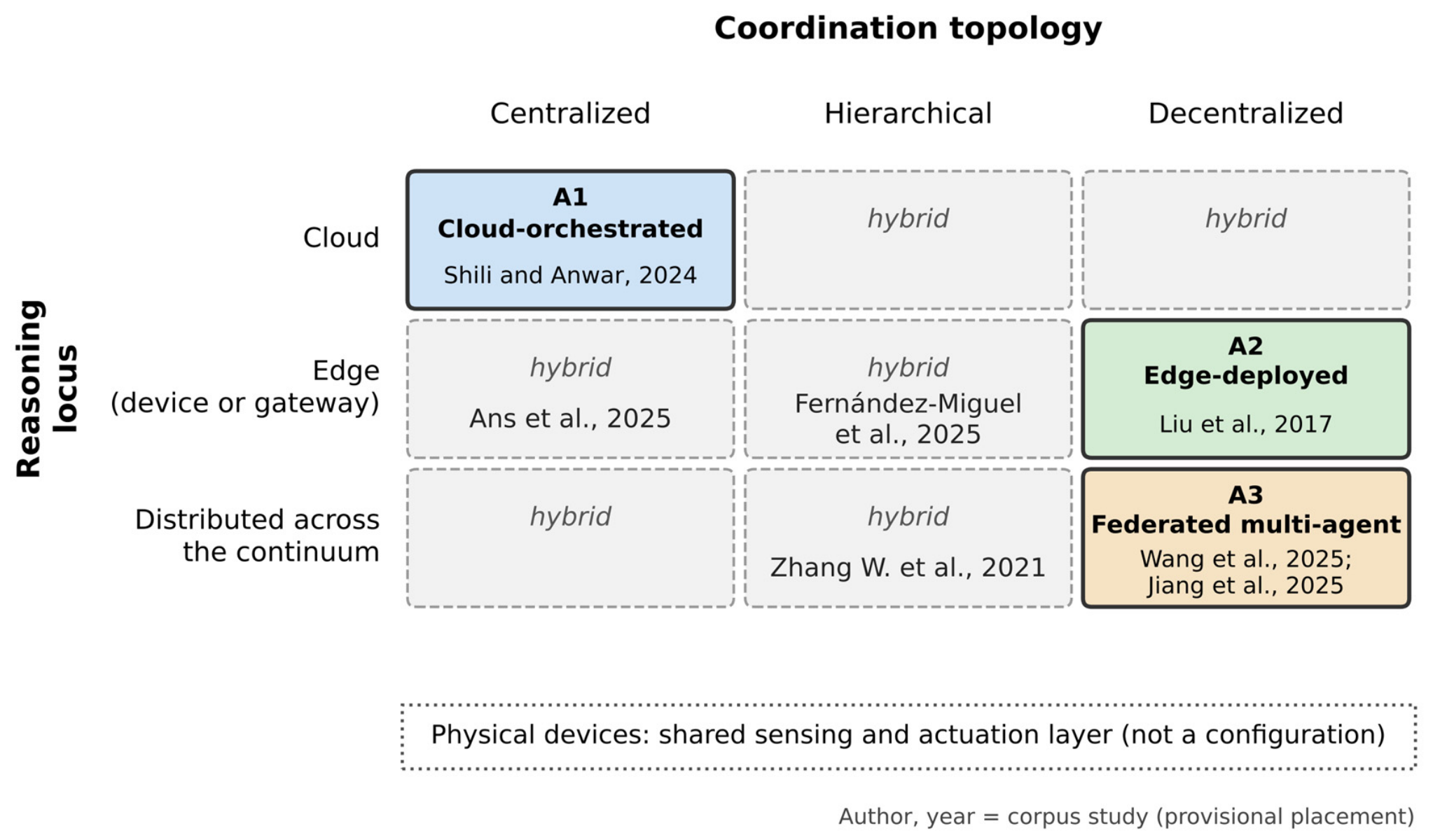
This section presents a taxonomy of agentic IoT deployment configurations, grounded in the corpus of Table 1. The taxonomy classifies system configurations, meaning a deployed or proposed system together with the infrastructure on which its agents run, not the capability of the agents themselves. Agent capability (reactive, cooperative, cognitive, agentic [5]) is an independent attribute and is not part of the classification; this distinguishes the taxonomy from agent-capability classifications such as that of Hu et al. [5]. Two design dimensions are used. Reasoning locus is the position on the device–edge–cloud continuum (Section 2.4) where the step that selects the next plan or action executes: cloud, edge (device or gateway), or distributed across nodes of different kinds. Coordination topology describes how agents, or an agent and an orchestrator, coordinate: centralized (one component has authority to assign tasks), hierarchical (parent–child aggregation, as in edge aggregation under a cloud model) or decentralized (peer exchange with no single authority). Their combination gives nine cells (Figure 1). Three are populated by recognizable archetypes: A1 cloud-orchestrated (cloud × centralized), A2 edge-deployed (edge × decentralized or local) and A3 federated multi-agent (distributed × decentralized). The other cells are hybrids and are assigned in the same way. A low-capability edge model that executes instructions from a cloud orchestrator is classified by where the decision is made, cloud × centralized (A1), with the edge component annotated as executor.
Figure 1.
Two-dimensional deployment-configuration taxonomy (reasoning locus × coordination topology), with corpus studies placed in their primary cell. Coloured boxes with solid borders are the three archetypes (A1, cloud-orchestrated, blue; A2, edge-deployed, green; A3, federated multi-agent, orange); grey boxes with dashed borders are hybrid cells. Studies shown: Shili and Anwar, 2024 [21]; Liu et al., 2017 [20]; Wang et al., 2025 [11]; Jiang et al., 2025 [22]; Ans et al., 2025 [23]; Fernández-Miguel et al., 2025 [26]; Zhang W. et al., 2021 [27].
Four rules assign a study to a cell. (1) Identify the component that selects the next action or plan; its location is the reasoning locus, and if selection is split across layers, the locus is distributed. (2) Identify whether any single component has authority to assign tasks to the others: if yes, coordination is centralized; if authority passes through parent–child aggregation, hierarchical; if none, decentralized. (3) If a study spans several cells, record the primary cell and annotate the others; do not assign by application domain. (4) Reviews are not placed in the grid.
3.1. A1—Cloud-Orchestrated Agent Systems
In A1, the primary reasoning engine runs in the cloud. IoT devices serve as data sources and command recipients. This configuration suits applications that tolerate a wide-area round trip and in which reasoning quality matters more than communication speed. Shili et al. [21] provide the primary corpus example: a cloud-based multi-agent system for e-commerce inventory management, where independent agents coordinate product recommendation and replenishment through a centralized broker. At the cloud layer, general-purpose agentic AI with cross-task adaptation is most readily deployable because the energy, memory, and compute constraints that restrict edge deployment do not apply [5].
3.2. A2—Edge-Deployed Agent Systems
Applications that need a local response independent of the wide-area network, such as traffic signal control, industrial fault response and medical device monitoring, favour edge deployment. Liu et al.’s [20] distributed Q-learning traffic controller is the clearest A2 example in the corpus: each intersection hosts an agent making local decisions in real time, with inter-agent communication limited to summary state exchanges with neighbors. The multi-agent reinforcement learning algorithms reviewed by Bahrpeyma and Reichelt [18]—including QMIX, MADDPG, and actor–critic variants—constitute the primary algorithmic toolkit in this configuration. Fernández-Miguel et al. [26] place monitoring agents at the edge of a ceramic manufacturing facility and aggregate learning by federated learning. In the taxonomy, this is an edge × hierarchical configuration, between A2 and A3, which is why it is cited under both.
3.3. A3—Federated Multi-Agent Systems
A3 is the most architecturally complex configuration: multiple agents of potentially different capability and type, operating across a distributed topology without a single coordination point. Wang et al. [11] provide the defining architecture through the Internet of Agents (IoA) framework, which specifies five components: capability notification and discovery, adaptive communication protocols, dynamic task matching, consensus and conflict resolution, and incentive models. A key structural tension identified by Wang et al. [11] is the decentralization paradox: full decentralization improves fault tolerance but creates coordination difficulties at scale. Zhang et al. [27] use a three-layer device–edge–cloud architecture with centrally trained, decentrally executed agents. Because cloud aggregation provides a coordination point, it is a distributed × hierarchical hybrid, not an A3 configuration.
3.4. Positioning Against Related Architectures
The taxonomy extends the substantial prior literature. Shi et al. [34] proposed edge computing as a model for pushing computation to the network periphery. Bonomi et al. [35] introduced fog computing as an intermediate cloud-to-device layer. Deng et al. [36] extended both frameworks to include machine learning models at the edge. Hu et al. [5] independently propose a cloud–edge–device layering for manufacturing agents. This taxonomy shares the three-layer structure but has a different analytical object: where Hu et al. [5] describe what capability type an agent at each layer possesses, this taxonomy describes what architectural configuration is appropriate for deploying an agentic system given a set of application constraints.
Table 5 summarizes the three archetypes and the hybrid cells observed in the corpus.
Table 5.
Deployment-configuration archetypes—comparative summary.
4. Application Domains and Use Cases
The domains below were not pre-selected. They are those represented in the corpus (Table 1, “Domain” column), plus e-commerce, and they are not exhaustive; agriculture, energy and utilities, and logistics are notable absences. For each domain, we report the evidence level, defined as follows. Operational: at least one primary study at IARL 7 or above. Prototype or real-data simulation: the best primary study is at IARL 5–6. Synthetic simulation: primary studies only at IARL 4 or below. Conceptual: no primary empirical study. Metrics from different studies are listed but are not comparable, because tasks, baselines and validation settings differ.
4.1. Smart Cities and Transportation
Smart city applications are represented in the corpus by one simulation study and one conceptual framework. Liu et al.’s [20] distributed Q-learning controller reduced average vehicle waiting time by 16.7%, 12.2% and 7.0% relative to a multi-agent Q-learning baseline at high, medium and low pedestrian rates, in a SUMO simulation of 33 intersections in Sunnyvale, California, with vehicle arrival rates estimated from Caltrans PeMS data and assumed pedestrian rates. This is a simulation result against one learning baseline and is not comparable with results from other studies. Xu et al. [37] provide a forward-looking framework for smart city operations that explicitly leverages agentic AI, moving beyond predictive analytics to autonomous workflow orchestration. The algorithmic toolkit applied in transportation—actor–critic methods, QMIX for coordinated vehicle control—is the same toolkit applied in manufacturing contexts by Bahrpeyma and Reichelt [18] and taxonomized by Zhang, D. et al. [19], which points to cross-domain transfer potential.
4.2. Industrial IoT and Manufacturing
Industrial automation has been one of the most active areas for agent-based IoT research. Bahrpeyma and Reichelt [18] systematically review MARL applications in smart factories, covering scheduling, autonomous vehicle routing, predictive maintenance, energy management, and human–robot collaboration. Hu et al. [5] refine this picture with a four-level agent capability classification: Reactive Agents at the device layer, Cooperative Agents at the edge, Cognitive Agents at the edge–cloud boundary, and fully Agentic AI at the cloud layer. The most significant contribution is Fernández-Miguel et al. [26], which reports the only fully operational agentic IoT deployment in the reviewed literature. Over 12 months in a ceramic tile manufacturing facility, a federated learning predictive maintenance system achieved 94% predictive accuracy, a 67% reduction in maintenance false positives, a 43% decrease in unplanned downtime, and an increase in overall equipment effectiveness from 74.3% to 82.7%. The authors’ financial analysis reports a net present value of €447,300 over five years and a payback period of 1.6 years [26].
4.3. Healthcare IoT and Elder Care
Healthcare is consistently identified as a high-value target for agentic IoT deployment. However, peer-reviewed evidence remains at the level of architectural proposal. Fortino et al. [13,25] describe multi-agent architectures for healthcare sensing environments. Studies specifically examining LLM-based agents in elder care contexts report hallucination rates ranging from 5% to 30%, which constitutes a documented safety concern requiring output verification mechanisms before any clinical deployment [38]. The complete absence of clinically validated agentic IoT trials remains the most significant evidence gap in this review and is addressed in Research Question 3 (Section 7.3). Figures from the review [38] are review-level claims, not original experiments.
4.4. Home Automation and Consumer IoT
Home automation represents the domain where agentic AI is most visible to end users. Luo et al. [17] is a review of multi-LLM edge intelligence and does not evaluate a home-automation system, so it is not used as evidence for this domain. Ans et al.’s [23] chatbot agents represent a natural language interface allowing non-technical users to control IoT devices without understanding underlying communication protocols. The zero-shot and few-shot natural language-to-action translation now achievable with current LLM controllers [5] suggests the distance between research prototypes and commercial deployment is decreasing. A plausible remaining barrier is hardware deployment cost and system integration complexity.
4.5. E-Commerce
E-commerce systems were among the earliest IoT-adjacent domains to employ multi-agent coordination. Shili et al. [21] describe a cloud-based system in which independent agents manage product recommendations and inventory replenishment through shared knowledge representation, with blockchain integration for data provenance. The commercial incentive structure—where every inventory error is directly visible in revenue—has made e-commerce an early adopter of multi-agent coordination in practice. Table 6 summarizes the evidence across domains.
Table 6.
Agentic IoT application domains—evidence summary.
5. Enabling Technologies and Technical Foundations
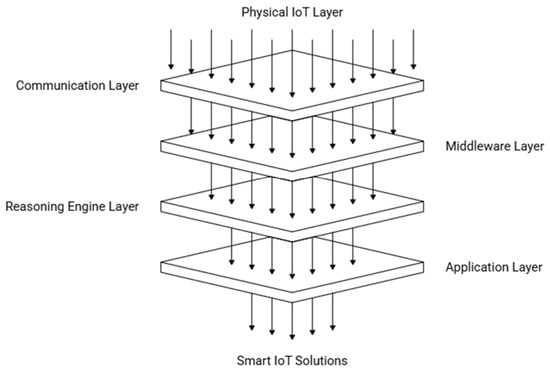
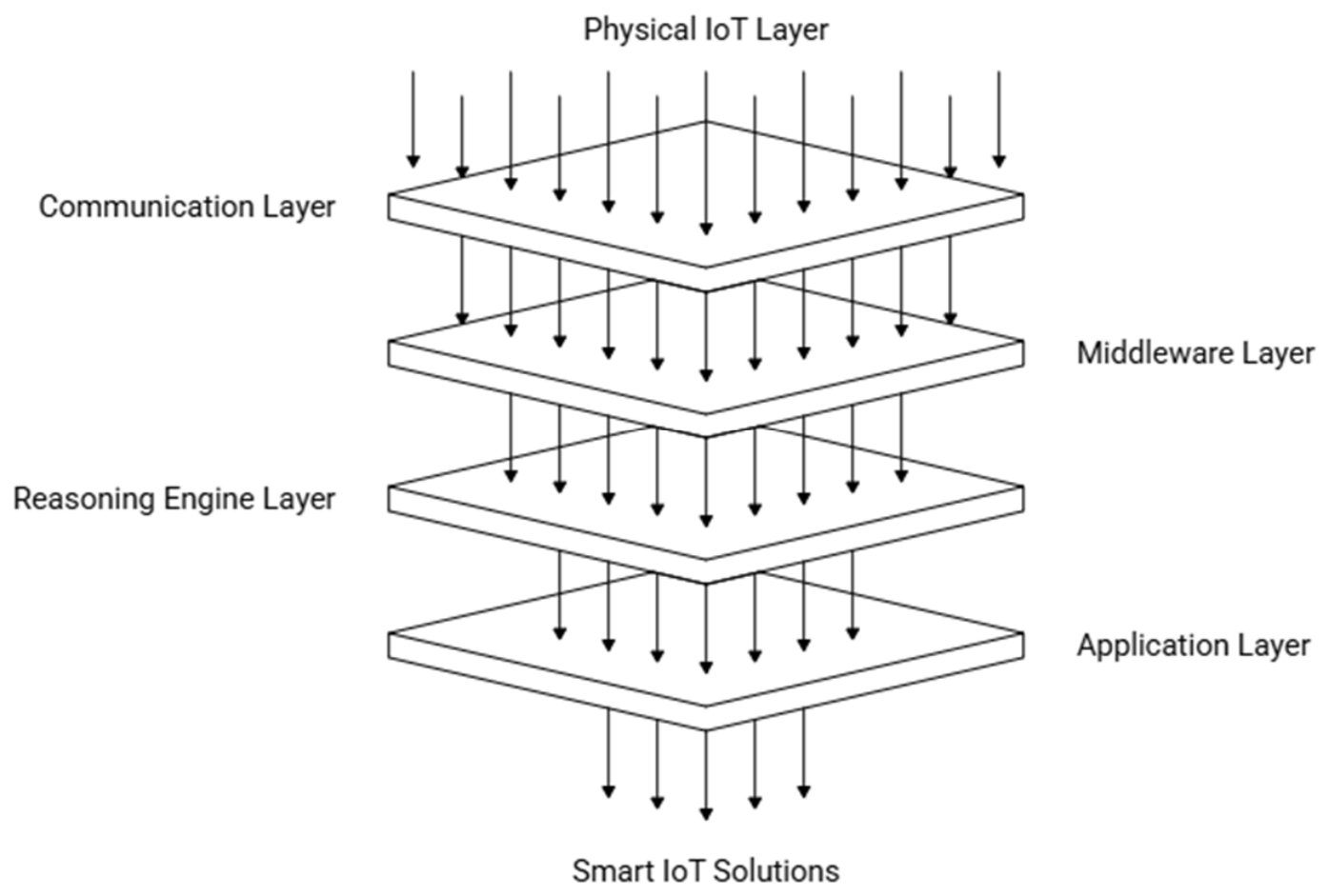
Agentic IoT systems are assembled from multiple technology layers that must work reliably together. This section examines four layers: AI reasoning engines (Section 5.1); model compression and edge deployment (Section 5.2); communication and networking infrastructure (Section 5.3); and middleware, software frameworks, and the applied practice gap (Section 5.4). Figure 2 summarizes how these layers form the agentic IoT technology stack.
Figure 2.
The agentic IoT technology stack. Arrows indicate the flow of sensor data and derived information from the physical IoT layer through the communication, middleware, reasoning engine and application layers to smart IoT solutions.
5.1. AI Reasoning Engines
The reviewed studies demonstrate a broad range of reasoning techniques. Reinforcement learning, particularly Q-learning and its multi-agent variants, was the dominant approach in earlier work and remains prevalent in latency-sensitive A2 deployments. More recent systems use Large Language Models for deliberative planning and multi-modal data integration [9,16]. Game-theoretic approaches—specifically Stackelberg game formulations—provide principled resource allocation mechanisms in competitive multi-agent settings [22]. Zhang, D. et al. [19] provide the most comprehensive taxonomy of MARL approaches, organizing the space into four paradigms: (1) behavior analysis; (2) centralized learning with decentralized execution (CTDE); (3) communication learning; and (4) collaborative learning. Zhang, W. et al. [27] demonstrate a concrete CTDE instantiation in IIoT: MARL agents are trained centrally, then deployed at edge servers where they execute decentralized device selection and resource allocation decisions.
Symbolic and reactive hybrid architectures—specifically, BDI agents implemented in frameworks such as Jason/AgentSpeak—remain the most mature and formally verifiable agent model for structured, safety-critical A2 IoT tasks. The practical principle is that BDI agents are appropriate for structured tasks where predictability and verifiability are paramount, while LLM-based agents are suited to tasks requiring linguistic flexibility and open-domain reasoning.
5.2. Model Compression and Edge Deployment
Resource-constrained edge devices require trained models to be reduced in size and computational cost before deployment. Primary techniques include pruning, quantization (reducing numerical precision from 32-bit to 8-bit or 4-bit), low-rank factorization, and knowledge distillation [36]. TinyML—machine learning designed for microcontrollers with tens to hundreds of kilobytes of available memory—extends on-device intelligence to the most constrained IoT hardware classes [39]. Deployment frameworks including TensorFlow Lite, ONNX Runtime Mobile, and Edge Impulse provide the runtime infrastructure for ARM Cortex-M class processors. Fernández-Miguel et al. [26] demonstrate 97% accuracy maintained across distributed edge agents with only 2.1% communication overhead. Zhang, W. et al. [27] show that joint optimization of device selection and resource allocation using deep MARL can substantially improve FL convergence in distributed IIoT.
The critical open question is not simply whether a compressed model runs on edge hardware, but whether it retains sufficient reasoning depth to execute multi-step tool-use sequences reliably. This is the focus of Research Question 1 in Section 7.
What Agentic Autonomy Costs at the Edge
Edge deployment is usually justified by latency, privacy and availability, but a multi-step agent loop multiplies the cost of every inference. Table 7 lists the quantities that determine feasibility and records whether the reviewed studies report them.
Table 7.
Quantities that determine the feasibility of edge agents and whether the corpus reports them.
First-order model (illustrative, not a measurement). Consider an agent that runs k reasoning steps with a base prompt of C0 tokens and Δ new tokens (thought, action, observation) appended per step. Without prompt caching, the full context is re-encoded at every step, so the prompt tokens processed are kC0 + Δk(k − 1)/2. With caching of earlier context, they are about C0 + (k − 1)Δ. For C0 = 1000, Δ = 200 and k = 5, this is 7000 versus 1800 tokens, a factor of about 3.9, before generated tokens are counted. Latency is approximately the prompt tokens divided by the prefill rate, plus generated tokens divided by the decode rate, plus the summed tool-call latencies; energy is approximately mean power times that time. Memory is the weight footprint (parameters × bits ÷ 8) plus the key-value cache, which grows linearly with context length T: about 2 × L × nkv × dhead × T × b bytes for L layers, nkv key-value heads, head dimension dhead and b bytes per element. The reasoning depth that makes an agent useful is therefore also what makes it costly on constrained hardware. These expressions are not a substitute for the benchmarks proposed in RQ1 and RQ5.
5.3. Communication and Networking Infrastructure
MQTT (OASIS MQTT v5.0, 2019) [40] is a lightweight publish–subscribe protocol suited to high-frequency, low-bandwidth sensor data from A2 edge agents. OPC UA (IEC 62541) [41] addresses semantic device discovery through its address space model, at a higher computational cost. Wang et al. [11] introduce further protocol requirements for A3 systems: agent-native communication protocols designed for agent-to-agent interaction. These protocols face a trilemma among Versatility, Efficiency, and Portability [11]. Table 8 summarizes communication protocol properties.
Table 8.
Communication protocol properties for agentic IoT systems.
5.4. Middleware, Software Frameworks, and the Applied Practice Gap
Middleware provides coordination infrastructure between IoT devices and agent reasoning components. ACOSO supports programming and management of cooperative agent-IoT systems. LLM-based agent frameworks such as LangChain [45], Microsoft AutoGen [46] and CrewAI provide scaffolding for multi-step reasoning, tool use and inter-agent coordination. None of the corpus studies name them. We treat this as an observation about the corpus, not a measured lag: our search strings did not include framework names, and seven studies were assessed from abstracts, so frameworks may have been used without being mentioned.
Several drivers plausibly contribute beyond review cycles. Frameworks are engineering artifacts, and publication venues reward novel algorithms rather than integration work. Their programming interfaces change on weekly to monthly timescales, which makes experiments hard to reproduce. Shared benchmarks that would let academic and industrial systems be compared are missing (RQ5). Access to industrial deployments and data is limited, and many deployments are closed-source. If academic work continues to operate outside mainstream agent engineering stacks, three risks follow: results may not transfer to the stacks practitioners use; practical concerns such as observability, cost control and framework-specific security (for example, prompt injection through tool outputs) remain unstudied; and academic architectures may be re-implemented ad hoc in industry without the safety analysis that academic work could supply.
6. Challenges, Limitations, and the IARL Framework
This section organizes the principal deployment challenges identified across the corpus and introduces the IARL, an ordinal assessment profile for agentic IoT systems. The challenges are discussed first (Section 6.1, Section 6.2 and Section 6.3), followed by the IARL framework (Section 6.4) and a summary of the principal challenges at the end of the section.
6.1. Resources and Computational Constraints
Computational and energy constraints represent structural limits on A2 edge deployment. Bahrpeyma and Reichelt [18] identify scalability, training stability, and real-time adaptability as the three dominant MARL deployment constraints. That these constraints are surmountable in practice is demonstrated by Fernández-Miguel et al. [26]: their A2 edge agents maintained autonomous operation during network outages of up to 4.7 h and sustained 99.8% message delivery reliability.
6.2. Scalability and Real-Time Coordination
Scalability challenges in agentic IoT are multi-dimensional. A system simulated at 33 intersections [20] faces qualitatively different coordination problems at city scale with thousands of agents. Wang et al. [11] identify scalability as the first practical barrier to IoA deployment. The decentralization paradox—full decentralization provides fault tolerance but impairs real-time coordination—is the central design tension for A3. Zhang, W. et al. [27] address one concrete instance of this problem: by aggregating model updates at edge servers before transmitting to the cloud, the frequency of cloud-level communication is substantially reduced.
6.3. Security, Privacy, and Regulatory Compliance
Agentic systems introduce qualitatively different security risks from passive sensing systems. Three categories of agentic-specific threats are particularly important: (1) prompt injection attacks, in which adversarial content embedded in sensor data or API responses manipulates the reasoning of an LLM-based agent; (2) Byzantine agent behavior, in which rogue agents transmit false readings or execute harmful actuator commands; and (3) the physical–cyber-attack surface expansion when agents control industrial machinery or medical devices. Wang et al. [11] add four IoA-specific threats: tool-poisoning attacks, Sybil attacks, hallucination-driven routing errors, and model poisoning through corrupted federated learning updates. Fernández-Miguel et al. [26] demonstrate one approach to managing safety risk: requiring human approval for all safety-critical actuator commands, maintaining full audit trails conforming to ISO 13374 [47] and IEC 62264 [48], and validating a critical alarm positive predictive value of 98.3% before extending autonomous authority. Table 9 provides a structured overview of agentic-specific security threats.
Table 9.
Agentic-specific security threats in IoT deployments.
In decentralized configurations (A3), the dominant new risk is not an attack on one agent but the propagation of error between agents. An agent’s hallucinated claim about device state can be accepted by peers as ground truth, reused in their reasoning, and reinforced when it returns through consensus or delegation (cascading hallucination). Classical Byzantine fault tolerance tolerates up to f faulty nodes among n ≥ 3f + 1 [49] and assumes faults are independent. Agents built on the same or similar base models fail in correlated ways, so agreement among them is weaker evidence than the protocol assumes. Mitigations are therefore architectural: diversity of base models and vendors, provenance and confidence labels on inter-agent messages, grounding of safety-relevant claims in attested sensor state before actuation, limits on delegation depth, and escalation to a human for safety-critical commands. This paragraph and the three rows added to Table 9 are the authors’ synthesis, not findings of the reviewed studies, except where [11] is cited.
6.4. The IARL Framework
The IARL is a nine-level, ordinal assessment profile derived from NASA’s Technology Readiness Level (TRL) scale [50,51] and adapted to agentic IoT. It is not a quantitative instrument: levels order evidence, and distances between levels carry no meaning. Table 10 lists the minimum evidence for each level and what does not suffice; Table 11 compares each level with TRL. Four decision rules apply. (1) Assign the highest level for which all criteria of that level and of every lower level are met. (2) Levels 6–9 require physical sensing and actuation, or an explicit statement that actuation was emulated. (3) Reviews, surveys and position papers are not rated; studies assessed from the abstract alone are rated provisionally (†) and excluded from field-level statements. (4) Record the autonomy mode: M0 advisory, M1 human-approved actuation, M2 supervised autonomy, and M3 autonomous.
Table 10.
IARLs and minimum evidence.
Table 11.
IARL compared with NASA TRL.
Rating procedure. Each system study was rated from the available text using Table 10. The first author made the ratings, and the ratings were reviewed with the second author. Because the ratings were not made independently, we report no inter-rater statistics. Application. Ref. [26] is IARL 7 (autonomy mode M1: safety-critical commands required human approval), based on a 12-month deployment. Refs. [20,27] are IARL 5, and ref. [23] is IARL 6 (a testbed with live control of real devices). Studies available only as abstracts are rated provisionally (†) and are excluded from field-level statements: refs. [21,22,24] at IARL 4, ref. [13] at IARL 3 and ref. [25] at IARL 2. No study reaches IARL 8. Six studies are reviews and are not rated. AIMM [26] and the agent evolution stages of [5] describe maturity from related perspectives; we compare them with the IARL qualitatively and do not treat the comparison as validation.
6.5. Limitations of the IARL Framework
Three limitations of the IARL should be acknowledged. First, the nine-level structure implies a linear progression from concept to mission-proven deployment; in practice, development pathways are frequently non-linear. Second, the IARL has not been validated prospectively or against deployment outcomes, and the three-month threshold for IARL 7 is the authors’ proposal. Third, ratings were made by the first author and reviewed with the second, so the procedure yields no independent agreement statistic and rests on nine system studies. Table 12 summarizes the principal deployment challenges discussed in this section.
Table 12.
Principal challenges in agentic IoT deployment.
7. Research Agenda: Five Open Problems
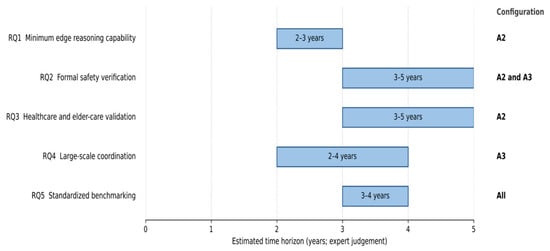
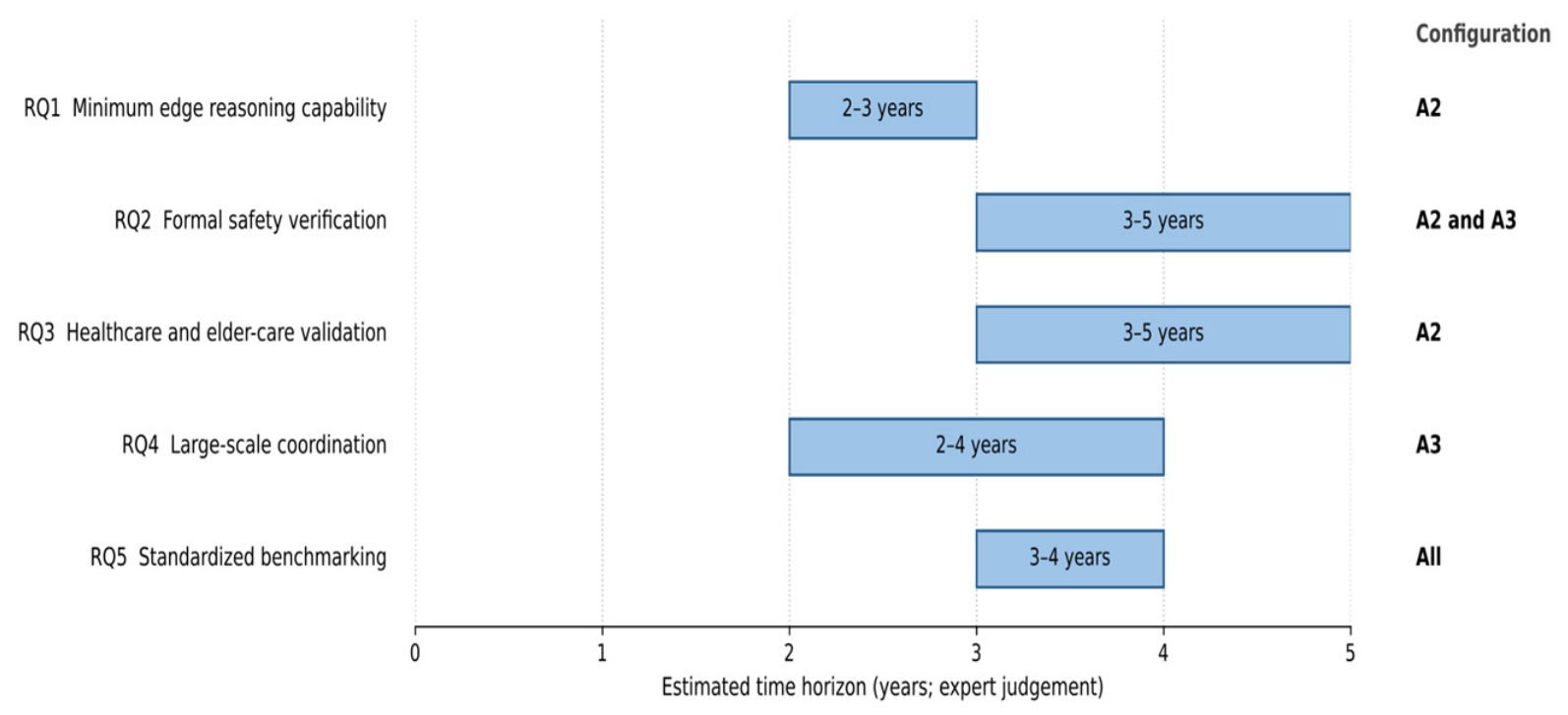
This section identifies five open problems in agentic IoT and states each as a specific research question with a proposed study design, the primary research community best positioned to address it, and an expert-judgement time horizon. The five problems were selected because they are: (a) tractable with existing methods, (b) specific enough to yield a falsifiable result, and (c) directly linked to the deployment challenges and IARL gaps identified in Section 6. Figure 3 summarizes the five problems, their deployment configurations and their expert-judgement horizons.
Figure 3.
Research agenda roadmap.
7.1. RQ1—Minimum Edge Capability for Reliable Agentic Reasoning
RQ1: For memory budgets of 512 MB, 2 GB and 8 GB, what is the smallest model size and quantization level at which an LLM-based agent completes a standardized multi-step IoT tool-use task suite at or above a stated reliability threshold, and how does that threshold vary with the latency budget of the application domain (traffic control, clinical monitoring, home automation)?
Study design: Weights alone need parameters × bits ÷ 8 bytes: about 0.5 GB for a 1B-parameter model at 4-bit, 1.5 GB for 3B and 3.5 GB for 7B, doubling at 8-bit. The key-value cache, activations and runtime add to this, so a design that places 1B, 3B and 7B models on a 512 MB device is infeasible, and 7B at 8-bit (about 7 GB) fits none of the named devices. Table 13 matches model sizes to three budgets, assuming (to be measured in the study) that half of RAM is available for weights. Benchmark those models with runtimes such as llama.cpp on an ARM Cortex-A class board with 512 MB, a Raspberry Pi 4 (2–8 GB variants) and a Jetson Nano (2–4 GB variants). Define a standardized task suite covering sensor query, conditional actuation and inter-agent coordination. Measure task completion rate against number of steps, per-step latency, peak memory and energy per task. Primary research community: TinyML researchers with IoT systems engineers. Estimated horizon: 2–3 years.
Table 13.
Memory budgets and feasible model sizes for RQ1.
7.2. RQ2—Formal Safety Verification for Autonomous IoT Control
RQ2: Can formal verification methods—model checking, runtime monitoring, or contract-based design—provide provable safety guarantees for agentic IoT control loops in safety-critical domains, and what is the computational overhead of those guarantees when deployed on A2 edge hardware?
Study design: Apply formal methods tools (TLA+, Isabelle, or Spin) to a representative agentic control loop—for example, an LLM agent managing a hospital infusion pump or an industrial actuator. Measure verification time and runtime monitor overhead on A2 edge hardware. Extend to IoA-specific threats including tool-poisoning and Byzantine fault tolerance for A3 systems [11]. Primary research community: formal methods researchers in collaboration with control and safety engineers. Estimated horizon: 3–5 years.
Technical basis. The tractable verification target is the safety envelope, not the language model: LLM reasoning is not amenable to model checking, so the design is a verified guard (runtime monitor or shield) between agent and actuator, enforcing invariants such as actuator bounds, rate limits and interlocks written as temporal-logic or contract properties. Metrics: verification time, monitor latency per command, and the fraction of unsafe actions blocked in fault-injection tests on A2 hardware.
7.3. RQ3—Controlled Validation in Healthcare and Elder Care IoT
RQ3: In a controlled clinical or care-home study, does an agentic monitoring system capable of detecting adverse events, escalating alerts, and coordinating care team notifications reduce adverse event response time compared to standard threshold-based alarm systems, without increasing alarm fatigue or introducing new patient safety risks?
Study design: controlled before–after study or cluster-randomized trial conducted in an ICU or residential care home setting. Primary endpoint: time elapsed between adverse event onset and documented clinical response. Secondary endpoints: alarm fatigue rate, false positive rate, and staff workload. The documented LLM hallucination rate of 5–30% in health-adjacent contexts [38] should be treated as a safety design constraint: any study protocol must include an output verification layer. Primary research community: clinical informatics researchers in partnership with clinical care staff. Estimated horizon: 3–5 years, including regulatory pathway.
Technical basis. The endpoint is time from adverse-event onset to documented clinical response, against threshold-based alarms. The study should be sized from a pilot’s variance. LLM output stays advisory or human-approved (autonomy mode M0 or M1) behind a verification layer. Regulatory classification of such software varies by jurisdiction, so engagement should start early.
7.4. RQ4—Coordination at Large Agent Populations
RQ4: At what agent population size and under what degree of agent heterogeneity do existing multi-agent coordination protocols exhibit degraded performance in convergence time, communication overhead, or decision quality—and what incentive mechanisms preserve near-optimal global performance in the presence of non-cooperative or adversarial selfish agents?
Study design: Large-scale simulation in which agent populations are scaled from 10 to 10,000 units using open simulation environments (SUMO for traffic, CityFlow for urban systems). Measure convergence time, message overhead, and reward decay as a function of population size and heterogeneity. A designated fraction of agents (5–10%) should operate as non-Cooperative Agents pursuing private objectives that conflict with the system-level goal. The metric set should include the Gini coefficient of reward distribution across agent types. Informed by the decentralization paradox identified by Wang et al. [11] and the IoA consensus mechanisms they propose. Primary research community: multi-agent systems researchers in collaboration with distributed computing engineers. Estimated horizon: 2–4 years.
Technical basis. Scale from 10 to 10,000 agents and vary heterogeneity; measure convergence time, per-agent message overhead, reward decay and the Gini coefficient; include 5–10% non-Cooperative Agents; and report how message overhead scales with population.
7.5. RQ5—Standardized Benchmarking for Agentic IoT
RQ5: Can a standardized benchmark suite for agentic IoT systems be developed that covers representative tasks across at least three application domains, runs in openly available simulation environments, reports both task-performance and resource-efficiency metrics, and enables reproducible cross-system comparison?
Study design. Community-driven benchmark development following the MLPerf model [52]: define a reference task set and reference implementations in at least two frameworks and specify a reproducible evaluation protocol hosted on a public leaderboard with mandatory disclosure of hardware configuration and model specifications. Wang et al. [11] and Zhang, D. et al. [19] independently identify the absence of unified evaluation standards as a priority gap. Primary research community: IoT systems researchers in collaboration with the MLCommons benchmarking community. Estimated horizon: 3–4 years.
Technical basis. Benchmark tasks come from at least three domains in open simulators, reporting success rate, steps, tokens, latency and energy per task, with mandatory hardware disclosure, a held-out test split to limit overfitting, and reference implementations in at least two frameworks. Table 14 summarizes the five research questions.
Table 14.
Research agenda summary.
Table 15.
Basis of the time horizons (expert judgement).
8. Discussion
8.1. Maturity of the Field
Among the nine system studies, most are validated in simulation (IARL 4–5) or on testbeds. One study [26] reports a multi-month operational pilot (IARL 7, autonomy mode M1): a 12-month deployment in a real industrial environment with measured operational and economic outcomes and an operator-trust rating that rose from 3.1 to 4.2 on a five-point scale. None reaches IARL 8. This is a single data point from one site, reported by its own authors; it shows what is possible, not what is typical. Agreement among corpus papers on similar architectures is not independent validation of the taxonomy, because the taxonomy and the corpus were assembled by the same authors. We treat the framework as a proposal to be tested.
8.2. Consequential Assumptions in the Reviewed Literature
Several assumptions in the corpus warrant scrutiny. The first is the assumption that simulation environments faithfully represent real deployment conditions. Fernández-Miguel et al. [26] document this directly: integration took 23% longer than planned because of legacy system compatibility issues, and high-temperature zones in the facility required hybrid communication solutions not anticipated in the initial design. The second assumption is that reinforcement learning reward metrics correspond to meaningful operational outcomes. Third, security analyses in the corpus are largely theoretical—prompt injection attacks on LLM-based IoT agents remain almost entirely unaddressed empirically in the reviewed literature.
8.3. Implications for Practitioners
8.3.1. When Is Agentic IoT Warranted?
Before choosing a configuration, practitioners should establish whether agentic reasoning is needed at all. Table 16 sets out seven criteria. They are derived from the operational definition (Section 2.2) and from the deployment in [26], not from a comparison of approaches: none of the reviewed studies evaluates an agentic system against a prediction-plus-predefined-workflow baseline on the same task. The criteria should be read as hypotheses. The benchmark in RQ5 would help close this gap.
Table 16.
Criteria for deciding whether agentic reasoning is warranted.
Decision rule. An agentic design is preferable when criteria 1–3 point toward agentic and criteria 5–6 can be met. Otherwise, rules or predict-then-workflow are preferable, optionally with an agentic advisory layer (autonomy mode M0 or M1). Device count, geographic distribution and the need for automation do not by themselves establish a need for agentic reasoning. Analysts expect over 40% of agentic AI projects to be cancelled by the end of 2027 for cost, unclear value or inadequate risk controls [3], which is consistent with criterion 7. In the corpus, [26] handled criterion 6 by requiring human approval of safety-critical commands, that is, autonomy mode M1.
8.3.2. Design and Qualification Guidance
Four guidance points emerge from the analysis. First, use the two-dimensional taxonomy (Table 5) as a design tool at the start of any agentic IoT project: the configuration choice cascades into protocol selection, security architecture, model choice, and energy budget. Second, use the IARL (Table 10) for project planning and stakeholder communication. Third, treat the security threats in Table 9 as a checklist specific to agentic systems; inherited IoT security measures address only a subset of these risks. Fourth, the federated learning architectures of Fernández-Miguel et al. [26] and Zhang, W. et al. [27] are the best-documented practical path in the corpus toward decentralized deployments, but [26] is a single site and [27] is a simulation, so the evidence is limited.
8.4. Limitations of This Review
Six limitations apply. (1) The corpus of 15 studies is small and was assembled by the authors as described in Section 1.2; this is not a systematic review, screening was done by one author, and because per-database counts were not logged, the search cannot be reproduced exactly. (2) Seven studies were assessed from abstracts, so their codes and ratings are provisional. (3) The IARL has not been validated; ratings were made by the first author and reviewed with the second, so no independent agreement statistic is available. (4) Only one study is an operational deployment, so no field-level maturity claim is made. (5) The LLM frontier moves quickly, and the memory arithmetic in Section 7.1 will date. (6) The corpus is English-language and indexed; industrial deployments, especially outside it, are under-represented, so IARL 7 is the frontier of the visible literature, not of practice.
9. Conclusions
This review analyzed 15 studies on agentic AI in IoT. It proposes a two-dimensional deployment-configuration taxonomy, an evidence-graded readiness profile (IARL) and a research agenda. Within the reviewed corpus, simulation-based evidence dominates. One study reports a 12-month operational pilot with human-approved actuation (IARL 7), with 94% predictive-maintenance accuracy, a 43% reduction in unplanned downtime and a 1.6-year payback at one site [26]; none reach IARL 8. This is one data point and does not establish a field-wide shift. No reviewed study compares agentic and non-agentic approaches on the same task, so the conditions under which agency is warranted remain a hypothesis (Section 8.3.1). Healthcare shows the largest evidence gap. The five research questions in Section 7 are tractable with existing methods, with the longest needing three to five years.
Author Contributions
Conceptualization, K.G. and M.I.; methodology, K.G.; validation, K.G. and M.I.; investigation, K.G. and M.I.; resources, M.I.; data curation, K.G.; writing—original draft preparation, K.G.; writing—review and editing, K.G. and M.I.; visualization, K.G. and M.I.; funding acquisition, K.G. and M.I. All authors have read and agreed to the published version of the manuscript.
Funding
This research received no external funding.
Institutional Review Board Statement
Not applicable.
Informed Consent Statement
Not applicable.
Data Availability Statement
The original contributions presented in this study are included in the article. Further inquiries can be directed to the corresponding authors.
Acknowledgments
During the preparation of this manuscript/study, the authors used QuillBot (web-based version, 2026) for the purposes of polishing the English language and to improve readability. The authors have reviewed and edited the output and take full responsibility for the content of this publication.
Conflicts of Interest
The authors declare no conflicts of interest.
References
- IoT Analytics. State of IoT 2025: Number of Connected IoT Devices; IoT Analytics GmbH: Hamburg, Germany, 2025; Available online: https://iot-analytics.com/number-connected-iot-devices/ (accessed on 5 November 2026).
- Gartner. Gartner Identifies the Top 10 Strategic Technology Trends for 2025; Gartner, Inc.: Stamford, CT, USA, 2024; Available online: https://www.gartner.com/en/newsroom/press-releases/2024-10-21-gartner-identifies-the-top-10-strategic-technology-trends-for-2025 (accessed on 4 November 2026).
- Reuters. Over 40% of Agentic AI Projects Will Be Scrapped by 2027, Gartner Says. Reuters, 25 June 2025.
- Singla, A.; Sukharevsky, A.; Yee, L.; Chui, M.; Hall, B. The State of AI: How Organizations Are Rewiring to Capture Value; McKinsey & Company: New York, NY, USA, 2025. [Google Scholar]
- Hu, K.; Yao, X.; Qiao, F. Agent Technologies in Smart Manufacturing: A Comprehensive Review of Evolution, Architectures, and Edge–Cloud Deployment. Adv. Eng. Inform. 2026, 70, 104235. [Google Scholar] [CrossRef] [Scilit]
- Savaglio, C.; Ganzha, M.; Paprzycki, M.; Bădică, C.; Ivanović, M.; Fortino, G. Agent-Based Internet of Things: State-of-the-Art and Research Challenges. Future Gener. Comput. Syst. 2020, 102, 1038–1053. [Google Scholar] [CrossRef] [Scilit]
- Savaglio, C.; Fortino, G.; Ganzha, M.; Paprzycki, M.; Bădică, C.; Ivanović, M. Agent-Based Computing in the Internet of Things: A Survey. In Intelligent Distributed Computing XI; Springer: Cham, Switzerland, 2018. [Google Scholar] [CrossRef] [Scilit]
- Pico-Valencia, P.; Holgado-Terriza, J.A. Agentification of the Internet of Things: A Systematic Literature Review. Int. J. Distrib. Sens. Netw. 2018, 14, 1550147718805945. [Google Scholar] [CrossRef] [Scilit]
- Alva, L.R.; Pandey, B. Agentic AI Systems in the Age of Generative Models: Architectures, Cloud Scalability, and Real-World Applications. Artif. Intell. Rev. 2026, 59, 88. [Google Scholar] [CrossRef] [Scilit]
- Abou Ali, M.; Dornaika, F.; Charafeddine, J. Agentic AI: A Comprehensive Survey of Architectures, Applications, and Future Directions. Artif. Intell. Rev. 2026, 59, 11. [Google Scholar] [CrossRef] [Scilit]
- Wang, Y.; Guo, S.; Pan, Y.; Su, Z.; Chen, F.; Luan, T.H.; Li, P.; Kang, J.; Niyato, D. Internet of Agents: Fundamentals, Applications, and Challenges. IEEE Trans. Cogn. Commun. Netw. 2025, 12, 4476–4501. [Google Scholar] [CrossRef] [Scilit]
- Page, M.J.; McKenzie, J.E.; Bossuyt, P.M.; Boutron, I.; Hoffmann, T.C.; Mulrow, C.D.; Shamseer, L.; Tetzlaff, J.M.; Akl, E.A.; Brennan, S.E.; et al. The PRISMA 2020 Statement: An Updated Guideline for Reporting Systematic Reviews. BMJ 2021, 372, n71. [Google Scholar] [CrossRef] [Scilit] [PubMed]
- Fortino, G.; Russo, W.; Savaglio, C.; Shen, W.; Zhou, M. Agent-Oriented Cooperative Smart Objects: From IoT System Design to Implementation. IEEE Trans. Syst. Man Cybern. Syst. 2018, 48, 1939–1956. [Google Scholar] [CrossRef] [Scilit]
- Pico-Valencia, P.A.; Holgado-Terriza, J.A.; Herrera-Sánchez, D.; Sampietro, J.L. Towards the Internet of Agents: An Analysis of the Internet of Things from the Intelligence and Autonomy Perspective. Ing. Investig. 2018, 38, 121–129. [Google Scholar] [CrossRef] [Scilit]
- Devlin, J.; Chang, M.-W.; Lee, K.; Toutanova, K. BERT: Pre-Training of Deep Bidirectional Transformers for Language Understanding. arXiv 2018, arXiv:1810.04805. [Google Scholar] [CrossRef] [Scilit]
- Yao, S.; Zhao, J.; Yu, D.; Du, N.; Shafran, I.; Narasimhan, K.; Cao, Y. ReAct: Synergizing Reasoning and Acting in Language Models. arXiv 2022, arXiv:2210.03629. [Google Scholar] [CrossRef] [Scilit]
- Luo, H.; Liu, Y.; Zhang, R.; Wang, J.; Sun, G.; Niyato, D.; Yu, H.; Xiong, Z.; Wang, X.; Shen, X. Toward Edge General Intelligence with Multiple-Large Language Model (Multi-LLM): Architecture, Trust, and Orchestration. IEEE Trans. Cogn. Commun. Netw. 2025, 11, 3563–3585. [Google Scholar] [CrossRef] [Scilit]
- Bahrpeyma, F.; Reichelt, D. A Review of the Applications of Multi-Agent Reinforcement Learning in Smart Factories. Front. Robot. AI 2022, 9, 1027340. [Google Scholar] [CrossRef] [Scilit] [PubMed]
- Zhang, D.; Yuan, Q.; Meng, L.; Xia, R.; Liu, W.; Qin, C. Reinforcement Learning for Single-Agent to Multi-Agent Systems: From Basic Theory to Industrial Application Progress, a Survey. Artif. Intell. Rev. 2025, 59, 46. [Google Scholar] [CrossRef] [Scilit]
- Liu, Y.; Liu, L.; Chen, W.-P. Intelligent Traffic Light Control Using Distributed Multi-Agent Q Learning. arXiv 2017, arXiv:1711.10941. [Google Scholar]
- Shili, M.; Anwar, S. Leveraging Agent-Based Modeling and IoT for Enhanced E-Commerce Strategies. Information 2024, 15, 680. [Google Scholar] [CrossRef] [Scilit]
- Jiang, K.; Zhong, Y.; Kang, J.; Dai, M.; Chen, C.; Xie, S. Stackelberg Game-Based Agentic AI Task Offloading in Internet of Agents. In Proceedings of the 2025 IEEE 28th International Conference on Computational Science and Engineering (CSE), November 2025; IEEE: Piscataway, NJ, USA, 2025; pp. 9–15. [Google Scholar]
- Ans, M.; Montanaro, T.; Sergi, I.; Troisi, G.; Sponziello, A.; Pezzuto, M.; Patrono, L. Design of an Innovative Solution to Integrate and Orchestrate IoT Technologies with Chatbots for Smart Home Automation. Internet Things 2025, 33, 101693. [Google Scholar] [CrossRef] [Scilit]
- Savaglio, C.; Fortino, G.; Zhou, M. Towards Interoperable, Cognitive and Autonomic IoT Systems: An Agent-Based Approach. In Proceedings of the 2016 IEEE 3rd World Forum on Internet of Things (WF-IoT), December 2016; IEEE: Piscataway, NJ, USA, 2016; pp. 58–63. [Google Scholar]
- Fortino, G.; Guerrieri, A.; Russo, W.; Savaglio, C. Integration of Agent-Based and Cloud Computing for the Smart Objects-Oriented IoT. In Proceedings of the 2014 IEEE 18th International Conference on Computer Supported Cooperative Work in Design (CSCWD); IEEE: Piscataway, NJ, USA, 2014; pp. 493–498. [Google Scholar] [CrossRef] [Scilit]
- Fernández-Miguel, A.; Ortíz-Marcos, S.; Jiménez-Calzado, M.; Fernández del Hoyo, A.P.; García-Muiña, F.E.; Settembre-Blundo, D. Agentic AI in Smart Manufacturing: Enabling Human-Centric Predictive Maintenance Ecosystems. Appl. Sci. 2025, 15, 11414. [Google Scholar] [CrossRef] [Scilit]
- Zhang, W.; Yang, D.; Wu, W.; Peng, H.; Zhang, N.; Zhang, H.; Shen, X. Optimizing Federated Learning in Distributed Industrial IoT: A Multi-Agent Approach. IEEE J. Sel. Areas Commun. 2021, 39, 3688–3703. [Google Scholar] [CrossRef] [Scilit]
- Bratman, M. Intention, Plans, and Practical Reason; Harvard University Press: Cambridge, MA, USA, 1987. [Google Scholar]
- Wooldridge, M.; Jennings, N.R. Intelligent Agents: Theory and Practice. Knowl. Eng. Rev. 1995, 10, 115–152. [Google Scholar] [CrossRef] [Scilit]
- Russell, S.; Norvig, P. Artificial Intelligence: A Modern Approach, 4th ed.; Pearson: Hoboken, NJ, USA, 2020. [Google Scholar]
- Wooldridge, M. An Introduction to Multiagent Systems, 2nd ed.; Wiley: Chichester, UK, 2009. [Google Scholar]
- Kokkonen, H.; Lovén, L.; Motlagh, N.H.; Partala, J.; González-Gil, A.; Sola, E.; Angulo, I.; Liyanage, M.; Leppänen, T.; Nguyen, T.; et al. Autonomy and Intelligence in the Computing Continuum: Challenges, Enablers, and Future Directions for Orchestration. arXiv 2022, arXiv:2205.01423. [Google Scholar]
- Ullah, A.; Kiss, T.; Kovács, J.; Tusa, F.; Deslauriers, J.; Dagdeviren, H.; Arjun, R.; Hamzeh, H. Orchestration in the Cloud-to-Things Compute Continuum: Taxonomy, Survey and Future Directions. J. Cloud Comput. 2023, 12, 135. [Google Scholar] [CrossRef] [Scilit]
- Shi, W.; Cao, J.; Zhang, Q.; Li, Y.; Xu, L. Edge Computing: Vision and Challenges. IEEE Internet Things J. 2016, 3, 637–646. [Google Scholar] [CrossRef] [Scilit]
- Bonomi, F.; Milito, R.; Zhu, J.; Addepalli, S. Fog Computing and Its Role in the Internet of Things. In Proceedings of the 1st MCC Workshop on Mobile Cloud Computing; ACM: New York, NY, USA, 2012; pp. 13–16. [Google Scholar] [CrossRef] [Scilit]
- Deng, S.; Zhao, H.; Fang, W.; Yin, J.; Dustdar, S.; Zomaya, A.Y. Edge Intelligence: The Confluence of Edge Computing and Artificial Intelligence. IEEE Internet Things J. 2020, 7, 7457–7469. [Google Scholar] [CrossRef] [Scilit]
- Xu, H.; Zlatanova, S.; Li, X.; Wachowicz, M.; Batty, M. Towards Fully Automated City Operations: Integrating Agentic AI with Urban Digital Twins. Comput. Environ. Urban Syst. 2026, 128, 102449. [Google Scholar] [CrossRef] [Scilit]
- Khalil, R.A.; Ahmad, K.; Ali, H. Redefining Elderly Care with Agentic AI: Challenges and Opportunities. IEEE Open J. Comput. Soc. 2026, 7, 326–342. [Google Scholar] [CrossRef] [Scilit]
- Banbury, C.R.; Reddi, V.J.; Lam, M.; Fu, W.; Fazel, A.; Holleman, J.; Huang, X.; Hurtado, R.; Kanter, D.; Lokhmotov, A.; et al. Benchmarking TinyML Systems: Challenges and Direction. arXiv 2020, arXiv:2003.04821. [Google Scholar] [CrossRef] [Scilit]
- OASIS. MQTT Version 5.0 Specification; OASIS Standard: Burlington, MA, USA, 2019; Available online: https://docs.oasis-open.org/mqtt/mqtt/v5.0/mqtt-v5.0.html (accessed on 3 February 2026).
- IEC 62541-1:2015; OPC Unified Architecture—Part 1: Overview and Concepts. International Electrotechnical Commission: Geneva, Switzerland, 2015.
- Shelby, Z.; Hartke, K.; Bormann, C. The Constrained Application Protocol (CoAP); RFC 7252; Internet Engineering Task Force: Fremont, CA, USA, 2014. [Google Scholar]
- ISO/IEC 19464:2014; Information Technology—Advanced Message Queuing Protocol (AMQP) v1.0 Specification. International Organization for Standardization: Geneva, Switzerland, 2014.
- Object Management Group. Data Distribution Service (DDS), version 1.4; OMG: Milford, MA, USA, 2015.
- Chase, H. LangChain [Software Framework]; GitHub: San Francisco, CA, USA, 2022; Available online: https://github.com/langchain-ai/langchain (accessed on 1 April 2026).
- Wu, Q.; Bansal, G.; Zhang, J.; Wu, Y.; Li, B.; Zhu, E.; Jiang, L.; Zhang, X.; Zhang, S.; Liu, J.; et al. AutoGen: Enabling Next-Generation LLM Applications via Multi-Agent Conversation. arXiv 2023, arXiv:2308.08155. [Google Scholar] [CrossRef] [Scilit]
- ISO 13374-1:2003; Condition Monitoring and Diagnostics of Machines—Data Processing, Communication and Presentation—Part 1: General Guidelines. International Organization for Standardization: Geneva, Switzerland, 2003.
- IEC 62264-1:2013; Enterprise-Control System Integration—Part 1: Models and Terminology. International Electrotechnical Commission: Geneva, Switzerland, 2013.
- Lamport, L.; Shostak, R.; Pease, M. The Byzantine Generals Problem. ACM Trans. Program. Lang. Syst. 1982, 4, 382–401. [Google Scholar] [CrossRef] [Scilit]
- NASA. NASA Technology Readiness Level Definitions; National Aeronautics and Space Administration: Washington, DC, USA, 2012. Available online: https://www.nasa.gov/directorates/heo/scan/engineering/technology/technology_readiness_level (accessed on 21 March 2026).
- Hirshorn, S.; Jeffries, S. NASA Systems Engineering Handbook; Rev. 2; NASA/SP-2016-6105; NASA: Washington, DC, USA, 2016. [Google Scholar]
- Mattson, P.; Cheng, C.; Diamos, G.; Coleman, C.; Micikevicius, P.; Patterson, D.; Tang, H.; Wei, G.-Y.; Bailis, P.; Bittorf, V.; et al. MLPerf Training Benchmark. Proc. Mach. Learn. Syst. 2020, 2, 336–349. [Google Scholar]

Disclaimer/Publisher’s Note: The statements, opinions and data contained in all publications are solely those of the individual author(s) and contributor(s) and not of MDPI and/or the editor(s). MDPI and/or the editor(s) disclaim responsibility for any injury to people or property resulting from any ideas, methods, instructions or products referred to in the content. |
© 2026 by the authors. Licensee MDPI, Basel, Switzerland. This article is an open access article distributed under the terms and conditions of the Creative Commons Attribution (CC BY) license.