


Abstract
This systematic review examined three complementary lines of intervention evidence in children and adolescents aged 6–18 years: (1) mobile app-supported physical activity (PA) interventions and learning-relevant cognitive, motivational, and psychosocial outcomes; (2) PA/physical education (PE) interventions and bullying/cyberbullying outcomes; and (3) mobile app-based interventions and bullying/cyberbullying outcomes. Twenty-two intervention studies identified across four databases between September 2016 and September 2026 were included. The results were organized into two main domains: bullying/cyberbullying and learning-relevant cognitive, motivational, and psychosocial outcomes. These outcomes were examined across emotional–motivational, sociobehavioral, and cognitive dimensions. In the emotional–motivational dimension, favorable outcomes were observed in self-efficacy, motivation, and emotional well-being, although effects varied across studies. In the sociobehavioral dimension, benefits were identified in prosocial behavior, social relationships, and peer support. Some studies also reported improvements in attention, concentration, and other cognitive functions related to learning. Regarding bullying/cyberbullying, an evidence gap was identified. No identified study evaluated the effects of mobile app-based PA interventions on bullying/cyberbullying-related outcomes. Interventions were also classified according to whether mobile applications were used independently or in combination with wearable devices or other digital technologies. Overall, the findings suggest that mobile applications may extend the benefits of PA beyond physical outcomes and promote learning-relevant cognitive, motivational, and psychosocial outcomes. Finally, the main evidence gaps were identified to guide the design of future interventions targeting children and adolescents.
1. Introduction
Physical activity is essential for healthy development during childhood and adolescence, with benefits for physical, mental, and cognitive health [1,2]. The World Health Organization recommends that children and adolescents aged 5 to 17 engage in an average of at least 60 min per day of moderate- to vigorous-intensity physical activity; however, a high proportion of the youth population does not meet these recommendations [3]. This situation is particularly relevant given that the benefits of PA can extend beyond physical health to other fundamental areas of youth development [4].
Among these areas, bullying and cyberbullying represent significant problems during childhood and adolescence due to their impact on well-being and peer relationships [5]. Bullying is characterized by intentional and repeated aggressive behaviors in which there is a power imbalance; it can manifest physically, verbally, or relationally [6]. Cyberbullying, on the other hand, refers to harassing behaviors carried out through digital media and communication technologies, which allow these situations to extend beyond face-to-face contexts [7]. Both forms of bullying can affect young people’s psychological well-being, social relationships, and school adjustment, underscoring the need to identify effective strategies for their prevention [8].
In this context, PA has garnered interest as a potential resource for addressing bullying and cyberbullying [9]. Engaging in physical activity can create opportunities for interaction, cooperation, and the formation of positive peer relationships [10]. Various studies have examined the relationship between physical activity, victimization, and perpetration, although the results have not always been consistent [9]. Likewise, some interventions developed through PA and physical education (PE) have shown promising results for certain forms of bullying [11].
Along with bullying and cyberbullying, another area of particular interest encompasses cognitive, motivational, and psychosocial outcomes relevant to learning [12]. Learning is a multidimensional process involving emotional, social, behavioral, and cognitive factors [13]. From this perspective, these outcomes can be organized into three dimensions: emotional–motivational, sociobehavioral, and cognitive [14]. The first includes aspects such as motivation, self-esteem, emotional regulation, and well-being [15]. The sociobehavioral dimension encompasses variables such as cooperation, peer relationships, prosocial behavior, and social interaction [16]. Finally, the cognitive dimension encompasses processes such as attention, concentration, working memory, inhibitory control, and cognitive flexibility [17].
PA has also shown potential to promote various cognitive, motivational, and psychosocial outcomes relevant to learning [18]. Its benefits can extend to emotional, social, and cognitive aspects relevant to young people’s educational development [19]. In this regard, Solas-Martínez et al. [14], after analyzing 42 intervention studies, identified positive effects of physical activity on the emotional, sociobehavioral, and cognitive dimensions of learning. These results support the interest in exploring new strategies to promote physical activity and expand its potential benefits during childhood and adolescence [20].
Given this background, there is growing interest in determining whether the potential benefits of physical activity can also be observed when it is promoted through mobile apps [21]. These tools have become particularly relevant due to their accessibility and the possibilities they offer for supporting users throughout the intervention [22]. They can incorporate features such as self-monitoring, goal setting, feedback, reminders, challenges, and gamification [23]. In this way, apps can facilitate the tracking of PA and encourage user engagement in achieving goals related to an active lifestyle [22].
Beyond their usefulness in promoting physical activity, these interventions have also attracted interest due to their potential effects on other variables relevant to adolescent development [24]. Some studies have also assessed psychological, social, and cognitive variables [25]. For example, interventions using Pokémon GO have analyzed indicators of attention, concentration, sociability, and emotional intelligence [26,27]. Other mobile app-based interventions have assessed variables such as self-efficacy, psychological well-being, social relationships, and peer support [24,28]. Furthermore, mobile apps can serve as the primary intervention tool or be combined with wearable devices and other digital technologies [28]. These combinations allow for the integration of data collection, tracking, and feedback functions [23].
In this context, from a theoretical perspective, the integration of PA and mobile apps could have complementary effects on learning and social relationships. According to Self-Determination Theory, support for autonomy, competence, and social relationships can foster motivation and engagement [29], while cooperative experiences linked to PA can reinforce peer interaction and support [10]. However, these potential mechanisms of interaction have scarcely been addressed collectively.
Despite growing interest in this area, the available evidence remains fragmented [30]. On the one hand, the relationship between physical activity and bullying and cyberbullying has been studied [9]. On the other hand, its effects on emotional–motivational, sociobehavioral, and cognitive outcomes relevant to learning have been analyzed [14]. Added to this is the growing use of mobile apps to promote PA [31]. However, these lines of research have been conducted primarily in isolation, highlighting the need to analyze them in an integrated manner.
To the best of our knowledge, no systematic reviews have been identified that comprehensively integrate the various lines of evidence linking physical activity, mobile apps, and learning-relevant cognitive, motivational, and psychosocial outcomes, as well as bullying/cyberbullying among young people. The available literature appears to have developed along distinct lines of intervention, making it difficult to determine to what extent these components have been integrated into a single intervention. Consequently, the question guiding this review arises: What evidence exists regarding interventions that link PA and mobile apps to learning-relevant cognitive, motivational, and psychosocial outcomes and bullying/cyberbullying among young people, and to what extent have these components been integrated into a single intervention?
Based on the above, the objective of this systematic review was to synthesize three complementary lines of evidence regarding interventions for children and adolescents aged 6 to 18 years: (1) physical activity interventions supported by mobile apps and their effects on learning-relevant cognitive, motivational, and psychosocial outcomes; (2) PA and PE interventions targeting bullying and/or cyberbullying; and (3) mobile app-based interventions targeting bullying and/or cyberbullying. We also examined the available evidence at the intersection of these lines to determine whether integrated PA interventions supported by mobile apps targeting bullying and/or cyberbullying have been evaluated, and to identify the main existing research gaps. Learning-relevant outcomes were analyzed across three dimensions: emotional–motivational, sociobehavioral, and cognitive.
2. Method
This systematic review was conducted following the methodological approach used in previous reviews [9,14] and the recommendations of the PRISMA 2020 statement [32]. A systematic literature search was conducted in four international databases (PubMed, Scopus, Web of Science, and ERIC) to identify intervention studies examining the relationships between physical activity, mobile apps, bullying/cyberbullying, and learning-relevant cognitive, motivational, and psychosocial outcomes in children and adolescents.
The search included articles published between 1 September 2016, and 1 September 2026. The starting date was selected to capture contemporary interventions developed during a period of increasing integration of mobile technologies into physical activity, health promotion, and educational settings, while maintaining a consistent ten-year reference period across the three evidence streams.
The search terms were organized into four conceptual categories: (1) physical activity (physical activity, exercise, sport, physical education); (2) mobile apps (mobile app, mobile application, smartphone app, mHealth); (3) population (child, children, adolescent, youth, student); and (4) outcome variables, including terms related to bullying, cyberbullying, and the emotional–motivational, sociobehavioral, and cognitive dimensions of learning. Terms within each category were combined using the Boolean operator OR, while the relevant conceptual categories were combined using AND. The strategy was structured around three complementary intervention–outcome relationships, allowing studies from each evidence stream to be identified without requiring the simultaneous presence of physical activity, mobile applications, and bullying/cyberbullying-related outcomes. Although the second evidence stream also included physical activity and physical education interventions without digital components, the same temporal restriction was maintained to ensure a consistent reference period across all three streams.
The search strategy was adapted to the specific syntax of each database and restricted to eligible peer-reviewed publications, written in English or Spanish, and involving children and adolescents aged 6–18 years, in accordance with the predefined eligibility criteria. Age-related eligibility was subsequently verified during the study selection process, taking into account the filtering options available in each database. The general search equation and the applied restrictions are presented in Table 1, while the complete database-specific search strategies, including search strings, field restrictions, applied filters, search dates, and numbers of records retrieved, are provided in Supplementary Table S1.
Table 1.
Database search strategy.
The three evidence streams were established during the initial methodological planning of the review and guided the eligibility criteria and synthesis framework. The systematic review was retrospectively registered in PROSPERO on September 29, 2026, following completion of the review procedures (registration number: CRD420261520204). Although the methodological framework had been established before the review was conducted, the absence of prospective registration limits the independent verification of adherence to the initial plan and any subsequent methodological amendments.
Generative AI was used exclusively for language and stylistic refinement and to generate a visual synthesis of the findings. It was not used for study design, literature searching, study selection, data extraction, methodological quality assessment, or interpretation of findings. All AI-assisted content was reviewed and verified by the authors.
2.1. Selection Criteria
The studies identified through the literature search were evaluated according to previously established eligibility criteria. The following were included: (1) original empirical intervention studies published in full text in peer-reviewed scientific journals or peer-reviewed research programme publication series, provided that sufficient methodological and outcome data were reported; (2) studies addressing at least one of three distinct evidence streams, defined according to the intervention delivered and the outcomes assessed: Stream 1, mobile app-supported physical activity (PA) interventions assessing at least one learning-relevant cognitive, motivational, or psychosocial outcome; Stream 2, PA or physical education (PE) interventions assessing at least one bullying/cyberbullying-related outcome, regardless of whether mobile app support was provided; and Stream 3, mobile app-based interventions assessing at least one bullying/cyberbullying-related outcome, regardless of whether a structured PA component was included; (3) studies conducted with children and adolescents aged 6 to 18 years from the general population, including those recruited on the basis of previous bullying or cyberbullying experiences; (4) studies reporting at least one eligible outcome corresponding to the evidence stream under consideration, with learning-relevant outcomes examined across emotional–motivational, sociobehavioral, and cognitive dimensions; (5) publications written in English or Spanish; and (6) studies published between 1 September 2016, and 1 September 2026.
The eligibility criteria allowed studies to meet the definitions of more than one evidence stream; however, for descriptive purposes, each included study was assigned to the stream corresponding to its primary intervention–outcome relationship, as reported in Section 3.1.
For the first evidence stream, mobile app-supported physical activity interventions were operationally defined as interventions incorporating a smartphone application for physical activity monitoring, self-monitoring, goal setting, or feedback, either as a standalone component or as part of a multicomponent intervention. This included wearable devices integrated with a companion smartphone application that enabled participants to access activity-related information or self-regulation features. Interventions relying exclusively on websites, text messages, or social media without an identifiable mobile application component were not considered eligible for this evidence stream.
Systematic reviews, meta-analyses, protocols, editorials, letters to the editor, book chapters, conference presentations, and gray literature were excluded. Also excluded were observational studies without intervention, studies that did not allow for an analysis of any of the three specified intervention–outcome relationships, and studies conducted exclusively with clinical populations or with participants selected on the basis of a diagnosed medical, psychiatric, or neurodevelopmental condition. The participants’ sex, ethnicity, and geographic origin were not exclusion criteria.
Eligibility decisions accounted for methodological differences among the included studies. Comparative designs involving self-selected exposure to mobile applications were distinguished from randomized interventions, and their findings were interpreted cautiously because of potential selection bias and limitations in causal inference. Similarly, the assessment of cognitive, motivational, or psychosocial constructs was distinguished from evidence of intervention effectiveness, which was considered only when supported by the reported outcome analyses.
The three evidence streams were synthesized separately to preserve the distinction between the intervention–outcome relationships examined. Evidence from one stream was not interpreted as demonstrating the effectiveness of an intervention–outcome relationship evaluated only indirectly through the other streams. In particular, the review did not establish the effectiveness of mobile app-supported PA interventions for bullying/cyberbullying-related outcomes, as no identified study directly evaluated this relationship.
2.2. Data Extraction and Reliability
The study selection process was conducted by four reviewers (R.G.-M., A.C.-I., N.G.-P. and A.R.-A.), except for Ruiz-Ariza et al. [27], for which A.R.-A., as a coauthor, did not participate in the eligibility assessment, data extraction, or methodological quality appraisal to ensure an independent evaluation. The reviewers initially examined the titles and abstracts of the identified articles. Potentially eligible studies were subsequently evaluated by reading the full text, and any disagreements regarding their inclusion were resolved by consensus. Information was extracted from each article regarding the author and year of publication, country, study design, sample, participants’ ages, duration of the intervention, mobile app used, and characteristics of the PA intervention. Additionally, researchers recorded whether the app was used independently or in combination with wearable devices or other digital technologies. Data extraction and methodological quality assessment were performed independently by the reviewers, and their results were subsequently compared. The extracted information was organized in a structured table to ensure consistency across studies. The extracted findings were checked against the original publications to verify their accuracy, and any discrepancies identified during this process were discussed and resolved by consensus.
Outcome variables were organized into two main domains: bullying/cyberbullying outcomes and learning-relevant cognitive, motivational, and psychosocial outcomes. The latter were examined across three dimensions: emotional–motivational, sociobehavioral, and cognitive. For interpretation purposes, cognitive performance outcomes were distinguished from educational outcomes and psychosocial variables potentially relevant to learning. Physical fitness and physical activity indicators were considered physical outcomes and were not classified as cognitive measures. Finally, the findings from the three evidence streams were examined to identify the reported relationships within each stream and the available evidence at their intersection.
The narrative synthesis was organized according to the three predefined evidence streams, with findings examined separately by study design, intervention characteristics, outcome measures, and assessment periods. When studies reported multiple outcomes, these were considered individually, distinguishing favorable, null, and unfavorable findings to avoid overestimating intervention effectiveness. Particular attention was paid to whether reported changes reflected within-group improvements or between-group differences, as well as to the methodological limitations of each study. A meta-analysis was not performed because the limited number of studies addressing sufficiently comparable intervention–outcome relationships, together with substantial differences in study designs, measurement instruments, and follow-up periods, did not support meaningful statistical pooling. Narrative synthesis was therefore selected to preserve the distinctions between the three evidence streams and provide a cautious interpretation of the available findings.
The individual methodological quality ratings for all 22 included studies, covering each of the six appraisal criteria (A–F), are reported in Table 2. The study-level data extracted for this review are presented in Table 3, including study design, sample characteristics, intervention features, outcome measures, and main findings. These tables provide access to the extracted information and quality appraisal results used in the evidence synthesis.
2.3. Methodological Quality Appraisal of Included Studies
The methodological quality of the included studies was assessed using a six-criterion checklist based on procedures previously employed in systematic reviews [9,33]. Given the heterogeneity of the study designs included, this checklist was used to provide a standardized and consistent methodological assessment across all studies. The instrument was intended to assess general methodological quality rather than to provide a design-specific risk-of-bias evaluation. For this assessment, the six criteria were scored as follows: 2 = criterion fully met; 1 = criterion partially met; and 0 = criterion not met or insufficient information. The overall score could range from 0 to 12 points. The studies were classified as High Quality (HQ) (9–12 points), Medium Quality (MQ) (5–8 points), or Low Quality (LQ) (<5 points). The 22 studies included in the review were evaluated according to these criteria to determine their methodological quality (Table 2). Importantly, this six-criterion checklist was used to assess general methodological quality rather than design-specific risk of bias. Consequently, the resulting quality classifications reflect performance against the predefined scoring criteria and should not be interpreted as indicating a uniformly low risk of bias or a high level of certainty regarding intervention effects.
Table 2.
List of included studies with quality scores.
3. Results
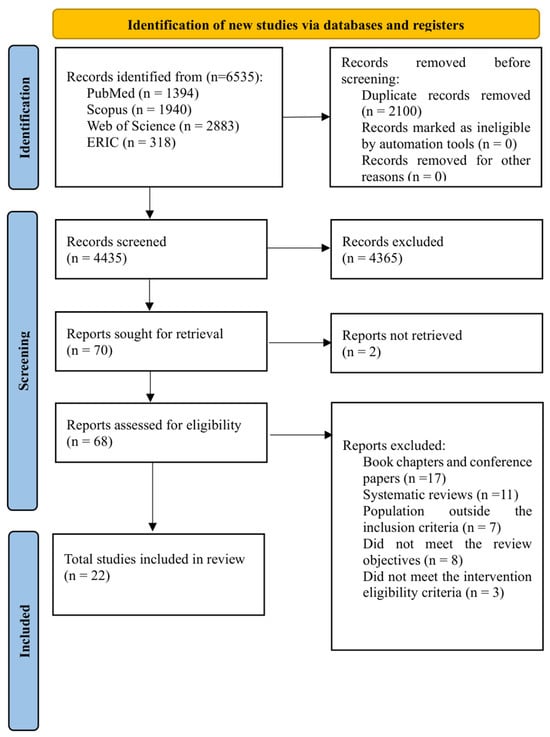
Figure 1 shows the flow of results obtained during the systematic review process. The initial literature search yielded a total of 6535 records in the four databases consulted (PubMed, Scopus, Web of Science, and ERIC). After removing 2100 duplicate records, 4435 studies were screened by reviewing titles and abstracts. Of these, 4365 were excluded, and 70 articles were selected for retrieval and subsequent full-text evaluation. Two reports could not be retrieved; therefore, 68 studies were ultimately evaluated to determine their eligibility. At this stage, 46 studies were excluded: 17 were book chapters or conference presentations, 11 were systematic reviews, 7 included a population that did not meet the inclusion criteria, 8 did not align with the review’s objectives, and 3 did not meet the intervention eligibility criteria. Supplementary Table S2 provides the bibliographic details and eligibility assessment of 46 full-text records, organized according to the exclusion categories presented in the PRISMA flow diagram. Therefore, 22 studies were included in this systematic review. Of these, 14 (63.6%) were randomized controlled trials (including individually randomized trials and cluster-randomized trials at the class, school, or family level); 7 (31.8%) used quasi-experimental designs without random assignment to comparison groups; and 1 (4.5%) was a pilot study with a pre–post design without a control group. The assignment of each study to a group was verified on a case-by-case basis based on the methodological description in each original article, since terms such as “experimental” or “quasi-randomized” do not always imply actual randomization of participants.
Figure 1.
PRISMA Flow Diagram of the Study Selection Process.
Across the 22 included intervention studies, a total of 13,652 children and adolescents aged 6 to 18 years were identified based on the sample sizes reported in Table 3, after excluding adult participants from family-based studies. Specifically, Wong et al. [25] included 67 children and 67 adults, Wunsch et al. [49] included 74 children and 74 adults, and Lu et al. [42] enrolled 214 eligible children from 218 initially assessed. The reported study sample sizes ranged from 41 participants [38] to 6639 participants [47]. The countries and territories where the research was conducted span 15 international locations: 4 studies were conducted in Spain, 3 in the United States, 2 in Taiwan, 2 in China/Hong Kong, and one study each in Australia, the United Kingdom, Germany, Poland, Norway, Belgium, Chile, Iceland, the Czech Republic, Hungary, and Indonesia. Table 3 shows the main characteristics of the 22 selected studies.
Table 3.
Main characteristics of the analyzed studies.
3.1. Mobile Apps and Digital Technologies Used in Interventions
The 22 included studies were classified into three evidence streams according to the intervention–outcome relationship examined. Stream 1 comprised 17 studies evaluating mobile app-supported physical activity interventions and learning-relevant outcomes [24,25,26,27,28,34,35,36,37,38,41,42,43,46,47,48,49]. Stream 2 included three studies examining physical activity or physical education interventions and bullying-related outcomes [11,44,45]. Stream 3 comprised two studies evaluating mobile app-based interventions and cyberbullying-related outcomes [39,40]. No included study directly evaluated the effects of mobile app-supported physical activity interventions on bullying/cyberbullying-related outcomes.
Of the 22 studies included, 19 (86.4%) used a mobile app as an active component of the intervention, while the remaining 3 were based on non-digital PA or PE programs specifically aimed at preventing bullying [11,44,45]. Of the 19 app-based interventions, 13 (68.4%) used the app independently as the sole technological support [24,25,26,27,36,37,38,39,42,43,46,47,49], while 6 (31.6%) combined the app with wearable devices or other digital technologies, such as PA monitors [28,35], tablets [41], social media [40], or websites and other digital platforms [34,48].
Among the technological features incorporated into the interventions, self-monitoring of PA, feedback, reminders, and self-regulation strategies were used to support behavior change [28,49]. Gamification elements, including points, levels, rankings, and challenges, were also incorporated in several interventions [25,28], while augmented reality was used through Pokémon GO to combine mobile gameplay with real-world movement [24,26,27]. Other interventions integrated wearable activity trackers [28,35], multimedia content and personalized messaging [35], automated app-based messaging and a brief remote video component [40], or chatbot-based support [28]. Technology was also embedded within broader social and educational contexts, including parent–child exercise activities [25,42,49] and teacher- or school-mediated interventions [34,36,41,43,46,48]. In addition to intervention content, several studies reported technology-related implementation indicators, including app uptake, adherence and nonusage attrition [28,34,38], while usability was explicitly considered in the evaluation of some interventions [36]. Overall, the technological approaches varied considerably in their degree of interactivity, behavioral support, social mediation, and integration with other digital devices. The duration of the interventions also varied widely, ranging from programs lasting as little as 2 weeks [41] to interventions spanning an entire school year [34,47].
App uptake, adherence, nonusage, and loss to follow-up represent distinct indicators. App uptake refers to initial app adoption or download, adherence to the prescribed intervention use, nonusage to failure to initiate or continue app use, and loss to follow-up to participants with missing follow-up assessments. These indicators were not consistently reported across the included studies and should not be interpreted interchangeably.
3.2. Effects of Interventions on Bullying and Cyberbullying
Five of the 22 included studies evaluated variables related to bullying or cyberbullying, although they did so using different approaches. On the one hand, two mobile app-based interventions specifically targeted the prevention of cyberbullying. Kutok et al. [40] evaluated the IMPACT app, distributed via Instagram, and found that the intervention group reported significantly higher well-being and significantly lower psychological stress at the 8- and 16-week follow-ups, as well as a higher number of bystander intervention attempts (p = 0.02). Høgsdal et al. [39] evaluated the NettOpp app as a self-help resource for addressing cyberbullying in a sample of 586 Norwegian schoolchildren. The primary intention-to-treat analysis did not reveal statistically significant intervention effects. Although a per-protocol analysis identified a reduction in hyperactivity problems among app users (p = 0.021), this secondary finding should be interpreted cautiously because participants who used the app may have differed systematically from those who did not, introducing potential selection bias.
On the other hand, three studies analyzed the effect of PA or PE interventions, without a mobile app component, on in-person bullying. Hormazábal-Aguayo et al. [11] showed that a pre-school physical activity program significantly reduced the likelihood of experiencing physical (OR = 0.18) and verbal (OR = 0.13) bullying after an 8-week intervention among vulnerable Chilean schoolchildren. Montero-Carretero et al. [44], using a judo curriculum integrated into physical education, observed significant reductions in moral disengagement, impulsivity, and the perpetration of bullying, along with increases in empathy and self-determined motivation. Finally, Murillo-Moraño et al. [45] compared a specific bullying prevention program (PREBULLPE) with a cooperative learning intervention, observing that only the former significantly reduced bullying perpetration compared to the control group (p = 0.044), especially among girls (p = 0.005), although this effect dissipated at the 13-week follow-up, and neither intervention significantly altered victimization.
None of the identified studies evaluated the effects of mobile app-based PA interventions on variables related to bullying/cyberbullying, highlighting a gap at the intersection of these lines of intervention.
Taken together, these results suggest that, while mobile apps focused on cyberbullying show promising effects on psychological well-being and bystander behavior, the evidence regarding their ability to directly reduce victimization is still limited. In contrast, some structured PA/PE-based interventions reported reductions in specific bullying-related outcomes, although these effects were not consistent across studies or maintained over time.
3.3. Effects on Learning-Relevant Cognitive, Motivational, and Psychosocial Outcomes
Learning-relevant cognitive, motivational, and psychosocial outcomes were assessed across the included studies and were organized into three dimensions: emotional–motivational, sociobehavioral, and cognitive. Some studies assessed outcomes across more than one dimension and/or alongside bullying/cyberbullying-related outcomes.
3.4. Emotional–Motivational Dimension
The emotional–motivational dimension was the most frequently assessed, including indicators such as self-efficacy, motivation, psychological well-being, life satisfaction, and symptoms of anxiety and depression. Mateo-Orcajada et al. [24] observed that the use of PA apps (Strava, Pacer, MapMyWalk, Pokémon GO) for 10 weeks significantly improved adolescents’ basic psychological needs and life satisfaction (p = 0.003–0.036), in addition to reducing problematic cell phone use (p = 0.004). Similarly, Wunsch et al. [49] reported findings related to intrinsic motivation, while Pratama et al. [46] observed improvements in exercise motivation within the intervention group, although the available results did not establish a statistically significant between-group effect. Maněnová et al. [43] observed an increase in intrinsic motivation and identified regulation, along with a decrease in amotivation, after 10 weeks of using apps in physical education, with greater benefits among students with lower initial performance. Varga and Révész [48], however, qualified these findings by noting that, although the groups that used ICT showed greater task orientation (p < 0.001), the group without ICT paradoxically increased its ego orientation and amotivation (p < 0.001; p = 0.04).
With regard to well-being and mental health, Egilsson et al. [38] reported descriptive increases in self-efficacy (+8.2%) and self-reported PA (+19.6%) in the intervention group, compared with decreases in the control group (−3.0% and −26.2%, respectively). However, these percentage changes should not be interpreted as statistically significant between-group intervention effects without corresponding inferential analyses. Peuters et al. [28] found beneficial effects on mood, although well-being and peer support worsened among adolescents who were attending school remotely during the pandemic. Studies with larger sample sizes did not always confirm these benefits: Smout et al. [47], in a sample of 6639 Australian adolescents, did not find the Health4Life app to be more effective than an active control group at 12 and 24 months, although short-term benefits regarding depressive symptoms and psychological distress were detected immediately after the intervention.
3.5. Social–Behavioral Dimension
The sociobehavioral dimension included variables such as social support, sociability, family climate, and psychosocial behavioral problems. Lee and Gao [41] found no significant differences between groups in perceived social support or enjoyment of physical activity after integrating iPads and mobile apps into physical education classes, and Wunsch et al. [49] also observed no significant improvements in the family health climate following the SMARTFAMILY intervention (all p-values > 0.30). In contrast, Wong et al. [25] reported a reduction in psychosocial problems at the 6-month follow-up (d = 0.35), with higher in-game rankings associated with fewer psychosocial problems. However, because this was an uncontrolled pre–post pilot study, the observed changes cannot be attributed exclusively to the Family Move app. Similarly, both Hsieh and Chen [26] and Ruiz-Ariza et al. [27] found significant increases in schoolchildren’s sociability following 10 and 8 weeks of playing the augmented reality game Pokémon GO, respectively.
3.6. Cognitive Dimension
Finally, the cognitive dimension was assessed in a smaller number of studies. Ruiz-Ariza et al. [27] observed significant increases in selective attention (p = 0.003) and concentration (p < 0.001) after 8 weeks of Pokémon GO use among Spanish adolescents, without finding significant changes in memory, mathematical calculation, or linguistic reasoning. Similarly, Hsieh and Chen [26] found significant improvements in selective attention (p = 0.025), concentration (p = 0.004), and creative imagination (p < 0.001) among Taiwanese elementary school students, with no observed changes in memory. Overall, the available evidence on cognitive effects focuses primarily on interventions based on Pokémon GO, while most other apps did not include specific cognitive measures among their outcome variables.
4. Discussion
The objective of this systematic review was to synthesize three complementary lines of intervention evidence in children and adolescents aged 6–18 years: (1) mobile app-supported PA interventions and learning-relevant cognitive, motivational, and psychosocial outcomes; (2) PA/PE interventions and bullying/cyberbullying outcomes; and (3) mobile app-based interventions and bullying/cyberbullying outcomes.
4.1. Effectiveness of Mobile Apps for Promoting Physical Activity
The results of this review, which show positive effects on PA in some short-term, standalone app-based interventions [38,46], are consistent with the most recent meta-analytic evidence. The meta-analysis by Wang et al. [30], which included randomized controlled trials in children and adolescents, confirmed that mHealth app-based interventions produce small- to moderate-sized beneficial effects on total PA (SMD = 0.29) and on sedentary behavior. Similarly, He et al. [50] found that interventions based specifically on apps, compared to other technologies such as text messages, produced the largest effect size on PA (SMD = 0.76), with this effect being significantly greater in interventions lasting 8 weeks or less. Although the short-term Pokémon GO interventions by Ruiz-Ariza et al. [27] and Hsieh and Chen [26] also reported favorable outcomes, these were primarily observed in cognitive and social variables rather than PA itself.
In contrast, the studies with larger sample sizes and longer durations included in this review, such as the EACH-B program [34] and the Health4Life program [47], did not show significant effects on PA or on the learning variables assessed. This pattern highlights the importance of considering participant engagement and sustained app use when interpreting intervention outcomes, as also addressed by Maenhout et al. [51] and Jakob et al. [52]. However, the implementation indicators reported across studies reflect different aspects of engagement and should not be interpreted as equivalent measures of dropout. Specifically, Barker et al. [34] reported that only 42.5% of students downloaded the application, reflecting app uptake rather than participant attrition. Peuters et al. [28] reported that 18% of participants did not initiate app use, indicating initial nonusage, whereas Egilsson et al. [38] reported that approximately 35% had discontinued app use by week six, reflecting nonusage attrition over time. These distinctions are important because downloading an application, initiating its use, maintaining engagement, and completing study follow-up represent different dimensions of intervention participation. Collectively, these findings suggest that limited uptake and sustained engagement may represent challenges for app-based interventions. Nevertheless, differences in study design, intervention duration, and reporting procedures prevent conclusions about the independent contribution of these factors to intervention effectiveness.
Furthermore, the incorporation of technology does not necessarily lead to greater effectiveness. Lee and Gao [41] observed a significantly greater reduction in moderate-to-vigorous physical activity (MVPA) in the group that used iPads and mobile apps compared to the comparison group. This finding suggests not that technology is the intervention in and of itself, but rather that its value depends on its design, user engagement, and pedagogical integration.
From a technological perspective, the included interventions showed considerable heterogeneity in the features used to support PA and behavior change. Beyond simple activity monitoring, several interventions incorporated feedback, reminders, self-regulation strategies, gamification, augmented reality, wearable devices, social interaction, personalized messaging, or chatbot-based support. Technology was also frequently embedded within broader social and educational contexts through family- or school-mediated activities. Importantly, implementation-related aspects such as app uptake, adherence, nonusage attrition, and usability were reported inconsistently across studies. This variability makes it difficult to determine which specific technological features contribute most effectively to intervention engagement and outcomes. Future studies should therefore provide more systematic reporting of app functionalities, user engagement, adherence, and usability to better identify the technological components associated with intervention effectiveness. Importantly, several interventions combined mobile applications with teacher or family involvement, educational activities, wearable devices, or other digital resources. Therefore, the observed outcomes should be attributed to the overall intervention rather than exclusively to the mobile application. Differences in comparator conditions also limit the isolation of app-specific effects.
4.2. Bullying, Cyberbullying and PA
The findings of this review regarding in-person bullying are consistent with the available evidence on the relationship between physical activity and bullying behaviors. The meta-analysis by García-Hermoso et al. [53] showed that failing to meet PA recommendations is associated with a 14% higher probability of being victimized by bullying (OR = 1.14), while excessive sedentary behavior is associated with a 21% higher probability (OR = 1.21). In line with this, the results of the before-school PA program by Hormazábal-Aguayo et al. [11] and the judo program by Montero-Carretero et al. [44] suggest that certain structured PA/PE-based interventions may contribute to reductions in specific bullying-related outcomes. This finding is also consistent with the review by Zhou et al. [54] on sports interventions, which reported reductions in bullying-related outcomes following martial arts interventions, including judo, while highlighting the potential relevance of psychosocial mechanisms such as self-control.
However, this relationship is not consistent across all dimensions of bullying because, in a recent meta-analysis, Liu et al. [55] found a significant negative correlation between PA and victimization (r = −0.16, p < 0.001), but no significant association with perpetration. Importantly, these findings concern observational associations and cannot explain the intervention-specific results reported by Murillo-Moraño et al. [45], who observed a reduction in bullying perpetration but not in victimization following the PREBULLPE programme. Meanwhile, the results regarding interventions targeting cyberbullying [39,40] are more modest than those described in the meta-analysis by Polanin et al. [56] on interventions to reduce cyberbullying perpetration and victimization, which did find significant effects in most of the interventions reviewed. This discrepancy could be explained by the fact that the apps evaluated in the present review (NettOpp, IMPACT) are self-help resources designed for relatively independent use, whereas the most effective interventions identified by Polanin et al. [56] typically combined curricular components and teacher and family involvement with the digital resource.
Taken together, these findings show that, to date, research on bullying and cyberbullying has followed two clearly distinct paths: on the one hand, in-person physical activity programs without digital support aimed at traditional bullying; on the other, mobile apps focused specifically on cyberbullying, without a structured physical activity component. No study identified in this review evaluated the effects of mobile app-based PA interventions on variables related to bullying/cyberbullying, highlighting a significant gap in current knowledge. This gap is particularly relevant given that previous research has reported associations between PA and bullying-related outcomes, as well as beneficial effects of digital interventions targeting cyberbullying [53,56], while the potential effects of integrating both components remain unexplored.
4.3. Effects on Learning-Relevant Cognitive, Motivational, and Psychosocial Outcomes
With regard to the emotional–motivational dimension, the positive effects identified on self-efficacy, life satisfaction, and intrinsic motivation [24,38,43] are consistent with the principles of Self-Determination Theory, given that numerous applications incorporated elements of feedback, autonomy in the choice of activities, and gamification, factors commonly associated with greater autonomous motivation. However, the absence of significant effects in larger-scale interventions, such as Health4Life [47], is consistent with the findings of Jakob et al. [52], who emphasize that the large number of users and the standardization of content in large-scale programs make it difficult to achieve the personalization necessary to sustain long-term motivational engagement.
With regard to the sociobehavioral dimension, the mixed results observed, with improvements in sociability following the use of Pokémon GO [26,27] but no changes in perceived social support in other interventions [41,49], could be explained by the inherently social nature of the first type of app, which involves group movement and coordination among peers, as opposed to more individual-oriented apps focused on personal activity tracking and monitoring. Finally, the limited evidence available on the cognitive dimension, which is concentrated almost exclusively in studies involving Pokémon GO [26,27], highlights a significant gap in the design of the apps analyzed, most of which did not include any cognitive measures among their outcome variables, despite the well-documented relationship between PA and cognitive performance in children and adolescents.
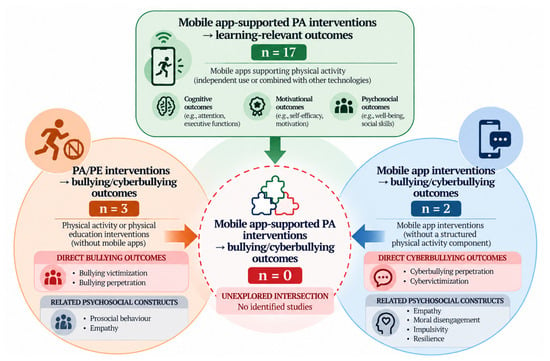
Figure 2 summarizes the three complementary evidence streams identified in this review and highlights the absence of directly identified integrated interventions within the scope of the search and eligibility criteria, bringing together evidence on mobile app-supported PA interventions; learning-relevant cognitive, motivational, and psychosocial outcomes; and bullying/cyberbullying outcomes.
Figure 2.
Visual synthesis of the three intersecting evidence streams and the unexplored intersection identified in the systematic review. Created with ChatGPT (OpenAI, GPT-5.6) Note. Direct bullying/cyberbullying outcomes refer to measured perpetration and victimization, whereas related psychosocial constructs (e.g., empathy, moral disengagement, impulsivity, and resilience) are presented separately and should not be interpreted as direct evidence of reduced bullying or cyberbullying.
5. Practical Recommendations
Based on the systematic review of the 22 selected articles, this section presents a table that summarizes, for each intervention domain, the observed evidence, its interpretation, and a proposed design implication for future PA interventions based on mobile applications, aimed at preventing or reducing bullying and cyberbullying, as well as enhancing learning-relevant cognitive, motivational, and psychosocial outcomes in children and adolescents aged 6 to 18 years. Unlike prescriptive recommendations, each proposal is formulated as a design hypothesis to be tested in future research, since none of the included studies directly manipulated the implementation parameters (duration, group size, teacher or family support, and user retention strategies) that could explain the observed effects. These guidelines integrate the pedagogical use of digital technologies and PA apps (either independently or in combination with wearable devices) with the need to adapt them to students’ levels of motor and digital competence, as well as to their socio-educational and cultural context. The table is intended to serve as a strategic guidance tool for educators, physical education teachers, families, and policymakers in the fields of education and school health, helping them identify feasible courses of action that leverage the mediating potential of mobile apps to promote emotional well-being, strengthen prosocial behaviors among peers, stimulate cognitive functions, and contribute to a positive social environment for the holistic development of young people.
Accordingly, Table 4 synthesizes the evidence identified across the intervention domains, together with its interpretation and the corresponding design hypotheses for future research and educational practice.
Table 4.
Evidence-informed design implications for future interventions, based on the studies included in this review.
6. Limitations and Strengths
This systematic review has some limitations that should be considered when interpreting the results. First, the included studies showed considerable heterogeneity in terms of methodological design, sample size (ranging from 41 to 6639 participants), intervention duration, and assessment instruments, which limits the direct comparability of the results and precludes a quantitative meta-analysis. Although all 22 included studies met the predefined threshold for high methodological quality according to the six-criterion checklist, this assessment reflects compliance with general methodological criteria rather than a design-specific evaluation of risk of bias. Randomized controlled trials may be affected by limitations in randomization procedures, allocation concealment, and blinding, whereas quasi-experimental studies are particularly susceptible to baseline imbalances, confounding factors, and selection bias. Similarly, uncontrolled pre–post studies cannot adequately distinguish intervention effects from temporal changes or other external influences. Therefore, the overall quality classifications should be interpreted as descriptive methodological ratings rather than evidence of uniformly low risk of bias or high certainty regarding intervention effects. Second, most studies relied on self-report questionnaires to assess bullying/cyberbullying outcomes and learning-relevant cognitive, motivational, and psychosocial outcomes, potentially introducing social desirability or recall bias. Third, only 5 of the 22 studies assessed bullying or cyberbullying variables, and none of the identified studies evaluated the effects of mobile app-based PA interventions on these variables, limiting the ability to draw conclusions about this type of integrated intervention.
Additional methodological limitations related to the review process should also be acknowledged. The search was restricted to studies published in English and Spanish and excluded gray literature, which may have limited the identification of relevant evidence and introduced potential publication bias. Despite the use of multiple synonyms and alternative Boolean combinations to cover the three evidence streams, the inclusion of outcome-related search terms may have excluded relevant studies employing different terminology or not explicitly mentioning the variables of interest in searchable bibliographic fields. No formal assessment of search sensitivity was documented; therefore, the possibility that some potentially eligible studies were not retrieved cannot be excluded. Moreover, the retrospective registration of the review in PROSPERO, following completion of the review procedures, does not provide the same safeguards against post hoc methodological decisions as prospective registration and represents an additional methodological limitation. Furthermore, the absence of a prospectively documented protocol prevents independent verification of whether the eligibility criteria remained unchanged throughout the review process. The established time frame (2016–2026), while consistent with the rapid evolution of mobile technologies, combined with the potential obsolescence of certain applications and platforms, may limit the validity of some findings. In addition, some studies were conducted during the COVID-19 pandemic, which may have influenced their implementation and results. The multicomponent nature of certain interventions also makes it difficult to isolate the specific contribution of the mobile app from other program components. Finally, the indirect nature of the available evidence regarding the integrated research question requires that conclusions about the potential effects of mobile app-supported physical activity interventions on bullying and cyberbullying be interpreted with caution.
Despite these limitations, this review has several strengths. The literature search was conducted systematically in accordance with the PRISMA 2020 guidelines and included four international databases (PubMed, Scopus, Web of Science, and ERIC), facilitating the identification of relevant evidence across complementary research fields. To the best of our knowledge, this review is the first to integrate evidence on mobile app-based PA interventions, bullying/cyberbullying, and learning-relevant cognitive, motivational, and psychosocial outcomes within a unified analytical framework, providing a novel reference for the design of future interventions and research in this largely unexplored field.
7. Conclusions
This systematic review identified 22 studies across three complementary lines of intervention evidence: mobile app-supported PA interventions examining learning-relevant cognitive, motivational, and psychosocial outcomes; PA/PE interventions targeting bullying/cyberbullying; and mobile app-based interventions targeting bullying/cyberbullying. Overall, the evidence is promising but structurally disconnected: mobile app-based PA interventions have predominantly examined learning-relevant cognitive, motivational, and psychosocial outcomes; PA interventions targeting bullying have largely lacked a digital component; and apps focused on cyberbullying have generally lacked a structured PA component. Consequently, the effectiveness of an integrated, mobile-app-based PA intervention for the prevention of bullying and cyberbullying remains unknown.
No identified study evaluated the effects of mobile app-based PA interventions on bullying/cyberbullying-related outcomes. This gap in the evidence identified within the scope of the present review underscores the need to develop and evaluate interventions that integrate mobile app-supported PA with bullying and cyberbullying prevention. Future trials should evaluate integrated interventions that combine mobile app-supported PA with explicit bullying and cyberbullying prevention components, using robust randomized designs, objective measures of PA, validated bullying outcomes, implementation indicators, and longer-term follow-up. The development of such integrated interventions could contribute not only to the promotion of active lifestyles but also to the prevention of two of the most prevalent psychosocial problems during childhood and adolescence.
Supplementary Materials
The following supporting information can be downloaded at https://www.mdpi.com/article/10.3390/technologies14100686/s1: Table S1: Database-specific search strategies, field restrictions, filters, and search dates; Table S2: Bibliographic details and reasons for exclusion of full-text studies.
Author Contributions
Conceptualization, R.G.-M., A.C.-I., N.G.-P. and A.R.-A.; methodology, R.G.-M., A.C.-I., N.G.-P. and A.R.-A.; validation, R.G.-M., A.C.-I., N.G.-P. and A.R.-A.; formal analysis, R.G.-M., A.C.-I., N.G.-P. and A.R.-A.; investigation, R.G.-M., A.C.-I., N.G.-P. and A.R.-A.; resources, R.G.-M., A.C.-I., N.G.-P. and A.R.-A.; data curation, R.G.-M., A.C.-I., N.G.-P. and A.R.-A.; writing—original draft preparation, R.G.-M., A.C.-I., N.G.-P. and A.R.-A.; writing—review and editing, R.G.-M., A.C.-I., N.G.-P. and A.R.-A.; visualization, R.G.-M., A.C.-I., N.G.-P. and A.R.-A.; supervision, R.G.-M., A.C.-I., N.G.-P. and A.R.-A.; project administration, R.G.-M., A.C.-I., N.G.-P. and A.R.-A. All authors have read and agreed to the published version of the manuscript.
Funding
This research was funded by the Junta de Andalucía (Spain) through the project “DGP_PIDI_2024_02434”, co-funded by the European Union through the European Regional Development Fund.
Data Availability Statement
No new primary participant-level data were collected in this systematic review. The extracted study-level data and methodological quality assessments are reported in Table 2 and Table 3 of the manuscript. The review selection process and reasons for full-text exclusions are summarized in the PRISMA flow diagram. Additional review records, where retained, may be requested from the corresponding author.
Acknowledgments
The authors would like to express their sincere appreciation to everyone who supported the development of this study, particularly their colleagues, Group HUM-943 and the University of Jaén for their valuable academic support. During the preparation of this manuscript, the authors used ChatGPT (OpenAI, GPT-5.6) to assist with language and stylistic refinement and to generate Figure 2. All AI-generated content was carefully reviewed, verified, and edited by the authors, who assume full responsibility for the final content of this manuscript.
Conflicts of Interest
The authors declare no conflict of interest.
Abbreviations
The following abbreviations are used in this manuscript:
| AR | Augmented reality |
| CG | Control group |
| EG | Experimental group |
| GenAI | Generative artificial intelligence |
| HQ | High quality |
| HRPF | Health-related physical fitness |
| HRQoL | Health-related quality of life |
| ICT | Information and communication technology |
| IG | Intervention group |
| LQ | Low quality |
| mHealth | Mobile health |
| MQ | Medium quality |
| MVPA | Moderate-to-vigorous physical activity |
| OR | Odds ratio |
| PA | Physical activity |
| PE | Physical education |
| PRISMA | Preferred Reporting Items for Systematic Reviews and Meta-Analyses |
| RCT | Randomized controlled trial |
| SIMS | Situational Motivation Scale |
| SMD | Standardized mean difference |
References
- Bull, F.C.; Al-Ansari, S.S.; Biddle, S.; Borodulin, K.; Buman, M.P.; Cardon, G.; Carty, C.; Chaput, J.-P.; Chastin, S.; Chou, R.; et al. World Health Organization 2020 guidelines on physical activity and sedentary behaviour. Br. J. Sports Med. 2020, 54, 1451–1462. [Google Scholar] [CrossRef] [Scilit] [PubMed]
- Chaput, J.P.; Willumsen, J.; Bull, F.; Chou, R.; Ekelund, U.; Firth, J.; Jago, R.; Ortega, F.B.; Katzmarzyk, P.T. 2020 WHO guidelines on physical activity and sedentary behaviour for children and adolescents aged 5–17 years: Summary of the evidence. Int. J. Behav. Nutr. Phys. Act. 2020, 17, 141. [Google Scholar] [CrossRef] [Scilit] [PubMed]
- World Health Organization. WHO Guidelines on Physical Activity and Sedentary Behaviour; World Health Organization: Geneva, Switzerland, 2020. [Google Scholar]
- Guthold, R.; Stevens, G.A.; Riley, L.M.; Bull, F.C. Global trends in insufficient physical activity among adolescents: A pooled analysis of 298 population-based surveys with 1.6 million participants. Lancet Child Adolesc. Health 2020, 4, 23–35. [Google Scholar] [CrossRef] [Scilit] [PubMed]
- UNESCO. Behind the Numbers: Ending School Violence and Bullying; UNESCO: Paris, France, 2019. [Google Scholar] [CrossRef] [Scilit]
- Olweus, D. Bullying at School: What We Know and What We Can Do; Blackwell: Oxford, UK, 1993. [Google Scholar]
- Kowalski, R.M.; Giumetti, G.W.; Schroeder, A.N.; Lattanner, M.R. Bullying in the digital age: A critical review and meta-analysis of cyberbullying research among youth. Psychol. Bull. 2014, 140, 1073–1137. [Google Scholar] [CrossRef] [Scilit] [PubMed]
- Arseneault, L. Annual research review: The persistent and pervasive impact of being bullied in childhood and adolescence: Implications for policy and practice. J. Child Psychol. Psychiatry 2018, 59, 405–421. [Google Scholar] [CrossRef] [Scilit] [PubMed]
- Rusillo-Magdaleno, A.; Suarez-Manzano, S.; Moral-García, J.E.; Ruiz-Ariza, A. Asociación de la práctica de actividad física semanal con bullying y ciberbullying en chicos y chicas de 10 a 16 años. Retos 2024, 59, 759–766. [Google Scholar] [CrossRef] [Scilit]
- Eime, R.M.; Young, J.A.; Harvey, J.T.; Charity, M.J.; Payne, W.R. A systematic review of the psychological and social benefits of participation in sport for children and adolescents: Informing development of a conceptual model of health through sport. Int. J. Behav. Nutr. Phys. Act. 2013, 10, 98. [Google Scholar] [CrossRef] [Scilit] [PubMed]
- Hormazábal-Aguayo, I.; Fernández-Vergara, O.; González-Calderón, N.; Vicencio-Rojas, F.; Russell-Guzmán, J.; Chacana-Cañas, C.; del Pozo-Cruz, B.; García-Hermoso, A. Can a before-school physical activity program decrease bullying victimization in disadvantaged children? The Active-Start Study. Int. J. Clin. Health Psychol. 2019, 19, 237–242. [Google Scholar] [CrossRef] [Scilit] [PubMed]
- Moon, J.; Webster, C.A.; Mulvey, K.L.; Brian, A.; Stodden, D.F.; Egan, C.A.; Ha, T.; Merica, C.B.; Beets, M.W. Physical activity interventions to increase children’s social and emotional learning: A systematic review and meta-analysis based on the comprehensive school physical activity programme framework. Rev. Educ. 2024, 12, e3455. [Google Scholar] [CrossRef] [Scilit]
- Cherukunnath, D.; Singh, A.P. Exploring cognitive processes of knowledge acquisition to upgrade academic practices. Front. Psychol. 2022, 13, 682628. [Google Scholar] [CrossRef] [Scilit] [PubMed]
- Solas-Martínez, J.L.; Marques, A.; Loureiro, V.; Ruiz-Ariza, A. Physical activity intensity as a catalyst for learning in young people: A systematic review and practical guide. Rev. Educ. Res. 2026. OnlineFirst. [Google Scholar] [CrossRef] [Scilit]
- Rachman, Y.A.; Sumarwan, U.; Latifah, M.; Herawati, T. Factors influencing the social-emotional development of children and adolescents: A study systematic literature review. J. Fam. Sci. 2023, 1–17. [Google Scholar] [CrossRef] [Scilit]
- Molleman, L.; Ciranka, S.; van den Bos, W. Social influence in adolescence as a double-edged sword. Proc. R. Soc. B 2022, 289, 20220045. [Google Scholar] [CrossRef] [Scilit] [PubMed]
- Hachem, M.; Gorgun, G.; Chu, M.-W.; Bulut, O. Social and emotional variables as predictors of students’ perceived cognitive competence and academic performance. Can. J. Sch. Psychol. 2022, 37, 362–384. [Google Scholar] [CrossRef] [Scilit]
- Donnelly, J.E.; Hillman, C.H.; Castelli, D.; Etnier, J.L.; Lee, S.; Tomporowski, P.; Lambourne, K.; Szabo-Reed, A.N. Physical activity, fitness, cognitive function, and academic achievement in children: A systematic review. Med. Sci. Sports Exerc. 2016, 48, 1197–1222. [Google Scholar] [CrossRef] [Scilit] [PubMed]
- Biddle, S.J.H.; Ciaccioni, S.; Thomas, G.; Vergeer, I. Physical activity and mental health in children and adolescents: An updated review of reviews and an analysis of causality. Psychol. Sport Exerc. 2019, 42, 146–155. [Google Scholar] [CrossRef] [Scilit]
- Lubans, D.; Richards, J.; Hillman, C.; Faulkner, G.; Beauchamp, M.; Nilsson, M.; Kelly, P.; Smith, J.; Raine, L.; Biddle, S. Physical activity for cognitive and mental health in youth: A systematic review of mechanisms. Pediatrics 2016, 138, e20161642. [Google Scholar] [CrossRef] [Scilit] [PubMed]
- Schoeppe, S.; Alley, S.; Van Lippevelde, W.; Bray, N.A.; Williams, S.L.; Duncan, M.J.; Vandelanotte, C. Efficacy of interventions that use apps to improve diet, physical activity and sedentary behaviour: A systematic review. Int. J. Behav. Nutr. Phys. Act. 2016, 13, 127. [Google Scholar] [CrossRef] [Scilit] [PubMed]
- Romeo, A.; Edney, S.; Plotnikoff, R.; Curtis, R.; Ryan, J.; Sanders, I.; Crozier, A.; Maher, C. Can smartphone apps increase physical activity? Systematic review and meta-analysis. J. Med. Internet Res. 2019, 21, e12053. [Google Scholar] [CrossRef] [Scilit] [PubMed]
- Direito, A.; Carraça, E.; Rawstorn, J.; Whittaker, R.; Maddison, R. mHealth technologies to influence physical activity and sedentary behaviors: Behavior change techniques, systematic review and meta-analysis of randomized controlled trials. Ann. Behav. Med. 2017, 51, 226–239. [Google Scholar] [CrossRef] [Scilit] [PubMed]
- Mateo-Orcajada, A.; Vaquero-Cristóbal, R.; Abenza-Cano, L. The use of physical activity mobile apps improves the psychological state of adolescents: A randomized controlled trial. Hum. Behav. Emerg. Technol. 2024, 2024, 4687827. [Google Scholar] [CrossRef] [Scilit]
- Wong, R.S.M.; Yu, E.Y.T.; Wong, T.W.-L.; Fung, C.S.C.; Choi, C.S.Y.; Or, C.K.L.; Liu, K.S.N.; Wong, C.K.H.; Ip, P.; Lam, C.L.K. Development and pilot evaluation of a mobile app on parent-child exercises to improve physical activity and psychosocial outcomes of Hong Kong Chinese children. BMC Public Health 2020, 20, 1544. [Google Scholar] [CrossRef] [Scilit] [PubMed]
- Hsieh, C.Y.; Chen, T. Effect of Pokémon GO on the cognitive performance and emotional intelligence of primary school students. J. Educ. Comput. Res. 2019, 57, 1849–1874. [Google Scholar] [CrossRef] [Scilit]
- Ruiz-Ariza, A.; Casuso, R.A.; Suarez-Manzano, S.; Martínez-López, E.J. Effect of augmented reality game Pokémon GO on cognitive performance and emotional intelligence in adolescent young. Comput. Educ. 2018, 116, 49–63. [Google Scholar] [CrossRef] [Scilit]
- Peuters, C.; Maenhout, L.; Cardon, G.; De Paepe, A.; DeSmet, A.; Lauwerier, E.; De Bourdeaudhuij, I.; Crombez, G. A mobile healthy lifestyle intervention to promote mental health in adolescence: A mixed-methods evaluation. BMC Public Health 2024, 24, 44. [Google Scholar] [CrossRef] [Scilit] [PubMed]
- Ryan, R.M.; Deci, E.L. Intrinsic and extrinsic motivation from a self-determination theory perspective: Definitions, theory, practices, and future directions. Contemp. Educ. Psychol. 2020, 61, 101860. [Google Scholar] [CrossRef] [Scilit]
- Wang, J.-W.; Zhu, Z.; Shuling, Z.; Fan, J.; Jin, Y.; Gao, Z.-L.; Chen, W.-D.; Li, X. Effectiveness of mHealth app–based interventions for increasing physical activity and improving physical fitness in children and adolescents: Systematic review and meta-analysis. JMIR mHealth uHealth 2024, 12, e51478. [Google Scholar] [CrossRef] [Scilit] [PubMed]
- Gómez Flores, M.I.; Lozada-Perezmitre, E.; Sommer, J.; Antonio-Ledo, G.V. Mobile apps to promote and motivate exercise in adolescents in Mexico: A systematic review. Stud. Health Technol. Inform. 2024, 315, 119–123. [Google Scholar] [CrossRef] [Scilit] [PubMed]
- Page, M.J.; McKenzie, J.E.; Bossuyt, P.M.; Boutron, I.; Hoffmann, T.C.; Mulrow, C.D.; Shamseer, L.; Tetzlaff, J.M.; Akl, E.A.; Brennan, S.E.; et al. The PRISMA 2020 statement: An updated guideline for reporting systematic reviews. BMJ 2021, 372, n71. [Google Scholar] [CrossRef] [Scilit] [PubMed]
- Aromataris, E.; Munn, Z. (Eds.) JBI Manual for Evidence Synthesis; JBI: Adelaide, Australia, 2020. [Google Scholar] [CrossRef] [Scilit]
- Barker, M.; Jenner, S.; Woods-Townsend, K.; Varkonyi-Sepp, J.; Barrett, M.; Bagust, L.; Lovelock, D.; Shaw, S.; Coakley, P.; Leonard, N.; et al. Engaging adolescents in changing behaviour to improve diet and physical activity levels in teenagers: The EACH-B research programme. Programme Grants Appl. Res. 2026, 14. [Google Scholar] [CrossRef] [PubMed]
- Carson, J.R.; Greenstadt, E.; Olivera, B.; Dunsiger, S.; Zive, M.; Higgins, M.; Godino, J.; Marcus, B.; Meyer, D.; Larsen, B. A multiple technology-based physical activity intervention for Latina adolescents: Results from the Chicas Fuertes randomized controlled trial. JMIR mHealth uHealth 2025, 13, e71623. [Google Scholar] [CrossRef] [Scilit] [PubMed]
- Cheng, C.H.; Chen, C.H. Developing a mobile app-supported learning system for evaluating health-related physical fitness achievements of students. Mob. Inf. Syst. 2018, 2018, 8960968. [Google Scholar] [CrossRef] [Scilit]
- Dzielska, A.; Mazur, J.; Nałęcz, H.; Oblacińska, A.; Fijałkowska, A. Importance of self-efficacy in eating behavior and physical activity change of overweight and non-overweight adolescent girls participating in Healthy Me: A lifestyle intervention with mobile technology. Nutrients 2020, 12, 2128. [Google Scholar] [CrossRef] [Scilit] [PubMed]
- Egilsson, E.; Bjarnason, R.; Njardvik, U. Usage and weekly attrition in a smartphone-based health behavior intervention for adolescents: Pilot randomized controlled trial. JMIR Form. Res. 2021, 5, e21432. [Google Scholar] [CrossRef] [Scilit] [PubMed]
- Høgsdal, H.; Kaiser, S.; Mabille, G.; Breivik, K.; Adolfsen, F.; Martinussen, M.; Kyrrestad, H. The effects of an app to prevent negative outcomes of cyberbullying: A cluster randomized controlled trial. PLoS Digit. Health 2025, 4, e0000819. [Google Scholar] [CrossRef] [Scilit] [PubMed]
- Kutok, E.R.; Dunsiger, S.; Patena, J.V.; Nugent, N.R.; Riese, A.; Rosen, R.K.; Ranney, M.L. A cyberbullying media-based prevention intervention for adolescents on Instagram: Pilot randomized controlled trial. JMIR Ment. Health 2021, 8, e26029. [Google Scholar] [CrossRef] [Scilit] [PubMed]
- Lee, J.E.; Gao, Z. Effects of the iPad and mobile application-integrated physical education on children’s physical activity and psychosocial beliefs. Phys. Educ. Sport Pedagog. 2020, 25, 567–584. [Google Scholar] [CrossRef] [Scilit]
- Lu, Y.; Li, S.; Xie, Z.; Meng, F.; Feng, R.; Zhang, Y.; Zhou, W.; Gao, Y. Digital parent-child intervention on children’s exercise behavior and psychological development—A randomized controlled trial based on family perspective. Behav. Sci. 2026, 16, 282. [Google Scholar] [CrossRef] [Scilit] [PubMed]
- Maněnová, M.; Knajfl, P.; Wolf, J. Motivation and performance of students in school physical education in which mobile applications are used. Sustainability 2022, 14, 9016. [Google Scholar] [CrossRef] [Scilit]
- Montero-Carretero, C.; Roldán, A.; Katagiri, N.; Cervelló, E. Curricular intervention in physical education to prevent bullying: A-Judo programme. Phys. Educ. Sport Pedagog. 2026, 1–21. [Google Scholar] [CrossRef] [Scilit]
- Murillo-Moraño, J.; Pérez-Sousa, M.Á.; Morente Montero, Á.; Benítez-Sillero, J.d.D. Cooperative learning and PREBULLPE programme: Two bullying prevention interventions in physical education. Health Educ. J. 2025, 84, 474–489. [Google Scholar] [CrossRef] [Scilit]
- Pratama, T.A.; Waris; Gita, R.S.D. Effectiveness of Android-based learning media “7 Minutes Workout” on the motivation and activity of junior high school students. J. Penelit. Pendidik. IPA 2025, 11, 707–713. [Google Scholar] [CrossRef] [Scilit]
- Smout, S.; Champion, K.E.; O’Dean, S.; Teesson, M.; Gardner, L.A.; Newton, N.C. Anxiety, depression and distress outcomes from the Health4Life intervention for adolescent mental health: A cluster-randomized controlled trial. Nat. Ment. Health 2024, 2, 799–809. [Google Scholar] [CrossRef] [Scilit]
- Varga, A.; Révész, L. Impact of applying information and communication technology tools in physical education classes. Informatics 2023, 10, 20. [Google Scholar] [CrossRef] [Scilit]
- Wunsch, K.; Fiedler, J.; Hubenschmid, S.; Reiterer, H.; Renner, B.; Woll, A. An mHealth intervention promoting physical activity and healthy eating in a family setting (SMARTFAMILY): Randomized controlled trial. JMIR mHealth uHealth 2024, 12, e51201. [Google Scholar] [CrossRef] [Scilit] [PubMed]
- He, Z.; Wu, H.; Yu, F.; Fu, J.; Sun, S.; Huang, T.; Wang, R.; Chen, D.; Zhao, G.; Quan, M. Effects of smartphone-based interventions on physical activity in children and adolescents: Systematic review and meta-analysis. JMIR mHealth uHealth 2021, 9, e22601. [Google Scholar] [CrossRef] [Scilit] [PubMed]
- Maenhout, L.; Peuters, C.; Cardon, G.; Crombez, G.; DeSmet, A.; Compernolle, S. Nonusage attrition of adolescents in an mHealth promotion intervention and the role of socioeconomic status: Secondary analysis of a 2-arm cluster-controlled trial. JMIR mHealth uHealth 2022, 10, e36404. [Google Scholar] [CrossRef] [Scilit] [PubMed]
- Jakob, R.; Harperink, S.; Rudolf, A.M.; Fleisch, E.; Haug, S.; Mair, J.L.; Salamanca-Sanabria, A.; Kowatsch, T. Factors influencing adherence to mHealth apps for prevention or management of noncommunicable diseases: Systematic review. J. Med. Internet Res. 2022, 24, e35371. [Google Scholar] [CrossRef] [Scilit] [PubMed]
- García-Hermoso, A.; Hormazábal-Aguayo, I.; Oriol-Granado, X.; Fernández-Vergara, O.; del Pozo Cruz, B. Bullying victimization, physical inactivity and sedentary behavior among children and adolescents: A meta-analysis. Int. J. Behav. Nutr. Phys. Act. 2020, 17, 114. [Google Scholar] [CrossRef] [Scilit] [PubMed]
- Zhou, Z.; Saibon, J.B.; Khairani, A.Z. Sport-based interventions to mitigate bullying behaviors among children and adolescents: A systematic review. Heliyon 2025, 11, e43307. [Google Scholar] [CrossRef] [Scilit]
- Liu, Y.; Chen, Z.; Wang, P. Relationship between bullying behaviors and physical activity in children and adolescents: A systematic review and meta-analysis. Aggress. Violent Behav. 2024, 78, 101960. [Google Scholar] [CrossRef] [Scilit]
- Polanin, J.R.; Espelage, D.L.; Grotpeter, J.K.; Ingram, K.; Michaelson, L.; Spinney, E.; Valido, A.; El Sheikh, A.; Torgal, C.; Robinson, L. A systematic review and meta-analysis of interventions to decrease cyberbullying perpetration and victimization. Prev. Sci. 2022, 23, 439–454. [Google Scholar] [CrossRef] [Scilit] [PubMed]

Disclaimer/Publisher’s Note: The statements, opinions and data contained in all publications are solely those of the individual author(s) and contributor(s) and not of MDPI and/or the editor(s). MDPI and/or the editor(s) disclaim responsibility for any injury to people or property resulting from any ideas, methods, instructions or products referred to in the content. |
© 2026 by the authors. Licensee MDPI, Basel, Switzerland. This article is an open access article distributed under the terms and conditions of the Creative Commons Attribution (CC BY) license.