


Abstract
Federated learning must accommodate statistical heterogeneity, costly client participation, and distinct fairness objectives for model performance and participation frequency. We introduce Fair Bayesian Stackelberg Federated Learning (FBS-FL), in which a server maintains beliefs over private client cost types and selects stochastic inclusion probabilities and incentives under an expected client-inclusion constraint. The framework combines an analytical cost-threshold response model with a scalable PPO–EXP3 behavioral implementation using approximate belief tracking. We evaluate FBS-FL over five seeds on CIFAR-10, FEMNIST, and Shakespeare. FBS-FL obtains Jain indices from 0.91 to 0.93 and KL divergences to uniform participation from 0.07 to 0.09, compared with 0.81 to 0.86 and 0.16 to 0.22 for the strongest baseline values on the same participation metrics. The evaluation jointly examines participation fairness, mean accuracy, and worst-client performance. The results indicate improved participation balance with small accuracy variation under the reported protocol.
1. Introduction
Federated learning (FL) has emerged as a central paradigm for training machine-learning models across decentralized data sources without requiring raw data to leave client devices, thereby mitigating privacy risks and reducing the need for centralized data collection [1,2]. Since the introduction of FedAvg [1], FL has been deployed in mobile, healthcare, finance, and edge-computing scenarios where privacy constraints, bandwidth limitations, and device diversity render centralized learning impractical [3,4,5]. Yet realistic FL deployments continue to be shaped by three intertwined challenges that classical formulations do not address jointly: client heterogeneity and strategic participation, multidimensional fairness, and incomplete information.
The first challenge combines heterogeneity with strategic participation. On the statistical side, clients typically hold non-IID data, highly unbalanced sample sizes, and local objectives that may diverge substantially, slowing convergence and biasing the global model toward a subset of dominant participants [3,6,7]. On the system side, clients differ in computation capability, energy availability, and communication quality, which induces stragglers, dropouts, and unstable participation patterns [8,9]. Crucially, participation is often costly: clients expend compute cycles, battery, and bandwidth, and a rational client may refuse to participate unless the offered reward compensates these costs [10,11,12]. This observation challenges the prevailing assumption that sampled clients participate passively and truthfully, and motivates treating client participation as the outcome of a decision problem rather than as an exogenous process.
The second difficulty is fairness. In FL, fairness is inherently multidimensional. Performance fairness concerns disparities in model quality across clients and motivates reweighted or personalized objectives such as q-FFL [13], Ditto [14], and the broader family of personalization-based methods [15,16]. Participation fairness, by contrast, concerns how often clients are selected and rewarded over time and aims to prevent a protocol from repeatedly overusing a few favorable clients while marginalizing weaker or more expensive ones [17,18,19,20]. The two notions are related but fundamentally distinct: a protocol may improve aggregate accuracy while repeatedly excluding disadvantaged clients, or enforce balanced participation while still yielding highly unequal local performance. Designing FL mechanisms that jointly address performance fairness, participation fairness, and incentive expenditure therefore remains an open challenge.
A third, less frequently emphasized difficulty ties the previous two together: incomplete information. In realistic deployments, the server does not directly observe a client’s unit compute cost, energy coefficient, or data freshness. These private attributes shape whether a reward offer will be accepted, and the server can at best maintain beliefs over them and refine those beliefs as participation decisions are observed. Ignoring this belief structure leads either to over-payment (safe but wasteful reward schedules) or to systematic exclusion (aggressive schedules that misprice costly clients). Neither outcome is desirable from an incentive or fairness standpoint.
Taken together, heterogeneity, strategic participation, dual fairness, and incomplete information call for a framework that coordinates the server and client decisions while explicitly representing private information. We therefore model their interaction as a Bayesian Stackelberg game. The server commits, at each round, to a stochastic client-inclusion policy and an incentive schedule while maintaining a belief over each client’s private cost type. In the structural game, clients best-respond to the observed offer through the analytical cost-threshold rule. The Bayesian Stackelberg formulation defines the round-wise information and decision structure; PPO–EXP3 provides a scalable behavioral implementation. Stackelberg models have a long history in hierarchical decision-making and have recently been adapted to FL and edge settings for pricing, worker motivation, and resource allocation [10,21,22,23,24]. Existing works, however, typically treat only part of this joint problem: some model strategic participation without explicit fairness control [24], others study fairness without endogenous incentives [18,19], and most do not combine Bayesian private types with joint fairness and incentive control. Among the closest recent works, FLamma drives a full-information Stackelberg game toward a fairer accuracy distribution [25], whereas RAIM couples a three-stage Stackelberg incentive with client reputation [26]. These approaches focus, respectively, on decay-factor design and reliability; neither combines Bayesian belief tracking, participation-fairness regularization, and learned strategic participation in a single framework.
In this paper, we propose Fair Bayesian Stackelberg Federated Learning (FBS-FL), a unified framework for FL with heterogeneous and strategic clients. The server maintains a finite-grid belief over each client’s private cost type, commits to a stochastic inclusion policy under an inclusion constraint, and optimizes a round-wise objective that jointly balances learning progress, incentive expenditure, and a Kullback–Leibler (KL) participation fairness regularizer. PPO with capped-simplex action projection implements the leader policy at scale, while EXP3 [27] provides the bounded-rational behavioral response used in the main simulations.
This work makes three main contributions. First, it provides a unified round-wise Bayesian Stackelberg formulation in which the server selects a stochastic inclusion policy under an inclusion constraint, commits to an incentive schedule, and maintains beliefs over private client cost types. Performance fairness, participation fairness, and incentive expenditure are thereby integrated into the same leader objective. Second, FBS-FL combines belief updates with cost-aware incentives and stochastic client inclusion, allowing the server to adapt its decisions to observed acceptance behavior; the analysis distinguishes a correctly specified posterior under the logistic response from a working belief under EXP3-generated responses. Third, the framework is implemented at scale using PPO with capped-simplex action projection for the leader and EXP3 as a behavioral follower model, and is evaluated using complementary measures: worst-client accuracy and cross-client dispersion for performance fairness, Jain’s index and KL divergence from the uniform distribution for participation fairness, and reported incentive expenditure with an explicit distinction between model-generated payments and imputed accounting charges.
The remainder of the paper follows this progression. Section 2 reviews prior work on FL under heterogeneity, incentives, fairness, Stackelberg game theory, and online bandit learning, and positions FBS-FL with respect to the closest recent contributions. Section 3 presents the FBS-FL system model and the algorithms used for simulation. Section 4 describes the experimental protocol on CIFAR-10, FEMNIST, and Shakespeare and reports the main results against six baselines over five independent seeds. Section 5 concludes and identifies directions for future work.
2. Related Work
Our work lies at the intersection of five research streams: federated optimization under heterogeneity, incentive mechanisms in FL, fairness in distributed learning, Stackelberg and Bayesian game theory, and online bandit learning for hierarchical decision making. This section reviews these streams in turn before making the positioning of FBS-FL explicit.
The first stream concerns federated optimization under heterogeneity. Federated learning was popularized by McMahan et al. [1], who introduced FedAvg as a simple and communication-efficient method for decentralized model training. Subsequent work addressed statistical and system heterogeneity through proximal regularization (FedProx [8]), control-variate and variance-reduction methods (SCAFFOLD [7]), and adaptive server-side optimization [28,29]. Surveys by Kairouz et al. [2] and Li et al. [3] provide comprehensive overviews of the open problems and early solution strategies in federated optimization. These works significantly improve optimization robustness, but they generally treat client participation as exogenous: clients are sampled uniformly or proportionally to data size, and the possibility that a rational client may decline to participate is not modeled.
Against this background, a complementary literature studies incentive mechanisms for FL. Representative approaches include contract-theoretic and reputation-aware mechanisms [11,12,26], auction-based pricing and selection [30,31], and reinforcement-learning-based incentive design [10]. Game-theoretic formulations have also been considered in FL and edge settings to model worker motivation and resource allocation [23,24]. Guo et al. [24] cast FL incentive design as a bi-level multi-objective programming problem solved by a modified NSGA-II, while Javaherian et al. [25] recently proposed FLamma, a Stackelberg-inspired mechanism that dynamically adjusts a decay factor to balance client influence.
Strategic FL also intersects with privacy and security objectives. Wang et al. [32] combine local privacy protection, contribution verification, and a two-tier reinforcement-learning incentive mechanism for UAV-assisted crowdsensing. Their emphasis is secure and high-quality model sharing rather than inference over private participation costs or participation-frequency fairness. More recently, Wang et al. [33] formulate federated LLM fine-tuning as a dynamic privacy-pricing game in which data owners choose differential- privacy noise levels under curator incentives and budget constraints. That follower decision concerns privacy–utility exchange, whereas FBS-FL studies binary cost-based participation and explicitly regularizes performance and participation fairness. The formulations are therefore complementary rather than directly interchangeable experimental baselines. FBS-FL does not provide a differential-privacy or secure-aggregation guarantee.
Two recent studies further clarify the positioning of FBS-FL within fairness-aware incentive mechanisms. Zhao et al. [34] jointly determine client selection and payments under heterogeneous differential-privacy requirements, with explicit attention to participation fairness. Xu et al. [35] combine Stackelberg incentives, adaptive batch-size decisions, fair reward allocation, and free-rider verification. These studies confirm the growing importance of jointly reasoning about incentives and fairness. Their strategic variables are, respectively, privacy budgets and resource-dependent batch sizes; neither maintains a sequential belief over a client’s latent binary participation threshold or couples that belief with both participation-frequency regularization and performance-fair aggregation.
These works recognize that participation is costly and strategic, and several obtain closed-form or equilibrium characterizations under full information about client costs. However, they typically emphasize pricing, payment design, or resource allocation in isolation, and rarely treat participation fairness or belief tracking as first-class ingredients of the mechanism. Within this representative set, we did not identify a method combining an explicit Bayesian belief over private cost types with a fairness-regularized leader objective.
Beyond optimization robustness and incentive design, fairness in FL has been studied along multiple dimensions. A first line focuses on performance fairness, namely reducing disparities in model quality across clients. The q-FFL objective of Li et al. [13] introduces a reweighted loss that up-weights high-loss clients, while personalization-based approaches such as Ditto [14] and pFedMe [15] improve local performance under client heterogeneity. Broader overviews of personalized FL are given in [16]. Other works consider robustness across distributions or sensitive groups through agnostic FL and group-fairness-aware aggregation [36,37,38].
A second line focuses on participation fairness via client selection. Cho et al. [18] analyze the effect of biased client selection on convergence, and Huang et al. [17] study trade-offs between fairness and efficiency. System-level frameworks such as Oort [39] and Power-of-Choice [18] demonstrate that guided participation can substantially improve training efficiency. More recently, Mao et al. [19] propose FedSDR, a data-representativity-based dynamic client selection scheme with explicit fairness guarantees, and Wan et al. [20] combine a joint security and fairness score with a DDPG agent to select reliable clients equitably. Yin et al. [40] cast fairness-aware client selection itself as a Stackelberg problem (FedSCS), while a Double-DQN variant, FairFedDRL [41], uses Jain’s index inside the reward function to balance selection frequency with client diversity.
These fairness-aware selection rules, however, typically treat client availability as exogenous (no cost-based acceptance decision) and do not couple the selection rule with explicit incentive payments or with a Bayesian model of private costs. Our framework differs in that it addresses both fairness axes within a single decision problem: performance fairness is reflected through a q-fair learning objective in the spirit of [13], participation fairness is enforced through a KL regularizer on smoothed participation frequencies, and both interact directly with an incentive expenditure that is itself the object of optimization. Crucially, the literature on incentive design and on fairness in FL have evolved largely in isolation: incentive mechanisms rarely include explicit participation-fairness regularization, and fairness-aware selection rules typically assume free or exogenous participation. FBS-FL bridges this gap.
The hierarchical structure created by strategic participation under incomplete information naturally connects this gap to Stackelberg and Bayesian game theory. Stackelberg games formalize interactions in which a leader commits first and followers best-respond after observing that commitment [42]. Bayesian Stackelberg games extend this setting to private follower types and are particularly relevant when the leader acts under incomplete information [22,43]. These models have been studied extensively in security, pricing, and resource allocation [21,22,44].
In FL and edge-learning contexts, Stackelberg formulations have primarily been used for incentive design, worker motivation, and pricing under resource constraints [23,24,25,26]. Most existing FL-oriented formulations, however, remain either full-information or restricted to a single aspect of the problem, such as payment design or reliability. Bayesian extensions that explicitly maintain posteriors over client types are rare, and to our knowledge have not been combined with participation-fairness regularization and learned strategic participation in the same framework. FBS-FL instantiates precisely this combination: private cost types, belief states, stochastic inclusion under an expected-inclusion constraint, and a fairness-penalized leader objective coexist within a single round-wise game.
At the scale considered here, the structural game is complemented by learning-based decision rules. These rules provide a practical implementation of the leader–follower timing. On the leader side, trust-region and proximal policy methods such as TRPO [45], PPO [46], and constrained policy optimization [47] provide practical tools for large-scale sequential decision problems. On the follower side, adversarial bandit methods such as EXP3 [27] can represent boundedly rational adaptation. Co-adaptation of the server policy and follower behavior motivates distinguishing this coupled process from standard external-regret settings [48].
Taken together, these research streams clarify the positioning of FBS-FL. Its contribution is not merely to introduce another incentive mechanism, but to combine Bayesian private-cost modeling with explicit posterior belief updates and stochastic client inclusion under an expected-inclusion constraint, rather than deterministic top-K selection. The framework jointly incorporates performance fairness, participation fairness, and incentive expenditure within a single leader objective, while remaining scalable through a simulation implementation based on PPO with capped-simplex action projection and behavioral EXP3 responses.
3. Materials and Methods
We model the interaction between a federated learning server and a population of heterogeneous, strategic clients as a Bayesian Stackelberg game. The server is the leader and commits, at each round, to a stochastic client-inclusion policy and an incentive schedule. Clients are followers and choose whether to participate based on private cost types and observed incentives. Fairness is enforced jointly along two axes: fairness of performance (via a q-fair global objective) and fairness of participation (via a convex regularizer on smoothed participation frequencies).
Throughout the section, a single notation and objective define FBS-FL. The analytical threshold response defines the structural follower, whereas PPO with capped-simplex action projection and EXP3 provide the server policy and behavioral client-response rules used in the main simulations.
3.1. System Description
A central server interacts with a set of clients over T communication rounds, indexed by . At the beginning of round t, the server holds a global model .
Client i owns a local dataset with , and . Its local risk is
Each client i has a private type , which we identify throughout the paper with the scalar acceptance threshold
where is the unit compute cost, the energy-cost coefficient, and are the nominal per-round compute workload and energy expenditure, assumed constant across rounds. Inference from binary accept/reject observations targets the composite acceptance threshold, rather than its individual cost components or other client attributes. Types are static during each main run, independent across clients, and unobserved by the server. The experiments use the common finite support .
The server maintains a posterior belief for each client; the joint belief factors across clients (independent types). In the experiments, each client starts from the uniform server-side prior . A concrete observation model for updating is given in Section 3.5.
At round t the server commits to
where the constraint ensures that the expected-inclusion limit is feasible. The leader commits, together with , to an incentive schedule , where denotes the server state defined below. We interpret as the marginal probability of candidate inclusion: it is the parameter of an independent Bernoulli variable , and the set of included clients is . The constraint enforces the expected-inclusion condition . It does not guarantee in every round under independent Bernoulli sampling. This is the Stackelberg commitment to a mixed strategy over inclusion sets, and is compact and convex.
For a deployment requiring a strict per-round cap, independent sampling can be replaced by dependent rounding [49]. The strict-cap variant preserves the learned marginals and satisfies
It changes only the sampling operator; the server state, incentive rule, follower response, and aggregation rule remain unchanged.
Each included client observes and chooses (reject or accept). Non-included clients have by convention. Effective participation is
If , client i runs E local SGD epochs from and returns an update . The server aggregates
with the convention if .
Participation fairness is tracked through an exponential moving average (EMA) of effective participation:
and its smoothed, normalized counterpart
which lies in the relative interior of the simplex . The smoothing by ensures that all KL divergences used in the sequel are well defined.
The server’s round-t state is .
3.2. Incentives and Utilities
If a client i participates (), it is paid and incurs compute and energy costs:
where the main experiments use the nominal one-round workload and energy expenditure from (2). If , then . The client knows its own threshold , which remains private from the server.
The FBS-FL incentive mapping is monotone and cost-aware. It is parameterized from operational running-average cost proxies, linearly in , with an equity bonus for under-represented clients:
where and are running-average compute and energy-cost proxies. The accept/reject likelihood tracks the composite threshold ; it does not separately identify these operational proxies. The posterior remains part of the server state and informs the learned inclusion policy. The running estimates are clipped to their configured ranges; together with this gives a known offer cap used to normalize the EXP3 utilities.
The leader’s round-t utility is a trade-off among progress, cost, and fairness:
where is a nonnegative progress signal, weights incentive expenditures, and weights the participation-fairness penalty (defined in Section 3.3). The progress signal is measured as the improvement, between and , of the loss on a small server-side proxy validation set (a standard device in FL system studies, although such a proxy may be unavailable in privacy-critical deployments).
3.3. Fairness Mechanism
We decouple two notions of fairness.
Following the q-fair federated learning formulation, we replace the standard FL objective by
which up-weights clients with larger local loss. The parameter q controls the equity-of-performance trade-off ( recovers the classical FedAvg objective).
The q-fair global objective (12) is translated into the following round-wise aggregation rule, which replaces the FedAvg weights of (6) whenever . For each participating client , set
with a small floor preventing zero weights at clients with vanishing local loss, and use in place of in (6). This rule is inspired by the q-FFL surrogate-gradient update of [13]: it follows the q-FFL re-weighting intuition of up-weighting high-loss clients by . The implementations differ: q-FFL uses a surrogate-gradient update, whereas our rule aggregates model deltas after E local epochs. For , (13) reduces exactly to the FedAvg weights . The local losses used in (13) are the same as those reported by the participating clients at the beginning of round t, so (13) adds no communication round and only one scalar loss payload per participating client relative to update-only aggregation.
Participation fairness is enforced through a hybrid regularizer that combines KL divergence from uniform participation with the complement of Jain’s fairness index:
with .
3.4. Bayesian Stackelberg Formulation
The follower action space is exactly . Local effort, update quality, and the number of local epochs are fixed by the protocol and are not strategic follower actions. Given an offer , a rational client of scalar type participates iff participation yields nonnegative utility:
with as in (2), drawn under the server belief from a distribution induced by . Ties are resolved by participation.
The server commits to inclusion probabilities and incentives before clients respond, which defines the round-wise Stackelberg hierarchy. Because client thresholds are private, the server bases its decisions on beliefs updated from observed accept/reject actions. For the structural one-round game, the Bayesian leader benchmark is
where the expectation also includes stochastic local updates. This equation defines the structural optimization target under analytical best responses; the PPO–EXP3 implementation uses behavioral responses, as detailed in Section 3.6.
3.5. Bayesian Belief Update
The acceptance probability is defined under belief through the smoothed logistic likelihood in (17). Its deterministic limit as yields the rational threshold best response (15): conditional on , acceptance rules out types above the offer and rejection rules out types below it, up to ties. Finite keeps the posterior at full support and accommodates noisy acceptance observations in simulation. Each client’s type is approximated by one of M latent classes, indexed by with class parameter , and prior .
Conditioned on and an offer , the client accepts according to a smoothed rational-threshold model:ed rational-threshold model:
recovering a deterministic threshold as .
Conditional on , the posterior is obtained by Bayes’ rule:
Non-included clients () contribute no information, so .
Equations (17) and (18) define a correctly specified Bayesian posterior when acceptance is generated by the likelihood-aligned logistic response. Under EXP3, the update provides an approximate belief over acceptance thresholds; the history-dependent response can introduce likelihood misspecification. The deterministic threshold, likelihood-aligned logistic, and EXP3 variants are denoted FBS-FL–BR, FBS-FL–Logit, and FBS-FL–EXP3, respectively.
3.6. Learning Algorithms
We use PPO with capped-simplex action projection for the server and EXP3 as the behavioral client-response model in the main simulations.
PPO Leader and Behavioral EXP3 Simulation Algorithms
For scalable simulation, the server decision is optimized by a Proximal Policy Optimization (PPO) agent whose output is projected onto the capped simplex, and client acceptance is generated by an EXP3 bandit learner on {reject, accept}. PPO–EXP3 implements coupled behavioral adaptation. Establishing external-regret bounds or convergence to a Bayesian Stackelberg equilibrium for this coupled process remains outside the present analysis.
3.7. Simulation Configuration
We summarize how the FBS-FL model is implemented in the experiments.
PPO and capped-simplex action projection (Algorithm 1). The actor outputs per-client logits passed through a sigmoid and then projected onto via a capped-simplex projection. Rewards are normalized component-wise (progress, incentive cost, fairness) before being combined into to stabilize PPO training.
| Algorithm 1 FBS-FL simulation: PPO leader with capped-simplex projection |
|
Experiments are made by the behavioral EXP3 learner of Algorithm 2 over the two actions {reject, accept}. Each client knows its own realized threshold, which remains private from the server. EXP3 models boundedly rational adaptation with persistent exploration, while the analytical threshold response serves as a best-response benchmark.
| Algorithm 2 FBS-FL–EXP3 behavioral follower i |
|
Incentive (10) and the hybrid penalty (14). The equity-bonus term in (10) is bounded by , where caps the inverse-participation factor. The fairness weight follows to avoid over-regularization in early rounds.
Update (18) uses the five classes in . Types are static in the reported main experiments. Under EXP3, serves as an approximate behavioral belief, with the response-model mismatch described in Section 3.5. The FBS-FL–Logit control uses the stated likelihood and yields the corresponding correctly specified posterior.
Worst-client and variance-across-clients accuracy (fairness of performance); Jain’s index and KL divergence to uniform, both computed on cumulative participation frequencies (see Section 4.3) (fairness of participation); total incentive expenditure.
The simulation therefore evaluates the FBS-FL–EXP3 implementation under a common objective spanning learning progress, participation fairness, and a soft expenditure penalty.
4. Results and Discussion
This section evaluates FBS-FL–EXP3, simulated with a PPO leader using capped-simplex action projection and behavioral EXP3 followers, against representative federated learning baselines.
4.1. Experimental Protocol
We evaluate FBS-FL on three standard federated benchmarks covering both vision and language. CIFAR-10 is partitioned across clients using a Dirichlet distribution with concentration over class labels, following the non-IID protocol of Hsu et al. [50]. FEMNIST, obtained from the LEAF benchmark [51], uses its natural per-writer partition, with clients retaining at least 50 samples each. Shakespeare, also obtained from LEAF, uses a character-level LSTM and the natural per-speaking-role partition with clients.
Each method is trained for rounds on CIFAR-10 and Shakespeare, and rounds on FEMNIST, with local epochs and an expected client-inclusion limit of candidates per round (Table 1). Local optimization uses SGD with momentum and a cosine learning-rate schedule. Each method uses its method-specific aggregation rule; FBS-FL uses the q-fair weights in (13), while recovers the FedAvg weights in (6).
Table 1.
Consolidated experimental configuration. The inclusion fraction is an expected candidate-inclusion fraction; the realized accepted-participation fraction is reported separately.
Standard FL benchmarks do not provide client cost information, so we simulate private types consistent with Section 3.5. Each client is assigned one of discrete cost classes with acceptance thresholds (normalized units), drawn multinomially at using the probabilities . The server’s prior is uniform over the M classes, the likelihood slope is , and types remain static in the reported experiments. The strategic layer applies uniformly to all evaluated methods: whenever any method includes a client, the client receives the corresponding offer ( from (10) for FBS-FL, the flat fee of (19) for the baselines) and decides whether to accept according to the same acceptance model, namely the EXP3 follower of Algorithm 2; no method observes the private types. Baseline results therefore reflect participation after strategic acceptance, and we record cumulative accepted updates for the matched-participation comparison in Section 4.5.
Every configuration is run with five random seeds. Unless stated otherwise, all tables report mean ± standard deviation over seeds, and curves are plotted as mean with shaded std regions. The exact seeds are .
Training, validation, and test splits are fixed per seed (80/10/10). Fairness and expenditure metrics are evaluated every 10 rounds on a held-out test pool covering all clients.
4.2. Baselines
To provide reference points along the positioning axes identified above, we compare against six representative baselines, chosen to jointly cover heterogeneity handling, performance fairness, and participation-aware selection:
- FedAvg [1], the canonical FL baseline with uniform random client sampling and no fairness or incentive mechanism.
- FedProx [8], which adds a proximal term to stabilize local updates under statistical heterogeneity. FedProx does not address fairness or incentives.
- q-FFL [13], which targets performance fairness via a q-power objective. This is the closest baseline to the q-fair global loss used by FBS-FL and represents the performance fairness axis.
- Ditto [14], a personalization-based method that achieves strong performance fairness through per-client regularized models. It serves as a strong fairness-aware but non-incentive baseline.
- Oort [39], a guided client-selection scheme targeting time-to-accuracy, which represents the participation-aware but fairness-agnostic design.
- Power-of-Choice [18], a selection rule that stochastically picks among the highest-loss clients. It serves as a lightweight, participation-biased baseline.
None of these baselines model private costs, posterior beliefs, or endogenous incentives; they therefore serve as reference points along individual axes that FBS-FL aims to unify. For descriptive accounting only, baselines without an explicit incentive mechanism are assigned a flat charge per accepted update, equal to the population-average acceptance threshold under the prior, i.e.,
which is independent of any method’s payment policy. This is a study-specific accounting convention, not an observed payment, and is applied identically to FedAvg, FedProx, q-FFL, Ditto, Oort, and Power-of-Choice. Because the strategic layer of Section 4.1 applies to every method, the number of effective (accepted, hence paid) participations differs across selection rules, so the imputed entries of the baselines need not coincide with one another. FBS-FL, by contrast, incurs an observed incentive expenditure determined endogenously by its reward schedule . We report both quantities in Table 2 under the name , with the understanding that FBS-FL reports endogenous model-generated payments, whereas the other entries are counterfactual accounting charges. The expenditure entries describe method-specific accounting, while the controlled comparison matches cumulative accepted client updates in Section 4.5.
Table 2.
Main comparison across CIFAR-10, FEMNIST, and Shakespeare. Values are mean ± standard deviation over five seeds, and arrows indicate the preferred direction. Expenditure/accounting values are normalized with FedAvg set to 100 and are not ranked; FBS-FL reports endogenous payments and all other methods report imputed accounting charges.
4.3. Evaluation Metrics
We split the metrics into three groups: (A) performance fairness, (B) participation fairness, and (C) reported expenditure accounting. Let denote the test accuracy, on client i’s local test split, of the final model deployed at client i: the global model for all global methods (including FBS-FL), and the personalized model for personalization-based baselines such as Ditto, matching each method’s intended mode of use; evaluating Ditto on its global model would understate the performance it is designed to deliver. This is therefore a use-mode comparison rather than a controlled comparison of identical model outputs. Participation-fairness metrics are computed on the cumulative empirical participation frequencies
and not on the EMA of (7). The EMA is a short-memory signal designed for the leader’s internal feedback loop; its stationary sampling noise under Bernoulli inclusion at rate (coefficient of variation at the nominal , ) would cap Jain’s index near for every method, masking precisely the differences that matter.
- Global accuracy ; higher is better. Reference quantity; not a fairness metric per se.
- Worst-client accuracy ; higher is better. Describes the minimum observed client performance, but is sensitive to the number of clients and to small local test sets.
- Cross-client standard deviation ; lower is better. Captures dispersion around the mean.
- Jain’s index ; higher is better, with 1 indicating perfect participation balance.
- KL divergence to uniform ; lower is better. This is the standard participation-balance metric used in the fairness-aware FL literature and provides a comparable, dimensionless measure across methods.
- Lorenz curve and Gini coefficient. To expose the full participation distribution rather than scalar summaries only, we also report the Lorenz curve of cumulative participations together with the associated Gini coefficient; lower is better.
Total expenditure ; within a fixed payment mechanism, lower values indicate lower expenditure at fixed accuracy. Expenditure comparisons are restricted to variants sharing the same payment mechanism.
Global accuracy is monitored every round; fairness and expenditure metrics are aggregated every 10 rounds and at the final round.
4.4. Discussion of Results
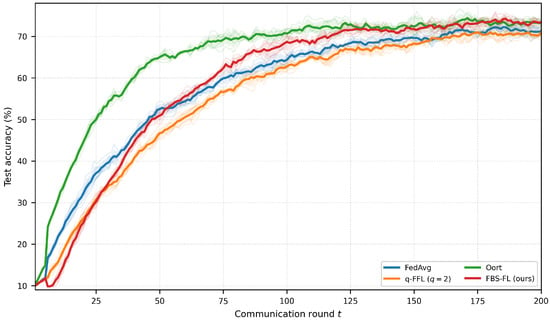
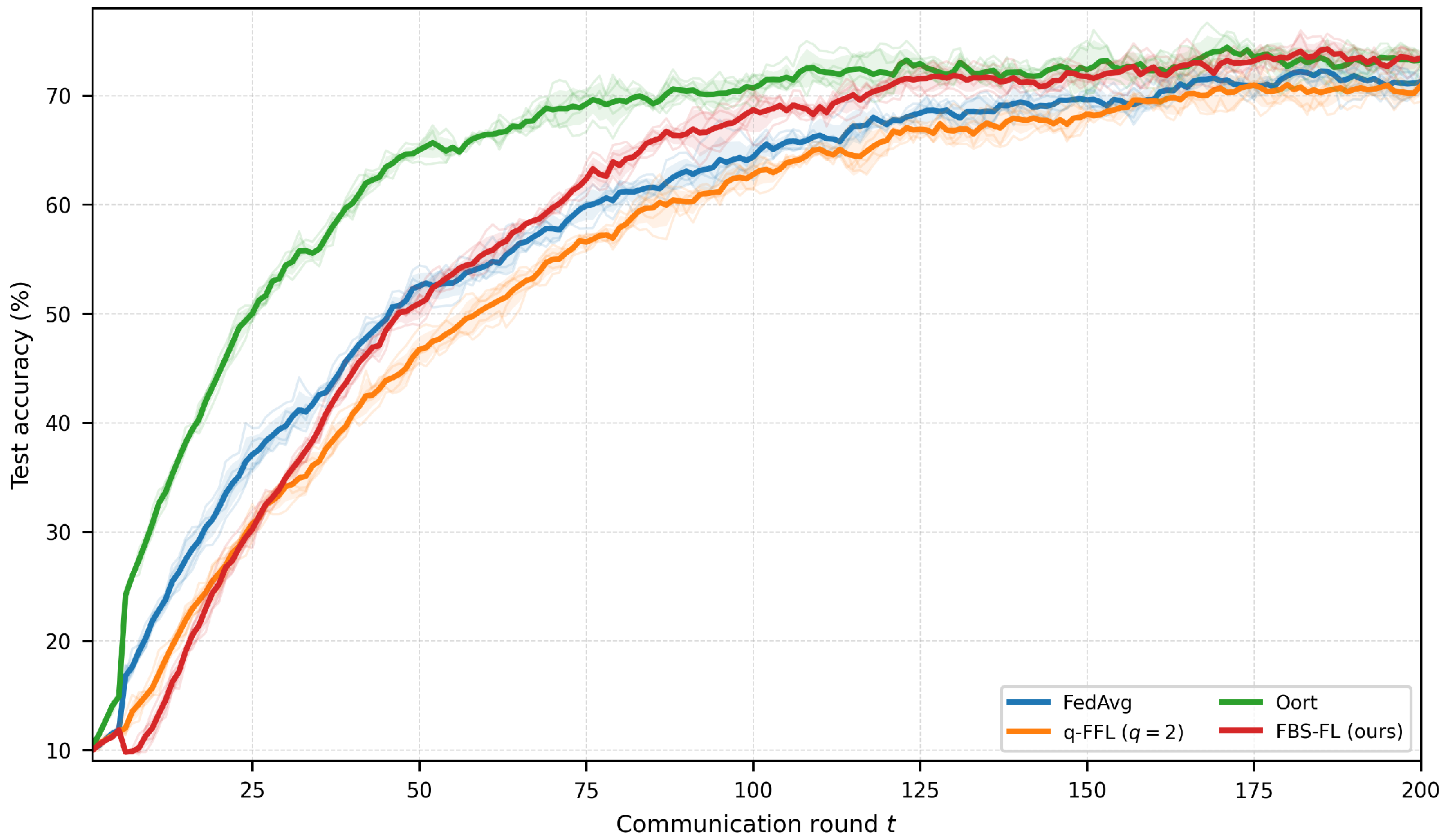
Table 2 and Figure 1 allow us to situate FBS-FL along four qualitative observations. Figure 1 shows that Oort converges fastest in the early rounds because of its utility-guided selection. FBS-FL exhibits a short fairness warm-up while the -schedule ramps up until and the working beliefs remain diffuse. It crosses FedAvg around and approaches Oort’s mean accuracy in the final rounds. Ditto, FedProx, and Power-of-Choice are omitted from the figure for legibility; their final results are reported in Table 2.
Figure 1.
Global test accuracy versus communication round on non-IID CIFAR-10. Curves show means and shaded bands indicate standard deviation over five seeds.
As expected from the design of q-FFL [13] and Ditto [14], both methods substantially improve the worst-client accuracy (from for FedAvg to and respectively) and reduce cross-client dispersion , confirming their role as strong references for performance fairness. However, their Jain indices and KL divergences to the uniform distribution remain essentially identical to those of FedAvg (, ), because neither method modifies the client-selection rule. This confirms the conceptual separation between performance fairness and participation fairness emphasized in Section 1: improving model-level equity does not automatically reduce selection imbalance.
Oort [39] and, to a lesser extent, Power-of-Choice [18] illustrate the opposite trade-off. Oort achieves the second-best mean accuracy in Table 2 (), consistent with its design goal of accelerating time-to-accuracy by favoring statistically useful clients, but its Jain index drops to and its KL divergence rises to , the worst among all baselines along the participation axis. In other words, efficiency-oriented guided selection aggravates participation imbalance rather than correcting it, which matches the behavior reported in Cho et al. [18]. Power-of-Choice lies between the uniform-sampling baselines and Oort, as expected from its softer biasing rule.
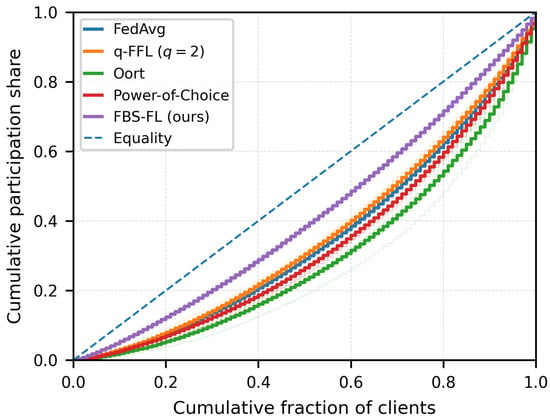
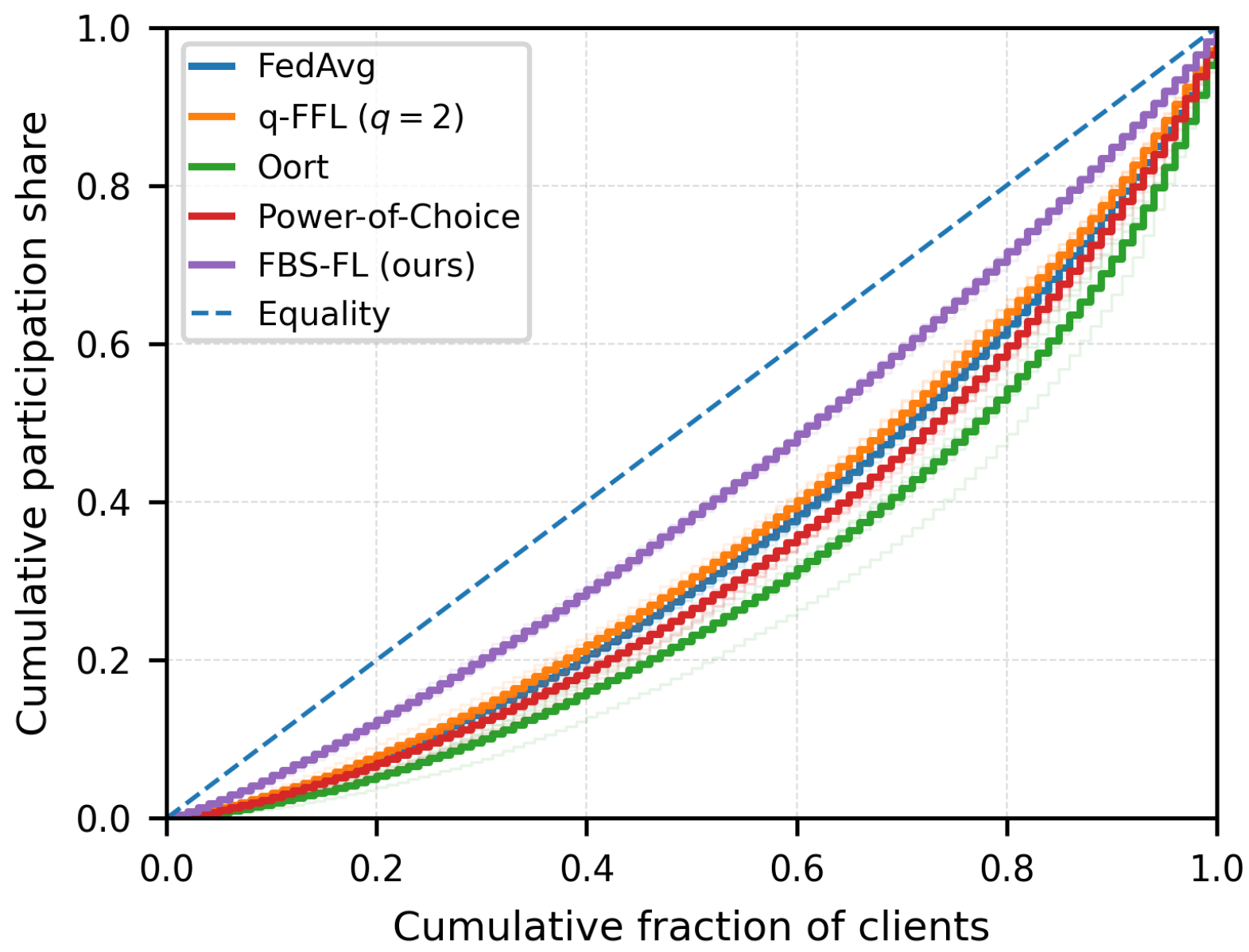
Figure 2 complements the scalar indices of Table 2 with the full participation distribution. FBS-FL is closest to the equality line, with a Gini coefficient of , whereas Oort is the most concentrated, with a Gini coefficient of . FedAvg, q-FFL, and Power-of-Choice lie between them, with respective coefficients of , , and . FedProx and Ditto coincide with FedAvg because they use the same sampler and are omitted from the figure. These curves confirm that efficiency-guided selection concentrates participation on a favorable subset of clients, whereas FBS-FL improves participation balance across the full distribution rather than for only a handful of clients. The absence of clients with zero cumulative participation is an empirical observation in these runs; neither EXP3 exploration nor the expected-inclusion constraint provides a deterministic client-coverage guarantee.
Figure 2.
Lorenz curves of cumulative client participation on CIFAR-10, averaged over five seeds. The equality line represents perfectly uniform participation.
On CIFAR-10, FBS-FL attains the best (or tied-best) values on both fairness axes: and for performance fairness, and , for participation fairness. Relative to the strongest competing mean-accuracy result, the FBS-FL differences are , , and percentage points on CIFAR-10, FEMNIST, and Shakespeare, respectively. Relative to the strongest competing worst-client result, the corresponding differences are , , and points. These differences are within the reported seed variability, indicating numerically close accuracy results alongside improved participation balance. Section 4.5 complements this comparison by matching cumulative accepted-update counts; the distinction between model-generated payments and imputed accounting charges is retained.
FBS-FL combines client selection with the q-fair aggregation rule (13), so the performance-fairness comparison reflects both components. Although FBS-FL and q-FFL share , their distinct model-delta and surrogate-gradient updates make Table 2 a comparison of complete methods rather than selection alone. The component ablation in Section 4.5 examines the contribution of q-fair aggregation within FBS-FL.
On CIFAR-10, the main benefit of FBS-FL is the combination: mean accuracy close to Oort, worst-client accuracy close to Ditto, and substantially better participation balance than both. Relative to Ditto, the differences are percentage points in worst-client accuracy and points in ; mean accuracy is points higher than Oort’s. This joint outcome complements methods focused on performance fairness or time-to-accuracy. It entails additional server-side computation for PPO training, belief updates, and capped-simplex projection; Section 4.6 specifies the implementation settings.
The same pattern holds on FEMNIST and Shakespeare, with two important nuances. On FEMNIST, where the per-writer partition produces a milder, more natural form of heterogeneity, the gaps between methods on the performance axis shrink considerably: Ditto attains the best worst-client accuracy () and FBS-FL is numerically close to it (, within one standard deviation). FBS-FL still leads on both participation-fairness metrics (, ). On Shakespeare, FBS-FL’s clearest advantage is participation fairness, while and remain close to those of the performance-fairness baselines. Oort retains a small numerical edge in mean accuracy within the reported per-seed variability.
4.5. Robustness and Component Diagnostics on CIFAR-10
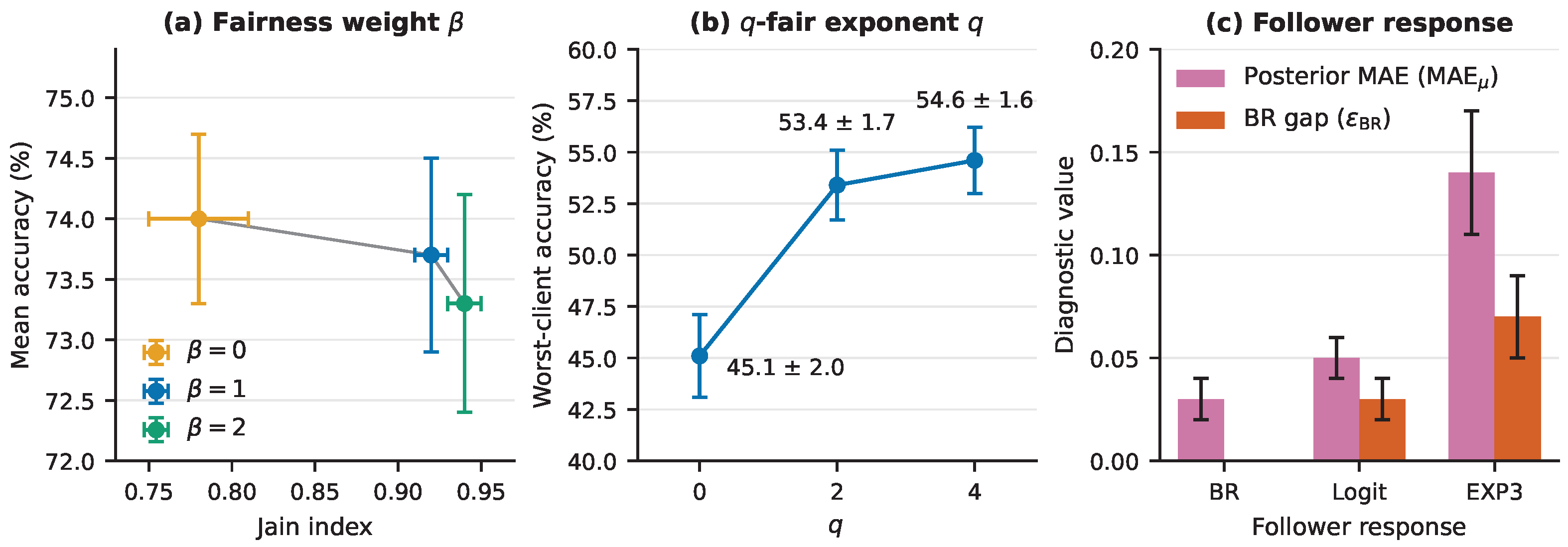
We evaluate the response-model mismatch using two diagnostics. The posterior-mean threshold error is
and the empirical follower best-response gap is
This metric quantifies empirical follower deviations from the analytical best response; assessing equilibrium would additionally require evaluating leader optimality.
Relative to FBS-FL–EXP3, FBS-FL–BR changes mean accuracy by percentage points and Jain’s index by , whereas FBS-FL–Logit changes them by points and , respectively (Table 3). Dependent rounding changes mean accuracy by points and Jain’s index by while reducing the observed overflow frequency from to zero (Table 4). Removing q-fair aggregation changes worst-client accuracy by points; removing the participation regularizer changes Jain’s index by (Table 5 and Figure 3).
Table 3.
Follower-response diagnostics on CIFAR-10 over five paired seeds. Disagreement is measured relative to the deterministic cost-threshold action.
Table 4.
Expected- versus strict-cap diagnostics. Candidate inclusion precedes the client’s accept/reject decision.
Table 5.
One-component-at-a-time ablation and sensitivity analysis on CIFAR-10. The payment index is compared only among FBS-FL variants using the same endogenous payment rule.
Figure 3.
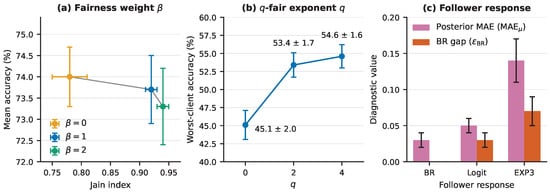
Component sensitivity and follower-response diagnostics on CIFAR-10. Panel (a) reports the accuracy–participation-fairness trade-off as varies; panel (b) reports the effect of q on worst-client accuracy; panel (c) compares posterior-mean threshold error and the empirical best-response gap under deterministic threshold, likelihood-aligned logistic, and EXP3 responses.
To control for different acceptance rates without imposing an artificial payment mechanism on the baselines, let and . Table 6 evaluates each method at the first evaluation checkpoint at which it reaches the same cumulative accepted-update count . The ratio is reported only to show how many accepted updates the method would accumulate over the complete T-round horizon; the accuracy and fairness columns are evaluated at the matched checkpoint, not at the final horizon.
Table 6.
CIFAR-10 comparison at the common cumulative number of accepted client updates.
At the matched accepted-update count, FBS-FL–EXP3 differs from Oort by points in mean accuracy, points in worst-client accuracy, and in Jain’s index.
Sensitivity to the Remaining Design Parameters
The remaining parameters govern the memory of the participation signal, the payment rule, and the timing of fairness regularization. For the EMA coefficient , the contribution of an observation decays as after h rounds. Thus, , , and give half-lives of approximately , , and rounds, respectively. Smaller values smooth short-term fluctuations but retain older participation information for longer; larger values provide faster feedback with less smoothing. This affects the control signal, whereas the reported Jain and KL metrics remain defined on cumulative participation, as in Section 4.3.
The bonus scale and cap jointly determine the maximum bonus , equal to at the reference setting. The cap is active whenever ; within this regime, changing either parameter changes the payment level through their product. Consequently, cap sensitivity should be assessed through expenditure and accepted participation as well as participation fairness. The existing ablation in Table 5 changes Jain’s index from to and KL from to , while mean accuracy changes from to . These results quantify the effect of disabling the bonus at the reference configuration.
The incentive parameters have distinct roles. The coefficient scales the energy-cost proxy, while controls the inclusion-dependent multiplier in (10). Since , this multiplier lies in at the reference ; it equals at . These are bounds on the offer formula, rather than estimates of the resulting learning performance. In contrast, weights the expenditure component of the leader objective after component-wise standardization. Increasing increases the relative penalty assigned to expenditure; it does not impose a hard monetary budget or guarantee a monotone change in realized expenditure under the learned policy.
The warm-up duration determines how quickly the fairness weight reaches . For , durations of 10, 20, and 40 rounds reach the full weight after , , and of training, respectively. The corresponding average scheduled weights over the horizon are , , and , obtained directly from . A longer warm-up delays the full fairness penalty, although the final cumulative participation distribution can retain effects of early decisions. These parameter effects therefore need to be interpreted jointly in terms of accuracy, participation balance, accepted-update counts, and total payments.
4.6. Implementation Details and Hyperparameters
For CIFAR-10 we use a ResNet-8 with group normalization (standard in cross-device FL to avoid batch-norm instabilities under small local batches). For FEMNIST we use a 2-layer CNN with dropout, and for Shakespeare a 2-layer LSTM with embedding dimension 80 and hidden size 256, following the LEAF reference implementations. The exact ResNet stage widths are , the CNN dropout probability is , and the Shakespeare sequence length is 80 tokens.
We use local SGD with momentum , weight decay , batch size 32, and a cosine learning-rate schedule decaying from to over the T rounds. Two local epochs per round ().
The actor is a two-layer MLP (hidden size 128, tanh activations) outputting per-client logits passed through a sigmoid and projected onto the capped simplex via a sorting-based projection [52]. The critic shares the first hidden layer. In the implementation, the abstract state is represented by the normalized round index, proxy-validation loss, previous progress signal, participation-frequency vector, and vector of posterior-mean thresholds. PPO uses clip ratio , GAE , discount , 4 update epochs per rollout, a rollout length of 16 rounds, Adam learning rate , and gradient norm clipped at . Reward components (progress, incentive cost, fairness) are standardized component-wise before being combined into (11).
Exploration and learning rate over the two actions (Algorithm 2). Realized utilities , which may be negative when the offered reward undercompensates the local cost, are affinely rescaled to using the a priori bounds before the exponential update, as required for the stability of EXP3-type updates.
We set , , , , in the q-fair objective, discrete cost classes, , , , , and . The observation-likelihood slope is . The fairness weight uses the warm-up schedule with . For the q-fair aggregation rule (13) we use and . The q-FFL baseline also uses , with the surrogate-gradient update distinguished from our model-delta rule in the discussion of (13). FedProx uses proximal coefficient ; Ditto uses personalization coefficient ; Oort uses pacer interval 10 and exploration factor ; and Power-of-Choice uses candidate-pool size . All remaining optimizer settings follow the common configuration above.
All experiments run in PyTorch version 2.5.1 on a single NVIDIA A100 GPU with FL orchestration simulated on CPU.
5. Conclusions
We have introduced Fair Bayesian Stackelberg Federated Learning (FBS-FL), a Bayesian Stackelberg framework that jointly addresses client heterogeneity, strategic participation under private costs, performance fairness, participation fairness, and incentive expenditure. The server maintains beliefs over client cost types and selects stochastic inclusion probabilities and rewards under an expected-inclusion constraint, while a q-fair objective and a KL-based participation regularizer promote the two fairness dimensions.
The PPO–EXP3 implementation achieves strong participation balance. Relative to the strongest competing results, its mean-accuracy differences are , , and percentage points and its worst-client differences are , , and points on CIFAR-10, FEMNIST, and Shakespeare, respectively. These results support an empirical participation-fairness–accuracy trade-off under the reported inclusion protocol. The expenditure analysis distinguishes FBS-FL’s model-generated payments from the accounting charges imputed to non-incentive baselines. Future work should study equilibrium-oriented solvers, likelihood-robust belief updates, hard-cap sampling, measured device costs, and large-scale deployment. Overall, FBS-FL demonstrates how belief-guided incentives and fairness-aware selection can improve participation balance while maintaining mean and worst-client accuracies close to the strongest competing results under the evaluated protocol.
Author Contributions
Conceptualization, H.R., M.E.K. and E.S.; methodology, H.R.; software, H.R.; validation, H.R., M.E.K. and E.S.; investigation, H.R.; data curation, H.R.; writing—original draft preparation, H.R.; writing—review and editing, H.R., M.E.K. and E.S.; visualization, H.R.; supervision, M.E.K. and E.S.; project administration, M.E.K. and E.S. All authors have read and agreed to the published version of the manuscript.
Funding
This research was supported by TÉLUQ University under research grant No. 711823.
Data Availability Statement
The datasets analyzed in this study are available in the public domain: CIFAR-10 (https://www.cs.toronto.edu/~kriz/cifar.html, accessed on 23 August 2026) and the FEMNIST and Shakespeare datasets of the LEAF benchmark (https://leaf.cmu.edu).
Conflicts of Interest
The authors declare no conflicts of interest.
Abbreviations
The following abbreviations are used in this manuscript:
| CDF | Cumulative distribution function |
| EMA | Exponential moving average |
| EXP3 | Exponential-weight algorithm for exploration and exploitation |
| FBS-FL | Fair Bayesian Stackelberg federated learning |
| FL | Federated learning |
| IID | Independent and identically distributed |
| KL | Kullback–Leibler |
| PPO | Proximal policy optimization |
References
- McMahan, H.B.; Moore, E.; Ramage, D.; Hampson, S.; Agüera y Arcas, B. Communication-Efficient Learning of Deep Networks from Decentralized Data. In Proceedings of the 20th International Conference on Artificial Intelligence and Statistics, Fort Lauderdale, FL, USA, 20–22 April 2017; Proceedings of Machine Learning Research. Volume 54, pp. 1273–1282. [Google Scholar]
- Kairouz, P.; McMahan, H.B.; Avent, B.; Bellet, A.; Bennis, M.; Bhagoji, A.N.; Bonawitz, K.; Charles, Z.; Cormode, G.; Cummings, R.; et al. Advances and Open Problems in Federated Learning. Found. Trends Mach. Learn. 2021, 14, 1–210. [Google Scholar] [CrossRef] [Scilit]
- Li, T.; Sahu, A.K.; Talwalkar, A.; Smith, V. Federated Learning: Challenges, Methods, and Future Directions. IEEE Signal Process. Mag. 2020, 37, 50–60. [Google Scholar] [CrossRef] [Scilit]
- Yang, Q.; Liu, Y.; Chen, T.; Tong, Y. Federated Machine Learning: Concept and Applications. ACM Trans. Intell. Syst. Technol. 2019, 10, 12:1–12:19. [Google Scholar] [CrossRef] [Scilit]
- Khan, L.U.; Saad, W.; Han, Z.; Hossain, E.; Hong, C.S. Federated Learning for Internet of Things: Recent Advances, Taxonomy, and Open Challenges. IEEE Commun. Surv. Tutor. 2021, 23, 1759–1799. [Google Scholar] [CrossRef] [Scilit]
- Zhao, Y.; Li, M.; Lai, L.; Suda, N.; Civin, D.; Chandra, V. Federated Learning with Non-IID Data. arXiv 2018, arXiv:1806.00582. [Google Scholar] [CrossRef] [Scilit]
- Karimireddy, S.P.; Kale, S.; Mohri, M.; Reddi, S.; Stich, S.; Suresh, A.T. SCAFFOLD: Stochastic Controlled Averaging for Federated Learning. In Proceedings of the 37th International Conference on Machine Learning, Virtual, 13–18 July 2020; Proceedings of Machine Learning Research. Volume 119, pp. 5132–5143. [Google Scholar]
- Li, T.; Sahu, A.K.; Zaheer, M.; Sanjabi, M.; Talwalkar, A.; Smith, V. Federated Optimization in Heterogeneous Networks. In Proceedings of the Machine Learning and Systems, Austin, TX, USA, 2–4 March 2020; Volume 2, pp. 429–450. [Google Scholar]
- Bonawitz, K.; Eichner, H.; Grieskamp, W.; Huba, D.; Ingerman, A.; Ivanov, V.; Kiddon, C.; Konečný, J.; Mazzocchi, S.; McMahan, H.B.; et al. Towards Federated Learning at Scale: System Design. In Proceedings of the Machine Learning and Systems, Stanford, CA, USA, 31 March–2 April 2019; Volume 1, pp. 374–388. [Google Scholar]
- Zhan, Y.; Li, P.; Qu, Z.; Zeng, D.; Guo, S. A Learning-Based Incentive Mechanism for Federated Learning. IEEE Internet Things J. 2020, 7, 6360–6368. [Google Scholar] [CrossRef] [Scilit]
- Kang, J.; Xiong, Z.; Niyato, D.; Xie, S.; Zhang, J. Incentive Mechanism for Reliable Federated Learning: A Joint Optimization Approach to Combining Reputation and Contract Theory. IEEE Internet Things J. 2019, 6, 10700–10714. [Google Scholar] [CrossRef] [Scilit]
- Tu, X.; Zhu, K.; Luong, N.C.; Niyato, D.; Zhang, Y.; Li, J. Incentive Mechanisms for Federated Learning: From Economic and Game Theoretic Perspective. IEEE Trans. Cogn. Commun. Netw. 2022, 8, 1566–1593. [Google Scholar] [CrossRef] [Scilit]
- Li, T.; Sanjabi, M.; Beirami, A.; Smith, V. Fair Resource Allocation in Federated Learning. In Proceedings of the International Conference on Learning Representations, Addis Ababa, Ethiopia, 26–30 April 2020. [Google Scholar]
- Li, T.; Hu, S.; Beirami, A.; Smith, V. Ditto: Fair and Robust Federated Learning Through Personalization. In Proceedings of the 38th International Conference on Machine Learning, Vienna, Austria, 18–24 July 2021; Proceedings of Machine Learning Research. Volume 139, pp. 6357–6368. [Google Scholar]
- Dinh, C.T.; Tran, N.H.; Nguyen, T.D. Personalized Federated Learning with Moreau Envelopes. Adv. Neural Inf. Process. Syst. 2020, 33, 21394–21405. [Google Scholar]
- Tan, A.Z.; Yu, H.; Cui, L.; Yang, Q. Towards Personalized Federated Learning. IEEE Trans. Neural Netw. Learn. Syst. 2023, 34, 9587–9603. [Google Scholar] [CrossRef] [Scilit] [PubMed]
- Huang, W.; Li, T.; Wang, D.; Du, S.; Zhang, J.; Huang, T. Fairness and Accuracy in Horizontal Federated Learning. Inf. Sci. 2022, 589, 170–185. [Google Scholar] [CrossRef] [Scilit]
- Cho, Y.J.; Wang, J.; Joshi, G. Towards Understanding Biased Client Selection in Federated Learning. In Proceedings of the 25th International Conference on Artificial Intelligence and Statistics, Virtual, 28–30 March 2022; Proceedings of Machine Learning Research. Volume 151, pp. 10351–10375. [Google Scholar]
- Mao, Y.C.; Shen, L.J.; Wu, J.; Ping, P.; Wu, J. Federated Dynamic Client Selection for Fairness Guarantee in Heterogeneous Edge Computing. J. Comput. Sci. Technol. 2024, 39, 139–158. [Google Scholar] [CrossRef] [Scilit]
- Wan, T.; Feng, S.; Liao, W.; Jiang, N.; Zhou, J. A Secure and Fair Client Selection Based on DDPG for Federated Learning. Int. J. Intell. Syst. 2024, 2024, 2314019. [Google Scholar] [CrossRef] [Scilit]
- Tambe, M. Security and Game Theory: Algorithms, Deployed Systems, Lessons Learned; Cambridge University Press: Cambridge, UK, 2011. [Google Scholar]
- Paruchuri, P.; Pearce, J.P.; Marecki, J.; Tambe, M.; Ordóñez, F.; Kraus, S. Playing Games for Security: An Efficient Exact Algorithm for Solving Bayesian Stackelberg Games. In Proceedings of the 7th International Joint Conference on Autonomous Agents and Multiagent Systems (AAMAS 2008), Estoril, Portugal, 12–16 May 2008; Volume 2, pp. 895–902. [Google Scholar]
- Sarikaya, Y.; Ercetin, O. Motivating Workers in Federated Learning: A Stackelberg Game Perspective. IEEE Netw. Lett. 2020, 2, 23–27. [Google Scholar] [CrossRef] [Scilit]
- Guo, W.; Wang, Y.; Jiang, P. Incentive Mechanism Design for Federated Learning with Stackelberg Game Perspective in the Industrial Scenario. Comput. Ind. Eng. 2023, 184, 109592. [Google Scholar] [CrossRef] [Scilit]
- Javaherian, S.; Turney, B.; Chen, L.; Tzeng, N.F. FLamma: Incentive-Compatible Federated Learning with Stackelberg Game Modeling. arXiv 2025, arXiv:2501.02662. [Google Scholar] [CrossRef] [Scilit]
- Zuo, C.; Xu, P.; Song, Y.; Lu, J.; Yuan, C.; Li, Y. RAIM: Three-Stage Stackelberg Game for Hierarchical Federated Learning with Reputation-Aware Incentive Mechanism. Sci. Rep. 2025, 15, 34344. [Google Scholar] [CrossRef] [Scilit] [PubMed]
- Auer, P.; Cesa-Bianchi, N.; Freund, Y.; Schapire, R.E. The Nonstochastic Multiarmed Bandit Problem. SIAM J. Comput. 2002, 32, 48–77. [Google Scholar] [CrossRef] [Scilit]
- Reddi, S.J.; Charles, Z.; Zaheer, M.; Garrett, Z.; Rush, K.; Konečný, J.; Kumar, S.; McMahan, H.B. Adaptive Federated Optimization. In Proceedings of the International Conference on Learning Representations, Vienna, Austria, 3–7 May 2021. [Google Scholar]
- Wang, J.; Liu, Q.; Liang, H.; Joshi, G.; Poor, H.V. Tackling the Objective Inconsistency Problem in Heterogeneous Federated Optimization. Adv. Neural Inf. Process. Syst. 2020, 33, 7611–7623. [Google Scholar]
- Le, T.H.T.; Tran, N.H.; Tun, Y.K.; Nguyen, M.N.H.; Pandey, S.R.; Han, Z.; Hong, C.S. An Incentive Mechanism for Federated Learning in Wireless Cellular Networks: An Auction Approach. IEEE Trans. Wirel. Commun. 2021, 20, 4874–4887. [Google Scholar] [CrossRef] [Scilit]
- Zeng, R.; Zhang, S.; Wang, J.; Chu, X. FMORE: An Incentive Scheme of Multi-Dimensional Auction for Federated Learning in MEC. In Proceedings of the 2020 IEEE 40th International Conference on Distributed Computing Systems; IEEE: Piscataway, NJ, USA, 2020; pp. 278–288. [Google Scholar] [CrossRef] [Scilit]
- Wang, Y.; Su, Z.; Zhang, N.; Benslimane, A. Learning in the Air: Secure Federated Learning for UAV-Assisted Crowdsensing. IEEE Trans. Netw. Sci. Eng. 2021, 8, 1055–1069. [Google Scholar] [CrossRef] [Scilit]
- Wang, Y.; Qian, K.; Pan, Y.; Su, Z.; Wang, W. Privacy–Utility Trade-Off in Federated LLM Fine-Tuning: A Dynamic Game Approach. IEEE Trans. Netw. 2026, 34, 3242–3257. [Google Scholar] [CrossRef] [Scilit]
- Zhao, X.; Wang, X.; Lin, W.; Ng, W.W.Y.; Liu, K. Fairness-Aware Client Selection and Payment Determination for Differentially Private Federated Learning. IEEE Trans. Inf. Forensics Secur. 2025, 20, 9818–9831. [Google Scholar] [CrossRef] [Scilit]
- Xu, J.; Zhang, H.; Yu, H.; Fan, G. IDFL: Incentive-Driven Federated Learning with Selfish Clients. Inf. Fusion 2026, 131, 104185. [Google Scholar] [CrossRef] [Scilit]
- Mohri, M.; Sivek, G.; Suresh, A.T. Agnostic Federated Learning. In Proceedings of the 36th International Conference on Machine Learning, Long Beach, CA, USA, 10–15 June 2019; Proceedings of Machine Learning Research. Volume 97, pp. 4615–4625. [Google Scholar]
- Ezzeldin, Y.H.; Yan, S.; He, C.; Ferrara, E.; Avestimehr, S. FairFed: Enabling Group Fairness in Federated Learning. In Proceedings of the AAAI Conference on Artificial Intelligence, Washington, DC, USA, 7–14 February 2023; Volume 37, pp. 7494–7502. [Google Scholar]
- Du, W.; Xu, D.; Wu, X.; Tong, H. Fairness-Aware Agnostic Federated Learning. In Proceedings of the 2021 SIAM International Conference on Data Mining (SDM), Virtual, 29 April–1 May 2021; pp. 181–189. [Google Scholar] [CrossRef] [Scilit]
- Lai, F.; Zhu, X.; Madhyastha, H.V.; Chowdhury, M. Oort: Efficient Federated Learning via Guided Participant Selection. In Proceedings of the 15th USENIX Symposium on Operating Systems Design and Implementation, Santa Clara, CA, USA, 14–16 July 2021; pp. 19–35. [Google Scholar]
- Yin, T.; Li, L.; Lin, W.; Liang, W.; Li, X.; Han, Z. FedSCS: Client Selection for Federated Learning under System Heterogeneity and Client Fairness with a Stackelberg Game Approach. In Proceedings of the 2023 IEEE International Conference on Communications Workshops; IEEE: Piscataway, NJ, USA, 2023; pp. 373–378. [Google Scholar] [CrossRef] [Scilit]
- Ghazi, S.; Farzi, S.; Nikoofard, A. Federated Learning for All: A Reinforcement Learning-Based Approach for Ensuring Fairness in Client Selection. IEEE Access 2025, 13, 118515–118535. [Google Scholar] [CrossRef] [Scilit]
- von Stackelberg, H. Marktform und Gleichgewicht; Springer: Vienna, Austria, 1934. [Google Scholar]
- Letchford, J.; Conitzer, V.; Munagala, K. Learning and Approximating the Optimal Strategy to Commit to. In Proceedings of the Algorithmic Game Theory; Springer: Berlin/Heidelberg, Germany, 2009; pp. 250–262. [Google Scholar]
- Conitzer, V.; Sandholm, T. Computing the Optimal Strategy to Commit to. In Proceedings of the 7th ACM Conference on Electronic Commerce, Ann Arbor, MI, USA, 11–15 June 2006; pp. 82–90. [Google Scholar] [CrossRef] [Scilit]
- Schulman, J.; Levine, S.; Moritz, P.; Jordan, M.; Abbeel, P. Trust Region Policy Optimization. In Proceedings of the 32nd International Conference on Machine Learning, Lille, France, 6–11 July 2015; Proceedings of Machine Learning Research. Volume 37, pp. 1889–1897. [Google Scholar]
- Schulman, J.; Wolski, F.; Dhariwal, P.; Radford, A.; Klimov, O. Proximal Policy Optimization Algorithms. arXiv 2017, arXiv:1707.06347. [Google Scholar] [CrossRef] [Scilit]
- Achiam, J.; Held, D.; Tamar, A.; Abbeel, P. Constrained Policy Optimization. In Proceedings of the 34th International Conference on Machine Learning, Sydney, Australia, 6–11 August 2017; Proceedings of Machine Learning Research. Volume 70, pp. 22–31. [Google Scholar]
- Arora, R.; Dekel, O.; Tewari, A. Online Bandit Learning against an Adaptive Adversary: From Regret to Policy Regret. In Proceedings of the 29th International Conference on Machine Learning, Edinburgh, UK, 26 June–1 July 2012; pp. 1503–1510. [Google Scholar]
- Gandhi, R.; Khuller, S.; Parthasarathy, S.; Srinivasan, A. Dependent Rounding and Its Applications to Approximation Algorithms. J. ACM 2006, 53, 324–360. [Google Scholar] [CrossRef] [Scilit]
- Hsu, T.M.H.; Qi, H.; Brown, M. Measuring the Effects of Non-Identical Data Distribution for Federated Visual Classification. arXiv 2019, arXiv:1909.06335. [Google Scholar] [CrossRef] [Scilit]
- Caldas, S.; Duddu, S.M.K.; Wu, P.; Li, T.; Konečný, J.; McMahan, H.B.; Smith, V.; Talwalkar, A. LEAF: A Benchmark for Federated Settings. arXiv 2018, arXiv:1812.01097. [Google Scholar] [CrossRef] [Scilit]
- Wang, W.; Lu, C. Projection onto the Capped Simplex. arXiv 2015, arXiv:1503.01002. [Google Scholar] [CrossRef] [Scilit]

Disclaimer/Publisher’s Note: The statements, opinions and data contained in all publications are solely those of the individual author(s) and contributor(s) and not of MDPI and/or the editor(s). MDPI and/or the editor(s) disclaim responsibility for any injury to people or property resulting from any ideas, methods, instructions or products referred to in the content. |
© 2026 by the authors. Licensee MDPI, Basel, Switzerland. This article is an open access article distributed under the terms and conditions of the Creative Commons Attribution (CC BY) license.