2.1. Bibliometric Corpus and Analytical Procedure
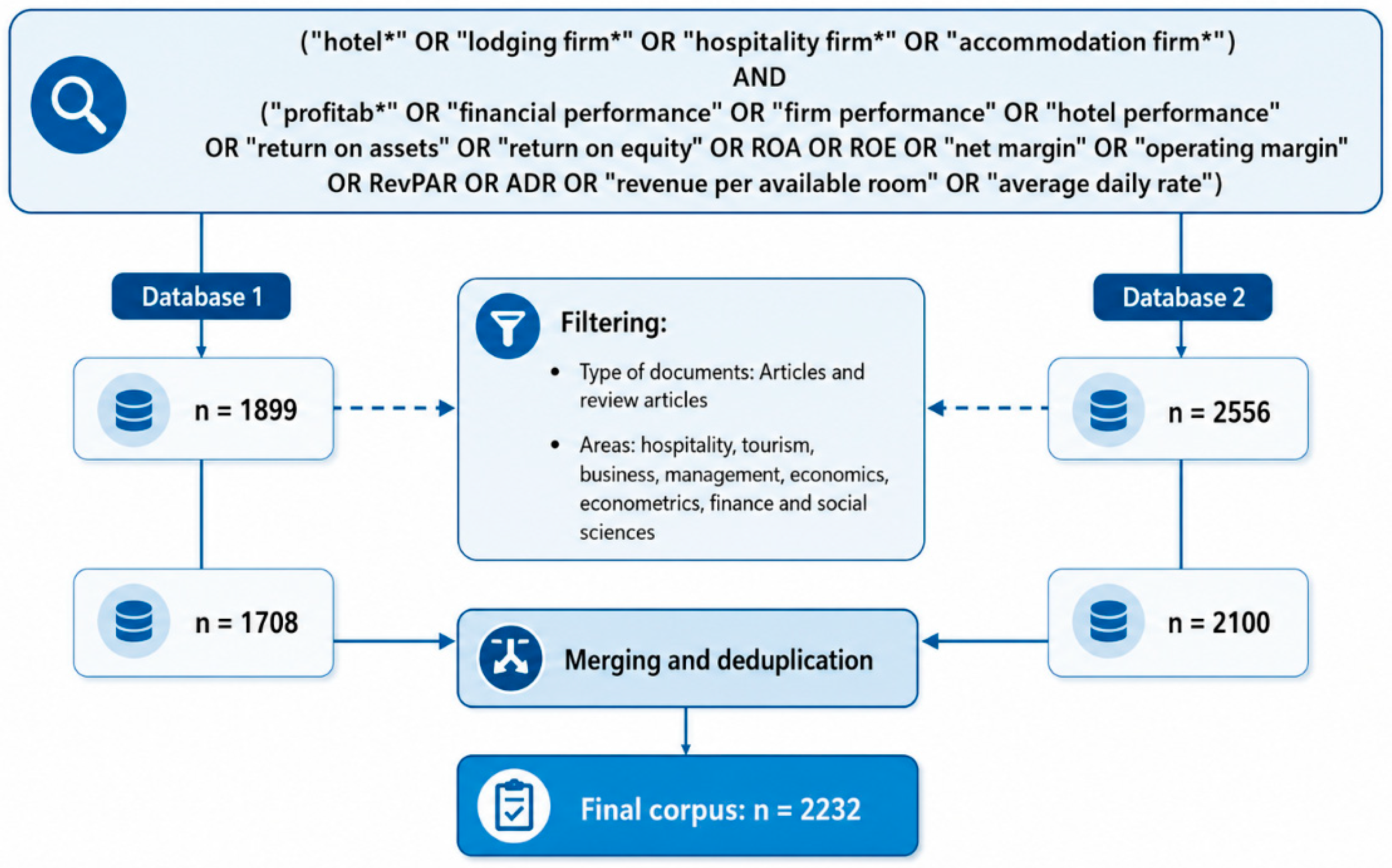
The bibliometric analysis draws on a combined corpus retrieved from the Web of Science Core Collection and Scopus. The search strategy was organised around two conceptual axes: the subject population—hotel, lodging, hospitality, and accommodation firms—and the performance outcome of interest—profitability, financial performance, firm performance, and related operational metrics. In Web of Science, the search used the Topic field (TS); in Scopus, the equivalent TITLE-ABS-KEY field was applied. The search string combined sector terms (hotel*, lodging firm*, hospitality firm*, and accommodation firm*) with accounting-based and operational performance terms (profitab*, financial performance, firm performance, hotel performance, return on assets, return on equity, ROA, ROE, net margin, operating margin, RevPAR, ADR, revenue per available room, and average daily rate). The asterisk (*) is used as a truncation wildcard to retrieve all word forms that begin with the specified root.
The initial search returned 1899 records in Web of Science and 2556 in Scopus. Subject-area filters were then applied to retain publications in hospitality, tourism, business, management, economics, econometrics, finance, and social sciences, with priority given to journal articles and reviews. After filtering, both datasets (1708 and 2100 documents) were subsequently merged and deduplicated through metadata harmonisation based on DOI, title, and bibliographic information, yielding a final analytical corpus of 2232 documents. The screening process is summarised in
Figure 1.
The retrieved documents were published across 605 sources between 1961 and 2026. The corpus is dominated by peer-reviewed journal articles (2087 documents, 93.5%), complemented by reviews (71 documents, 3.2%) and other indexed records such as book chapters and conference papers with complete bibliographic metadata (74 documents, 3.3%). Bibliometric analyses and the construction of the conceptual map were performed using the Bibliometrix 5.4.0. R (version 4.5.1) package (
Aria & Cuccurullo, 2017) through its Biblioshiny 5.2.1 web interface. Keyword co-occurrence analysis was carried out with VOSviewer 1.6.19 (
Van Eck & Waltman, 2014), applying the association strength normalisation method and a minimum author keyword co-occurrence threshold of 20 occurrences. A thesaurus was applied to harmonise equivalent terms, acronyms, and spelling variants, particularly for performance indicators, COVID-19-related terms, financial variables, and operational hotel metrics.
The analytical procedure covers five dimensions: (i) annual scientific production and temporal dynamics; (ii) source concentration and journal impact; (iii) geographical distribution of research and Spain’s position within the field; (iv) conceptual structure through keyword co-occurrence analysis; and (v) thematic evolution and emerging topics. The findings from each dimension inform the structure of the literature review in
Section 3 and the variable selection in the empirical model in
Section 4.
2.2. Growth and Temporal Evolution of the Field
The bibliometric evidence reveals a field that has grown from a modest, exploratory body of work into a large and rapidly expanding research domain within hospitality and tourism management. The corpus spans more than six decades, from the first recorded contributions in 1961 to preliminary figures for 2026, with an annual growth rate of 7.03% and an average of 32.19 citations per document, figures that reflect both sustained scholarly expansion and substantial intellectual influence.
Table 1 summarises the main descriptive indicators of the corpus.
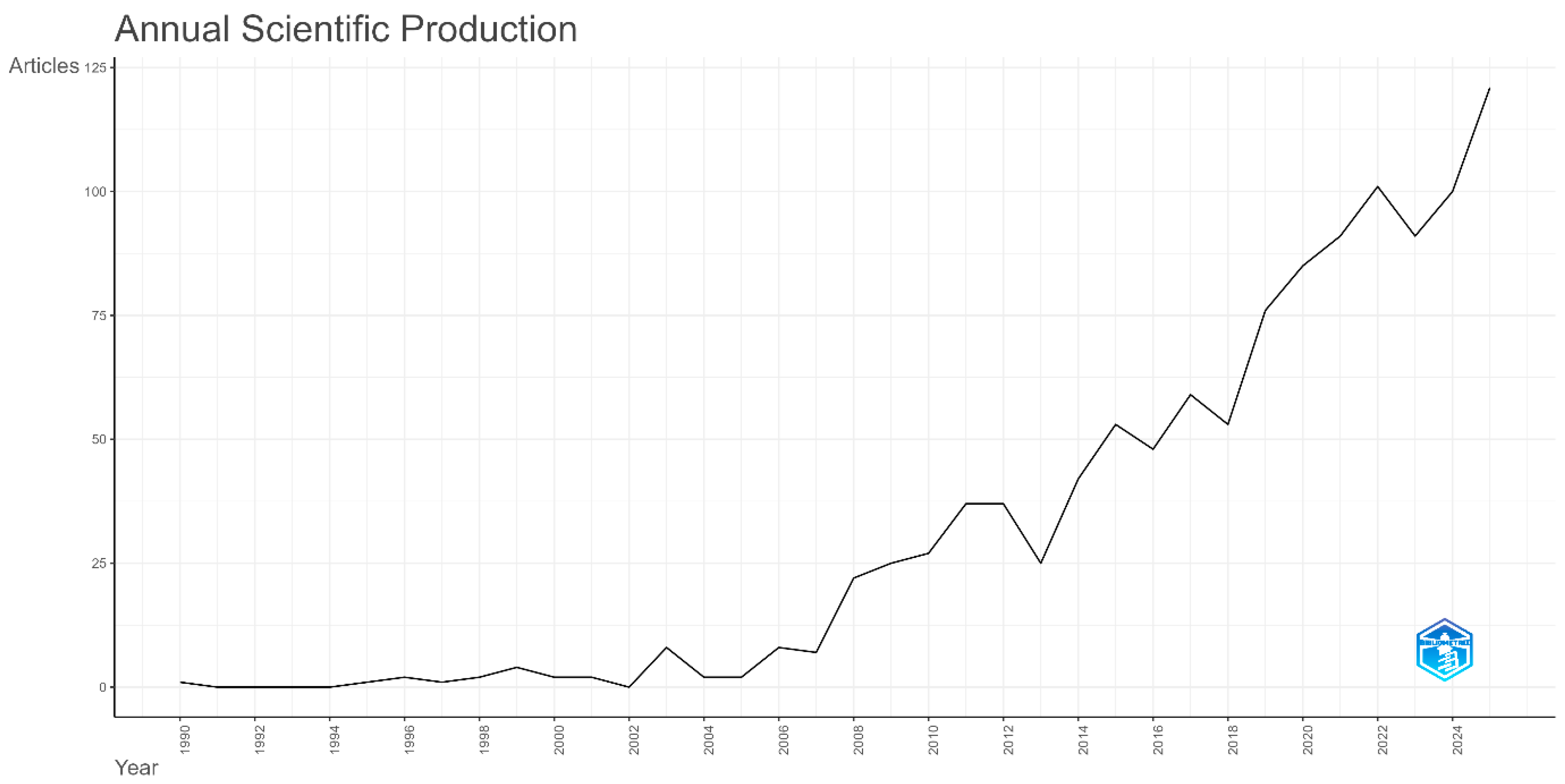
The temporal distribution of publications suggests four broad phases. Before 2000, the field produced only 82 documents (3.7% of the total corpus), reflecting its exploratory character and concentration in a limited number of specialist outlets. Output rose to 258 documents (11.6%) during 2000–2009, then accelerated markedly in 2010–2019, when production reached 818 documents (36.6%). The most striking feature, however, is the concentration of output in the most recent period: 1074 documents (48.1% of the entire corpus) were published between 2020 and 2026.
This acceleration reflects several converging developments. The COVID-19 pandemic generated unprecedented interest in hotel resilience, financial vulnerability, and recovery dynamics. Also, sustainability, ESG criteria, and corporate social responsibility gained greater prominence within hospitality research. Finally, digitalisation, machine learning, and platform-based competition emerged as increasingly visible themes in the broader performance literature. These patterns suggest that hotel performance research is not only mature but also evolving rapidly in response to new economic, technological, and institutional pressures.
Figure 2 illustrates annual scientific production from 2000 to 2025 and highlights the main inflection points in the growth trajectory. The sustained upward trend from the late 2010s, followed by persistently high output levels in the post-pandemic years, indicates that the scholarly response to COVID-19 has generated a durable expansion of the research agenda rather than a short-lived publication spike.
2.3. Journals, Authors, and Geographical Distribution
Despite the breadth of the corpus, the field is characterised by a marked concentration in a relatively small number of specialist hospitality and tourism journals. This pattern is consistent with Bradford’s Law of bibliometric scattering, according to which scientific production on a given topic tends to concentrate in a core set of journals, followed by a long tail of more occasional sources (
Brookes, 1979).
Table 2 reports the ten most productive sources, together with their local h-index and total citations within the corpus.
The International Journal of Hospitality Management is the dominant outlet, with 260 documents, a local h-index of 69, and 15,586 citations within the corpus. The International Journal of Contemporary Hospitality Management ranks second, followed by Tourism Management, Tourism Economics, and Cornell Hospitality Quarterly. Together, the three leading journals account for approximately 23% of the corpus and display local impact indicators substantially above the rest of the field, confirming that hotel and hospitality performance research is institutionally anchored in specialist hospitality and tourism outlets.
A notable implication of this source structure is that general corporate finance, accounting, and industrial economics journals are less visible among the most productive sources, even though many of the constructs examined in hotel performance research, such as leverage, capital structure, cost intensity, productivity, and asset structure, are central to those disciplines. This does not imply an absence of financial analysis in hospitality research, but it does suggest that the field has developed primarily within a hospitality and tourism management tradition. It reinforces the value of a study that connects hotel performance research with firm-level financial analysis.
The authors’ structure reflects a broad and relatively dispersed research community. The corpus includes 4126 unique authors, with an average of 2.81 co-authors per document and an international co-authorship rate of 17.92%. The author productivity distribution is highly skewed: 3274 authors (79.3% of the total) appear only once in the corpus, while a much smaller group has contributed repeatedly to the field. The most prolific authors include Lee S. (49 documents), Chen M. (28), Marco-Lajara B. (23), Hua N. (21), Molina-Azorín J. F. (21), and Pereira-Moliner J. (21). The presence of several Spanish scholars among the most productive authors underlines Spain’s importance not only as a tourism destination but also as a significant contributor to hotel performance research.
Table 3 reports the distribution of documents by country of the corresponding author, together with the share of multi-country publications (MCP) as an indicator of international collaboration. The United States leads the corpus with 432 documents, followed by China with 263 and Spain with 212. Spain is thus the third-largest national contributor in terms of corresponding-author documents, accounting for 9.50% of the corpus.
Spain’s position is particularly relevant for the empirical contribution of this paper. As the third-largest contributor in terms of corresponding-author documents and one of the most important tourism economies in Europe, Spain provides both a strong scholarly and empirical context for analysing hotel profitability. The existence of a substantial Spanish research community on hotel strategy, quality management, and performance makes the Spanish hotel sector a well-grounded empirical setting rather than an isolated case. At the same time, Spain’s MCP rate is notably lower than that of the United Kingdom, China, or South Korea, suggesting that a considerable part of Spanish hotel performance research is domestically oriented, an observation that points to an opportunity for connecting Spanish firm-level evidence more explicitly to the broader international literature.
2.4. Conceptual Structure and Thematic Evolution
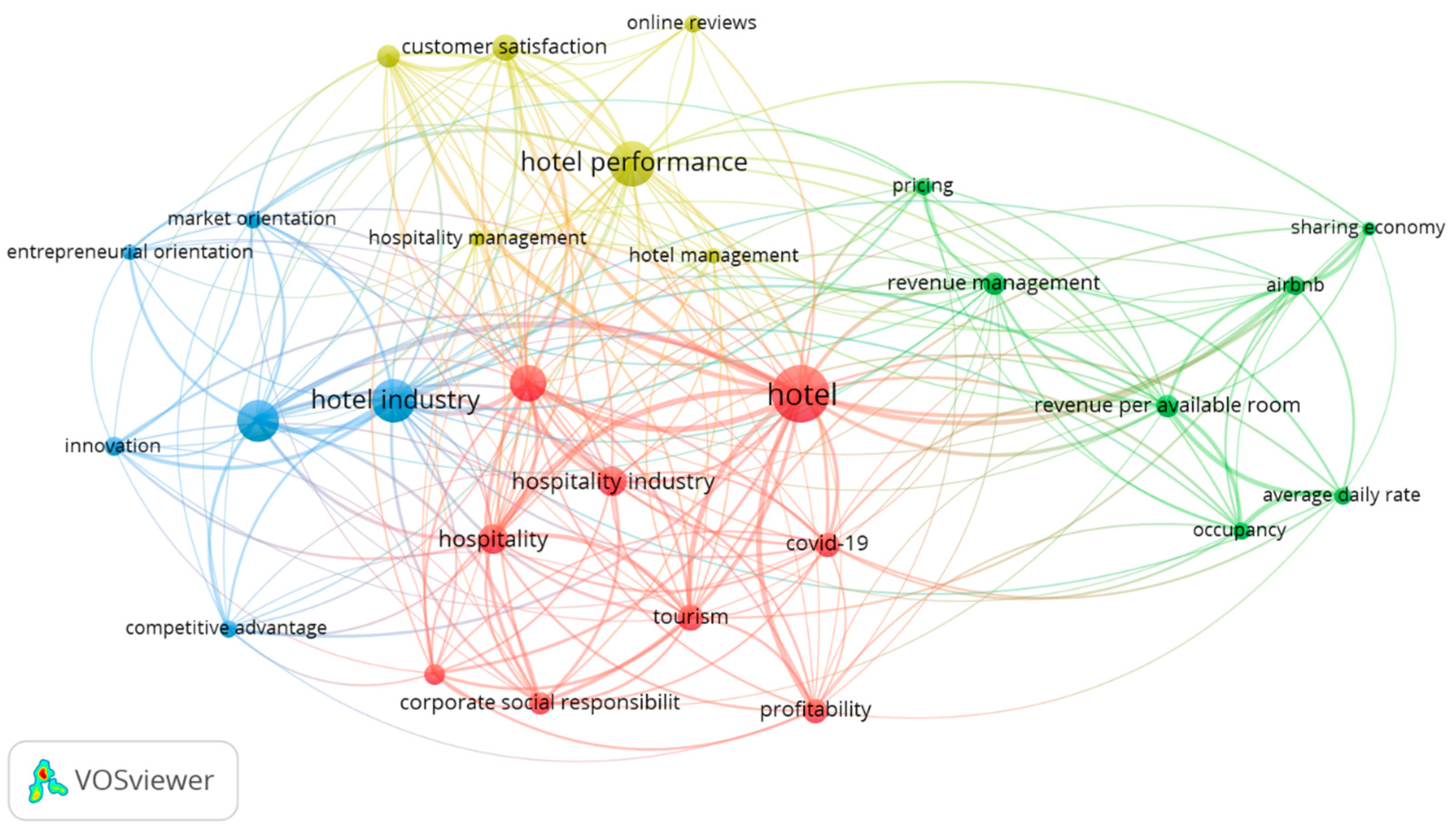
To characterise the thematic structure of the field, a keyword co-occurrence analysis (
Figure 3) was performed on the full corpus using VOSviewer 1.6.19. The analysis included author-supplied keywords after term harmonisation and exclusion of generic expressions. Node size in the resulting network reflects keyword frequency, link thickness reflects co-occurrence strength, and colours indicate algorithmically detected keyword communities. Rather than treating each community as an isolated topic, the map is used here to identify broader thematic areas within hotel and hospitality performance research.
The co-occurrence network reveals four broad and partially overlapping thematic areas. The first centres on customer-facing hotel performance (yellow nodes), represented by terms such as hotel performance, customer satisfaction, online reviews, service quality, hospitality management, and hotel management. This stream conceptualises performance primarily through customer perceptions, service encounters, and relational outcomes, and it reflects the strong influence of service marketing and consumer behaviour approaches in hospitality research, a tradition in which performance is typically measured through satisfaction, perceived quality, loyalty, or online ratings rather than through accounting profitability.
A second area focuses on operational and revenue-management performance (green nodes), gathering keywords such as revenue management, revenue per available room, average daily rate, occupancy, pricing, Airbnb, and sharing economy. This stream reflects the centrality of revenue per available room (RevPAR), average daily rate (ADR) and occupancy as industry-specific performance indicators, and the growing prominence of platform-based competition in relation to pricing, occupancy, and market structure.
A third area is associated with strategic and firm-level performance (blue nodes), including terms such as hotel industry, firm performance, innovation, competitive advantage, market orientation, and entrepreneurial orientation. This stream is closer to strategic management, the resource-based view and dynamic-capability perspectives, where performance is interpreted as the outcome of managerial capabilities, innovation behaviour, market orientation, or competitive positioning.
The fourth area brings together financial, contextual, and sustainability-related performance, with keywords including financial performance, profitability, tourism, hospitality, COVID-19, sustainability, and corporate social responsibility (red nodes). This cluster is especially relevant for the present study because it connects accounting and financial outcomes with the broader sectoral context in which hotel firms operate. The presence of COVID-19 and sustainability within this area suggests that recent research increasingly analyses financial performance as a response to external shocks, institutional pressures, and long-term viability concerns, not merely as a firm-level accounting outcome.
The network also reveals a gap directly relevant to this paper. While terms related to profitability, revenue management, efficiency, and financial performance are visible, balance-sheet and cost-structure determinants such as leverage, debt, capital structure, labour costs, fixed assets, and asset intensity do not emerge as dominant thematic nodes. Their absence does not mean these variables have never been analysed, but it does suggest that they have not become central organising themes in the broader hotel performance literature, a striking gap given their theoretical importance for firm-level profitability in an asset-intensive and labour-intensive sector.
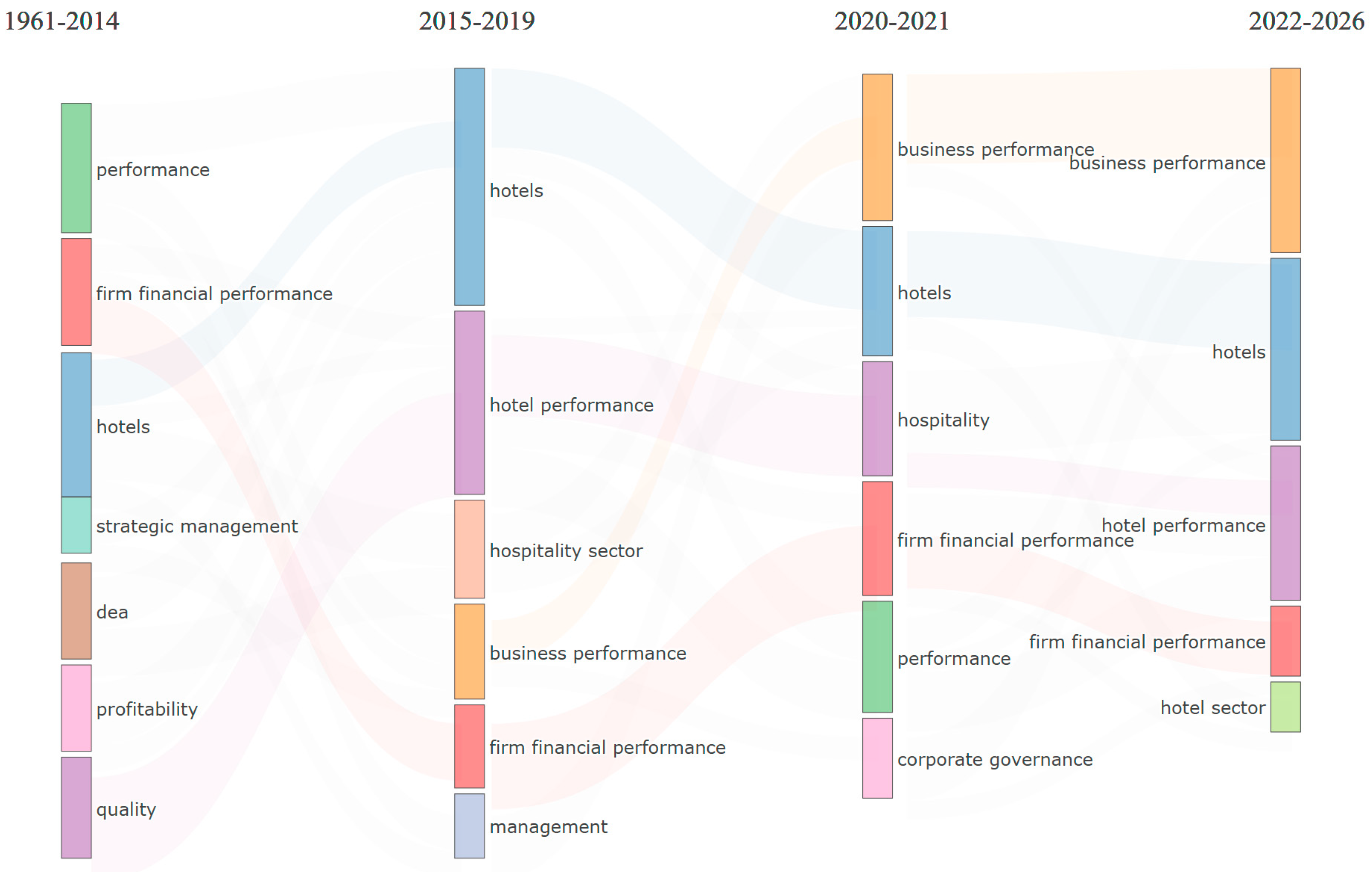
To complement the static co-occurrence network, a thematic evolution analysis was conducted by dividing the corpus into four periods: 1961–2014, 2015–2019, 2020–2021, and 2022–2026.
Figure 4 presents the resulting Sankey diagram, tracing the continuity and transformation of dominant themes across these periods.
The earlier literature was organised around broad themes such as performance, hotels, profitability, quality, strategic management, firm financial performance, and Data Envelopment Analysis (DEA)-based efficiency analysis. In 2015–2019, these themes became more explicitly connected to hotels, hotel performance, business performance, firm financial performance, and management, indicating a consolidation of performance as a central research label and a gradual shift towards more specific hotel- and firm-level formulations. The 2020–2021 period marks a clear transition: themes such as business performance, hospitality, firm financial performance, and corporate governance gained visibility during the COVID-19 disruption, suggesting that the pandemic reoriented the field towards financial resilience, governance, and firm vulnerability. In the most recent period (2022–2026), dominant themes continue to revolve around business performance, hotel performance, and firm financial performance, confirming that the post-COVID-19 literature has consolidated around an explicit concern with firm-level performance and hotel-sector recovery.
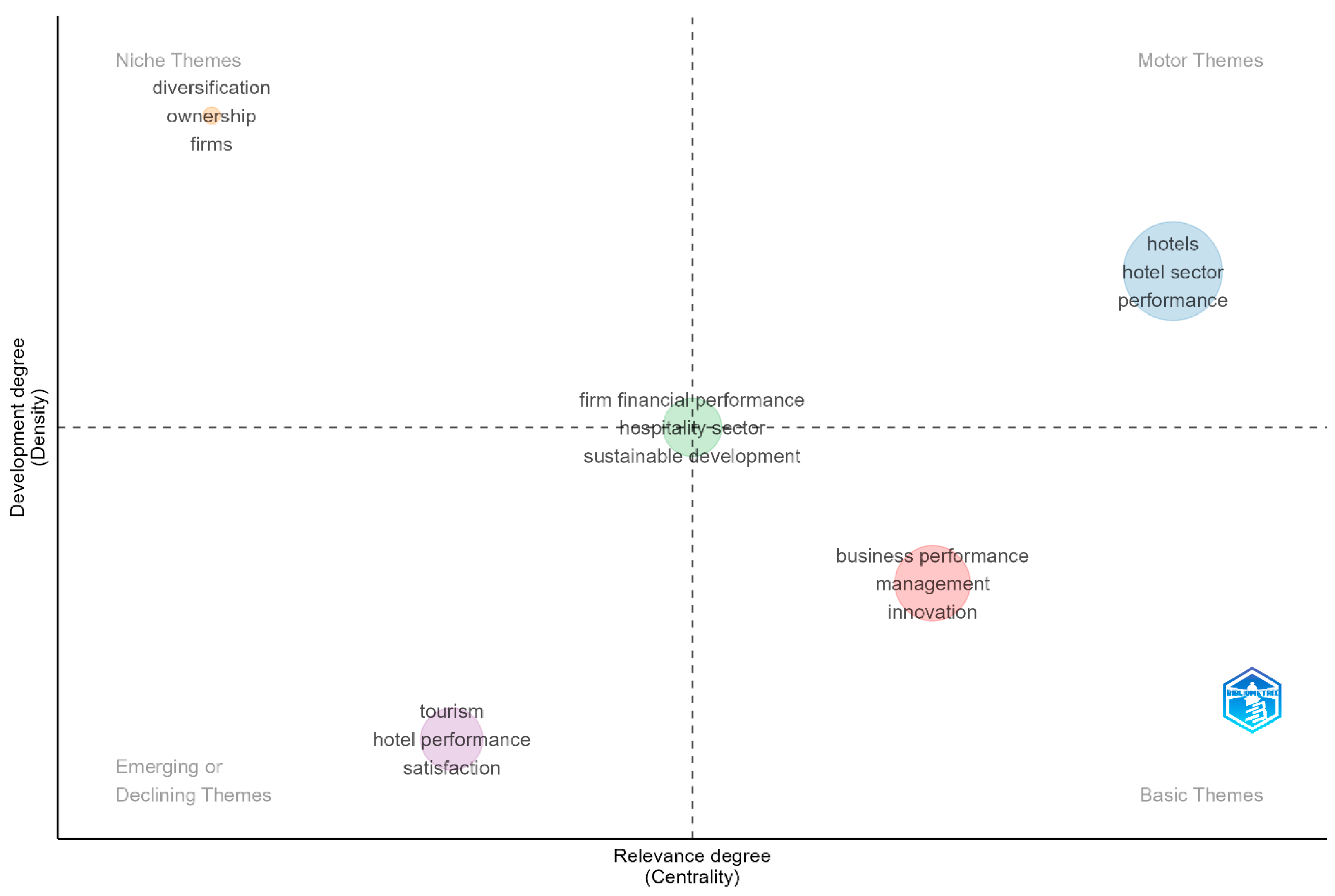
To further assess the strategic position of these themes, a global thematic map was constructed using centrality and density indicators.
Figure 5 classifies themes into four quadrants: motor themes, basic themes, niche themes, and emerging or declining themes, providing a complementary perspective to the co-occurrence and Sankey diagrams.
The global thematic map confirms that hotels, the hotel sector, and performance constitute a motor theme: they are both central to the field and internally well developed. By contrast, the theme combining business performance, management, and innovation falls in the basic-theme quadrant, indicating importance for connecting the field but less internal consolidation as a specialised subfield. The theme linking firm financial performance, the hospitality sector, and sustainable development occupies an intermediate position, suggesting that financial performance has gained visibility, particularly in connection with sustainability, but has not yet become a fully dominant motor theme.
The map also identifies more specialised or peripheral topics. The theme combining diversification, ownership, and firms appears as a niche theme: internally developed but less central to the broader field. The theme grouping tourism, hotel performance, and satisfaction appears closer to the emerging or declining quadrant, not because satisfaction and tourism are unimportant, but because within this corpus and at the selected thresholds, this thematic grouping is less central and less internally dense than the dominant hotel-sector performance cluster.
Across the three analytical tools, a coherent picture emerges: hotel and hospitality performance research has evolved from a broad literature on performance, profitability, quality, and efficiency into a more differentiated domain structured around customer-facing performance, operational metrics, strategic capabilities, financial performance, sustainability, and crisis resilience. Yet the underlying accounting mechanisms that may explain profitability differences across hotel firms remain less visible in the thematic structure. Leverage, labour productivity, labour cost intensity, and fixed-asset intensity are not central organising themes despite their theoretical relevance for firm-level profitability. This is the gap addressed in the next two sections.
2.5. Summary of Bibliometric Findings and Transition to the Theory-Driven Literature Review
The bibliometric analysis yields three main findings that guide the rest of the paper. First, hotel and hospitality performance research is a mature and rapidly expanding field. The combined Web of Science and Scopus corpus comprises 2232 documents published across 605 sources between 1961 and 2026, with almost half of those documents published since 2020, confirming that hotel performance is a consolidated research domain that has gained renewed momentum in the post-COVID-19 period.
Second, the field is institutionally anchored in specialist hospitality and tourism journals, and Spain occupies a prominent position in the international research landscape. At the country level, Spain is the third-largest contributor in corresponding-author documents after the United States and China, supporting the relevance of the Spanish hotel sector as both a major tourism economy and a well-established empirical context for hotel performance research.
Third, the conceptual structure of the field is multidimensional. The keyword co-occurrence network shows overlapping areas: customer-facing hotel performance, operational and revenue-management metrics, strategic and firm-level performance, and financial or contextual performance linked to tourism, sustainability, and COVID-19. The thematic evolution and global thematic maps reinforce this interpretation: hotel performance research has moved from broad themes towards a more explicit concern with business performance, firm financial performance, hotel-sector recovery, and resilience.
These findings justify the need for a theory-oriented review. The bibliometric analysis shows where the field is concentrated and how it has evolved, but does not clarify how specific profitability mechanisms have been conceptualised, measured, and tested in previous studies. The review in
Section 3 therefore narrows the broad performance literature to the determinants most directly connected to firm-level hotel profitability, organising the evidence around four axes: (i) hotel profitability and performance measurement; (ii) financial structure, leverage, and vulnerability; (iii) operational efficiency, labour cost structure, and asset intensity; and (iv) destination context, COVID-19 exposure, and recovery.