


Abstract
Every dollar directed toward green finance carries a promise, but does it deliver? This study tests whether corporate green bond issuance translates into measurable improvements in firm-level high-quality development, which is defined as the enhancement of firms’ sustainable growth capacity and resource allocation efficiency and is proxied by total factor productivity (TFP), a widely adopted indicator of development quality in the economics literature. Using panel data from Shanghai and Shenzhen A-share listed enterprises over 2014–2024, we employ a multi-period difference-in-differences framework, validated by parallel trend and placebo tests, to identify the causal effect of green bond issuance. Results confirm a significant positive impact, with green bond issuance raising firm TFP by 0.240 units, representing a substantial improvement in firms’ productivity performance relative to the sample average, robust across Olley–Pakes, Levinsohn–Petrin, and propensity score matched specifications. Mechanism analysis identifies three transmission channels: green technological innovation and green management practices operate as partial mediators, while financing constraints serve as a mediator. Heterogeneity tests reveal stronger effects among firms with higher agency costs, heavier pollution burdens, and those located in eastern China’s more marketized regions. By uncovering the productivity-enhancing mechanisms of green bond issuance, this study enriches the literature on sustainable finance and corporate high-quality development and provides new firm-level evidence on the economic consequences of green financial instruments. These findings provide micro-level evidence that green finance generates tangible productivity gains beyond signaling, offering actionable guidance for policymakers advancing sustainable corporate development under China’s dual carbon targets.
1. Introduction
The tension between economic growth and environmental sustainability has become one of the defining policy challenges of the twenty-first century. Conventional growth models, built on carbon-intensive production and resource extraction, are increasingly incompatible with the ecological boundaries that governments can no longer afford to ignore. In response, policymakers have shifted from voluntary environmental frameworks toward binding financial mechanisms that embed sustainability directly into capital allocation decisions. China has pursued this shift with particular ambition: the third plenary session of the 20th Central Committee of the Communist Party of China called for the coordinated reduction of carbon emissions, pollution control, green growth expansion, and sustainable economic development—a mandate that places green finance at the center of the country’s long-term development strategy. Yet, policy ambition alone cannot drive transformation; what matters is whether financial instruments can actually redirect corporate behavior at the firm level. The green financial system that China has constructed in response—encompassing green credit, green bonds, and associated regulatory frameworks—is premised on exactly this possibility: that channeling capital through sustainability-oriented instruments can not only meet environmental targets but fundamentally improve the quality of economic development itself (R. Li et al., 2024).
As a vital element within China’s green financial framework, green bonds perform two major functions: optimizing resource allocation efficiency and supporting environmental governance supervision (C. S. Li et al., 2025). In late 2015, the National Development and Reform Commission of China issued the Guidelines on Green Bond Issuance, clarifying its coverage boundary and key supported fields. Afterwards, the 2016 Guiding Opinions on Building a Green Financial System highlighted the importance of constructing a sound green financial system and formulated detailed norms to strengthen the supervision of green bond businesses. Additionally, the report delivered at the 20th CPC National Congress clearly highlighted the significance of advancing green transformation in economic development and “enhancing the market-based allocation system for resources and environmental factors.” Building a market-oriented green financial and governance system is highly compatible with China’s development goals (Zheng et al., 2023). Strong policy support has coincided with the fast growth of China’s green bond market, with Climate Initiative data showing issuance reached USD 85.4 billion in 2022. Globally, the cumulative value of labeled green bonds climbed to USD 489 billion by the end of that year, covering both domestic and cross-border markets. Green bonds have thus emerged as a key element within China’s green finance system, second only to green credit. Understanding how firms adapt to this financing channel is therefore central to advancing both practice and research on high-quality development under the current policy framework. From a theoretical perspective, green bonds may affect firms’ high-quality development through multiple channels. By providing long-term and environmentally targeted financing, green bonds can alleviate financing constraints, facilitate green technological innovation, and encourage improvements in environmental governance and management practices. These changes may enhance resource allocation efficiency and productivity performance, thereby contributing to firms’ high-quality development. Nevertheless, whether such theoretical benefits can be translated into actual productivity gains remains an empirical question that warrants further investigation.
According to the existing literature, micro-level investigations into how green finance policies affect firms predominantly center on two key dimensions: green credit and green bonds. Scholars have devoted considerable attention to exploring how green credit impacts enterprises at the micro level. Current research findings indicate that green credit policies tend to limit heavily polluting firms’ access to financing (Chai et al., 2022), compelling enterprises with high energy consumption and high emissions to prioritize pollution control and implement emission reduction measures (Chen et al., 2022; Xu et al., 2023). At the same time, green credit offers policy incentives that encourage enterprises to pursue green innovation (Hu et al., 2021; Q. Liu & Dong, 2022; Lv et al., 2023), which in turn contributes to advancing high-quality development (Ouyang et al., 2023). As a further critical cornerstone of the green finance system, green bonds serve an important function in fostering high-quality corporate development. Compared with green credit, research on green bonds has developed along two lines: pricing and post-issuance effects. In pricing, most studies indicate that green bonds typically trade at a lower price than conventional bonds (Gianfrate & Peri, 2019; Teti et al., 2022; Zerbib, 2019). In terms of effects, existing research connects green bond issuance to reduced financing costs (Ning et al., 2023), greater investor attention, and improved market performance (Tang & Zhang, 2020; D. Zhang & Du, 2020). However, Lebelle argues that green activities funded through green bonds carry significant risks, potentially leading to declines in stock prices as investors seek to avoid risks (Lebelle et al., 2020). For environmental performance, existing studies explore how green bond issuance influences carbon emission reductions, energy transition, and innovation in green development (Lian et al., 2024; T. Wang et al., 2022), as well as its role in financing green energy projects (Benlemlih et al., 2023; Kanamura, 2020; Y. Wang & Taghizadeh-Hesary, 2023). Additionally, the relevant literature examines the factors influencing high-quality development. Liu and Li examined “the beneficial effects of green bond issuance on firms’ green TFP at the micro level” (S. Liu & Li, 2024), while domestic scholars argue that such bonds can improve urban TFP and contribute to sustainable high-caliber economic expansion at the city level. Although recent studies have begun to examine the firm-level consequences of green bond issuance, existing evidence has primarily focused on financing outcomes, market performance, and environmental benefits. Moreover, the findings of previous studies are not entirely consistent. While a growing body of literature suggests that green bonds can reduce financing costs, stimulate green innovation, and improve environmental performance, some scholars argue that green projects may involve substantial compliance costs, investment risks, and uncertain financial returns, which may weaken their economic benefits (Lebelle et al., 2020). Consequently, whether green bond issuance can generate sustained productivity improvements and promote firms’ high-quality development remains an open question. Comparatively less attention has been paid to whether green bonds can promote firms’ high-quality development from the perspective of total factor productivity (TFP), through which mechanisms such effects occur, and whether these effects vary across different firm and regional characteristics. To address these issues, this paper investigates three questions: (1) whether issuing green bonds improves firms’ high-quality development; (2) through which channels this effect operates; and (3) how firm and regional characteristics influence these effects.
Despite the growing literature on green finance and green bonds, several research gaps remain. First, existing studies have predominantly examined the environmental, financing, and market effects of green bonds, while evidence regarding their influence on firms’ high-quality development remains relatively limited. Second, although prior research has identified several potential benefits of green bond issuance, the underlying mechanisms through which green bonds affect productivity outcomes have not been fully explored. Third, there is still insufficient understanding of how the effects of green bonds differ across firms and regions with distinct characteristics. Addressing these gaps can provide a more comprehensive understanding of the economic consequences of green bond issuance and further justify the need for firm-level empirical evidence.
In summary, this research makes three contributions to the existing literature. First, this study extends the literature on green finance by examining the relationship between green bond issuance and firms’ high-quality development from a micro-level perspective. Using Chinese A-share listed firms as the research setting, we provide additional evidence on the productivity effects of green bonds measured by total factor productivity. Second, this study explores the potential mechanisms through which green bonds affect firms’ high-quality development. Specifically, we investigate the roles of green technological innovation, green management practices, and financing constraints, thereby contributing to a better understanding of how green finance influences firm productivity. Third, this study examines heterogeneity across firm and regional characteristics. By identifying differences in the effects of green bond issuance among firms with different agency costs, pollution intensities, and regional marketization levels, we provide additional evidence regarding the conditions under which green bonds may generate stronger economic effects.
The rest of this paper is organized as follows. In Section 2, a detailed exposition of the theoretical analysis is provided, along with the formulation of corresponding hypotheses. Section 3 covers data preparation and model specification. Section 4 reports empirical results, robustness tests, and mechanism analysis, and Section 5 offers the conclusions.
2. Theoretical Analysis and Hypotheses
2.1. Basic Assumptions
In China’s shift toward an innovation-driven, high-quality economic model, total factor productivity (TFP) in enterprises not only reflects a key measure of high-quality development but also acts as a critical pathway to achieving it. TFP reflects the overall efficiency of converting input into output, with variations primarily resulting from differences in resource allocation efficiency and technological advancement (Su et al., 2023). Recent evidence further suggests that green finance can improve economic performance by enhancing resource allocation efficiency and promoting sustainable productivity growth (R. Wang et al., 2025). Green enterprise investment projects inherently possess quasi-public good characteristics and information opacity (Taghizadeh-Hesary & Yoshino, 2019). Information gaps between firms and stakeholders lead external investors to face adverse selection, which, in turn, causes discriminatory lending practices toward green enterprises. This restricts the enterprise’s technological advancement, misallocates production factors, and impedes high-quality development.
Green bonds, which combine market-based environmental governance with financial allocation, can help alleviate these issues. According to stakeholder theory, issuing green bonds can have a “certification effect” and “income effect,” providing green enterprises with external market advantages, including resource prioritization and social recognition (H. Wang et al., 2023). Firstly, within the green finance system, green bond issuance can help firms build a sustainability-oriented image, thereby improving visibility and market value. Moreover, green bond issuance involves robust information disclosure, which increases media attention to these enterprises. When issuing green bonds, enterprises must disclose financial status, creditworthiness, fund allocation, project planning, and environmental benefits, which reduces information asymmetry between companies and investors (R. Zhang et al., 2021) and helps prevent managerial abuse of authorities (Jensen, 1986). Additionally, under fixed financial capital, green bond issuance can direct more social funds toward green enterprises (Cheng & Wu, 2024), reduce their financing costs, and facilitate greater investment in production. Furthermore, flexible environmental regulation can “establish market access barriers for enterprises characterized by high energy consumption and heavy pollution,” encouraging them to pursue environmentally sustainable and high-quality growth (Porter & van der Linde, 1995). Increased green bond financing reduces capital for polluting projects, compelling such firms to allocate more resources toward environmental protection and green initiatives, thereby enhancing energy efficiency and reducing harmful outputs (Zhao et al., 2022), thereby contributing to improvements in firms’ development quality. In conclusion, under the premise of restricting the use of funds and strengthening supervision, green bond issuance can elevate firms’ level of high-quality development. Following this analysis, the hypothesis is given below:
Hypothesis 1.
Issuing green bonds enables enterprises to significantly advance high-quality development.
2.2. The Pathway to High-Quality Enterprise Development: Green Innovation and Financing Constraints
2.2.1. Green Technology Innovation
As per the Porter Hypothesis, enterprises are primarily driven to invest in environmental protection to alleviate cost pressures imposed by environmental regulations. This investment in green technological innovation enables them to simultaneously enhance both environmental and business performance. On the one hand, Schumpeter’s innovation theory emphasizes that access to funds is a crucial factor in driving technological innovation. The long implementation cycles, substantial capital requirements, and comparatively low returns inherent to green projects often deter firms from securing consistent and stable funding through traditional financial channels (Nguyen & Do, 2025). This constraint restricts the flow of resources dedicated to green development initiatives. Green bond issuance, by contrast, is designed to serve dual goals of green financing and governance oversight. It channels capital directly toward corporate green innovation projects, thereby providing critical support for overall green transformation efforts (H. Dong et al., 2024). Thus, green bonds act as an important external financing channel for corporate green initiatives. On the other hand, Flammer, using a global green bond sample, found that green bond issuance sends reliable “green signals” to investors (Flammer, 2021), attracting those with environmental investment preferences and a commitment to sustainability, which in turn strengthens funding stability (Zheng et al., 2023), fostering green technological advancement (X. Dong & Yu, 2024) and supporting high-quality enterprise development. The stringent environmental disclosure policies of green bonds can establish more effective regulatory mechanisms, curtail managerial tendencies toward self-interest, lower agency costs from resource misallocation and inefficient investments, and encourage executives to make more informed green innovation decisions (Yang et al., 2025), positively impacting enterprise economic development. In summary, green bond issuance can incentivize and supervise enterprises, encouraging green technology innovation and advancing high-quality development. Based on these, the following hypothesis is proposed:
Hypothesis 2.
The issuance of green bonds encourages enterprises to invest in green technological innovation, thereby fostering high-quality development.
2.2.2. Green Management Innovation
Social responsibility theory points out that while an enterprise is creating a good market image, its internal governance system will bear greater expectations and pressure of social responsibility. In the process of enterprise operation, it is necessary to carry out pollution control and resource protection and realize the deep integration and coordinated promotion of enterprise economic ben, which supports firm development. From the perspective of environmental oversight, capital market reactions to environmental events are often reflected in stock price fluctuations, creating a deterrent effect on corporate behavior (L. Wu et al., 2025). Green bond issuance encourages firms to enhance environmental performance through improved governance, optimize their green financing structure, and make informed adjustments to equity distribution. Recent studies suggest that green financing can strengthen environmental governance systems, improve sustainability management practices, and enhance firms’ ESG-related performance, thereby supporting long-term value creation (Bai, 2025). This approach not only draws attention from external analysts and enhances the clarity and reliability of information disclosure but also exerts a monitoring influence on controlling shareholders, mitigating potential risks from environmental infractions or short-sighted managerial decisions, thereby improving corporate environmental governance and supporting long-term firm development and value creation. Furthermore, evidence from Chinese listed firms indicates that the accumulation of green organizational capabilities and sustainability-oriented management practices can significantly enhance firms’ economic vitality and development quality (G. Wu et al., 2026).
Hypothesis 3.
The issuance of green bonds can enhance green management innovation and drive high-quality development.
2.2.3. Financing Constraints
Financing constraints and costs represent resource barriers limiting enterprises’ progression toward high-quality development. Constraints resulting from information asymmetry and agency problems in the financial market hinder corporate R&D investment and green governance, thereby reducing corporate total factor productivity (TFP) (Ma & Li, 2025). From the perspective of the resource attributes of green bonds, green finance optimizes resource allocation, enhances resource acquisition and capability integration in enterprises, provides a robust financial foundation, and ultimately promotes enterprises’ high-quality development. Specifically, on the one hand, the resource dependence theory points out that green bond issuance enables enterprises to fully leverage external investors and bank funding to alleviate financing constraints while also encouraging issuers to broaden green investment and fulfill their social responsibilities. The repayment term of bond financing can match the long-term cycle for enterprises to achieve high-quality development, providing necessary resources to fund R&D and innovation (Sheng et al., 2021). On the other hand, as an emerging debt financing channel, green bonds can influence bank lending by enhancing enterprises’ leverage in credit negotiations through spillover effects. This impact reduces indirect financing costs, diversifies financing risks, and enables more efficient resource allocation. Furthermore, the green certification and signaling effect preceding green bond issuance reflect enterprises’ commitment to social responsibility (Huang & Li, 2015), attracting external investors, expanding financing channels, and fostering a virtuous cycle that supports sustainable and higher-quality growth. In addition, recent reviews suggest that green bond issuance improves firms’ access to external capital and lowers financing frictions by enhancing transparency and signaling environmental commitment to investors (Negi et al., 2025). The hypothesis is stated as follows:
Hypothesis 4.
The issuance of green bonds serves to ease financial constraints and fosters high-caliber development.
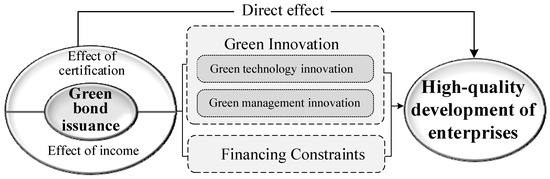
Building on the preceding analysis, the research model proposed in this paper is illustrated in Figure 1.
Figure 1.
Structural frame diagram.
3. Data and Methodology
3.1. Sample Selection and Data Sources
This research employs a sample consisting of A-share listed firms in Shanghai and Shenzhen over the period from 2014 to 2024. Firms issuing green bonds are classified as the treatment group, whereas other firms are assigned to the control group. The sample is refined by excluding the following: (1) financial institutions; (2) ST, PT, and firms that have exited the market; (3) enterprises with an asset-liability ratio exceeding 1; and (4) observations with missing values. Green bond-related data are sourced from the Wind database, while micro-level corporate information is supplemented by CSMAR. A full set of firm characteristic variables and financial indicators is also extracted from the above two databases. All continuous variables involved in the regression analysis are subjected to 1% two-tailed winsorization.
3.2. Model Construction and Variable Definition
This paper adopts a multi-period DID model to explore the influence of listed enterprises’ green bond issuance behavior on corporate high-quality development. The benchmark regression formula is set as Model (1):
In Model (1), the dependent variable is high-quality development. Following the approach of Lee et al. (2023), the core of high-quality development lies in the shift from factor-driven to innovation-driven growth, and TFP precisely captures this “quality” dimension by measuring output growth beyond factor inputs, thereby reflecting technological progress and improvements in resource allocation efficiency. Therefore, this study measures “the level of high-quality development” in firms using total factor productivity (TFP). It takes into account the extent to which improvements beyond mere factor inputs enhance resource allocation efficiency. To reduce potential biases arising from different measurement methods, we calculate total factor productivity with the Olley–Pakes (OP) method and employ this measure as the primary outcome in the regression analysis. For robustness purposes, we also consider TFP estimated through the Levinsohn–Petrin (LP) approach.
The key explanatory variable is Gbi × Afteri,t, which serves as the primary explanatory factor. Firms issuing green bonds are coded Gbi as 1, categorizing them in the treatment group. Conversely, if the company issues regular bonds, Gbi is 0, placing it in the control group. If an enterprise belongs to the treatment group and has issued green bonds, the value of Afteri,t is 1; otherwise, it is 0. The interaction equals 1 only for treated firms after green bond issuance, isolating the treatment effect via a difference-in-differences design.
Controlsi,t represents the control variables, drawn from the established literature, including Lev, ROA, Growth, Board, Dual, Top1, TobinQ, and Indep. In addition, fixed effects μt and industry fixed effects φj are included, and standard errors are clustered at the firm level. The variable descriptions are provided in Table 1.
Table 1.
Variables description.
3.3. Descriptive Statistical Analyses
The descriptive statistics shown in Table 2 indicate that the variance of total factor productivity (TFP) is 0.878, with the lowest and highest values recorded as 3.287 and 10.845, respectively. This range underscores the significant variation in the developmental stages among the sampled enterprises. Regarding the control variables, the mean Lev stands at 42.9%, and the enterprise with the largest debt ratio reaches 92.5%, indicating that most enterprises bear more than half of the debt and have high financial risks. The average corporate profitability (ROA) is 4%, that is, most bond issuers have high profitability. These findings are broadly consistent with prior studies (Cui et al., 2022), and the observed values of the variables fall within expected limits.
Table 2.
Definition of variables.
4. Empirical Results and Analysis
4.1. Baseline Regression Results
Table 3 presents the results of benchmark regressions analyzing the impact of green bonds on firms’ high-quality development. Column (1) includes only year and industry fixed effects, with the coefficient of the interaction term (Gb × After) showing a significant positive relationship at the 1% level. When control variables are introduced in Column (2), the coefficient of green bonds (Gb × After) remains significant at 1%, with a value of 0.240, suggesting that green bonds have a notable positive influence on the high-quality development of firms. Economically, following the issuance of green bonds, a one-unit increase in the interaction term (Gb × After) corresponds to a 0.240-unit rise in firms’ total factor productivity, providing preliminary support for Hypothesis 1. This indicates that green financing significantly improves firms’ resource allocation efficiency. It suggests that green bonds, by channeling funds toward environmental projects, promote a transition toward a more efficient and sustainable development model.
Table 3.
Baseline regression results.
4.2. Robustness Tests
4.2.1. Parallel Trend Test with Dynamic Effects
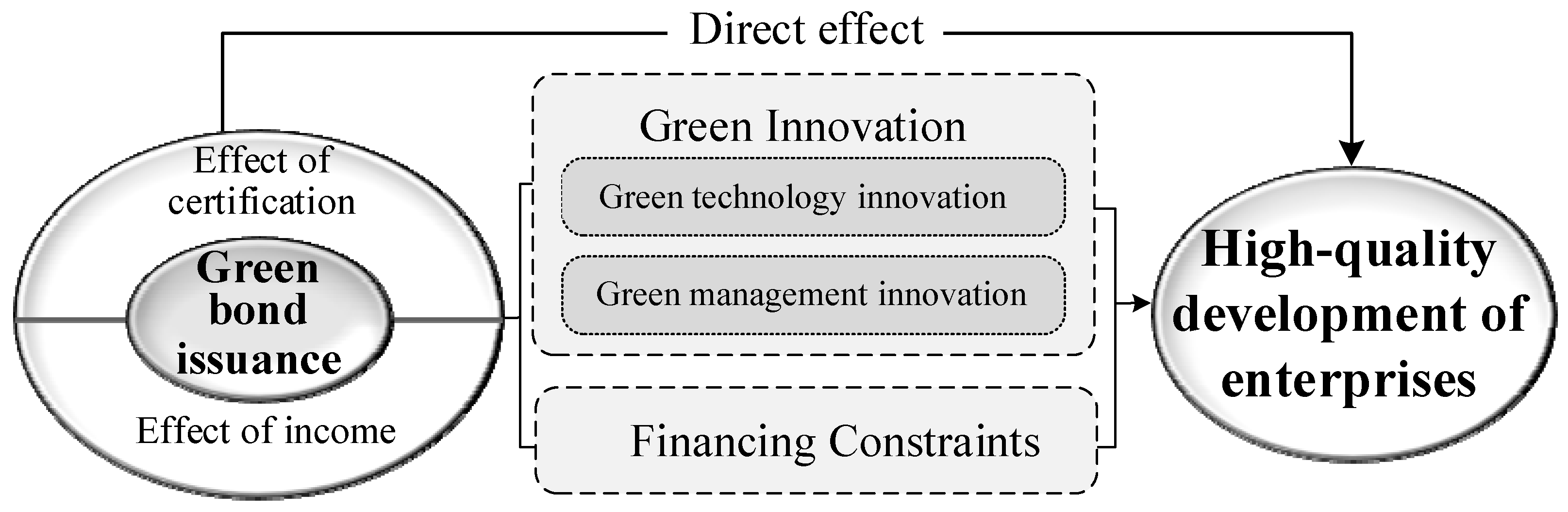
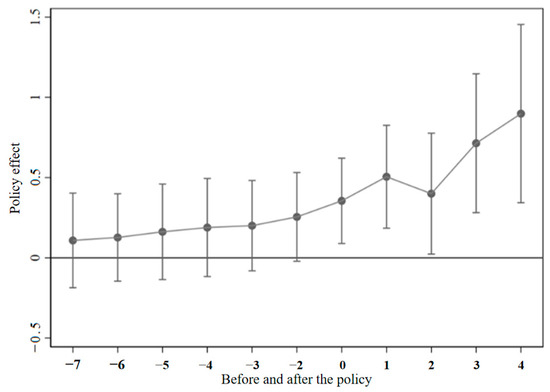
To guarantee the rational and credible estimation outcomes of the DID framework, the parallel trend hypothesis must be satisfied. The treatment group and control group should maintain consistent changing trends in high-quality development before green bond issuance is implemented. The baseline regression results of Model (1) only offer static empirical evidence and fail to capture the dynamic evolutionary effects brought by green bond issuance. On this basis, this paper further introduces the event study method to identify the dynamic correlation between green bond issuance and corporate development performance. As clearly demonstrated in Figure 2, no substantial divergence exists in the high-quality development level of the two sample groups in the pre-event period, fully verifying the validity of the parallel trend test. In addition, green bond issuance can steadily drive the continuous improvement of corporate high-quality development, verifying its long-term promotional value for stable and high-level operational growth.
Figure 2.
Parallel trend test.
4.2.2. Replace the Explained Variable
This study takes enterprise total factor productivity (TFP) as the core explained variable in the benchmark regression. For robustness verification, TFP is re-measured through the LP, OLS. and GMM methods, respectively. The corresponding empirical outcomes are presented in Columns (1), (2), and (3) of Table 4. The regression coefficients are significantly positive at the 1% statistical level or higher under different measurement strategies, proving the reliability and stability of the baseline positive correlation.
Table 4.
Robustness test.
4.2.3. Placebo Test
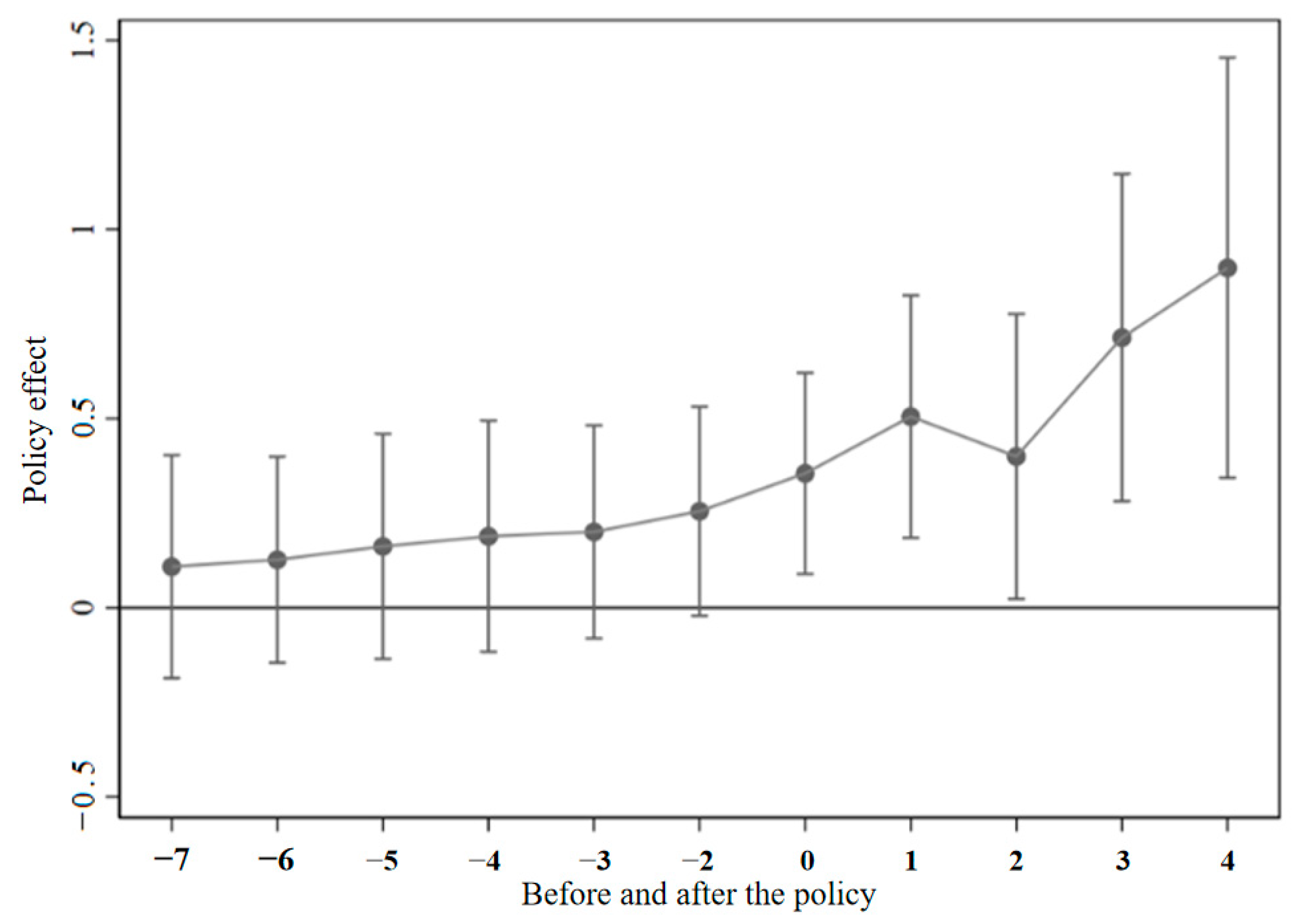
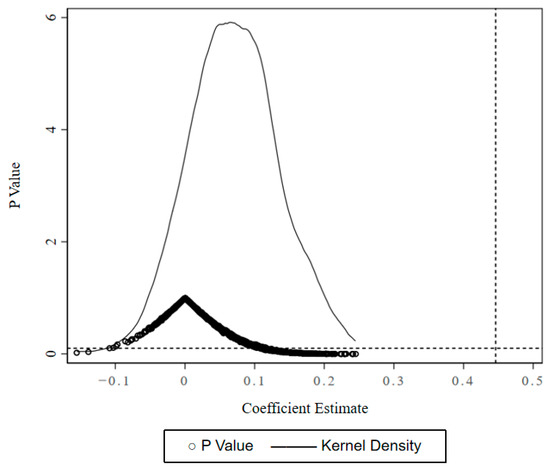
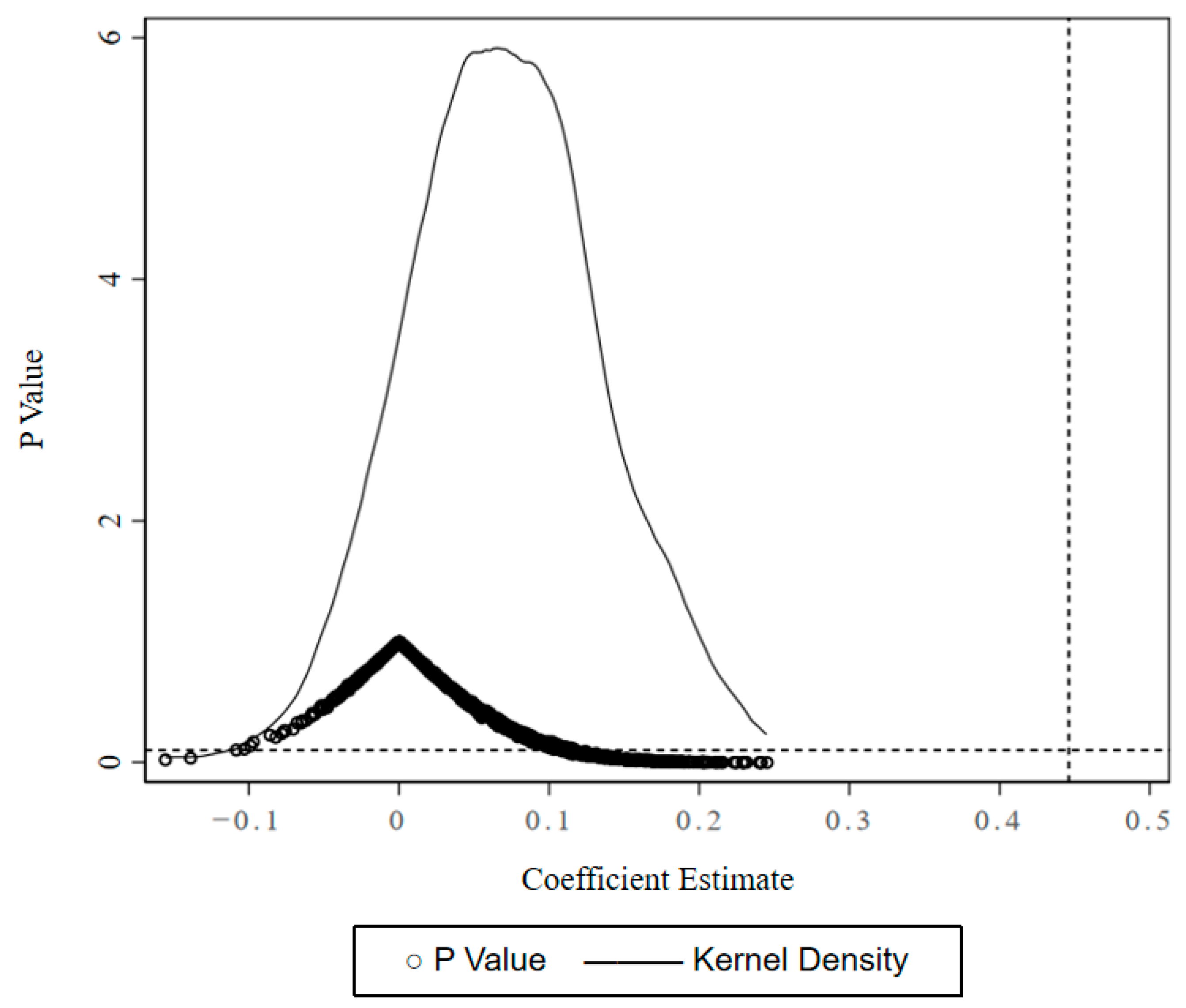
To verify the accuracy of treatment and control group construction, this study conducts a placebo analysis based on randomly assigned groups. The procedure is as follows: cities issuing green bonds in the original treatment group are reassigned to the control group; meanwhile, the timing of issuance remains unchanged, and n issuing firms in year t are replaced with n randomly selected firms that had not issued green bonds by that year, forming a new treatment group. This setup allows the completion of a placebo test. Repeating this procedure 1000 times yields 1000 estimated coefficients for Gb × After, with an average coefficient of 0.0703, significantly smaller than the benchmark regression coefficient. Moreover, according to Figure 3, most of the coefficients are concentrated around 0, supporting the conclusion that green bond issuance positively influences enterprise total factor productivity from a counterfactual perspective.
Figure 3.
Placebo test.
4.3. Heterogeneity Tests
4.3.1. Internal Management Agency Costs
High-quality development is grounded in green development, requiring senior managers to assume certain risks to advance sustainable growth. High agency costs may lead managers to take short-term measures to fulfill green development requirements, often prioritizing personal interests and risk aversion over shareholders’ interests, which ultimately restricts enterprise growth. The issuance of green bonds creates a stronger internal control framework within firms, improving oversight and limiting managerial opportunism. Consequently, firms burdened by higher internal agency costs tend to exhibit a stronger response in terms of high-quality development following green bond issuance. To proxy internal agency costs, we employ the management expense ratio and split the sample into two subsamples at the median. As reported in Table 5, green bond issuance remains positively associated with high-quality development across both groups; however, the magnitude of the coefficient and its statistical significance are somewhat attenuated, suggesting that agency frictions may partially dampen the effect.
Table 5.
Heterogeneity analysis by agency level, marketization, and pollution intensity.
4.3.2. Level of Marketization
In this study, internal agency costs are proxied by the management expense ratio. The sample is divided into high- and low-cost groups based on the median, and Table 5 shows that green bond issuance continues to have a positive effect on high-quality development, although both the coefficient size and statistical strength decline to some extent. To examine regional marketization heterogeneity, this paper categorizes samples into high- and low-marketization groups according to the median value. The influence of the coefficients of green bonds on firms’ sustainable growth in both groups is significantly positive. However, the coefficient of the high-marketization group (β1 = 0.438) exceeds that of the low-marketization group (β1 = 0.196), and the low-marketization coefficient fails to reach statistical significance. This finding suggests that in regions with more developed market systems, green bond issuance plays a stronger role in supporting firms’ sustainable and high-quality growth.
4.3.3. Industry Pollution Degree
To explore the heterogeneous influence of green bond issuance on corporate high-quality development under distinct pollution characteristics, the full sample is split based on industrial pollution intensity. Firms are classified into high-pollution and low-pollution subgroups in accordance with their actual pollution discharge conditions. All grouped regression findings are listed in Table 5. For high-pollution enterprises, green bond issuance yields a notable positive influence, with the regression coefficient significant at the 1% statistical level. For low-pollution entities, the coefficient remains positive yet fails to pass significance tests. Inter-group difference testing further verifies a marked gap between the two subgroups. It reveals that green bond financing exerts a more pronounced improvement effect on enterprises bearing heavy environmental pressure. Such heterogeneity may stem from differentiated regulatory constraints. Heavily polluting firms face stricter environmental supervision and stronger external governance pressure, which strengthens the incentive effect of green financing on industrial upgrading. These enterprises actively issue green bonds to raise funds, optimize high-pollution and high-energy-consumption production modes, and increase investment in clean production technology. This financing-driven transformation helps enterprises complete internal operational adjustments and ultimately accelerates the transition toward green transformation and high-quality development.
4.3.4. Regional Distribution
Significant regional differences in resource conditions contribute to uneven development across regions. The advanced economic development in the eastern region provides favorable conditions for green finance expansion; however, environmental challenges increasingly constrain economic growth, prompting local governments to intensify green finance policy implementation and oversight. In comparison to the eastern region, where resource supervision is stronger, local governments in central and western regions exhibit relatively weaker oversight regarding the way corporate green bond proceeds are utilized, largely due to urgent economic development pressures. This insufficient supervision limits corporate green project growth and hinders improvements in high-quality development levels for these enterprises. Therefore, green bond issuance is likely to exert a stronger influence on firms’ high-quality development in the eastern region. To examine regional variation, the sample is grouped into eastern, central, and western regions, and the results are reported in Table 6. In the eastern region, the coefficient for green bond issuance is significantly positive. In contrast, although positive, the coefficients for central and western regions are not statistically significant. These findings suggest that the effect of green bond issuance on firm development is more pronounced in the eastern region, highlighting the need to strengthen green bond development in central and western areas.
Table 6.
Heterogeneity analysis by region.
4.4. Mechanism Analysis
As established earlier, green bond issuance can enhance enterprises’ high-quality development levels. To examine the mechanisms through which green bonds exert this influence, the present work constructs a framework to explore the contributions of green technology innovation, financing constraints, and advancements in green management practices in driving high-quality development facilitated by green bonds.
The mediating variables Mi,t in Model (2) represent firms’ green technology efforts, innovations in green management, and limitations in financing.
First, to examine whether green bond issuance affects firms’ high-quality development through the green technological innovation channel, this study uses the variable ln(green invention patent + green utility patent + 1) to measure firms’ green innovation level (Envr). The results, presented in Column (1) of Table 7, show that the regression coefficient of Gb × After on Envr is 0.393, significant at the 5% level, indicating that green bond issuance significantly promotes firms’ green innovation activities. This is consistent with the theoretical expectations of this study and supports Hypothesis 2.
Table 7.
Results of mechanism test.
Second, this study examines whether green bond issuance affects firms’ total factor productivity through the green management channel. GM is measured using five indicators from listed firms’ environmental regulation and certification disclosure: environmental governance system, environmental training, sustainability initiatives, ISO9001 and ISO14001 certifications (ISO, 2026). Each indicator is assigned a value of 1 if present and 0 otherwise. GMI equals the sum of the five binary indicators, ranging from 0 to 5, with higher values indicating stronger green management innovation. The results, reported in Column (2) of Table 7, show that the regression coefficient of Gb × After on GM is 0.081, significant at the 5% level, indicating that green bond issuance significantly improves firms’ internal environmental management capabilities. This suggests that green bond issuance promotes high-quality development by enhancing firms’ green management practices, which is consistent with the theoretical expectations and supports Hypothesis 3.
Third, this study constructs an FC index to measure firms’ financing constraints, following the existing literature, and conducts a mediation effect test. The FC index is constructed as follows: FC = −0.737 × size + 0.043 × size2 − 0.04 × age, where size denotes the natural logarithm of total assets and age represents the number of years since the company’s establishment. The estimates in Column (3) of Table 7 show that green bond issuance is negatively associated with the FC index, indicating that firms relying on green bonds face lower financing frictions. This confirms that financing constraints play a full mediating role between green bond issuance and firms’ high-quality development. This finding suggests that green bond issuance primarily promotes firms’ high-quality development by alleviating financing constraints, which is consistent with the theoretical expectations and supports Hypothesis 4.
5. Conclusions and Policy Implications
This work explores whether corporate green bond issuance can deliver tangible progress in overall development quality. Taking green bond practices as the research setting and adopting a DID empirical design, this study verifies that green bond issuance markedly lifts comprehensive development performance at the firm level. Mechanism tests reveal three primary paths through which this influence functions: technological innovation, green operation management, and eased financing constraints. Heterogeneity tests also suggest the promotional effect is more pronounced among enterprises plagued by serious agency conflicts, heavy pollution emissions, and those operating in eastern areas or regions with advanced marketization. Relevant policy suggestions are put forward accordingly. This study confirms that green bonds drive firm-level TFP growth and resource allocation optimization, providing micro-level causal evidence for green finance-driven high-quality development. Identifying the boundary conditions of their effects enables policymakers to design more targeted and efficient green finance policies.
(1) Optimize and refine the institutional arrangement of the green bond market. Given the proven positive value of green bond financing for corporate high-quality development, regulators ought to expand the scale of the green bond market and complete supporting supervision rules. Authorities need to optimize relevant legal clauses and institutional norms, standardize the whole-chain management of green bond capital, and offer targeted incentives to enterprises that rely on green bonds to advance sustainable transformation. For central and western areas, differentiated policy tools should be formulated in light of local ecological conditions and development needs, alongside tighter supervision over capital utilization. Regional authorities may draw on mature experience from eastern provinces, integrate local resource endowments with green bond financing tools, and thereby underpin the development of a green, low-carbon, and circular economic system.
(2) Leverage green bond financing to drive corporate green transformation and sustainable growth. Policy support should guide firms to expand investment in environmentally oriented innovation, improve environmental governance systems, and achieve sustainable development. The empirical evidence presented in this study proves that corporate green bond issuance can advance green technology innovation, upgrade internal green management practices, and substantially lift comprehensive development quality. From the enterprise side, companies should formulate targeted strategies based on their own operational characteristics and market dynamics, fully utilizing the resource allocation function of green bonds to enhance their green technology competitive advantages. By combining green financing with low-carbon transformation plans, enterprises can embed sustainable development principles into their long-term strategies, cultivate a green-oriented corporate culture, and align internal governance practices with green bond requirements to achieve environmentally sustainable, high-quality growth.
(3) Broaden financing channels and ease corporate financing constraints. To underpin steady high-quality development, regulatory authorities need to optimize financial and credit market rules and institutional constraints. Meanwhile, targeted policy tools including special funds, interest subsidies, and fee reduction measures can be rolled out to help enterprises enhance their green financing capacity. These policy tools will directly boost corporate green innovation and lay the foundation for sustained high-quality growth. From the corporate perspective, enterprises need to break away from outdated development modes, improve internal governance mechanisms, and establish sound green financial arrangements. Making full use of the resource allocation advantages brought by green bond financing helps enterprises steadily advance sustainable progress and high-quality development.
6. Limitations and Scope
This study has two main limitations. First, the mechanism analysis relies on a mediation model assuming that green innovation, green management, and financing constraints operate independently. However, these channels may interact or substitute for each other. For example, improved green innovation may simultaneously alleviate financing constraints rather than serving as a separate pathway. Future research could adopt more refined causal identification strategies, such as instrumental variable approaches or structural equation modeling, to disentangle each mechanism’s independent contribution.
Second, the external validity is limited by the Chinese institutional context, where the green bond market is heavily policy-driven. The identified mechanisms may not generalize to other institutional settings with varying marketization levels. Future studies could conduct cross-country comparative analyses to examine how green bonds affect firm development quality across different institutional environments.
Author Contributions
Conceptualization, Y.W. and Y.X.; Methodology, Y.W.; Validation, Y.X. and X.M.; Formal analysis, Y.W. and Y.X.; Writing—original draft, Y.W. and Q.Z.; Writing—review and editing, Q.Z., X.M., and M.A.; Supervision, X.M. and M.A.; Project administration; Funding acquisition, X.M. All authors have read and agreed to the published version of the manuscript.
Funding
This research was funded by the “Shandong Province Social Science Foundation Project” with grant number [23DGLJ23].
Institutional Review Board Statement
Not applicable.
Informed Consent Statement
Not applicable.
Data Availability Statement
The data used in this study are available from the corresponding author upon reasonable request.
Acknowledgments
During the preparation of this work, the authors used ChatGPT (OpenAI GPT-5.) in order to improve language and readability. After using this tool, the authors reviewed and edited the content as needed and takes full responsibility for the content of the publication.
Conflicts of Interest
The authors declare no conflicts of interest.
References
- Bai, Y. (2025). The impact of green bond issuance on corporate environmental and financial performance: An empirical study of Japanese listed firms. International Journal of Financial Studies, 13(3), 141. [Google Scholar] [CrossRef] [Scilit]
- Benlemlih, M., Jaballah, J., & Kermiche, L. (2023). Does financing strategy accelerate corporate energy transition? Evidence from green bonds. Business Strategy and the Environment, 32(1), 878–889. [Google Scholar]
- Chai, S., Zhang, K., Wei, W., Ma, W., & Abedin, M. Z. (2022). The impact of green credit policy on enterprises’ financing behavior: Evidence from Chinese heavily-polluting listed companies. Journal of Cleaner Production, 363, 132458. [Google Scholar] [CrossRef] [Scilit]
- Chen, Z., Zhang, Y., Wang, H., Ouyang, X., & Xie, Y. (2022). Can green credit policy promote low-carbon technology innovation? Journal of Cleaner Production, 359, 132061. [Google Scholar] [CrossRef] [Scilit]
- Cheng, Z., & Wu, Y. (2024). Can the issuance of green bonds promote corporate green transformation? Journal of Cleaner Production, 443, 141071. [Google Scholar] [CrossRef] [Scilit]
- Cui, X., Wang, P., Sensoy, A., Nguyen, D. K., & Pan, Y. (2022). Green credit policy and corporate productivity: Evidence from a quasi-natural experiment in China. Technological Forecasting and Social Change, 177, 121516. [Google Scholar] [CrossRef] [Scilit]
- Dong, H., Zhang, L., & Zheng, H. (2024). Green bonds: Fueling green innovation or just a fad? Energy Economics, 135, 107660. [Google Scholar] [CrossRef] [Scilit]
- Dong, X., & Yu, M. (2024). Green bond issuance and green innovation: Evidence from China’s energy industry. International Review of Financial Analysis, 94, 103281. [Google Scholar]
- Flammer, C. (2021). Corporate green bonds. Journal of Financial Economics, 142(2), 499–516. [Google Scholar] [CrossRef] [Scilit]
- Gianfrate, G., & Peri, M. (2019). The green advantage: Exploring the convenience of issuing green bonds. Journal of Cleaner Production, 219, 127–135. [Google Scholar] [CrossRef] [Scilit]
- Hu, G., Wang, X., & Wang, Y. (2021). Can the green credit policy stimulate green innovation in heavily polluting enterprises? Evidence from a quasi-natural experiment in China. Energy Economics, 98, 105134. [Google Scholar] [CrossRef] [Scilit]
- Huang, J.-W., & Li, Y.-H. (2015). Green innovation and performance: The view of organizational capability and social reciprocity. Journal of Business Ethics, 145(2), 309–324. [Google Scholar] [CrossRef] [Scilit]
- ISO. (2026). Environmental management systems—Requirements with guidance for use (ISO 14001:2026). International Organization for Standardization. Available online: https://www.iso.org/standard/14001 (accessed on 1 May 2026).
- Jensen, M. C. (1986). Agency costs of free cash flow, corporate finance, and takeovers. The American Economic Review, 76(2), 323–329. [Google Scholar]
- Kanamura, T. (2020). Are green bonds environmentally friendly and good performing assets? Energy Economics, 88, 104767. [Google Scholar] [CrossRef] [Scilit]
- Lebelle, M., Lajili Jarjir, S., & Sassi, S. (2020). Corporate green bond issuances: An international evidence. Journal of Risk and Financial Management, 13(2), 25. [Google Scholar] [CrossRef] [Scilit]
- Lee, C.-C., Tang, M., & Lee, C.-C. (2023). Reaping digital dividends: Digital inclusive finance and high-quality development of enterprises in China. Telecommunications Policy, 47(2), 102484. [Google Scholar]
- Li, C. S., Cao, X. J., Wang, Z. Y., Zhang, J. L., & Liu, H. (2025). The impact of green bond issuance on corporate green innovation: A signaling perspective. International Review of Financial Analysis, 102, 104113. [Google Scholar] [CrossRef] [Scilit]
- Li, R., Li, Z., Hu, K., & Gan, K. (2024). The spillover effects of green bond issuance: A study based on Chinese firms’ stock price synchronicity. Economic Change and Restructuring, 57(1), 12. [Google Scholar] [CrossRef] [Scilit]
- Lian, J., Huang, X., & Wu, X. (2024). How green bonds promote firms’ green collaborative innovation? Corporate Social Responsibility and Environmental Management, 31(3), 2109–2126. [Google Scholar]
- Liu, Q., & Dong, B. (2022). How does China’s green credit policy affect the green innovation of heavily polluting enterprises? The perspective of substantive and strategic innovations. Environmental Science and Pollution Research, 29(51), 77113–77130. [Google Scholar] [CrossRef] [Scilit] [PubMed]
- Liu, S., & Li, S. (2024). Corporate green bond issuance and high-quality corporate development. Finance Research Letters, 61, 104880. [Google Scholar]
- Lv, C., Fan, J., & Lee, C.-C. (2023). Can green credit policies improve corporate green production efficiency? Journal of Cleaner Production, 397, 136573. [Google Scholar] [CrossRef] [Scilit]
- Ma, T. F., & Li, J. K. (2025). Green credit policy, financing constraints, and total factor productivity of enterprises. Finance Research Letters, 85, 108060. [Google Scholar] [CrossRef] [Scilit]
- Negi, P., Jaiswal, A., & Rekunenko, I. (2025). Green bonds and corporate value creation: A review of financial, market, and environmental performance. Discover Sustainability, 6(1), 1106. [Google Scholar] [CrossRef] [Scilit]
- Nguyen, Q. M. N., & Do, T. K. (2025). Do financial constraints hinder or spur green innovation? Economics Letters, 257, 112688. [Google Scholar] [CrossRef] [Scilit]
- Ning, Y., Cherian, J., Sial, M. S., Álvarez-Otero, S., Comite, U., & Zia-Ud-Din, M. (2023). Green bond as a new determinant of sustainable green financing, energy efficiency investment, and economic growth: A global perspective. Environmental Science and Pollution Research, 30(22), 61324–61339. [Google Scholar] [PubMed]
- Ouyang, H., Guan, C., & Yu, B. (2023). Green finance, natural resources, and economic growth: Theory analysis and empirical research. Resources Policy, 83, 103604. [Google Scholar] [CrossRef] [Scilit]
- Porter, M. E., & van der Linde, C. (1995). Toward a new conception of the environment-competitiveness relationship. Journal of Economic Perspectives, 9(4), 97–118. [Google Scholar] [CrossRef] [Scilit]
- Sheng, Q., Zheng, X., & Zhong, N. (2021). Financing for sustainability: Empirical analysis of green bond premium and issuer heterogeneity. Natural Hazards, 107(3), 2641–2651. [Google Scholar] [CrossRef] [Scilit]
- Su, J., Wei, Y., Wang, S., & Liu, Q. (2023). The impact of digital transformation on the total factor productivity of heavily polluting enterprises. Scientific Reports, 13(1), 6386. [Google Scholar] [CrossRef] [Scilit] [PubMed]
- Taghizadeh-Hesary, F., & Yoshino, N. (2019). The way to induce private participation in green finance and investment. Finance Research Letters, 31, 98–103. [Google Scholar] [CrossRef] [Scilit]
- Tang, D. Y., & Zhang, Y. (2020). Do shareholders benefit from green bonds? Environmental, Social, and Governance Issues: Emerging Markets and Beyond, 61, 101427. [Google Scholar] [CrossRef] [Scilit]
- Teti, E., Baraglia, I., Dallocchio, M., & Mariani, G. (2022). The green bonds: Empirical evidence and implications for sustainability. Journal of Cleaner Production, 366, 132784. [Google Scholar] [CrossRef] [Scilit]
- Wang, H., Hu, X., & Li, H. (2023). Regional production restriction policy and firms’ green transition: Evidence from Beijing-Tianjin-Hebei region. Energy, 282, 128857. [Google Scholar]
- Wang, R., Duan, Y., & Li, D. (2025). Beyond scale to efficiency: A dual-perspective framework for green finance in China. Discover Sustainability, 6(1), 483. [Google Scholar] [CrossRef] [Scilit]
- Wang, T., Liu, X., & Wang, H. (2022). Green bonds, financing constraints, and green innovation. Journal of Cleaner Production, 381, 135134. [Google Scholar] [CrossRef] [Scilit]
- Wang, Y., & Taghizadeh-Hesary, F. (2023). Green bonds markets and renewable energy development: Policy integration for achieving carbon neutrality. Energy Economics, 123, 106725. [Google Scholar] [CrossRef] [Scilit]
- Wu, G., Zhang, T., & Dong, A. (2026). Does greenization pay off? Insights from an economic vitality perspective. Humanities and Social Sciences Communications, 13(1), 709. [Google Scholar] [CrossRef] [Scilit]
- Wu, L., Xu, C., Qi, L., Lam, J., & Chen, G. (2025). Can CFOs’ overseas experience contribute to corporate digital transformation: Evidence from China. Humanities and Social Sciences Communications, 12(1), 1–16. [Google Scholar] [CrossRef] [Scilit]
- Xu, P., Ye, P., Jahanger, A., Huang, S., & Zhao, F. (2023). Can green credit policy reduce corporate carbon emission intensity: Evidence from China’s listed firms. Corporate Social Responsibility and Environmental Management, 30(5), 2623–2638. [Google Scholar]
- Yang, M., Ma, L., Gu, Y., & Wu, W. (2025). The impacts of green bonds on the green innovation: Evidence from the corporate green transformation in China. Emerging Markets Review, 65, 101252. [Google Scholar] [CrossRef] [Scilit]
- Zerbib, O. D. (2019). The effect of pro-environmental preferences on bond prices: Evidence from green bonds. Journal of Banking & Finance, 98, 39–60. [Google Scholar] [CrossRef] [Scilit]
- Zhang, D., & Du, P. (2020). How China “Going green” impacts corporate performance? Journal of Cleaner Production, 258, 120604. [Google Scholar] [CrossRef] [Scilit]
- Zhang, R., Li, Y., & Liu, Y. (2021). Green bond issuance and corporate cost of capital. Pacific-Basin Finance Journal, 69, 101626. [Google Scholar] [CrossRef] [Scilit]
- Zhao, L., Chau, K. Y., Tran, T. K., Sadiq, M., Xuyen, N. T. M., & Phan, T. T. H. (2022). Enhancing green economic recovery through green bonds financing and energy efficiency investments. Economic Analysis and Policy, 76, 488–501. [Google Scholar] [CrossRef] [Scilit]
- Zheng, J., Jiang, Y., Cui, Y., & Shen, Y. (2023). Green bond issuance and corporate ESG performance: Steps toward green and low-carbon development. Research in International Business and Finance, 66, 102007. [Google Scholar] [CrossRef] [Scilit]

Disclaimer/Publisher’s Note: The statements, opinions and data contained in all publications are solely those of the individual author(s) and contributor(s) and not of MDPI and/or the editor(s). MDPI and/or the editor(s) disclaim responsibility for any injury to people or property resulting from any ideas, methods, instructions or products referred to in the content. |
© 2026 by the authors. Licensee MDPI, Basel, Switzerland. This article is an open access article distributed under the terms and conditions of the Creative Commons Attribution (CC BY) license.