


Abstract
This paper investigates how referentiality interacts with the syntax of Hindi–Urdu. It argues that three patterns, namely, object reduplication, association with the focus particle hī, and cross-clausal agreement, are manifestations of a single structural contrast determined by object shift. With our novel observations, we show that only objects that introduce discourse referents undergo displacement to a higher syntactic position, where they can trigger agreement or serve as associates of the focus particle hī. Reduplicated nominals, which lack referential features, must remain inside the VP and are consequently excluded from these dependencies. The analysis formalizes this correlation through a referential licensing condition that restricts movement to SpecvP to arguments bearing a referential feature [+Ref]. This condition derives the observed interactions between object shift and interpretation of the object. The resulting account integrates phenomena of agreement and focus with the semantics of specificity, offering a unified model of how referential interpretation is encoded in the clause structure of Hindi–Urdu.
1. Introduction
In Hindi and Urdu, three phenomena that may appear unrelated at first—object reduplication, the licensing of the focus-sensitive particle hī, and cross-clausal agreement—collectively reveal a deeper structural contrast in how direct objects are interpreted. Specifically, they distinguish objects that can introduce discourse referents from those that cannot. What is remarkable is that all three converge on the same structural asymmetry: whether or not an object undergoes movement to a higher functional projection, a process often described as object shift in the literature.
Nominal reduplication in Hindi gives rise to a similative or “loose” interpretation that systematically resists specificity and definiteness. For instance, chāy-vāy, formed by reduplication of chāy ‘tea’, conveys the meaning ‘tea-like drinks’ (Abbi, 1975; Montaut, 2009). In contrast, nominals marked with the focus particle hī (‘only’) are obligatorily interpreted as specific or definite. The incompatibility between reduplicated nominals and hī thus follows naturally, since the particle requires its associate to denote a specific discourse referent. A comparable contrast is found in agreement patterns: as observed in Yadav (2024), cross-clausal agreement and its step-up counterpart arise only when embedded objects are interpreted as specific or definite, not when they cannot be interpreted as specific or definite.
Building on these interactions, this paper argues that agreement, focus association, and reduplication in Hindi–Urdu form a single, tightly organized system in which referentiality and syntactic position are mutually dependent. The analysis proposes that only those direct objects that introduce discourse referents must undergo object shift; such objects are visible to higher probes, while non-referential, reduplicated nominals remain in situ and therefore cannot participate in constructions that require referential licensing.
This correlation between interpretation and syntactic height has broader implications for the mapping between semantics and structure. It shows that Hindi–Urdu encodes the distinction between referential and non-referential objects syntactically, and that this contrast becomes empirically visible through agreement, focus, and movement. In this respect, our proposal aligns with works arguing that discourse-related features (e.g., definiteness, referentiality, topic/focus) are active in the narrow syntax and can trigger movement and agreement on a par with -features. In particular, Miyagawa (2010, 2017) argues that languages may syntactically encode discourse features (on C/T or the clausal spine) that attract or license constituents; Jimenez-Fernandez and Spyropoulou (2013) show that such features participate in Feature Inheritance to lower heads (e.g., v) and thereby shape clause structure and information–structural positions. The evidence presented here contributes to this picture by showing that in Hindi–Urdu an object’s ability to introduce a discourse referent (specificity/definiteness) is tied to access to a higher structural position. We formalize this via a referential licensing condition, connecting object shift to [+Ref] and deriving the observed interactions among focus association, agreement, and anti-specific reduplication. This supports the broader hypothesis, in the spirit of Heusinger (2002), that clausal architecture is sensitive not merely to grammatical function but also to interpretive type.
The paper proceeds as follows. Section 2 examines nominal reduplication and its incompatibility with hī, introducing them as diagnostics for referentiality versus anti-referentiality. Section 3 presents the analysis of object shift and its relationship to referentiality. Section 4 turns to cross-clausal agreement and shows that agreement correlates systematically with the raised position of specific objects. Section 5 concludes.
2. Reduplication and the Focus Particle
2.1. Reduplication
Reduplication is found across many of the world’s languages, where it often serves grammatical or discourse functions such as intensification, distributivity, or plurality (Moravcsik, 1978). Hindi exhibits productive reduplication in several morphosyntactic categories, including adjectives (e.g., thodā-thodā ‘a little bit’) and adverbs (e.g., jaldi-jaldi ‘hastily’). Of particular relevance for the present discussion is nominal reduplication, where the direct object undergoes reduplication, as illustrated in (1a–1c). This construction typically produces a similative interpretation as in Smith (2020), where the speaker leaves the reference deliberately vague, indicating a loosely understood group/type, rather than a specific entity. Thus, chāy-vāy refers to tea-like entities more generally.
| (1) | a. | chāy-vāy |
| tea-red | ||
| ‘tea or some kind of hot beverage’ | ||
| b. | kursī-vursī | |
| chair-red | ||
| ‘chair(s) or some kind of furniture’ | ||
| c. | kitāb-vitāb | |
| book-red | ||
| ‘book(s) or other kinds of reading material’ |
At the clausal level, reduplication systematically blocks specific or definite interpretations (as discussed in Butt & King, 2006; Dayal, 2011). This becomes clear when we compare the behavior of bare nominals with their reduplicated counterparts. While the demonstrative wō ’that’ can co-occur with a bare nominal, as in (2b), it cannot appear with a reduplicated object, as shown in (3b).
| (2) | a. | Rām-ne | chāy | banā-yī. | |
| Ram-erg | tea.f | make-pfv.f | |||
| ‘Ram made (the) tea.’ | |||||
| b. | Rām-ne | wō | chāy | banā-yī. | |
| Ram-erg | that | tea.f | make-pfv.f | ||
| ‘Ram made that tea.’ | |||||
| (3) | a. | Rām-ne | chāy-vāy | banā-yī. | ||
| Ram-erg | tea-red | make-pfv.f | ||||
| ‘Ram made tea or something similar.’ | ||||||
| b. | *Rām-ne | wō | chāy-vāy | banā-yī. | ||
| Ram-erg | that | tea-red | make-pfv.f | |||
| Intended: ’Ram made that tea or that tea-like beverage.’ | ||||||
The contrast is instructive: (3a) is perfectly grammatical with a vague, non-specific interpretation, but (3b) is unacceptable because the demonstrative, which enforces refrentiality, conflicts with the anti-specific meaning of the reduplicated noun. This pattern supports the view that nominal reduplication in Hindi systematically excludes specific interpretation, consistent with Dayal’s (2011) analysis of anti-specificity as both a structural and interpretive property.
Reduplicated objects also exhibit characteristic discourse behavior. Unlike specific indefinites, which can be anchored to previous discourse or to the speaker’s knowledge state, reduplicated objects resist such discourse linking. They fail to establish discourse referents and consequently cannot be resumed anaphorically or picked up by subsequent pronominal reference. This behavior parallels that of weak indefinites in other languages (Bhatt & Anagnostopoulou, 1996; Diesing, 1992, among others). Since reduplicated objects do not introduce discourse referents in the sense of Heim (1982), they are unavailable for operations like topicalization (4b) and pronominal resumption (5b).
| (4) | a. | Chāy | Rām-ne | banā-yī. | ||
| tea.f | Ram-erg | make-pfv.f | ||||
| ‘The tea, Ram made.’ | ||||||
| b. | *Chāy-vāy | Rām-ne | banā-yī. | |||
| tea-red | Ram-erg | make-pfv.f | ||||
| Intended: ‘The tea or similar thing, Ram made.’ | ||||||
| (5) | a. | Rām-ne | chāy | banā-yī | aur | use | thandā | hone | diyā. | |||||
| Ram-erg | tea.f | make-pfv.f | and | it.acc | cold | become | let.pfv.m | |||||||
| ‘Ram made tea and let it go cold.’ | ||||||||||||||
| b. | */???Rām-ne | chāy-vāy | banā-yī | aur | use | thandā | hone | diyā. | ||||||
| Ram-erg | tea-red | make-pfv.f | and | it.acc | cold | become | let.pfv.m | |||||||
| Intended: ‘Ram made some tea or whatever and let it go cold.’ | ||||||||||||||
*/??? indicates inter-speaker variation: the sentence is judged as degraded by some speakers and ungrammatical by others.
Further evidence comes from the interaction with differential object marking. The marker ko, which typically appears with specific or definite objects in Hindi, is incompatible with reduplicated nominals:
| (6) | a. | Peter-ne | kursī-ko | toḍā. | |
| Peter-erg | chair.f-dom | break.pfv.m | |||
| ‘Peter broke the chair.’ | |||||
| b. | *Peter-ne | kursī-vursī-ko | toḍā. | ||
| Peter-erg | chair-red-dom | break.pfv.m | |||
| Intended: ’Peter broke some chair-like piece of furniture.’ | |||||
Taken together, these patterns reveal a clear form–function correspondence: reduplication, as a morphophonological process, systematically produces anti-specificity effects. It signals that the object lacks referential anchoring and, given the impossibility of movement operations, suggests that reduplicated nominals must remain syntactically low in the structure.
2.2. Focus Particle hī
Another argument for the anti-specific status of reduplicated nominals comes from their incompatibility with scope-taking elements. Reduplicated objects cannot associate with universal quantifiers (7) or with focus-sensitive operators such as hī ‘only’ (8). The contrast is clear: non-reduplicated objects freely combine with quantifiers and focus particles, but reduplicated forms cannot.1
| (7) | a. | bacco-ne | sāre | seb | khāye. | |
| child-pl.erg | all | apple | eat.pfv.m.pl | |||
| ‘Children ate all the apples.’ | ||||||
| b. | *bacco-ne | sāre | seb-veb | khāye. | ||
| child-pl.erg | all | apple-red | eat.pfv.m.pl | |||
| Intended: ‘Children ate all apple-like things.’ | ||||||
| (8) | a. | Mary-ke | pās | ek | degree | hī | hai. | |
| Mary-gen | near | one | degree | only | be.prs | |||
| ‘Mary has only one degree.’ | ||||||||
| b. | *Mary-ke | pās | ek | degree-vigrī | hī | hai. | ||
| Mary-gen | near | one | degree-red | only | be.prs | |||
| Intended: ‘Mary has only one degree-like thing.’ | ||||||||
The focus-sensitive particle hī projects exhaustivity and contrastive focus, affecting information structure and referential interpretation (see Kidwai, 2000; Lahiri, 1998 for more discsusion). When hī associates with a nominal, it presupposes that the referent uniquely satisfies the predicate. This interpretive condition forces specificity, aligning with cross-linguistic observations that focus operators favor discourse-linked or referential expressions (Beaver & Clark, 2008; Krifka, 1992).
To realize this exhaustivity effect, the associate of hī must be identifiable in discourse, typically achieved through syntactic movement. Within the Mapping Hypothesis (Diesing, 1992), movement to a position outside VP yields a specific interpretation. Hungarian and Turkish exhibit this pattern: in both, pre-verbal focused objects must move and yield specificity (É. Kiss, 1998; Kornfilt, 1997). Hindi behaves in the same fashion, arguments associated with hī surface pre-verbally and are obligatorily specific. This pattern is exactly what one expects if hī introduces (or probes for) a discourse-related focus feature (let us call it [Foc]) on the clausal spine in the sense of Miyagawa (2010, 2017): the associate must raise to a dedicated position where discourse features are checked/licensed, yielding a specific, discourse-identifiable reading.
| (9) | a. | Rām-ne | bas | [wō | kitāb] | hī | paṛhī | hai. | |
| Ram-erg | just | that | book | only | read.pfv.f | be.prs | |||
| ‘Ram has read just that one book.’ | |||||||||
| b. | *Rām-ne | paṛhī | hai | bas | [wō | kitāb] | hī. | ||
| Ram-erg | read.pfv.f | be.prs | just | that | book | only | |||
| Intended: ‘Ram has read only that one book.’ | |||||||||
Empirical evidence supports this claim: when hī associates with a direct object, the object must appear in a preverbal position and is obligatorily interpreted as specific. This interpretation is not preserved under alternative word orders permitted by general scrambling in Hindi–Urdu, as in example (10).
| (10) | a. | Rām-ne | ek | kitāb | hī | paṛhī | hai. | |||
| Ram-erg | one | book | only | read.pfv.f | be.prs | |||||
| ‘Ram read only one (specific) book.’ | ||||||||||
| b. | *Rām-ne | paṛhī | hai | ek | kitāb | hī. | ||||
| Ram-erg | read.pfv.f | be.prs | one | book | only | |||||
| Intended: ‘Ram read only one (specific) book.’ | ||||||||||
However, when hī associates with a reduplicated object, the result is ungrammatical, showing that anti-specific forms resist focus association:
| (11) | *Rām-ne | ek | kitāb-vitāb | hī | paṛhī | hai. |
| Ram-erg | one | book-red | only | read.pfv.f | be.prs | |
| Intended: ‘Ram read only one book-like thing.’ | ||||||
This pattern reflects a structural contrast between VP-internal and VP-external objects: only objects occupying a higher syntactic position may serve as associates of the focus particle hī, whereas reduplicated nominals are excluded. The incompatibility between reduplication and hī therefore follows from restrictions on syntactic position rather than from properties of focus association itself.
The structural height of direct objects is established in the following section using independent positional and scopal properties.
2.3. Diagnostics for VP-Internal vs. VP-External Objects
The patterns discussed so far reveal a consistent asymmetry in the syntactic behavior of direct objects in Hindi–Urdu. Nominal reduplication and association with the focus particle hī systematically track whether an object remains structurally low or occupies a higher position in the clause. This asymmetry aligns with the Mapping Hypothesis (Diesing, 1992), under which VP-internal objects receive weak or non-specific interpretations, while objects interpreted outside VP are compatible with discourse-linked, referential readings. In Hindi–Urdu, this contrast is made empirically visible through a set of well-established positional and scopal diagnostics (Dayal, 2011; Diesing, 1992).
2.3.1. Low Manner Adverbs
The relative position of the direct object with respect to low VP-level manner adverbs provides insight into how referential interpretation is structurally realized. In Hindi–Urdu, objects that receive a referential interpretation may appear in a position above such adverbs, whereas objects lacking referential flavour must remain below them. Non-reduplicated objects permit both orders, consistent with their availability for either referential or non-referential readings (12).
| (12) | a. | Narendra-ne | jaldi-se | chāy | banāyī. | |
| Narendra-erg | quickly | tea | make.pfv.f | |||
| ‘Narendra quickly made tea.’ | ||||||
| b. | Narendra-ne | chāy | jaldi-se | banāyī. | ||
| Narendra-erg | tea | quickly | make.pfv.f | |||
| ‘Narendra made the tea quickly.’ | ||||||
Reduplicated objects, by contrast, are uniformly non-referential and are therefore restricted to the post-adverbial position, indicating that they remain VP-internal.
| (13) | a. | Narendra-ne | jaldi-se | chāy-vāy | banāyī. |
| Narendra-erg | quickly | tea-red | make.pfv.f | ||
| ‘Narendra quickly made tea-like beverages.’ | |||||
| b. | *Narendra-ne | chāy-vāy | jaldi-se | banāyī. | |
| Narendra-erg | tea-red | quickly | make.pfv.f | ||
| Intended: ‘Narendra made tea-like beverages quickly.’ | |||||
2.3.2. Double-Object Constructions
The same interpretive contrast surfaces in the ordering of internal arguments in ditransitives. In Hindi–Urdu, a direct object that precedes the indirect object (DO > IO) is necessarily interpreted as referential (14a), while the inverse order (IO > DO) allows both referential and non-referential reading (14b).
| (14) | a. | Narendra-ne | chāy | Amit-ko | dī. | |
| Narendra-erg | tea | Amit-dat | give.pfv.f | |||
| ‘Narendra gave the tea to Amit.’ | ||||||
| b. | Narendra-ne | Amit-ko | chāy | dī. | ||
| Narendra-erg | Amit-dat | tea | give.pfv.f | |||
| ‘Narendra gave (the) tea to Amit.’ | ||||||
Importantly, when the direct object is non-referential (as in reduplication), only the IO > DO order is possible, as in example (15).
| (15) | a. | Narendra-ne | Amit-ko | chāy-vāy | dī. |
| Narendra-erg | Amit-dat | tea-red | give.pfv.f | ||
| ‘Narendra gave Amit tea-like beverages.’ | |||||
| b. | *Narendra-ne | chāy-vāy | Amit-ko | dī. | |
| Narendra-erg | tea-red | Amit-dat | give.pfv.f | ||
| Intended: ‘Narendra gave tea-like beverages to Amit.’ | |||||
This restriction shows that non-referential objects cannot occupy the higher position associated with DO > IO order.
2.3.3. Scope Under Negation
Scope interactions with negation make the interpretive contrast between direct objects particularly clear. In Hindi–Urdu, non-reduplicated objects allow both narrow- and wide-scope readings with respect to negation, depending on whether they are interpreted as non-referential or referential.2
| (16) | Narendra-ne | jīvan-me | kabhī | chāy | nahīñ | banā-yī. |
| Narendra-erg | life-in | ever | tea | neg | make-pfv.f | |
| ‘Narendra never made tea in his life.’ (NEG > tea; tea > NEG)3 | ||||||
Reduplicated objects, by contrast, lack referential anchoring and are obligatorily interpreted under negation, yielding only a narrow-scope reading.
| (17) | Narendra-ne | jīvan-me | kabhī | chāy-vāy | nahīñ | banā-yī. |
| Narendra-erg | life-in | ever | tea-red | ;neg | make-pfv.f | |
| ‘Narendra never made tea-like beverages in his life.’ (NEG > tea-like; *tea-like > NEG) | ||||||
These diagnostics will be used below to characterize the objects that participate in association with hī and in cross-clausal agreement: in both domains, the relevant objects pattern with VP-external, referential nominals, while reduplicated objects pattern uniformly as VP-internal.
3. Theoretical Implementation
3.1. Core Theoretical Assumptions
Following Massam (2001), Kornfilt (2003) and Dayal (2011), and most recently Jenkins (2025), nominal expressions may enter the derivation as either DPs or NPs. This structural distinction determines both their case behavior and their interpretive potential:
| (18) | (a) | 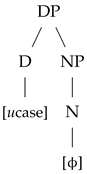 | (b) | 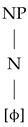 |
If the nominal projects a D head, it bears an uninterpretable case feature that must be licensed by a higher functional headl we take this projection to be v. If no D head is projected (as with reduplicated nominals), the phrase merges as an NP without an uninterpretable case feature, and it is not visible for case-licensing or -agreement, and remains VP-internal.4
Following Jenkins (2025), object shift is taken to target SpecvP. Referentiality is encoded as a formal feature [+Ref] that must be licensed at the vP edge, in line with approaches that treat discourse-related features as syntactically active (Miyagawa, 2010, 2017). On this view, only DPs bearing [+Ref] may occupy SpecvP, while nominals lacking this feature remain VP-internal. The relevant condition is stated in (19).
| (19) | Referential Licensing Condition (RLC) |
| For a DP to move to SpecvP, it must be [+Ref]. If a DP lacking a referential feature moves to SpecvP, the derivation crashes. |
In the present system, a non-reduplicated object is generated inside the VP as a DP bearing an uninterpretable case feature [uCase], which must be licensed by the higher head . To obtain this licensing, the DP raises to SpecvP, and gets accusative case. As per (19) only DPs specified as [+Ref] can undergo this movement. If a DP lacking [+Ref] attempts to move, the derivation crashes, since only permits referential nominals in its specifier.5 Conversely, reduplicated nominals are merged as NPs without D (Dayal, 2011). They lack both [uCase] and [+Ref], and thus cannot raise to SpecvP, and therefore cannot serve as goals for a higher probe. This derives their uniform VP-internal profile documented in Section 2.3.
Movement to SpecvP Has Two Direct Consequences:
- 1.
- By occupying the phase edge, the DP becomes accessible for further syntactic interactions, including probing by higher functional heads.6
- 2.
- At the interpretive interface, the DP is mapped outside the nuclear scope of VP and is therefore interpreted as referential, following Diesing (1992).
To conclude this section, under this system, “object shift” in Hindi–Urdu is not a stylistic or optional displacement but the syntactic reflex of a licensing relation between a referential DP and the head . DPs that satisfy the RLC must raise to SpecvP; those that cannot remain in situ.
4. Cross-Clausal Agreement
4.1. Specificity in Cross-Clausal Agreement
Yadav (2024) showed that referentiality plays a central role in the derivation of cross-clausal agreement (CCA) (20) and step-up agreement (SUA) (21) in Hindi–Urdu.7
| (20) | Rām-ne | roṭī | khānī | chāhī. | |
| Ram-erg | bread.f | eat.inf.f | want-pfv.f | ||
| ‘Ram wanted to eat the bread.’ (CCA: matrix and embedded verb agrees with | |||||
| embedded object) | (Bhatt, 2005) | ||||
| (21) | Rām-ne | roṭī | khānā | chāhī. | |
| Ram-erg | bread.f | eat.inf.m | want-pfv.m | ||
| ‘Ram wanted to eat the bread.’ (SUA: matrix verb agrees with embedded object while | |||||
| embedded shows default masculine) | (Yadav, 2024) | ||||
On the contrary, there is another pattern where both matrix verb and embedded verb show default masculine agreement (henceforth DA), as shown in (22).
| (22) | Rām-ne | rotī | khānā | chāhā. | |
| Ram-erg | bread.f | eat.inf.m | want-pfv.m | ||
| ‘Ram wanted to eat bread.’ (DA: matrix verb and embedded both show default | |||||
| masculine) | (Bhatt, 2005) | ||||
Yadav (2024) demonstrates that embedded objects in CCA/SUA contexts are VP-external, as diagnosed by the tests in Section 2.3. Table 1 summarizes these findings, showing the correlation between agreement type, position of the embedded object, and interpretation.
Table 1.
Agreement type, position of the object, and its interpretation.
More generally, linking agreement availability to a discourse-related property of the object fits a view where interpretive features are structurally distributed and inherited to lower phase heads (Jimenez-Fernandez & Spyropoulou, 2013). On this view, a [+Ref] feature on the object facilitates its movement to a structurally high position (object shift), from where it can enter into an agree relation with functional probes (like v/T) bearing unvalued -features, thereby enabling agreement across a clause boundary. Cross-clausal agreement is thus conditioned by interpretive strength rather than by -content alone. Cross-linguistic support comes from heritage grammars where discourse-linked licensing leaves a syntactic footprint (Frasson, 2022).
As shown in Section 2, reduplicated objects in Hindi are interpreted as similative and resist referentiality, while the focus particle hī enforces a referential reading, the framework predicts two clear outcomes. First, if CCA and SUA depend on the object being referential and syntactically high, then these constructions should be ungrammatical with reduplicated nominals, which lack the features required for object shift. Second, if hī-marked objects require referentiality and movement, hī should be allowed only in CCA and SUA and excluded in DA.
These predictions are borne out. As shown below, reduplicated nominals such as chāy-vāy ‘tea-like things’ fail to trigger agreement in CCA/SUA but are grammatical in DA, where no agreement is established.
| (23) | a. | *John-ne | chāy-vāy | pīnī | chāhī. | |
| John-erg | tea.f-red | drink.inf.f | want.pfv.f | |||
| ‘John wanted to drink tea-like beverages.’ | [CCA] | |||||
| b. | *John-ne | chāy-vāy | pīnā | chāhī. | ||
| John-erg | tea.f-red | drink.inf.m | want.pfv.f | |||
| ‘John wanted to drink tea-like beverages.’ | [SUA] | |||||
| c. | John-ne | chāy-vāy | pīnā | chāhā. | ||
| John-erg | tea.f-red | drink.inf.m | want.pfv.m | |||
| ‘John wanted to drink tea-like beverages.’ | [DA] | |||||
Conversely, when the object bears hī, only CCA and SUA are grammatical. The presence of hī enforces specificity and exhaustivity, requiring the object to be syntactically high and semantically referential. In DA, the object remains low and non-specific, and association with hī is impossible.
| (24) | a. | John-ne | ice-cream | hī | khānī | chāhī. | |
| John-erg | ice-cream.f | only | eat.inf.f | want.pfv.f | |||
| ‘John wanted to eat only the ice-cream.’ | [CCA] | ||||||
| b. | John-ne | ice-cream | hī | khānā | chāhī. | ||
| John-erg | ice-cream.f | only | eat.inf.m | want.pfv.f | |||
| ‘John wanted to eat only the ice-cream.’ | [SUA] | ||||||
| c. | *John-ne | ice-cream | hī | khānā | chāh. | ||
| John-erg | ice-cream.f | only | eat.inf.m | want.pfv.m | |||
| Intended: ‘John wanted to eat only the ice-cream.’ | [DA] | ||||||
In sum, CCA and SUA occur only when the embedded object is syntactically raised and referentially strong. Reduplicated objects, being anti-specific, remain in their base position and therefore cannot participate in long-distance agreement.
4.2. Semantics of Cross-Clausal Agreement
The syntactic diagnostics discussed above show that CCA and SUA depend on the raised position of specific objects. The interpretive consequences of this configuration are considered next. In particular, the interaction between syntactic height and intensional verbs such as chāh ‘want’ yields the familiar de re/de dicto contrast, roughly corresponding to the de re/de dicto distinction.
Following von Fintel and Heim (2011), chāh is assumed to denote a relation between an individual and a proposition: it maps an individual x and a property P to true if, in all worlds compatible with x’s desires, P holds. The crucial difference arises when object argument is introduced. When the object is merged and interpreted inside the embedded infinitival clause, its existential quantifier remains within the scope of the attitude predicate, yielding a non-specific (de dicto) interpretation. When the object raises out of the embedded clause and is interpreted in the higher matrix domain, it takes wide scope over chāh, resulting in a specific (de re) interpretation.
| (25) | a. | John-ne | ek | gaṛī | kharīdnā | chāhā. |
| John-erg | one | car | buy.inf.m | want.pfv.m | ||
| ‘John wanted to buy a car.’ (de dicto) | ||||||
| b. | John-ne | ek | gaṛī | kharīdnī | chāhī. | |
| John-erg | one | car | buy.inf.f | want.pfv.f | ||
| ‘John wanted to buy a particular car.’ (de re) | ||||||
In (25a), agreement defaults to masculine and the object receives a narrow-scope interpretation: John buys a car in each of his desired worlds. In (25b), agreement reflects the features of the object, indicating that it has raised to a higher syntactic position. This movement allows the object to take scope over the attitude predicate, giving the reading that there is a particular car, identifiable in the actual world—that John wanted to buy. Thus, the difference in agreement morphology directly correlates with a difference in scope and interpretation.
A simplified representation of the compositional difference is shown in (26).
| (26) | a. | DA (de dicto): | |
| b. | CCA (de re): |
In the first configuration, the existential quantifier is inside the complement of ‘want’, producing the reading “John wanted there to be a car that he buys.” In the second, the object raises and its quantifier takes scope over want, yielding “There is a particular car that John wants to buy.” The change in agreement morphology—from masculine default to feminine or number-matching agreement—reflects this shift in syntactic domain and, correspondingly, in semantic scope.8
Importantly, this account requires no additional stipulations about the semantics of chāh. The interpretive contrast follows from the independently motivated movement of specific objects. Thus, the syntax of CCA encodes a meaningful semantic distinction: agreement marks the object as referentially anchored and interpreted outside the intensional predicate’s scope. This unified account connects agreement, specificity, and interpretation within a single structural framework.
5. Conclusions
This study has shown that object reduplication, the focus particle hī, and cross-clausal agreement in Hindi–Urdu converge on a single structural principle: the syntactic encoding of referentiality. Across these apparently distinct domains, the same interpretive contrast recurs. Nominals that introduce discourse referents, i.e., those that are specific or definite, undergo syntactic raising into a higher functional projection, while vague or non-referential nominals, such as reduplicated forms, remain in their base position within the VP.
Reduplicated nominals provide clear evidence of this structural division. They systematically resist markers of specificity and definiteness, fail to anchor discourse referents, and are incompatible with topicalization, pronominal resumption, or the differential object marker ko. In contrast, the focus particle hī enforces exhaustivity and reference, targeting only nominals that are syntactically raised and interpretable as specific. A parallel pattern appears in cross-clausal agreement, where agreement with embedded objects arises only when those objects are raised and interpreted as referential. Reduplicated nominals, by contrast, remain low, inaccessible to agreement or focus probes, and are interpreted existentially within the predicate domain.
The proposed analysis captures these converging patterns through the Referential Licensing Condition (RLC), which ties the availability of higher syntactic positions to the presence of a referential feature. Movement of a DP to SpecvP is thus not optional but a syntactic reflex of referential licensing. Only DPs bearing a referential feature may undergo this movement, resulting in agreement, focus association, and wide-scope readings. NPs lacking this feature remain in situ and yield anti-specific interpretations.
These findings contribute to a broader understanding of how the syntax–semantics interface organizes interpretation. Hindi–Urdu provides direct evidence that referentiality is structurally encoded, with morphological and interpretive effects arising from a single configurational asymmetry. The convergence of reduplication, focus, and agreement therefore supports a unified architecture in which interpretive type aligns systematically with syntactic position. Referentially strong nominals occupy derived positions where they interact with higher functional heads, while non-referential nominals remain within the predicate domain, invisible to those dependencies.
More broadly, this study reinforces the cross-linguistic generalization that specificity and clause structure are intimately linked. In Hindi–Urdu, as in other languages, the syntax renders visible distinctions of referential strength that are semantically motivated but grammatically realized; and syntactic movement not only establishes licensing relations but also determines how nominals participate in discourse and interpretation.
Author Contributions
P.Y. and and G.C.M. conceived of the present idea. P.Y. developed the theoretical formalism and wrote the final version of the manuscript. All authors have read and agreed to the published version of the manuscript.
Funding
This research received no external funding.
Institutional Review Board Statement
Not applicable.
Informed Consent Statement
Not applicable.
Data Availability Statement
The data that support the findings of this study are available on request from the corresponding author.
Conflicts of Interest
The authors declare no conflicts of interest.
Abbreviations
The following abbreviations are used in this manuscript:
| CCA | Cross-Clausal Agreement |
| DA | Default Agreement |
| DOM | Differential Object Marking |
| f | Feminine |
| m | Masculine |
| pfv | Perfective |
| pl | Plural |
| red | Reduplication marker |
| sg | Singular |
| SUA | Step-Up Agreement |
Notes
| 1 | As suggested by an anonymous reviewer, a clearer example would be to demonstrate that the focus-sensitive particle hī is incompatible with non-specific objects. Since bare nouns in Hindi-Urdu are ambiguous between specific and non-specific interpretations, we use koi, an existential determiner, to disambiguate the intended reading. As shown below in (i) and (ii), hī cannot appear with non-specific objects.
| ||||||||||||||||||||||||||||||||||||
| 2 | When such objects receive a referential interpretation, they most naturally take scope over negation and, without special contextual support, resist a narrow-scope reading. | ||||||||||||||||||||||||||||||||||||
| 3 | The sentence allows two readings. On one reading (NEG > tea), Narendra never made tea at all. On the other reading (tea > NEG), there is a specific tea that he never made. This ambiguity is not available with reduplicated objects. | ||||||||||||||||||||||||||||||||||||
| 4 | Assuming case is valued via downward probing Bošković (2021, 2024) a DP can establish an Agree relation with v even when not in SpecvP, provided it c-commands the licensing head from a higher position. This model predicts that movement to SpecFP yields the same morphological Case marking as movement to SpecvP, but without the interpretive restrictions typically associated with object shift. | ||||||||||||||||||||||||||||||||||||
| 5 | When an accusative object appears in a clause-medial position, it must be interpreted as referential, because movement to SpecvP is restricted to such DPs. | ||||||||||||||||||||||||||||||||||||
| 6 | This becomes relevant for cross-clausal agreement and step-up agreement, discussed in the next section. | ||||||||||||||||||||||||||||||||||||
| 7 | Earlier studies on cross-clausal agreement in Hindi-Urdu had also observed that embedded objects that control agreement are typically specific or definite (Butt, 1995; Davison, 1991; Hook, 1979; Mahajan, 1990). However, these analyses were not developed to capture this distinction. | ||||||||||||||||||||||||||||||||||||
| 8 | The fact that wide-scope (de re) readings align with positions licensed by discourse-related features fits the broader claim that interpretive features are encoded in the narrow syntax and regulate movement (Jimenez-Fernandez & Spyropoulou, 2013; Miyagawa, 2010, 2017). | ||||||||||||||||||||||||||||||||||||
References
- Abbi, A. (1975). Reduplication in Hindi: A generative semantic study [Ph.D. dissertation, Cornell University]. [Google Scholar]
- Beaver, D., & Clark, B. (2008). Sense and sensitivity: How focus determines meaning. Wiley-Blackwell. [Google Scholar]
- Bhatt, R. (2005). Long distance agreement in Hindi-Urdu. Natural Language & Linguistic Theory, 757–807. [Google Scholar]
- Bhatt, R., & Anagnostopoulou, E. (1996). Object shift and specificity: Evidence from ko-phrases in Hindi. In L. Dobrin, K. Singer, & L. McNair (Eds.), Proceedings of the 32nd annual meeting of the chicago linguistic society (CLS 32) (pp. 11–22). Chicago Linguistic Society. [Google Scholar]
- Bošković, Ž. (2021). Merge, move, and contextuality of syntax: The role of labeling, successive-cyclicity, and EPP effects [Manuscript]. University of Connecticut. [Google Scholar]
- Bošković, Ž. (2024). The comp-trace effect and contextuality of the EPP. In R. Autry, P. de Lacy, S. O’Hara, & C. Santori (Eds.), Proceedings of the 39th west coast conference on formal linguistics (pp. 71–81). Cascadilla proceedings project. [Google Scholar]
- Butt, M. (1995). The structure of complex predicates in Urdu. CSLI Publications. [Google Scholar]
- Butt, M., & King, T. H. (2006). The status of case. In M. Butt, T. H. King, & G. Ramchand (Eds.), Proceedings of the LFG06 conference (pp. 144–162). CSLI Publications. [Google Scholar]
- Davison, A. (1991). Feature percolation and agreement in Hindi/Urdu [Manuscript]. University of Iowa. [Google Scholar]
- Dayal, V. (2011). Hindi pseudo-incorporation. Natural Language & Linguistic Theory, 29(1), 123–167. [Google Scholar] [CrossRef] [Scilit]
- Diesing, M. (1992). Indefinites. MIT Press. [Google Scholar]
- Frasson, A. (2022). The syntax of subject pronouns in heritage languages. LOT Publications. [Google Scholar]
- Heim, I. (1982). The semantics of definite and indefinite noun phrases [Ph.D. dissertation, University of Massachusetts Amherst]. [Google Scholar]
- Hook, P. (1979). Hindi structures: Intermediate level. Center for South and Southeast Asian Studies, University of Michigan. [Google Scholar]
- Jenkins, R. (2025). Scrambling, specificity effects, and phasal variation in Turkish and Uyghur. Linguistic Inquiry. [Google Scholar] [CrossRef] [Scilit]
- Jiménez-Fernández, Á., & Spyropoulou, V. (2013). Feature inheritance, vP phases and the information structure of small clauses. Studia Linguistica, 67(2), 185–224. [Google Scholar] [CrossRef] [Scilit]
- Kidwai, A. (2000). XP-adjunction in universal grammar: Scrambling and binding in Hindi-Urdu. Oxford University Press. [Google Scholar]
- Kiss, K. É. (1998). Identificational focus versus information focus. Language, 74(2), 245–273. [Google Scholar] [CrossRef] [Scilit]
- Kornfilt, J. (1997). Turkish. Routledge. [Google Scholar]
- Kornfilt, J. (2003). Scrambling, subscrambling, and case in Turkish. In S. Karimi (Ed.), Word order and scrambling (pp. 125–155). Blackwell Publishing. [Google Scholar]
- Krifka, M. (1992). A compositional semantics for multiple focus constructions. In J. Jacobs (Ed.), Informationsstruktur und grammatik (pp. 17–53). Westdeutscher Verlag. [Google Scholar]
- Lahiri, U. (1998). Focus and negative polarity in Hindi. Natural Language Semantics, 6(1), 57–123. [Google Scholar] [CrossRef] [Scilit]
- Mahajan, A. (1990). The A/A-bar distinction and movement theory [Ph.D. dissertation, MIT]. [Google Scholar]
- Massam, D. (2001). Pseudo noun incorporation in Niuean. Natural Language and Linguistic Theory, 19(1), 153–197. [Google Scholar] [CrossRef] [Scilit]
- Miyagawa, S. (2010). Why agree? Why move? Unifying agreement-based and discourse-configurational languages. MIT Press. [Google Scholar]
- Miyagawa, S. (2017). Agreement beyond Phi. MIT Press. [Google Scholar]
- Montaut, A. (2009). Reduplication and echo words in Hindi/Urdu. In R. Singh (Ed.), Annual review of south asian languages and linguistics (pp. 21–91). Mouton de Gruyter. [Google Scholar]
- Moravcsik, E. A. (1978). Reduplicative constructions. In J. H. Greenberg (Ed.), Universals of human language, volume 3: Word structure (pp. 297–334). Stanford University Press. [Google Scholar]
- Smith, R. (2020). Similative plurality and the nature of alternatives. Semantics and Pragmatics, 13, 1–44. [Google Scholar] [CrossRef] [Scilit]
- von Fintel, K., & Heim, I. (2011). Intensional semantics [Unpublished lecture notes]. MIT.
- von Heusinger, K. (2002). Specificity and definiteness in sentence and discourse structure. Journal of Semantics, 19(3), 245–274. [Google Scholar] [CrossRef] [Scilit]
- Yadav, P. (2024). Patterns and conditions in cross-clausal agreement in Hindi-Urdu. In S. Phadnis, C. Spellerberg, & B. Wilkinson (Eds.), NELS 54: Proceedings of the fifty-fourth annual meeting of the north east linguistic society (Vol. 1, pp. 225–234). GLSA. [Google Scholar]

Disclaimer/Publisher’s Note: The statements, opinions and data contained in all publications are solely those of the individual author(s) and contributor(s) and not of MDPI and/or the editor(s). MDPI and/or the editor(s) disclaim responsibility for any injury to people or property resulting from any ideas, methods, instructions or products referred to in the content. |
© 2026 by the authors. Licensee MDPI, Basel, Switzerland. This article is an open access article distributed under the terms and conditions of the Creative Commons Attribution (CC BY) license.