
Unstable Boundaries: Phonological Change and Morphosyntactic Ambiguity in Contemporary Sardinian

Abstract
1. Introduction
2. External Sandhi Phenomena Affecting Morphemes
2.1. Assimilations
| (1) | |
| a. | /papas pani/ [ˈpapːas ˈpani] ‘(you) eat bread’ |
| b. | /papas tamata/ [ˈpapːas taˈmːatːa] ‘(you) eat tomatoes’ |
| c. | /papas kasu/ [ˈpapːas ˈkazu] ‘(you) eat cheese’ |
| d. | /papas fiɡu/ [ˈpapːas ˈfiɣu] ‘(you) eat figs’ |
| e | /papas sali/ [ˈpapːa ˈsːali] ‘(you) eat salt’ |
| f. | /papas ʧeresia/ [ˈpapːa ʃːeˈrezia] ‘(you) eat cherries’ |
| (2) | |
| a. | /tɛnis baska mɛda/ [ˈtɛnir ˈbaska ˈmːɛða] ‘(you) are very hot’ (lit. ‘(you) have much heat’) |
| b. | /tɛnis disiʎu/ [ˈtɛnir diˈziʎːu] ‘(you) feel longing/nostalgia (for something)’ |
| c. | /tɛnis ɡana mala/ [ˈtɛnir ˈɡana ˈmːala] ‘(you) feel nauseous’ (lit. ‘(you) have bad desire’) |
| (3) | |
| a. | /tɛnis bakas/ [ˈtɛnir ˈβakːaza] ‘(you) have/own cows’ |
| b. | /tɛnis dinari mɛda/ [ˈtɛnir ðiˈnari ˈmːɛða] ‘(you) have a lot of money’ |
| c. | /pɔrtas ɡanɡas fortis/ [ˈpɔrtar ˈɣaŋɡas ˈfɔrtizi] ‘(you) have a strong voice’ (lit. ‘(you) carry a strong voice’) |
| d. | /tɛnis ʤenuɡus sanus/ [ˈtɛnir ʤeˈnuɣus ˈsanuzu] ‘your knees are fine’ (lit. ‘(you) have healthy knees’) |
| (4) | |
| a. | /papas latua/ [ˈpapːar ˈlatːua] ‘(you) eat lettuce’ |
| b. | /papas mendula/ [ˈpapːar ˈmendula] ‘(you) eat almonds’ |
| c. | /papas nuʤi/ [ˈpapːar ˈnuʤːi] ‘(you) eat walnuts’ |
| (5) | |
| a. | /papat pani/ [ˈpapːa ˈpːani] ‘(s/he) eats bread’ |
| b. | /papat tamata/ [ˈpapːa tːaˈmːatːa] ‘(s/he) eats tomatoes’ |
| c. | /papat kasu/ [ˈpapːa ˈkːazu] ‘(s/he) eats cheese’ |
| d. | /papat fiɡu/ [ˈpapːa ˈfːiɣu] ‘(s/he) eats figs’ |
| e | /papat sali/ [ˈpapːa ˈsːali] ‘(s/he) eats salt’ |
| f. | /papat ʧeresia/ [ˈpapːa ʧːeˈrezia] ‘(s/he) eats cherries’ |
| (6) | |
| a. | /tɛnit baska mɛda/ [ˈtɛni ˈbːaska ˈmːɛða] ‘(lit. ‘(s/he) has much heat’) |
| b. | /tɛnit disiʎu/ [ˈtɛni dːiˈziʎːu] ‘(s/he) feels longing/nostalgia (for something)’ |
| c. | /tɛnit ɡana mala/ [ˈtɛni ˈɡːana ˈmːala] ‘(s/he) feels nauseous’ |
| (7) | |
| a. | /tɛnit bakas/ [ˈtɛni ˈβakːaza] ‘(s/he) has/owns cows’ |
| b. | /tɛnit dinari mɛda/ [ˈtɛni ðiˈnari ˈmːɛða] ‘(s/he) has a lot of money’ |
| c. | /pɔrtat ɡanɡas fortis/ [ˈpɔrta ˈɣaŋɡas ˈfɔrtizi] ‘(s/he) has a strong voice’ (lit. ‘(s/he) carries a strong voice’) |
| d. | /tɛnit ʤenuɡus sanus/ [ˈtɛni ʤːeˈnuɣus ˈsanuzu] ‘his/her knees are fine’ (lit. ‘(s/he) has healthy knees’) |
| (8) | |
| a. | /papat latua/ [ˈpapːa ˈlːatːua] ‘(s/he) eats lettuce’ |
| b. | /papat mendula/ [ˈpapːa ˈmːendula] ‘(s/he) eats almonds’ |
| c. | /papat nuʤi/ [ˈpapːa ˈnːuʤːi] ‘(s/he) eats walnuts’ |
2.2. Vowel Insertion
3. Weakening of Final Codas in Campidanese
4. Conclusions
Funding
Institutional Review Board Statement
Informed Consent Statement
Data Availability Statement
Acknowledgments
Conflicts of Interest
| 1 | In central-northern Sardinia, Logudorese varieties are spoken, differing from Campidanese varieties in various phonological, morphological, and lexical respects (Lai, 2022a; Mensching & Remberger, 2016; Pisano, 2015, 2016; among others). |
| 2 | Several features distinguish the Ogliastra region from the rest of the Campidanese domain. The Ogliastra varieties, together with those of the Lower Barbagia, still maintain a phonological distinction between voiced stops in the native lexicon and those found in loanwords (Wagner, 1941/1984, pp. 138–141; Lai, 2022a, p. 615), a contrast that has been lost in the southernmost varieties. They also retain rhotics in coda position, a possibility that no longer exists in the southern varieties due to metathesis processes that have led to the elimination of these segments in that position (Lai, 2015a, pp. 282–289). Moreover, like other Campidanese varieties, they have developed prosthesis in words with an initial rhotic; however, whereas in the southern varieties the vowel is invariably [a] (e.g., rota > [arˈrɔða] ‘wheel’), in Ogliastra and Lower Barbagia the quality of the vowel is determined by a vowel-copying pattern (e.g., rota > [orˈrɔða] ‘wheel’), as was also the case in the Middle Ages in areas farther south (Wagner, 1941/1984, pp. 95–97; Lai, 2022a, p. 613). |
| 3 | The word-final fricative -s is followed by a paragogic vowel that copies the final vowel of the word (Lai, 2022a, pp. 612–613). |
| 4 | |
| 5 | I will not dwell here on the phonological behavior of the voiced stops inherited from Latin. This aspect of Sardinian phonology has been the subject of scholarly investigation since Wagner (1941/1984). For a detailed phonological analysis and a comprehensive review of the literature, the reader is referred to Lai (2022b, pp. 71–89). |
| 6 | These two studies also examine other Sardinian varieties—Nuoro, Cargeghe, and Buddusò—but since these belong to the Logudorese group, they will not be considered in the present study. |
| 7 | In /papas ʧeresia/, where /ʧ/ is preceded by the coda /-s/, there is first a partial assimilation (in terms of place of articulation) of /s/ to [ʃ]. Subsequently, /ʧ/ undergoes total assimilation to [ʃ], yielding [ˈpapːa ʃːeˈrezia]. |
| 8 | The difference between the voiced obstruents in (2) and those in (3) lies in the fact that the latter belong to the native lexicon, whereas the former occur in borrowings from Catalan, Spanish, or Italian. These correspond to two distinct phonological lexicons that obey different phonological rules (Lai, 2022a, pp. 614–616, 2022b, pp. 71–89). With respect to the realization of the word-final coda, however, they do not display any differences. |
| 9 | |
| 10 | The coda surfaces only when the verb in the third person singular occurs in isolation. In that case, a paragogic vowel is inserted, copying the final vowel of the word, e.g., [ˈtɛniði] ‘(s/he) holds/has’, [ˈpapːaða] ‘(s/he) eats’ (Lai, 2022a, pp. 612–613). |
| 11 | |
| 12 | Here and throughout the remainder of the paper, the epenthetic vowel under discussion will be enclosed in square brackets, in addition to the brackets used for phonetic transcription. |
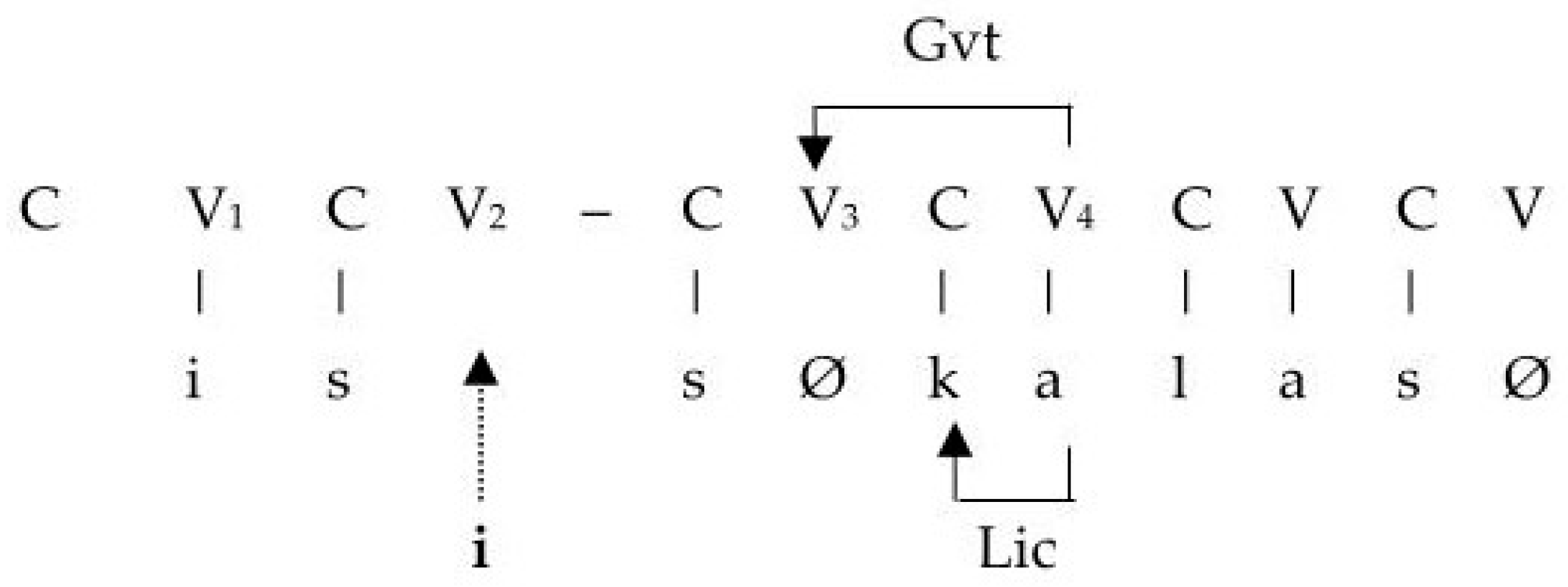
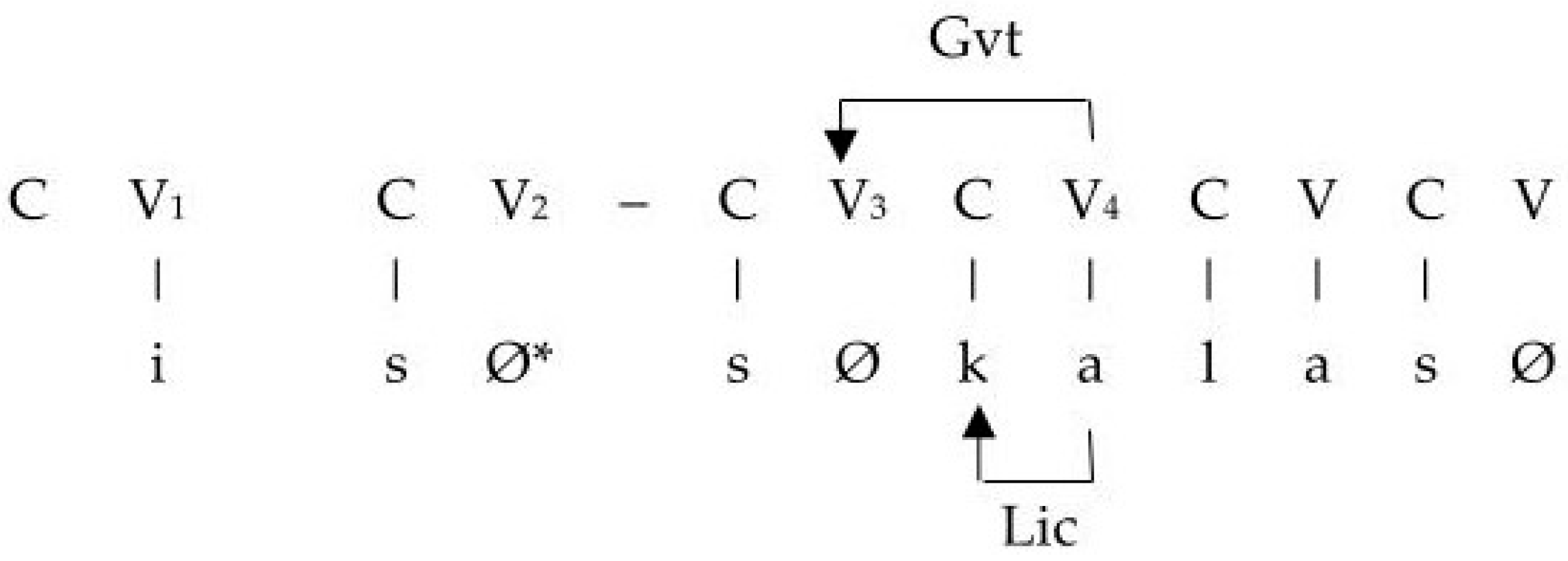
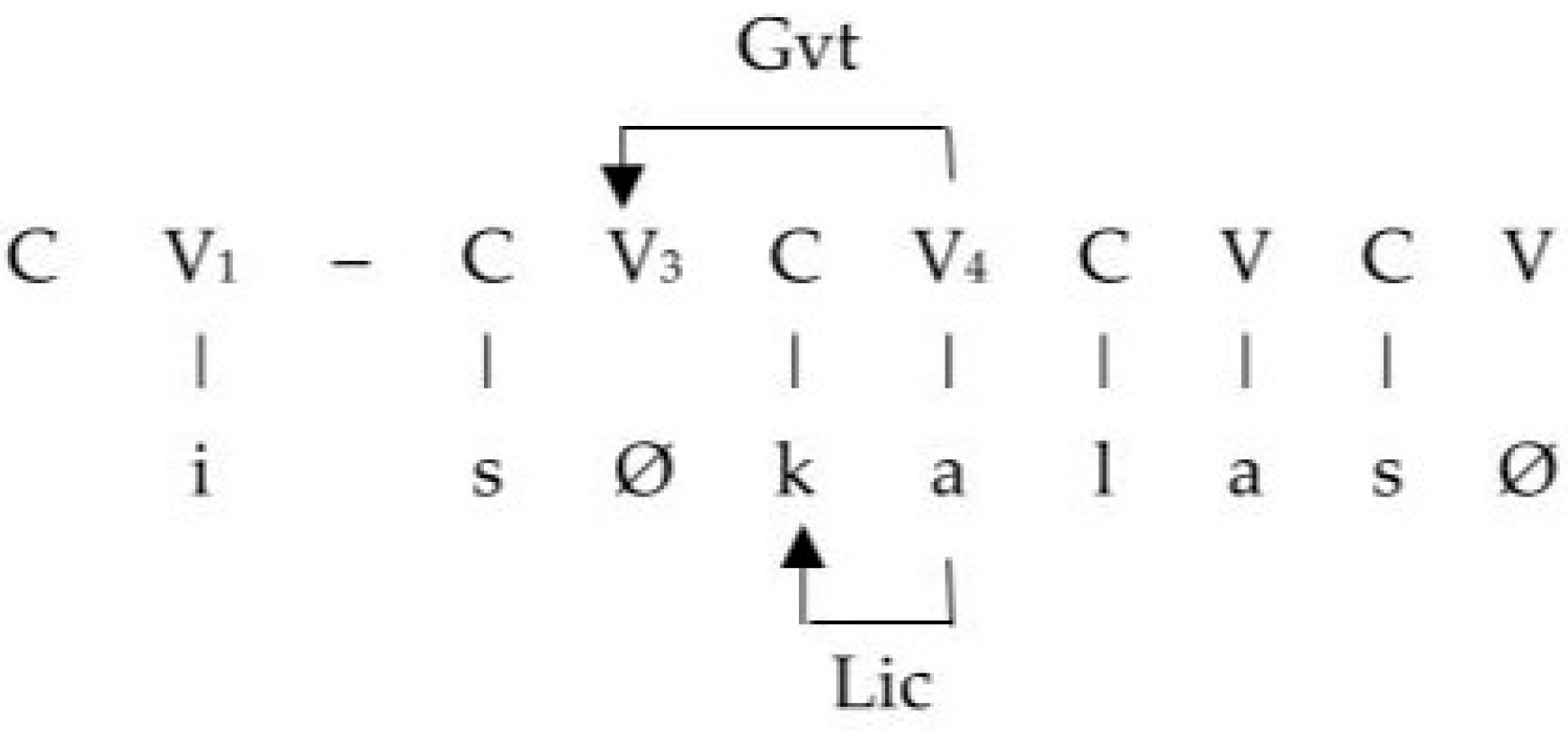
| 13 | In this paper, I will refer to this type of vowel insertion as ‘epenthesis’. It is true that, depending on the theoretical framework adopted, it may be analyzed either as an epenthetic vowel inserted before the heterosyllabic cluster or as a paragogic vowel inserted into the empty vocalic slot associated with the final coda. As Schuchardt (1874, p. 2, note 1) already observed with regard to a comparable phenomenon in Italian—the insertion of a vowel between a word-final coda and an sC cluster—“Dans ce dernier cas, l’i appartient aussi bien à un mot qu’à l’autre”. To highlight this ambivalent status, in the present contribution the epenthetic vowel will be indicated in the IPA transcription by means of an additional pair of square brackets within the brackets enclosing the entire phonetic transcription, e.g., [iz [i] sˈkalaza] ‘the stairs’. |
| 14 | A reviewer suggests that, with respect to non-epenthetic realizations, there may be a hierarchical ordering whereby functional forms (e.g., determiners or prepositions) and/or clitics (pronouns) are affected earlier than full lexical words. The data currently available appear to be consistent with this hypothesis. However, a more extensive dataset would be required to confirm this generalization more robustly. |
| 15 | A reviewer points out that an alternative analysis would be to treat the coda /-s/ as a floating segment, given that the sibilant surfaces only in a specific context (i.e., before a vowel). One further line of analysis is provided in Lai (2022b, p. 58), where I examine similar data, focusing less on the phonological nature of the coda /s/ and more on the structure of sC clusters. In that monograph, for innovative varieties such as Pula, I adopt the approach proposed by Scheer and Ségéral (2020, pp. 199+201), whereby the sibilant in sC clusters branches onto the following nucleus. |
References
- Charette, M. (1990). Licence to govern. Phonology, 7, 233–253. [Google Scholar] [CrossRef] [Scilit]
- Contini, M. (1986). Les phénomènes de sandhi dans le domaine sarde. In H. Andersen (Ed.), Sandhi phenomena in the languages of Europe (pp. 519–550). De Gruyter Mouton. [Google Scholar]
- Cossu, M. G. (2013). Unità e variabilità fonetiche delle parlate sarde meridionali. Dell’Orso. [Google Scholar]
- Harris, J. (1990). Segmental complexity and phonological government. Phonology, 7, 255–300. [Google Scholar] [CrossRef] [Scilit]
- Kaye, J. (1992). Do you believe in magic? The story of s+C sequences. SOAS Working Papers in Linguistics and Phonetics, 2, 292–313. [Google Scholar]
- Kaye, J., Lowenstamm, J., & Vergnaud, J.-R. (1985). The internal structure of phonological representations. Phonology Yearbook, 2, 305–328. [Google Scholar] [CrossRef] [Scilit]
- Kaye, J., Lowenstamm, J., & Vergnaud, J.-R. (1990). Constituent structure and government in phonology. Phonology, 7, 193–232. [Google Scholar] [CrossRef] [Scilit]
- Lai, R. (2015a). Lateral relations in Sardinian metathesis: A unified account. In D. Russo (Ed.), The notion of syllable across history, theories and analysis (pp. 264–293). Cambridge Scholars Publishing. [Google Scholar]
- Lai, R. (2015b). Word-initial geminates in Sardinian. Quaderni di Linguistica e Studi Orientali, 1, 37–60. [Google Scholar] [CrossRef] [Scilit]
- Lai, R. (2022a). 19 Sardinian. In C. Gabriel, R. Gess, & T. Meisenburg (Eds.), Manual of Romance phonetics and phonology (pp. 597–627). De Gruyter. [Google Scholar]
- Lai, R. (2022b). Fenomeni di sandhi esterno in sardo campidanese. Edizioni Dell’Orso. [Google Scholar]
- Lai, R. (2025). La tipologia dei parlanti di lingue di minoranza: Tradizionali, ereditari e neo-parlanti. Quaderni di Linguistica e Studi Orientali, 11, 147–164. [Google Scholar] [CrossRef] [Scilit]
- Lowenstamm, J. (1996). CV as the only syllable type. In J. Durand, & B. Laks (Eds.), Current trends in phonology: Models and methods (pp. 419–442). European Studies Research Institute. [Google Scholar]
- Mensching, G., & Remberger, E.-M. (2016). Sardinian. In A. Ledgeway, & M. Maiden (Eds.), The Oxford guide to the Romance languages (pp. 270–291). Oxford University Press. [Google Scholar]
- Molinu, L. (1992). Gli esiti fonosintattici del dialetto di Buddusò. L’Italia Dialettale, 55, 123–153. [Google Scholar]
- Molinu, L. (2006). L’allophonie de /s/ et /r/ dans le logoudorien occidental. Cahiers de Grammaire, 30, 277–289. [Google Scholar]
- Molinu, L., & Pisano, S. (2016). Riflessioni sulle realizzazioni di /s/ in alcune parlate sarde confrontate con quelle di altre varietà romanze. In F. Rainer, M. Russo, & M. Sanchez Miret (Eds.), Actes du XXVIIe congrès international de linguistique et de philologie romanes (Nancy, 15–20 juillet 2013) (pp. 129–139). ELiPhi. [Google Scholar]
- Mura, P. (2025). Elementi di purismo linguistico nel sardo scritto dei nuovi contesti d’uso: Un confronto con il parlato (semi)spontaneo. Lingue Antiche e Moderne, 14, 203–229. [Google Scholar]
- Pisano, S. (2010). Esiti fonosintattici e desinenze verbali in alcune varietà sarde: Verso la confluenza delle desinenze di seconda e terza singolare -s e -t? In P. Del Puente (Ed.), Dialetti: Per parlare e parlarne, atti del I convegno internazionale di dialettologia-progetto A.L.Ba. (pp. 175–190). EditricErmes. [Google Scholar]
- Pisano, S. (2015). Importanza del superstrato catalano, castigliano e italiano in alcune varietà sarde moderne: Aspetti lessicali, fonetici e morfosintattici. In L. Filipponio, & C. Seidl (Eds.), Le lingue d’Italia e le altre. Contatti, sostrati e superstrati nella storia linguistica della Penisola (pp. 149–165). Franco Angeli. [Google Scholar]
- Pisano, S. (2016). Il sistema verbale del sardo moderno: Tra conservazione e innovazione. ETS. [Google Scholar]
- Pisano, S. (2025). Che sardo si parla nei media televisivi e radiofonici? Appunti sulla lingua di neoparlanti al microfono. Lingue Antiche e Moderne, 14, 231–262. [Google Scholar]
- Rohlfs, G. (1966). Grammatica storica della lingua italiana e dei suoi dialetti, Fonetica (Vol. 1). Einaudi. [Google Scholar]
- Scheer, T. (2004). A lateral theory of phonology. What is CVCV and why should it be? Mouton de Gruyter. [Google Scholar]
- Scheer, T., & Ségéral, P. (2020). Elastic s+C and left-moving yod in the evolution from Latin to French. Probus, 32(2), 183–208. [Google Scholar] [CrossRef] [Scilit]
- Schuchardt, H. (1874). Les modifications syntactiques de la consonne initiale dans les dialectes de la Sardaigne, du centre et du sud de l’Italie. Romania, 9, 1–30. [Google Scholar]
- Virdis, M. (1978). Fonetica del dialetto sardo campidanese. Della Torre. [Google Scholar]
- Virdis, M. (2018). Sociolinguistica storica nella Sardegna medievale. Aspetti, problemi, affioramenti: Fra dialettologia e filologia. In G. Paulis, I. Putzu, & M. Virdis (Eds.), Il sardo medievale. Tra sociolinguistica storica e ricostruzione linguistico-culturale (pp. 11–34). Franco Angeli. [Google Scholar]
- Wagner, M. L. (1984). Fonetica storica del sardo. In Introduzione, traduzione e appendice di Giulio Paulis. Trois. (Original work published 1941). [Google Scholar]


Disclaimer/Publisher’s Note: The statements, opinions and data contained in all publications are solely those of the individual author(s) and contributor(s) and not of MDPI and/or the editor(s). MDPI and/or the editor(s) disclaim responsibility for any injury to people or property resulting from any ideas, methods, instructions or products referred to in the content. |
© 2026 by the author. Licensee MDPI, Basel, Switzerland. This article is an open access article distributed under the terms and conditions of the Creative Commons Attribution (CC BY) license.
Share and Cite
Lai, R. Unstable Boundaries: Phonological Change and Morphosyntactic Ambiguity in Contemporary Sardinian. Languages 2026, 11, 85. https://doi.org/10.3390/languages11050085
Lai R. Unstable Boundaries: Phonological Change and Morphosyntactic Ambiguity in Contemporary Sardinian. Languages. 2026; 11(5):85. https://doi.org/10.3390/languages11050085
Chicago/Turabian StyleLai, Rosangela. 2026. "Unstable Boundaries: Phonological Change and Morphosyntactic Ambiguity in Contemporary Sardinian" Languages 11, no. 5: 85. https://doi.org/10.3390/languages11050085
APA StyleLai, R. (2026). Unstable Boundaries: Phonological Change and Morphosyntactic Ambiguity in Contemporary Sardinian. Languages, 11(5), 85. https://doi.org/10.3390/languages11050085