


Abstract
Several southern Italian dialects show a systematic alternation in the forms of the third person object clitic between proclisis and enclisis; moreover, in proclisis, the object clitic and the definite article have different forms that alternate between prevocalic and preconsonantal contexts. On the whole, the distribution of forms constitutes a varied and complex picture, which has often been treated in terms of allomorphy. In particular, this article examines the arrangement of proclitic forms in the Neapolitan variety in which the forms are distributed according to three different patterns. The article explores the possibility of analysing the alternations in purely phonological terms, using the representational tools of “floating melody”, “stress space” and “virtual geminate”. The results obtained are encouraging: while some alternations have proven to be allomorphic in nature, a unified phonological explanation has been developed for challenging issues, including the so-called “l-deletion” and the corresponding vowel lengthening.
1. Introduction
Several Italo-Romance dialects, distributed discontinuously in an area extending from Lazio to Puglia, Calabria, Sicily (cf. Rohlfs, 1968), and Corsica, show an alternation between different forms of the object clitic pronoun and, in relevant contexts, the definite article derived from Latin ILLE, while in other Romance languages, including standard Italian and other Italian dialects, the clitic uniformly has the full shape consisting of the lateral-vowel sequence /lV/ (e.g., la, le, li, lo/lu), where /V/ realises the inflexion for gender and number. In general, in dialects that exhibit alternation, the third person clitic (3ACC hereafter) appears in proclisis in the shape /L/ (i.e., singleton or geminate lateral) or /V/, and in enclisis in the full shape /LV/. The distribution of alternating forms follows a complex pattern. On the one hand, it depends directly on phonological conditions, /L/ being selected before a word-initial vowel and /V/ before a word-initial consonant; however, on the other hand, the distribution is driven by a distinction between proclisis and enclisis, and therefore involves a syntactic variable. This distribution is generally considered to be an allomorphic alternation, in which the allomorphs /V/, /L/ and /LV/ are selected according to the phonological and syntactic context. As we will see in more detail, the alternation of the forms of the 3ACC clitic and of the definite article constitutes a more varied picture, due to the fact that /L/ can occur in different phonetic forms, giving rise to variation between geminate, singleton and silent lateral.
In a recent article, Manzini and Scheer (2026) deal with 3ACC alternations and propose an analysis of these phenomena with a twofold objective: on the one hand, to establish whether the alternation between enclitic and proclitic object pronouns can be explained without resorting to allomorphy and, on the other, to produce a theory in line with a strictly modular conception of grammar, concerning the way in which syntactic information is made available for phonological computation. Their analysis focuses on a set of dialects belonging to the corpus extracted from Manzini and Savoia (2005); in that set, the phonetic form of /L/ is uniformly the singleton [l]. As we will see, this uniformity is a crucial condition for the phonological side of their analysis.
In particular, the present article refers to the Neapolitan variety, in which in proclisis /L/ can be silent or take the form of a singleton or geminate lateral and in enclisis is a singleton, except in dative-accusative clitic clusters and in few other cases where it is geminate. These different forms of the lateral partly respond to phonological conditions and are therefore predicted by the grammar. In other respects, however, they represent a free variation between alternative options available to speakers. In fact, from data collected through fieldwork, it has emerged that, under the same phonological conditions, a same informant may produce [l] or [ll] or opt for “zero” realisation. However, this variation is not chaotic, since it is possible to recognise phonologically driven patterns in it. I believe that the adequate way to investigate the nature of this variation is to consider the different options as belonging to different grammars that coexist in speakers of the same linguistic community. However, the aim of this paper is not to analyse the variation from a sociolinguistic point of view. Rather, the purpose is to provide an explanation of the data by establishing a relation between phonetic forms and grammatical properties, whatever the reason may be for the existence of partially different grammars, which are available to the same speaker or within a given linguistic community.
With this in mind, we can identify three different patterns that emerge from the data relating to varieties from the Naples area. These patterns concern the behaviour of the lateral in proclitics (3ACC pronouns and definite articles), where we find:
- (i).
- Alternation [ll]/[l];
- (ii).
- Alternation [ll]/zero;
- (iii).
- [ll] in all contexts.
The three arrangements combine with a single pattern for enclisis, i.e., [lV] in all contexts, except in DAT=ACC clitic clusters and few other cases, where the lateral is a geminate. We will return to enclitics in Section 7.
None of the three patterns above fall within the purview of Manzini & Scheer’s analysis, and therefore a different account must be worked out for them. However, in the analysis proposed here, we will start from one of Manzini & Scheer’s insights that proves crucial in explaining the [ll]/zero alternation, the most puzzling of the three patterns just described.
The article is organised as follows. Section 2 provides an overview of the data relating to southern dialects; Section 3 presents the essential aspects of the phonological analysis by Manzini and Scheer (2026). The data on dialects from the Neapolitan variety are examined in greater detail in Section 4, which identifies three patterns governing the distribution of forms. Section 5 is devoted to the analysis of alternations in proclisis, and alternations in the presence of a negation are dealt with in Section 6. Section 7 gives a picture of 3ACC enclitics while Section 8 contains concluding remarks.
2. The Data
As already noted, the pattern with [V]/[L] in proclisis and the full form [LV] in enclisis is common to many dialects of central and southern Italy. Here, I will take into account the variability concerning the phonetic form of the lateral, which can be a singleton or a geminate and, in proclitic position, can also undergo deletion.
Let us first consider proclisis, bearing in mind that the observations concerning the 3ACC proclitic pronoun generally also apply to the definite article, which exhibits the same alternation between preconsonantal and prevocalic position. The preconsonantal form of proclitics is uniformly constituted by a vowel, which realises the features of gender and number. In this context, no alternations or variations are observed; however, the fact that the full form [LV] does not appear before a consonant has no obvious phonological motivation and needs to be explained. Conversely, the absence of [V] in prevocalic position seems to respond to a phonological preference that is very general in these languages, namely the avoidance of a hiatus. Nevertheless, the prevocalic forms of proclitics are actually the most problematic since they exhibit strong variation.
In some southern Italian dialects, the prevocalic lateral of proclitics can appear as a singleton or a geminate, depending on stress, in that [ll] and [l] occur before stressed and unstressed vowels, respectively (cf. Rohlfs, 1968, p. 111). In Neapolitan, the occurrence of [ll]/[l] tends to respect to the stress condition, although exceptions are not uncommon (cf. Ledgeway, 2009, pp. 171, 305; and see below, Section 4). The correlation with stress, although not exceptionless, is quite clear as far as the definite article is concerned. The same does not apply to the 3ACC pronoun, mainly because lexical verbs with an initial stressed vowel are extremely rare, if they exist at all, in these languages; in any case, they are not recorded in the data used for the present analysis and it has not been possible to elicit them. The only words with an initial stressed vowel preceded by a proclitic pronoun are those of avere, which is exclusively an auxiliary in the variety discussed here. In the forms of avere, there is variation between [ll] and [l]. For example, the present indicative first person [ˈadʤə] patterns with the nouns with an initial stressed vowel selecting [ll], as well with the nouns with an initial unstressed vowel selecting [l] or the variant with a silent lateral.
The data in (1) illustrate the stress-driven pattern for the definite article (1a) and for the pronoun (1b). In (1c) are examples of violation of the stress restriction.1 The examples in (1) are taken from utterances in which the proclitic is not in an absolute initial position and is not preceded by words that cause gemination. Due to the absence of the vowel, the lateral can be interpreted as referring to masculine/feminine and singular/plural, according to the context; for each example, the actual value of the phi-features of the 3ACC clitic can be deduced from the translation.
| (1) | Neapolitan | |
| # V + stress | # V - stress | |
| a. | ll ˈakkwɐ ‘the water’. | l adˈdorə ‘the smell’. |
| ll ˈɔmmə ‘the man’. | l alˈiʃə ‘the anchovies’. | |
| ll ˈɛvərɐ ‘the grass’. | l awˈʃjellə ‘the birds’. | |
| b. | ll ˈadʤə truˈatə ‘(I) have found them (m.pl). | l aˈrapə ‘(s/he) open them (fem.pl)’. |
| c. | l ˈadʤə ˈvistə ‘(I) have seen him’. | ll akˈkattə ‘(I) buy it’. |
| ll awˈʃjellə | ||
| ll aˈliʃə |
When preceded by words that trigger Raddoppiamento sintattico (RS), e.g., the prepositions /pə/ ‘for’, /ku/ ‘with’ and the sentence negation /nu/, the lateral of prevocalic proclitics is regularly geminated (for more on negation, see Section 6):
| (2) | pə ll awˈʃjellə ‘for the birds’. |
| ku ll aˈmiʃə ‘with the friends’. | |
| nu ll akˈkatta ‘(s/he) does not buy it’. | |
| nu ll ˈadʤə truˈvatɐ ‘(I) have not found it’. |
The deletion of the lateral of the proclitic 3ACC pronoun is attested in the literature on southern Italian dialects.2 Lausberg (1939) describes it in a number of dialects in the border area between Lucania and Calabria. These dialects show a difference in the quality of the initial vowel in the forms of avere, depending on whether they correspond to the lexical verb, which has [a] (3a), or to the auxiliary, which has [ɛ] (3b). However, preceded by the 3ACC clitic, the auxiliary takes the vowel [a] while the lateral is not realised (3c). The examples, taken from Lausberg (1939, p. 165) and adapted to the IPA, are from Nuova Siri (province of Matera):
| (3) | a. | ˈadʤə ˈfamə ‘(I) am hungry (lit. have hunger)’. |
| b. | mˈɛdʤ manˈʤaːtə nu ˈpan ‘(I) have eaten a bread’. | |
| c. | m ˈadʤ manˈʤat ‘(I) have eaten it’. |
More recently, the deletion of /L/ in the 3ACC proclitic has been addressed by Manzini and Savoia (2005), who document the phenomenon in a wider area that also includes varieties from Campania and eastern Sicily. They highlight how some systems differentiate the two forms of the auxiliary based on the absence/presence of the proclitic pronoun (4a, data relating to Rotondella, province of Matera) while others show no differentiation in the vowel (4b, data relating to Calascibetta, province of Enna).3
| (4) | a. | ˈɛdʤə ca’maːtə a fˈfratə ˈtujə ‘(I) have called your brother’. |
| ˈadʤə ˈvistə ‘(I) have seen him’. | ||
| b. | a tɔ ˈsura ˈaju caˈmatʊ ‘(I) have called your sister (lit. To your sister (I) have called)’. | |
| a tɔ ˈsura ˈaju caˈmatʊ ‘Your sister, I called her’ (lit. To your sister (I) have called her)’. |
Manzini and Savoia (2005) also discuss more specific conditions governing the realisation of the proclitic /l/, which in some varieties is sensitive to person, tense and mood; for example, in Volturino (province of Foggia), [l] is deleted with the auxiliary avere only in the present indicative 2P or 3P singular, but is realised in other cases.
In some southern dialects, the deletion of /L/ also affects the definite article; Rohlfs (1968, p. 112) reports the phenomenon for Lucania, Calabria and Sicily. In Neapolitan, the deletion of /L/ in proclitics is quite common and affects both the 3ACC clitic and the definite article when they are followed by an unstressed vowel (the position where otherwise the singleton lateral is expected). As already observed about the alternation [l]/[ll], the auxiliary avere may have the silent lateral regardless of the position of the stress. Therefore, we find variant forms [l aˈliʃə] and [aˈliʃə], [l aʃˈpɛttǝ] and [aʃˈpɛttǝ], but also [l ˈadʤə ˈvistə] and [ˈadʤə ˈvistə]. Moreover, l-deletion may be combined with vowel lengthening, resulting in [aːˈliʃə], [aːʃˈpɛttǝ] and [ˈaːdʤə ˈvistə].
Let us now briefly consider the behaviour of the 3ACC pronoun in enclisis. In some of the southern dialects affected by the alternations described above, the enclitic /LV/, which appears regularly in the full shape, may present the geminate lateral in some cases. The following data, taken from the Manzini & Savoia corpus, refer to Nocara (province of Cosenza). In the examples, 3ACC pronouns, cliticised on the imperative, may refer to masculine or feminine and to singular or plural; they are indicated here simply by 3ACC:
| (5) | ˈcamə-mə ‘call (2 Sg) me’. |
| caˈmamə-lə ‘call (1 Pl) 3acc’. | |
| caˈma-llə ‘call (2 Sg) 3acc’. |
In Neapolitan, [llV] appears in enclisis in specific contexts, namely after monosyllabic verbs (6b) and in dative-accusative clusters (6c):
| (6) | a. | ˈpɔrtələ ‘bring (2 Sg) 3acc’. |
| b. | ˈdallə ‘give (2 Sg) 3acc’. | |
| c. | ˌpɔrtaˈtillə ‘bring (2 Sg) 2dat=3acc’. |
In Section 4, we will specifically take into account the phonological properties of proclitics in the Neapolitan variety.
3. Manzini & Scheer’s Analysis
In this section, we turn to the analysis that Manzini & Scheer apply to a set of dialects selected within the Manzini and Savoia (2005) corpus. These dialects have regular alternation between the vowel and lateral in proclisis, depending on the quality of the initial segment of the following word: [V] (i.e., the inflectional vowel) occurs before a consonant and [l] occurs before a vowel. The full lateral-vowel shape appears in enclisis. Given this pattern, Manzini and Scheer (2026) point out the following generalisation, the explanation of which is the main focus of their analysis:
| (7) | “If a clitic has two alternants of varying phonological complexity, then the poorer alternant may appear in proclisis and the richer alternant in enclisis, but not the reverse.” |
Departing from previous approaches that dealt with this state of affairs as allomorphy, Manzini & Scheer’s hypothesis develops two fronts, the syntactic and the phonological, with the aim of demonstrating how properties of syntactic structure, in particular those concerning phasehood, can be directly translated, through Spell-Out, into properties of the linearised phonological string. The perspective is a strictly modular one, whereby each component of the grammar is a computational system with access to information belonging uniquely to that module, and uses a vocabulary specific to it. The vocabulary of phonology consists of such objects as segmental features, CVs and association lines, whereas lexical or morphosyntactic information does not belong to it (Scheer, 2004, 2012). It is by means of these strictly phonological objects that the syntactic property of phases may be translated into phonology.
As far as the syntactic issue is concerned, Manzini & Scheer’s discussion leads to the conclusion that the enclitic pronoun is at the edge of the v* phase, i.e., occurs at the left edge of a Spell-Out domain, while 3ACC proclitics are adjoined to IP and therefore internal to it. In other words, in syntax there is a phase edge between the enclitic and its host, whereas this is not the case for the proclitic. With this established, the question is how the syntactic configuration is translated into phonology, so that the syntactic edge produces a structural distance in the linearised phonological output.
The discussion of the phonological issue is built on two fundamental theoretical concepts: “phase space” and “virtual geminates”. As regards the first, according to Strict CV Theory (cf. Scheer, 2004, 2012), the linearised string of a phonological utterance is made up of CVs that correspond to a lexically established segmental content, but it may also contain empty phonological space that can emerge in the sequence from various sources: lexically established empty nuclei or onsets, stress space, i.e., the extra CV that can be inserted next to a stressed vowel (cf. Scheer & Szigetvári, 2005), and phase space, i.e., the extra CV that marks the left margin of a Spell-Out domain (cf. Scheer, 2012). This theorisation provides an explanation for the aforementioned generalisation whereby the richer of the two alternating clitic forms occurs in enclisis and not in proclisis: there is more available phonological space in enclisis, consisting of an extra CV. However, another property of the clitic phonology must be explained, namely the [L]/[V] alternation in proclisis. With the aim of determining the phonological motivation for this alternation, Manzini & Scheer refer to the concept of ‘virtual geminate’.
It has been observed in the phonological literature (cf. Ségéral & Scheer, 2001, among others) that, across languages, some segments that are phonetically singleton consonants behave in many respects as geminates, or “partial geminates”, i.e., homorganic clusters. A classic example is [ŋ] in English (cf. Gussmann, 2002) and German (cf. Wiese, 1996), where a consonant shows distributional properties that differentiate it from other nasals. The particular behaviour of these segments can be easily explained if we consider them to be phonologically geminate, i.e., associated with two x-slots: indeed, “virtual geminates”, given that they are singletons in their phonetic realisation. The consequence of this theorization is that in a given language, if a consonant is a virtual geminate, it cannot be involved in a singleton/geminate contrast.
More specifically, the essential property of the lateral of the 3ACC clitic in these languages is that it can only be realised when two skeletal positions are available to associate with it. In the set of dialects selected by Manzini & Scheer, the lateral of 3ACC takes the phonetic form of a singleton [l] in all contexts. The possibility that its phonetic realisation is [ll] is not excluded, but is not actually addressed by the authors because it is too scarcely recorded in the Manzini & Savoia corpus. The crucial point is that if in a given language the clitic lateral is a virtual geminate /L/, it must have a consistent phonetic form, either as a single or as a geminate. The following is the way Manzini and Scheer (2026) represent the lateral of 3ACC clitics, relative to the set of dialects considered in their analysis:
| (8) | L is a phonological geminate | |||
| a. | geminate L | |||
 | pronunciation | |||
| [l] | ||||
On this basis, the variable behaviour of /LV/, whose segments are pronounced only if specific conditions are met, is captured in the representation by the fact that this lexical unit contains floating melodic material; i.e., it is not lexically stable: its realisation depends on the possibility, determined by the context, that the melodic units are associated with syllabic constituents.
Given these theoretical tools, an explanation of the alternation between the forms of the clitic 3ACC follows directly. There is only one lexical form, /LV/, consisting of floating melodic material (see 9a), where /L/ is a virtual geminate, and there is no recourse to allomorphy. /LV/ receives phonetic interpretation in proclisis before an initial vowel (see 9b), because in that context the lateral finds a second C-slot corresponding to the initial empty onset, e.g., [l ˈadʤə ˈvistə] ‘I have seen him’. /L/ is realised also in enclisis (see 9c), because there it finds the extra C-position belonging to the phase space, e.g., [ˈcamalə] ‘call him’. Instead, the lateral is not realised in proclisis before a consonant, since there it does not find a second C-position (9d); as a result, no crossing line prevents the vowel in /LV/ from associating with the corresponding nucleus and receiving phonetic interpretation, e.g., [o ˈvekə] ‘I see him’. The following illustrates Manzini & Scheer’s representation of “identity and working of LV”:
| (9) | ||||||||||||||||
| a. | lexical. | b. | in proclisis before a V-initial word. | c. | in enclisis after phase space. | |||||||||||
| C | V | 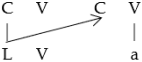 | 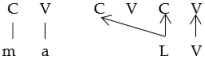 | |||||||||||||
| L | V | |||||||||||||||
| [l ˈadʤə ˈvistə] | [ˈcamalə] | |||||||||||||||
| d. | 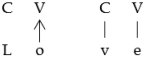 | |||||||||||||||
| [o ˈvekə] | ||||||||||||||||
Given that, for the “virtual geminate” explanation, the lateral must have a single phonetic form in all contexts, either as [l] or [ll], Manzini & Scheer explicitly state that dialects in which the lateral of the 3ACC clitic appears as a singleton in some contexts and as a geminate in others do not fall within the purview of their analysis.
The Neapolitan variety analysed in the following sections does not share all the characteristics of the dialects to which Manzini & Scheer apply their analysis. In fact, they present alternating forms of the 3ACC clitic and definite article thus confirming the generalisation in (7), since they have the full form /LV/ in enclisis and a poorer form, i.e., either a vowel or the lateral, in proclisis. However, as we will see, they exhibit considerable variation in the phonetic form of the lateral and therefore do not fit the pattern that predicts [V] or [l] in proclisis and [lV] in enclisis.
4. Patterns in the Neapolitan Variety
In this article, we specifically investigate the properties of proclitics (3ACC pronouns and definite articles) in the Neapolitan variety.4
As in the other dialects that present alternation between proclisis and enclisis, proclitics in the preconsonantal position always consist of the vowel alone:
| (10) | o ˈkanə ‘the dog’. | o ˈvekə ‘(I) see him’. |
In prevocalic context, we find the alternation in the phonetic forms of the lateral. As we saw in (1), the distribution tends to depend on the position of the word stress, before both nouns and lexical verbs (11a). When the prevocalic proclitics precede the forms of the auxiliary avere, the stress condition is not always fulfilled (11b). In fact, the auxiliary forms that have the lexical stress on the first syllable may select [ll], as well as [l] or zero, e.g., [ll ˈadʤə truˈvatə]/[l ˈadʤə truˈvatə]/[ˈaːdʤə truˈvatə] “I have found him”. This behaviour can probably be attributed to the fact that the auxiliary forms are often destressed postlexically, due to the position they occupy in the utterance, i.e., a prosodically weak position. The examples in (11) illustrate the stress conditioned alternation [ll]/[l] and the peculiar behaviour of the auxiliary:
| (11) | # V +stress | # V -stress |
| ll ˈɛvərɐ ‘the grass’. | l adˈdorə ‘the smell’. | |
| ll ˈakkwɐ ‘the water’. | l aˈliʃə ‘the anchovies’. | |
| ll ˈadʤə truˈatə | l ˈadʤə truˈvatə ‘I have found him’. | |
| l aʃˈpɛttə ‘ I wait for him’. |
In positions preceding an unstressed word-initial vowel (12a), /L/ is frequently subject to deletion (more properly it is a “non-realisation”), so that a free a variation emerges between [l] and zero. Moreover, the forms with silent lateral very frequently show a long initial vowel. This also applies to forms of avere (12b). In sum, where [l] can occur, the zero lateral can likewise occur:
| (12) | a. | # V -stress | |
| l aˈliʃə | aːˈliʃə | ||
| l aʃˈpɛttə | aːʃˈpɛttə | ||
| b. | l ˈadʤə truˈvatə | ˈaːdʤə truˈvatə | |
The silent lateral is to be considered a variant of the singleton [l], selected in the same stress context. This is supported by the fact that l-deletion never appears before a stressed vowel, and forms such as *[ˈakkwa] or *[ˈaːkkwa] for /l ˈakkwa/ ‘the water’ never appear in the data.
Besides the stress-driven distribution, a different pattern is observed, which is favoured by some informants, whereby the geminate lateral is extended to all prevocalic contexts, before nouns and lexical verbs as well as the auxiliary avere, regardless of the position of the stress.5
| (13) | ll ˈɛvərɐ |
| ll aˈliʃə | |
| ll aʃˈpɛttə |
The data presented in (11), (12) and (13), besides stress-driven alternation, indicate the existence of a variation that is not governed by phonological conditions, and is therefore sociolinguistic in nature. With regard to the data in (12) in particular, both alternative forms are acceptable for most speakers, with the forms involving l-deletion being perceived as more genuinely dialectal. This picture emerged with sufficient clarity from the fieldwork carried out in Naples and Bacoli. The informants in Bacoli, in particular, used forms with a silent /L/ in most cases, explicitly judging them to be more appropriate in dialectal speech. Here we will not deal with the sociolinguistic side of the question. For the purposes of this article, it suffices to be able to state that the pattern with l-deletion is provided by the grammar of these languages.
To sum up, this picture reveals a variation of three patterns, that we can consider as realising alternative grammar subsystems; as noted, the forms of the auxiliary avere may not match the stress pattern.
| (14) | a. | Pattern 1 | # V +stress. | # V -stress. | |
| ll ˈɛvərɐ | l adˈdorə | ||||
| l aʃˈpɛttə | |||||
| l ˈadʤə truˈvatə | |||||
| b. | Pattern 2 | # V +stress. | # V -stress. | ||
| ll ˈɛvərɐ | aːdˈdorə | ||||
| aːʃˈpɛttə | |||||
| ˈaːdʤə truˈvatə | |||||
| c. | Pattern 3 | ll ˈɛvərɐ | |||
| ll aˈddorə | |||||
| ll aʃˈpɛttə | |||||
| ll ˈadʤə truˈvatə |
From my fieldwork, it emerged that Pattern 1 and Pattern 2 are options available to a same speaker, in the sense that l-deletion is an alternative outcome in the same phonological (i.e., segmental and stress-related) context. Pattern 3, on the other hand, does not meet the same conditions and involves the extension of the geminate lateral to all the contexts in proclisis, an outcome that not all informants consider fully acceptable.6
5. The Analysis of the Alternation Patterns in Proclisis
In this section, we will analyse the patterns presented above, particularly focusing on the most intriguing one: the one that includes l-deletion.
The analysis proposed here is based on Strict CV Theory (Scheer, 2004). However, a different notation is adopted here. The notation commonly used in the CVCV literature develops on two levels: the CVCV tier and the melodic content tier. This allows three kinds of segmental units to be defined; Scheer (2004, p. 92) represents three types of nucleus as follows: (15a) corresponds to a phonetically realised nucleus, (15b) to a “true” empty nucleus and (15c) to a nucleus with floating content ([M] stands for “melodic content”):
| (15) | a. | N | b. | N | c. | N |
| | | ||||||
| [M] | [M] |
Instead, my proposal is that representations should develop on the three autosegmental levels of the syllabic tier (O, N), the x-slot tier, and the melodic tier. In its effects, this is not just a notational variant, in that it allows for a more detailed diversification between segment types, particularly with regard to the properties of so-called empty segments and floating units. The resulting representation is not simply equivalent to the more concise two-level representation; in fact, it distinguishes explicitly between the syllabic organisation, which is above the skeleton, and the x-tier, which represents the segmental unit and quantitative properties (Bafile, 2024, in press).
The reasons for the approach adopted here are pointed out, for example, by the discussion of V-zero alternations in Italo-Romance dialects of Emilia (Bafile, 2019). In fact, phenomena of that kind highlight some shortcomings of the two-level representation. One is that it is unable to express the difference between two kinds of nuclear positions; the “true” empty nucleus, i.e., the one within coda-onset clusters, e.g., [kan-to] ‘song’, and the empty nucleus that separates the two adjacent consonants resulting from vowel syncope, e.g., [um-da] ‘humid (f.sg.)’.7 They are clearly different phonological objects, firstly because true empty nuclei never receive phonetic interpretation, whereas the nucleus involved in vowel-zero alternations, under predictable conditions, takes on melodic content and emerges to the phonetic surface in the form of a so-called “epenthetic”vowel, e.g., [ˈumɐd] ‘humid (m.sg.)’. Secondly, syncope may produce phonetic forms containing non-homorganic sequences, like [m-d], that do not respect a phonotactic restriction which otherwise applies regularly in the language. This seeming violation reveals the different nature of the two types of empty nuclei: syncope clusters contain a nucleus that, although empty, is substantial enough to keep the two consonants apart, whereas the empty nucleus of the coda-onset clusters does not emerge phonetically either directly or indirectly.
The notations in (15) do not allow this necessary distinction. In fact, (15b) corresponds to a “true” empty nucleus, while (15c) can represent vowels with a floating but lexically established melodic content. The latter is the nature of the epenthetic vowel in some languages, including some Emilian dialects, in which the quality of the epenthetic vowels is not always predictable and must be specified in the lexicon (cf. Passino, 2013a for a discussion). However, the case here mentioned refers to a language that has only the epenthetic vowel [ɐ] that is a so-called “default” vowel. Based on (15), it is not possible to differentiate the two kinds of epenthetic vowels.
The three-level representation in (16) allows the different kinds of nuclei to be kept distinct from each other.8 In particular, with regard to the phenomena discussed in the present article, we use three different configurations for empty or floating segments:
| (16) | a. | O | N | b. |  | c. | 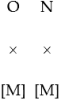 |
The units in (16a) correspond to the “true” empty nuclei of coda-onset clusters, and to the onsets of syllables that begin with a vowel. In (16b), the association with “x” represents the fact that the constituent corresponds to a segmental unit and plays a role in temporal organisation. Concerning the nucleus, it is able to represent the lack of structural adjacency between the consonants of syncope clusters (cf. Bafile, in press). For the onset, this configuration corresponds, for example, to the consonant that appears in external sandhi in contexts of Raddoppiamento Sintattico (cf. among others Passino, 2013b). As we will see, (16b) also corresponds to the CV produced by the stress placed on an adjacent syllable. The configuration in (16c) is the one for floating segments whose phonetic quality is established in the lexicon (Passino, 2013a). Both notations in (16b) and (16c) imply the presence of a syllabic constituent that can license phonetic content, whether defined lexically or not, that can only be phonetically realised when specific conditions are met.
In order to explain the different shapes that the proclitics 3ACC pronoun and definite article take before consonants and before vowels, I adopt the solution of Manzini & Scheer that the proclitic shape consists of floating melodic content /LV/, and that the lateral of this specific lexical unit is a segment that can only be realised phonetically if associated with two x-slots. In truth, the lateral is not a “virtual geminate” in the strict sense in the dialects here discussed, if we maintain that virtual geminates are phonological geminates that are pronounced as singletons (cf. Ségéral & Scheer, 2001); as a matter of fact, in the Neapolitan variety, in proclisis the lateral may also appear as a geminate or not appear at all. Therefore, I adopt a slightly different definition here, according to which the essential property of this type of segment concerns the phonological form, which must consist of two x-slots: if the phonological condition is satisfied, phonetic realisation can follow, either in the form of a single consonant or in the form of a geminate, depending on the specific grammar. In other words, the lateral of the proclitic can only be realised if it finds a second onset in the environment that can be associated with it.
As predicted by Manzini & Scheer’s analysis, in the preconsonantal position, the lateral does not find a second x-slot and remains unrealised, while the vowel can be associated with its nucleus. The representation in (9d) is repeated in (17), adapted to the different notation:
| (17) | 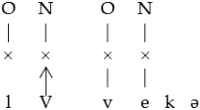 | |
| [o ˈvekə] ‘I see him’ |
In prevocalic contexts, however, Manzini & Scheer’s model cannot be applied as such to the languages here considered.
Let us now begin by examining what is defined as Pattern 1 and Pattern 2 in (14). Recall that the proclitic is realised as [ll] before a stressed vowel, whereas before an unstressed vowel, the lateral is singleton (Pattern 1) or silent (Pattern 2).9
In order to identify the relevant properties of different patterns, the first point to consider is why the presence or absence of stress on the initial vowel of the following word affects the behaviour of /L/. In Lateral Phonology, stress is encoded in the phonological structure as an empty CV preceding or following the stressed vowel (cf. Scheer & Szigetvári, 2005). This stress space explains the qualitative and quantitative effects of stress on the segments belonging to the stressed syllable.
In many Italo-Romance varieties, including standard Italian, where vowel length is not contrastive, the stressed vowel in an open syllable is systematically long. This phenomenon can be directly explained by the presence of an empty CV inserted to the right of the stressed vowel, so that the melodic content of the nucleus can spread to the next nuclear position.
| (18) | 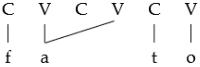 | |
| [ˈfaːto] ‘fate’ |
In other languages, the effects of stress are manifested in the quality of the consonants contained in the stressed syllable (cf. Ségéral & Scheer, 2008). For example, in English, voiceless stops are aspirated when they are in the onset of a stressed syllable, while they are plain stops (and in many varieties subject to lenition) if they occur in an unstressed syllable, e.g., I[th]alian vs. I[t]aly. This type of phenomenon can also be explained as the effect of an extra CV, which in this case is inserted to the left of the stressed vowel. This means that the consonant in the onset of the stressed syllable has a preceding C to which it can associate. Therefore, aspirated consonants are phonological geminates, with a given melodic content associated with two C positions.
Interestingly, in the dialects we are dealing with, and probably in those belonging to a wider area of central and southern Italy, stress appears to affect the phonological string to the left of the tonic vowel, under certain circumstances. More precisely, the presence of stress on the vowel that occupies the word-initial position impedes the deletion of a preceding vowel. Note that vowel elision is very pervasive in these varieties and applies regularly to the final vowel of a word in a sequence V1 # V2, provided both vowels are unstressed. As can be seen in (19), the process is blocked when V2 is stressed.
| (19) | a. | mo ˈvɛnə ˈanʤəlɐ | b. | mo ˈvɛn anˈtɔnjə | ‘now Angela/Antonio comes’. |
| ku ˈanʤəlɐ | k anˈtɔnjə | ‘with Angela/Antonio’. | |||
| pə ˈanʤəlɐ | p anˈtɔnjə | ‘for Angela/Antonio’. |
This is a puzzling effect: while it goes without saying that V1 must be unstressed for elision to apply, the reason why V2 must also be unstressed is unclear and requires explanation.
On the basis of the data in (19), I propose that in these dialects, the stress on a vowel in the word-initial position provides an extra CV (20a), and that this is placed to the left. In this hypothesis, the initial vowel of the word, not being preceded by a full onset, is in the particular condition of causing the insertion of a CV immediately to its left. The assumption is that the stress space insertion is regulated by a parameter specifically regarding this particular word-initial configuration.
Having established the above, it is the presence of an extra CV that places the two superficially adjacent vowels of the forms in (19a) structurally apart, thereby preventing the formation of a hiatus and removing a context for elision (see 20b), which instead applies in the configuration in (20c):
| (20) | a. | 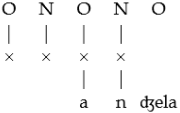 | |||||||||
| b. | 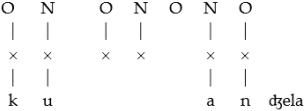 | c. | 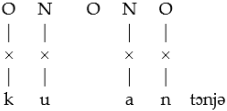 | ||||||||
Stress space is a first point in this analysis of the behaviour of the proclitic /LV/: when the /LV/ precedes a word beginning with a stressed vowel, as in [ll ˈanəmɐ] ‘the soul’, the extra CV corresponding to the stress space provides an onset x-position for /l/ to be realised; recall that in the varieties here discussed, the phonological geminate surfaces as a phonetic geminate. Note that the representation in (21) can also account for the lengthening of the stressed vowel:
| (21) | 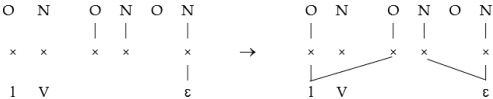 | |
| [ll ˈɛːvəra] |
A second step is explaining the alternations characteristic of Pattern 2, e.g., [ll ˈanəma] ‘the soul’ vs. [aːˈliʃə] ‘the anchovies’. To do this, we need to define another aspect of the phonology of these varieties. We saw in (9b) that in Manzini & Scheer’s analysis, the empty onset preceding a word-initial vowel is available for association with melodic content, thus providing the second C-position for the virtual geminate lateral to be pronounced. In order to account for l-deletion, I propose that the possibility for the lateral to associate with a second C-position is regulated parametrically. In the variety with the alternation geminate/silent lateral, only an onset lexically associated with an x-slot allows for the licensing of segmental content, while a true empty onset does not (see 16). The former condition is guaranteed by the presence of a stress space (recall that in the stress space, O and N are associated with x-slots, see (16b)), but it is not met before an unstressed initial vowel, with the result that the lateral remains silent there.
The specific parameter setting just described accounts for [l] deletion; moreover, the configuration in (22) also accounts for the vowel lengthening which is often correlated. As shown in (22), the lateral cannot be realised because the empty onset to its right does not provide the necessary x-slot. This creates the conditions for vowel lengthening, because the word-initial vowel is free to extend to the preceding nucleus, thanks to the absence of crossing association lines:
| (22) | 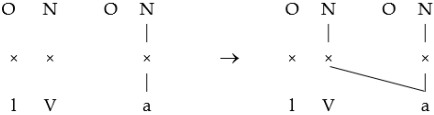 | |
| [aːˈliʃə], [aːʃˈpɛttə] |
Finally, let us turn to some observations concerning the other patterns of alternation in proclisis.
The analysis just proposed cannot be extended to the pattern that has [l] instead of the silent lateral, i.e., o kánə/l alíʃə/ll ánəma (Pattern 1 in (14)). The virtual geminate hypothesis is not a suitable solution for this system, in which [l] contrasts with [ll]. As a consequence, there is no analytical tool that can explain in phonological terms why the lateral is absent in preconsonantal proclitics and *lo kánə is a non-existent form. Therefore, we must attribute the alternation o kánə/l alíʃə to the existence of two lexicalised shapes, i.e., two allomorphs selected on the basis of the phonological context (see 23a). Note that the lexical representation of these allomorphs does not contain floating melody, since the phonetic content is fully associated with the x-tier and hence to the O/N-tier; this is shown in (23a), while in (23b) we see a configuration involving the /l/ allomorph. On the other hand, the gemination that appears regularly before stressed vowels needs not be considered allomorphic; indeed, we can maintain the phonological explanation whereby the initial stress space produces [ll] as in (23c), exactly in the same way as in (21). The same applies when the proclitic is preceded by an RS trigger that also provides a C-position on which the lateral can extend (23d):
| (23) | a. | 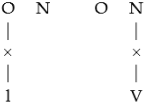 | b. | 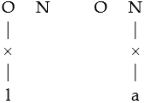 | |||||||||
| [l aˈliʃə] | |||||||||||||
| c. | 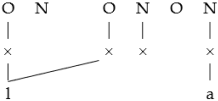 | ||||||||||||
| [ll ˈanəma] | |||||||||||||
| d. | 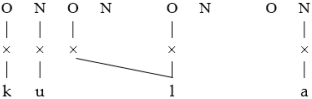 | [ku ll a ˈliʃə] | |||||||||||
We now consider Pattern 3, in which the lateral is realised uniformly as [ll] in proclisis, i.e., o kánə/ll alíʃə/ll ánəma. One possible interpretation of this distribution is that in this system, /L/ is a virtual geminate that is realised phonetically as a geminate rather than a singleton lateral. In this explanation, it must be specified that the parametric restriction mentioned above and exemplified in (20) and (21) is not active. We therefore hypothesise that in this grammar, even a true empty onset can provide the second x-slot necessary for the phonetic realisation of the lateral:
| (24) | a. | 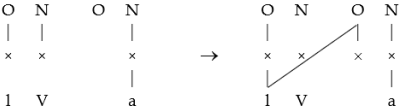 | |
| [ll aˈliʃə], [ll aʃˈpɛttə] |
To sum up, with regard to proclisis, in the variety here investigated, an explanation in purely phonological terms for the distribution of the prevocalic and preconsonantal forms of the 3ACC and the definite article is possible only in part of the cases. The approach proposed by Manzini and Scheer (2026), concerning the particular status of the lateral derived from the Latin ILLE, has been applied here to the partly differing data that characterise Neapolitan. The proposal is that by means of the “virtual geminate”, it is possible to account for the non-realisation of the lateral and the consequent vowel lengthening, as well as for the alternative pattern in which [ll] occurs in all prevocalic contexts. However, the alternation of singleton and geminate that we see in l alíʃe/ll ákkwa is incompatible with the hypothesis that, whatever its phonetic realisation, the lateral is a geminate consonant phonologically. We can think that a virtual geminate can be realised phonetically either as a singleton or as a geminate, but it is impossible to reconcile the two outcomes in the same grammar. Therefore, given the pattern o kánə/l alíʃe/ll ákkwa, the only way to explain the occurrence of /L/ before vowels and /V/ before consonants is that they are allomorphs, since it is not possible to derive those alternating forms from a single lexical representation.
Furthermore, if we consider proclisis and enclisis as a whole, in none of the three patterns described above does the lateral have a uniform phonetic realisation, which means that resorting to allomorphy is inevitable, at least to a certain extent. In Section 7, we will turn to the behaviour of 3ACC pronouns in enclisis.
6. The Negation + Proclitic Cluster
In the dialects treated here, sentence negation appears in two different shapes.
The first is /nu/, which occurs before obstruent consonants or coda-onset clusters, in (25a), and before sonorants, in (25b). The lexical form of this negation is represented in (25c). As an RS trigger, /nu/ also contains an onset position that lacks melodic content, but is associated with an x-slot and therefore causes external sandhi gemination. In the case of sC clusters in (25d), the final empty nucleus of the negation is not governed by the nucleus that follows it, which is also empty, and is therefore removed together with the preceding onset.
| (25) | a. | ˈkillə nu kkaˈpiʃʃə ˈnjentə ‘he does not understand nothing’. | |||||||||||
| ˈkillǝ nu sta ˈbbwonǝ ‘he is not feeling well’. | |||||||||||||
| b. | ˈkillǝ nu ˈllassa ˈnjentǝ ‘he does not leave nothing’ . | ||||||||||||
| ˈkillǝ nu ˈmmanʤa ˈnjentǝ ‘he does not eat nothing’. | |||||||||||||
| ˈkillǝ nu rriʃˈpɛtt a nniʃˈʃunǝ ‘he does not respect nobody’. | |||||||||||||
| c. | 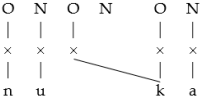 | ||||||||||||
| [nu kkaˈpiʃʃə] | |||||||||||||
| d. | 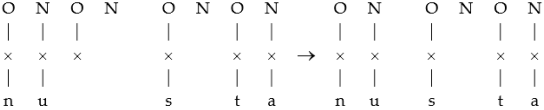 | ||||||||||||
| [nu ˈsta] | |||||||||||||
When followed by a proclitic, /nu/ causes the gemination of the lateral in all three dialectal patterns discussed here.
The second negation is /nunn/. This can appear in reduced forms, without the initial nasal or nasal-vowel sequence, [unn] and [nn]. The distribution of the reduced forms does not reflect a phonological conditioning and should therefore be considered a free variation. Conversely, the alternation concerning the final nasal is context-driven: it is a geminate before a word with an initial vowel and a singleton before a word with an initial consonant. The following examples illustrate the alternation between preconsonantal contexts (26a) and prevocalic contexts (26b) as well as the aforementioned free variation:
| (26) | a. | prevocalic | b. | preconsonantal |
| ˈkillə nunn aˈrap a niʃʃunə | ˈkillə nuŋ kaˈpiʃʃə ˈnjentə | |||
| ˈkill unn aʃˈpɛtt a niʃʃunə | ˈkill uŋ kaˈpiʃʃə ˈnjentə | |||
| ˈkillə nn aʃˈpɛtt a niʃʃunə | ˈkillə ŋ kaˈpiʃʃə ˈnjentə | |||
| ‘he does not open to nobody’. | ‘he does not understand nothing’. |
Indeed, the two negations /nu/ and /nunn/ are phonologically very similar, and when followed by a sonorant produce identical phonetic results, since sequences n+R (where R stands for ‘sonorant’) systematically undergo total regressive assimilation; therefore, the forms in (25b) could be equally listed in (26b). Note that n+R assimilation is a general rule of the phonology of this language, as can be seen from the behaviour of another word with a final nasal, namely don, a title for men (27):
| (27) | [dɔl luˈidʤǝ] ‘don Luigi’. |
| [dɔm maˈrjanǝ] ‘don Mariano’. | |
| [dor raffa’ɛlǝ] ‘don Raffaele’. |
Despite their similarity, nu and nun cannot be derived from the same lexical phonological representation, given the existence of sequences such as [nu kˈkapiʃʃə] (see 25a), which by no means can be considered the result of assimilation. In fact, total regressive assimilation in n+Stop clusters is not a rule existing in Neapolitan phonology. Therefore, we must regard nu and nunn as two different lexical shapes, i.e., two allomorphs.10
We have seen in (26) that in the shape /nunn/, the only segment that has a stable phonetic realisation is the first nasal after the vowel. The final nasal is not realised before a consonant, while the initial segments are unstable and may be left unpronounced.
As we have already seen with the proclitic /LV/, a word with alternating forms due to the presence/absence of certain segments can be represented as a single lexical unit, in which the unstable segments correspond to floating segmental content, that only receives a phonetic interpretation when specific conditions are met. Along these lines, alternations typically considered to be allomorphic have been reinterpreted in purely phonological terms in several recent analyses (cf. Scheer, 2022; Faust et al., 2018, who elaborate on a proposal by Larsen, 1998; Russo, 2021; Russo & Ulfsbjorninn, 2021; Bafile, 2024). The same model, in the enriched representation here proposed concerning the association between autosegmental tiers, is applied to the negation /nunn/:
| (28) | 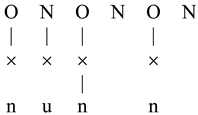 |
It should be noted that the representation in (28) contains two different types of floating melody: the final onset is a consonant that receives phonetic realisation when the conditions specified in the phonological computation are met. Instead, the two initial segments are simply identified as unstable, but the grammar has nothing to say about this. In this case, what floating melody represents is that the possibility of free variation is encoded in the lexicon: it is this lexical item, and not any lexical item, that is subject to segmental deletion. In any case, we will not explore this free variation here, which is probably influenced by phonetic factors related to performance (such as speech rate and accuracy).
The behaviour of the negation /nunn/ in the two different sandhi contexts is represented in (29). In prevocalic position (29a), the final empty nucleus (N2) of the negation is deleted together with the subsequent onset (O3), while the word-initial nucleus (N3) governs the nucleus N1 and licenses O2, enabling the gemination of the nasal. Before a consonant (29b), the final onset (O2) is not licensed by a subsequent nucleus; therefore, the second position of the nasal is suppressed, together with N2:
| (29) | a. | 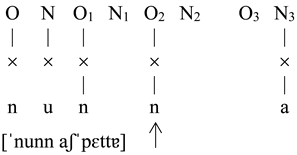 | b. | 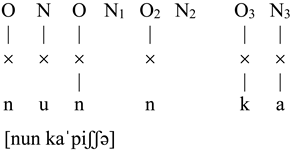 |
Let us now turn to the interaction between nun and the prevocalic proclitic /LV/.
As shown in (25b), a sequence /n+l/ produces the assimilated outcome [ll]. Therefore, when the prevocalic proclitic has the form [l] (as in Pattern 1, e.g., o kánə/l alíʃə/ll ánəma), the sequence nun + /l/ results in [ll], e.g., [l aʃˈpɛttə]/[nul l aʃ’pɛttə] ‘I wait/I do not wait for him’. The same holds for Pattern 3 (e.g., o kánə/ll alíʃə/ll ánəma), in which /L/ is a geminate in all prevocalic contexts, e.g., [ll aʃˈpɛttə]/[nul l aʃˈpɛttə].11
In Pattern 2 (e.g., o kánə/a:líʃə/ll ánəma), /L/ is silent before an unstressed vowel. Recall that, in all lexical verbs beginning with a vowel, that vowel is unstressed, and that the forms of the auxiliary avere often behave in the same way. Therefore, in the negation+/L/ sequences the lateral is not realised, and the prevocalic form of the negation appears. This produces forms such as [nunn aːʃˈpɛtta] ‘he does not wait for him’, and [nunn ˈaːdʤə truˈvatə] ‘I did not find it’, in which the clitic remains silent. The configuration in (30) mirrors the one in (29a), in which the second nasal of /nunn/ is licensed by a subsequent full nucleus:
| (30) | 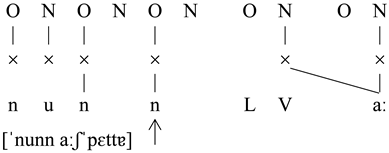 | ||||||
The forms of the negation nun before consonants and before vowels, as shown in (26) and (29), are consistent with the behaviour of the title don described in (27). Both words belong to a very small set of lexical items ending in a consonant and showing a restricted distribution, as they do not occur in the final position of an utterance.12 In both nun and don, the final geminate consonant alternates with the singleton before a vowel and before a consonant respectively, e.g., don Pasquale but donn Antonio. This behaviour reveals that the phonological form of don, just like nun, contains a second final nasal, which is floating in the lexical representation, exactly as shown in (28) and (30).
7. The Third Person Object Pronoun in Enclisis
The main subject of this paper is the analysis of the phonological properties of the elements derived from Latin ILLE occurring in proclisis. However, in order to ascertain to what extent the distribution of 3ACC forms can be explained in purely phonological terms, we now briefly take into account their behaviour in enclisis.
As we have seen in previous sections, allomorphy can be avoided by adopting Manzini and Scheer’s model, provided that the forms of the 3ACC clitic fall within a regular pattern, in which the phonetic form of the lateral is consistently singleton in all contexts, in proclisis and in enclisis. This is the case for the dialects included in the set investigated by Manzini and Scheer (2026).
The phonological forms of the Neapolitan enclitic 3ACC fall completely within the generalisation reported in (7), since only the full form, consisting of the sequence [LV], appears in enclisis, thus alternating with the poorer forms [L] or [V] occurring in proclisis. However, as we have seen for proclisis, even in enclisis, the lateral can be a singleton or a geminate, depending on the context.
Sequences in which the verb hosts a single 3ACC enclitic in most cases have the phonetic form [lə] (31a). With enclitic sequences, a different pattern emerges, in which the so-called “stress shift” and the lateral gemination take place (31b). In the latter examples, the verb hosts a clitic sequence ‘dat=3acc’. In the examples in this section, the verb is in the imperative form.
| (31) | a. | ˈpɔrta=lə ‘bring (2 sg) it’. |
| purˈtatə=lə ‘bring (2 pl) it’. | ||
| b. | purta=ˈti=llə ‘bring (2 sg) it for you (sg)’. | |
| purˌtatɐ=ˈvi=llə ‘bring (2 pl) it for you (pl)’. |
The reasons for such distribution of enclitic forms are controversial. The most frequent explanation attributes it to a fundamentally phonological motivation, i.e., the fact that the attachment of a bisyllabic enclitic sequence produces a stress configuration that is illicit in a language where the “three-syllable window” limits the placement of the lexical stress: the stress must fall on one of the three final syllables of the word (see amog others Kenstowicz, 1991; Bafile, 1994; Peperkamp, 1997; Lai, 2020; Russo, 2021). In this view, to avoid the illegal form *pórta=tə=lə, with stress on the fourth from last position, a stress shift takes place to repair the ill-formed sequence.13 Moreover, in some accounts, the new stress assignment is considered to be in turn the cause of lateral gemination, as an effect of RS (see Russo, 2021; Manzini & Scheer, 2026).
The stress replacement, with connected gemination, also takes place in a different configuration, i.e., when either a single clitic (32a) or a sequence of clitics (32b) follow a monosyllabic verb. The sequence in (32b) consists of a monosyllabic verb followed by an enclitic string ‘dat=3acc”:
| (32) | a. | ˈda=llǝ ‘give (2 sg) it’. | ˈda=mmǝ ‘give (2 sg) to me’. |
| b. | da=mˈmi=llǝ ‘give (2 sg) it to me’. | ||
If we consider only the syllabic level, given that a form like dá=mmə=lə fits within the three-syllable window, we would not expect stress replacement. Viewed from this perspective, the stress shift in (32b) does not have a straightforward explanation. In a different perspective, Russo (2021) proposes that the stress shift also applies in the case illustrated in (32b), since in the recursive Prosodic Word corresponding to the clitic group, stress is reassigned in accordance with a general metrical requirement, common across Italo-Romance systems, which determines the construction of a trimoraic trochaic foot (HL). Under the same hypothesis, the gemination of the lateral in the second enclitic is due to the requirement that the stressed syllable of the trochee be heavy.14 The gemination of the initial consonant of the enclitic in (32a) and of the first enclitic in (32b) meets the same requirement, in relation to the first foot of the clitic sequence. More generally, in Russo’s (2021) analysis, the phonological RS, i.e., the RS determined by the stress, is the product of the same mechanism: in external sandhi, it is the final stressed vowel of the word1 that must be made heavy through the addition of a mora.
I will not deal in depth here with the controversial questions concerning stress shift and consonant gemination in enclisis, because they are not relevant to the main topic of this paper. What we have seen is sufficient to establish that the alternation [l]/[ll] also appears in enclisis, whatever the cause may be, and therefore that the phonetic forms that the pronoun takes on in different contexts, in proclisis and enclisis, do not allow us to treat their existence and distribution in purely phonological terms.
8. Conclusions
The investigation into the behaviour of the clitic 3ACC and the definite article has shown that the variety examined here differs in crucial aspects from the dialects analysed by Manzini and Scheer (2026), leading us to conclude that the alternation cannot be addressed without resorting to allomorphy. However, some results have been obtained that I believe are of descriptive as well as theoretical interest.
We have shown that Manzini & Scheer’s conception of “virtual geminate” applied to the lateral of clitic /LV/ may produce interesting results even if it cannot be extended to all contexts in the language analysed here. Indeed, it can explain, in purely phonological terms, some aspects of clitic forms and distribution in proclisis: on the one hand, l-gemination extended to all prevocalic contexts, on the other hand, l-deletion occurred before unstressed vowels. Moreover, this approach has allowed us to formulate a unified explanation for the puzzling correspondence of “l-deletion” and consequent vowel lengthening.
These results were also obtained thanks to the adoption of an enriched notation within the phonological representation. This representation is in accordance with the fundamentals of Strict CV Theory and its classic two-tier notation, but through discussion we have shown that distinguishing between the skeleton and what lies above it allows us to grasp concepts that may be relevant for the phonological computation.
Finally, an analysis of the behaviour of word-initial stressed vowels has led us to put forward the hypothesis that in the dialects considered, but possibly in numerous other Italo-Romance varieties, stress produces a stress space that is inserted to the left rather than to the right of the tonic vowel. This hypothesis may shed light on phonological properties not dealt with in this article, and I believe it deserves further research.
Overall, from an empirical point of view, the topic of items derived from Latin ILLE in southern dialects and Italo-Romance languages in general is highly complex, given the massive variation that characterises it, and lends itself very poorly to strong generalisations. However, the analysis of a set of dialects that are similar to each other but differ in specific aspects can lead to the identification of unexpected theoretical tools with promising results.
Funding
This research received no external funding.
Institutional Review Board Statement
Not applicable.
Informed Consent Statement
I obtained informed consent from subject involved in the study, i.e., native speakers who provided spontaneous and elicited speech in response to my questions. The fieldwork involved fully informed adults who were familiar with the objectives of the interviews, and participated in them voluntarily.
Data Availability Statement
The data used in this article have been collected by the author through fieldwork over time, starting from 1990 onwards, and particularly during the period 2018–2022. Data taken from the literature, including the author’s own work, have been explicitly cited. On the whole, all the data presented and cited in this article will be available for use by scholars who read it.
Conflicts of Interest
The author declares no conflict of interest.
Notes
| 1 | Unless otherwise specified, the examples refer to data collected through fieldwork by the author. |
| 2 | For Neapolitan, Rohlfs (1968, p. 112) and Bichelli (1974, p. 69) mention l-deletion in relation to the definite article, and explicitly limit its context to the position preceding an unstressed initial /a/. Bafile (2008) expresses doubt that this restriction has sufficient empirical basis, as traditional Neapolitan vocabulary contains very few words beginning with an unstressed vowel other than [a] and not subject to apheresis, as can be verified by consulting dictionaries and dialectal texts, as well as through direct data collection. In fact, these forms have never emerged in the author’s fieldwork carried out over time. Bafile (2012), nevertheless, also considers the possibility that the vowel quality might be relevant and attempts to provide an explanation for its correlation with l-deletion. The analysis proposed in this paper does not follow in those footsteps. |
| 3 | The corpus extracted from Manzini and Savoia (2005) can be consulted at https://manzinisavoia.changes.unimi.it/ (accessed on 7 November 2025). Also see Savoia et al. (2025). |
| 4 | Where not specified, the examples are taken from data collected through author’s fieldwork in Naples and Bacoli (part of the metropolitan city of Naples). With regard to the phenomena investigated here, the Bacoli dialect does not differ in relevant ways from Neapolitan. On the other hand, the data collected in Bacoli show greater uniformity in the speakers’ responses, in the absence of the more complex variation that characterises a large city like Naples. |
| 5 | The data regarding the phonetic form of /L/ are described above as they result from the findings of fieldwork conducted in several sessions over time, from 1990 to 2022 in Naples and in 2018 in Bacoli; the data were collected mainly through elicitation and, to a lesser extent, observed in spontaneous speech. The literature on Neapolitan tends to confirm this picture, although there are some divergent accounts, belonging both to traditional, non-scientific and to scientific work. A part from Rohlfs (1968, p. 211) who, referring to southern dialects in general, attributes the alternation l/ll to the stress pattern, the same correlation was described by Francesco Oliva, a Neapolitan grammarian who lived from 1671 to 1736 (in Malato, 1970, p. 203). Volpe (1869) reports the geminate lateral for the plural forms of the article of both genders, e.g., l’ obbreche/ll’ uobbreche ‘the obligation m. sg./pl.’, l’ anema/ll’ aneme ‘the soul f. sg./pl’. Imperatore (1974, pp. 28, 65), referring specifically to the feminine plural, relates the geminate [ll] of the prevocalic article to the gemination due to RS produced by the preconsonantal article, e.g.,’a pala/‘e ppale ‘the shovel f. sg./p.’ as well as l’aquila/ll’aquile ‘the eagle f. sg./pl.’. According to Bichelli (1974), the geminate [ll] is extended to all the prevocalic forms of the definite article. See Ledgeway (2009, Chapter 5) for a survey of the literature over time. |
| 6 | Judgments of acceptability regarding such subtle variations are not generally expressed with absolute certainty. However, a form such as [ll aˈliʃǝ] sounds “unfamiliar” to a part of the informants, especially the older ones, and they correct it when repeating it, pronouncing [l aˈliʃǝ] or [aːˈliʃǝ]. |
| 7 | The examples refer to the dialect of Finale Emilia (province of Modena). |
| 8 | Further arguments in favour of the enriched representation emerge from the analysis of vowel deletion phenomena in Tuscan varieties. I refer to Bafile (in press) for a discussion. |
| 9 | An anonymous reviewer required that Russo (2021) and Russo and Ulfsbjorninn (2021) should be discussed in the present article. In fact, those papers address the morphophonological properties of the definite article in dialects of the Neapolitan area, in an approach with which my proposal shares some theoretical grounds. In their account, the article forms derived from the Latin ILLE are attributed to a single lexical shape consisting of a bisyllabic CVCV (in line with Faust et al., 2018). In particular, the forms with a geminate lateral in the prevocalic article have the property of introducing M.SG. mass nouns or F.PL. indefinite (i.e., collective) nouns (as in Procidano [dˈd ‘woʝʝə] ‘the oil’ and [dˈd ɔssəɾə] ‘the bones’, with the hardening of the lateral). Those articles derive from the Latin ILLOC, ILLAEC, with a final consonant that reappears in Italo-Romance forms as an RS trigger. In their analysis, the prevocalic form which show a geminate lateral before M.SG. and before F.PL. nouns parallels the preconsonantal forms which cause RS (as in Procidano [rə kˈkesə] ‘the cheese’, [rə dˈdetəɾɐ] ‘the fingers’), since the former and the latter introduce, respectively, mass nouns and indefinite plural nouns. Russo (2021) and Russo and Ulfsbjorninn (2021) provide an explanation for that parallelism, arguing that the lateral gemination and the RS are markers of the syntactic–semantic properties ‘uncountable’/‘indefinite plural’. As far as the data here considered are concerned, this analysis cannot be applied for empirical reasons. Russo (2021) and Russo and Ulfsbjorninn (2021) examine data collected in Monte di Procida, Pozzuoli, and the islands of Procida and Ischia; although all located in the province of Naples, those varieties show data that differ in relevant aspects from those belonging to Naples and Bacoli which are examined in this paper (even though Bacoli is geographically very close to the area investigated by Russo and Ulfsbjorninn). Specifically, the data I have used show that: (i) the occurrence of [l]/[ll] is partly regulated by the stress position, and even if this pattern is not entirely consistent, there is no evidence whatsoever that the alternation depends on the contrast between countable/mass or definite/indefinite plural; (ii) RS caused by M.SG. mass and PL.F. articles is absolutely regular; however, the PL.F. article causes RS in all kinds of feminine plural nouns that follow it, with no exceptions, i.e., is not limited to the “indefinite” plural. For these basic reasons, the linguistic variety examined in this article does not fall within the purview of the theorisation proposed by Russo (2021) and Russo and Ulfsbjorninn (2021). |
| 10 | Diachronically, we can think that the assimilation of the final nasal of nun in n+R sequences led to lexicalisation of a form /nu/ as an RS trigger, and therefore to its extension to all preconsonantal contexts. This is suggested by the testimony of Francesco Oliva (in Malato, 1970, p. 290): "Se al non sieguono l, m, n, r, il non si pronunzia e scrive no’ e le consonanti suddette si raddoppiano (…)" (If non is followed by l, m, n, r, it is not pronounced and is written no’ and the consonants mentioned are geminated). |
| 11 | As previously pointed out, the sequence [null] can correspond to either /nunn+L/ or /nu+L/, in the latter case with gemination due to RS. |
| 12 | Apart from articles, the set includes three words with alternating prevocalic and preconsonantal forms: besides the negation nun and the title don described above, san/sant ‘saint’, e.g., san Carlo/sant Antonio. The preposition in appears in Neapolitan only in preconsonantal position, in few lexicalised phrases (cf. Bafile, 2003). |
| 13 | Studies that have addressed such phenomena of a so-called “stress shift” have often proposed an explanation for the difference between the languages described above and the languages, including standard Italian, in which the addition of the enclitic string does not result in a reassignment of the main stress. The most common hypothesis is that in Italian, enclitics are attached within the phonological phrase, a prosodic domain that is broader than the domain in which the lexical stress is assigned, i.e., the phonological word, whereas in languages like Neapolitan, enclitics are inserted within a recursive phonological word (see among others, Bafile, 1994; Monachesi, 1996; Peperkamp, 1997). |
| 14 | Russo (2021) attributes the fact that the consonant, rather than the vowel, is subject to lengthening in that context to the effect of a ranking concerning the Weight Identity constraints, whereby WtIdent(C) >> WtIdent(V). |
References
- Bafile, L. (1994). La riassegnazione postlessicale dell’accento nel napoletano. Quaderni del Dipartimento di Linguistica. Università degli Studi di Firenze, 5, 1–23. [Google Scholar]
- Bafile, L. (2003). Le consonanti finali nel fiorentino e nel napoletano. Rivista Italiana di Dialettologia, 27, 149–178. [Google Scholar]
- Bafile, L. (2008). Alcune osservazioni sull’allomorfia dell’articolo determinativo e del proclitico oggetto nel dialetto napoletano. Annali online di Ferrara—Lettere, 1, 1–13. [Google Scholar]
- Bafile, L. (2012). Fenomeni di cancellazione dell’articolo e del proclitico oggetto nel napoletano ed altre varietà italiane meridionali. In D. Pescarini, & J. Garzonio (Eds.), Atti della XVII giornata di dialettologia. Quaderni di Lavoro ASIT (Volume 14, pp. 1–28). [Google Scholar]
- Bafile, L. (2019). Vowel-zero alternations in government phonology and strict cv theory. Studi e Saggi Linguistici, 57(2), 83–113. [Google Scholar]
- Bafile, L. (2024). Representing unstable segments: External sandhi rules in Tuscan varieties. Studi e Saggi Linguistici, 62(2), 57–88. [Google Scholar]
- Bafile, L. (in press). La rappresentazione dei processi fonologici con condizionamento morfosintattico o lessicale: Il ruolo delle linee di associazione.
- Bichelli, P. (1974). Grammatica del dialetto napoletano. Edizioni Pégaso. [Google Scholar]
- Faust, N., Lampitelli, N., & Ulfsbjorninn, S. (2018). Articles of Italian unite! Italian definite articles without allomorphy. Canadian Journal of Linguistics/Revue Canadienne de Linguistique, 63(3), 359–385. [Google Scholar] [CrossRef] [Scilit]
- Gussmann, E. (2002). Phonology: Analysis and theory. Cambridge University Press. [Google Scholar]
- Imperatore, L. (1974). Appunti sul dialetto napoletano. Berisio. [Google Scholar]
- Kenstowicz, M. (1991). Enclitic accent: Latin, Macedonian, Italian, Polish. In P. M. Bertinetto, M. Kenstowicz, & M. Loporcaro (Eds.), Certamen phonologicum II: Papers from the 1990 cortona phonology meeting (pp. 173–185). Rosenberg & Sellier. [Google Scholar]
- Lai, R. (2020). Stress shift under cliticization in the Sardinian transitional area. In L. Franco, & P. Lorusso (Eds.), Linguistic variation: Structure and interpretation (pp. 357–370). De Gruyter Mouton. [Google Scholar]
- Larsen, B. U. (1998). Vowel length, Raddoppiamento Sintattico and the selection of the definite article in Italian. In P. Sauzet (Ed.), Langues et Grammaire II-III, Phonologie (pp. 87–102). University of Vincennes-Saint-Denis. [Google Scholar]
- Lausberg, H. (1939). Die Mundarten südlukaniens. Niemeyer. [Google Scholar]
- Ledgeway, A. (2009). Grammatica diacronica del napoletano. Max Niemeyer Verlag. [Google Scholar]
- Malato, E. (Ed.). (1970). F. Galiani, Del dialetto napoletano. In Appendice Francesco Oliva, grammatica della lingua napolitana. Bulzoni. [Google Scholar]
- Manzini, M. R., & Savoia, L. M. (2005). I dialetti italiani e romanci. Morfosintassi generativa. Edizioni dell’Orso. [Google Scholar]
- Manzini, M. R., & Scheer, T. (2026). Italo-romance proclitic/enclitic alternations: An alternative to allomorphy. [Manuscript submitted for publication].
- Monachesi, P. (1996). On the representation of Italian clitics. In U. Kleinhenz (Ed.), Interfaces in phonology. Studia grammatica 41 (pp. 83–101). Akademie Verlag. [Google Scholar]
- Passino, D. (2013a). A place in the lexicon for the epenthetic vowels of the Emilian dialects. Lingue e Linguaggio, 12(1), 5–30. [Google Scholar]
- Passino, D. (2013b). A unified account of consonant gemination in external sandhi in Italian: Raddoppiamento Sintattico and related phenomena. The Linguistic Review, 30, 313–346. [Google Scholar] [CrossRef] [Scilit]
- Peperkamp, S. (1997). Prosodic Words. HIL dissertations 34. Holland Academic Graphics. [Google Scholar]
- Rohlfs, G. (1968). Grammatica storica della lingua italiana e dei suoi dialetti. II: Morfologia. Einaudi. [Google Scholar]
- Russo, M. (2021). Prosodie et Raddoppiamento Sintattico dans les séquences à (double) enclise dans les dialectes italiens. L’Italia dialettale, 82, 179–224. [Google Scholar]
- Russo, M., & Ulfsbjorninn, S. (2021). Accounting for the definite articles in medieval Italian and modern dialects. No allomorphy—A common UR. In M. Russo (Ed.), The emergence of Grammars. A closer look at dialects between phonology and morphosyntax (pp. 101–158). Nova Science Publishers. [Google Scholar]
- Savoia, L. M., Manzini, M. R., Mazzaggio, G., Luca Andrea, L., Vena, M. V., Zoli, C., Baldi, B., Franco, L., & Binazzi, N. (2025). The Manzini & Savoia (2005) Corpus: Morphosyntactic variation in Italian and Romansh dialects. Available online: https://zenodo.org/records/14803999 (accessed on 4 November 2025).
- Scheer, T. (2004). A lateral theory of phonology. Vol.1: What is CVCV, and why should it be? Mouton de Gruyter. [Google Scholar]
- Scheer, T. (2012). Direct interface and one-channel translation. A non-diacritic theory of the morphosyntax-phonology interface. Vol.2 of a lateral theory of phonology. Mouton de Gruyter. [Google Scholar]
- Scheer, T. (2022, May 25–27). Hiatus in French: A unified analysis of liaison and elision [Conference handout]. Manchester Phonology Meeting, Online. [Google Scholar]
- Scheer, T., & Szigetvári, P. (2005). Unified representations for stress and the syllable. Phonology, 22, 37–75. [Google Scholar] [CrossRef] [Scilit]
- Ségéral, P., & Scheer, T. (2001). Abstractness in phonology: The case of virtual geminates. In K. Dziubalska-Kołaczyk (Ed.), Constraints and preferences (pp. 311–337). Mouton de Gruyter. [Google Scholar]
- Ségéral, P., & Scheer, T. (2008). The Coda Mirror, stress and positional parameters. In J. Brandão de Carvalho, T. Scheer, & P. Ségéral (Eds.), Lenition and fortition (pp. 483–518). Mouton de Gruyter. [Google Scholar]
- Volpe, P. P. (1869). Vocabolario Napoletano-Italiano. Gabriele Sarracino Librajo-Editore. [Google Scholar]
- Wiese, R. (1996). The phonology of German. Oxford University Press. [Google Scholar]
Disclaimer/Publisher’s Note: The statements, opinions and data contained in all publications are solely those of the individual author(s) and contributor(s) and not of MDPI and/or the editor(s). MDPI and/or the editor(s) disclaim responsibility for any injury to people or property resulting from any ideas, methods, instructions or products referred to in the content. |
© 2026 by the author. Licensee MDPI, Basel, Switzerland. This article is an open access article distributed under the terms and conditions of the Creative Commons Attribution (CC BY) license.