


Abstract
The family serves as a critical domain for ethnic minority children to acquire their ethnic language. It plays a vital role in fostering multilingual competence and sustaining language diversity. Therefore, the family language planning (FLP) of ethnic minorities in China has attracted scholarly attention in recent years. However, there is relatively little research on the FLP of the Yi ethnic group. The present study investigated the FLP of the Yi (Nuosu) families in Liangshan Yi Autonomous Prefecture (Liangshan) through questionnaires, interviews, and ethnographic observations. The aim was to elucidate the language life within Nuosu families in the context of recent policy modifications regarding the instruction of Putonghua, the Nuosu language, and English. The results indicate that Nuosu families pay greater attention to Putonghua and English, and the Nuosu language practice in the family domain is decreasing across generations. There are signs of language shift from the Sichuan dialect to Putonghua in urban Nuosu families and from the Nuosu language to Putonghua in rural Nuosu families. The Nuosu parents adopt divergent language management strategies in response to the new language education policies. The findings contribute to our understanding of the FLP of a less-discussed ethnic group, as well as the interaction between FLP and school education policies. This study also provides a unique case in the field of multilingual studies, both domestically and internationally.
1. Introduction
As the sixth largest ethnic minority in China, the population of the Yi ethnic group reached 9.83 million in 20201. Liangshan, located in southwest Sichuan Province, is the largest Yi-concentrated region in China, where the population of the Yi people has surpassed 3 million2. Generally speaking, there are three types of language environment in Liangshan. The first one is the Nuosu3-concentrated rural and mountain areas, where the language environment is Nuosu monolingual or Nuosu language-dominated. The second type comprises the urban areas of the Nuosu-concentrated counties, where the Nuosu language and Chinese4 are both used. The third type is represented by the counties where the Han ethnic group is predominant. In these areas, Chinese is the primary language spoken, with a small amount of the Nuosu language (Teng, 2000).
At the macro-level, since the founding of the People’s Republic of China, both Putonghua and the languages of the 55 ethnic minorities have been recognized and protected by the Chinese government (Feng & Adamson, 2017). The promotion of Putonghua has consistently constituted a national language policy, with the objectives of facilitating internal communication and strengthening national unity (Shi, 2022). Bilingual education of Chinese and the ethnic language has been implemented in ethnic minority areas since the 1950s. However, the penetration rate of Putonghua in ethnic minority regions remains relatively low even in the 21st century (Shi, 2018). Therefore, to accelerate the economic and social development and foster a sense of community for the Chinese nation in ethnic minority regions, the promotion of Putonghua has been comprehensively intensified by the government5 in recent years.
At the meso-level, several new language education policies have been implemented in Liangshan. Firstly, Putonghua is emphasized from preschool education. The Xueqian Xuepu policy (literally meaning ‘learning Putonghua in preschool education’) was introduced in 2018 to facilitate preschool education in Liangshan and promote Putonghua among preschool Nuosu children (Y.-L. Chen et al., 2021). By the year 2023, more than 3000 preschools had been established in Liangshan, providing preschool education to over 430,000 children (Bimu, 2023). Secondly, English carries more weight in Liangshan’s primary school education. In 2024, English became a compulsory course for students in Grades 3 to 6 in primary schools.6 Meanwhile, English was incorporated into the middle school entrance examination in 20257. Thirdly, the Nuosu language is facing a decline in school education. There were formerly two teaching models in Liangshan. In the first model, the Nuosu language is used as the medium of instruction and standard Chinese is taught as a subject. In the second model, the roles of the Nuosu language and Chinese are reversed (Liu et al., 2015). In recent years, the first model has gradually ceased to be provided in Liangshan. The principal of a local first model school has stated that the first model education in Liangshan will conclude in 2028, but no formal document is currently available. However, admission to the first model middle school education in Xichang City of Liangshan ceased in 2023, according to the admission notice released by the Education Bureau of Xichang8. Meanwhile, the Nuosu language education in the second model is not implemented adequately. This is primarily due to a shortage of teaching faculty and the exclusion of the Nuosu language course from the entrance examination (Aga & Harrell, 2020; L.-J. Wang, 2017). Therefore, the status of the Nuosu language in school education is decreasing rapidly.
The above-mentioned language education policies in Liangshan may also affect the FLP of Nuosu families. As an important field in the research of language planning, FLP can help to understand how external pressures are reflected in the family domain. Moreover, it holds ‘critical relevance to decisions made inside the family concerning the language or languages with which children should grow up’ (Spolsky, 2004, p. 45). Previous studies have revealed that changes in language policies at both the macro- and meso-levels may have a significant impact on FLP (e.g., Curdt-Christiansen, 2009, 2016; Spolsky, 2012; L. Zhang & Tsung, 2019b), and the school is one of the most influential institutions that impact FLP by advocating for the use of a particular medium of instruction (Spolsky, 2012). For example, the Singaporean Education Department simplified the Chinese language curriculum by introducing a B syllabus while teaching all other subjects in English. As a result, parents tend to lower their expectations for their children’s Chinese proficiency and provide inadequate resources for Chinese language learning (Curdt-Christiansen, 2016). Bohnacker (2022) revealed that mandatory early and extensive attendance in preschools leads to Swedish children’s preference for Swedish over their heritage language, Turkish. These studies demonstrated the importance of school education policy in shaping FLP (Curdt-Christiansen, 2014, 2016; Spolsky, 2012).
Some scholars have delved into the FLP of certain ethnic minorities in China (e.g., Shen et al., 2021; Yin & Li, 2019; L. Zhang & Tsung, 2019b) and the FLP of different ethnic groups and immigrant communities out of China (e.g., Bohnacker, 2022; Curdt-Christiansen, 2009; Nesteruk, 2010). Among the research conducted on the Yi ethnic group, Hu (2008) undertook a study of Nuosu people’s language choices in different domains, with a discussion of language use in rural Nuosu families. Nie and Wang (2025) explored the homescape of four Nuosu families in big cities and revealed the efforts of these parents in developing children’s Nuosu language literacy. These studies have facilitated a greater understanding of language life (Y.-M. Li, 2022) in Nuosu families. However, there is a paucity of systematic investigation into the FLP of Nuosu families in Liangshan. Meanwhile, although there are studies on multilingualism in school education of Liangshan, e.g., the imbalance of bilingual (the Nuosu language and Chinese) and trilingual (the Nuosu language, Chinese, and English) education (e.g., Aga & Harrell, 2020; Liu et al., 2015), research into multilingualism in Liangshan’s family context, which is an important aspect of FLP, remains largely unexplored. Following the implementation of the Xueqian Xuepu policy in 2018, research efforts have centered on the enhancement of Putonghua proficiency among Nuosu children, exploring its significance for individual development and poverty alleviation (Y.-L. Chen et al., 2021; Shi, 2022). However, the impact of the Xueqian Xuepu policy on the family domain remains unclear. In addition, the effects of Liangshan’s recent English and Nuosu language education reforms on the family domain have received little attention from preceding research. The FLP of Nuosu families merits in-depth exploration, as it can shed light on current FLP status and elucidate how Nuosu families respond to and interact with changes at the macro- and meso-levels, especially school language education policies. Against this backdrop, the present study investigates language ideology, language practice, and language management within Nuosu families, by drawing on Spolsky’s (2004) theory.
2. Family Language Planning
2.1. Definition of Family Language Planning
FLP examines language planning in the family domain, focusing on language use and language choice among family members (Curdt-Christiansen, 2013; King et al., 2008). Language planning is intended to influence or change ways of speaking or literacy practices within a society (Baldauf, 2006). Language policy refers to the ideas, laws, regulations, rules, and practices intended to achieve planned language change (Kaplan & Baldauf, 1997). In recent studies of language policy and language planning, the two terms have often been used interchangeably and coalesced into one term: language policy and planning (LPP) (Hornberger, 2006; Johnson, 2013). In this study, ‘language policy’ refers to the laws and regulations implemented by the government or state-owned organizations. ‘Language planning’ refers to language-related adjustments at various levels and domains. Such adjustments may occur at the macro-, meso-, and micro-levels (Kaplan & Baldauf, 1997). In consideration of previous discussions of language planning at these three levels (e.g., Kaplan & Baldauf, 1997; Y.-M. Li, 2022; Shen et al., 2021), the present study defines the macro-level language planning as the language adjustment at the national or supranational level; the meso-level as the regional, municipal, institutional, and community level; and the micro-level as the language adjustment made by individual or small groups, such as family.
Although situated at the bottom levels of language planning, FLP plays a vital role in shaping children’s linguistic abilities and future development. In addition, it is connected with the success of school education and determines the maintenance of minority languages (King et al., 2008; Spolsky, 2012). The extant studies on FLP have primarily been conducted within the framework of Spolsky’s ‘three elements’ theory, which are language ideology (belief), language practice, and language management (Spolsky, 2004, 2009). Language ideologies are the values or statuses assigned to named languages, varieties, and features (Spolsky, 2004). Language practices are observable behaviors and language use choices in daily life (Spolsky, 2009). Language management is the ‘explicit and observable effort by someone or some group that has or claims authority over the respondents in the domain to modify their practices or beliefs’ (Spolsky, 2009, p. 4). In some cases, language management may not be explicitly stated, but rather choices based on language practice and ideology (Spolsky, 2009).
2.2. Family Language Planning of China’s Ethnic Minorities
The ethnic minorities in China have a diversified language life. In addition to the lingua franca (Putonghua), regional Chinese dialects (Fangyan), and English, the 55 ethnic minorities speak more than 130 languages (Sun, 2015). Therefore, the FLP of different ethnic minorities in China, such as Mongolian (Gu et al., 2022), Tibetan (L. Zhang & Tsung, 2019b), Xibo (Yin & Li, 2019), Miao (Shen et al., 2021; L. Wang, 2019), and Sala groups (Tuo & Li, 2019), has received increasing attention. Generally speaking, ethnic minority parents exhibited positive attitudes towards their ethnic languages and concomitantly acknowledged the significance of Chinese and English in their children’s academic performance and career development (Song & Zhang, 2025; H. Zhang et al., 2022). The utilization of ethnic language is waning across generations, while Chinese is on the rise, especially among urban ethnic minority families (L. Wang, 2019; Yin & Liu, 2013; H. Zhang et al., 2022). Within the family, parental influence was a crucial factor in the transmission of ethnic language to the children (Gu et al., 2022; Tuo & Li, 2019). Outside the family, the FLP in ethnic minority families was primarily influenced by meso-level (e.g., school) and macro-level (e.g., national policy) factors (Shen et al., 2021; Song & Zhang, 2025; H. Zhang et al., 2022).
In China’s ethnic-minority-dominated areas, the FLP varies according to geographic location, economic development level, local policies, etc. In a Miao ethnic group-dominated county in Guizhou Province, some parents have chosen not to communicate with their children in Miao language. It is believed that the Miao language is unpragmatic for their children’s future development (Shen et al., 2021). Therefore, the Miao children are shifting from the Miao language to Putonghua. In a Tibetan-dominated county in Qinghai Province, Tibetan parents have asserted the importance of their children maintaining their ethnic language. Despite the relatively limited teaching resources available in schools using Tibetan as the instructional language, these schools are selected by the Tibetan parents (L. Zhang & Tsung, 2019b). These cases reveal that, although ethnic minority families in China are subject to the same macro-level national policies, some differences still exist at the meso- and micro-levels. Consequently, conducting FLP research within diverse contexts is conducive to comprehending the intricate and dynamic interplay between families and external forces. Therefore, a study on the FLP of Nuosu families in Liangshan would contribute new knowledge to this field.
According to the theory of Spolsky (2004, 2009), FLP encompasses language ideology, language practice, and language management within the family domain. This study investigates the language ideology through an analysis of Nuosu parents’ attitudes towards the Nuosu language, Putonghua, the Sichuan dialect, and English. The language ideology specifically explores the values attributed to these languages, the necessity of their institutional support, and the importance of fluency in these languages. The language practice comprises the language used among family members in the family domain. The language management is founded upon three factors: the Nuosu parents’ language requirement for their children, the explicit language instruction provided at home, and the children’s involvement in extracurricular language courses. This study aims to explore the following research questions:
What is the current FLP of Nuosu families in Liangshan?
- (1)
- What is the family language ideology in Nuosu families?
- (2)
- What is the family language practice in Nuosu families?
- (3)
- What is the family language management in Nuosu families?
The main research question is to ascertain the FLP in Nuosu families. The question consists of three components: family language ideology, family language practice, and family language management. The present study was conducted in the context of new language education policies in Liangshan. Therefore, the possible impact of these policies on Nuosu families will be discussed.
3. The Study
3.1. Methods
This study employed both quantitative and qualitative methods to examine FLP in Nuosu families. The data was collected via questionnaires, semi-structured interviews, and ethnographic observations from July 2024 to March 2025. The questionnaire was developed on the basis of studies by Y.-B. Zhang (2011), Curdt-Christiansen and Wang (2018). Moreover, it was informed by Spolsky’s (2004) language policy theory. The questionnaire consisted of 46 questions and was divided into five sections: basic information, language competence, language ideology, language practice, and language management. The questionnaire was administered to a sample of over 30 families to ensure the clarity of the questions and their accurate interpretation. The revised survey was re-implemented as a pilot study with a different cohort of families. Following this, a further refinement of the questionnaire was conducted.
In addition to the questionnaires, semi-structured interviews with eight Nuosu parents were conducted, along with observations of their families. The participation of the eight families was not intended to achieve generalisability; instead, its purpose was to enhance and complement the survey data. Interviews and observations of these families can offer insights into the underlying motivations behind language choices and provide a more nuanced understanding of family language practices. The semi-structured interviews focused on the language ideology, language practice, and language management of these families. The reasons for these families’ language practice and language management were also explored. Additionally, the authors explored the parents’ attitudes towards the new school education policies concerning Putonghua, the Nuosu language, and English. For the four families whose children had received preschool education after the implementation of the Xueqian Xuepu policy, the authors further investigated any alterations in family language practices that occurred after the children’s admission to preschool. In addition to semi-structured interviews, participatory observation was conducted, centering on interactions among family members, with a particular emphasis on the language practice of the children. Since external factors such as school education policies and social networks in the community influence FLP (Caldas, 2012; Curdt-Christiansen, 2016), observations and interviews also encompass language use in school and community settings.
3.2. Participants
In the family domain, parents predominantly determine the language practice at home (e.g., King & Fogle, 2006; MacLeod & Demers, 2023; Spolsky, 2012). Therefore, the respondents were all Nuosu parents who resided in Liangshan and had at least one child. As the first author is a member of the Nuosu community, the questionnaire was distributed via WeChat (a widely used social media platform in China) to families deemed representative of the target population. As illustrated in Table 1, the respondents exhibited a wide range of educational levels, age groups, and occupational backgrounds. As language proficiency serves as a precondition for language choice and language management (Spolsky, 2009), the language competence of respondents is presented in Table 2. The majority of respondents demonstrated proficiency in the Nuosu language, Putonghua, and the Sichuan dialect. Nevertheless, English proficiency and Nuosu language literacy was comparatively limited.
Table 1.
Basic information of respondents (N = 95).
Table 2.
Language competence of respondents (N = 95).
In order to examine potential differences in FLP between urban and rural9 families, this study incorporated interviewees from both settings. The eight interviewees are related to the first author through the same or a closely related family clan10. As a result, the author is familiar with their background information. Table 3 provides the basic information about the eight participants. Children from U1, U2, R1, and R2 commenced schooling before the implementation of the Xueqian Xuepu policy. Two children from rural families, R1 and R2, started primary school directly without attending preschool. Two children of R1 received Nuosu language-instructed first model education. In contrast, the children of U3, U4, R3, and R4 received preschool education after the implementation of the Xueqian Xuepu policy. These children are receiving the second model education, which employs Putonghua as the medium of instruction.
Table 3.
Basic information of interviewees (N = 8).
3.3. Data Collection and Analysis
In the data collection procedure, the authors used Wenjuanxing (a prevalent online questionnaire platform in China) to edit the questionnaire. Following this, the authors disseminated the questionnaire link via WeChat to collect the data. A total of 151 questionnaires were collected, of which 95 were analyzed to better reflect the demographic proportions of Liangshan. Qualitative data were collected during family visits and other meetings, including family clan gatherings, weddings, funerals, traditional Nuosu festivals, and religious rites. The duration of each family visit was approximately 60 min. Interviews and observations conducted during family gatherings ranged from 10 to 30 min. Except for the interviews with U3 and U4, which incorporated both the Sichuan dialect and the Nuosu language, the remaining interviews were conducted exclusively in the Nuosu language. Field notes were taken during family visits and/or after other gatherings.
Regarding the data analysis procedure, the questionnaire data were analyzed using SPSS 27.0. Interview transcripts and the observation field notes were reviewed, analyzed, and classified according to Spolsky’s (2004) tripartite model (language ideology, language practice, and language management). The most representative extracts were selected and translated into English. The reliability of the English translation was verified through triangulation. The process involved a collaborative discussion between two authors and an additional researcher in the field to verify the accuracy of the English translation.
4. Results and Analysis
The Nuosu families’ language ideology, language practice, and language management will be presented with collected data serving as the primary evidence base. In addition, a comparison is drawn between the FLP of the Nuosu families across different generations and regions.
4.1. Family Language Ideology: High Recognition of the Nuosu Language and Putonghua
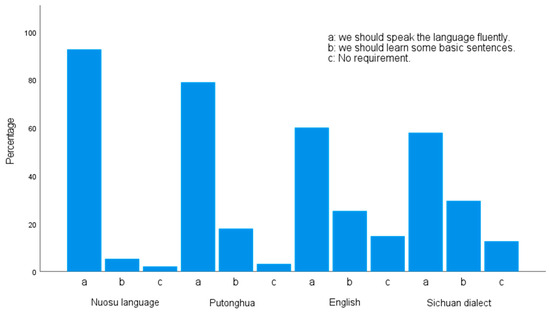
The Nuosu parents’ language ideologies regarding the Nuosu language, Putonghua, the Sichuan dialect, and English are illustrated in Figure 1. Respondents held a positive attitude towards their ethnic language, with 92.6% considering fluency in the Nuosu language an essential component of Nuosu identity.
Figure 1.
Language ideology of the Nuosu parents.
The interviewees also expressed the importance of the ethnic language. High recognition of the Nuosu language is a premise for language practice and language management at home:
R1: ꆈꌠꉙꉉꈧꀋꐛꋋꈨꆏꆈꌠꇯꍝꌠꀋꉬ, ꀋꉬꋌꑋꆈꌠꐈꉌꈲꐛꌐꀐ。
Those who cannot speak the Nuosu language are not genuine Nuosu people. They have already changed into the Han ethnic group. (Translated by the authors)
(Only English translations are presented hereafter due to space constraints.)
R2: As Nuosu people, we should know how to speak the Nuosu language.
In addition to the Nuosu language, Putonghua was the most widely recognized of the three languages. As the lingua franca in China and the medium of instruction in schools, Putonghua plays a pivotal role in education. Respondents demonstrated a lower level of recognition of the Sichuan dialect and English:
U2: Putonghua has nationwide application and has a strong correlation with children’s academic performance and future development.
U3: I use the Sichuan dialect frequently in my everyday interactions with colleagues and friends. For my son, Putonghua is more important, as it offers a broader range of uses in both educational and daily contexts. English is important in the contemporary era of globalization, and children need to take English examinations in the future.
Overall, the ranking of the Nuosu parents’ language ideology was as follows: the Nuosu language > Putonghua > English > the Sichuan dialect. The Nuosu language continues to serve as a symbolic representation of ethnic identity and culture. Putonghua holds a favored position due to its status as the national common language and its wide range of practical applications. Although English is not the medium of people’s daily communication in Liangshan, it is an important school subject. The Sichuan dialect is not an ethnic symbol of the Nuosu people, and Putonghua is replacing it both as a national and regional lingua franca. As a result, it received relatively low recognition.
4.2. Family Language Practice: Three Trends of Language Shift in Nuosu Families
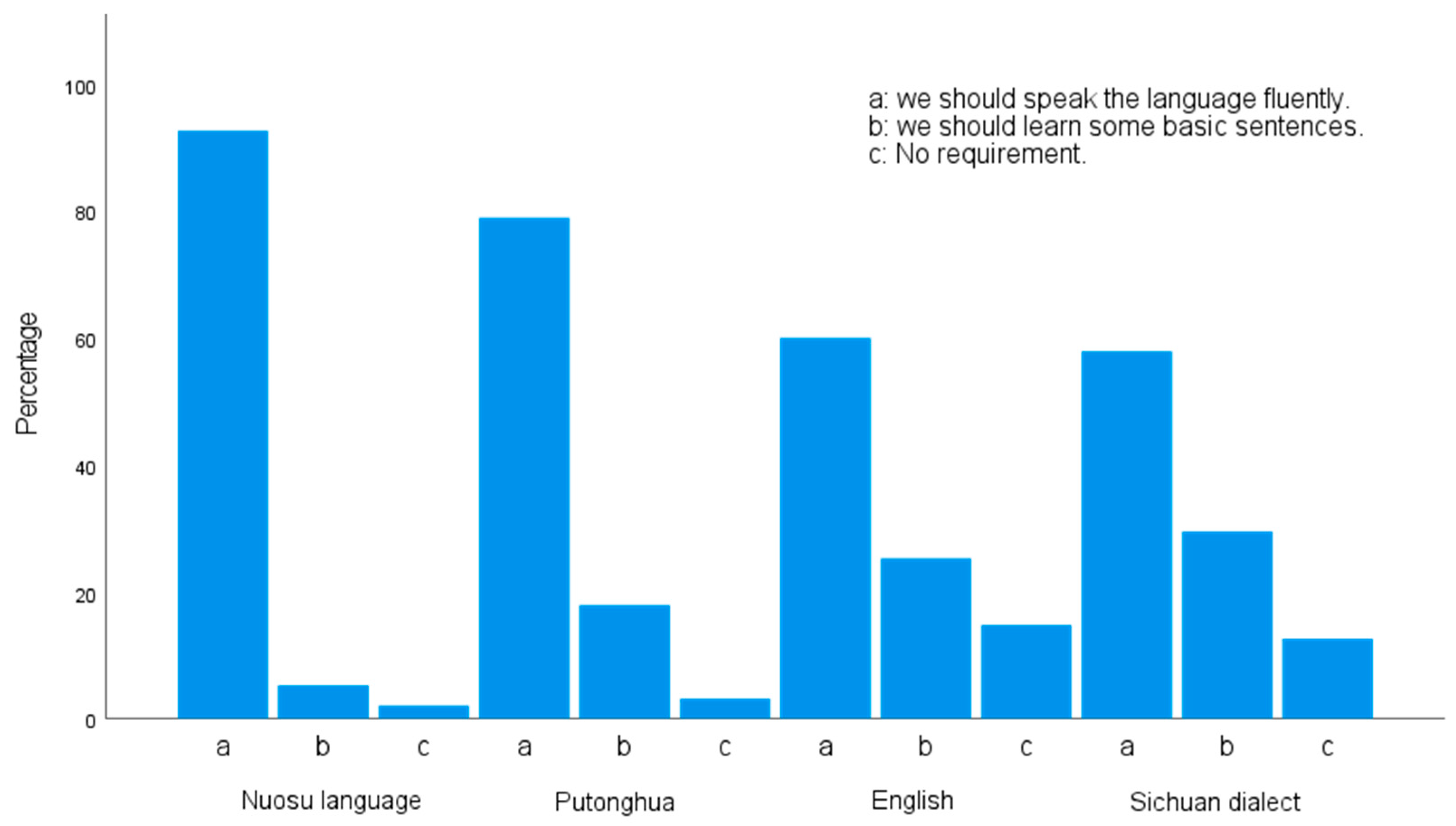
The Nuosu families’ language practices are presented from a variety of perspectives, including the number of languages spoken at home and the language choices made by individuals across different generations and regions. As demonstrated in Figure 2, the Nuosu language was still utilized by the majority of Nuosu families. 38.9% of respondents spoke the Nuosu language at home, while 31.6% employed a combination of the Nuosu language, the Sichuan dialect, and Putonghua. The inclusion of both the Nuosu language and the Sichuan dialect at home was 13.7%. It is also noteworthy that 6.4% of Nuosu families have shifted completely to using Chinese (either the Sichuan dialect or Putonghua) at home.
Figure 2.
Language practice in the family domain.
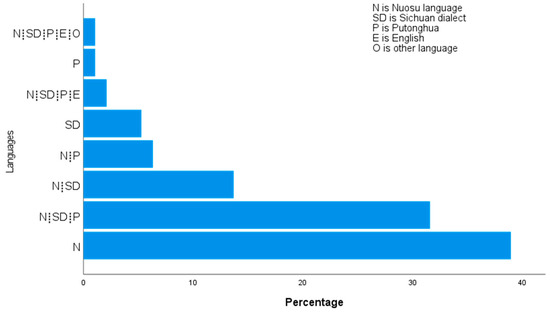
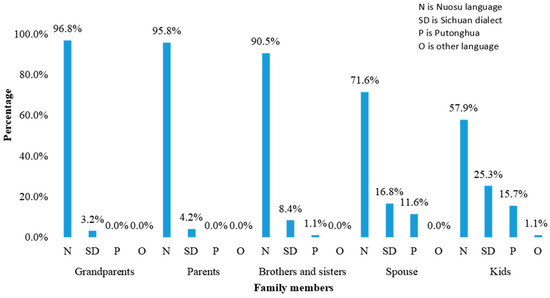
There is a significant disparity in family language practice across generations. The intergenerational communication of Putonghua was on the rise. As displayed in Figure 3, the respondents (Nuosu parents) did not use Putonghua with their grandparents or parents. However, the percentage increased to 15.7% when communicating with their children. Meanwhile, there has been a marked increase in the use of the Sichuan dialect. A mere 3.2% of respondents reported using the Sichuan dialect with their grandparents. However, 25.3% indicated its employment in communication with their children. On the contrary, the Nuosu language has seen a significant decline in its prevalence across generations. The data indicated that 96.8% of respondents spoke the Nuosu language with their grandparents, while only 57.9% used the Nuosu language with their children. The study also revealed a discrepancy between the Nuosu parents’ language ideology and language practice. Although 92.6% of respondents acknowledged the importance of proficiency in the Nuosu language (see Figure 1), only about half of them primarily used it with their children.
Figure 3.
Nuosu parents’ most frequently used language with different family members.
Table 4 illustrates the dominant languages used by Nuosu parents and children in different regions. The data revealed that urban (city and county) Nuosu parents primarily spoke the Sichuan dialect and Putonghua with their children. At the same time, the Nuosu language was mainly used in rural areas (towns and villages). It is noteworthy that Putonghua was popular in cities and villages, while the Sichuan dialect was more prevalent in counties. The Nuosu children in villages acquired the Nuosu language at home, while their formal education focused on Putonghua. Consequently, except for the Nuosu language, Putonghua was more popular than the Sichuan dialect in villages. Although Nuosu children from cities and counties were familiar with both the Sichuan dialect and Putonghua, Nuosu parents from counties displayed comparatively lower levels of Putonghua proficiency than those from cities. As a result, Putonghua was most prevalent in cities, and the Sichuan dialect was more frequently used in counties than in cities.
Table 4.
Most frequently used language between Nuosu parents and children across regions.
After combining questionnaire data with interviews and observations of the eight families, it was found that there were three trends of language shift in the language practice of Nuosu families. The first trend was the language shift from the Nuosu language to the Sichuan dialect. During family visits and other festival gatherings, although U1 and his wife communicated in the Nuosu language, they switched to the Sichuan dialect with their children. The three children (attending secondary school) also spoke the Sichuan dialect among themselves, with the Nuosu language absent from their conversation. U1 made this statement:
I speak the Han language11 with a rather pronounced Nuosu accent. I hope the children can speak the Han language more proficiently, without a Nuosu accent. Therefore, we mainly communicate with them in the Han language. They also learn the Han language at school, and it is of greater significance for them to have a good command of the Han language.
This language shift can be ascribed to the Sichuan dialect-dominated language environment in urban communities, the limited practicality of the Nuosu language in children’s education and career development, and parents’ prejudice against the Nuosu language, among other factors. In brief, the inferior status of the Nuosu language in the political, economic, educational, and cultural domains leads parents to disregard the ethnic language. With regard to U2 and U4, their spouses’ Nuosu language competence was limited. The reason for this was the predominance of the Sichuan dialect in community and family domain. U3 could speak some Nuosu language, but not as fluently as his parents. The phenomenon of speaking the Sichuan dialect instead of the Nuosu language is prevalent among second-generation Nuosu people in urban areas. However, following the implementation of the Putonghua promotion policy at the macro- and meso-levels in recent years, the shift from the Nuosu language to the Sichuan dialect may be superseded by a transition from the Sichuan dialect to Putonghua in the future.
The second trend is the language shift from the Sichuan dialect to Putonghua. This phenomenon is primarily among the younger generation living in urban areas. As illustrated in Table 4, 21.2% of city Nuosu parents predominantly used Putonghua when communicating with their children. U4’s spouse had limited proficiency in the Nuosu language. Consequently, the Sichuan dialect was the primary language used in the family domain. The elder child of U4, a 7-year-old boy, acquired proficiency in Putonghua after attending preschool. During the family visit, the boy primarily communicated with his parents in Putonghua. When the child interacted with his peers in the community, Putonghua was the sole language they used. U4 described that:
Before my son entered preschool, we mainly spoke the Sichuan dialect with him. Nevertheless, I would also use Putonghua when reading storybooks to him. After he started preschool, he gradually spoke more Putonghua. When he communicates with us in Putonghua, we unconsciously respond in Putonghua as well. Moreover, he likes watching TV, and all the cartoons are in Putonghua, so he has also learned some words from them.
In urban Nuosu families, the second generation has shifted from the Nuosu language to the Sichuan dialect, as previously stated. The third generation predominantly speak Putonghua after receiving school education, as evidenced by the children of U4. Therefore, in the third generation of urban Nuosu families, there is a sign of language shift from the Sichuan dialect to Putonghua after the recent intensification of the Putonghua promotion policy.
The third trend is the language shift from the Nuosu language to Putonghua. In the families of U3, R3, and R4, all the children acquired the Nuosu language as their first language. Nevertheless, after receiving preschool education, there was a notable enhancement in their proficiency in Putonghua. They also began to communicate in Putonghua with their siblings and parents. According to U3, who has a 6-year-old son, the child spoke the Nuosu language initially. The reason for this was primarily the assumption of childcare responsibilities by the grandparents while the parents were at work. The grandparents predominantly spoke the Nuosu language. Nonetheless, during the family visit to U3, it was observed that the boy responded in Putonghua even when other family members employed the Nuosu language or the Sichuan dialect with him. The following is a transcript of a discourse between the child and other family members:
The researcher was talking with U3 and his mother, and the child and his mother came back home from school. Approximately 20 min after they arrived, they had dinner together.
U3: 你回来啦? (Putonghua) [Coming back?]Child: 对啊。 (Putonghua) [Yes.]Mother: ꃀꒉꆏꌧꌦꀕ, ꃀꒉꄷ [Still remember aunt? Say hi.]Child: ꃀꒉ [Aunt.]Researcher: ꌳꉔꀐ, ꅽꀉꂿꆐꑊꀃꑍꐕꍮꑌꇁꅀꄆꇙꍯꑌꇁ?[Good boy, you and your Mom take the car or the electric bicycle today?]Child: 我们坐车来的 (Putonghua) [We take the car.]……Grandma: ꅽꀆꐒꑞꃅꇣꅝꇧꎭꀋꌐ? [Why didn’t you finish your water?]Child: 我喝了呀 (Putonghua) [I did.]……Grandpa: 看我们两个哪个先吃完。 (the Sichuan dialect)[Let’s see which one of us finishes the meal first.]Child: 我吃完啦,我第一。 (Putonghua) [I have finished, I am the first.]Mother: 把你碗里的饭吃完。 (Putonghua) [Finish the rice in your bowl.]Child: 我不吃了,我吃饱了。 (Putonghua) [No, I am full.]
Except for the underlined word ‘ꃀꒉ’ used by the boy to greet the researcher at the beginning of the conversation, the replies given were all in Putonghua. The mother reported that although the boy could understand the Nuosu language, he only spoke Putonghua. It can be revealed that the child has already shifted from the Nuosu language to Putonghua. In the case of R3 and R4, although the parents did not deliberately teach Putonghua at home, the children still acquired the language after receiving preschool education. Observations revealed that the two children of R3, who are attending primary school, predominantly used Putonghua in interactions with their peers and siblings, while the Nuosu language was exclusively used with their grandparents. When communicating with their parents, both the Nuosu language and Putonghua were used. The elder child of R4 (6 years old) also frequently conversed in Putonghua with her father during the family visit. Therefore, for the Nuosu children who have received the Xueqian Xuepu policy preschool education, their enhanced proficiency in Putonghua empowers them to incorporate Putonghua into the family domain.
To summarize, the intergenerational transmission of the Nuosu language exhibits a declining trend, whereas that of Putonghua and the Sichuan dialect demonstrates a growing tendency. In rural Nuosu families, the Nuosu language still retains its dominant status in daily communication, but Putonghua has gained popularity among the children in recent years. In urban Nuosu families, the Sichuan dialect plays an important role in family communication, while the Nuosu language is primarily used between parents and grandparents. Meanwhile, following the school’s recent Putonghua promotion policy, the language is now used not only among children of the same age group, but also in conversations between young urban Nuosu parents and their children. In light of the observed language practices, it can be revealed that urban Nuosu children are undergoing a transition from a predominantly Sichuan dialect to a prevalent use of Putonghua. Concurrently, rural Nuosu children are moving away from using Nuosu as their primary language towards the dominant use of Putonghua. Therefore, the Nuosu children tend to use more Chinese and less Nuosu language in their daily communication.
4.3. Family Language Management: Dependence of the Instrumental Value of the Language
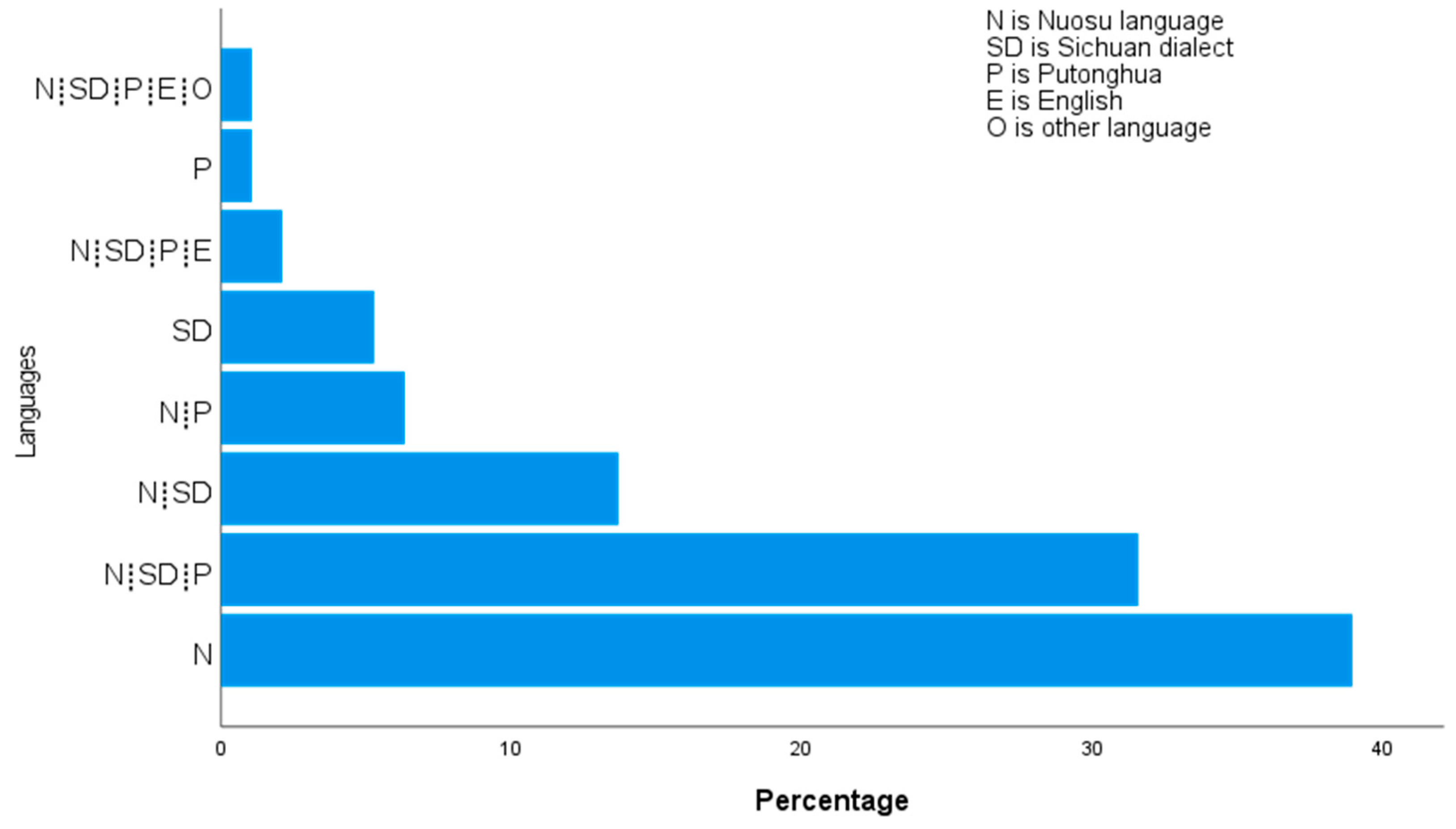
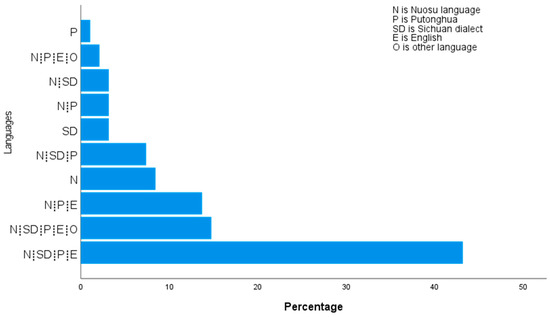
Family language management in this study examines the language requirements of Nuosu parents for their children and the language guidance provided to children at home and through extracurricular courses. As demonstrated in Figure 4, the respondents expressed a range of language requirements for their children. The data indicated that 43.2% of respondents reported the necessity for their children to acquire the Nuosu language, Putonghua, English, and the Sichuan dialect. A notable proportion of these parents, 14.7%, expressed a desire for their children to acquire languages other than the four aforementioned languages. Meanwhile, 13.7% of respondents considered proficiency in the Nuosu language, Putonghua, and English sufficient. These findings indicate that the majority of the Nuosu parents expressed support for multilingualism and the Nuosu language learning.
Figure 4.
Nuosu parents’ language requirements for their children.
Nonetheless, an analysis of interviews and observational studies of the eight Nuosu families has revealed a divergence in parents’ Nuosu language requirements:
U1: The children have no difficulty in understanding the Nuosu language. They just lack fluency in speaking the language, and this is sufficient for them as well.
U2: It is hard for my child to master the Nuosu language because the language environment around him is mostly the Han language. It would be better if he could understand some simple Nuosu words or sentences in the future.
R2: It is unacceptable if my children cannot speak the Nuosu language.
As R2 mentioned, the four rural parents emphasized the necessity for their children to attain fluency in the Nuosu language, given its status as the dominant language in the family domain. In contrast, urban Nuosu families operated within a more linguistically diverse family environment, where the Sichuan dialect and Putonghua were frequently employed in interactions between parents and their children. Consequently, these urban parents did not insist that their children should possess a high level of fluency in the Nuosu language.
Table 5 illustrates the language management employed by the Nuosu parents, encompassing guidance within the home and in extracurricular courses. The majority of Nuosu parents reported guiding the Nuosu language and Putonghua at home. These findings demonstrate the significance of both languages in family language management. The observations of the eight families in this study revealed that, except R1, R2, and U1, who were unable to speak Putonghua, the remaining parents utilized Putonghua when instructing their children on homework or reading storybooks.
Table 5.
Language management in Nuosu families.
The participants exhibited different language management towards Putonghua. In U3’s family, the child (6 years old) acquired the Nuosu language first. However, in order to prepare the child for the Putonghua environment in preschool, the mother decided to speak Putonghua instead of the Nuosu language before he started preschool. The mother explained that:
When my son was two and a half years old, I decided that he needed to learn more Putonghua because it was the only language spoken at preschool. If he cannot understand Putonghua, it may be difficult for him to communicate with the teachers. So, I started speaking more Putonghua with him.
The mother’s transition from the Nuosu language to Putonghua is indicative of her language management strategy, which aimed to enhance her child’s Putonghua proficiency. This language management strategy was a response to the Xueqian Xuepu policy, which stipulated the acquisition of Putonghua in preschool. Moreover, after the child attended preschool, his proficiency in Putonghua further intensified. Consequently, the boy has shifted from the Nuosu language to Putonghua. Despite the grandparents’ endeavors to engage the child in Nuosu language conversations and encourage him to respond in the Nuosu language, the child persisted in replying in Putonghua, as evidenced in the excerpt above. The grandmother would sometimes tell the boy: ‘ꀊꂵꉌꈲꉙꀋꌧ,ꆏꆈꌠꉙꃅꀊꂵꇬꏈ [Grandma does not understand Chinese. Speak the Nuosu language with grandma]’, yet the child was aware that his grandmother could understand Putonghua. Therefore, he also responded in Putonghua, stating: ‘哎呀, 我不会说彝族话 [I cannot speak the Nuosu language].’ The grandmother had previously suggested sending the child to a rural area, where he could socialize with children who only spoke the Nuosu language. However, it proved challenging to find any Nuosu children who spoke only the Nuosu language after receiving a school education. As the grandmother stated:
Even the Nuosu children in our village only speak Putonghua among themselves nowadays. So, even if we take our grandson back to the village, children around the same age would still speak Putonghua with each other.
Therefore, Putonghua has become a prevalent language among the Nuosu children in both urban and rural areas. It is difficult to identify a ‘pure’ Nuosu language environment that can meet the needs of the grandmother. During the interview, the mother expressed a sense of remorse regarding the child’s prior language management:
I should not have spoken Putonghua with him before he went to preschool. If we had insisted on speaking the Nuosu language with him, even if he learned Putonghua at school, he might also spoke the Nuosu language with us when he came home.
The mother reported an increase in the frequency of her communication with her child in the Nuosu language. She also requested her child to articulate in concise Nuosu words, even when the child was unable to speak complex sentences.
In addition to caregivers’ language management within the family domain, the extracurricular language course is another way for parents to enhance their children’s language competence. Nevertheless, the decision regarding enrollment in extracurricular language courses is affected by the proportion of the language in high-stakes examinations. For example, U1 enrolled his children in an extracurricular Nuosu language course12 during their middle school education. The inclusion of the Nuosu language in high school entrance examination was a key factor in this decision. Following the implementation of English as a mandatory component of Liangshan’s primary education curriculum, U4 enrolled her seven-year-old child in a weekend extracurricular English educational institution.
In sum, the instrumental value of a language is a critical factor in understanding parents’ language management. While parents’ language competence and the language environment in community can influence their approach to language guidance at home, a strong correlation exists between parents’ investment in their children’s extracurricular language courses and school language education policies.
5. Discussion
Many factors impact the FLP, with the school language education policy being a particularly salient one (Curdt-Christiansen et al., 2023; Spolsky, 2012). The present study further sought to discuss the impact of Liangshan’s new language education policies on the FLP of Nuosu families.
5.1. The Impact of the New Language Education Policies on the FLP of Nuosu Families
Firstly, the Xueqian Xuepu policy plays a vital role in promoting Putonghua among Nuosu families. Although Putonghua promotion has always been a national policy since the founding of the PRC (Shi, 2022), it is noteworthy that the Xueqian Xuepu policy targets preschool children aged between three and six, which is a critical period for language acquisition (Bialystok & Hakuta, 1994; Lenneberg, 1967). Before the implementation of the Xueqian Xuepu policy, preschool education was not available in the rural areas of Liangshan. As a result, rural Nuosu students attended primary school directly without undergoing preschool education. In urban Nuosu families, although the children had received preschool education before the Xueqian Xuepu policy, the emphasis on Putonghua was not as intense as it is at present. R1 and U2 stated that:
R1: My children went straight to primary school, as there were no preschools in our village at that time. Nowadays, it is very convenient for children in our village to attend preschool, and they only speak Putonghua with each other.
U2: When my child attended preschool (in 2015), Putonghua was also used at school, although it was not as emphasized as it is nowadays. Some teachers also communicated with the children in the Sichuan dialect.
Following the implementation of the Xueqian Xuepu policy, professional language teaching companies and preschool education institutions in Beijing have provided guidance and resources to support Putonghua education in Liangshan. Thousands of preschool teachers have been trained to speak qualified Putonghua (Bimu, 2023). Putonghua was the only language teachers used, whether in urban or rural areas. Consequently, the Putonghua proficiency of children who have undergone the Xueqian Xuepu policy has demonstrably improved (Qian, 2021). In the family domain, Nuosu children’s enhanced Putonghua proficiency enabled them to communicate with their family members in Putonghua or to teach them how to speak the language (Ren, 2021). Therefore, the Nuosu children acted as agents who brought Putonghua from the school into the family domain.
Therefore, the Xueqian Xuepu policy promoted Nuosu children’s language preference from the Nuosu language to Putonghua in rural families and from the Sichuan dialect to Putonghua in urban families. The language change in urban Nuosu families aligns with previous research that demonstrated the dominance of Putonghua in urban Han dialect families, where Putonghua has replaced regional dialects (e.g., Curdt-Christiansen & Wang, 2018; Peng & Wan, 2023). However, the Putonghua practices between parents and children in rural Nuosu families differ from a previous study (H. Zhang et al., 2022), which indicated a lack of Putonghua involvement in the FLP of rural ethnic minorities in Yunnan Province. The findings indicate the success of the Xueqian Xuepu policy in rural Liangshan and validate the importance of school education policies on FLP (Curdt-Christiansen, 2016; Spolsky, 2012; L. Zhang & Tsung, 2019b).
Secondly, the diminishing of the first model education (the Nuosu language instruction) may have an impact on parents’ language attitude and language management towards the Nuosu language. As demonstrated in the disparity between the Nuosu parents’ language attitude and language practice towards the Nuosu language, while ethnic minorities viewed their ethnic language as a source of pride, they had to adopt a more pragmatic perspective in FLP (Curdt-Christiansen et al., 2023). If a language possesses only emotional value and no instrumental value, its neglect becomes a distinct possibility. The role of school education in children’s future development is indisputable. Consequently, the Nuosu parents place significant emphasis on their children’s education. The interviewees expressed their thoughts on Nuosu language education:
U2: If you are in the first model education, the Nuosu language competence, especially Nuosu language literacy, is of great significance for your academic performance. However, for the students in the second model education, the Nuosu language is not important.
U1: It is good for Nuosu children to learn some Nuosu characters. But urban schools do not offer Nuosu language courses. If the Nuosu language is not required in the examination, it is not necessary to spend too much time and money on it, because the children have numerous other subjects to study.
R1: My daughter was in the first model education, and I also helped her with her Nuosu language study during her high school years. The Nuosu language is essential for the first model students.
The status of the Nuosu language in school education, particularly in high-stakes examinations, influences parents’ attitudes and investments in their children’s Nuosu language learning. In the first model education, the Nuosu language is not merely a course, but an important instrumental language that facilitates the learning of other subjects. Yao and Liu (2024) conducted an investigation into two middle schools in a Nuosu-concentrated county of Liangshan, revealing the predominance of Putonghua on the second model campus. These students were the driving force behind the language shift from the ethnic language to Putonghua compared with the first model students. It was argued that the first model education might further widen the academic performance gap between students from these two models (L.-J. Wang, 2017). However, the first model education enabled the Nuosu children to receive education in their mother tongue, thereby facilitating the transmission and protection of the Nuosu language (Teng, 2000; L.-J. Wang, 2017). Despite the stipulation of the Liangshan government that the Nuosu language course be provided in second model schools where Nuosu students predominate, research has indicated that the Nuosu language classes in the majority of these schools are inadequate (Aga & Harrell, 2020; L. Zhang & Tsung, 2019a). Therefore, in the absence of the first model education, the Nuosu language education is scarcely represented in schools. Without the Nuosu language education at school, its support within the family domain may also be affected. The reason is that children’s academic performance and future development are not contingent on their proficiency in the Nuosu language, but rather on their proficiency in Putonghua and English.
Thirdly, the incorporation of English in the middle school entrance examination has heightened parental emphasis on English education. In 2024, English became a compulsory course in Liangshan’s primary schools, and it was included in the middle school entrance examination in 2025. The reform enhanced the status of English not only in school but also in the family domain:
R3: I have also heard that English will be included in the middle school entrance examination. The children will then need to spend more time learning English. We do not understand English, so we cannot teach them at home. Moreover, it is hard for us to afford the extracurricular English courses.
U2: My son is in Grade 6 now, and he needs to take the English test for the middle school entrance examination. It is a big change. I have already sent him to extracurricular English courses on weekends. I also bought some English books to help him learn English.
U4: Recently, I have been searching for a suitable English training program for my son (7 years old) to attend on weekends. English is now a compulsory subject in primary school, and you need to learn it.
It can be revealed that the English education reform in Liangshan’s primary school exerts an influence on Nuosu parents’ language ideology and language management. The child of U2 was in the final year of primary school. The couple were actively supporting their children’s English study, as the subject would be included in the middle school entrance examination. Even though the son of U4 was only in Grade 1 of primary school and English was not a compulsory subject until Grade 3, his parents had already enrolled him in extracurricular English courses. The language management measures implemented by Nuosu parents were also related to their language competence and socioeconomic status. Many rural Nuosu parents have limited resources for English instruction, whether at home or through extracurricular courses. Therefore, they can only rely on school education.
Admittedly, there are other factors playing facilitating roles in shaping FLP in Liangshan, such as the intensified Putonghua promotion policy at the macro-level, the poverty alleviation and relocation policy at the meso-level, and the Putonghua-dominated digital media at the micro-level. However, language education policy exerts the most direct impact since it is related to children’s academic performance and future development. With a deep-rooted tradition of instrumentalism in language policymaking in the Chinese context, Putonghua and English are associated with modernization and socioeconomic development (Curdt-Christiansen & Wang, 2018; Shen et al., 2021). In contrast, languages other than those that are directly promoted by the government or required in school education are easily neglected. In underdeveloped regions such as Liangshan, parents often perceive education as the primary means for their children to achieve social mobility. Therefore, the importance of Putonghua and English in school education would inevitably draw Nuosu parents’ attention to these languages. Consequently, the Nuosu parents’ support for the school language, coupled with their children’s enhanced proficiency in the language, gradually extended the school language to the family domain.
5.2. The Nuosu Families’ Reactions to the School Language Education Policies
The Nuosu families’ reactions to the language education policies can be further categorized into active involvement, passive acceptance, and active resistance. The language management in the family of U3 revealed a complex dynamic, characterized by a shift from active engagement with Putonghua to active resistance. The mother’s increased Putonghua practice before her child attended preschool can be regarded as an active involvement in facilitating her child’s adjustment to the Putonghua environment during preschool education. Subsequently, when the caregivers became aware of the child’s transition from the Nuosu language to Putonghua, there were signs of active resistance within the family. For instance, the grandmother’s proposal to send the child to the village (although ultimately unsuccessful), her pretence of an inability to comprehend Putonghua, the mother’s increased Nuosu language practice with the child, and her stipulation for the child to respond in at least short Nuosu words (see Section 4.3). The measures employed by the caregivers indicated an endeavour to enhance the child’s Nuosu language proficiency. Nevertheless, whether the family of U3 could reverse the language shift (Fishman, 1991) remains uncertain. Caldas (2012) posited that, as the child grows older, the influence of peers on a child’s language competence becomes more significant than that of parents. The situation is that nearly all Nuosu children in the child’s community and school environment speak Putonghua. Therefore, passive acceptance may gradually supersede active resistance in the family of U3. In three other families whose children have received preschool education under the Xueqian Xuepu policy, passive acceptance was the response towards their children’s increased Putonghua practice at home. The parents did not actively instruct their children to speak Putonghua at home, nor did they deliberately require their children to use the Nuosu language when speaking Putonghua with their siblings. Passive acceptance was also the response to the decreased Nuosu language education in school. Meanwhile, many families presented active involvement in their children’s English learning after the implementation of a mandatory English course in primary schools. As demonstrated by the family of U2 and U4, the parents arranged English instruction at home and/or through extracurricular English courses.
The decreased institutional support for ethnic language leaves the pressure of ethnic language maintenance on the family. However, families may concede to pragmatism and opted for giving up their ethnic language (Curdt-Christiansen et al., 2023). Fishman (1991) emphasizes that without the intergenerational language transmission at home, ethnic language cannot be maintained solely through school education. Nevertheless, when the community language environment and institutional support are both in the dominant language, it can be challenging for families to maintain their ethnic language.
6. Conclusions
The present study explored the FLP of Nuosu families in Liangshan Yi Autonomous Prefecture. The results indicate a strong tendency towards Chinese-dominant language use among younger Nuosu generations. It also demonstrated the significant impact of language education policies on FLP, especially the importance of the Xueqian Xuepu policy on children’s language development. As members of the Chinese community, Nuosu children need to develop proficiency in Putonghua, which benefits their language repertoire, academic success, and prospects. Meanwhile, the Putonghua promotion policy in Liangshan is expected to contribute to social stability, economic prosperity, and national unity in the long run. However, it is worth noting that the predominance of Putonghua among Nuosu children and the declining intergenerational transmission of the ethnic language in Nuosu families could endanger the Nuosu language in the next generation. Therefore, the language policy in Liangshan should be designed to achieve a balance among the Nuosu language, Putonghua, and English, with the objective of enhancing the multilingual competence of Nuosu children. The implementation of translanguaging pedagogy within school education has the potential to broaden the linguistic repertoire of Nuosu students. The FLP in Nuosu families should prioritize children’s proficiency in the Nuosu language.
This study is a new attempt to explore FLP in Nuosu families of the Yi ethnic group. The findings shed light on the language life of the Nuosu families and the contributing factors. Such insights could be enlightening for those interested in language policies within a multilingual context. The limitations of the present study are the relatively small sample size, uneven distribution of the subjects’ educational backgrounds, and the shortage of a fine-grained description of linguistic shifts. In future research, it is important to encompass a more representative and larger sample. In addition, it is essential to incorporate the Nuosu children into the study. As recommended by Z.-H. Li (2023) and Yu (2024), future studies could investigate whether the documented shifts in language use correspond to an actual shift in language competence, particularly from a linguistic structural perspective.
Author Contributions
Conceptualization, Z.W. and C.L.; methodology, Z.W. and C.L.; software, Z.W.; validation, Z.W. and C.L.; formal analysis, Z.W. and C.L.; investigation, Z.W.; resources, Z.W. and C.L.; data curation, Z.W. and C.L.; writing—original draft preparation, Z.W. and C.L.; writing—review and editing, C.L. and Z.W.; visualization, Z.W.; supervision, C.L.; project administration, Z.W. and C.L.; funding acquisition, Z.W. All authors have read and agreed to the published version of the manuscript.
Funding
This research was funded by The Rural Education Research Center of Liangshan grant number SCE2025B05.
Institutional Review Board Statement
The study was conducted in accordance with the Declaration of Helsinki, and approved by the Institutional Ethics Committee of College of International Studies, Southwest University (date of approval: 20240627).
Informed Consent Statement
Informed consent was obtained from all subjects involved in the study.
Data Availability Statement
Data is unavailable due to privacy.
Conflicts of Interest
The authors declare no conflict of interest.
Notes
| 1 | National Statistics Bureau of China. (2021). Chinese Statistical Yearbook 2021. Retrieved 20 June 2025, from https://www.stats.gov.cn/sj/ndsj/2021/indexch.htm. |
| 2 | The big data centre of Liangshan. (9 June 2025). The introduction of Liangshan. Retrieved 10 July 2025, from https://www.lsz.gov.cn/wcls/lsgk/xzqhyrk/202506/t20250609_2842893.html. |
| 3 | The Yi ethnic group comprises several subgroups, including the Nuosu, Niesu, and Nasu. The Yi people living in Liangshan Yi Autonomous Prefecture, Sichuan Province, and the northwest part of Yunnan Province refer to themselves as Nuosu. The Niesu live in the south and southeast of Yunnan Province. The Nasu live in western Guizhou and Guangxi Provinces and the northeast of Yunnan Province (K. Chen, 2010). These subgroups speak different dialects of the Yi language. In this study, ‘Nuosu’ refers to the Yi people in Liangshan, and ‘Nuosu language’ refers to the Nuosu dialect of the Yi language. |
| 4 | In ethnic minority areas, both the local Chinese dialect and Putonghua are called Chinese (the Han language). In Liangshan, this refers to the Sichuan dialect (a subset of Southwest Chinese dialect) and/or Putonghua. |
| 5 | Ministry of Education. (14 October 2020). A review of the development of Chinese language work since the founding of New China. Retrieved 20 June 2025, from http://www.moe.gov.cn/jyb_xwfb/s5147/202010/t20201014_494446.html. |
| 6 | Liangshan Daily. (9 October 2024). The addition of new subjects in the unified graduation test in primary school. Retrieved 20 June 2025, from https://www.lsz.gov.cn/hdjl/shrd/202410/t20241009_2738181.html. |
| 7 | In the 2025 middle school entrance examination in Liangshan, the English course was included in the assessment. However, due to the differences in availability and teaching arrangements of English courses in primary schools before 2024, English scores were not considered in the 2025 admission procedure. It is estimated that English may gradually be included in the admission process of Liangshan’s middle schools in the future. |
| 8 | Education and Sports Bureau of Xichang. (28 June 2023). Notice from the Education and Sports Bureau of Xichang City on the work of students’ admission for the 2023 compulsory education stage. Retrieved 25 September 2025, from http://www.xichang.gov.cn/zfxxgk/zfxxgknr/tzgg_31367/202306/t20230628_2502868.html. |
| 9 | In this study, the terms ‘urban’ and ‘rural’ refer to participants’ current residential locations. The term ‘urban’ refers to families who reside in cities or counties. The term ‘rural’ refers to families living in towns or villages. |
| 10 | The Nuosu people place a distinct emphasis on the concept of ‘clan’, which refers to individuals sharing the same family name that has been passed down across generations. In rural areas, members of a family clan usually reside together. Relatives belonging to the same clan, as well as those related through marriage, often gather for various events, whether in urban or rural areas. These occasions range from traditional festivals to weddings, funerals, etc. |
| 11 | The Nuosu people in Liangshan usually use ꆈꌠꉙ/彝话 (Nuosu language) and ꉌꈲꉙ/汉话 (Han language) to differentiate the Nuosu language and the language of the Han ethnic group. When they use the “Han language”, it may refer to the Sichuan dialect, Putonghua, or both languages, depending on the context. |
| 12 | According to the education policy in Liangshan, students can take the Nuosu language examination as part of the high school entrance examination. A maximum of 50 scores can be attained in the Nuosu language examination when U1’s children took the high school entrance examination (only 20 scores since 2025). The total score of the high school entrance examination is 900. |
References
- Aga, R., & Harrell, S. (2020). Theory and practice of bilingual education in China: Lessons from Liangshan Yi Autonomous Prefecture. International Journal of Bilingual Education and Bilingualism, 23(10), 1254–1269. [Google Scholar] [CrossRef] [Scilit]
- Baldauf, R. B. (2006). Rearticulating the case for micro language planning in a language ecology context. Current Issues in Language Planning, 7(2–3), 147–170. [Google Scholar] [CrossRef] [Scilit]
- Bialystok, E., & Hakuta, K. (1994). In other words: The science and psychology of second-language acquisition. Basic Books. [Google Scholar]
- Bimu, R.-L. (2023, September 19). The education in Liangshan from “Xueqian Xuepu” to “Xuepu Yongpu”: Liangshan deepens the “Xueqian Xuepu” action. Liangshan Daily (Chinese Version). 006.
- Bohnacker, U. (2022). Turkish heritage families in Sweden: Language practices and family language policy. Journal of Multilingual and Multicultural Development, 43(9), 861–873. [Google Scholar] [CrossRef] [Scilit]
- Caldas, S. J. (2012). Language policy in the family. In B. Spolsky (Ed.), The Cambridge handbook of language policy (pp. 351–373). Cambridge University Press. [Google Scholar]
- Chen, K. (2010). The dialects of the Yi language. China Minzu University Press. [Google Scholar]
- Chen, Y.-L., Zhang, L.-H., & Qiu, J.-H. (2021). A study of a diversified action plan on the ‘learning standard Chinese for preschool education’ in ethnic minority areas in the new era: Taking Z County of Liangshan Yi Autonomous Prefecture and Y County of Panzhihua as case studies. Journal of Ethnology, 12(12), 99–105+134. [Google Scholar] [CrossRef]
- Curdt-Christiansen, X. L. (2009). Invisible and visible language planning: Ideological factors in the family language policy of Chinese immigrant families in Quebec. Language Policy, 8(4), 351–375. [Google Scholar] [CrossRef] [Scilit]
- Curdt-Christiansen, X. L. (2013). Family language policy: Sociopolitical reality versus linguistic continuity. Language Policy, 12(1), 1–6. [Google Scholar] [CrossRef] [Scilit]
- Curdt-Christiansen, X. L. (2014). Family language policy: Is learning Chinese at odds with learning English in Singapore. In X. L. Curdt-Christiansen, & A. Hancock (Eds.), Learning Chinese in diasporic communities: Many pathways to being Chinese (pp. 35–58). John Benjamins. [Google Scholar]
- Curdt-Christiansen, X. L. (2016). Conflicting language ideologies and contradictory language practices in Singaporean multilingual families. Journal of Multilingual and Multicultural Development, 37(7), 694–709. [Google Scholar] [CrossRef] [Scilit]
- Curdt-Christiansen, X. L., Li, W., & Zhu, H. (2023). Pride, prejudice and pragmatism: Family language policies in the UK. Language Policy, 22(4), 391–411. [Google Scholar] [CrossRef] [Scilit]
- Curdt-Christiansen, X. L., & Wang, W.-H. (2018). Parents as agents of multilingual education: Family language planning in China. Language, Culture and Curriculum, 31(3), 235–254. [Google Scholar] [CrossRef] [Scilit]
- Feng, A., & Adamson, B. (2017). Language policies and sociolinguistic domains in the context of minority groups in China. Journal of Multilingual and Multicultural Development, 39(2), 169–180. [Google Scholar] [CrossRef] [Scilit]
- Fishman, J. A. (1991). Reversing language shift: Theory and practice of assistance to threatened languages. Multilingual Matters. [Google Scholar]
- Gu, M. M., Han, Y., & Tang, L. (2022). Family language policy in a multilingual Mongolian family in China: A cross-generation exploration. Journal of Multilingual and Multicultural Development, 46(10), 3291–3308. [Google Scholar] [CrossRef] [Scilit]
- Hornberger, N. H. (2006). Frameworks and models in language policy and planning. In T. Ricento (Ed.), An introduction to language policy: Theory and method (pp. 24–41). Blackwell. [Google Scholar] [CrossRef] [Scilit]
- Hu, S.-H. (2008). Assessment of the social functions and vitality of the Yi language from the perspective of its usage domains. Chinese Education & Society, 41(6), 61–70. [Google Scholar] [CrossRef] [Scilit]
- Johnson, D. C. (2013). Language policy. Palgrave Macmillan. [Google Scholar]
- Kaplan, R. B., & Baldauf, R. B. (1997). Language planning: From practice to theory. Multilingual Matters. [Google Scholar]
- King, K. A., & Fogle, L. (2006). Bilingual parenting as good parenting: Parents’ perspectives on family language policy for additive bilingualism. International Journal of Bilingual Education and Bilingualism, 9(6), 695–712. [Google Scholar] [CrossRef] [Scilit]
- King, K. A., Fogle, L., & Logan-Terry, A. (2008). Family language policy. Language and Linguistics Compass, 2(5), 907–922. [Google Scholar] [CrossRef] [Scilit]
- Lenneberg, E. H. (1967). Biological foundations of language. John Wiley and Sons. [Google Scholar]
- Li, Y.-M. (2022). A brief discussion on language planning studies. Lexicographical Studies, (1), 1–17+125. [Google Scholar] [CrossRef]
- Li, Z.-H. (2023). Substitution of kernel words in contact-induced language shift: The case of Jiuhe Naxi. Linguistic Research, (2), 57–77. [Google Scholar]
- Liu, C.-Y., Ding, H.-D., Wong, H., Yu, L.-J., & Yang, M.-Z. (2015). A multi-case investigation into trilingualism and trilingual education in Liangshan Yi Autonomous Prefecture. In A. W. Feng, & B. Adamson (Eds.), Trilingualism in education in China: Models and challenges (pp. 141–171). Springer. [Google Scholar]
- MacLeod, A. A. N., & Demers, C. (2023). Understanding family factors for language transmission of minoritized languages in bilingual kindergarten children growing up in multilingual neighborhoods. Journal of Multilingual and Multicultural Development, 46(7), 1798–1814. [Google Scholar] [CrossRef] [Scilit]
- Nesteruk, O. (2010). Heritage language maintenance and loss among the children of Eastern European immigrants in the USA. Journal of Multilingual and Multicultural Development, 31(3), 271–286. [Google Scholar] [CrossRef] [Scilit]
- Nie, P., & Wang, S. (2025). Homescape, parental agency and family language policy: How Yi parents utilize semiotic resources to facilitate language maintenance. Current Issues in Language Planning, 1–20. [Google Scholar] [CrossRef] [Scilit]
- Peng, Y., & Wan, Y. (2023). Understanding parental agency in family language policies from language-as-resource ideology perspective: The case of three Shanghainese families. Journal of Multilingual and Multicultural Development, 46(7), 1833–1844. [Google Scholar] [CrossRef] [Scilit]
- Qian, X. (2021, October 19). Telling new stories of Liangshan in Putonghua. Liangshan Daily (Chinese Version). 002.
- Ren, R. (2021, October 26). Xueqian Xuepu lights up the dreams of Yi children in Liangshan. Chinese Women’s Newspaper. 004. [CrossRef]
- Shen, Q., Wang, L., & Gao, X. (Andy). (2021). An ecological approach to family language policy research: The case of Miao families in China. Current Issues in Language Planning, 22(4), 427–445. [Google Scholar] [CrossRef] [Scilit]
- Shi, L. (2018). Strategies for deepening the popularization of national common language and script in ethnic minority areas from the perspective of targeted poverty alleviation. Social Scientist, 4, 150–156. [Google Scholar]
- Shi, L. (2022). Putonghua education for preschool children and strengthening a sense of Chinese national community in ethnic minority Areas. Journal of Ethnology, 13(12), 78–87+154. [Google Scholar] [CrossRef]
- Song, L., & Zhang, X. (2025). Multilingual family language planning among Mongolian families in Inner Mongolia: A case study of Naiman banner. Journal of Multilingual and Multicultural Development, 1–20. [Google Scholar] [CrossRef] [Scilit]
- Spolsky, B. (2004). Language policy. Cambridge University Press. [Google Scholar]
- Spolsky, B. (2009). Language management. Cambridge University Press. [Google Scholar]
- Spolsky, B. (2012). Family language policy—The critical domain. Journal of Multilingual and Multicultural Development, 33(1), 3–11. [Google Scholar] [CrossRef] [Scilit]
- Sun, H.-K. (2015). A discussion on the one hundred years’ planning of Chinese minority nationalities’ languages. Qinghai Journal of Ethnology, 26(2), 91–99. [Google Scholar]
- Teng, X. (2000). The necessity of implementing the Yi-Han bilingual education in Liangshan Yi communities. Journal of Research on Education for Ethnic Minorities, 1, 5–25. [Google Scholar] [CrossRef]
- Tuo, H.-Y., & Li, Z.-Y. (2019). A case study of the Salar family language policy. Minzu Tribune, (2), 107–112. [Google Scholar] [CrossRef]
- Wang, L. (2019). The research on family language policy in Taijiang Miao families of Guizhou. Guizhou Ethnic Studies, 40(4), 190–195. [Google Scholar]
- Wang, L.-J. (2017). Rethinking the bilingual education for China’s minorities: A case study of Liangshan Yi Prefecture. Journal of Qinghai Minzu University (Social Sciences), 43(4), 148–154. [Google Scholar]
- Yao, J., & Liu, S. (2024). Exploring the language shift of secondary Yi students in Liangshan Yi Autonomous Prefecture, Sichuan, China. Journal of Multilingual and Multicultural Development, 46(9), 3152–3165. [Google Scholar] [CrossRef] [Scilit]
- Yin, X.-R., & Li, G.-F. (2019). Generational differences of the Xibo family language attitude. Chinese Journal of Language Policy and Planning, 4(2), 31–41. [Google Scholar]
- Yin, X.-R., & Liu, J. (2013). Probe into the situation of language kept in Xibo family. Journal of Xinjiang Normal University (Social Sciences), 34(06), 95–100. [Google Scholar]
- Yu, D.-J. (2024). A Study of rank analysis from a micro case of core word replacement. Contemporary Linguistics, 26(3), 418–437. [Google Scholar]
- Zhang, H., Shi, Y., & Li, Z. (2022). Family language policy in multi-ethnic and multilingual villages in Yunnan, China: A comparative case study of Kena village and Anmin village. Journal of Multilingual and Multicultural Development, 45(9), 3846–3861. [Google Scholar] [CrossRef] [Scilit]
- Zhang, L., & Tsung, L. (2019a). Bilingual education and minority language maintenance in China: The role of schools in saving the Yi language. Springer. [Google Scholar]
- Zhang, L., & Tsung, L. (2019b). Tibetan bilingual education in Qinghai: Government policy vs. family language practice. International Journal of Bilingual Education and Bilingualism, 22(3), 290–302. [Google Scholar] [CrossRef] [Scilit]
- Zhang, Y.-B. (2011). Language ecology and language protection in ethnically mixed areas of northwest Guizhou [Doctoral dissertation, Minzu University of China]. [Google Scholar]

Disclaimer/Publisher’s Note: The statements, opinions and data contained in all publications are solely those of the individual author(s) and contributor(s) and not of MDPI and/or the editor(s). MDPI and/or the editor(s) disclaim responsibility for any injury to people or property resulting from any ideas, methods, instructions or products referred to in the content. |
© 2025 by the authors. Licensee MDPI, Basel, Switzerland. This article is an open access article distributed under the terms and conditions of the Creative Commons Attribution (CC BY) license (https://creativecommons.org/licenses/by/4.0/).