
A Survey of Family Language Planning in Liangshan Yi Autonomous Prefecture in the Context of New Language Education Policies

Abstract
1. Introduction
2. Family Language Planning
2.1. Definition of Family Language Planning
2.2. Family Language Planning of China’s Ethnic Minorities
- (1)
- What is the family language ideology in Nuosu families?
- (2)
- What is the family language practice in Nuosu families?
- (3)
- What is the family language management in Nuosu families?
3. The Study
3.1. Methods
3.2. Participants
3.3. Data Collection and Analysis
4. Results and Analysis
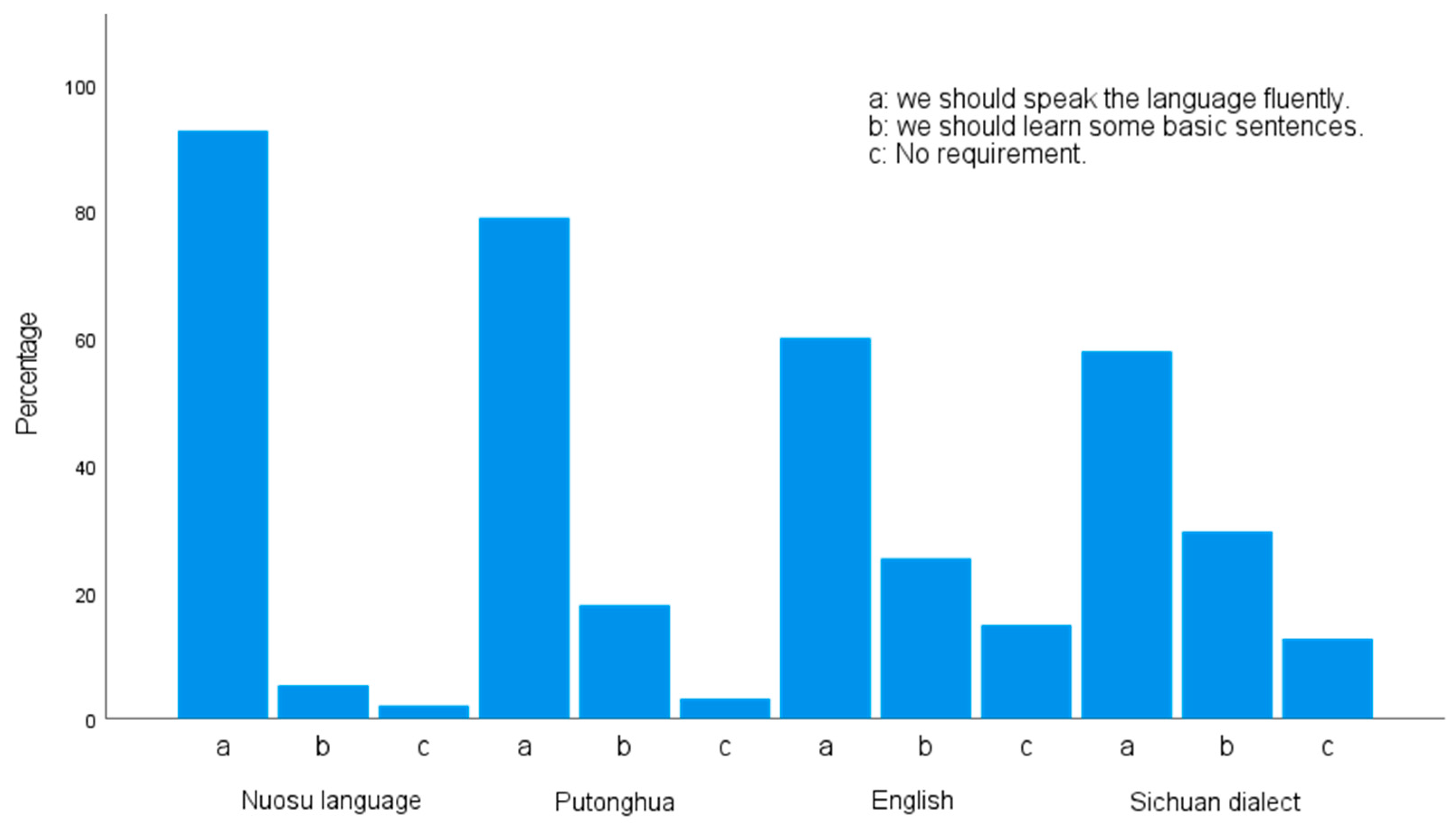
4.1. Family Language Ideology: High Recognition of the Nuosu Language and Putonghua
R1: ꆈꌠꉙꉉꈧꀋꐛꋋꈨꆏꆈꌠꇯꍝꌠꀋꉬ, ꀋꉬꋌꑋꆈꌠꐈꉌꈲꐛꌐꀐ。
Those who cannot speak the Nuosu language are not genuine Nuosu people. They have already changed into the Han ethnic group. (Translated by the authors)
(Only English translations are presented hereafter due to space constraints.)
R2: As Nuosu people, we should know how to speak the Nuosu language.
U2: Putonghua has nationwide application and has a strong correlation with children’s academic performance and future development.
U3: I use the Sichuan dialect frequently in my everyday interactions with colleagues and friends. For my son, Putonghua is more important, as it offers a broader range of uses in both educational and daily contexts. English is important in the contemporary era of globalization, and children need to take English examinations in the future.
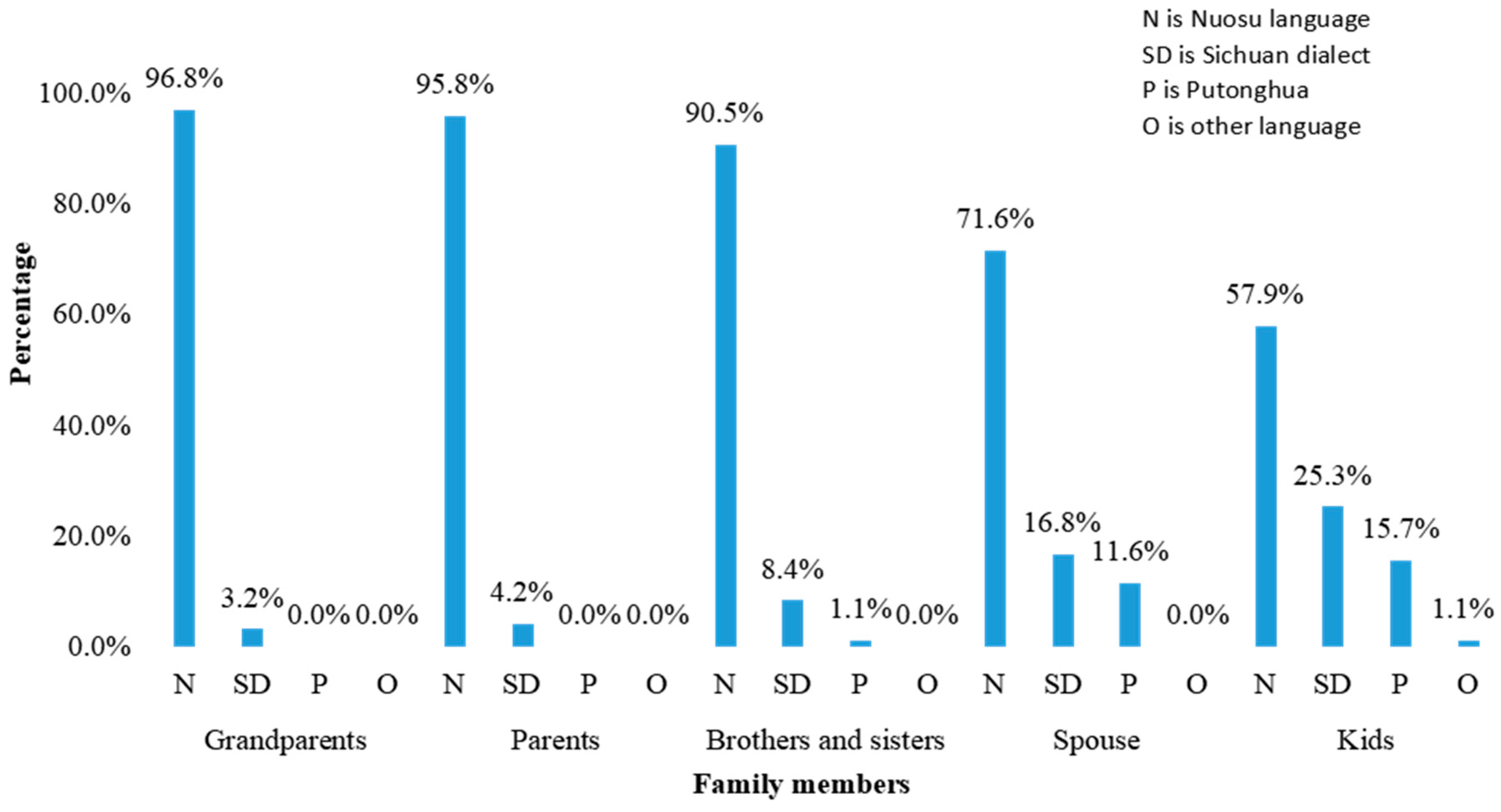
4.2. Family Language Practice: Three Trends of Language Shift in Nuosu Families
I speak the Han language11 with a rather pronounced Nuosu accent. I hope the children can speak the Han language more proficiently, without a Nuosu accent. Therefore, we mainly communicate with them in the Han language. They also learn the Han language at school, and it is of greater significance for them to have a good command of the Han language.
Before my son entered preschool, we mainly spoke the Sichuan dialect with him. Nevertheless, I would also use Putonghua when reading storybooks to him. After he started preschool, he gradually spoke more Putonghua. When he communicates with us in Putonghua, we unconsciously respond in Putonghua as well. Moreover, he likes watching TV, and all the cartoons are in Putonghua, so he has also learned some words from them.
U3: 你回来啦? (Putonghua) [Coming back?]Child: 对啊。 (Putonghua) [Yes.]Mother: ꃀꒉꆏꌧꌦꀕ, ꃀꒉꄷ [Still remember aunt? Say hi.]Child: ꃀꒉ [Aunt.]Researcher: ꌳꉔꀐ, ꅽꀉꂿꆐꑊꀃꑍꐕꍮꑌꇁꅀꄆꇙꍯꑌꇁ?[Good boy, you and your Mom take the car or the electric bicycle today?]Child: 我们坐车来的 (Putonghua) [We take the car.]……Grandma: ꅽꀆꐒꑞꃅꇣꅝꇧꎭꀋꌐ? [Why didn’t you finish your water?]Child: 我喝了呀 (Putonghua) [I did.]……Grandpa: 看我们两个哪个先吃完。 (the Sichuan dialect)[Let’s see which one of us finishes the meal first.]Child: 我吃完啦,我第一。 (Putonghua) [I have finished, I am the first.]Mother: 把你碗里的饭吃完。 (Putonghua) [Finish the rice in your bowl.]Child: 我不吃了,我吃饱了。 (Putonghua) [No, I am full.]
4.3. Family Language Management: Dependence of the Instrumental Value of the Language
U1: The children have no difficulty in understanding the Nuosu language. They just lack fluency in speaking the language, and this is sufficient for them as well.
U2: It is hard for my child to master the Nuosu language because the language environment around him is mostly the Han language. It would be better if he could understand some simple Nuosu words or sentences in the future.
R2: It is unacceptable if my children cannot speak the Nuosu language.
When my son was two and a half years old, I decided that he needed to learn more Putonghua because it was the only language spoken at preschool. If he cannot understand Putonghua, it may be difficult for him to communicate with the teachers. So, I started speaking more Putonghua with him.
Even the Nuosu children in our village only speak Putonghua among themselves nowadays. So, even if we take our grandson back to the village, children around the same age would still speak Putonghua with each other.
I should not have spoken Putonghua with him before he went to preschool. If we had insisted on speaking the Nuosu language with him, even if he learned Putonghua at school, he might also spoke the Nuosu language with us when he came home.
5. Discussion
5.1. The Impact of the New Language Education Policies on the FLP of Nuosu Families
R1: My children went straight to primary school, as there were no preschools in our village at that time. Nowadays, it is very convenient for children in our village to attend preschool, and they only speak Putonghua with each other.
U2: When my child attended preschool (in 2015), Putonghua was also used at school, although it was not as emphasized as it is nowadays. Some teachers also communicated with the children in the Sichuan dialect.
U2: If you are in the first model education, the Nuosu language competence, especially Nuosu language literacy, is of great significance for your academic performance. However, for the students in the second model education, the Nuosu language is not important.
U1: It is good for Nuosu children to learn some Nuosu characters. But urban schools do not offer Nuosu language courses. If the Nuosu language is not required in the examination, it is not necessary to spend too much time and money on it, because the children have numerous other subjects to study.
R1: My daughter was in the first model education, and I also helped her with her Nuosu language study during her high school years. The Nuosu language is essential for the first model students.
R3: I have also heard that English will be included in the middle school entrance examination. The children will then need to spend more time learning English. We do not understand English, so we cannot teach them at home. Moreover, it is hard for us to afford the extracurricular English courses.
U2: My son is in Grade 6 now, and he needs to take the English test for the middle school entrance examination. It is a big change. I have already sent him to extracurricular English courses on weekends. I also bought some English books to help him learn English.
U4: Recently, I have been searching for a suitable English training program for my son (7 years old) to attend on weekends. English is now a compulsory subject in primary school, and you need to learn it.
5.2. The Nuosu Families’ Reactions to the School Language Education Policies
6. Conclusions
Author Contributions
Funding
Institutional Review Board Statement
Informed Consent Statement
Data Availability Statement
Conflicts of Interest
| 1 | National Statistics Bureau of China. (2021). Chinese Statistical Yearbook 2021. Retrieved 20 June 2025, from https://www.stats.gov.cn/sj/ndsj/2021/indexch.htm. |
| 2 | The big data centre of Liangshan. (9 June 2025). The introduction of Liangshan. Retrieved 10 July 2025, from https://www.lsz.gov.cn/wcls/lsgk/xzqhyrk/202506/t20250609_2842893.html. |
| 3 | The Yi ethnic group comprises several subgroups, including the Nuosu, Niesu, and Nasu. The Yi people living in Liangshan Yi Autonomous Prefecture, Sichuan Province, and the northwest part of Yunnan Province refer to themselves as Nuosu. The Niesu live in the south and southeast of Yunnan Province. The Nasu live in western Guizhou and Guangxi Provinces and the northeast of Yunnan Province (K. Chen, 2010). These subgroups speak different dialects of the Yi language. In this study, ‘Nuosu’ refers to the Yi people in Liangshan, and ‘Nuosu language’ refers to the Nuosu dialect of the Yi language. |
| 4 | In ethnic minority areas, both the local Chinese dialect and Putonghua are called Chinese (the Han language). In Liangshan, this refers to the Sichuan dialect (a subset of Southwest Chinese dialect) and/or Putonghua. |
| 5 | Ministry of Education. (14 October 2020). A review of the development of Chinese language work since the founding of New China. Retrieved 20 June 2025, from http://www.moe.gov.cn/jyb_xwfb/s5147/202010/t20201014_494446.html. |
| 6 | Liangshan Daily. (9 October 2024). The addition of new subjects in the unified graduation test in primary school. Retrieved 20 June 2025, from https://www.lsz.gov.cn/hdjl/shrd/202410/t20241009_2738181.html. |
| 7 | In the 2025 middle school entrance examination in Liangshan, the English course was included in the assessment. However, due to the differences in availability and teaching arrangements of English courses in primary schools before 2024, English scores were not considered in the 2025 admission procedure. It is estimated that English may gradually be included in the admission process of Liangshan’s middle schools in the future. |
| 8 | Education and Sports Bureau of Xichang. (28 June 2023). Notice from the Education and Sports Bureau of Xichang City on the work of students’ admission for the 2023 compulsory education stage. Retrieved 25 September 2025, from http://www.xichang.gov.cn/zfxxgk/zfxxgknr/tzgg_31367/202306/t20230628_2502868.html. |
| 9 | In this study, the terms ‘urban’ and ‘rural’ refer to participants’ current residential locations. The term ‘urban’ refers to families who reside in cities or counties. The term ‘rural’ refers to families living in towns or villages. |
| 10 | The Nuosu people place a distinct emphasis on the concept of ‘clan’, which refers to individuals sharing the same family name that has been passed down across generations. In rural areas, members of a family clan usually reside together. Relatives belonging to the same clan, as well as those related through marriage, often gather for various events, whether in urban or rural areas. These occasions range from traditional festivals to weddings, funerals, etc. |
| 11 | The Nuosu people in Liangshan usually use ꆈꌠꉙ/彝话 (Nuosu language) and ꉌꈲꉙ/汉话 (Han language) to differentiate the Nuosu language and the language of the Han ethnic group. When they use the “Han language”, it may refer to the Sichuan dialect, Putonghua, or both languages, depending on the context. |
| 12 | According to the education policy in Liangshan, students can take the Nuosu language examination as part of the high school entrance examination. A maximum of 50 scores can be attained in the Nuosu language examination when U1’s children took the high school entrance examination (only 20 scores since 2025). The total score of the high school entrance examination is 900. |
References
- Aga, R., & Harrell, S. (2020). Theory and practice of bilingual education in China: Lessons from Liangshan Yi Autonomous Prefecture. International Journal of Bilingual Education and Bilingualism, 23(10), 1254–1269. [Google Scholar] [CrossRef] [Scilit]
- Baldauf, R. B. (2006). Rearticulating the case for micro language planning in a language ecology context. Current Issues in Language Planning, 7(2–3), 147–170. [Google Scholar] [CrossRef] [Scilit]
- Bialystok, E., & Hakuta, K. (1994). In other words: The science and psychology of second-language acquisition. Basic Books. [Google Scholar]
- Bimu, R.-L. (2023, September 19). The education in Liangshan from “Xueqian Xuepu” to “Xuepu Yongpu”: Liangshan deepens the “Xueqian Xuepu” action. Liangshan Daily (Chinese Version). 006.
- Bohnacker, U. (2022). Turkish heritage families in Sweden: Language practices and family language policy. Journal of Multilingual and Multicultural Development, 43(9), 861–873. [Google Scholar] [CrossRef] [Scilit]
- Caldas, S. J. (2012). Language policy in the family. In B. Spolsky (Ed.), The Cambridge handbook of language policy (pp. 351–373). Cambridge University Press. [Google Scholar]
- Chen, K. (2010). The dialects of the Yi language. China Minzu University Press. [Google Scholar]
- Chen, Y.-L., Zhang, L.-H., & Qiu, J.-H. (2021). A study of a diversified action plan on the ‘learning standard Chinese for preschool education’ in ethnic minority areas in the new era: Taking Z County of Liangshan Yi Autonomous Prefecture and Y County of Panzhihua as case studies. Journal of Ethnology, 12(12), 99–105+134. [Google Scholar] [CrossRef]
- Curdt-Christiansen, X. L. (2009). Invisible and visible language planning: Ideological factors in the family language policy of Chinese immigrant families in Quebec. Language Policy, 8(4), 351–375. [Google Scholar] [CrossRef] [Scilit]
- Curdt-Christiansen, X. L. (2013). Family language policy: Sociopolitical reality versus linguistic continuity. Language Policy, 12(1), 1–6. [Google Scholar] [CrossRef] [Scilit]
- Curdt-Christiansen, X. L. (2014). Family language policy: Is learning Chinese at odds with learning English in Singapore. In X. L. Curdt-Christiansen, & A. Hancock (Eds.), Learning Chinese in diasporic communities: Many pathways to being Chinese (pp. 35–58). John Benjamins. [Google Scholar]
- Curdt-Christiansen, X. L. (2016). Conflicting language ideologies and contradictory language practices in Singaporean multilingual families. Journal of Multilingual and Multicultural Development, 37(7), 694–709. [Google Scholar] [CrossRef] [Scilit]
- Curdt-Christiansen, X. L., Li, W., & Zhu, H. (2023). Pride, prejudice and pragmatism: Family language policies in the UK. Language Policy, 22(4), 391–411. [Google Scholar] [CrossRef] [Scilit]
- Curdt-Christiansen, X. L., & Wang, W.-H. (2018). Parents as agents of multilingual education: Family language planning in China. Language, Culture and Curriculum, 31(3), 235–254. [Google Scholar] [CrossRef] [Scilit]
- Feng, A., & Adamson, B. (2017). Language policies and sociolinguistic domains in the context of minority groups in China. Journal of Multilingual and Multicultural Development, 39(2), 169–180. [Google Scholar] [CrossRef] [Scilit]
- Fishman, J. A. (1991). Reversing language shift: Theory and practice of assistance to threatened languages. Multilingual Matters. [Google Scholar]
- Gu, M. M., Han, Y., & Tang, L. (2022). Family language policy in a multilingual Mongolian family in China: A cross-generation exploration. Journal of Multilingual and Multicultural Development, 46(10), 3291–3308. [Google Scholar] [CrossRef] [Scilit]
- Hornberger, N. H. (2006). Frameworks and models in language policy and planning. In T. Ricento (Ed.), An introduction to language policy: Theory and method (pp. 24–41). Blackwell. [Google Scholar] [CrossRef] [Scilit]
- Hu, S.-H. (2008). Assessment of the social functions and vitality of the Yi language from the perspective of its usage domains. Chinese Education & Society, 41(6), 61–70. [Google Scholar] [CrossRef] [Scilit]
- Johnson, D. C. (2013). Language policy. Palgrave Macmillan. [Google Scholar]
- Kaplan, R. B., & Baldauf, R. B. (1997). Language planning: From practice to theory. Multilingual Matters. [Google Scholar]
- King, K. A., & Fogle, L. (2006). Bilingual parenting as good parenting: Parents’ perspectives on family language policy for additive bilingualism. International Journal of Bilingual Education and Bilingualism, 9(6), 695–712. [Google Scholar] [CrossRef] [Scilit]
- King, K. A., Fogle, L., & Logan-Terry, A. (2008). Family language policy. Language and Linguistics Compass, 2(5), 907–922. [Google Scholar] [CrossRef] [Scilit]
- Lenneberg, E. H. (1967). Biological foundations of language. John Wiley and Sons. [Google Scholar]
- Li, Y.-M. (2022). A brief discussion on language planning studies. Lexicographical Studies, (1), 1–17+125. [Google Scholar] [CrossRef]
- Li, Z.-H. (2023). Substitution of kernel words in contact-induced language shift: The case of Jiuhe Naxi. Linguistic Research, (2), 57–77. [Google Scholar]
- Liu, C.-Y., Ding, H.-D., Wong, H., Yu, L.-J., & Yang, M.-Z. (2015). A multi-case investigation into trilingualism and trilingual education in Liangshan Yi Autonomous Prefecture. In A. W. Feng, & B. Adamson (Eds.), Trilingualism in education in China: Models and challenges (pp. 141–171). Springer. [Google Scholar]
- MacLeod, A. A. N., & Demers, C. (2023). Understanding family factors for language transmission of minoritized languages in bilingual kindergarten children growing up in multilingual neighborhoods. Journal of Multilingual and Multicultural Development, 46(7), 1798–1814. [Google Scholar] [CrossRef] [Scilit]
- Nesteruk, O. (2010). Heritage language maintenance and loss among the children of Eastern European immigrants in the USA. Journal of Multilingual and Multicultural Development, 31(3), 271–286. [Google Scholar] [CrossRef] [Scilit]
- Nie, P., & Wang, S. (2025). Homescape, parental agency and family language policy: How Yi parents utilize semiotic resources to facilitate language maintenance. Current Issues in Language Planning, 1–20. [Google Scholar] [CrossRef] [Scilit]
- Peng, Y., & Wan, Y. (2023). Understanding parental agency in family language policies from language-as-resource ideology perspective: The case of three Shanghainese families. Journal of Multilingual and Multicultural Development, 46(7), 1833–1844. [Google Scholar] [CrossRef] [Scilit]
- Qian, X. (2021, October 19). Telling new stories of Liangshan in Putonghua. Liangshan Daily (Chinese Version). 002.
- Ren, R. (2021, October 26). Xueqian Xuepu lights up the dreams of Yi children in Liangshan. Chinese Women’s Newspaper. 004. [CrossRef]
- Shen, Q., Wang, L., & Gao, X. (Andy). (2021). An ecological approach to family language policy research: The case of Miao families in China. Current Issues in Language Planning, 22(4), 427–445. [Google Scholar] [CrossRef] [Scilit]
- Shi, L. (2018). Strategies for deepening the popularization of national common language and script in ethnic minority areas from the perspective of targeted poverty alleviation. Social Scientist, 4, 150–156. [Google Scholar]
- Shi, L. (2022). Putonghua education for preschool children and strengthening a sense of Chinese national community in ethnic minority Areas. Journal of Ethnology, 13(12), 78–87+154. [Google Scholar] [CrossRef]
- Song, L., & Zhang, X. (2025). Multilingual family language planning among Mongolian families in Inner Mongolia: A case study of Naiman banner. Journal of Multilingual and Multicultural Development, 1–20. [Google Scholar] [CrossRef] [Scilit]
- Spolsky, B. (2004). Language policy. Cambridge University Press. [Google Scholar]
- Spolsky, B. (2009). Language management. Cambridge University Press. [Google Scholar]
- Spolsky, B. (2012). Family language policy—The critical domain. Journal of Multilingual and Multicultural Development, 33(1), 3–11. [Google Scholar] [CrossRef] [Scilit]
- Sun, H.-K. (2015). A discussion on the one hundred years’ planning of Chinese minority nationalities’ languages. Qinghai Journal of Ethnology, 26(2), 91–99. [Google Scholar]
- Teng, X. (2000). The necessity of implementing the Yi-Han bilingual education in Liangshan Yi communities. Journal of Research on Education for Ethnic Minorities, 1, 5–25. [Google Scholar] [CrossRef]
- Tuo, H.-Y., & Li, Z.-Y. (2019). A case study of the Salar family language policy. Minzu Tribune, (2), 107–112. [Google Scholar] [CrossRef]
- Wang, L. (2019). The research on family language policy in Taijiang Miao families of Guizhou. Guizhou Ethnic Studies, 40(4), 190–195. [Google Scholar]
- Wang, L.-J. (2017). Rethinking the bilingual education for China’s minorities: A case study of Liangshan Yi Prefecture. Journal of Qinghai Minzu University (Social Sciences), 43(4), 148–154. [Google Scholar]
- Yao, J., & Liu, S. (2024). Exploring the language shift of secondary Yi students in Liangshan Yi Autonomous Prefecture, Sichuan, China. Journal of Multilingual and Multicultural Development, 46(9), 3152–3165. [Google Scholar] [CrossRef] [Scilit]
- Yin, X.-R., & Li, G.-F. (2019). Generational differences of the Xibo family language attitude. Chinese Journal of Language Policy and Planning, 4(2), 31–41. [Google Scholar]
- Yin, X.-R., & Liu, J. (2013). Probe into the situation of language kept in Xibo family. Journal of Xinjiang Normal University (Social Sciences), 34(06), 95–100. [Google Scholar]
- Yu, D.-J. (2024). A Study of rank analysis from a micro case of core word replacement. Contemporary Linguistics, 26(3), 418–437. [Google Scholar]
- Zhang, H., Shi, Y., & Li, Z. (2022). Family language policy in multi-ethnic and multilingual villages in Yunnan, China: A comparative case study of Kena village and Anmin village. Journal of Multilingual and Multicultural Development, 45(9), 3846–3861. [Google Scholar] [CrossRef] [Scilit]
- Zhang, L., & Tsung, L. (2019a). Bilingual education and minority language maintenance in China: The role of schools in saving the Yi language. Springer. [Google Scholar]
- Zhang, L., & Tsung, L. (2019b). Tibetan bilingual education in Qinghai: Government policy vs. family language practice. International Journal of Bilingual Education and Bilingualism, 22(3), 290–302. [Google Scholar] [CrossRef] [Scilit]
- Zhang, Y.-B. (2011). Language ecology and language protection in ethnically mixed areas of northwest Guizhou [Doctoral dissertation, Minzu University of China]. [Google Scholar]




| N | % | N | % | ||||
|---|---|---|---|---|---|---|---|
| Gender | Male | 55 | 57.8 | Job | Businessman | 5 | 5.3 |
| Female | 40 | 42.2 | Retired Staff | 5 | 5.3 | ||
| Age | 21–39 | 60 | 63.1 | Others | 7 | 7.4 | |
| 40–59 | 30 | 31.6 | Part-time job | 20 | 21.0 | ||
| >60 | 5 | 5.3 | Farmer | 19 | 20.0 | ||
| Address | Village a | 40 | 42.1 | Civil servant | 6 | 6.3 | |
| Town | 6 | 6.3 | Public institution staff | 33 | 34.7 | ||
| County | 17 | 17.9 | Education | Primary school or below | 22 | 23.2 | |
| City | 32 | 33.7 | Junior high school | 17 | 17.9 | ||
| Ethnicity | Yi | 95 | 100 | Senior high school | 12 | 12.6 | |
| Han | 0 | 0 | College | 44 | 46.3 | ||
| Language | Level | N | % | Language | Level | N | % |
|---|---|---|---|---|---|---|---|
| Nuosu listening | all of them | 95 | 100 | Sichuan dialect | fluent | 70 | 73.7 |
| some sentences | 0 | 0 | some sentences | 14 | 14.7 | ||
| several words | 0 | 0 | several words | 10 | 10.5 | ||
| none | 0 | 0 | none | 1 | 1.1 | ||
| Nuosu speaking | fluent | 92 | 96.8 | Putonghua | fluent | 58 | 61.1 |
| some sentences | 3 | 3.2 | some sentences | 24 | 25.3 | ||
| several words | 0 | 0 | several words | 9 | 9.5 | ||
| none | 0 | 0 | none | 4 | 4.2 | ||
| Nuosu literacy | all characters | 12 | 12.6 | English | CET-6 and above | 4 | 4.2 |
| most of them | 20 | 21.1 | CET-4 and CET-3 | 11 | 11.6 | ||
| several words | 44 | 46.3 | several sentences | 12 | 12.6 | ||
| none | 19 | 20.0 | several words | 32 | 33.7 | ||
| none | 36 | 37.9 |
| Name | Age | Gender | Address | Education | Job | Language Competence (Speaking) | Children and Their Age |
|---|---|---|---|---|---|---|---|
| U1 | 45 | Male | Urban | Middle school | Driver | Fluent in Nuosu and Sichuan dialect | Three children (18, 16, 14) |
| U2 | 42 | Female | Urban | College | Teacher | Fluent in Nuosu, Sichuan dialect, and Putonghua, some English | One child (12) |
| U3 | 35 | Male | Urban | College | Civil servant | Fluent in Sichuan dialect and Putonghua. Some Nuosu, a little English | One child (6) |
| U4 | 32 | Female | Urban | College | Civil servant | Fluent in Nuosu, Sichuan dialect, and Putonghua, a little English | Two children (7, 4) |
| R1 | 47 | Male | Rural | Middle school | Farmer | Fluent in Nuosu and Sichuan dialect | Four children (20, 18, 15, 13) |
| R2 | 40 | Female | Rural | None | Farmer | Fluent in Nuosu, some Sichuan dialect | Three children (16, 14, 12) |
| R3 | 33 | Female | Rural | Middle school | Casual worker | Fluent in Nuosu and Sichuan dialect, some Putonghua | Two children (9, 7) |
| R4 | 31 | Male | Rural | High school | Casual worker | Fluent in Nuosu and Sichuan dialect, some Putonghua | Two children (6, 3) |
| Nuosu Language | Putonghua | Sichuan Dialect | Others | Total | |
|---|---|---|---|---|---|
| Village | 31 | 6 | 3 | 0 | 40 |
| 77.5% | 15% | 7.50% | 0% | 100.00% | |
| Town | 4 | 0 | 1 | 1 | 6 |
| 66.7% | 0% | 16.7% | 16.7% | 100.00% | |
| County | 6 | 1 | 9 | 0 | 16 |
| 37.5% | 6.3% | 56.2% | 0% | 100.00% | |
| City | 16 | 7 | 10 | 0 | 33 |
| 48.5% | 21.2% | 30.3% | 0% | 100.00% | |
| Total | 57 | 14 | 23 | 1 | 95 |
| 60.0% | 14.7% | 24.2% | 1.1% | 100.00% |
| N | % | ||
|---|---|---|---|
| Will you guide kids to speak the Nuosu language at home? | Yes | 88 | 92.6 |
| No | 7 | 7.4 | |
| Will you guide kids to speak Putonghua at home? | Yes | 73 | 76.8 |
| No | 22 | 23.2 | |
| Will you guide kids to speak English at home? | Yes | 45 | 47.4 |
| No | 50 | 52.6 | |
| Will your kids have extracurricular Nuosu language courses? | Yes | 57 | 60.0 |
| No | 19 | 20.0 | |
| Depends on the test | 19 | 20.0 | |
| Will your kids have extracurricular English courses? | Yes | 35 | 36.8 |
| No | 32 | 33.7 | |
| Depends on the test | 28 | 29.5 | |
Disclaimer/Publisher’s Note: The statements, opinions and data contained in all publications are solely those of the individual author(s) and contributor(s) and not of MDPI and/or the editor(s). MDPI and/or the editor(s) disclaim responsibility for any injury to people or property resulting from any ideas, methods, instructions or products referred to in the content. |
© 2025 by the authors. Licensee MDPI, Basel, Switzerland. This article is an open access article distributed under the terms and conditions of the Creative Commons Attribution (CC BY) license (https://creativecommons.org/licenses/by/4.0/).
Share and Cite
Wang, Z.; Liu, C. A Survey of Family Language Planning in Liangshan Yi Autonomous Prefecture in the Context of New Language Education Policies. Languages 2025, 10, 303. https://doi.org/10.3390/languages10120303
Wang Z, Liu C. A Survey of Family Language Planning in Liangshan Yi Autonomous Prefecture in the Context of New Language Education Policies. Languages. 2025; 10(12):303. https://doi.org/10.3390/languages10120303
Chicago/Turabian StyleWang, Zhaoyu, and Chengyu Liu. 2025. "A Survey of Family Language Planning in Liangshan Yi Autonomous Prefecture in the Context of New Language Education Policies" Languages 10, no. 12: 303. https://doi.org/10.3390/languages10120303
APA StyleWang, Z., & Liu, C. (2025). A Survey of Family Language Planning in Liangshan Yi Autonomous Prefecture in the Context of New Language Education Policies. Languages, 10(12), 303. https://doi.org/10.3390/languages10120303