You are currently viewing a new version of our website. To view the old version click .

Aerospace, Volume 6, Issue 7

July 2019 - 8 articles

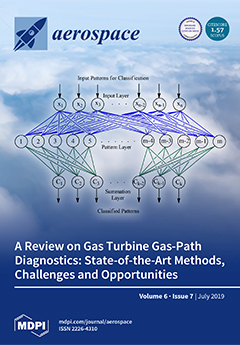
Cover Story: Gas-path diagnostics is an essential part of gas turbine condition-based maintenance (CBM). Extensive literature exists on gas-path diagnostics and a variety of methods have been introduced so far. This review aims to provide a critical survey of the existing literature produced in the area over the past few decades. It includes discussions on the major engine physical faults and their consequences, gas-path diagnostic challenges and desirable attributes, state-of-the-art methods along with their respective strengths and weaknesses, and the available validation techniques that system developers used in the past. Concluding remarks and further research directions are highlighted at the end. View this paper.
  • Issues are regarded as officially published after their release is announced to the table of contents alert mailing list .
  • You may sign up for email alerts to receive table of contents of newly released issues.
  • PDF is the official format for papers published in both, html and pdf forms. To view the papers in pdf format, click on the "PDF Full-text" link, and use the free Adobe Reader to open them.

Articles (8)

  • Review
  • Open Access
140 Citations
23,694 Views
53 Pages

A Review on Gas Turbine Gas-Path Diagnostics: State-of-the-Art Methods, Challenges and Opportunities

  • Amare D. Fentaye,
  • Aklilu T. Baheta,
  • Syed I. Gilani and
  • Konstantinos G. Kyprianidis

Gas-path diagnostics is an essential part of gas turbine (GT) condition-based maintenance (CBM). There exists extensive literature on GT gas-path diagnostics and a variety of methods have been introduced. The fundamental limitations of the convention...

  • Article
  • Open Access
1 Citations
5,862 Views
14 Pages

With the goal of assessing the capability of Computational Fluid Dynamics (CFD) to simulate combustion instabilities, the present work considers a premixed, bluff-body-stabilized combustor with well-defined inlet and outlet boundary conditions. The p...

  • Article
  • Open Access
26 Citations
13,919 Views
11 Pages

The last decade has seen an almost exponential increase in the number of rocket launches for sounding missions or for delivering payloads into low Earth orbits. The emergence of new technologies like rapid prototyping, including 3D printing, is chang...

  • Article
  • Open Access
8 Citations
6,670 Views
24 Pages

Departure and Arrival Routes Optimization Near Large Airports

  • Jeremie Chevalier,
  • Daniel Delahaye,
  • Mohammed Sbihi and
  • Pierre Marechal

The bottleneck of today’s airspace is the Terminal Maneuvering Areas (TMA), where aircraft leave their routes to descend to an airport or take off and reach the en-route sector. To avoid congestion in these areas, an efficient design of departu...

  • Article
  • Open Access
26 Citations
10,323 Views
15 Pages

Conventional or fixed wings require a certain thickness of skin material selection that guarantees structurally reliable strength under expected aerodynamic loadings. However, skin structures of morphing wings need to be flexible as well as stiff eno...

  • Article
  • Open Access
26 Citations
7,269 Views
11 Pages

A Novel Self-Deployable Solar Sail System Activated by Shape Memory Alloys

  • Gianluigi Bovesecchi,
  • Sandra Corasaniti,
  • Girolamo Costanza and
  • Maria Elisa Tata

This work deals with the feasibility and reliability about the use of shape memory alloys (SMAs) as mechanical actuators for solar sail self-deployment instead of heavy and bulky mechanical booms. Solar sails exploit radiation pressure a as propulsio...

  • Article
  • Open Access
13 Citations
7,728 Views
14 Pages

A Virtual Test Bench of a Parallel Hybrid Propulsion System for UAVs

  • Luca Boggero,
  • Sabrina Corpino,
  • Andrea De Martin,
  • Giuseppe Evangelista,
  • Marco Fioriti and
  • Massimo Sorli

The article proposes the design of a test bench simulator to test a parallel hybrid propulsion architecture for aeronautical applications. The virtual test bench simulates, in a scaled version, the real test bench, designed for a power of about 0.4 M...

  • Article
  • Open Access
14 Citations
6,725 Views
19 Pages

Active control techniques are a key factor in today’s aircraft developments to reduce structural loads and thereby enable highly efficient aircraft designs. Likewise, increasing the autonomy of aircraft systems aims to maintain the highest degr...

Get Alerted

Add your email address to receive forthcoming issues of this journal.

XFacebookLinkedIn
Aerospace - ISSN 2226-4310