


Abstract
Data association for space-based radar multi-target tracking is a significant challenge in dense clutter and complex scenarios, often leading to tracking errors and target loss. This paper proposes a classification-aided message-passing algorithm for space-based radars (CA-MP-SBRs), which employs a hybrid mean-field and belief-propagation (MF-BP) framework enhanced with target classification information. We leverage high-resolution range profile (HRRP) data, which are processed by a convolutional neural network (CNN) to classify targets. The classification output is then seamlessly integrated into the MF-BP framework to jointly infer target kinematic states, visibility states, data association, and class index. Simulation results demonstrate that incorporating HRRP-based classification improves data-association reliability and tracking accuracy. Specifically, compared with Classification-aided Gaussian mixture probability hypothesis density (CA-GM-PHD), the proposed CA-MP-SBRs reduces the average root mean square error (RMSE), optimal subpattern assignment (OSPA), and generalized optimal subpattern assignment (GOSPA) by 33.4%, 31.7%, and 32.1%, respectively, while the corresponding reductions relative to classification-aided labeled multi-Bernoulli tracking for space-based radars (CA-LMB-SBRs) are 23.2%, 25.6%, and 30.3%. These results confirm the effectiveness of CA-MP-SBRs for tracking diverse target types in dense-target scenarios.
1. Introduction
1.1. Background, Motivation, State of the Art
Space-based radar (SBR) has emerged as a critical asset for multi-target tracking, as its ability to provide persistent global coverage underpins essential applications in situational awareness. However, data association for SBR faces severe challenges, particularly under downward-looking geometries. The primary obstacles are twofold: intense background clutter which significantly degrades the signal-to-clutter ratio and increases measurement ambiguity; and dense target formations exhibit high spatial and kinematic similarity, making individual targets difficult to distinguish. Under these conditions, conventional association metrics relying solely on spatial distance are often rendered ineffective, frequently resulting in track fragmentation and target loss. To address these challenges, it is essential to incorporate auxiliary target information into the tracking framework, particularly within the data association [1,2,3]. In trajectory-crossing and dense-target scenarios, class information provides additional discriminatory cues for target differentiation, thereby reducing association ambiguity and improving the accuracy of measurement-to-track assignment. Accordingly, this paper focuses on exploiting target-class information to improve the overall performance of SBR multi-target tracking under dense-target and heavy-clutter conditions.
The problem of tracking multiple targets in complex environments necessitates the simultaneous tasks of estimating target kinematic states, detecting an unknown number of targets, and data association. Established methodologies exist for each of these individual problems and deal with these problems sequentially. Specifically, state estimation aims to infer the true kinematic state of a target from noisy measurements. For linear Gaussian models, this is typically addressed via the standard Kalman filter (KF) [4], whereas nonlinear models are generally handled using the extended Kalman filter (EKF) [5], the unscented Kalman filter (UKF) [6], and the partical filter. Classical methods for detecting an unknown number of targets include tracking-before-detection [7], the Hough transform [8], and the generalized likelihood ratio test [9]. Regarding data association, which aims to determine which measurements constitute valid information for track updates, common approaches include multiple hypothesis tracking [10] and joint probabilistic data association (JPDA) [11,12]. Random finite set (RFS) multi-target tracking algorithms circumvent the intractable data association problem by integrating target detection and tracking within a unified Bayesian framework. Prominent implementations of this approach include the probability hypothesis density (PHD) filter [13] and the cardinalized PHD (CPHD) filter [14]. However, the aforementioned methods typically address only one or two isolated sub-problems within the tracking domain, or address a couple of sub-problems sequentially. Given that kinematic state estimation, target detection, and data association are interdependent and coupled in practical scenarios, these approaches inevitably suffer from the accumulation of coupling errors. Consequently, it is imperative to formulate the multi-target tracking problem within a unified framework that facilitates joint inference and error mitigation.
Recently, Bayesian inference based on probabilistic graphical models has emerged as a dominant paradigm in multi-target tracking. By jointly estimating high-dimensional latent variables, this approach unifies kinematic state estimation, target detection, and data association, significantly reducing coupling errors. In a related complex-scene application, Dong et al. [15] learned temporal distributions and spatial correlations and employed a stochastic Bayesian refinement mechanism to improve moving-object segmentation. Nevertheless, exact inference on the joint probability distribution function (PDF) is generally intractable. This intractability stems from the absence of closed-form solutions for integrals involving continuous latent variables (i.e., kinematic state) and the prohibitive computational cost of marginalizing over all possible permutations of discrete variables, such as target visibility and data association hypotheses. Two iterative optimization algorithms, mean field (MF) and belief propagation (BP), are commonly employed to approximate high-dimensional inference problems in target tracking. Initially, BP was predominantly utilized in data association for its effectiveness in handling hard constraints [16,17,18]. Subsequently, Meyer et al. [19,20] extended its application to encompass all constituent stages of target tracking, establishing a unified representation via factor graphs. While BP excels at managing deterministic hard constraints, it suffers from high computational complexity in continuous PDF except Gaussian distribution. In contrast, the MF algorithm, serving as a prominent variant of variational Bayes, has found extensive application in target tracking for yielding simple, closed-form expressions. For instance, an adaptive KF relying on MF approximation was proposed in [21] to handle unknown measurement noise covariance. To effectively mitigate computational costs, a novel filtering approach utilizing MF to approximate the marginalization over data association was presented in [22]. Lau et al. [23] proposed the structured mean field existence-based tracker, which enables joint inference of target kinematic states and target visibility.
In principle, MF approximates the intractable joint PDF in target tracking by minimizing the Kullback–Leibler divergence under a fully factorized assumption, offering the virtues of convergent implementation and simple update rules for conjugate-exponential models. In contrast, BP seeks to recover marginal distributions by minimizing the Bethe free energy, a formulation that inherently accommodates hard constraints. While BP and MF each possess distinct advantages, relying on either algorithm alone is insufficient to efficiently handle both deterministic hard constraints and continuous state estimation simultaneously. Motivated by their complementary virtues, integrating BP and MF into a unified message-passing framework enables joint iterative optimization. By updating the approximate posterior distributions in a closed-loop manner, this combined MF-BP approach effectively eliminates the coupling errors between estimation and decision-making processes. To leverage their complementary strengths, Riegler et al. [24] integrated BP and MF based on region-based free energy approximation. Turner et al. [25] proposed a probabilistic tracking algorithm that integrates data association, track management, and state estimation. Specifically, this approach utilizes BP to approximate data association and employs MF to factorize the joint PDF. Extending the work in [25], Lan et al. [26] introduced a multipath target tracking and detection algorithm. Later, they proposed an MF-BP-based multi-maneuvering target tracking method [27]. This method was subsequently applied to target tracking within an over-the-horizon radar network [28]. Bai et al. [29] developed a robust multi-target tracking framework using message passing (MP) to simultaneously estimate clutter and target kinematic states for data association. Later, they proposed a classification-aided tracking algorithm based on neural-enhanced message passing, which utilizes range-Doppler(RD) spectrum information to significantly improve clutter suppression and association accuracy [30]. Wang et al. [31] proposed a multi-target tracking algorithm based on distributed SBR. This method employs a unified MP framework to jointly resolve target detection, kinematic state estimation, data association, and distributed fusion. Although unified MF-BP frameworks provide a principled approach for jointly solving the main subproblems of multi-target tracking (MTT) and reducing the coupling among them, they do not by themselves provide sufficiently discriminative evidence for measurement-to-target association. In downward-looking SBR scenarios with dense clutter and closely spaced targets exhibiting similar kinematic behaviors, association based primarily on kinematic and spatial measurements remains ambiguous and insufficiently robust. This motivates the incorporation of target-class information as an additional probabilistic cue for data association.
The integration of target attribute information via classification-aided tracking offers a powerful solution to the limitations of purely kinematic-based approaches, thereby significantly augmenting the discriminative power of the data association process. In a seminal contribution, Bar-Shalom et al. [32] integrated radar echo amplitude into the interacting multiple model algorithm [33,34] to improve data association reliability. Building on [32], additional physical features such as Doppler shift [35] and down-range extent were incorporated into UKF-JPDA frameworks to enhance robustness in dense clutter [36]. More recently, Gaglione et al. [37] further advanced this paradigm by embedding semantic class information into a sum-product framework, utilizing class-dependent motion models to effectively distinguish targets from clutter. Among various signature representations, the high-resolution range profile (HRRP) has gradually emerged as a prominent feature source, owing to its motion insensitivity and aspect stability [38,39,40]. From a hardware implementation perspective, Ma et al. [41] developed an RF-SoC-based radar recognition system capable of extracting target-specific features directly from HRRP. In terms of algorithm design, Zheng et al. [42] proposed an HRRP-aided PHD filter which leverages Gaussian mixture (GM) weights to effectively address the tracking of space targets, a method validated by robust simulation results. Furthermore, to tackle multi-target tracking in complex environments, Dong et al. [43] established a comprehensive framework that integrates HRRP template matching with constant false alarm rate detector detection, employing an adaptive sequential Monte Carlo labeled multi-Bernoulli (LMB) filter to ensure robust trajectory extraction and false alarm suppression. In addition, MP-based approaches for classification-aided MTT are garnering significant interest. For example, Liang and Meyer [44] exploited LiDAR-derived shape information to refine the BP data association process and bolster false alarm mitigation. Bai et al. [30] utilized radar range-Doppler spectra to distinguish target measurements from clutter, using this distinction as auxiliary information to significantly enhance both clutter suppression and data association.
1.2. Contributions and Paper Organization
In this paper, we propose the classification-aided message-passing algorithm for space-based radars (CA-MP-SBRs) algorithm to address the multi-target tracking problem in SBR scenarios characterized by dense clutter and densely distributed maneuvering targets. Unlike the RD spectra used in [30] primarily for distinguishing target-generated measurements from clutter, HRRP captures target-dependent scattering signatures related to structural characteristics, making it more suitable for discriminating among different aircraft classes. The classification-aided multi-target tracking problem is formulated as a probabilistic inference problem on a unified factor graph. The corresponding joint probability density couples the relevant high-dimensional continuous and discrete latent variables, enabling the joint inference of target kinematic states, target visibility states, data associations, and class index. The main contributions of this article are threefold:
- Class information is incorporated into kinematic state filtering through class-dependent process-noise covariance matrices, while the CNN-derived HRRP confusion matrix is introduced into BP-based data association as a probabilistic soft constraint. This dual use of class information improves state estimation and reduces association ambiguity in dense-target and heavy-clutter environments.
- A hybrid MF-BP message-passing procedure is developed for the unified factor graph. MF handles the state-related inference, whereas BP enforces the one-to-one data-association constraints and performs the classification-aided association update, enabling tractable iterative inference of the coupled latent variables.
- The proposed CA-MP-SBRs is validated through controlled ablation experiments and comparisons with CA-GM-PHD and CA-LMB-SBRs trackers. The results demonstrate consistent improvements in tracking accuracy and data-association robustness under dense-target and heavy-clutter conditions.
The rest of this paper is organized as follows. The system modeling and problem description of classification-aided multi-target tracking are detailed in Section 2. Section 3 presents the detailed derivation of the CA-MP-SBRs algorithm. Section 4 performs simulations to assess the performance of the CA-MP-SBRs algorithm. Finally, Section 5 concludes the paper.
2. System Modeling
This section begins by presenting the modeling of target kinematic state, target class evolution, and visibility state, followed by the modeling of radar measurement, classifier modeling, and data association. Subsequently, the classification-aided multiple target tracking problem is formulated within a unified Bayesian framework.
2.1. Target Kinematic, Class Evolution, and Visibility State Modeling
We consider multiple targets moving in the Earth-Centered Earth-Fixed (ECEF) coordinate system. Define the kinematic state of target k at time n as
where and represent the position and velocity of the target in the ECEF coordinate system, respectively. Then, the joint kinematic states of all targets at time n are represented as , where , and denotes the maximum number of potential targets. Each target k belongs to one of C distinct classes at time n; the class of target k at time n is specified by the class index variable . Accordingly, the joint class index states of all targets at time n are denoted as . Following the established target-dynamics model in [45], we assume that the kinematic state of each target evolves independently according to a first-order Markov process. Accordingly, the state transition model is written as
where is the corresponding state transition matrix, and represents the zero-mean and class-dependent Gaussian noise with covariance , which is constructed as
where denotes the class-independent baseline process-noise covariance, T is the tracking sampling interval, is the identity matrix, and is the standard deviation of the acceleration perturbation associated with class c. For a state vector consisting of position and velocity, the block-matrix term is obtained from , where maps a random acceleration assumed constant within one sampling interval to the position and velocity components. Consequently, the class-dependent process-noise covariance reflects the distinct maneuvering characteristics of different target classes, thereby coupling class information with kinematic state estimation.
Under the assumption that the class evolution of a target is independent of the target kinematic state (i.e., ), the class transition probability distribution is characterized by a constant transition matrix , which is defined as
According to (6), denotes the probability of transition from class (j) at time (n−1) to class (i) at time (n). Since the target must belong to one of the C possible classes at the current time, (5) normalizes each column of , ensuring that it is a valid class-transition probability matrix.
Let represent the visibility state of target k at time n. Specifically, indicates that target k is present at time n, and otherwise. The evolution of is modeled as a discrete-time homogeneous Markov chain [28],
where the transition matrix is
The joint visibility state of all targets at time n is denoted by . For each target k, and indicate its presence and absence, respectively, and in (8) defines the corresponding two-state homogeneous Markov transition model, whose columns and rows represent the visibility states at times and n, respectively. The four entries of give the probabilities that the target remains present, appears, disappears, and remains absent, respectively, with the entries in each column summing to one.
2.2. Radar Measurement and Classifier Modeling
We consider that a radar network consisting of S space-based radars is used to track the targets. The set of the measurements derived from the S space-based radars at time n is denoted as , where is the set of the measurements derived from radar s at time n, and each measurement comprises range, azimuth, and elevation angles obtained from the radar array measurement frame (RAMF). The measurement equation of radar s accounting for clutter is
where denotes the nonlinear measurement function, and is zero-mean Gaussian measurement noise with covariance . The clutter model describes false-alarm measurements produced after radar front-end preprocessing and thresholding, rather than the raw clutter echoes. Specifically, false alarms within each scan are assumed to occur independently and at an approximately constant spatial rate over the region of interest. Under these assumptions, the clutter-originated measurements can be modeled as a homogeneous Poisson point process in the measurement space. Consequently, a clutter-originated measurement is uniformly distributed over the region of interest with volume , i.e.,
and the number of clutter-originated measurements within this region follows a Poisson distribution. In particular, if denotes the expected number of clutter measurements per unit measurement volume, the corresponding Poisson mean is . This model is widely adopted in multi-target tracking because it provides a reasonable approximation to independently generated false alarms and leads to a tractable data-association formulation.
In addition to the point measurement , we consider that the spaced-based radars can obtain the HRRP of the targets, which are processed by a classier to obtain the class identification of the targets. Define the collection of classifier outputs from all space-based radars at time n as , where denotes the set of class index recognition for radar s, yielded by a classifier. The value of characterizes the source of the measurement . More specifically, means that corresponds to clutter, while implies that is generated by a target of class c.
The classifier performance is modeled by the probability density function , which is described by the confusion matrix ,
where (13) denotes the probability of the classifier outputting class i when the target’s true class is j.
2.3. Data Association Modeling
Assuming independent observation among radars, the joint data association event at time n across all radars is denoted as , where . The binary variable represents the association event between target k and measurement m in radar s at time n. Specifically, if and , it indicates that measurement m originates from target k; otherwise, . The event (with ) denotes that target k is missed, yielding no measurement. In addition, (with ) signifies that measurement m originates from clutter and is unassociated with any target.
The set of all feasible data association events for radar s at time n is denoted as , each of which satisfies the constraints that each target generates at most one measurement in radar s, and each measurement originates from at most one target. Mathematically, a feasible data association event must satisfy
As seen in (14) and (15), data association is governed by hard constraints. To strictly enforce these requirements within the proposed framework, we use the indicator function , which evaluates to unity for any feasible joint event and vanishes otherwise.
At time n, with targets and measurements, the prior distribution of the data-association event , conditioned on the target visibility state , is given by
where denotes the binary detection indicator for the k-th target at time n with respect to radar s, and denotes the number of clutter-originated measurements. According to the Poisson clutter model introduced in (9), where is the spatial clutter intensity and . Furthermore, the detection probability is conditioned on the target visibility state . It should be noted that (16) gives the probability of a particular feasible association hypothesis , rather than the probability mass function of the clutter count alone. The standard Poisson probability mass function for is For a fixed clutter count , the indexed measurements give rise to feasible assignments of the detected targets to measurement indices. Therefore, the probability of the clutter count is apportioned among the corresponding association hypotheses, and each hypothesis contributes the factor Thus, the denominator in (16) is intentional and results from the normalization over measurement-to-target association hypotheses, rather than from the Poisson probability mass function alone. Further details can be found in [31].
2.4. Problem Formulation
Define , where , , , and denote the variables of kinematic states, visibility states, data associations, and class index, respectively, over time steps from 1 to N. Our objective involves estimating these variables given radar measurements and classifier output . Under the Bayesian framework, one aims to derive the joint posterior PDF,
Following [28], we assume that the kinematic states, class index, and visibility states of different targets evolve independently according to first-order Markov processes. Conditioned on the relevant hidden variables, the data-association events, radar measurements, and classifier outputs are assumed to be independent across time steps and sensors, with the latter two also being independent across individual measurements within each scan. Under these assumptions, one has , , , , , and . In the last factorization, indicates whether the classification likelihood contributes to the joint likelihood, with the corresponding factor being identically equal to one when target k is unassociated (). Accordingly, one obtains
The aim of classification-aided MTT is to jointly estimate kinematic states , target visibility state , and class index , given radar measurements and class recognition with unknown data association . It can be seen that in (18) is a high-dimensional joint posterior PDF involving both continuous random variables and discrete random variables . Direct marginalization of is intractable; therefore, an approximate solution is required.
The combined MF-BP approximation is an iterative optimization method [24] that employs message passing on a factor graph. To leverage the respective advantages of MF and BP, the factor graph is strategically partitioned into MF and BP regions. Under this unified framework, the latent variables are iteratively estimated via closed-form updates, thereby effectively eliminating the coupling errors between them. Note that complex MTT tasks of SBR impose significant challenges on data association. First, the look-down perspective of SBR often leads to a large number of land or sear clutter, which significantly complicates the association process. Second, in scenarios involving dense targets, the spatial proximity and similar maneuvers of multiple targets render data association based exclusively on kinematic information ineffective. To address these challenges, we propose an HRRP-classification-aided MF-BP algorithm in the following section.
3. The CA-MP-SBRs Approach
In this section, we present a classification-aided MF-BP algorithm within a unified framework for solving the MTT problem of SBR, namely, CA-MP-SBRs. We provide the update rules for the combined MF and BP method and derive the beliefs of the hidden variables including target kinematic states, target visibility states, data association, and class index. Finally, we summarize the proposed CA-MP-SBRs algorithm, discussing track initialization and implementation, followed by an analysis of the computational complexity.
3.1. Factor Graph Construction and Region Partitioning
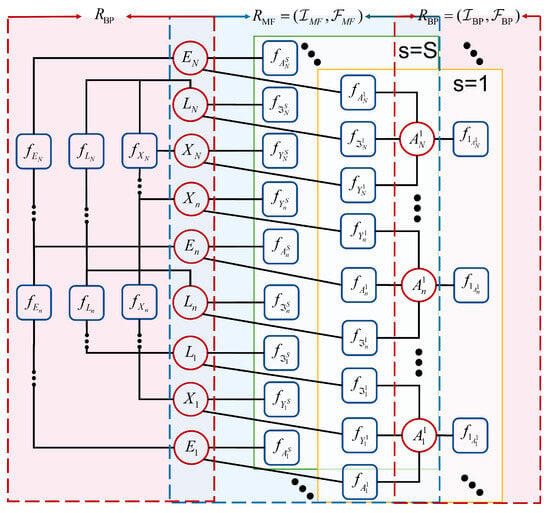
Building upon the joint posterior distribution in (18), we establish the definitions for the factor nodes as , , , , , , .
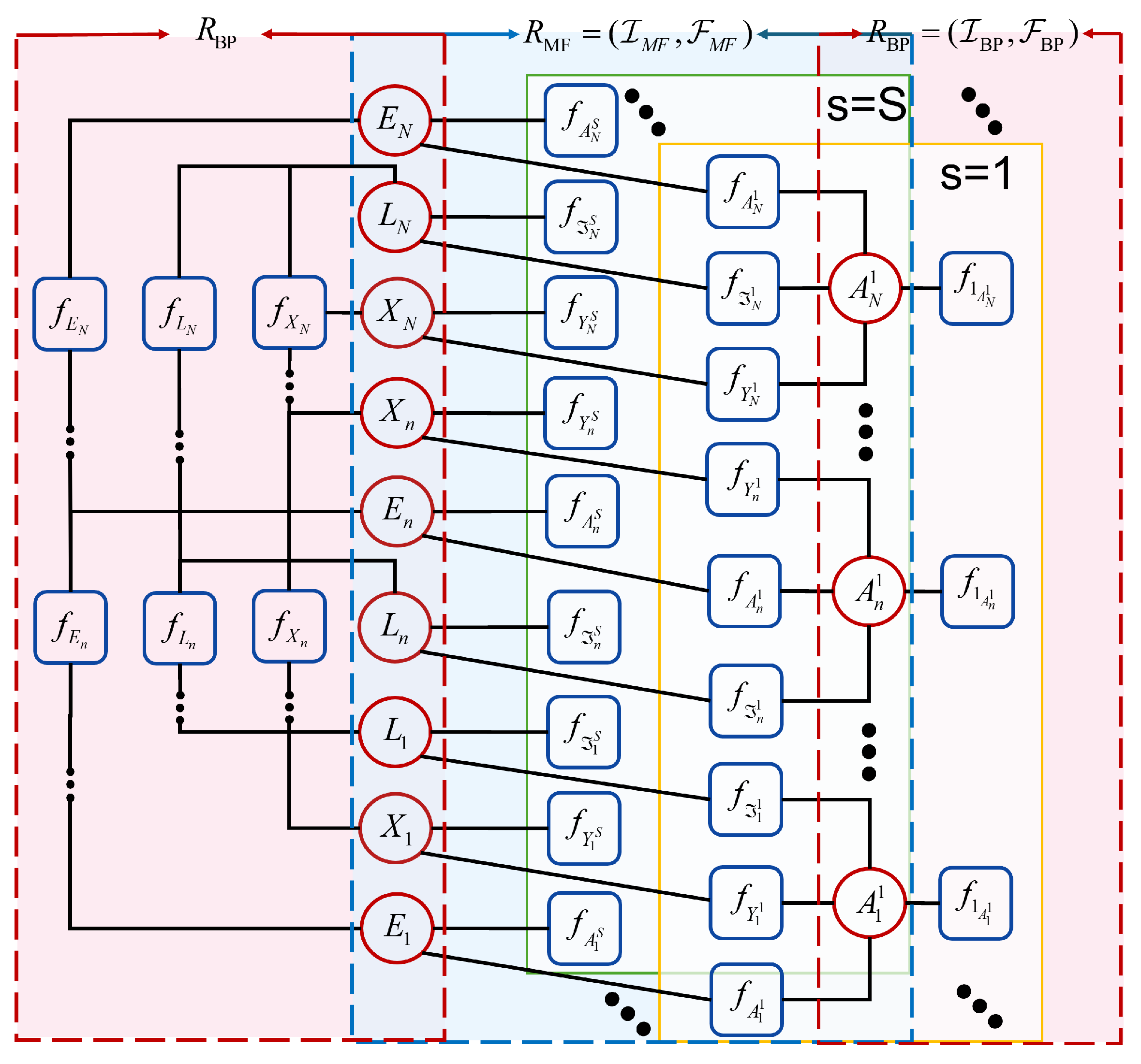
Let , and be the sets of factor nodes and variable nodes, respectively. The corresponding factor graph is illustrated in Figure 1, where the blue rounded rectangles and red circles denote factor and variable nodes, respectively. The red and blue dashed borders delineate the BP and MF regions, respectively, while the green and yellow solid borders indicate the radar-specific subgraphs associated with and , respectively.
Figure 1.
Factor graph corresponding to the factorization of the joint posterior probability distribution function (PDF) .
Subsequently, the factor graph is decomposed into two regions: the MF region and the BP region , where
Therefore, (19) is the factorization of the original joint PDF according to the conditional-independence structure of the probabilistic model. The multiplication of the two factor products simply reconstructs the complete joint PDF. MF and BP specify the inference methods applied to the corresponding factor subsets and do not imply that they are two independent probability densities.
Correspondingly, the joint posterior PDF is expressed as
According to the combined MF-BP message-passing rules [24], the beliefs of the target kinematic states, class index, visibility states, and data-association variables are computed by combining the incoming messages from their neighboring factor nodes in the MF and BP regions as follows:
Here, and denote the sets of neighboring factor nodes belonging to the BP and MF regions, respectively, while and denote the corresponding factor-to-variable messages. The proportionality symbol indicates that each product of the incoming messages must be normalized to obtain a valid approximate marginal posterior distribution, where the message update rules are as follows:
where is the variable to be approximated, i.e., , , , , represents the set of factor nodes linked to the variable node i, represents the message from variable node i to factor node , and are normalization factors, indicates the variable nodes linked to the factor node excluding variable node i, denotes the sum over all elements of except . If there is no factor node belongs to BP region, one has
The detailed derivation of each belief and its corresponding local factor graph will be presented in the remainder of this section. For brevity, we simplify the message representation and below.
3.2. Belief Computation
This subsection derives the belief-update expressions for the target kinematic states, visibility states, class index, and data-association variables. In the following factor graphs, red circles and blue boxes denote variable and factor nodes, respectively; ellipses indicate omitted repetitive structures, and yellow shading highlights the components of interest.
3.2.1. Belief Calculation for
Given the independent kinematic states of each target k, the belief of joint kinematic state can be factorized as
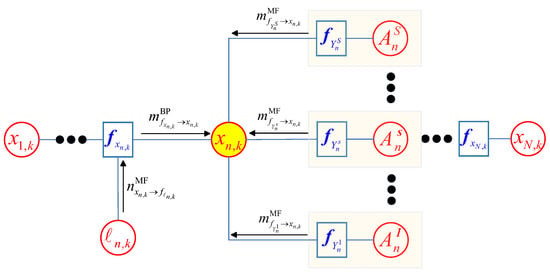
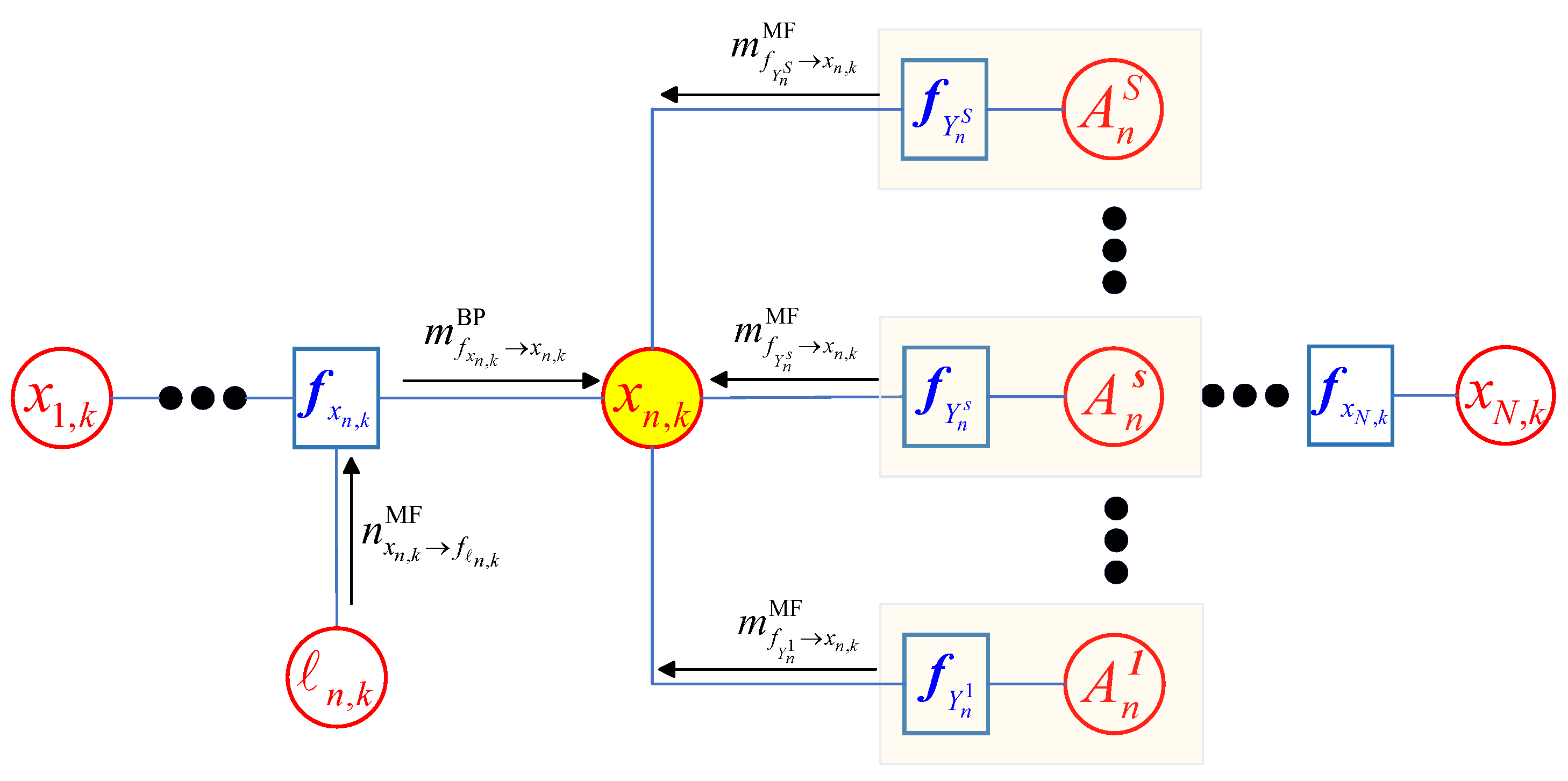
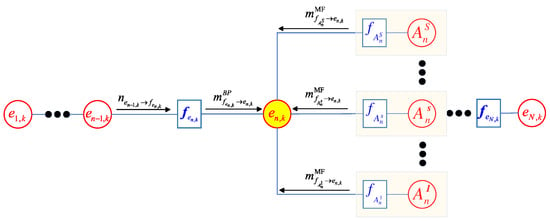
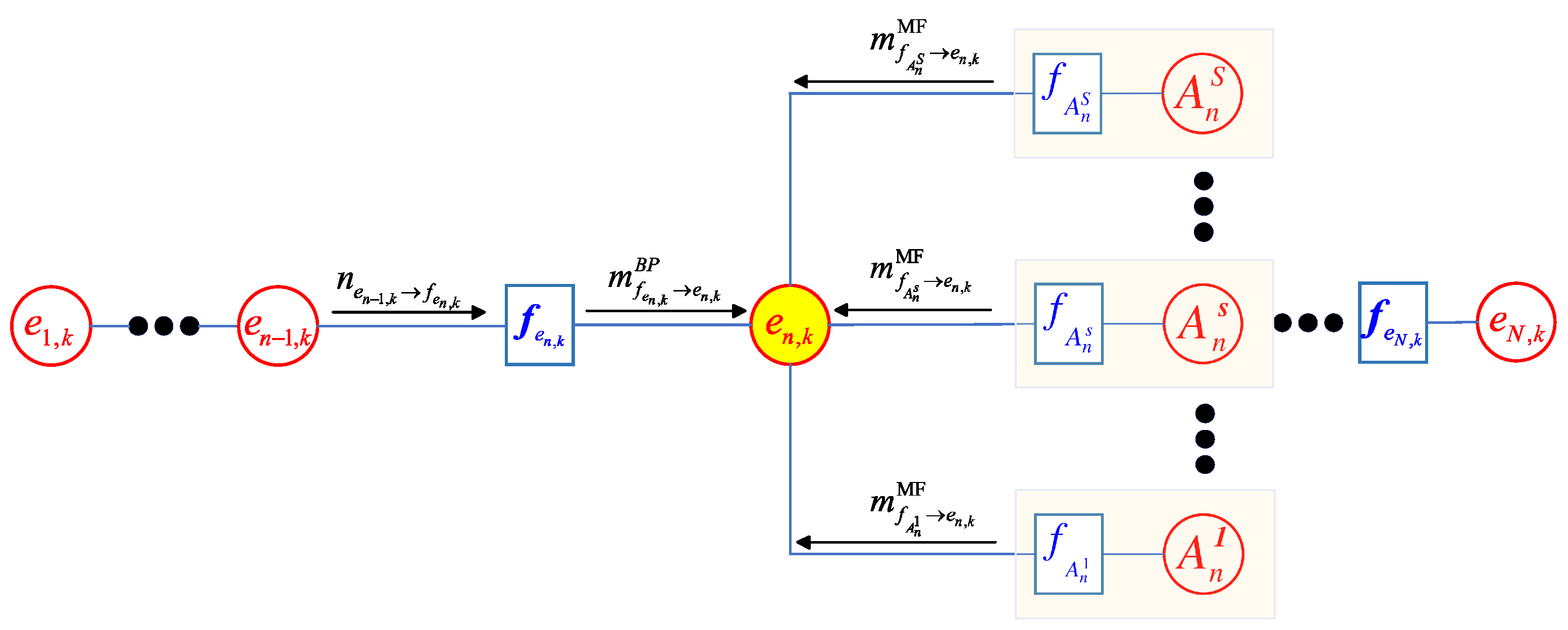
As shown in Figure 2, for each variable node at time n, its connected factor node set is .
Figure 2.
Subgraph of kinematic state estimation with belief .
The variable nodes connected to each factor node in are , .
Using the BP rule in (21), the belief is computed as
Following the general message update rules in (22), the BP prediction message and the MF measurement messages in (25) can be expressed in Gaussian form. Their detailed derivation is provided in Appendix A.
3.2.2. Belief Calculation for
The subgraph corresponding to the belief of target visibility state is shown in Figure 3. Considering the independence of target visibility state, can be factorized as
Figure 3.
Subgraph of target visibility state with belief .
For each variable node , it is connected to factor nodes, denoted as . The sets of variable nodes connected to each factor node are given by and .
The belief is calculated as
where
Within time window , the belief of target visibility state is derived as
which follows the hidden Markov model (HMM) framework and can be solved via the forward-backward algorithm.
3.2.3. Belief Calculation for
Given the independence of class index among targets, the belief of joint class index is factorized as
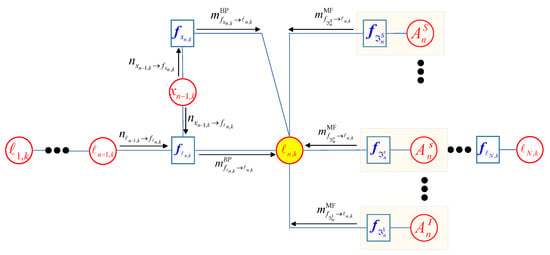
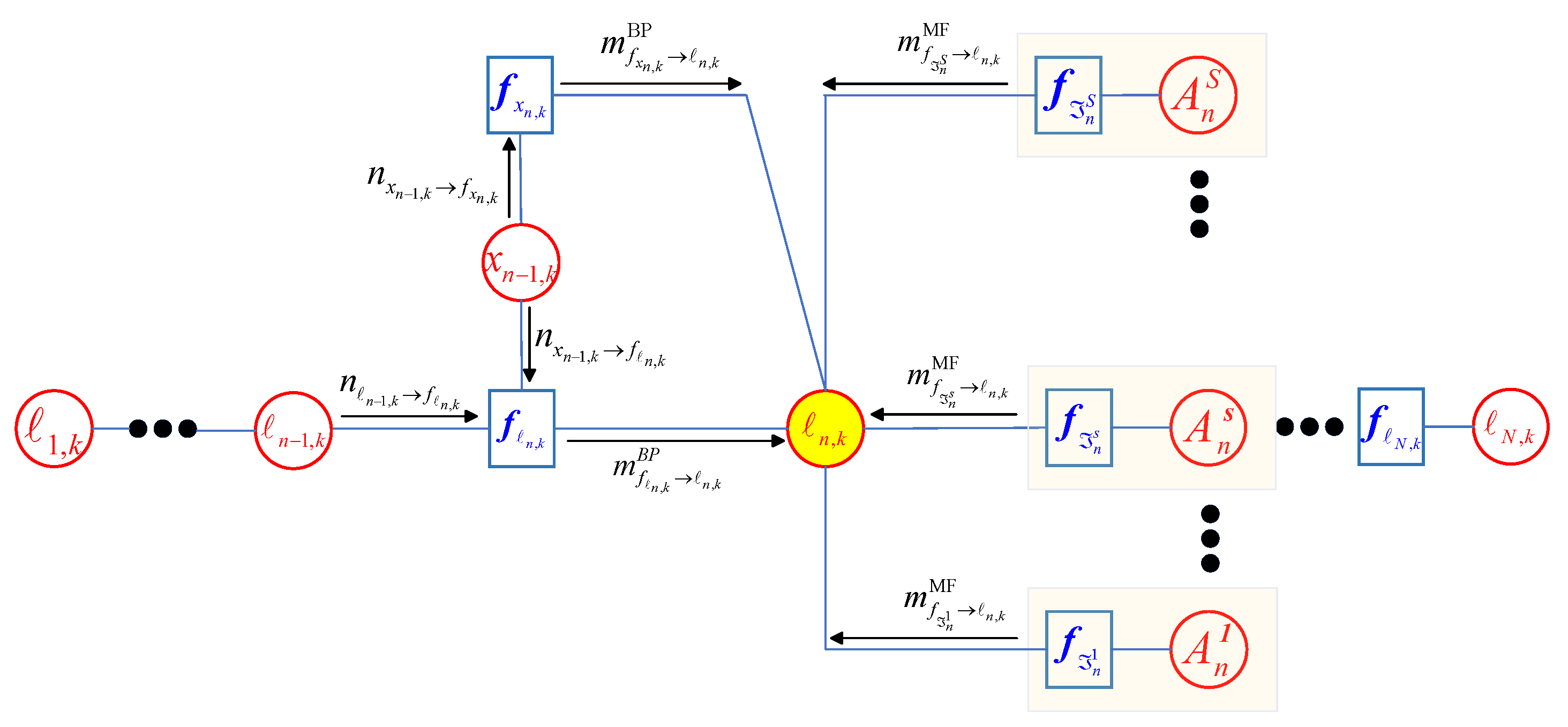
As shown in Figure 4, for each variable node at time n, its connected factor node set is . The variable nodes connected to each factor node are , and .
Figure 4.
Subgraph of class index estimation with belief .
Using the BP rule in (21), the class index belief is
The message update rules yield the following:
Combining (32)–(34) into (31), one has
where the joint likelihood term is defined as
The classification belief over time steps from 1 to N becomes
where denotes the initial probability of target k belonging to class , is the class transition probability, and represents the joint likelihood sequence. This standard HMM formulation can be efficiently solved via the forward-backward algorithm.
3.2.4. Belief Calculation for
Assuming independent observation across radars, the belief of data association belief is factorized as
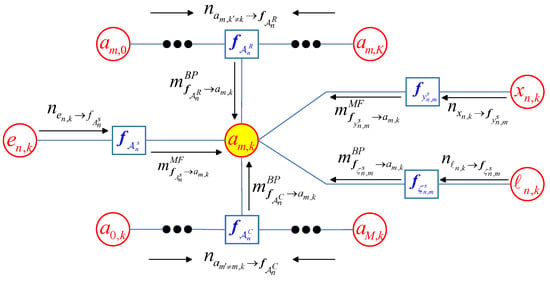
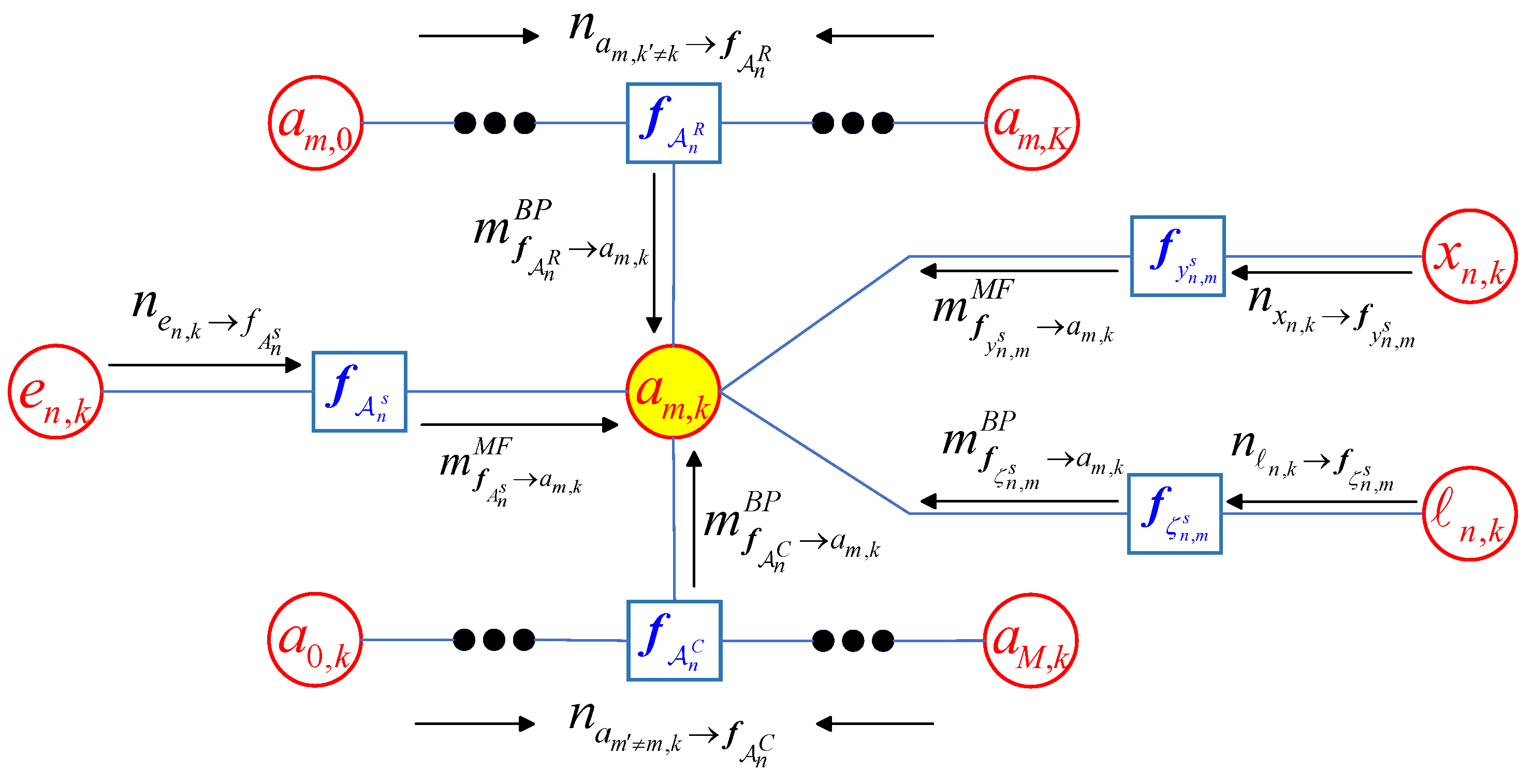
Figure 5 illustrates the local factor graph for data association variable , connecting to five factor nodes (association constraints), (kinematic likelihoods), (classification likelihoods), (measurement constraints), and (target constraints). The set of variable nodes connected to the corresponding factor nodes is given by and .
Figure 5.
Local factor graph for data association belief . Time index n and sensor index s are omitted; .
The messages provided by the prior and likelihood factors are combined with the BP messages associated with the row and column association constraints to calculate the data-association belief. The detailed derivation of these messages and the resulting association probabilities is provided in Appendix B.
3.3. Implementation, Initialization, and Computational Complexity
The proposed CA-MP-SBRs algorithm employs a sliding-window batch mechanism to strike a balance between estimation accuracy and computational burden, processing the N most recent scans in each cycle. The beliefs of the hidden variables, specifically, the kinematic state , visibility state , class index , and data association , are iteratively updated according to (A9), (29), (37) and (A17). These updates are facilitated by the extended Rauch–Tung–Striebel smoother, forward-backward algorithm, and loopy belief propagation (LBP), respectively. The complete procedure of the CA-MP-SBRs algorithm is summarized in Algorithm 1.
| Algorithm 1: CA-MP-SBRs algorithm |
|
Before performing the iteration of CA-MP-SBRs, it is necessary to derive the initial beliefs , , and , as well as the maximum number of targets , where denotes the length of the sliding window. The initialization procedure for the first sliding window is given as follows.
- •
- At the first scan (), the measurement set is obtained by radar s, where every measurement is initialized as a tentative track. At the second scan (), each radar s receives a new measurement set . Based on these two sets, velocity information is derived given the sampling time . An association gate is then established for each tentative track, constrained by the assumed maximum velocity , minimum velocity , and measurement noise intensity. If a measurement falls within this gate, the associated tentative track evolves into a preliminary track; otherwise, the tentative track is discarded. Additionally, the target visibility state is initialized at the first scan and recursively updated at the second scan using the forward-backward algorithm. For the target class initialization, an uninformative uniform prior is assumed. Upon receiving the initial classifier output , the class belief vector is initialized by applying the confusion matrix , yielding the normalized initial posterior .
- •
- At the third scan (), data association should be considered. To associate the measurements in with the established preliminary tracks, we first obtain the predicted position of the preliminary track via (2). This predicted position is then transformed into the RAMF coordinate system to yield the predicted measurement . Subsequently, a validation gate defined by the Mahalanobis distance is established around the predicted measurement to screen for candidate measurements from . A measurement is selected as a candidate if it satisfies the condition , where denotes the covariance matrix of the innovation . In scenarios where a single preliminary track validates multiple candidate measurements, the LBP algorithm is employed to calculate the data association belief for each candidate, thereby generating a weighted pseudo-measurement for state update. Simultaneously, the visibility probability and the class index belief vector are recursively updated using the forward-backward algorithm, wherein the class evolution is propagated by the transition matrix , and the class identification is updated using the classifier outputs derived via the confusion matrix . Finally, any measurements falling outside the validation gates of existing tracks are utilized to initialize new preliminary tracks in CA-MP-SBRs.
- •
- For the batch window , track management is performed based on . Specifically, a tentative track is confirmed when its visibility probability exceeds in at least three scans within the initialization window. Once confirmed, a track is terminated when its visibility probability remains below for three consecutive scans or when the number of consecutive missed measurements reaches three. Here, denotes the total number of confirmed potential tracks within the batch window to construct the valid track set for CA-MP-SBRs.
The CA-MP-SBRs algorithm is an iterative optimization method within a unified factor graph framework, utilizing a sliding window of length . The computational complexity of the algorithm is analyzed as follows. First, the estimation of the target kinematic state is performed via the extended Rauch-Tung-Striebel Smoother. Consequently, its computational complexity is , where denotes the dimension of the target kinematic state vector. The estimation of the target visibility state is solved by the forward-backward algorithm, yielding a computational complexity of . The estimation of the class index is again solved via the forward-backward algorithm, resulting in a computational complexity of , where denotes the number of distinct target categories. The data association problem is solved via the loopy belief propagation (LBP) algorithm, and its primary computational cost is analyzed as follows. In each iteration, the computational cost for each variable node is . Given that the factor graph contains at most nodes in total, and each node represents a binary variable (taking values of 0 or 1), the total computational cost is , where denotes the number of LBP iterations. Therefore, the total computational complexity per sliding window can be expressed as
where denotes the number of iterations of the MP algorithm.
4. Simulation and Analysis
In this section, we verify the effectiveness of the proposed CA-MP-SBRs algorithm. It should be noted that all evaluations presented in this section are based exclusively on simulated data rather than real-world measurements. First, the kinematic trajectories of dense aerial targets from different classes are simulated. Subsequently, Field Computation for Objects of Arbitrary Shape (FEKO) software is used to generate the targets’ HRRP data [46], based on which a CNN is employed to obtain the target confusion matrix. Finally, we evaluate the data-association and tracking accuracy of CA-MP-SBRs as the number of target classes increases.
4.1. Parameter Configuration
The simulation parameters are selected by considering scenario representativeness, algorithmic convergence, and computational complexity. The sampling period balances the characterization of target maneuvers and computational cost, while the clutter intensity , corresponding to an average of 80 clutter measurements per scan, provides a challenging clutter-rich scenario. The settings , , and are used to evaluate the influence of different levels of target-category information on tracking performance. The parameters associated with the target-motion, state-transition, and message-passing models are selected based on the established models cited in the corresponding subsections. The remaining implementation parameters are determined by balancing temporal-information utilization, numerical convergence, and computational complexity. Specifically, the sliding-window length and step size of three provide sufficient temporal information with manageable computational complexity, whereas the convergence thresholds and ensure stable message-passing updates. The state-transition parameters characterize the temporal persistence of target visibility and category, while the classifier confusion matrix is obtained from the CNN classification results using the FEKO-generated HRRP data. The same parameter settings are used across all comparative experiments to ensure a fair comparison.
4.1.1. Simulation Scenarios
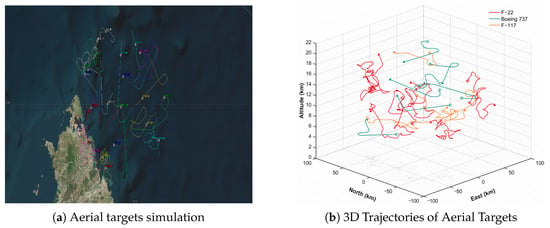
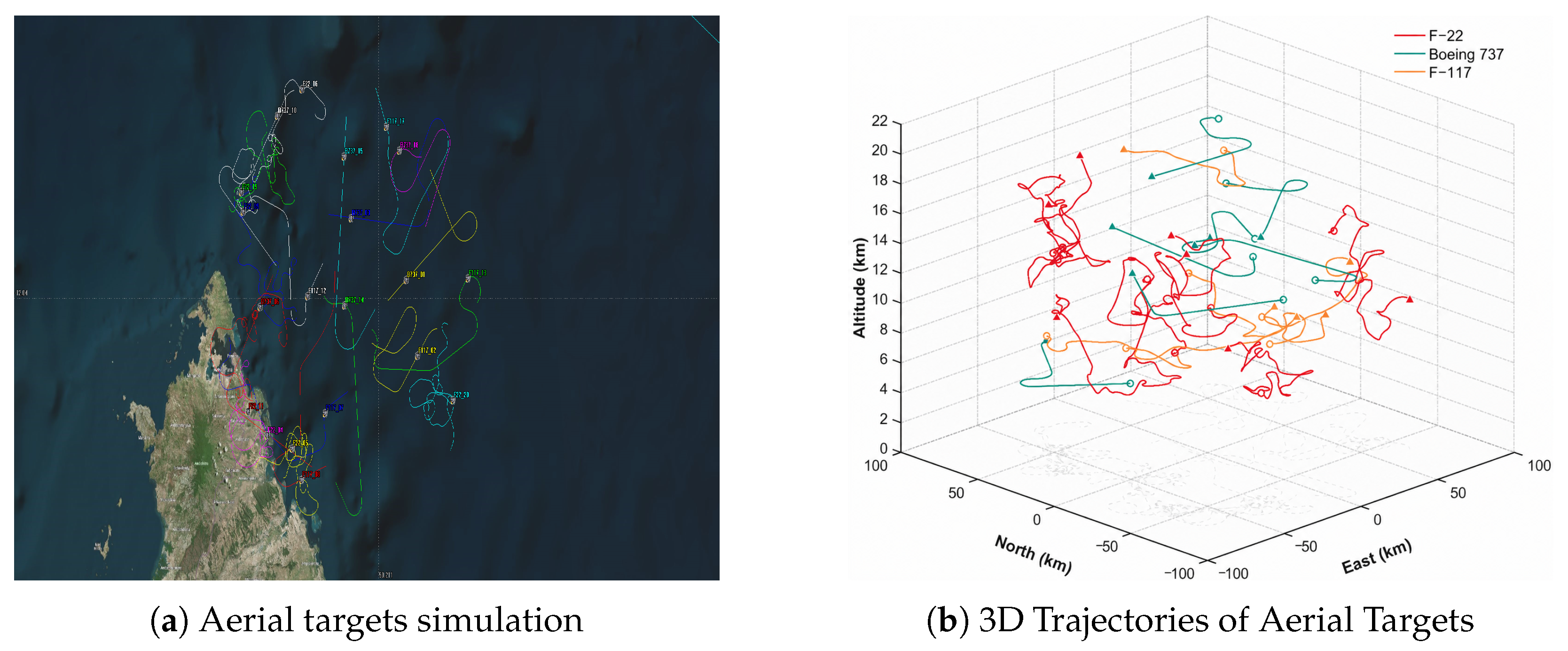
Consider a scenario where two independent space-based radars track 20 aerial targets. The tracking scenarios are shown in Figure 6. The orbital elements of the satellites carrying SBRs are given in Table 1.
Figure 6.
Simulation schematic of various dense aerial targets. The differently colored trajectories in subplot (b) represent different target types; the circles denote the starting points, and the triangles denote the end points.
Table 1.
Configuration of the six Keplerian elements for the two space-based radars.
The surveillance region spans with uniformly distributed background clutter. Three types of aerial targets are simulated, with parameters being shown in Table 2. To simulate complex environments where diverse aircraft operate densely within restricted areas, distinct kinematic profiles are designed. Specifically, the highly maneuverable F-22 typically executes rapid tactical evasive maneuvers; the F-117 generally operates at subsonic speeds with a moderate turn rate; and the Boeing 737 predominantly maintains a prolonged cruising state characterized by a low maximum turn rate. To model the kinematic trajectories of diverse aircraft categories, this study utilizes an aerodynamic response smoothing model to simulate flight dynamics [45,47].
Table 2.
Typical aerial target types and parameters.
4.1.2. Target Setting
Assume that the maneuver parameters of the targets at time k include the target turn rate , the target vertical velocity , and the target 3D resultant velocity . Then, the actual dynamic parameter update equations at time k are given by , , and , where , , and are the smoothing factors.
Based on the aforementioned parameters, the 3D kinematic model of the system is formulated as , , and
where and denote the heading angle and horizontal velocity, respectively, while (40) and (41) describe the velocity and position vector updates.
Table 2 summarizes the differences in physical size and maneuverability among the three target types. Accordingly, Table 3 groups the 20 aerial targets into three classification scenarios with , and the corresponding class labels are assigned to their HRRP samples. Here, C specifies the granularity of the target-category partition summarized in Table 3; thus, Table 3 provides only a macro-level grouping of the targets. It does not directly determine the parameters used in motion-state estimation. Instead, the category information is incorporated into the motion model through the class-dependent process-noise vector , whose elements specify the process-noise levels associated with the corresponding target categories. Consequently, the influence of category information on tracking is realized through , which adjusts the prediction uncertainty of the motion model and thereby affects the estimated motion states. Owing to the distinct kinematic characteristics of the three aircraft types, their maneuver cycles and motion parameters follow different statistical distributions. Detailed parameters of the corresponding motion models are provided in Table 4.
Table 3.
Simulation scenarios for distinct target models.
Table 4.
Motion models and maneuver parameter distributions for different aerial target types.
The ranges of the radial distance, azimuth angle, and pitch angle for each SBR are km, and . For all SBRs, the sampling period is , and (the expected number of clutter is 80). The kinematic state transition matrix is . The base process noise covariance matrix is , where denotes the variance of the target maneuvering acceleration. The measurement noise covariance matrix is .
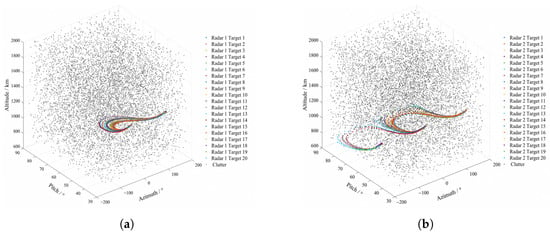
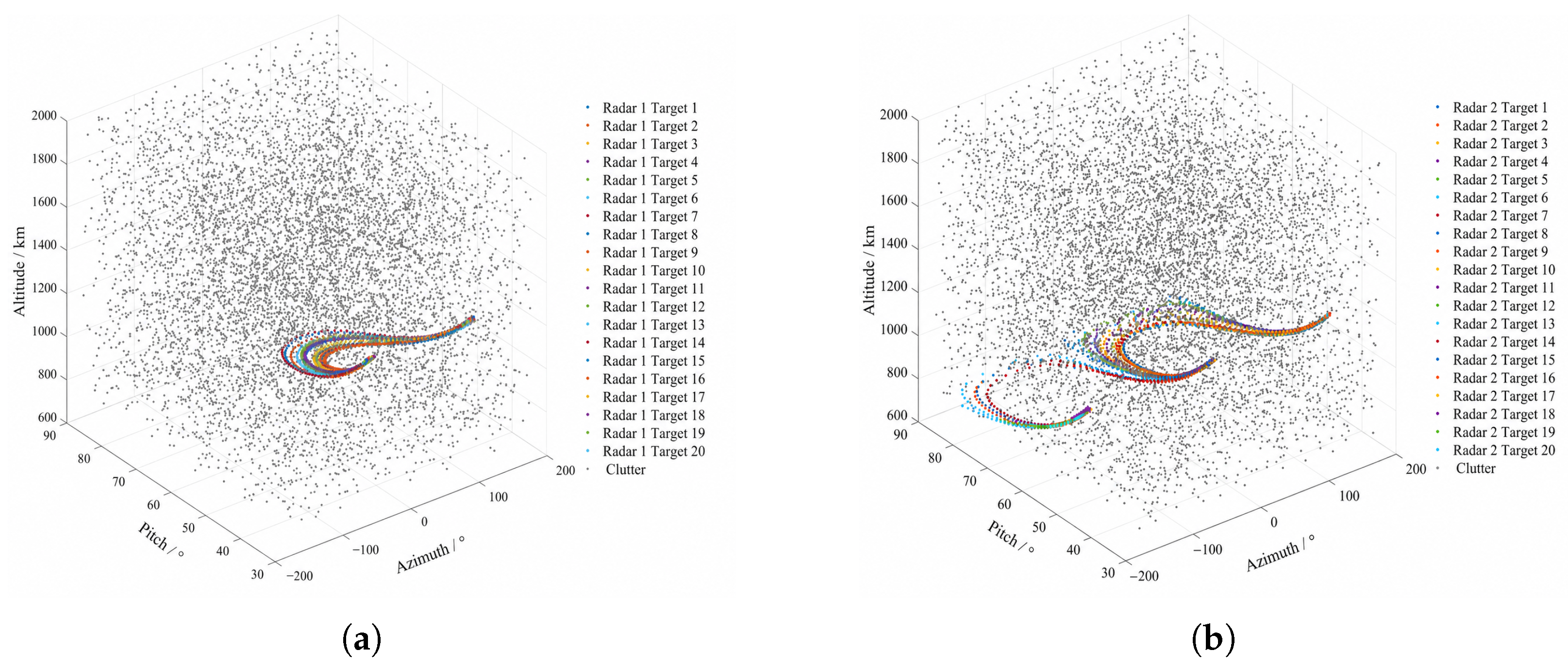
Figure 7 shows the measurements from the two radars for 20 targets under dense clutter conditions. As shown in the figure, the target trajectories are highly dense. Coupled with the extremely dense clutter, this poses stringent requirements on the performance of the data association and tracking algorithm.
Figure 7.
Radar measurements under dense clutter conditions. (a) Measurement of targets and clutter by SBR 1; (b) Measurement of targets and clutter by SBR 2.
The HRRP data for all target classes are generated using FEKO, a computational electromagnetics software package. First, a CAD model is constructed for each target and discretized into triangular elements with a maximum edge length of , where denotes the radar wavelength at the center frequency. Under the specified radar configurations and observation geometries, FEKO calculates the complex wideband frequency-domain scattering responses of the target models. The corresponding HRRPs [46] are then obtained by applying an inverse fast Fourier transform to these simulated responses. Thus, FEKO is used to generate the simulated HRRP data and is not involved in the subsequent target-tracking or data-association process.
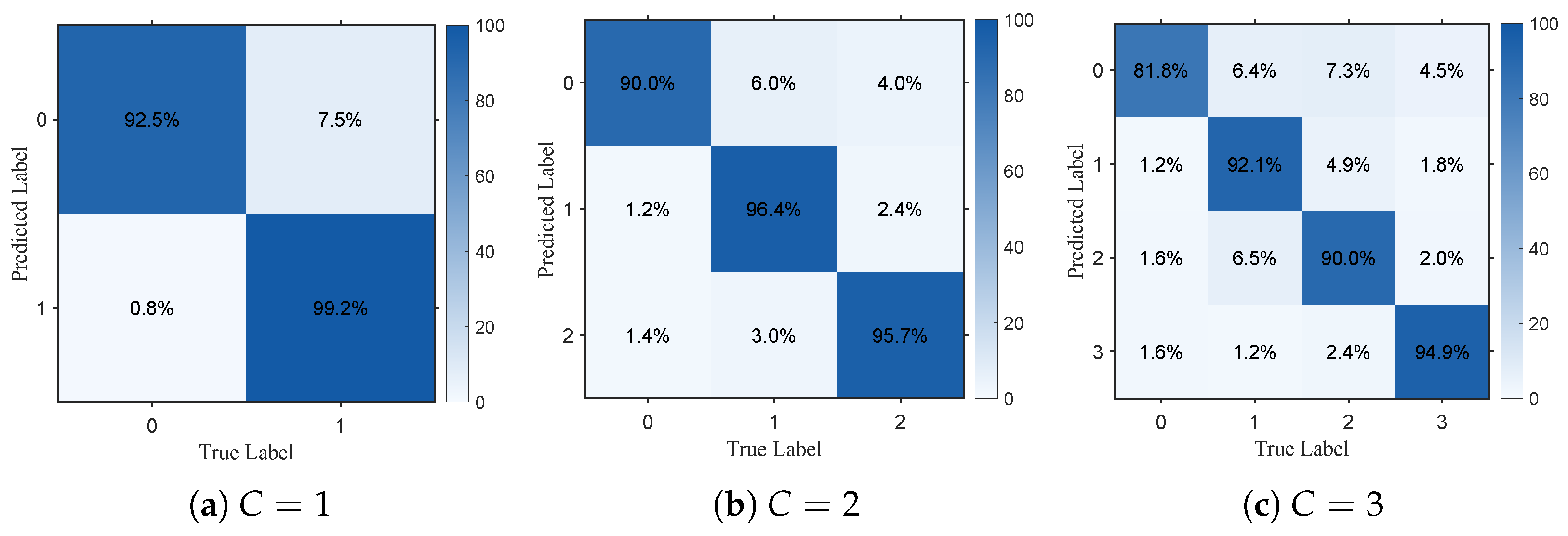
The generated HRRP sequences are subsequently used to train and evaluate a CNN for aerial-target classification. The CNN extracts discriminative class features from the HRRP samples, and the resulting classification outcomes are summarized in a normalized confusion matrix. The diagonal elements represent the class-specific correct-classification probabilities, whereas the off-diagonal elements characterize the interclass misclassification tendencies.
4.1.3. Algorithm Parameters
- •
- Iteration and sliding window parameters: The message passing process utilizes a sliding window length of with a step size of 3, an iteration convergence threshold of , and a maximum iteration limit of . For solving data association via LBP, the iteration threshold is , and the maximum allowable number of iterations is .
- •
- Track management parameters: The detection probability is when the target does not exist. The corresponding state transition matrix is . Additionally, a threshold is used for both track confirmation and termination.
- •
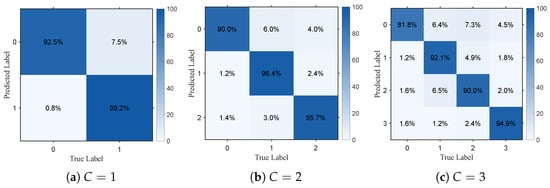
- Category parameters: The elements of the class evolution matrix are set to for and for . The elements of the classifier’s confusion matrix are derived from HRRP training, with the specific values detailed in Figure 8.Figure 8. Classification confusion matrices of aerial targets.
4.2. Performance Evaluation and Simulation Results Analysis
In this paper, the trajectories of various aerial targets are simulated based on the kinematic characteristics of different aircrafts, and three simulation scenarios are established (see Table 3). For a comprehensive performance evaluation of the proposed tracking algorithm, standard metrics including optimal subpattern assignment (OSPA), generalized optimal subpattern assignment (GOSPA), mean optimal subpattern assignment (MOSPA), mean generalized optimal subpattern assignment (MGOSPA), the Redundant Track Ratio (RTR), and Track Maintenance Ratio (TMR) are utilized. To ensure a statistically robust evaluation against system uncertainties, all performance metrics are averaged over 200 independent Monte Carlo trials. For a structured analysis, these metrics are further categorized into set-theoretic distances and track management statistics.
4.2.1. Performance Evaluation
(1) Set-Theoretic Distance Metrics: This study adopts set-theoretic distance metrics as the primary evaluation criteria, with particular emphasis on the OSPA metric and its generalized version, GOSPA. The OSPA metric measures the discrepancy between two finite target sets by jointly accounting for localization and cardinality errors. However, its cardinality penalty couples the contributions of missed targets and false tracks, making it difficult to identify the individual sources of tracking errors. GOSPA addresses this issue by introducing a modified cardinality penalty that allows the total error to be interpreted in terms of localization error, missed-target error, and false-track error. These metrics therefore provide both an overall assessment of tracking accuracy and an interpretable analysis of performance degradation caused by clutter-induced false tracks or missed detections.
For completeness, the standard definitions of OSPA and GOSPA are given below. Let and denote the true and estimated target sets, respectively, with . The OSPA distance is defined as [48]
where , p is the order, c is the cutoff parameter, and denotes the set of permutations of n elements. The corresponding GOSPA distance is defined as [49]
where controls the cardinality penalty. In this study, is used, allowing the GOSPA error to be decomposed into localization, missed-target, and false-track components. Finally, MOSPA and MGOSPA denote the averages of the corresponding OSPA and GOSPA values over the independent Monte Carlo trials.
(2) Track Management Metrics: In addition to the overall distance metrics, RTR and TMR are utilized to explicitly quantify the trajectory continuity and reliability. RTR is defined as the ratio of the number of redundant tracks to the total number of estimated tracks, effectively reflecting the algorithm’s capability to suppress track duplication and maintain unique track-to-target associations. Conversely, TMR evaluates the tracking continuity by calculating the ratio of the maintained trajectory lifespan to the true target lifespan. A higher TMR and a lower RTR indicate superior track management performance.
4.2.2. Simulation Results Analysis
Figure 8 present the classification confusion matrices for aerial targets, respectively. Taking the confusion matrix results for aerial targets at as an example, the second row illustrates the classification performance for Class 1. Specifically, 92.1% of the data is correctly identified as Class 1, while 1.2% is misidentified as clutter, 4.9% is misclassified as Class 2, and 1.8% is misclassified as Class 3. These confusion matrices characterize the recognition reliability and inter-class confusion at different classification granularities. The resulting classification likelihoods are incorporated into the data-association update as a probabilistic soft constraint through (A11).
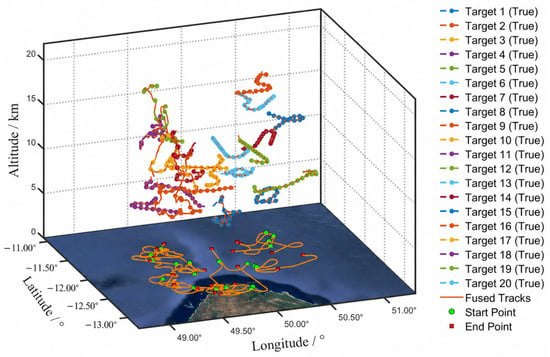
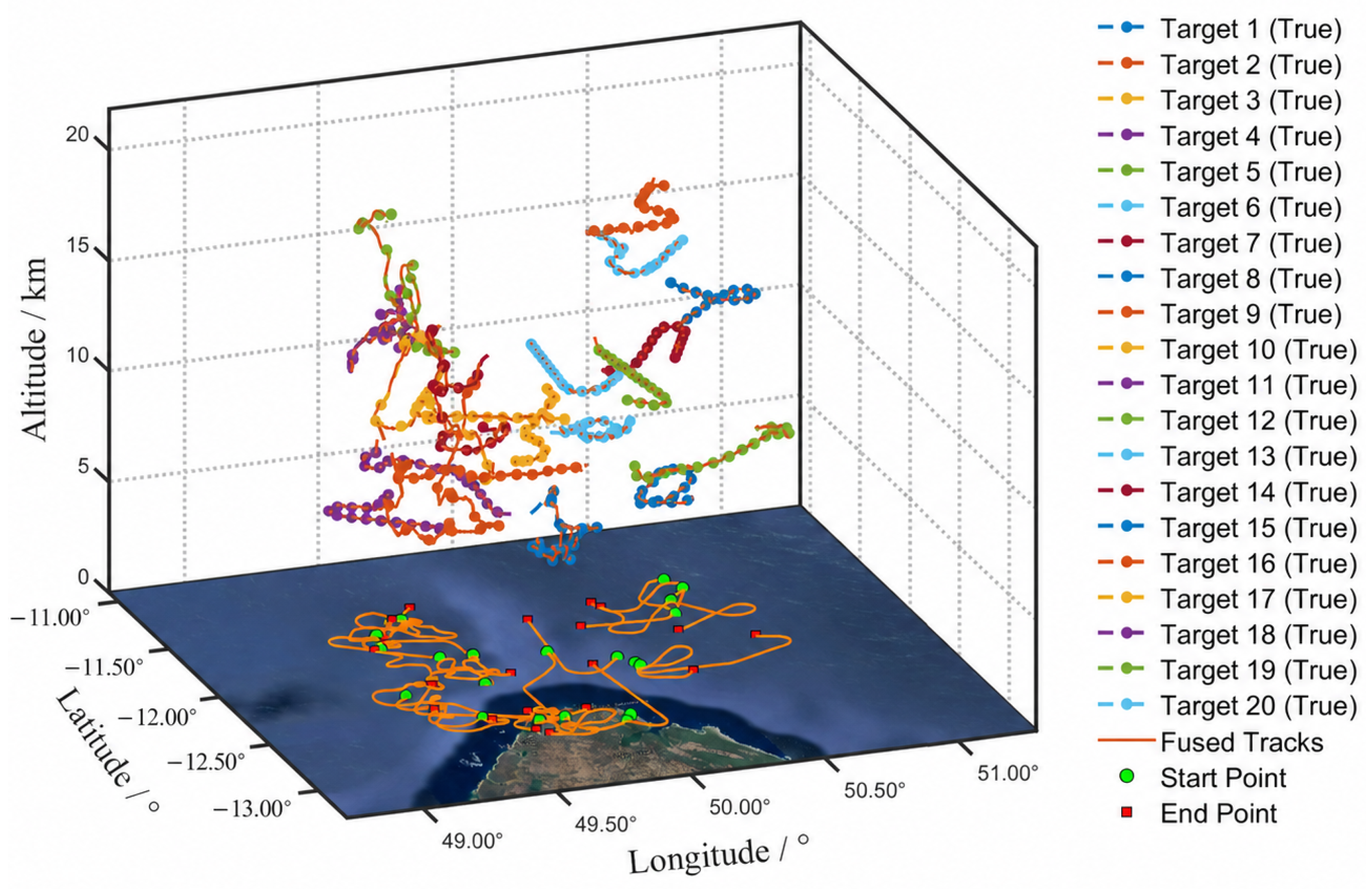
To verify the tracking performance of the proposed algorithm, Figure 9 presents a simulated scenario in which space-based radars employ the CA-MP-SBRs algorithm to track dense targets within the LLA coordinate system. The 20 aerial targets exhibit high maneuverability with intersecting and overlapping spatial trajectories. Furthermore, the observation environment is characterized by heavy clutter, as depicted in Figure 7. These highly complex conditions impose stringent requirements on the algorithm, ultimately demonstrating its robust tracking performance.
Figure 9.
Target trajectories obtained by the proposed algorithm.
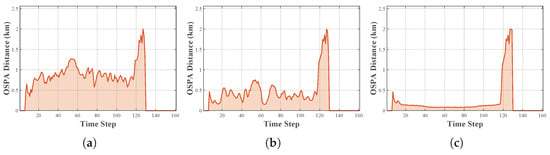
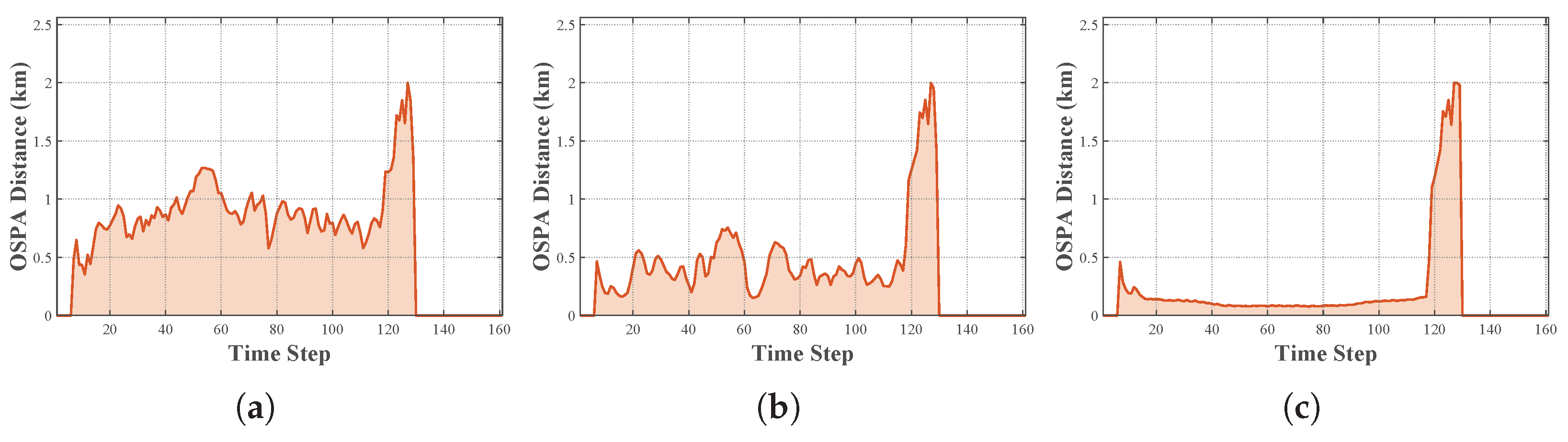
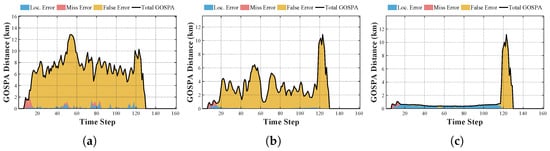
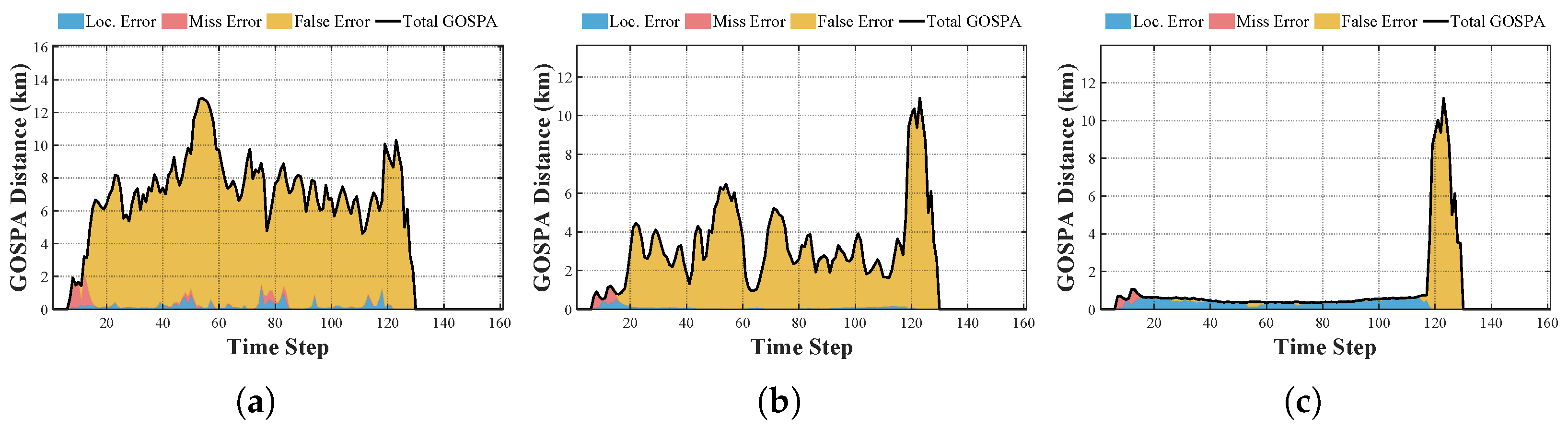
Figure 10 and Figure 11 and Table 5 compare the OSPA and GOSPA performance under different controlled process-noise-model configurations in a dense-clutter environment. In this context, the target class is assumed to be invariant across the observing satellites. Given the intrinsic correlation between a target’s category and its kinematic behavior, distinct target classes are assigned specific acceleration noise variances , which, according to (3), determine the class-dependent process-noise covariance and represent the additional maneuverability associated with each target type. Specifically, as shown in Figure 10a and Figure 11a, when all elements of are set to zero, the system relies exclusively on the fundamental process-noise covariance. This zero-additional-noise ablation omits the class-dependent maneuvering component and therefore introduces substantial process-model mismatch for highly maneuvering targets, resulting in degraded track continuity and data association performance. Figure 10b and Figure 11b show the results obtained with a partially class-dependent process-noise model. Although this configuration provides additional maneuvering compensation for selected target types, the motion models of the remaining target types are still not fully matched. In contrast, Figure 10c and Figure 11c present the results of the proposed fully class-dependent process-noise model. By assigning process-noise parameters according to the maneuverability of each target class, this configuration improves state-estimation accuracy, track continuity, and data-association robustness in the considered scenario. From a macroscopic perspective, synthesizing the visual trends with the data in Table 5 leads to a definitive conclusion: refining the granularity of classification priors significantly enhances both data association robustness and overall tracking accuracy. Notably, a pronounced error spike emerges at the tail of each curve. This phenomenon occurs because the targets have flown out of the radar’s field of view. To prevent premature track termination caused by temporary missed detections, the tracking algorithm intentionally coasts the trajectories using the kinematic prediction model for several subsequent frames, even when no measurements are received, resulting in a transient increase in estimation error.
Figure 10.
Optimal subpattern assignment (OSPA) performance under controlled process-noise-model ablations: (a) zero-additional-noise model (); (b) partially class-dependent model (); and (c) class-dependent noise model ().
Figure 11.
Generalized optimal subpattern assignment (GOSPA) performance under the controlled process-noise-model ablations. The parameter settings in (a–c) are identical to those in Figure 10, and the colored regions decompose the total GOSPA into localization, missed-target, and false-track errors. (a) zero-additional-noise model; (b) partially class-dependent model; (c) class-dependent noise model.
Table 5.
Tracking performance comparison of single- and joint-SBR configurations under different process-noise models.
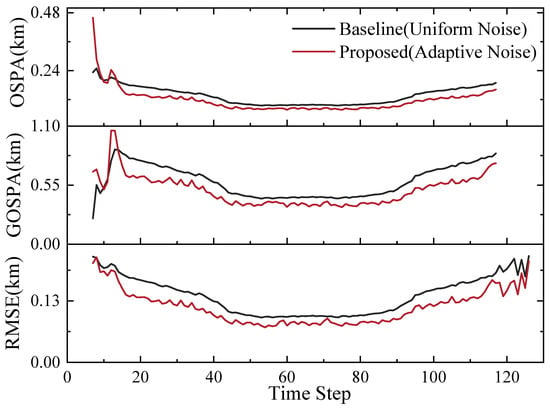
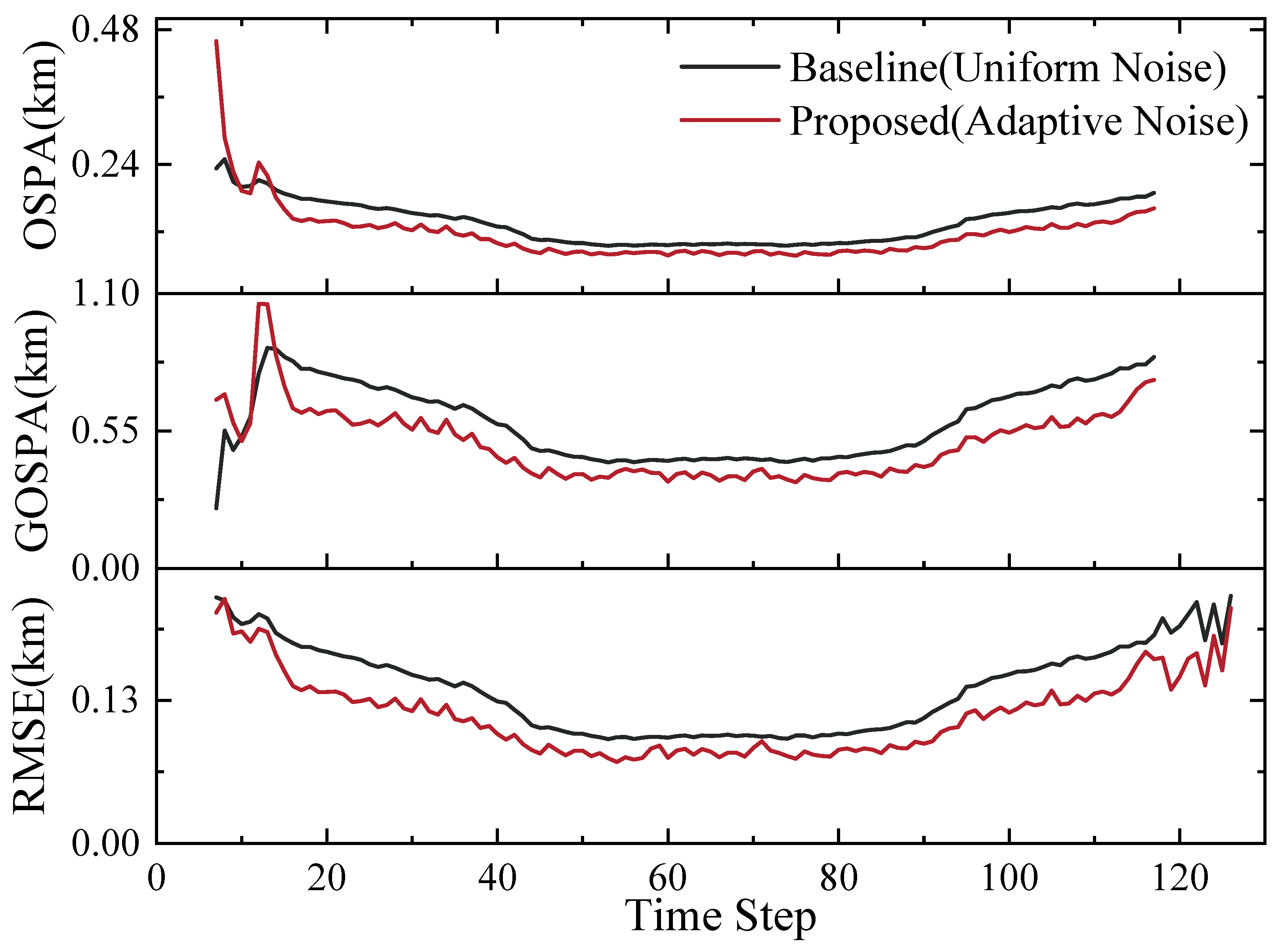
To provide a deeper insight into the superiority of the proposed classification-aided algorithm, a comparative analysis is conducted between the uniform baseline strategy () and the adaptive proposed strategy (), as illustrated in Figure 12. To evaluate the steady-state tracking precision independently of transient boundary effects, the terminal transient spikes induced by targets exiting the radar field of view (FoV) are excluded. Specifically, the baseline adopts a class-agnostic process noise model, allocating an identical, worst-case maneuvering variance to all targets regardless of their actual kinematic profiles. Although this conservative margin preserves trackability during sharp target maneuvers, it inevitably inflates the validation gate volume, forcing the filter to indiscriminately absorb clutter and measurement noise. Consequently, this manifests as a noticeably elevated steady-state error floor across all metrics. In stark contrast, the proposed strategy implements a class-adaptive process noise allocation driven by HRRP target attributes. For instance, when an aerial target is classified as a low-maneuverability type (e.g., the Boeing 737), the algorithm assigns a minimal process noise to its motion model. This attribute-conditioned process noise constraint directly reduces the innovation covariance, thereby achieving robust clutter rejection. Quantitatively, compared with the uniform baseline, the proposed method reduces the MOSPA, MGOSPA, and RMSE by 14.7%, 14.8%, and 17.7%, respectively. Ultimately, by allocating high-tolerance flexibility to maneuvering targets to prevent track fragmentation, while simultaneously enforcing tight motion constraints on stable targets to reject clutter, the proposed method achieves superior state estimation performance in complex multi-target scenarios.
Figure 12.
Tracking performance comparison over time in terms of OSPA, GOSPA, and RMSE.
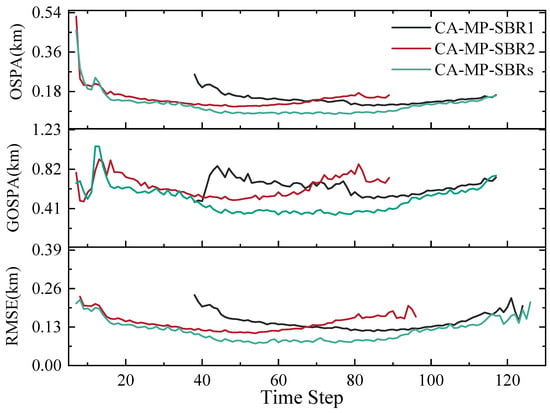
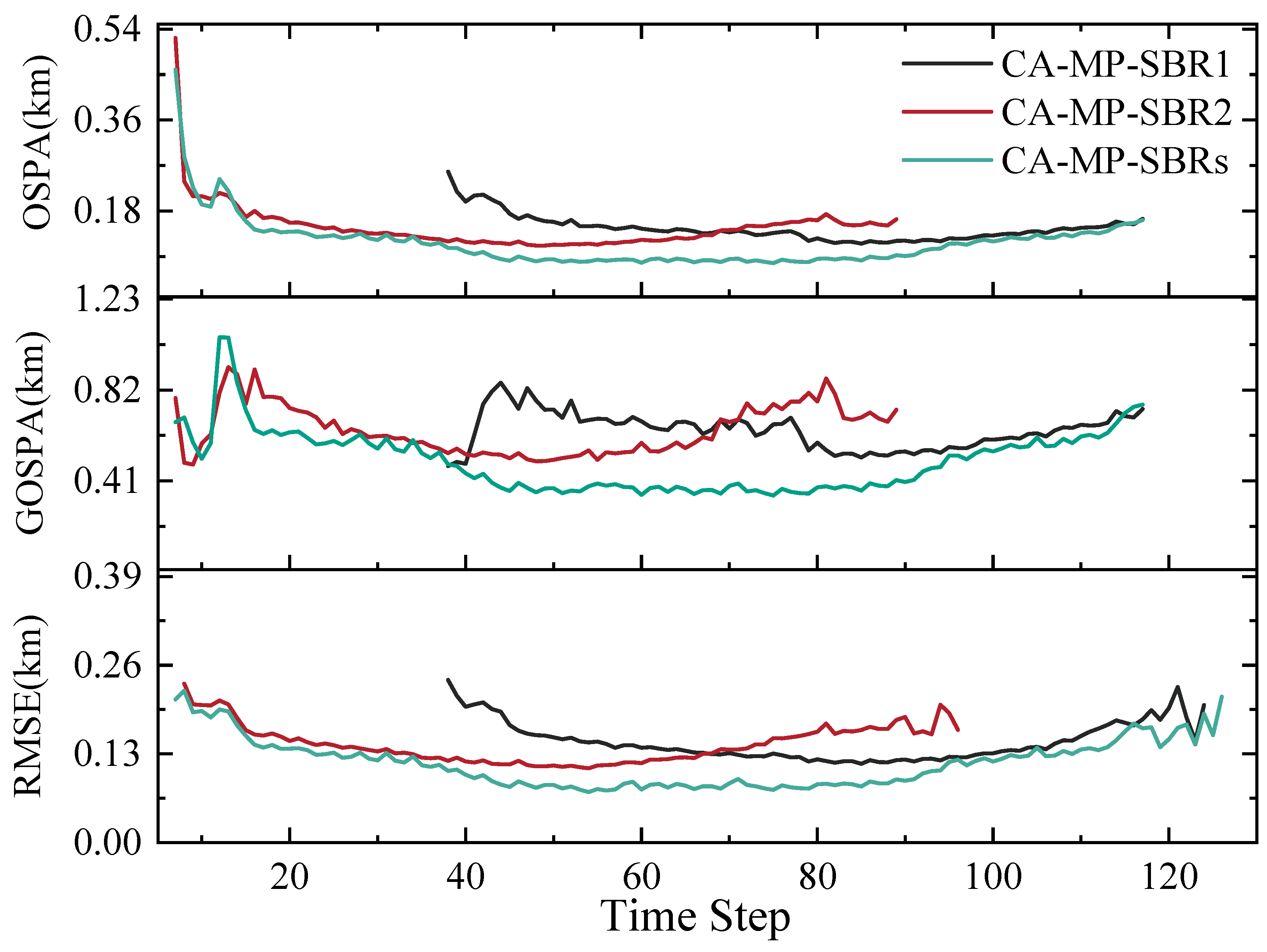
To validate the necessity of multi-sensor fusion, a comparative analysis is conducted between the single-sensor CA-MP-SBR and the multi-sensor CA-MP-SBRs algorithms, with all parameters kept identical except for the process noise settings. Specifically, the process noise parameters are set to for the single-sensor methods, and for the multi-sensor fusion method. As illustrated in Figure 13, the effective information acquired by single-sensor detection is relatively sparse. To avert track fragmentation induced by missed detections or maneuvers, single-sensor algorithms are compelled to employ these larger process noise values to maintain track continuity, which inherently elevates the system noise and directly degrades tracking performance. In contrast, the proposed multi-sensor fusion algorithm fully leverages the spatial complementarity of multiple platforms to enhance the global measurement quality. This advantage permits the aforementioned substantial reduction in process noise, thereby achieving simultaneous improvements in both tracking robustness and estimation accuracy.
Figure 13.
Comparison of tracking performance using single-sensor and multi-sensor fusion methods.
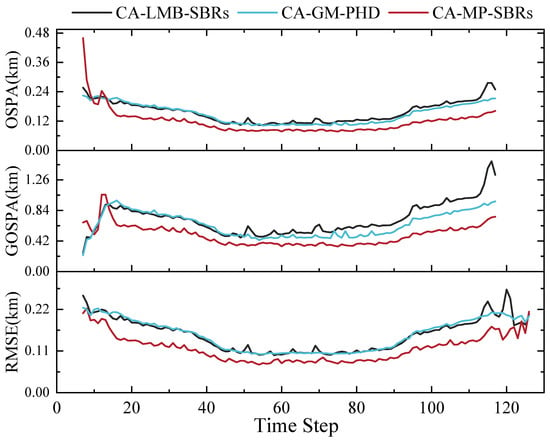
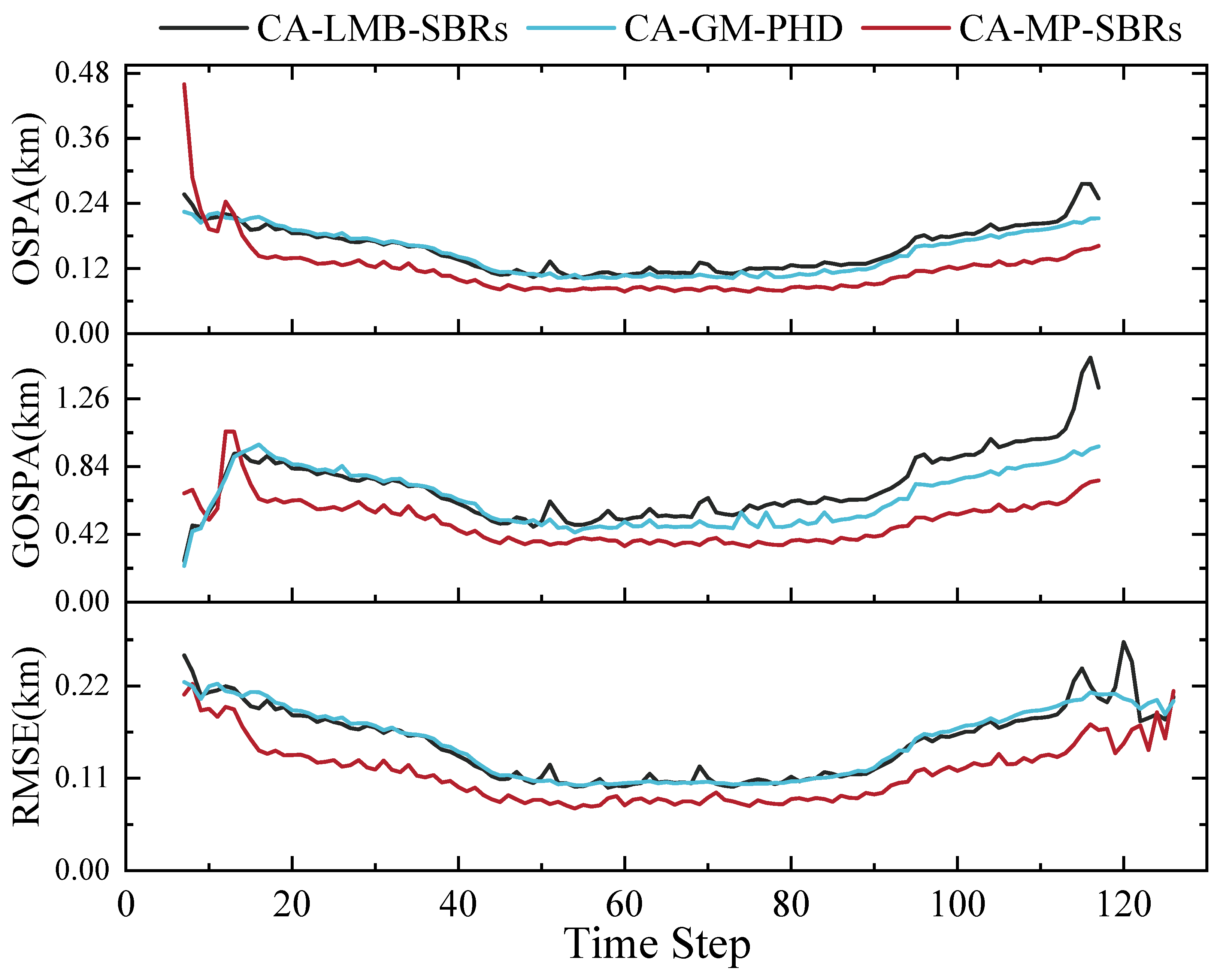
To provide a comprehensive comparison with existing approaches, CA-GM-PHD [42,50] and CA-LMB-SBRs [51,52] are selected as representative baseline methods. For a fair comparison, all three methods are evaluated under identical simulation scenarios. As shown in Figure 14 and Table 6, although the three methods exhibit broadly similar temporal trends, the proposed CA-MP-SBRs yields lower RMSE, OSPA, and GOSPA values than both baseline methods over most of the tracking interval. Specifically, compared with CA-GM-PHD and CA-LMB-SBRs, the proposed CA-MP-SBRs achieves reductions of 33.4%/23.2% in RMSE, 31.7%/25.6% in OSPA, and 32.1%/30.3% in GOSPA, respectively. The reduction in RMSE indicates improved state-estimation accuracy, whereas the lower OSPA and GOSPA values indicate a smaller discrepancy between the estimated and true target sets. These quantitative results demonstrate that the proposed framework, which integrates class information with multisensor measurements, can more effectively improve multi-target tracking performance.
Figure 14.
Comparison of the OSPA, GOSPA, and RMSE performance of Classification-aided labeled multi-Bernoulli tracking for space-based radars (CA-LMB-SBRs), Classification-aided Gaussian mixture probability hypothesis density (CA-GM-PHD), and the proposed Classification-aided message-passing algorithm for space-based radars (CA-MP-SBRs) over time.
Table 6.
Average tracking performance comparison among different methods.
5. Conclusions
To address the challenges of track swapping and association ambiguity in dense-clutter and multi-target scenarios, we proposed the CA-MP-SBRs algorithm, which integrates HRRP-derived class information into a unified MF-BP tracking framework. In this framework, class information is incorporated into kinematic state filtering through class-dependent process-noise covariances, allowing the maneuvering characteristics of different target classes to be represented. Meanwhile, the confusion matrix obtained from CNN-based HRRP classification is introduced into the BP data-association process as a probabilistic soft constraint to modulate the association likelihoods. Simulation results demonstrate that the proposed classification-aided message-passing framework improves tracking accuracy and data-association robustness in dense-target and heavy-clutter environments. Compared with CA-GM-PHD, CA-MP-SBRs reduces the average RMSE, OSPA, and GOSPA by 33.4%, 31.7%, and 32.1%, respectively, while the corresponding reductions relative to CA-LMB-SBRs are 23.2%, 25.6%, and 30.3%. Since the current validation is based on simulated data, future work will extend the proposed method to measured-data validation, online learning of class-dependent process-noise parameters, and computationally efficient real-time multisensor tracking.
Author Contributions
Conceptualization, S.J., Y.S. and Z.W.; methodology, G.Z., J.L., D.Q., S.Z. and Z.W.; software, G.Z.; validation, G.Z. and J.L.; data curation, G.Z.; writing—original draft preparation, G.Z. and J.L.; writing—review and editing, D.Q. and Z.W.; supervision, S.J., Y.S., S.Z. and Z.W. All authors have read and agreed to the published version of the manuscript.
Funding
This research received no external funding.
Data Availability Statement
The data generated and analyzed during the current study are available from the corresponding author upon reasonable request.
Conflicts of Interest
Authors Shuling Jin, Yuxiang Shu and Shuangshuang Zhu were employed by the company The 38th Research Institute of China Electronics Technology Group Corporation. The remaining authors declare that the research was conducted in the absence of any commercial or financial relationships that could be construed as a potential conflict of interest.
Abbreviations
The following abbreviations are used in this manuscript:
| BP | Belief propagation |
| CA | Classification-aided |
| CA-GM-PHD | Classification-aided Gaussian mixture probability hypothesis density |
| CA-LMB-SBRs | Classification-aided labeled multi-Bernoulli tracking for space-based radars |
| CA-MP-SBRs | Classification-aided message-passing algorithm for space-based radars |
| CNN | Convolutional neural network |
| EKF | Extended Kalman filter |
| FoV | Field of view |
| GOSPA | Generalized optimal subpattern assignment |
| HRRP | High-resolution range profile |
| LBP | Loopy belief propagation |
| LMB | Labeled multi-Bernoulli |
| MF | Mean field |
| MF-BP | Mean-field belief propagation |
| MGOSPA | Mean generalized optimal subpattern assignment |
| MOSPA | Mean optimal subpattern assignment |
| MP | Message passing |
| MTT | Multi-target tracking |
| OSPA | Optimal subpattern assignment |
| Probability density function | |
| RCS | Radar cross section |
| RFS | Random finite set |
| RMSE | Root mean square error |
| RTR | Redundant track ratio |
| TMR | Track maintenance ratio |
| UKF | Unscented Kalman filter |
Appendix A. Derivation of the Kinematic-State Belief
Given that for all and , it follows that
Substituting (A3) into (A1) and (A2) yields
Here, the equivalent process noise covariance matrix is the expected covariance matrix over all possible classes:
The MF measurement message becomes
Here,
It follows from (A7) that is Gaussian-distributed. Its parameters can be calculated using a nonlinear filter such as the EKF:
The belief over the time interval is
where and can be computed using a nonlinear fixed-interval smoother, such as the extended RTS smoother.
The derivation shows that the prediction message incorporates a class-weighted equivalent process noise covariance matrix, whereas each measurement message incorporates an association-weighted fused measurement and its corresponding covariance matrix. Consequently, the belief remains Gaussian-distributed, i.e., . The parameters and can be calculated using a nonlinear filter such as the EKF. Over the time interval , the smoothed parameters and can be obtained using a nonlinear fixed-interval smoother, such as the extended RTS smoother.
Appendix B. Derivation of the Data-Association Belief
The messages from the factors in the MF region are computed as follows:
Here, is calculated as
where denotes the dimension of .
The messages from the factors in the BP region are calculated as follows:
Therefore, the association belief is calculated as
Specifically, target visibility, kinematic likelihood, and classification information are incorporated into the association belief through the corresponding factor-to-variable messages. Meanwhile, the BP messages enforce the one-to-one association constraints between targets and measurements. By combining these incoming messages, the association probability can be obtained through iterative LBP updates.
References
- Kenari, L.R.; Arvan, M.R. Comparison of nearest neighbor and probabilistic data association methods for non-linear target tracking data association. In Proceedings of the 2014 Second RSI/ISM International Conference on Robotics and Mechatronics (ICRoM); IEEE: New York, NY, USA, 2014; pp. 47–52. [Google Scholar]
- Carrier, J.; Litva, J.; Leung, H.; Lo, T.K.Y. Genetic algorithm for multiple-target-tracking data association. In Proceedings of the Defense, Security, and Sensing; SPIE: Bellingham, WA, USA, 1996. [Google Scholar]
- Memon, S.A.; Kim, M.; Shin, M.; Daudpoto, J.; Pathan, D.M.; Son, H. Extended smoothing joint data association for multi-target tracking in cluttered environments. IET Radar Sonar Navig. 2020, 14, 564–571. [Google Scholar] [CrossRef] [Scilit]
- Khodarahmi, M.; Maihami, V. A review on Kalman filter models. Arch. Comput. Methods Eng. 2023, 30, 727–747. [Google Scholar] [CrossRef] [Scilit]
- Yao, J.; Liu, Y.C.; Chen, Y.Y.; Xu, K. Multiple Maneuvering Target Tracking Based on Extended Kalman Filter. In Proceedings of the 2018 Chinese Automation Congress (CAC); IEEE: New York, NY, USA, 2018; pp. 3763–3766. [Google Scholar] [CrossRef] [Scilit]
- Yang, J.; Chen, Z.; Zhong, Z.; Zhang, Y. Feature-Aided UKF-PHD Filter for Nonlinear Multi-target Tracking in Holographic Staring Radar. In Proceedings of the 2024 IEEE International Conference on Signal, Information and Data Processing (ICSIDP); IEEE: New York, NY, USA, 2024; pp. 1–6. [Google Scholar] [CrossRef] [Scilit]
- Lu, X.; He, Z.; Xing, L.; Wu, H.; Zhang, X. A Hybrid Integration Method Based on TBD for Maneuvering Target Detection with OTH Radar. IEEE Trans. Aerosp. Electron. Syst. 2025, 61, 8127–8142. [Google Scholar] [CrossRef] [Scilit]
- Yan, B.; Paolini, E.; Xu, L.; Lu, H. A Target Detection and Tracking Method for Multiple Radar Systems. IEEE Trans. Geosci. Remote Sens. 2022, 60, 1–21. [Google Scholar] [CrossRef] [Scilit]
- Mooney, J.E.; Ding, Z.; Riggs, L.S. Performance Analysis of a Glrt in Late-Time Radar Target Detection-Abstract. J. Electromagn. Waves Appl. 1999, 13, 1339–1341. [Google Scholar] [CrossRef] [Scilit][Green Version]
- Blackman, S. Multiple hypothesis tracking for multiple target tracking. IEEE Aerosp. Electron. Syst. Mag. 2004, 19, 5–18. [Google Scholar] [CrossRef] [Scilit]
- Chen, J.; He, J.; Wang, G.; Peng, B. A Maritime Multitarget Tracking Method with Non-Gaussian Measurement Noises Based on Joint Probabilistic Data Association. IEEE Trans. Instrum. Meas. 2025, 74, 1–12. [Google Scholar] [CrossRef] [Scilit]
- Li, J.; Wu, P.; Li, X.; Liu, B.; He, S.; Zhao, R. Hybrid-Driven Multiple Target Tracking Using Pulse Description Word From Targets’ Radar Sensors. IEEE Trans. Instrum. Meas. 2025, 74, 1–17. [Google Scholar] [CrossRef] [Scilit]
- Kim, W.C.; Song, T.L. Interactive clutter measurement density estimator for multitarget data association. IET Radar Sonar Navig. 2017, 11, 125–132. [Google Scholar] [CrossRef] [Scilit]
- Mahler, R.P.S.; Vo, B.T.; Vo, B.N. CPHD Filtering with Unknown Clutter Rate and Detection Profile. IEEE Trans. Signal Process. 2011, 59, 3497–3513. [Google Scholar] [CrossRef] [Scilit]
- Dong, G.; Zhao, C.; Pan, X.; Basu, A. Learning Temporal Distribution and Spatial Correlation Toward Universal Moving Object Segmentation. IEEE Trans. Image Process. 2024, 33, 2447–2461. [Google Scholar] [CrossRef] [Scilit] [PubMed]
- Williams, J.; Lau, R. Approximate evaluation of marginal association probabilities with belief propagation. IEEE Trans. Aerosp. Electron. Syst. 2014, 50, 2942–2959. [Google Scholar] [CrossRef] [Scilit]
- Williams, J.L.; Lau, R.A. Multiple Scan Data Association by Convex Variational Inference. IEEE Trans. Signal Process. 2018, 66, 2112–2127. [Google Scholar] [CrossRef] [Scilit]
- Sun, S.; Lan, H.; Wang, Z.; Pan, Q.; Zhang, H. The application of sum-product algorithm for data association. In Proceedings of the 2016 19th International Conference on Information Fusion (FUSION); IEEE: New York, NY, USA, 2016; pp. 416–423. [Google Scholar]
- Meyer, F.; Braca, P.; Willett, P.; Hlawatsch, F. A scalable algorithm for tracking an unknown number of targets using multiple sensors. IEEE Trans. Signal Process. 2017, 65, 3478–3493. [Google Scholar] [CrossRef] [Scilit]
- Soldi, G.; Meyer, F.; Braca, P.; Hlawatsch, F. Self-tuning algorithms for multisensor-multitarget tracking using belief propagation. IEEE Trans. Signal Process. 2019, 67, 3922–3937. [Google Scholar] [CrossRef] [Scilit]
- Sarkka, S.; Nummenmaa, A. Recursive Noise Adaptive Kalman Filtering by Variational Bayesian Approximations. IEEE Trans. Autom. Control 2009, 54, 596–600. [Google Scholar] [CrossRef] [Scilit]
- Kastella, K. Event-averaged maximum likelihood estimation and mean-field theory in multitarget tracking. IEEE Trans. Autom. Control 1995, 40, 1070–1074. [Google Scholar] [CrossRef] [Scilit]
- Lau, R.A.; Williams, J.L. A structured mean field approach for existence-based multiple target tracking. In Proceedings of the 2016 19th International Conference on Information Fusion (FUSION); IEEE: New York, NY, USA, 2016; pp. 1111–1118. [Google Scholar]
- Riegler, E.; Kirkelund, G.E.; Manchon, C.N.; Badiu, M.A.; Fleury, B.H. Merging Belief Propagation and the Mean Field Approximation: A Free Energy Approach. IEEE Trans. Inf. Theory 2013, 59, 588–602. [Google Scholar] [CrossRef] [Scilit]
- Turner, R.; Bottone, S.; Avasarala, B. A Complete Variational Tracker. In Proceedings of the Advances in Neural Information Processing Systems; Ghahramani, Z., Welling, M., Cortes, C., Lawrence, N., Weinberger, K., Eds.; Curran Associates, Inc.: Red Hook, NY, USA, 2014; Volume 27. [Google Scholar]
- Lan, H.; Sun, S.; Wang, Z.; Pan, Q.; Zhang, Z. Joint Target Detection and Tracking in Multipath Environment: A Variational Bayesian Approach. IEEE Trans. Aerosp. Electron. Syst. 2020, 56, 2136–2156. [Google Scholar] [CrossRef] [Scilit]
- Lan, H.; Ma, J.; Wang, Z.; Pan, Q.; Xu, X. A message passing approach for multiple maneuvering target tracking. Signal Process. 2020, 174, 107621. [Google Scholar] [CrossRef] [Scilit]
- Lan, H.; Wang, Z.; Bai, X.; Pan, Q.; Lu, K. Measurement-Level Target Tracking Fusion for Over-the-Horizon Radar Network Using Message Passing. IEEE Trans. Aerosp. Electron. Syst. 2021, 57, 1600–1623. [Google Scholar] [CrossRef] [Scilit]
- Bai, X.; Lan, H.; Wang, Z.; Pan, Q.; Hao, Y.; Li, C. Robust multitarget tracking in interference environments: A message-passing approach. IEEE Trans. Aerosp. Electron. Syst. 2023, 60, 360–386. [Google Scholar] [CrossRef] [Scilit]
- Bai, X.; Wang, Z.; Pan, Q.; Yun, T.; Lan, H. Classification-Aided Robust Multiple Target Tracking Using Neural Enhanced Message Passing. IEEE Trans. Aerosp. Electron. Syst. 2025, 61, 3882–3903. [Google Scholar] [CrossRef] [Scilit]
- Wang, Z.; Qi, D.; Meng, H.; Lan, H. Message Passing-Based Distributed Track-Level Fusion Tracking for Space-Based Radar Networks with Time-Varying Topology. IEEE Trans. Aerosp. Electron. Syst. 2025, 61, 15358–15380. [Google Scholar] [CrossRef] [Scilit]
- Lerro, D.; Bar-Shalom, Y. Automated Tracking with Target Amplitude Information. In Proceedings of the 1990 American Control Conference; IEEE: New York, NY, USA, 1990; pp. 2875–2880. [Google Scholar]
- Lerro, D.; Bar-Shalom, Y. Interacting multiple model tracking with target amplitude feature. IEEE Trans. Aerosp. Electron. Syst. 1993, 29, 494–509. [Google Scholar] [CrossRef] [Scilit]
- Akhtar, S.; Habibi, S. The Interacting Multiple Model Smooth Variable Structure Filter for Trajectory Prediction. IEEE Trans. Intell. Transp. Syst. 2023, 24, 9217–9239. [Google Scholar] [CrossRef] [Scilit]
- Ying, C.; Zhen, C.; Shuliang, W. Feature aided Gaussian mixture probability hypothesis density filter with modified 2D assignment. In Proceedings of the 2011 IEEE CIE International Conference on Radar; IEEE: New York, NY, USA, 2011; Volume 1, pp. 800–803. [Google Scholar]
- Zhan, R.; Zhang, J. Target classification algorithm based on feature aided tracking. In Proceedings of the International Conference on Graphic and Image Processing; SPIE: Bellingham, WA, USA, 2013. [Google Scholar]
- Gaglione, D.; Soldi, G.; Braca, P.; De Magistris, G.; Meyer, F.; Hlawatsch, F. Classification-Aided Multitarget Tracking Using the Sum-Product Algorithm. IEEE Signal Process. Lett. 2020, 27, 1710–1714. [Google Scholar] [CrossRef] [Scilit]
- Bai, X.; Zhou, F.; Bao, Z. High-Resolution Radar Imaging of Space Targets Based on HRRP Series. IEEE Trans. Geosci. Remote Sens. 2014, 52, 2369–2381. [Google Scholar] [CrossRef] [Scilit]
- Chen, S.; Huang, X.; Xu, W. Adaptive soft threshold transformer for radar high-resolution range profile target recognition. IET Radar Sonar Navig. 2024, 18, 1260–1273. [Google Scholar] [CrossRef] [Scilit]
- Herath, S.; Ziemann, M.R.; Wagner, K.; Metzler, C.A. High-Resolution Range Profile Target Recognition with Neuromorphic ADCs and Spiking Neural Networks. In Proceedings of the 2024 IEEE Radar Conference (RadarConf24); IEEE: New York, NY, USA, 2024; pp. 1–6. [Google Scholar]
- Ma, X.; Sun, B.; Ren, H.; Xue, Q.; Wu, J.; Jiang, T. Radar target recognition SOC system based on HRRP. In Proceedings of the International Conference on Algorithms, High Performance Computing, and Artificial Intelligence (AHPCAI 2023); SPIE: Bellingham, WA, USA, 2023. [Google Scholar]
- Zheng, S.; Jiang, L.; Yang, Q.; Zhao, Y.; Wang, Z. Space Target Tracking with the HRRP Characteristic-Aided Filter via Space-Based Radar. Remote Sens. 2023, 15, 4808. [Google Scholar] [CrossRef] [Scilit]
- Dong, W.; Wang, J.; Chen, J.; Zhang, Y.; Song, Z.; Fu, Q. Radar Multi-Target Detection and Tracking Based on LMB Filter. In Proceedings of the 2021 International Conference on Control, Automation and Information Sciences (ICCAIS); IEEE: New York, NY, USA, 2021; pp. 986–992. [Google Scholar] [CrossRef] [Scilit]
- Liang, M.; Meyer, F. Neural Enhanced Belief Propagation for Multiobject Tracking. IEEE Trans. Signal Process. 2024, 72, 15–30. [Google Scholar] [CrossRef] [Scilit]
- Rong Li, X.; Jilkov, V. Survey of maneuvering target tracking. Part I. Dynamic models. IEEE Trans. Aerosp. Electron. Syst. 2003, 39, 1333–1364. [Google Scholar] [CrossRef] [Scilit]
- Fu, Z.; Li, S.; Li, X.; Dan, B.; Wang, X. A Performance Analysis of Neural Network Models in HRRP Target Recognition. In Proceedings of the 2019 IEEE International Conference on Signal, Information and Data Processing (ICSIDP); IEEE: New York, NY, USA, 2019; pp. 1–4. [Google Scholar] [CrossRef] [Scilit]
- Singer, R.A. Estimating Optimal Tracking Filter Performance for Manned Maneuvering Targets. IEEE Trans. Aerosp. Electron. Syst. 1970, AES-6, 473–483. [Google Scholar] [CrossRef] [Scilit]
- Schuhmacher, D.; Vo, B.T.; Vo, B.N. A Consistent Metric for Performance Evaluation of Multi-Object Filters. IEEE Trans. Signal Process. 2008, 56, 3447–3457. [Google Scholar] [CrossRef] [Scilit]
- Rahmathullah, A.S.; Garcia-Fernandez, A.F.; Svensson, L. Generalized optimal sub-pattern assignment metric. In Proceedings of the 2017 20th International Conference on Information Fusion (Fusion); IEEE: New York, NY, USA, 2017; pp. 1–8. [Google Scholar] [CrossRef] [Scilit]
- Wei, Y.; Yaowen, F.; Jianqian, L.; Xiang, L. Joint Detection, Tracking, and Classification of Multiple Targets in Clutter using the PHD Filter. IEEE Trans. Aerosp. Electron. Syst. 2012, 48, 3594–3609. [Google Scholar] [CrossRef] [Scilit]
- Guo, Q.; Teng, L.; Wu, X.; Song, W.; Huang, D. Generalized Labeled Multi-Bernoulli Filter with Signal Features of Unknown Emitters. Front. Inf. Technol. Electron. Eng. 2022, 23, 1871–1880. [Google Scholar] [CrossRef] [Scilit]
- Liang, J.; Li, M.; Jing, Z.; Pan, H. Multi-Target Joint Detection; Tracking and Classification Based on Marginal GLMB Filter and Belief Function Theory. Sensors 2020, 20, 4235. [Google Scholar] [CrossRef] [Scilit] [PubMed]

Disclaimer/Publisher’s Note: The statements, opinions and data contained in all publications are solely those of the individual author(s) and contributor(s) and not of MDPI and/or the editor(s). MDPI and/or the editor(s) disclaim responsibility for any injury to people or property resulting from any ideas, methods, instructions or products referred to in the content. |
© 2026 by the authors. Licensee MDPI, Basel, Switzerland. This article is an open access article distributed under the terms and conditions of the Creative Commons Attribution (CC BY) license.