


Abstract
This study is an exploratory single-case study. As the complexity of aviation transport systems continues to escalate, the safety and operational efficiency of airside operations are increasingly reliant on real-time cross-unit information sharing and collaborative decision-making. Flight Operations Officers (FOs) and Airport Operations Officers (AOs) fulfill crucial roles as intermediaries between flight operations and airport airside management. Nevertheless, existing research has predominantly concentrated on airport-wide safety management systems or macro-level assessments of operational performance, with comparatively limited focus on a comprehensive analysis of perceived competency service quality satisfaction (Perceived Competency Satisfaction). This study adopts the perspective of FOs to assess the competency performance of AOs in airside management and safety support, employing an evaluation framework based on the four dimensions of the Safety Management System (SMS): Safety Policy, Safety Risk Management, Safety Assurance, and Safety Promotion. A questionnaire survey methodology is employed, targeting 24 senior FOs permanently stationed at Taiwan Taoyuan International Airport as the primary respondents. The study applies Yeh’s Satisfaction Index (YSI) and the Revised Decision-Making Trial and Evaluation Laboratory (Revised DEMATEL) method to quantify their evaluations of AOs’ competency quality and to elucidate the causal relationships among key influencing factors. The findings indicate that AOs’ Reporting Accuracy and Timeliness, as well as Operational Record Management and Retrieval, are comparatively weaker. Additionally, Cross-Departmental Communication and Information Dissemination are identified as primary influencing factors, whereas Safety and Security Operations and Primary Contingency Response Coordination are recognized as the principal affected factors. This study is subject to the constraints of a single-airport setting and a small-sample perceptual survey, with findings centered on the perceptual assessment of cross-unit communication. The insights derived from this research are expected to contribute to the reduction in airside risks, the enhancement of aviation safety standards, and serve as a practical reference for airside safety governance at Taiwan Taoyuan International Airport.
1. Introduction
Flight Operations Officers (FOs) and Airport Operations Officers (AOs) serve as vital intermediaries of information and decision-support agents within airside operations. Their responsibilities are crucial to maintaining aviation safety and enhancing ground operational efficiency. The safety of aviation transport depends on a highly intricate and interdependent system of factors; when accidents occur, they not only result in significant human and financial losses but also severely erode public confidence in the aviation transport system [1]. Although the aviation sector generally maintains a comparatively high safety record relative to other modes of transportation, safety management remains the fundamental pillar for ensuring the sustainable advancement of aviation services.
Domestic research on airport airside risk analysis has identified poor cross-unit communication, lack of information transparency, and unreliable personnel handovers as high-priority areas for improvement, indicating that information coordination between FOs and AOs directly affects airside safety [2,3]. Furthermore, as important information intermediaries within airlines, the quality of FOs’ interactions with flight crew and ground handling units directly influences the timeliness of flight decisions and the effectiveness of safety monitoring [4].
Safety management practice also indicates that a single indicator is insufficient to support senior management in prioritizing under resource-constrained conditions. There is an urgent need to integrate multiple safety performance indicators and assign them relative weights, so as to form a comprehensive safety evaluation framework with genuine decision-making value [1,5]. International practice and simulation research have further demonstrated that the coordination of ground service resources, scheduling efficiency, and information integration exert significant influence on flight punctuality, ground safety, and passenger satisfaction. Through simulation, AI-assisted approaches, and algorithmic methods, the robustness of ground operations and dedicated vehicle scheduling can be enhanced, reducing the risks of delay and conflict [6,7,8,9,10]. These studies collectively suggest that any gap between FOs and AOs in information flow, risk perception, and decision coordination will simultaneously affect operational efficiency and airside safety performance.
On another front, preliminary research conducted by Feng and Chung [11] suggests that approximately 80 percent of aviation incidents occur during the airport phase. This underscores the necessity of risk identification, quantitative assessment, and ongoing monitoring as fundamental components of airport airside safety management. More recent investigations have also highlighted the pivotal influence of organizational and individual factors on safety culture, including management commitment, safety communication, training, and employee engagement, as well as individual considerations such as safety beliefs and risk perception. These elements collectively shape the safety behavior of personnel engaged in airside operations and can be enhanced through organizational development initiatives and action research methodologies [12].
Furthermore, research on airport performance has indicated that the professional experience, interdisciplinary competence, and decision-making quality of management personnel are pivotal to operational efficiency, resilience, and risk mitigation capabilities [13]. As an area characterized by high aircraft activity, the airside zone of an airport is where safety and security protocols directly affect flight safety [14,15]. Consequently, coordination and information integration among operations officers influence not only individual flight operations but also the overall performance of the airport and the safety management of the airside area.
Given that the professional capabilities, knowledge, and experience of AOs are inherently challenging to quantify objectively through any singular instrument, and considering that in highly interdependent operational environments, the adaptive responses and safety behaviors exhibited by frontline personnel directly influence the collaborative experiences with cross-unit partners [16], the assessment of FOs’ satisfaction with their collaborative interactions with AOs is effectively conducted through the ‘external satisfaction evaluation’ of daily frontline operational partners. This approach serves as the most valid external proxy variable for representing and reflecting the actual on-site perceived professional competence of AOs.
In summary, the literature reviewed above demonstrates that collaborative operations, information exchange, and risk perception among operations officers influence not only the safety and efficiency of individual flights but also, more deeply, the overall operational performance of the airport and the maturity of its safety management system. However, objective measures of competency and safety performance typically require data on accident rates, operational error rates, and on-site field assessments. This study draws on FOs’ frontline collaborative experience to evaluate their subjective perceived satisfaction with AOs’ service quality and the causal pathways underlying it. Accordingly, this study adopts a practice-oriented approach, focusing on FOs’ assessments of their satisfaction with AOs’ competencies and on identifying factors associated with lower satisfaction levels, with the aim of enhancing airside operational efficiency and safety. It is hoped that the findings will meet expectations for practical improvement, the application of performance indicators, and decision-making support, and will serve as an important reference for fostering collaborative operations between FOs and AOs.
2. Literature Review
2.1. Aviation Competencies
Within the aviation industry, aviation competencies are defined as the knowledge, skills, attitudes, and behavioral performance that individuals must possess to perform their duties effectively and safely in specific aviation work environments. Their scope extends beyond purely professional technical capabilities to include regulatory compliance, situational judgment, self-efficacy, and the ability to learn continuously. Existing research suggests that the development and maintenance of aviation competencies are heavily reliant on systematic talent development and learning enhancement mechanisms. Atiku et al. [17], in their study of airport companies, observe that inadequate training needs assessments, a lack of specialized training, and low employee engagement directly affect employee performance and organizational operational efficiency, thereby underscoring the vital role of learning and development (L&D) in strengthening aviation competencies.
From an aviation safety perspective, competencies are further regarded as a significant determinant of safety performance. Susanto et al. [18] noted in a literature review that competency level, work discipline, and self-efficacy each exert a significant influence on the performance of aviation safety personnel, and that the interaction among the three factors can enhance aviation safety outcomes. Taken as a whole, aviation competencies are not merely a matter of human resource or performance management. They are intimately connected to aviation risk control and operational reliability, underscoring the importance of competency-oriented talent development and management strategies within the aviation safety system.
2.1.1. Airport Operations Officers
AOs serve as pivotal frontline professionals within the airport operations system. Their duties entail a comprehensive integration of regulatory compliance oversight, on-site operational coordination, and real-time risk management. According to the Aviation Operations Management Training Manual published by Taiwan’s Civil Aeronautics Administration Aviation Training Institute [19], AOs are mandated to complete structured professional training prior to their appointment. Furthermore, they are required to continually enhance their competencies through on-the-job training and recurrent training during their service tenure. Their scope of responsibilities includes aviation regulations, airside operations, flight information management, aviation security, dangerous goods handling, and contingency response protocols. This illustrates that AOs are not merely administrative personnel but rather the essential link integrating airport operations and ensuring flight safety.
In international aviation practice, AOs are mandated under shift arrangements to undertake responsibilities such as monitoring airside and landside operations, ensuring regulatory compliance, inspecting facilities, identifying hazards, coordinating construction and maintenance activities, recording aircraft movements, and managing emergency incidents [20,21,22]. This role generally necessitates a background in aviation or airport operations, complemented by strong communication abilities and proficiency in cross-unit coordination, thereby reflecting the highly real-time, uncertain, and safety-critical nature of the responsibilities.
Examining AOs further from the perspective of airport operations management and decision-making, AOs are predominantly deployed in Airport Operations Control Centers (AOCCs), where they are responsible for flight coordination, aircraft parking and gate allocation, NOTAM notification, incident recording, and the procedural activation of contingency response mechanisms [23,24]. These duties rely heavily on Safety Management Systems (SMS), risk assessment, and cross-stakeholder communication, making AOs important frontline gatekeepers in maintaining overall airport operational stability and flight safety. Their professional judgment and immediate actions directly influence operational continuity and the effectiveness of accident prevention.
The Civil Aeronautics Administration (CAA)’s Airport Operations and Management Planning, along with its airside safety standards, are substantively modeled on ICAO Annex 14/19 as well as the United States FAA Part 139 and TSA security regulations. Furthermore, considering TTIA’s role as a critical hub on trans-Pacific routes, its on-site Standard Operating Procedures (SOPs) must also satisfy routine border security and operational protection audits conducted by the US TSA and FAA. Accordingly, this study incorporates FAA Part 139 and TSA regulations into the indicator framework and combines them with the CAA Flight Operations Management Training Manual, Eighteenth Edition (2024), for localized adaptation—an approach that fully aligns with the actual regulatory environment governing AOs’ duties at TTIA.
2.1.2. Flight Operations Officers
Flight Operations Officers (FOs), also known as Flight Dispatchers, are essential professionals within an airline’s flight operations framework. Their primary responsibilities involve providing decision support both prior to and during flights to ensure adherence to safety standards, regulatory requirements, and operational efficiency. FOs are required to synthesize aircraft performance data, meteorological information, route conditions, airport facility constraints, and flight notices to develop comprehensive flight plans. Furthermore, they share joint responsibility for flight safety with pilots [25]. This role exemplifies that FOs are not merely administrative support personnel but are professional decision-makers who collaborate closely with pilots within the flight decision-making system.
Regarding the nature of the duties, FOs are responsible for integrating aircraft performance assessment, flight plan preparation, pre-flight briefings, flight clearance applications, and air traffic monitoring. They must maintain continuous awareness of weight and balance, system limitations, weather variations, route risks, and conditions at alternate airports. Furthermore, they are tasked with monitoring aircraft movements throughout the flight via communication systems, offering assistance in decision-making related to flight modifications and coordinating emergency responses when necessary [25]. Considering the highly time-sensitive, uncertain, and risk-sensitive nature of these responsibilities, the professional judgment and information processing capabilities of FOs are pivotal factors influencing flight safety and operational stability.
From the perspective of human resource development and working conditions, Flight Operations (FOs)’s professional competencies are highly dependent on institutionalized training and the accumulation of practical experience. Prayitno et al. [26] highlight that a combination of theoretical coursework and on-the-job training (OJT) can effectively enhance FOs’ employment readiness and practical performance, with work discipline and teamwork being particularly significant. Additionally, within the operational environment characterized by 24 h rotating shifts and the substantial pressure of their responsibilities, stress resilience and human factors management capabilities constitute essential core competencies.
According to Service Performance Theory (SERVPERF), the assessment of satisfaction provided by external collaborative units concerning frontline operational personnel is fundamentally determined through direct observation of their on-site operational capabilities and performance [16]. In summary, when intrinsic professional competence cannot be directly quantified via comparative methods, the satisfaction level expressed by FOs—who collaborate daily with AOs—becomes the most practically grounded external proxy indicator for evaluating whether AOs’ professional competencies have been successfully translated into operational execution capability. Overall, FOs serve as critical ground-based flight decision-makers within the aviation safety system, and their professional competencies are directly related to flight risk management and accident prevention outcomes.
2.2. Airside Safety and Risk
Airside operations comprise a highly intricate and risk-intensive system. The safety performance therein relies not solely on procedures and equipment but is also significantly influenced by personnel judgment and the organization’s capacity for risk management. Existing literature indicates that organizations often underestimate residual operational risks during their risk assessment processes, especially in scenarios characterized by low frequency yet high severity. Ewertowski et al. [27] demonstrate that personnel with greater experience are more adept at identifying such risks. This underscores the necessity for professional expertise and effective organizational knowledge transfer mechanisms in airside safety management, as well as the importance of rigorous risk assessment and ongoing training.
In the domain of safety management, aviation safety has progressively transitioned from an accident-centric approach to a systems-oriented perspective for evaluating safety performance in aviation. No and Cha [28] suggest that organizations should concurrently monitor failure events and the successful patterns of daily operations to gain a comprehensive understanding of the mechanisms that underpin safety performance. Nonetheless, current safety interventions on the airside primarily focus on procedural compliance, with comparatively little emphasis on management oversight and organizational culture, indicating that improvements at the individual level alone are insufficient as risk control measures given the high complexity of airside operations.
From the perspective of overall risk management, airside safety cannot be effectively managed through any single domain or department. Sivakumar [29] emphasizes that the cross-departmental identification of compound hazards and the establishment of a comprehensive organization-level risk picture are instrumental in overcoming the tendency of traditional risk management to overlook low-frequency, high-consequence events. Empirical research has also demonstrated that personnel competencies play a critical mediating role between safety risk management and safety performance [30]. Taken as a whole, airside safety risk should be understood as the product of the interaction among systems, management philosophy, and personnel competencies, underscoring the necessity of advancing integrated risk management and competency development in tandem.
3. Research Methodology and Evaluation Framework
3.1. Yeh’s Satisfaction Index (YSI)
The Customer Satisfaction Score (CSAT) is a widely used metric in commercial contexts, serving as a critical performance indicator for customer service and product quality across various types of enterprises. Moghadasnian and Nasr [31] highlight that integrating CSAT into a key performance management system facilitates airlines in systematically evaluating service performance, enhancing customer loyalty, and supporting ongoing improvement decision-making. Likewise, Moghadasnian and Takzare [32] underline that a comprehensive key performance framework encompassing service quality, operational efficiency, digital interaction, and employee satisfaction can effectively enhance overall customer experience, thereby emphasizing the central role of CSAT in the strategic management of aviation services.
The literature concerning the application of CSAT to assess AOs’ competency satisfaction is limited. Zubair et al. [33] integrate CSAT and YSI to perform a quantitative evaluation of service quality at Jinnah International Airport. The YSI is determined by the difference between the number of satisfied and dissatisfied respondents, expressed as a proportion of the total sample, thereby offering a structurally concise and comparative measure of satisfaction as an extended implementation of traditional CSAT. Within the framework of this study, the YSI model is not utilized to diagnose the psychological or cognitive test capabilities of AOs, but rather to translate the observed “on-site adaptive response and execution performance of AOs” as evaluated by FOs into quantifiable indicators. In summary, the satisfaction index of FOs functions as an external proxy to accurately measure whether the professional competencies demonstrated by AOs are adequate to meet on-site operational demands and to identify practical discrepancies between the two. The operational procedure for calculating Yeh’s Satisfaction Index is outlined as follows.
In this formula, satisfied refers to the number of respondents who selected either “very satisfied” or “satisfied” (corresponding to scores of 4 and 5 on the five-point Likert scale); dissatisfied refers to the number of respondents who selected either “very dissatisfied” or “dissatisfied” (corresponding to scores of 1 and 2); and “neutral” (corresponding to a score of 3) is regarded as a neutral response. It is excluded from the numerator but included in the total respondents’ denominator, where a YSI value of 0 indicates extreme dissatisfaction.
3.2. Revised Decision Making Trial and Evaluation Laboratory (RDEMATEL)
The Decision Making Trial and Evaluation Laboratory (DEMATEL) is a multi-criteria decision-making (MCDM) technique primarily employed to identify the direct and indirect causal relationships among the constituent elements of a system. Abdulrahman and Dweiri [34] observe that DEMATEL, through directional linkages and quantified degrees of influence, facilitates the creation of causal relationship diagrams that more effectively portray the direction and magnitude of influence, thereby providing a significant advantage in analyzing the causal structure of complex systems.
The quality of airport operational services encompasses multiple highly interconnected factors, including safety policy, safety risk management, safety assurance, and safety promotion, which do not exist in isolation from one another. DEMATEL is capable of concurrently identifying critical driving factors and their causal relationships, thereby strengthening the validity of causal interpretations. Consequently, it has been extensively applied in transportation-related analyses, demonstrating that its methodological features are well-suited to research on the causal interdependencies that influence FOs’ satisfaction with AOs’ competencies.
Despite DEMATEL’s notable advantages in analyzing causal relationships, Lee et al. [35] explicitly highlight that, within the context of the traditional DEMATEL methodology, substantial variability in expert judgments or an extensive number of factors under consideration may cause the initial direct relationship matrix to fail to meet convergence criteria, resulting in unstable outcomes. The assessment of aviation operations service quality heavily depends on the experiential judgments of practitioners; if the analytical approach itself is unstable, there exists an increased risk of decision-makers misinterpreting crucial causal relationships of competencies.
To address this issue, Lee et al. [35] propose RDEMATEL, which guarantees the convergence of the total influence matrix, thereby significantly enhancing the model’s stability. The influence network constructed using RDEMATEL exhibits greater stability with respect to causal direction, and the ranking of influence magnitudes is more consistent. This also improves the reliability of causal interpretation, rendering it particularly appropriate for research contexts characterized by structural complexity and high requirements for analytical precision, such as the investigation of AOs’ competency quality.
Although there is no existing research that has specifically applied RDEMATEL within the aviation sector, in the broader transportation industry, Ho et al. [36] conducted a study of the contract transportation sector which revealed that when the original DEMATEL method was employed to establish causal relationships, the initial direct relationship matrix could become non-convergent, thereby compromising the validity of the analytical outcomes. Consequently, the study adopted the Revised DEMATEL approach to ensure more stable matrix convergence and a more dependable interpretation of influence pathways. Ho and Lee [37], in a study concerning autonomous vessel adoption decisions, explicitly identified the primary rationale for adopting RDEMATEL as its ability to address the instability of traditional DEMATEL concerning the convergence of the relationship matrix and causal interpretation. Their empirical findings further confirm that RDEMATEL improves the numerical stability of calculations regarding the magnitude of causal influence and effectively facilitates multi-criteria integration with AHP and BOCR frameworks.
Although these studies are primarily applied within the maritime domain, their subjects similarly pertain to transport service systems that require highly specialized division of labor and stringent safety standards. This renders them with significant methodological reference value for analyzing service interactions between FOs and AOs. However, a review of the literature from the past five years indicates that the employment of this method in examining aviation operations competency satisfaction and causal interdependencies remains relatively limited. This academic gap highlights that integrating RDEMATEL for analyzing causal relationships impacting AOs’ competencies not only provides a clear methodological advantage but also addresses a pertinent scholarly lacuna in aviation research. The operational procedures of RDEMATEL are as follows:
- Define the factors and determine the relationships;
These are typically acquired through a review of existing literature or brainstorming sessions, and the interrelationships among factors may be delineated based on the subjective expertise of specialists. The assessment dimensions and criteria in this research were assembled and integrated through an examination of recent scholarly works related to airside operational performance and safety.
- 2.
- Generate the direct relationship matrix and calculate the average matrix ;
Where the number of criteria is , the criteria are compared pairwise according to their influence relationships and degrees, yielding a direct relation matrix. Assuming experts provide assessments on criteria, using 0, 1, 2, 3 and 4 respectively to represent the degree to which they consider factor to influence factor , the value provided by the -th expert for the relationship between factor and factor is denoted . Each expert’s assessment constitutes an non-negative matrix , such that represent the matrices formed from the responses of the experts. The diagonal elements of the matrix are 0, indicating that neither factor nor factor influences itself. The numerical entries in the matrix indicate the degree to which criterion influences criterion . The average matrix is then calculated, averaging the assessments of the experts, as shown in Equation (2).
- 3.
- Calculate the normalized direct relationship matrix;
The initial direct relationship matrix is normalized and denoted , calculated as shown in Equations (3) and (4):
Which gives
- 4.
- Calculate the total relationship matrix of direct and indirect influences;
Following normalization of the initial direct relationship matrix, the matrix raised to the power of can be used to represent the influence generated after iterations of interaction. The total influence and total relationships are obtained by summing , with converging to the zero matrix. The total relationship matrix is given by Equation (5):
- 5.
- Draw the Impact Relations Map;
The Impact-Relations Map (IRM) simplifies intricate causal relationships into an accessible framework, thereby facilitating decision-makers in acquiring deeper insights into the issue and identifying potential avenues for resolution. Prominence represents the total sum of a factor’s influencing and affected relationships; the causality , if positive, indicates that the factor is an influencing factor, whereas a negative value indicates that it is an affected factor.
To enhance the transparency and reproducibility of the research analysis, this study employs Excel for the RDEMATEL calculations. Regarding the selection and evaluation process for experts, twenty-four senior FOs who met stringent screening criteria were invited to complete the questionnaire. The questionnaire employed a five-point integer scale ranging from 0 (no influence), 1 (low influence), 2 (moderate influence), 3 (high influence), to 4 (very high influence), through which respondents performed pairwise comparisons of the degree of influence among the twelve competency criteria and completed an individual 12 × 12 direct influence matrix.
Regarding matrix computation and the convergence mechanism, the arithmetic mean of the 24 expert questionnaires is used to establish the initial direct influence matrix. This is subsequently followed by normalization based on the maximum value of the row sums and column sums. The RDEMATEL method is then applied to rectify the direct and indirect relationship matrix, effectively addressing the non-convergence issue inherent in the traditional DEMATEL approach when applied to expert judgment matrices.
Regarding the establishment of the threshold value, it is determined based on the outcomes of sensitivity analysis. Only influence relationships exceeding the threshold are retained to eliminate the interference of weak factors and to accurately construct the IRM.
3.3. Research Framework
Existing research has predominantly examined aviation safety management and SMS effectiveness; however, analyses that integrate the competencies of specific airport roles, such as AOs, with the four SMS components—Safety Policy, Safety Risk Management, Safety Assurance, and Safety Promotion—remain scarce [38]. As frontline operational decision-makers, AOs’ professional competencies directly influence flight safety and risk mitigation and are highly pertinent to the practical implementation of SMS. Incorporating AOs’ competencies within the four SMS dimensions offers a comprehensive foundation for enhancing risk management and improving safety performance.
AOs play a central role within the aviation safety system, and their professional competencies directly affect risk assessment and safety performance. Marzec and Skorupski [39] demonstrate that functional deviations in airport operational processes can give rise to decision-making vulnerabilities, and that process analysis can be used to identify critical mitigation measures that ensure operational reliability. Furthermore, AOs’ competencies exert a significantly positive influence on safety management performance. The effective implementation of safety inspections and airport safety programs can enhance aviation safety performance, with personnel professional capabilities further amplifying this effect [40]. Following the synthesis of the literature review and the integration of the 4S dimensions of SMS, although the pertinent evaluation criteria draw upon international regulations such as FAA Part 139 and TSA, they have been adapted to conform to CAA regulations and TTIA operational conditions through an expert review. The evaluation dimensions and criteria for FOs’ satisfaction with and causal relationship analysis of AOs’ competencies are presented in Table 1.
Table 1.
Evaluation Dimensions and Criteria for FOs’ Satisfaction with and Causal Relationship Analysis of AOs’ Competencies.
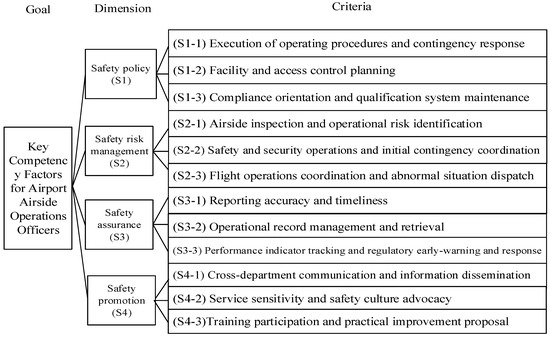
As demonstrated in Table 1, this research categorizes the competencies of AOs into four evaluation dimensions to thoroughly assess their influence on aviation safety.
Safety Policy encompasses the enforcement of regulatory frameworks and the organization’s commitment to safety, including the execution of operational procedures and contingency response, as well as facility and access control planning, alongside compliance orientation and qualification system maintenance.
Safety Risk Management encompasses the systematic identification of hazards and implementation of risk control measures. It includes airside inspection and operational risk identification, safety and security operations, primary contingency response coordination, and flight operations coordination, along with abnormal situation dispatch.
Safety Assurance encompasses reporting and record-keeping, including reporting accuracy and timeliness; operational record management and retrieval; as well as performance indicator tracking and early warning and response to regulatory violations.
Safety Promotion involves the advancement of safety culture and inter-departmental collaboration skills, including: cross-departmental communication and information dissemination abilities; service sensitivity and safety culture advocacy competencies; and capabilities for training participation and practical optimization recommendations.
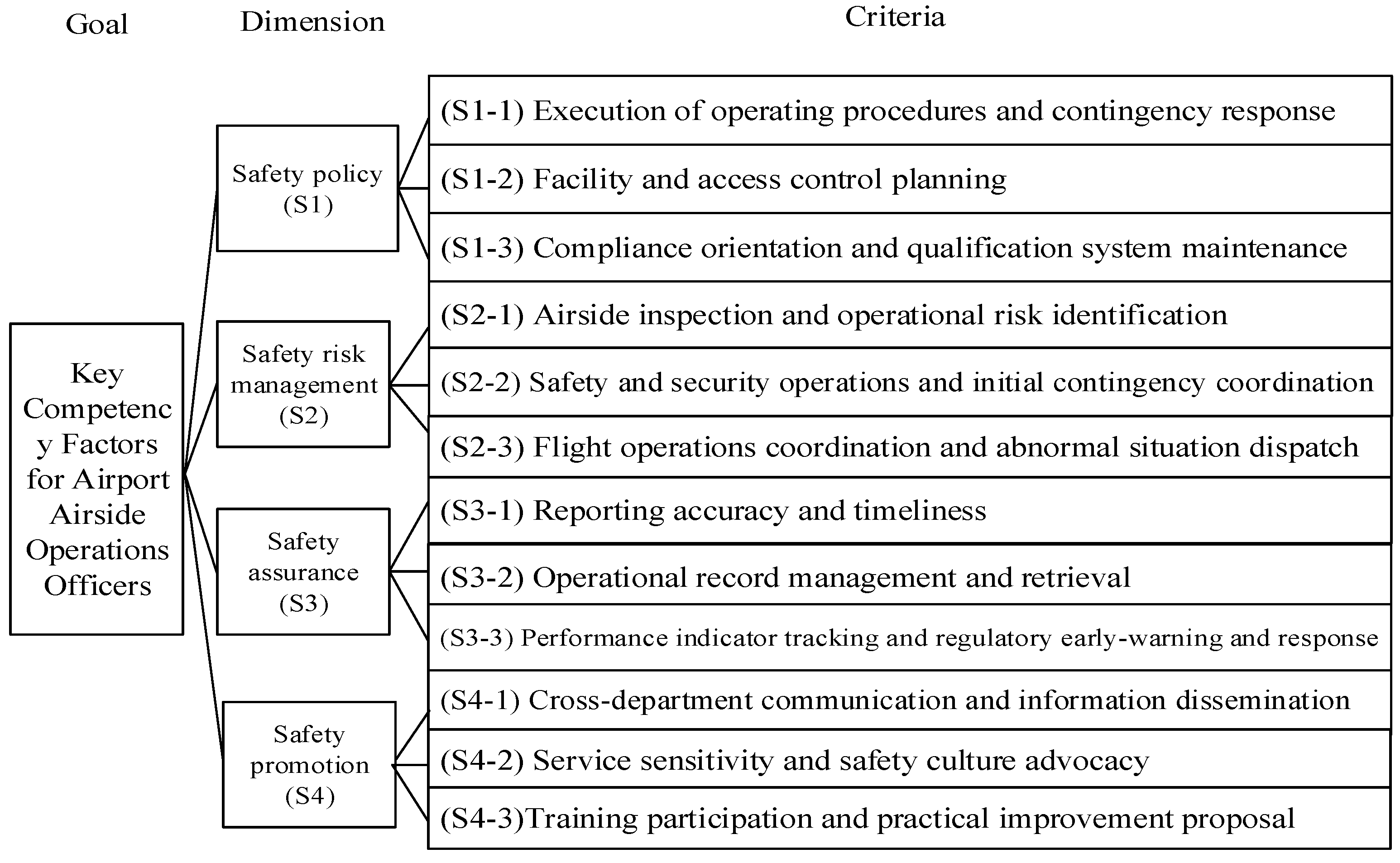
By integrating these four dimensions, this study provides a comprehensive assessment of the contribution of AOs’ competencies to flight safety performance, and offers management a reference basis for safety management and human resource development. The research framework is illustrated in Figure 1.
Figure 1.
Research Framework for FOs’ Satisfaction with and Causal Relationship Analysis of AOs’ Competencies.
4. Empirical Analysis
4.1. Questionnaire Analysis
The survey for this study was conducted between December 2025 and February 2026. In accordance with academic ethical standards, the first page of the questionnaire clearly stated the research purpose, assured anonymity, and specified that the data would be used solely for academic analysis. With respect to questionnaire design and validity verification, the 12 evaluation criteria in this study were developed based on ICAO SARPs, FAA Part 139 regulations, and the literature review. The initial draft of the questionnaire was submitted to 2 senior executives in the aviation field for expert content-validity review and semantic revision to ensure the professional accuracy and precision of the questionnaire items.
Concerning the rigor of expert delineation, the respondents in this study are not practitioners chosen via general random sampling. Instead, they are practicing experts selected based on three rigorous inclusion criteria: possession of a professional FO license issued by a recognized national or civil aviation authority; ongoing assignment at TTIA with frequent daily or weekly on-site collaborative operational experience with AOs; and possessing sufficient seniority as seasoned professionals within the aviation industry.
A total of 33 electronic questionnaires were distributed as part of this study, of which 24 were returned and all 24 were deemed valid, resulting in an effective response rate of 72.72%. All respondents are Flight Officers (FOs) permanently assigned to Taiwan Taoyuan International Airport. Regarding years of service, 16 respondents have between 10 and less than 20 years of experience, followed by 6 with between 6 and less than 10 years, and 2 with between 1 and less than 3 years, indicating that the sample predominantly comprises professionals with mid-to-senior levels of experience and substantial practical expertise. Concerning workload, 22 respondents handle more than 300 flight movements per month, with only 2 managing between 50 and 150; 22 work primarily on irregular rotating shifts, with only 2 working predominantly during daytime hours. Furthermore, the frequency of respondents’ interactions with AOs is notably high: 16 engage daily, 6 weekly, and the remaining 2 interact on a monthly or occasional basis, reflecting the significant reliance on real-time cross-unit coordination and information exchange. In terms of language use, 21 respondents use both English and Chinese, with only 3 primarily employing Chinese, thus indicating a distinctly bilingual working environment.
Considering that the current total number of FOs does not exceed 40 and this study obtained 24 questionnaires, it covers more than approximately 60 percent of the parent group. Furthermore, the sample is concentrated among core operational personnel with high interaction frequency and high flight-handling volume and is therefore reasonably representative of the work characteristics and perspectives of FOs in this operational setting. Overall, this sample enhances the explanatory power and reference value of the subsequent analysis with respect to actual operational conditions.
4.2. Competency Satisfaction Analysis
To further clarify the distinctions in relative performance across the individual competency criteria, the subsequent section presents a comparative analysis and discussion of the satisfaction index of AOs’ competency, integrated with an interpretation of the practical operational context. This analysis seeks to identify the satisfaction and dissatisfaction outcomes within the AOs’ competency framework and to explore potential avenues for enhancement. It also serves as the foundation for the subsequent analysis of causal relationships. The competency satisfaction index for AOs at Taiwan Taoyuan International Airport is provided in Table 2.
Table 2.
AOs’ Competency Satisfaction Index—Taiwan Taoyuan International Airport (N = 24).
As illustrated in Table 2, regarding the satisfaction of AOs’ competencies, Safety and Security Operations, along with Primary Contingency Response Coordination, receive the highest satisfaction ratings. This is succeeded by four other competencies that demonstrate comparable performance: Facility and Access Control Planning, Cross-Departmental Communication and Information Dissemination, Airside Inspection and Operational Risk Identification, as well as Service Sensitivity and Safety Culture Advocacy. Conversely, the competencies of Reporting Accuracy and Timeliness, and Operational Record Management and Retrieval, exhibit comparatively lower satisfaction indices.
In an operational environment where airport operations are highly dependent on real-time information sharing, Reporting Accuracy and Timeliness directly affect flight safety and operational continuity [38]. In aviation practice, deficiencies in reporting quality are most commonly associated with insufficient process standardization and a lack of decision-support tools. Following the standardized information management principles advocated by ICAO is recommended to establish and implement comprehensive NOTAM drafting and review processes, combined with digital reporting platforms and scenario-based simulation training, so as to reduce human error and time delays and enhance the consistency and reliability of cross-unit information transmission [47].
Regarding Operational Record Management and Retrieval, inconsistent record quality diminishes an organization’s capacity to follow up on safety incidents. To address this issue, implementing an integrated electronic records system with a standardized record-entry workflow could enhance data completeness and traceability, thereby reducing information gaps stemming from individual discrepancies in documentation practices. Additionally, through case reviews and scenario-based instruction and training, historical records can be transformed into valuable organizational learning resources. This process fosters a systematic approach among AOs to verification and retrospective analysis, rendering record management a fundamental support for safety decision-making and process optimization.
Overall, the key to mitigating the decline in competency satisfaction resides in approaching airside operations as a highly interconnected and collaborative system. By implementing process integration, shared performance management, and mechanisms for cross-unit learning, a robust operational framework can be developed that effectively diminishes operational risks and maintains the safety and reliability of airport airside operations.
4.3. Causal Relationship Analysis
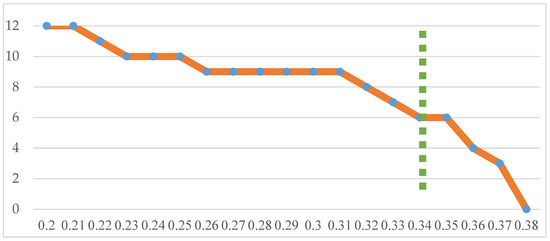
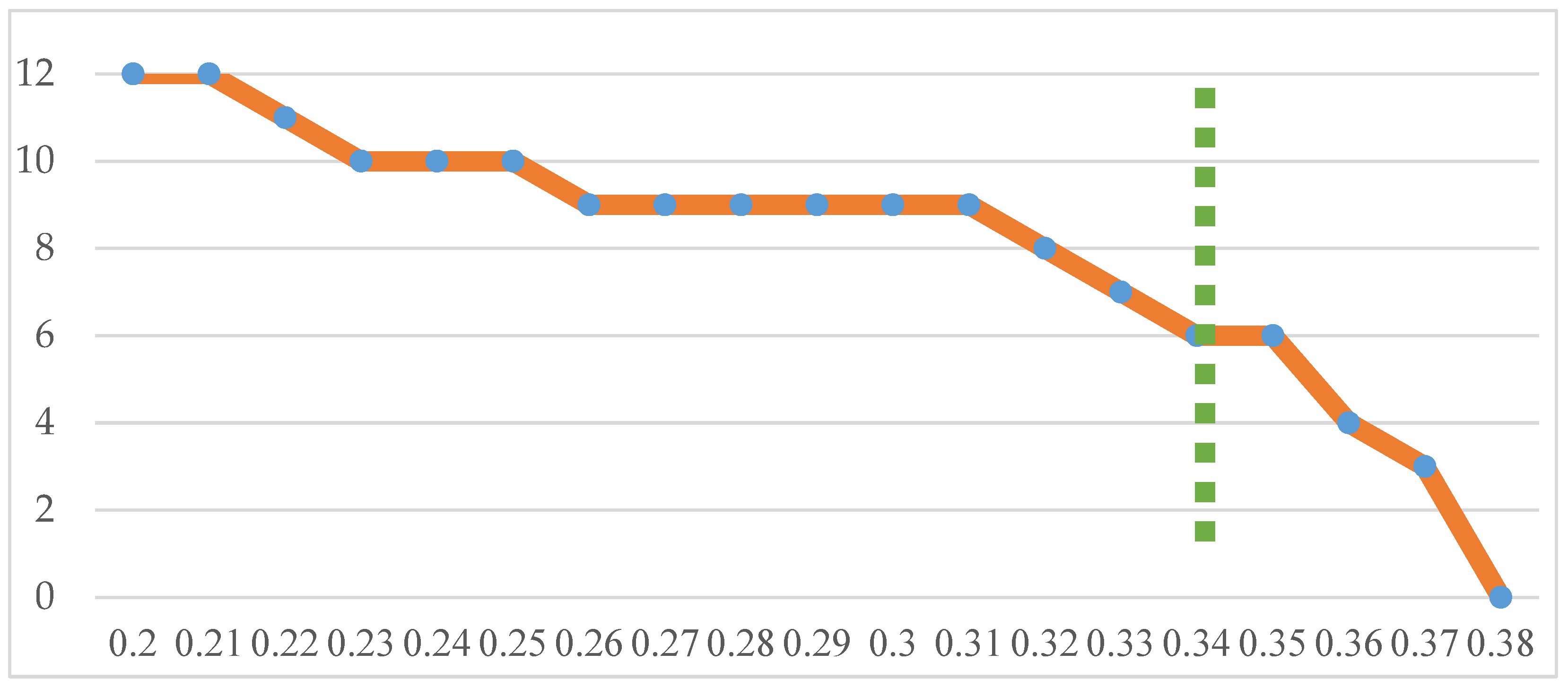
To simplify the intricate causal interdependencies among AOs’ competencies and to concentrate on the factors that substantially influence competency quality, this study employs sensitivity analysis to identify the strength of causal relationships and the direction of influence among the key competency factors. The threshold value is determined through Threshold Sensitivity Analysis by observing the steep inflection points in the number of retained causal links within the influence network as the threshold value is progressively increased. As illustrated in Figure 2, when the threshold value is set at 0.34, the number of retained links exhibits a distinct scree inflection point, facilitating the filtration of low-relevance noise while preserving the six principal causal links, thereby ensuring that the system structure remains efficient and not unduly redundant.
Figure 2.
Sensitivity Analysis. Notes: The horizontal axis represents the Threshold Value and the vertical axis represents the number of retained evaluation criteria; the green dashed line marks the inflection point at a threshold value of 0.34; N = 24.
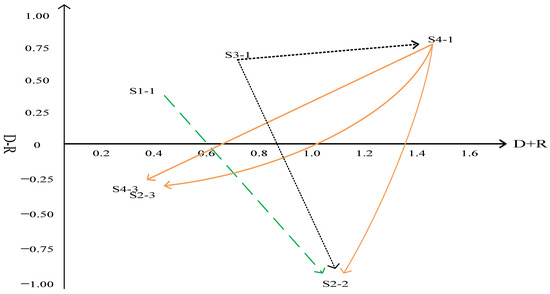
Following the determination of the threshold value, the evaluation criteria, influence magnitude, and direction of influence for the key factors affecting AOs’ competency quality are presented in Table 3. In this table, D denotes the degree of influence and R denotes the degree of being affected. Both the prominence value (D + R) and the cause degree (D − R) are calculated from the complete, untruncated total influence matrix T; the threshold value of 0.34 is applied solely for the purpose of filtering the key causal links displayed in the causal relationship diagram in Figure 3.
Table 3.
Causal Relationship Analysis of Key Factors Affecting AOs’ Competency Quality (Threshold Value: 0.34).
Figure 3.
Causal Relationship Diagram. Notes: The dashed line represents the unidirectional influence of S1-1 on S2-2; dotted lines represent the unidirectional influence of S3-1 on S2-2 and S4-1; solid lines represent the unidirectional influence of S4-1 on S2-2, S2-3, and S4-3; N = 24.
As shown in Table 3, the factors exhibiting a high degree of causal association with AOs’ competency quality at Taiwan Taoyuan International Airport include: Operational Procedure Execution and Contingency Response (S1-1), Safety and Security Operations and Primary Contingency Response Coordination (S2-2), Flight Operations Coordination and Abnormal Situation Dispatch (S2-3), Reporting Accuracy and Timeliness (S3-1), Cross-Departmental Communication and Information Dissemination (S4-1), and Training Participation and Practical Optimization Recommendation (S4-3).
Among these, Cross-Departmental Communication and Information Dissemination (S4-1) exhibits the strongest overall influence and is recognized as the primary influencing factor. Conversely, Safety and Security Operations and Primary Contingency Response Coordination (S2-2) are identified as the primary impacted factors. The causal relationships among these key influencing factors are depicted in Figure 3.
As depicted in Figure 3, Safety and Security Operations and Primary Contingency Response Coordination (S2-2), are primarily influenced by Cross-Departmental Communication and Information Dissemination (S4-1), Reporting Accuracy and Timeliness (S3-1), and Operational Procedure Execution and Contingency Response (S1-1). Additionally, Training Participation and Practical Optimization Recommendation (S4-3), as well as Flight Operations Coordination and Abnormal Situation Dispatch (S2-3), are considered secondary factors of influence, both of which are affected by Cross-Departmental Communication and Information Dissemination (S4-1).
From the perspective of aviation practice, events involving safety, security, and primary contingency response typically involve multiple units—including air traffic control, airline ground handling, security screening, airport police, fire services, and medical teams—all of which must reach a unified and immediate consensus before a coordinated response can be enacted. Considering the frequent airside construction activities and runway configuration modifications at Taiwan Taoyuan International Airport, and despite the existence of an electronic inspection system, it is advisable to further incorporate Geographic Information Systems (GIS) and artificial intelligence logic to establish an automated NOTAM decision-support system. Although digital entry is presently available, implementing a system capable of automatically translating site obstacle data into standardized NOTAM code recommendations would more effectively alleviate the cognitive burden on AOs during peak periods, thereby ensuring the timeliness and accuracy of information dissemination across units.
Furthermore, aviation operations are highly reliant on reported information. Although the Airport Collaborative Decision Making (A-CDM) system already established at TTIA has implemented robust node management, it is advised that, within the dynamic environment created by the construction of the Third Terminal, an intelligent airside reporting system be further integrated with A-CDM data linkages. For instance, when a Foreign Object Debris (FOD) is identified during an airside inspection, the system should not merely record the incident but should also be capable of triggering real-time linkage with A-CDM to generate recommendations for subsequent aircraft gate adjustments. Additionally, it is recommended that existing historical data on bird strikes and taxiing anomalies be used to develop scenario-based three-dimensional (3D) simulation training, thereby enhancing Aviation Officers’ (AOs) capacity to anticipate conditions at specific hotspots and improving their on-site resource allocation efficiency [48].
Moreover, the AOs’ proficiency with Standard Operating Procedures (SOPs) constitutes the fundamental basis for effective crisis management. Within TTIA’s current SMS framework, the feedback system should be advanced from a mere case-inquiry mechanism to a continuous SOP-optimization process. AOs should be prompted to provide feedback on obstacles encountered during SOP implementation in specialized, dynamic environments, such as construction zones. Regarding evaluation methods, the conventional written examination ought to be replaced with field-based scenario assessments, which evaluate whether AOs can proficiently execute tasks such as cordoning off areas, directing traffic, and reporting under the exigent conditions characteristic of A-CDM operations, thereby enhancing their capacity to handle complex situations [49].
Finally, cross-departmental communication among AOs is fundamental to the efficacy of overall operations. Although TTIA has already implemented reporting feedback mechanisms and A-CDM, practical measures must be adopted to prevent the occurrence of information silo phenomena. It is advisable that the existing reporting system be formally standardized as a closed-loop communication protocol, particularly by establishing mandatory read-back procedures between AOs and the control tower and construction units. Through regular cross-unit sharing seminars, system data can be transformed into collective organizational intelligence, thereby enhancing AOs’ ability to propose practical optimization recommendations and strengthening the operational resilience of overall airside management.
5. Conclusions and Recommendations
5.1. Conclusions
The findings of this study’s AOs competency quality satisfaction analysis indicate that deficiencies in Reporting Accuracy and Timeliness (S3-1) and Operational Record Management and Retrieval (S3-2) fundamentally reflect inadequacies in cross-departmental information flow, facility control information integration, and knowledge management mechanisms. Cross-departmental information integration strategies, however, have the capacity to improve resource access and knowledge sharing, thereby enhancing organizational performance and risk-control [50]. Accordingly, Cross-Departmental Communication and Information Dissemination (S4-1) plays a pivotal role in connecting facility control, reporting, and compliance management.
In the aggregate, enhancement strategies for airport operations management should concentrate on establishing an integrated operational framework that encompasses information management, considering real-time reporting processes and operational record management and maintenance as a cohesive system design. By bolstering cross-departmental information integration and institutional consistency, the reliability of both real-time reporting and post-event retrieval can be concurrently improved, thereby comprehensively advancing the overall performance of AOs’ core competencies.
Regarding performance management, a unified indicator system for facility and access control planning should be established, incorporating metrics such as reporting punctuality rate, record completeness rate, and retrieval availability rate as key achievement indicators [5]. By considering facility control planning, cross-departmental communication mechanisms, real-time reporting processes, and records governance systems as an integrated framework, the reliability and consistency of both Reporting Accuracy and Timeliness (S3-1) and Operational Record Management and Retrieval (S3-2) can be enhanced concurrently at the institutional level. This comprehensive approach aims to significantly reduce airline FOs’ dissatisfaction with AOs’ core performance competencies.
Regarding causal relationships, the competency structure of AOs at Taiwan Taoyuan International Airport clearly demonstrates a causal pattern where information coordination and communication serve as the fundamental drivers, with contingency response speed being the resultant outcome. For AOs at TTIA, increased accuracy in information transmission correlates with enhanced ability to manage unforeseen on-site situations—constituting a dynamic linkage between communication and contingency response. From an aviation practice perspective, safety and security incidents, along with abnormal operational scenarios, are inherently multi-unit and real-time collaborative in nature; any delay in reporting, communication gaps, or unfamiliarity with procedures may pose risks to flight and passenger safety, as well as to airport operational continuity [51]. Consequently, the essential capabilities of both primary and secondary influencing factors can be comprehensively fortified through the implementation of standardized communication protocols, integrated information dissemination systems, cross-unit joint exercises, ongoing SOP training, and digital collaborative platforms.
5.2. Recommendations
The findings of this study indicate that AOs at Taiwan Taoyuan International Airport exhibit comparatively lower satisfaction ratings in competencies that are heavily reliant on information and institutional expertise, such as reporting accuracy and timeliness, and operational record management and retrieval—areas whose performance is critically linked to information integration within multi-unit collaborative operations, regulatory compliance requirements, and operational process design.
To facilitate tangible progress, it is advisable that TTIA and the civil aviation authority collaboratively pursue efforts across various domains. Initially, a standardized, cross-unit closed-loop communication protocol should be established, incorporating mandatory read-back and confirmation procedures for AOs, FOs, and the control tower during the management of abnormal events to mitigate the risk of miscommunication. Furthermore, the promotion of field-based scenario response assessments should be prioritized, shifting AOs’ performance evaluations from conventional written examinations to on-site simulations that incorporate real-world A-CDM scenarios, thereby enhancing their emergency response and handling capabilities. Lastly, exploration of emerging technologies is recommended: in alignment with the trend towards smart airports, a decision-support platform integrating Geographic Information Systems (GIS) and Artificial Intelligence (AI) could be developed to automatically convert airside inspection findings into standardized NOTAM recommendations, thereby effectively alleviating cognitive burdens on personnel during peak operational periods.
Should such systems be deeply integrated with existing airside operational processes and cross-unit collaborative frameworks, and complemented by scenario-based exercises and human–machine collaborative decision-making mechanisms, they would not only help to optimize critical competency performance but could also serve as an important foundation for developing an intelligent airside safety management model. Future research may employ empirical case analysis and system simulation to verify the impact of AI adoption on AOs’ operational efficiency and safety performance, and on airline FOs’ level of acceptance, thereby establishing an intelligent aviation operations management framework that balances technical feasibility with practical applicability.
5.3. Limitations and Future Research
As an exploratory single-case study, this research is subject to several limitations. First, concerning the scope of the single airport and sample size, the study considers TTIA as its sole case and, limited by the population of domestically stationed FOs, includes only 24 valid questionnaires. Although this sample is highly representative of the operational environment in question, caution should be exercised when generalizing the findings to other domestic or international airports. Second, regarding the discrepancy between perceived satisfaction and objective performance, this study emphasizes FOs’ subjective perceptual evaluations of AOs and does not directly correlate these evaluations with objective safety data such as runway incursion rates, accident frequencies, or recorded delay times. With respect to future research directions, subsequent studies may broaden the scope of data collection to encompass other international airports and incorporate objective Safety Management System (SMS) performance indicators—using big data analysis or on-site operational observations—to empirically substantiate the relationship between perceived satisfaction and actual safety performance.
Funding
This research received no external funding.
Data Availability Statement
Data is contained within the article.
Conflicts of Interest
The author declare no conflicts of interest.
Abbreviations
The following abbreviations are used in this manuscript:
| AOs | Airport Operations Officers |
| FOs | Flight Operations Officers |
| RDEMATEL | Revised Decision-Making Trial and Evaluation Laboratory |
| YSI | Yeh’s Satisfaction Index |
References
- Pacheco, R.R.; Fernandes, E.; Domingos, E.M. Airport airside safety index. J. Air Transp. Manag. 2014, 34, 86–92. [Google Scholar] [CrossRef] [Scilit]
- Huang, C.J. Constructing the Airside Safety Risk Framework for Domestic Airport—The Case of Using FMEA on the Chiayi Airport. Master’s Thesis, National Cheng Kung University, Tainan, Taiwan, 2019. [Google Scholar]
- Lin, J.W. A Study on the Airside Safety Management of Military—Civilian Airport—With Case Study of Tainan Airport. Master’s Thesis, National Cheng Kung University, Tainan, Taiwan, 2021. [Google Scholar]
- Hao, Y.M. How Do the Interactions Between Flight Dispatchers and Plots Within an Airline Affect the Flight Safety. Master’s Thesis, Kainan University, Taoyuan, Taiwan, 2023. [Google Scholar]
- Na, I.K.; Choi, Y.J. Developing airport safety performance indicators and index: The case of Incheon airport airside. J. Korean Soc. Aviat. Aeronaut. 2023, 31, 103–118. [Google Scholar] [CrossRef] [Scilit]
- Luo, Q.; Liu, H.; Liu, C.; Deng, Q. Multi-strategy cooperative scheduling for airport specialized vehicles based on digital twins. Sci. Rep. 2024, 14, 15533. [Google Scholar] [CrossRef] [Scilit] [PubMed]
- Zhang, J.; Chong, X.; Wei, Y.; Bi, Z.; Yu, Q. Optimization of apron support vehicle operation scheduling based on multi-layer coding genetic algorithm. Appl. Sci. 2022, 12, 5279. [Google Scholar] [CrossRef] [Scilit]
- Alonso-Tabares, D.; Mora-Camino, F.; Drouin, A. A multi-time scale management structure for airport ground handling automation. J. Air Transp. Manag. 2021, 90, 101959. [Google Scholar] [CrossRef] [Scilit]
- Geske, A.M.; Herold, D.M.; Kummer, S. Integrating AI support into a framework for collaborative decision-making (CDM) for airline disruption management. J. Air Transp. Res. Soc. 2024, 3, 100026. [Google Scholar] [CrossRef] [Scilit]
- Uyar, M.T.; Gürsel, G. Enhancing airport efficiency by simulating passenger waiting times. J. Appl. Eng. Agric. Sci. 2024, 1, 47–51. [Google Scholar]
- Feng, C.M.; Chung, C.C. Assessing the risks of airport airside through the fuzzy logic-based failure modes, effect, and criticality analysis. Math. Probl. Eng. 2013, 2013, 239523. [Google Scholar] [CrossRef] [Scilit]
- Apiratanarungsi, P.; Dowpiset, K. Organizational and individual factors on safety culture in airside operations department at international airport AAA in Southeast Asia. ABAC ODI J. 2024, 12, 119–136. [Google Scholar]
- Ripoll-Zarraga, A.E.; Huderek-Glapska, S. Airports’ managerial human capital, ownership, and efficiency. J. Air Transp. Manag. 2021, 92, 102035. [Google Scholar] [CrossRef] [Scilit]
- Irawan, G.; Suryono, W.; Furyanto, F.A. The analysis of security facilities on the air side toward flight safety and security at Kalimarau Berau class 1 airport. In Proceeding of International Conference of Advance Transportation, Engineering and Applied Social Science, Surabaya, Indonesia, 9 October 2023; Atlantis Press: Dordrecht, The Netherlands, 2023; Volume 2, pp. 366–373. [Google Scholar]
- Aryaswari, N.L.P.P.; Rozi, F.; Ratnasari, D. The influence of surveillance using closed circuit television (CCTV) on airside safety at Blu Upbu class I utama juwata tarakan. In Proceeding of International Conference of Advanced Transportation Engineering and Applied Social Science; Atlantis Press: Dordrecht, The Netherlands, 2025; Available online: https://ejournal.poltekbangsby.ac.id/index.php/icateass/article/view/2432 (accessed on 18 January 2026).
- Cronin, J.J., Jr.; Taylor, S.A. Measuring service quality: A reexamination and extension. J. Mark. 1992, 56, 55–68. [Google Scholar] [CrossRef] [Scilit]
- Atiku, S.O.; Oladejo, O.M.; Sibalatani, A.N. Addressing learning and development issues in airport companies: Implications for organizational development specialists. Dev. Learn. Organ. 2025, 39, 28–31. [Google Scholar] [CrossRef] [Scilit]
- Susanto, P.C.; Sawitri, N.N.; Ali, H.; Ronny, Z.T. Analysis of competency, discipline, and self-efficacy on the performance of aviation security staff: Literature review. Greenation Int. J. Tour. Manag. 2024, 2, 166–172. [Google Scholar] [CrossRef] [Scilit]
- Aviation Training Institute Civil Aviation Administration. Flight Operations Management Training Manual, 18th ed.; Aviation Training Institute: Taipei, Taiwan, 2024. [Google Scholar]
- City of Williston. Airport Operations Officer Job Description. Available online: https://cms3.revize.com/revize/williston/Airport%20Operations%20Officer%20(Rev%201-18).pdf (accessed on 29 June 2025).
- Kaplan Community Career Center. Airport Operations Officer Job Description. Available online: https://jobs.community.kaplan.com/career/airport-operations-officer-2/job-descriptions (accessed on 20 July 2025).
- Hiringpeople. Example Airport Operations Officer Job Description. Available online: https://hiringpeople.io/en-US/job-descriptions/public-sector/airport-operations-officer (accessed on 20 July 2025).
- Cayman Islands Airports Authority. Job Description. Available online: https://www.caymanairports.com/upimages/ckeditor/1669059184AirportOperationsDutyOfficerJD21Nov22FINAL.pdf (accessed on 20 July 2025).
- Australian Airports Association. Airport Operations Officer–Position Description and Essential Requirements. Available online: https://airports.asn.au/job_listing/airport-operations-officer-2/ (accessed on 20 July 2025).
- Aviation Science Popularization. Introduction to the Job of a Flight Dispatcher. Available online: https://vocus.cc/article/66d6da2dfd89780001c2673d (accessed on 9 August 2025).
- Prayitno, H.; Ekohariadi; Cholik, M.; Supardam, D.; Wibisono, W.D. The relationship between on the job training flight operation officer and job readiness. Int. J. Sci. Soc. 2023, 5, 218–227. [Google Scholar] [CrossRef] [Scilit]
- Ewertowski, T.; Berlik, M.; Sławińska, M. The effectiveness of operational residual risk assessment. Sustainability 2024, 16, 10606. [Google Scholar] [CrossRef] [Scilit]
- No, H.W.; Cha, W.C. An integrated framework for implementing safety-I and safety-II principles in aviation safety management. Safety 2025, 11, 56. [Google Scholar] [CrossRef] [Scilit]
- Sivakumar, S. A novel integrated risk management method for airport operations. J. Air Transp. Manag. 2022, 105, 102296. [Google Scholar] [CrossRef] [Scilit]
- Majid, S.A.; Nugraha, A.; Sulistiyono, B.B.; Suryaningsih, L.; Widodo, S.; Kholdun, A.I.; Febrian, W.D.; Wahdiniawati, S.A.; Marlita, D.; Wiwaha, A.; et al. The effect of safety risk management and airport personnel competency on aviation safety performance. Uncertain. Supply Chain Manag. 2022, 10, 1509–1522. [Google Scholar] [CrossRef] [Scilit]
- Moghadasnian, S.; Nasr, R. Optimizing airline customer service: A KPI-driven approach for chief customer services officers. In Proceedings of the 8th National Conference on Management and E-Commerce, Tehran, Iran, 19 May 2024. [Google Scholar]
- Moghadasnian, S.; Takzare, S. Enhancing airline customer experience: A strategic approach to KPI-driven management. In Proceedings of the 8th International Conference on Management Accounting, Economic and Social Science, Hamadan, Iran, 5 March 2024; Available online: https://www.researchgate.net/profile/Seyyedabdolhojjat-Moghadasnian/publication/378316240_Enhancing_Airline_Customer_Experience_A_Strategic_Approach_to_KPI-Driven_Management/links/682d63f08a76251f22e3a471/Enhancing-Airline-Customer-Experience-A-Strategic-Approach-to-KPI-Driven-Management.pdf (accessed on 11 January 2026).
- Zubair, M.; Kalwar, S.; Mangi, Y.; Abeer, U. Measuring airport service quality through Yeh’s satisfaction model. SSRN 2022. [Google Scholar] [CrossRef] [Scilit]
- Abdulrahman, M.A.S.A.S.; Dweiri, F.T. A systematic literature review and thematic analysis of DEMATEL in transport systems. Open Transp. J. 2025, 19, e26671212385655. [Google Scholar] [CrossRef] [Scilit]
- Lee, H.S.; Tzeng, G.H.; Yeih, W.C.; Wang, Y.J.; Yang, S.C. Revised DEMATEL: Resolving the infeasibility of DEMATEL. Appl. Math. Model. 2013, 37, 6746–6757. [Google Scholar] [CrossRef] [Scilit]
- Ho, T.C.; Chiu, R.H.; Chung, C.C.; Lee, H.S. Key influence factors for ocean freight forwarders selecting container shipping lines using the revised DEMATEL approach. J. Mar. Sci. Technol. 2017, 25, 299–310. [Google Scholar] [CrossRef]
- Ho, T.C.; Lee, H.S. Analysis of key factors and correlations influencing the adoption of autonomous ships by shipping companies—A study integrating revised DEMATEL-AHP with BOCR. J. Mar. Sci. Eng. 2024, 12, 2153. [Google Scholar] [CrossRef] [Scilit]
- Stroeve, S.; Smeltink, J.; Kirwan, B. Assessing and advancing safety management in aviation. Safety 2022, 8, 20. [Google Scholar] [CrossRef] [Scilit]
- Marzec, D.; Skorupski, J. FRAM-based analysis of airport risk assessment process. Aerospace 2025, 12, 99. [Google Scholar] [CrossRef] [Scilit]
- Fauzi, M.; Setyawati, A.; Kurniawan, J. The performance of aviation security personnel services at Sentani airport. J. Transp. Logist. Bus. Manag. 2021, 7, 141–146. [Google Scholar] [CrossRef] [Scilit]
- Careervira. Airport Operations Officer. Available online: https://www.careervira.com/en-US/job-role/transportation-airport-operations-officer-for-late-career-in-us (accessed on 27 July 2025).
- Huang, H.C.; Huang, C.N.; Lo, H.W.; Thai, T.M. Exploring the mutual influence relationships of international airport resilience factors from the perspective of aviation safety: Using Fermatean fuzzy DEMATEL approach. Axioms 2023, 12, 1009. [Google Scholar] [CrossRef] [Scilit]
- Everglades University. What Are the Common Airport Operations? Available online: https://www.evergladesuniversity.edu/blog/common-airport-operations/ (accessed on 27 July 2025).
- Chang, Y.H.; Shao, P.C.; Chen, H.J. Performance evaluation of airport safety management systems in Taiwan. Saf. Sci. 2015, 75, 72–86. [Google Scholar] [CrossRef] [Scilit]
- Malandri, C.; Mantecchini, L.; Reis, V. Aircraft turnaround and industrial actions: How ground handlers’ strikes affect airport airside operational efficiency. J. Air Transp. Manag. 2019, 78, 23–32. [Google Scholar] [CrossRef] [Scilit]
- Choi, S.; Hanaoka, S. Prediction of aircraft waiting time at airport during immediate response to disaster. Aerospace 2019, 6, 40. [Google Scholar] [CrossRef] [Scilit]
- Abdellah, H.; Abdellah, E.B. Airport safety management: A proactive model based on risk assessment and benchmarking. Proact. Airpt. Saf. Risk Manag. 2025, 20, 875–891. [Google Scholar]
- Liu, M.; Fang, Q.; Yang, Y.; Zhao, C.; Cai, K. Knots: A large-scale multi-agent enhanced expert-annotated dataset and LLM prompt optimization for NOTAM semantic parsing. Adv. Eng. Inform. 2026, 69, 104086. [Google Scholar] [CrossRef] [Scilit]
- Asata, M.N.; Nyangoma, D.; Okolo, C.H. Standard operating procedures in civil aviation: Implementation gaps and risk exposure factors. Int. J. Multidiscip. Res. Growth Eval. 2021, 2, 985–996. [Google Scholar] [CrossRef] [Scilit]
- Wipulanusat, W.; Sunkpho, J.; Stewart, R.A. Effect of cross-departmental collaboration on performance: Evidence from the federal highway administration. Sustainability 2021, 13, 6024. [Google Scholar] [CrossRef] [Scilit]
- Moon, S.; Kim, G.; Seo, H.; Jun, J.; Park, E. A study on information strategy planning (ISP) for applying smart technologies to airport facilities in South Korea. Aerospace 2025, 12, 595. [Google Scholar] [CrossRef] [Scilit]

Disclaimer/Publisher’s Note: The statements, opinions and data contained in all publications are solely those of the individual author(s) and contributor(s) and not of MDPI and/or the editor(s). MDPI and/or the editor(s) disclaim responsibility for any injury to people or property resulting from any ideas, methods, instructions or products referred to in the content. |
© 2026 by the author. Licensee MDPI, Basel, Switzerland. This article is an open access article distributed under the terms and conditions of the Creative Commons Attribution (CC BY) license.