


Abstract
Cellular-pulsating (hotspot) burning of energetic materials has resisted a unified theoretical explanation for over 6 decades, despite extensive experimental characterization across multiple materials and laboratories. The central question—why no prior theoretical approach has simultaneously accounted for all defining characteristics of this phenomenon—has never been addressed in systematic form. This study presents the first systematic classification of the complete theoretical corpus, comprising 73 key publications from 1942 to 2025, into six functional research classes, each rigorously assessed against three mandatory, mutually independent diagnostic criteria derived directly from the experimental record: spontaneous pattern formation on smooth, homogeneous burning surfaces (Criterion S); material-independent pressure scaling (Criterion U); and millisecond spatial coordination of cells across inter-cell distances of 10–20 mm (Criterion C). The analysis reveals that 0% of classified publications satisfy all three criteria simultaneously. Criterion C is structurally unreachable for all existing models, reflecting a four-orders-of-magnitude discrepancy (×40,000) between the thermal diffusion timescale (~1000 s) and the experimentally observed coordination timescale (20–40 ms). This systematic failure is traced to a single shared unstated axiom—that inter-cell information propagates exclusively via thermal diffusion and chemical kinetics—inherited from classical continuum combustion theory and never previously identified as such. The classification provides the first rigorous evaluation framework for unified combustion theories, derives three necessary physical constraints on any complete theory, and explains why the century-long Zel’dovich–Novozhilov tradition reached its logical limit without resolving the origin of cellular patterns.
1. Introduction
Cellular-pulsating or hotspot burning is a non-one-dimensional, unsteady burning regime observed in energetic materials (EMs)—double-base and nitroglycerin propellants, pure explosives such as RDX and HMX, and other homogeneous compositions—when the combustion pressure falls below a characteristic threshold. Instead of the smooth, uniformly receding burning surface that classical one-dimensional theory predicts, the combustion front breaks up into discrete luminous hotspots that appear, propagate transversely across the sample surface, and extinguish in a quasi-periodic pattern. The phenomenon has been known since the 1960s: K.I. Sinaev is cited in the literature as having made the first observations of this regime [1,2], though his original publication [3] is available only as a secondary reference in subsequent works.
The experimental characterization of cellular-pulsating burning was developed systematically in the Soviet Union and later in Russia, producing over subsequent decades a detailed kinematic and thermal picture of how hotspot cycles and transverse waves behave [2,4,5,6]. By the mid-2010s, video imaging and thermocouple measurements had established the characteristic scaling of hotspot dimensions with pressure, the velocity distribution within transverse wave propagation events, and the temperature profiles at the burning surface during transverse wave passage. The experimental archive is rich: hotspot dimensions, wave velocities, temperature profiles, pressure dependencies, and critical diameters were all measured with care across multiple materials and laboratories.
What the archive lacks—what it has lacked since the first observations—is a theoretical framework capable of deriving the observed phenomena from physical first principles. Every major theoretical approach advanced over the past 6 decades has successfully described some features of cellular-pulsating burning while failing to account for others. The result is a situation in which a phenomenon is experimentally well-documented and theoretically much-studied yet remains without a complete mechanistic explanation. Without a physical mechanism for spontaneous pattern formation, for material universality, and for millisecond coordination, each new measurement added to the inventory of unexplained facts rather than resolving them.
This paper addresses that situation—not by adding to the experimental record and not by proposing a new theoretical model, but by asking a prior question that has not previously been asked in systematic form: why has no prior approach succeeded in providing a simultaneous, first-principles explanation of all the defining characteristics of cellular-pulsating burning? The answer advanced here is that the failure is structural rather than technical: every prior approach, regardless of mathematical sophistication, inherits a single unstated assumption that makes a complete explanation unreachable within any framework that carries it.
The depth of this challenge is illustrated with particular clarity by the scientific career of Boris Vasilyevich Novozhilov (1930–2017), the principal architect of the Zel’dovich–Novozhilov (ZN) framework for unsteady solid-propellant combustion. The ZN theory, developed from the 1960s onward, provided the first rigorous mathematical description of transient burning response and established stability criteria that have underpinned propulsion engineering practice for more than 50 years. Novozhilov’s engagement with the specific problem of cellular-pulsating burning was confined, remarkably, to exactly two publications—both in 2015, in the final period of his scientific career [4,7]. These two publications are his only contributions specifically devoted to cellular-pulsating burning over an entire career spanning more than 5 decades. Novozhilov passed away in 2017 [8,9], and these two papers remained his last contributions to the topic. That the founder of the dominant theoretical tradition devoted his last publications to this specific problem reflects the seriousness with which the problem was regarded as unresolved within the tradition he had built.
To make the argument of this paper precise, three criteria are defined in Section 2. These criteria emerge directly from the experimental record and are mutually independent in the sense that satisfying one does not logically entail satisfying the others. A complete theory of cellular-pulsating burning must account for all three simultaneously. Section 3 presents the six-category classification of 73 publications with full assessment against these criteria. Section 4 identifies the common structural assumption shared by all six categories. Section 5 analyses why the structural barrier remained invisible for 60 years, with the Novozhilov case as its sharpest illustration. Section 6 presents the key mathematical formulations underpinning the diagnostic framework. Section 7 derives the logical constraints on a complete theory. Section 8 discusses implications, and Section 9 presents conclusions.
A methodological note on the author’s position relative to this classification is appropriate here. The present author (i) defines the diagnostic criteria applied throughout (Section 2) and the coding rubric used to score every publication against them (Section 8.4) and (ii) is the sole investigator behind one of the six classified research programs, Class VI (Section 3.6), which is scored under the same rubric as the other 58 publications and receives the only partial affirmative Criterion S assessment in the corpus. These facts do not affect the classification of the other 58 publications, which rests on quantitative benchmarks established and published independently by the research groups cited in Section 3. They do mean that the reader should treat the Class VI assessment, and any interpretive claim beyond its raw class-level scoring reported in Section 3.7, with corresponding caution; Section 8.4 returns to this point directly.
2. Three Diagnostic Criteria: What Any Complete Theory Must Explain
The three criteria—Criterion S (spontaneous pattern formation), Criterion U (material universality), and Criterion C (millisecond coordination)—are logically independent. Satisfying Criterion S does not entail satisfying Criterion U, and satisfying Criterion U does not entail satisfying Criterion C. This independence is not merely formal: it reflects genuinely different physical questions, each demanding a different kind of explanatory mechanism. The insistence on all three being satisfied simultaneously is therefore not an artificially stringent standard; it is the minimum requirement for a theory to account for the phenomenon as it is actually observed.
2.1. Criterion S: Spontaneous Pattern Formation
Experiments consistently show that organized cellular structures appear on initially smooth, chemically homogeneous burning surfaces under low-pressure conditions, without pre-existing perturbations, without surface roughness above a critical scale, and without structural heterogeneities in the propellant sample [2,3,4,6]. The primary evidentiary basis for this criterion is the direct experimental description of spontaneous pattern formation on nominally smooth surfaces given by Marshakov and coworkers [1,4,10] (discussed further in Section 3.3) and Ananiyev et al. [2], both independently obtainable. Sinaev [3] is retained here as a historical priority note; the original is cited only in the secondary literature and is not independently obtainable, and it is not used as load-bearing evidence for this criterion. The pattern emerges spontaneously, with characteristic cell dimensions in the range of 1–5 mm at pressures of 1–10 atm. A complete theory must explain this spontaneous symmetry-breaking: not merely describe how a pattern evolves once it exists, but derive why a pattern must emerge from a spatially uniform initial condition.
The distinction is critical and easy to overlook. Many theoretical models describe how an initially perturbed burning surface evolves—how a given disturbance grows, propagates, or saturates. This is a well-posed and tractable mathematical problem. But the experiments show that a nominally unperturbed surface develops cellular structure spontaneously; the models describe what happens after a structure already exists. To satisfy Criterion S, a theory must bridge this gap: it must derive, from the governing physics, the inevitability of pattern formation starting from uniform initial conditions, including both the existence and the pressure dependence of the transition threshold.
2.2. Criterion U: Material-Independent Scaling
The characteristic hotspot dimension scales with pressure as L = A · p−n, with n in the range of 0.74–0.84, across double-base propellants, nitroglycerin compositions, RDX, HMX, AP-based systems, and TATB empirical fitting for individual materials. Specific benchmark correlations from the experimental record are Ld = 2.34 · p−0.74 for propellant NB [11] and Ld = 4.0 · p−0.84 for propellant N [12] and the updated correlation Lm = 2.6 · p−0.76 valid from 1 to 60 atm [10]. The dimensionless ratio L/δh—where δh = α/U is the thermal layer thickness—consistently falls in the range of 10–15 across all these materials [2,10,13,14]. These measurements derive predominantly from a single research group (Marshakov and coworkers) applying a consistent experimental methodology; independent replication in an unaffiliated laboratory has not yet been reported, and Criterion U should be read as consistent across all measurements reported to date rather than as independently established universality.
Classical thermal-wave theories predict this ratio to be of the order of 2–3 [7,15]—a factor of 4–15 below experimental observation. The thermal conductivities, flame temperatures, and chemical mechanisms of these materials differ by orders of magnitude, yet the geometric scaling remains essentially constant. A complete theory must derive this universality from material-independent physical parameters: it must explain not just the value of the scaling law for one material but why the same value is observed for all. This near-universality is a direct constraint on the organizing principle: whatever determines hotspot dimensions must depend on physical parameters approximately conserved across all homogeneous EMs. Figure 1 illustrates that the predicted L/δh ≈ 2–3 from classical theory falls a factor of 4–15 below the observed range of 10–15 across all materials.
Figure 1.
Experimental pressure-scaling correlations for hotspot dimension L(p) across multiple homogeneous EMs: propellant NB (Ld = 2.34 · p−0.74 [14]); propellant N (Ld = 4.0 · p−0.84 [4]); HMX [14]; and the unified cross-material correlation Lm = 2.6 · p−0.76 valid over 1–60 atm [10]. The red shaded band shows the classical thermal-wave theory prediction (L/δh ≈ 2–3; δh = α/U), lying a factor of 4–15 below experimental observations (L/δh = 10–15) across all materials [2,10,13,16]. These measurements derive predominantly from a single research group (Marshakov and coworkers) applying a consistent methodology; independent replication in other laboratories has not yet been reported. This discrepancy, consistent across all measurements reported to date, constitutes the experimental content of Criterion U and is not reproduced by any classified theoretical publication. Line color denotes source: blue—all materials pooled; purple—N; orange—NB; green—HMX. Red band—classical thermal prediction.
2.3. Criterion C: Millisecond Spatial Coordination
The third criterion is the most decisive discriminator between competing theoretical approaches because it involves a quantitative discrepancy of 4 orders of magnitude between what classical thermal–mechanical physics can deliver and what the experiments require. The timescale on which spatially separated cells synchronize their pulsation cycles is of the order of 20–40 ms over inter-cell distances of 10–20 mm [4,10,13]. This range is obtained in the source publications from high-speed video (frame rates of 1000–2000 fps in [4]) and fine-wire thermocouple records from a reported sample of the order of 15–20 identified wave-synchronization events per pressure condition; the source publications do not report a formal propagated uncertainty budget for this range, which we note here as a limitation of the underlying experimental record rather than implying a precision that has not been established. The discrepancy factor Γ = 4 × 10⁴ below is computed using a representative midpoint of 25 ms; even the most conservative reading of the source data—40 ms, the slowest reported coordination time—still yields a discrepancy of approximately 2.5 × 10⁴, i.e., the qualitative argument does not depend on the precise value chosen within the reported range. Thermal diffusion over 10 mm in a typical solid propellant with thermal diffusivity α ≈ 10−7 m2/s requires approximately 103 s, computed as tdiff ≈ d2/α = (10−2)2/(10−7) = 1000 s. The discrepancy is therefore 1000 s/0.025 s = 40,000×—exactly 4 orders of magnitude. This is not a quantitative discrepancy removable by parameter adjustment: it is a qualitative impossibility within any diffusion-based transport framework, because the gap is a structural property of the parabolic heat equation and is preserved under all non-linear extensions of it. Criterion C is therefore NO for all 73 classified publications without exception.
An independent experimental study of oscillating and cellular structures on the burning surface across a broader parameter range [17] provides additional quantitative confirmation of the same millisecond coordination timescale, reinforcing the structural character of the discrepancy identified in Criterion C.
The four-orders-of-magnitude discrepancy and the three relevant timescales are shown schematically in Figure 2.
Figure 2.
Three characteristic timescales for information transport across an inter-cell separation distance d = 10 mm in the solid-propellant condensed phase (α ≈ 10−7 m2 s−1). Panel (a): logarithmic-scale comparison of thermal diffusion (tdiff ≈ 1000 s, blue), observed inter-cell coordination (tobs = 20–40 ms, red band [4,10,13]), and acoustic transit (tac ≈ 7 μs, green; vac ≈ 1500 m s−1). The discrepancy ratio Γ = tdiff/tobs = 4 × 10⁴ is indicated by the double-headed arrow. Panel (b): physical geometry of the coordination requirement, with minimum required signal speed vreq = 0.40 m s−1. The four-orders-of-magnitude barrier is a structural property of the parabolic heat equation and is not removable by parameter adjustment within any diffusion-based framework [4,17]. Colors in (a) match the corresponding labels in (b): blue—tdiff; red—tobs; green—tac.
Local-scale evidence independently confirms the magnitude of this discrepancy. The mean ignition time of secondary transverse waves, ti = 0.7 s (range 0.56–1.0 s) at 1 atm, was established from thermocouple and video measurements documented in the Class III experimental record [4,10]. The thermal diffusion time at the 2 mm inter-wave scale is approximately 40 s. The resulting local discrepancy factor is approximately 57—an independent, smaller-scale confirmation of the same fundamental barrier. For reference, acoustic propagation in solid-propellant condensed phases at sound velocities of the order of 1000–2000 m/s covers 10 mm in approximately 5–10 μs, which is more than 3 orders of magnitude faster than the observed coordination timescale and thus physically adequate as a coordination mechanism. This comparison is presented here not to anticipate a specific theoretical framework but to establish the order-of-magnitude speed requirement that any complete theory must meet.
2.4. The Independence and Simultaneity of the Three Criteria
A theory satisfying Criteria S and U but not C can explain spontaneous pattern formation and universal scaling but cannot explain how cells coordinate their behavior across spatial separations of 10–20 mm within 20–40 ms. A theory satisfying S and C but not U provides no account of why the same geometric scaling appears across all homogeneous EMs despite their widely differing thermochemical properties. A theory satisfying U and C but not S requires pre-existing perturbations as input and cannot derive the phenomenon from smooth initial conditions—the very condition under which it is experimentally observed. The classification presented in Section 3 shows that every prior theoretical category satisfies at most one of these three criteria fully, with at most partial satisfaction of a second and systematic failure on the third. The assessment against all three criteria simultaneously is therefore not an artificially stringent standard but the minimum requirement for a theory to be considered complete. The diagnostic outcomes across all 73 classified publications are summarized in Table 1.
Table 1.
Three diagnostic criteria for a complete theory of cellular-pulsating burning of homogeneous EMs, their experimental benchmarks, and aggregate S/U/C assessment outcome across the 73-publication classified corpus (1942–2025). Assessment levels: YES = criterion fully satisfied from first principles; PARTIAL = partially or conditionally addressed; NO = structurally unreachable. The Criterion C column is NO across all 73 publications without exception, reflecting the four-orders-of-magnitude discrepancy between the thermal diffusion timescale (~1000 s) and the observed inter-cell coordination timescale (20–40 ms) over a separation distance of 10 mm.
2.5. Operational Coding Rubric for the YES/PARTIAL/NO Assessment
Section 8.4 acknowledges that the three-level assessment scale used throughout this classification involves judgment, particularly at the boundary between PARTIAL and NO. The following operational definitions were used consistently in scoring every publication against each of the three criteria and are given here explicitly so that the classification can be independently checked or reproduced:
YES—the criterion’s quantitative benchmark is derived in closed form from the publication’s own stated first principles, with no criterion-specific fitted or externally assumed parameter;
PARTIAL—a mechanism or mode relevant to the criterion is proposed or identified by the publication, but the specific pattern, scale, or coordination required by the criterion is not derived from it, or the result is restricted to a subset of materials, geometries, or pressure ranges narrower than the full range over which the criterion is defined in Section 2.
NO—the criterion is outside the spatial dimensionality or physical scope of the model as constructed, or the publication’s own comparison with experiment falsifies the criterion for that approach.
These definitions were formulated to match, rather than to retrospectively justify, the classification already presented in Table 2 and documented per-publication in Table S1 of the Supplementary Materials. The per-publication rationale in Table S1 is provided so that other researchers can independently re-apply this rubric and identify any point of disagreement; as discussed in Section 8.4, the Criterion C outcome does not depend on this judgment-based rubric, while the Criterion S and U outcomes do.
3. A Systematic Classification of Prior Theoretical Approaches
Before presenting the classification, a note on how the corpus was assembled is in order. The 73 publications classified below were identified through an iterative, expert-led literature search conducted over more than three decades of direct engagement with the cellular-pulsating burning and chuffing literature (1993–2026) rather than a single retrospective database query executed at the time of manuscript preparation. Candidate publications were located directly through the search interfaces of the relevant journals and publishers—principally Fizika Goreniya i Vzryva/Combustion, Explosion, and Shock Waves, the Journal of Propulsion and Power, the AIAA technical library (including the Progress in Astronautics and Aeronautics monograph series), and the Journal of Chemical Physics—using the Russian- and English-language keyword sets given in Section 2 (cellular-pulsating burning, hotspot combustion, transverse wave combustion, chuffing, L*-instability, and Zel’dovich–Novozhilov). This was supplemented by searches of relevant combustion and propulsion conference proceedings and of dissertation and thesis records, principally through the Russian Science Citation Index (eLIBRARY.ru), which indexes Russian-language doctoral and candidate dissertations not otherwise captured by international bibliographic databases. Newly identified publications were cross-checked iteratively against the reference lists and citation records of publications already in the corpus. A publication was included if it reported (a) a new theoretical mechanism proposed to explain any aspect of cellular-pulsating burning or the closely related chuffing phenomenon, (b) new quantitative experimental data on hotspot dimension, wave speed, or coordination timing, or (c) an explicit review or synthesis addressing more than one of the three criteria of Section 2. This process is not equivalent to a reproducible, single-timepoint systematic-review protocol, and Section 8.4 discloses that the completeness of the corpus cannot be guaranteed; given the concentration of the primary literature in Russian-language, non-database-indexed sources, we consider this sustained, cross-validated approach better suited to capturing the relevant corpus than a single keyword search would have been. This process is summarized schematically in Supplementary Figure S1.
The corpus classified in this section comprises 73 publications spanning 1942–2025, involving investigators from Russia, the United States, Spain, Israel, India, Australia, and Ukraine, organized into six functional research classes. Assessment against the three diagnostic criteria (S, U, and C) defined in Section 2 yields the following result: zero publications (0%) achieve YES on all three criteria simultaneously. The Criterion C column—millisecond spatial coordination—is NO across all 73 classified publications, without exception. This outcome is structural, not statistical.
Table 2 provides a concise overview of all six research classes with their aggregate S/U/C outcomes, and Figure 3 (below) provides a visual overview of the entire classification result. The following subsections describe each class in turn, including its principal contributions and its structural limitation as diagnosed against the three criteria. Particular weight is placed throughout on self-admission statements—explicit acknowledgements by the authors themselves of their approach’s limits—as the most authoritative evidence of incompleteness, since they originate from within each research program rather than from external criticism. The complete per-publication S/U/C assessment matrix, including the classification rationale for each of the 73 publications, is provided as Table S1 in the Supplementary Materials.
3.1. Class I: One-Dimensional Zel’dovich–Novozhilov Stability Theory (11 Publications)
The theoretical study of non-steady solid-propellant combustion emerged from the broader classical program of Soviet combustion science that preceded the ZN framework, including early work on the combustion of explosive materials [19] and the foundational theory of combustion waves in condensed phases [20]. The conditions for the instability of normal combustion were analyzed within this tradition as early as 1947 [21]. The Zel’dovich–Novozhilov (ZN) framework itself—developed principally by B.V. Novozhilov (1930–2017) from the 1960s onward and consolidated in the monograph [15]—is the theoretical foundation on which all subsequent stability analysis in the field rests.
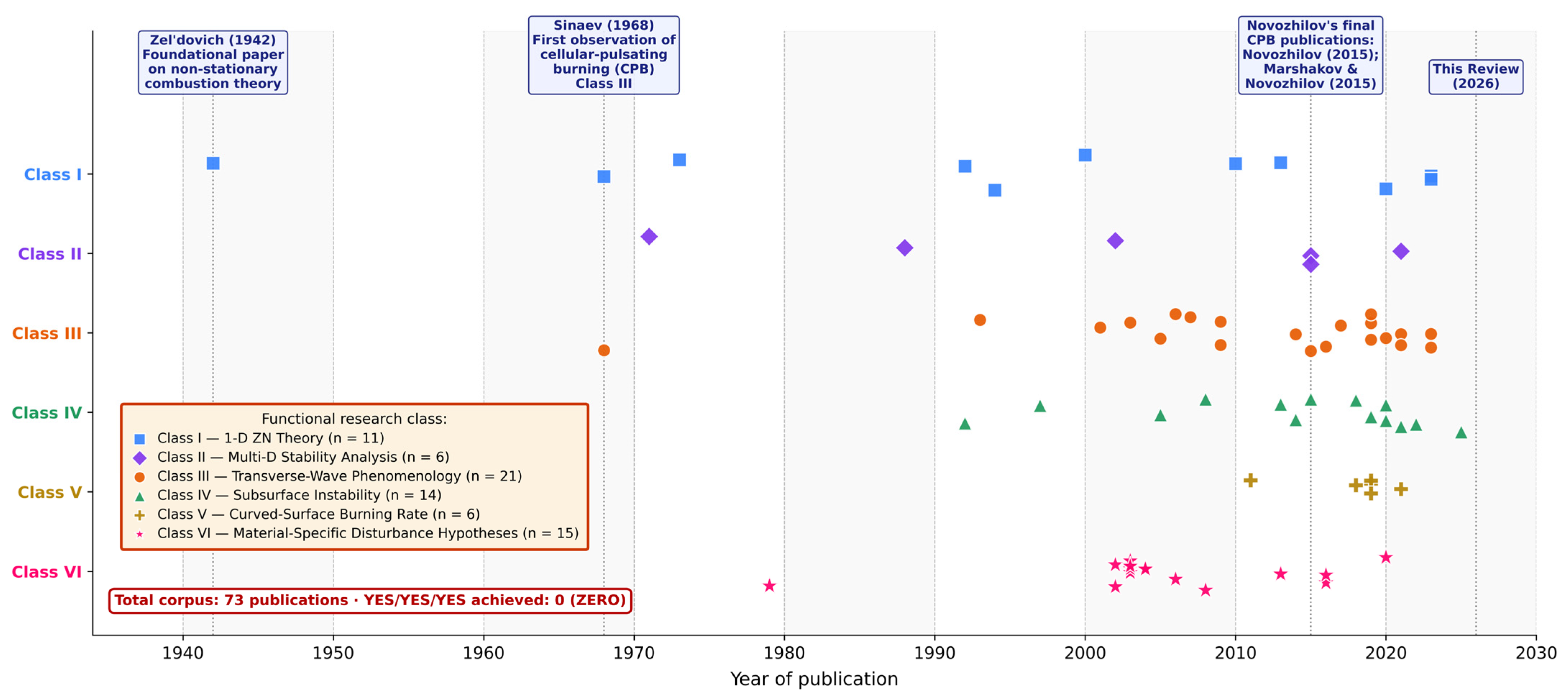
Figure 3.
Timeline of the 73-publication classified corpus (1942–2025), distributed across the 6 functional research classes (I–VI; symbol shapes and colors identified in the legend). Vertical dotted lines mark 4 key events: the foundational Zel’dovich publication (1942) [20]; the first documented observation of cellular-pulsating burning by Sinaev (1968) [3]; the date of B.V. Novozhilov’s final publication on the topic (2015), the principal architect of the ZN framework [4,7]; and the present classification (2026). No publication in any class achieves a simultaneous YES on all three diagnostic criteria.
Starting from conservation equations for the condensed phase and matching conditions at the burning surface, the ZN theory derives the conditions under which a steadily burning 1-dimensional front becomes temporally unstable and predicts the frequency and growth rate of the resulting pulsations. The practical outcome—expressed in terms of dimensionless sensitivity parameters k and n—provides engineers with a tractable criterion for predicting pulsating behavior. This criterion has been validated across numerous propellant systems and remains in routine engineering use.
Class I contains 11 classified publications: Zel’dovich (1942) [20]; Novozhilov (1968, 1973, 1992, 1994, 2000) [22,23,24,25,26]; Novozhilov and Novozhilov (2020) [15]; Zarko and Gusachenko (2010) [27]; Wang et al. (2023) [28]; Rashkovskiy (2023) [29]; and Larionov (2013) [30].
The ZN framework is 1-dimensional by construction: its spatial domain is the single coordinate perpendicular to the burning surface. The concept of a cellular pattern—requiring lateral variation across the surface—is not representable within this geometry. The structural limitation was stated most directly by Zarko and Gusachenko [27]: the impropriety of extending the purely 1-dimensional approach to the instability region is explicitly noted in their review. The assessment is S = NO; U = NO; C = NO for all 11 publications.
3.2. Class II: Multidimensional Linear Stability Analysis (Six Publications)
The founding contribution is the 1971 paper by Makhviladze and Novozhilov [31], which performed the first 2-dimensional stability analysis of a condensed-phase combustion system and showed that spatial modes can be less stable than the planar mode. Subsequent work by Margolis and Williams [32] applied a diffusional–thermal instability framework to solid propellants, obtaining mode spectra dependent on material-specific activation energies. Novozhilov [7], in the final publications of his career, extended the multidimensional linear analysis to cylindrical samples, obtaining a spectrum of unstable hotspot modes; the same paper compares predicted and observed hotspot dimensions, finding that classical thermal models deviate from experiment by factors of 4–15. The 2015 experimental comparison paper [4] confirmed this discrepancy quantitatively. Gurram and Chakravarthy [33] provided the first experimental validation of diffusional–thermal instability for AP-based composites at 7–15 MPa, finding material-specific parameter dependence; Kurdyumov and Gubernov [34] extended the analysis to full 3-dimensional non-linear simulations in cylindrical geometry. The most explicitly interdisciplinary paper in the entire corpus, applying the Prigogine–Haken synergetics framework to combustion self-organization [35], also belongs to this class; it derives a critical Damköhler number for cellular combustion transition and computes cell dimensions but addresses gas-phase combustion only and does not extend to solid-propellant cellular-pulsating burning.
Linear stability analysis can identify which modes are potentially unstable but cannot follow the non-linear evolution that selects and saturates a specific cellular pattern from a smooth initial surface. Novozhilov [7] stated the following explicitly: in linear approximation it is impossible to single out a specific mode which in the course of its time evolution will lead to a real system of oscillating hotspots. The assessment is S = PARTIAL; U = NO or PARTIAL; C = NO for all six publications.
3.3. Class III: Transverse-Wave Phenomenology and Critical-Diameter Correlations (21 Publications)
Class III encompasses the most extensive experimental and phenomenological program on cellular-pulsating burning in existence, developed primarily by Marshakov and colleagues over more than 2 decades. Its contributions are indispensable to the field and provide the quantitative benchmarks against which all theoretical approaches in this review are assessed. The class contains 21 publications: Sinaev (1968) [3]; Melik-Gaikazov (1993) [36]; Ananiyev et al. (2001) [2]; Marshakov, Istratov and Puchkov (2003) [37]; Rashkovskiy (2005) [38]; Istratov and Marshakov (2006) [18]; Marshakov and Istratov (2007) [11]; Romanov et al. (2009) [39]; Marshakov, Kolesnikov-Svinarev and Finyakov (2009) [40]; Marshakov, Krupkin and Mokhin (2014) [1]; Marshakov and Novozhilov (2015) [4]; Marshakov (2016) [5]; Marshakov and Finyakov (2017) [12]; Mikhailov, Kalmykov and Alyoshin (2019) [41]; Krupkin, Marshakov and Rashkovskiy (2019) [42]; Marshakov, Krupkin and Rashkovskiy (2020) [16]; Krupkin, Marshakov and Rashkovskiy (2019) [17]; Marshakov and Melik-Gaikazov (2021) [14]; Arkhipov et al. (2023) [43]; Finyakov, Krupkin and Marshakov (2021) [44]; and Marshakov and Krupkin (2023) [10].
The principal quantitative contributions of Class III are: the pressure scaling Lm = 2.6 · p−0.76 valid over 1–60 atm [10]; surface wave speeds Vr = 0.85–3.4 mm/s [5]; secondary wave ignition time ti = 0.7 s with a range of 0.56–1.0 s [4]; and a critical diameter Dcr ≈ 3 Lm. Marshakov and Melik-Gaikazov [14] provide the most direct multi-material universality evidence in the entire corpus: HMX local velocity data fall within the same ±1.65·Uav band as propellants NB and N. Arkhipov et al. [43] document oscillatory burning rates at 8–12 Hz during pressure drop—the most direct temporal fingerprint of cellular-pulsating burning in the corpus. Thermocouple measurements of the thermal-wave structure at elevated pressures [44] extend the Class III quantitative database to pressure regimes above atmospheric, establishing that the kinematic and thermal benchmarks assembled in this class apply consistently across the full experimental pressure range of the corpus.
The percolation-based model of Rashkovskiy [38] achieves partial agreement with cellular scaling but requires a pre-assigned focal structure rather than deriving it from uniform initial conditions.
The most striking single quantitative result in the entire corpus is found in [4]: the directly measured mean ignition time of secondary transverse waves, ti = 0.7 s, compared with the thermal diffusion time of approximately 40 s at the 2 mm inter-wave scale—a local discrepancy factor of approximately 57, independently confirming the 4-order-of-magnitude barrier identified in Section 2.3. The phenomenological model describes what transverse waves do after they exist but provides no mechanism for why they arise spontaneously on a smooth surface. Marshakov and Novozhilov [4] stated the following: the origin of perturbations deserves separate analysis. The assessment is S = NO; U = PARTIAL; C = NO for all 21 publications.
3.4. Class IV: Condensed-Phase Subsurface Instability and Thermal Explosion (14 Publications)
Class IV provides the theoretically most rigorous results in the prior literature on the inevitability of pulsating behavior. Its 14 publications are: Gusachenko, Zarko and Rychkov (1997) [45]; Gusachenko and Zarko (2005) [46]; Gusachenko and Zarko (2008) [47]; Krupkin, Mokhin and Khalturinskiy (2013) [48]; Krupkin and Mokhin (2014) [49]; Krupkin and Mokhin (2015) [50]; Marshakov and Frost (2018) [51]; Krupkin and Mokhin (2019) [52]; Kurdyumov and Gubernov (2020) [53]; Alymov, Rubtsov and Sepliarsky (2020) [54]; Krupkin and Mokhin (2021) [55]; Gusachenko, Zarko and Kiskin (2022) [56]; Krupkin and Mokhin (2025) [57]; and Zanotti et al. (1992) [58].
Gusachenko, Zarko and Rychkov [45] proved rigorously that combustion waves with a subsurface temperature maximum are absolutely unstable. Krupkin and Mokhin [50] first proposed, from an approximate energy-balance estimate, that a critical surface temperature Tcr separates steady one-dimensional burning from an unsteady pulsating regime; the authors describe this relation explicitly as approximate, with its temperature-dependent coefficient to be fixed empirically. Krupkin and Mokhin [52] subsequently gave a non-linearized proof that the ratio ta/th < 1 holds universally, establishing the pulsating mode as a robust thermodynamic attractor of the 1-D dynamics.
Krupkin and Mokhin [55] analyzed the ignition conditions of solid propellants by a heated surface and demonstrated that ignition hotspots necessarily form at a subsurface depth of approximately 1.5 thermal explosion length units from the surface, regardless of surface geometry and initial temperature.
Gusachenko and Zarko [46] is particularly noteworthy because the paper itself uses the term “cross-surface combustion waves” to describe what the transverse waves of cellular-pulsating burning are, explicitly connecting Class IV thermal explosion theory to Class III phenomenology—while remaining structurally 1-D. Krupkin and Mokhin [57] document period-doubling and chaos in 1-D pulsating combustion via a Feigenbaum-type route, representing the richest 1-D dynamical result in the corpus.
All results are obtained in one spatial dimension or for isolated axisymmetric geometries. Krupkin and Mokhin [55] provided the most direct self-admission in the entire 73-publication corpus: the description of such a non-stationary combustion regime is beyond the scope of this paper, requires accumulation of experimental data, and development of the corresponding multidimensional models. The assessment is S = NO; U = NO; C = NO for all 14 publications.
3.5. Class V: Burning-Rate Theory for Curved Surfaces (Six Publications)
Class V contains six publications: Rashkovskiy (2011) [59]; Rashkovskiy (2018) [60]; Krupkin, Marshakov and Rashkovskiy (2019) [61,62,63]; and Rashkovskiy, Krupkin and Marshakov (2021) [13].
Rashkovskiy [59] derived the Michelson–Markstein burning-rate relation Z = exp(−2kK0/Z) for solid-propellant combustion, relating the dimensionless local burning rate to the dimensionless surface curvature. Experimental confirmation across multiple materials and pressure conditions is provided in [61,62,63].
The overview [13] represents the most comprehensive prior synthesis of experimental and theoretical knowledge on cellular-pulsating burning in existence.
The curvature-rate relation is pointwise and local: it gives the burning rate at a point given the curvature at that point, with no account of how a smooth, flat surface spontaneously develops periodic curvature with the universal scale L/δh ≈ 10–15. Class V describes the surface response to curvature but provides no derivation of why curvature appears. Rashkovskiy, Krupkin and Marshakov [13] stated that a complete theoretical description of spontaneous pattern formation is not yet available. This statement constitutes the Class V program’s own assessment of where it stands. The assessment is S = NO; U = PARTIAL; C = NO for all six publications.
3.6. Material-Specific Disturbance Hypotheses and Lukin Program (15 Publications)
Class VI is the only category that proposes specific physical mechanisms for spontaneous perturbation generation, and it is therefore the only category in which Criterion S receives a partial affirmative assessment. Its 15 publications span from Vishnivetskiy, Rozenband and Belyaev (1979) [64] through Chuiko (2016) [6] and the Lukin program (2002–2020) [65,66,67,68,69,70,71,72,73,74,75,76,77].
Vishnivetskiy, Rozenband and Belyaev [64] describe material-specific non-steady burning at low pressures, proposing a mechanism restricted to a specific propellant class. Chuiko [6] proposed that pulsating combustion of double-base propellants arises from boiling of volatile liquid components in the near-surface layer—a physically specific and experimentally grounded mechanism but one that is structurally inaccessible to purely solid EMs such as RDX, HMX, and TATB, in which no liquid volatile components are present.
The Lukin program, developed across multiple conference proceedings and journal publications from 2002 onward [65,66,67,68,69,70,71,72,73], proposes thermo-electric convection in the liquid-viscous layer (LVL)—the partially decomposed near-surface layer first identified by Zhukov [78]—toroidal vortex microstructures, and electromagnetic self-synchronization as driving forces for cellular pattern formation. The key journal publications are [73,74,75,76,77]. The 2016 publication [76] introduces explicit electromagnetic self-synchronization concepts, referencing the theoretical framework of coupled non-linear oscillators [79], and frames cellular-pulsating burning within the language of self-organizing systems in active media. These mechanisms are physically plausible for EMs forming ionic melt layers, and this physical plausibility is the reason for S = PARTIAL. However, the restriction to ionic LVL materials makes cross-material universality (Criterion U) structurally unaddressable: cellular-pulsating burning occurs in RDX, HMX, and TATB with the same scaling law as in double-base propellants, yet these materials form no ionic liquid layer. The 4-order-of-magnitude coordination timescale discrepancy (Criterion C) remains unresolved in all 15 publications.
The assessment is S = PARTIAL (for double-base and ionic LVL materials only); U = NO; C = NO for all 15 publications.
3.7. Aggregate S/U/C Outcome Across All Six Classes
Table 2 summarizes the aggregate S/U/C diagnostic outcome for each of the six research classes. The result is unambiguous: no class achieves simultaneous YES on all three criteria. The Criterion C column is NO across all six classes without exception—the direct and necessary consequence of the diffusive transport axiom identified in Section 4. The complete per-publication assessment is provided as Table S1 in the Supplementary Materials, where the rationale for each individual classification decision is documented.
Table 2.
Aggregate S/U/C diagnostic outcomes for the 6 functional research classes assessed against three independent diagnostic criteria (73 classified publications, 1942–2025). The representative self-admission statement—an explicit acknowledgement by the leading investigator(s) of each class of the approach’s structural limitation—is cited for each class. Result: 0 of 6 classes (0%) achieve a simultaneous YES on all 3 criteria. The Criterion C column is NO for all 6 classes without exception, constituting a structural impossibility rather than a quantitative shortfall. Five genuine self-admissions appear in Classes I–V; Class VI assessment is the author’s characterization—see Section 4.3.
Figure 4 provides a graphical summary of both the publication count per class and the S/U/C diagnostic outcome distribution across all six classes, making the complete absence of YES assessments in the Criterion C column visually explicit.
Figure 4.
Quantitative summary of the 73-publication classified corpus. Panel (a): publication count per research class (I–VI); Class III contains the largest sub-corpus (21 publications). Panel (b): S/U/C diagnostic outcome distribution per class, color-coded as green (YES), amber (PARTIAL), and blue (NO). The complete absence of green in the Criterion C column across all 6 classes—the direct consequence of the diffusive transport axiom identified in Section 4—constitutes the central finding of this systematic classification.
6. Key Mathematical Formulations Underpinning the Diagnostic Framework
This section gathers the principal quantitative relationships that define and bound the three diagnostic criteria (S, U, and C) established in Section 2, identifies the foundational governing equations of each research class, and makes concrete the four-orders-of-magnitude barrier derived in Section 4 and Section 5. All equations are presented in a form that permits direct verification from the experimental record cited in Section 2 and Section 3. Table 3 provides a consolidated index of these equations, cross-referenced to their physical content and to the diagnostic criterion (S, U, or C) each one bears on.
Table 3.
Principal mathematical relations of Section 6, their physical content, and their role in the three-criterion diagnostic framework. Equation numbers correspond to numbered display equations in Section 6. S = Criterion S (spontaneous pattern formation); U = Criterion U (material-independent scaling); C = Criterion C (millisecond spatial coordination). The central result of the diagnostic framework—the four-orders-of-magnitude barrier Γ = tdiff/tobs = 4 × 10⁴—is expressed in Equations (2), (3) and (5).
6.1. The Coordination Timescale Inequality (Criterion C)
The three physically distinct timescales governing information transport across a separation distance d = 10 mm in the solid-propellant condensed phase satisfy the strict ordering
The thermal diffusion timescale at condensed-phase thermal diffusivity α ≈ 10−7 m2 s−1 is
The observed inter-cell coordination timescale, established by direct thermocouple measurement [4], is
The acoustic transit timescale at condensed-phase sound velocity vac ≈ 1500 m s−1 is
The discrepancy ratio—the core quantitative result of this classification—is
This ratio of 4 × 10⁴ (four orders of magnitude) is the “barrier” referenced throughout this paper. It is a structural consequence of the parabolic character of the heat equation and is not removable by any parameter adjustment within a diffusion-based framework.
Local-scale confirmation. The same barrier is independently confirmed at the 2 mm scale by the measured secondary transverse wave ignition time [4] against the thermal diffusion time , giving a local discrepancy factor:
Condensed- and gas-phase chemical kinetics for these EMs operate on microsecond-or-shorter timescales at the relevant surface temperatures, consistent with the activation energy and Zel’dovich number parameters discussed in Section 6.6, and are therefore not the rate-limiting step in the 20–40 ms coordination timescale of Criterion C: the four-orders-of-magnitude gap identified in Equation (26) is a transport discrepancy between the diffusion timescale and the required signal speed, not a kinetic one.
6.2. The Pressure-Scaling Law and Dimensionless Hotspot Scale (Criterion U)
The general pressure-scaling law for the mean hotspot dimension Lm [10] is
where p is combustion pressure in atm and Lm is in mm. Three benchmark correlations are established from the experimental record across multiple EMs [4,5,18]:
Equations (29) and (30) are for propellants NB and N, respectively [4,18,39,40]; Equation (31) is the unified cross-material correlation valid over the widest pressure range in the experimental record [10].
The thermal layer thickness δh—the characteristic length scale of the condensed-phase heat diffusion zone—is defined as
where is the steady-state linear burning rate. The dimensionless hotspot scale is the decisive discriminator between experimental observation and classical theory prediction: [2,7,10,13,16,17]
The factor-of-4-to-15 discrepancy between Equations (33) and (34) constitutes the quantitative content of Criterion U: not a single theoretical class derives the experimentally observed ratio from first principles [7,15].
6.3. The Effective Diffusivity Gap and Minimum Signal Speed
To satisfy Criterion C, a coordinating mechanism must transport information across d = 10 mm within tobs = 20–40 ms. The effective diffusivity required for this coordination is
The gap factor between the required and actual thermal diffusivity is
The minimum required signal propagation speed for any mechanism that could satisfy Criterion C is
For comparison, acoustic propagation covers in
Acoustic transit is more than three orders of magnitude faster than the observed coordination timescale (38), establishing that acoustic-speed mechanisms are physically compatible with Criterion C, while thermal diffusion (23) falls short by four orders of magnitude (26). The gap expressed by Equations (35) and (36) cannot be closed by any adjustment of thermal or chemical parameters within a parabolic heat equation framework because non-linearity changes the amplitude of solutions but not their parabolic transport character.
6.4. The Zel’dovich Burning Rate Formula (Class I)
The foundational one-dimensional burning rate formula, which defines the mass flux density through the condensed-phase combustion zone and forms the basis of all Class I publications [20], is
where λ is the thermal conductivity of the condensed phase, Q is the heat of decomposition, Ws is the condensed-phase reaction rate evaluated at the surface temperature Ts, R is the universal gas constant, E is the activation energy, and ΔH is the enthalpy difference between burned and unburned states. This formula defines the steady-state burning rate as a function of condensed-phase thermochemical parameters only. It contains no spatial coordinate other than the one perpendicular to the burning surface and no transverse variable of any kind. All Class I publications extend and apply Equation (39) within this one-dimensional geometry; none introduces a lateral spatial coordinate. The structural incompleteness of Class I with respect to Criteria S and C follows directly from the geometry of Equation (39).
6.5. The Michelson–Markstein Curvature-Rate Relation (Class V)
The dimensionless local burning rate Z = u/U at a point of dimensionless curvature K0 on the burning surface, derived by Rashkovskiy [59] and confirmed experimentally [61], is
where k is the ZN dimensionless pressure sensitivity parameter and K0 is the dimensionless curvature. Equation (40) correctly describes how the local burning rate responds to a prescribed surface curvature, but it is strictly pointwise and local: it takes as a given input at a specific surface point and returns the local burning rate at that point. It contains no mechanism by which a smooth, flat burning surface ( everywhere) could spontaneously develop the spatially periodic curvature pattern observed in cellular-pulsating burning. The Criterion S failure of Class V follows directly from this local character of Equation (40): the equation describes the response to existing curvature but cannot generate or predict the emergence of curvature from uniform initial conditions.
6.6. The Zel’dovich Number and Absolute Instability Criterion (Classes I and IV)
The Zel’dovich number β—the dimensionless activation energy parameter central to the stability criteria of both Class I and Class IV—is
where Tf is the adiabatic flame temperature and T0 is the initial propellant temperature. For solid-propellant combustion, the representative value is β = 7–8 [53]. The Zel’dovich number controls the onset of pulsating instability in the one-dimensional thermal model: a sufficiently large drives the steady-state solution away from its thermal diffusion attractor.
The absolute instability criterion derived by Krupkin and Mokhin [52] for burning waves with a subsurface temperature maximum is
where ta is the adiabatic thermal explosion time at the subsurface temperature maximum and th is the characteristic heat-diffusion time in the condensed phase. This generalizes the critical-temperature estimate Ts/Tcr first proposed by the same authors [50]. Equation (42) establishes rigorously that all burning waves with a subsurface temperature maximum are absolutely unstable—the pulsating mode is a thermodynamic inevitability, not a contingent outcome of initial conditions. This is the deepest analytical result of Class IV. However, like Equation (39), both (41) and (42) are formulated in one spatial dimension: the subsurface instability is proved as a one-dimensional pulsation attractor, and the transition from this one-dimensional pulsation to the two-dimensional cellular pattern observed experimentally requires additional physics not present in Equation (42). This is the structural gap acknowledged explicitly in the self-admission of Krupkin and Mokhin [55].
7. Logical Constraints on a Complete Theory: What the Classification Requires
Section 3, Section 4, Section 5 and Section 6 together establish that every prior theoretical category shares a single unstated structural assumption that makes one diagnostic criterion permanently unreachable within any framework that carries it. The present section draws the logical consequences of this result. The approach is deductive: each of the three diagnostic criteria, combined with the demonstrated inadequacy of all known classical mechanisms for satisfying it, generates a necessary condition on the physics that any complete theory must contain.
These conditions are necessary, not sufficient: they eliminate any candidate theory that violates them without guaranteeing the correctness of any theory that satisfies them. They therefore define a rigorous evaluative framework against which proposed theoretical approaches can be assessed independently of their internal details.
7.1. Constraint 1 (From Criterion C): Wave-Speed Physics Is Required
Constraint 1: The coordinating mechanism must operate at acoustic or near-acoustic propagation speeds.
The quantitative argument is exact. Criterion C requires coordination across d = 10 mm within tobs = 20–40 ms, corresponding to a minimum required propagation speed of vreq = 0.40 m s−1 [Equation (37)]. Thermal diffusion over the same distance requires tdiff ≈ 1000 s [Equation (23)], falling short of the required timescale by a factor of Γ = 4 × 10⁴ [Equation (26)]. As demonstrated in Section 4.2 and quantified in Equations (35) and (36), the effective diffusivity gap between what is required (αeff,req ≈ 5 × 10⁻³ m2 s−1) and what thermal diffusion can provide (α ≈ 10−7 m2 s−1) is approximately 50,000-fold (~4.7 orders of magnitude), and this gap is a property of the parabolic character of the heat equation that is preserved under all non-linear extensions. No adjustment of thermal or chemical parameters within any diffusion-based framework can close it.
Sound velocities in homogeneous EM condensed phases lie in the range of 1000–2000 m s−1, giving acoustic transit times of 5–10 μs over d = 10 mm [Equation (25)]—three orders of magnitude shorter than tobs and therefore comfortably compatible with the observed coordination timescale. Constraint 1 eliminates all six prior research categories simultaneously, because all six operate exclusively within the diffusive transport axiom identified in Section 4.
7.2. Constraint 2 (From Criterion U): The Organizing Principle Must Depend on Material-Invariant Physical Parameters
Constraint 2: The physical parameter that determines hotspot dimensions must be approximately conserved across all classes of homogeneous EMs.
This constraint follows directly from the experimental content of Criterion U: the dimensionless ratio L/δh = 10–15 [Equation (33)] is observed across double-base propellants, nitroglycerin compositions, RDX, HMX, AP-based composites, and TATB, despite order-of-magnitude differences in thermal conductivity, flame temperature, and chemical reaction rate constants between these materials. As noted in Section 2.2, the measurements underlying this constraint derive predominantly from a single research group; the constraint should accordingly be read as consistent with all measurements reported to date, pending independent replication. A mechanism whose characteristic length scale depends on thermal conductivity or chemical kinetics would produce material-specific scaling, in direct contradiction to the experimental record.
Acoustic impedance Z = ρvac—the product of condensed-phase density and sound velocity—is the physical parameter that most closely satisfies this constraint. Across the class of homogeneous EMs, acoustic impedance varies by a factor of approximately 1.5–2, while thermal conductivities vary by an order of magnitude or more and chemical rate constants by many orders of magnitude. A coordinating mechanism governed primarily by acoustic impedance would therefore naturally produce the observed material-independent scaling without empirical fitting for individual materials. Constraint 2 is independent of Constraint 1—it addresses the physical quantity governing the length scale of the pattern, not the speed at which information propagates to organize it.
7.3. Constraint 3 (From Criterion S): An Intrinsic Self-Organizing Mechanism Is Required
Constraint 3: The mechanism must contain an intrinsic source of spatial symmetry-breaking, capable of selecting a preferred length scale from uniform initial conditions consistent with L/δh ≈ 10–15.
This constraint follows from the experimental content of Criterion S: cellular structures emerge on nominally smooth, chemically homogeneous burning surfaces without pre-existing perturbations. A theory that requires a pre-specified perturbation as input—whether a surface roughness, a material inhomogeneity, or a randomly assigned initial condition—cannot derive the phenomenon from first principles and therefore cannot be considered a complete explanation.
Satisfying Constraint 3 requires a spatially extended instability that has an intrinsic preferred length scale and a non-linear saturation mechanism that selects and stabilizes a specific cellular pattern from among the unstable modes. The theoretical language for this class of problem—self-organizing systems driven far from equilibrium—is well established in condensed-matter physics and non-linear science [94]. Its central result, in the context of this constraint, is that spontaneous pattern formation with a specific wavelength requires a feedback mechanism that amplifies perturbations at a preferred scale while suppressing perturbations at other scales. This conceptual framework has been applied extensively to chemical, hydrodynamic, and biological pattern formation [94] but has not previously been applied to solid-propellant combustion. Constraint 3 is independent of both Constraints 1 and 2: it addresses the mechanism by which a specific length scale is selected and stabilized, not the speed of coordination or the material invariance of the scale.
7.4. Mutual Consistency of the Three Constraints and Their Evaluative Role
The three constraints are mutually consistent and, taken together, define the class of physical frameworks within which a complete theory must be sought. Constraint 1 specifies the required propagation speed (acoustic); Constraint 2 specifies the required governing parameter (approximately material-invariant, acoustic impedance being the leading candidate); and Constraint 3 specifies the required dynamical character (self-organizing, with intrinsic length-scale selection). Any theoretical framework that simultaneously satisfies all three constraints operates through physics that propagates at acoustic speeds, is governed by parameters approximately conserved across all homogeneous EMs, and contains an intrinsic mechanism for spatial symmetry-breaking from uniform initial conditions.
The three constraints are also mutually reinforcing in an important sense: a framework capable of satisfying Constraint 1 (wave-speed physics) already provides conceptual resources that are naturally relevant to Constraints 2 and 3, since wave-based phenomena are characterized by impedance parameters and can generate spatially periodic standing structures with wavelengths set by wave properties. This mutual consistency does not constitute a proof that any specific framework is correct—it means only that the three constraints are compatible with each other and collectively define a coherent class of physical approaches.
Crucially, these constraints function as a falsification criterion for any proposed complete theory of cellular-pulsating burning: a theory that violates Constraint 1 can be excluded on timescale grounds alone, without detailed calculation; a theory that violates Constraint 2 can be excluded on universality grounds; and a theory that violates Constraint 3 can be excluded on pattern-formation grounds. The classification presented in Section 3 and Section 4 shows that all six prior research categories are excluded by Constraint 1 alone—and that this exclusion is structural, not technical. The constraints therefore do not merely summarize the limitations of prior work: they define what any new work must achieve.
Two clarifications follow directly from this formulation. First, these constraints are stated at the level of a physical mechanism rather than a solution method and apply equally to analytical, continuum-CFD, and data-driven (e.g., physics-informed machine-learning) approaches: any of these techniques can in principle satisfy Constraints 1–3 if the underlying model includes a coordinating physical process operating at or near acoustic speed, and none can satisfy them if the underlying model—regardless of how it is solved numerically—relies solely on the diffusive transport axiom identified in Section 4.1. Second, a propagating pressure or stress perturbation could in principle modulate the local reaction rate at a neighboring surface site through the same pressure sensitivity coupling already captured, in the temporal domain, by the k and n parameters of the Zel’dovich–Novozhilov formulation (Section 6.4); establishing this concretely for the spatial, inter-cell case is a task for future theoretical and experimental work and is not undertaken in the present classification.
8. Discussion: Implications of the Systematic Classification
The findings of this systematic classification carry implications at four distinct levels: for the theoretical tradition that has dominated the field for 6 decades; for the direction and requirements of future theoretical work; for engineering practice in solid-propellant propulsion and EM development; and for the self-understanding of the research community regarding the nature and persistence of structural barriers in specialized scientific fields. Each level is addressed in turn.
8.1. Implications for the Zel’dovich–Novozhilov Tradition: A Question of Scope, Not Error
The central finding of this classification—that no prior theoretical approach satisfies all three diagnostic criteria simultaneously—should not be interpreted as a criticism of the ZN tradition or of any of the individual research programs classified in Section 3.1, Section 3.2, Section 3.3, Section 3.4, Section 3.5 and Section 3.6. Such an interpretation would be factually incorrect and would miss the deeper point of the analysis.
The ZN framework correctly describes everything it was designed to describe. The stability criteria derived by Novozhilov [15,22,23,24,25,26], the non-steady burning rate relations [23,24], and the acoustic response functions built on the ZN foundation have been validated across a wide range of propellant systems and remain in productive engineering use. These are genuine, non-trivial scientific achievements. The Class III experimental program [2,3,4,5,6,10,36,37,38,39,40,41,42,43] produced the most detailed kinematic and thermal characterization of cellular-pulsating burning in existence, accumulating the quantitative benchmarks—the pressure-scaling laws [Equations (28)–(31)], the characteristic coordination timescales [Equation (24)], and the dimensionless ratio L/δh [Equation (33)]—against which all theoretical approaches including future ones must be assessed. Without this program, the diagnostic framework of the present review could not have been constructed.
What the classification reveals is not that the ZN tradition is wrong but that it is incomplete in a specific and precisely characterizable way: it was designed for one spatial dimension and never claimed to solve the two-dimensional cellular pattern-formation problem. The structural limitation identified in Section 4—the diffusive transport axiom—is not an error introduced by any individual investigator. It is a natural consequence of the physical domain that the ZN framework was built to address, inherited into every subsequent extension because none of those extensions ventured outside that domain. Identifying the limitation is therefore an act of clarification, not a critique. The self-admissions assembled in Section 4.3—written by the leading representatives of five of the six research categories—confirm that the investigators themselves recognized the limitation; what was missing was not the awareness of incompleteness but the identification of its structural cause.
The argument of this paper is that the structural cause has now been identified. The 60-year research program produced, in the course of reaching its logical limit, precisely the experimental database and the diagnostic framework needed to recognize what a complete theory must do differently. In this sense, the classification presented here is built on the ZN tradition rather than against it.
8.2. Implications for Future Theoretical Work: Necessary Conditions and the Interdisciplinary Pathway
The three constraints derived in Section 7 define the minimum physics that any complete theory of cellular-pulsating burning must contain. The following restates them in the language of a research program.
Any candidate theory must demonstrate, from first principles, that a coordinating signal propagates between cells at a speed of at least 0.40 m s−1 over 10 mm (Constraint 1); that the resulting hotspot length scale depends primarily on physical parameters approximately conserved across all homogeneous EMs, of which acoustic impedance is the leading quantitative candidate (Constraint 2); and that the pattern arises spontaneously from uniform initial conditions through an intrinsic symmetry-breaking mechanism with a preferred length scale consistent with L/δh ≈ 10–15 (Constraint 3). The theoretical language for this last requirement—the general framework of self-organizing systems driven far from equilibrium—is mature and well-established in condensed-matter and non-linear physics [94] and has been applied extensively to chemical, hydrodynamic, and biological pattern formation. Acoustic-based instabilities, in particular, exhibit precisely the combination of wave-speed propagation, impedance-dependent length scales, and intrinsic symmetry-breaking that the three constraints require. The fact that this conceptual vocabulary was available in the condensed-matter literature throughout the period under review, while oscillating combustion phenomena in entirely different experimental systems had already been shown to exhibit indirect mechanical coupling mediated by the surrounding medium [93], makes the 60-year interdisciplinary gap identified in Section 5.5 all the more striking in retrospect.
Within the prior classification, the research program closest to identifying the relevant physics is arguably Class V (the Michelson–Markstein curvature-rate program [13,58,59,60,61,62]), which correctly identifies surface curvature as the local physical variable connecting the burning rate to spatial geometry and which comes nearest to Criterion U. The limitation of Class V—that Equation (40) is pointwise and local—defines precisely what a more complete curvature-based approach would need to add: a mechanism by which spatially extended curvature patterns arise and coordinate spontaneously from a flat surface. The Class VI program (the Lukin program, [65,66,67,68,69,70,71,72,73,74,75,76,77]) constitutes the sole prior attempt to seek a coordinating mechanism outside classical thermal-diffusion physics, though it is restricted to materials forming an ionic LVL, which prevents satisfaction of Criterion U across all homogeneous EMs. Its conceptual contribution—demonstrating that the search for such a mechanism is physically legitimate and technically tractable—deserves recognition as a step in the direction of the interdisciplinary pathway.
The present systematic review provides the evaluative framework against which any proposed mechanism of inter-cell coordination should be assessed: the three constraints of Section 7 are the necessary evaluation criteria against which any proposed complete theory of cellular-pulsating burning should be assessed.
The claim that the findings of this review constitute a paradigm shift in the sense of Kuhn (1962) [95] deserves explicit defense, because the term is frequently used in scientific writing as rhetorical emphasis rather than technical description. The present case, however, fits the Kuhnian schema with unusual precision. Normal science within the ZN tradition operated according to an implicit axiom—the diffusive transport axiom—that was never stated as such, never subjected to empirical challenge, and never identified as a limiting assumption. Under this axiom, a large and productive research program accumulated. Anomalies accumulated in parallel: the four-orders-of-magnitude discrepancy identified in Criterion C, the five categories of published self-admissions assembled in Section 4.3, and the persistent failure of successive refinements to close the gap. The defining feature of a Kuhnian pre-crisis period is precisely this structure: anomalies are documented, acknowledged, and set aside, because the dominant framework provides no mechanism for resolving them. The present systematic classification makes that structure visible by assembling the self-admissions in one place and demonstrating that they share a common structural cause. The shift proposed—from a diffusion-based, one-dimensional framework to a wave-based, pattern-formation framework—is not a quantitative refinement of the existing paradigm but a replacement of its organizing physical principle. This is what distinguishes a paradigm shift from incremental progress, and it is this distinction that justifies the characterization in the title of the companion publication.
The three constraints of Section 7 generate specific, independently testable predictions that do not depend on the correctness of any particular candidate theory. From Constraint 1, any complete theory must produce a coordinating signal propagating at no less than 0.40 m s−1 over inter-cell distances of 10 mm; this implies that experimental interventions that modify the physical conditions at the burning surface—while leaving the thermal properties of the propellant unchanged—should produce a measurable shift in cellular pattern dimensions. From Constraint 2, if acoustic impedance Z is the material-invariant governing parameter for hotspot scale, then materials differing primarily in acoustic impedance while matched in thermal properties should exhibit proportionally different characteristic hotspot dimensions Lm at comparable reduced pressures. This prediction is testable against the existing Class III dataset without new experiments: the acoustic impedance values of double-base propellants, RDX, HMX, AP-based composites, and TATB differ measurably, and the corresponding Lm values are available from [4,10,16]. A correlation of the form Lm ∝ Zn should emerge if Constraint 2 is correct; its absence would falsify the acoustic impedance hypothesis while leaving the constraint itself intact. From Constraint 3, the dimensionless ratio L/δh ≈ 10–15 should be recoverable as a derived quantity from the physical mechanism, not merely imposed as a fitting parameter. These predictions are stated here explicitly so that they can be evaluated independently of the companion publication.
The most predictable objection to the central argument of this paper is the following: every one of the 73 classified publications acknowledges its own limitations and the incompleteness of existing theories has therefore long been known, so in what sense does the present classification constitute new knowledge? The answer is that there is a categorical difference between knowing that individual theories are incomplete and knowing that all theories are incomplete for the same structural reason and that this shared reason is precisely characterized. Prior to this classification, the pattern of failures was interpretable as a collection of independent dead-ends, each arising from the particular modeling choices of a given research group. The classification reveals that the pattern is not independent: five research traditions, using different mathematical methods over more than 6 decades, all reached the same boundary, Criterion C, and reached it for the same reason, namely that no diffusion-based framework can propagate influence at the required speed regardless of how the equations are extended or refined. This convergence is not a coincidence; it is a structural constraint imposed by the parabolic character of the governing equations. Knowing that a shared structural cause exists is qualitatively different from knowing that each theory has limitations: it tells investigators exactly what the next theory must do differently, rather than merely that it must do better. The three constraints of Section 7 are the direct formal expression of this knowledge.
The Lukin Program: What It Did Correctly, and the Distance to a Complete Theory
The Class VI research program (Lukin et al. [65,66,67,68,69,70,71,72,73,74,75,76,77]) occupies a singular position in the classified corpus. It is the only program among the 73 that explicitly sought a coordinating mechanism outside classical thermal-diffusion physics. This was the correct methodological diagnosis: Lukin and collaborators identified, earlier than any other group, that the ZN framework could not, in principle, account for spatial coordination at the observed timescale and that a different physical mechanism was required. The physical candidate they proposed—an ionic LVL at the burning surface generating an electroacoustic field—represents a genuine attempt to supply the coordinating mechanism that all other program implicitly assumed unnecessary. This conceptual contribution deserves explicit recognition: the Lukin program established that the search for a non-diffusive coordinating mechanism is physically legitimate and technically tractable within the experimental infrastructure of Class III program.
Against this recognition, the diagnostic analysis of Section 5 is precise about where the program falls short of Criterion U and why. The ionic LVL mechanism is specific to propellant formulations that develop a well-defined liquid surface layer during combustion—a condition satisfied by double-base propellants and certain composite formulations but not by the full range of homogeneous EMs for which the universal pressure-scaling law [Equations (28)–(31)] has been experimentally documented. The material-invariant character of the observed hotspot scaling—the same power-law exponent n ≈ 0.74–0.84 across double-base propellants, RDX, HMX, AP-based composites, and TATB—requires that the governing physical parameter be a property that all of these materials share, independently of whether they form an ionic liquid layer.
A material-independent coordinating mechanism—one that does not depend on the presence of an ionic liquid layer—would be needed to satisfy Criterion U for all homogeneous EMs; identifying and establishing such a mechanism is a task for future work and is not undertaken in this classification. Table 2 records the Class VI program’s criterion scoring (S = PARTIAL, restricted to double-base and ionic LVL materials; U = NO; C = NO) under the same rubric (Section 2.5) applied to the other 58 publications in the corpus. This particular score carries the conflict-of-interest caveat described in the Introduction most acutely, since the present author is also the sole investigator behind the Class VI program; independent evaluation of Class VI by researchers outside this program is needed before any interpretive claim beyond the raw Table 2 scoring should be treated as established.
8.3. Implications for Engineering Practice and Energetic Materials Development
The practical significance of the outstanding theoretical problem is proportional to the operational importance of the cellular-pulsating regime itself. Solid rocket motors designed to operate across a wide pressure range—including during start-up transients, partial-impulse maneuvers, or low-altitude ignition—encounter the cellular-pulsating regime as the combustion pressure drops below the critical threshold. The consequences include non-uniform burning across the propellant surface, localized hotspot erosion, unpredictable pressure oscillation signatures, and anomalous regression rates that deviate from classical steady-state burn-rate laws. None of these phenomena can be predicted from first principles using the current theoretical framework; they are instead managed through empirical correlations and safety margins accumulated from testing.
A complete first-principles theory would transform this situation in several specific ways. It would allow prediction of the cellular-pulsating threshold pressure for any new EM formulation from its physical properties alone, without testing in the cellular regime. It would allow prediction of the hotspot dimension Lm [Equations (28)–(31)] and therefore the critical sample diameter Dcr ≈ 3 Lm—the minimum diameter below which the cellular-pulsating regime cannot be sustained—from material physical parameters. It would allow prediction of the coordination timescale and therefore the characteristic frequency of burning-rate oscillations in the cellular regime, which is directly relevant to chamber acoustic stability analysis. And, because the universality documented in Criterion U holds across double-base propellants, RDX, HMX, AP-based composites, and TATB [4,10,14], a single theoretical framework would apply to all of these material classes without empirical re-fitting.
For the wider EMs community, the identification of acoustic impedance as the leading candidate for the material-invariant governing parameter (Constraint 2) has direct consequences for formulation strategy: it suggests that tailoring the acoustic impedance of the condensed-phase layer—through density modification, phase composition, or particle size distribution in composite materials—may provide a novel pathway for controlling the onset and characteristics of cellular-pulsating burning. This hypothesis is testable within the existing experimental infrastructure of Class III research programs [4,10,13] and does not require new instrumentation.
Beyond these direct engineering consequences, a complete theory reframes the central scientific question from stability analysis to pattern formation. Within the stability-analysis framework, the question is, under what conditions does the one-dimensional steady burn become unstable? Within a pattern-formation framework, the question is, what determines the characteristic length and timescale of the self-organized structure that replaces it? The latter formulation is structurally richer and connects to a mature theoretical language—the theory of self-organizing systems driven far from equilibrium, developed by Cross and Hohenberg [94] and applied extensively to chemical, hydrodynamic, and biological pattern formation—that has not previously been brought to bear on solid-propellant combustion. The reframing has a concrete empirical consequence: the large scatter in local burning-rate measurements documented in thermocouple studies (Marshakov and Novozhilov, 2015; Marshakov, 2016) [4,5] would, within a complete theory, be reinterpreted not as measurement error or stochastic noise but as genuine physical variation reflecting position within a spatially organized pattern. A complete theory predicts not merely the mean burning rate but its spatial distribution across the cellular structure—a qualitatively different predictive target than anything the current framework addresses.
A further implication concerns the status of the pressure-scaling exponent n ≈ 0.74–0.84 in the relation L ∝ p−n [Equations (28)–(31)]. In the current framework, n is an empirically fitted parameter, characteristic of each material class and established by experiment. A complete first-principles theory would transform this empirical fitting parameter into a derived quantity—a consequence of the physical mechanism governing hotspot scale and its pressure dependence. This transformation is a hallmark of genuine theoretical progress: it would mean that n could in principle be predicted for a new propellant formulation from its physical properties alone, before any combustion experiment is performed, which would represent a qualitative change in the design capability available to the propulsion engineer.
Finally, the conceptual reorientation from stability analysis to pattern formation opens a qualitatively new horizon for combustion stability management. Rather than treating the cellular-pulsating regime as a failure mode to be avoided through grain design, a complete theory would allow its characteristics to be predicted and, in principle, controlled. The specific physical mechanism enabling this control is addressed in the companion publication; its practical implications for propellant engineering are identified there in detail.
8.4. Scope and Limitations of the Present Classification
Systematic transparency requires an explicit account of what the present classification does not establish and where its conclusions are subject to interpretive uncertainty.
The 73-publication corpus was assembled through a comprehensive search of the primary literature across Russian, English, and Ukrainian language sources, but the completeness of the corpus cannot be guaranteed. Conference proceedings not indexed in major bibliographic databases—a non-negligible source in Russian combustion science before 2000—may contain relevant work that was not captured. The classification is therefore best understood as covering the accessible and documented corpus rather than the totality of all work ever performed on this topic.
The diagnostic criteria (S, U, and C) were defined from the experimental record and argued to be mutually independent and exhaustive of the defining characteristics of the phenomenon. The independence argument is structural (Section 2.4) and has not been challenged by any of the classified publications; however, it is conceivable that a future theoretical development might reveal that one criterion logically entails another under specific physical conditions not currently recognized.
The three-level assessment scale (YES/PARTIAL/NO) involves judgment, particularly at the boundary between PARTIAL and NO. The justifications for each assessment are documented per-publication in Table S1, but individual classification decisions—especially for publications receiving PARTIAL on Criterion S or U—could be reasonably argued differently. The key finding—that Criterion C is NO for all 73 publications—is not subject to this uncertainty: it follows from the exact quantitative argument of Equations (23)–(26) and is independent of interpretive judgment.
All 73 classifications under this rubric were performed by a single rater—the present author, who is also the author of the 15 Class VI publications—and no second, independent coder was available within the timeframe of this study to assess inter-rater agreement. This limitation does not apply uniformly across the corpus: Criterion C is NO for all 73 publications as a direct, non-judgment-based consequence of the closed-form timescale comparison in Equations (23)–(26), and this conclusion does not depend on the rater. Criteria S and U, by contrast, involve the judgment-based rubric described above and are the categories in which independent verification would be most valuable. The rationale documented for each publication in Table S1 is provided specifically so that other researchers can independently re-apply the rubric and report any disagreement.
A related disclosure concerns self-citation: 16 of the 95 references in this manuscript (approximately 17%) are authored or co-authored by the present author. This concentration reflects the narrow specialization of the Class VI sub-literature, which is authored almost exclusively by the present author (Section 3.6), rather than an attempt to inflate the author’s own contribution; the classification of the other 58 publications in the corpus does not rely on these self-citations.
Finally, the identification of the shared diffusive transport axiom as the structural cause of the collective failure is an interpretation, albeit one supported by the mathematical argument of Section 4.2 (which establishes that the parabolic character of the heat equation is the property that makes Criterion C structurally unreachable) and by the distributed consensus of self-admissions assembled in Section 4.3. An alternative interpretation—that the failures of individual approaches are independent and accidental rather than structurally connected—is logically possible but would need to explain why five independent research groups, using different mathematical methods over more than a decade, all reached the same boundary. The convergence of evidence documented in Section 5.4 makes the structural interpretation substantially more parsimonious than the alternative.
8.5. Limitations of the Present Study
Several limitations of the present classification should be stated explicitly, so that its scope and the appropriate confidence in its conclusions are clear to the reader.
First, no new computational validation has been undertaken. The classification in Section 3 and the diagnostic conclusion in Section 4 rest on the published theoretical, analytical, and experimental record; no new CFD, finite-element, or other numerical simulation has been run specifically for this review. This is a deliberate scope decision rather than an oversight: as discussed in Section 7.4, the diagnostic conclusion follows from comparing two independently measured timescales (Equations (23)–(26)) and is invariant to the numerical method used to solve any given governing equation model, so simulating an existing model in more detail would not by itself test the conclusion. A new simulation could become informative once a specific candidate mechanism satisfying the three constraints of Section 7 has been proposed and specified in enough detail to be implemented; developing and validating such a mechanism is future work outside the scope of the present classification.
Second, this review does not evaluate recent data-driven or machine-learning approaches to combustion modeling beyond the corpus assembly search described in Section 3, which found none applied specifically to cellular-pulsating burning or the closely related chuffing phenomenon. Physics-informed machine-learning methods are a fast-moving field, and a study applying them to this specific problem may appear after this review’s search was concluded. Section 7.4 states explicitly that such methods are constrained in the same way as any other solution method—by whether the underlying model contains a coordinating mechanism operating at or near acoustic speed—so their future evaluation, when available, can proceed using the same three-criterion framework (Section 2) and three-constraint test (Section 7) applied throughout this review, rather than requiring revision of the framework itself.
Third, extending this classification’s conclusions beyond the 73 reviewed publications carries the ordinary uncertainty of any classification exercise. The three diagnostic criteria (Section 2) and the resulting Criterion C failure are read directly from the published literature and do not depend on this uncertainty. The three constraints derived in Section 7, however, are necessary conditions inferred from that failure; the present classification does not, and could not, establish that they are sufficient, since no publication in the corpus satisfies them, and sufficiency can only be tested once a specific complete theory is proposed and evaluated against an experiment. Readers should treat the constraints as a diagnostic checklist for evaluating future theories, including future computational and data-driven ones, rather than as a guarantee that any theory satisfying them will prove correct.
9. Conclusions
This paper set out to answer a question that has not previously been posed in systematic form: why has no prior theoretical approach to cellular-pulsating burning of homogeneous EMs provided a simultaneous, first-principles explanation of all the defining characteristics of the phenomenon? The approach adopted was a systematic classification of the complete accessible theoretical corpus—73 key publications spanning 1942 to 2025, drawn from research traditions in Russia, the United States, Spain, Israel, India, Australia, and Ukraine—against three mutually independent diagnostic criteria derived directly from the experimental record: spontaneous pattern formation on smooth, homogeneous burning surfaces under low-pressure conditions (Criterion S); material-independent pressure scaling of hotspot dimensions across all classes of homogeneous EMs (Criterion U); and the millisecond spatial coordination of spatially separated cells across inter-cell distances of 10–20 mm (Criterion C).
The classification result is unambiguous. Zero of the 73 classified publications—zero of six functional research categories—achieve simultaneous satisfaction of all three criteria. The Criterion C column is NO across all 73 publications without exception, and this outcome is not a statistical regularity but a structural necessity: the observed inter-cell coordination timescale of 20–40 ms stands at a discrepancy factor of Γ = 4 × 10⁴ relative to the thermal diffusion timescale of approximately 1000 s over the same 10 mm distance. This four-orders-of-magnitude barrier is a property of the parabolic character of the heat equation—it is preserved under all non-linear extensions of the governing equations and under all coordinate transformations—and cannot be closed by any adjustment of thermal or chemical parameters within any diffusion-based framework. The maximum result achieved by any single publication across the 73-paper corpus is partial satisfaction of one criterion and full satisfaction of none. The best result across an entire research category is partial satisfaction of two criteria in Class II (multidimensional linear stability analysis) and Class V (burning-rate theory for curved surfaces), each at the cost of systematically failing the third.
The structural cause of this collective failure is a single unstated assumption shared by all six research categories: that information about the local burning state propagates between spatially separated regions of the burning surface exclusively through thermal diffusion and chemical reaction—the only transport mechanisms recognized by classical continuum combustion theory. This assumption was never written down as such in any of the 73 classified publications because it was never questioned; it was inherited, without deliberation, from the mathematical structure of the governing equations and naturalized through 6 decades of productive application within its valid scope. The evidence for its structural role is not merely deductive: five independent research programs, through their leading investigators, produced self-admission statements over a span of more than a decade that collectively document the same structural boundary from inside each tradition—from Zarko and Gusachenko [27], Novozhilov [7], Marshakov and Novozhilov [4], Krupkin and Mokhin [55], and Rashkovskiy, Krupkin and Marshakov [13]. That five independent research groups, using different mathematical methods and working in different institutional contexts across more than 10 years, all reached the same boundary and documented it in print constitutes the strongest available evidence that the boundary is structural rather than contingent.
The analysis of Section 5 demonstrates that the persistence of the structural barrier for 60 years was itself not accidental. Three reinforcing mechanisms—the success screen of the ZN tradition within its valid domain, the systematic substitution of tractable kinematic descriptions for the unresolved mechanistic question, and the terminological naturalization of the governing equations as natural descriptions rather than theoretical choices—maintained the invisibility of the diffusive transport axiom within the research network. The epistemological case of B.V. Novozhilov (1930–2017), documented in detail in Section 5.3, provides the most precise individual evidence: the founder of the ZN tradition, who had developed the mathematical language for acoustic–combustion coupling over five decades, never extended that vocabulary to the inter-cell coordination problem in his two final publications on the subject [4,7]. The case of Academician A.M. Lipanov, documented in Section 5.4, provides an independent real-time verification of the same boundary from a different research tradition. The systematic finding of Section 5.5—that not one of 73 publications incorporates tools or concepts from a domain of physics outside classical thermal-diffusion-based combustion theory—is an independent empirical result that confirms the disciplinary character of the barrier.
The contribution of the present analysis is not a new theory of cellular-pulsating burning. Rather, it is the rigorous analytical framework that any proposed complete theory must satisfy and the precise identification of what a complete theory must contain. The three diagnostic criteria define what must be explained simultaneously. The three constraints derived in Section 7 from the demonstrated inadequacy of all prior approaches define what a complete theory must physically contain: a coordinating mechanism operating at speeds compatible with the observed 20–40 ms coordination timescale (Constraint 1); an organizing principle governed by physical parameters approximately conserved across all classes of homogeneous EMs (Constraint 2); and an intrinsic symmetry-breaking mechanism capable of selecting a preferred spatial scale from uniform initial conditions consistent with L/δh ≈ 10–15 (Constraint 3). These constraints are necessary, not sufficient: they eliminate all theories that violate any one of them and define the minimum physics that a complete theory must contain. A specific theoretical framework satisfying all three constraints and identifying a concrete physical mechanism of inter-cell coordination is described in a companion publication currently under review. The present classification provides the evaluative framework against which that mechanism—and all future proposed mechanisms—can be assessed: a theory of cellular-pulsating burning that satisfies Constraints 1, 2, and 3 simultaneously will be the first to do so in more than 60 years of research.
Supplementary Materials
The following supporting information can be downloaded at https://www.mdpi.com/article/10.3390/aerospace13090761/s1.
Funding
This research received no external funding.
Institutional Review Board Statement
Not applicable. This study is a systematic classification and review of previously published theoretical and experimental literature and does not involve human participants, animal experiments, or new experimental data collection requiring ethical approval.
Informed Consent Statement
Not applicable.
Data Availability Statement
No new experimental data were created or analyzed in this study. The complete S/U/C classification matrix for the 73 publications reviewed in this systematic study—including per-publication classification rationale and the text of self-admission statements—is provided as Table S1 in the Supplementary Materials and is available at the journal’s online repository. Independent researchers are invited to use the published rationale column in Table S1 to re-apply the classification rubric (Section 2.5) and report any disagreement. All 73 primary publications reviewed and classified are cited in the reference list and are accessible through their respective DOIs or repository links. The complete reference list, including DOIs for all sources where available, is provided at the end of this manuscript.
Acknowledgments
The author expresses sincere gratitude to the Western-Caucasus Research Center for their support throughout this theoretical research. Their expertise, resources, and funding made this conceptual work possible. The author gratefully acknowledges access to the Russian Science Citation Index (eLIBRARY.ru) for retrieval of pre-1990 conference proceedings and dissertations cited in this review. During the preparation of this manuscript, the author used Claude (Anthropic, San Francisco, CA, United States; claude.ai, model Sonnet 4.6, 2026) in order to improve readability and language quality, particularly for proofreading grammatical accuracy and enhancing clarity of technical explanations, and Perplexity AI (Free version; Perplexity AI, Inc., San Francisco, CA, United States) to generate draft fragments of the Graphical Abstract. After using these tools, the author reviewed and edited the content as needed and takes full responsibility for the content of the publication.
Conflicts of Interest
The author declares no conflicts of interest. The funders had no role in the design of the study; in the collection, analyses, or interpretation of data; in the writing of the manuscript; or in the decision to publish the results.
Abbreviations
The following abbreviations are used in this manuscript:
| AP | Ammonium Perchlorate |
| C | Criterion C—millisecond spatial coordination (diagnostic criterion) |
| CPB | Cellular-pulsating burning |
| DB | Double-base (propellant) |
| EM(s) | Energetic material(s) |
| HMX | High Melting Explosive; cyclotetramethylene tetranitramine (octogen); extensively studied for cellular-pulsating burning |
| HTPB | Hydroxyl-Terminated Polybutadiene |
| LVL | Liquid-viscous layer—the partially decomposed near-surface layer in solid-propellant combustion, first identified by Zhukov [78] |
| N | Nitro-based/Nitrate-based propellant |
| NB | Nitroglycerin-based propellant |
| NC | Nitrocellulose |
| NC/NG | Nitrocellulose/nitroglycerin double-base propellant |
| NG | Nitroglycerin |
| RDX | Cyclotrimethylene trinitramine (hexogen) |
| S | Criterion S—spontaneous pattern formation (diagnostic criterion) |
| SRM | Solid rocket motor |
| TATB | 1,3,5-Triamino-2,4,6-trinitrobenzene, a thermally stable, low-sensitivity explosive |
| U | Criterion U—material-independent scaling (diagnostic criterion) |
| ZN | Zel’dovich–Novozhilov (theoretical framework for non-steady solid-propellant combustion) |
Nomenclature
| Latin Symbols | ||
| A | Prefactor in pressure scaling law L = A · p−n | mm · atmn |
| d | Inter-cell separation distance | m, mm |
| dcr | Critical diameter for cellular-pulsating burning | mm |
| E | Activation energy of condensed-phase decomposition reaction | J mol−1 |
| k | ZN dimensionless pressure sensitivity parameter | — |
| K0 | Dimensionless surface curvature parameter in Z = exp(−2kK0/Z) | — |
| L | Characteristic hotspot dimension (mean size or separation) | mm |
| Ld | Hotspot dimension from direct video measurement | mm |
| Lm | Mean hotspot size from statistical analysis | mm |
| L/δh | Dimensionless ratio: hotspot size to heated-layer thickness | — |
| m | Mass flux density through the condensed-phase combustion zone | kg m−2 s−1 |
| n | Pressure exponent in L ∝ p−n; also ZN temperature sensitivity | — |
| p | Combustion pressure | atm |
| Q | Heat of decomposition of the energetic material in the condensed phase | J kg−1 |
| R | Universal gas constant (8.314 J mol−1 K−1) | J mol−1 K−1 |
| t | Time | s, ms |
| ta | Adiabatic thermal explosion time | s |
| tdiff | Characteristic thermal diffusion time ≈ d2/α | s |
| th | Characteristic heat-diffusion time in condensed phase | s |
| ti | Secondary wave ignition time (measured ≈ 0.7 s) | s |
| Ts | Surface temperature at the burning interface | K |
| U | Mean linear burning rate (steady-state) | mm s−1 |
| v | Signal propagation velocity | m s−1 |
| vr | Surface transverse wave speed (measured 0.85–3.4 mm/s) | mm s−1 |
| Ws | Condensed-phase reaction rate evaluated at the surface temperature Ts | kg m−3 s−1 |
| Z | Dimensionless local burning rate, Z = u/U | — |
| Greek Symbols and Special Characters | ||
| α | Thermal diffusivity of condensed phase (≈ 10−7 m2 s−1) | m2 s−1 |
| β | Zel’dovich number, β = E(Tf − T0)/(RTf 2) | — |
| δh | Thermal layer thickness, δh = α/U | mm |
| ΔH | Enthalpy difference between burned and unburned states of the condensed phase | J kg−1 |
| λ | Thermal conductivity of the condensed phase | W m−1 K−1 |
References
- Marshakov, V.N.; Krupkin, V.G.; Mokhin, G.N. Hotspot Combustion Data for Double-Base Propellant. In Zel’Dovich Memorial: Accomplishments in the Combustion Science in the Last Decade; Borisov, A.A., Frolov, S.M., Eds.; Torus Press: Moscow, Russia, 2014; Volume 2, pp. 287–292. [Google Scholar]
- Ananiyev, A.V.; Istratov, A.G.; Kirsanova, Z.V.; Marshakov, V.N.; Melik-Gaikazov, G.V. Instability at the Steady-State Burning of the Gunpowders and Explosives. Khim. Fiz. 2001, 20, 47–52. (In Russian) [Google Scholar]
- Sinaev, K.I. First Observations of Cellular Structures on the Burning Surface of Solid Propellants. In Proceedings of the 1st All-Union Symposium on Combustion and Explosion, Chernogolovka, USSR, 19–24 February 1968. (In Russian) [Google Scholar]
- Marshakov, V.N.; Novozhilov, B.V. Theoretical Models of Hotspot-Pulsed Combustion of Double-Base Propellants and Experiment. Goren. Vzryv (Combust. Explos.) 2015, 8, 121–128. (In Russian) [Google Scholar]
- Marshakov, V.N. Transverse Waves in Ballistite Propellant Combustion. Goren. Vzryv (Combust. Explos.) 2016, 9, 124–134. (In Russian) [Google Scholar]
- Chuiko, S.V. On the Nature of Disturbances as a Reason of Double-Base Propellants Pulsating Combustion. Goren. Vzryv (Combust. Explos.) 2016, 9, 132–137. (In Russian) [Google Scholar]
- Novozhilov, B.V. Linear Analysis of the Hotspot-Pulsating Mode of Propellant Combustion. Russ. J. Phys. Chem. B 2015, 9, 43–49. [Google Scholar] [CrossRef] [Scilit]
- Belyaev, A.A.; Bodneva, V.L.; Kozhushner, M.A.; Kuznetsov, N.M.; Lidsky, B.V.; Marshakov, V.N.; Novozhilova, L.M.; Posvyansky, V.S. In Memoriam: Boris Vasil’evich Novozhilov. Goren. Vzryv (Combust. Explos.) 2017, 10, 121–127. (In Russian) [Google Scholar]
- Vasil’evich, B. Boris Novozhilov (1930–2017) [Obituary]. Khim. Fiz. 2017, 36, 79–80. (In Russian) [Google Scholar] [CrossRef] [Scilit]
- Marshakov, V.N.; Krupkin, V.G. Hot-Spot Mode Combustion of Double-Base Gunpowder. Khim. Fiz. 2023, 42, 42–48. [Google Scholar] [CrossRef] [Scilit]
- Marshakov, V.N.; Istratov, A.G. Critical Diameter and Transverse Waves of Powder Combustion. Combust. Explos. Shock Waves 2007, 43, 188–193. [Google Scholar] [CrossRef] [Scilit]
- Marshakov, V.N.; Finyakov, S.V. Local Non-Unidimensional Combustion Front Velocities for Nitroglycerin-Based Propellants. Russ. J. Phys. Chem. B 2017, 11, 450–459. [Google Scholar] [CrossRef] [Scilit]
- Rashkovskiy, S.A.; Krupkin, V.G.; Marshakov, V.N. Non-One-Dimensional Combustion Modes of Solid Homogeneous Energetic Materials: An Overview. Int. J. Energ. Mater. Chem. Propuls. 2021, 20, 13–32. [Google Scholar] [CrossRef] [Scilit]
- Marshakov, V.N.; Melik-Gaikazov, G.V. Local Velocities of Hot-Spot Combustion Front in HMX. Goren. Vzryv (Combust. Explos.) 2021, 14, 59–67. [Google Scholar] [CrossRef] [Scilit]
- Novozhilov, B.V.; Novozhilov, V.B. Theory of Solid-Propellant Nonsteady Combustion; Wiley-ASME Press: Chichester, UK, 2020. [Google Scholar]
- Marshakov, V.N.; Krupkin, V.G.; Rashkovskiy, S.A. The Mechanism of Double-Base Propellant Combustion at Low Pressures. Goren. Vzryv (Combust. Explos.) 2020, 13, 124–129. [Google Scholar] [CrossRef] [Scilit]
- Krupkin, V.G.; Marshakov, V.N.; Rashkovskiy, S.A. Oscillating and Cellular Structures on the Burning Surface of Solid Homogeneous Energetic Materials. Int. J. Energ. Mater. Chem. Propuls. 2019, 18, 287–302. [Google Scholar] [CrossRef] [Scilit]
- Istratov, A.G.; Marshakov, V.N. Structure of a Transverse Combustion Wave in Nitroglycerin Powder. Khim. Fiz. 2006, 25, 37–42. (In Russian) [Google Scholar]
- Belyaev, A.F. On the Combustion of Explosive Materials. Zh. Fiz. Khim. 1938, 12, 93. (In Russian) [Google Scholar]
- Zel’dovich, Y.B. Theory of Combustion of Gunpowders and Explosives. Zh. Eksp. Teor. Fiz. 1942, 12, 498–524. (In Russian) [Google Scholar]
- Zel’dovich, Y.B.; Rozlovskii, A.I. On the Conditions for the Instability of Normal Combustion. Dokl. Akad. Nauk SSSR 1947, 57, 365–368. (In Russian) [Google Scholar]
- Novozhilov, B.V. Theory of Nonstationary Combustion of Homogeneous Propellants. Combust. Explos. Shock Waves 1968, 4, 276–282. [Google Scholar] [CrossRef] [Scilit]
- Novozhilov, B.V. Nonsteady Combustion of Solid Rocket Fuels; Nauka: Moscow, Russia, 1973. (In Russian) [Google Scholar]
- Novozhilov, B.V. Theory of Nonsteady Burning and Combustion Stability by the Zeldovich-Novozhilov Method. In Nonsteady Burning and Combustion Stability of Solid Propellants; Progress in Astronautics and Aeronautics; De Luca, L.T., Price, E.W., Summerfield, M., Eds.; AIAA: Washington, DC, USA, 1992; Volume 143, pp. 601–641. [Google Scholar] [CrossRef] [Scilit]
- Novozhilov, B.V. Combustion of Volatile Condensed Systems Behind the Stability Limit. Combust. Explos. Shock Waves 1994, 30, 430–437. [Google Scholar] [CrossRef] [Scilit]
- Novozhilov, B.V. Acoustic Resonance Upon Propellant Combustion. Combust. Explos. Shock Waves 2000, 36, 3–9. [Google Scholar] [CrossRef] [Scilit]
- Zarko, V.E.; Gusachenko, L.K. Critical Review of Phenomenological Models for Studying Transient Combustion of Solid Propellants. Int. J. Spray Combust. Dyn. 2010, 2, 151–194. [Google Scholar] [CrossRef] [Scilit]
- Wang, Z.; Zhang, W.; Liu, Y. A Phenomenological Model for the Unsteady Combustion of Solid Propellants from a Zel’dovich-Novozhilov Approach. Aerospace 2023, 10, 767. [Google Scholar] [CrossRef] [Scilit]
- Rashkovskiy, S.A. Thermal Inertia Effects in the Skeleton Layer and Acoustic Admittance of Propellant Combustion Surface. Combust. Explos. Shock Waves 2023, 59, 445–454. [Google Scholar] [CrossRef] [Scilit]
- Larionov, B.I. Physical Prerequisites for the Existence of Pressure Pulsations in an SRM Chamber at the Quasi-Stationary Phase of Operation. Khim. Fiz. Mezoskopiya 2013, 15, 17–25. (In Russian) [Google Scholar]
- Makhviladze, G.M.; Novozhilov, B.V. Two-Dimensional Stability of the Combustion of Condensed Systems. J. Appl. Mech. Tech. Phys. 1971, 12, 676–682. [Google Scholar] [CrossRef] [Scilit]
- Margolis, S.B.; Williams, F.A. Diffusional-Thermal Coupling and Intrinsic Instability of Solid Propellant Combustion. Combust. Sci. Technol. 1988, 59, 27–84. [Google Scholar] [CrossRef] [Scilit]
- Gurram, N.; Chakravarthy, S.R. Experimental Investigation of Cellular Instability in Ammonium Perchlorate (AP) and Fine AP-Binder Mixtures. Proc. Combust. Inst. 2015, 35, 2455–2461. [Google Scholar] [CrossRef] [Scilit]
- Kurdyumov, V.N.; Gubernov, V.V. Combustion Waves in Narrow Samples of Solid Energetic Material: Chaotic versus Spinning Dynamics. Combust. Flame 2021, 229, 111407. [Google Scholar] [CrossRef] [Scilit]
- Aslanov, S.K. On the Self-Organization of the Structure of Combustion and Explosion Processes. In Fizika Aerodispersnykh Sistem; Odessa National University I.I. Mechnikov: Odessa, Ukraine, 2002; pp. 187–194. (In Russian) [Google Scholar]
- Melik-Gaikazov, G.V. Critical Phenomena in the Combustion of Condensed Substances. Combust. Explos. Shock Waves 1993, 29, 1–7. [Google Scholar] [CrossRef] [Scilit]
- Marshakov, V.N.; Istratov, A.G.; Puchkov, V.M. Combustion-Front Non-One-Dimensionality in Single- and Double-Base Propellants. Combust. Explos. Shock Waves 2003, 39, 452–457. [Google Scholar] [CrossRef] [Scilit]
- Rashkovskiy, S.A. Hot-spot Combustion of Heterogeneous Condensed Mixtures. Therm. Percolation. Combust. Explos. Shock Waves 2005, 41, 35–46. [Google Scholar] [CrossRef] [Scilit]
- Romanov, O.Y.; Baranov, A.A.; Besedovskii, V.F.; Polulyashnyi, D.N. Video-Chromatic Measurements of Temperature Fields during Combustion of Low-Temperature Solid Propellant Compositions. Combust. Explo. Shock Waves 2009, 45, 293–302. [Google Scholar] [CrossRef] [Scilit]
- Marshakov, V.N.; Kolesnikov-Svinarev, V.I.; Finyakov, S.V. On the Critical Diameter and Hotspot Combustion of a Double-Base Propellant. Russ. J. Phys. Chem. B 2009, 3, 85–90. [Google Scholar] [CrossRef] [Scilit]
- Mikhailov, Y.M.; Kalmykov, Y.B.; Alyoshin, V.V. Combustion Hotspots of Energetic Condensed Systems. Combust. Explos. Shock Waves 2019, 55, 661–670. [Google Scholar] [CrossRef] [Scilit]
- Krupkin, V.G.; Marshakov, V.N.; Rashkovskiy, S.A. The Mechanism of Ignition of Double-Base Propellant at Low Pressures. Goren. Vzryv (Combust. Explos.) 2019, 12, 90–99. (In Russian) [Google Scholar] [CrossRef] [Scilit]
- Arkhipov, V.A.; Basalaev, S.A.; Bondarchuk, S.S.; Glotov, O.G.; Poryazov, V.A.; Dubkova, Y.A. Experimental Study of Unsteady Burning Rate of High-Energy Materials during Pressure Drop. Combust. Explos. Shock Waves 2023, 59, 133–140. [Google Scholar] [CrossRef] [Scilit]
- Finyakov, S.V.; Krupkin, V.G.; Marshakov, V.N. Thermal Structure of the Gunpowder Combustion Wave at Elevated Pressures. Goren. Vzryv (Combust. Explos.) 2021, 14, 109–121. [Google Scholar] [CrossRef] [Scilit]
- Gusachenko, L.K.; Zarko, V.E.; Rychkov, A.D. Instability of a Combustion Model with Surface Vaporization and Overheat in the Condensed Phase. Combust. Explos. Shock Waves 1997, 33, 43–49. [Google Scholar] [CrossRef] [Scilit]
- Gusachenko, L.K.; Zarko, V.E. Stability of Self-Sustaining Combustion of Energetic Materials with Pronounced Condensed-Phase Reactions. Propellants Explos. Pyrotech. 2005, 30, 264–268. [Google Scholar] [CrossRef] [Scilit]
- Gusachenko, L.K.; Zarko, V.E. On the Stability of the Self-Sustained Combustion of Energetic Materials with Intense Subsurface Heat Release. Russ. J. Phys. Chem. B 2008, 2, 83–90. [Google Scholar] [CrossRef] [Scilit]
- Krupkin, V.G.; Mokhin, G.N.; Khalturinskii, N.A. Pulsed Modes of the Formation of Multilayer Char Structures on the Surface of Fire-Retardant Intumescent Paints. Russ. J. Phys. Chem. B 2013, 7, 448–452. [Google Scholar] [CrossRef] [Scilit]
- Krupkin, V.G.; Mokhin, G.N. Formation of Ignition Hotspots in Condensed Matter with Surface Inhomogeneities. In Gorenie i Vzryv (Combust. Explos.); Frolov, S.M., Ed.; Torus Press: Moscow, Russia, 2014; pp. 293–298. (In Russian) [Google Scholar]
- Krupkin, V.G.; Mokhin, G.N. Pulsed Mode of Combustion of Subsurface Layer in Homogeneous Energetic Materials. Goren. Vzryv (Combust. Explos.) 2015, 8, 138–146. (In Russian) [Google Scholar]
- Marshakov, V.N.; Frost, V.A. Peculiarities of the Process of Ignition of Condensed Energetic Material at Thermal Initiation. Goren. Vzryv (Combust. Explos.) 2018, 11, 71–80. [Google Scholar] [CrossRef] [Scilit]
- Krupkin, V.G.; Mokhin, G.N. Instability of Solid Propellant Combustion Waves with a Subsurface Temperature Maximum. Russ. J. Phys. Chem. B 2019, 13, 107–111. [Google Scholar] [CrossRef] [Scilit]
- Kurdyumov, V.N.; Gubernov, V.V. Dynamics of Combustion Waves in Narrow Samples of Solid Energetic Material: Impact of Radiative Heat Losses on Chaotic Behavior and Dynamical Extinction. Combust. Flame 2020, 219, 349–358. [Google Scholar] [CrossRef] [Scilit]
- Alymov, M.I.; Rubtsov, N.M.; Sepliarsky, B.S. Combustion Waves in Condensed Media: Initiation, Critical Phenomena, Size Effects; Russian Academy of Sciences (ISMAN): Moscow, Russia, 2020; 316p. (In Russian) [Google Scholar]
- Krupkin, V.G.; Mokhin, G.N. Hot-Spot Ignition of Solid Propellants by a Hot Surface. Russ. J. Phys. Chem. B 2021, 15, 667–671. [Google Scholar] [CrossRef] [Scilit]
- Gusachenko, L.K.; Zarko, V.E.; Kiskin, A.B. Excessive Subsurface Heat Release as a Possible Cause of the Negative Erosion Effect during Combustion of Homogeneous Solid Propellants. Combust. Explos. Shock Waves 2022, 58, 638–656. [Google Scholar] [CrossRef] [Scilit]
- Krupkin, V.G.; Mokhin, G.N. Period Doubling and Transition to Chaos in Pulsed Combustion Modes of Reactive Solids. Goren. Vzryv (Combust. Explos.) 2025, 18, 99–107. (In Russian) [Google Scholar] [CrossRef] [Scilit]
- Zanotti, C.; Carretta, U.; Grimaldi, C.; Colombo, G. Self-Sustained Oscillatory Burning of Solid Propellants: Experimental Results (Ch. 11). In Nonsteady Burning and Combustion Stability of Solid Propellants; Progress in Astronautics and Aeronautics; De Luca, L.T., Price, E.W., Summerfield, M., Eds.; AIAA: Washington, DC, USA, 1992; Volume 143, pp. 399–438. [Google Scholar] [CrossRef] [Scilit]
- Rashkovskiy, S.A. Effect of the Curvature of the Burning Surface of Condensed Energetic Materials on the Burning Rate. Combust. Explos. Shock Waves 2011, 47, 687–696. [Google Scholar] [CrossRef] [Scilit]
- Rashkovskiy, S.A. Combustion of Grains of Condensed Energetic Materials with a Curved Burning Surface. Goren. Vzryv (Combust. Explos.) 2018, 11, 90–96. (In Russian) [Google Scholar]
- Krupkin, V.G.; Marshakov, V.N.; Rashkovskiy, S.A. Michelson–Markstein Effect in Combustion of Solid Homogeneous Energetic Materials. Combust. Flame 2019, 205, 415–421. [Google Scholar] [CrossRef] [Scilit]
- Krupkin, V.G.; Marshakov, V.N.; Rashkovskiy, S.A. Effect of the Curvature of the Burning Surface on the Burning Rate of a Solid Homogeneous Energetic Material. Combust. Flame 2019, 208, 45–50. [Google Scholar] [CrossRef] [Scilit]
- Rashkovskiy, S.A.; Krupkin, V.G.; Marshakov, V.N. Burning Rate of Solid Homogeneous Energetic Materials with a Curved Burning Surface. J. Phys. Conf. Ser. 2019, 1250, 012041. [Google Scholar] [CrossRef] [Scilit]
- Vishnivetskii, A.V.; Rozenband, V.I.; Belyaev, A.F. Non-Steady Combustion of Propellants at Low Pressure. Combust. Explos. Shock Waves 1979, 15, 22–27. [Google Scholar]
- Lukin, A.N. The Center-Pulsating Burning Mode and Rayleigh-Taylor Instability Phenomenon at the Energetic Materials Burning. In Proceedings of the 6th Asia-Pacific International Symposium on Combustion and Energy Utilization, Kuala Lumpur, Malaysia, 20–22 May 2002; Faculty of Mechanical Engineering, Universiti Teknologi Malaysia: Skudai, Malaysia, 2002; pp. 404–409. [Google Scholar]
- Lukin, A.N. The Solid Rocket Propellants Center-Pulsating Burning Mode and Non-Stationary Hydrodynamic Processes under the Burning Surface. In Proceedings of the 29th International Pyrotechnics Seminar, Westminster, CO, USA, 14–19 July 2002; Los Alamos National Laboratory: Los Alamos, NM, USA, 2002; pp. 649–660. [Google Scholar]
- Lukin, A.N. Mechanism of the Energetic Materials Cellular-Pulsating Burning Phenomena Excitation. In Proceedings of the European Combustion Meeting ECM-2003, Orléans, France, 25–28 October 2003; LCSR-CNRS: Orléans, France, 2003; Volume 48, pp. 48.1–48.6. [Google Scholar]
- Lukin, A.N. Thermo-Electric Mechanism of the Dissipative Cellular Microstructures Excitation at the Energetic Materials Burning. In Proceedings of the High Energy Materials Conference and Exhibits (HEMCE-2003), Pune, India, 18–20 November 2003; pp. 417–426. [Google Scholar]
- Lukin, A.N. Combustion Instability of Solid Propulsion Systems: Limitations of Current Propulsion Techniques and Advanced Technologies for Prevention. In Proceedings of the 8th International Workshop on Combustion and Propulsion (8-IWCP); Politecnico di Milano, SP Lab: Milan, Italy, 2003; pp. 20.1–20.18. [Google Scholar]
- Lukin, A.N. Understanding of the Dissipative Cellular Micro-Structures Excitation Phenomena at the Energetic Materials Burning. In Theory and Practice of Energetic Materials; Science Press: Beijing, China, 2003; Volume 5, pp. 426–441. [Google Scholar]
- Lukin, A.N. Mechanism of Cellular-Pulsating Burning of the Energetic Materials. In Proceedings of the 4th International Workshop on Combustion Processes (IWCP), Saint-Petersburg, Russia, 28 June–3 July 2004; Baltic State Technical University: Saint-Petersburg, Russia, 2004; Volume 1, pp. 99–102. [Google Scholar]
- Lukin, A.N. Universal Concept of the Spatial-Periodic Micro-Structures Excitation at the Energetic Materials Combustion. In Proceedings of the Thirty-First International Pyrotechnics Seminar, Fort Collins, CO, USA, 11–16 July 2004; Schelling, F.J., Ed.; IPSUSA Seminars, Inc.: Colorado Springs, CO, USA, 2004; pp. 361–379. [Google Scholar]
- Lukin, A.N. Universal Law of the Spatial-Periodic Nano- and Micro-Structures Excitation during the Transient Combustion of Energetic Materials. Int. J. Energ. Mater. Chem. Propuls. 2007, 6, 119–142. [Google Scholar] [CrossRef] [Scilit]
- Lukin, A.N. The Instability of Physical Fields in the Liquid-Viscous Layer during the Burning of Energetic Materials. Int. J. Energ. Mater. Chem. Propuls. 2008, 7, 223–252. [Google Scholar] [CrossRef] [Scilit]
- Lukin, A.N. Self-Organizing of the Micro-Structures in the Reactionary Zones of the Energetic Materials and Excitation of the Phenomenon of Waves of Negative Erosion. Fuel Process. Technol. 2013, 107, 155–165. [Google Scholar] [CrossRef] [Scilit]
- Lukin, A.N. Universal Concept of Self-Synchronization of the Micro/Nano-Structures of the Energetic Materials Reactionary Zones and Micro-Scale Combustion Mechanisms. Int. J. Aeronaut. Aerosp. Res. 2016, 3, 91–96. [Google Scholar] [CrossRef] [Scilit]
- Lukin, A.N. New Insights into the Reactionary Zones Excited-State Programming by Plasma-Acoustic Coupling Mechanism for Next-Generation Small Satellite Solid Propulsion Systems. J. Phys. Conf. Ser. 2020, 1507, 022006. [Google Scholar] [CrossRef] [Scilit]
- Zhukov, B.P. Research and Development of New Types of Ballistic Rocket Propellants. Doctoral Dissertation, Moscow Institute of Chemical Technology, Moscow, Russia, 1951. (In Russian) [Google Scholar]
- Pikovsky, A.; Rosenblum, M.; Kurths, J. Synchronization: A Universal Concept in Nonlinear Sciences; Cambridge University Press: Cambridge, UK, 2001; 432p. [Google Scholar]
- Price, E.W. L*-Instability (Ch. 9). In Nonsteady Burning and Combustion Stability of Solid Propellants; Progress in Astronautics and Aeronautics; De Luca, L.T., Price, E.W., Summerfield, M., Eds.; AIAA: Washington, DC, USA, 1992; Volume 143, pp. 325–361. [Google Scholar] [CrossRef] [Scilit]
- De Luca, L. Theory of Nonsteady Burning and Combustion Stability of Solid Propellants by Flame Models (Ch. 14). In Nonsteady Burning and Combustion Stability of Solid Propellants; Progress in Astronautics and Aeronautics; De Luca, L.T., Price, E.W., Summerfield, M., Eds.; AIAA: Washington, DC, USA, 1992; Volume 143, pp. 519–598. [Google Scholar] [CrossRef] [Scilit]
- Pivkin, N.M.; Pelykh, N.M. High-Frequency Instability of Combustion in Solid Rocket Motors. J. Propuls. Power 1995, 11, 651–656. [Google Scholar] [CrossRef] [Scilit]
- Huffington, J.D. The unsteady burning of cordite. Trans. Faraday Soc. 1954, 50, 942–952. [Google Scholar] [CrossRef] [Scilit]
- Yount, R.A.; Angelus, T.A. “Chuffing” and Non-Acoustic Instability Phenomena in Solid Propellant Rockets. AIAA J. 1964, 2, 1307–1313. [Google Scholar] [CrossRef] [Scilit]
- Beckstead, M.W.; Price, E.W. Nonacoustic Combustor Instability. AIAA J. 1967, 5, 1989–1996. [Google Scholar] [CrossRef] [Scilit]
- Kumar, R.N.; McNamara, R.P. Some Experiments Related to L*-Instability in Rocket Motors. In Proceedings of the AIAA/SAE 9th Propulsion Conference, Las Vegas, NV, USA, 5–7 November 1973; p. AIAA 73-1300. [Google Scholar] [CrossRef] [Scilit]
- Schoyer, H.F.R. Results of Experimental Investigations of the L* Phenomenon. J. Spacecr. Rocket. 1980, 17, 200–206. [Google Scholar] [CrossRef] [Scilit]
- Raghunandan, B.N.; Bhaskariah, P. Some New Results of Chuffing in Composite Solid Propellant Rockets. J. Spacecr. Rocket. 1985, 22, 218–220. [Google Scholar] [CrossRef] [Scilit]
- Lipanov, A.M.; Lukin, A.N.; Aliev, A.V. Analysis of Modern Approaches to Mathematical Description of Intermittent Combustion of Solid Propellants. In Scientists of Izhevsk State Technical University—to Production: Proceedings of the Scientific-Technical Conference of the Robotics and Mechanical Engineering Faculties, Izhevsk, Russia, 11–13 April 1994; Izhevsk State Technical University: Izhevsk, Russia, 1994; p. 162. Available online: https://www.elibrary.ru/item.asp?id=26058566 (accessed on 15 May 2026).
- Pelykh, N.M. Unsteady Combustion of Solid Propellant Charges and Its Application for Civil Purposes. Ph. D. Thesis, Research Institute of Polymeric Materials (FGUP NIIPM), Perm, Russia, 2002; 244p. Available online: https://elibrary.ru/item.asp?id=16013226 (accessed on 15 May 2026).
- Lukin, A.N. Hotspot-Pulsating Combustion (Gorenie Ochagovo-Pul’siruyushchee). In Energetic Condensed Systems: A Concise Encyclopaedic Dictionary; Yanus-K Publishing House: Moscow, Russia, 2000; pp. 147–148. (In Russian) [Google Scholar]
- Lukin, A.N. Pulsating (Intermittent) Combustion (Gorenie Pul’siruyushchee). In Energetic Condensed Systems: A Concise Encyclopaedic Dictionary; Yanus-K Publishing House: Moscow, Russia, 2000; pp. 160–161. (In Russian) [Google Scholar]
- Kitahata, H.; Taguchi, J.; Nagayama, M.; Sakurai, T.; Ikura, Y.; Osa, A.; Sumino, Y.; Tanaka, M.; Yokoyama, E.; Miike, H. Oscillation and Synchronization in the Combustion of Candles. J. Phys. Chem. A 2009, 113, 8164–8168. [Google Scholar] [CrossRef] [Scilit]
- Cross, M.C.; Hohenberg, P.C. Pattern Formation Outside of Equilibrium. Rev. Mod. Phys. 1993, 65, 851–1112. [Google Scholar] [CrossRef] [Scilit]
- Kuhn, T.S. The Structure of Scientific Revolutions, 1st ed.; University of Chicago Press: Chicago, IL, USA, 1962. [Google Scholar] [CrossRef] [Scilit]
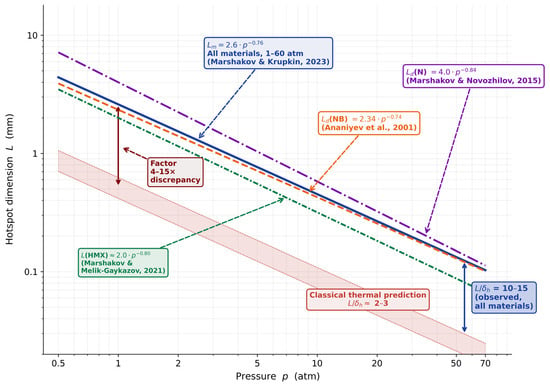
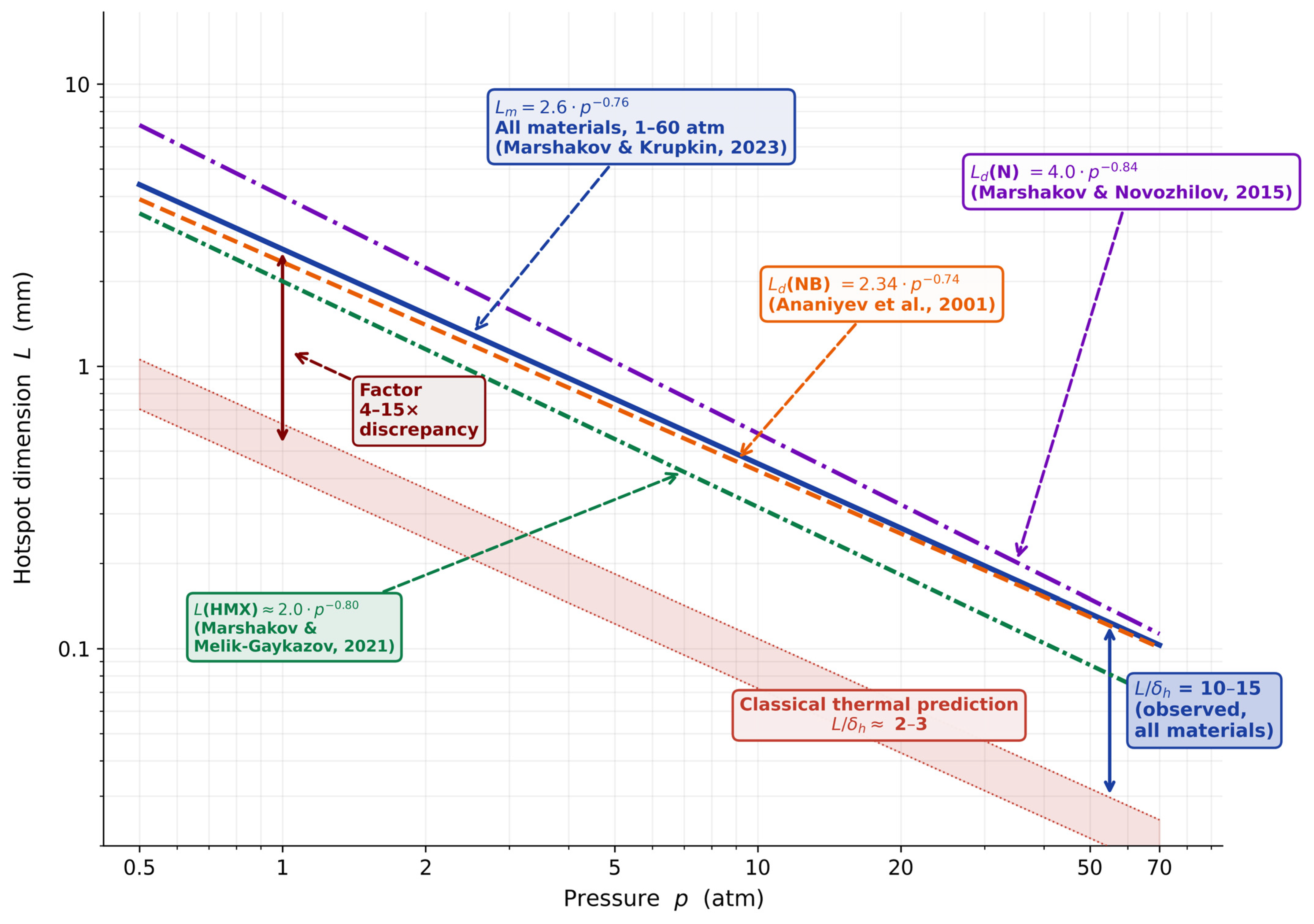
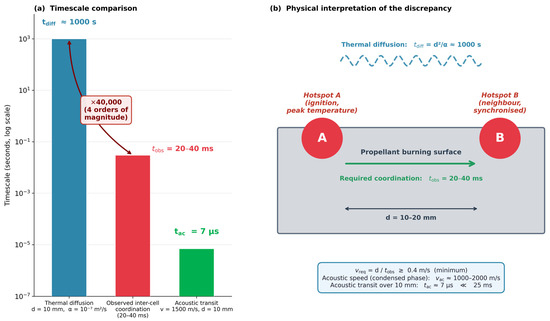
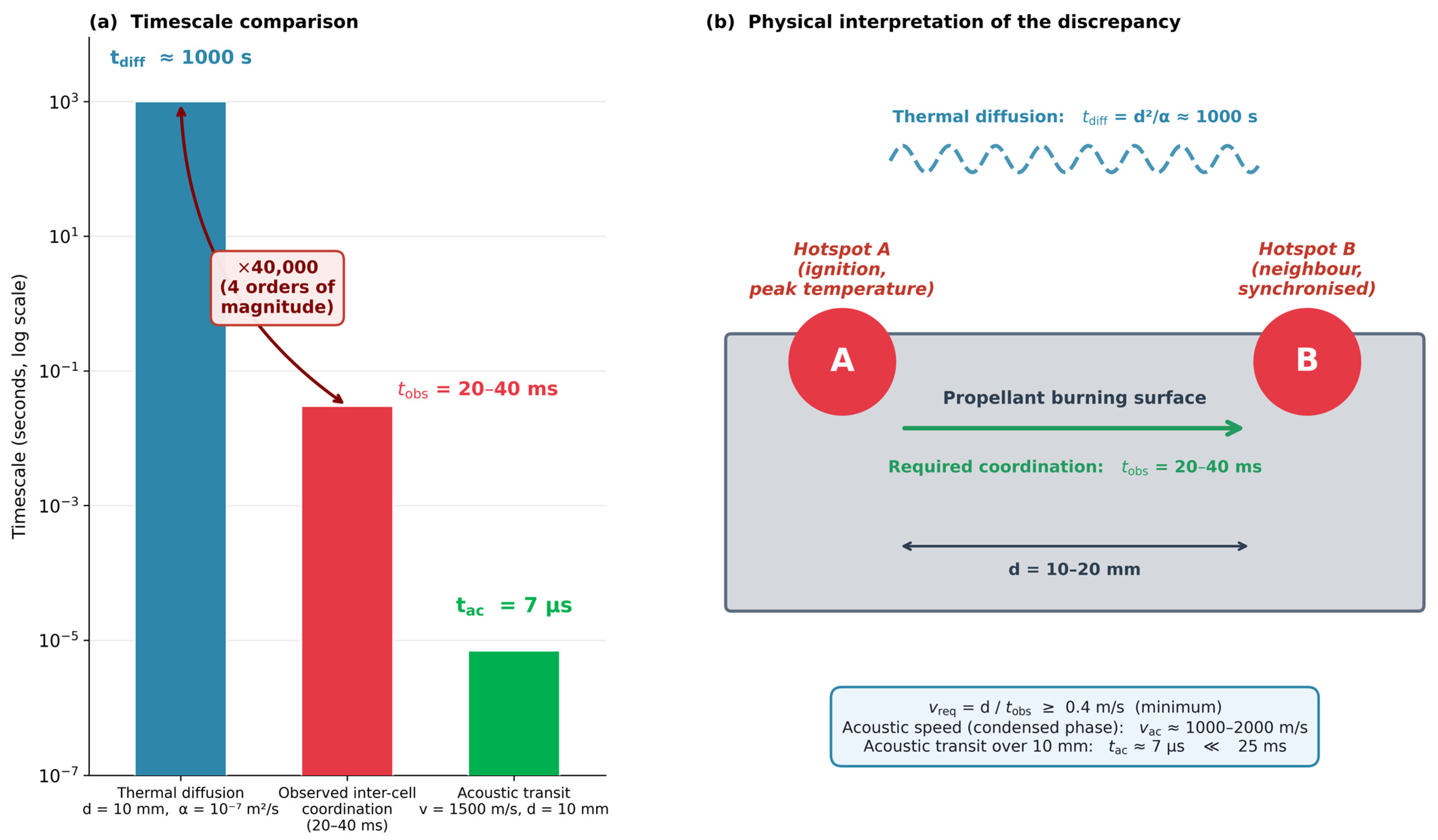
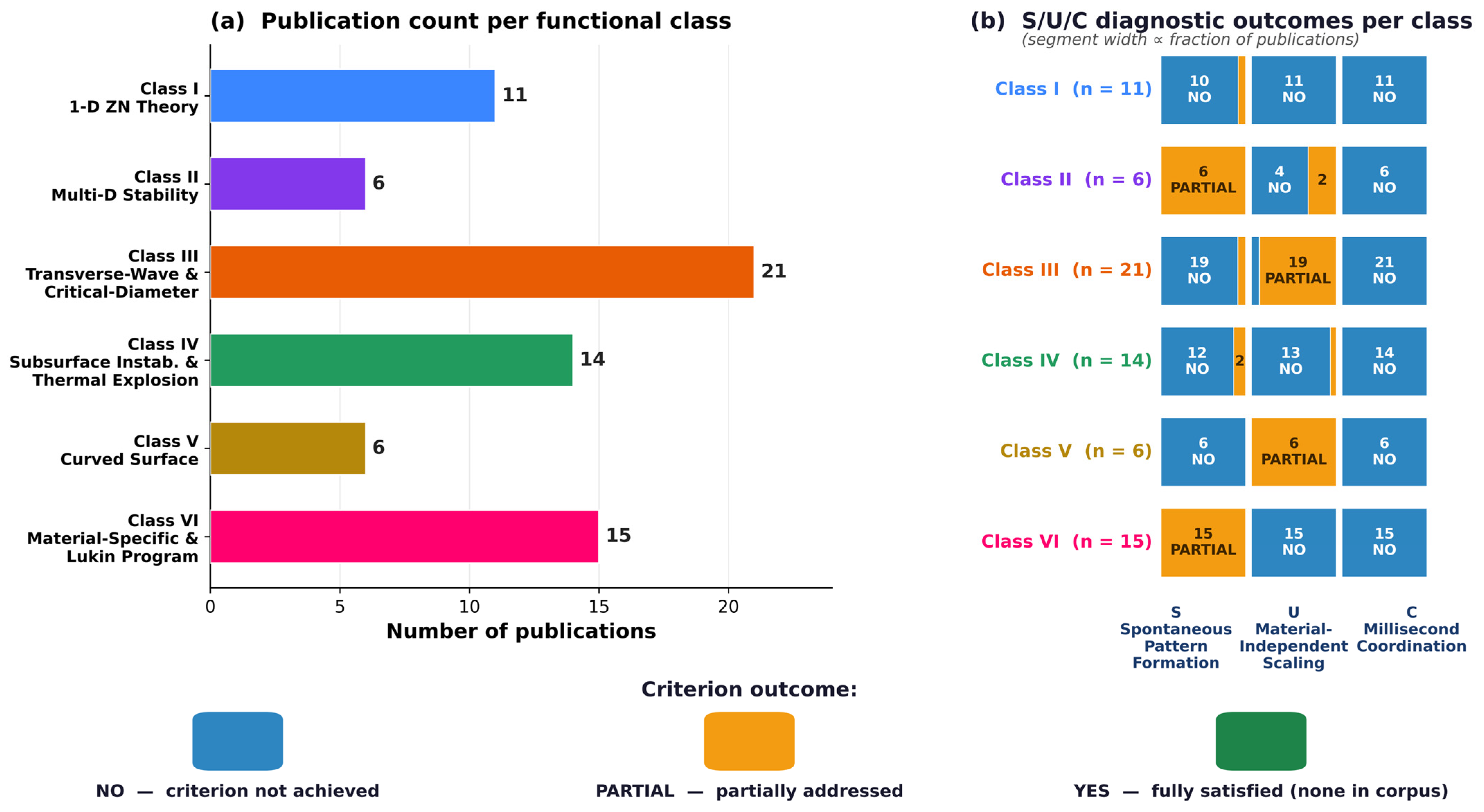

Disclaimer/Publisher’s Note: The statements, opinions and data contained in all publications are solely those of the individual author(s) and contributor(s) and not of MDPI and/or the editor(s). MDPI and/or the editor(s) disclaim responsibility for any injury to people or property resulting from any ideas, methods, instructions or products referred to in the content. |
© 2026 by the author. Licensee MDPI, Basel, Switzerland. This article is an open access article distributed under the terms and conditions of the Creative Commons Attribution (CC BY) license.