Article

Forward Air Control Mission Suitability Case Study: Tactical and Airworthiness Evaluation of the LX7-135 Turboprop as a Commercial Derivative Aircraft


by
Süleyman Murat Köroğlu
1,*,
İlker Ünlü
2 and
İbrahim Özkol
1
1
Faculty of Aeronautics and Astronautics, Istanbul Technical University, Istanbul 34469, Turkey
2
Fixed and Rotary Wing Aircraft Campus, International Test Pilot School, London, ON N5V 3Z9, Canada
*
Author to whom correspondence should be addressed.
Aerospace 2026, 13(8), 667; https://doi.org/10.3390/aerospace13080667
Submission received: 22 June 2026 / Revised: 23 July 2026 / Accepted: 24 July 2026 / Published: 25 July 2026
(This article belongs to the Section Aeronautics)

Abstract

The modern multi-domain battlespace increasingly demands cost-effective, persistent platforms for Forward Air Control (Airborne) (FAC(A)) and Close Air Support (CAS) missions. While utilizing Commercial Derivative Aircraft (CDA) presents a viable alternative to high-maintenance military assets, the specific aerodynamic, ergonomic, and cognitive workload limitations encountered during the transition across the civil–military “airworthiness seam” remain a significantly underexplored gap in contemporary aerospace literature. To address this gap, a comprehensive empirical flight test campaign was executed on the LX7-135 turboprop to evaluate its tactical mission suitability. Employing the Cooper–Harper Handling Qualities Rating and Bedford Workload scales, and guided by military specifications (MIL-HDBK-516C, MIL-F-8785C), the study systematically assessed the aircraft’s pure performance, unaugmented flight dynamics, and human–machine interface during simulated combat scenarios, including dynamic 9-Line briefings and kinetic “Box Pattern” delivery profiles. Flight test data indicated 12 “SATISFACTORY” parameters, highlighting climb rates, extended endurance, and heavily damped short-period and Dutch roll modes optimal for target tracking. Conversely, the evaluation identified 4 “UNSATISFACTORY” and 10 “TOLERABLE” deficiencies—chiefly a single-door egress bottleneck, restricted stick clearance, degraded longitudinal static stability, and the absence of secure tactical communications. Although these constraints elevated pilot cognitive workload during multi-axis tasks, the LX7-135 demonstrates potential suitability for further development for the FAC(A) role, subject to the successful implementation and subsequent flight-test verification of the identified critical engineering modifications and specialized training syllabi.

1. Introduction

The coordinated integration of air and ground forces remains a cornerstone of modern asymmetric warfare, relying heavily on the execution of CAS and the strategic employment of the FAC(A). While these missions were traditionally executed by high-cost, multi-role jet aircraft, contemporary military procurement is increasingly shifting toward cost-effective, high-endurance turboprop platforms under the CDA paradigm [1]. According to the United States Department of Defense Joint Publication 3-09.3 (JP 3-09.3), CAS is formally defined as air action by fixed- and rotary-wing aircraft against hostile targets that are in close proximity to friendly forces, a proximity that dictates the detailed integration of each air mission with the fire and movement of those forces [2]. Within this intricate doctrinal framework, the FAC(A) serves as a specifically trained and qualified aviation officer functioning as an airborne extension of the ground-based Tactical Air Control Party (TACP) [2,3]. The primary mandate of the FAC(A) is to orchestrate airspace deconfliction, conduct terminal attack control, and strictly mitigate fratricide, which remains a critical risk induced by battlefield confusion, misidentification of targets, or loss of situational awareness [2,3]. Historically, military aviation procurement has heavily favored the development of high-technology, multi-role jet aircraft designed to penetrate and defeat sophisticated Integrated Air Defense Systems (IADS) [3]. However, in contemporary irregular warfare and distributed operations, deploying highly expensive jet assets for prolonged CAS holding patterns is often logistically and economically inefficient [4,5]. Consequently, there has been a strategic shift toward utilizing “right-technology” platforms—specifically, cost-effective, high-endurance turboprop aircraft [3,5]. These smaller platforms offer operational agility and persistent Intelligence, Surveillance, and Reconnaissance (ISR) capabilities, enabling them to operate closely with distributed ground units from austere forward operating bases [3]. Yet, adapting a civilian-certified aircraft to a highly dynamic tactical role introduces a critical regulatory and engineering gap known as the “Airworthiness Seam”—the complex boundary between civil aviation safety regulations (such as FAA 14 CFR) and rigorous military specifications (such as MIL-HDBK-516C). Bridging this seam requires comprehensive independent flight testing to validate structural integrity, aerodynamic stability, and tactical system integration beyond the baseline civilian use.
To meet the evolving demands of asymmetric warfare while adhering to stringent fiscal constraints, military procurement strategies have increasingly shifted away from developing clean-sheet, military-specific organic aircraft, opting instead to adopt the CDA paradigm to fulfill specialized roles, including the FAC(A) and ISR missions [2,4]. The CDA approach leverages existing civilian aircraft that have already proven their aerodynamic reliability and possess established, global supply chains to reduce development time, manage cost overruns, and mitigate technical risks [5,6]. However, transitioning a civilian platform into a highly dynamic tactical asset introduces regulatory and engineering complexities, as civil standards (FAA 14 CFR) are fundamentally predicated on passenger safety and standard flight profiles [7]. According to FAA Advisory Circular (AC) 20-169, any Special Mission Equipment (SME) or combat system that may be hazardous to the aircraft, its occupants, or other aircraft—explicitly including weapon systems, rockets, missiles, and active electronic countermeasures—is strictly ineligible for civil FAA certification [7]. This regulatory and engineering gap between the limits of FAA civil certification and the operational requirements of a military mission defines the “Airworthiness Seam” [6,7]. Navigating this critical seam requires a hybrid certification approach using military standards; for structural modifications and systems falling outside civil FAA jurisdiction, the military relies on the criteria established in MIL-HDBK-516C [8,9]. This handbook provides the definitive framework for evaluating the integration of external stores (such as target-marking smoke rockets), validating structural integrity under asymmetric tactical loads, and ensuring the electromagnetic compatibility of high-powered military communication suites [9]. This rigorous validation is critical because precise target marking remains a primary enabler for a successful FAC(A) mission, building immediate situational awareness, delineating specific targets, reducing the probability of fratricide, and facilitating terminal attack control [1,2]. Doctrinally, FAC(A) crews frequently employ externally mounted smoke rockets, typically released 60 to 90 s prior to a strike fighter’s designated Time On Target (TOT) [3], while augmenting operations with laser designators and infrared (IR) pointers in low visibility [1]. Consequently, any CDA intended for the FAC(A) role must physically and aerodynamically support the integration of both conventional and advanced marking payloads [10].
The test article evaluated in this study, designated as the LX7-135 (Tail Number N802BT), is a single-engine, pressurized light experimental turboprop aircraft featuring retractable landing gear, constructed utilizing advanced carbon fiber pre-impregnated materials [11]. Powered by a Pratt & Whitney PT6A-135 free-spinning turbine engine generating 750 shaft horsepower coupled with a Hartzell four-bladed aluminum constant-speed propeller, the aircraft features a pressurized cabin that substantially mitigates crew cognitive fatigue and hypoxia risks up to FL250 during extended loitering [11]. Aerodynamically, the flight control architecture consists of a conventional system operated via side stick controls, utilizing a closed-loop cable system for ailerons, a robust torque tube configuration for pitch control, and a unique double-slotted flap system to maximize lift during low-altitude tactical observation. Tactically, the cockpit leverages a Commercial Off-The-Shelf (COTS) open-architecture avionics suite, prominently featuring the Garmin G3X Touch system alongside a GTN 750 GPS/NAV/COM interface [12]. This modern glass cockpit is managed by a GFC 500X digital autopilot interfacing with a solid-state Attitude and Heading Reference System (AHRS) to alleviate pilot workload during complex engagements. However, the LX7-135 possesses a Maximum Take-Off Weight (MTOW) of 3850 lb, an empty weight of 2300 lb, and a maximum landing weight of 3400 lb. When fueled to its maximum capacity of 180 U.S. gallons to achieve extended loiter times, the remaining payload margin is severely constrained. Consequently, to simulate the weights of the EO/IR system, rocket stations, and UHF radio, two Flight Test Engineers (FTEs) were carried in the rear cabin while fuel was limited to 30 U.S. gallons for relocation. To adapt the platform for the FAC(A) mission, a strategic payload reallocation is applied: by optimizing the cabin strictly for a two-person tactical crew (a pilot and an observer/JTAC) and omitting the rear passenger seats, a critical weight margin is reclaimed. This reallocation provides the necessary physical and weight capacity to integrate mission-essential equipment—such as EO/IR sensor turrets, secure multi-band tactical radios, and externally mounted smoke rockets—without exceeding structural MTOW limits, turning the platform into a highly agile, light-kinetic command node.
To empirically bridge the aforementioned “Airworthiness Seam” and ascertain the true tactical viability of the LX7-135 for the FAC(A) mission, a comprehensive flight test campaign was executed [13]. The tactical assessment encompassed extensive ground evaluations followed by an airborne phase consisting of four dedicated sorties, accumulating a total of 6.5 flight hours under Visual Meteorological Conditions (VMC). Unlike standard civil certification flights, this evaluation was rigorously benchmarked against United States Department of Defense specifications, primarily “MIL-F-8785C” (Military Specification—Flying Qualities of Piloted Airplanes), to ensure the platform met the dynamic and static stability criteria demanded by combat operations for Class I aircraft across Category A through C flight phases [14]. A focal point of this evaluation was the practical execution of the target marking mandate, using a specialized “Box Pattern” smoke rocket delivery profile designed to critically assess the aircraft’s handling qualities during simulated tactical engagements [2]. Doctrinally, the Box Pattern is highly favored for FAC(A) missions because it facilitates continuous target observation, manages airspeed and altitude during the dive, and enables precise tracking of the target before munitions release. During the execution of this task, the aircraft was subjected to combat-representative maneuvers, including steep descents, fine target tracking, and aggressive 3G dive recoveries. The resulting handling qualities and cognitive demands placed on the aircrew were systematically quantified utilizing the Cooper–Harper Handling Qualities Rating (CHR) scale and the Bedford Workload scale [15]. By directly comparing the LX7-135’s aerodynamic responses and pilot compensation levels against MIL-F-8785C parameters, this methodology ensured that any identified aerodynamic or ergonomic anomalies were evaluated not merely as civilian inconveniences, but as critical tactical vulnerabilities that necessitate mitigation prior to active CAS deployment.
Consequently, this research makes several distinct contributions to the contemporary aerospace and defense literature by bridging the empirical gap between CDA procurement strategies and tactical battlespace execution [10]. First, it provides a rare empirical analysis of the civil–military “airworthiness seam”—the complex regulatory and aerodynamic intersection between civil FAA certification and stringent military specifications (such as MIL-HDBK-516C and MIL-F-8785C)—demonstrating how inherent civil design limitations directly influence military flight operations [16,17]. Second, the study introduces a rigorous quantification of pilot cognitive workload and task saturation during multi-axis FAC(A) profiles, utilizing the Cooper–Harper and Bedford scales to evaluate the human–machine interface within a COTS glass cockpit adapted for dynamic targeting and 9-Line CAS briefings. Third, it formulates and validates a dedicated kinetic “Box Pattern” simulated delivery profile, specifically optimized to mitigate the unaugmented stability deficiencies and pronounced P-Factor of high-torque, light turboprops, thereby establishing a foundational tactical framework for future training syllabi. To systematically address these contributions, the remainder of this paper is structured as follows: Section 2 details the flight test methodology, qualitative evaluation scales, and Flight Test Instrumentation (FTI); Section 3 outlines the test article’s structural specifications and operational limitations, and provides their summary in table; Section 4 analyzes the quantitative and qualitative data of the aircraft’s unaugmented aerodynamics, focusing on ground ergonomics, climb and endurance performance, and dynamic stability; Section 5 evaluates the operational mission suitability of the LX7-135 for the FAC(A) role, analyzing pilot cognitive workload during dynamic targeting, holding patterns, and the simulated kinetic delivery task; Section 6 synthesizes the flight test outcomes into satisfactory, tolerable, and unsatisfactory domains; and Section 7 delivers the final conclusions and structures a series of highly desirable and desirable engineering and training recommendations. It must be emphasized that this flight test campaign represents an early-stage developmental assessment of the baseline airframe and human–machine interface. It does not constitute a final operational validation of a fully militarized weapon system. The scope of this study is strictly bounded by the preliminary evaluation of flying qualities, pilot workload, and tactical task suitability under simulated combat profiles, while leaving physical store integration, weapon separation dynamics, and electromagnetic compatibility for subsequent testing phases.

2. Flight Test Methodology and Instrumentation

Building upon the theoretical framework of the “Airworthiness Seam” and the strategic payload reallocation for the FAC(A) mission established in the previous section, this section delineates the practical methodology employed during the flight test campaign. Evaluating a CDA for a highly dynamic military role necessitates a fundamental departure from standard civil certification flight testing. To accurately assess the platform’s tactical viability under combat-representative conditions, the evaluation must adopt rigorous military flight test techniques. Consequently, the methodology of this study is structured into three sequential focus areas. First, the overarching test design and the implementation of mission-specific “Non-Standard Flight Test Techniques”—such as the simulated “Box Pattern” for smoke rocket delivery and the “9-Line Briefing” in a target holding area—are detailed. Second, the qualitative evaluation metrics utilized to translate subjective pilot feedback into quantifiable data, specifically the CHR and the Bedford Workload Scale, are introduced. Finally, the specialized, non-intrusive FTI suite deployed to capture high-fidelity data without permanently altering the aircraft’s civilian baseline architecture is described. This FTI suite comprises the Garmin G3X flight logger, an attachable gunsight (featuring a 2.1 cm inner circle, a 4.2 cm outer circle, and a 5 mm dash interval between the rings), a handheld force gauge, and action cameras utilized for data acquisition during the test campaign.

2.1. Test Design and Mission-Specific Maneuvers

The aircraft was evaluated against military specifications, including MIL-F-8785C (Flying Qualities), MIL-STD-1333 (Aircrew Station Geometry), MIL-C-18244A (Control Accuracy), and MIL-STD-1290A (Crash Resistance). The tactical assessment comprised four dedicated sorties, accumulating a total of 6.5 flight hours. Originally planned for three sorties, the campaign was extended by an additional flight following an unforeseen bird strike during the second sortie, highlighting the unpredictable nature of low-altitude tactical environments. All flight tests were executed during daylight hours under VMC within a block altitude of 3000 to 8000 feet Above Mean Sea Level (AMSL). The atmospheric conditions featured occasional light turbulence (TURB 2) to intermittent moderate chop (TURB 4), providing a realistic representation of the operational FAC(A) environment. Certain flight test points, such as wind-up turns (WUT) and Instrument Flight Rules (IFR) approaches, were omitted due to time constraints, air traffic, and specific system malfunctions; consequently, the evaluation scope was strictly focused on primary combat maneuvers.
To systematically evaluate the civil–military ‘airworthiness seam’ and ensure proper interpretation of both flying qualities and crew workload, the flight test campaign defines and separates three distinct system configurations: Baseline Airframe Characteristics (Unaugmented), where both the Yaw Damper (YD) and the Autopilot (AP) are disengaged to isolate the raw aerodynamics against MIL-F-8785C standards; Nominal Mission Configuration (Augmented), representing the intended operational standard with YD and AP fully functional; and Degraded-System Operation (Failure State), where stability augmentation or tactical automation is lost due to unserviceability. Due to a pre-flight YD malfunction, the entire 6.5-h campaign was conducted with the YD OFF; consequently, the Baseline Airframe Characteristics configuration was evaluated during aerodynamic stability points (Sorties 1, 2, and 4), while an in-flight AP failure during Sortie 3 allowed a direct evaluation of Degraded-System Operation during tactical tasks. Although Nominal Mission Configuration was not directly flown, pilot workload and mission suitability under nominal operations are projected as an analytical estimate from the baseline and degraded-system findings. These nominal projections must be treated as non-empirical, predictive forecasts separate from the actual flight-test measurements. They serve as a theoretical baseline requiring subsequent operational flight-test verification once the systems are fully serviceable.
The maneuvering envelope was strictly limited to a load factor of −2G to +5G, a maximum bank angle of ± 75 ° , and a maximum pitch attitude of +30 ° . Crucially, although the PT6A-135 engine is capable of producing high power, the torque setting for short-field takeoffs was artificially limited to 2000 ft-lb (and 1800 ft-lb for level acceleration tasks) to prevent uncontrollable yaw excursions. Standard test techniques and their associated conditions are detailed in Table 1. The test points are ordered logically based on conventional flight test methodology; however, this listing does not dictate the chronological execution sequence during the sorties.
Given that civil testing parameters fundamentally evaluate point-to-point navigation and passenger comfort, the campaign incorporated “Non-Standard Flight Test Techniques” specifically tailored to evaluate the aircraft’s handling qualities under combat-representative conditions. Two primary tactical maneuvers were designed and executed:
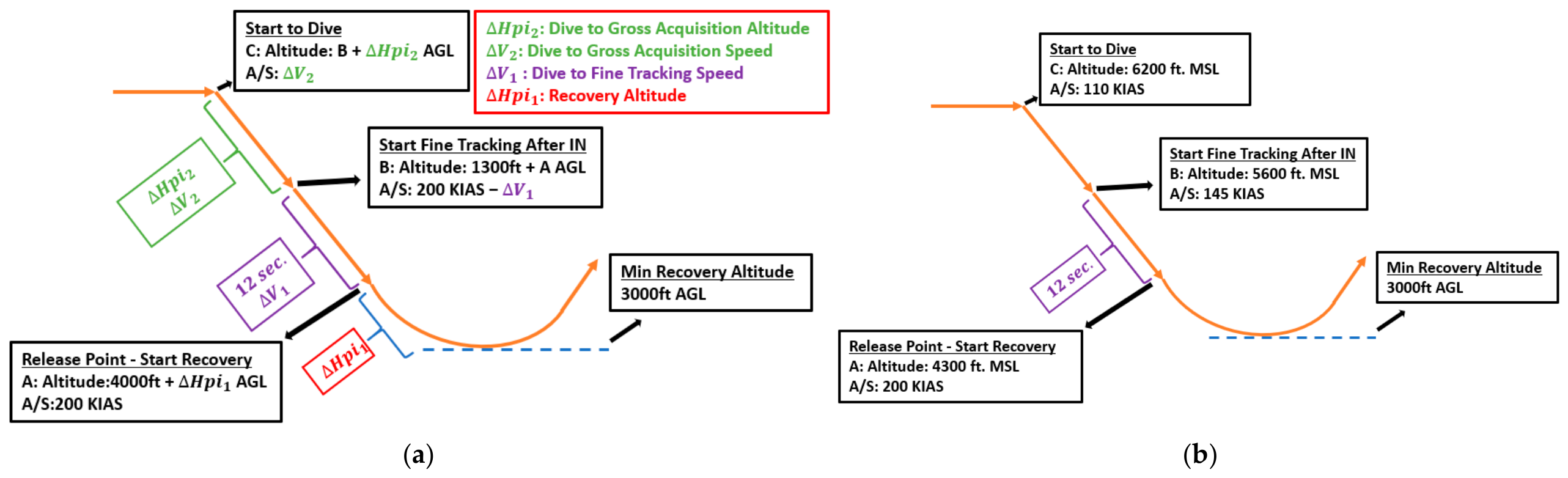
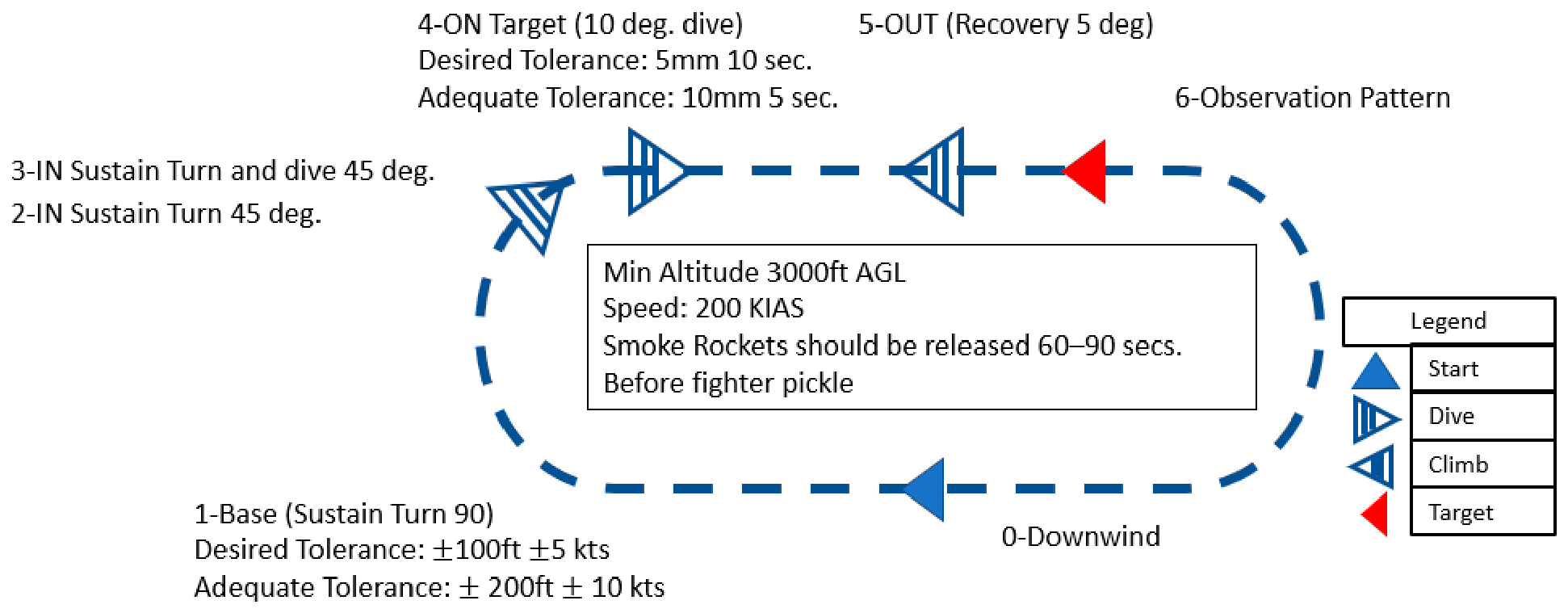
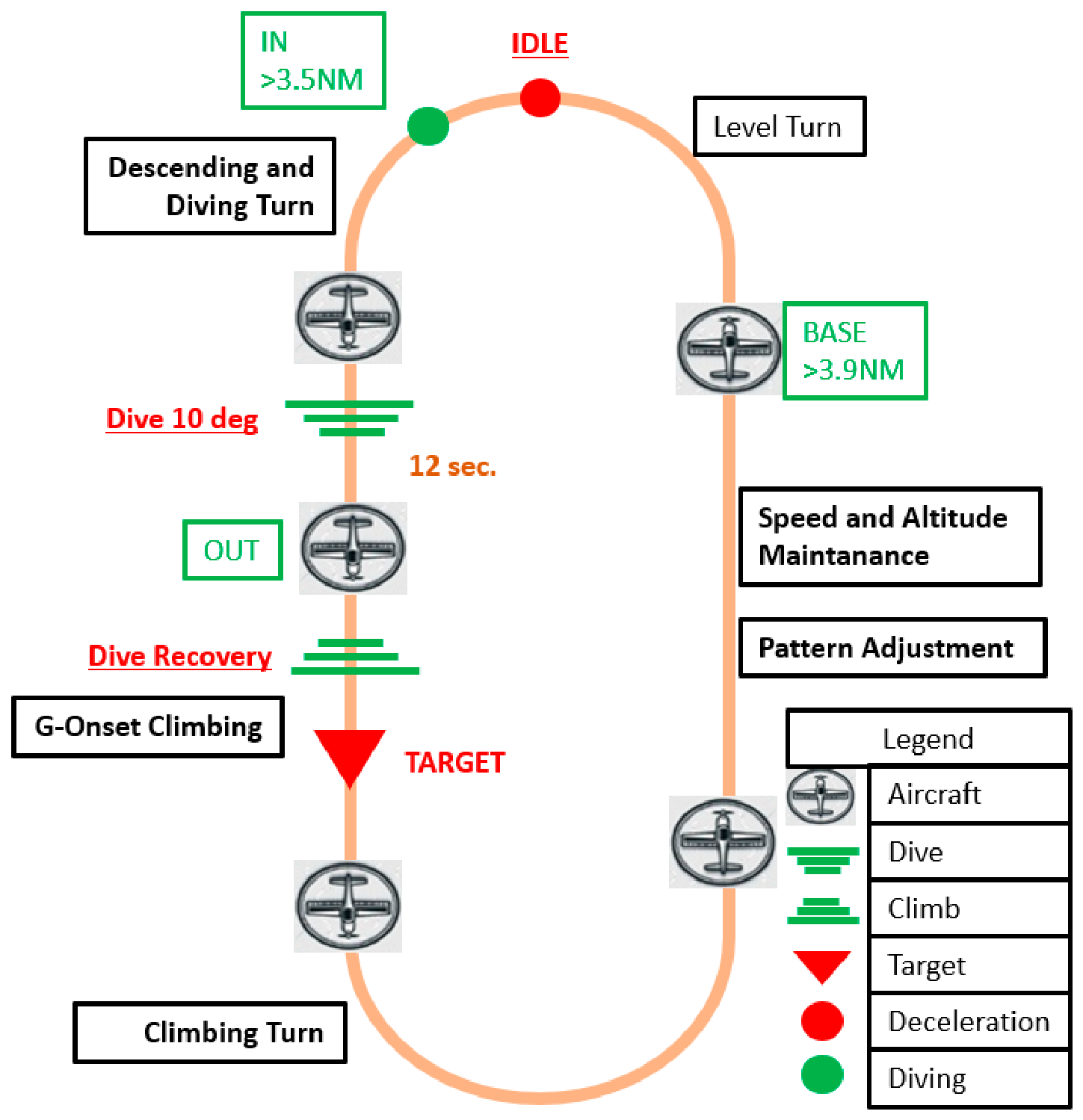
The Smoke Rocket Delivery Task (Box Pattern): The primary simulated kinetic requirement of a FAC(A) platform is the precise delivery of marking ordnance 60 to 90 s prior to a strike fighter’s TOT. A “Box Pattern” delivery profile was doctrinally selected because it facilitates continuous target observation, manages airspeed during the dive, and enables precise fine tracking. The profile required the aircraft to initiate an “IN” maneuver from a base leg, achieving a 10 ° dive angle. Following gross acquisition, the pilot maintained the target within the gunsight for 12 to 13 s. Immediately following the simulated rocket release at 4300 ft MSL the pilot executed a strict 3G dive recovery within 2 s to safely egress above the 3000 ft Above Ground Level (AGL) minimum recovery altitude, avoiding the fragmentation envelope. A schematic representation of the box pattern is presented in Figure 1.
Target Area Holding Pattern and 9-Line Briefing: To quantify the cognitive demands placed on the pilot, a simulated 9-Line CAS briefing task was integrated into a target area holding pattern. While manually maintaining altitude and heading within narrow tolerances ( ± 200 ft and ± 4 ° ), the pilot was tasked with relaying a standard 9-Line Briefing, tracking the ground target visually, scanning for simulated threats, and communicating over tactical radio channels. This non-standard technique rigorously evaluated whether the LX7-135 allowed the pilot sufficient “spare cognitive capacity” to perform essential battle management duties without degrading fundamental aircraft control.

2.2. Qualitative Evaluation Metrics

Standard civil airworthiness certification under FAA 14 CFR Part 23 primarily focuses on aerodynamic stability, structural integrity, and baseline passenger safety. However, determining the operational suitability of a CDA for the FAC(A) mission requires evaluating the human–machine interface under severe combat stress. In a tactical environment, the aircraft’s handling characteristics must not demand excessive pilot compensation that could degrade mission effectiveness or lead to loss of control [18]. To empirically quantify these subjective pilot experiences and bridge the airworthiness seam, the flight test campaign employed standardized, military-recognized qualitative evaluation metrics, specifically focusing on handling qualities, cognitive workload, and environmental constraints.
Although the LX7-135 is an experimental aircraft certified under civilian guidelines (FAA 14 CFR), civil airworthiness standards are fundamentally optimized for steady-state, point-to-point passenger transportation and benign flight profiles. Civil regulations do not evaluate the severe physical and cognitive demands of high-G combat maneuvers, close-proximity tactical targeting, low-altitude weapons release, or high-density multi-channel tactical communications. Consequently, evaluating the suitability of a CDA for a FAC(A) mission requires a rigorous transition across the civil–military ‘airworthiness seam.’ To achieve this, the flight test campaign benchmarked the aircraft’s performance and flying qualities against established military specifications, specifically MIL-F-8785C for piloted flying qualities, MIL-STD-1333B for cockpit ergonomics and control stick clearances, and MIL-STD-1290A for emergency crash resistance and egress. Benchmarking against these standards ensures that any identified aerodynamic or ergonomic anomaly is evaluated not merely as a civilian inconvenience, but as a potential tactical vulnerability that could compromise mission safety and effectiveness.
To establish a standardized and empirical framework for the flight test campaign, the qualitative and quantitative assessments of the aircraft’s aerodynamic characteristics, handling qualities, and human–machine interface were systematically categorized into four definitive operational domains, derived from the Cooper–Harper and Bedford scales. “SATISFACTORY” and “Level 1” denote that the evaluated system or flight characteristic fully meets the stipulated mission requirements, wherein desired performance is readily attainable without necessitating any significant pilot compensation or immediate engineering improvement with the representation of the CHR 1–3. “TOLERABLE” and “Level 2” indicate that while specific operational or ergonomic deficiencies exist that warrant future improvement, adequate mission performance remains safely attainable, albeit with a noticeable and sustained increase in pilot workload with the representation of the CHR 4–6. Conversely, “UNSATISFACTORY” and “Level 3” signify the presence of major deficiencies that require mandatory engineering intervention before tactical fielding, as adequate performance is not attainable even with maximum tolerable pilot compensation, although the aircraft fundamentally remains controllable with the representation of the CHR 7–9. Finally, “UNACCEPTABLE” represents a critical violation of baseline safety or mission parameters, indicating that improvement is absolutely mandatory due to an imminent risk of losing aircraft control or a complete inability to apply sufficient pilot effort to complete the designated tasks, corresponding to CHR 10.
The primary tool utilized to assess the aircraft’s controllability and maneuverability during simulated kinetic delivery tasks was the CHR scale [15]. The CHR scale is a highly structured decision tree that assigns a numerical rating from 1 to 10 based on the adequacy of the aircraft for a selected task and the amount of pilot compensation required to achieve desired performance. In the context of this evaluation, the CHR scale was specifically applied to the Box Pattern maneuver. The objective was to ensure that handling qualities did not degrade during steep dives, gross target acquisition, or high-G dive recoveries, and to verify that the aircraft exhibited no divergent characteristics across different trim conditions that would violate MIL-F-8785C standards.
While the Cooper–Harper Handling Qualities Rating (CHR) and Bedford Workload scales provide structured, military-recognized frameworks to quantify pilot-vehicle interaction, it is crucial to recognize that these subjective metrics are inherently pilot-dependent. A primary methodological limitation of the current flight test campaign is that all qualitative ratings were generated by a single experimental test pilot over a total of 6.5 flight hours on a single prototype. Consequently, establishing formal inter-rater reliability—which would quantify pilot-to-pilot rating variability—was outside the scope of this initial evaluation.
However, this single-pilot approach is methodologically justified within the context of early-stage Developmental Test and Evaluation (DT&E) and proof-of-concept evaluations. The test pilot who executed all sorties is a highly qualified Graduate Experimental Test Pilot, trained to function as a standardized “calibrated instrument.” Unlike operational pilots, experimental test pilots undergo rigorous training to decouple personal flying preferences from standardized ratings, evaluating handling qualities strictly against the empirical boundaries of pilot compensation, task performance, and environmental turbulence defined by the CHR and Bedford decision trees. While this specialized training significantly mitigates subjective bias and minimizes the variance of the assigned ratings, the lack of multiple raters remains a constraint. Therefore, while this single-pilot developmental flight test phase is highly effective for identifying first-order aerodynamic and ergonomic deficiencies (such as control stick interference and static instability), establishing robust inter-rater reliability is essential prior to potential operational fielding. It is highly recommended that subsequent Operational Test and Evaluation (OT&E) phases employ a larger and more diverse cohort of three to five active tactical pilots to fully validate the platform’s suitability across varying pilot backgrounds and operational scenarios.
While the CHR scale evaluates physical handling qualities, the FAC(A) mission inherently encompasses an airborne battle management role, imposing extreme cognitive demands on the aircrew. To quantify these cognitive demands and the pilot’s available cognitive bandwidth, the Bedford Workload Scale was utilized. This scale evaluates the operator’s demand level based on their “spare capacity” to undertake additional tasks, assigning a rating from 1 (Workload insignificant) to 10 (Tasks abandoned). During the flight test campaign, the Bedford scale was specifically applied to assess the pilot’s workload during the Target Area Holding Pattern while simultaneously relaying a simulated 9-Line CAS briefing [19]. This metric was critical in determining whether the LX7-135’s inherent stability allowed the pilot enough spare capacity to communicate with joint terminal attack controllers (JTACs), maintain visual target tracking, and monitor for threats without compromising aircraft control.
To ensure that the qualitative CHR and Bedford ratings were contextualized within a realistic and measurable environment, atmospheric conditions were continuously monitored and recorded using a standardized Turbulence Rating Scale. The scale ranges from 1 (Calm/Nil) to 10 (Extreme Turbulence), categorizing the intensity of the turbulence and the corresponding aircraft reaction. During the evaluation, the test conditions intentionally encompassed an environmental envelope ranging from “Intermittent Light Turbulence” (TURB 2) to “Occasional Moderate Chop” (TURB 5). Documenting these environmental conditions ensured that the pilot workload and handling quality scores were representative of an austere, low-altitude combat environment rather than an idealized, calm-air civilian test flight.

2.3. Flight Test Instrumentation and Data Acquisition

Instrumenting a CDA for a military flight test campaign presents a unique engineering challenge. Traditional military FTI often requires extensive structural modifications to install specialized sensors, boom probes, and telemetry equipment. To preserve the LX7-135’s baseline civilian certification and prevent permanent structural alterations, a specialized, non-intrusive FTI suite was deployed to capture both quantitative flight parameters and qualitative pilot compensation metrics.
The primary quantitative data acquisition was facilitated by the aircraft’s integrated COTS avionics suite, utilizing a 32 GB SD card to extract flight parameters directly from the Garmin G3X Flight Logger. This digital system continuously recorded critical flight data, including Indicated Airspeed (IAS), pressure altitude, engine metrics (such as NG, NP, and torque), and basic attitude data. However, a significant limitation of the COTS flight logger was its low sampling frequency of 1 Hz. While this recording rate was adequate for assessing steady-state climb performance and static stability, it precluded the precise measurement of highly dynamic aerodynamic responses. Consequently, high-frequency metrics such as the short-period mode natural frequency, acceleration sensitivity, and higher-speed roll mode time constants could not be fully quantified using solely the digital logger.
To empirically compensate for the lack of integrated flight control force transducers and to accurately evaluate the Flight Control Mechanical Characteristics (FCMC), a handheld force gauge was utilized [20]. This portable tool enabled the test pilot to self-calibrate and precisely log the longitudinal and lateral stick forces, as well as rudder pedal forces. Furthermore, a smartphone equipped with a clinometer application (Dioptra) was mounted on a tripod at the pilot’s Design Eye Point to measure azimuth and elevation angles. This non-intrusive method facilitated the generation of an Aitoff projection to map the cockpit’s Field of View (FOV) and identify structural visual obstructions detrimental to the FAC(A) mission [21,22]. Physical control deflections and cockpit ergonomics were further measured using calibrated measuring tapes and plumb lines.
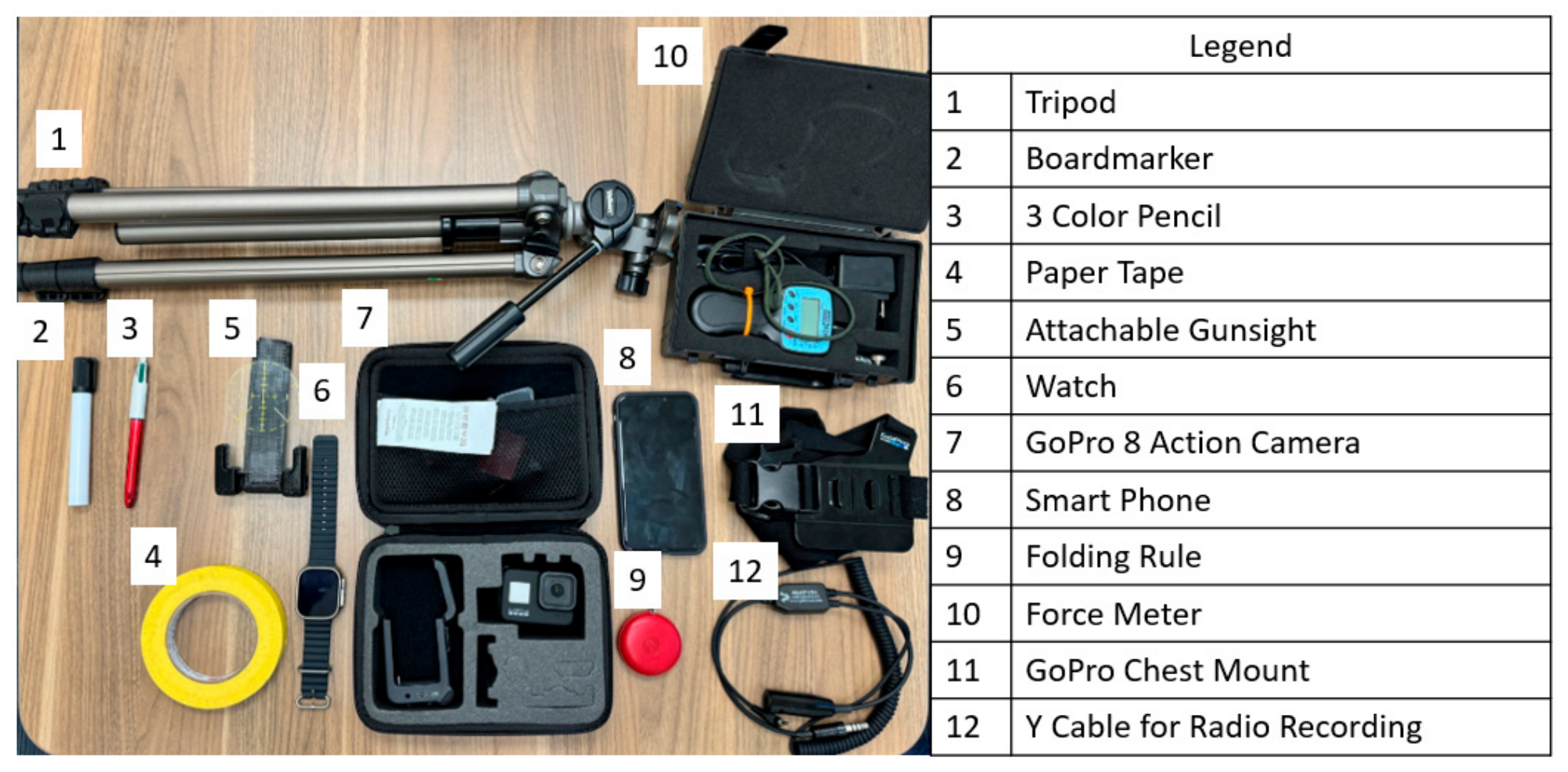
Evaluating the Smoke Rocket Delivery Profile required visual aiming references that were inherently absent in the baseline civilian cockpit. Since the LX7-135 lacked a Head-Up Display (HUD) or specialized targeting symbology, a temporary attachable gunsight was integrated into the cockpit to serve as a precise tracking reference during the gross acquisition and fine tracking phases of the dive [23]. A non-permanent windscreen marker was additionally used to draw supplementary attack symbology directly onto the windshield. To synchronize aircraft aerodynamic responses with pilot cognitive workload, a network of action cameras, including a chest-mounted accessory, was attached. These cockpit-mounted action cameras recorded at a standard frame rate of 30 frames per second (fps), which introduces a timing uncertainty of ± 0.03 s. The cameras were connected to the aircraft’s intercom system via a specialized Y-Cable, simultaneously capturing real-time flight instrument displays (for visual backup of the primary flight parameters) and the pilot’s verbal Cooper–Harper and Bedford ratings during high-stress tactical engagements. An overview of this integrated instrumentation suite and the data acquisition setup is illustrated in Figure 2.

3. Flight Test Conditions and Test Executions

The flight test campaign designed to evaluate the LX7-135 turboprop for the FAC(A) mission was conducted from CASPRI AIR facilities in Kitchener, Ontario (CYKF), spanning from the 6th to the 10th of November 2023. Originally scheduled as a three-sortie campaign, the evaluation was unexpectedly extended to four dedicated data flights accumulating a total of 6.5 flight hours and consuming 198 U.S. gallons of Jet-A fuel. This extension was mandated after the second sortie had to be prematurely aborted due to a mid-air bird strike, an unforeseen event that inadvertently highlighted the unpredictable and hazardous nature of the low-altitude tactical environments in which a FAC(A) platform is expected to operate. Following the bird strike, which involved a small avian impact on the outboard section of the right wing, the pilot executed a controllability check to verify control effectiveness and performed a precautionary landing at CYKF without changing configuration. A thorough visual inspection of the right wing’s composite skin structure and associated flight control surfaces was immediately conducted by the flight test maintenance team. The inspection confirmed that the aircraft’s structural integrity remained completely uncompromised, with no physical damage, cracking, or surface deformation detected. Furthermore, the FTI data logged up to the moment of the strike was verified as fully intact and valid. Once the platform’s absolute airworthiness and data integrity were confirmed, the flight test authority cleared the aircraft to execute the fourth sortie to safely complete the remaining tactical test points.
Although the test flights were conducted with a multi-crew complement consisting of a primary experimental test pilot, a safety pilot, and two flight test engineers (FTEs), all qualitative handling and workload assessments were performed solely by the primary evaluation pilot. The safety pilot’s role was strictly limited to airspace deconfliction and risk mitigation. Furthermore, while the proposed tactical configuration of the aircraft omits the rear passenger seats to accommodate external smoke rockets and EO/IR payloads, the two FTEs occupied the rear cabin area during the test flights strictly to simulate the MTOW conditions and to replicate the exact Center of Gravity (CG) shifts that such heavy tactical equipment would induce.
As the flight test campaign progressed, the operational weight of the aircraft was strategically adjusted to evaluate the platform’s endurance limits and structural responses. While the first sortie was conducted at a ramp weight of 3817 lb, subsequent flights maximized fuel intake to enhance sortie duration, resulting in an initial ramp weight of up to 3911 lb for high-endurance profiles. To ensure strict compliance with the aircraft’s certified Maximum Take-Off Weight (MTOW) of 3850 lb, pre-flight fuel burn was carefully managed and recorded. During mandatory pre-flight ground operations—encompassing engine start, avionic instrumentation checks, taxiing at CYKF, and a high-power engine run-up—the PT6A-135 engine consumed approximately consumed a measured 60 to 70 lb of fuel. Consequently, by the time takeoff thrust was applied at the runway threshold, the actual gross take-off weight had been reduced to between 3841 lb and 3850 lb, ensuring the aircraft departed strictly within its certified airworthiness weight boundaries. Throughout the execution of these maximum payload profiles, the CG was maintained within a tight tolerance band of 24.49% to 26.58% Mean Aerodynamic Chord (MAC). This precise mass distribution ensured that the dynamic stability evaluations yielded highly consistent and repeatable aerodynamic data compliant with MIL-F-8785C requirements.
Finally, the execution of the test campaign was significantly influenced by the unserviceability of key COTS avionics systems. The entire flight test program was conducted with the Yaw Damper disengaged due to a system malfunction, which left the aircraft’s inherent lateral-directional characteristics entirely unsuppressed. Furthermore, during the third sortie, the digital autopilot system failed, forcing the pilot to relay the complex “9-Line CAS Briefing” and manage dynamic target data entry tasks entirely through unaugmented manual flight control. Evaluating the aircraft under degraded system conditions allowed the engineering team to capture genuine Bedford Workload and CHRs, ultimately demonstrating that the LX7-135’s baseline aerodynamic stability requires substantial pilot compensation when tactical automation fails during a FAC(A) mission. A summary of the limitations, constraints, and operational impacts is provided in Table 2.

4. Ground Ergonomics, Performance, and Flying Qualities

Following the rigorous execution of the flight test campaign under combat-representative conditions, a comprehensive dataset encompassing cockpit ergonomics, aircraft performance, and aerodynamic stability was acquired. Evaluating a CDA for military deployment necessitates a systematic comparison of this empirical data against stringent military specifications—primarily MIL-STD-1290A, MIL-STD-1333B, and MIL-F-8785C. The objective of this section is to present the quantitative and qualitative engineering metrics obtained during the evaluation. To ensure a structured analysis, the fundamental aerodynamic responses and structural constraints are deliberately isolated from their broader tactical implications, which will be subsequently correlated in Section 5. Accordingly, the data presentation is divided into three primary subsections: first, an assessment of ground ergonomics and physical constraints; second, a quantification of aircraft climb and endurance performance; and finally, an evaluation of the inherent flying qualities and dynamic stability characteristics of the unaugmented airframe.

4.1. Ground Evaluation and Ergonomic Constraints

Prior to initiating the airborne aerodynamic and tactical assessments, a comprehensive ground evaluation of the LX7-135 was conducted to determine the baseline suitability of the cockpit architecture for the FAC(A) mission. The physical Pilot-Vehicle Interface (PVI) is a critical determinant of mission success, as the FAC(A) role demands extensive external visual scanning, simultaneous operation of complex communication suites, and the execution of high-G tactical maneuvers. To systematically evaluate these ergonomic and safety parameters, the assessment was divided into several distinct operational domains based on stringent military specifications, including MIL-STD-1333B and MIL-STD-1290A. First, the emergency ground egress procedures were analyzed to ensure rapid and safe evacuation capabilities in combat-damage scenarios. The evaluation then progressed to quantify the pilot’s external FOV, which is paramount for visual target acquisition and threat avoidance in contested airspace. Furthermore, the structural adequacy of the existing restraint system was assessed against the physical demands of aggressive simulated kinetic delivery profiles. The physical clearances and mechanical freedom of the primary flight controls were also rigorously examined to identify any structural interference during full-deflection inputs. Finally, the COTS Electronic Flight Instrument System (EFIS) and primary cockpit displays were evaluated for their readability, menu intuitiveness, and overall contribution to the pilot’s situational awareness without inducing unintentional system activations. Collectively, these ground-based assessments establish the ergonomic baseline required to accurately interpret the subsequent in-flight workload and handling qualities data.

4.1.1. Ground Egress and Pilot Outside View

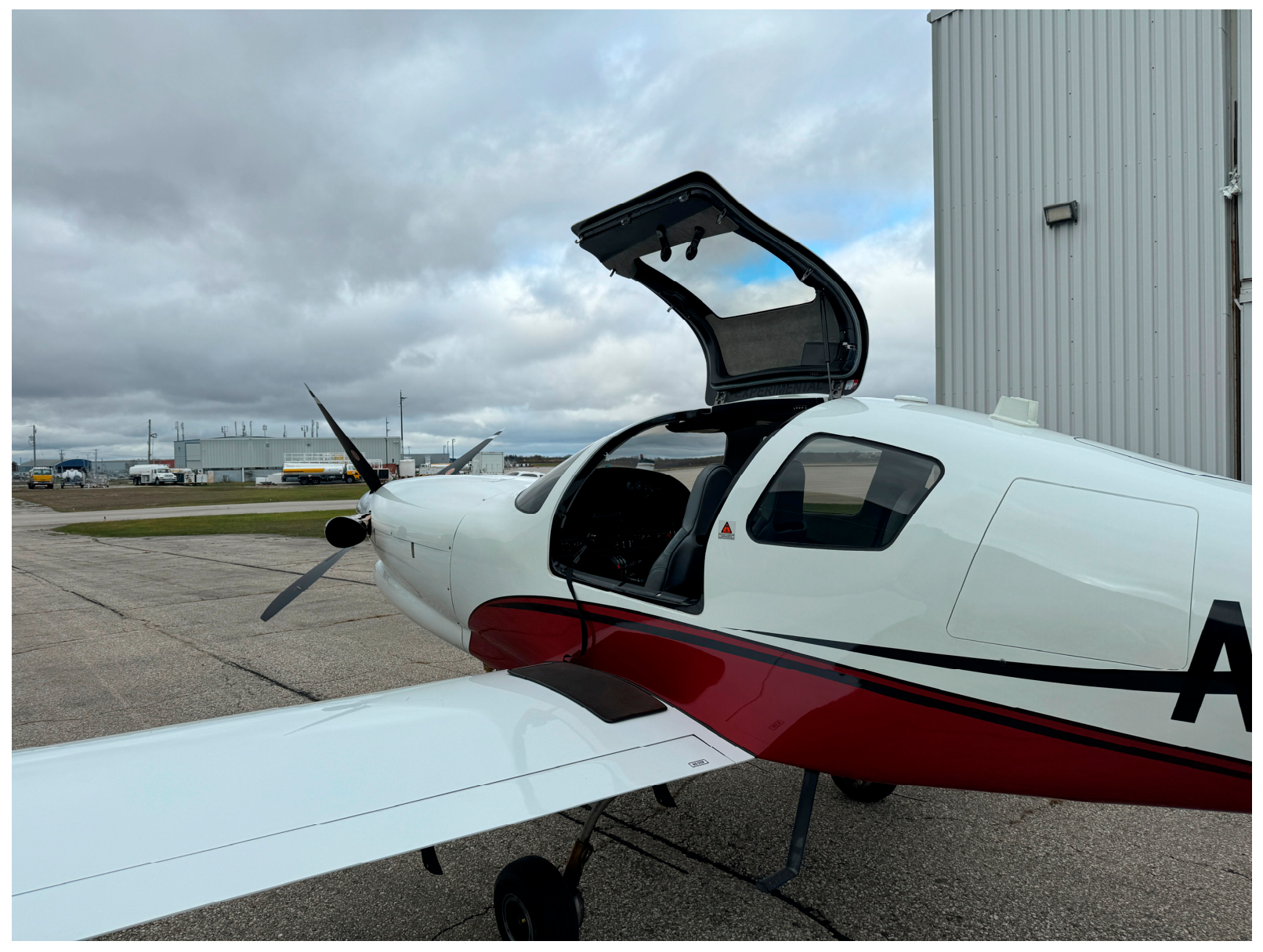
The translation of a civilian CDA into a military battlespace introduces immediate structural and anthropometric challenges, most notably in the critical domains of crew survivability and visual situational awareness. To evaluate the LX7-135’s emergency egress capabilities against the stringent crash resistance criteria of MIL-STD-1290A, a simulated ground evacuation was meticulously conducted in a hangar environment under controlled artificial lighting. The test article was manned by a standard FAC(A) crew configuration consisting of a left-seat pilot and a right-seat observer, both fully secured with flight headsets and restraint systems to accurately replicate combat-representative conditions. The fundamental structural constraint of the LX7-135 is its single access door, which is located exclusively on the left side of the fuselage, as illustrated in Figure 3. Pilot anthropometric data are detailed in Table 3.
To evaluate crew survivability under the crashworthiness framework of MIL-STD-1290A Paragraph 5.4, a ground egress simulation was conducted in a draft-free hangar under controlled lighting. The single cabin access door, located on the left side of the fuselage, was completely closed, secured, and locked using the multi-point mechanical latch. The left seat was occupied by the primary test pilot, and the right seat was occupied by a flight test engineer serving as the tactical observer. Both participants wore representative flight suits, flight headsets, and kneeboards; however, full tactical military gear—such as ballistic helmets, survival vests (containing radios/beacons), and body armor—was omitted from this baseline evaluation. The timing sequence was initiated upon the verbal command “EGRESS! EGRESS! EGRESS!”. The sequence was terminated only when both crew members had successfully unbuckled their restraint systems, removed their headsets, opened the left door latch, exited the aircraft, and established physical contact with the hangar floor with both feet. The primary test pilot (left seat) corresponded to an 80th-percentile male stature (height: 1830 mm, weight: 98 kg, sitting eye height: 829 mm) and the tactical observer (right seat) corresponded to a 15th-percentile male stature (height: 1695 mm, weight: 84.4 kg), as detailed in Table 3.
During the evacuation simulation, the left-seat pilot successfully egressed by descending via the trailing edge of the left wing. However, due to the single-point egress bottleneck inherent to the fuselage design, the right-seat observer was required to translate laterally across the center console into the left seat to initiate egress. The single trial yielded a total egress duration of 60.0 s. This duration represents a critical non-compliance with MIL-STD-1290A Paragraph 5.4, which mandates the complete evacuation of all occupants within 30 s. Because this result was derived from a single trial with specific, partially representative gear and a single set of anthropometric dimensions, the ‘UNSATISFACTORY’ rating cannot be statistically generalized and remains strictly limited to this specific crew configuration and evaluation envelope. The distance of the pilot’s seating position relative to different parts of the aircraft is given in Table 4.
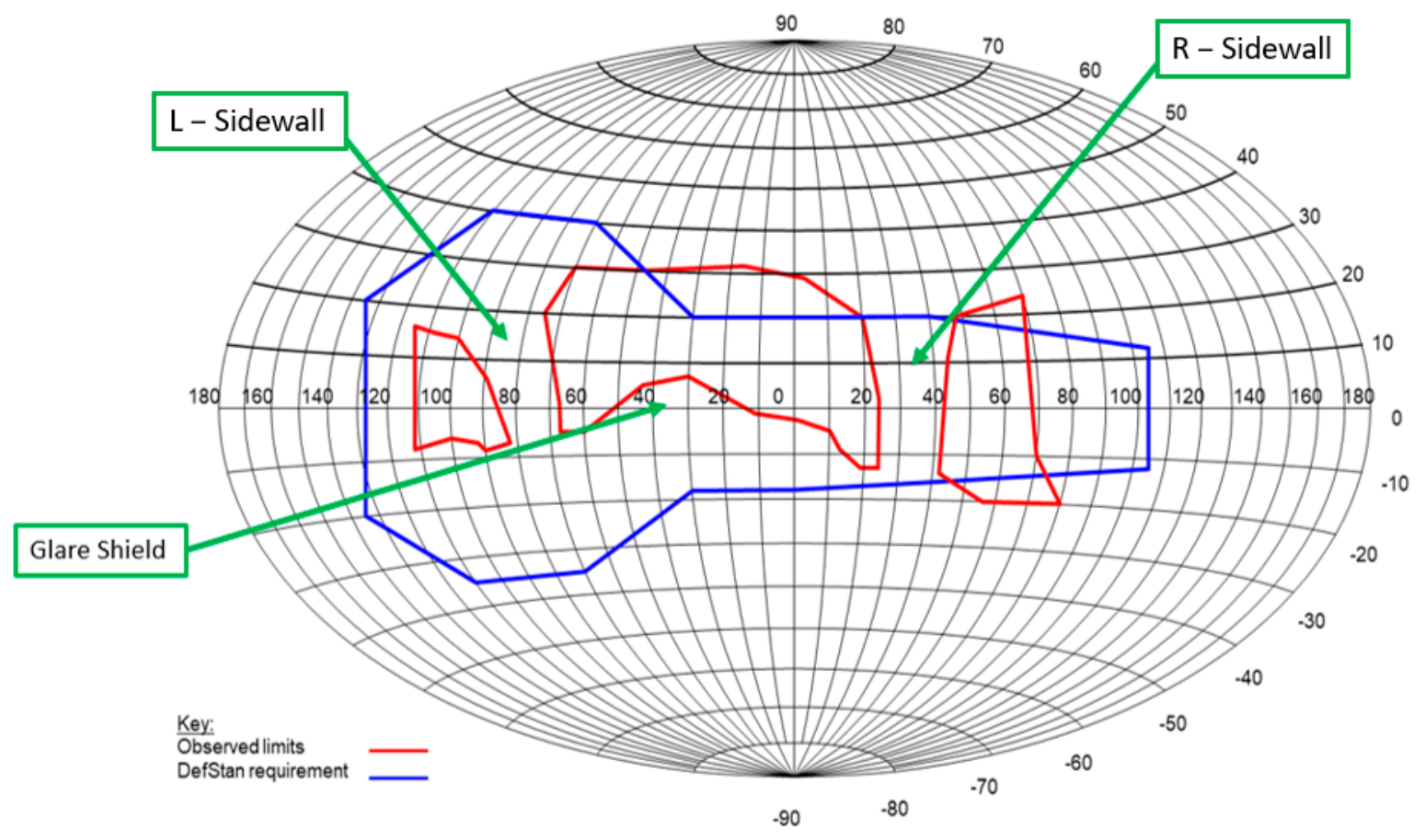
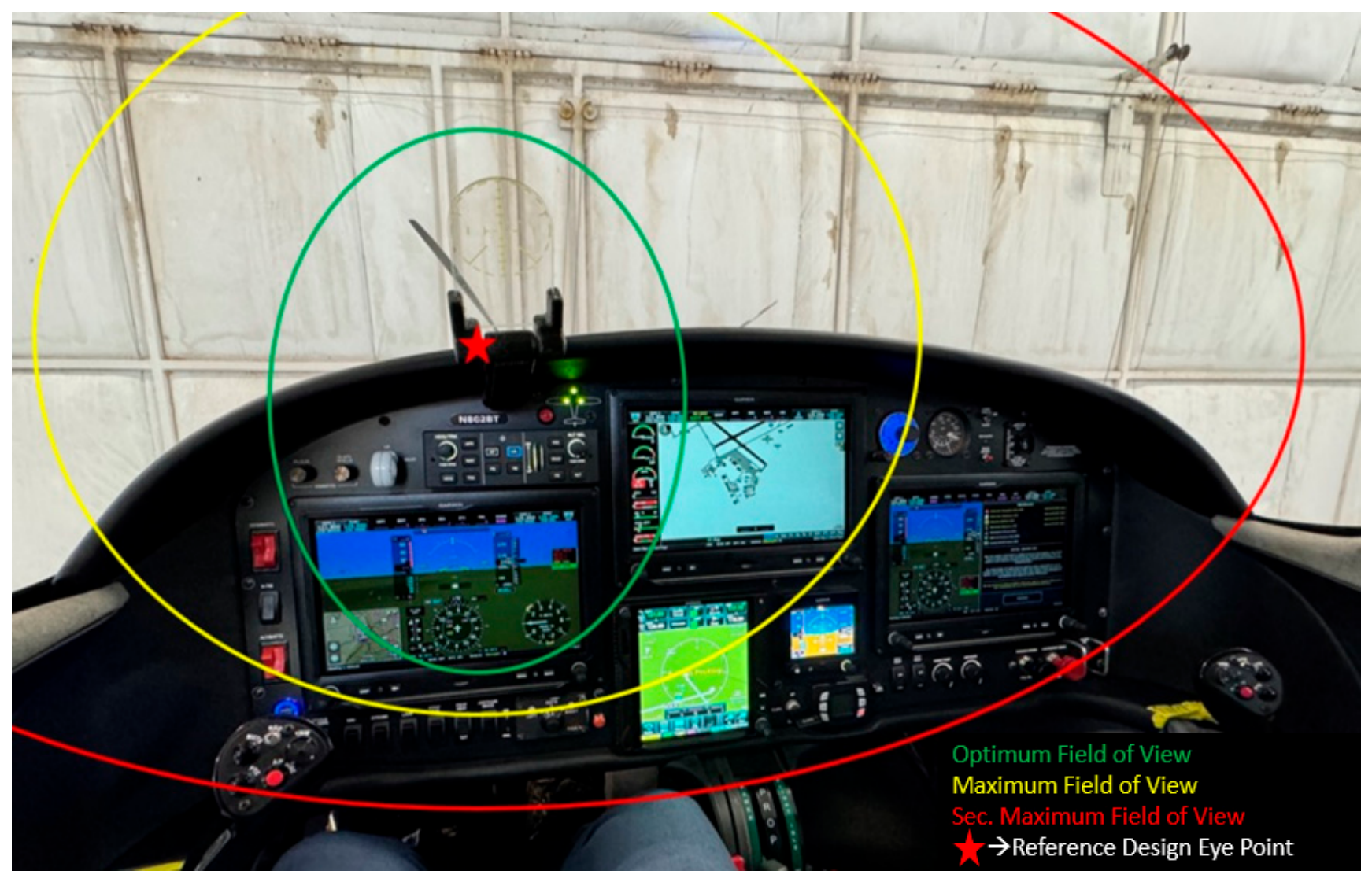
Similarly, the pilot’s external Field of View (FOV) was evaluated from the left seat. The primary test pilot utilized a standardized 8 cm polyurethane seat cushion to artificially elevate his eye line to the Design Eye Position (DEP), positioned 68.7 cm above the glare shield. Azimuth and elevation angles were mapped across 180 ° lateral sweep using a smartphone-based clinometer (Dioptra) mounted on a stable cockpit-centered tripod, yielding a measurement uncertainty of ± 1.0 ° . The Aitoff projection analysis in Figure 4 revealed that the high-angle glare shield, thick cabin A-pillars, and low-wing roots severely obstruct downward and lateral-forward visibility. Because this FOV mapping was executed for a single pilot stature (80th-percentile) using a single, static cushion configuration, the results are highly pilot-dependent and cannot be statistically generalized across a standard military pilot population. In a dynamic combat environment, these obstructions inherently degrade the pilot’s ability to maintain continuous visual target acquisition during complex maneuvers, such as the inbound dive or the 9-Line CAS relay orbit. Despite these pronounced limitations, which demonstrably diminish overall mission effectiveness, the outside view was assessed as “TOLERABLE”. To resolve these visual deficiencies, it is recommended to integrate an adjustable mechanical seat-lift mechanism to accommodate a standard 5th to 95th-percentile military pilot range. Additionally, installing a downward-facing cockpit mirror or a nose-mounted camera feed linked to the Multi-Function Display (MFD) would artificially restore the obscured downward visual angle.

4.1.2. Cockpit Control Evaluation

A critical determinant of a FAC(A) platform’s survivability and kinetic effectiveness is its unrestricted maneuverability. Executing precise target area holding patterns, steep dive profiles for ordnance delivery, and subsequent high-G egress maneuvers requires the pilot to have full and unimpeded control authority over the aircraft’s aerodynamic surfaces. To empirically evaluate the LX7-135’s mechanical control clearances under combat-representative conditions, a comprehensive ground assessment of the cockpit controls was conducted. The evaluation was executed with the test pilot occupying the left seat, fully outfitted with standard military flight gear (flight suit, kneeboard, and headset), and securely restrained by the aircraft’s restraint system to precisely replicate combat-representative anthropometric constraints.
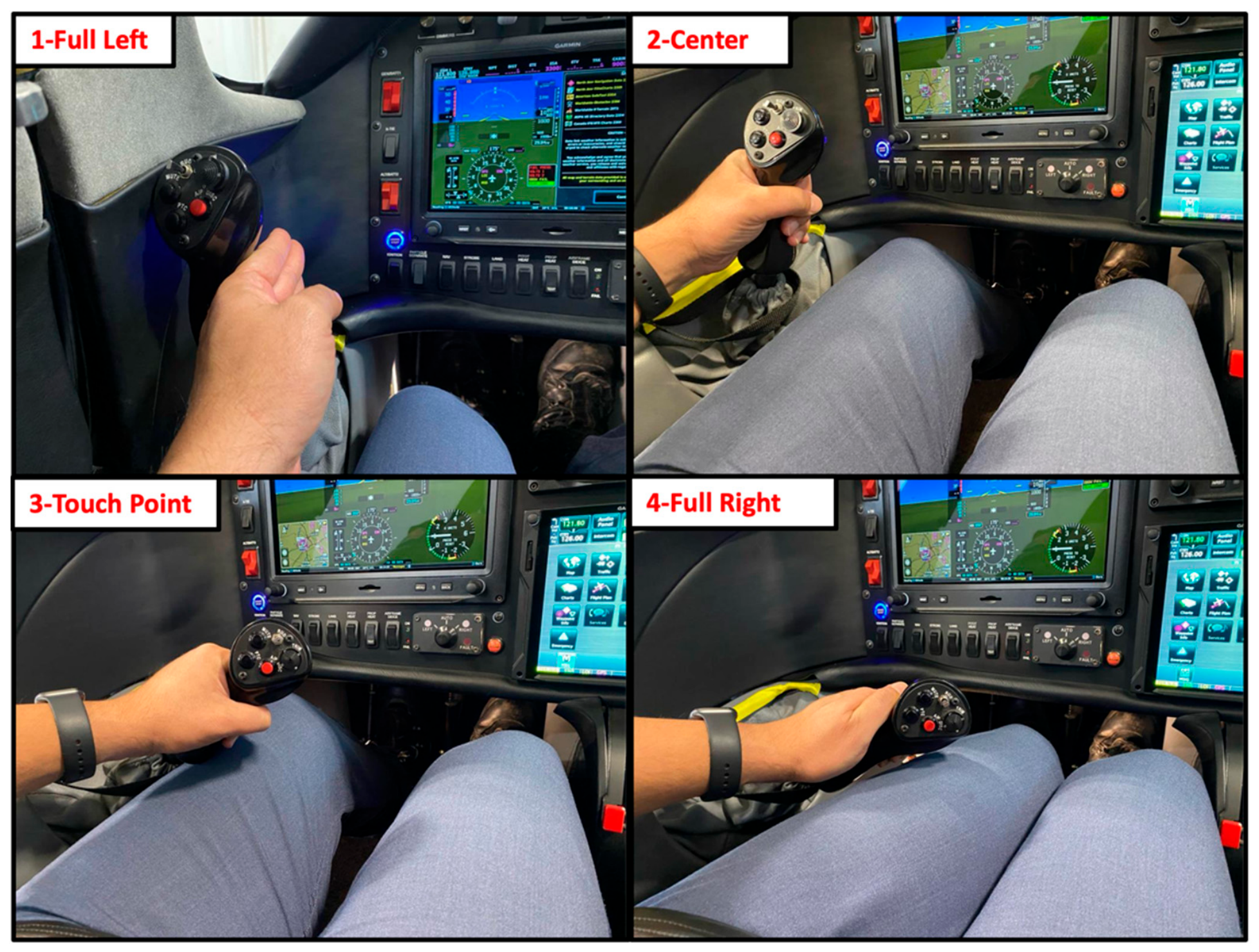
During the assessment of the aircraft’s sidestick inceptor, severe mechanical and ergonomic constraints were identified when the pilot attempted to achieve maximum lateral control inputs. When executing full outboard lateral commands, the control stick resulted in hard mechanical interference with the cockpit side wall. Conversely, when applying full inboard lateral commands, the stick fouled against the pilot’s own leg. This severe spatial limitation precluded the attainment of full aileron deflection without requiring compensatory repositioning of the pilot’s leg during the maneuver, as illustrated in Figure 5.
This lack of spatial clearance represents a critical safety-of-flight and operational vulnerability. According to the stringent military aircrew station geometry standards defined in MIL-STD-1333, specifically Paragraph 5.1.1.1, a minimum clearance of 1.5 inches must be strictly maintained between the sidestick inceptor and all surrounding structures when the inceptor is positioned at any of its extreme kinematic limits. The LX7-135’s sidestick design represents a direct non-compliance with this requirement. In a highly dynamic FAC(A) mission, where rapid, full-deflection evasive maneuvers are often required to defeat ground-based threats or to execute the box pattern delivery profile, the inability to swiftly achieve maximum roll rate severely degrades the aircraft’s tactical maneuverability. Consequently, the positioning and mechanical limitation of the LX7-135’s sidestick inceptor, which inherently precludes full lateral deflection, was rated as UNSATISFACTORY. Prior to any potential operational fielding of the aircraft, it is considered a HIGHLY DESIRABLE engineering mandate that the sidestick architecture be fundamentally redesigned to ensure full, unrestricted lateral control authority.

4.1.3. Cockpit Display Evaluation

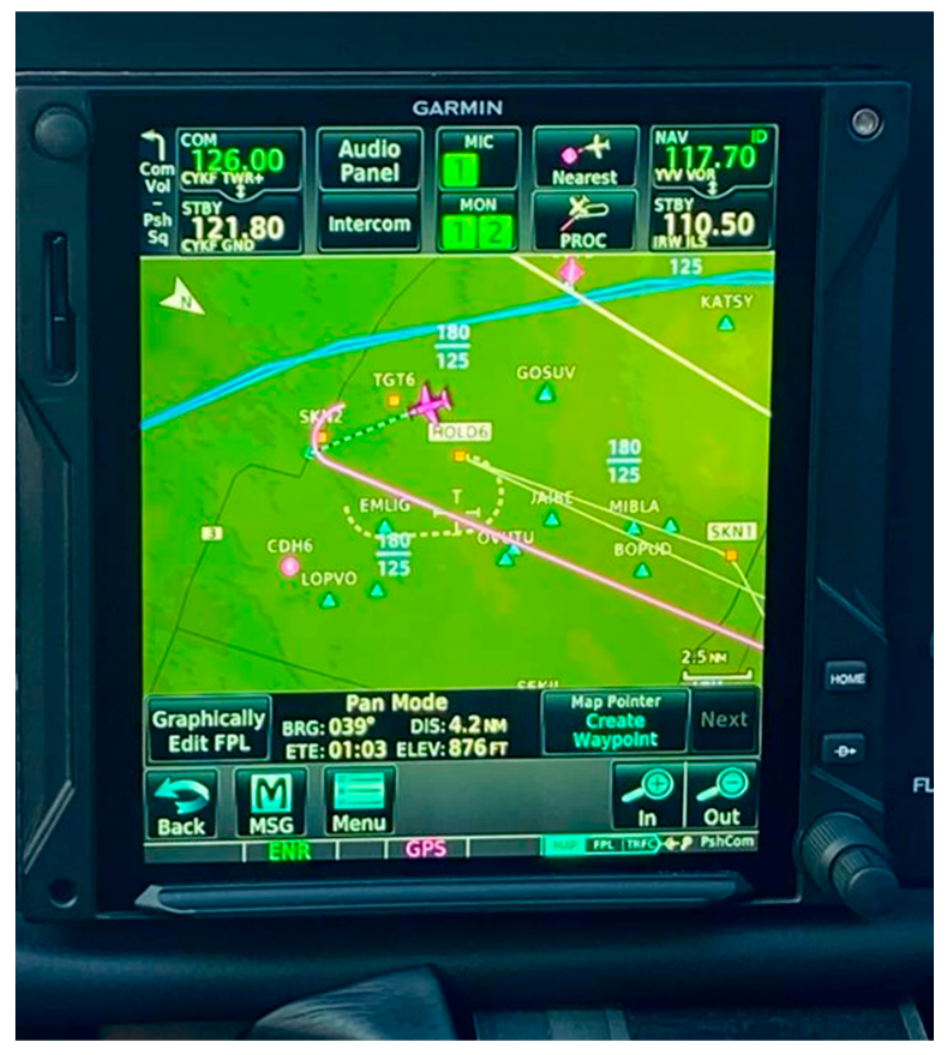
In the highly dynamic and cognitively demanding environment of a FAC(A) mission, the pilot’s situational awareness is fundamentally reliant on the efficacy of the PVI. To evaluate the operational suitability of the LX7-135’s avionic architecture, a comprehensive ground assessment of the COTS EFIS—comprising the Primary Flight Display (PFD), Multi-Function Display (MFD), and GTN-750—was conducted at the established DEP. Quantitative and qualitative evaluations indicated that the primary displays, engine instrumentation, and the attachable gunsight were optimally positioned within the pilot’s FOV. The Garmin G3X Touch system demonstrated high-definition resolution, readability, and contrast, remaining free from overlapping symbology that could induce visual clutter. The synchronization of brightness adjustments across the PFD and MFD, coupled with intuitive touch-screen functionalities such as pinch-to-zoom and map panning, significantly enhanced basic navigational awareness. Furthermore, the absence of a dedicated hardware annunciator panel was effectively mitigated by centralizing all critical caution and warning alerts directly within the PFD, ensuring immediate pilot notification of abnormal conditions. A visual representation of the pilot’s FOV is provided in Figure 6. Based on these baseline ergonomic metrics, the visual characteristics of the EFIS were rated as SATISFACTORY.

4.2. Aircraft Performance Data

Transitioning from the static ergonomic constraints of the cockpit, the flight test campaign rigorously evaluated the dynamic aerodynamic performance characteristics of the LX7-135 to determine its operational viability for the FAC(A) mission. In a hostile combat environment, a CDA survivability and tactical effectiveness are fundamentally dictated by its pure performance metrics—specifically its ability to rapidly gain altitude to avoid ground-based threats and its capacity to persistently loiter over a designated target area. To systematically quantify these critical mission parameters, the performance data presentation is structured into two sequential focus areas. First, the aircraft’s climb performance is analyzed using the level acceleration method to establish the maximum Rate of Climb (ROC) and the best rate of climb airspeed V y , which are vital parameters for safely egressing the fragmentation envelope following a steep dive rocket delivery profile. Second, the endurance performance is evaluated utilizing the equivalent weight method to determine the optimal loiter speeds and maximum time-on-station, an essential metric for orchestrating prolonged battlespace management, continuous target illumination, and airspace deconfliction.

4.2.1. Climb Performance

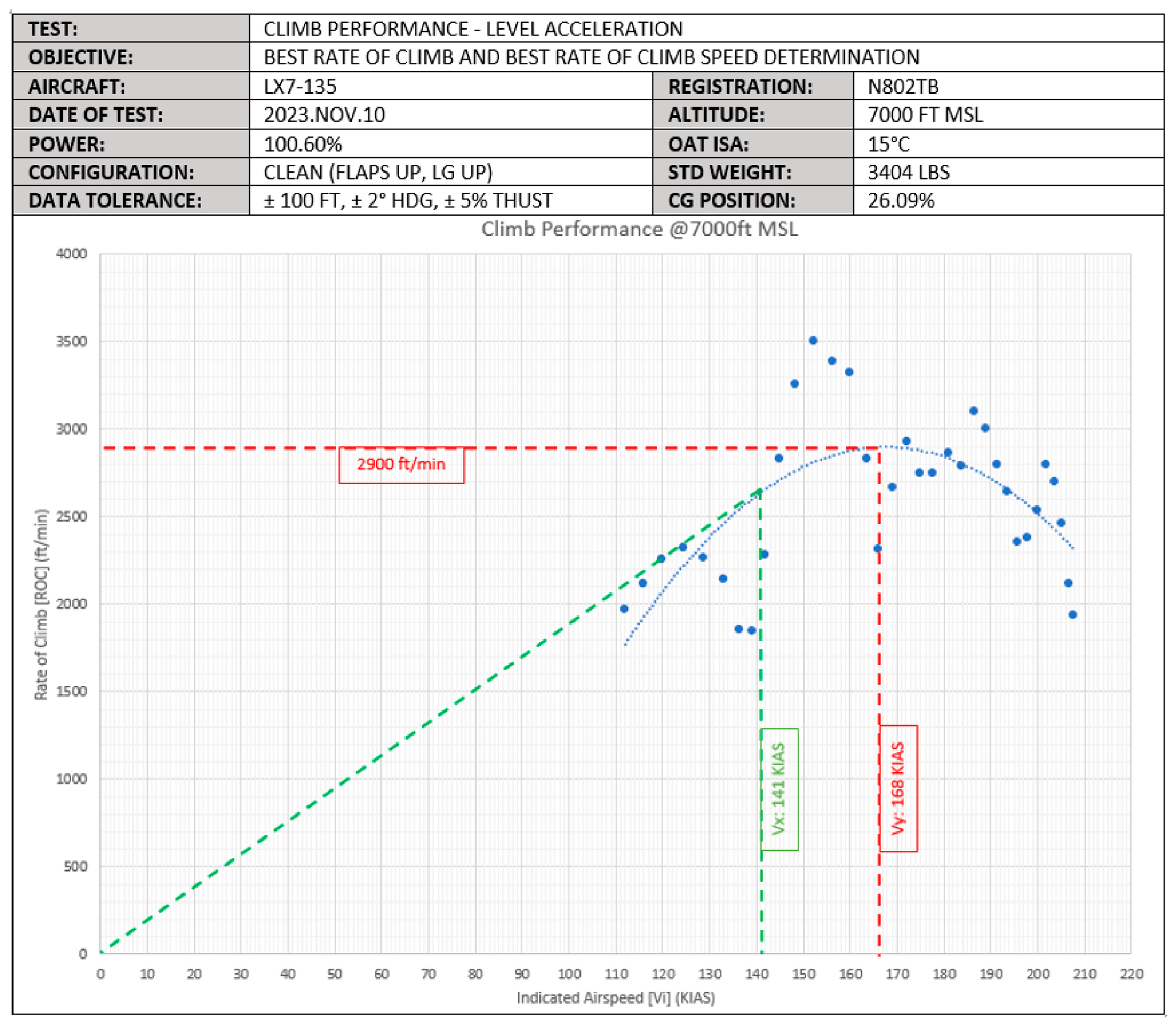
The climb performance of the LX7-135 was empirically evaluated utilizing the level acceleration flight test technique to accurately determine the aircraft’s maximum ROC and the best rate of climb airspeed V y . Establishing these precise aerodynamic parameters is critical for the FAC(A) mission, particularly to ensure a rapid altitude gain during the egress phase following a steep dive rocket delivery. The test point was conducted at a pressure altitude of 7000 ft MSL under the VMC, with the aircraft established in a clean configuration. The test article’s gross weight was recorded at 3809 lb, with a CG positioned at 26.09% MAC, and the Yaw Damper intentionally set to the OFF position to observe unaugmented dynamics.
During the execution of the test point, a significant operational limitation regarding the aircraft’s powerplant was identified and mathematically mitigated. Although the Pratt & Whitney PT6A-135 turbine engine is capable of producing a maximum torque of 2400 ft-lb, the flight test team was forced to artificially limit the power setting to 1900 ft-lb at 1900 RPM. This stringent restriction was mandated because applying maximum power generated a P-Factor and slipstream effect, which induced an uncontrollable left yawing moment that exceeded the pilot’s available rudder authority to maintain coordinated flight. Despite this substantial reduction in available thrust, the post-flight data reduction—normalized to a standard weight of 3404 lb and standard atmospheric conditions—revealed climb capabilities.
To isolate the aircraft’s true climb capability, the raw flight data was reduced using the Specific Excess Power ( P s ) method. The fundamental energy equation governing the level acceleration run is;
P s = V T D W t e s t = V t g d V t d t + d h d t
For a level acceleration task where the altitude is held constant d h / d t = 0 , the raw specific excess power is directly proportional to the acceleration rate
P s = V t g Δ V t Δ t
where V t is the true airspeed, g is the gravitational acceleration, and Δ V t / Δ t is the acceleration gradient recorded at 1 Hz from the G3X. The equivalent rate of climb ROC obs is then calculated as:
R O C o b s = P s 1 + V t g d V t d h
where the denominator term accounts for the accelerate-climb correction factor during a non-standard climb. To permit independent evaluation, all raw data was normalized to a standard reference weight of W s t d = 3404   l b s and standard atmospheric conditions (ISA at 7000 ft MSL, T s t d = 1.1   ° C and ρ = 0.001927   s l u g s / f t 3 using the standard turboprop performance reduction ratio:
R O C c o r r e c t e d = R O C o b s W t e s t W s t d σ t e s t σ s t d 0.5 + R O C t e m p
where W t e s t = 3809   l b s represents the test gross weight, σ is the atmospheric density ratio, and R O C t e m p is the temperature correction term accounting for the Pratt & Whitney PT6A-135’s thermodynamic performance variation (ISA-4 °C test ambient). The cumulative measurement uncertainty for the computed ROC was calculated to be + / 85   f t / m i n based on a root-sum-square (RSS) analysis of the G3X sensor errors + / 1.5 KIAS, + / 30 ft pressure altitude, + / 0.1   ° C OAT.
The aircraft achieved a ROC of 2900 ft/min, with the corresponding best rate of climb airspeed V y established at 168 KIAS. The detail of the test and reduced data graph is presented in Figure 7.
When comparing these empirical flight test results with the baseline civilian pilot’s operating handbook (POH), a notable discrepancy was observed. The civilian checklist suggested a V y of 140 KIAS at a lower torque setting of 1550 ft-lb. The flight test established V y of 168 KIAS differed from the published manual by approximately 20%; however, within the context of an experimental military evaluation operating under altered power parameters, this deviation was considered both expected and acceptable.
As Specific Excess Power increases, the engine torque raises from 1550 ft-lb to 1900 ft-lb (~22.5% increase), shifting the peak of the excess power curve to a higher airspeed. This occurs because the thrust available remains high at elevated speeds, while the drag curve rises more gradually. Additionally, at lower airspeeds (such as 140 KIAS), the high-torque (1900 ft-lb) slipstream and P-factor generate an intense asymmetric left yaw. To maintain coordinated flight at 140 KIAS, the pilot must apply heavy right rudder deflection, generating significant trim drag. By flying at a higher V y of 168 KIAS, the increased dynamic pressure over the vertical stabilizer increases the inherent aerodynamic restoring moment, allowing the pilot to maintain coordination with lower rudder deflection, thereby minimizing trim drag and maximizing net rate of climb.
From a tactical perspective, a V y of 168 KIAS closely aligns with the expected airspeed following a 3G dive recovery maneuver, allowing the operational FAC(A) pilot to transition from a kinetic rocket attack into an optimal climb profile without experiencing excessive speed bleed-off. Consequently, yielding a 2900 ft/min climb rate to rapidly avoid ground fragmentation effects and small-arms fire, the climb performance of the LX7-135 was assessed as SATISFACTORY for the intended mission.

4.2.2. Endurance Performance

The endurance performance of the LX7-135, a paramount metric determining the platform’s time-on-station for prolonged FAC(A) missions, was rigorously quantified utilizing the level flight equivalent weight flight test technique. In a dynamic battlespace, maximizing loiter time is essential for the FAC(A) to persistently observe targets, coordinate multiple strike packages, and maintain continuous airspace deconfliction. The evaluations were conducted at a target pressure altitude of 5000 ft MSL under the VMC, encountering significant aloft winds (e.g., 252°/32 KT). To capture unaugmented aerodynamic data, the test article was established in a clean configuration with the Yaw Damper intentionally disengaged. During the execution of the test points, the aircraft’s CG was strictly maintained between 25.14% and 26.09% MAC, with the gross weight varying from 3628 lb to 3809 lb. The propeller was set to the full forward position, maintaining a constant 1900 RPM.
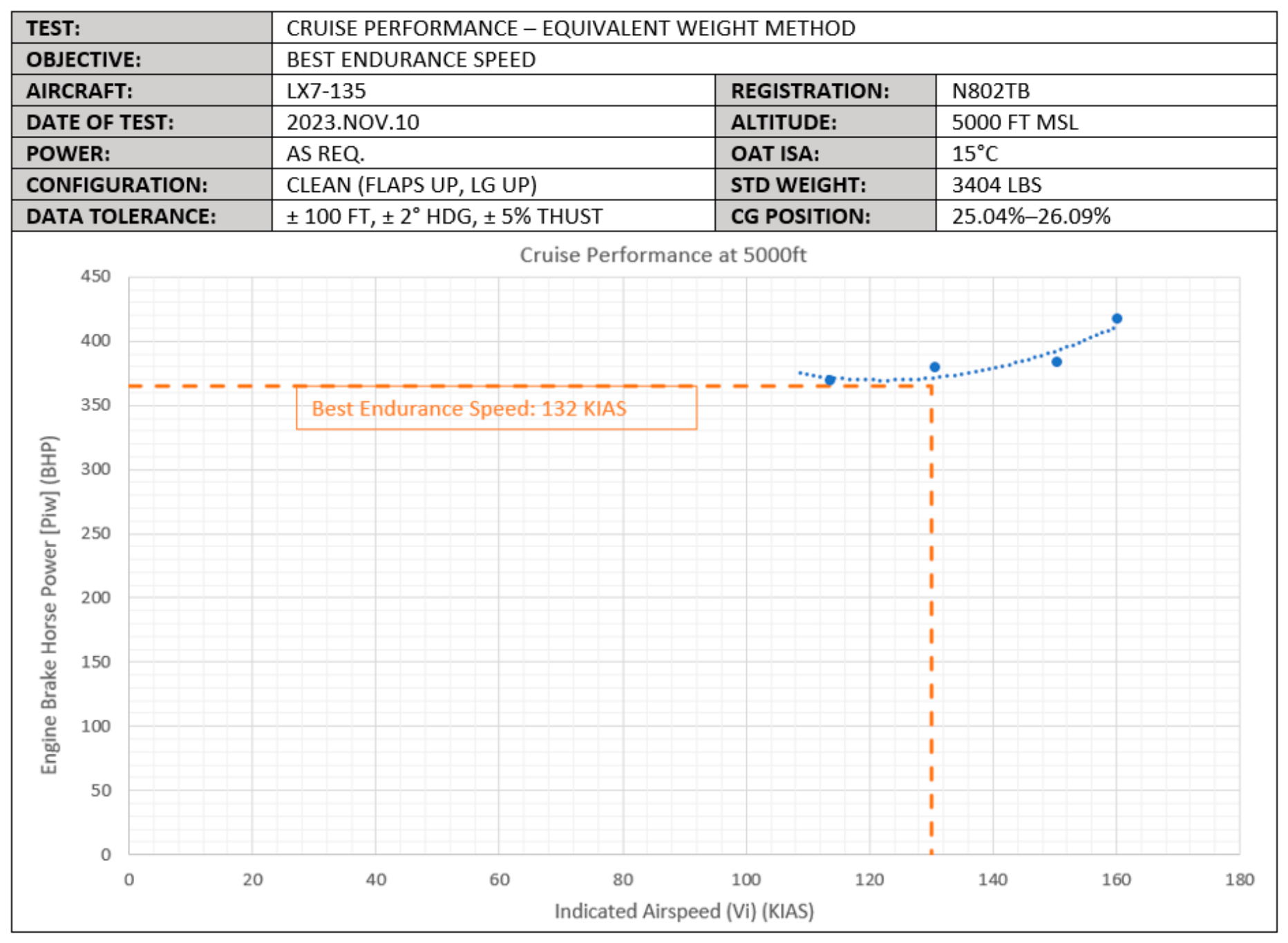
To determine the maximum time-on-station for prolonged FAC(A) missions, the loiter performance of the LX7-135 was rigorously evaluated at a pressure altitude of 5000 ft MSL under the VMC. The flight test was executed across a raw speed range of 115 KIAS to 160 KIAS, measuring the fuel flow at stabilized level-flight points. To establish a predictive fuel burn model, a second-order polynomial (quadratic) regression was applied to the collected data points (weight-corrected to 3404 lb), yielding the following governing equation:
F F V = 0.0435 V 2 11.48 V + 923.6
where FF is the fuel flow in lb/hr and V is the Indicated Airspeed in KIAS. This regression model achieved a coefficient of determination R 2 of 0.982. The derivative of this equation d ( F F ) / d V = 0 mathematically establishes the optimum endurance speed at exactly 132 KIAS, corresponding to a minimum fuel flow of 164.2 lb/hr (24.5 U.S. gallons/hour) at 78.7% NG. To provide an assessment of the platform’s operational capabilities, we define and distinguish between the various fuel boundaries of the aircraft. The LX7-135 has a total fuel capacity of 180 U.S. gallons (all of which is usable under standard civil operations). However, for the tactical FAC(A) mission configuration, a tactical fuel limit of 150 U.S. gallons was selected. This tactical limit is mandatory to reclaim sufficient weight margin to support a two-person tactical crew (pilot and JTAC/observer) and an additional 200 lb of tactical payload (such as EO/IR sensor turrets, secure radios, and rocket pylons) while strictly remaining within the 3850 lb MTOW.
Extrapolating the measured fuel flow model (Equation (5)) to this combat-representative loadout with the 150-gallon tactical limit, the LX7-135 demonstrated a total endurance of 5.7 h to complete fuel exhaustion (corresponding to 1005 lb of Jet-A). This total endurance comprises 4.7 h of operational mission endurance (on-station loiter time) and a dedicated 1-h safety reserve (approx. 24.5 U.S. gallons, or 164.2 lb of fuel) based on the optimum fuel flow of 164.2 lb/hr at 132 KIAS. The detail of the test and reduced data graph is presented in Figure 8.
In the context of the FAC(A) mission profile, this extensive endurance capacity provides the operational commander with significant tactical flexibility. It enables the aircraft to establish a prolonged holding pattern either within an uncontested standoff airspace awaiting strike fighters, or directly over a hostile zone during kinetic engagements. For operational and procedural simplicity, a nominal loiter speed of 130 KIAS at 5000 ft MSL can be practically adopted to maximize endurance without inducing excessive cognitive workload for precise airspeed maintenance. Consequently, the endurance performance of the LX7-135 was assessed as SATISFACTORY for safe-area holding operations.

4.3. Flying Qualities and Dynamic Stability

Transitioning from the quantitative assessment of aircraft performance, the flight test campaign necessitated a rigorous evaluation of the LX7-135’s inherent flying qualities and dynamic stability to determine its operational suitability for the FAC(A) mission. Because the tactical environment demands precise aircraft handling during high-workload tasks such as ordnance delivery and target area holding, the unaugmented aerodynamic responses of the platform were meticulously quantified against the stringent requirements of MIL-F-8785C. To provide a systematic and comprehensive analysis of the airframe’s handling characteristics—particularly given that the entire campaign was conducted with the yaw damper disengaged to expose the baseline aerodynamics—the presentation of flying qualities data is structured into four sequential domains. First, the FCMC are evaluated to quantify friction, breakout forces, and centering mechanisms that dictate the fundamental physical pilot-vehicle interface. Second, the longitudinal stability profile is analyzed, encompassing both static stick force gradients and dynamic responses such as the short-period and phugoid modes, which are critical for maintaining pitch authority during precise target tracking. Third, the lateral-directional stability is assessed through steady-heading sideslip (SHSS) maneuvers, Dutch roll damping, spiral mode divergence, and roll performance to verify controllability during asymmetric maneuvers and crosswind engagements. Finally, the aircraft’s stall characteristics are examined to define the low-speed aerodynamic boundaries, buffet warning margins, and recovery profiles, ensuring that the platform can safely operate near its lift limits during aggressive tactical maneuvering without departing controlled flight.

4.3.1. Flight Control Mechanical Characteristics

In the execution of a FAC(A) mission, precise target tracking and the management of high-workload maneuvers intrinsically depend on the physical interface between the pilot and the aircraft’s flight control system. To empirically evaluate this interaction, the FCMC of the LX7-135 were assessed to quantify friction, breakout forces, control free play, and centering mechanisms [24]. The evaluation was conducted on 6 November 2023, under light turbulence conditions at pressure altitudes of 3800 ft (6 °C) and 6020 ft (5 °C). The test article was established in a clean configuration with the yaw damper intentionally disengaged, flying at trimmed airspeeds of 140 KIAS and 180 KIAS. The test pilot introduced small elevator, rudder, and aileron deflections to break the trim condition, utilizing structural markings to measure free play and qualitative pilot force estimation to calibrate the required breakout and friction forces. The collected data revealed that the combined breakout and friction forces were low; stick inputs required less than 1 lb of force in both longitudinal and lateral axes at both airspeeds, while rudder pedal inputs required less than 3 lb. Additionally, the measured free play across all axes was minimal, ranging from less than 1 mm to a maximum of 4 mm depending on the axis and speed. These slight tolerances were actually deemed operationally beneficial, as they provide a buffer that prevents unintentional pilot inputs caused by combat-environment vibrations or atmospheric gusts [24]. However, the most critical finding regarding the mechanical controls emerged during the evaluation of the centering motion. When the controls were released, the aircraft exhibited positive rather than absolute centering characteristics. In the context of a tactical FAC(A) mission, the absence of absolute centering imposes a significant operational penalty; it necessitates continuous pilot compensation to maintain a stable flight path, particularly during extended navigation or target area holding patterns. The 140 KIAS and 180 KIAS test results are presented in Table 5 and Table 6 respectively.
This continuous physical adjustment inherently detracts from the pilot’s cognitive capacity to focus on primary battle management tasks, such as visual target acquisition or radio communications. Consequently, the flight control mechanical characteristics of the LX7-135 were assessed as TOLERABLE for the intended mission, with a DESIRABLE recommendation heavily emphasizing the mandatory use of the autopilot to alleviate physical fatigue when the pilot is engaged in secondary tactical duties. Despite the lack of absolute centering, the aggregate influence of the mechanical forces and free play did not induce any adverse handling characteristics, allowing the aircraft to successfully meet the stringent requirements of MIL-F-8785C Class I Category A paragraph 3.5.2.1 as Level 1, as well as paragraph 3.5.2.2.

4.3.2. Longitudinal Stability

The longitudinal stability of the LX7-135 was systematically evaluated to determine its capability to maintain pitch authority and airspeed awareness during the highly demanding phases of the FAC(A) mission. The assessment encompassed both static and dynamic longitudinal characteristics, conducted entirely with the yaw damper disengaged to isolate the airframe’s inherent, unaugmented aerodynamic responses. Longitudinal static stability was evaluated utilizing the stabilized method at airspeeds ranging from 140 to 180 KIAS. The empirical data indicated a marginally positive static stability, appropriately requiring push forces for airspeeds above trim and pull forces for airspeeds below trim. However, a critical aerodynamic deficiency was identified: the aircraft exhibited no free return speed range and possessed an excessively low, albeit stable, stick force curve slope of approximately 1 lb per 20 KIAS. In a tactical environment, the absence of a free return speed combined with such a shallow force gradient severely degrades the pilot’s airspeed awareness. It demands continuous, fatiguing pilot compensation to maintain a trimmed flight path during extended target area holding or point-to-point navigation. Consequently, the longitudinal static stability was assessed as UNSATISFACTORY, satisfying only MIL-F-8785C Class I Category A Level 2 requirements, thereby highlighting a HIGHLY DESIRABLE engineering mandate to increase the stick force curve slope.
Conversely, the aircraft’s longitudinal dynamic stability presented highly favorable characteristics that adequately support aggressive tactical maneuvering. The short-period mode, excited via doublet inputs at 121 KIAS, demonstrated a response completely devoid of Pilot-Induced Oscillation (PIO) tendencies. Although the 1 Hz sampling limitation of the COTS Garmin G3X flight logger precluded the precise mathematical quantification of the short-period natural frequency and acceleration sensitivity, the mode was characterized qualitatively as deadbeat and heavily damped, based on a combination of pilot observation and post-flight cockpit display video analysis (30 fps). The qualitative absence of overshoots during controls-fixed and controls-free evaluations was definitive; therefore, it is treated as an approximate qualitative finding rather than a high-frequency instrumental measurement. This deadbeat characteristic is tactically vital; it ensures that the aircraft will not exhibit adverse oscillations when the pilot executes abrupt pitch inputs, such as those strictly required during the 3G dive recovery phase of a simulated kinetic ordnance delivery profile. Accordingly, the short-period dynamic response was assessed as SATISFACTORY; early qualitative evaluation indicates it meets Level 1 requirements of the MIL-F-8785C Class I Category A standard.
Finally, the long-period dynamic stability was investigated by inducing a 15% airspeed reduction from the trimmed flight condition. The resulting phugoid motion was quantitatively resolved using the 1 Hz Garmin G3X flight logger—which is highly adequate for capturing slow phugoid oscillations—and cross-verified with synchronized cockpit display video (30 fps). At 120 KIAS, the motion was convergent, yielding a damping ratio δ of 0.09, while exhibiting a marginally divergent behavior at a higher airspeed of 160 KIAS. Despite the marginal high-speed divergence, the oscillation periods were exceedingly long—extending up to 200 s. In the context of a FAC(A) mission, where a pilot’s attention is frequently diverted outside the cockpit for visual target acquisition, these gradual and prolonged oscillations provide the pilot with ample time to recognize the aerodynamic deviation and smoothly suppress the motion without experiencing excessive cognitive workload. Therefore, the long-period dynamic stability did not pose a flight safety hazard, fully satisfied MIL-F-8785C Class I Category A paragraph 3.2.1.2 criteria, and was assessed as SATISFACTORY for operational deployment.

4.3.3. Lateral Directional Stability

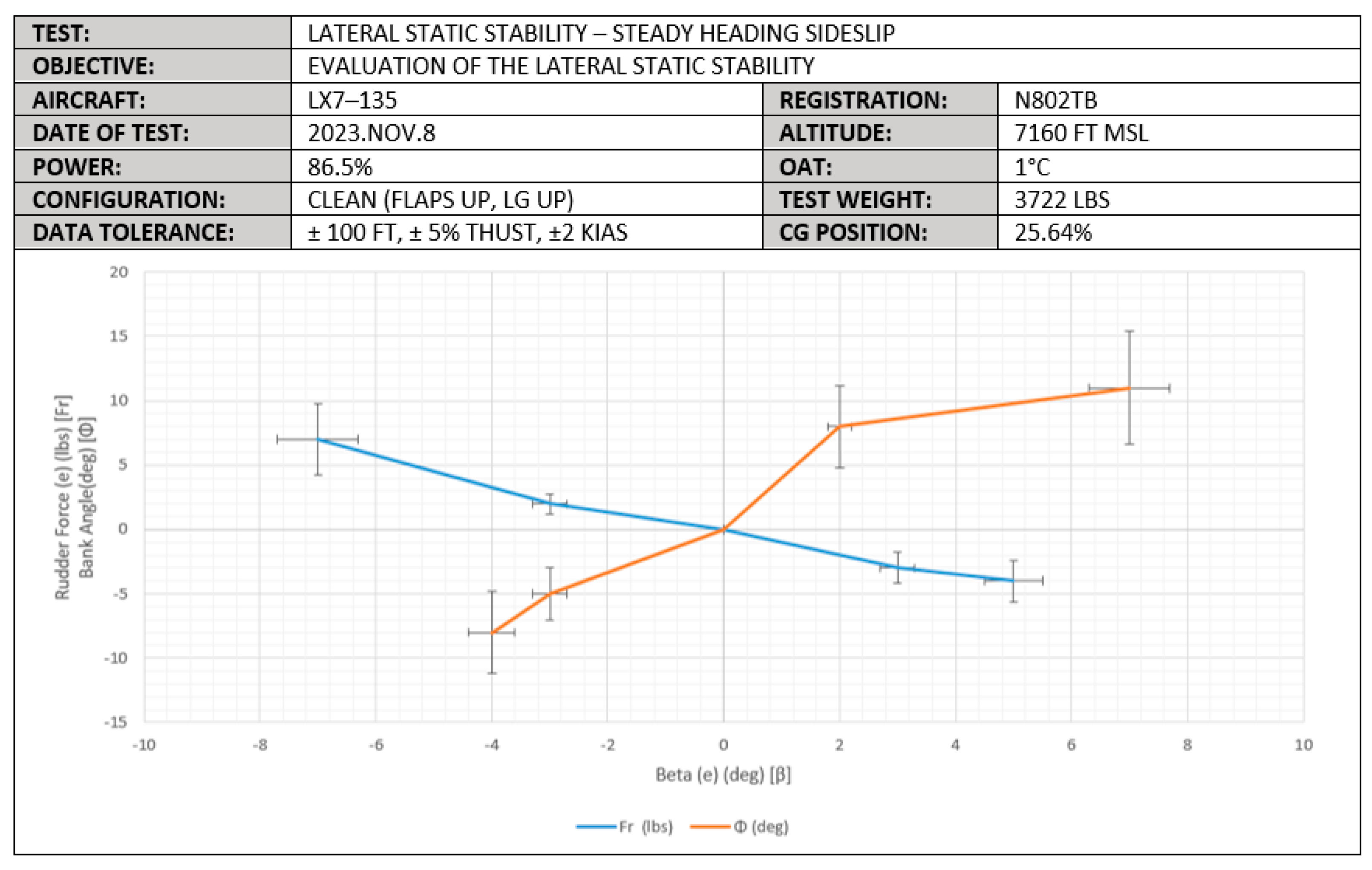
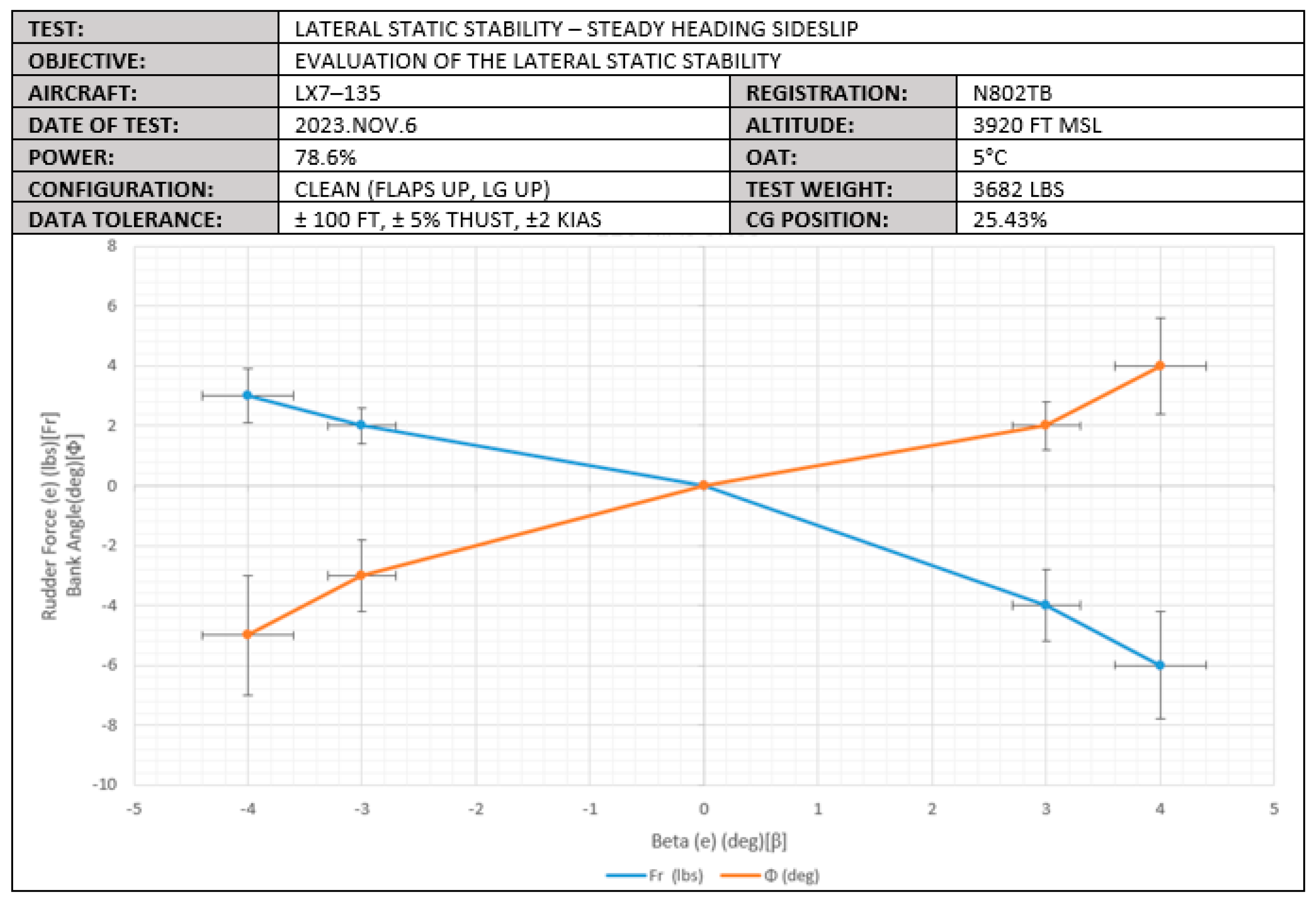
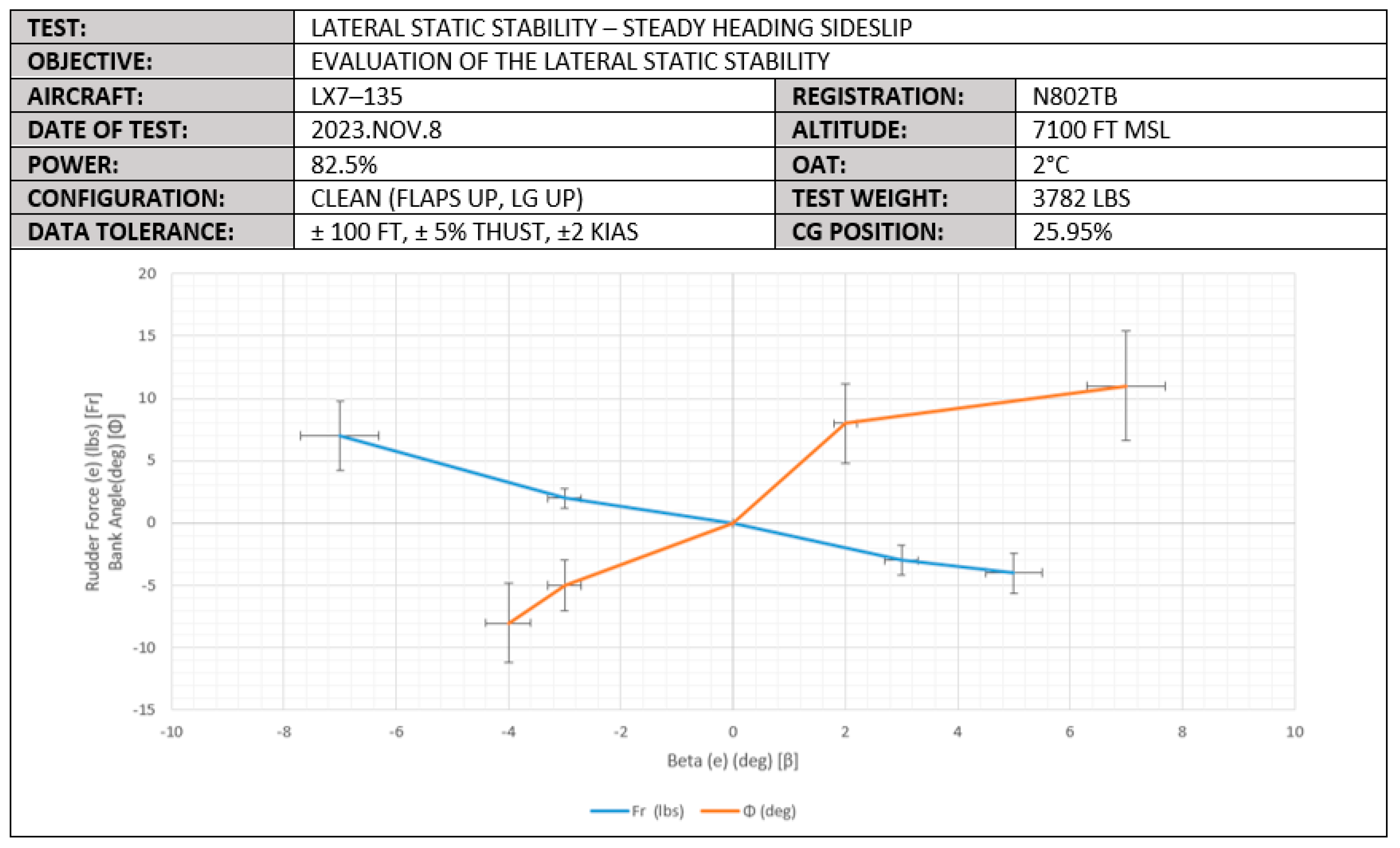
The lateral-directional stability profile of the LX7-135 was empirically evaluated to verify controllability during asymmetric flight, crosswind engagements, and aggressive roll maneuvers essential for the FAC(A) mission. Conducted entirely with the yaw damper disengaged to isolate the unaugmented baseline aerodynamics, the evaluation commenced with an assessment of lateral static stability via SHSS maneuvers at airspeeds ranging from 120 to 200 KIAS. The empirical data indicated a neutral lateral static stability; the aircraft exhibited a tendency to maintain the induced bank angle, requiring continuous lateral pilot compensation to maintain the desired bank angle and heading. While rudder deflections and forces increased linearly and predictably with sideslip, the necessity for constant lateral adjustments increases pilot workload, particularly during crosswind landings or dynamic target tracking in the “Box Pattern”. Consequently, the lateral static stability was assessed as TOLERABLE, complying with MIL-F-8785C Class I Category A paragraphs 3.2.3.7 and 3.3.6.2, but demanding a higher degree of continuous pilot proficiency. The related data for the 120 KIAS, 160 KIAS, and 200 KIAS graphs are presented in Figure 9, Figure 10, and Figure 11, respectively.
In contrast to the workload-intensive static characteristics, the dynamic lateral-directional modes exhibited highly favorable damping properties. The Dutch roll mode, excited via doublet inputs at 119 KIAS, proved to be oscillatory yet heavily convergent. The calculation for the Dutch roll damping and neutral frequency is performed with Equations (1)–(3).
ζ D R = 7 ( n u m b e r   o f   o v e r s h o o t ) 10
ω d D R = 2 π ( n u m b e r   o f   c y c l e ) t o t a l   t i m e
ω d D R = ω n D R 1 ζ D R 2
The predominant motion was yawing, with an estimated roll-to-yaw ratio ϕ / β of 0.5. The oscillations became minimal after the second overshoot. Because high-frequency rate-gyro data was unavailable on the COTS avionics, these parameters were estimated using post-flight cockpit display video analysis (30 fps) to count the overshoots and timing intervals, supplemented by the pilot’s real-time observations. Given the 1 Hz update rate of the G3X display, these values represent approximate qualitative estimates rather than precise sensor-derived measurements. This analysis yielded an estimated damping ratio ζ D R of 0.4 ± 0.05 for controls-free and 0.5 ± 0.05 for controls-fixed conditions. For the FAC(A) pilot, this heavily damped nature ensures that atmospheric gusts or abrupt rudder inputs during fine tracking will not result in uncontrollable lateral-directional excursions. Similarly, the Spiral mode, evaluated at 197 KIAS, demonstrated a slightly divergent, yet highly safe characteristic. When released from a 20 ° bank, the aircraft’s bank angle increased gradually (e.g., reaching 28 ° in 20 s), but the time required to double the amplitude extended well beyond the 12-s threshold. This ensures the pilot can safely suppress the motion without diverting attention from primary mission objectives. Supported by both qualitative and empirical evaluations, both dynamic modes were therefore assessed as SATISFACTORY.
Finally, the aircraft’s roll performance was quantified to determine its agility during the visual target acquisition and dive recovery phases. Bank-to-bank maneuvers with 45° executed at varying airspeeds with 25% and 50% aileron step inputs revealed a sufficiently low roll mode time constant and favorable roll rate acceleration. Due to the 1 Hz sampling limitation of the COTS Garmin G3X flight logger, high-frequency roll rate transients could not be precisely resolved; thus, the roll mode time constant and roll acceleration are classified as qualitative, approximate findings derived from pilot assessment and cross-verified via cockpit display video (30 fps). The variation in roll response was linear with respect to control input, devoid of any adverse non-linearities or reversals when arresting the roll. Although some minor roll rate oscillations were noted at lower speeds (120 KIAS) due to aerodynamic coupling, the aircraft provided high roll rates that enable the pilot to establish optimal ordnance delivery headings swiftly and safely with minimal rudder input at higher speeds. Thus, the roll performance fully complied with MIL-F-8785C Class I Category A criteria (paragraphs 3.3.2.2 and 3.3.4.4) and was assessed as SATISFACTORY.

4.3.4. Stall Characteristics

In the highly dynamic environment of a FAC(A) mission, particularly during the steep dive recovery phase of a rocket delivery pattern or high-g evasive maneuvers against ground threats, the aircraft frequently operates precariously close to its aerodynamic lift boundaries. Consequently, evaluating the stall characteristics of the LX7-135 is paramount to ensure that inadvertent energy mismanagement by a pilot focused on visual target acquisition does not result in a catastrophic departure from controlled flight. The empirical stall assessment was conducted under smooth atmospheric conditions with the aircraft established in a clean configuration and the yaw damper intentionally disengaged to observe unaugmented aerodynamic responses. The rigorous test matrix encompassed wings-level, 30 ° bank turning, and accelerated turning stalls, evaluated at both idle and power-on thrust settings. The evaluation revealed that the aircraft possesses an intuitive stall warning architecture. The primary warning is provided by an aural tone integrated into the Garmin G3X Angle of Attack (AOA) system, which emits a low-frequency alert that progressively increases in pitch as the aircraft approaches within 10 KIAS of the actual stall speed. Although the flight control system lacks a mechanical stick shaker, a distinct and natural aerodynamic buffet precedes the stall, providing the pilot with unambiguous tactile feedback before lift is compromised. During the stall event itself, the LX7-135 exhibited mild and benign characteristics; the flight controls retained full authority, and the airframe demonstrated no adverse un-commanded pitch-up tendencies or spin entry dynamics. Furthermore, stall recovery was consistently achieved utilizing standard pilot procedures, without necessitating exceptional piloting skill or inducing excessive altitude loss. From a tactical perspective, these stall characteristics provide a substantial operational advantage. They instill aerodynamic confidence, allowing the FAC(A) pilot to aggressively maneuver and fully exploit the aircraft’s lift boundary while maintaining visual focus on the target area, with the assurance that an impending stall will be clearly understood and easily recoverable. Accordingly, the stall characteristics of the LX7-135 were assessed as SATISFACTORY. The aircraft fully complied with the stringent military requirements of MIL-F-8785C Class I Category C paragraphs 3.4.2.1.1, 3.4.2.1.2, and 3.4.2.1.3: the stall approach is accompanied by perceptible buffets, the aircraft remains controllable without exceeding a 30° attitude change, and recovery forces remain within specified limits. The detailed parameters for the stall characteristics test results are presented in Table 7.

5. Mission Suitability and Role Relation

Transitioning from the isolated aerodynamic and performance metrics established in Section 4, this section evaluates the operational mission suitability and the PVI role relation of the LX7-135 within the context of a FAC(A) environment. The FAC(A) mission demands a synthesis of physical aircraft control and cognitive battle management, requiring the pilot to maintain precise flight parameters while simultaneously acquiring ground targets, coordinating with joint strike assets, and mitigating surface-to-air threats. To systematically determine whether the CDA provides the pilot with sufficient spare cognitive capacity to execute these complex tasks without degrading flight safety, the mission suitability assessment is structured into four sequential operational domains. First, the avionic architecture and its direct impact on cognitive workload are examined, specifically focusing on flight plan insertion and dynamic target data entry via the commercial Garmin interfaces. Second, the dual demands of target area holding patterns combined with simulated 9-Line CAS briefings are analyzed to quantify pilot saturation during sustained loiter operations. Third, the critical simulated kinetic ordnance delivery task is evaluated by applying the Cooper–Harper Handling Qualities Rating Scale to the specific tactical maneuvers of the orthogonal tactical delivery pattern, encompassing gross target acquisition, fine tracking, and high-g dive recovery. Finally, the platform’s broader tactical navigation and communication capabilities are assessed, addressing the aerodynamic challenges of short field takeoffs, autopilot navigation modes, and the limitations of the existing radio suite within a contested battlespace.

5.1. Avionics Setup and Cognitive Workload

In the modern multi-domain battlespace, the tactical effectiveness of a FAC(A) platform is inextricably linked to its avionic architecture and the subsequent cognitive demands placed upon the flight crew. To evaluate the LX7-135’s COTS Garmin EFIS—specifically the G3X Touch and GTN-750 interfaces—comprehensive assessments of the baseline avionics setup, flight plan insertion, and dynamic target data entry were conducted. While the COTS avionics provide intuitive, menu-driven interfaces that streamline conventional point-to-point civilian navigation, adapting these systems for combat-representative tasks introduces distinct PVI challenges. During the flight plan insertion phase, the pilot demonstrated the ability to rapidly program standard navigational waypoints prior to departure; however, the tactical environment frequently dictates immediate airborne re-tasking and the rapid processing of pop-up targets. This operational limitation became particularly evident during the target data entry evaluation, where the pilot was tasked with receiving and manually inputting coordinate data derived from a simulated 9-Line CAS briefing. Civilian GPS architectures are traditionally optimized for latitude/longitude or standard aviation identifiers rather than the rapid, alphanumeric insertions required by the Military Grid Reference System (MGRS). Consequently, inputting complex target data via the highly sensitive GTN-750 touchscreen while simultaneously maintaining manual aircraft control—especially given the previously identified positive centering issues and the presence of intermittent light turbulence (TURB 2)—forced the pilot into a prolonged head-down posture. This physiological and cognitive diversion inherently degrades the pilot’s external visual scan, which is critical for ground threat avoidance and spatial orientation in a contested airspace. The cognitive saturation experienced during these dynamic data entry tasks was empirically quantified utilizing the Bedford Workload Scale. The evaluation revealed that while the pilot could successfully maintain primary aircraft control, the intense visual and manual attention required for the touch-screen interface significantly reduced the spare capacity available for secondary battle management duties, yielding a Bedford rating indicative of elevated operator demand. Despite these procedural limitations, the open-architecture nature of the Garmin system offers a tactical mitigation; it possesses the inherent capability to integrate external high-resolution EO/IR sensor feeds directly into the MFD, thereby centralizing the pilot’s visual references once the target is electronically acquired. The avionics setup and the associated cognitive workload for dynamic targeting were assessed as TOLERABLE. To successfully bridge this specific operational deficiency, it is highly recommended that tactical data entry duties be explicitly delegated to the right-seat observer during combat operations, or that the COTS software suite be fundamentally upgraded to process military coordinate formats without inducing excessive pilot workload.

5.2. Target Area Holding and 9-Line Briefing

Following the avionic data entry evaluations, the dynamic cognitive demands of the FAC(A) mission were assessed by simulating a continuous target area holding pattern integrated with a standard 9-Line CAS briefing. The fundamental role of a FAC(A) necessitates establishing a stable loiter profile to maintain uninterrupted visual target tracking, scanning the airspace for threat systems, and orchestrating incoming joint strike assets via complex radio communications. To quantify pilot saturation during these simultaneous tasks, the LX7-135 was flown at a trimmed airspeed of 180 KIAS at 6000 ft MSL under occasional light turbulence, with the yaw damper disengaged to enforce manual flight control. During the initial phase of establishing the holding pattern, a pronounced avionics anomaly severely compounded the pilot’s workload; a waypoint dynamically generated on the MFD map and inserted into the GTN-750 erroneously appeared 25 nautical miles south of the intended location in the flight plan. Despite repeated attempts, this persistent data transfer error between the Garmin G3X and GTN-750 forced the pilot to manually estimate the target location using the MFD range scale, achieving a degraded coordinate precision of approximately 0.3 nautical miles. Furthermore, the digital representation of the holding pattern on the moving map displayed an irregular geometry, as presented in Figure 12, combining one linear and one curved flight path, which diminished the intended situational awareness benefits of the graphical interface.
Once the holding pattern was established, the pilot initiated the 2.5-min simulated 9-Line briefing while continuously flying the aircraft manually. The empirical flight data revealed the physiological and cognitive limits of the pilot under such multi-axis task saturation. While the pilot successfully adhered to the desired time constraints and maintained altitude ± 200 ft and route deviations ± 0.2 nm within adequate parameters, maintaining a consistent heading (HDG) proved problematic. The aircraft’s heading deviated up to ± 7 ° , critically exceeding the predefined adequate limit of ± 4 ° . This specific directional degradation was directly attributed to the pilot’s divided attention; the necessity to visually track the ground target, scan for aerial threats, and mentally process the 9-Line briefing over the tactical channel overwhelmed the pilot’s capacity to recognize and compensate for the aircraft’s neutral lateral static stability. However, this out-of-tolerance heading deviation did not compromise flight safety or result in mission failure. Crucially, the aircraft’s route deviation was maintained at ±0.2 nm (complying with the ‘Desired’ threshold), the platform remained strictly within its assigned holding airspace. Furthermore, the primary mission task—the 9-Line briefing transmission—was successfully completed within 2.5 min. Therefore, while the individual heading control parameter was technically out of tolerance under unaugmented manual flight conditions (yaw damper and autopilot unavailable), the overall mission suitability of the platform during this holding task was assessed as TOLERABLE for the degraded configuration. This rating is justified because the critical navigational containment and communication goals were safely met, and the heading deviation can be completely mitigated in operational scenarios by engaging the GFC 500X autopilot as recommended. The intense concentration required for primary aircraft control while managing briefing protocols left virtually no spare cognitive capacity for additional battle management duties. Consequently, the task was empirically quantified with a Bedford Workload rating of 6 under the degraded manual configuration (Table 8). While this degraded-system flight-test segment demonstrates that the aircraft remained controllable and the primary 9-Line briefing could be completed under manual flight control, this outcome is strictly constrained to the tested VMC and evaluating pilot’s proficiency. This localized success does not imply or establish a generalized robust fail-safe airworthiness for the platform, which would otherwise require comprehensive multi-axis Failure Mode and Effects Analyses and systematic degraded-mode flight-test validation.
While the Bedford Workload rating of 6 successfully quantifies the pilot’s spare cognitive capacity during the manual 9-Line briefing task, it is critical to acknowledge that this assessment relies on a single evaluating pilot’s subjective rating. The absence of objective physiological metrics—such as heart rate variability (HRV), electroencephalography (EEG), or eye-tracking data—to corroborate this subjective score remains a limitation of the current flight test campaign, primarily driven by the mandate to utilize a non-intrusive FTI suite to preserve the aircraft’s civilian certification baseline. Consequently, future evaluation phases of the modified LX7-135 are strongly recommended to integrate wearable, non-intrusive biometric sensors to quantitatively validate these cognitive workload peaks under combat-representative stress.

5.3. Delivery Task and Handling Qualities

The kinetic apex of the FAC(A) mission involves the precise delivery of marking ordnance, such as smoke rockets, to designate hostile targets for incoming strike assets. To empirically evaluate the LX7-135’s handling qualities during this critical phase, a standard “Box Pattern” delivery profile was established under VMC with the yaw damper intentionally disengaged. The box pattern was deliberately selected over other delivery profiles because it facilitates systematic flight path adjustments with minimal cockpit input, enables the continuous monitoring of critical flight parameters (altitude and airspeed) during the dive, and ensures uninterrupted visual target tracking. The representation of the box pattern and its key elements are presented in Figure 13.
The evaluation commenced with an in-depth analysis of the initial downwind and base-leg phases of the pattern. This segment focused on the pilot’s ability to maintain airspeed, altitude, and precise bank angles while establishing the pattern width using external visual references. Flight data revealed that at lower airspeeds, the pilot was forced to exert continuous and fatiguing control compensation in both the longitudinal and lateral axes to maintain the designated altitude. This increased workload was a direct aerodynamic consequence of the aircraft’s previously identified slightly positive longitudinal static stability and neutral lateral static stability. However, as the airspeed was systematically increased beyond 160 KIAS, and optimally established at 180 KIAS for the downwind leg, the requirement for such control compensation significantly diminished. From a tactical perspective, maintaining 180 KIAS during the downwind and base-leg phases provides a dual advantage: it aerodynamically mitigates the aircraft’s static stability deficiencies while simultaneously reducing the platform’s exposure time within the target area, thereby complicating enemy anti-aircraft tracking. Furthermore, once the evaluating pilot became thoroughly familiarized with the airframe’s unaugmented dynamics, the neutral lateral static stability actually proved advantageous, enhancing overall maneuverability during the coordinated, steep bank-angle turns required to establish the base leg. Evaluated using the Cooper–Harper Handling Qualities Rating Scale, the aircraft’s performance during the final downwind and base-leg patterns yielded a rating of CHR 4, indicating that desired performance required moderate pilot compensation. Consequently, the handling qualities during these initial delivery phases were formally assessed as TOLERABLE, with a highly desirable recommendation that comprehensive familiarization with these specific aerodynamic nuances be integrated into the operational pilot training syllabus to ensure combat readiness.
Following the establishment of the base leg, the delivery profile transitions into the highly critical gross acquisition phase, where the pilot must visually acquire the target and aggressively maneuver the aircraft into an optimal dive geometry. During the flight test, this inbound phase was initiated at an altitude of 5200 feet AGL and a lateral distance of 3.5 nautical miles from the objective, precisely when the target aligned with the leading edge of the left wingtip. To establish the required attack vector, the evaluating pilot was required to execute a simultaneous 90 ° turn coupled with a 10 ° dive. Flight data indicated that when properly executed, this complex, multi-axis maneuver yielded highly favorable entry parameters for the subsequent weapon release phase, specifically resulting in a controlled altitude loss of 350 feet and an optimal airspeed increase of 20 KIAS. However, achieving this precise spatial geometry without the assistance of an active yaw damper necessitated continuous and intricate rudder inputs to maintain coordinated flight. The application of these unaugmented rudder controls during the steep inbound turn invariably excited the aircraft’s Dutch roll mode just as the evaluating pilot was attempting to transition into the fine tracking phase. While the previously established heavily damped nature of the LX7-135’s Dutch roll mode allowed the test evaluating pilot to suppress the lateral-directional oscillations by momentarily freezing the flight controls, actively managing this inherent dynamic instability while simultaneously maintaining visual target tracking significantly elevated the overall workload. Consequently, the evaluating test pilot evaluated the gross acquisition task with a rating of CHR 5 on the Cooper–Harper Scale, indicating that while adequate performance was attainable, it required considerable pilot compensation. This specific phase of the delivery task was formally assessed as TOLERABLE for the FAC(A) mission, yet it revealed a tactical insight: an operational pilot lacking intimate familiarity with suppressing the airframe’s unaugmented natural modes could experience severe target tracking degradation during the critical inbound dive, making comprehensive aerodynamic familiarization training an absolute necessity. The test tolerances and results are presented in Table 9.
Transitioning from the gross acquisition geometry, the aircraft enters the fine tracking phase, which is the prerequisite for accurate ordnance delivery. Commencing at an altitude of 4600 feet AGL and an airspeed of 135 KIAS, the evaluating pilot successfully sustained continuous visual target tracking for 13 s. The initial transition phase required to stabilize the aircraft for a simulated three-smoke-rocket salvo consumed approximately 4 s. During this highly focused tracking period, the aircraft experienced a significant kinematic shift, losing 1300 feet of altitude while accelerating by an additional 55 KIAS. Aerodynamically, the fine tracking phase once again highlighted the airframe’s susceptibility to Dutch roll oscillations induced by necessary rudder adjustments. However, as the evaluating pilot’s familiarization with the unaugmented dynamics increased, these lateral-directional oscillations were effectively damped through proper control inputs, resulting in a CHR 4, and the tracking task was formally assessed as TOLERABLE. Immediately following the simulated ordnance release, the evaluating pilot executed a high-G dive recovery maneuver to safely egress the low-altitude threat envelope, a phase that demonstrated highly favorable handling qualities. The optimal recovery profile required the evaluating pilot to achieve a 3G load factor within 2 s, maintaining a wings-level ascent until reaching a 10 ° nose-up attitude, which resulted in an average altitude loss of merely 300 feet during the pull-out. Notably, the Garmin avionics effectively supported situational awareness by automatically displaying the G-meter when flight load factors exceeded 3.0G. While executing the maneuver up to a maximum of 4.4G, the required longitudinal control stick force was only 3.5 lb, a direct manifestation of the previously identified low stick longitudinal control force gradient. Because the aircraft allowed for the rapid, precise, and sustained application of onset G forces without departing controlled flight, the dive recovery phase earned a rating of CHR 2 and was formally assessed as SATISFACTORY. Collectively, these findings validate the LX7-135’s preliminary assessment of the simulated kinetic delivery task while reinforcing the necessity of specialized pilot training to manage its inherent aerodynamic nuances.
Building upon the empirical handling qualities data gathered during the individual phases of the delivery task, a finalized, optimal simulated kinetic delivery profile—specifically tailored to the unaugmented aerodynamics of the LX7-135—was formulated and validated during the final flight test sorties. To evaluate the simulated kinetic delivery task, a total of eight Box Pattern trials were executed (Runs 1 through 8, as detailed in Table 9). Among these, the first two trials (Runs 1 and 2) were unsuccessful due to the evaluating pilot’s adaptation challenges with the unaugmented flight dynamics: Run 1 suffered excessive speed and altitude deviations, while Run 2 was aborted after exceeding the V n e safety limit, prompting a ‘Knock-It-Off’ call. The subsequent six trials (Runs 3 through 8) were successfully completed and utilized as incremental build-up patterns to systematically formulate and optimize the aircraft-specific parameters.
It is critical to distinguish between the flight-test methodology itself and the novel scientific contributions of this study. The Box Pattern is an established, standard military tactical and flight-test procedure widely utilized in Close Air Support (CAS) and FAC(A) target-marking doctrines [2,13]. The core contribution of the present study, therefore, does not lie in the invention of this maneuver, but rather in the development of the unique, aircraft-specific flight parameters (e.g., the 180 KIAS downwind target speed, the 110 KIAS idle-glide deceleration technique, and the segmented 90° inbound turns) and the empirical handling-quality observations recorded during its execution. This empirical characterization bridges a key gap in the civilian-military airworthiness seam by documenting how a high-torque, light turboprop without stability augmentation behaves during this demanding operational task in baseline configuration.
The optimal profile commences on the downwind leg at 180 KIAS, accepting a calculated 35-s interruption in visual target tracking while utilizing the left wingtip as a spatial reference mark. The base turn is initiated at 3.9 NM from the target, transitioning into an rapid deceleration phase where the throttle is reduced to IDLE, allowing the airspeed to bleed to exactly 110 KIAS within a 20-s window. At precisely 3.5 NM, the inbound maneuver is executed via a highly coordinated, segmented approach: an initial 45 ° level turn maintaining a minimum of 105 KIAS to prevent critical energy depletion, immediately followed by a second 45 ° descending turn establishing a 10 ° dive angle toward the objective. This specific spatial geometry optimally establishes a 12 to 13-s fine tracking window, which is operationally critical for accurate weapon deployment before reaching the minimum release altitude. Immediately following the simulated ordnance release, the egress is executed via a 3G dive recovery sustained into a 10 ° nose-up attitude, stabilizing at an optimum climb speed of 160 to 170 KIAS. The calculations for the delivery pattern profile parameters are presented in Figure 14a. The results for the delivery profile and recommendations are presented in Figure 14b. Furthermore, level turns throughout the entire pattern are optimized at up to 60 ° of bank to expedite aircraft repositioning.

5.4. Tactical Navigation and Communications

Once airborne, effectively navigating to the target area requires a reliable autopilot to reduce the evaluating pilot’s physical workload and increase spare cognitive capacity for battle management. The evaluation of the autopilot climb mode revealed that while the system accurately captured the target altitude with minimal deviations, a critical human–machine interface discrepancy existed within the control architecture. Specifically, the NOSE UP/DN wheel on the autopilot panel functioned inversely depending on whether the system was in IAS or Vertical Speed (VS) mode. In a dynamic combat environment requiring frequent altitude and speed adjustments, this contradictory operation introduces a severe risk of mode confusion, potentially causing an inadvertent descent during low-altitude operations and exposing the aircraft to ground fire. Therefore, the autopilot climb mode was assessed as TOLERABLE, with a strong recommendation for an immediate engineering investigation to rectify the inverse functionality of the control wheel.
Upon establishing the holding pattern, the efficacy of the FAC(A) mission is entirely dependent on robust and secure communications with joint assets. The evaluation of the VHF radio suite demonstrated clarity (5/5 rating) and sufficient volume at ranges up to 40 nautical miles. However, the contemporary battlespace is characterized by advanced electronic warfare, making standard VHF transmissions highly susceptible to low-frequency jamming and interception. The LX7-135 currently lacks both UHF and Secure Voice communication capabilities. In a contested environment, the inability to securely transmit critical information—such as 9-Line briefings, clearance authorities, or hostile threat alerts—represents a tactical vulnerability. Accordingly, the absence of secure and anti-jamming communication suites was unequivocally assessed as UNSATISFACTORY. Before the aircraft can be operationally fielded, it is a mandatory requirement that comprehensive secure voice systems and UHF radios be integrated to guard against communication disruptions and enemy intelligence gathering.

6. Recommendations and Discussion

To ensure the optimal operational effectiveness and flight safety of the LX7-135 for the FAC(A) mission, a comprehensive series of engineering, procedural, and training recommendations must be addressed prior to its tactical fielding. While the platform is fundamentally suitable, its excessive available power and unique unaugmented aerodynamic nuances necessitate rigorous pilot familiarization. Foremost among the requirements categorized as HIGHLY DESIRABLE are critical safety and control interventions; an immediate engineering investigation must evaluate the right-seat evacuation procedure in the event that the left-door egress path becomes compromised. Also, it is recommended to integrate an adjustable mechanical seat-lift mechanism to accommodate a standard 5th to 95th-percentile military pilot range, and to install a downward-facing cockpit mirror or nose-mounted camera feed linked to the MFD to artificially restore the lost downward visual angle. Aerodynamically, the control stick must be physically adjusted to permit full lateral deflection without structural interference, and the longitudinal control stick force curve slope must be artificially increased to reduce pilot compensation during extended en-route navigation. Furthermore, it is categorized as HIGHLY DESIRABLE to conduct additional longitudinal static stability testing at the operationally most aft CG, alongside the mandatory integration of Secure Voice and UHF communication suites to prevent hostile intelligence gathering and jamming. Complementing these critical requirements are several recommendations categorized as DESIRABLE, aimed at optimizing the human–machine interface and tactical execution. Ergonomically, recommendations include utilizing seating cushions to improve the pilot’s FOV and upgrading the seatbelt fastening mechanisms for high-G maneuvers. Operationally, the standard utilization of the autopilot during 9-Line CAS briefings is recommended to effectively manage cognitive workload. Formally incorporating the newly identified box pattern delivery profile and its associated handling parameters into the advanced pilot training syllabus will be the definitive step in enhancing the LX7-135’s preliminary mission suitability. For the Operational Test and Evaluation Phase at least three evaluating pilots should be assigned to evaluate the aircraft’s mission characteristics.

7. Conclusions

The comprehensive flight test campaign systematically evaluated the LX7-135 turboprop aircraft to determine its preliminary operational viability, aerodynamic performance, and human–machine interface suitability for the demanding FAC(A) mission. Throughout the rigorous evaluations—which encompassed ground egress, static and dynamic stability, pure performance metrics, and complex tactical delivery tasks—the CDA demonstrated highly favorable baseline flight characteristics, particularly at elevated airspeeds, alongside an intuitive avionic infrastructure that effectively supports mission management. Although the transition from a civilian platform to a military battlespace revealed specific ergonomic and aerodynamic deficiencies—such as the severe left yawing moment induced by the P-Factor, the lack of an absolute stick centering mechanism, and structural egress limitations—these constraints did not fundamentally preclude the successful execution of the designated tactical profiles. The empirical flight data and qualitative evaluating pilot assessments using the Cooper–Harper and Bedford scales yielded a total of 12 SATISFACTORY, 10 TOLERABLE, and 4 UNSATISFACTORY evaluation points across all tested parameters. Based on this early-stage developmental flight test campaign, the LX7-135 shows potential suitability for further development, subject to the physical implementation and subsequent verification of the identified engineering modifications, secure communications, and training protocols. Rather than declaring the baseline aircraft immediately suitable, this evaluation establishes that the aircraft’s ultimate viability is gated by the resolution of the identified critical safety deficiencies. A summary of the total findings and recommended mitigations is given in Table 10.
This summary matrix demonstrates that the safety-critical findings (the 4 UNSATISFACTORY ratings) act as absolute gating requirements for future airworthiness certification and operational fielding, rather than being numerically offset or compensated by the 12 SATISFACTORY findings. While the aircraft’s core aerodynamic performance and handling qualities show strong potential, the platform cannot be deemed operationally suitable until each of these critical gates is successfully cleared, physically implemented, and verified through subsequent flight testing.
While the LX7-135 exhibited numerous capable attributes, the evaluation identified four critical areas where the platform failed to meet baseline military standards, resulting in UNSATISFACTORY ratings. Foremost among the ergonomic and safety deficiencies is the aircraft’s single-door configuration, which presents an unacceptable bottleneck for emergency ground egress in a combat scenario. Furthermore, the mechanical evaluation of the primary flight controls revealed a severe spatial constraint; the side-mounted control stick structurally impacts the cockpit wall or the evaluating pilot’s leg during full lateral deflections, directly violating the stringent clearance mandates of MIL-STD-1333. Transitioning to aerodynamic limitations, the aircraft’s longitudinal static stability proved highly deficient for tactical tracking tasks due to the complete absence of a free return speed and an excessively shallow longitudinal control force gradient, failing to meet Level 1 criteria and satisfying only MIL-F-8785C Level 2 requirements. Finally, in the domain of battle management, the absence of UHF radios and Secure Voice cryptographic capabilities severely compromises the platform’s ability to conduct safe and integrated 9-Line briefings in an electronically contested environment. Collectively, these four UNSATISFACTORY parameters represent significant operational hazards that mandate immediate engineering intervention and redesign prior to any tactical deployment.
Beyond the critical deficiencies, the flight test campaign identified ten distinct operational domains that were assessed as TOLERABLE, indicating that adequate mission performance was attainable with an increased reliance on continuous evaluating pilot compensation. Aerodynamically, the baseline unaugmented airframe presented handling challenges such as a positive rather than absolute control stick centering mechanism and a neutral lateral static stability profile that forced the evaluating pilot to continuously input lateral corrections to maintain a constant heading. Furthermore, specific mission execution phases were complicated by the contradictory, inverse operation of the autopilot climb mode selection wheel. In the context of tactical battle management, this accumulation of minor aerodynamic and avionic friction points directly culminated in elevated cognitive and physical workloads during simulated 9-Line CAS briefings within the holding pattern and throughout the simulated kinetic delivery task. Specifically, navigating the downwind and base-leg phases at 180 KIAS, along with executing coordinated multi-axis maneuvers for gross target acquisition and sustained fine tracking under yaw damper failure conditions, required moderate to considerable evaluating pilot effort. Nevertheless, while these TOLERABLE characteristics inherently erode the pilot’s spare cognitive capacity, they do not precipitate a loss of aircraft control or mission failure, thereby remaining acceptable for the FAC(A) role provided that comprehensive familiarization training is institutionalized.
Counterbalancing the identified operational limitations, the comprehensive flight test campaign underscored the LX7-135’s inherent capabilities, resulting in twelve distinct aerodynamic and functional parameters being evaluated as SATISFACTORY. In the domain of pure performance, the aircraft demonstrated climb rates and optimum endurance speeds, which are fundamental for rapid ground-threat evasion and prolonged safe-area holding during extended FAC(A) operations. Aerodynamically, the unaugmented dynamic stability profile proved highly advantageous for aggressive tactical maneuvering; the heavily damped, deadbeat characteristics of the short-period and Dutch roll modes, combined with easily suppressible Phugoid and Spiral divergences, ensure a highly stable platform for visual target acquisition. Furthermore, the aircraft’s high roll rates, mild stall characteristics accompanied by intuitive aerodynamic buffets, and precise high-G dive recovery capabilities instill aerodynamic confidence, allowing the evaluating pilot to safely exploit the lift boundary during simulated kinetic rocket deliveries. From a human–machine interface perspective, the intuitive architecture of the COTS Garmin GTN750 system effectively supported complex flight plan insertions and dynamic target data entries within a high-workload environment. Ultimately, synthesizing these robust performance metrics with the aforementioned constraints, the LX7-135 is concluded to show potential suitability for further development for the FAC(A) mission, with its eventual operational viability strictly subject to the physical implementation and subsequent flight-test verification of the mandatory engineering interventions regarding egress safety, control clearances, and secure communications.

Author Contributions

Conceptualization, methodology, and writing—original draft preparation, S.M.K.; Test Pilot comments and mission description İ.Ü.; writing—review and editing, İ.Ö. All authors have read and agreed to the published version of the manuscript.

Funding

This research received no external funding.

Data Availability Statement

The data presented in this study are available on request from the corresponding author. The data are not publicly available due to confidential issue.

Acknowledgments

The authors would like to thank ITPS Canada Ltd. and CASPRI Air for the research and aircraft usage.

Conflicts of Interest

The authors declare no conflicts of interest.

Abbreviations

The following abbreviations are used in this manuscript:
AGLAbove Ground Level
AHRSAttitude and Heading Reference System
AMSLAbove Mean Sea Level
AOAAngle of Attack
CASClose Air Support
CDACommercial Derivative Aircraft
CFRCode of Federal Regulations
CGCenter of Gravity
CHRCooper—Harper Rating
COTSCommercial Off The-Shelf
DEPDesign Eye Point
DoDDepartment of Defense
DT&EDevelopment Test and Evaluation
EFISElectronic Flight Instrument System
EO/IRElectro-Optical/Infrared
FAAFederal Aviation Administration
FAC(A)Forward Air Control Airborne
FCMCFlight Control Mechanical Characteristic
FOVField of View
FTIFlight Test Instrumentation
HUDHead Up Display
IADSIntegrated Air Defense Systems
IASIndicated Airspeed
IFRInstrument Flight Rule
IRInfrared
ISRIntelligence, Surveillance, and Reconnaissance
JTACJoint Terminal Attack Controller
LDLinear dichroism
MACMean Aerodynamic Chord
MFDMulti-Functional Display
MGRSMilitary Grid Reference System
MTOWMaximum Take-Off Weight
OT&EOperational Test and Evaluation
PFDPrimary Flight Display
POHPilot Operating Handbook
PVIPilot-Vehicle Interface
REPReference Eye Point
ROCRate of Climb
SHSSSteady Heading Sideslip
SMESpecial Mission Equipment
TACPTactical Air Control Party
TOTTime On Target
UHFUltra-High Frequency
V s Stall Speed
VHFVery High Frequency
VMCVisual Meteorological Conditions
VSVertical Speed

References

  1. Sacks, B.J.; Younossi, O.; Clayton, B. Improving Acquisition and Sustainment Outcomes for Military Commercial Derived Aircraft: The KC-46A Pegasus Experience; RAND Corporation: Santa Monica, CA, USA, 2023; pp. 1–120. Available online: https://www.rand.org/pubs/research_reports/RRA1676-1.html (accessed on 10 June 2026).
  2. Joint Chiefs of Staff. Joint Tactics, Techniques, and Procedures for Close Air Support (CAS); Joint Publication JP 3-09.3; U.S. Department of Defense: Washington, DC, USA, 2003; pp. 1–150. Available online: https://www.jcs.mil/Doctrine/Joint-Doctrinal-Publications/ (accessed on 10 June 2026).
  3. Bamford, G.R. VMLO: The Strategic, Operational and Tactical Imperative for a Light Observation Squadron within the USMC. Master’s Thesis, Naval Postgraduate School, Monterey, CA, USA, 2012; pp. 13–49. Available online: https://calhoun.nps.edu/handle/10945/27794 (accessed on 10 June 2026).
  4. U.S. Government Accountability Office. Special Operations Forces: DOD Should Slow Acquisition of Armed Overwatch Aircraft Until It Conducts Needed Analysis; Report No. GAO-24-106283; GAO: Washington, DC, USA, 2023; p. 2. Available online: https://www.gao.gov/products/gao-24-106283 (accessed on 10 June 2026).
  5. U.S. Air Force. Command and Control; Air Force Doctrine Publication AFDP 3-0.1; LeMay Center for Doctrine Development and Education, Maxwell AFB: Montgomery, AL, USA, 2025; pp. 1–10. Available online: https://www.doctrine.af.mil/Operational-Level-Doctrine/AFDP-3-01-Command-and-Control/ (accessed on 10 June 2026).
  6. Department of the Navy. Navy Forward Air Controller (Airborne) (FAC[A]) Program Manual; OPNAV M-1500.2; Office of the Chief of Naval Operations: Washington, DC, USA, 2025; pp. 1–4. Available online: https://www.secnav.navy.mil/doni/ (accessed on 10 June 2026).
  7. McCrackin, M. Airpower Theory, Close Air Support, and a New Approach to the Forward Air Controller in the Vietnam War. Master’s Thesis, Pittsburg State University, Pittsburg, KS, USA, 2025; pp. 38–42, 88–90. Available online: https://digitalcommons.pittstate.edu/etd/ (accessed on 10 June 2026).
  8. Clayton, B.; Younossi, O.; Dolan, B.; Goughnour, T.; Hill, D.; Mazzotta, G.; Sacks, B.J.; Bicksler, B. Life Cycle Management of Military Commercial Derivative Aircraft: Improving FAA Certification, Implementation of Digital Engineering and Sustainment Strategy; Report No. RR-A1676-2; RAND Corporation: Santa Monica, CA, USA, 2023; pp. 1–145. Available online: https://www.rand.org/pubs/research_reports/RRA1676-2.html (accessed on 10 June 2026).
  9. Lorenzo, W.P.; Takahashi, T.T. Can We Fly it? Yes We Can: A Comparative Study of Military Airworthiness and Flight Operations. In Proceedings of the AIAA SCITECH 2024 Forum, Orlando, FL, USA, 7–11 January 2024; American Institute of Aeronautics and Astronautics: Reston, VA, USA, 2024; pp. 1–24. [Google Scholar] [CrossRef] [Scilit]
  10. Federal Aviation Administration. Guidance for Certification of Military and Special Mission Modifications and Equipment for Commercial Derivative Aircraft (CDA); Advisory Circular AC 20-169; U.S. Department of Transportation: Washington, DC, USA, 2010; pp. 3–4, 10–11. Available online: https://www.faa.gov/regulations_policies/advisory_circulars/ (accessed on 10 June 2026).
  11. RDD Enterprises. LX7 Turboprop. LX7 Aircraft 2026. Available online: https://www.lx7aircraft.com/lx7-turboprop.html (accessed on 10 June 2026).
  12. Garmin International, Inc. Garmin G1000 NXi Integrated Flight Deck Pilot’s Guide for the Cessna NAV III; Document No. 190-02823-00, Rev. A; Garmin International, Inc.: Olathe, KS, USA, 2026; pp. 1–350. Available online: https://support.garmin.com/ (accessed on 10 June 2026).
  13. Luterbacher Mus, R.; Rodeck, R.; Wende, G. Initial and Continued Airworthiness: Commonalities and Differences Between Civil and Military Aviation. Aerospace 2024, 12, 23. [Google Scholar] [CrossRef] [Scilit]
  14. U.S. Department of Defense. Military Specification: Flying Qualities of Piloted Airplanes; MIL-F-8785C; Department of Defense: Washington, DC, USA, 1980; pp. 1–80. Available online: https://quicksearch.dla.mil/qsDocDetails.aspx?ident_number=7180 (accessed on 10 June 2026).
  15. Cooper, G.E.; Harper, R.P. The Use of Pilot Rating in the Evaluation of Aircraft Handling Qualities; NASA TN D-5153; National Aeronautics and Space Administration: Washington, DC, USA, 1969; pp. 1–32. Available online: https://ntrs.nasa.gov/citations/19690014894 (accessed on 10 June 2026).
  16. Federal Aviation Administration. Type Certification Procedures for Military Commercial Derivative Aircraft; FAA Order 8110.101A; U.S. Department of Transportation: Washington, DC, USA, 2015. Available online: https://www.faa.gov/regulations_policies/orders_notices/ (accessed on 10 June 2026).
  17. Dennis, D.N. Airworthiness Decision Factors in the US Air Force. Master’s Thesis, Air Force Institute of Technology, Dayton, OH, USA, 2022. Available online: https://scholar.afit.edu/etd/ (accessed on 10 June 2026).
  18. U.S. Department of Defense. Department of Defense Handbook: Airworthiness Certification Criteria; MIL-HDBK-516C; Department of Defense: Washington, DC, USA, 2014; pp. 1–450. Available online: https://everyspec.com/MIL-HDBK/MIL-HDBK-0500-0599/MIL-HDBK-516C_52120/ (accessed on 10 June 2026).
  19. Zabrodskyi, M.; Watling, J.; Danylyuk, O.; Reynolds, N. Preliminary Lessons in Conventional Warfighting from Russia’s Invasion of Ukraine: February–July 2022; Royal United Services Institute (RUSI): London, UK, 2022; pp. 1–68. Available online: https://rusi.org/explore-our-research/publications/ (accessed on 10 June 2026).
  20. Altunkaya, E.C.; Ozkol, I. Stick-Free Flight Stability Problem Revisited: A Modeling and Simulation Approach. Aerospace 2023, 10, 234. [Google Scholar] [CrossRef] [Scilit]
  21. Blaginin, A.A.; Vu, Q.H.; Annenkov, O.A. Psychophysiological Training of Pilots for Cases of Emergency Cockpit Decompression. Extrem. Med. 2025, 27, 367–374. [Google Scholar]
  22. Department of the Air Force. Developmental Engineering Airworthiness; Air Force Instruction DAFI 62-601; U.S. Department of the Air Force: Washington, DC, USA, 2025; pp. 6–7, 20–21. Available online: https://static.e-publishing.af.mil/production/1/saf_aq/publication/dafi62-601/dafi62-601.pdf (accessed on 10 June 2026).
  23. Fazzini, T.; Herber, D. Development of a Structured Approach for Establishing Mission Engineering Requirements. In Proceedings of the AIAA AVIATION 2026 Forum, San Diego, CA, USA, 15–19 June 2026; American Institute of Aeronautics and Astronautics: Reston, VA, USA, 2026; pp. 6–7. [Google Scholar] [CrossRef] [Scilit]
  24. Panchal, J.; Benaroya, H. Review of Control Surface Freeplay. Prog. Aerosp. Sci. 2021, 127, 100729. [Google Scholar] [CrossRef] [Scilit]
Figure 1. Schematic representation of the specialized “Box Pattern” target-marking smoke rocket delivery profile.
Aerospace 13 00667 g001
Figure 2. Flight test instrumentations used during flight test campaign.
Aerospace 13 00667 g002
Figure 3. LX7-135 Access Door to the Cockpit.
Aerospace 13 00667 g003
Figure 4. LX7-135 front left seat Aitoff plot.
Aerospace 13 00667 g004
Figure 5. Full deflection stick positions in lateral axes.
Aerospace 13 00667 g005
Figure 6. Pilot Field Of View.
Aerospace 13 00667 g006
Figure 7. Climb performance of LX7-135 @7000ft MSL.
Aerospace 13 00667 g007
Figure 8. Cruise performance LX7-135 @5000ft. MSL.
Aerospace 13 00667 g008
Figure 9. 120 KIAS SHSS beta vs. rudder force and bank angle graph.
Aerospace 13 00667 g009
Figure 10. 160 KIAS SHSS beta vs. rudder force and bank angle graph.
Aerospace 13 00667 g010
Figure 11. 200 KIAS SHSS beta vs. rudder force and bank angle graph.
Aerospace 13 00667 g011
Figure 12. Half display of the holding pattern.
Aerospace 13 00667 g012
Figure 13. Box pattern key factors.
Aerospace 13 00667 g013
Figure 14. Delivery pattern altitude and airspeed determination: (a) calculation parameters for the delivery pattern profile; (b) final recommendation for the delivery pattern profile parameters.
Aerospace 13 00667 g014
Table 1. Flight test log and test conditions matrix.
SortieWeatherTests ConductConf.V *
(KIAS)
H p *
(ft)
O A T *
(°C)
CG
(MAC%)
Weight
(lbs)
1METAR CYKF 061600Z AUTO 15012KT 9SM BKN091 OVC110 09/05 A2987 RMK SLP123LSS + FCMCClean
(YD OFF
AP not used)
Baseline Configuration
140
180
3840
6020
−10
−17
25.25
24.49
3648
3514
Short Period1213920525.423682
Dutch Roll1193940725.503695
SHSS1213920525.433682
Roll Mode1224100725.393675
Stall-Idle1216600125.183653
Stall-Idle-30 Deg.1306580125.063615
Stall-Idle-30 Deg.-ACC. *1346890024.953595
Stall-Power On1127600224.883581
Stall-Power On-30 deg.1357240124.763561
Stall-Power On-30 deg.-ACC. *1357360124.723554
2METAR CYKF 081300Z AUTO 07009KT 9SM OVC091 M02/M07 A3019 RMK SLP240Take-offTakeoff0GRD226.453842
Level AccelerationClean
(YD OFF
AP not used) Baseline Configuration
956900−426.093809
Phugoid1206800325.993789
SHSS1607100225.433682
Roll Mode1607040225.993789
SHSS2007160125.643722
Roll Mode2007160125.503695
Spiral1975840425.473688
3METAR CYKF 091800Z AUTO 27015KT 9SM FEW044 09/M00 A3001 RMK SLP173Workload Asses.Takeoff0GRD326.583845
Holding Pattern-9 Line BriefingClean
(AP Failure
YD OFF)
Degraded-System Operation
1806000−225.973605
Entry Target Data1805500−325.503695
Delivery Profile110–2203400
6000
224.823642
Comm Test Range1754500124.723555
4METAR CYKF 101300Z AUTO 24010KT 9SM FEW071 OVC110 03/M01 A3003 RMK SLP181Take-offTakeoff0GRD−226.493843
Climb with A/PClean
(AP OFF
YD OFF)
Baseline Configuration
156200−325.603745
Level Acceleration956900−426.093809
Equivalent Weight115
160
5000−225.953782
Entry Target Data1805500−125.803753
Delivery Profile110–2203400
6000
−225.663762
Phugoid1606040−425.253648
*: ACC: acceleration; V: airspeed; H p : altitude; O A T : outside air temperature; GRD: ground.
Table 2. Classified flight test limitations, constraints, and operational impacts.
CategorySpecific Limitation/
Constraint
Technical Details & Empirical ParametersOperational &
Airworthiness Impact
MethodologicalSingle Aircraft and EvaluatorEvaluation conducted on a single prototype airframe by a single Experimental Test Pilot Lacks statistical inter-rater reliability; handling qualities remain highly pilot-dependent
Restricted Operational
Envelope
Restricted to daylight VMC and 3000–8000 ft AMSL block altitudeHigh-altitude, night, and Instrument Flight Rules (IFR) handling qualities were not evaluated
Omitted High-Dynamic
Maneuvers
Wind-Up Turns (WUT) and formal IFR approaches were excludedQuantitative elevated-G maneuver stability boundaries remain unmapped
Limited Number of SortiesFlight campaign constrained to four dedicated data-gathering sorties, accumulating a total of 6.5 flight hoursLimits the ability to perform extensive analysis of performance data, meaning long-term reliability and repeatability under varying atmospheric conditions remain unmapped.
Aerodynamic & PayloadClean External Aerodynamic ConfigurationAircraft flown with clean wings/fuselage; no physical weapons, pylons, or EO/IR pods mountedActual aerodynamic drag penalties and structural aeroelastic/vibration effects of external stores unmeasured
Simulated Maximum Weight & BalanceMTOW (3850 lb) and CG shifts (24.49–26.58% MAC) simulated internally via 2 rear-seat FTEsReplicated operational weight and inertia without modifying civilian external aerodynamics
Notional Weapons ReleaseSmoke rocket release at 4300 ft MSL was purely procedural/notionalStores separation dynamics and physical jettison behaviors were not evaluated
Flight Test Instrumentation (FTI)Low Data Logging FrequencyGarmin G3X internal flight logger recorded quantitative parameters at only 1 HzInsufficient for mathematical modeling of high-frequency dynamic states (short period/roll mode time constant)
Manual Control Force GaugingControls lacked integrated force transducers; manual handheld gauge was utilizedControl force measurements required pilot self-calibration, risking manual recording latency
Non-Standard Target InterfaceCockpit lacked military HUD; temporary mechanical gunsight and windshield glass markers usedBasic visual aiming references utilized; lacked tactical head-up targeting symbology
Platform & SystemsYaw Damper System MalfunctionEntire campaign conducted with the Yaw Damper locked in the “OFF” positionDynamic lateral-directional stability characteristics were completely unsuppressed
Autopilot In-Flight FailureDigital autopilot failed during Sortie 3, requiring complete manual controlSystem failure and increase crew workload during high-stress 9-Line briefing coordination
Artificial Powerplant DeratingTakeoff torque artificially limited to 2000 ft-lb (1800 ft-lb during level acceleration)Imposed to prevent uncontrollable left-yaw excursions caused by P-factor/slipstream
Load Factor−2G to +5GNot Applicable
Bank Angle ± 75 ° Not Applicable
Secure Tactical RadiosStandard VHF radio used procedurally during holding pattern tasks.UHF/Secure Voice cryptographic modules, antenna placement, and EMI/EMC electromagnetic coupling.
Table 3. Anthropometric and ergonomic profile of the flight test evaluator.
Measurement PositionPopulation Percentile (%)MeasurementPopulation Percentile (%)Measurement
Acromial Height, Sitting (mm)9565285638
Bideltoid Breadth (mm)4049050495
Body Mass Index (BMI)55295529
Buttock-Knee Length (mm)6061610570
Buttock-Popliteal Length (mm)7050320464
Eye Height, Sitting (mm)7082950814
Hand Breadth (mm)90942085
Hand Length (mm)6020020188
Hip Breadth, Sitting (mm)9543075403
Knee Height, Sitting (mm)9558445535
Sitting Height (mm)8095635914
Stature (mm)801830151695
Thumb tip Reach (mm)3577420755
Thumb tip Reach, Extended (mm)5591525878
Weight (kg)80984584.4
Table 4. Pilot seat position from different reference points.
Measurement PositionDistance (cm)
From Left Window to Pilot Headset18.0
From Top to the Pilot Eyes20
From Glare Shield to the Pilot Eyes68.7
From full aft position to the forward8.7
Table 5. 140 KIAS Flight Control Mechanical Characteristics.
Control InputDirectionFree Play
Deflection (e)
Breakout + Friction Force (e)MIL-SPEC-8785
3.5.2.1. [lb]
Centering Motion
MINMAX
STICKFWD<1 mm<1 lb−0.5−3Positive
AFT<2 mm<1 lb0.53Positive
LEFT<2 mm<1 lb−0.5−3Positive
RIGHT<2 mm<1 lb0.53Positive
RUDDERLEFT<1 mm<3 lb−1−7Positive
RIGHT<1 mm<2 lb17Positive
Table 6. 180 KIAS Flight Control Mechanical Characteristics.
Control InputDirectionFree Play
Deflection (e)
Breakout + Friction Force (e)MIL-SPEC-8785
3.5.2.1. [lb]
Centering Motion
MINMAX
STICKFWD<1 mm<1 lb−0.5−3Positive
AFT<2 mm<2 lb0.53Positive
LEFT<4 mm<1 lb−0.5−3Positive
RIGHT<2 mm<1 lb0.53Positive
RUDDERLEFT<1 mm<2 lb−1−7Positive
RIGHT<1 mm<2 lb17Positive
Table 7. Stall characteristics test results.
Test PointsStall W. * [KIAS]Buffet [KIAS]Vs [KIAS]Stall Alt. [ft]A/C * ResponseBleed Rate [KIAS/s]Rec. * Alt. [ft]
Ɵ [Deg]φ [Deg]β [Deg]
Wings Level-Idle85816963103 PD *5 L *-1.16020
30° Left Bank-Idle118857868207 PD *10 R *-0.96640
30° Left Bank-Acc *1308170691010 PD *20 L *-4.16400
Wings Level-Pwr *1217168736010 PD *40 L *20 L17900
30° Left Bank-Pwr *117916978205 PD *5 L *-1.17540
30° Left Bank-Acc-Pwr *1368570798010 PD *30 L *-4.17440
*: L: left; R: right; PD: pitch down; Pwr: Power; Acc: accelerated; A/C aircraft; Rec: Recovery; Stall W: Stall Warning.
Table 8. Performance tolerances for target area holding pattern.
Performance TolerancesTEST EXECUTION
ParameterDesiredAdequate
Heading
Deviation
± 2° HDG ± 4° HDG ± 7° HDGOut of Tolerance
Route Deviation ± 0.2 nm ± 0.4 nm ± 0.2 nmDesired
Altitude Deviation ± 100 ft ± 200 ft ± 200 ftAdequate
Time 3 min5 min2.5 minDesired
Maintenance holding pattern (overshoot will be counted when 5 deg HDG change) 2 Overshoot4 Overshoot3 OvershootAdequate
Workload RatingWL6
Table 9. Quantitative flight parameters and CHR recorded across the eight Box Pattern delivery trials.
ManeuverDesiredAdequatePerformed
12345678
Level Turns Altitude ± 100 ft ± 200 ftDW *: −250 ft
BS *: −200 ft
DW *: −100 ft
BS *: −200 ft
DW *: −200 ft
BS *: −100 ft
DW *: −100 ft
BS *: −100 ft
DW *: −50 ft
BS *: −80 ft
DW *: +30 ft
BS *: −80 ft
DW *: +30 ft
BS *: −80 ft
DW *: +30 ft
BS *: −80 ft
Level Turns Speed ± 5 KIAS ± 10 KIAS+20 KIAS−20 KIAS+3 KIAS−5 KIAS+2 KIAS+3 KIAS+3 KIAS+3 KIAS
Gunsight trackingIn 2.1 cmIn 4.2 cm--AD *AD *DS *DS *DS *DS *
Tracking Time4 s2 s1 s
V n e -KIO
1 × Grs.Acq *.
2 s
V n e -KIO
1 × Fine Trk. *
7 s
V n e -KIO
2 × Fine Trk. *
10 s
2 × Fine Trk. *
10 s
2 × Fine Trk. *
12 s
3 × Fine Trk. *
12 s
3 × Fine Trk. *
12 s
3 × Fine Trk. *
Overshoot at gross acquisition1 Overshoot2 Overshoots21211111
CHR--76554433
*: V n e : speed; KIO: knock it off; Trk: tracking; Grs Acq: gross acquisition; AD: adequate; DS: desired; DW: downwind; BS: base; red color: failed in task; yellow color: adequate performance; green color: desired performance. Runs 1 and 2 represent initial pilot familiarization trials that failed to achieve the desired tracking criteria, while Runs 3 through 8 represent the successful build-up trials used to optimize the aircraft-specific parameters.
Table 10. Suitability summary matrix.
No.Assessed Parameter (Standard)Eval. TypeTest Conditions & Measured ValueCrit./Rating *Recommended Mitigation/
Corrective Action
1Emergency Egress
(MIL-STD-1290A §5.4)
Quan. * (Stop Watch) Single Trial.Ground, 2-person crew: 60 s (single left door bottleneck) H/U *Redesign canopy/right-seat hatch; develop specialized egress training.
2Stick Clearance
(MIL-STD-1333 §5.1.1.1)
Quan. * (Folding Rule)Ground, full lateral deflection: 0 in (impacts wall & pilot leg)H/U *Modify/bend side-stick control geometry to clear cockpit sidewalls.
3Longitudinal Static Stability (MIL-F-8785C)Quan. * (1 Hz. Garmin Log)140–180 KIAS, unaugmented: ~1 lb/20 KIAS slope, no free returnH/U *Integrate down spring or bobweight mechanism into pitch control run.
4Secure Comm.
(Mission Req.)
Qual. * (Functional Audit)Active holding: No UHF band or Secure Voice/cryptoH/U *Integrate military-spec multi-band UHF/VHF radio with crypto modules.
5Cockpit Field of View (MIL-STD-1333B)Quan. * (Angular Measurement)DEP: High glare shield & wings obstruct down-visionM/T *Use seat cushions to elevate eye line; schedule taller-percentile pilots.
6Control Centering
(MIL-F-8785C §3.5.2.1)
Qual. * (Pilot Assessment)140 & 180 KIAS: Positive but non-absolute centeringM/T *Engage GFC 500X autopilot during non-maneuvering phases to lower workload.
7Lateral Static Stability (MIL-F-8785C §3.2.3.7)Qual. * (Pilot Assessment)120–200 KIAS: Neutral stability (holds low wing)M/T *Integrate lateral-directional coordination and slip-trim in training.
8Autopilot Climb Mode (MIL-HDBK-516C)Qual. * (Functional Audit)Climb phase: NOSE UP/DN wheel functions inversely in IAS vs. VSM/T *Apply software/mechanical patch to standardize wheel direction.
9Avionics Data Entry
(MIL-STD-1333B)
Subjective Workload RatingTURB 2: Touchscreen coordinate entry requires long head-down time (Bedford WL 5)M/T *Delegate coordinate entry tasks to right-seat Observer/JTAC in combat.
10HDG Deviation in Holding (Test Limits)Subjective Rating and 1 Hz. Garmin Log180 KIAS, manual holding (AP failed): ±7° HDG deviation (Bedford WL 6). [Note: Nominal configuration workload of 3–4 is an analytical estimate, not empirically measured].M/T *Engage Garmin autopilot during active 9-Line briefing transmissions to maintain flight path control under tested VMCs.
11Downwind & Base Legs (MIL-F-8785C)CHR (1 pilot) and 1 Hz. Garmin LogBox Pattern, 110–180 KIAS: Continuous axial trimming required (CHR 4)L/T *Optimize downwind leg airspeed at 180 KIAS to mitigate static limits.
12Gross Target Acquisition (MIL-F-8785C)CHR (1 pilot) and 1 Hz. Garmin Log90° turn, 10° dive: Rudder inputs excite Dutch roll (CHR 5)M/T *Incorporate manual Dutch roll suppression/coordination in flight training.
13Fine Target Tracking
(MIL-F-8785C)
CHR (1 pilot) and 1 Hz. Garmin Log10° dive, 135–190 KIAS: Small inputs excite Dutch roll
(CHR 4)
M/T *Train pilots on smooth, coordinated flight path inputs during active dive.
14Tactical Nav
(MIL-HDBK-516C)
Qual. (Functional Audit)Holding orbit: Persistent 25 NM south waypoint offsetL/T *Deploy Garmin software patch to resolve inter-unit sync error.
15EFIS & Cockpit Displays (MIL-STD-1333B)Qual. (Functional Audit)DEP, all phases: High-res PFD/MFD, clear warning alertsL/S *None required (PVI visual characteristics optimal).
16Climb Performance
(MIL-F-8785C)
Quan. (1 Hz. Garmin Log)7000 ft MSL, Vy = 168 KIAS: 2900 ft/min ROCL/S *None required (meets combat escape performance standards)
17Loiter Endurance (Mission Req.)Quan. (1 Hz. Garmin Log)5000 ft MSL, 132 KIAS optimum loiter speed. Total endurance of 5.7 h to fuel exhaustion on a 150-gal tactical limit (4.7 h operational endurance + 1-h safety reserve)L/S *None required (tactical fuel limit of 150 gal successfully balances payload and endurance requirements within 3850 lb MTOW).
18Short Period Mode (MIL-F-8785C §3.2.1.2)Qual. * (Pilot Assessment with given formula & Cockpit Video Backup)121 KIAS, pitch doublet: Deadbeat, heavily damped, no PIO. Characterized qualitatively due to 1 Hz flight logger limitL/S *None required (Level 1 dynamic response optimal for tracking)
19Phugoid Mode
(MIL-F-8785C §3.2.1.2)
Quan. * (1 Hz. Garmin Log & Cockpit Video Cross-Verification)120 KIAS: Convergent, δ = 0.09, long period (200 s) Resolved via 1 Hz Garmin logL/S *None required (exceedingly gradual, easily managed)
20Dutch Roll Mode
(MIL-F-8785C)
Qual. * (Pilot Assessment with given formula & Pilot Observation)119 KIAS, yaw doublet: Highly convergent, ζ D R = 0.4 (free)/0.5 (fixed) Estimated via 30 fps video overshoot countingL/S *None required (Level 1 damping ensures high tracking stability)
21Spiral Stability Mode
(MIL-F-8785C)
Quan. * (1 Hz. Garmin Log)197 KIAS, 20° bank: Slow divergence (time-to-double > 12 s)L/S *None required (easily suppressed with minimal pilot attention).
22Roll Performance
(MIL-F-8785C §3.3.2.2)
Quan. * (1 Hz. Garmin Log & Cockpit Video Backup)Various speeds, step inputs: High roll rate, linear response Roll time constant is approximate due to 1 Hz flight logger sampling rate limits.L/S *None required (enables rapid establishment of delivery headings)
23Stall Characteristics
(MIL-F-8785C §3.4.2)
Qual. * (Pilot Assessment)Clean, idle/power-on: Progressive G3X AOA tone, benign buffet & nose-dropL/S *None required (low-speed recovery boundaries)
24Dive Recovery
(MIL-F-8785C)
CHR (1 pilot) and 1 Hz. Garmin LogBox Pattern, 3G pull-out: 3G within 2 s, low stick force (3.5 lb)L/S *None required (enables rapid, safe egress above fragmentation zone)
25Open Architecture
(Mission Req.)
Qual. * (Functional Audit)Avionics bus: external high-res EO/IR feed integrationL/S *None required (centralizes target acquisition within cockpit MFD)
26Breakout & Friction (MIL-F-8785C §3.5.2)Quan. * (Physical measurement with force gauge)140/180 KIAS: Stick < 1 lb, rudder < 3 lb, minimal free playL/S *None required (compliant with mechanical control standards)
*: Crit.: criticality; H: high; M: medium; L: low; U: unsatisfactory; T: tolerable; S: satisfactory; Quan.: quantitively; Qual.: qualitatively; Eval.: evaluation. Note on Evaluation Gating: Safety-critical findings (Ratings marked as ‘U’/’Unsatisfactory’) represent non-negotiable requirements that must be resolved and verified through subsequent flight testing. These critical safety deficiencies cannot be offset or balanced by the presence of a larger number of satisfactory parameters.
Disclaimer/Publisher’s Note: The statements, opinions and data contained in all publications are solely those of the individual author(s) and contributor(s) and not of MDPI and/or the editor(s). MDPI and/or the editor(s) disclaim responsibility for any injury to people or property resulting from any ideas, methods, instructions or products referred to in the content.