


Abstract
Integrated satellite-terrestrial networks are crucial for critical communications, yet the initial access for user equipment (UE) is hampered by signal blockage and dynamic loads, challenging traditional random access (RA) mechanisms in achieving low latency and high success rates. To address this, we propose a Sensing-aware Random Access (SaRA) mechanism. SaRA introduces a lightweight sensing micro-slot before the standard RACH procedure, leveraging the sensing signal to jointly determine an optimal access decision threshold and a candidate beam set. This proactively filters users with poor channel conditions and narrows the beam search space. We formulate the resource allocation as a constrained optimization problem and propose a practical, low-complexity algorithm. Extensive simulations validate that SaRA provides substantial gains in access latency and system access capacity under high-load conditions compared with the standard 3GPP FR2 RACH baseline, while maintaining competitive first-attempt success probability with minimal additional overhead.
1. Introduction
With the rapid development of smart grids and the energy internet, there are unprecedented demands on the wide-area monitoring, precise control, and emergency communication capabilities of power systems [1,2,3,4]. In remote areas or during emergencies where terrestrial infrastructure is damaged, integrated satellite-terrestrial networks, particularly those using Low Earth Orbit (LEO) constellations, are a key technology due to their wide coverage and high resilience [5]. However, directly applying terrestrial wireless technologies to these scenarios presents numerous challenges, especially for the initial access (IA) process [6]. The efficiency of IA is critical for Quality of Service (QoS), but the unique characteristics of satellite links introduce significant difficulties, including dynamic signal blockage from the satellite’s movement and terrestrial obstacles, long propagation delays that render traditional multi-step handshakes inefficient, difficulties in aligning high-gain narrow beams, and the potential for severe network congestion from bursty and unbalanced loads in emergency situations [7,8,9,10].
Traditional random access (RA) mechanisms, like the 4-step Random Access Channel (RACH) procedure from Long-Term Evolution (LTE) and 5G New Radio (NR), were not designed for these unique satellite-terrestrial challenges [11]. Current research on optimizing random access for Non-Terrestrial Networks (NTNs) primarily focuses on discrete solutions. These include physical layer adaptations to compensate for long delays and Doppler shifts, location-aided beam management relying on external Global Navigation Satellite System (GNSS) data that cannot perceive instantaneous channel blockages, and reactive congestion control mechanisms like Access Class Barring (ACB) that intervene only after congestion has already occurred [12]. In summary, most existing works are incremental modifications of terrestrial technologies, adapting to channel changes passively rather than proactively using intrinsic environmental information to predict access feasibility and guide resource selection [13]. This highlights a key research gap: the need for a lightweight mechanism to actively sense real-time channel conditions and use this information for intelligent decision-making at the very start of the access process, thereby preventing futile attempts and congestion from the source.
To address this gap, this paper introduces the concept of Integrated Sensing and Communication (ISAC) [14] into the initial access problem, proposing a Sensing-aware Random Access (SaRA) mechanism. The core idea of SaRA is to insert a short sensing micro-slot before the formal RACH procedure. During this slot, the UE transmits a sparse sensing preamble, which the network analyzes to quickly obtain side information on channel quality and the UE’s coarse angle of arrival. This intrinsic, real-time information is then used to establish a dynamic access decision threshold, which acts as a proactive congestion control mechanism by preventing users on deeply blocked links from making futile attempts. Simultaneously, it narrows the beam search down to a small candidate set, significantly accelerating the subsequent beam alignment process. Conceptually, SaRA shifts the initial access from a reactive try-then-adjust paradigm to a proactive sense-then-decide strategy.
The main contributions of this paper are summarized as follows:
- 1.
- First, we propose SaRA, a sensing-aware initial-access framework that inserts a lightweight sensing micro-slot before the standard RACH to obtain real-time channel and coarse AoA side information for access admission and candidate-beam selection, enabling a proactive sense-then-decide strategy instead of the conventional try-then-adjust approach.
- 2.
- Second, we establish a unified optimization framework to model the SaRA process. This framework jointly considers the access decision threshold, backoff strategy, and candidate beam set, subject to constraints on access latency and system overhead. This formulation as a constrained optimization problem () provides a solid theoretical foundation for the mechanism design.
- 3.
- Third, we design a practical, low-complexity suboptimal algorithm to solve the optimization problem, making it suitable for real-time implementation. The proposed algorithm decouples the problem by configuring long-term parameters semi-statically and adjusting short-term parameters dynamically based on real-time sensing information.
- 4.
- Finally, through theoretical analysis and extensive simulations, we validate the effectiveness of the SaRA mechanism. We derive the structural properties of the optimal solution, providing theoretical insights for parameter tuning. Simulation results demonstrate that SaRA significantly reduces access latency and prevents throughput degradation under heavy load compared with the standard 3GPP FR2 RACH baseline (SSB-based beam selection), while maintaining comparable first-attempt success probability (and slightly improving it in the highly congested regime).
The remainder of this paper is organized as follows:Section 2 details the system model. Section 3 provides the mathematical problem formulation. Section 4 describes the specific design of the SaRA mechanism. Section 5 conducts a theoretical analysis of its properties. Section 6 presents the simulation setup and results analysis. Finally, Section 7 concludes the paper.
2. The System Model for Integrated Satellite-Terrestrial Networks
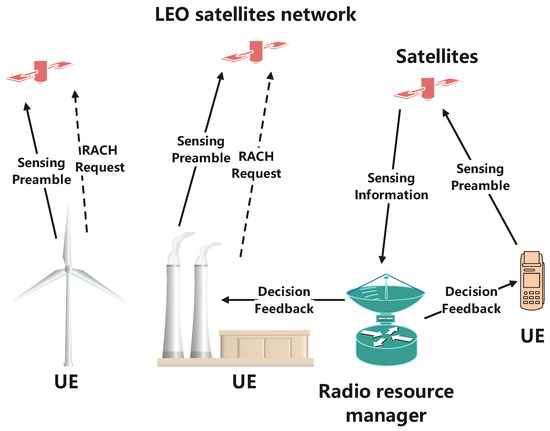
We consider a satellite-terrestrial communication system composed of LEO satellites and terrestrial user equipment (UEs). When the UE accesses the network, we consider the proposed SaRA mechanism that augments the standard RACH by inserting a lightweight sensing micro-slot prior to PRACH and using the sensed side information for admission and candidate-beam selection. In the SaRA mechanism, the UE first transmits a sparse sensing preamble in a sensing micro-slot, and the network (LEO satellites) captures this signal and extracts key side information about the channel quality and the direction-of-arrival of the UE. Then, the information is shared with a radio resource manager (RRM), which dynamically generates an access policy for the UE based on the real-time information and the current system load. The access policy specifies the channel quality decision threshold and the candidate beam set , and it is fed back to the UE via downlink signaling.
Subsequently, the UE makes an access decision: it is permitted to transmit a formal access preamble on the subsequent RACH resources and select a beam from the candidate set only if its own channel quality meets the threshold . For an access attempt to be deemed successful, it must sequentially satisfy three conditions: (1) collision-free transmission, (2) passing the sensing-based access decision, and (3) successful signal decoding.
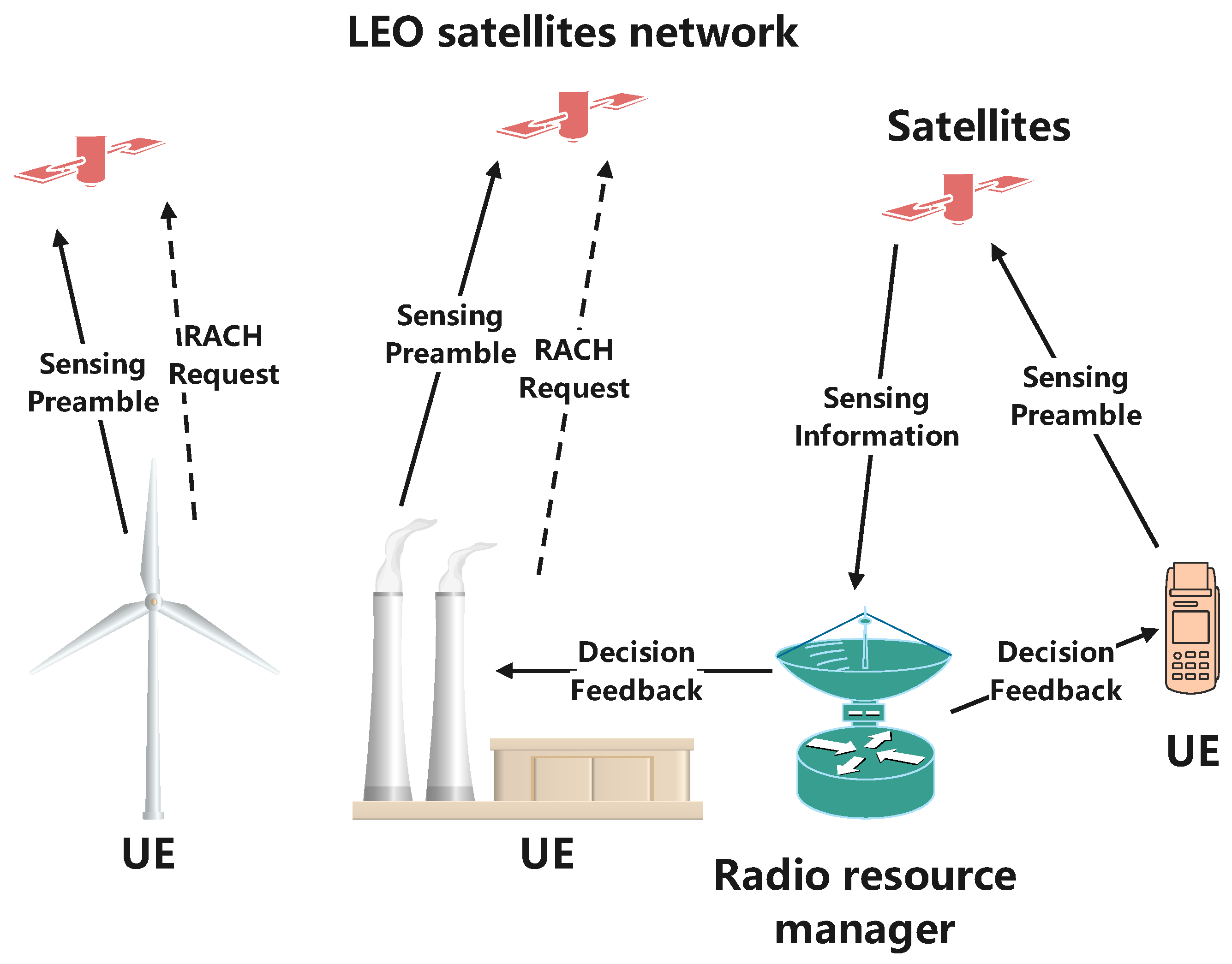
The proposed SaRA system is shown in Figure 1, which illustrates the interactions among the UE, the LEO satellites, and the RRM. In this architecture, we consider a centralized RRM model that can be located either at a ground station (gateway) or on a master satellite, depending on the constellation’s processing capability. The satellites act as edge sensing nodes, collecting channel measurements and forwarding them to the RRM. While Figure 1 conceptually depicts the information flow, in a full constellation deployment, this backhaul connectivity is maintained via Inter-Satellite Links (ISLs) or transparent feeder links to the ground, ensuring that the RRM has a global or regional view of the load. To ensure compatibility with the current network standards, we assume the system follows the basic framework of 5G NR, adapted for the characteristics of NTN [15]. In the SaRA system, the UE first transmits a sensing preamble in a sensing micro-slot. The satellite performs channel sensing, direction-of-arrival estimation, and load estimation, forwarding this information to the RRM. Based on the sensing information and system policies, the RRM dynamically determines the access threshold (), backoff window (W), and candidate beam set (), and feeds this decision back to the UE. Only those UEs that satisfy the access conditions are permitted to initiate a subsequent RACH request, with their transmission confined to the candidate beam set determined by the sensing process.
Figure 1.
The proposed SaRA system framework.
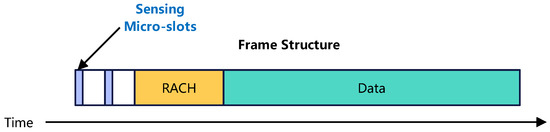
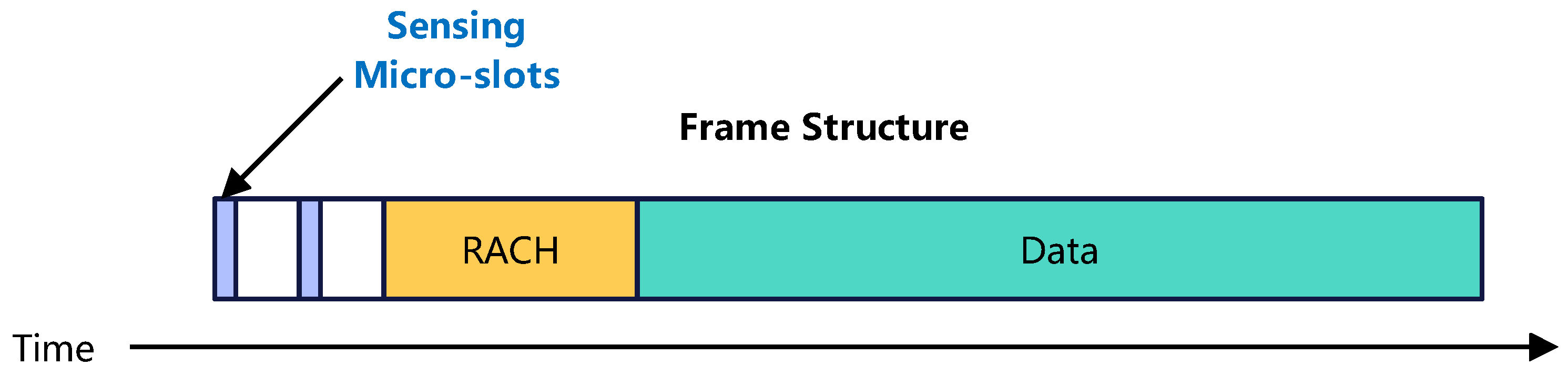
In the SaRA system, the frame structure is shown in Figure 2, which is based on the 5G NR framework. The initial OFDM symbols are configured as the sensing micro-slots, and the RACH is followed. The remaining frame time is used for subsequent data transmission. Hence, a flexible sensing stage is embedded into the standard access procedure:
Figure 2.
The SaRA frame structure.
- 1.
- Sensing Micro-slot: This is not a fixed time interval but consists of several Orthogonal Frequency Division Multiplexing (OFDM) symbols at the beginning of one or more subframes. The total duration, , can be semi-statically adjusted based on network load and channel conditions, where is the sensing resource allocation factor. In our evaluation, and is configured within 1– for adaptive SaRA.To rigorously address the lack of valid Timing Advance (TA) for UEs in the initial access state, the sensing micro-slot structure explicitly incorporates a Guard Period (GP). (Note: The specific time interval for RRM processing and policy feedback, , occurs immediately after the sensing micro-slot and before the RACH opportunity, as conceptually illustrated in the gap between these phases in Figure 2).
- 2.
- RACH: This part corresponds to the Physical RACH (PRACH) transmission occasions in 5G NR [16,17]. It occupies predefined time–frequency resource blocks for UEs to initiate random access requests. To cope with the long propagation delay of satellite links, the timing of PRACH occasions (e.g., the interval relative to downlink control signaling) is pre-compensated and adjusted according to the satellite ephemeris [18].
- 3.
- Data: After a UE successfully accesses the network, the system allocates data transmission, corresponding to the Physical Uplink/Downlink Shared Channel (PUSCH/PDSCH).
The following subsections will provide precise mathematical models for each stage of this complete process, including the randomness of user arrivals, the probability of sensing decisions, the decoding success rate, and the final performance overhead.
2.1. Arrival and Collision Model
Assume that within a frame, the total number of initial access requests from all UEs in the system follows a Poisson distribution with an arrival rate of . While real-world NTN traffic, especially in IoT or emergency scenarios, may exhibit bursty characteristics (e.g., Beta-distributed synchronized arrivals), the Poisson model serves as a standard tractable baseline for random access analysis [19]. We emphasize that this Poisson assumption is adopted for analytical tractability and for deriving closed-form approximations in the collision model (e.g., Equation (2)); all analytical expressions in this paper are based on this baseline. Nevertheless, SaRA’s operational procedure relies on sensing-based admission and real-time load estimation/backoff, and thus can be applied under more general (bursty) arrival patterns; evaluating such non-Poisson traffic models is an interesting direction for future work. The system provides M RACH channels (e.g., different time–frequency resource blocks), each configured with K pseudo-random preamble sequences. Thus, the total number of preamble resources is . Hence, the system load can be defined as the ratio of the average number of arriving requests to the total number of preambleresources:
Here, denotes the mean number of access intents per frame, M is the number of PRACH channels/occasions per frame, K is the number of available pseudo-random preamble sequences per channel, and is the total contention preamble resources per frame. When a UE selects a preamble to send a request, the transmission is considered collision-free if no other UE selects the same preamble on the same channel. Under the Poisson arrival assumption and uniform preamble selection, the number of contenders choosing a given preamble is Poisson with mean , and the collision-free probability for a tagged access can be approximated as
This Poisson-thinning-based approximation is highly accurate when the total number of contention resources N is large.
2.2. Sensing and Decision Model
In the sensing micro-slot, the UE transmits a dedicated sparse sensing preamble. The satellite receives the signal y and extracts a statistic that reflects the instantaneous channel quality. For example, could be an estimate of the Signal-to-Noise Ratio (SNR) or signal energy. Hence, we can define an access decision threshold . When , the UE is considered to be in an accessible window and allowed to initiate an access attempt in the subsequent RACH slot. This decision process can be measured by the following two ways:
- False Alarm (FA): The channel is actually unavailable, but it is judged as available. The probability is
- Missed Detection (MD): The channel is actually available, but it is judged as unavailable. The probability is
The sensing duration/resources (captured by ) affect the reliability of the statistic ; therefore, we explicitly write and as functions of in the sequel.
To make the sensing micro-slot lightweight yet robust, we instantiate the sparse sensing preamble as a short CAZAC (Zadoff–Chu) sequence mapped to the allocated uplink subcarriers (following the well-established NR PRACH principle). Here, sparse refers to the fact that the sensing preamble occupies only a small fraction of time–frequency resources (a few OFDM symbols and a limited set of subcarriers) within the sensing micro-slot, leaving the rest of the frame for standard RACH and data. This choice provides (i) a sharp autocorrelation peak for timing-uncertainty-tolerant detection, (ii) constant-envelope/low-PAPR transmission, and (iii) straightforward reuse of existing PRACH generation and correlation-based detectors at both the UE and the satellite receiver. In practice, only a small reserved subset of the available Zadoff–Chu roots/cyclic shifts is used for sensing, which is sufficient because the sensing micro-slot aims for coarse feasibility probing and side information acquisition rather than full data demodulation. On the satellite side, the receiver performs matched filtering (correlation) against this reserved sequence set; a UE is declared present when the peak correlation exceeds a threshold. We then instantiate the channel-quality statistic as the normalized correlation-peak power (or an equivalent SNR/energy estimate derived from the correlation output), which directly drives the access decision threshold . For NTN operation, the same ephemeris-aided timing/Doppler pre-compensation used for PRACH can be reused, while the residual impairments are handled by non-coherent correlation.
Simultaneously, by estimating the Angle of Arrival (AoA) of the sensing signal, a coarse azimuth of the UE can be obtained. Based on this, the system can construct a small candidate beam set , which most likely contains the optimal beam pointing towards the UE. The UE’s subsequent fine beam sweeping will be confined to this small set, thereby significantly reducing the search overhead. We denote the beam selection probability distribution over the set as .
To describe the construction criteria more explicitly, we assume a satellite beam codebook indexed by b with known boresight directions and an (approximate) 3 dB beamwidth . From the spatial matched-filter outputs of the sensing preamble across the satellite antenna array, the satellite obtains a coarse AoA estimate via a low-complexity beamspace scan (or a standard subspace method such as MUSIC), together with an uncertainty proxy that increases under low SNR or sensing collisions. We then construct a contiguous candidate set centered at by selecting all beams whose boresights fall within the uncertainty interval, i.e., , where is a conservative margin. Consequently, the candidate-set size is determined by the beamwidth and the sensing/AoA uncertainty rather than being chosen ad hoc. For example, we can set , where and are configurable bounds to control beam sweeping overhead and robustness. Any additional angular uncertainty due to user distribution within a beam or residual sensing errors can be absorbed into (or, equivalently, a slightly larger ). In our simulations, we treat as a semi-static design parameter selected from AoA-error statistics for reproducibility, while the same criterion can be used in deployment to adapt frame-by-frame if is estimated online.
2.3. Link and Decoding Model
Assume that the UE transmits a RACH preamble with power . After traversing the satellite-terrestrial link with an average path loss, the average SNR at the satellite receiver is . When a beam b is selected, the gain from beamforming is , and the SNR can be expressed as
The successful decoding of the preamble depends on whether the received SNR exceeds a certain decoding threshold . Therefore, for a given beam b, the probability of successful decoding can be obtained as
For analytical tractability, we assume the beam gain is a random variable whose statistical properties can be obtained from measurements or channel models. We adopt a mild sub-Gaussian gain assumption. This mathematical abstraction allows us to bound the tail probabilities of decoding failures without restricting the model to a specific fading distribution (like Rician or Rayleigh). It is widely applicable to LoS-dominant satellite channels with random pointing errors and atmospheric scintillation. Furthermore, since the sensing step (Step 1) pre-filters users with severe blockage (non-LoS), the residual channel variations for admitted users are well-behaved and fit within the sub-Gaussian tail bounds, minimizing the risk of overstating performance. This means that for a gain with expectation , there exists a variance proxy such that its moment-generating function is bounded. Specifically, for any real-valued auxiliary variable , the following condition holds:
The auxiliary variable allows probing the properties of the distribution’s tails; the fact that this inequality holds for all ensures that the gain fluctuations are well-behaved and decay at least as fast as a Gaussian distribution. This model effectively captures gain fluctuations caused by the superposition of various small-scale random effects, such as pointing errors, atmospheric scintillation, and phase noise, and is widely applicable in satellite communication channel modeling [20].
2.4. Latency and Overhead Model
We focus on the total latency from the moment a UE generates an access intent to the successful transmission of the first data packet. This latency can be approximately decomposed into several components:
where we have the following:
- is the time spent on sensing, which is linearly proportional to the allocated sensing resource ratio .
- is the average latency of the RACH process, which is primarily caused by collisions. The probability of a successful RACH attempt is , so on average attempts are needed. The average backoff time after each failure is proportional to the backoff window W. If we define as the length of one backoff slot, can be approximated asEquation (9) follows by modeling each PRACH attempt as an independent trial with success probability (geometric number of attempts). Each failed attempt incurs an average waiting time of one PRACH periodicity plus a uniform backoff with mean ; substituting yields the second line, where denotes the PRACH opportunity periodicity (in our frame structure, there is one PRACH opportunity per frame; thus, ). For schemes with admission control (e.g., SaRA), should be interpreted as the effective contention load (i.e., ), since only admitted UEs proceed to PRACH. This expression clearly shows the direct impact of load and backoff window W on access latency.
- is the time required for fine beam sweeping and alignment within the candidate beam set . Assuming the UE tries candidate beams sequentially until success, and the time for a single beam sweep and attempt is , the average alignment time is related to the size of the candidate set . Under a uniform selection strategy , it is approximated asThis model indicates that a smaller candidate set provided by sensing leads to lower beam alignment latency.
- denotes a fixed 4-step RACH completion time (Msg1–Msg4), including propagation and baseband/processing delays. It is common to all schemes; we add it when reporting end-to-end in simulations, but it does not change the optimization structure since it is constant.
Then, we introduce the sensing mechanism incurs additional system overhead , which can be modeled as
where we have the following:
- denotes the sensing resource overhead, proportional to the time–frequency resource ratio allocated to the sensing micro-slot, where is the unit resource cost.
- denotes the control signaling overhead, related to determining and notifying the candidate beam set. We use the information entropy of , to quantify its uncertainty. This is based on a fundamental conclusion from information theory that the minimum average number of bits required to describe a specific outcome (which beam to choose) is determined by the entropy of its probability distribution. Higher entropy implies greater uncertainty, thus requiring more signaling overhead. is the signaling cost per unit of information.
3. Problem Formulation
Given the system model and known parameters/constraints, our goal is to determine the control variables that maximize the first-attempt access success probability for a typical UE, subject to the latency budget , the overhead budget , and the false-alarm constraint . To that end, we formulate the following constrained optimization problem.
3.1. Modeling the First-Attempt Access Success Probability
A successful initial access is the intersection of the following events:
- 1.
- Event (Collision-Free): The RACH preamble chosen by the UE is not selected by any other UE on the same time–frequency resource. According to Equation (2), the probability is .
- 2.
- Event (Decision Pass): The channel occupied by the UE is correctly identified as accessible by the sensing system. The requirement is that the channel itself is available and that the sensing decision did not result in a missed detection. Let denote the prior probability of channel availability. The probability of this event is then .
- 3.
- Event (Successful Decoding): Given a collision-free and available channel, the satellite receiver can successfully decode the RACH preamble sent by the UE. According to Equation (6), its probability is .
Therefore, to model the collision process more accurately, we first define the effective access load, . Not all users will initiate a RACH request at the same time; only those who pass the sensing decision will do so. Therefore, the average number of users actually competing for RACH channels is
and the corresponding effective load is
Assuming these three events are approximately physically independent, the first-attempt access success probability is the product of their respective probabilities, averaged over the candidate-beam selection distribution , as follows:
This objective function links the system load, the sensing accuracy, and the link quality.
To maximize , we need to optimize the following parameters:
- Sensing Decision Threshold : This controls the sensitivity of the sensing system. Increasing reduces the false alarm rate , avoiding resource waste on bad channels, but increases the missed detection rate , potentially missing access opportunities on available channels. This is a trade-off between access conservativeness and aggressiveness.
- Backoff Window W: This controls the retransmission strategy after a collision. A larger W reduces the probability of subsequent collisions but at the cost of increased average access latency. This is a trade-off between collision avoidance and latency tolerance.
- Sensing Resource Ratio : This controls the amount of resources allocated to the sensing task. Increasing can improve sensing accuracy (reducing and ), but it occupies resources that could be used for data transmission and directly increases the sensing latency . This is a trade-off between sensing gain and resource cost.
- Candidate Beam Selection Strategy : This controls the scope and manner of the beam search. A smaller candidate beam set (with lower entropy ) can significantly reduce beam alignment latency and signaling overhead, but it may miss the optimal beam due to inaccurate angle-of-arrival sensing, thereby affecting the decoding success rate. This is a trade-off between search efficiency and beam diversity.
3.2. Constrained Optimization Problem
Based on the preceding system model, the SaRA resource optimization problem, denoted as (), can be formally stated as follows:
The constraints of this problem are interpreted as follows:
- Constraint (C1) (Average Total Latency): This constraint ensures that the end-to-end average latency from user intent to successful access does not exceed the maximum tolerated value . This is a fundamental QoS requirement. Specifically, (C1) aggregates the sensing time , the collision/backoff delay term (driven by and W), the beam sweeping delay term (driven by and ), and a fixed 4-step RACH core delay (Msg1–Msg4).
- Constraint (C2) (Additional Overhead): This constraint ensures that the extra resource overhead introduced by sensing and related control signaling (Equation (11)) does not exceed the system’s maximum budget .
- Constraint (C3) (False Alarm Rate): This constraint controls the false alarm rate of the sensing decision to an acceptable level to prevent UEs from frequently initiating access on invalid channels, which would waste terminal energy and network resources.
- Constraint (C4) (Probability Distribution): This constraint ensures that the beam selection strategy is a valid probability distribution (i.e., all probabilities are non-negative and sum to one).
- Constraints (C5) and (C6) (Variable Ranges): These constraints ensure that the backoff window W and the sensing resource ratio are within their effective, physically achievable ranges.
This optimization problem () is a complex Mixed-Integer Nonlinear Programming (MINLP) problem because the optimization variables , W, , are coupled, the objective function and constraints are nonlinear, and the variable W is an integer. Directly solving this problem is computationally infeasible, which motivates us to design a practical and high-performing suboptimal mechanism, namely SaRA.
4. SaRA Mechanism Design: A Suboptimal Algorithm for Problem ()
The above section formulates the SaRA as a precise but computationally intractable MINLP problem (). In a practical wireless communication system, the network must make resource allocation decisions on a millisecond timescale, making a direct solution to () unrealistic. Therefore, we aim to design a computationally efficient and high-performing suboptimal algorithm, which constitutes the concrete implementation of the SaRA mechanism. While offline high-performance solvers (e.g., on supercomputers) could in principle be used to obtain benchmarking solutions for (), they are unsuitable for online frame-level operation; accordingly, we adopt an offline–online split where long-term parameters can be tuned offline (e.g., via LUT generation) and short-term parameters are updated online with complexity.
Our method is to decouple the complex joint optimization problem based on the operational timescale of different parameters
- Semi-static Configuration: The parameters, such as the sensing resource ratio and the candidate beam set size , are more related to long-term channel statistics and the service’s QoS requirements. These parameters can be configured semi-statically by the network based on statistics gathered over hours or days, without needing frame-by-frame adjustments.
- Dynamic Adjustment: The parameters, such as the access decision threshold and the backoff window W, are directly related to instantaneous network congestion and channel quality. These parameters must be adjusted rapidly and dynamically at the frame level (milliseconds) to respond to bursty service requests.
Based on this approach, the SaRA mechanism operates as a closed-loop process consisting of 3 stages: sense, decide, and execute. The following section provides a detailed description of each step.
4.1. Step 1: Real-Time Sensing Information Acquisition
This step provides the real-time input parameters required for the subsequent decision optimization. During the sensing micro-slot at the start of each frame, the network processes the sensing preambles sent by user equipment to acquire three key types of information. First, it obtains the channel quality statistic , which serves as the basis for the access decision; the statistical distribution of determines the relationship between the decision threshold and the probabilities of false alarm and missed detection . Second, the network estimates a coarse angle-of-arrival , which is used for the construction of the candidate beam set . Concretely, the sensing preamble can be detected by correlation-based matched filtering against a reserved CAZAC (Zadoff–Chu) sequence set; can be instantiated as the normalized correlation-peak power, and can be obtained from the spatial matched-filter outputs via a low-complexity beamspace scan over the codebook (details are given in the Sensing and Decision Model). Third, accurate load estimation is challenging because multiple UEs selecting the same sensing preamble result in a single detection (collision), leading to underestimation if strictly counted. To mitigate this, the network employs a statistical collision-recovery estimator. By counting the number of detected active sensing preambles () out of the total available (), we estimate the arrival rate using the Method of Moments inversion of the collision probability: . This provides a significantly more accurate estimate of the true demand than raw counting, serving as a reliable input for the load-adaptive algorithm.
4.2. Practical Feasibility and 5G NR Compatibility
To ensure that SaRA is not merely a theoretical concept but a viable solution for real-world deployments, we specifically address its compatibility with existing 5G NR standards and hardware constraints:
- Standard Compatibility via Flexible Slots: The proposed sensing micro-slot does not require a new physical channel definition. In 5G NR (and its NTN evolution), the frame structure supports flexible slot formats where symbols can be dynamically configured as Downlink (D), Uplink (U), or Flexible (F). The sensing micro-slot can be implemented by configuring a small number of symbols at the beginning of a frame as Flexible or Uplink specifically for sensing preambles, transparent to legacy terminals that would simply treat them as reserved resources.
- Synchronization and Guard Periods: As discussed in Section 2, the primary synchronization challenge—the lack of precise Timing Advance (TA) for initial access UEs—is mitigated by the Guard Period (GP). By dimensioning the GP to cover the maximum differential delay within a beam (typically tens of microseconds for LEO spots), we ensure that the asynchronous sensing signals do not interfere with subsequent data or RACH slots. This is a standard technique in TDD systems and RACH design, inducing negligible overhead compared to the long satellite round-trip time.
- Hardware Constraints: SaRA reuses the existing RACH preamble generation and detection hardware chains. The sensing preamble is simply a subset of the available Zadoff–Chu sequences or a shorter format preamble. In particular, we reserve a small number of Zadoff–Chu roots/cyclic shifts solely for the sensing micro-slot, which keeps the design lightweight while preserving near-orthogonality and sharp correlation peaks; this enables robust correlation-based detection and coarse AoA extraction under timing uncertainty with standard matched-filter receivers. Therefore, no additional RF chains or specialized sensing hardware are required at the UE or the satellite payload. The logic for decision thresholding and beam selection is implemented purely in the basebandprocessing (L2/L3), ensuring low implementation complexity.
4.3. Step 2: Dynamic Optimization of Access Policy
After acquiring the real-time information, the RRM on the network side performs a lightweight optimization to dynamically determine the access parameters for the UEs.
The decision threshold is chosen to balance the trade-off between access opportunities and congestion control, while ensuring the false alarm constraint (C3) is satisfied. To ensure rapid decision-making, the RRM uses a lookup table (LUT) generated offline via simulations or analytical methods. This LUT is indexed by the current estimate of system load , and each entry stores a pre-computed, approximately optimal value of that maximizes system throughput for that load.
The backoff window W is selected to control retransmission congestion following collisions and to satisfy the overall latency constraint (C1). Larger W values can better distribute retransmissions and reduce the likelihood of secondary collisions, but they also increase the average backoff duration. Thus, the RRM balances these factors by adapting W according to the effective access load : as the load increases, a larger W is chosen.
Specifically, the RRM selects an initial W value based on a load-dependent policy function (e.g., a piecewise linear function). It then verifies if this W value satisfies the latency constraint
If the W value satisfies the constraint, it is adopted. If not, the RRM will select the largest integer W allowed under this constraint as an alternative. If the maximum allowed W is less than 2 (meaning effective backoff is not possible), the system determines that the QoS requirement cannot be met and may temporarily bar the access requests from that batch of users.
4.4. Step 3: UE-Side Access Execution
Since the network does not know the identities of the accessing UEs yet, the optimized access policy is not sent to individual users. Instead, it is transmitted as a cell-specific or beam-specific broadcast message via the common downlink control channel. To align with 5G NR standards, we propose implementing this by introducing a new field in the System Information Block Type 1 (SIB1) or defining a new SIB (e.g., SIB19 for NTN) specifically for dynamic access control parameters. Alternatively, for faster updates, a Group-Common PDCCH (using a specific RNTI like SaRA-RNTI) could be utilized. All UEs within the beam decode this common message and apply the same policy parameters to their local channel measurements to independently determine their eligibility for access. The procedure is as follows:
- 1.
- Access Decision: The UE compares its own channel measurement with the threshold specified by the network.
- 2.
- Initiate RACH or Back off:
- If , the UE is authorized to initiate access. It selects a beam from the candidate set (according to policy ) and a random RACH preamble, then transmits the access request.
- If , the UE is barred from initiating access. It remains silent during this access opportunity and waits for the next one, which is equivalent to a channel-quality-based access control.
- 3.
- Post-Collision Handling: If the UE does not receive a response from the network after a RACH attempt (implying a collision or decoding failure may have occurred), it will randomly select a number of backoff slots from the range , wait for the corresponding time, and then select the next beam from to retransmit.
A summary of the entire decision process is presented in Algorithm 1. Through these 3 steps, the SaRA mechanism decomposes a complex joint optimization problem into a series of practically feasible, dynamic control procedures based on real-time sensing, thereby achieving an efficient suboptimal solution to problem () with low complexity.
| Algorithm 1 SaRA Dynamic Decision Process |
|
4.5. Algorithm Complexity and Scalability Analysis
The proposed SaRA algorithm is designed for real-time RRM implementation. By decoupling the optimization variables, the computational complexity is significantly reduced compared to the original MINLP problem.
- Offline Phase (Semi-static): The lookup table (LUT) for the optimal threshold is generated offline. This is a one-time computation or a low-frequency background task (e.g., hourly), independent of the frame-level real-time loop.
- Online Phase (Dynamic): In each frame, the RRM performs:
- 1.
- Load estimation: Simple arithmetic operations (Method of Moments), complexity .
- 2.
- Threshold selection: Table lookup, complexity .
- 3.
- Backoff window calculation: Closed-form expression (Equation (9)), complexity .
- 4.
- Beam set construction: Sorting or filtering based on AoA, complexity proportional to the number of beams, .
Total online complexity is , which scales linearly with the beam codebook size and is independent of the number of users . This ensures excellent scalability for massive connectivity scenarios. The algorithm’s robustness is guaranteed by the fallback to the conservative maximum backoff window (Step 2, Algorithm 1) if the latency constraint cannot be met under the estimated load.
5. Theoretical Analysis
To provide a solid theoretical foundation for the SaRA algorithm, we first analyze the objective function and its properties, before finally deriving the necessary conditions that the optimal solution must satisfy.
5.1. Analysis of the Objective Function
For ease of analysis, we reiterate the objective function from Equation (14). This expression intuitively breaks down the first-attempt access success probability into four key factors: the collision-free probability (), the prior probability of channel availability (), the probability of correct sensing (), and the average link decoding success rate (). Understanding this structure is crucial for analyzing the properties of the optimization problem.
5.2. Problem Complexity and Heuristic Decoupling
The optimization problem () is a complex Mixed-Integer Nonlinear Programming (MINLP) problem, which is generally computationally intractable to solve directly, especially within the millisecond-scale decision-making timeframe required for real-time network operation. The variables are tightly coupled, and the constraints are nonlinear.
To devise a practical and computationally tractable solution, we adopt a common heuristic approach: decoupling the problem based on the operational timescale of the variables. We configure parameters related to long-term statistics (, , and by extension ) semi-statically, while adjusting parameters related to instantaneous conditions (, W) dynamically. This separation of concerns allows for a lightweight, responsive algorithm and forms the basis for the efficient SaRA mechanism detailed in Algorithm 1.
5.3. Insights into the Structure of the Optimal Solution
To further understand how system resources should be allocated between sensing and communication at the optimal operating point, we analyze its Lagrangian function and the Karush–Kuhn–Tucker (KKT) conditions. Intuitively, the optimization seeks the balance point where investing one more unit of resource into sensing (to better filter users) yields exactly the same gain in success probability as investing it into signaling (to narrow the beam search). This balance ensures that neither sensing nor control signaling is over-provisioned. For simplicity, we only consider the case where the overhead constraint (C2) is active (i.e., the budget is tight).
Theorem 1
(Marginal Utility Balancing for Optimal Resource Allocation). Assume a unique optimal solution exists, and at this optimum, the overhead constraint (C2) is strictly active (i.e., ). Let be the Lagrange multiplier corresponding to constraint (C2). Then, the optimal solution must satisfy the following marginal utility balance equation
where represents the marginal gain in with respect to variable X.
Proof.
We construct the Lagrangian function with respect to as
According to the KKT conditions, at the optimum, the partial derivatives of with respect to each variable must be zero. For instance, we have
This directly leads to the balance relationship above. □
Physical interpretation of Theorem 1: This theorem formalizes the marginal return per unit cost principle in resource allocation. The left term represents the efficiency of sensing (how much increases per unit of sensing cost), while the middle term represents the efficiency of beamforming control. At the optimum, these efficiencies must be equal. If sensing were more efficient, the system should divert resources from beam control to sensing until balance is restored. This provides a clear, intuitive guideline for tuning the system: resource allocation should follow the path of highest marginal return. Note that is an operator-configurable resource budget (combining sensing and control overhead); in our evaluation, we set , and the proposed framework can accommodate other budget values by re-optimizing accordingly.
5.4. Theoretical Support for the SaRA Algorithm Design
The theoretical analysis above provides solid justification for the design choices within the SaRA algorithm. The inherent complexity of problem () as an MINLP, coupled with the different operational timescales of its variables, motivates the adoption of a decoupled, two-layer optimization approach. This heuristic is a pragmatic way to achieve a high-performing, low-complexity solution suitable for real-time implementation. Furthermore, Theorem 1 offers the fundamental theoretical guidance for parameter tuning. It suggests that the RRM should semi-statically configure parameters such as and with the goal of driving the system’s long-term operating point towards the marginal utility balance state, thereby ensuring an efficient allocation of sensing and control resources. Finally, the monotonic impact of the decision threshold on and validates that using a simple, fast search or a lookup-table-based approach, as implemented in Algorithm 1, is an effective heuristic for dynamically adapting to the system load.
6. Simulation and Analysis
To quantitatively evaluate the performance of the SaRA mechanism and validate its effectiveness under diverse network conditions, we built an event-driven simulation framework based on Python 3.12.3. While direct validation on commercial satellite constellations is currently inaccessible, we ensure empirical credibility by following the key NTN assumptions and representative parameter ranges recommended in 3GPP TR 38.811 (e.g., large-scale path loss/blockage statistics and cell-edge SNR regimes), while using a tractable SNR-based decoding abstraction for access-layer evaluation [19]. This framework simulates the dynamic access process of a large number of UEs and the signaling interaction flows of different access protocols. Importantly, our goal is a transparent, standard-aligned access-layer evaluation in which key standardized mechanisms (SSB, BI/ACB, and the 4-step RACH timing) are made explicit and reproducible, complementing full-stack system-level simulators. The key parameters used in our simulation are detailed in Table 1.
Table 1.
Simulation Parameters.
Unless otherwise stated, we use the parameter configuration in Table 1 with and an adaptive sensing ratio for SaRA; we consider a wide load range per frame to cover both typical and extreme burst scenarios. The false-alarm constraint is set to , and we evaluate robustness to sensing imperfection by sweeping the missed detection probability . When the offered load becomes extremely high so that the QoS latency constraint cannot be met (i.e., the implied in Algorithm 1), the network temporarily broadcasts an access barring signal to protect QoS.
In particular, to address the realism of the standardized baseline, our 3GPP FR2/NTN RACH simulation explicitly accounts for (i) SSB burst periodicity and the corresponding average initial beam-acquisition delay, (ii) imperfect SSB-based beam selection via an SNR-dependent correct-selection probability, and (iii) standardized load-control via BI/ACB. Specifically, we use a representative FR2 configuration with ms, ms, and ; we configure as a piecewise mapping: 0 ms if , 10 ms if , 20 ms if , 40 ms if , 80 ms if , and 160 ms otherwise; and we configure as if , if , if , if , and otherwise. Finally, for realistic end-to-end latency reporting, we add a fixed 4-step RACH completion time (Msg1–Msg4 including propagation/processing) to all schemes; since it is common, it does not affect comparative trends.
We compare SaRA with the following 4 baseline schemes to comprehensively evaluate its performance gains:
- 1.
- Traditional RACH (Blind Access): This baseline serves as a performance lower bound, representing a scenario where beam correspondence is not established. A UE randomly selects a beam from a wide beam set covering all possible directions and a preamble to initiate access. It lacks the SSB-based beam selection of 3GPP FR2, as well as channel sensing and load adaptation capabilities.
- 2.
- Standard 3GPP FR2/NTN RACH (Realistic baseline): This baseline follows the standardized FR2 initial-access philosophy: SSB-based beam acquisition followed by PRACH transmission. Unlike our previous upper-bound abstraction, we explicitly model the SSB burst periodicity and the corresponding initial beam-acquisition delay, as well as an SNR-dependent beam-selection error probability. We also explicitly model standardized load-control mechanisms including the Backoff Indicator (BI) and Access Class Barring (ACB) as load-adaptive policies (Table 1) and provide a BI/ACB ablation.
- 3.
- Ideal Location-aided Access (Upper bound): To isolate the impact of realistic beam acquisition, we also include an upper-bound baseline that assumes perfect beam correspondence (i.e., always selecting the optimal beam with no SSB waiting/measurement delay), while keeping the same PRACH resource/collision model and the same BI/ACB load-control configuration as the realistic 3GPP baseline. This serves as an upper bound on beam-selection/beamforming performance (but is not necessarily an upper bound on the overall access success probability when proactive admission control is enabled, as in SaRA).
- 4.
- Fixed Frame-SaRA: A non-adaptive variant of the SaRA mechanism. Its parameters, such as , are statically configured to a set of optimal values for average channel and load conditions, without adapting to the instantaneous state of each access frame. This scheme is used to validate the value of SaRA’s adaptive capabilities.
We evaluate the different access schemes using four performance metrics from multiple perspectives. The first is the first-attempt access success rate (), defined as the probability that a UE successfully completes initial access in the first PRACH opportunity after generating an access intent. This definition consistently counts any admission/barring decision that defers the attempt (e.g., SaRA thresholding or 3GPP ACB) as a failure to succeed in that first opportunity. The second is the average access latency (), which measures the mean time interval from when a UE generates an access intent to the successful completion of initial access (Msg1–Msg4) and the first data scheduling, thereby reflecting the timeliness of access. The third metric is system access capacity (often referred to as throughput in random access literature), representing the total number of UEs that are able to access the network successfully per unit of time (per frame in this study); this shows the overall capacity of the system. The final metric is additional overhead (), which quantifies the resource overhead caused by sensing and related control signaling, and it is used to assess the implementation cost of the SaRA mechanism.
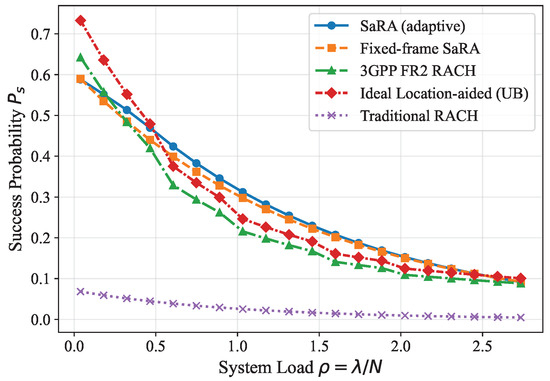
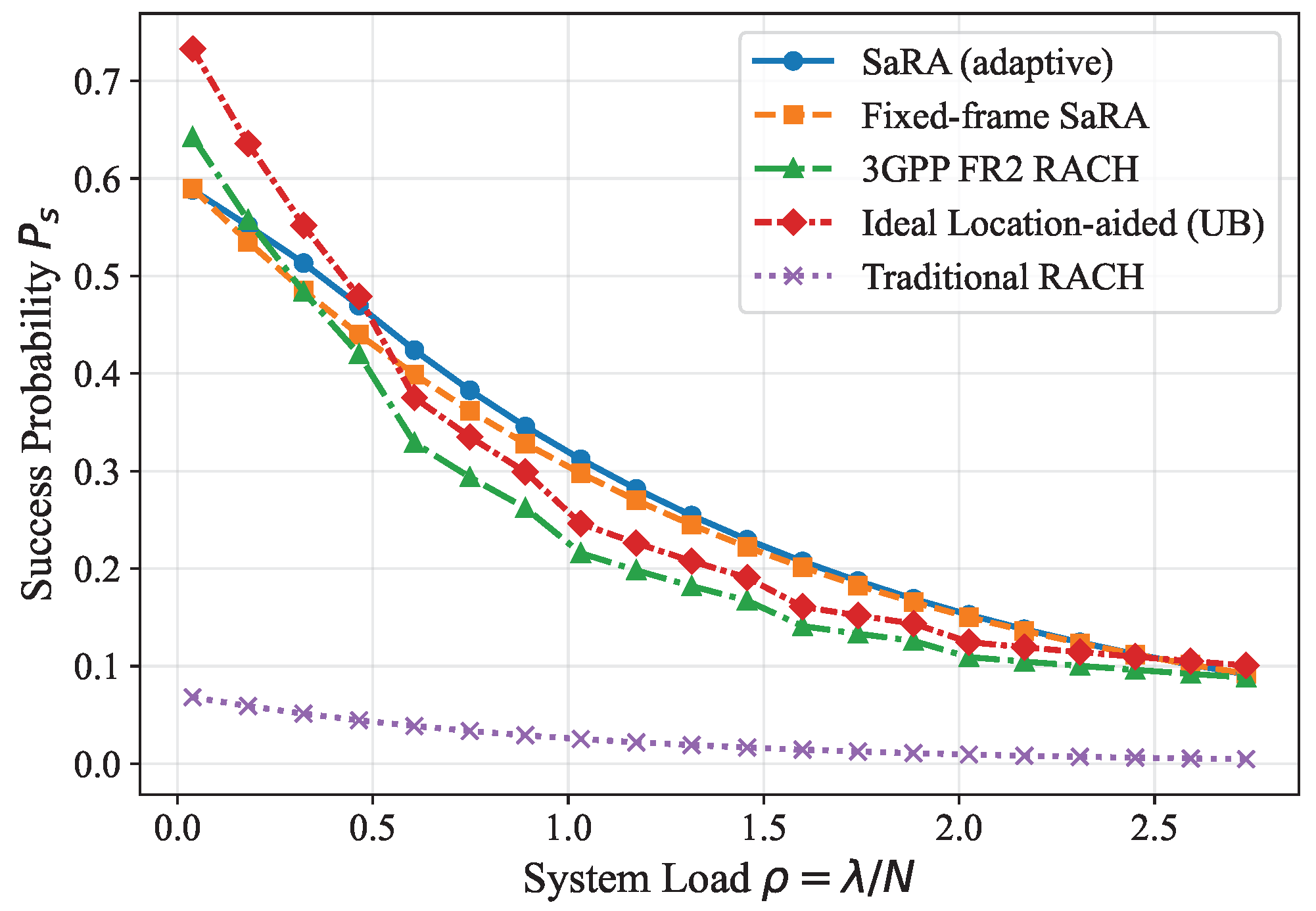
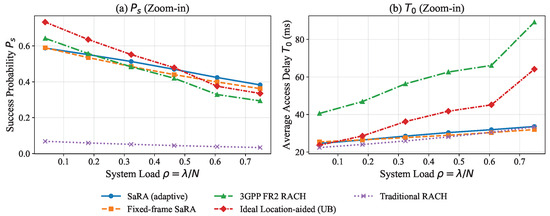
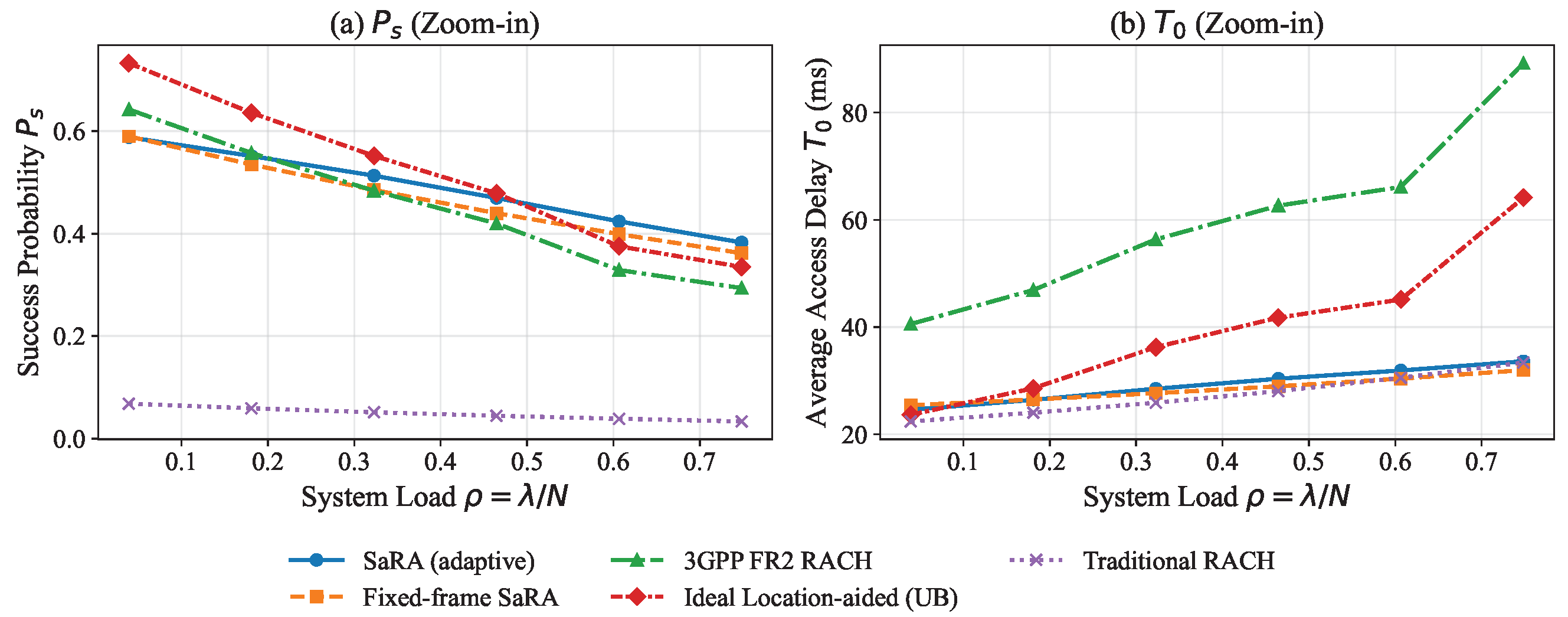
The first-attempt access success rate as a function of system load is presented in Figure 3. This figure shows the first-attempt access success rate as a function of user load at a fixed channel quality (SNR = 2.5 dB). While all schemes exhibit a decline in success rate as the load () increases, their performance trends differ significantly. The Ideal Location-aided upper bound achieves the highest in the low-to-medium load regime due to perfect beam correspondence (no beam-selection error and no SSB waiting), and the realistic 3GPP FR2 baseline closely follows it thanks to SSB-based beam acquisition. SaRA may incur a modest penalty at light load due to sensing-based admission (missed detections), but it becomes increasingly advantageous as the load grows because sensing proactively suppresses futile contention and narrows the beam search. The traditional RACH scheme, lacking any congestion control and effective beamforming, deteriorates most sharply, with its success rate dropping to a mere 0.5% at the highest load (), making it impractical for high-load operation. In contrast, the adaptive SaRA scheme demonstrates strong resilience under heavy load by suppressing the effective contention and improving decoding via sensing-informed candidate beams, achieving at compared with for the realistic 3GPP baseline (and for the ideal upper bound). At , this corresponds to an absolute gain of about percentage points and a relative improvement of approximately over the realistic 3GPP baseline. The markedly lower Traditional RACH curve (purple) is due to blind beam selection without beam correspondence, which severely reduces the beamforming gain and decoding probability even before considering contention. We also provide a zoom-in view of a more typical-load regime in Figure 4.
Figure 3.
Success probability under different system loads.
Figure 4.
Zoom-in view of the typical-load regime: (a) first-attempt success probability and (b) average access latency.
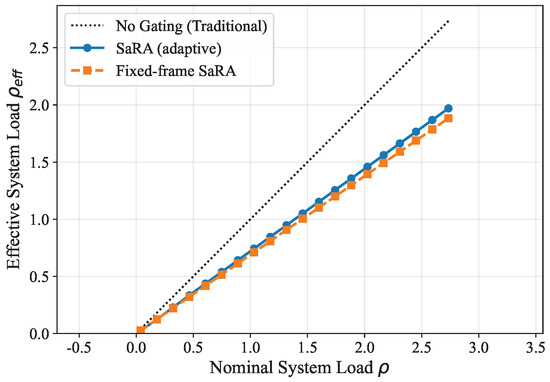
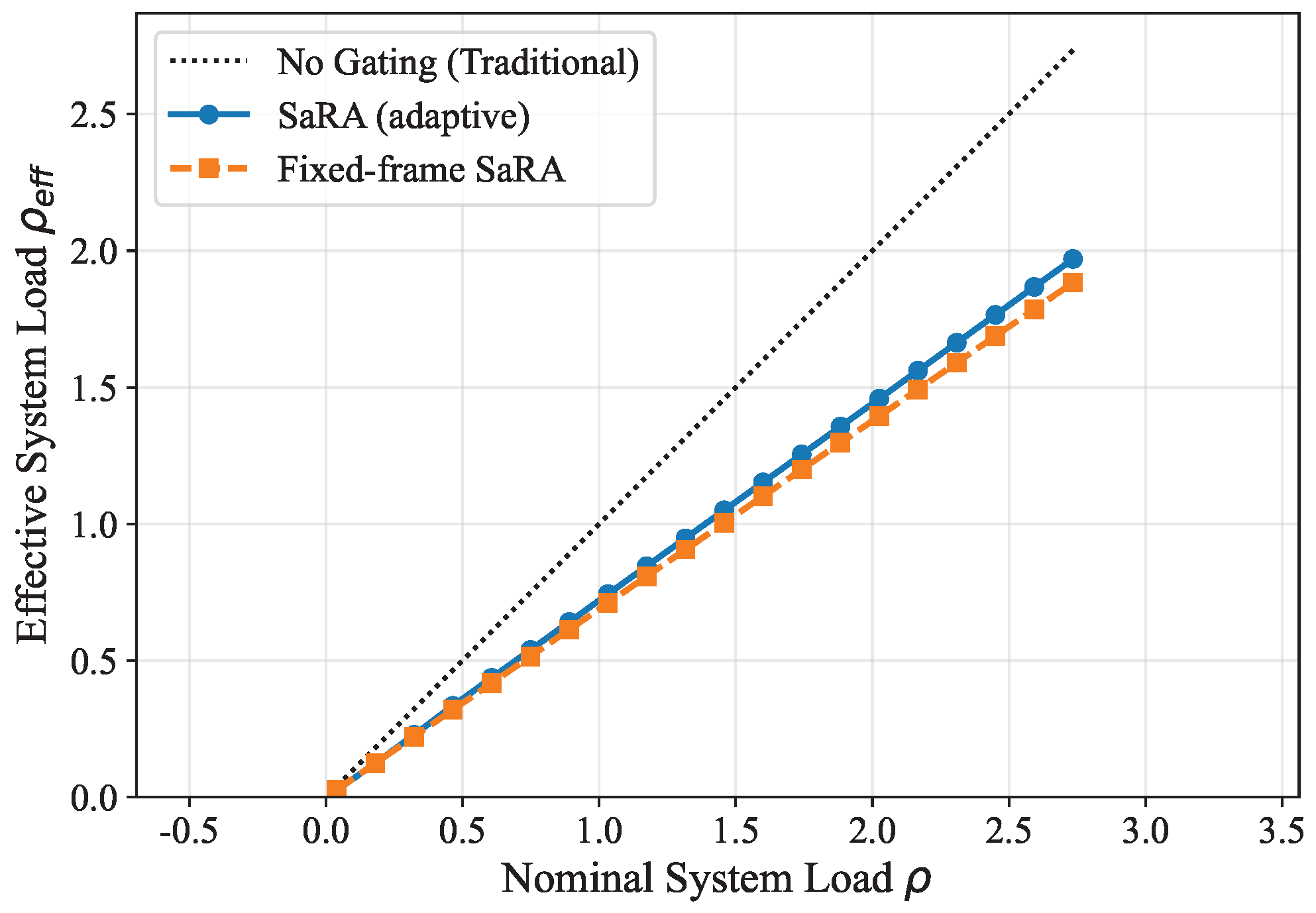
The fundamental reason for SaRA’s robustness under heavy load is its ability to suppress the effective access load, as illustrated in Figure 5. This figure shows the relationship between the nominal system load () and the effective load () that actually competes for RACH resources. For the traditional RACH scheme, these two loads are identical. However, SaRA’s proactive sensing decision step filters out a portion of UEs with low access feasibility, thereby reducing the fraction of UEs that proceed to PRACH. As a result, is consistently lower than , which mitigates collision intensity and stabilizes performance under heavy load (even though still increases with ). In Figure 5, the Traditional RACH curve corresponds to the identity (no admission), whereas the SaRA variants lie below it because only a fraction of UEs passing the sensing decision proceed to PRACH; the gap between and reflects the strength of sensing-based filtering.
Figure 5.
Effective load under different system loads.
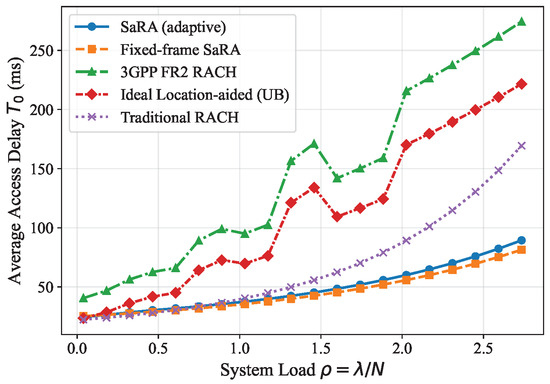
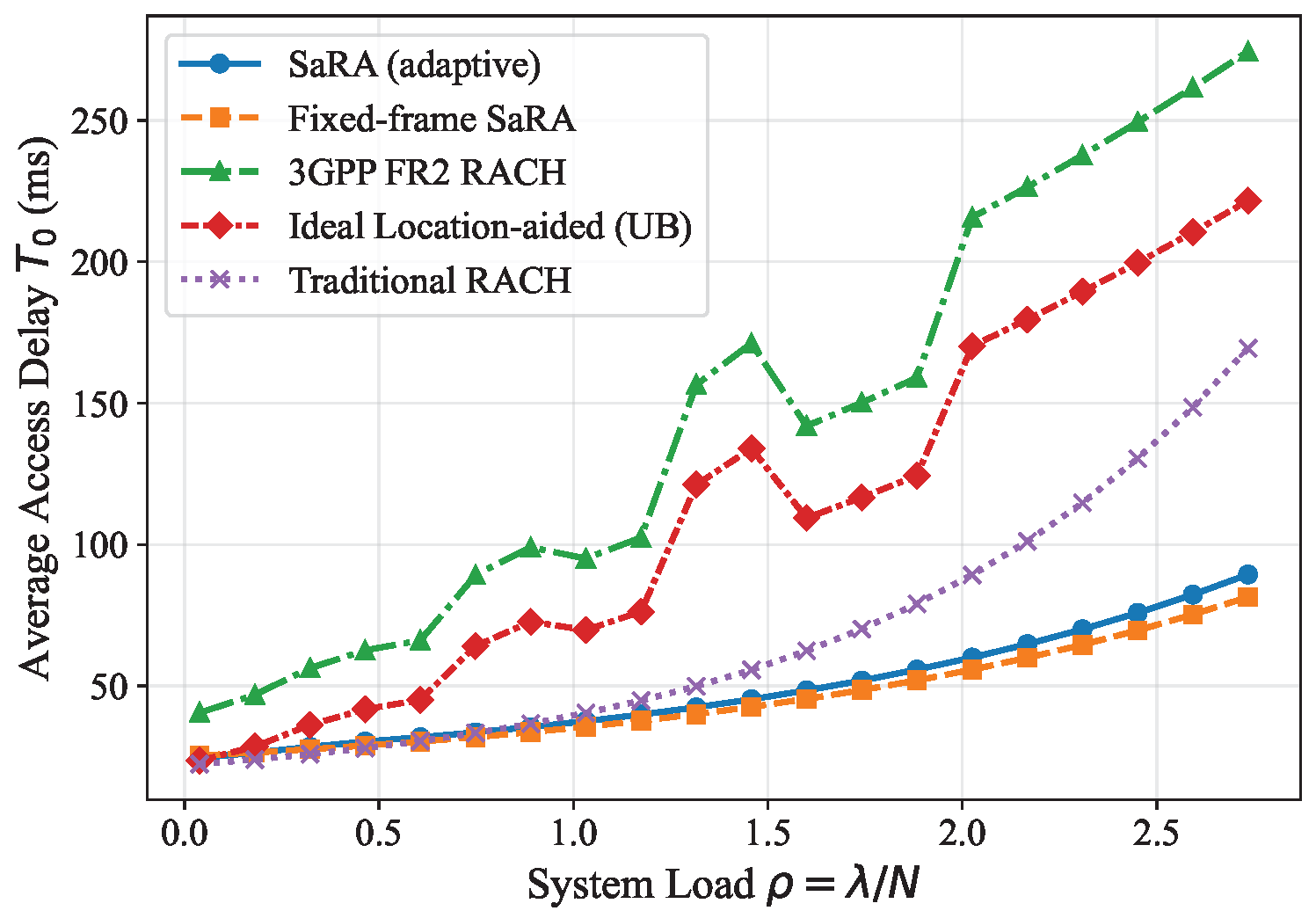
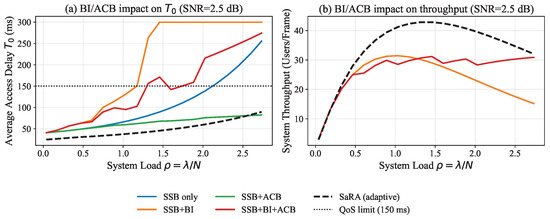
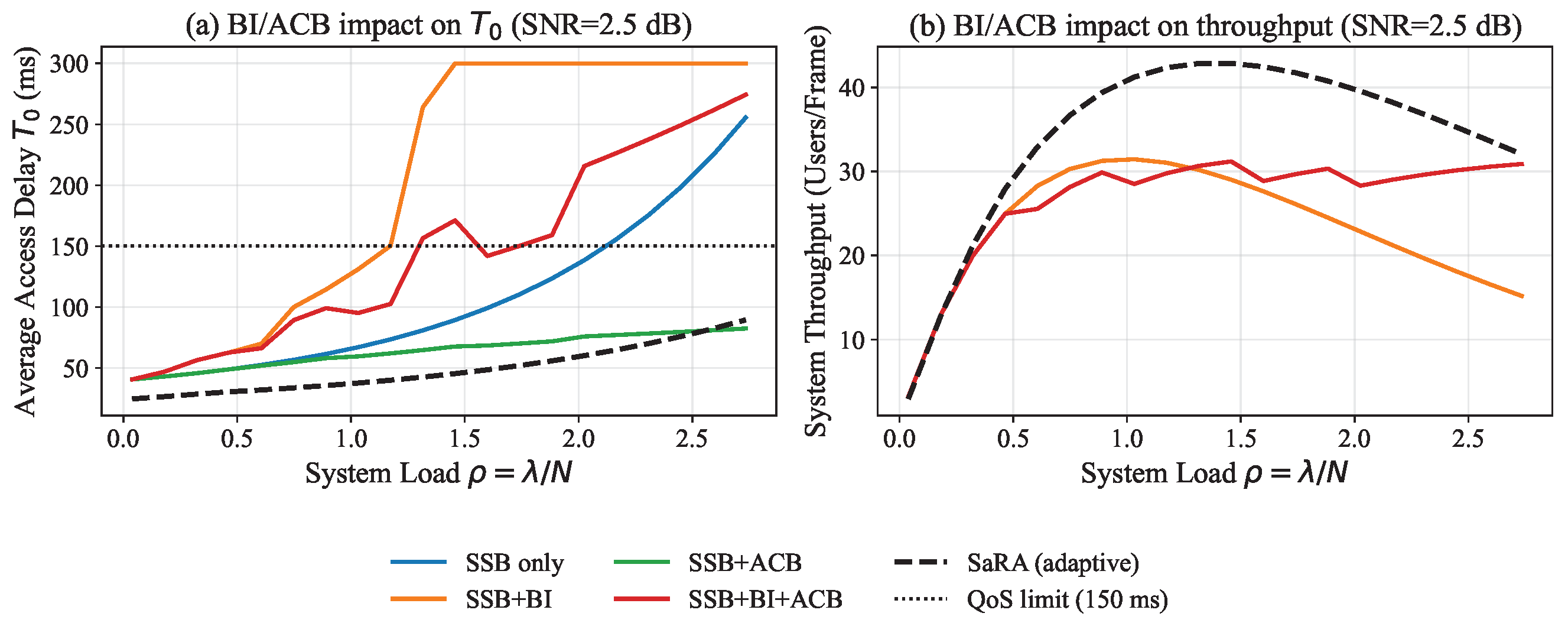
This effective congestion control directly translates to a significant advantage in meeting QoS requirements, as validated by the average access latency analysis in Figure 6. At low loads, the latency of the blind/traditional scheme is minimal, while the realistic 3GPP baseline includes a non-negligible initial delay due to SSB-based beam acquisition (Table 1). However, as the load increases, the latency of the traditional RACH and the realistic 3GPP baseline grows rapidly due to collisions, retransmissions, and standardized BI/ACB control. For example, at , the average access latency of the realistic 3GPP baseline reaches about 274 ms (and 222 ms for the ideal upper bound), clearly violating the typical 150 ms QoS limit, whereas SaRA remains at about 89 ms. This represents a latency reduction of approximately compared with the realistic 3GPP baseline at the same load. This is further highlighted in Figure 7, where even the standardized BI/ACB configurations in the 3GPP baseline can exceed the QoS limit under high load, while SaRA stays below . We include this BI/ACB ablation figure to explicitly isolate the impact of standardized load-control mechanisms in the baseline, thereby improving transparency and reproducibility of the comparison. In stark contrast, SaRA’s sensing-aware admission and reduced beam search overhead keep the average latency consistently within the QoS bound and significantly lower than the standardized baseline across the load range, thus ensuring high service availability even under heavy traffic.
Figure 6.
Average access latency under different system loads.
Figure 7.
Influence of standardized load-control mechanisms in the 3GPP baseline: BI/ACB ablation on (a) access latency and (b) throughput, with SaRA shown as a reference and the QoS latency limit ( ms) indicated.
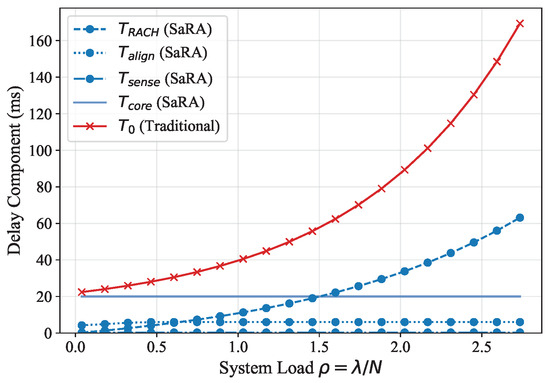
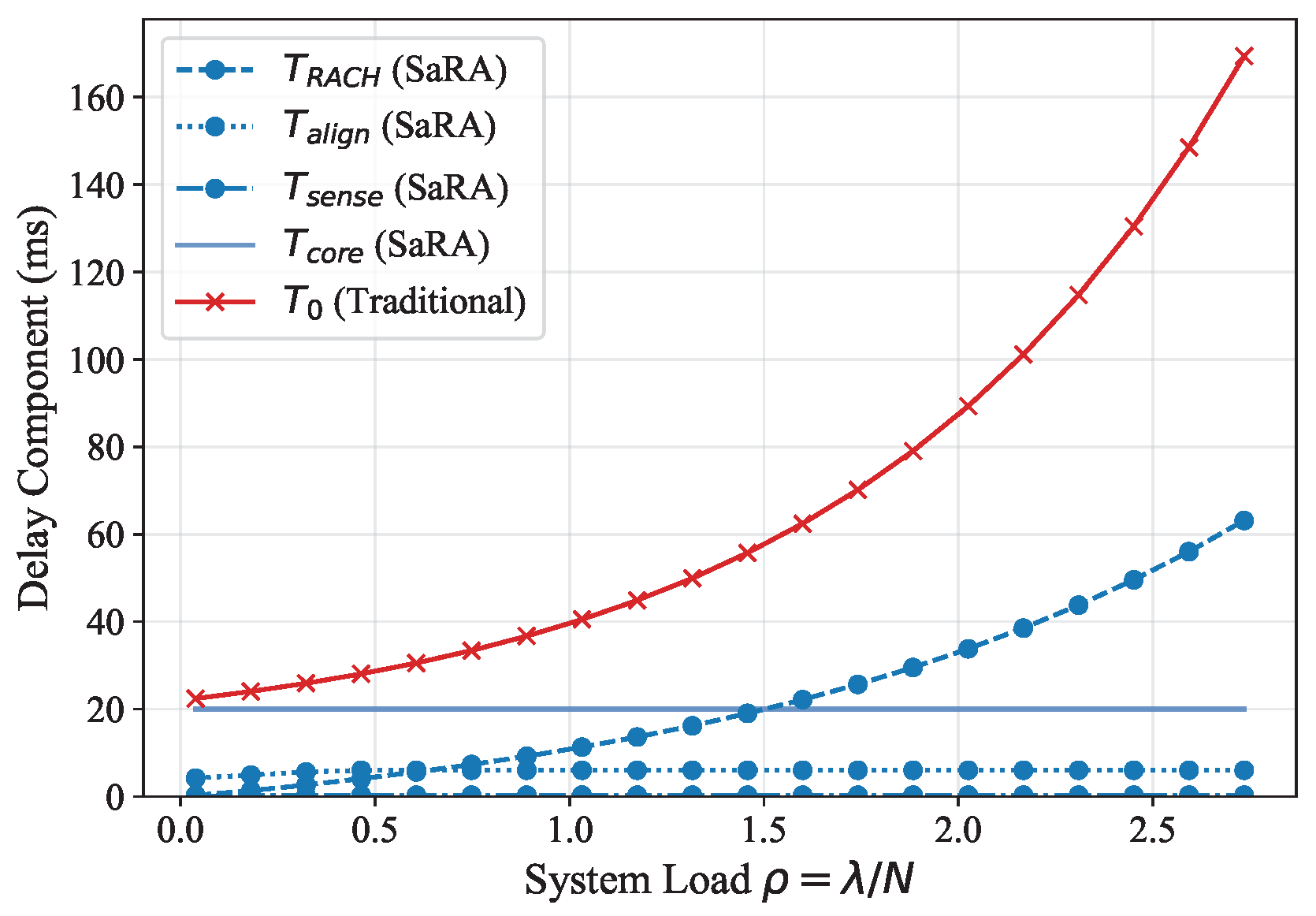
A breakdown of the total latency components, shown in Figure 8, provides further insight into this performance difference. For traditional RACH, the total latency at high loads is almost entirely dominated by the exponentially growing collision-related delay (). Conversely, the total latency for SaRA consists of four stable components: sensing, collision/backoff (RACH), beam alignment, and a fixed 4-step RACH core delay (). By introducing a small and controllable sensing delay (), SaRA successfully avoids the much larger and rapidly deteriorating collision latency, thereby achieving a more favorable trade-off.
Figure 8.
Access latency breakdown under different system loads (including a fixed 4-step RACH core delay).
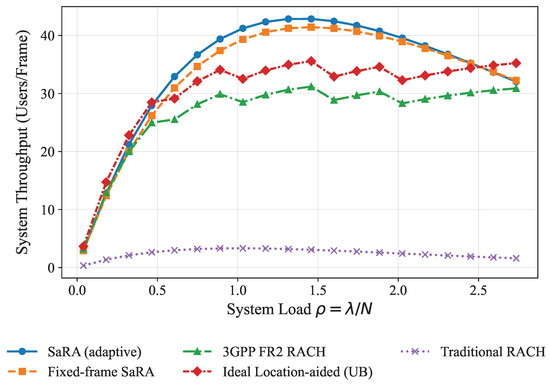
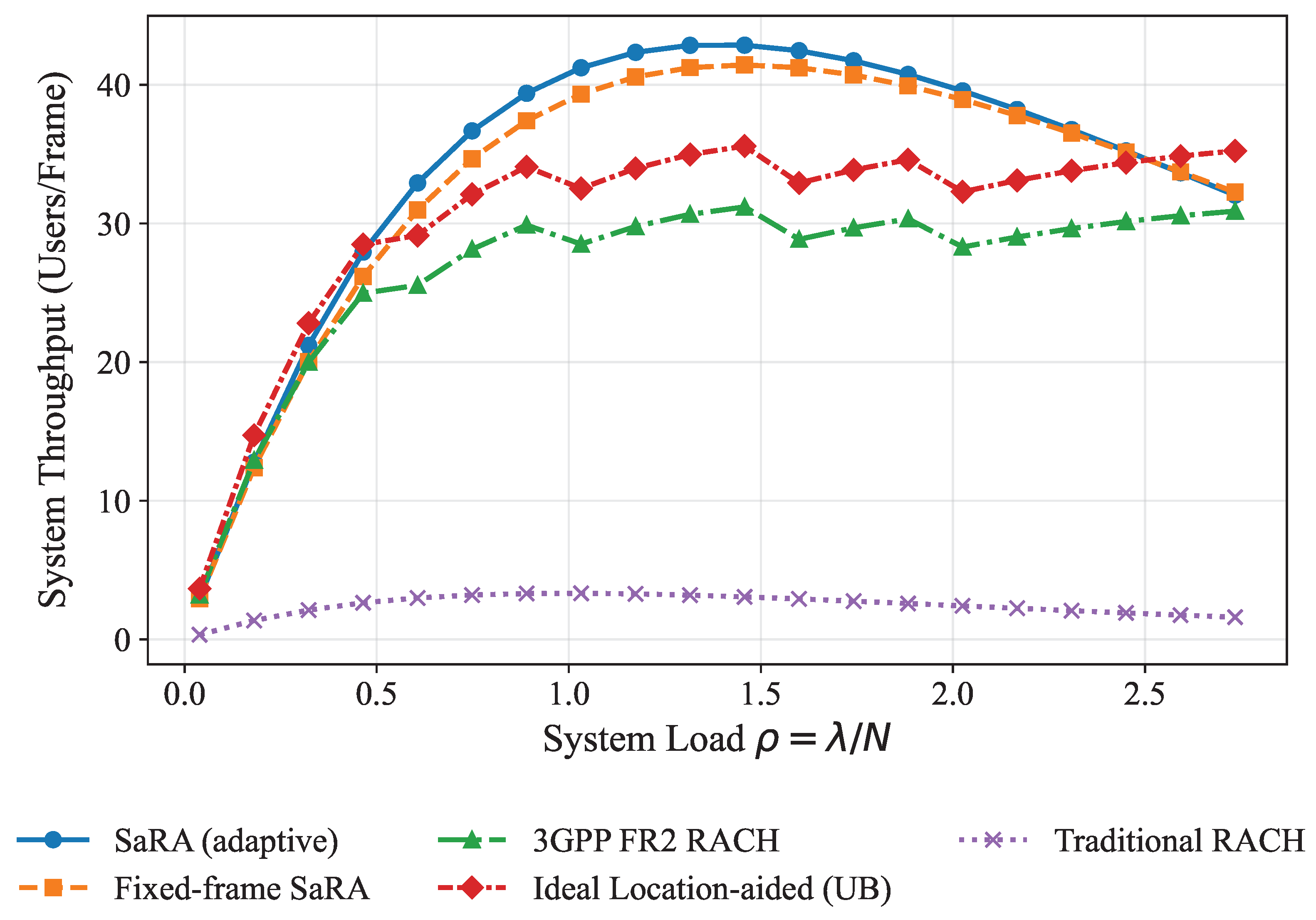
The combined benefits of controlled contention and low latency result in a substantial improvement in overall system access capacity, as depicted by the analysis in Figure 9. The access capacity (defined as the number of successfully accessed UEs per frame) of Traditional RACH saturates quickly and then decreases as congestion worsens, a phenomenon known as congestion collapse [22]. The realistic 3GPP baseline benefits from standardized SSB-based beam acquisition and BI/ACB-based load-control (Figure 7), achieving a higher capacity than blind access; however, its capacity still degrades in the highly congested regime due to collision-driven retransmissions and the overhead/delay induced by standardized control. SaRA achieves a high access capacity under heavy load while keeping latency low; for example, at , SaRA supports about users/frame versus for the realistic 3GPP baseline (and for the ideal upper bound), demonstrating improved robustness against congestion-induced throughput degradation while meeting stringent QoS latency requirements. At , this corresponds to a relative capacity increase of about over the realistic 3GPP baseline.
Figure 9.
System access capacity (successful UEs per frame) under different system loads.
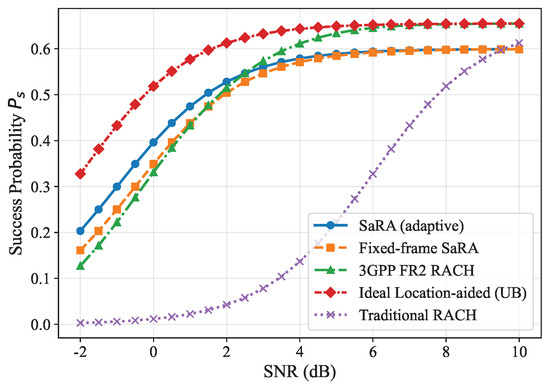
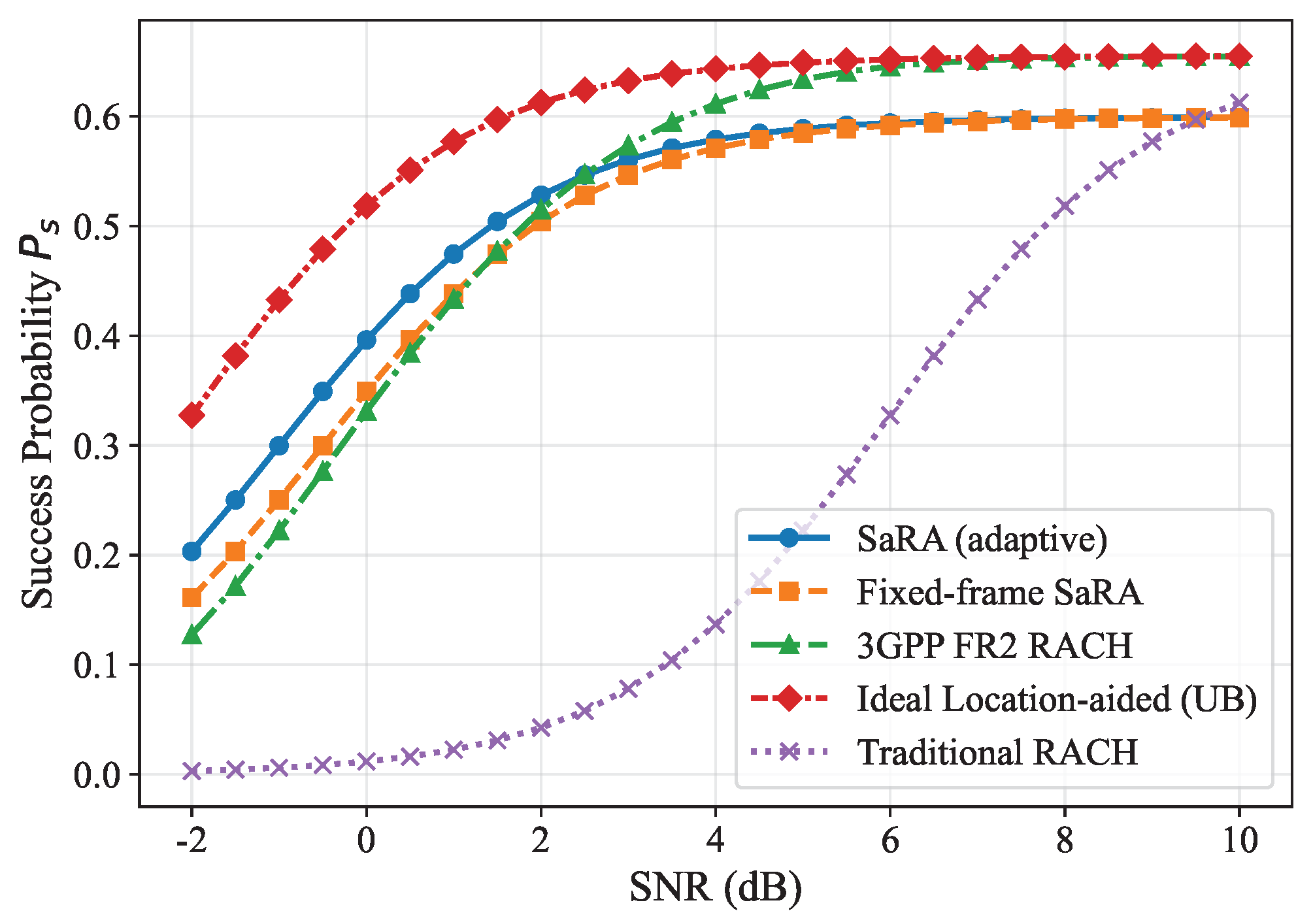
Beyond performance under varying loads, the mechanism’s robustness to link quality is also critical. Figure 10 illustrates the success rate as a function of Signal-to-Noise Ratio (SNR) at a moderate load (). The Ideal Location-aided upper bound provides the highest success probability across the SNR range due to perfect beam correspondence, while the realistic 3GPP baseline is slightly lower due to SSB-based beam-selection errors. Traditional RACH is highly sensitive to SNR due to its lack of beamforming gain, yielding very low success probability in the low-SNR regime. SaRA, by incorporating a lightweight sensing stage and sensing-informed candidate beams, substantially improves the success probability over blind access and can outperform the realistic 3GPP baseline in the low-to-medium SNR regime (e.g., at 0 dB versus for the realistic 3GPP baseline and for Traditional RACH).
Figure 10.
Success probability under different SNRs.
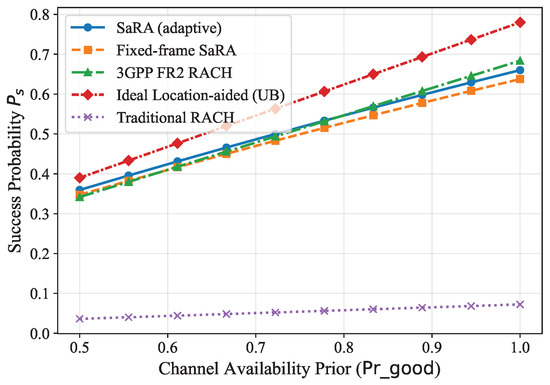
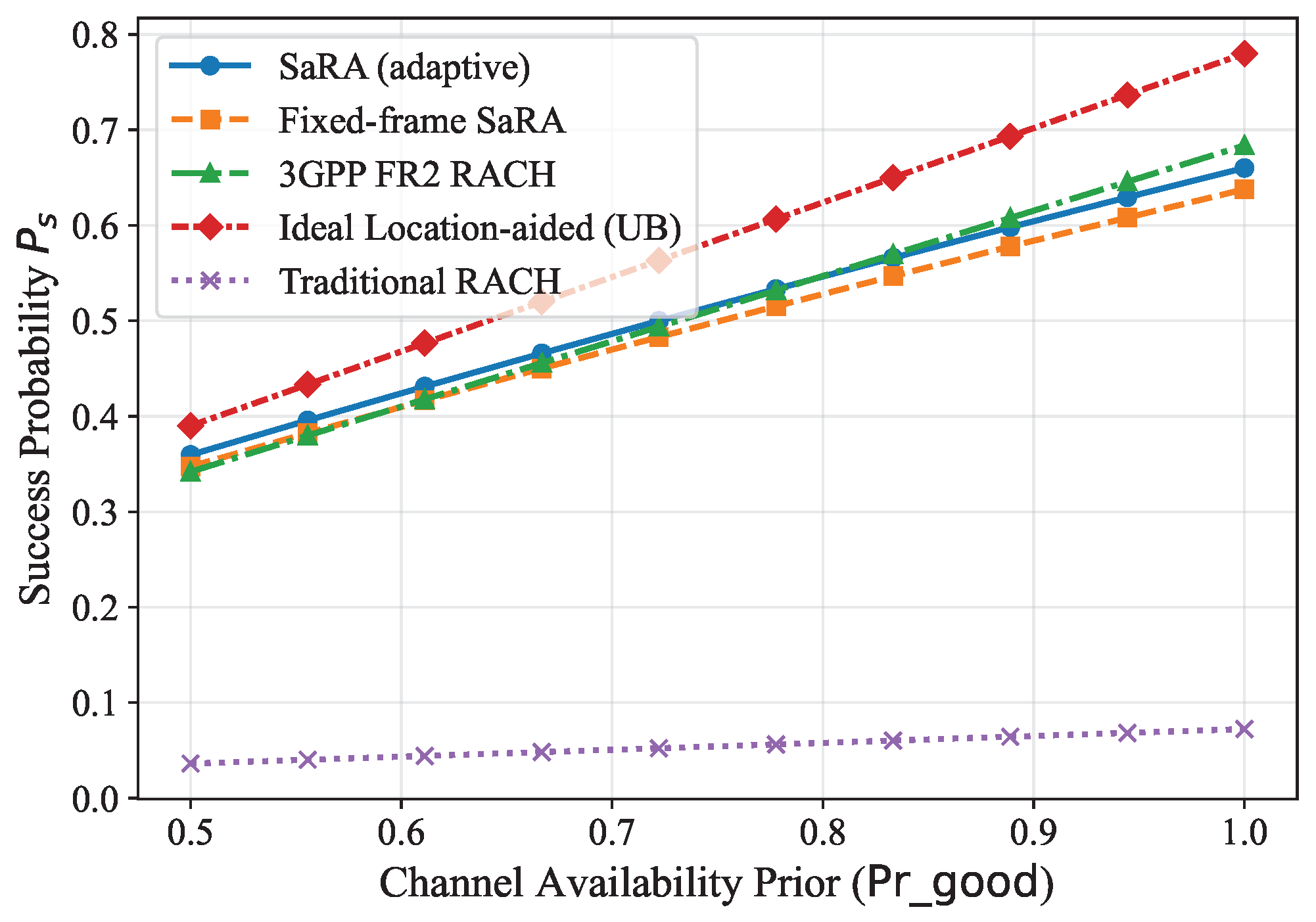
To further validate its performance in different environments, Figure 11 shows the success rate as the prior probability of channel availability (Pr_good) is varied. The Ideal Location-aided upper bound remains the upper bound in terms of across environments because it assumes perfect beam correspondence and no SSB-induced beam-selection errors. SaRA, however, consistently and substantially outperforms blind access (Traditional RACH) and maintains a significantly higher performance floor in harsh, frequently blocked environments (e.g., at Pr_good versus for the realistic 3GPP baseline and for Traditional RACH). This confirms that the proposed sensing-aware admission can effectively avoid futile attempts on deeply blocked links and preserve access efficiency under adverse conditions.
Figure 11.
Success probability under different channel availability.
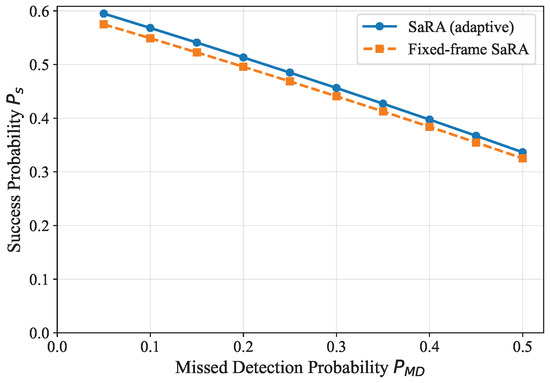
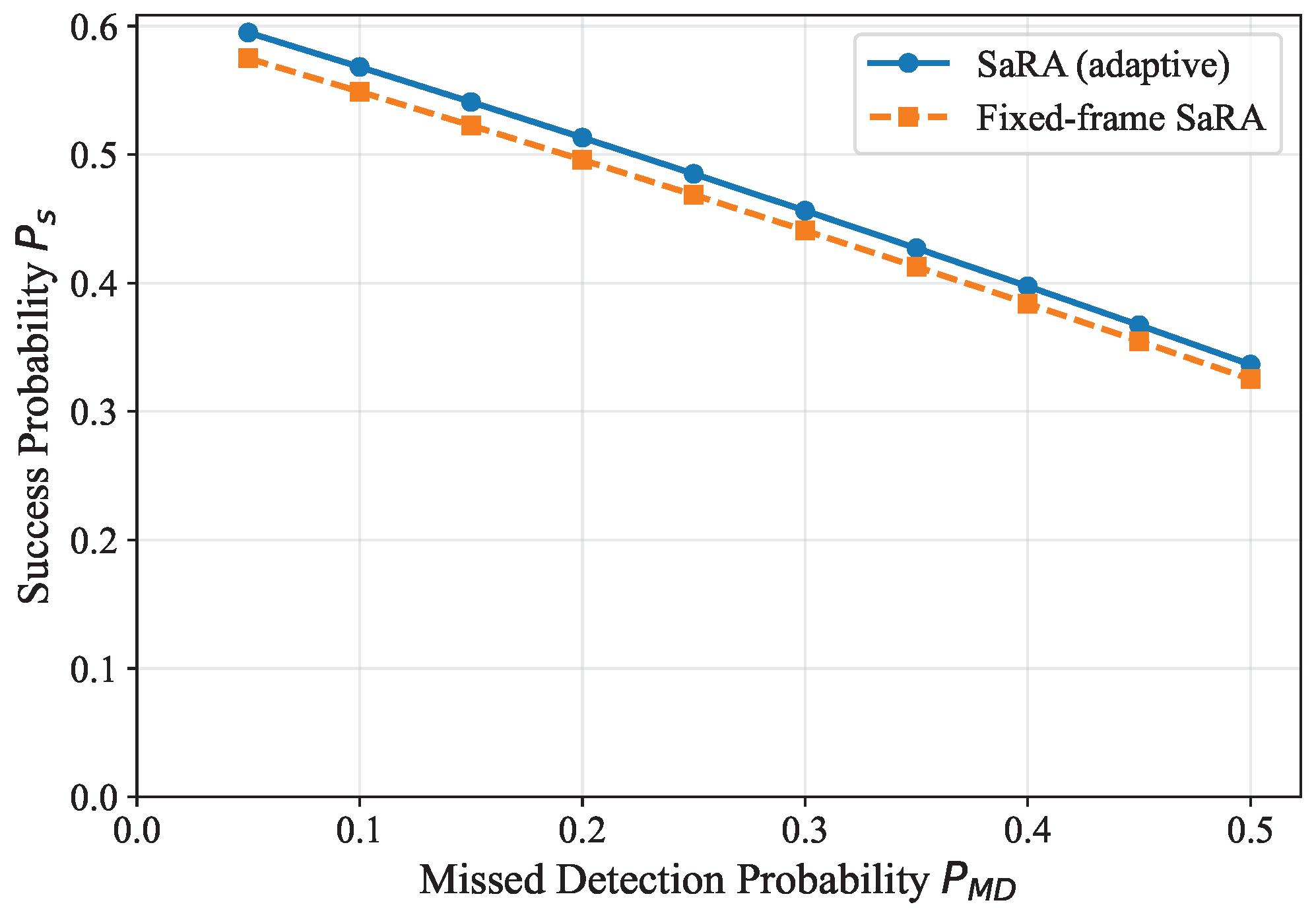
The SaRA mechanism also demonstrates strong robustness to imperfect sensing, a crucial factor for practical implementation, as shown in Figure 12. The analysis reveals that even with a high missed detection rate of 0.5, where half of the available channels are mistakenly discarded, the success rate of adaptive SaRA remains around 20%. This suggests that SaRA does not rely on perfect sensing; even moderately accurate sensing information can support decisions that improve access performance over blind access.
Figure 12.
Success probability under different missed detection rate.
Overhead-Throughput Trade-Off Analysis
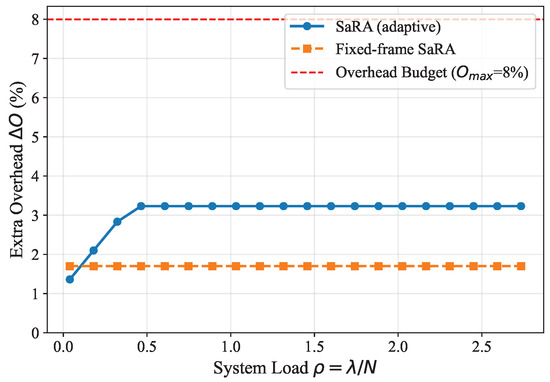
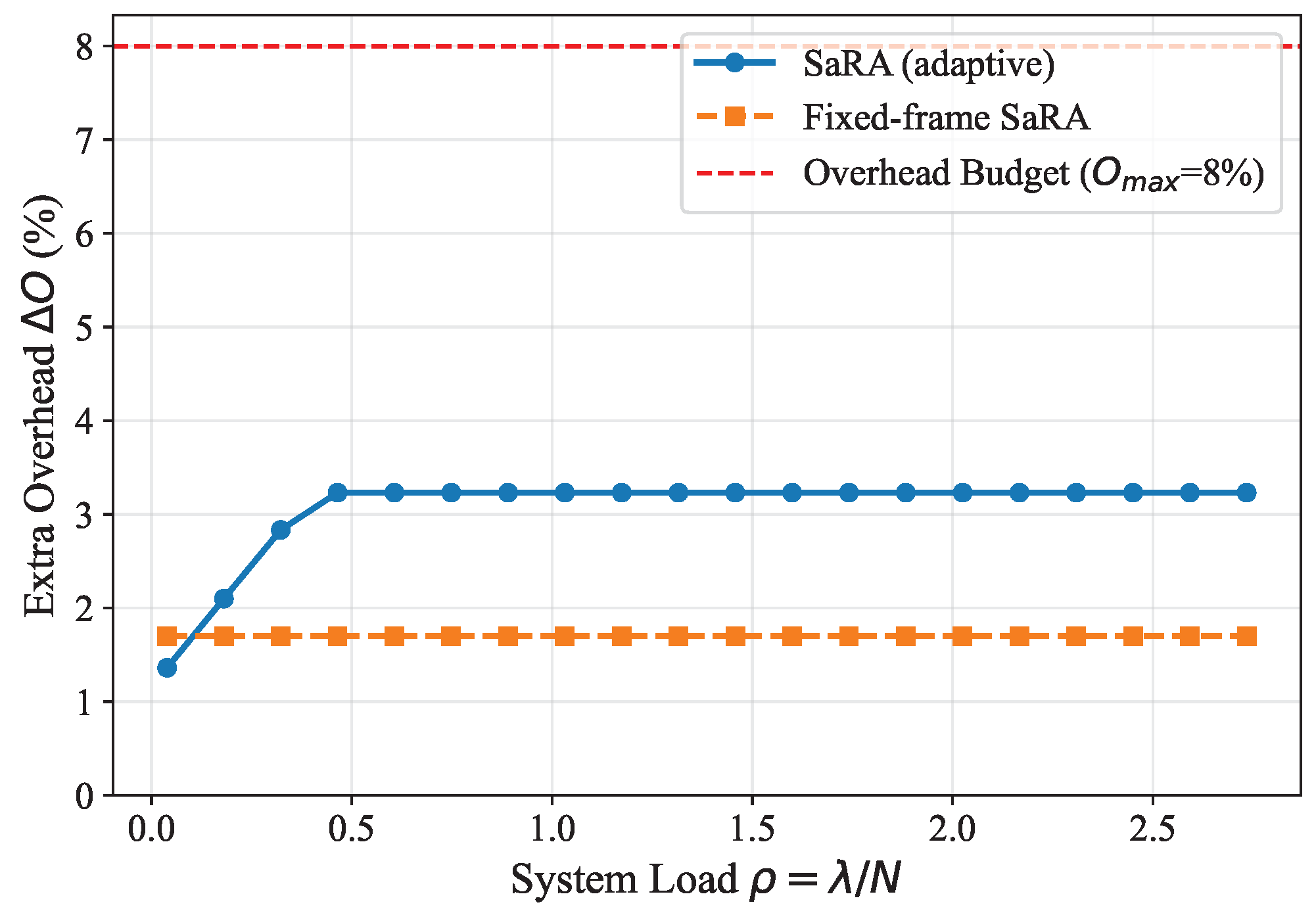
The trade-off between sensing overhead and throughput is a critical design dimension. While sensing consumes time–frequency resources (), it yields higher success probabilities and reduces collision-induced retransmissions. Figure 13 implicitly captures this trade-off: as load increases, SaRA dynamically increases overhead (up to a modest 3.23%) to maintain system stability. In extremely dense environments where the demand for sensing resources might compete with data transmission, our optimization framework (Problem , Constraint C2) imposes a hard cap (e.g., 8%). In particular, when the sensing ratio is configured close to the upper end of the considered range (around ), the sensing micro-slot becomes slightly longer but improves the reliability of admission/beam narrowing; the resulting total overhead remains modest and below the budget in our settings. In our evaluated settings, the sensing overhead does not outweigh the resulting performance gains. Effectively, the sensing micro-slot acts as a high-efficiency investment: a small upfront bandwidth expenditure helps mitigate congestion collapse observed in Traditional RACH under heavy load (Figure 9).
Figure 13.
Additional overhead under different system loads.
7. Conclusions
This paper addresses the critical challenge of efficient initial access in dynamic integrated satellite-terrestrial networks by proposing SaRA, a novel sensing-aware random access mechanism. By innovatively introducing a lightweight sensing micro-slot before the RACH procedure, SaRA proactively acquires real-time channel and location information to jointly optimize the access decision threshold, backoff strategy, and candidate beam set, marking a paradigm shift from passive adaptation to proactive management. We established a unified optimization framework and designed a practical implementation whose effectiveness is validated by extensive simulations. Results demonstrate that SaRA significantly reduces access latency and improves system access capacity under heavy load compared with the standard 3GPP FR2 RACH baseline, while maintaining competitive first-attempt success probability (especially in the highly congested regime) and keeping the additional overhead within strict budgets. The proposed method offers an effective solution for current NTN deployments and provides a valuable reference for the deep integration of sensing and communication in future 6G networks, with promising extensions towards machine learning-based optimization and enhanced mobility support. Future work will also focus on bridging the gap between simulation and deployment by validating SaRA on Software-Defined Radio (SDR) hardware testbeds and utilizing open satellite datasets to further corroborate these findings.
Author Contributions
Validation, J.Z.; Investigation, T.J.; Resources, T.J.; Data curation, Z.Z.; Writing—original draft, Y.D. and J.Z.; Writing—review & editing, P.C.; Visualization, Z.Z.; Funding acquisition, P.C. All authors have read and agreed to the published version of the manuscript.
Funding
This research was funded by the State Grid Shandong Electric Power Company’s Sci-Tech Project (Research and Application of Key Communication Technologies for Intelligent Early Warning and Emergency Response in Electric Power Safe Production, ERP No. 520605250006).
Data Availability Statement
The original contributions presented in this study are included in the article. Further inquiries can be directed to the corresponding author.
Conflicts of Interest
Author Yuanke Du was employed by the company State Grid Yantai Power Supply Company, and author Jian Zhang was employed by the company State Grid Shandong Electric Power Company. The remaining authors declare that the research was conducted in the absence of any commercial or financial relationships that could be construed as a potential conflict of interest.
References
- Ye, Z.; Chen, C.; Liu, R.; Wu, K.; Bie, Z.; Lou, G.; Gu, W.; Yuan, Y. Boost Distribution System Restoration with Emergency Communication Vehicles Considering Cyber-Physical Interdependence. IEEE Trans. Smart Grid 2023, 14, 1262–1275. [Google Scholar] [CrossRef] [Scilit]
- Kim, S.; Kwon, E.Y.; Kim, M.; Cheon, J.H.; Ju, S.-h.; Lim, Y.-h.; Choi, M.-s. A Secure Smart-Metering Protocol Over Power-Line Communication. IEEE Trans. Power Deliv. 2011, 26, 2370–2379. [Google Scholar] [CrossRef] [Scilit]
- Yang, B.; Tang, J.; Luo, Z.; Yang, C.; Dong, X.; Geng, J.; Jia, Y.; Liu, H. Optimal Collaborative Expansion Planning of Integrated Cooling and Power System for Low-Latitude Distribution Networks. IEEE Access 2021, 9, 43736–43747. [Google Scholar] [CrossRef] [Scilit]
- Kumar, A.; Majhi, S.; Li, H. Sensing and Channel Estimation for OTFS-ISAC System with Reduced PAPR. IEEE Commun. Lett. 2025, 29, 2023–2027. [Google Scholar] [CrossRef] [Scilit]
- Shen, Y.; Zhou, Q.; Wen, Y.; Shuai, Z.; John Shen, Z. Integrated Satellite-Terrestrial Network Framework for Next Generation Smart Grid. IEEE Trans. Smart Grid 2024, 15, 5249–5252. [Google Scholar] [CrossRef] [Scilit]
- Liu, Y.; Ni, L.; Peng, M. A Secure and Efficient Authentication Protocol for Satellite-Terrestrial Networks. IEEE Internet Things J. 2023, 10, 5810–5822. [Google Scholar] [CrossRef] [Scilit]
- Chen, P.; Cao, Z.; Chen, Z.; Wang, X. Off-Grid DOA Estimation Using Sparse Bayesian Learning in MIMO Radar with Unknown Mutual Coupling. IEEE Trans. Signal Process. 2019, 67, 208–220. [Google Scholar] [CrossRef] [Scilit]
- Sun, Q.; Hu, Q.; Chen, X.; Yang, Y.; Dang, S.; Zhang, J. Performance Analysis of RIS-Aided FSO/RF Hybrid Satellite-Terrestrial Network with Imperfect CSI. IEEE Trans. Veh. Technol. 2025, 74, 2958–2972. [Google Scholar] [CrossRef] [Scilit]
- Li, S.; Yuan, W.; Liu, C.; Wei, Z.; Yuan, J.; Bai, B.; Ng, D.W.K. A Novel ISAC Transmission Framework Based on Spatially-Spread Orthogonal Time Frequency Space Modulation. IEEE J. Sel. Areas Commun. 2022, 40, 1854–1872. [Google Scholar] [CrossRef] [Scilit]
- Yang, R.; Wang, C.X.; Huang, J.; Aggoune, E.H.M.; Hao, Y. A Novel 6G ISAC Channel Model Combining Forward and Backward Scattering. IEEE Trans. Wirel. Commun. 2023, 22, 8050–8065. [Google Scholar] [CrossRef] [Scilit]
- Zhang, X.; Liu, J.; Xiong, Z.; Huang, Y.; Zhang, R.; Mao, S.; Han, Z. Cost-Effective Hybrid Computation Offloading in Satellite-Terrestrial Integrated Networks. IEEE Internet Things J. 2024, 11, 36786–36800. [Google Scholar] [CrossRef] [Scilit]
- Tang, X.; Li, L.; Hao, L.; Peng, M. Joint Random Access Control Scheme based on PRACH Channel Quality and Access Class Barring. In Proceedings of the 2020 IEEE 92nd Vehicular Technology Conference (VTC2020-Fall), Victoria, BC, Canada, 18 November–16 December 2020; pp. 1–5. [Google Scholar] [CrossRef] [Scilit]
- Xiao, A.; Chen, Z.; Wu, S.; Jin, S.; Ma, L. Collaborative Long-Short Term Bandwidth Allocation for Satellite-Terrestrial Networks. IEEE Commun. Lett. 2022, 26, 1121–1125. [Google Scholar] [CrossRef] [Scilit]
- Kong, Q.; You, L.; Li, H.; Zhou, H.; Wang, Y.; Zhu, F.; Gao, X. Cooperative Precoding for Integrated Sensing and Communication in Massive MIMO LEO Satellite-Terrestrial Networks. In IEEE Wireless Communications Letters; IEEE: New York, NY, USA, 2025; pp. 4117–4121. [Google Scholar] [CrossRef] [Scilit]
- Darwish, T.; Kurt, G.K.; Yanikomeroglu, H.; Bellemare, M.; Lamontagne, G. LEO Satellites in 5G and Beyond Networks: A Review from a Standardization Perspective. IEEE Access 2022, 10, 35040–35060. [Google Scholar] [CrossRef] [Scilit]
- Jiang, N.; Deng, Y.; Condoluci, M.; Guo, W.; Nallanathan, A.; Dohler, M. RACH Preamble Repetition in NB-IoT Network. IEEE Commun. Lett. 2018, 22, 1244–1247. [Google Scholar] [CrossRef] [Scilit]
- Chen, Z.; Chen, P.; Guo, Z.; Zhang, Y.; Wang, X. A RIS-Based Vehicle DOA Estimation Method with Integrated Sensing and Communication System. IEEE Trans. Intell. Transp. Syst. 2024, 25, 5554–5566. [Google Scholar] [CrossRef] [Scilit]
- Jung, D.H.; Im, G.; Ryu, J.G.; Park, S.; Yu, H.; Choi, J. Satellite Clustering for Non-Terrestrial Networks: Concept, Architectures, and Applications. IEEE Veh. Technol. Mag. 2023, 18, 29–37. [Google Scholar] [CrossRef] [Scilit]
- 3rd Generation Partnership Project (3GPP). Study on New Radio (NR) to Support Non-Terrestrial Networks. Technical Report TR 38.811, 3GPP, 2020. Release 15. Available online: https://portal.3gpp.org/desktopmodules/Specifications/SpecificationDetails.aspx?specificationId=3234 (accessed on 7 January 2026).
- Bakhsh, Z.M.; Omid, Y.; Chen, G.; Kayhan, F.; Ma, Y.; Tafazolli, R. Multi-Satellite MIMO Systems for Direct Satellite-to-Device Communications: A Survey. IEEE Commun. Surv. Tutor. 2025, 27, 1536–1564. [Google Scholar] [CrossRef] [Scilit]
- Ali, S.M.; Qu, S.; Kohandani, F.; Lusina, P. Deterministic and Statistical-Based Channel Models in the MIMO Link Evaluation. IEEE Antennas Wirel. Propag. Lett. 2009, 8, 927–930. [Google Scholar] [CrossRef] [Scilit]
- Albuquerque, C.; Vickers, B.; Suda, T. Network border patrol: Preventing congestion collapse and promoting fairness in the Internet. Ieee/Acm Trans. Netw. 2004, 12, 173–186. [Google Scholar] [CrossRef]

Disclaimer/Publisher’s Note: The statements, opinions and data contained in all publications are solely those of the individual author(s) and contributor(s) and not of MDPI and/or the editor(s). MDPI and/or the editor(s) disclaim responsibility for any injury to people or property resulting from any ideas, methods, instructions or products referred to in the content. |
© 2026 by the authors. Licensee MDPI, Basel, Switzerland. This article is an open access article distributed under the terms and conditions of the Creative Commons Attribution (CC BY) license.