


Abstract
This study develops a mission energy-based framework to assess the performance and technical feasibility of retrofitting an existing commuter aircraft with battery-electric propulsion. The Britten-Norman BN-2B-26 Islander is selected as the case study aircraft for selected domestic routes in Scotland. A MATLAB-based parametric assessment framework was developed to evaluate aircraft and the feasibility of selected routes, and it integrates key design parameters including power, energy, battery system, operations and payload. The results show that battery specific energy is a dominant technology parameter, while specific power, available installation volume and retained payload determine whether the resulting configuration is practically feasible. For a 50 km mission, increasing battery specific energy from 400 to 1000 Wh/kg reduces the required battery mass fraction by approximately 60%. The energy available is around 57.6% of the nominal energy after deducting battery operational, regulatory and fixed mission energy requirements. Matching the baseline aircraft capability of approximately 774 kg of payload over 998 km would require about 6050 Wh/kg and 2840 Wh/L of battery technology. Route assessment indicates that high payload cases are infeasible, while reduced payload cases can support wider short-route coverage under future battery assumptions. Overall, the results indicate that battery-electric retrofitting is most feasible for short-range commuter operations with reduced payload demand.
1. Introduction
Greenhouse gas emissions play a key role in climate change. Commercial aviation emitted approximately 918 million tons of CO2 in 2018, representing about 2.4% of global CO2 emissions [1]. The ICCT projected that global passenger traffic would grow at an average annual rate of 3% between 2019 and 2050 [2]. Scientific reviews describe aviation as a hard-to-abate transport sector because aircraft require lightweight propulsion systems and energy sources with high specific energy, power density, reliability and safety [3,4]. Electric and hybrid-electric propulsion can improve energy efficiency and eliminate direct in-flight CO2 and NOx emissions; however, their practical application is limited by battery specific energy, battery system mass and volume, operational requirements, regulatory requirements and payload–range penalties [5,6].
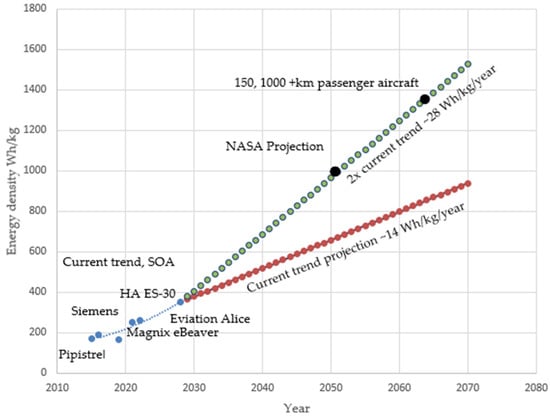
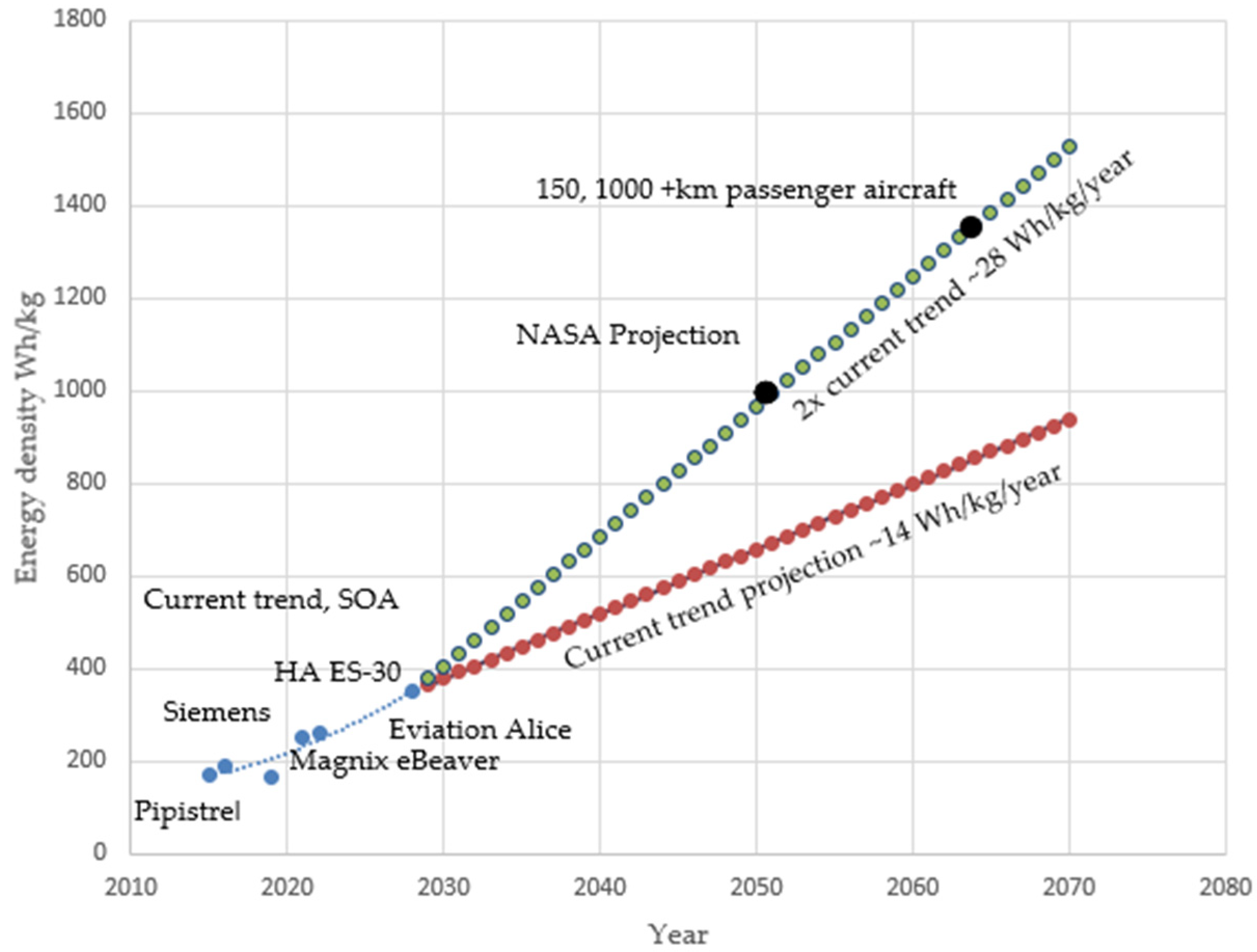
There are several promising technologies that are evolving to solve these problems like electric-, hybrid-, hydrogen- and SAFs-powered aircraft. For example, the battery-electric powertrains can reach up to 90% energy efficiency, reduce direct operating cost and reduce up to 10 dB noise, which is around 50% lower compared with conventional aircraft [7,8]. The battery-electric powertrain components like motor, gearbox, controller and other electrical distribution systems have higher efficiency. Battery mass specific energy and battery volume specific energy are remaining the main technical limitation for battery-electric aircraft. Current state-of-the-art lithium-ion battery packs typically provides about 180–300 Wh/kg at the pack level [6], which is far lower than the energy density of aviation fuel. Jet fuel has a gravimetric energy density of approximately 43 MJ/kg, while advanced lithium-ion batteries are around 1 MJ/kg on a cell or pack basis [6]. Recent battery developments show progress, including pouch-type rechargeable lithium batteries with a reported cell-level specific energy of 711.3 Wh/kg and volumetric energy density of 1653.66 Wh/L [9]. Commercially available battery cells have also been reported by Amprius, with values up to 520 Wh/kg and 1150 Wh/L [10]. Beyond lithium-ion technology, lithium–sulphur batteries offer a high theoretical specific energy of approximately 2654 Wh/kg [11], although practical cell and pack level values are expected to be considerably lower. Future battery projections indicate that optimistic aircraft relevant battery specific energy may approach about 1000 Wh/kg by around 2050 [12]. Figure 1 shows the aircraft using batteries with the specific energy density and required density in the future to meet the NASA projection on battery chemistry.
Figure 1.
Battery specific energy SOA and future projection.
The energy density projection in Figure 1 shows that the current trend will not achieve the projected value by NASA, and battery chemistry may require a breakthrough to achieve such value in 2050. Clean-sheet battery-electric aircraft are underway. However, progress in key enabling technology metrics has yet to be improved. Novel aircraft design is costly and time-consuming. On the other hand, retrofitting with battery propulsion systems on an existing platform provides a pathway to enable battery-powered aircraft faster and with minimal certification and regulatory constraints compared with new designs. Currently, BN-2B-26 Islander is under operation in many domestic routes in Scotland, including in inter-island and mainland-to-island operations.
Previous studies have established that battery-electric regional aviation is strongly constrained by battery specific energy and battery mass fraction. Ludowicy et.al [13] showed that exact replacement of a larger regional aircraft mission, such as the ATR 42-500, would require a battery energy density (3450 Wh/kg) far beyond near-term technology; however, it does not include the battery installation volume constraint and payload replacement trade-off. Hepperle [14] highlighted that low battery volumetric energy density may become a significant design constraint when the available internal aircraft volume is limited, potentially requiring larger structural volumes or alternative battery integration arrangements. Anker.et.al [15] analysed the 9-seat and 19-seat electric commuter aircraft for the Norwegian short-haul network. This study evaluated mass, power, energy and thermal management feasibility rather than physical battery packaging feasibility for electric aircraft. However, this study focused on existing electric aircraft, not retrofit. Bærheim et al. assumed that the existing fuel and fuel tank mass was replaced by batteries while maintaining the original aircraft mass; however, this study does not specify whether the batteries are installed in the wings, fuselage, cabin or cargo compartments. Mukhopadhaya et al. [16] assessed evolutionary 9-, 19- and 90-passenger electric aircraft concepts under pack-level battery specific energies of 250 and 500 Wh/kg. Their findings identified short commuter missions as the most realistic near-term application, although detailed battery installation volume and systematic payload reduction effects were not assessed. Avanzini et al. [17] derived maximum range relationships for battery-powered aircraft, while Traub [18] investigated the influence of battery weight fraction on maximum range and endurance. Previous studies have shown that MTOW, battery mass and payload trade-offs are important constraints. Therefore, mission energy requirements alone are not sufficient for battery sizing, and the mass and physical integration limits of the baseline aircraft must also be considered [19,20,21]. Existing studies have investigated battery specific energy, battery mass fraction, maximum range and regional electric aircraft feasibility. However, fewer studies have simultaneously coupled mission energy demand, peak power requirements, retained payload, battery mass, physical installation volume and operational route requirements within the geometry and mass constraints of an existing commuter aircraft. This combined assessment is particularly important for retrofit applications because a configuration that satisfies the mission energy requirement may still be infeasible because of mass, power, payload or installation volume constraints. The present study therefore develops a mission energy-based aircraft retrofit feasibility framework and applies it to the Britten-Norman BN-2B-26 Islander. The framework evaluates mission energy demand, battery sizing, retained payload, installation volume requirements, payload–range capability and route feasibility. A configuration is considered technically feasible only when the mission energy, peak power, MTOW, retained payload and installation volume requirements are satisfied simultaneously. This study therefore aims not only to determine the achievable electric range, but also to identify which physical or operational constraint governs the feasibility of battery-electric retrofit such as route distance, payload and battery technology change.
2. Materials and Methods
A mission-based computational framework was developed in MATLAB 2025b to assess the technical feasibility and performance of converting an existing conventional commuter aircraft to battery-electric propulsion. The methodology was formulated as an aircraft-level retrofit assessment rather than a clean sheet aircraft design. Consequently, the baseline aircraft maximum take-off weight, operating empty weight, disposable load capability, mission characteristics and available installation volume were treated as principal boundary conditions.
2.1. Baseline Aircraft and Mass Balance
The assessment framework consists of six linked modules: (i) aircraft and retrofit input definition, (ii) mission energy calculations, (iii) battery energy and battery mass calculations, (iv) retained payload and installation volume assessment, (v) payload–range and design space analysis and (vi) route feasibility screening. The same set of mass, energy, reserve and volume constraints is applied throughout the model so that all outputs are internally consistent.
The performance specifications of BN-2B-26 Islander are provided in Table 1. The mass balance formulation for the battery-electric retrofit is based on fixed maximum take-off weight. The MTOW of the battery-electric aircraft cannot reach beyond 2994 kg. The reason behind this assumption is to avoid the complexities involved in the certification requirements. The baseline aircraft take-off mass can be written as
mMTOW,b = mOEW,b + MPL + mfuel
Table 1.
BN-2B-26 Islander specifications [22].
The mass removed from the aircraft is the masses of the engines, fuel system and tanks. The electric propulsion system mass, mEPS, includes the motors, inverters, gearboxes, high voltage distribution equipment, controllers, and thermal management system. The additional integration mass, mintegration, accounts for mounting provisions, battery containment, fire protection and any required structural reinforcement. The net propulsion system mass difference can be expressed as Equation (2).
Δmprop = mEPS + mintegration − mremoved
The take-off mass of the battery-electric aircraft is
mMTOW,BE = mOEW,b + mbattery + MPL + Δmprop
This study assumes that the removed mass from the baseline aircraft (mremoved) is equal to the electric powertrain (mEPS) and integration masses (mintegration). The mass of the battery-electric aircraft can be expressed as
mMTOW,BE = 1866 (kg) + mbattery + MPL
The retrofit study must satisfy the maximum mass constraint that is mMTOW,BE ≤ mMTOW,b so the maximum take-off weight is equal to the baseline aircraft, i.e., 2994 kg. From Equation (4), the maximum battery mass can be estimated as
mbattery,max = 1128 − MPL
The mass constraint becomes a trade-off between payload and battery mass, as shown in Equation (6).
Δmprop + mbattery + MPL ≤ 1128 kg
This mass balance determines how much battery mass can be carried. The battery mass ratio can be determined using Equation (7).
The battery mass ratio (β) is assumed to be same as the baseline aircraft; in that case, the net propulsion system mass difference (Δmprop) becomes zero (theoretical maximum possible mass).
2.2. Battery Technology, Efficieny Calculations and Operational Contraints
Battery technology is represented by battery specific energy. The model evaluates a range of battery specific energy assumptions to represent current, near-term, and future battery technology levels. The aircraft level usable energy is lower than the nominal battery energy because reserve, powertrain efficiency, SOC margin, and end-of-life degradation allowance are applied before cruise energy is calculated.
Section 2.3 discusses energy allowances and performance calculations. The reserve requirement was selected with reference to aviation safety requirements, while the SOC and EOL margins were treated as preliminary engineering assumptions for feasibility screening. Table 2 provides the assumptions and requirements for simulation.
Table 2.
Battery operational requirements and modelling assumptions [23].
The powertrain efficiency is calculated based on Table 3 and Equation (8). The total powertrain efficiency is around 0.8.
ηpowertrain = ηbatηHVηinvηmotηgbηprop
Table 3.
Battery-electric powertrain component’s efficiency.
Table 3 provides information to calculate the battery energy required after applying the powertrain efficiency, SOC margin, reserve and end-of-life requirements.
2.3. Mission Energy Model
The energy available for the battery-electric mission is determined from the installed battery mass, battery specific energy and the operational energy allowances. For a selected battery mass fraction, β, the battery mass is calculated as
mbattery = β mMTOW
The corresponding nominal battery energy is
Enominal = mbattery SE
For the protection of battery health, a minimum state of charge (SOC) of 20% is assumed as the modelling assumption, not a regulatory requirement. And to avoid reducing the battery operational cycle, an end-of-life limit of 90% is assumed [25].
Eusuable = Enominal(1 − SOC)(1 − EOL)(ηpowertrain)
A previous study used a similar fraction for total efficiency in the modelling assumption for powertrain efficiency, which includes all the components in the powertrain and propeller [26].
Mission Phase Energy
The battery-electric mission was represented using a phase-based energy model comprising taxi-out, take-off, climb, cruise, descent, approach, taxi-in and reserve segments. For each prescribed mission phase i, the electrical energy requirement was calculated from
Ei = Piti
Taxi power was estimated from the power required to overcome aircraft rolling resistance. For a simplified taxi-out equation at low speed (25 km/h), a higher rolling resistance value of 0.05 [27] and battery to traction efficiency of 0.5 leads to around 20 kW taxi-out power, according to Equation (13).
The flightradar24 [28] shows that most of the flights during taxi-out and taxi-in time were up to 5 min and 3 min, respectively. The change in altitude was estimated as the difference between the cruise altitude and the departure airport elevation. Most flights operate at cruise altitudes below 300 m, and many of the airports are located close to sea level. Therefore, an altitude change of approximately 300 m was adopted. The maximum rate of climbing of the reference aircraft is around 4.4 m/s. Using Equation (14), time to climb can be calculated under steady climbing conditions. Table 4 provides power, time and mission phase energy for various phases of the flight.
Table 4.
Mission profile and energy requirements.
Equation (15) was used to calculate the fixed mission energy, defined as the total energy required for taxi-out, take-off, climb, descent, approach, and taxi-in; cruise and reserve energy were calculated separately. The reference BN-2B-26 is powered by two Lycoming O-540-E4C5 engines, each rated at 260 hp, giving a total rated take-off power of 520 hp or approximately 388 kW [29]. A climb power of 300 kW, corresponding to approximately 75% of the total rated power, was adopted as a mission model assumption [30]. The economical cruise power was assumed as 65% cruise power setting to the total rated power [31]. The fixed mission energy is 23.75 kWh.
The descending flights take time up to a maximum up to 5 min, so the current assumption keeps the values which is closer to the maximum time required to descending. These values are from the real-time flight trajectory of the baseline aircraft and selected routes for the study.
Efixed = Etaxi out + Etake off + Eclimb + Edescent + Eapproach + Etaxi in
The reserve energy is calculated using Equation (16).
Ereserve = Pcruise ∗ treserve
The remaining energy after reserve and fixed mission energy is the cruise energy available to convert into range. It is calculated using Equation (17).
Ecruise = Eusable − Efixed − Ereserve
The energy consumed during the actual mission is expressed as
Emission = Efixed + Ecruise + Ereserve
For the present preliminary model, cruise is assumed to occur at constant power, speed and altitude. The available cruise energy can be calculated as
Ecruise = β mMTOW SE(1 − SOC)(1 − EOL)(ηpowertrain) − (Efixed) − (Ereserve)
Using the energy available Equation (19), cruise power and cruise speed, the range is calculated as
The final range calculation is based on Equation (20); it is obtained by substituting Equation (18) into Equation (19).
Equation (21) provides the range calculation from available energy for cruising. The cruise phase is assumed to be at constant altitude.
2.4. Battery Sizing
Battery sizing was performed by considering both the mission energy requirement and the peak power requirement, with additional pack-level burden included. The pack burden assumption is supported by NASA X-57 battery pack modelling and cell-to-pack scaling studies [32]. Nominal energy is calculated using Equation (10). The corresponding battery mass is calculated using Equation (22),
mbattery = max(mP, mE)
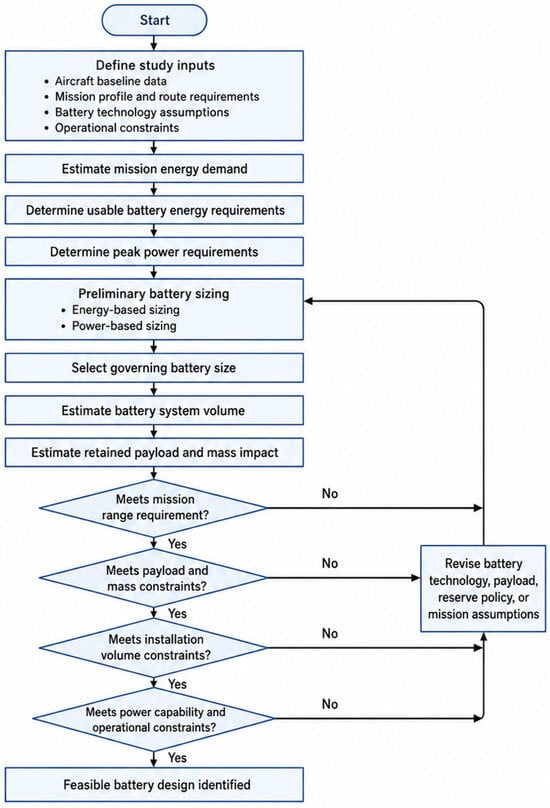
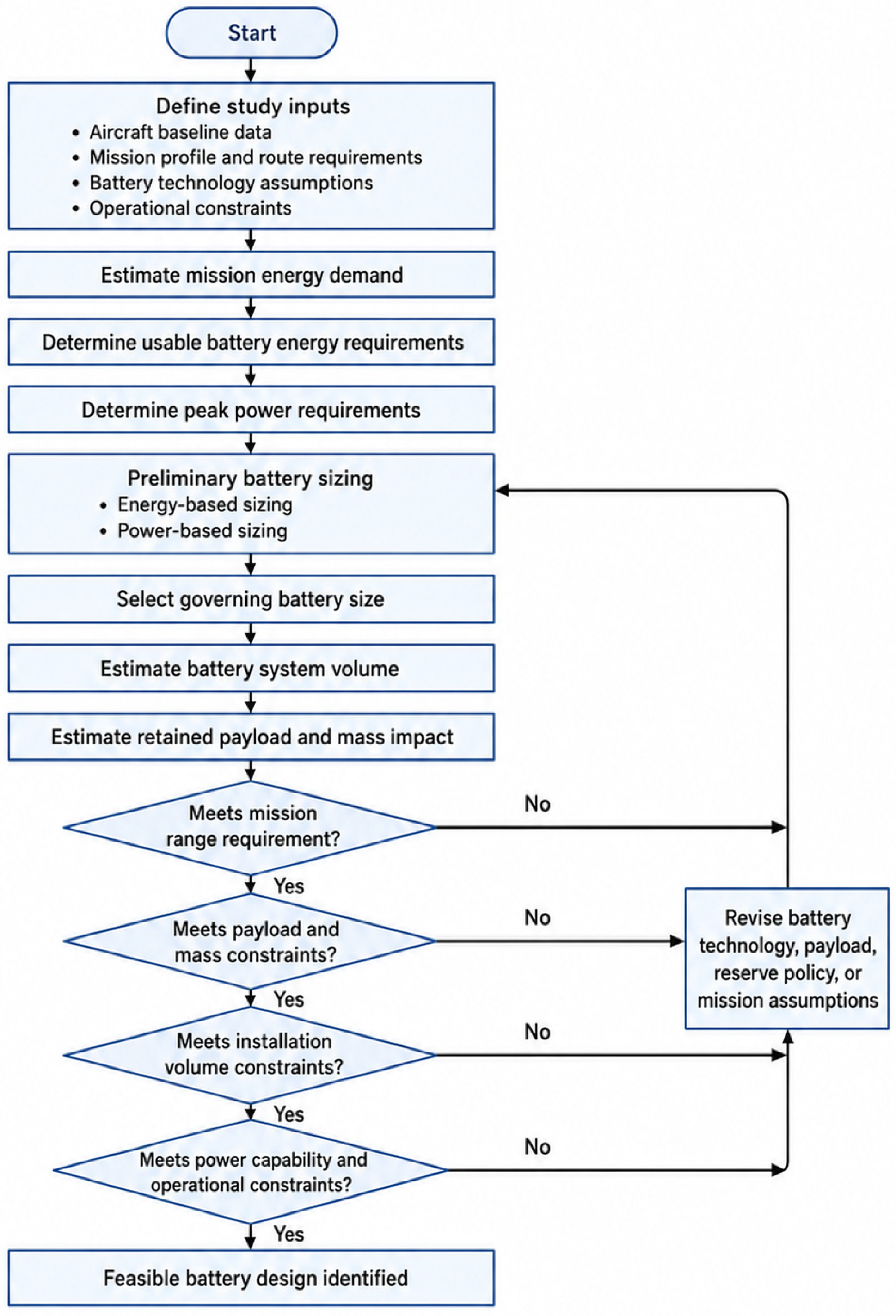
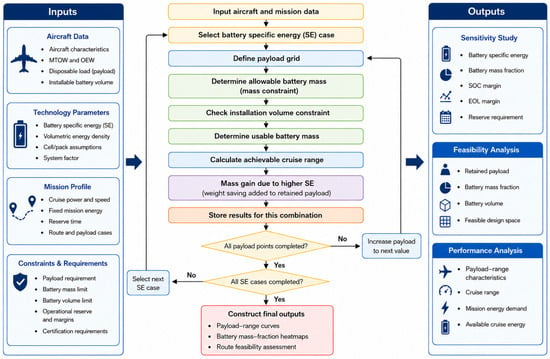
mP is the power limited battery mass. Maximum power requirement was determined (take-off power), and a pack specific power of 1.0 kWkg−1 was assumed. Under this assumption, 388 kg is the minimum mass for power limit. mE is the energy limited battery mass. The battery sizing (estimation of mass and volume) is an iterative process under operational, performance and certification constraints as shown in Figure 2. The battery system volume is
Figure 2.
Battery sizing flowchart.
ρV,pack is the pack-level volumetric energy density range of 180–580 Wh/L for 200–1000 Wh/kg battery specific energy, with a 1.35 installed system volume factor. High-energy lithium-ion cells have been reported with cell-level volumetric energy density approaching or exceeding 950 Wh/L, but aircraft pack-level values are lower after packaging, cooling, containment and battery management system integration [33].
Figure 2 provides the battery sizing workflow, and Section 2.6 further explains the aircraft battery volume calculations and available volume for passengers.
2.5. Sensitivity and Design Space Analysis
Sensitivity and design space analysis were performed to evaluate how battery technology and operational assumptions influence the battery mass requirement, retained payload and achievable cruise range of the battery-electric retrofit aircraft. The sensitivity analysis determines the minimum battery mass fraction required for a specified mission, whereas the design space analysis provide a design points and performance information.
The useable energy should be equal to the energy required for the mission and regulatory requirements.
The reserve energy is based on the cruise power required for 30 min. From the above equation, the nominal energy required can be written as
The battery mass required can be written as
The required battery mass fraction is the ratio between battery mass and maximum take-off mass. From Equation (7), the required battery mass fraction can be expressed as,
Based on the assumptions and requirements, the SOC, EOL and reserve time can be applied on the above equation. Therefore, the reference required battery mass fraction is
At the reference condition, both battery mass fraction required and reference become equal. Hence, the required battery mass fraction can be written as
The main design space map expresses achievable cruise range as a function of battery specific energy and battery mass fraction. Payload boundaries are superimposed on the design space to identify whether a given range can be achieved while retaining a useful payload. The required battery mass fraction (βreq) is calculated using Equations (27) and (28).
For a required range, the required battery mass fraction is
The aircraft is assumed to be cruising at constant speed. Therefore, cruising time can be simplified as a required range over cruising velocity.
2.6. Battery Installation Volume and Available Aircraft Volume
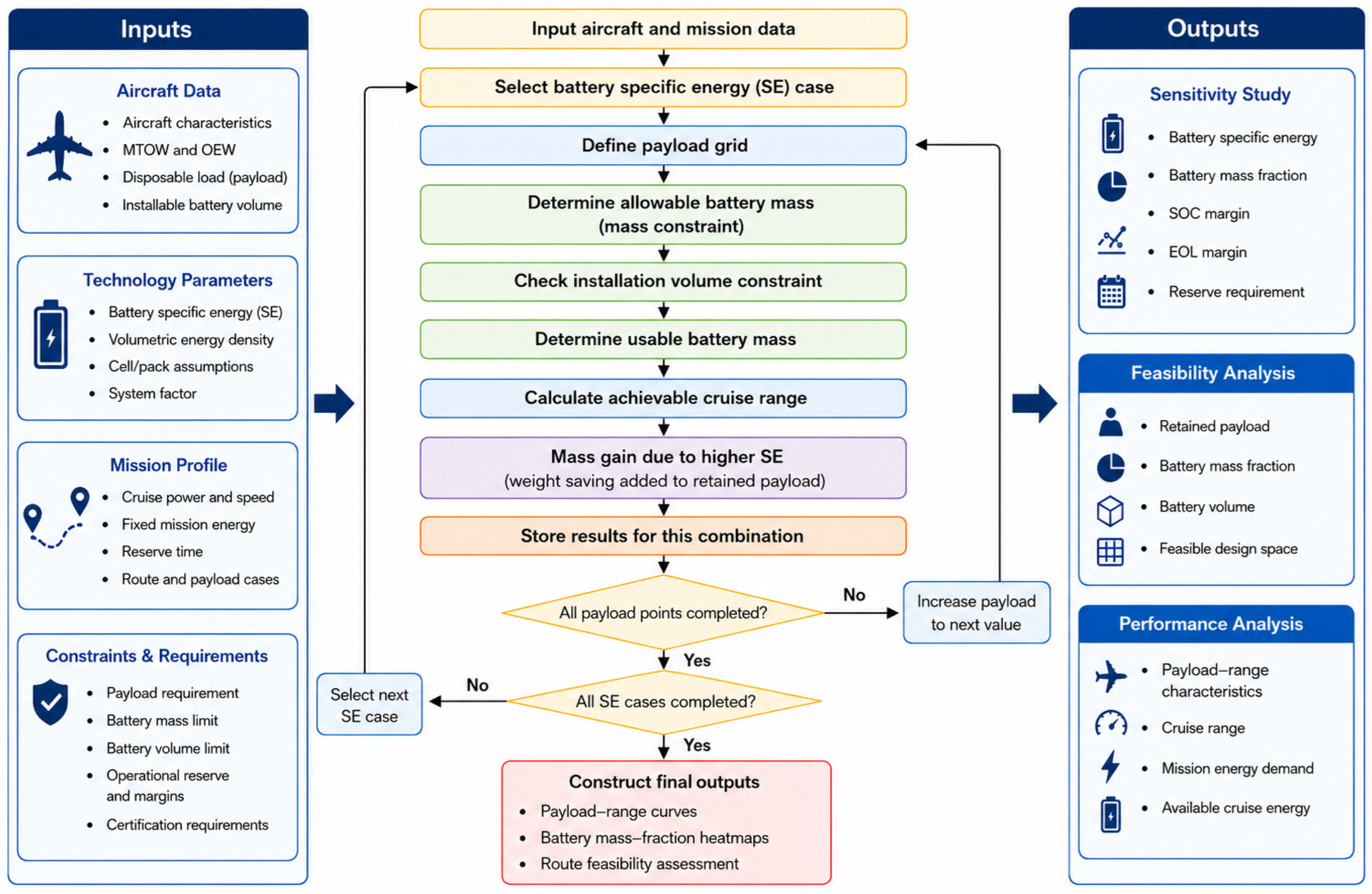
In addition to battery mass and energy requirements, the feasibility of a battery-electric retrofit is constrained by the physical volume available for battery installation within the existing aircraft geometry. For the BN-2B-26 retrofit, the battery installation assessment considers the battery pack volume, additional system integration volume, and the usable volume available within the former fuel storage region, baggage compartment and passenger cabin. A retrofit configuration is considered volume-feasible only when the required installed battery system volume does not exceed the available installation volume. The subsystem volume (Equation (31)) accounts for the additional volume required by supporting battery system components such as cooling, battery management and high voltage equipment, containment and installation allowance. Figure 3 shows the workflow for feasibility assessment.
Figure 3.
Integrated workflow for payload–range analysis and route feasibility assessment.
The installation volume is assumed to be 0.08, and the total volume required for the battery system is 1.35 times the battery volume at the pack level. A safety volume fraction of 0.35 is added. The factor for this additional volume is in Table 5.
Table 5.
The battery cell to pack level factors.
The battery volume is given in Equation (23). The total battery system volume is calculated by Equation (32), and the battery volume is calculated based on volumetric energy density, referring to Equation (33).
Vsystem = Vbattery + Vsubsystem
The available cabin volume behind the crew zone is calculated from the usable cabin length, cabin width and cabin height, as shown in Equation (17).
Vcabin behind crew = (Lcabin − Lcrew zone) WcabinHcabin
The passenger occupancy in the cabin is calculated as
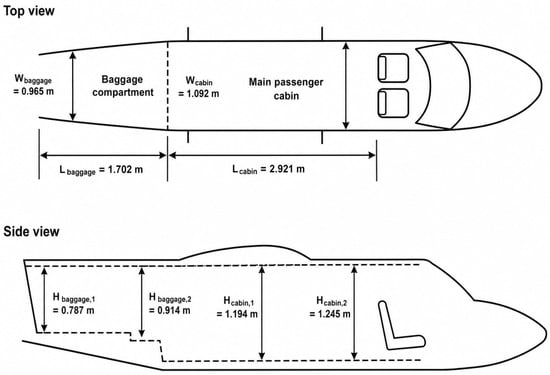
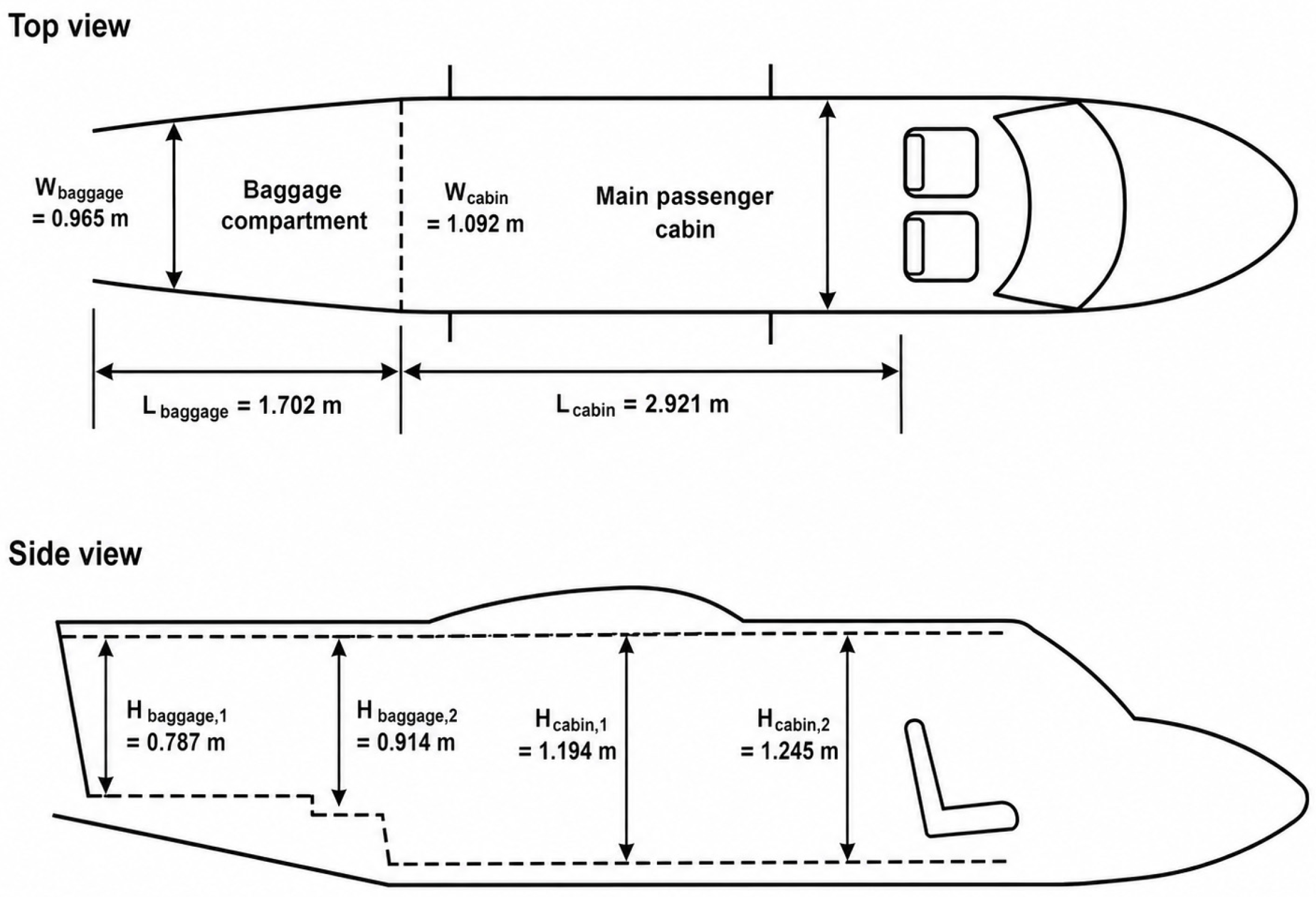
There are eight seats behind the crew members (if we assume that the two front seats are for crew members). Available battery installation volume (Equation (35)) is calculated by adding the cabin volume behind the crew zone, fuel volume in the wing and the baggage volume; subtracting the occupied volume; and applying a miscellaneous (Table 6). Figure 4 provides the dimensions for aircraft geometry.
Table 6.
BN-2B-26 Islander cabin and baggage dimensions [22].
Figure 4.
BN-2B-26 Islander cargo and cabin dimensions.
The baseline aircraft can carry a fuel mass of up to 354 kg at the full payload condition, and the equivalent volume is 0.442 cubic meters. The baggage and cabin dimensions are given in Table 6. The available volume for battery installation must be higher than the battery system volume. It can be written as
Vsystem ≤ Vavailable
2.7. Route Selection and Feasibility Screening
The selected route groups used for this feasibility screening are listed in Table 7. The routes are assessed under the constraints to check the feasibility at different battery specific energy, battery mass ratio and payload. The combined feasibility map is:
F = f(SE,β,Rreq,mPL,req,Vavailable)
Table 7.
Selected routes for finding the potential of converting BN-2B-26 Islander into battery-electric [37,38,39].
For each route i, battery scenario s and payload case p, run:
Ravailable(SEs,β,p) ≥ Rreq,i
Then apply the retrofit constraints:
mpayload retained ≥ mpayload required
β ≤ βpayload
V system ≤ Vavailable
Eusable ≥ Efixed + Ecruise + Ereserve
A route is technically feasible only if all these Equations (38)–(41) are true.
For each selected route, the required route distance was compared with the cruise range predicted by the battery-electric retrofit model for each combination of battery specific energy, volumetric energy density, specific power and retained payload. A route was classified as technically feasible only when the required range was achieved while simultaneously satisfying the mission energy, peak power, MTOW, retained payload and battery installation volume constraints.
3. Results
This study investigates the potential of converting BN-2B-26 Islander into a battery-powered propulsion. The output of the framework provides a range of information under assumptions and constraints. The results are presented in a sequence that follows the modelling framework developed in Section 2.
3.1. Mission Energy Budget
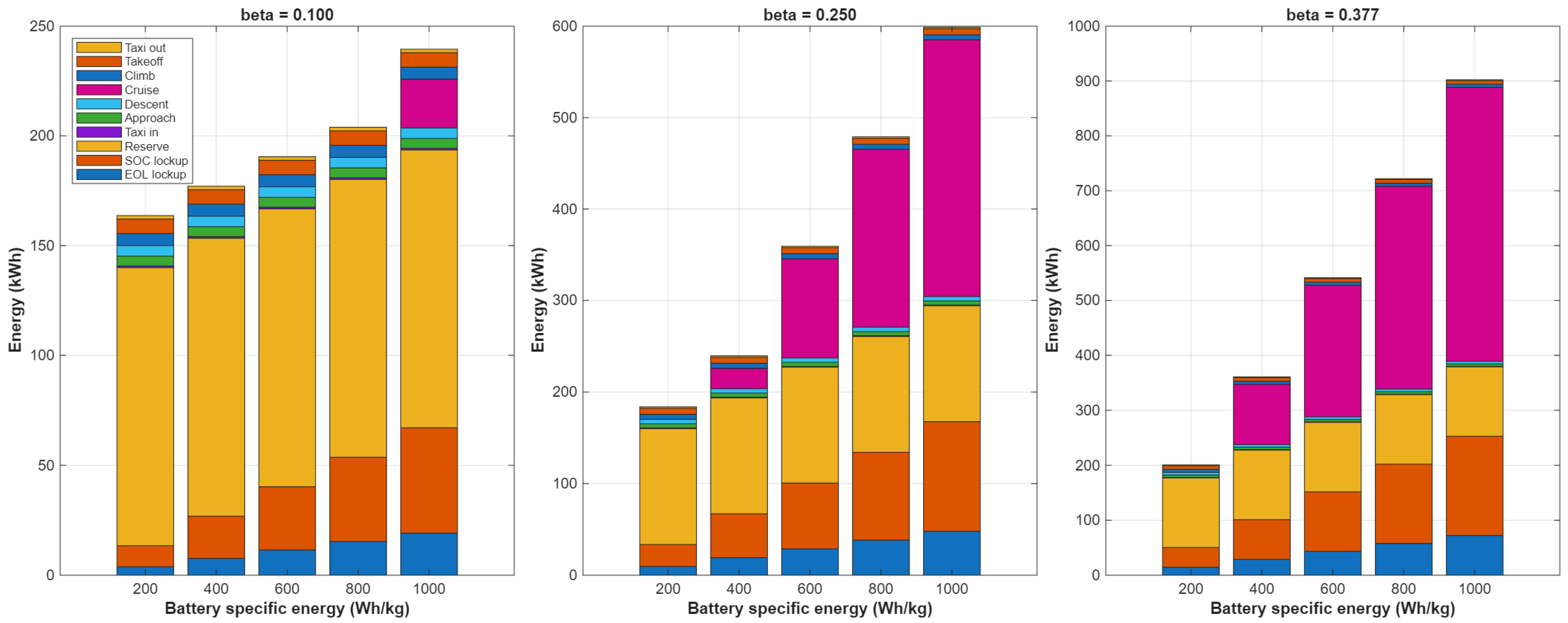
The mission energy budget shows that the energy requirement of the battery-electric retrofit is not dominated by take-off despite take-off being the highest power mission phase. The 388 kW take-off requirement acts primarily as a peak power constraint because of its short duration, contributing only approximately 6.6 kWh to the mission. In contrast, climbing requires approximately 5.5 kWh and represents the second largest fixed flight phase energy demand. The 30 min reserve requirement is more significant, requiring approximately 126.5 kWh at the cruise power of 253 kW. Consequently, approximately 150.25 kWh is allocated to fixed mission phases, and reserve before cruise range energy is considered. The resulting mission energy breakdown is shown in Figure 5.
Figure 5.
Energy budget model for a battery-electric BN-2B-26 retrofit.
The optimum battery mass fraction can be identified by locating the point at which the calculated cruise range reaches its maximum value. This occurs when the gradient of range with respect to battery mass fraction becomes zero; therefore, range increases with battery mass fraction until the aircraft reaches the allowable mass or payload boundary. For short missions, this fixed energy burden represents a substantial fraction of the total mission requirement, which explains why increasing route distance does not result in a proportional increase in required battery mass. After applying the powertrain efficiency and SOC and EOL allowances, only 57.6% of the nominal battery energy is available for satisfying the modelled mission energy requirement.
3.2. Sensitivity Analysis
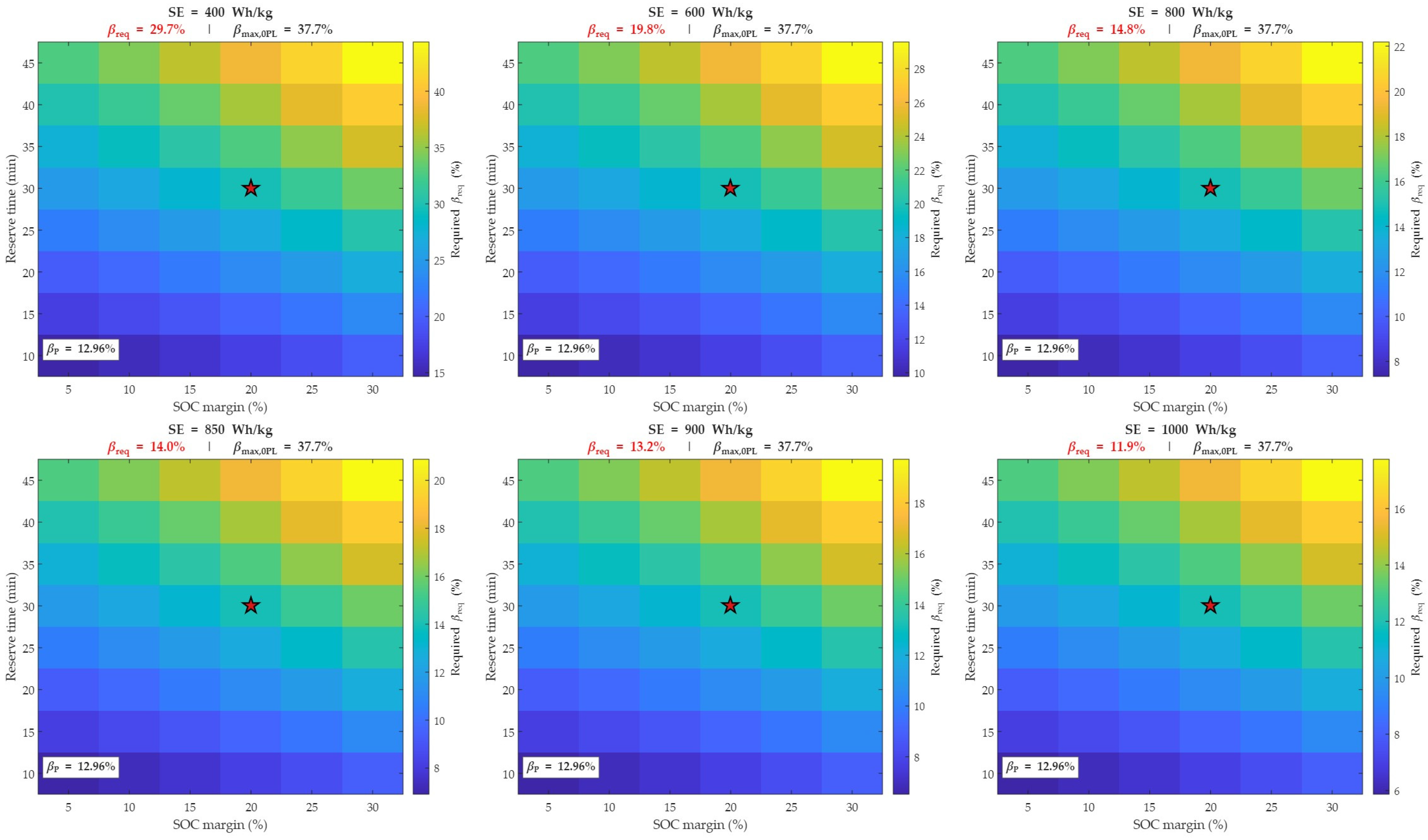
The sensitivity analysis evaluates the influence of battery specific energy, state-of-charge margin, and reserve time on the minimum battery mass fraction required for a 50 km mission (Figure 6). The end-of-life allowance was maintained at 10% throughout the analysis, while the other parameters (SOC and reserve) were varied according to Equation (27) in Section 2.5. The results show that battery specific energy has the strongest influence on the required battery mass fraction. At the reference operating condition, increasing the battery specific energy from 400 Wh/kg to 1000 Wh/kg reduces the required battery mass fraction from approximately 29.65% to 11.9%, corresponding to a reduction of about 60%. This occurs because higher specific energy allows the same mission energy requirement to be satisfied with a lower battery mass. βP is the minimum battery mass fraction required for power limit.
Figure 6.
SOC, reserve and battery specific energy sensitivity to battery mass ratio at 10% EOL, 50 km range.
βmax,0PL is the theoretical maximum battery mass fraction at zero retained payload, it is around 37.7% of the MTOW. The sensitivity map demonstrates that the required battery mass fraction is reducing for the same range as battery specific energy increases, which means the mass fraction reduction provides additional mass that can be used as payload.
3.3. Battery-Electric Retrofit Design Space
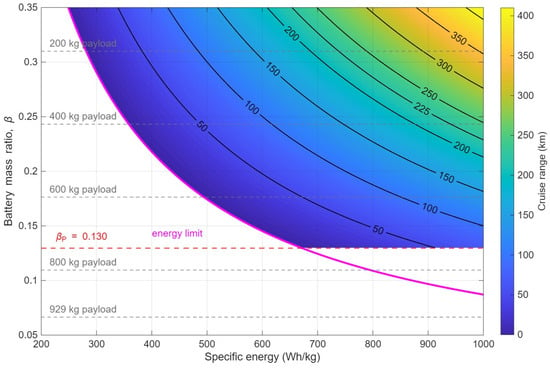
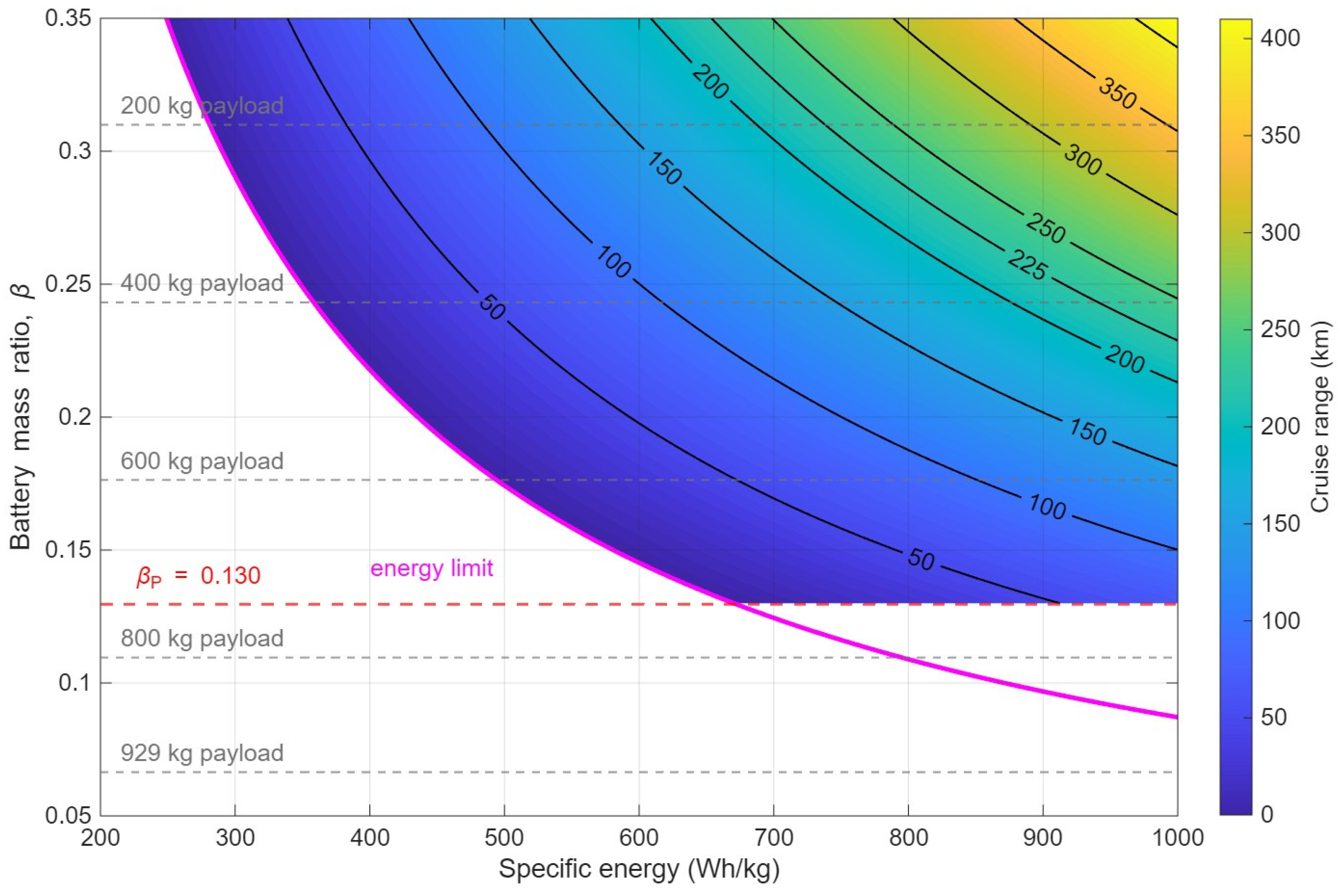
The battery-electric design space shows achievable cruise range as a function of battery specific energy and battery mass fraction (Figure 7). Range increases as either battery specific energy or battery mass fraction increases. However, the useful design region is bounded by retained payload limits. At lower battery specific energy, a high battery mass fraction is required to meet even short-range requirements, leaving little useful payload. At 400 Wh/kg, the indicated design point retains only about 240 kg of payload. Increasing battery specific energy to 1000 Wh/kg increases the retained payload to about 740 kg for the same design space condition. The corresponding retrofit design space is presented in Figure 7.
Figure 7.
Design space for BN-2B-26 Islander.
With 1000 Wh/kg and 580 Wh/L batteries, the baggage compartment plus former fuel tank volume is sufficient for approximately a 49 km range while retaining 774 kg of payload (satisfied both volume and mass for PAX). However, it became infeasible due to the power limited mass. At higher specific energy, the battery mass ratio reduces. But due to the specific power limitations, the minimum battery mass is maintained to satisfy the power limit (βP), i.e., 12.96% (~13%) of MTOW.
At the maximum battery specific energy considered in this study, 1000 Wh/kg, the required battery mass fraction increases from approximately 11.86% for a 50 km cruise range to approximately 22.88% for a 225 km cruise range. A retained payload of 400 kg corresponds to an allowable battery mass fraction of approximately 24.3%, providing a maximum calculated cruise range of about 248 km. If the retained payload is reduced to 200 kg, the allowable battery mass fraction increases to approximately 31.0%, extending the calculated cruise range to about 354 km. The theoretical zero-payload upper limit corresponds to a battery mass fraction of approximately 37.7% and a calculated cruise range of about 460 km. Although this condition represents the maximum range within the fixed-MTOW mass balance, it is not operationally useful because no payload is retained.
3.4. Retained Payload–Range Performance Analysis
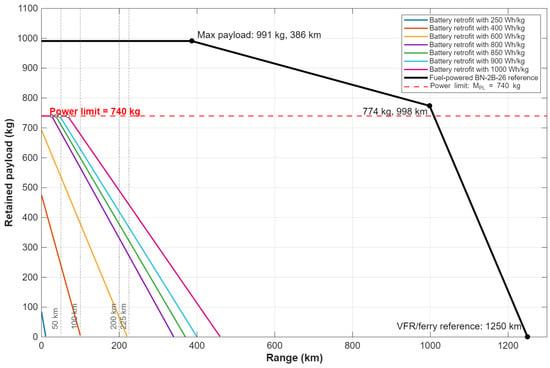
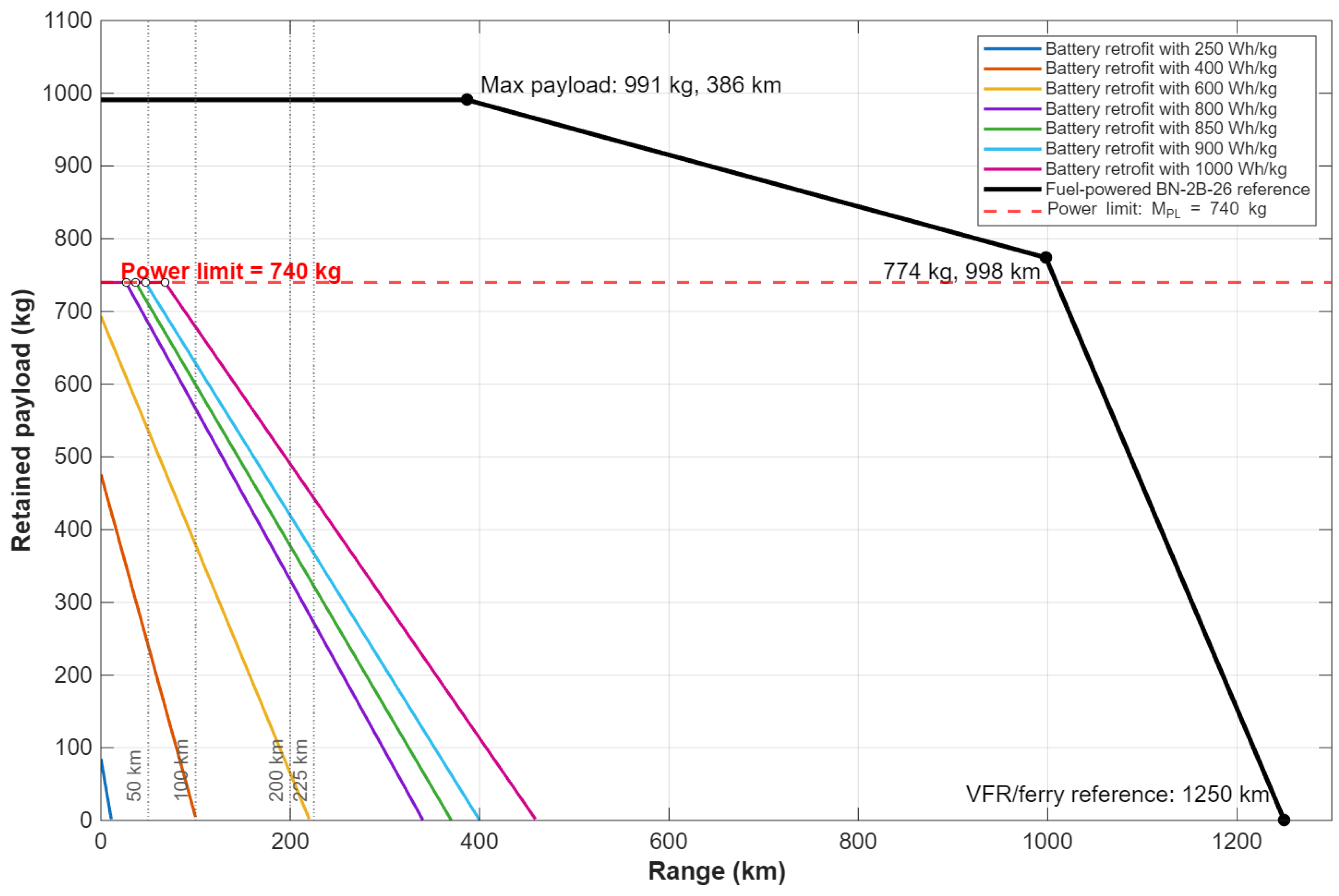
In Figure 8, each curve shows range and payload variation. Higher payload leaves less mass and volume for batteries, so range decreases. Higher battery specific energy shifts the curve outward because the same battery mass stores more energy. The retained payload–range analysis shows the trade-off between retained payload and achievable cruise range for the battery-electric BN-2B-26 retrofit. The maximum range at maximum payload for baseline aircraft is estimated based on the fraction of maximum fuel that can be carried while retaining maximum structural payload [29].
Figure 8.
Payload–range comparison of battery-electric retrofit with different battery technologies and the baseline aircraft.
The baseline aircraft can carry approximately 774 kg of payload over about 998 km under the selected IFR range condition, whereas even the most optimistic battery case considered in this study remains substantially below this range. At 1000 Wh/kg, the maximum achievable electric range is 460 km under the theoretical zero-payload condition, and for a retained payload of 400 kg it is approximately 248 km, whereas reducing the retained payload to 200 kg increases the calculated cruise range to approximately 354 km.
3.5. Route Feasibility Assessment
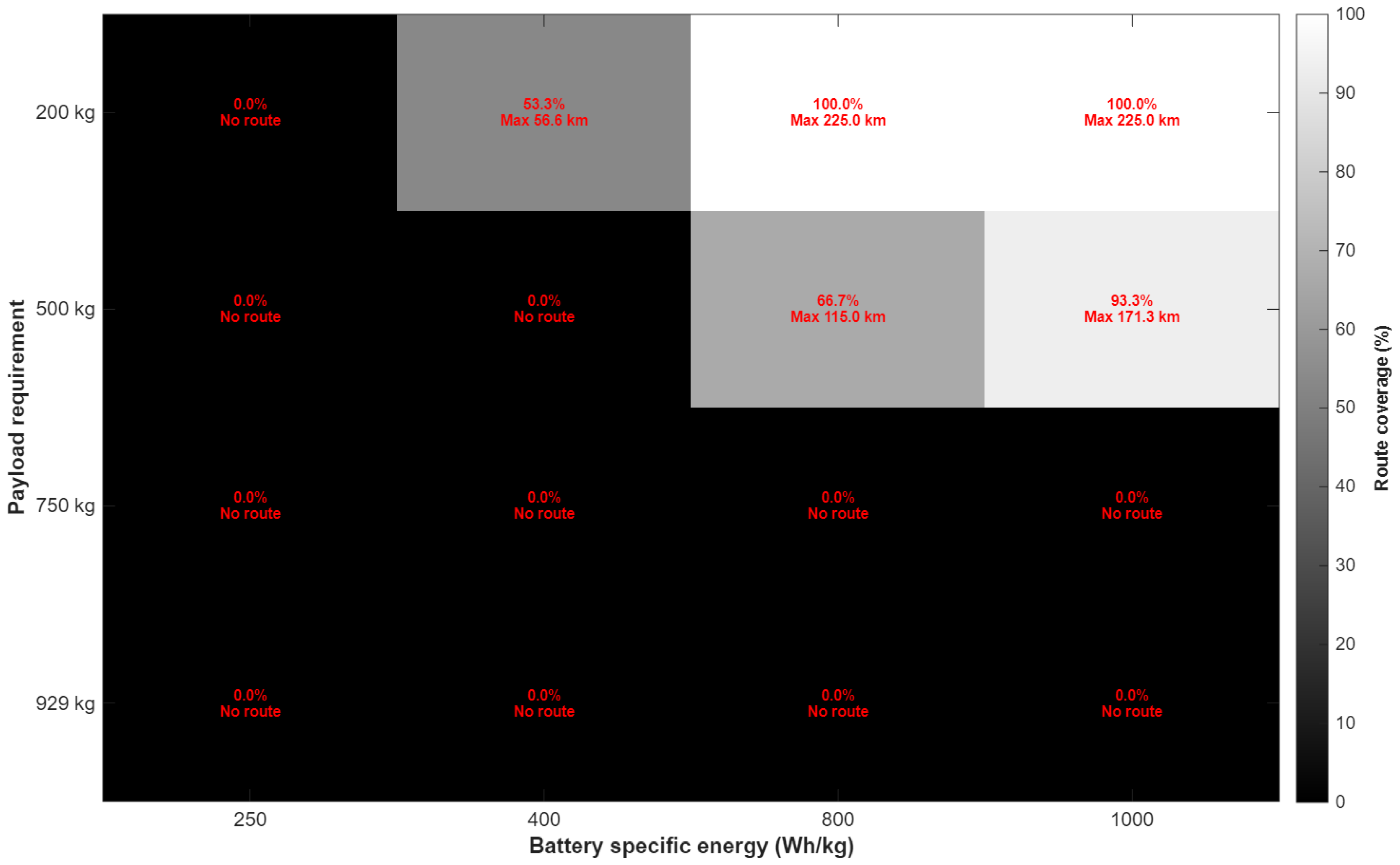
The route feasibility assessment shows that route coverage depends strongly on both retained payload and battery specific energy. The 929 kg retained payload case, corresponding to nine passengers plus luggage, is not feasible for any of the selected routes across the battery specific energy range considered. The 750 kg retained payload case is also infeasible under all evaluated battery specific energy assumptions because only 378 kg is available for the battery, which is below the 388 kg minimum battery mass required to satisfy the 388 kW peak power requirement at the assumed battery specific power of 1.0 kW/kg.
Retained payload was translated into passenger capability using an assumed allowance of 85 kg per passenger and 15 kg of luggage per passenger. Under this assumption, the 929 kg, 750 kg, 500 kg and 200 kg payloads correspond approximately to nine, seven, five and two passengers with luggage, respectively. The results show that high passenger loading sharply reduces feasible route coverage, while lower retained payload cases allow wider route coverage under future battery specific energy assumptions.
Table 8 summarizes the route level feasibility of the battery-electric BN-2B-26 retrofit for selected domestic routes based on retained payload and battery specific energy assumptions. A route was considered feasible only when the calculated cruise range satisfied the route distance while also meeting the retained payload, battery mass, battery volume, reserve energy and operational constraints.
Table 8.
Selected domestic routes in Scotland served by retrofitted aircraft under current, near-term and future battery technology.
The 500 kg retained payload case becomes feasible as battery specific energy increases. At 800 Wh/kg, approximately 66.7% of the selected routes are feasible, with a maximum covered route distance of approximately 115 km. At 1000 Wh/kg, route coverage increases to approximately 93.3%, with routes up to approximately 171.3 km becoming technically feasible (Figure 9). The 200 kg retained payload case provides the widest route coverage. At 400 Wh/kg, approximately 53.3% of the selected routes are feasible, with a maximum covered distance of approximately 56.6 km. These route coverage outcomes are reported in Table 8.
Figure 9.
Selected route coverage and maximum covered distance.
Overall, the battery-electric retrofit of the BN-2B-26 is not suitable for full payload replacement of the conventional aircraft. Instead, feasibility improves mainly through payload reduction and higher battery specific energy. The most operationally meaningful compromise is the 500 kg payload case under high specific energy battery assumptions, while the 200 kg case demonstrates maximum route coverage but with limited passenger number.
4. Discussion
The results show that the feasibility of a battery-electric BN-2B-26 Islander retrofit is controlled by the combined effect of battery specific energy, MTOW, retained payload, reserve energy requirement and available installation volume. Although increasing battery specific energy improves the calculated cruise range, the retrofit remains constrained by the fixed MTOW. Therefore, the battery-electric conversion cannot be interpreted simply as replacing fuel mass with battery mass; instead, the retrofit creates a direct competition between battery mass and useful payload.
A significant fraction of the usable battery energy is consumed by a 30 min reserve requirement before any useful cruise range is produced. As a result, nominal battery capacity cannot be converted directly into range. And for short-range missions, reserve energy is a constraint for limiting the passenger.
The design space analysis shows that a technically possible design is not always useful in operation. At 1000 Wh/kg, the theoretical maximum range is about 460 km, but this occurs at the zero-payload limit, so it is not suitable for route operation. The conventional aircraft can retain approximately 774 kg of payload over about 998 km under the selected IFR range condition, whereas the most optimistic battery case considered in this study remains substantially below this envelope. The range increases further as electric powertrain weight reduces.
The route feasibility results show that the retrofit is strongly payload-dependent. The 500 kg payload provides the most practical balance between passenger capacity and route coverage, while the 200 kg case maximizes route coverage but offers limited passenger number. This supports the conclusion that battery-electric retrofits are more suitable for short, reduced payload route applications than for full payload replacement of the conventional aircraft. The main findings can be summarized in the following points.
- After SOC margin and end-of-life allowance are applied, only 57.6% of battery energy remains before fixed mission and reserve energy are subtracted.
- Matching baseline aircraft performance would require approximately 6050 Wh/kg and 2840 Wh/L, which is beyond current and near-term battery technology.
- Key technology parameters such as battery pack volumetric density, battery specific energy, battery specific power and battery mass ratio are contributing to deciding the feasibility of retrofitting an aircraft into battery-electric.
- Short routes are power limited and longer routes are energy limited (energy is limited by MTOW, payload and volume of the baseline aircraft).
- The results show that 3 to 60 km is the near-term, 60 to 150 km is a technology sensitive region and finally 150 to 225 km is a higher-energy and payload-constrained region.
Future work will focus on the model to include detailed battery pack architecture, thermal management design, CG analysis, structural integration, lifecycle emissions and operating cost. A comparative assessment of battery-electric, hydrogen-electric, hybrid-electric and conventional propulsion for the same route set would also be valuable. Such work would help identify whether battery-electric retrofit is a suitable solution for the short routes, while alternative zero emission propulsion systems may appear more suitable for longer routes.
Author Contributions
Conceptualisation, D.G. and B.R.; methodology, D.G. and B.R.; software, D.G. and B.R.; formal analysis, D.G. and B.R.; investigation, D.G., C.R. and B.R.; resources, D.G., B.R., C.R., W.Z. and T.M.; data curation, D.G., W.Z. and B.R.; writing—original draft preparation, D.G. and B.R.; writing—review and editing, D.G., B.R., C.R., W.Z. and T.M.; visualisation, D.G. and B.R.; supervision, D.G., B.R., C.R. and T.M. All authors have read and agreed to the published version of the manuscript.
Funding
This research received no external funding.
Data Availability Statement
The original contributions presented in this study are included in the article. Further inquiries can be directed to the corresponding author.
Acknowledgments
During the preparation of this manuscript, the author used ChatGPT-5.6 Sol, an OpenAI language model, for language editing, image generation and assistance with MATLAB code formatting. The author reviewed and edited the output and takes full responsibility for the content of this publication.
Conflicts of Interest
The authors declare no conflicts of interest.
Abbreviations
The following abbreviations are used in this manuscript:
| BMS | Battery Management System |
| BN-2B-26 | Britten-Norman Islander BN-2B-26 Aircraft Variant |
| C-rate | Battery Charge/Discharge Rate Relative to Nominal Capacity |
| CG | Centre of Gravity |
| CTOL | Conventional Take-Off and Landing |
| DHC | De Havilland Canada |
| EASA | European Union Aviation Safety Agency |
| EOL | End of Life |
| ICCT | International Council on Clean Transportation |
| IFR | Instrument Flight Rules |
| IPCC | Intergovernmental Panel on Climate Change |
| Li-ion | Lithium-Ion |
| Li-S | Lithium–Sulphur |
| MTOW | Maximum Take-Off Weight |
| NASA | National Aeronautics and Space Administration |
| NOx | Nitrogen Oxides |
| OEW | Operating Empty Weight |
| PAX | Passengers |
| SE | Battery Specific Energy |
| SOC | State of Charge |
| TAS | True Airspeed |
| VFR | Visual Flight Rules |
Nomenclature
| Notation | Definition | Unit |
| mMTOW,b | Baseline aircraft maximum take-off mass | kg |
| mOEW,b | Baseline aircraft operating empty weight | kg |
| MPL | Retained payload mass | kg |
| mfuel | Fuel mass | kg |
| mMTOW,BE | Battery electric aircraft take-off mass | kg |
| mMTOW | Maximum take-off mass | kg |
| Δh | Height change during climb | m |
| ROC | Rate of climb | m/s |
| P_TO | Take-off power | kW |
| Pcruise | Cruise power | kW |
| treserve | Reserve time | h or min |
| Vcruise | Cruise speed | km/h |
| R | Achievable cruise range | km |
| Rreq | Required range | km |
| fcool | Cooling system volume factor | - |
| fBMS/HV | Battery management system and high voltage volume factor | - |
| fcontain | Battery containment volume factor | - |
| Lcrew zone | Crew zone length | m |
| NPAX | Number of passengers | - |
| Vbaseline fuel | Baseline fuel storage volume | m3 |
| Ravailable | Available cruise range | km |
| mpayload retained | Retained payload mass | kg |
| mpayload required | Required payload mass | kg |
References
- Graver, B.; Rutherford, D.; Zheng, S. CO2 Emissions from Commercial Aviation—ICCT; International Council on Clean Transportation: Washington, DC, USA, 2020. [Google Scholar]
- Graver, B.; Zheng, S.; Rutherford, D.; Mukhopadhaya, J.; Pronk, E. Vision 2050: Aligning Aviation with the Paris Agreement; International Council on Clean Transportation: Washington, DC, USA, 2022. [Google Scholar]
- Mohan, V.; Jeyaraj, A.K.; Liscouët-Hanke, S. Systems Integration Framework for Hybrid-Electric Commuter and Regional Aircraft. Aerospace 2023, 10, 533. [Google Scholar] [CrossRef] [Scilit]
- Zhang, J.; Roumeliotis, I.; Zolotas, A. Sustainable Aviation Electrification: A Comprehensive Review of Electric Propulsion System Architectures, Energy Management, and Control. Sustainability 2022, 14, 5880. [Google Scholar] [CrossRef] [Scilit]
- Schäfer, A.W.; Barrett, S.R.H.; Doyme, K.; Dray, L.M.; Gnadt, A.R.; Self, R.; O’Sullivan, A.; Synodinos, A.P.; Torija, A.J. Technological, Economic and Environmental Prospects of All-Electric Aircraft. Nat. Energy 2019, 4, 160–166. [Google Scholar] [CrossRef] [Scilit]
- Brelje, B.J.; Martins, J.R.R.A. Electric, Hybrid, and Turboelectric Fixed-Wing Aircraft: A Review of Concepts, Models, and Design Approaches. Prog. Aerosp. Sci. 2019, 104, 1–19. [Google Scholar] [CrossRef] [Scilit]
- EASA. European Aviation Environmental Report 2022; Publications Office of the European Union: Luxembourg, 2022.
- Sahoo, S.; Zhao, X.; Kyprianidis, K. A Review of Concepts, Benefits, and Challenges for Future Electrical Propulsion-Based Aircraft. Aerospace 2020, 7, 44. [Google Scholar] [CrossRef] [Scilit]
- Li, Q.; Yang, Y.; Yu, X.; Li, H. A 700 W⋅h⋅kg−1 Rechargeable Pouch Type Lithium Battery. Chin. Phys. Lett. 2023, 40, 048201. [Google Scholar] [CrossRef] [Scilit]
- Amprius. CES Recognizes Amprius with an Innovation Award. Available online: https://ir.amprius.com/news-events/press-releases/detail/154/ces-recognizes-amprius-with-an-innovation-award (accessed on 15 June 2026).
- Yang, C.; Li, P.; Yu, J.; Da Zhao, L.; Kong, L. Approaching Energy-Dense and Cost-Effective Lithium–Sulfur Batteries: From Materials Chemistry and Price Considerations. Energy 2020, 201, 117718. [Google Scholar] [CrossRef] [Scilit]
- Tiede, B.; O’Meara, C.; Jansen, R. Battery Key Performance Projections Based on Historical Trends and Chemistries. In Proceedings of the 2022 IEEE Transportation Electrification Conference and Expo, ITEC, Anaheim, CA, USA, 15–17 June 2022. [Google Scholar]
- Ludowicy, J. Feasibility Study for a Medium-Range Regional Aircraft Designed for Conventional, Battery-Electric, and Hydrogen Propulsion. In Proceedings of the Joint 10th EUCASS—9th CEAS Aerospace Europe, Lausanne, Switzerland, 9–13 July 2023. [Google Scholar]
- Hepperle, M. Electric Flight—Potential and Limitations. Available online: https://www.sto.nato.int/document/electric-flight-potential-and-limitations/ (accessed on 16 August 2026).
- Anker, M.A.; Hartmann, C.; Nøland, J.K. Feasibility of Battery-Powered All-Electric Propulsion for Short-Haul Commuter Aircraft. IEEE Access 2025, 13, 32260–32275. [Google Scholar] [CrossRef] [Scilit]
- Mukhopadhaya, J.; Graver, B. Performance Analysis of Regional Electric Aircraft; International Council on Clean Transportation: Washington, DC, USA, 2022. [Google Scholar]
- Avanzini, G.; Giulietti, F. Maximum Range for Battery-Powered Aircraft. J. Aircr. 2013, 50, 304–307. [Google Scholar] [CrossRef] [Scilit]
- Traub, L.W. Optimal Battery Weight Fraction for Maximum Aircraft Range and Endurance. J. Aircr. 2016, 53, 1176–1178. [Google Scholar] [CrossRef] [Scilit]
- Palaia, G.; Abu Salem, K. Mission Performance Analysis of Hybrid-Electric Regional Aircraft. Aerospace 2023, 10, 246. [Google Scholar] [CrossRef] [Scilit]
- Karpuk, S.; Elham, A. Influence of Novel Airframe Technologies on the Feasibility of Fully-Electric Regional Aviation. Aerospace 2021, 8, 163. [Google Scholar] [CrossRef] [Scilit]
- Palaia, G.; Abu Salem, K.; Quarta, A.A. Parametric Analysis for Hybrid–Electric Regional Aircraft Conceptual Design and Development. Appl. Sci. 2023, 13, 11113. [Google Scholar] [CrossRef] [Scilit]
- Britten-Norman. Britten-Norman 2B 26 Islander. Available online: https://britten-norman.com/britten-norman-products/islander/ (accessed on 10 May 2026).
- Code of Federal Regulations: 14 CFR 135.209. Available online: https://www.ecfr.gov/current/title-14/chapter-I/subchapter-G/part-135/subpart-D/section-135.209 (accessed on 3 July 2026).
- Staack, I.; Sobron, A.; Krus, P. The Potential of Full-Electric Aircraft for Civil Transportation: From the Breguet Range Equation to Operational Aspects. CEAS Aeronaut. J. 2021, 12, 803–819. [Google Scholar] [CrossRef] [Scilit]
- Mcdonald, R. Batteries Are Not Fuel. Available online: https://www.linkedin.com/pulse/batteries-fuel-rob-mcdonald (accessed on 6 August 2026).
- Barheim, T.; Lamb, J.J.; Noland, J.K.; Burheim, O.S. Potential and Limitations of Battery-Powered All-Electric Regional Flights—A Norwegian Case Study. IEEE Trans. Transp. Electrif. 2023, 9, 1809–1825. [Google Scholar] [CrossRef] [Scilit]
- Horne, W.B.; Leland, T.J.W. Influence of Tire Tread Pattern and Runway Surface Condition on Braking Friction and Rolling Resistance of a Modern Aircraft Tire; Langley Research Center: Hampton, VA, USA, 1962. [Google Scholar]
- Flightradar Playback of Flight. Available online: https://www.flightradar24.com/data/aircraft/g-bpca#412a8023 (accessed on 14 August 2026).
- EASA. Type Issue: 4 BN2 Islander Series Aircraft; European Union Aviation Safety Agency: Cologne, Germany, 2025.
- FAA. AC 23-15A—Small Airplane Certification Compliance Program; Federal Aviation Administration: Washington, DC, USA, 2003. [Google Scholar]
- FAA. Airplane Flying Handbook (FAA-H-8083-3C) Chapter 13: Transition to Multiengine Airplanes; Federal Aviation Administration: Washington, DC, USA, 2026. [Google Scholar]
- Chin, J.; Look, K.; McNichols, E.O.; Hall, D.; Gray, J.; Schnulo, S.L. Battery Cell-to-Pack Scaling Trends for Electric Aircraft. In Proceedings of the AIAA Propulsion and Energy 2021 Forum; American Institute of Aeronautics and Astronautics: Reston, VA, USA, 2021. [Google Scholar]
- FREMONT. Amprius Launches SiCore 450 Wh/kg High-Energy Cell, with Near-Term Mass Production Capability to Scale. Available online: https://amprius.com/amprius-launches-sicore-450-wh-kg-high-energy-cell-with-near-term-mass-production-capability-to-scale/?utm_source (accessed on 3 July 2026).
- Feinauer, M.; Uhlmann, N.; Ziebert, C.; Blank, T. Simulation, Set-Up, and Thermal Characterization of a Water-Cooled Li-Ion Battery System. Batteries 2022, 8, 177. [Google Scholar] [CrossRef] [Scilit]
- Schöberl, J.; Ank, M.; Schreiber, M.; Wassiliadis, N.; Lienkamp, M. Thermal Runaway Propagation in Automotive Lithium-Ion Batteries with NMC-811 and LFP Cathodes: Safety Requirements and Impact on System Integration. eTransportation 2024, 19, 100305. [Google Scholar] [CrossRef] [Scilit]
- Shen, K.; Yang, L.; Sun, J.; Xu, C.; Wang, H.; Zheng, Y.; Feng, X. Experimental and Simulations Study of Thermal Performance of Cell-to-Pack Structure for a Lithium-Ion Battery Pack. J. Electrochem. Energy Convers. Storage 2023, 20, 041003. [Google Scholar] [CrossRef] [Scilit]
- Orkney Islands Council. Inter-Island Air Guide; Orkney Islands Council: Kirkwall, UK, 2026. [Google Scholar]
- Loganair Our Fleet. Available online: https://www.loganair.co.uk/flying-with-us/our-fleet/ (accessed on 7 June 2026).
- Hebridean Air Services. Where We Fly. Available online: https://www.hebrideanair.co.uk/where-we-fly (accessed on 15 July 2026).

Disclaimer/Publisher’s Note: The statements, opinions and data contained in all publications are solely those of the individual author(s) and contributor(s) and not of MDPI and/or the editor(s). MDPI and/or the editor(s) disclaim responsibility for any injury to people or property resulting from any ideas, methods, instructions or products referred to in the content. |
© 2026 by the authors. Licensee MDPI, Basel, Switzerland. This article is an open access article distributed under the terms and conditions of the Creative Commons Attribution (CC BY) license.