Article

Beyond GDP: COVID-19’s Effects on Macroeconomic Efficiency and Productivity Dynamics in OECD Countries


Department of Management and Supply Chain, College of Business and Technology, East Tennessee State University, Johnson City, TN 37614, USA
Econometrics 2025, 13(3), 29; https://doi.org/10.3390/econometrics13030029

Submission received: 30 June 2025 / Revised: 22 July 2025 / Accepted: 28 July 2025 / Published: 4 August 2025
(This article belongs to the Special Issue Advancements in Macroeconometric Modeling and Time Series Analysis)

Abstract

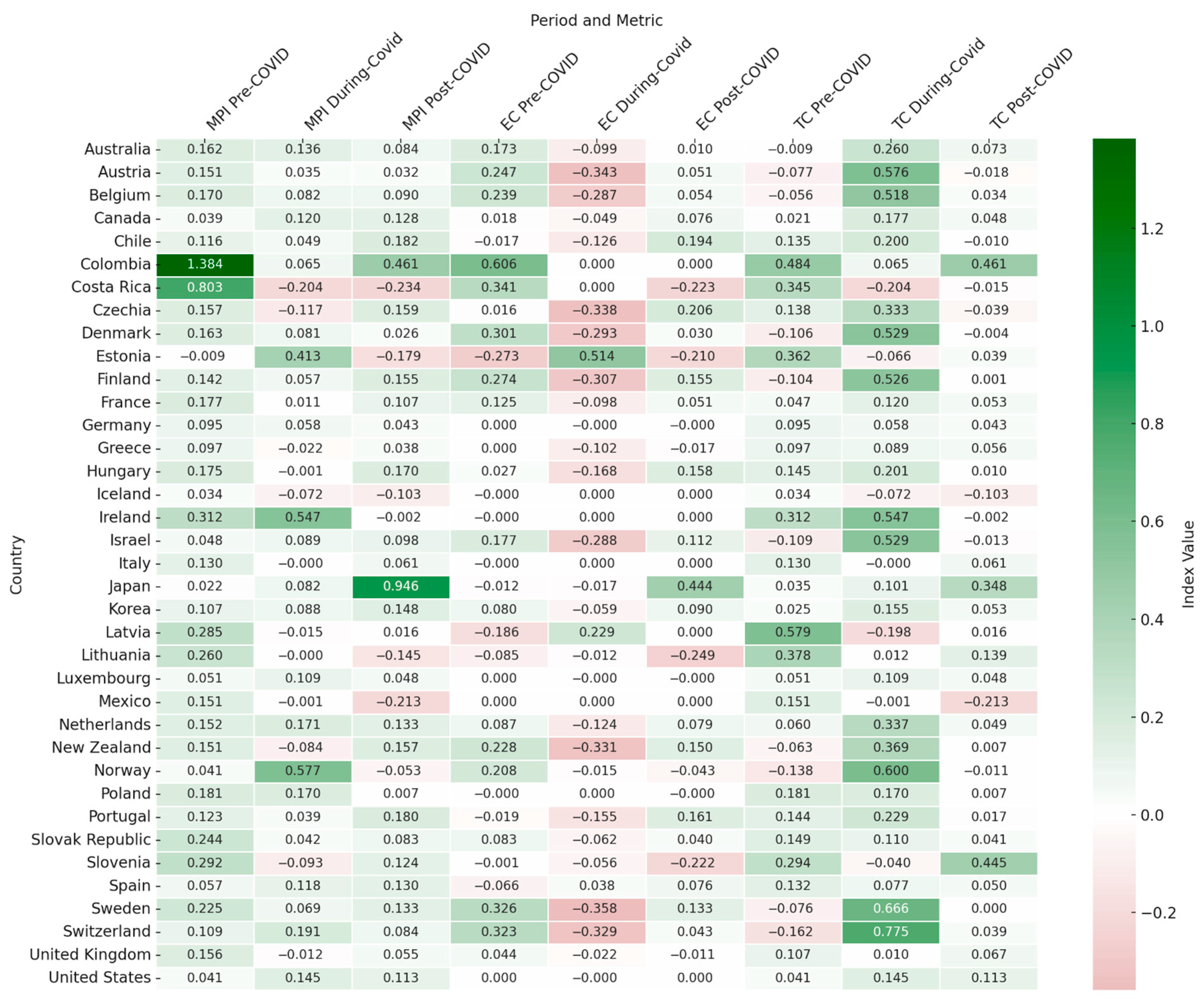
The COVID-19 pandemic triggered unprecedented economic disruptions, raising critical questions about the resilience and adaptability of macroeconomic productivity across countries. This study examines the impact of COVID-19 on macroeconomic efficiency and productivity dynamics in 37 OECD countries using quarterly data from 2018Q1 to 2024Q4. By employing a Slack-Based Measure Data Envelopment Analysis (SBM-DEA) and the Malmquist Productivity Index (MPI), we decompose total factor productivity (TFP) into efficiency change (EC) and technological change (TC) across three periods: pre-pandemic, during-pandemic, and post-pandemic. Our framework incorporates both desirable (GDP) and undesirable outputs (inflation, unemployment, housing price inflation, and interest rate distortions), offering a multidimensional view of macroeconomic efficiency. Results show broad but uneven productivity gains, with technological progress proving more resilient than efficiency during the pandemic. Post-COVID recovery trajectories diverged, reflecting differences in structural adaptability and innovation capacity. Regression analysis reveals that stringent lockdowns in 2020 were associated with lower productivity in 2023–2024, while more adaptive policies in 2021 supported long-term technological gains. These findings highlight the importance of aligning crisis response with forward-looking economic strategies and demonstrate the value of DEA-based methods for evaluating macroeconomic performance beyond GDP.
Keywords: COVID-19 pandemic; Malmquist-Productivity Index (MPI); macroeconomic efficiency; non-oriented-slack-based measure-data envelopment analysis (NO-SBM-DEA) COVID-19 pandemic; Malmquist-Productivity Index (MPI); macroeconomic efficiency; non-oriented-slack-based measure-data envelopment analysis (NO-SBM-DEA)