


Abstract
Smart irrigation across spatially variable agricultural environments requires local decisions and coordination without exclusive dependence on a central controller. This study presents and evaluates a distributed irrigation architecture based on Multi-Agent Systems (MAS) and ESP32 edge controllers. Each irrigation agent normalizes soil-moisture readings, calculates fuzzy urgency, exchanges information for cooperative moisture estimation, and participates in distributed valve negotiation. Twelve original field campaigns—six MAS and six centralized reference campaigns—produced 1,010,151 telemetry records. Across four main MAS operation campaigns, consensus RMSE ranged from 3.51% to 41.85%, and mean neighbor availability was close to two per agent. Mean packet loss reached 52.88% during a dedicated node-disconnection test. The initial sensing-fault campaign contained 203 sensor-alert records, 192 invalid local-moisture readings, and four degradation episodes; telemetry-recovery intervals ranged from 18.02 to 193.98 s. A mutual-exclusion flag in the four-agent campaign was not corroborated by its valve-state records. A separate concurrent comparison (19–23 October 2026) produced 1,008,768 additional records across centralized, local-independent, and MAS configurations. Unequal zone allocation and unmeasured zone-level irrigation demand limit this comparison to descriptive results; the available data do not establish architectural superiority in water or energy efficiency.
1. Introduction
The digital transformation of agriculture has led to the incorporation of sensors, communication networks, and automation into tasks that previously depended to a greater extent on manual actions or fixed rules. In smart irrigation, this evolution is particularly relevant because soil moisture and environmental conditions do not behave in the same way across all zones or remain constant throughout a day. IoT solutions and edge processing make it possible to bring data acquisition and processing closer to where the phenomenon occurs, enabling timely decisions and reducing dependence on remote infrastructure [1,2,3].
A centralized architecture brings data acquisition, processing, and actuation together in a main controller. This organization can facilitate system integration, but it concentrates in a single point functions that are necessary for operation. When differences exist between crop zones or sensing and communication problems arise, this dependence may hinder the continuation of certain functions locally. Distributed and Edge-IoT architectures provide an alternative by moving part of the processing and decision-making toward nodes close to the information source [2,4].
Multi-Agent Systems provide a different way of organizing control: each entity has a degree of autonomy to perceive its environment, process information, and exchange states with other entities. In a zoned irrigation installation, this characteristic allows information from each area to contribute to a collective decision, even when network conditions are not constant [5,6].
Smart agriculture studies have addressed sensing, monitoring, connectivity, and irrigation automation separately or in combination, including IoT-based smart-irrigation systems [7,8,9,10]. Sensor networks and Edge-IoT architectures have also been proposed to move part of the processing toward the field [3,4,9]. However, it remains relevant to determine what occurs when agent coordination, shared estimation of water status, actuation negotiation, and fault response are jointly implemented on embedded hardware and subjected to field conditions.
Existing studies have examined intelligent IoT-multiagent precision irrigation at farm and district scales [11], water distribution for community irrigation [12], and semi-centralized multi-agent reinforcement learning for irrigation scheduling [13]. Other reviews cover intelligent irrigation systems, Edge-IoT, and smart drip/IoT architectures [14,15,16]. The Contract Net Protocol (CNP) provides a negotiation framework for distributing tasks among distributed nodes [17], while consensus theory analyzes information exchange among networked agents under assumptions about graph topology, delays, and failures [18]. Fuzzy inference controllers have combined soil and environmental measurements to determine irrigation actuation [19]. Agent-based systems have also been studied for collective irrigation [20], and learning-based multi-agent model-predictive control has been explored for irrigation scheduling [21]. Broader reviews address data-driven estimation of water needs [22] and IoT-/machine-learning-based real-time irrigation automation [23]. These studies establish that the use of multi-agent systems in irrigation is not itself the novelty of the present work.
The contribution of this study is an implementation-level integration on low-cost ESP32 controllers: local fuzzy irrigation urgency, neighbor-based cooperative moisture estimation, CNP-inspired distributed valve negotiation, and fallback decision logic during sensing degradation. Unlike optimization-oriented irrigation schedulers [13,21], this work does not estimate crop water demand or claim measured improvements in water-use efficiency. It characterizes the operation and limitations of the implemented embedded coordination architecture under the evaluated field conditions [11,12,13,14,15,16,19,20,21].
Based on this need, the present study develops a MAS architecture using ESP32 controllers. The agents perform local acquisition, calculate irrigation urgency through fuzzy inference, exchange information to construct a cooperative moisture estimate, and participate in a distributed mechanism to establish actuation priority. The implementation also incorporates a fallback response for invalid local readings and adapts the set of nodes considered available when connectivity changes.
The study seeks to characterize the technical and operational behavior of the proposed system across five aspects: irrigation response, multi-agent coordination, communication, fault tolerance, and estimated electrical charge consumption. A centralized architecture was used as a reference to contextualize the results. Because the campaigns for both configurations were conducted on different dates and under different conditions, this comparison is not presented as a causal experiment.
The contributions of this work are concentrated in four elements: (i) an implementation of distributed irrigation control on ESP32 nodes; (ii) the integration of local decision-making, cooperative estimation, and negotiation among agents; (iii) an embedded fallback mechanism for selected sensing-degraded conditions; and (iv) an empirical characterization of communication, coordination, and telemetry limitations. The novelty is therefore the combined embedded implementation and its field evaluation, not a claim to introduce a new general consensus algorithm or to guarantee formal mutual exclusion.
2. Materials and Methods
2.1. Experimental System Architecture
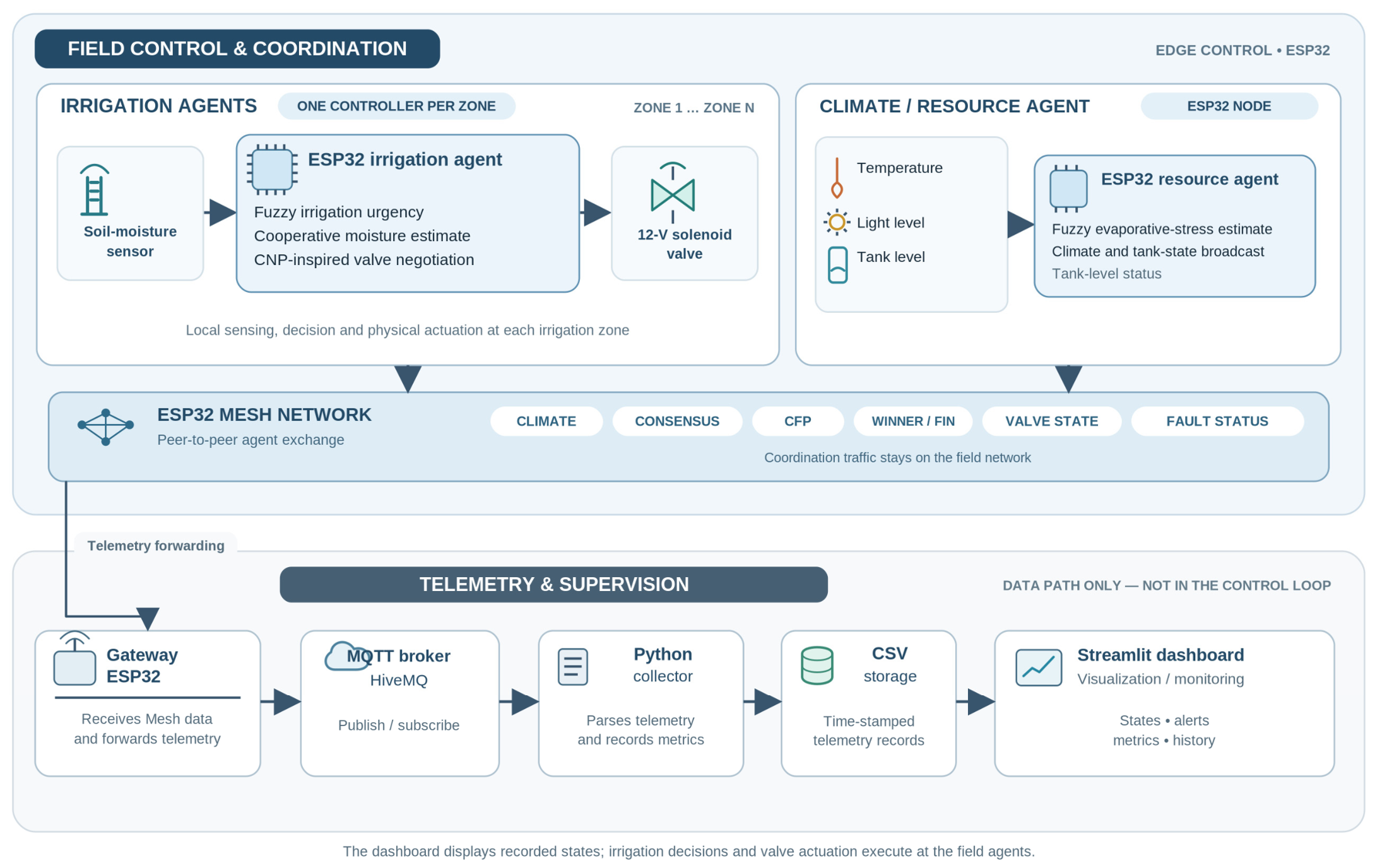
The prototype was evaluated in a field agricultural environment located in Amaguaña, Quito, Ecuador. Natural site conditions were maintained during the campaigns; therefore, soil moisture, ambient temperature, and other environmental variables were not artificially adjusted to make the different test dates equivalent. The proposed multi-agent system (MAS) used ESP32-WROOM-32 modules manufactured by Espressif Systems (Shanghai, China), mounted on development boards supplied by MEGATRONICA (Quito, Ecuador), as embedded processing units. Each irrigation agent combined a capacitive HW-390 V2.0 soil-moisture sensor supplied by MEGATRONICA (Quito, Ecuador), local processing, a single-channel high-level-trigger relay module, and a 12 V DC normally closed (NC) solenoid valve with a 1/2-in connection assigned to a crop zone. The relay module and solenoid valve were supplied by MEGATRONICA (Quito, Ecuador); the supplier’s product listings do not disclose the OEM manufacturers of these generic modules. A separate environmental/resource agent used a DHT22/AM2302 sensor manufactured by Aosong (Guangzhou) Electronics Co., Ltd. (Guangzhou, China) for ambient-temperature acquisition [24], an analog light-dependent resistor (LDR) supplied by MEGATRONICA (Quito, Ecuador) for relative light intensity, and an HC-SR04 ultrasonic sensor supplied by MEGATRONICA (Quito, Ecuador) for tank-level monitoring. The ESP32 platform provided the embedded processing and 12-bit ADC resources used by the irrigation agents [25]. The overall architecture and separation between field control and telemetry are illustrated in Figure 1. The firmware used in the experimental campaigns was version v2.0_Blindado and was developed and compiled using Arduino IDE version 2.3.8.
Figure 1.
Architecture of the ESP32-based multi-agent irrigation system, showing decentralized field control and separate telemetry and supervision paths.
Agents exchanged mesh messages containing cooperative moisture estimates, environmental context, irrigation urgency, negotiation state, valve state, and fault information. A gateway bridged the mesh network to an MQTT broker for data collection. The external Python 3.13 software was used for telemetry acquisition, storage, and visualization; irrigation decisions, fuzzy inference, coordination, and valve actuation were executed locally on the embedded agents. This separation between embedded control and remote monitoring is consistent with layered designs used in smart agriculture and IoT-based sensing systems [3,4,7,8].
2.2. Embedded Sensing and Fuzzy Irrigation Control
The irrigation agents sampled the capacitive soil-moisture sensor through the 12-bit ESP32 ADC. The firmware used two operational reference values, 2850 ADC counts for the dry reference and 1080 ADC counts for the wet reference, and mapped the raw measurement to a normalized 0–100% soil-moisture scale. The conversion implemented in the embedded software can be expressed as:
The result was constrained to the 0–100% interval. ADC readings at or below 10 counts or at or above 4090 counts were classified as invalid and represented internally by the sentinel value −1. The irrigation-agent sensing and control cycle was executed at approximately 2 s intervals. For consecutive valid readings, the change applied to the internal local-moisture state was limited to ±8 percentage points per cycle to reduce the influence of abrupt single-sample variations.
The environmental/resource agent updated ambient temperature, relative light intensity, and tank level every 5 s. The LDR measurement was mapped from the 12-bit ADC range to a 0–100% relative-light scale with inverted polarity. Temperature and relative light intensity were used by a fuzzy inference system to obtain an evaporative-stress indicator. This indicator was a control variable generated by the embedded agent rather than a direct measurement of evapotranspiration. The configured fuzzy variables and membership breakpoints are summarized in Table 1.
Table 1.
Fuzzy variables and trapezoidal membership functions implemented in the embedded controllers.
The environmental fuzzy rule base covered the nine combinations of three temperature states and three light states. For cold conditions, low and medium light produced null stress, and high light produced moderate stress. At optimal temperature, low, medium, and high light produced null, moderate, and high stress, respectively. Under hot conditions, the corresponding outputs were moderate, high, and critical. Table 1 reports the four FuzzySet parameters (a, b, c, d) configured in the supplied firmware; repeated endpoint values are retained because they define the implemented shoulder-shaped sets.
The irrigation controller used local moisture, the cooperative moisture estimate, and the evaporative-stress indicator as inputs. Five rules were implemented: (1) dry local soil with normal cooperative moisture and low stress produced critical urgency; (2) dry local soil combined with either a cooperative deficit or high stress produced maximum urgency; (3) optimal local moisture with low stress produced low urgency; (4) optimal local moisture with high stress produced medium urgency; and (5) a wet local sensor state produced low urgency. The use of fuzzy inference to combine soil and environmental inputs has precedent in automated irrigation, but the membership breakpoints and rules remain specific to each controller and its intended operating context [19,23]. The irrigation-control logic was developed and programmed by the authors and deployed on the ESP32-WROOM-32 embedded modules; it was not a separately purchased commercial irrigation controller.
The ADC anchors (2850 counts for the dry reference and 1080 counts for the wet reference) are operational reference readings for the installed HW-390/ESP32 sensor assembly. They define a normalized relative-moisture index and are not a gravimetrically validated volumetric-water-content calibration. Published calibration studies show that low-cost capacitive probes can exhibit soil-dependent errors and that field validation, soil-specific calibration, and potential effects of temperature and electrical conductivity matter when interpreting moisture measurements [26,27,28,29]. Likewise, the membership breakpoints in Table 1 and the urgency/stress/tank thresholds are prototype settings, not universal agronomic limits; no crop-specific soil-water retention characterization was available for this study.
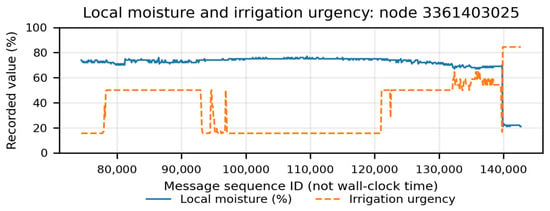
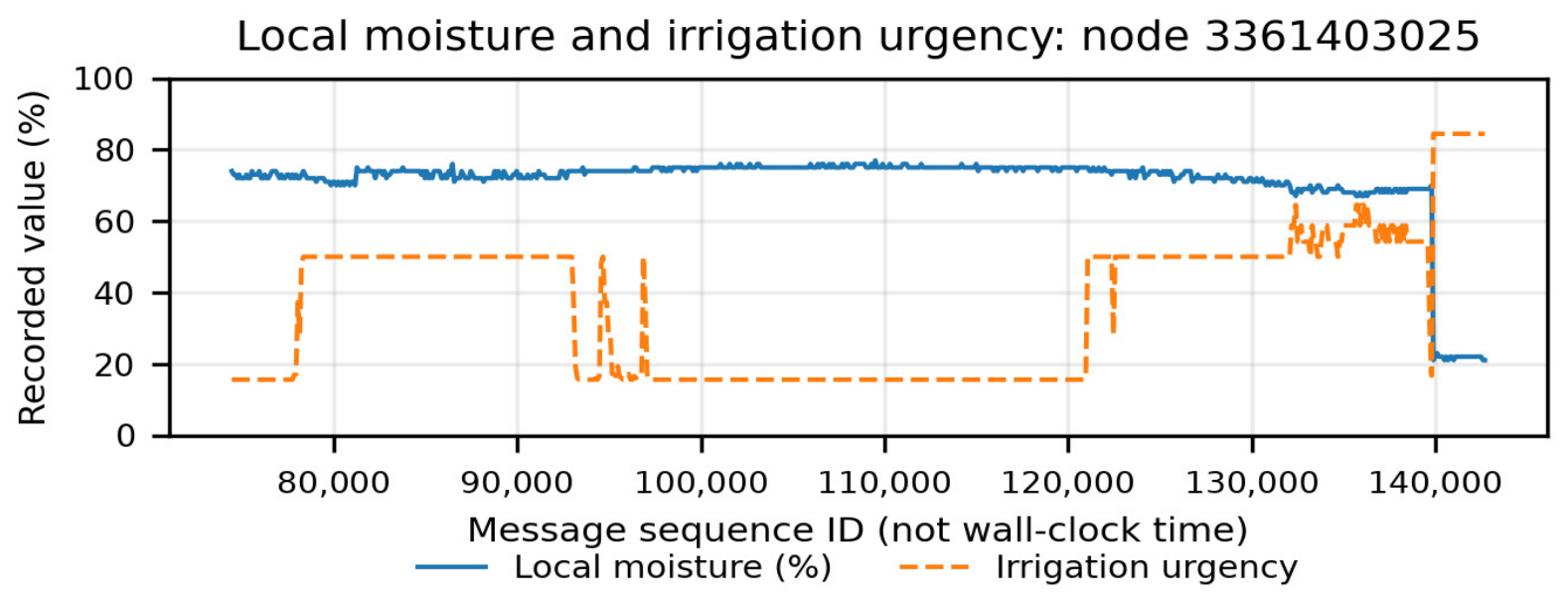
A separate code-level sensitivity test examined the supplied irrigation fuzzy-rule system without treating the stored field records as a synchronized replay. The three normalized inputs (local moisture, cooperative moisture, and evaporative-stress indicator) were evaluated on a uniform grid from 0 to 100 in 5-percentage-point increments (213 = 9261 input combinations). For each run, internal trapezoidal breakpoints in one membership family were shifted by −5 or +5 percentage points, with the outer domain anchors fixed at 0 and 100; two additional runs shifted all membership families together. The supplied rule structure and the Mamdani min–max/center-of-area inference semantics documented for eFLL [30] were reconstructed offline, with the output centroid approximated on a 0.25-point grid. Changes were compared with the baseline output at identical input combinations. This uniform-grid simulation is a deterministic software sensitivity test, not a crop-weighted analysis or a replay of observed irrigation events. Because the logs do not preserve raw ADC counts or an exact synchronized snapshot of the inputs consumed by each inference cycle, ADC-anchor sensitivity and crop-specific calibration cannot be established from the archived records. A representative recorded local-moisture and urgency trace is shown in Figure 2; its horizontal axis is message sequence ID, not wall-clock time.
Figure 2.
Local moisture and irrigation urgency recorded for node 3361403025 during the 22–23 August 2026 MAS campaign. The horizontal axis is message sequence ID, not wall-clock time.
2.3. Cooperative Moisture Estimation and Multi-Agent Coordination
Each irrigation agent maintained a cooperative soil-moisture estimate. At startup, the estimate was initialized with the first valid local measurement; when no valid local measurement was available, it was initialized to 50%. For each received consensus message, the agent stored the neighbor’s cooperative estimate, the reception time, and the neighbor sensor-fault state. A neighbor was removed from the active set if no updated message was received for 10 s, and estimates from neighbors reporting a sensing fault were excluded from the consensus contribution.
When at least one healthy neighbor was available, the implemented update was:
where Ĥi is the cooperative estimate of agent i, Niʰ(k) denotes the set of active neighbors without a reported sensing fault, Ni(k) is the number of active neighbors retained by the agent, and ΔHi(k) is the change between consecutive valid local-moisture measurements. The local innovation was limited to ±8 percentage points. If no healthy neighbor was available while the local sensor remained valid, the estimate was moved toward the local measurement using a convergence factor of 0.2. The estimator operated continuously and did not use a separate numerical stopping criterion. It is treated as the implementation-specific cooperative estimator reconstructed from the firmware, not as a formal consensus algorithm with a proven convergence guarantee under general network conditions [18].
Ĥi(k + 1) = Ĥi(k) + εi(k) Σ(j ∈ Nih(k)) [Ĥj(k) − Ĥi(k)] + KΔ ΔHi(k)
εi(k) = 1/[Ni(k) + 2], KΔ = 0.5
Valve access was coordinated using a distributed auction inspired by the Contract Net Protocol (CNP), a negotiation-based approach to task distribution among distributed problem-solving nodes [17]. Each agent operated in three states: IDLE, AUCTIONING, and IRRIGATING. A candidate could initiate an auction when no other node was registered as irrigating, its sensing/actuation condition was admissible, irrigation urgency was greater than 70 and not lower than the largest known network urgency, the evaporative-stress indicator was below 80, and tank level was above 15%. The candidate then broadcast a CFP-type message containing its identifier and current urgency.
The auction window was 5 s. During this interval, every agent retained the highest received urgency; equal urgencies were resolved deterministically in favor of the numerically lower node identifier. A candidate withdrew if its own urgency fell below 60 during the auction. At the end of the interval, the selected agent opened its valve, entered the IRRIGATING state, and broadcast a winner message. The nominal irrigation interval was 90 s, after which the valve was closed and a completion message was broadcast.
Distributed mutual exclusion was implemented through the identifier of the node currently authorized to irrigate. Agents refrained from starting a new auction while this identifier remained active. As an additional conflict-resolution mechanism, an agent already irrigating that received a winner message from another node relinquished the valve when the competing node had higher urgency, or the same urgency with a lower identifier. A 120 s watchdog cleared stale winner or auction information when communication updates were no longer received. This mechanism was intended to reduce concurrent valve activation rather than to provide a formal proof of mutual exclusion.
2.4. Fault Handling and Degraded Operation
The firmware combined direct invalid-reading detection with functional checks after irrigation. A local sensor was treated as degraded when the normalized moisture value was at or below 2% (including the −1 invalid-reading sentinel) or when it had previously been classified as frozen. After an irrigation interval, the agent compared the change in tank level with the change in local soil moisture. An increase of more than 5 percentage points in local moisture was treated as evidence of sensing response. If tank level decreased by less than 1 percentage point and no moisture increase was observed, a failed-response counter was incremented toward a possible valve fault. If tank level decreased by at least 1 percentage point but local moisture did not increase, the same counter was incremented toward a possible frozen-sensor condition. Three consecutive unsuccessful responses were required to assert the corresponding fault flag.
When the local sensor was degraded but healthy neighboring agents remained available, the node used the cooperative moisture estimate as a fallback decision variable. Cooperative moisture at or below 40% enabled an emergency-irrigation condition with an urgency of 75; if ambient temperature was at least 26 °C, the urgency was increased to 85. The node still had to satisfy the distributed negotiation, tank-level, environmental, and actuator-availability constraints before valve activation. After an emergency irrigation interval, the node entered a waiting state before another emergency cycle; the waiting condition was released when the cooperative estimate reached at least 60% or again fell to 40% or below.
A more degraded condition was defined when the local sensor was faulty and no healthy neighbors were available. In that case, the node did not use the cooperative moisture estimate for the emergency decision. Irrigation urgency was set to 80 when the evaporative-stress indicator was at least 60 or ambient temperature was at least 28 °C; otherwise, urgency was set to zero. These mechanisms were treated as contingency logic for partial functional continuity rather than as physical recovery of the failed sensor or actuator. Fault detection and recovery are recognized design concerns in agricultural wireless sensor and distributed IoT systems, but the specific thresholds and fallback behavior here remain prototype-specific and were evaluated only under the tested scenarios [31,32].
2.5. Data Acquisition and Experimental Design
Mesh messages were forwarded by the gateway to an MQTT broker using port 1883. The experimental acquisition service, implemented in Python 3.13, decoded the JSON payloads and assigned a host reception timestamp to the processed records. Environmental messages updated the most recent temperature, relative-light, evaporative-stress, and tank-level context; these values were then associated with subsequent consensus records. Consensus records contained the node identifier, message identifier, local and cooperative moisture, irrigation urgency, negotiation state, valve state, neighbor count, and fault indicators. The monitoring dashboard was used for online supervision and visualization only and was not part of the embedded control loop. Related smart-irrigation implementations have also combined edge or embedded nodes with telemetry, remote storage, and dashboard supervision, although these monitoring paths should not be confused with distributed valve-control logic [33,34,35].
The original experimental evaluation reported in this manuscript comprised 12 campaigns: six centralized campaigns and six MAS campaigns. The consolidated original dataset contained 1,010,151 records, of which 1,010,088 were measurement records, and 63 were event or auxiliary records. The centralized campaigns accounted for 344,116 records and used one central controller. The MAS campaigns accounted for 666,035 records and used configurations of two to four embedded irrigation agents. The MAS scenarios included normal operation/coordination, an initial sensing-fault validation campaign, and a dedicated node-disconnection/degradation test. These original campaign totals remain separate from the Supplementary Comparison conducted in October 2026. The 1,010,151 original records are repeated telemetry observations nested within these 12 campaigns, not 1,010,151 independent experimental units; architecture-level inference must therefore be based on campaign-level replication, which remains limited. Table 2 summarizes the original campaigns and the date windows available in the exported records.
Table 2.
Summary of the consolidated experimental campaigns.
The centralized and MAS campaigns were conducted on different dates and under naturally varying environmental conditions; they therefore did not constitute temporally paired or environmentally matched experiments. The centralized architecture was used as a descriptive experimental reference. Each campaign was analyzed independently before campaign-level indicators were consolidated, and no causal superiority of one architecture over the other was inferred from cross-campaign differences. For most campaigns, the exported source files retained calendar dates but not time-of-day; Table 2 therefore reports date coverage and calendar-day span rather than exact elapsed runtime. The 945-record sensing-fault file retained timestamps and spans 14:24:52–14:40:36 on 18 March 2026.
In the 228,711-record four-agent campaign, node 3637975737 contributed 87 rows, all dated 6 April 2026. Of those rows, 35 carried a sensor-alert flag, and 33 contained the invalid local-moisture sentinel (−1). The exported CSV does not retain time-of-day or a diagnostic event that explains the sparse contribution; consequently, its cause cannot be established from the available file. The node is therefore treated as sparsely represented in the telemetry, and full-campaign participation is not inferred from these 87 records.
Supplementary Concurrent Comparison: Experimental Setup
A separate five-day comparison was conducted from 19 to 23 October 2026, in parallel with but distinct from the twelve original campaigns. The centralized controller operated one zone, the local-independent controller operated one zone, and the MAS operated two zones. According to the experimental operating schedule, the configurations ran concurrently in their assigned zones for approximately 06:00–18:00 each day. The exported workbook retains the date but not individual time-of-day values; the exact overlap of individual records therefore cannot be reconstructed from the spreadsheet alone. The Supplementary Workbook contains 1,008,768 records: 344,110 in the centralized sheet, 343,045 in the MAS sheet, and 321,613 in the local-independent sheet. These data are analyzed separately from the original 1,010,151-record dataset. Because the MAS controlled two zones while each other configuration controlled one, and because zone-level irrigation demand was not independently measured or balanced, this comparison is descriptive rather than a balanced causal experiment.
2.6. Evaluation Metrics
Consensus disagreement was calculated only for records containing a valid local soil-moisture value. This RMSE is a descriptive discrepancy between each valid local normalized reading and the cooperative estimate; it is not a direct pairwise measure of agreement among all agents and is not a convergence-rate metric.
Ei(k) = [Hlocal,i(k) − Hglobal,i(k)]2
Campaign-level consensus disagreement was summarized using the root mean square error:
RMSE = √[(1/N) Σk Ek]
Packet loss was estimated independently for each node from discontinuities in its sequential message identifier. Missing identifiers were accumulated as lost messages, and the cumulative percentage was calculated as:
P_loss (%) = 100 Nlost/(Nlost + Nreceived)
Neighbor availability was characterized from the number of neighbors reported in each consensus record. Irrigation activity was calculated as the proportion of measurement records with an active valve, and high-demand operation as the proportion with irrigation urgency greater than 70. Sensor and valve alert counts were interpreted as alert-bearing records rather than as independent failure events.
A post hoc urgency-threshold exceedance check was applied to the 666,035 original MAS records using candidate cutoffs from >50 to >95 in 5-point increments (Table 3). This analysis quantifies the distribution of recorded urgency scores at alternative thresholds. It does not perturb the fuzzy membership breakpoints, rerun the embedded inference, or simulate valve operation under counterfactual settings.
Table 3.
Post hoc exceedance of recorded MAS irrigation-urgency scores at alternative cutoffs.
A sensing-fault episode was tracked from the first record in which the sensor-error flag was active or local moisture equaled −1 until the first subsequent record from the same node without that condition. The elapsed acquisition time was reported as the observed telemetry recovery time. Mutual-exclusion violations were identified from telemetry when the most recently reported valve states indicated more than one irrigation valve active simultaneously; this indicator was therefore derived from reported states rather than from an independent physical flow measurement.
Electrical consumption was not measured instrumentally. Instead, a software-based electrical-charge estimate was calculated for each inter-record interval using an assumed 100 mA current for an ESP32-WROOM-32 module manufactured by Espressif Systems (Shanghai, China) with the wireless mesh active and an additional 500 mA while its irrigation valve was active:
where V(k) is 1 for an active valve and 0 otherwise, and Δtk is the elapsed time in seconds between consecutive records from the same node. Consequently, the reported mAh values were interpreted as estimated electrical charge consumption rather than as direct measurements of electrical energy.
Qk (mAh) = [100 + 500 V(k)] Δtk/3600
OpenAI ChatGPT (GPT-5.6 during earlier revision work and GPT-6 during final revision; accessed on 17 September and 26 October 2026) was used to assist with language refinement, organization of author-provided technical content, editorial consistency, code-level sensitivity analysis, and preparation of selected figures. It was not used to generate or alter primary experimental data, operate the experimental system, or independently determine the reported results or conclusions. All AI-assisted content and calculations were reviewed and verified by the authors, who retain full responsibility for the final manuscript.
3. Results
3.1. Irrigation Response
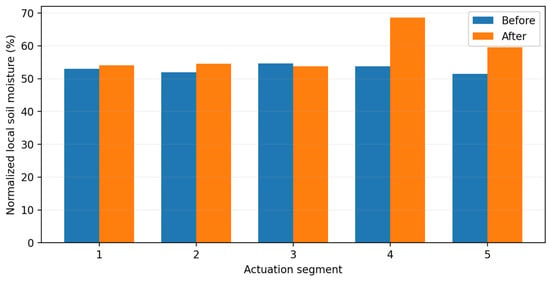
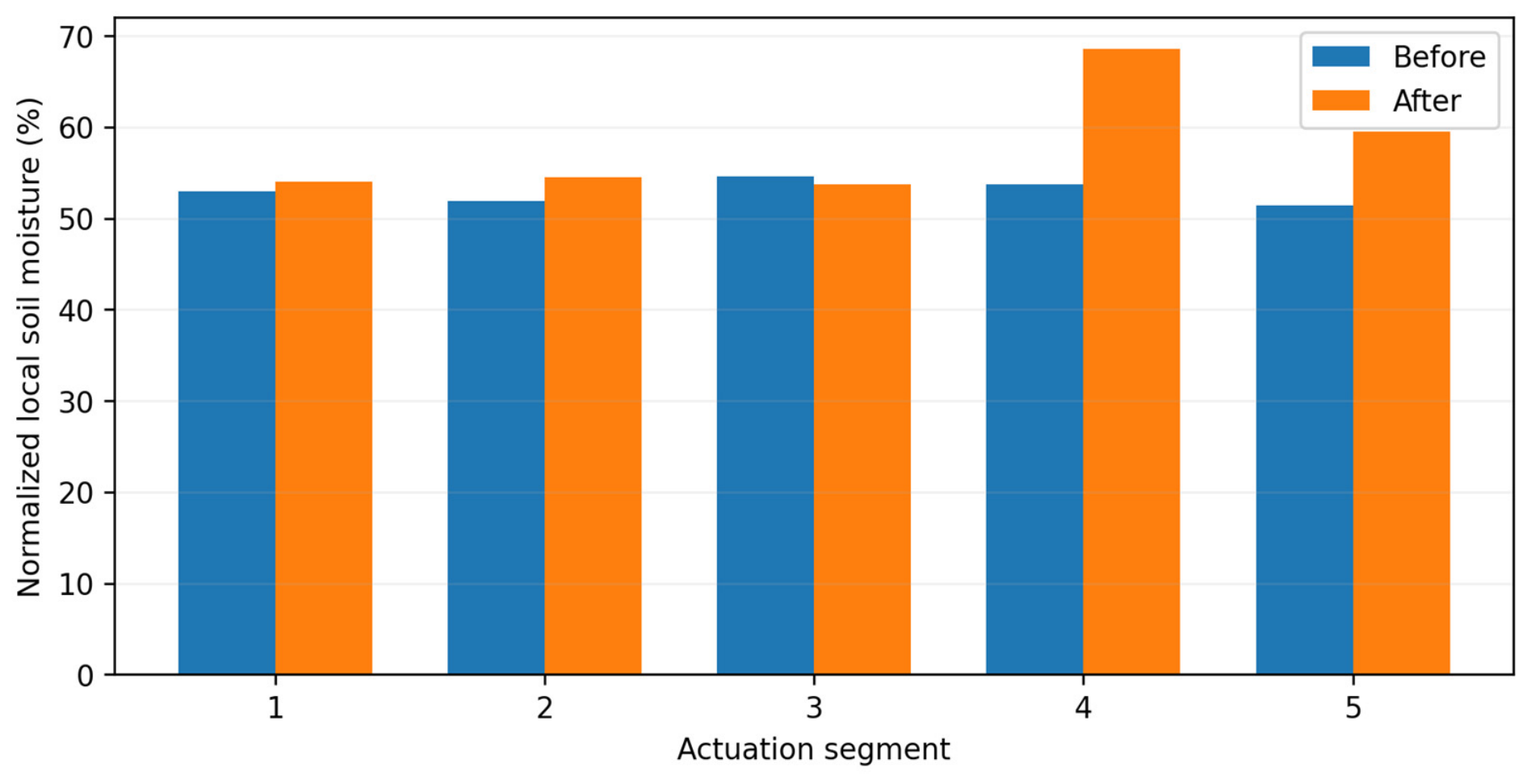
In the centralized reference architecture, five valve-actuation segments contained sufficient information to examine the normalized local soil-moisture reading before, during, and after actuation. Comparing the selected pre- and post-actuation windows, the reading increased by 1.0, 2.6, 14.9, and 8.1 percentage points in four segments and decreased by 0.9 percentage points in the remaining segment (Figure 3).
Figure 3.
Normalized local soil-moisture readings before and after the five valve-actuation segments in the centralized reference architecture.
The observed response was heterogeneous across the five segments. Because the experiments were conducted under field conditions and the soil-moisture variable corresponds to the normalized sensor output described in Section 2.2, the magnitude of the pre/post change should be interpreted together with the initial local condition and field dynamics. These segments document the operational response of the centralized reference system, but they do not provide a direct measurement of water volume applied and therefore do not support calculation of water-use efficiency.
3.2. Multi-Agent Coordination
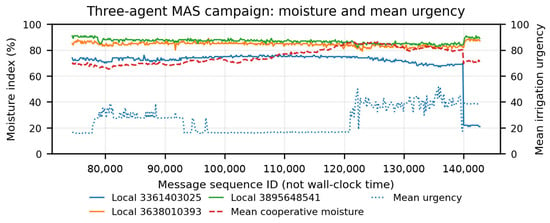
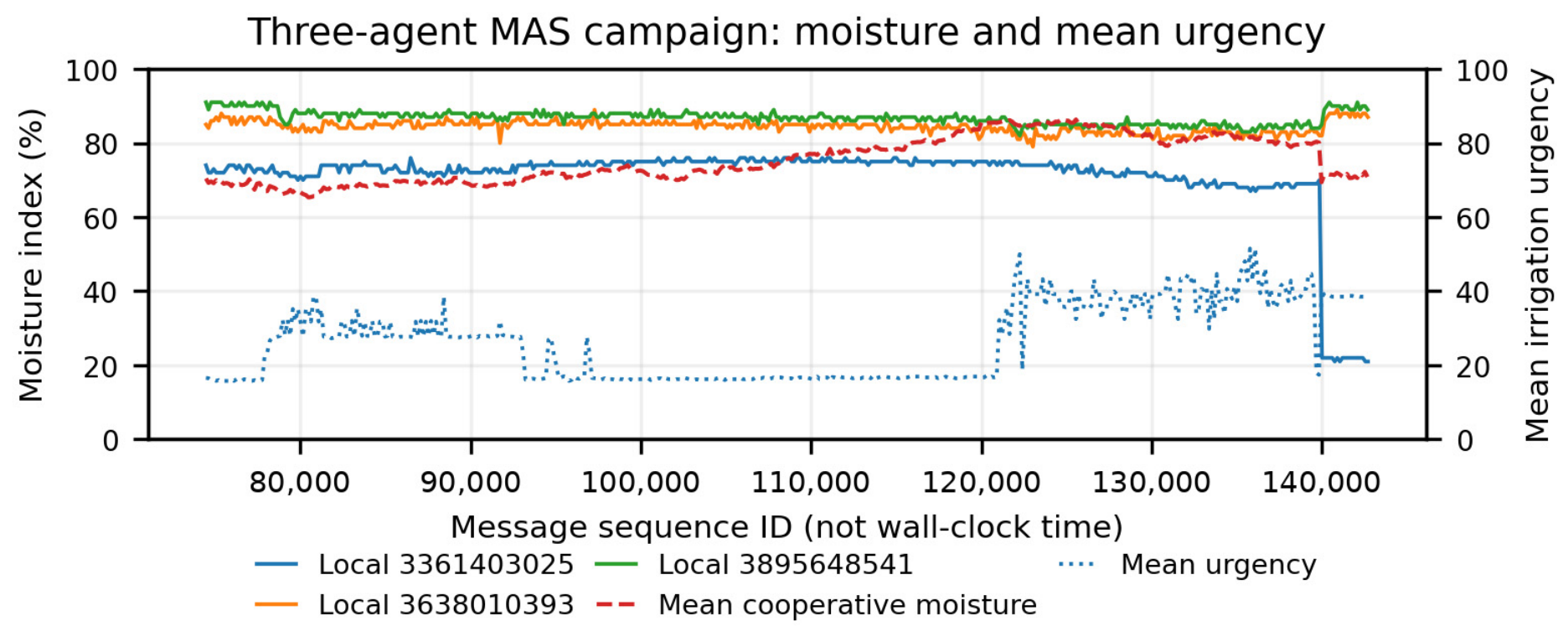
Figure 4 presents local-moisture readings, the cooperative estimate, and irrigation urgency for a representative three-agent MAS campaign.
Figure 4.
Local moisture for three agents, mean cooperative moisture estimate, and mean irrigation urgency during the 22–23 August 2026 MAS campaign. The horizontal axis is message sequence ID, not wall-clock time.
The four main MAS operation campaigns, comprising 41,770, 129,700, 204,544, and 228,711 measurement records, yielded campaign-level consensus RMSE values of 41.85%, 3.51%, 12.57%, and 30.07%, respectively. Mean neighbor availability was 2.00, 2.00, approximately 2.00, and approximately 2.00 neighbors per agent. Therefore, the similar mean neighbor count observed across these campaigns did not by itself explain the substantial variation in disagreement between the normalized local measurement and the cooperative estimate.
Across the 666,035 original MAS records, the share of telemetry records above candidate urgency cutoffs declined from 1.625% at >50 (10,820 records) to zero at >95 (Table 3). At the implemented cutoff (>70), 3607 records (0.542%) exceeded the threshold; at >85, only 113 records (0.017%) did. These counts describe repeated telemetry scores rather than independent irrigation events. The sweep is a post hoc threshold-distribution analysis and does not establish how the fuzzy controller, distributed negotiation, or actuator constraints would behave if membership breakpoints or thresholds were changed.
In the 9261-point uniform input grid, the local-moisture membership family produced the largest one-family response to a ±5-point perturbation: mean absolute urgency change was 3.73 points, the 95th-percentile change was 32.44 points, and the maximum was 77.37 points. The strict urgency >70 classification changed at 4.76% of grid points. Perturbing cooperative-moisture or stress membership breakpoints produced smaller mean absolute changes (0.25 and 0.45 points, respectively) and no crossings of the 70 cutoff in this grid. Shifting all membership families together produced mean absolute changes of 6.39–6.50 points and 4.76% threshold-classification changes. These are uniform-grid model outcomes, not estimated frequencies of field events or valve activations. The code-level sensitivity results are summarized in Table 4.
Table 4.
Code-level sensitivity of fuzzy irrigation urgency to membership-breakpoint perturbations.
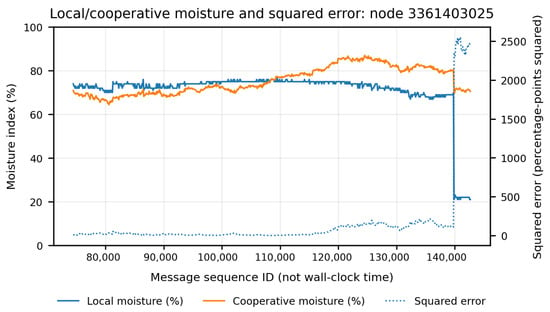
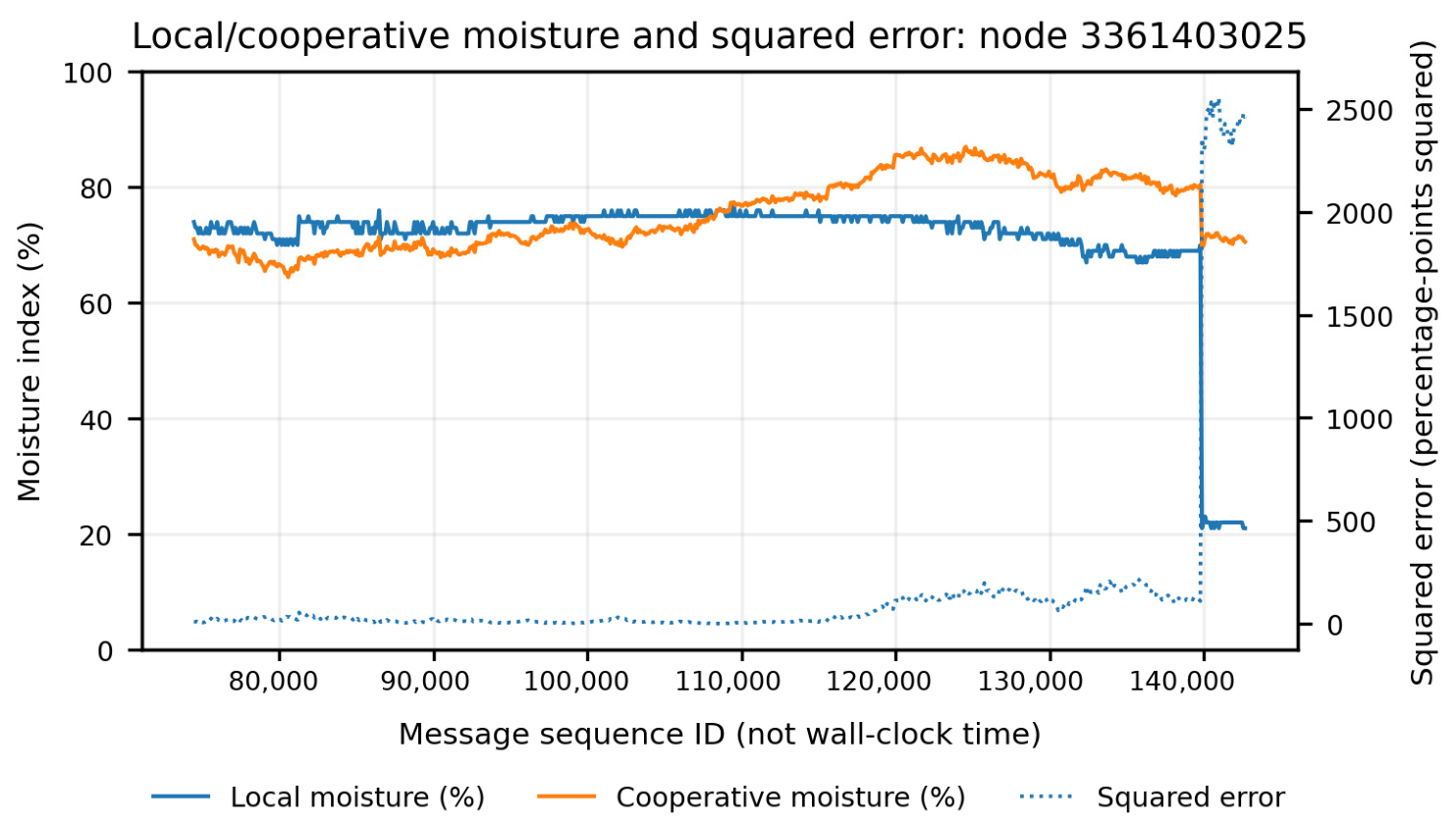
A representative local-versus-cooperative moisture trace and its squared-error behavior are shown in Figure 5.
Figure 5.
Local and cooperative moisture estimates and squared-error trace for node 3361403025 during the 22–23 August 2026 MAS campaign. The horizontal axis is message sequence ID, not wall-clock time.
Figure 5 illustrates periods in which the normalized local measurement and the cooperative estimate tracked closely, alternating with intervals of greater separation. The campaign-level RMSE summarizes this disagreement across valid records and should not be interpreted as a formal convergence rate. Because the campaigns were conducted at different times and under different environmental and sensing conditions, the contribution of individual factors to the observed RMSE variation cannot be isolated with the present experimental design.
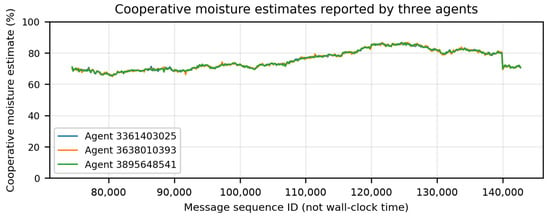
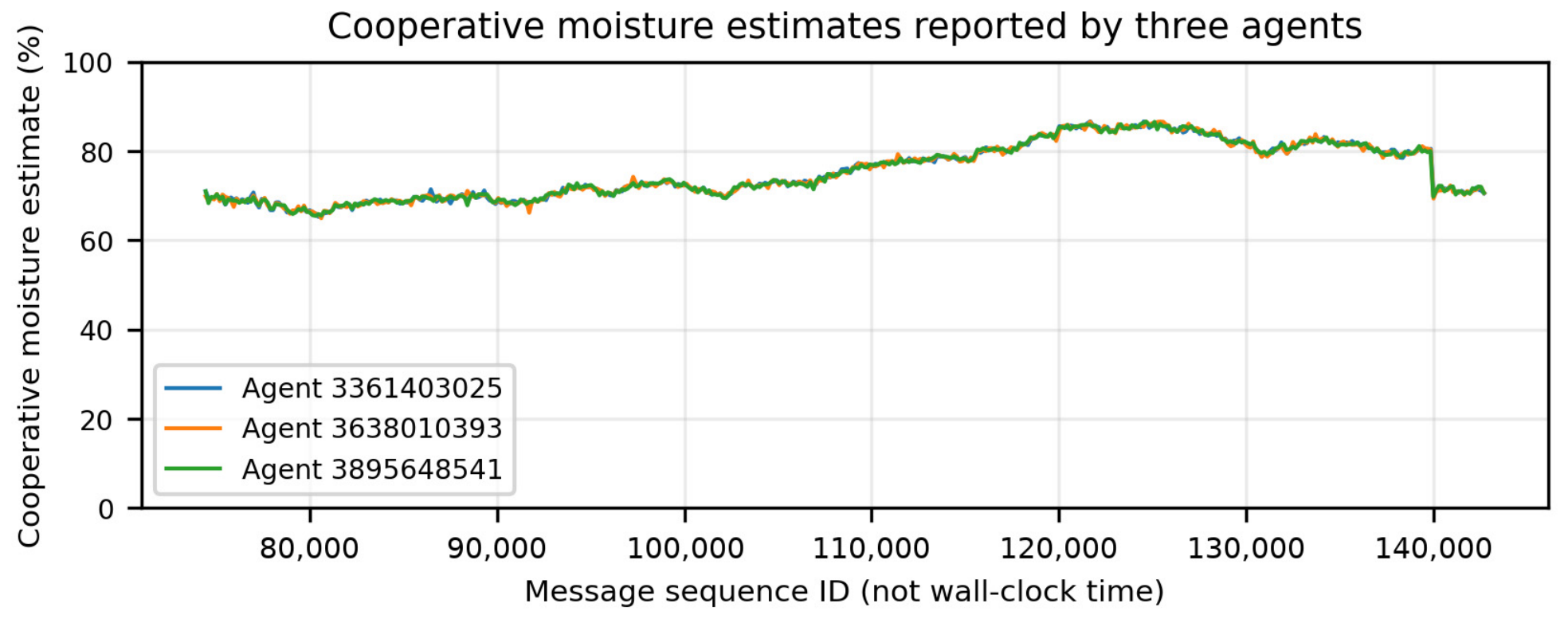
Figure 6 shows the cooperative moisture estimates reported by three irrigation agents during the same campaign.
Figure 6.
Cooperative moisture estimates reported by three irrigation agents during the 22–23 August 2026 MAS campaign. The horizontal axis is message sequence ID, not wall-clock time.
The cooperative estimates reported by the three agents became closely aligned over extended intervals after the initial transients, while common shifts remained visible as the sensed conditions changed. The firmware operated continuously and did not implement a numerical stopping or convergence threshold; therefore, this behavior is interpreted as temporal agreement among agent estimates rather than as proof of mathematical convergence.
3.3. Communication and Negotiation
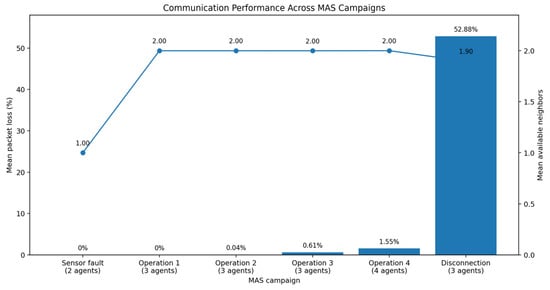
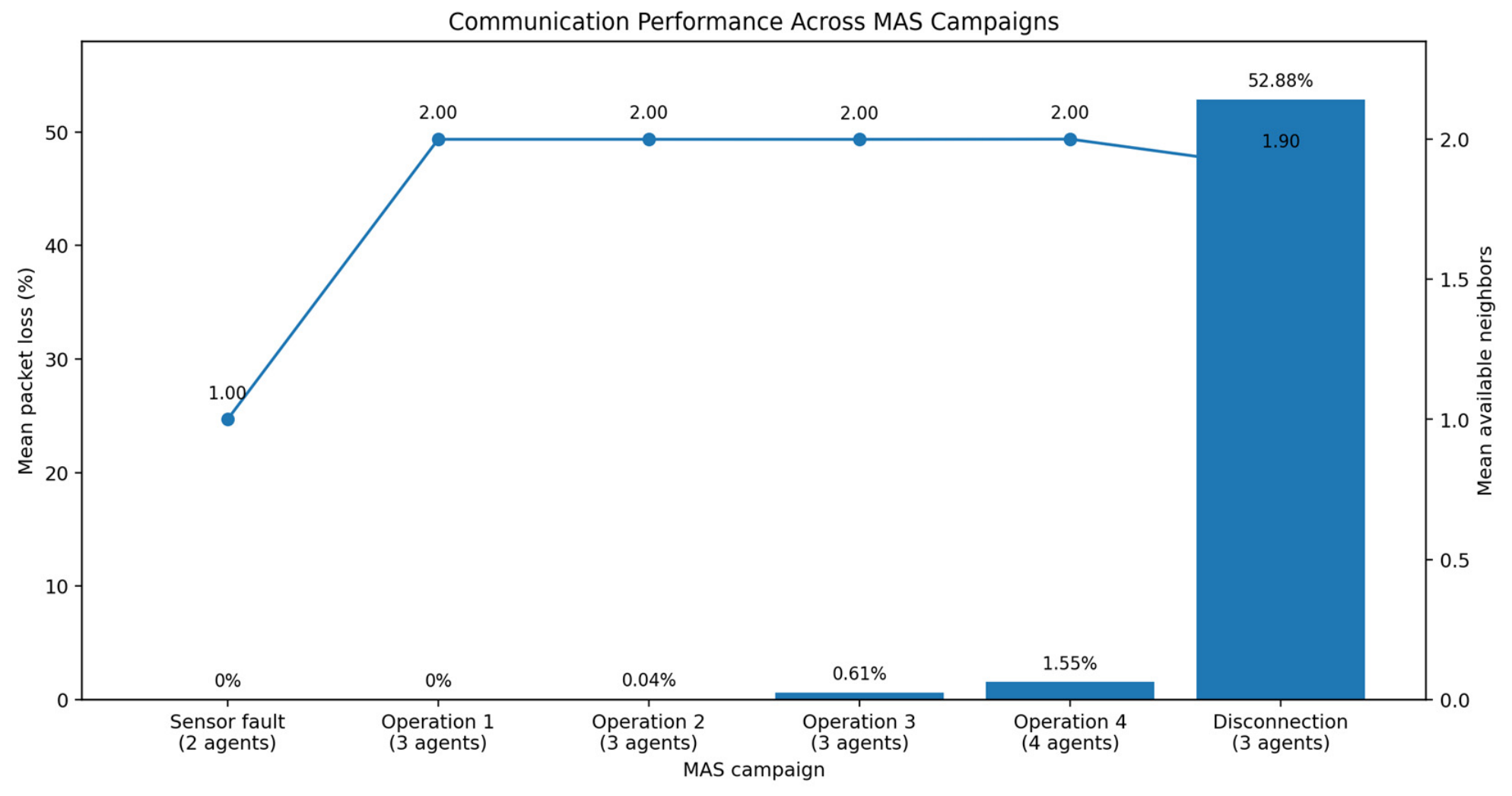
Across the four main MAS operation campaigns, mean packet loss was 0.00%, 0.04%, 0.61%, and 1.55%, while mean neighbor availability remained approximately 2.00 neighbors per agent. In contrast, the dedicated node-disconnection campaign reached 52.88% mean packet loss and 1.90 mean available neighbors. The initial two-agent sensor-fault validation campaign reported one available neighbor on average, as expected from its two-agent topology rather than from a communication degradation. Figure 7 summarizes these campaign-level communication indicators.
Figure 7.
Communication performance across MAS campaigns: mean packet loss and mean available-neighbor count. The two-agent sensor-fault campaign is included to show the topology-dependent neighbor count, whereas the dedicated disconnection campaign represents an induced communication-degradation scenario.
The communication results show that the large increase in packet loss was specific to the induced node-disconnection scenario and should not be treated as representative of normal MAS operation. In the 228,711-record four-agent campaign, one row carries the flag Violacion_Exclusion_Mutua = SI; however, every record in the exported campaign has Valvula = 0. The flag is therefore inconsistent with the available valve-state series and cannot be interpreted as a corroborated concurrent-actuation event. It is retained as an unverified telemetry flag, not as evidence of a confirmed physical mutual-exclusion violation.
3.4. Fault Tolerance
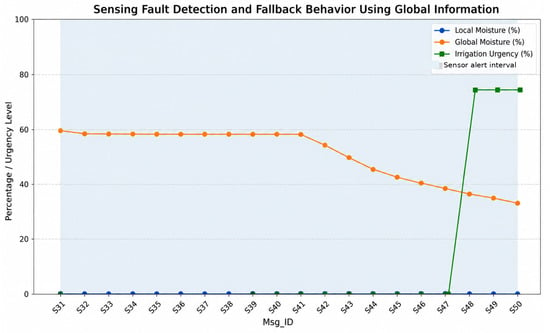
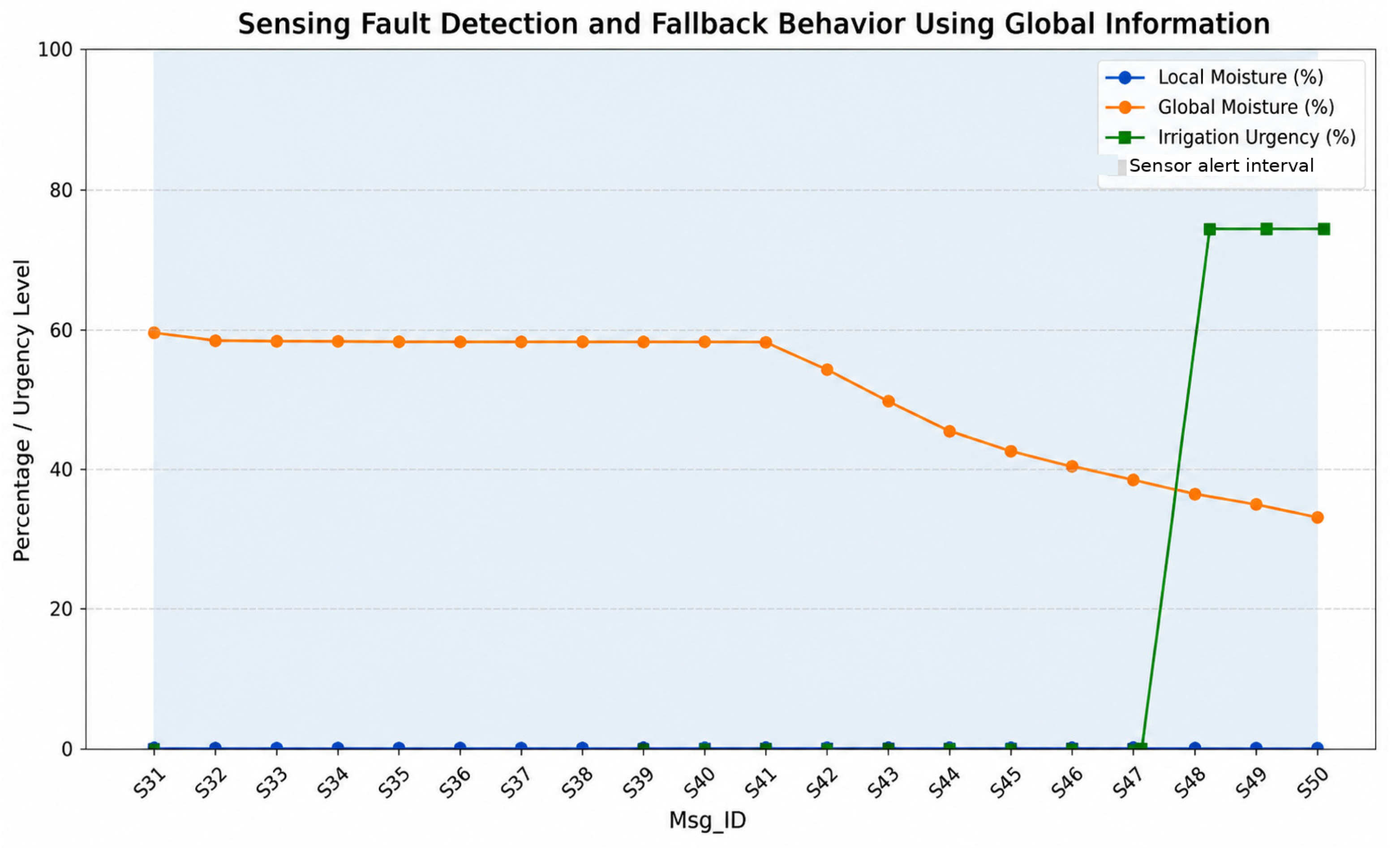
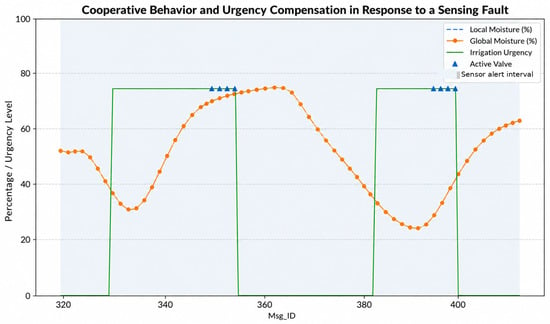
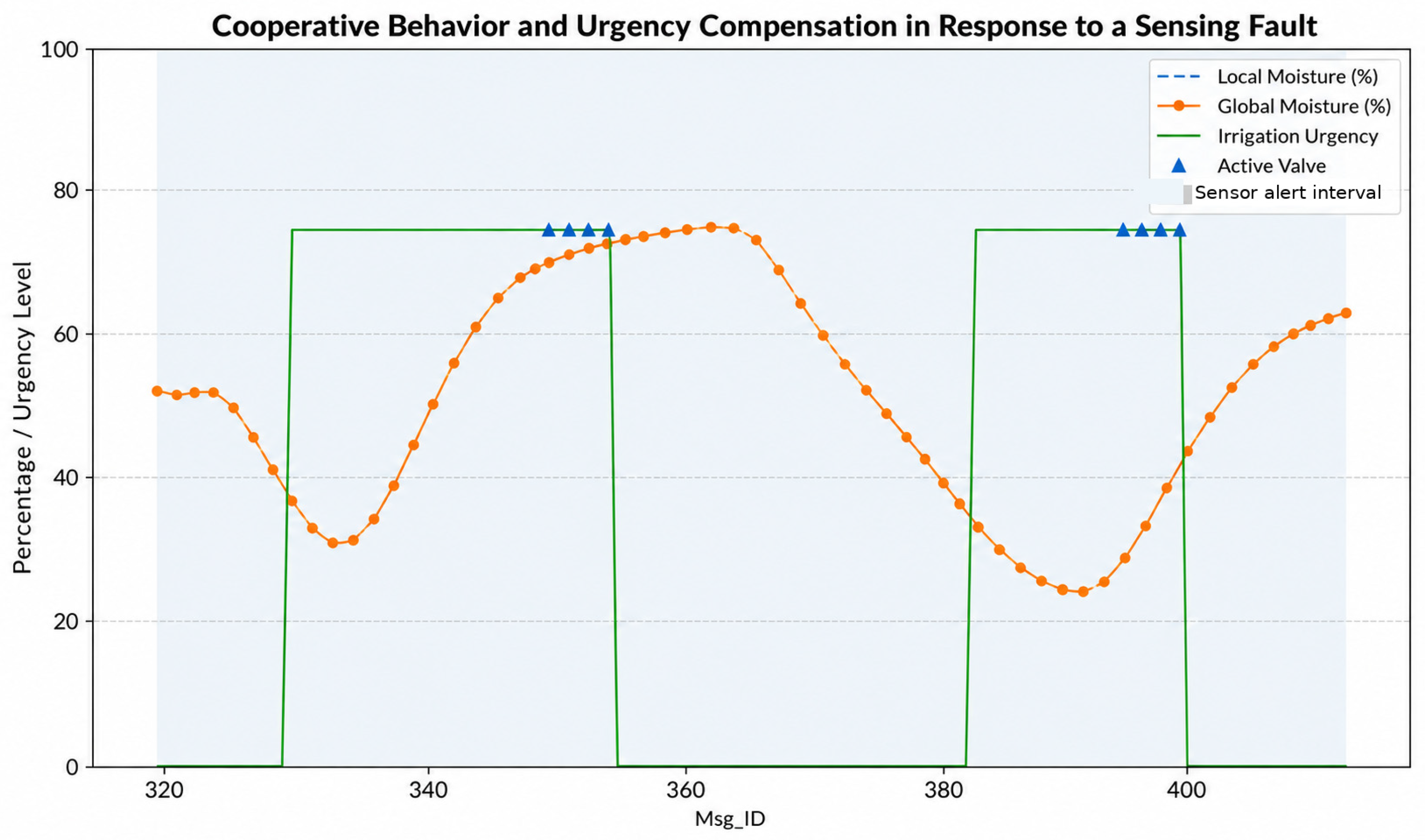
Figure 8 summarizes a representative sensing-fault interval, showing the invalid local reading, cooperative estimate, and fallback irrigation urgency.
Figure 8.
Representative sensing-fault interval showing the invalid local-moisture condition, the cooperative moisture estimate, and the fallback irrigation-urgency response. Invalid local readings were encoded as −1; because the plotted vertical scale begins at 0%, these values appear at the lower boundary of the graph. The blue-shaded region indicates the sensor-alert interval.
The initial sensing-fault validation campaign comprised 945 records. A total of 203 records carried a sensor-alert state and 192 records contained the invalid local-moisture sentinel value (−1). These counts represent alert-bearing records rather than independent failures. Sequential analysis grouped the affected records into four sensing-fault episodes: two associated with node 3637020885 and two with node 3895648541. The observed telemetry-recovery intervals were 154.08 s and 18.02 s for the first node, and 193.98 s and 39.99 s for the second, corresponding to an overall observed range of 18.02 to 193.98 s. As defined in Section 2.6, these intervals indicate restoration of a valid reported sensing state and should not be interpreted as physical repair of the sensor. A representative cooperative-fallback interval with the reported valve state is shown in Figure 9.
Figure 9.
Cooperative estimate, fallback irrigation urgency, and reported valve activation during a sensing-fault interval. The local sensor remained in an invalid state while information from the cooperative layer continued to be available. The blue-shaded region indicates the sensor-alert interval.
For a representative episode involving node 3895648541, the local moisture measurement remained invalid while the cooperative estimate continued to be available. As the cooperative moisture estimate decreased, the fallback logic updated irrigation urgency and reached a value of 75. Figure 9 also shows that valve activation occurred only during selected portions of the alert interval. This behavior is consistent with the implemented fallback mechanism, which preserves selected decision-making functions from shared information when the local sensing input is unavailable; it does not imply recovery of the failed local sensor.
Node disconnection constituted a second degradation scenario. As reported in Section 3.3, this test produced a mean packet loss of 52.88% and reduced the mean available-neighbor count to approximately 1.90. The neighbor-timeout mechanism updated the logical active-node set as connectivity changed, but it did not eliminate the effect of severe communication loss on the cooperative layer. Taken together, the sensing-fault and disconnection tests support partial functional continuity under the evaluated degraded conditions rather than complete recovery or tolerance to all possible failure modes.
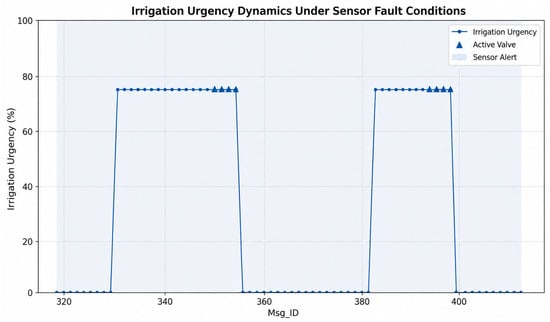
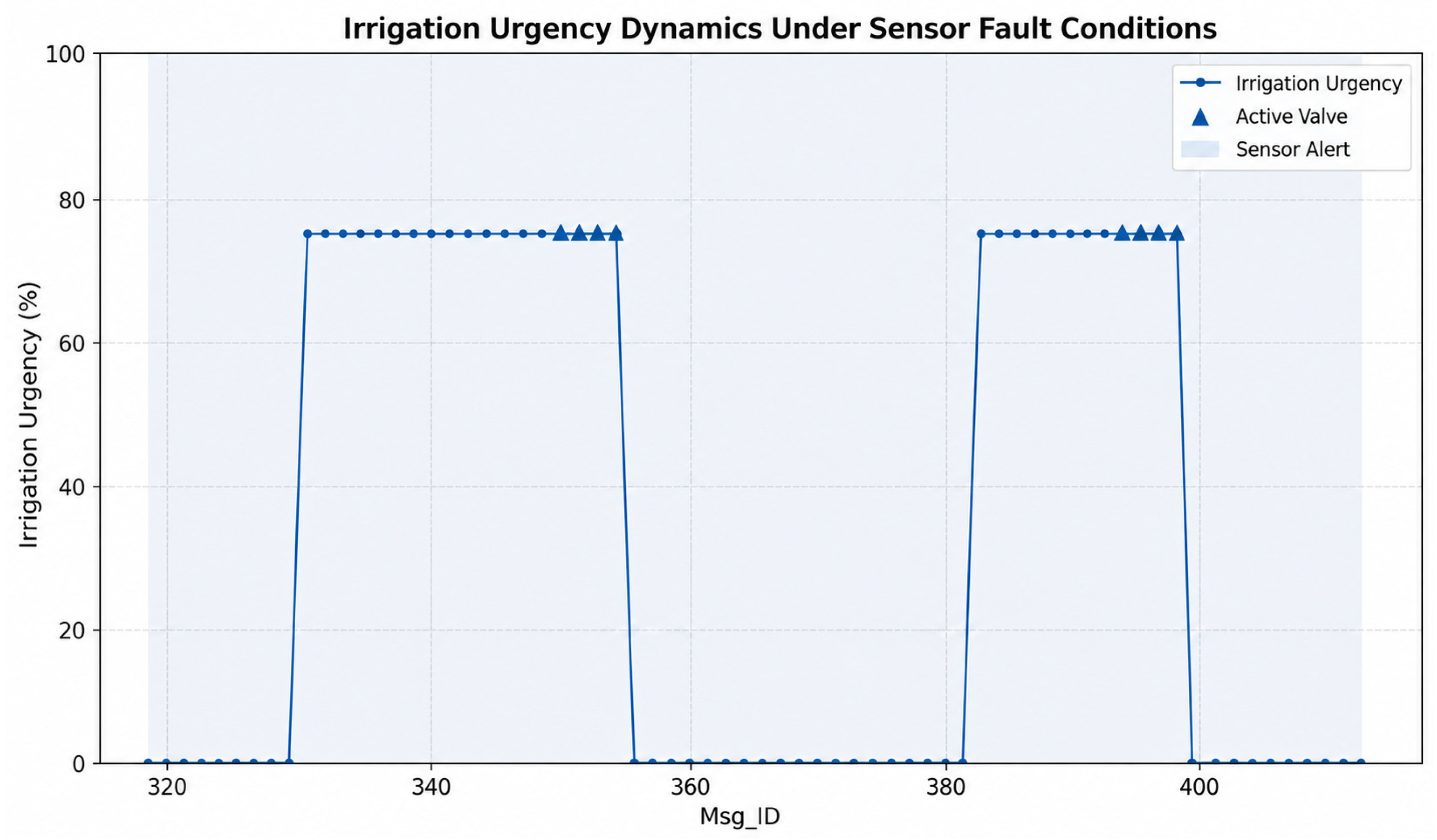
Figure 10 isolates the urgency and reported valve-state response during the sensor-alert intervals.
Figure 10.
Irrigation-urgency and reported valve-state dynamics during the sensing-fault interval. Sensor-alert shading denotes the period in which the local sensing input was unavailable.
Figure 10 isolates the decision-layer response during the same type of degraded sensing condition. Irrigation urgency rose to 75 during the fallback intervals, while the reported valve state was active only for subsets of those intervals. The result therefore documents continued execution of the embedded decision and actuation logic during a sensor-alert state, not restoration of a valid local measurement.
3.5. Estimated Electrical Charge Consumption
The software-based electrical charge estimate ranged from 80.36 to 12,960.42 mAh across the MAS campaigns and from 29.48 to 26,245.69 mAh across the centralized reference campaigns. Within the MAS dataset, the lowest total corresponded to the 945-record sensing-fault campaign and the highest to the 228,711-record four-agent operation campaign. Within the centralized dataset, the lowest total was observed in the 239-record diagnostic/reference campaign and the highest in the 169,333-record normal-operation campaign.
These values are descriptive campaign totals. Because the metric accumulates assumed current over the elapsed time between consecutive records from the same node and adds the valve-current term while the corresponding valve is reported active, the totals are influenced by campaign duration and valve activity. No external current or energy meter was used. Accordingly, the mAh values are reported as estimated electrical charge consumption and are not interpreted as direct measurements of energy or as evidence of energy-efficiency superiority of either architecture.
3.6. Supplementary Concurrent Comparison (19–23 October 2026)
The Supplementary Comparison generated 1,008,768 records across the three configurations. The physical valve-state field was recorded as active in 577 centralized records, 300 MAS records, and 215 local-independent records. These counts correspond to 0.168%, 0.087%, and 0.067% of the records in their respective sheets. They are counts of records with the valve reported open, not counts of distinct opening events. The daily distribution differed among configurations, consistent with the fact that the two MAS zones and the two single-zone configurations did not have identical irrigation demand. The results are therefore reported descriptively and are not interpreted as evidence that one architecture irrigated more efficiently. Table 5 summarizes the record counts and valve-open proportions for the three configurations.
Table 5.
Summary of the supplementary concurrent comparison conducted on 19–23 October 2026.
4. Discussion
The experimental results support the technical feasibility of distributing sensing, local decision-making, cooperative estimation, negotiation, and actuation across ESP32-based agents. This extends the role of embedded IoT nodes beyond monitoring and remote supervision, which are prominent in smart-irrigation and digital-agriculture studies [7,8,21,22,31,32,33,34,35]. The present contribution is not a claim of measured water savings or a new general MAS algorithm; it is a field characterization of the combined embedded components and the limitations exposed by the recorded campaigns.
The consensus results also require conditional interpretation. Campaign-level RMSE ranged from 3.51% to 41.85%, where RMSE quantifies disagreement between the normalized local soil-moisture reading and the cooperative estimate; it is not a mathematical convergence rate. Mean neighbor availability remained close to two in the principal three- and four-agent campaigns. Networked consensus theory treats convergence and robustness as dependent on assumptions about graph structure, communication delays, and failures [18]; the present measurements do not establish those formal properties for this implementation.
Communication quality was a structural limitation of the cooperative layer. Normal-operation campaigns produced low mean packet-loss values, whereas the dedicated disconnection test reached 52.88% and reduced mean neighbor availability to approximately 1.90. The 10 s neighbor-timeout mechanism allowed the logical active-node set to change when updates stopped arriving but did not prevent severe degradation in the dedicated disconnection scenario. Agricultural wireless sensor network studies likewise identify connectivity loss and fault containment as important design concerns; the present results characterize only the tested topology and failure conditions [31,32].
The sensing-fault experiment provides complementary evidence of partial functional continuity. The initial campaign contained 203 sensor-alert records, 192 invalid local readings, and four degradation episodes. During representative fault intervals, the cooperative estimate remained available, and the fallback logic continued to update irrigation urgency. This is evidence of the implemented fallback behavior under selected faults, not evidence that the sensor itself recovered or that all failure modes are tolerated; this distinction is important in the context of fault-aware agricultural sensor networks [31,32].
The negotiation mechanism implemented actuation prioritization, but the telemetry evidence for mutual exclusion requires qualification. One row in the four-agent campaign was flagged as a violation even though all 228,711 records in that exported campaign report Valvula = 0. The available dataset therefore does not corroborate a physical concurrent-actuation event, and the flag is treated as unverified rather than as a confirmed violation. Future validation should preserve synchronized per-node valve-state logs and, where possible, independent actuator or flow measurements.
The electrical consumption indicator must also be interpreted within its measurement limits. The reported values are estimated electrical charge in mAh, calculated in software from assumed current values and elapsed time, not direct measurements of electrical energy. Likewise, no homogeneous instrumental measurement of applied water volume was available. Therefore, the present dataset does not support claims of lower energy consumption, lower water use, or higher irrigation efficiency for the MAS relative to the centralized reference architecture.
Comparison between the original centralized and MAS architectures is limited because their campaigns differed in date, duration, environmental conditions, number of active nodes, and operational scenario. The Supplementary Comparison conducted from 19 to 23 October 2026 reduces temporal confounding by operating the three configurations concurrently, but it does not isolate the effect of architecture: the MAS controlled two zones while the centralized and local-independent configurations controlled one zone each, and zone-level water demand was not independently measured. The additional valve-state proportions are therefore descriptive rather than evidence of superior efficiency or robustness.
Overall, the strongest evidence provided by the experiments is the joint operation of local fuzzy decision-making, cooperative moisture estimation, distributed negotiation, communication monitoring, and fault-aware fallback on embedded controllers under field conditions. A subsequent validation stage should use paired campaigns with comparable initial conditions, direct measurement of applied water and electrical energy, and systematic individual and simultaneous fault tests. Such a design would make it possible to quantify architectural effects more rigorously and to evaluate whether the distributed approach provides measurable efficiency or robustness benefits beyond the functional capabilities demonstrated here.
The two sensitivity-related analyses have different scopes. Table 3 describes the distribution of recorded urgency scores above alternative cutoffs, whereas Table 4 reports a code-level grid perturbation of fuzzy membership breakpoints. The latter is not a calibrated field replay: the input grid is uniform, the historical logs do not retain raw ADC values or an exact synchronized input snapshot for each inference cycle, and soil/crop-specific reference measurements are unavailable. Published calibration studies demonstrate why low-cost capacitive sensor anchors should be validated against reference moisture measurements under the relevant soil and field conditions [26,27,28,29]. Consequently, these analyses do not establish the agronomic optimality of the ADC anchors or membership functions. Experimental calibration against an independent soil-moisture reference and a crop-/substrate-specific validation remain necessary.
5. Conclusions
A multi-agent irrigation-control architecture was implemented and experimentally evaluated on ESP32 nodes, integrating local sensing, fuzzy inference, cooperative moisture estimation, inter-agent communication, distributed negotiation, and degraded-mode fallback mechanisms.
Across the four main MAS operation campaigns, consensus RMSE ranged from 3.51% to 41.85%, while mean neighbor availability remained close to two neighbors per agent. These results characterize the degree of agreement between normalized local soil-moisture readings and the cooperative estimates under the conditions of each campaign; they should not be interpreted as proof of mathematical convergence.
The dedicated node-disconnection test reached a mean packet loss of 52.88%. In the initial sensing-fault campaign, 203 alert-bearing records, 192 invalid local-moisture readings, and four degradation episodes were identified, with observed telemetry-recovery intervals ranging from 18.02 to 193.98 s. The records show that selected decision functions could continue under the evaluated degraded conditions through the use of cooperative information, but they do not demonstrate physical sensor recovery or complete fault tolerance for all possible failures.
The distributed negotiation mechanism implemented actuation prioritization among agents. However, the single mutual-exclusion flag in the four-agent export is not corroborated by the valve-state column, which reports Valvula = 0 in every record of that campaign. It is therefore reported as an unverified telemetry flag rather than as a confirmed physical violation.
The original centralized campaigns provided a descriptive experimental reference, but the original MAS and centralized campaigns were not evaluated as equivalent temporal or environmental pairs. The additional concurrent comparison on 19–23 October 2026 provides complementary field telemetry under simultaneous operation, but the unequal zone allocation and absence of direct water-volume measurements prevent a balanced causal comparison. Consequently, the available data do not support claims of superiority in water-use or electrical-energy efficiency. The reported electrical-consumption indicator remains a software-based charge estimate in mAh rather than a direct instrumental energy measurement.
Supplementary Materials
The following supporting information can be downloaded at: https://www.mdpi.com/article/10.3390/jsan15060094/s1, comprising the following files: JSAN_RESULTADOS_TESIS_EXTRACTED.xlsx and JSAN_RESULTADOS_OE3_EXTRACTED.xlsx (processed campaign-level datasets and summary analyses); JSAN_Supplementary_Concurrent_Comparison_19-23_Oct_2026_EXTRACTED.xlsx (the additional concurrent comparison conducted on 19–23 October 2026); JSAN_Agente_Riego_sanitized.ino and JSAN_Agente_Clima_NivelTanque_sanitized.ino (sanitized ESP32 irrigation-agent and environmental-agent firmware); and JSAN_README_MINIMAL_DATASET_EXTRACTED.md (dataset structure, variables, units, and interpretation). The October comparison is separate from the original twelve-campaign dataset and is not included in the original total of 1,010,151 records. Additional raw per-message experimental logs and supporting files are available from the corresponding author upon reasonable request.
Author Contributions
Conceptualization, J.A.A.R. and J.V.R.B.; methodology, J.A.A.R., D.A.P.A. and J.V.R.B.; software, J.A.A.R. and D.A.P.A.; validation, J.A.A.R., D.A.P.A., W.F.A.G. and P.F.B.E.; formal analysis, D.A.P.A.; investigation, D.A.P.A.; resources, J.A.A.R., D.A.P.A. and J.V.R.B.; data curation, J.A.A.R., D.A.P.A. and J.V.R.B.; writing—original draft preparation, J.A.A.R. and J.V.R.B.; writing—review and editing, J.V.R.B., W.F.A.G. and P.F.B.E.; visualization, J.A.A.R.; supervision, J.A.A.R., W.F.A.G. and P.F.B.E.; project administration, J.A.A.R. All authors have read and agreed to the published version of the manuscript.
Funding
This research received no external funding.
Data Availability Statement
The original contributions presented in this study are included in the article/Supplementary Material. Further inquiries can be directed to the corresponding author.
Acknowledgments
The authors thank Universidad Tecnológica Israel for the academic support provided during the development of the degree project. OpenAI ChatGPT (GPT-5.6 during earlier revision work and GPT-6 during final revision; accessed on 17 September and 26 October 2026) was used for manuscript revision, organization of author-provided technical content, code-level sensitivity analysis, and preparation of selected figures. The authors reviewed and verified all AI-assisted content and take full responsibility for the final manuscript.
Conflicts of Interest
The authors declare no conflicts of interest.
Abbreviations
The following abbreviations are used in this manuscript:
| ADC | analog-to-digital converter |
| CNP | Contract Net Protocol |
| ESP32 | Espressif ESP32 microcontroller family |
| IoT | Internet of Things |
| LDR | light-dependent resistor |
| MAS | multi-agent system |
| MQTT | Message Queuing Telemetry Transport |
| RMSE | root mean square error |
References
- Rijswijk, K.; Klerkx, L.; Bacco, M.; Bartolini, F.; Bulten, E.; Debruyne, L.; Dessein, J.; Scotti, I.; Brunori, G. Digital Transformation of Agriculture and Rural Areas: A Socio-Cyber-Physical System Framework to Support Responsibilisation. J. Rural Stud. 2021, 85, 79–90. [Google Scholar] [CrossRef] [Scilit]
- Obaideen, K.; Yousef, B.A.A.; AlMallahi, M.N.; Tan, Y.C.; Mahmoud, M.; Jaber, H.; Ramadan, M. An Overview of Smart Irrigation Systems Using IoT. Energy Nexus 2022, 7, 100124. [Google Scholar] [CrossRef] [Scilit]
- Uztürk, D.; Büyüközkan, G. Industry 4.0 Technologies in Smart Agriculture: A Review and a Technology Assessment Model Proposition. Technol. Forecast. Soc. Change 2024, 208, 123640. [Google Scholar] [CrossRef] [Scilit]
- Zhang, Y.; Wang, X.; Jin, L.; Ni, J.; Zhu, Y.; Cao, W.; Jiang, X. Research and Development of an IoT Smart Irrigation System for Farmland Based on LoRa and Edge Computing. Agronomy 2025, 15, 366. [Google Scholar] [CrossRef] [Scilit]
- Chainbi, W.; Hamdi, N. A Multi-Agent System Based Architecture for Enabling Edge Autonomous Management. Sustain. Comput. Inform. Syst. 2022, 36, 100816. [Google Scholar] [CrossRef] [Scilit]
- Mahela, O.P.; Khosravy, M.; Gupta, N.; Khan, B.; Alhelou, H.H.; Mahla, R.; Patel, N.; Siano, P. Comprehensive Overview of Multi-Agent Systems for Controlling Smart Grids. CSEE J. Power Energy Syst. 2022, 8, 115–131. [Google Scholar] [CrossRef] [Scilit]
- Khoa, T.A.; Man, M.M.; Nguyen, T.-Y.; Nguyen, V.; Nam, N.H. Smart Agriculture Using IoT Multi-Sensors: A Novel Watering Management System. J. Sens. Actuator Netw. 2019, 8, 45. [Google Scholar] [CrossRef] [Scilit]
- Fuentes-Peñailillo, F.; Gutter, K.; Vega, R.; Silva, G.C. Transformative Technologies in Digital Agriculture: Leveraging Internet of Things, Remote Sensing, and Artificial Intelligence for Smart Crop Management. J. Sens. Actuator Netw. 2024, 13, 39. [Google Scholar] [CrossRef] [Scilit]
- Olatinwo, D.D.; Myburgh, H.C.; De Freitas, A.; Abu-Mahfouz, A.M. A Review of Smart Crop Technologies for Resource Constrained Environments: Leveraging Multimodal Data Fusion, Edge-to-Cloud Computing, and IoT Virtualization. J. Sens. Actuator Netw. 2025, 14, 99. [Google Scholar] [CrossRef] [Scilit]
- García, L.; Parra, L.; Jiménez, J.M.; Lloret, J.; Lorenz, P. IoT-Based Smart Irrigation Systems: An Overview on the Recent Trends on Sensors and IoT Systems for Irrigation in Precision Agriculture. Sensors 2020, 20, 1042. [Google Scholar] [CrossRef] [Scilit] [PubMed]
- Jiménez, A.-F.; Cárdenas, P.-F.; Jiménez, F. Intelligent IoT-multiagent precision irrigation approach for improving water use efficiency in irrigation systems at farm and district scales. Comput. Electron. Agric. 2022, 192, 106635. [Google Scholar] [CrossRef] [Scilit]
- Chiewchan, K.; Anthony, P.; Kc, B.; Samarasinghe, S. Water distribution in community irrigation using a multi-agent system. J. R. Soc. N. Z. 2023, 53, 6–26. [Google Scholar] [CrossRef] [Scilit] [PubMed]
- Agyeman, B.T.; Liu, J.; Shah, S.L. Semi-Centralized Multi-Agent RL for Irrigation Scheduling. IFAC-PapersOnLine 2024, 58, 145–150. [Google Scholar] [CrossRef] [Scilit]
- Hammouch, H.; El-Yacoubi, M.A.; Qin, H.; Berbia, H. A Systematic Review and Meta-Analysis of Intelligent Irrigation Systems. IEEE Access 2024, 12, 128285–128304. [Google Scholar] [CrossRef] [Scilit]
- Cambra Baseca, C.; Dionísio, R.; Ribeiro, F.; Metrôlho, J. Edge-Computing Smart Irrigation Controller Using LoRaWAN and LSTM for Predictive Controlled Deficit Irrigation. Sensors 2025, 25, 7079. [Google Scholar] [CrossRef] [Scilit] [PubMed]
- Jaiswal, N.; Kumar, T.V.; Shukla, C. Smart drip irrigation systems using IoT: A review of architectures, machine learning models, and emerging trends. Discov. Agric. 2025, 3, 253. [Google Scholar] [CrossRef] [Scilit]
- Smith, R.G. The Contract Net Protocol: High-Level Communication and Control in a Distributed Problem Solver. IEEE Trans. Comput. 1980, C-29, 1104–1113. [Google Scholar] [CrossRef] [Scilit]
- Olfati-Saber, R.; Fax, J.A.; Murray, R.M. Consensus and Cooperation in Networked Multi-Agent Systems. Proc. IEEE 2007, 95, 215–233. [Google Scholar] [CrossRef] [Scilit]
- Jaiswal, S.; Ballal, M.S. Fuzzy Inference Based Irrigation Controller for Agricultural Demand Side Management. Comput. Electron. Agric. 2020, 175, 105537. [Google Scholar] [CrossRef] [Scilit]
- Ikidid, A.; El Fazziki, A.; Sadgal, M. Internet of Things and Agent-Based System to Improve Water Use Efficiency in Collective Irrigation. Comput. Sci. Inf. Syst. 2023, 20, 405–421. [Google Scholar] [CrossRef] [Scilit]
- Agyeman, B.T.; Naouri, M.; Appels, W.M.; Liu, J.; Shah, S.L. Learning-Based Multi-Agent MPC for Irrigation Scheduling. Control Eng. Pract. 2024, 147, 105908. [Google Scholar] [CrossRef] [Scilit]
- Togneri, R.; Prati, R.; Nagano, H.; Kamienski, C. Data-Driven Water Need Estimation for IoT-Based Smart Irrigation: A Survey. Expert Syst. Appl. 2023, 225, 120194. [Google Scholar] [CrossRef] [Scilit]
- Nsoh, B.; Katimbo, A.; Guo, H.; Heeren, D.M.; Nakabuye, H.N.; Qiao, X.; Ge, Y.; Rudnick, D.R.; Wanyama, J.; Bwambale, E.; et al. Internet of Things-Based Automated Solutions Utilizing Machine Learning for Smart and Real-Time Irrigation Management: A Review. Sensors 2024, 24, 7480. [Google Scholar] [CrossRef] [Scilit] [PubMed]
- Aosong (Guangzhou) Electronics Co., Ltd. ASAIR AM2302 (DHT22) Temperature and Humidity Sensor Module. Available online: https://www.aosong.com/en/Products/info.aspx?itemid=2294 (accessed on 26 October 2026).
- Espressif Systems. ESP32 Series Datasheet, Version 5.3, 29 July 2026. Available online: https://www.espressif.com/en/support/download/documents/chips (accessed on 17 September 2026).
- Abdelmoneim, A.A.; Al Kalaany, C.M.; Khadra, R.; Derardja, B.; Dragonetti, G. Calibration of Low-Cost Capacitive Soil Moisture Sensors for Irrigation Management Applications. Sensors 2025, 25, 343. [Google Scholar] [CrossRef] [Scilit] [PubMed]
- Adla, S.; Bruckmaier, F.; Arias-Rodriguez, L.F.; Tripathi, S.; Pande, S.; Disse, M. Impact of Calibrating a Low-Cost Capacitance-Based Soil Moisture Sensor on AquaCrop Model Performance. J. Environ. Manag. 2024, 353, 120248. [Google Scholar] [CrossRef] [Scilit] [PubMed]
- Satoh, Y.; Kakiuchi, H. Calibration Method to Address Influences of Temperature and Electrical Conductivity for a Low-Cost Soil Water Content Sensor in the Agricultural Field. Agric. Water Manag. 2021, 255, 107015. [Google Scholar] [CrossRef] [Scilit]
- Strypsteen, G.; Persson, M.; Miroshnychenko, M.; Rakonjac, N. Field Performance and Calibration Strategies for Low-Cost Capacitive Soil Moisture Sensors. Sensors 2026, 26, 3291. [Google Scholar] [CrossRef] [Scilit] [PubMed]
- Alves, A.J.; Lira, R.; Lemos, M.; Kridi, D.S.; Leal, K. eFLL (Embedded Fuzzy Logic Library). GitHub Repository. Available online: https://github.com/alvesoaj/eFLL (accessed on 26 October 2026).
- Smara, M.; Pathan, A.-S.K. An Enhanced Mechanism for Fault Tolerance in Agricultural Wireless Sensor Networks. Network 2024, 4, 150–174. [Google Scholar] [CrossRef] [Scilit]
- Perdana, D.; Lorenz, P.; Cahyono, O.; Hartati, S. Distributed Intelligent IoT System for High Reliability and Scalability in Vertical Farming Systems. J. Sens. Actuator Netw. 2026, 15, 55. [Google Scholar] [CrossRef] [Scilit]
- Kasera, R.K.; Acharjee, T. A Comprehensive IoT Edge-Based Smart Irrigation System for Tomato Cultivation. Internet Things 2024, 28, 101356. [Google Scholar] [CrossRef] [Scilit]
- Morchid, A.; Jebabra, R.; Khalid, H.M.; El Alami, R.; Qjidaa, H.; Ouazzani Jamil, M. IoT-Based Smart Irrigation Management System to Enhance Agricultural Water Security Using Embedded Systems, Telemetry Data, and Cloud Computing. Results Eng. 2024, 23, 102829. [Google Scholar] [CrossRef] [Scilit]
- Morchid, A.; Et-taibi, B.; Oughannou, Z.; El Alami, R.; Qjidaa, H.; Ouazzani Jamil, M.; Boufounas, E.-M.; Abid, M.R. IoT-Enabled Smart Agriculture for Improving Water Management: A Smart Irrigation Control Using Embedded Systems and Server-Sent Events. Sci. Afr. 2025, 27, e02527. [Google Scholar] [CrossRef] [Scilit]

Disclaimer/Publisher’s Note: The statements, opinions and data contained in all publications are solely those of the individual author(s) and contributor(s) and not of MDPI and/or the editor(s). MDPI and/or the editor(s) disclaim responsibility for any injury to people or property resulting from any ideas, methods, instructions or products referred to in the content. |
© 2026 by the authors. Licensee MDPI, Basel, Switzerland. This article is an open access article distributed under the terms and conditions of the Creative Commons Attribution (CC BY) license.