

You are currently viewing a new version of our website. To view the old version click .

Plants, Volume 6, Issue 4

December 2017 - 24 articles

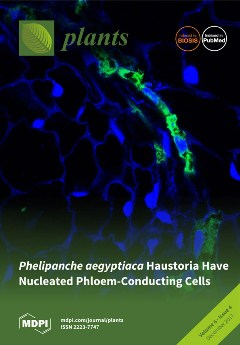
Cover Story: It has been known that macromolecular transport occur between phloem tissues of host- and parasitic plants. However, it is still unclear whether sieve elements are developed in haustoria. In this study, we demonstrated that phloem-conducting cells in haustoria of P. aegyptiaca are nucleated, without sieve plates, thus differ from sieve elements. Our results suggested that formation of plasmodesmata with large size exclusion limit is independent of enucleation and sieve plate formation. View this paper
  • Issues are regarded as officially published after their release is announced to the table of contents alert mailing list .
  • You may sign up for email alerts to receive table of contents of newly released issues.
  • PDF is the official format for papers published in both, html and pdf forms. To view the papers in pdf format, click on the "PDF Full-text" link, and use the free Adobe Reader to open them.

Articles (24)

  • Review
  • Open Access
65 Citations
9,222 Views
30 Pages

20 December 2017

The flavonoid composition of various tissues throughout plant development is of biological relevance and particular interest for breeding. Arabidopsis thaliana TRANSPARENT TESTA GLABRA 1 (AtTTG1) is an essential regulator of late structural genes in...

  • Article
  • Open Access
20 Citations
10,767 Views
18 Pages

19 December 2017

It is commonly assumed that dead pericarps of dry indehiscent fruits have evolved to provide an additional physical layer for embryo protection and as a means for long distance dispersal. The pericarps of dry fruits undergo programmed cell death (PCD...

  • Article
  • Open Access
15 Citations
7,632 Views
14 Pages

Preserving Traditional Botanical Knowledge: The Importance of Phytogeographic and Ethnobotanical Inventory of Peruvian Dye Plants

  • José Mostacero León,
  • Segundo E. López Medina,
  • Helmut Yabar and
  • Jordan De La Cruz Castillo

18 December 2017

Peru is a megadiverse country with native species of all kinds, including dye plants, which have been used for hundreds of years by the local population. Despite the fact that many of these natural dyes are of a superior quality compared to synthetic...

  • Article
  • Open Access
28 Citations
7,353 Views
19 Pages

Flavonoids and Ellagitannins Characterization, Antioxidant and Cytotoxic Activities of Phyllanthus acuminatus Vahl

  • Mirtha Navarro,
  • Ileana Moreira,
  • Elizabeth Arnaez,
  • Silvia Quesada,
  • Gabriela Azofeifa,
  • Felipe Vargas,
  • Diego Alvarado and
  • Pei Chen

15 December 2017

The phenolic composition of leaves from Phyllanthus acuminatus L., a plant commonly used in Costa Rica as traditional medicine, was studied using UPLC-ESI-MS on an enriched phenolic extract. A total of 20 phenolic compounds were identified, comprisin...

  • Article
  • Open Access
16 Citations
8,072 Views
16 Pages

6 December 2017

Enset (Ensete ventricosum (Welw.) Cheesman) is Ethiopia’s most important root crop. A total of 387 accessions collected from nine different regions of Ethiopia were evaluated for 15 quantitative traits at Areka Agricultural Research Centre to determi...

  • Feature Paper
  • Article
  • Open Access
15 Citations
4,358 Views
17 Pages

6 December 2017

The nitrogen (N) effect of legumes is one of the main reasons for their inclusion in rotation systems and their success in rainfed agriculture of Mediterranean areas. The comparative analysis of this effect in relation to alternative systems or pract...

  • Feature Paper
  • Article
  • Open Access
18 Citations
7,138 Views
12 Pages

5 December 2017

Phelipanche aegyptiaca parasitizes a wide range of plants, including important crops, and causes serious damage to their production. P. aegyptiaca develops a specialized intrusive organ called a haustorium that establishes connections to the host’s x...

  • Communication
  • Open Access
7 Citations
6,303 Views
11 Pages

5 December 2017

An ethnobotanical study was carried out in the Saïda region among herbalists to evaluate the use of Salvia argentea (L.), a plant species native from North Africa belonging to the Lamiaceae family. Forty-two herbalists were interviewed individually,...

  • Feature Paper
  • Article
  • Open Access
16 Citations
6,463 Views
16 Pages

24 November 2017

Aim: To identify the extent and direction of range shift of Eucalyptus sideroxylon and E. albens in Australia by 2050 through an ensemble forecast of four species distribution models (SDMs). Each was generated using four global climate models (GCMs),...

  • Review
  • Open Access
41 Citations
9,675 Views
12 Pages

18 November 2017

Cuticular matrices covering aerial plant organs or delimiting compartments in these organs are composed of an insoluble hydrophobic polymer of high molecular mass, i.e., cutin, that encompass some cell wall polysaccharides and is filled by waxes. Cut...

of 3

Get Alerted

Add your email address to receive forthcoming issues of this journal.

XFacebookLinkedIn
Plants - ISSN 2223-7747